Monday, December 29, 2025
Home Blog Page 4971

Iran ready to annul visa requirements with neighbors

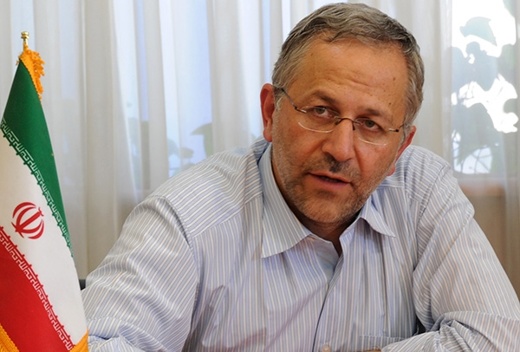
Hassan Qashqavi

“The Islamic Republic of Iran is prepared to waive visa [requirements] or facilitate the process of issuing visas for all countries, especially the neighbors, if they take similar action,” said Hassan Ghashghavi, Iranian Deputy Foreign Minister for Consular, Parliamentary and Iranian Expatriates’ Affairs.

Ghashghavi cited Kuwait as an example, saying that Iran is planning to annul visa requirements for Kuwaiti nationals as the Arab country no longer requires Iranian visitors to obtain visas.

The high-ranking Iranian diplomat, who was addressing a national conference on health tourism, said that Iran has nearly halved tariffs for issuing health visas compared to the fees charged for ordinary visas.

“…this shows Iran’s cooperation … to ease traveling to Iran for foreign nationals,” he said.

He noted that Iran is a safe destination for foreign tourists as there has been no report of any incident for foreigners visiting the country over the past few years.

Terrorism, violence in name of Islam reprehensible: Rouhani

Rouhani

“We condemn extremism, violence and terrorism whether in Palestine, Lebanon and the Levant or in Paris and the US,” Rouhani said in a meeting with the delegates to the Islamic Unity Conference in the Iranian capital, Tehran, on Friday.

“Those who are unrightfully killing people and carrying out acts of violence and extremism in the name of Jihad, religion or Islam are, wittingly or unwittingly, treading the path of [promoting] Islamophobia and [are actually] fighting against Islam,” he added.

Rouhani once again reaffirmed the Islamic Republic’s support for nations that stand up and resist terrorism.

“We are very happy that Muslim people in the region from Iraq, Syria, Lebanon and Palestine to Pakistan and Afghanistan resist extremism, violence and terrorism and achieve new victories on a daily basis,” the Iranian president stated.

Rouhani emphasized that Iran condemns any person who supports terrorism and violence whether in the regional countries or in Europe and the US.

The Iranian president’s remarks came after masked gunmen stormed the Paris headquarters of the satirical weekly, Charlie Hebdo, on Wednesday, gunning down a dozen people, including eight journalists, two police officers, a maintenance worker and a visitor.

A policewoman on Thursday also succumbed to injuries she sustained in a separate shooting in southern Paris.

On Friday, a shootout, followed by a hostage-taking at a kosher grocery shop northeast of Paris, left at least two people dead.

Tehran Friday prayer leader condemns France’s terror attack

Ahmad Khatami

The Friday prayer leader of Tehran Ayatollah Ahmad Khatami has strongly condemned Wednesday’s terrorist attack in Paris and said, “Islam does not approve of killing innocent people, whether in Paris, or in Syrian, Iraq, Yemen, Pakistan and Afghanistan. The following is the translation of part of Ayatollah Khatami’s sermon as reported by the Islamic Republic News Agency (IRNA) on January 9:

In comments aimed at Western powers, the Friday prayer leader said, “These terrorists are part of a problem of your own making. They live off the political support you and your allies lend them.”

He urged Western powers to quit mischief and said the approach the West has followed in the past decade – support for terrorists – leads nowhere and should be abandoned.

Ayatollah Khatami also criticized the Bahraini government for its heavy-handed tactics in dealing with the peaceful protests of its people.

Divisive moves linked to Western spy agencies: Leader

Supreme Leader

“The hands that sow discord among Shias and Sunnis are linked to the spy services of the enemies of Islam,” said the Leader in a meeting with the delegates to the Islamic Unity Conference underway in the Iranian capital, Tehran.

Ayatollah Khamenei noted that the Western-style leanings alleged to be Islamic, in fact, run counter to Islam.

“The [so-called] Shiism linked to the UK’s MI6 is not [real] Shia [Islam], nor is the [so-called] Sunnism which is the mercenary of America’s CIA [real] Sunni [Islam], but both are against Islam,” the Leader said.

The Leader further called on Muslim nations to close ranks and foster their unity.

Ayatollah Khamenei then noted that certain Middle East states which are pursuing a hostile approach vis-à-vis Iran have set foot in the wrong path.

“Some regional governments have based their foreign policy on enmity toward Iran; this is a big mistake and runs counter to common sense and wisdom,” the Leader said.

“On the contrary, Iran has based its policy on friendship with neighboring Muslim nations.”

Afghan media team visits refugees’ schools in Tehran

Afghan Students in Iran

A media delegation from Afghanistan on Wednesday paid a visit to the schools the Afghan refugees and nationals attend. Fars News Agency released photos of the Afghan team’s visit in Tehran on January 7. Take a look:


Iran, OPEC states pursuing sliding crude prices

Zangeneh-Iran oil minister

Iran and other members of the Organization of the Petroleum Exporting Countries (OPEC) are pursuing the issue of falling oil prices, says Iran’s oil minister.

“The issue of global oil prices is not that simple, but Iran and [other] OPEC members are following up the issue [of plummeting price],” Bijan Namdar Zanganeh told reporters on Wednesday.

He described plunging oil prices as complicated, saying that the issue is affected by both economic factors and political intentions.

A rise in the production of petroleum products could not help lower crude prices, Zanganeh added.

“Global oil supply and demand as well as products are all significant. More products will bring us further added value, but given the present circumstances, oil prices will not change. Nevertheless, the cost of petroleum products has fallen, too,” Zanganeh added.

On Wednesday, the price of Brent crude oil fell below $50 a barrel for the first time since May 2009. Meanwhile, the West Texas Intermediate crude has already fallen below $50.

Oil prices have plunged about 50 percent since June last year over increased supplies by certain countries such as Saudi Arabia, the largest OPEC producer, and slowing global economic growth.

Observers say that oil price could see further declines in the coming weeks as OPEC seems unlikely to do anything about over-output.

We need to get closer to religions through rationality

Iran-Larijani PUIC Troika must urgently meet on Gaza
Iran’s Majlis Speaker Ali Larijani

The speaker of the Islamic Consultative Assembly said that the group known as the Islamic State of Iraq and the Levant (ISIL) has been formed based on warmongering attitudes. Ali Larijani went on to say that the ISIL warlords are likely to be led by others, but the group members have their own ideologies and this shows that something serious and practical must be done. The top MP also underscored efforts to keep interfaith dialogue alive and a focus on commonalities as what is direly needed for peaceful coexistence.

Larijani made the remarks in a ceremony celebrating the birthday of Prophet Muhammad (Peace Be upon Him) and the graduation of students of the University of Religions and Denominations on Thursday in the central city of Qom. The following is the translation of his comments as reported by Fars News Agency on January 8:

Formation of a university which could focus – along with the seminary schools – on [different] religions and denominations was of great significance. Today we see that such a university is flourishing in Qom.

It is a must to delve deeply into religions and denominations from different angles. In the past, controversies arose in the East and West for which biased people waged wars against each other. Today we witness that ignorant prejudice against and improper attitudes toward religion have brought disgrace [on nations].

A look at this condition reveals that research into religions and denominations is highly essential. The current situation in the region has caused the potential of several Islamic countries to be wasted; only the US and Israel take advantage of this situation.

The ISIL group has emerged drawing on a warlike mentality, and their warlords seem likely to have been led by others. They have ideologies of their own and this shows serious scientific studies should be carried out.

Conflicts have given rise to multiple problems in the world of Islam. These conflicts have even been taken to their TV channels.

Religions have been practiced by a large population throughout the world. They share many questions and this is the potential which should not be ignored.

Where people are to be guided to is the centerpiece of a religious way of thinking. Commonalities [among various religions] should be highlighted, and peaceful coexistence – not division and discord – should be the core of [religious] principles.

Proximity with religions should be accompanied through a rational view. It should be noted that all religions have mystic views and orientations. Positive results will be produced if we pay due attention to mystic questions on top of rational matters.

Dialogue among religions should be kept alive. Socially speaking, today’s world is in need of interfaith dialogue, and the existing voids should be filled in this regard.

Points which we missed on ‘referendum’ proposal

Mehdi Fazaeli
Mehdi Fazaeli

Some comments by the president, including his remarks in a conference on the Iranian economy [on Sunday], evoke memories of those who created red herrings for any speech; the outsiders would take advantage of such marginal issues which would also ruin opportunities, wrote Mehdi Fazaeli, a former managing director of Fars News Agency (FNA) in an opinion piece in Jamejam daily. The following is the translation of the piece as reported by Fars News Agency on January 6:

The president’s recent remarks can be a topic for discussion, but the time is tight for addressing all issues surrounding it. In one part of his remarks which was on foreign policy and [nuclear] talks, the president said, “Threats, opportunities and common interests are the base of foreign policy, and principles and ideals are not up for discussion in foreign policy.”

The president further reiterated, “All talks intend to build a bridge between what the other party seeks and what we require. Our ideal is not tied to centrifuges; rather, it is tied to our heart and willpower.”

Apart from false reasoning, there is one clear point in his remarks: “Principles and ideals are not up for discussion in foreign policy.”

In the same conference, Mr. Rouhani pointed to the role and responsibility of the president in implementing the Constitution and somehow expressed regret for non-implementation of “referendum”! Let’s not deny the fact that referendum is a license, not a must, for certain questions, and the difference between the two is clear for experts.

The Constitution’s Article 59 reads, “In considering vital economic, political, social, and cultural issues, it is possible that the legislative power be exercised through referendum or reference to direct public vote. The request to appeal to public votes must be approved by two-thirds of the entire representatives of the Islamic Consultative Assembly.”

Careful attention should be devoted to the phrase “it is possible”, not ‘it is a must’! Moreover, the process to ratify a referendum has been clarified. But in the foreign policy which has been given a separate chapter (Chapter Ten) in the Constitution due to its importance, it is not a matter of “it is possible”, “it can be” and the like; rather, the phrases are completely clear and imperative in order to remove any ambiguity and [possible] ifs and buts.

Read over three, out of four, articles on foreign policy. (The fourth article is on asylum seeking and is irrelevant here).

Article 152 reads, “The foreign policy of the Islamic Republic of Iran is based on the rejection of any kind of domination, both its exercise and submission to it; the preservation of the all-inclusive independence of the country and its territorial integrity; the defense of the rights of all Muslims; non-alignment in relation to the domineering powers; mutual peaceful relations with nonaggressive states.”

We read in Article 153, “Any form of agreement that would result in foreign domination over the natural and economic resources, foreign domination over culture, the army, and other affairs of the country, is forbidden.”

And finally Article 154, which has pointed to the “ideal” – in the foreign policy chapter – says, “The Islamic Republic of Iran considers human happiness throughout human society as its ideal. It considers independence, freedom, and the governance of justice and truth as the right of all the people of the world. Consequently, while it completely abstains from any kind of intervention in the internal affairs of other nations, it supports the struggles of the oppressed for their rights against the oppressors anywhere in the world.”

Now we want to put this question to the president: What do you think about ‘the rejection of any kind of domination, both its exercise and submission to it; the preservation of the all-inclusive independence of the country, non-alignment in relation to the domineering powers, and prevention of any form of agreement that would result in foreign domination, etc.’? Are they interests or ideals? We think they are ideals and believe that the interests of the Islamic Republic have been intertwined with these ideals, with the benefit of the hindsight.

Should attention to these issues be just in our mind and heart, or we should be careful about them at the negotiating table? When talks possibly result in submission to domination or [foreign] domination over the natural and economic resources, culture, the army, and other affairs of the country, is it possible to claim that the country’s interests have been maintained?

“Sometimes” in foreign policy we face “conditions” in which the smallest retreat, even when it is as small as [decommissioning] one single centrifuge, can be a perfect example of submission to domination, and at other times the shutdown of the entire enrichment [program] has no similar meaning. Whether “sometimes” applies to our status today or how the conditions are is a separate, overarching issue which I am not to get into here.

Today we take pride in the fact that not one single meter of the Islamic Republic of Iran’s soil remained under the enemy’s occupation during the Sacred Defense, and hundreds of soldiers fell to prevent such a thing from happening. Drawing on such logic, isn’t it possible not to sustain human losses and allow some areas remain under the enemy’s occupation and say that the country’s territorial integrity is not compromised with one border city?

The president has sworn to God Almighty before the Iranian nation to safeguard the Constitution, an oath he is obliged to make good on, an oath which comes with legal and religious duties once the president takes it.

Mr. Rouhani, you need to be watchful of your advisors!

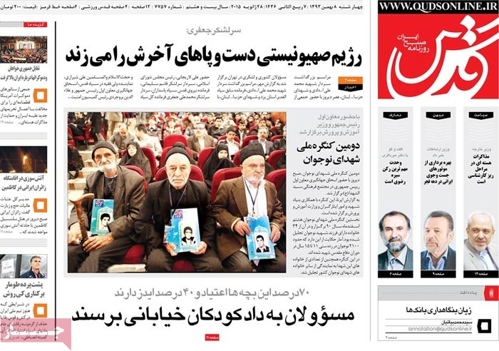
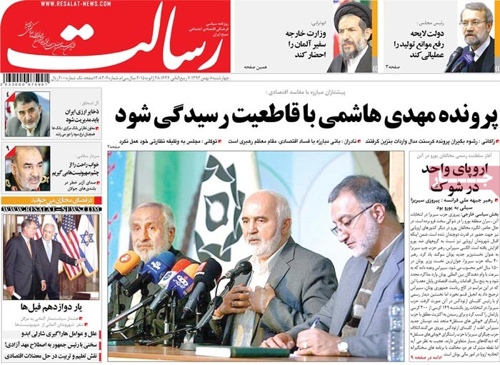
A look at Iranian newspaper front pages on Jan. 8

Iranian Newspapers Headlines

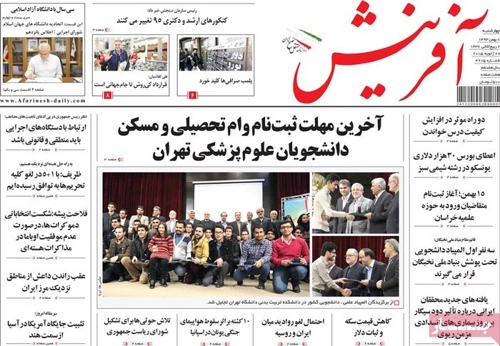
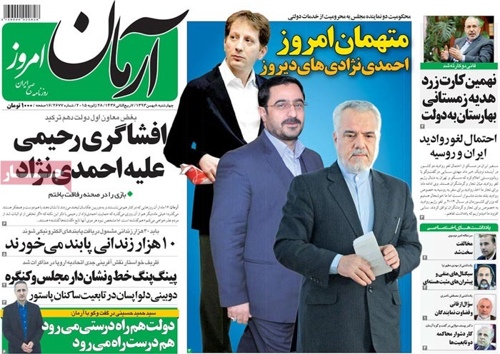
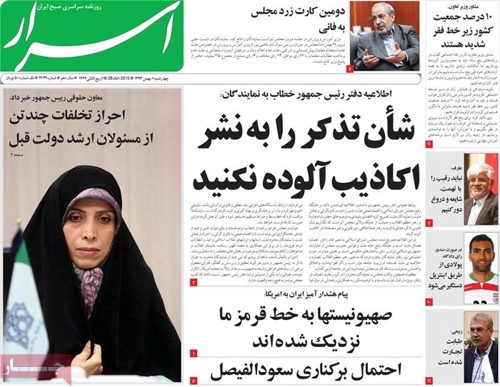
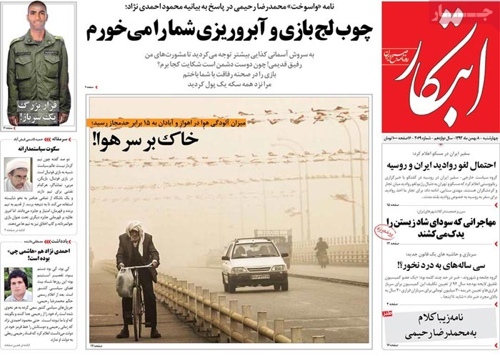
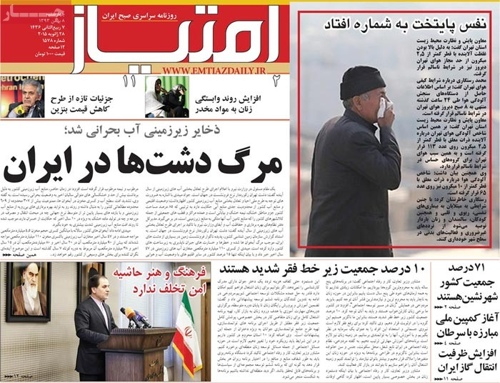
The comments of the Supreme Leader about important issues such as national unity and nuclear talks dominated the front pages of the Iranian dailies on Thursday. The president’s remarks at an Islamic Unity conference in Tehran also made front-page headlines. Last but not least, the deadly terrorist attack in Paris that claimed 12 lives appeared on the cover of almost every newspaper.


Abrar Eghtesadi: Parliament has rejected a government plan to keep unchanged the National Development Fund’s share of oil revenues.


Abrar eghtesadi newspaper 1- 8


Aftab-e Yazd: The Law Enforcement Force has urged promoters of virtue to talk softly to the public.

Aftab-e Yazd: Oil prices dropped by as much as $3 in a single day.


Aftabe yazd newspaper 1- 8


Arman-e Emrooz: “I am not against talks. Everyone should help the government. Creation of division is against our ideals and national interests,” said the Supreme Leader.

Arman-e Emrooz: “Laws can be changed,” is what Chairman of the Expediency Council Akbar Hashemi Rafsanjani thinks of referendum.


Armane emruz newspaper 1- 8


Ebtekar: “Floating the idea of holding a referendum is not illegal,” said the government spokesman.


Ebtekar newspaper1- 8


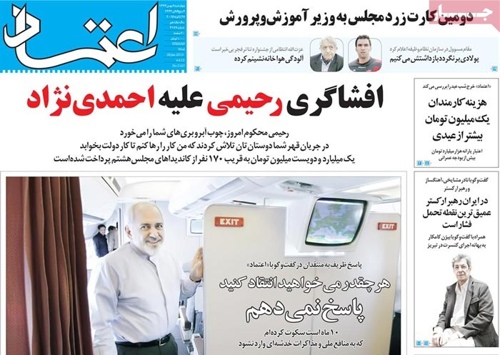
Etemad: There are conflicting reports about messaging and phone apps LINE, WhatsApp, and Tango being blocked.

Etemad: Black Wednesday in Paris. Gunmen stormed the offices of Charlie Hebdo satirical weekly in Paris, killing 12 people and wounding five others.


Etemad newspaper 1- 8


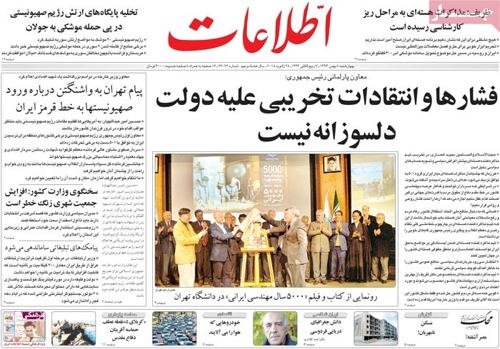
Ettela’at: “Recognition of each other and tolerance are the requirements of unity,” President Rouhani told an Islamic Unity Conference in Tehran.


Ettelaat newspaper 1- 8


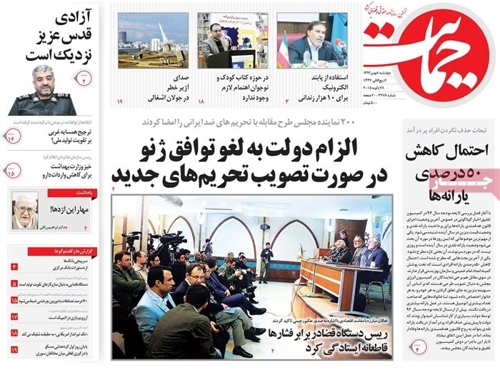
Hemayat: “Tying the country’s economy to nuclear talks is the same as reassuring the enemy,” said Judiciary Chief Ayatollah Sadegh Amoli Larijani.


Hemayat newspaper 1- 8


Iran: Terrorists staged a bloody show in Paris, killing 12 people.

Iran: The government spokesman has said it is shameful that some have insulted the president following his call for a referendum on major issues.


Iran newspaper 1- 8


Javan: “American companies have expressed readiness to screen Muhammad, the Messenger of Allah,” said Majid Majidi the director of the movie which will premiere at the 33rd Fajr International Film Festival later this year.


Javan newspaper 1- 8


Kaenat: “We unanimously condemn insults being hurled at religious sanctities,” said President Rouhani.


Kaenaat newspaper 1- 8


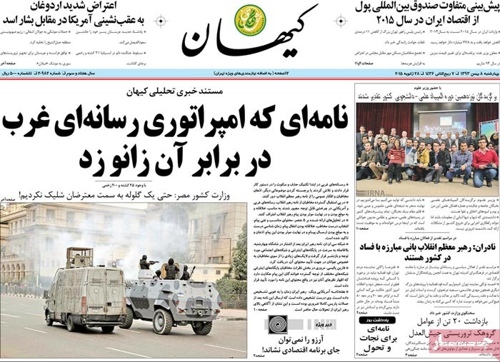
Kayhan: “If you take one step back, the enemy will target our ideals,” the Supreme Leader said in comments aimed at Iranian statesmen.


Kayhan newspaper 1- 8


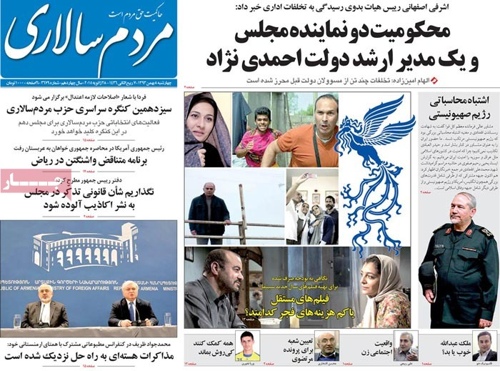
Mardomsalari: “A report on acid attacks has been handed to President Rouhani,” said the vice-president for women and family affairs.


Mardom salari newspaper 1- 8


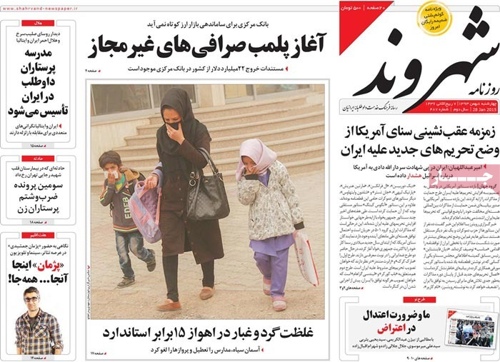
Shahrvand: President Rouhani has named Dr. Amir Mohsen Ziaei as the director of the Iranian Red Crescent Society.


Shahrvand newspaper 1- 8


Taadol: “You should take the weapon of sanctions away from the enemy,” the Supreme Leader said in a statement aimed at statesmen.


Taadol newspaper 1- 8


Change in US Congress won’t affect Iran’s nuclear stance

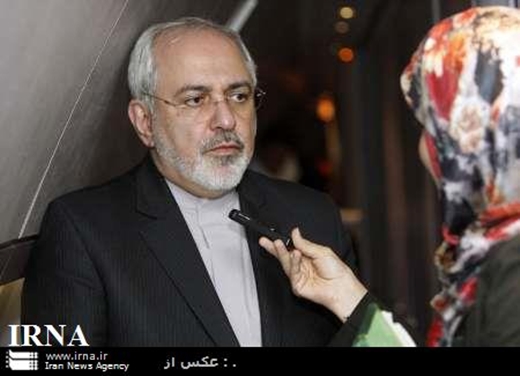
ZArif

Iran’s foreign minister says that the recent changes in the US Congress will have no impact on Tehran’s stance in the nuclear talks with P5+1.

“The changes have no impact on us,” Mohammad Javad Zarif said in an interview with Iran’s parliament news service, ICANA.

Zarif added that he thinks it is possible to reach a final nuclear deal with P5+1 within a short period of time. However, he added that for this to happen, the other negotiating side should abandon its excuses and does not try to prolong talks over Iran’s nuclear program.

“I have always believed that the possibility exists for reaching the agreement in a short period [of time],” Zarif said in the interview, which was published on Wednesday, adding, “… if the other side does not seek excuses and does not prolong the job, there is the possibility of reaching an understanding.”

Zarif also denied a recent report by the Associated Press that Iran has allegedly accepted to transfer some of its enriched uranium outside of the country, describing the report as “rumors and fake news.”

He also said certain achievements have been made in the talks after the last round of negotiations with 5+1 in Vienna this past November. However, Zarif emphasized that those achievements cannot be made public before they are complete.