Tuesday, January 20, 2026
Home Blog Page 4954

Iran, Belarus agree to expand bilateral ties

Iran-Belarus-FMs

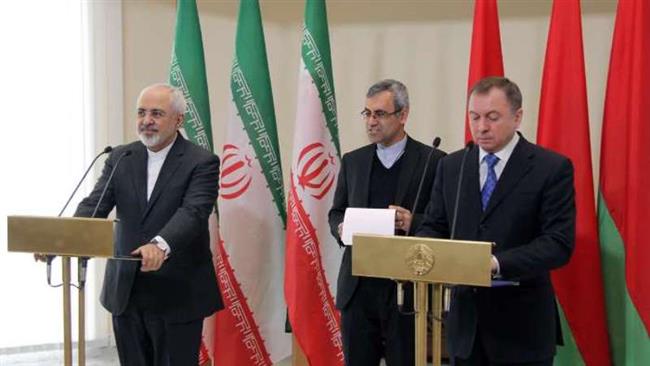
Iran’s Foreign Minister Mohammad Javad Zarif visited the Belarusian capital Minsk on Tuesday, setting store by the bilateral ties.

“We enjoy good relations with Belarus in the political, cultural, and economic areas, and we agreed today to expand and deepen these ties through the visit by Mr. Alexander Lukashenko, the president of Belarus, to Tehran, which will take place in near future,” Zarif said.

During the visit, the Iranian foreign minister inaugurated the new building of Iran’s embassy in the city during a ceremony, which was also attended by his Belarusian counterpart Vladimir Makei and other countries’ ambassadors.

Zarif said Iran’s policy is based on having friendly relations and constructive interaction with all countries in the world.

“The Islamic Republic of Iran extends the hand of cooperation and constructive and beneficial relation to all countries in the world,” said Zarif.

The Belarusian foreign minister stated, “The two countries mutually try to expand bilateral relations and support each other in the political arena; we will continue to do so in the future.”

During the visit, Zarif also met with the former Belarusian prime minister and speaker of the upper house of parliament, Mikhail Myasnikovich, who expressed readiness for the extension of parliamentary cooperation with Iran.

Exclusion of love from teenage literary books is alarming

Love

“In a society where one cannot write freely about love, writings will be tinged with violence, and affection and friendship will be replaced with hatred and spite,” Iranian novelist Farhad Hassanzadeh said.

What comes below is the translation of his comments about the concept of love and its necessary presence in teenage literary works as posted by the Iranian Students News Agency on February 16:

Love is an emotion which promotes traction and diligence. This feeling takes on different nuances at different stages of life, though. During childhood, it attracts the individual to their parents and family at large. In teen years, one is attracted to members of the opposite sex which mostly manifests itself in emotional contacts and attempts to overcome fear and loneliness. Throughout other stages in life, love becomes part of our behavior.

However you look at it, this feeling cannot be overlooked or obliterated by a morality eraser. Children need love as much as they need to frolic and be joyful. The reflection of love in literature helps them be seen and appreciated.

The elimination of this concept from teenage literary books, however, will drive a wedge between them and books. This feeling is part of their character and they want to learn more about it, so it would be much better for us to satisfy their curiosity, answer their questions and avoid burying our heads in the sand.

One of the reasons Iranian novels do not appeal much to our teenagers and they find foreign novels more intriguing is the failure in our books to pay attention to the matters that teenagers are interested in. In spite of all limitations, in translated novels, there is still a trace of close relationships and examples of characters who display love and affection.

Teenagers are clueless about the restrictions and censorship that authors are subject to and keep asking us to pen books which revolve around the concept of love. They think we do not understand them, whereas the problem lies somewhere else.

Of course such restrictions are not confined to books; they apply to our publications too which are subject to stricter regulations. I raised this concept in my novels “Bambak’s Scorpions” and “This Weblog for Sale”. In my opinion, a good novel covers a series of concepts; philosophy, history, satire and love are among the factors that contribute to the appeal of literature and leave a profound impact on the world of readers.

In my works, I try to juxtapose such concepts with each other in a way that leaves them less exposed to censorship. Thus teenagers can enjoy them more.

In spite of all the tricks I employ, censorship comes back to haunt me. For instance, before the publication of the two books I just mentioned, I was asked to cross out some sections.

Unfortunately, a majority of book censors think that love is merely about eroticism. As long as such viewpoints persist, we cannot expect the release of story books in which teenagers can see a reflection of their own characters. We should not think or decide on behalf of teenagers. We should value their pure thoughts and help them ride out the turbulent era of adolescence.

Sanctions against Iran benefit drug trafficking and terrorism

Rahmani_Fazli

The Islamic Republic News Agency quoted Secretary General of the Drugs Control Headquarters Abdolreza Rahmani Fazli as telling journalists on February 16 that in the war on narcotics, the international community has not provided Iran with enough financial aid.

Taking a swipe at the failure of the world community to give Iran technical equipment under the pretext of West-slapped sanctions, he urged the world to be wary of the growing threat of terrorism and drug trafficking.
Underlining the alarming shift in drug consumption patterns, with a mounting trend for chemical narcotics, he said, “In the fight against chemical narcotics, good decisions have been made in Iran and a ban has been imposed on imports of a large number of precursors.”

As for a list of technical equipment Iran has submitted to the United Nations, Rahmani Fazil said, “If items on the list meet UN criteria, the world body will ship the equipment to us.”

He went on to say, “In my opinion, sanctions are simply an excuse, the aid we have been offered, especially in terms of finances and equipment, is not effective.”

Rahmani Fazli added, “In a report presented by Executive Director of the United Nations Office on Drugs and Crime (UNODC) Yuri Fedotov, Iran’s measures have been hailed as remarkable.”

He further said, “There is a direct relation between narcotics and money laundered by drug traffickers and terrorists. If one draws an analogy between the terrorism map of the world and that of drug trafficking, it will dawn on them that they overlap, because drug trafficking is a major source of funding terrorist activities.”
He concluded, “Over the past five years, the geography of terrorism has spread to the heart of Europe and the world must be alert to the major threat of terrorism and drug trafficking.”

The rights of Mother Nature are now recognized: Environment chief

Khuzestan-Water

Director of the Environment Protection Organization (EPO) Masoumeh Ebtekar has said the budget her agency receives to protect lagoons and fundamentally deal with the problem of particulates is meager as compared with dam-building budget, appealing to parliament to raise the amount of money it allocates to the EPO.

In an interview that appeared in the February 17 issue of Iran, a state-run newspaper, the environment chief said according to an old line of thinking, in allocation of water resources, drinking water should be given priority.

“Next on the list of priorities come agriculture and industry which have to do with the living and employment of citizens. If there is anything left, which according to experience is usually too insignificant, if not nothing, it is allocated to nature,” she added.

Ebtekar went on to say, “The hydrology cycle should remain in place for humans to have access to water. That nature should be given a share has now been recognized as indispensible and the change in official policy on nature is very important.”

She further said the role of locals in areas affected by environmental crises is of great importance, adding the budget her agency is offered to focus on building the culture of optimized water use and better exploitation of natural resources is not enough.

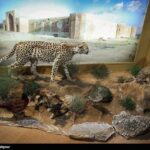
Mating of leopards captured on camera

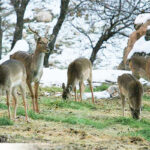
Persian Leopard-1

In late January, Ali Seifoddin, an Iranian wildlife photographer and documentary maker, filmed Bardiya, one of two Persian leopards fitted with GPS tracking neckbands, mating in Tandooreh National Park.

A 20-minute wildlife documentary of what he has caught on camera will be released soon.

Borna, and Bardiya [two male Persian leopards which are estimated to be 4-6 years old and 8-10 years old respectively] were captured alive and equipped with GPS tracking neckbands in the national park in northeastern Iran in late September.

The following is a photo gallery that the news website of Iran Environment and Wildlife posted online on February 16:


Municipality should not pick up the tab for efforts to undermine the government

Mohsen Sarkhou

A member of Tehran City Council has criticized the Municipality’s Basij Unit for what he says is undermining the government and nuclear negotiators. The following is a partial translation of Mohsen Sarkhou’s remarks as reported by the Iranian Labor News Agency (ILNA) on February 16:

He said distribution by Tehran Municipality’s Basij Unit of placards during the February 11 rallies [marking the Islamic Revolution’s victory] – which read “A shameful agreement brings disgrace on the nation” – was aimed at weakening the government and Iran’s nuclear negotiating team, adding the municipality’s budget doesn’t allow for financing such measures.

He said there’s no doubt that the US has always shown animosity toward the Iranian nation, but such issues shouldn’t be used as a pretext to weaken the government and its negotiating team.

Such measures are against the Supreme Leader’s viewpoints, and the municipality’s budget shouldn’t be wasted, he said.

Insulting the government runs counter to the principles of the Islamic Republic, national interests and the Leader’s viewpoints, Sarkhou said, adding violators should be held accountable.

On reports that people have thanked the council for the placards, he said the thankers are likely to have been the contractors who have charged the municipality heftily for the placards.

A look at Iranian newspaper front pages on Feb. 17

Iranian Newspapers Headlines

The comments of the Supreme Leader at a meeting with religious minority MPs dominated the front pages of Iranian newspapers on Tuesday. At the meeting the Supreme Leader said, “Islam has taught the faithful to treat the followers of other religions fairly.” A news conference of the judiciary spokesman in which issues related to former presidents Ahmadinejad and Khatami were brought up also appeared on the covers of dailies.


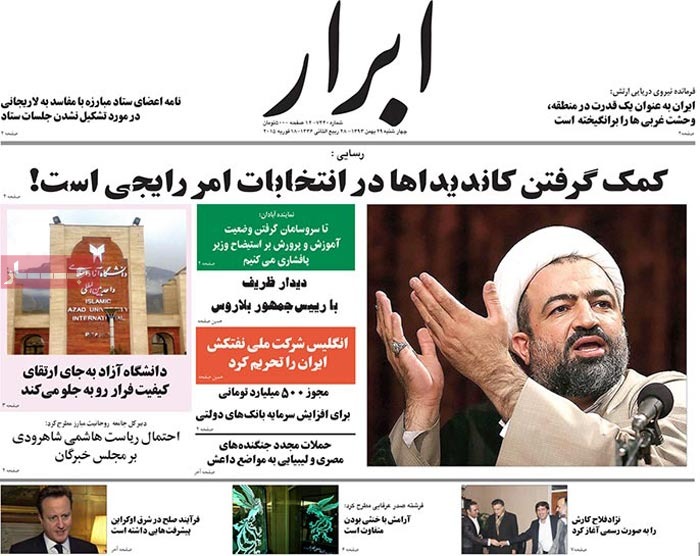
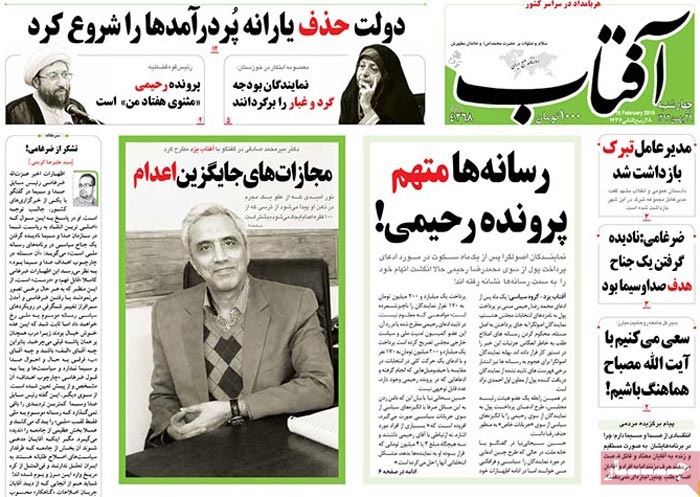
Abrar: “A ruling in the case of Mehdi Hashemi [a son of Ayatollah Hashemi Rafsanjani] will be issued soon,” said the judiciary spokesman.


A look at Iranian newspaper front pages on Feb. 17


Abrar-e Eghtesadi: Iran and Iraq have signed 10 cooperation agreements.


A look at Iranian newspaper front pages on Feb. 17


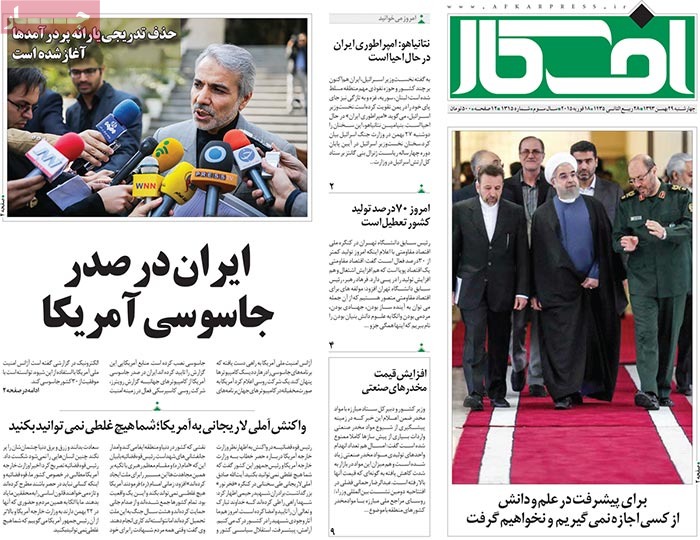
Afkar: “The Oil Ministry won’t have money to invest in the petroleum sector next year,” said the oil minister.

Afkar: “Those who have supported IS are now beset [by the terrorist grouping],” said the Iranian first vice-president on a visit to Iraq.


A look at Iranian newspaper front pages on Feb. 17


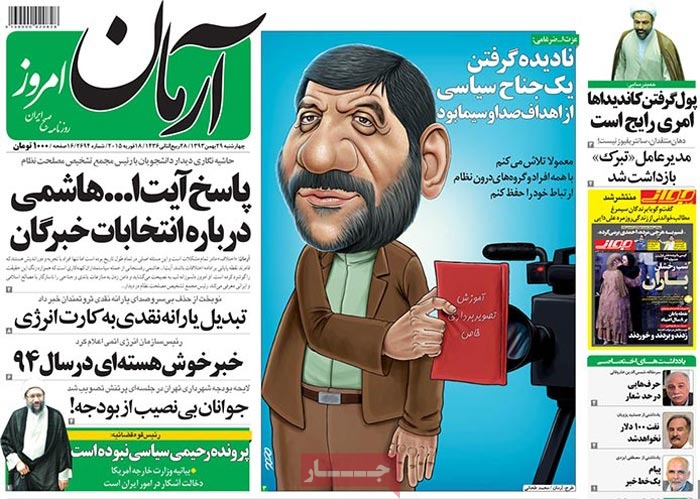
Arman-e Emrooz: “In Iran aggression toward non-Muslims is unprecedented,” said the Supreme Leader.

Arman-e Emrooz: “Five judges have been found incompetent to sit on the bench,” said the judiciary spokesman.


A look at Iranian newspaper front pages on Feb. 17


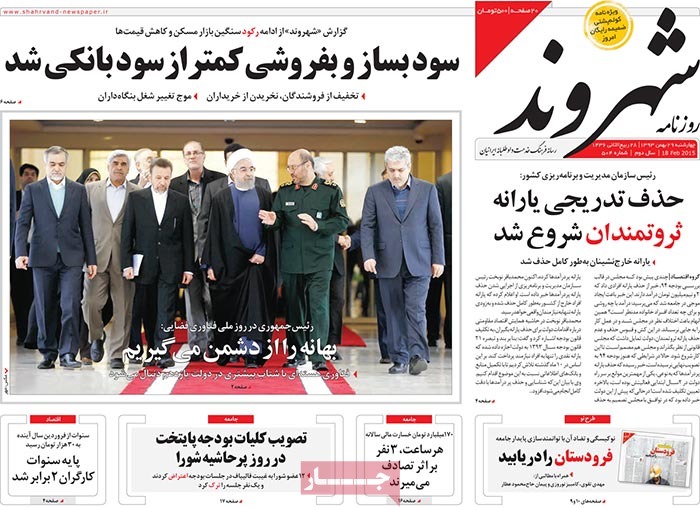
Ebtekar: Gasoline prices will increase five percent as of next year [starts March 21, 2015].


A look at Iranian newspaper front pages on Feb. 17


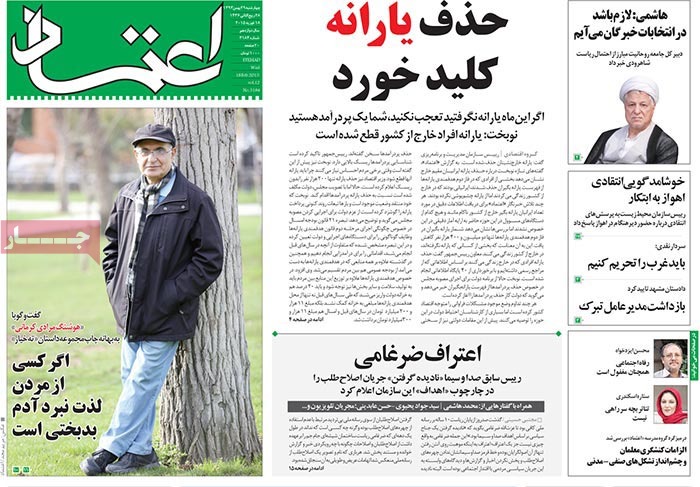
Etemad: In a press conference the judiciary spokesman has talked about legal cases and bans.

“[Former First Vice-President Mohammad Reza] Rahimi was convicted of bribery; the case involving former President Mahmoud Ahmadinejad is under investigation. Media are not allowed to release news on former President [Mohammad Khatami]. A verdict in the case of Mehdi Hashemi will be issued shortly. Five judges have been disbarred,” Gholamhossein Mohseni Ejei said.

Etemad: “Because of the social policies of the previous government, the number of families who live below the poverty line tripled,” said a former welfare minister.


A look at Iranian newspaper front pages on Feb. 17


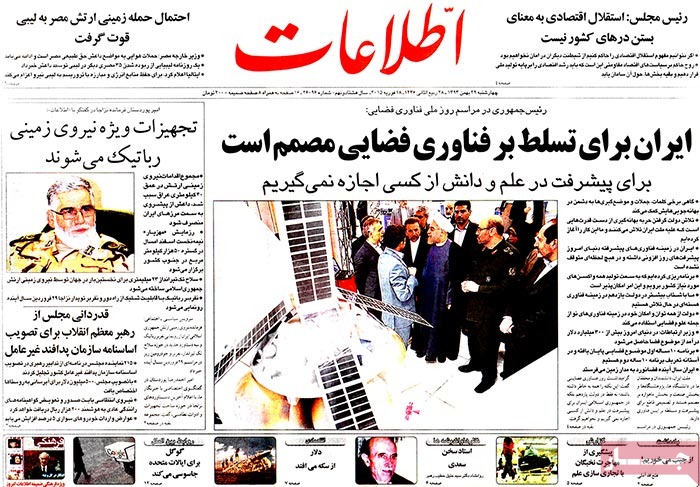
Ettela’at: “The world has to live with the Iranian nuclear progress,” said the director of the Atomic Energy Organization.

“We have found ways to ease the groundless concerns of the West. At the same time these solutions guarantee the nuclear rights of the Iranians. Nuclear talks are close to their final stages. During the negotiations the West has found out that continued pressures, including sanctions, won’t work in dealing with Iran. In less than two months a few new achievements of the nuclear industry will be unveiled,” said Ali Akbar Salehi in an exclusive interview with the daily.

Ettela’at: “The sufferings of the people should not be used for political gains,” said the director of the Environment Protection Organization (EPO).

Masoumeh Ebtekar further said her agency is not involved in factional politics and that several EPO experts working to ease the harmful effects of dust storms come from a faction that does not see eye to eye with the government.

She added the Iraqi government has drawn up a plan to counter the problem of particulates and agreements have been signed to that end with Iran. Because of security reasons, though, those plans cannot be implemented.

Ettela’at: A specialty hospital is to be built in Qom for the clergymen.

Ettela’at: A ceremony has been held at the Association for the Appreciation of Cultural Works and Dignitaries to honor the memory of former First Vice-President Hassan Habibi.


A look at Iranian newspaper front pages on Feb. 17


Hemayat: “Muslims in Europe and America are not safe,” said the Supreme Leader at a meeting with MPs representing religious minorities in parliament.


A look at Iranian newspaper front pages on Feb. 17


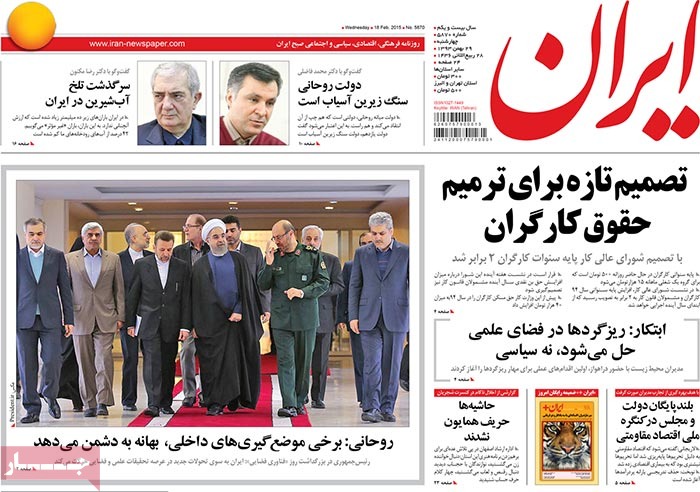
Iran: Eight members of the Rouhani Cabinet are in Baghdad to talk trade and find a way to tackle the problem of particulates [crippling several towns in southwestern Iran].


A look at Iranian newspaper front pages on Feb. 17


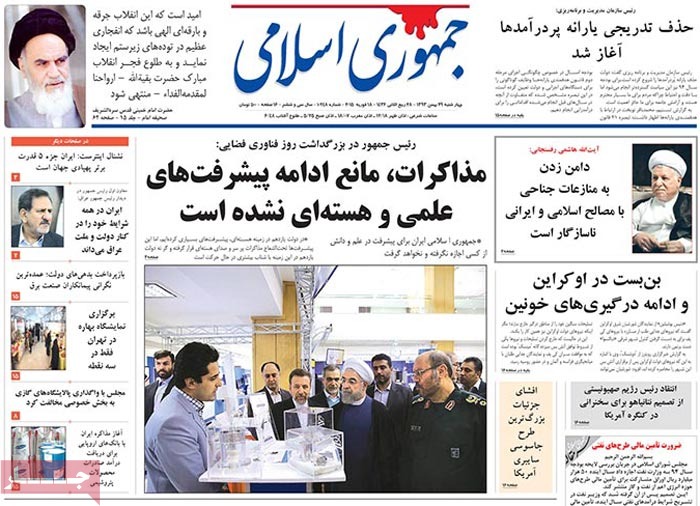
Jomhouri Islami: The executive director of UNODC has said Iran has been the most successful country in the fight against drugs.


A look at Iranian newspaper front pages on Feb. 17


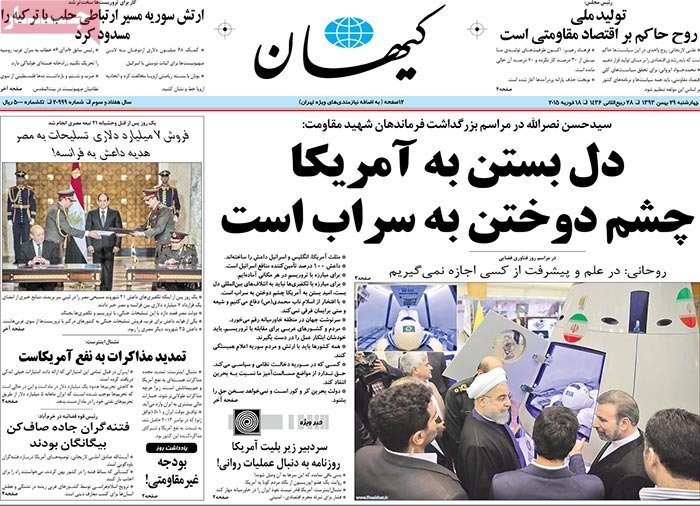
Kayhan: “The volume of trade between Iran and China is to hit $200 billion,” said the Chinese foreign minister at a meeting with an adviser to the Supreme Leader.

Kayhan: Following the publication of an exposé by Kayhan, a planned New Year Antalya tour for some of the Education Ministry personnel has been called off.


A look at Iranian newspaper front pages on Feb. 17


Mardomsalari: “Iran is ready to help Afghanistan introduce an alternative crop,” said the Iranian interior minister.


A look at Iranian newspaper front pages on Feb. 17


Qods: Iran’s new UN ambassador has said that Tehran will exhaust every avenue to have the sanctions lifted.


A look at Iranian newspaper front pages on Feb. 17


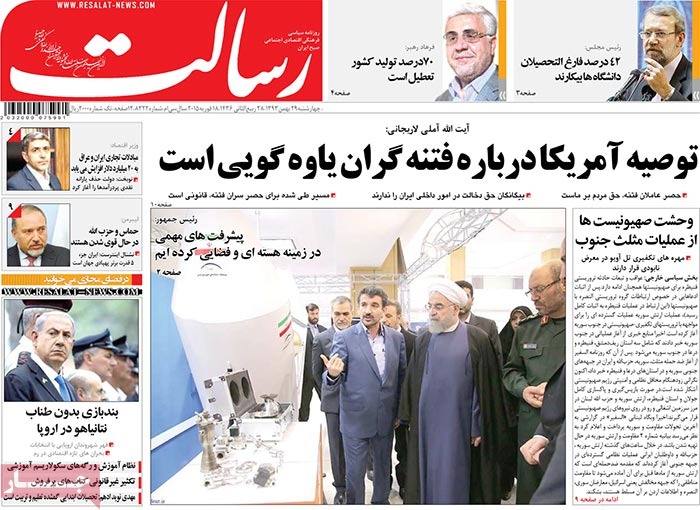
Resalat: “Drawing a line between general outlines and details [of a nuclear deal] is a colonial plot,” said Velayati, an adviser to the Supreme Leader.

Resalat: “Present MPs are not on the list of individuals who have received money from Rahimi [a convicted former VP],” said the judiciary spokesman.


A look at Iranian newspaper front pages on Feb. 17


Taadol: Iran and Iraq have signed a deal in Baghdad to settle the problem of particulates.


A look at Iranian newspaper front pages on Feb. 17


Islam urges justice, fairness toward non-Muslims: Ayatollah Khamenei

Supreme Leader

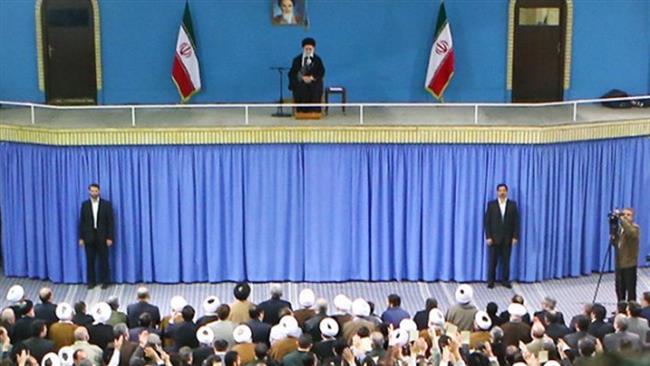
“What is seen in the world today is that powers and governments which claim to [advocate] fairness and justice do not observe any fairness and justice except within the bounds of their narrow, limited and cruel policies,” Ayatollah Khamenei said in a meeting with representatives of religious minorities in Iran’s Parliament (Majlis).

The Leader pointed to the propaganda campaign against Muslims in Europe and the US and said, “What is at issue is not why the Muslims do not have the necessary freedom in most of these countries, but why the Muslims do not have any [sense of] physical safety.”

Ayatollah Khamenei cited the Hollywood film, American Sniper, as an example and said it encourages Christian or non-Muslim youngsters to harass the Muslims as much as possible.

The Muslim faith does not accept this approach, the Leader said, adding, “Islam believes in fairness.”

Ayatollah Khamenei stated that Imam Ali, the first Imam of the Shias, has said a Muslim would not be blamed if they die of sadness over the harassment of a non-Muslim in a Muslim country.

If a Muslim dies of this sadness, that person has died for the right cause, the Leader pointed out.

The Leader said young neo-Nazis have on several occasions beaten up and killed Muslims and damaged mosques with impunity.

Ayatollah Khamenei cited the instance of young Arab Muslim girls who have been beaten up or even killed because of their hijab and nobody even bothered to investigate the issue.

The Leader added that similar cases also exist in other countries which claim to defend human rights, including the US.

Ayatollah Khamenei said after the victory of the Islamic Revolution

VP: Eliminating polluting particles calls for multilateral cooperation

Jahangiri-Iran

First Vice President Eshagh Jahangiri said the fight against polluting particles calls for multi-national cooperation.

Talking to IRNA after his meeting with the Iraqi parliament Speaker Salim al-Jabouri, he said the problem of particulates is a major issue at the center of Iran’s attention.

He said Iran, Iraq, Syria, Saudi Arabia and Turkey have to cooperate in this particular field.

He said in his talks with the Iraqi premier too he focused on the issue among other topics.

The Iranian First Vice President further stressed that particulates were initially originated outside the country, particularly in Saudi Arabia.

He said that according to an agreement signed between Iran and Iraq, the two countries are to carry out joint measures to stop spread of polluting particles.

Jahangiri, who arrived in Baghdad on Monday at the top of a high-ranking delegation to participate in the Supreme Joint Iran-Iraq Commission, met with Al-Jabouri and the heads of various fractions at the Iraqi Parliament.

Iran, Azerbaijan FMs explore Nagorno-Karabakh disputes

Iran Azerbaijan

Iranian Foreign Minister Mohammad Javad Zarif and his Azeri counterpart Elmar Mammadyarov discussed Nagorno-Karabakh conflict as well as ways to fight terrorism.

“We discussed battling terrorism. We also explored peace process on Nagorno-Karabakh, but so far no progress has been made on the issue,” Mammadyarov said after a meeting with Zarif in Baku.

He also called Iran-Azerbaijan ties ‘historic’, and reiterated that the two sides need to keep brotherly ties.

Zarif, for his part, said Tehran attaches great importance to relations with neighboring states, especially with Azerbaijan.

“One hundred kilometers of Iranian borders lie in the disputed Nagorno-Karabakh region, and Iran is seeking a peaceful solution to end the dispute through international law. We call for establishment of peace and stability in neighboring countries which are of great importance. Azerbaijan is the most important neighbor for Iran. We are so close to the country, and the conflict can also harm us. Iran has so far worked with Azerbaijan to resolve the dispute,” said Zarif.

The two ex-Soviet Caucasus nations claim the territory of Nagorno-Karabakh, which is located in Azerbaijan but largely populated by Armenians.

Ethnic Armenian forces took control of the enclave, which accounts for 16 percent of Azerbaijan territory, in the early 1990s during a six-year war that took place from February 1988 to May 1994. The conflict left an estimated 30,000 people dead and one million displaced before the two sides agreed to a ceasefire in 1994. A permanent peace accord has never been inked and the dispute still remains unsettled.

Azerbaijan has threatened to take back the region by force if negotiations between the two sides fail to yield results.