Tuesday, January 20, 2026
Home Blog Page 4953

A 4,200-year-old Zoroastrian grave found in northeastern Iran

4200-year-old Zoroastrian grave

Deputy Director of the Cultural Heritage, Handicrafts and Tourism Organization Ali Akbar Vahdati said that a Zoroastrian grave as old as 4,200 years has been discovered at the northeastern heights of Bojnourd in North Khorasan Province.

What comes next is a partial translation of a February 15 report the Islamic Republic News Agency filed on the find:

Vahdati said, “The discovery of the grave was made in 2012 during a project to build a park in Bojnourd. Back then the public announcement was put on hold so that further archeological examinations could be carried out. Unfortunately, operations by heavy machinery caused some damage to the skeleton and the vessels buried together with it in the grave.”

He further said that a bone sample from the skeleton was sent to a laboratory for DNA tests and studies on the vessels and the grave revealed signs of the Iranian civilization and Zoroastrianism in the region.

The ash found in the grave and the skeleton of a dog in an adjacent burial plot are indicative of Zoroastrian burial rites.

Vahdati added, “Further studies on the finds and the region suggest that there was an ancient cemetery in the suburbs of Bojnourd, an indication that back then some people took up residence in the Bojnourd Plain. The studies also confirmed that there has been a close cultural relation between the northern and southern parts of the Kopet Dag [a mountain range on the frontier between Turkmenistan and Iran’s North Khorasan Province] since 4,200 years ago.”

He went on to say, “The examination has revealed that there is a close resemblance between the finds in this region with those excavated in a hill in Turkmenistan’s Merv, suggesting that Zoroastrianism is older than it was previously thought.”

Vahdati added, “Although researchers and archeologists initially believed that people started taking up residence in the Bojnourd Plain during the Islamic Age, the recent evidence reveals that Persian tribes established residence in Bojnourd at least 4,200 years ago.”

A look at Iranian newspaper front pages on Feb. 19

Iranian Newspapers Headlines

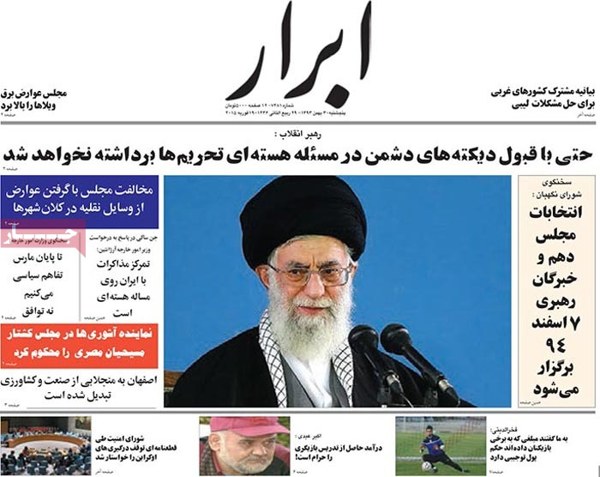
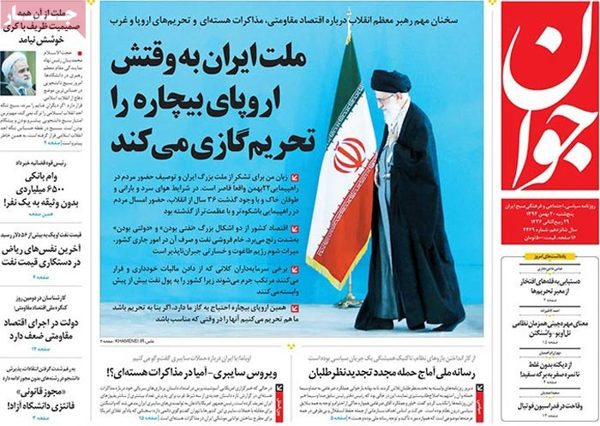
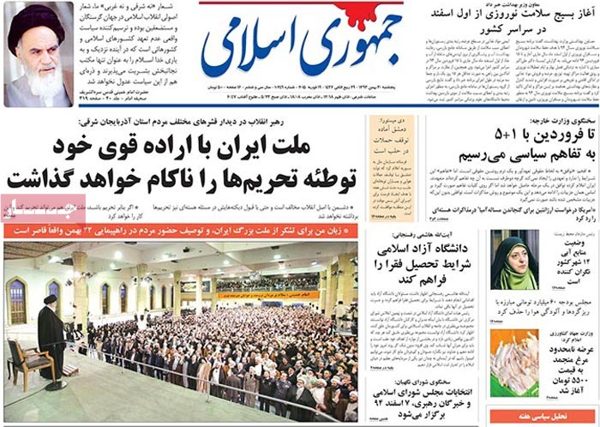
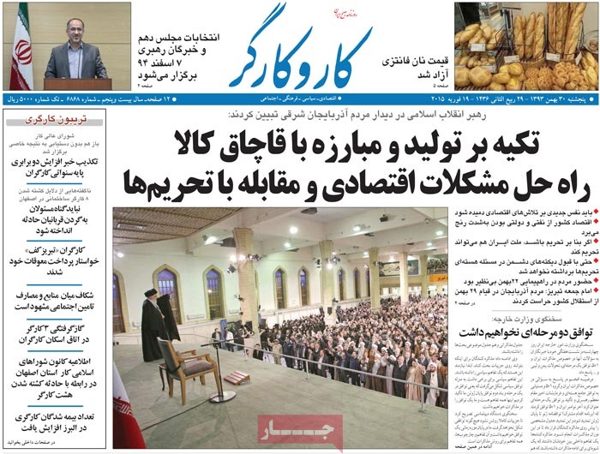
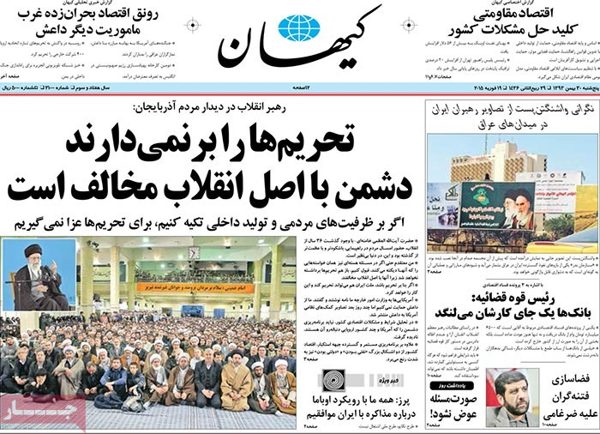
Comments by the Supreme Leader that if Europe imposes new sanctions on Iran, Tehran will retaliate and slap sanctions on Europe too dominated the front pages of Iranian newspapers on Thursday. Reformist-leaning papers put on their covers the news of parliament’s failure to allocate budget to efforts to tackle the problem of particulates.


Abrar: “Parliamentary and Assembly of Experts elections will be held on Feb. 26, 2016,” said the spokesman of the Guardian Council.

Abrar: Parliament has opposed plans to levy tariffs on cars in metropolises.

Abrar newspaper 2 - 19 - 2015


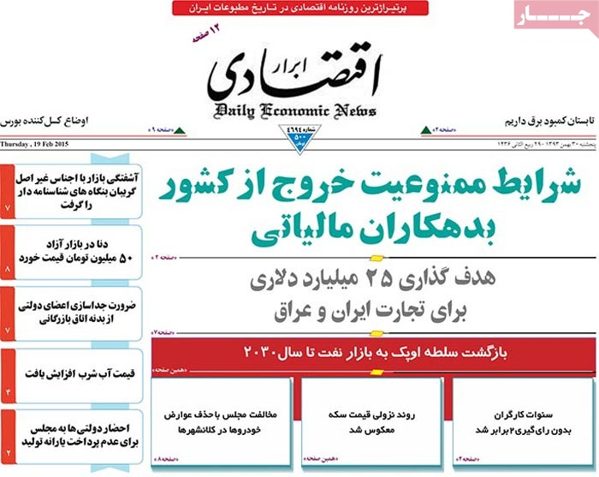
Abrar-e Eghtesadi: Iran and Iraq aim to increase the volume of their bilateral trade to $25 billion.


Abrare eghtesadi newspaper 2 - 19 - 2015


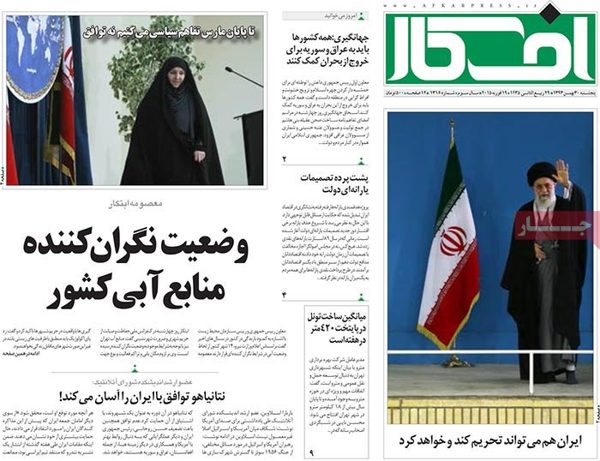
Afkar: “The country’s water resources are in an alarming condition,” said the director of the Environment Protection Organization.


Afkar newspaper 2 - 19 - 2015


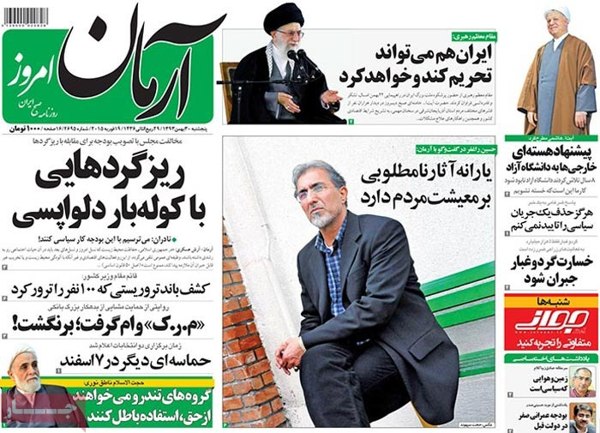
Arman-e Emrooz: Parliament has refused to allocate budget to efforts to fight particulates.

Elyas Naderan [a principlist MP] has said: We fear the budget might be used for political purposes!


Armane emruz newspaper 2 - 19 - 2015


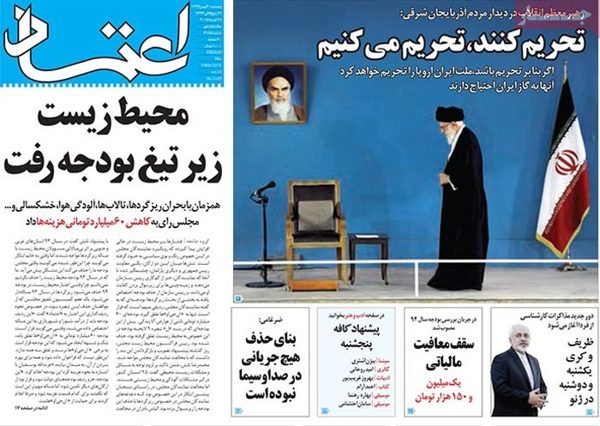
Etemad: Zarif and Kerry in Geneva on Sunday and Monday

A new round of expert talks will get underway tomorrow.


Etemad newspaper 2 - 19 - 2015


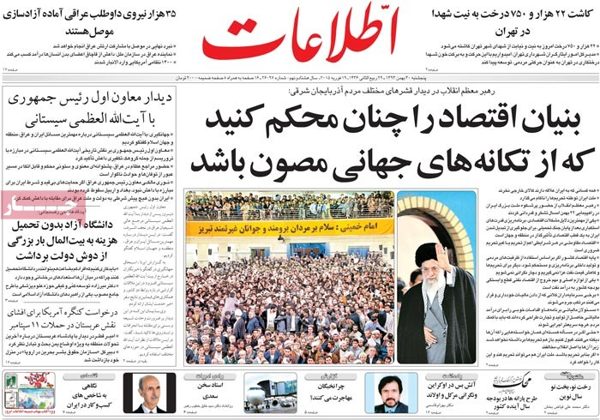
Ettela’at: Some 22,750 trees have been planted in Tehran in honor of martyrs.

Ettela’at: The first vice-president has met with [Iraqi Shiite cleric] Grand Ayatollah Sistani to discuss issues related to the region and the world of Islam.


Ettelaat newspaper 2 - 19 - 2015


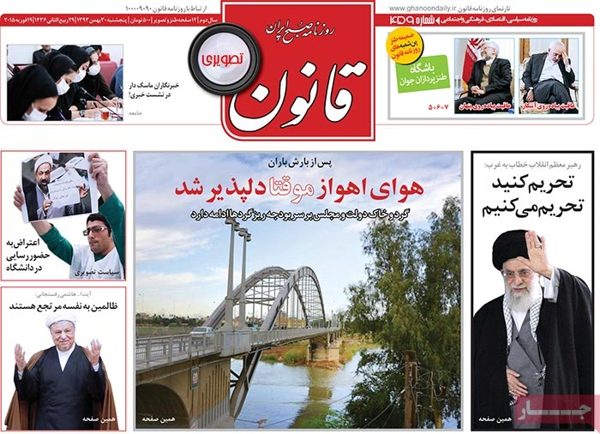
Ghanoon: After a recent rainfall, the air in Ahvaz temporarily turned blue.


Ghanoon newspaper 2 - 19 - 2015


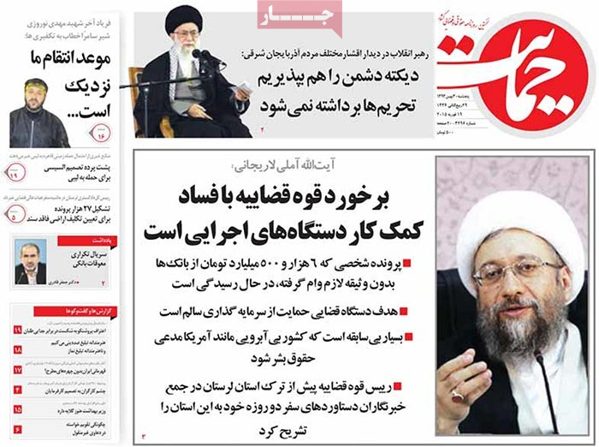
Hemayat: “Judicial crackdown on corruption helps executive institutions better fulfill their duties,” said Ayatollah Sadegh Amoli Larijani.

The judiciary chief, who was in Lorestan Province, further said the case of an individual who has received almost $2.2 billion in banking loans without collateral is under investigation. He also said the judicial system aims to support healthy investment.


Hemayat newspaper 2 - 19 - 2015


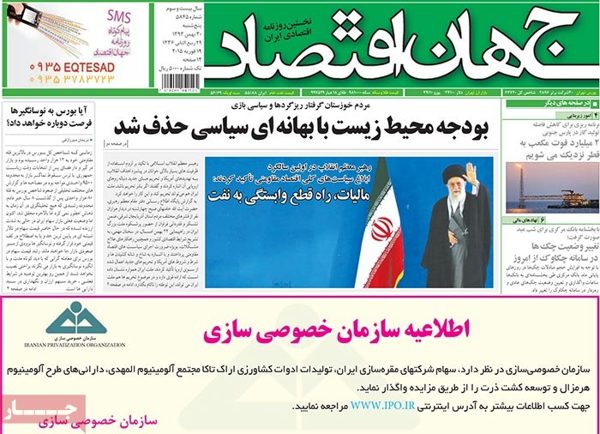
Jahan-e Eghtesad: The environment budget has been eliminated under political pretexts.


Jahane eghtesad newspaper 2 - 19 - 2015


Javan: “The Iranian nation did not like the cordiality between Zarif and Kerry,” said the Leader’s representative at universities.


Javan newspaper 2 - 19 - 2015


Jomhouri Islami: “We’ll reach a political understanding with P5+1 by yearend [March 21],” said the Foreign Ministry spokeswoman.


Jomhorie eslami newspaper 2 - 19 - 2015


Kar va Kargar: “There won’t be a two-stage solution,” said Foreign Ministry spokeswoman Marziyeh Afkham.


Karo karegar newspaper 2 - 19 - 2015


Kayhan: “They won’t lift the sanctions. The enemy is opposed to the nature of the revolution,” said the Supreme Leader.


Kayhan newspaper 2 - 19 - 2015


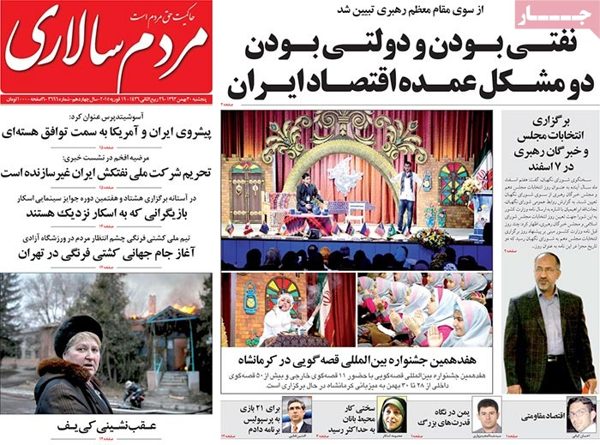
Mardomsalari: The Supreme Leader has said the problem of Iran’s economy is that it relies on oil and is run by the government.


Mardom salari newspaper 2 - 19 - 2015


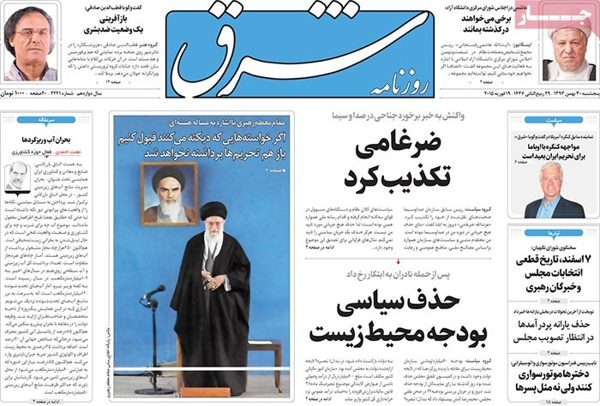
Sharq: [Former IRIB chairman] Ezzatollah Zarghami has denied that the national broadcaster followed a factional agenda when he was in charge.


Shargh newspaper 2 - 19 - 2015


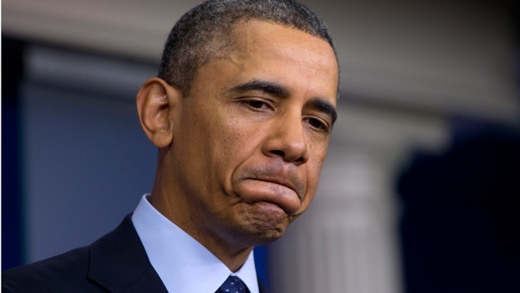
All the deadlocks of Obama

Barack-Obama

White House officials will in fact lose the Geneva deal in case no agreement is struck [between Iran and P5+1]. Such failure will see the Geneva deal become history. The Supreme Leader’s stress on the need for inking a one-phase [nuclear] deal has caused the American plot to procrastinate the talks to hit a deadlock.

The following is the translation of part of an opinion piece by Hossein Mizan published by khamenei.ir on February 15:

One month before the June 2009 elections [in Iran], Barack Obama, the 44th US president wrote a letter to the Supreme Leader asking him to try to open a new chapter in relations between the US and Iran. In the letter, Obama admitted that no issue in West Asia could be settled without Iran’s aid and presence. […]

In February 2013, Obama wrote another letter to the Islamic Revolution leader, expressing his country’s readiness to clinch a bilateral agreement on Iran’s nuclear program. […]

What is the reason behind the correspondence? If Iran is not in a good state – as the US officials claim – how come the US president sends a letter to Iran’s highest-ranking political official and appeals for help?

Perhaps one reason can be found in “Obama legacy”. […] Without fail, one reason the American historiography pays special attention to Ronald Reagan [the 40th] US president [1981–89] is his role in ending the Cold War which was one of the gravest US foreign policy crises. […]

So far Obama is among a few US presidents who have not left behind a legacy in which he and his fellow Democrats can take pride down the road. Of course he does not have much time left to create such a legacy. Thus, many believe that Obama’s legacy can be the diplomatic settlement of the Islamic Republic of Iran’s nuclear case. […]

After Democrats lost the congressional race to Republicans [in November 2014], a breakthrough in the nuclear talks with Iran could be the Democrats’ sole chance to win in the elections [in November 2016]. […]

There’s every indication that failure by Democrats to ink a deal with Iran could bring them down from the pyramid of political power for eight years. This comes as the occupants of the White House praise the Geneva deal as a big achievement of the Obama presidency, claiming that they have managed – thanks to this agreement – to stop the progress of Iran’s nuclear program after years.

Barack Obama proudly said in a recent interview with Vox [an American news website run by Vox Media] that the progress of Iran’s nuclear plan has been brought to an end in the course of 11 years of nuclear talks. Thus the American side seems to direly need the Geneva deal. The continuation of the talks or – at least – maintaining the Geneva agreement is what the US needs in order to advance its agenda at home and abroad.

What’s more, Americans badly need Iran’s help to solve regional problems. The fight against ISIL in Syria and Iraq, Lebanon’s political situation, recent political developments in Yemen and many other Gordian knots which are unfolding in the Middle East can be undone only by Iran […]

The question of Iran’s cooperation with the US for the settlement of its regional woes was categorically rejected by the Islamic Revolution leader. So a breakdown in nuclear talks will aggravate the strategic crises the US is facing in the region.

In reality, American efforts to show that Iran has lost ground in nuclear talks come at a time when US authorities or the Democrats – to say the least –are engaged in a life-and-death struggle the result of which hinges on conclusion of a nuclear agreement with Iran. […]

A while ago, [David] Cohen [the US Department of Treasury undersecretary of terrorism and financial intelligence] claimed that the Iranian economy is in a condition which basically cannot rebound unless Iran signs a nuclear deal with the West, and this has given the US more leverage in final talks with Iran.

Regardless of what has been already said – which fundamentally rejects Cohen’s claim – such viewpoints are met with strong opposition even inside the United States. Tony Blinken, the US Deputy Secretary of State, has recently said that sanctions were not what brought Iran’s nuclear program to a halt; rather a nuclear agreement with Iran has simply stopped such activities. […]

Despite rhetoric by Obama, Kerry, Cohen, etc. the US need for talks or at least keeping the Geneva agreement in place far exceeds that of the Iranian side. So walking away from the negotiating table by the US will spell the collapse of the talks. In case a breakthrough is not achieved [in the talks], the US officials will practically lose the Geneva deal and it would become history.

The US strategy used to show itself in efforts to re-extend the talks and buy time in order not to lose the Geneva deal. But the Supreme Leader’s remarks last week and his stress on a one-stage agreement which encompasses both general and detailed outlines put the Americans in a quandary. The Leader has also ruled out a multi-phase agreement as well as a [general] diplomatic agreement before agreeing on the details.

Boastful remarks by Kerry and Obama’s recent bragging all indicate that their prospective plans for reaching a general, yet half-finished, agreement – something which failed to serve the national interests of the Islamic Republic of Iran and only served the interests of the US, especially those of Democrats – have all been foiled.

The order of the Supreme Leader on a one-phase deal has targeted the Americans’ Achilles’ heel. Undoubtedly, a unique opportunity has opened up for Iran’s nuclear team to persevere and reclaim the rights of the Iranian nation and ask for the removal (not suspension) of sanctions once and for all.

It is no secret today that for Obama, his colleagues and fellow Democrats, a bad deal is better than no deal.

The original article in Farsi featured several references to support the assertions of the author.

Iran’s economic woes predate sanctions: Larijani

Larijani
Larijani

Economic independence is not tantamount to slamming the doors shut to the world, said Parliament Speaker Ali Larijani.

Speaking at a national conference on resistance-based economy in Tehran, the top MP said, “There is no ambiguity in the general policies of the resistance-based economy; the problem lies in how such policies should be implemented. It’s inaccurate to think that the Expediency Council’s formulation of policies to create a resistance-based economy has come as a result of sanctions.”

What appears below is a partial translation of a report that the Islamic Republic News Agency filed on February 17 about what else Larijani said at the congress:

“Sanctions might have opened the wound of our ailing economy, but our economic problems are old. That’s why only policies put forth by a resistance-based economy can address them. […] Before sanctions, unemployment was high; today 44 percent of our graduates are jobless. We must try to tackle these issues. State employment is the worst solution. Responsibilities should be delegated to the private sector so that the economy is run by the public.”

Stating that today’s economic problems are the very same ones we had 100 years ago, he said, “That the late Ayatollah Modarres [a notable supporter of the Iranian Constitutional Revolution] said the government cannot be a good employer and it should not be in charge of economy has nothing to do with sanctions; in fact it is wrong to think that the government should lead the development drive. The late cleric would always suggest that production should be done at home so that we could be independent. […]”

On general policies of the resistance-based economy, Article 44 and engagement of the public in economic activities, he said, “The public was supposed to be given a role on the economic front to promote competition and productivity. However, today we are still dealing with these problems. The policies envisaged in Article 44 were designed to get the public involved in the economy, yet they have not been implemented well over the last decade and these flaws need to be fixed.”

He went on to say, “Sometimes doctoral theses aimed at addressing production shortcomings are turned down. As a result, university students do not opt for such topics. In the industry sector, thanks to the absence of a competitive atmosphere, no need for the presence of universities is felt. […] We owe our progress in nuclear and nanotechnology arenas to the involvement of universities.”

Stressing that security independence would be in place when others could not interfere in our security, he stated, “Economic independence does not mean that we sever our ties with others; rather it means that their influence in our political decision-making is diminished. […]”

Larijani concluded, “Economic independence means that enemies should not interfere with our economy. There have to be relations, yet if we fail to secure economic independence, we won’t be immune to mischief by others.”

At the congress, a number of books and products related to the resistance-based economy were unveiled.

Iran should resist sanctions: Leader

e945b0bb-4867-47e4-ba17-c81b9a206202

Leader of the Islamic Revolution Ayatollah Seyyed Ali Khamenei says Iran can stand up to sanctions against the country and foil enemy plots.

“Serious work should be done. We can resist sanctions and keep the enemy from achieving its objectives,” Ayatollah Khamenei said during an address to thousands of people in Tehran on Wednesday.

The Leader said that if Iran does not resist sanctions, the enemy will set conditions for Tehran’s nuclear program and put bans on the country.

The Leader said that the enemy is taking maximum advantage of sanctions as a tool to stop Iran’s progress.

“If sanctions are to be used [as a tool], the Iranian nation will put sanctions on them in the future. Iran has the world’s largest total reserves of oil and [natural] gas, the gas that the world and Europe are in need of. Iran can impose sanctions on them (Western countries) if necessary,” the Leader said.

Ayatollah Khamenei noted that the West will not lift sanctions against Iran even if nuclear talks proceed as they dictate, because they are opposed to the Islamic Revolution in principle.

The Leader also underlined the need to cut dependence on oil revenues and stressed that Iran should wean the country’s economy off oil and increase domestic production instead.

Ayatollah Khamenei also rejected the US claim of fighting ISIL militants, saying pictures showing Washington’s arms supplies to the terrorist group contradict the so-called coalition’s claim.

Eighth Tehran International Tourism Exhibition (Photos)

Tourism Expo

The 8th Tehran International Tourism Exhibition was held at the capital’s Permanent Fairground from February 12 to 15.

The following is a collection of photos of the expo released by Tasnim News Agency on February 16:


A look at Iranian newspaper front pages on Feb. 18

Iranian Newspapers Headlines

President Rouhani’s assertion that Iran does not need the permission of others to make scientific headway dominated the front pages of Iranian newspapers on Wednesday. News that high-income individuals are being taken off the list of people who receive cash subsidies also made front-page headlines.


Abrar: Foreign Minister Mohammad Javad Zarif has met with the Belarusian President.

Abrar: Britain has slapped sanctions on the Iranian National Tanker Company.

A look at Iranian newspaper front pages on Feb. 18


Afkar: “To make scientific progress we have not gotten and will not get permission from anyone,” said President Rouhani.

A look at Iranian newspaper front pages on Feb. 18


Aftab-e Yazd: Elimination of the cash subsidies of high-income individuals has gotten underway.

A look at Iranian newspaper front pages on Feb. 18


Arman-e Emrooz: “Ignoring a certain political group was a goal of IRIB (Islamic Republic of Iran Broadcasting),” said former director of the state broadcaster Ezzatollah Zarghami.

Arman-e Emrooz: “The trial of former First Vice-President Mohammad Reza Rahimi was not politically motivated,” said the judiciary chief.

Arman-e Emrooz: “That candidates running for public office receive money is common,” said Hamid Rasaei, a principlist MP.

A look at Iranian newspaper front pages on Feb. 18


Bani Film: The Supreme Leader has criticized American Sniper [for encouraging harassment of Muslims].

A look at Iranian newspaper front pages on Feb. 18


Etemad: [As part of investigation into corruption allegations] Police have arrested the managing director of Tabarok [a food company which among other things produces tomato paste].

A look at Iranian newspaper front pages on Feb. 18


Ettela’at: “Iran is determined to master space technology,” said President Rouhani at a ceremony to mark the national day of space technology.

A look at Iranian newspaper front pages on Feb. 18


Iran: “To settle the problem of particulates a scientific, not political, atmosphere is needed,” said the Iranian environment chief.

Iran: “The stance of some at home plays into the hands of the enemy,” said President Rouhani.

A look at Iranian newspaper front pages on Feb. 18


Jomhouri Islami: “Stoking factional disputes is not compatible with our Iranian and Islamic interests,” said the chairman of the Expediency Council.

Jomhouri Islami: “Nuclear talks have not interfered with Iran’s scientific and nuclear progress,” said President Rouhani.

A look at Iranian newspaper front pages on Feb. 18


Kar va Kargar: “Capitulation is over. No one can interfere in Iran’s internal affairs,” said the judiciary chief.

A look at Iranian newspaper front pages on Feb. 18


Kayhan: Some $7 billion in arms sales to Egypt was a present IS handed to France.

A look at Iranian newspaper front pages on Feb. 18


Resalat: “Some 42 percent of university graduates are unemployed,” said Parliament Speaker Ali Larijani.

A look at Iranian newspaper front pages on Feb. 18


Shahrvand: Three citizens die in accidents per hour.

A look at Iranian newspaper front pages on Feb. 18

Iran president slams ISIL beheading of Egypt Christians

President Hassan Rouhani

Iranian President Hassan Rouhani has vehemently condemned the mass execution of 21 Egyptian Christians at the hands of the ISIL Takfiri militants in Libya, describing the murders as an “inhumane,” “un-Islamic” and “savage” move.

“Unfortunately, such acts are being perpetrated in the name of Islam and Muslims, while the terrorist and inhumane acts of such people have nothing to do with Islam,” Rouhani stated as he presided over a session of Iran’s Supreme Cultural Revolution Council in Tehran Tuesday.

He added that common sense does not approve of the ISIL terrorists’ brutal deeds, especially as they stoke hatred and violence by releasing videos of their massacres.

“Those, who initially helped these terrorists and funneled money to them, should apologize to the world nations and history for their conducts, and those who are regretfully still backing them should stop providing support to these terrorists,” Rouhani pointed out.

[…]

A new face of the Assembly of Experts

Assembly of Experts

With almost one year to go before Iranians go to the polls to elect members of parliament and the Assembly of Experts, jockeying for position by political groups and factions seems to be already underway, unofficially though.

Hamshahri Mah magazine published an article in its 129th issue by Arash Ghavami on the new faces who may contest the seats in the upcoming Assembly of Experts. The following is the full translation of the article:

Early campaigning for seats in the Islamic Consultative Assembly is nothing new, because the vote provides a platform for political rivals to line up against each other.

But when it comes to the seats on the Assembly of Experts, in Iran’s political history intense rivalry is unprecedented, or less common to say the least. That the country’s two main political factions seek to drum up support and activate electoral mechanisms to garner a majority of seats in the Expert Assembly elections – like what they usually do in parliamentary polls – is a new phenomenon in Iran.

A council with few changes

The fact that since its establishment, the Assembly of Experts has chosen only three chairmen indicates that the assembly pursues a non-political and non-factional agenda. The chairs have been elected through consensus or picked in a one-man-show race. The late Ayatollah Ali Meshkini was chosen as the [first] chairman in 1982 when the assembly was established. After his passing, Akbar Hashemi Rafsanjani picked up the seat in 2007 and three years later Mohammad Reza Mahdavi Kani replaced Hashemi Rafsanjani.

Speculations as to who will take charge of the assembly after the demise of Ayatollah Mahdavi Kani can perhaps be interpreted as the first political showdown inside the council. In fact in the absence of Ayatollah Mahdavi Kani, Iran’s two political groups are putting in efforts to elect a new chairman who has a special political leaning.

To that end, in an interview with Al-Alam News Network [Iran’s Arabic news channel], Ayatollah Ahmad Khatami – a member of the assembly’s residing board – said Ayatollahs Hashemi Shahroodi, Yazdi, Jannati and Movahedi Kermani are the main candidates for chairmanship of the Assembly of Experts. He did not mention Ayatollah Hashemi Rafsanjani’s candidacy. “Mr. Hashemi Rafsanjani has said in certain quarters that he is unwilling to run for chairmanship of the assembly,” he said.

Ayatollah Hashemi Rafsanjani promptly reacted to the interpretation of Ayatollah Khatami. In an interview with Jomhouri Islami daily, a source close to Akbar Hashemi Rafsanjani quoted him as saying, “In case certain people whom I don’t think are qualified for the chairmanship of [the Assembly of] Experts intend to run for it, I will voice readiness to field my candidacy.”

In another move, the official website of the Chairman of the Expediency Council Ayatollah Hashemi Rafsanjani [hashemirafsanjani.ir] republished “I will run for Experts chairmanship” as its banner headline.

Although efforts were being made earlier to make the elections of the Assembly of Experts’ chairman and the agenda the body pursues nonpartisan, such rivalries show that a new atmosphere is likely to be in the making in the assembly which is an influential institution in the [Islamic] establishment.

Principlists and concerns about measures by the anti-revolution camp

Under such circumstances, principlists have sought in recent months to warn about the conditions of the upcoming elections. Ayatollah Jannati’s comments that the enemies of the Islamic revolution have set their sights on the Assembly of Experts are among the starkest warnings in this regard. He has said, “The enemies want to see individuals who do not stand up to acquisitive demands elected to the assembly. They have plans to achieve their ominous goal.”

Jannati, who was speaking in a congress of Velayatmadaran [the followers of the Supreme Leader] in Fars Province, added, “The enemies want a leader they approve of. They have plans for the next 10, 20, 50 or even 200 years. Thanks to divine assistance, they have not achieved their ominous goals.” (Fars, Feb. 8, 2015)

Other key principlists have offered analyses similar to Ayatollah Jannati’s and reacted to measures taken by their rivals for strong showing in the elections. Asadollah Badamchian, a key member of the Islamic Coalition Party, for instance, has said, “The [Experts Assembly] election is very critical this time. We need to enter the race vigilantly, knowingly and tactfully. A closer look at the electoral events clearly reveals that the enemies of the revolution want a Tunisia-style election. This has made the [upcoming] elections more important.”

He has also said, “They are trying to bring the Western-leaning Iranian elements to power. We need to be fully vigilant about the assembly’s elections … When two clerical mainstreams, namely the Society of Seminary Teachers of Qom and The Combatant Clergy Association, released a ticket, it would become clear that the Islamic Coalition Party officially supports the ticket.” (Mehr, Feb 2, 2015).

In fact, the principlists’ election strategy for the Assembly of Experts is to build solidarity [among fellow principlists] and have a pervasive, concerted presence [in electoral campaigning] to defeat efforts by reformists. This is pursued through maximal interaction between the two clerical mainstreams.

Reformists’ agenda for Assembly elections

Just like principlists who are considering a concerted presence in the elections to defeat their rivals, the reformist camp too has launched efforts to mobilize their forces.

Mohammad Hossein Mousavi Tabrizi, the secretary-general of the Assembly of Qom Seminary Scholars and Researchers, recently stressed in the 13th congress of The Democracy Party of Iran that the reformist goals will be achieved only through [participation in] the elections. “We have to set aside egotism and take action for the parliamentary and Assembly of Experts elections.” (Fars, January 29, 2015).

Reformists seem to be going to try to put on their ticket the names of not-very- famous figures, or those who are not known for their reformist leanings, to be able to increase the number of votes they can poll, building on those figures’ jurisprudence and religious credentials.

Meanwhile, certain principlists have talked in their analyses about the division of labor in the reformist camp and their planning for participation in the elections for the Assembly of Experts and the Islamic Consultative Assembly. They have said that Ayatollah Hashemi Rafsanjani, Hojatoleslam Seyyed Hassan Khomeini and [former President] Mohammad Khatami will lead efforts for the Experts Assembly vote, and individuals close to the government will manage the parliamentary campaign.

Reports in this regard suggest that Hashemi will enter the race on a reformist-moderate ticket. The assembly elections seem to be of special significance to reformists and government officials. In the environment created following Hassan Rouhani’s presidential victory, the takeover by the reformists of the Assembly of Experts can tip the balance in their favor, improve their position in the establishment and [consequently] weaken some elements in the rival camp.

Assembly of Experts: political or non-political?

Does the pervasiveness of a factional or political mentality in the Assembly of Experts serve the interests of this institution? Does the assembly’s special position place it among the institutions like the Islamic Consultative Assembly which are formed on the back of a popular vote? Or the opposite, is the fate of this popular institution decided in a non-political environment and far away from the common political, factional strife?

Regardless of what the answer to these two questions might be, there is one interesting point: extension of political-factional rivalry – like what happens in presidential and parliamentary elections – to the Assembly of Experts elections amounts to departure from dogmatism and attention to the concerns and responsibilities of this influential institution.

That Ayatollah Hashemi Rafsanjani spearheads one camp and Ayatollah Mesbah Yazdi leads the anti-Hashemi camp is in fact a stark reminder of typical political antagonism. It deals a blow to the dignity and position of the assembly’s members as well as to the nature of their candidacy and the agenda they are pushing.

Still we can remain hopeful that the upcoming race will eventually take place in the form of rivalry between the two tickets put forward by the clerical bodies of the two [opposing] camps.

We also hope such rivalry does not fall into the trap of common political race in the country which usually comes with ill-temperedness and political grandstanding.

Persian fallow deer are successfully protected

Iran Nature

Over the years an initiative to protect Persian fallow deer has proved successful in Ilam Province [in Western Iran]. Mohitzist.ir has reported that the plan has seen the number of deer in the province rise to 44. The following photos feature this rare ruminant mammal: