Saturday, December 27, 2025
Home Blog Page 4947

A dreamy look at realities on the ground

Rouhani-tv

Kayhan daily on January 31 ran an opinion piece by Hossein Shamsian in which he takes a swipe at President Rouhani’s government for what he says is focusing too much attention on nuclear talks. Shamsian then disputes as half-baked the idea which says “removal of sanctions” would translate into “settlement of the country’s economic problems”.

He also takes a closer look at “the government’s failure to pay attention to [national] production and employment which were among Candidate Rouhani’s top election pledges”.

The columnist then brings under focus the country’s economic woes, partly blaming lack of proper planning for the current troubles Iran is grappling with. The following is a partial translation of what else he has written in the critical piece:

[…]

What is clear, and at the same time undeniable, is the government’s attention to and focus on [nuclear] talks and its efforts to offer salvation [for the country from the bite of sanctions] by lifting the sanctions!

Nobody can deny such a clear proposition. Each week Iranian officials live the big dream of sanctions removal and share their dreams with people despite comments by arrogant Americans on exerting more and more pressure on Iran.

[…]

How can the existing problems be removed under such circumstance? Does playing with words by the [first] vice-president help? What about his articulation of poetic-like statements like “The budget of next year [starting March 2015] is disciplinary, not contractionary”? […]

Isn’t it right that measures should be taken to make smuggling in goods a thing of the past? […]

Isn’t it right that solutions should be worked out for massive tax evasions? […]

Isn’t it right that the government does not want to damage its fictional prestige by cutting the subsidies of high-income people? […]

We do not forget that on the campaign trail Dr. Rouhani made the following sarcastic comment about employment, “That’s right. Jobs have been created, but for the Chinese industries and for Chinese workers!”

The question that arises here is how many jobs have been created for Iranian workers given the alarming rise in imports, and even worse, the smuggling of one-third of all imported items? […]

Certain people in the government have delegated all responsibilities to the Foreign Ministry and defined its [main] mission as establishing ties with the US.

One and a half years have passed since the [eleventh] government came to office with the unique experience of trusting the US, which is the Iranian nation’s number-one enemy.

In the past, maybe it was possible to tell people that talks with “The Headman” [a reference to the US] would rapidly settle their problems, but it is not the case anymore. Today nobody buys what they sell, even the closest people to the government, because 12 months of flexibility have resulted in nothing but impudent and shameless attitudes by Washington.

Constant concessions in return for yet-to-be-kept promises have led the country to the point in which the government has been unable to name an envoy of its own choosing to the United Nations. In a painful process, it had to change its pick for the UN ambassador!

As things stand, isn’t it better to replace ‘agreement at any cost’ with efforts to tap into domestic potential, rely exclusively on people and the youth who are the country’s assets and work toward a solution to the [troubled] economy?

Other than the government, those MPs who are involved in debates [on parliament floor] on the country’s spending package are responsible too.

Kerman holds biggest Zoroastrian Sadeh Festival

Zoroastrian-2

On January 30 each year, Zoroastrians from all over Iran and other countries gather in Kerman, southeast of Iran, to celebrate the Zoroastrian Sadeh Festival by burning firewood outdoors.

Every year, on January 30, thousands of Zoroastrians and even Muslims from across Iran as well as other countries gather in Kerman, the city with the greatest Zoroastrian population, to celebrate the religious feast of Jashn-e Sadeh by burning firewood in an open space to celebrate the coming of spring and the victory of light over the forces of darkness, frost and cold.

Sadeh (meaning ‘hundred’ in Persian) is a mid-winter festival which is celebrated 50 days before Nowrouz, the Persian New Year.

Mohammad Ali Golabzadeh, a researcher who specializes in Kerman studies, told Mehr News that the ceremony is still celebrated like the ancient times in Kerman, Yazd, and some other Iranian cities.

“Although Sadeh is attributed to Zoroastrians, the ceremony itself has its roots in Kerman’s rituals and even Muslims participate in it,” he said, adding that to the majority of Iranians Sadeh is not a religious occasion and people simply gather together to have a good time and celebrate the precious things God has granted humanity.


Iran starts laying new gasline to Iraq

iran iraq gas pipeline

Iran started building a second pipeline to export its gas to neighboring Iraq.

Once the pipeline is operational, Iran’s gas export capacity to Iraqi will rise in two years.

The construction of the first pipeline which goes to Baghdad is almost complete and is to start carrying gas to the country by May, 2015.

The project is designed to export about 4 million cubic meters of gas to Baghdad on a daily basis. The figure will gradually rise to 25 million cubic meters a day.

According to Director of International Relations at the National Iranian Gas Company, Azizollah Ramezani, about 7 kilometers of the pipeline which runs to Baghdad is still under construction inside the Iraqi soil.

The second pipeline carrying Iranian gas to Iraq via Basra will have a capacity of 35 million cubic meters per day.

The two pipelines together have a capacity to increase Iran’s gas exports to Iraq to 70 million cubic meters a day.

Iranian oil exports to Asian states jump by nearly 20% in 2014

Iran oil

Asian imports of Iranian crude oil increased by 19.8 percent last year to hit a three-year high, despite Western sanctions against the Iranian oil industry over the country’s peaceful nuclear program.

Imports by Iran’s four biggest buyers – China, India, Japan and South Korea – averaged 1.12 million barrels per day (bpd) in 2014, government and tanker-tracking data showed, the highest since the region took more than 1.5 million bpd in 2011.

December imports into Asia rose 22.1 percent from a year ago to 1.21 million bpd – the highest since May – due to a huge jump in India’s imports for the month and higher seasonal winter demand.

India has asked its refiners to slash oil buy from Iran in the next two months to keep its imports in line with the previous fiscal year’s levels, sources with knowledge of the matter told Reuters last week.

Under an interim agreement between Iran and P5+1 (the five permanent UN Security Council members plus Germany) in November 2013, Iran is allowed to keep exports at about 1 million bpd versus a total of 2.2 million bpd before toughened sanctions were put in place in early 2012.

The US Senate Banking Committee on Thursday advanced a bill that would toughen sanctions on Iran, but a full vote on the bill is not expected until at least March 24 in the face of veto threats by President Barack Obama.

“It looks as though the West’s stance is inconsistent and the (nuclear) talks are unlikely to be finalized,” said an oil industry analyst who declined to be identified.

The US named nine new sanctions targets in Iran at the end of December, a move that Iran’s foreign ministry said “raises doubts about America’s intentions and violates the good will principles” of the nuclear negotiations.

Iran ready to help anti-Boko Haram campaign: Deputy FM

Boko Haram

Hossein Amir-Abdollahian, Iran’s deputy foreign minister for Arab and African affairs, said on Saturday that Tehran supports African countries’ fight against the militant group.

The Iranian official made the remarks during a press conference on the sidelines of the 24th Summit of the African Union (AU) in the Ethiopian capital, Addis Ababa, ISNA reported.

Amir-Abdollahian condemned terrorist attacks by Boko Haram militants in Nigeria and said Iran, which has already shouldered heavy responsibilities in the fight against terrorist groups in the Middle East, is ready to cooperate with the AU against terrorism.

On Friday, the African Union called for a regional five-nation force of 7,500 troops to fight Nigeria-based Boko Haram militants.

Boko Haram, whose name means “Western education is forbidden,” controls large parts of northeastern Nigeria. Cameroon, Chad, Niger and Nigeria are the four African countries which have been directly affected by the growing threat of Boko Haram.

More than 13,000 people have been killed and over a million made homeless as a result of Boko Haram violence since 2009.

ISIL and Boko Haram Takfiri militants

Amir-Abdollahian called the ISIL Takfiri terrorist group in the Middle East as a malicious phenomenon which has destabilized Syria and Iraq, saying that Boko Haram and ISIL Takfiri terrorist groups are two sides of the same coin.

ISIL militants control some parts of Iraq, including the northern city of Mosul, as well as areas of neighboring Syria.

The terrorist group has committed gross human rights violations and violence against many groups in Iraq including Christians, Izadi Kurds, Sunnis and Shias.

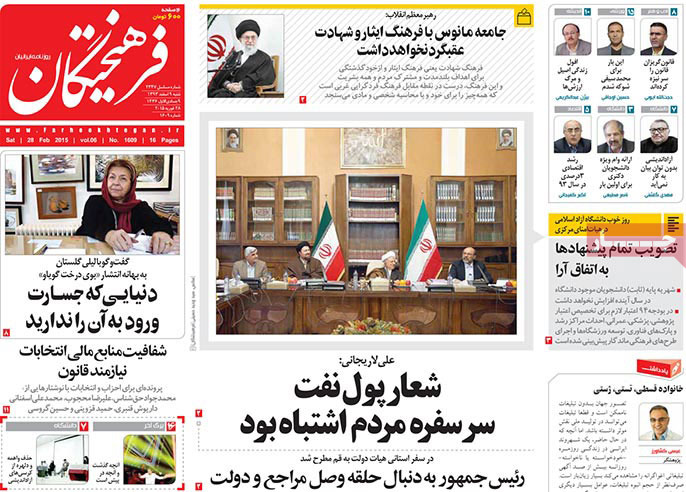
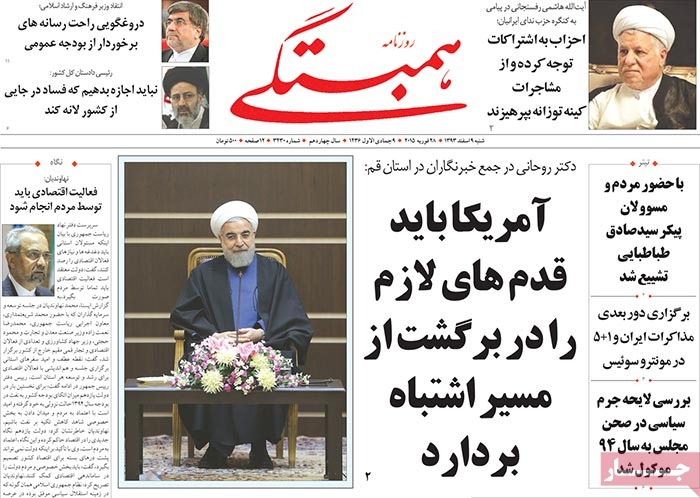
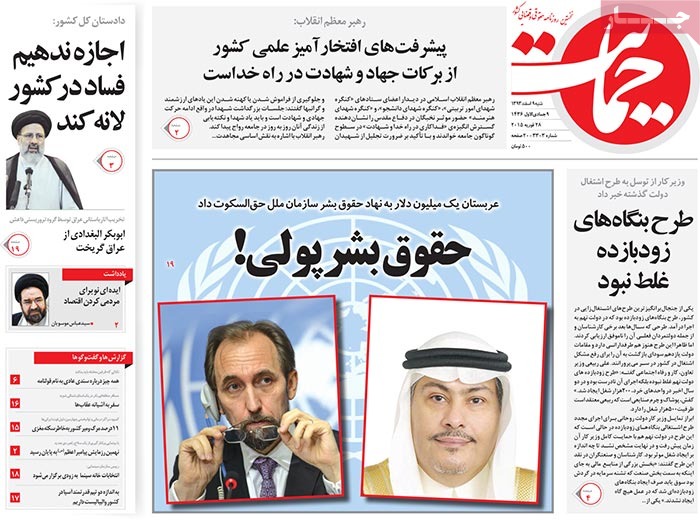
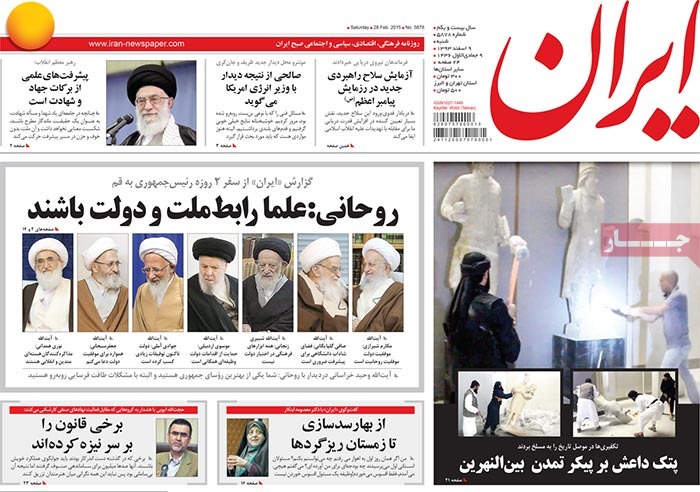
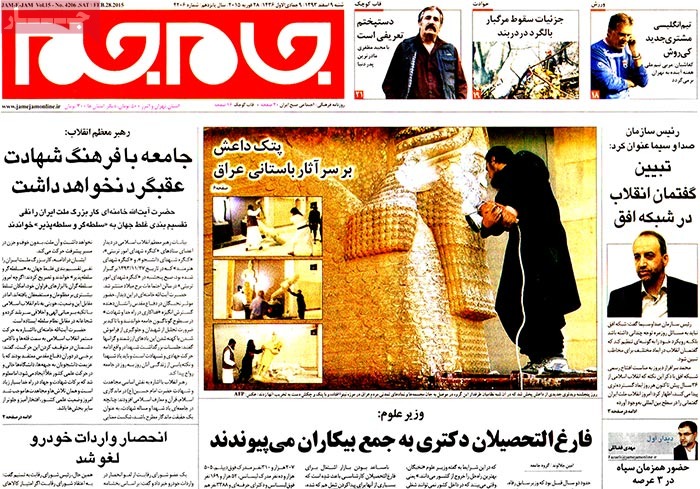
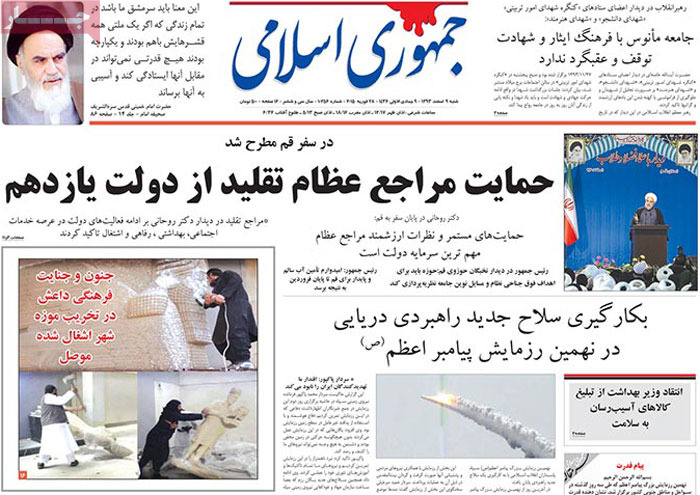
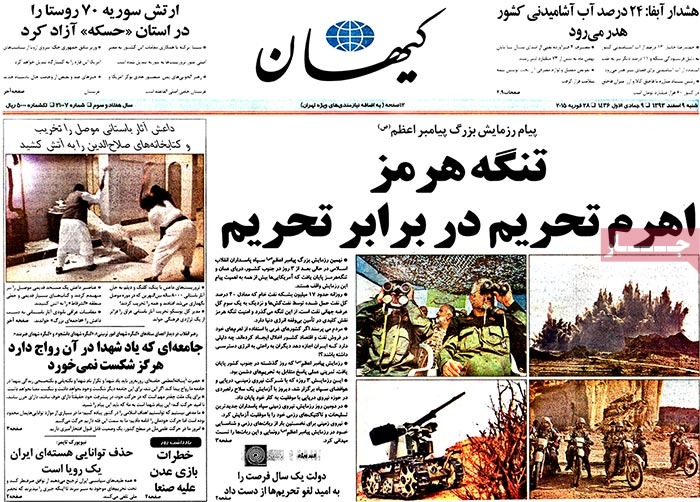
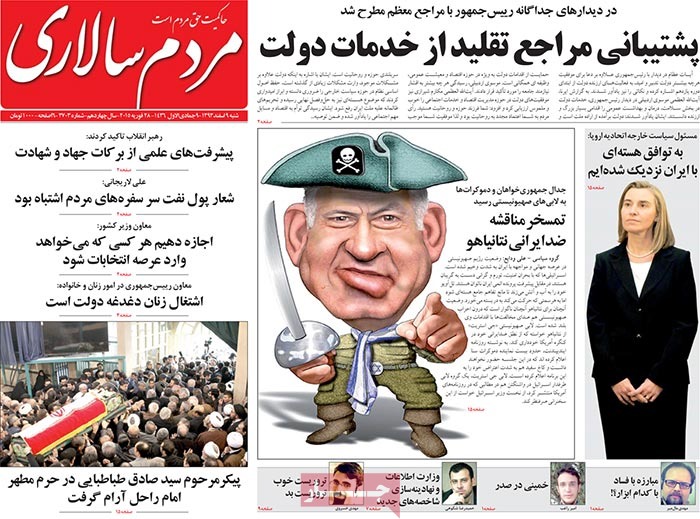
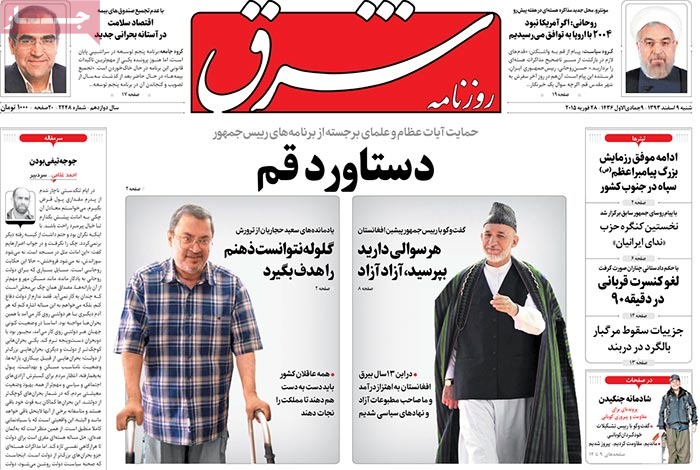
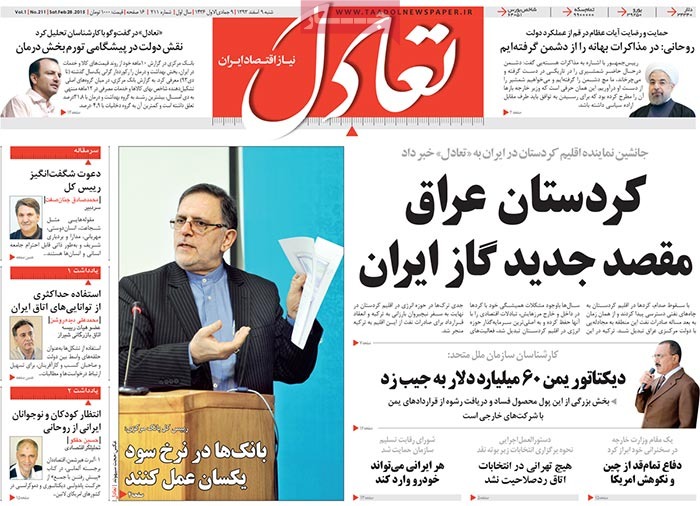
A look at Iranian newspaper front pages on Feb. 1

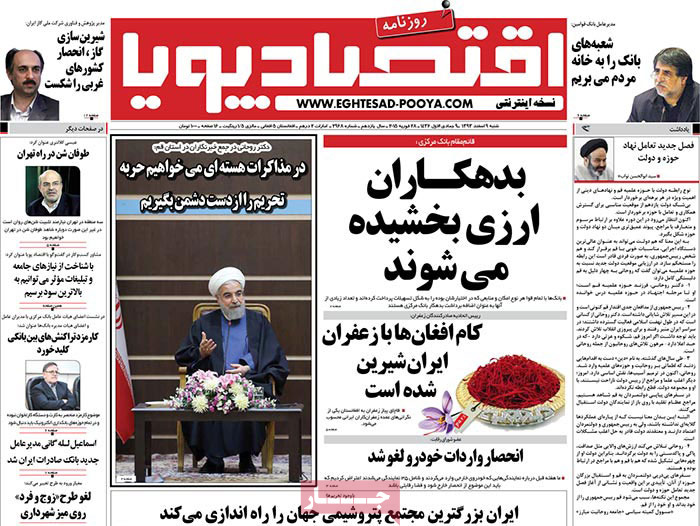
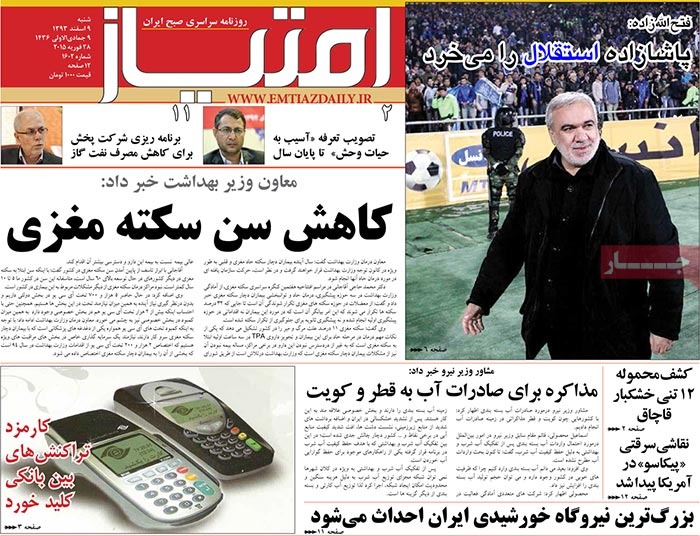
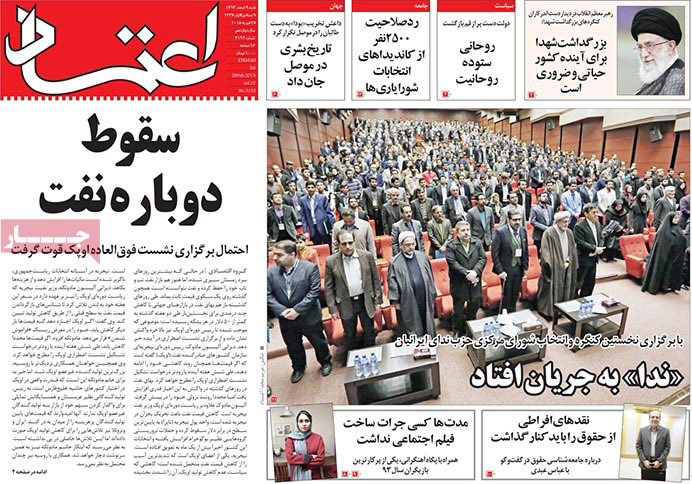
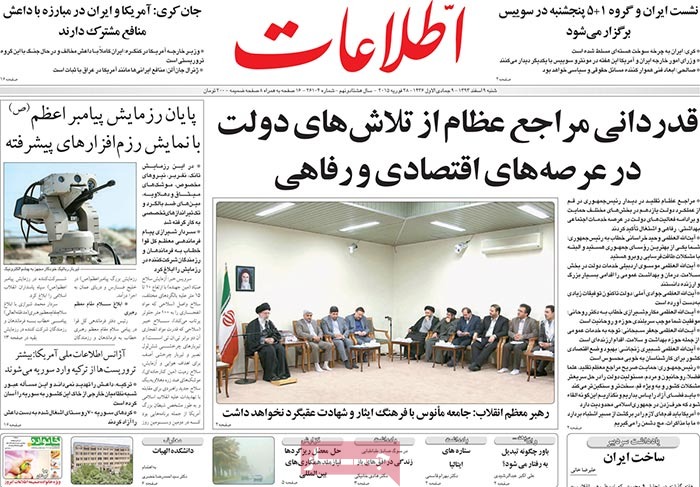
Iranian Newspapers Headlines

The warning of the Supreme Leader during an inspection tour of a nanotechnology exhibition to officials to keep politics out of science and research and the president’s criticism of hardliners who use every opportunity to take aim at his government dominated the front pages of Iranian dailies on Sunday.


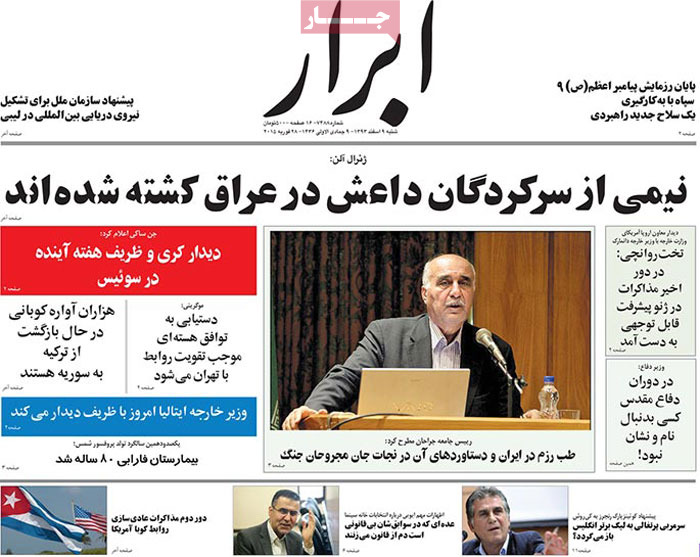
Abrar: A member of parliament’s Agriculture Committee has floated the idea of water imports from Azerbaijan Republic.


Abrar newspaper 1 - 2 - 2015


Afarinesh: “Do not allow political motivations to find their way into scientific and research centers,” said the Supreme Leader during an inspection tour of a nanotechnology exhibition.

Afarinesh: The US Statement Department has said that Secretary Kerry and Foreign Minister Zarif are likely to meet during the Munich Security Conference.

Afarinesh: “The IS terrorist group had set its sights on Tehran,” said a senior advisor to the commander of the Quds Force, an affiliate of the Islamic Revolution Guard Corps.


Afarinesh newspaper 1 - 2 - 2015


Afkar: Deputy Minister of Culture and Islamic Guidance Hossein Entezami has said that actors and sports figures can appear in commercials involving local products and industries.


Afkar newspaper 1 - 2 - 2015


Amin: Parliament Speaker Ali Larijani has condemned the killing of Shiites in Pakistan.


Amin newspaper 1 - 2 - 2015


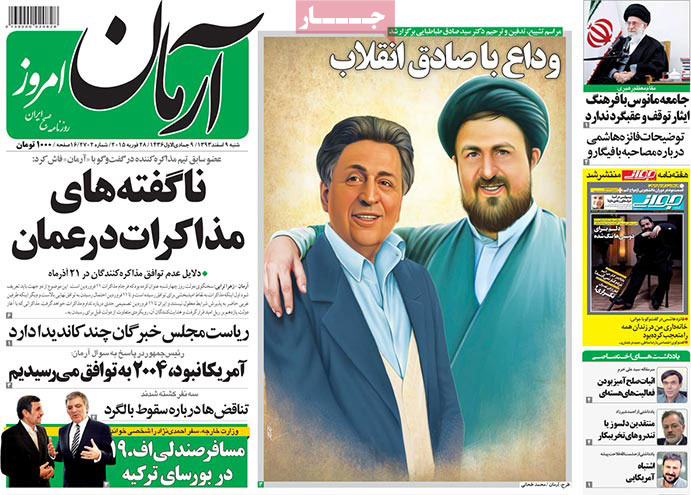
Arman-e Emrooz: President Rouhani has taken a swipe at hardliners who seize every opportunity to lash out at his government. “That some say they [diplomats representing Iran in nuclear negotiations with P5+1] have walked too fast or too slow, or that their coats are askew, etc. is nonsense.”

Arman-e Emrooz: “February 11 [which marks the victory of the Islamic Revolution 36 years ago] does not exclusively belong to a certain group. It is everyone’s festivity,” said Ayatollah Hashemi Rafsanjani.


Armane emruz newspaper 1 - 2 - 2015


Asr-e Iranian: The center that deals with organized cyber-crime has busted a network producing unethical content on Facebook.


Asre iranian newspaper 1 - 2 - 2015


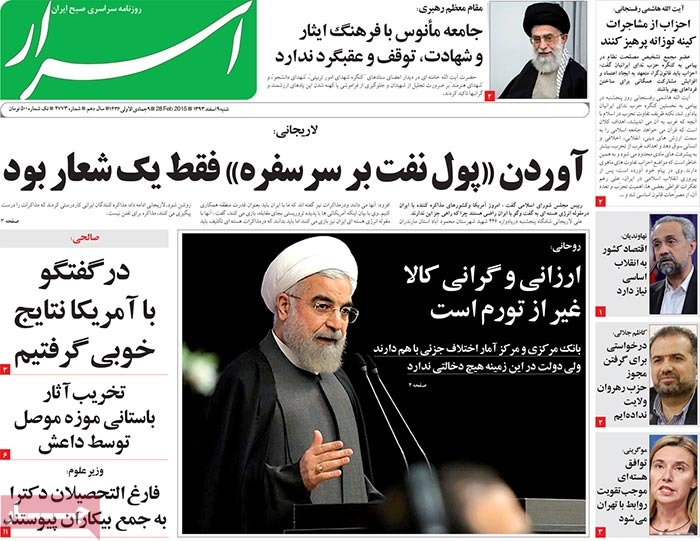
Asrar: “Some are harming our national interests in the name of criticism,” President Rouhani said as he threw his weight behind “our brave diplomats” and accused some hardliners at home of cheering the other side in nuclear talks.


Asrar newspaper 1 - 2 - 2015


Etemad: “The privatization of the past amounted to an auction in which the national capital went under the hammer,” said the minister of roads and urban development.


Etemad newspaper 1 - 2 - 2015


Javan: The Ministry of Culture and Islamic Guidance has sacked one of its managers opposed to the release of a book with an anti-revolutionary theme.


Javan newspaper 1 - 2 - 2015


Jomhouri Islami: The Iranian nuclear negotiators led by Foreign Minister Zarif fly to Germany on Friday to attend the Munich Security Conference.


Jomhorie eslami newspaper 1 - 2 - 2015


Khorasan: Oil prices have climbed above $50 a barrel.


Khorasan newspaper 1 - 2 - 2015


Mardomsalari: The spokesman of the Supreme National Security Council has denied reports by media outlets affiliated to foreign countries about what has happened in the meetings of the council.


Mardom salari newspaper 1 - 2 - 2015


Rah-e Mardom: ‘Under the present circumstances, I can’t carry on leading the national team,” said Carlos Queiroz, the Portuguese coach of the Iranian soccer squad.


Rahe mardom newspaper 1 - 2 - 2015


Resalat: “We don’t need to import sugar and rice,” said the minister of agriculture jihad.


Resalat newspaper 1 - 2 - 2015


Rooyesh-e Mellat: “Tehran stands ready to counter Boko Haram,” said Iranian Deputy Foreign Minister Hossein Amir Abdollahian.


Ruyesh melat newspaper 1 - 2 - 2015


Sharq: The grandson of the founding father of the Islamic Republic has said that one needs to be brave in order to secure freedom.


Shargh newspaper 1 - 2 - 2015


Iran has signed a contract to buy FPSO vessel

FPSO Vessel

On January 30, Shana.ir quoted the CEO of Petroiran Development Company Limited (PEDCO) as saying that a contract has been signed to buy a floating production, storage and offloading (FPSO) unit which is to be used in South Pars project. The following is the translation of the report:

Stressing that the FPSO will be delivered within 21 months, Raham Ghasemi said, “Some oil wells have been drilled in the South Pars Field and by the time the floating vessel is ready to be used, a few more injection oil wells will have been drilled and the oil layer of the South Pars Field will be ready to be exploited.”

He went on to say, “PEDCO will remain in charge of the project for six months before handing the vessel to the final operator: Iranian Offshore Oil Company (IOOC).”

Under Ahmadinejad, the purchase of an FPSO, laying 55 kilometers of pipeline to the Balal Oil Field, construction and installation of a series of plants and the retrofitting of the floating storage unit installed at Soroush and Nowruz oil fields were contemplated. But, some of these projects such as the purchase of an FPSO were not top priority because of sanctions.

The project to develop and exploit oil layers in the South Pars Gas Field which is jointly owned by Iran and Qatar is to be carried out in two stages. Qatar started producing oil at the joint field in 1991.

At the first stage of this project, 35,000 barrels are projected to be produced on a daily basis. At the end of the first stage and following further studies of the field, the second stage that will produce 54,000 barrels a day would get under way if the development of the field turned out to be cost-effective.

Senior Iran MP warns US Congress against new sanctions

Abutorabi

The first vice speaker of the Iranian parliament has warned that Tehran will scale up its nuclear program should Capitol Hill impose further sanctions against the Islamic Republic over its civilian atomic work.

“If the US Congress makes the slightest move to ratchet up sanctions [against Iran], parliament will instruct the government to take measures to further advance its nuclear objectives and [increase] uranium enrichment for peaceful purposes as much as needed by the country,” Mohammad-Hassan Aboutorabi-Fard told reporters on Thursday.

He said that parliament has so far worked out the necessary strategies, advising Washington to “learn lessons” from its experience over the past few years.

Following the referral of Iran’s nuclear case to the UN Security Council a decade ago, Aboutorabi-Fard said, parliament tasked the government with pressing ahead with the country’s nuclear program, adding that the Arak heavy water reactor, 19,000 centrifuges and the Fordo nuclear facility are among the achievements of the country.

The Iranian official’s remarks came after the US Senate Committee on Banking on Thursday approved a bill that would endorse further sanctions against Iran if nuclear talks between Tehran and P5+1 fail to lead to an agreement by a self-imposed deadline.

This comes as US President Barack Obama administration has warned that the new Iran sanctions proposed by the US Congress would spoil the ongoing talks.

Obama has also threatened to veto further sanctions.

A newly released album, a prelude to female solo songs in Iran

Noushin Tafi

Javan daily, the mouthpiece of the Islamic Revolution Guard Corps, on January 31 featured a report on the release of a somewhat unique album in Iran’s traditional music market, saying the album in which the [sonorous] voice of a female singer is dominant is a prelude to breaking religious taboos surrounding solo female performances.

The following is a partial translation of the principlist daily’s take on the album which holds a permit from the Ministry of Culture and Islamic Guidance:

You Ancient Land, I Love Thee (To Ra Ey Kohan Boom O Bar Doost Daram), an album by Nooshin Tafi and Mohsen Karamati [singer and trainer of the vocal radif of Persian classical music], has been unveiled in a ceremony [in Tehran].

It came after Minister of Culture and Islamic Guidance Ali Jannati said females can sing solo. The new album in which a woman’s commanding voice is noticeable has brought the Culture Ministry one step closer to making what its boss Ali Jannati had said a reality.

Nooshin TaefiAlthough duets or trios in which female and male singers perform together date back to before Jannati took charge of the ministry, what distinguishes You Ancient Land, I Love Thee from other records is the fact that the vocal range of the female singer has been highlighted both in performing and in news on the newly released album. Certain media outlets have even gone further, introducing the album through its female singer.

Nooshin Tafi is a traditional vocalist whose solo pieces had earlier found their way to the market. In this album, which is her first official work, Tafi performs duet with Mohsen Karamati, her trainer.

[…]

In the ceremony, Karamati took aim at a ban on women’s singing and said, “We all get familiar with music through the voice of a woman who sings lullabies for us and that woman is none other than our mom. Let’s treat all ladies as our own mothers and let their voices be heard, literally.”

[…]

Javan concludes its report by highlighting the contradiction of what the eleventh government’s Ministry of Culture and Islamic Guidance has allowed with religious decrees [unanimously dismissing solo female performances as religiously forbidden].


On Saturday the spokesman of the Ministry of Culture and Islamic Guidance said the album in question is not solo performance. 

Hossein Noushabadi said the album has been approved for release after careful examination and that allegations otherwise are not simply true.
He added in the past similar albums have received the green-light from the ministry and the content is not against regulations.

What is really going on in Yemen? An expert point of view (PART TWO)

Yemen-1

In light of recent developments in Yemen, Jafar Ghannad-Bashi, a Middle East expert, believes the country is highly likely to fall apart. Khabaronline’s Zohreh Norouzpour had an interview with Ghannad-Bashi on January 27, putting Yemen’s developments under the microscope. The following is PART TWO of the translation of the interview:

What consequences will the Persian Gulf Cooperation Council (PGCC) and the rulers of Arab nations face if Houthis take over in Yemen?

Four years ago when a revolutionary movement began to emerge in Yemen, the PGCC together with other Arab and Western nations scrambled to stop the revolution from securing its stated goal. Over the past four years, the PGCC did what it could to suppress the revolution. Through numerous military attacks, it inflicted big human and property losses on the Yemenis. They even dropped bombs on areas where elements of the Yemeni regime were present.

As a result of their measures the former vice-president remained at the helm of power. They also prevented the former authoritarian system from falling apart and managed to prevent the Yemeni revolution from emerging victorious. The Security Council’s statement confirming Mansour Hadi and provision of arms to people in the South are some other measures taken toward the same goal.

The PGCC did what it did to prevent the current situation in Yemen. They even prompted US warships to advance on Yemen. The PGCC has encouraged and financed the flight of US drones in the Yemeni airspace in recent days. It is quite natural if they carry on with their animosity in case a new government takes over in the country.

They seem to have reached the finish line after the experience which resulted from the actions of the Yemeni people and Ansarullah movement. They have to accept the realities of Yemen’s revolution, especially because those who support Ansarullah are cynical about Saudi Arabia, the US, and reactionary regional states.

In fact, Yemen is not the right place for them to be. The embassy closures in recent days are a sign of that. Whenever a threat looms in Sana’a, they think their diplomatic missions would be in jeopardy and their opponents may target their embassies which are the first sign of their presence in Yemen.

Given the four-year experience of Yemen’s revolution, the Arabs mobilized what they had against the people of Yemen, and now they have run out of arrows in their quiver to prevent the revolution from happening. They need to accept the realities. For the time being, the Arabs in the Persian Gulf concentrate their focus on disintegrating Yemen. They have already set the formation of South Yemen in motion, boosting the South to go to war with the North. PGCC members arm people in the South to later use them in order to seize Sana’a [in the North].

The Persian Gulf Arab states seek the disintegration of Yemen because they fear a Shiite government in Yemen may unite with Shiites in Saudi Arabia, something which may finally splinter the kingdom. Is that right?

It is not a matter of Shiites versus Sunnis. Saudi Arabia cannot bear to see a democracy thrive along its borders. Riyadh offered $16 billion in assistance to Egypt’s military men. Kuwait and the UAE, combined, sent around $32 billion to Egypt’s military only to undermine democracy in Egypt, because they didn’t want it to be an example for other Arab countries, especially in the Persian Gulf region and Saudi Arabia.

Iraq is a neighbor of Saudi Arabia. They did their utmost to block Iraq’s parliamentary election. They did not want a popular vote to be organized there. They even dragged ISIL to Iraq. In Bahrain, another neighbor, Saudi Arabia’s military presence is evident. Any model of democracy is viewed as a threat to Saudi Arabia and the Arabs.

The PGCC was formed exactly four months after the victory of the Islamic Revolution in Iran. Back then the council had a mission to counter democratic movements in order to prevent a revolution, like that of Iran, from taking place.

The question here is not one of Shiites versus Sunnis; it is all about a democratic system. The Shiites in Yemen and Saudi Arabia are not seeking to unite. Saudi Shiites have no intention of joining the Houthis and help disintegrate Yemen.

Houthis too are not trying to interfere in other countries. They have openly said they are willing to hold talks with all nations. Military support and Saudi meddling are all meant to facilitate Yemen’s disintegration. There’s no evidence that Saudi Shiites and Yemeni Shiites are making endeavors to disintegrate Saudi Arabia. The opposite is true; Al Saud is trying to make Yemeni disintegration a reality.

How would Shiites affect their country’s ties with Iran if they take over in Yemen?

What matters for Iran is not religion. The stance of Yemen is more important. Iran maintains close ties with the Venezuelan president who is not a Shiite or heads of other Latin American countries or other non-Muslim allies. These countries only share stance with Iran; they are against Israel and have been embraced by the current and previous governments in Tehran.

Iran’s ties with [former Venezuelan President Hugo] Chavez were established when [former President] Khatami was in office. The Yemeni people are bitterly opposed to Israel, arrogant powers and the US. They are against reactionary regional monarchies. Such attitude puts them on our side.

A country whose stance is similar to Iran is on our side; Lebanon, Syria and Iraq are among these countries. This is how the anti-Israeli front is boosted in the region. It is not the question of Shiites versus Sunnis. The stances matter more. Yemen’s previous government was unpopular and backed by the US and Britain and was a stooge of Saudi Arabia.

Abdullah Saleh’s government consisted of aristocrats who had forgotten about people and overlooked the economy. Iran cannot have a Yemen like that on its side. But a Yemen with a different attitude can be on Iran’s side.