Saturday, December 27, 2025
Home Blog Page 4946

Lebanese PM asks for Iran’s assistance in settlement of presidency crisis

broujerdi-lebanon

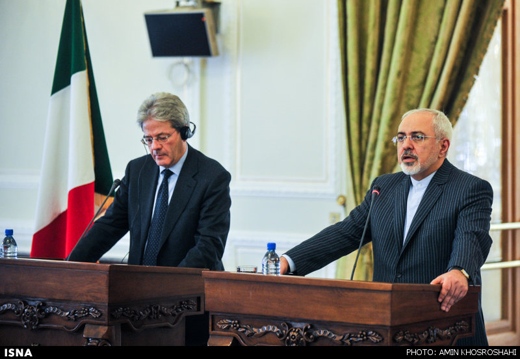
Lebanese Prime Minister Tammam Salam in a meeting with Chairman of the Iranian parliament’s National Security and Foreign Policy Committee Alaeddin Boroujerdi called for Tehran’s continued support for efforts to settle the crisis in his country over the election of a new president.

“We insist on the establishment of the best relations with Iran and hope that these relations will be established with all Lebanese groups,” Salam said during the meeting as reported by the London-based al-Hayat newspaper on Sunday.

“As you supported the formation of a cabinet during the complicated conditions that existed before, we hope that you will also help the progress of affairs towards ending the political vacuum and election of a new president,” he added.

Boroujerdi traveled to Beirut on Thursday to attend the commemoration ceremony of Hezbollah members who were killed in the Israeli airstrike on Syria’s Golan Height on January 18.

Besides his meeting with the Lebanese prime minister, Boroujerdi held meetings with Lebanon’s Foreign Minister Gebran Bassil and Lebanese Parliament Speaker Nabih Berri.

During his meeting with Salam, Boroujerdi underscored Iran’s continued support for security and stability in Lebanon.

Iran “is fully ready to play a vital, practical and serious role in support of efforts to strengthen and develop relations between Iran and Lebanon”, he told reporters on Friday after the meeting.

He also added that Tehran considers that Beirut plays an exceptional and prominent role in both the regional and global political developments.

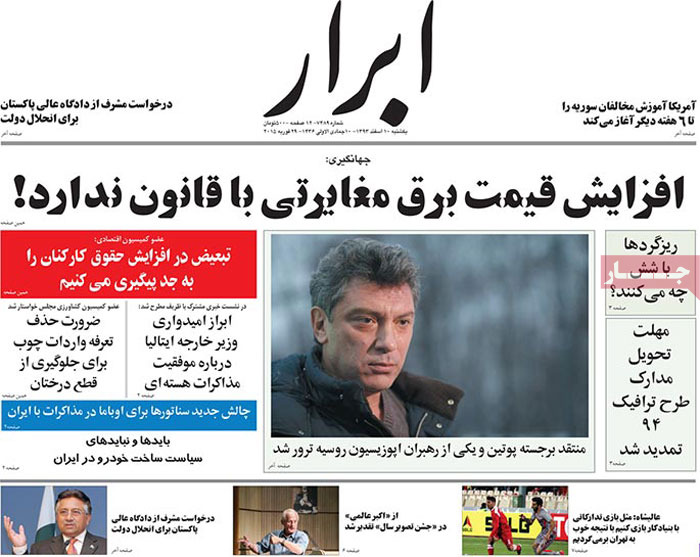
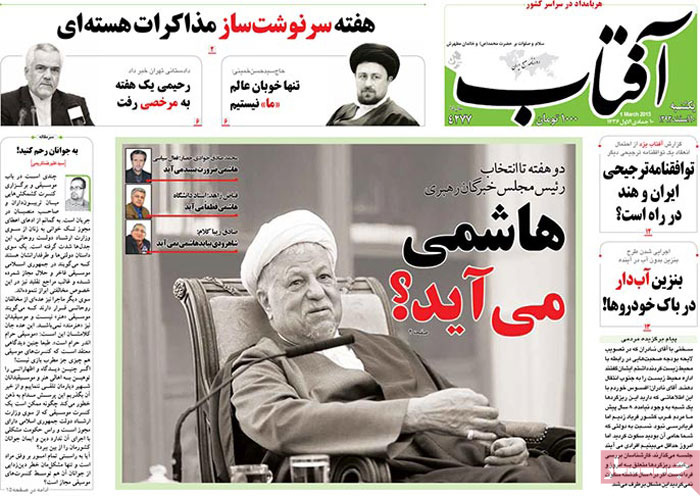
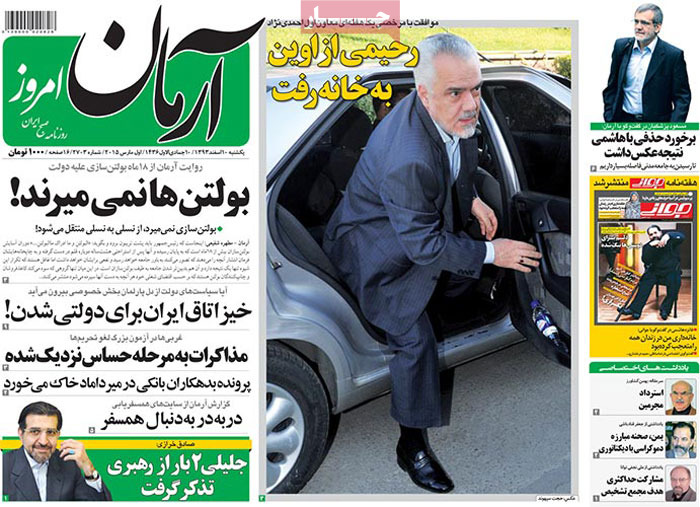
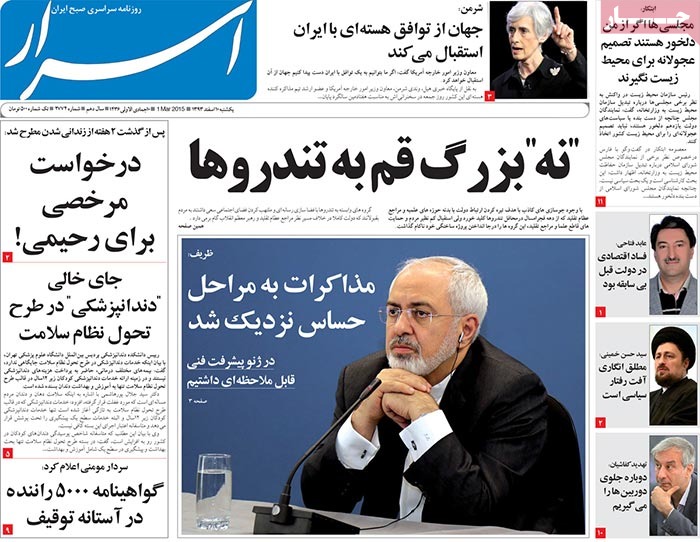
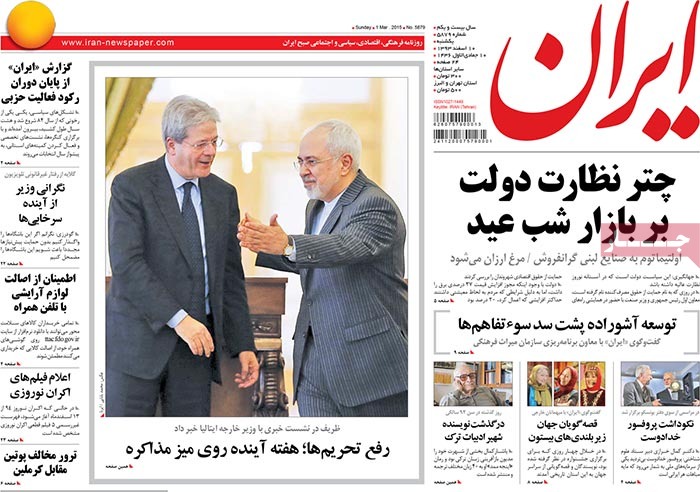
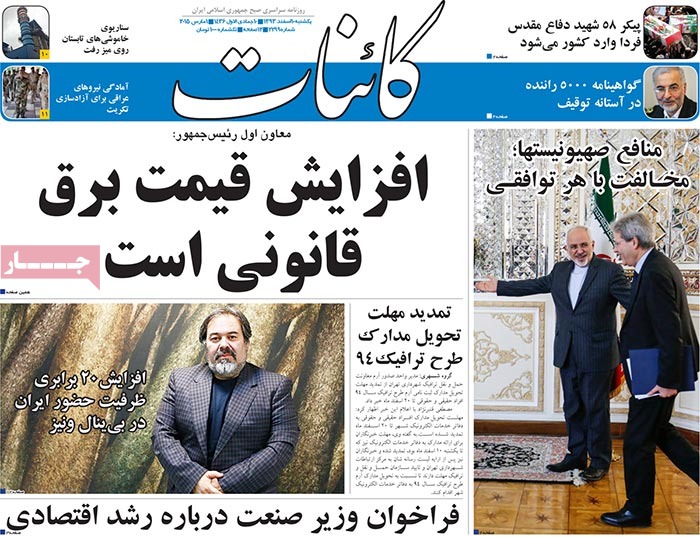
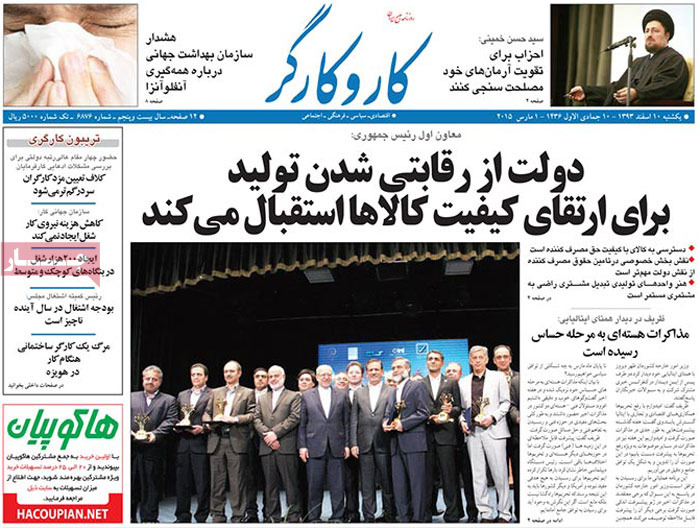
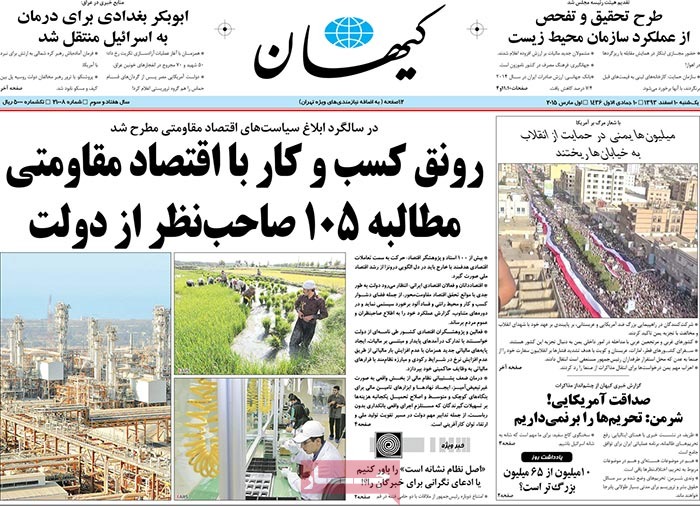
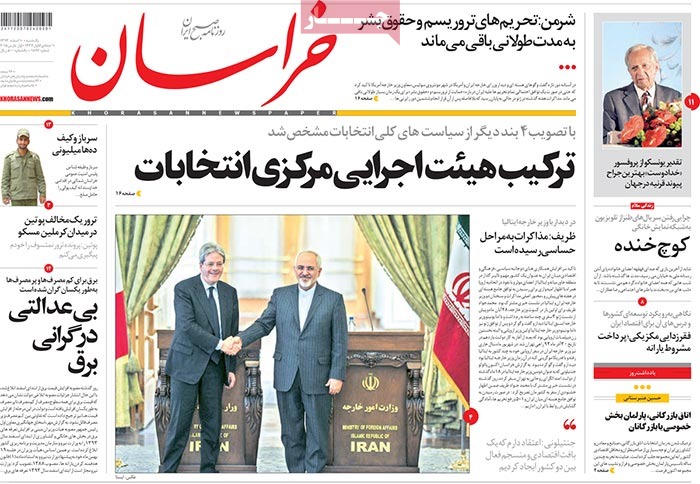
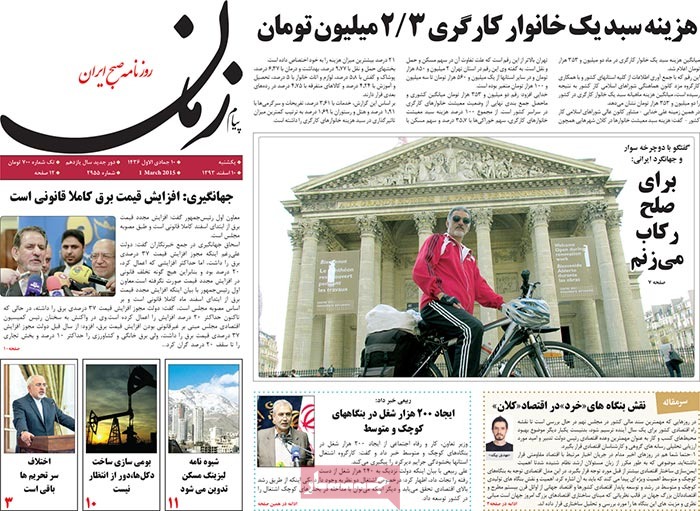
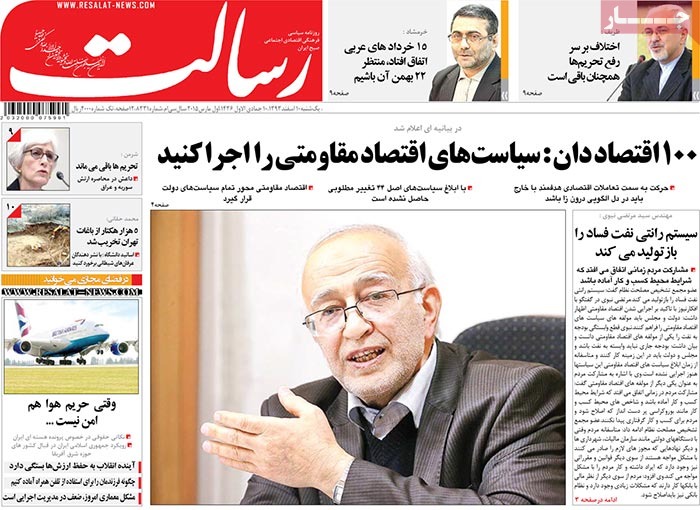
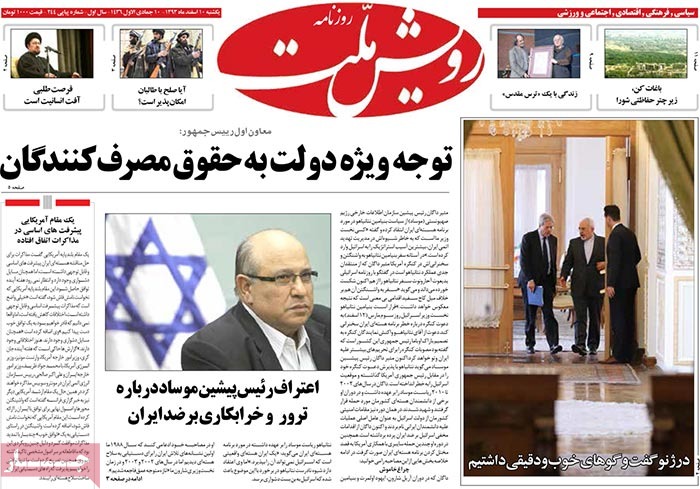
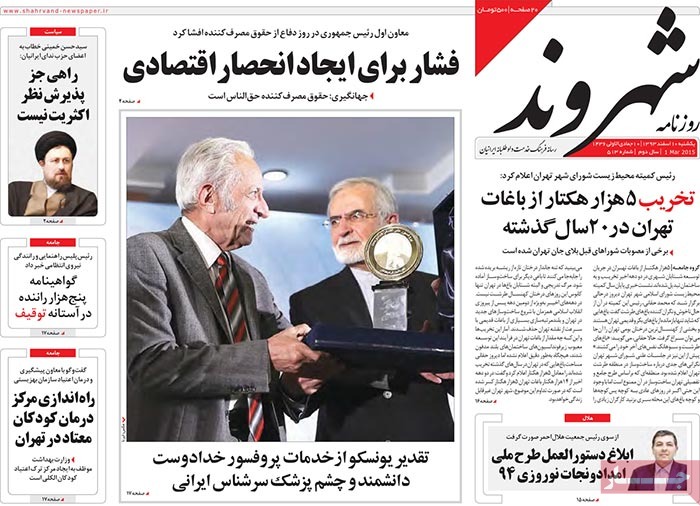
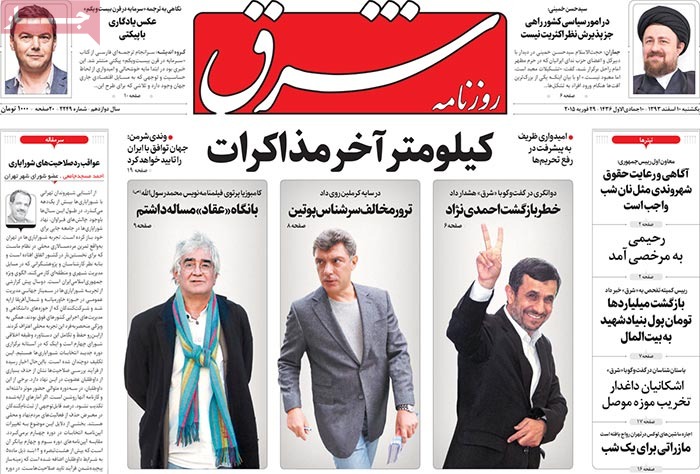
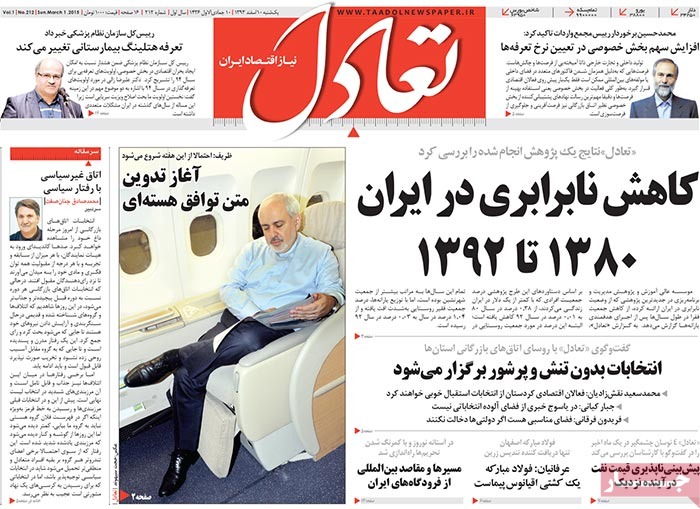
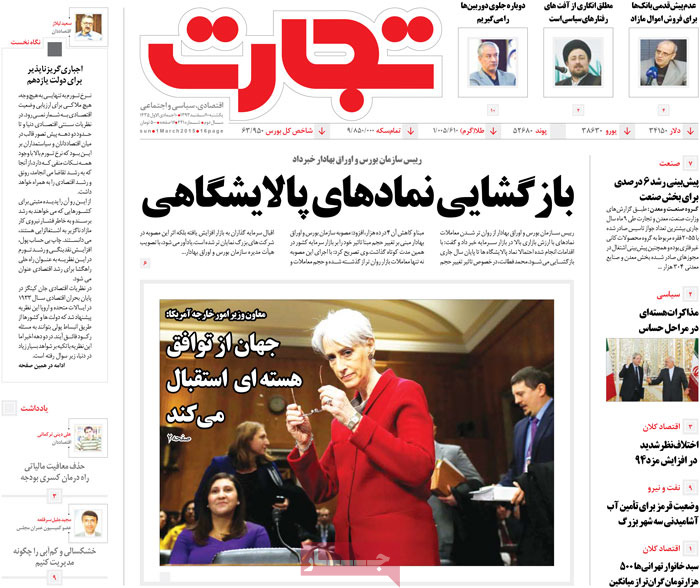
A look at Iranian newspaper front pages on Feb. 2

Iranian Newspapers Headlines

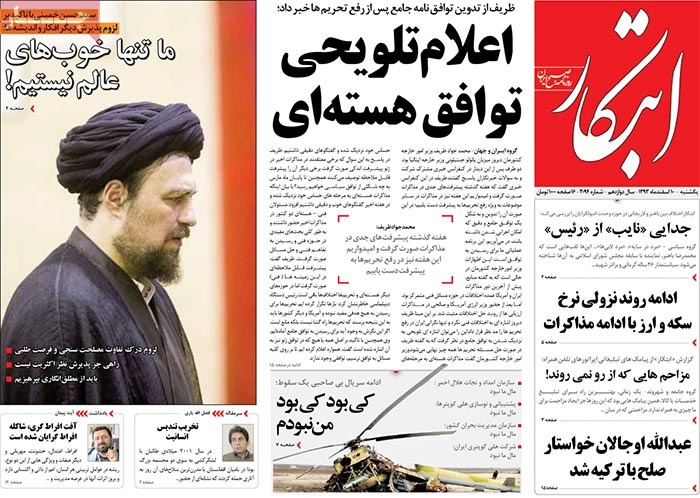
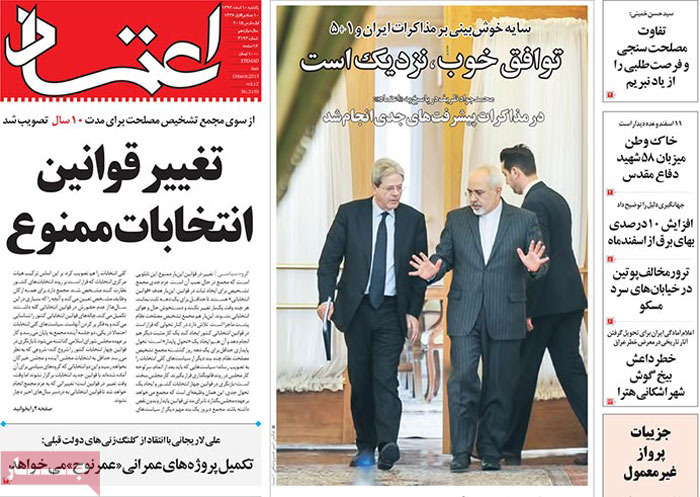
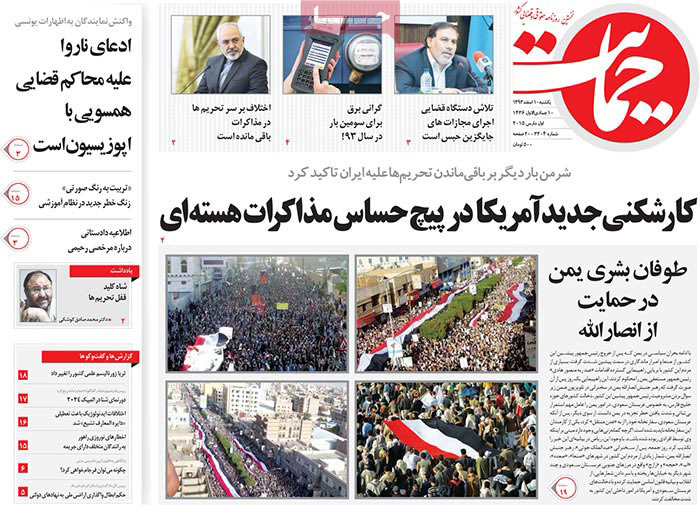
The aftermath of allegations by Former First Vice-President Mohammad Reza Rahimi that he has contributed $400,000 to the campaigns of 170 parliamentary candidates dominated the front pages of Iranian dailies Monday. The spokesman of the Guardian Council has said if those allegations are substantiated, the council will consider them in the vetting process of upcoming elections. Also on the cover of newspapers were the comments of the parliament speaker who blamed the US president for the potential failure of nuclear talks between Iran and P5+1. “Because of internal problems, President Obama cannot make a wise decision in response to the logical stance of the Iranians,” Larijani said.


Afarinesh: The 33rd edition of Fajr International Film Festival has officially opened in Tehran with a number of top actors and directors in attendance.


Afarinesh newspaper 2 - 2 - 2015


Afkar: School bells across the nation were sounded on Sunday to mark the moment the founding father of the Islamic Republic returned home 36 years ago.


Afkar newspaper 2 - 2 - 2015


Aftab-e Yazd: Tehran municipality has more than $11 billion in unpaid debts.

Aftab-e Yazd: “The property Babak Zanjani [who is expected to stand trial shortly for massive corruption] owns covers less than 30 percent of his debts,” announced the Ministry of Oil.


Aftabe yazd newspaper 2 - 2 - 2015


Arman-e Emrooz: Twenty parliament deputies have called for the list of MPs who have allegedly received money from a convicted former vice president to be made public.


Armane emruz newspaper 2 - 2 - 2015


Asr-e Iranian: A number of MPs have taken a swipe at the government for its reluctance to cut the cash subsidies of high-income individuals.


Asre iranian newspaper 2 - 2 - 2015


Asr-e Rasaneh: “In the first 10 months of the year, the government’s tax revenues have posted a 52 percent rise over last year,” said the director of the State Taxation Organization.

Asr-e Rasaneh: The Cultural Heritage Organization is working with other state institutions to have the country’s cultural items returned home.


Asre resaneh newspaper 2 - 2 - 2015


Asrar: The previous government employed some 500,000 individuals illegally.

Asrar: “Even at the height of the revolution, Imam would not resort to violence and extremism,” said the minister of roads and urban development.


Asrar newspaper 2 - 2 - 2015


Ebtekar: “The seventh parliament is to blame for the designation of Mohammad Reza Rahimi as the head of the Supreme Audit Court [before he was named first vice-president by Ahmadinejad],” said Mohammad Khoshchehreh, an economist and politician.


Ebtekar newspaper 2 - 2 - 2015


Eghtesad-e Pooya: The director of the Atomic Energy Organization has signaled Iran’s readiness to set up a nuclear power plant safety convention in the region.


Eghtesade puya newspaper 2 - 2 - 2015


Emtiaz: A ceremony will be held to celebrate the 80th birthday of renowned actor Ali Nasirian.

Emtiaz: Iranian athletes who bagged medals in the Asian Para Games in Incheon 2014 have been praised at a ceremony.

Emtiaz: A large gasoline production project will be launched by the end of the year.


Emtiaz newspaper 2 - 2 - 2015


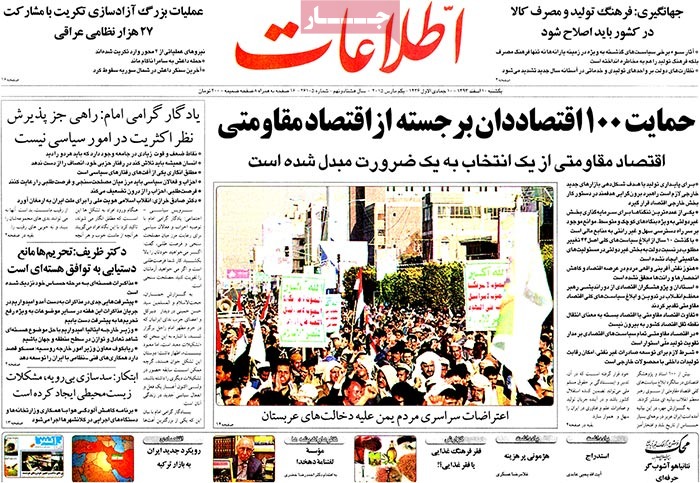
Ettela’at: Parliament has approved a motion under which Astan Qods Razavi, which runs the shrine of Imam Reza in the holy city of Mashhad, and economic institutions affiliated to the armed forces will have to pay taxes.


Ettelaat newspaper 2 - 2 - 2015


Jomhouri Islami: Some 400 mining projects will be inaugurated across the nation during Ten-Day Dawn [marking the anniversary of the victory of the Islamic Revolution].


Jomhorie eslami newspaper 2 - 2 - 2015


Kaenat: The State Taxation Organization has appealed to the judiciary for help, saying businesses owe it some $4 billion in unpaid taxes.


Kaenaat newspaper 2 - 2 - 2015


Kar va Kargar: The Iranian deputy foreign minister has met with the Egyptian president on the sidelines of an African summit.


Karo karegar newspaper 2 - 2 - 2015


Kayhan: The US has once again hailed the Geneva Deal; President Obama has said the world has stopped the nuclear progress of Iran without making any concessions in return.


Kayhan newspaper 2 - 2 - 2015


Sayeh: “It is necessary to update issues that have to do with jurisprudence,” said the chairman of the Expediency Council.


Sayeh newspaper 2 - 2 - 2015


Tejarat: Soccer clubs and players owe more in taxes than any other sport entities.


Tejarat newspaper 2 - 2 - 2015


Iran, Russia ties help Syria fight terror: Velayati

velayati-2

“Iran-Russia cooperation has been constructive, paving the way for the Syrian government and nation [to continue] their resistance under the legitimate leadership of Bashar al-Assad,” said Ali Akbar Velayati, a senior adviser to Leader of the Islamic Revolution Ayatollah Seyyed Ali Khamenei, in an interview with al-Alam news network.

Ties between Tehran and Moscow have had a profound impact on developments in regional and international relations, added Velayati, who was on an official visit to Russia last week as Iranian President Hassan Rouhani’s special envoy.

Tehran and Moscow have, on numerous occasions, emphasized the need for national dialogue among Syrian groups to help resolve the crisis, which has claimed over 200,000 lives so far.

Last year, Iran put forward a peace initiative, which stresses a political resolution of the Syria crisis, the territorial integrity, and independence of the Arab country as well as its people’s right to self-determination.

Moscow mediated negotiations on the Syrian crisis last week, with six members of the Syrian government meeting 32 members of various opposition groups. The initiative came after previous UN efforts to stop the hostilities between the conflicting sides in Syria failed to bear fruit.

Iran’s SCO membership

Velayati further pointed to the expansion of Tehran-Moscow ties in recent years, saying close relations between two sides are reflected in their cooperation within the framework of the Shanghai Cooperation Organization (SCO), where the Islamic Republic currently holds observer status.

Moscow, which is set to preside over the next SCO summit in summer, can play a positive role in the decision to grant Iran a permanent membership of the organization, Velayati added.

The SCO is an intergovernmental organization that was founded in 2001 in Shanghai by the leaders of China, Kazakhstan, Kyrgyzstan, Russia, Tajikistan and Uzbekistan.

During his trip to Russia on January 28, Velayati held a meeting with Russian President Vladimir Putin and gave Rouhani’s message to the Russian president in Moscow.

The two sides agreed on efforts for the promotion of Iran’s status at the SCO, according to the Iranian embassy in the Russian capital.

Iran’s 2008 application for full membership has so far been blocked due to sanctions imposed on the Islamic Republic over its nuclear program.

Pakistan will honor undertaking to lay gas pipelines on its side

iran pakistan gas pipeline

Pakistani Oil Minister Khaqan Abbassi assured on Sunday that the Pakistani government will fulfill its undertaking to lay gas pipelines on its side and Pakistan’s gas imports from Iran will begin as of late 2016 or early 2017.

The Pakistani oil minister whose comments were reported by the country’s mass media noted that Islamabad is involved in talks with Tehran to convince the Iranian officials to extend the delivery date of the Iranian gas transfer from its original 2014 to 2016 or one year later.

On reparation for Islamabad’s delay in completing the pipeline on the Pakistani side, the minister said that Iran has thus far not asked for compensations, but negotiations are underway to settle the dispute.

“Natural gas is cleaner, its imports are less costly, and the people in cities and villages can get easy access to it. That is why I predict that rather than one pipeline, Pakistan will ask for construction of three, or even four gas pipelines from Iran to our country,’ he added.

The completion of Iran-Pakistan gas pipeline – which was initially called the Iran-Pakistan-India Peace Pipeline and there were talks to extend it up to China – has been delayed for several times on the Pakistani side.

In line with efforts by President Rouhani’s government to seek détente with the world and the visit by economic delegations from different countries to Tehran, Islamabad has seemingly realized that the continued delay might put the Pakistani national interests at stake.

A firsthand account by a veteran journalist

Hamshahri-Imam Khomeini

Hamshahri daily on February 1 published an interview with a veteran journalist and professor of journalism, Fereydoon Sedighi, who used to be a Kayhan reporter 36 years ago when the late Imam Khomeini returned home from exile to topple the unpopular regime of the Shah.

Fereydoon Sedighi-1 Sedighi says the headline “The Imam Returned Home” [a famous banner headline of the Kayhan daily in February 1979] was somehow chosen by Imam Khomeini himself, [implying that Imam’s arrival home against all odds prompted journalists to pick the famous headline].

The following is the translation of the full interview with the veteran journalist and a witness to Imam’s homecoming:


Why were you picked to cover the home return of the [late] Imam for Kayhan daily?

There were three of us who were assigned to go to the airport that day [February 1, 1979]. We had already been selected. The late Hossein Partovi was the photojournalist who shot the famous photo featuring Imam in a meeting with a number of Homafars [an officer rank in the Iranian Air Force and Iran’s Army Aviation from 1968 to 1988].

The atmosphere was so heavy that Mr. Partovi went to hiding for 48 hours for the photo he had taken from Imam. He didn’t want to be arrested. Another group led by Mr. Mehdi Forghani had been based in Behesht-e Zahra Cemetery. They covered the speech Imam delivered in the cemetery of which the headline “I slap this government in the face” was highlighted.


At what time did you get to the airport?

We went there in the wee hours of the morning. Coordination work had been done with the daily’s senior staff beforehand. The airport had asked for the list [of reporters] and reporters could only enter the airport with pre-planned coordination. A special place had been dedicated to reporters. Back then the communications devices were not as common as today; there was no mobile phone and no easy access to communication devices. It was not at all like what we have today.


Do you remember how you relayed the news of Imam’s arrival to Kayhan in that atmosphere?

We had gone to the airport early in the morning. A site at the heart of the side corridor had been designated for the telephone contacts of reporters. The hall Imam was planned to enter through was flanked by the representatives of different [political] parties and groups carrying placards.

The Freedom Movement of Iran, the National Front, different organizations as well as students and teachers’ institutions had all sent their envoys to the ceremony. They all thought that Imam would enter the hallway, pay an inspection tour, and leave the scene heading for the intended destination.

Reporters and photographers had been stationed in the airport’s upper mezzanine overlooking the runway. The place was teeming with reporters from different media circles and broadcasters. A group of youth was waiting at a lower level of the building. One hour later we learned that they were members of the chorus which was to perform the famous Khomeini O Imam (Khomeini Ey Imam) song.

When Imam entered the place, the crowd mobbed him and everything was out of control. As a result, the meeting with the representatives of different groups – which were waiting for Imam’s arrival in an orderly manner – did not happen. In the meantime, the chorus began to sing the song. I heard it there for the first time.


Where was this group affiliated to?

I think the committee in charge of welcoming Imam had made preparations for this group.


When exactly did you make the first contact with the daily?

In that massive, packed crowd, the first contact with the daily was established when the plane [carrying Imam] touched down. I sent the report to the newspaper via an airport phone, saying for instance: ‘It is 9:27 a.m. Imam has come [home] and Air Force officers (Homafars) are at the airport. The photographers are standing on the airstair.’ I could only find an opportunity to relay the report that Imam returned home and it turned into a banner headline.


How many times did Kayhan go to reprint that day, February 1, 1979?

I heard five times. Back then only four cover pages of Kayhan used to be reprinted. “The Imam has returned home” was a Kayhan headline that day. Another was “I slap this government in the face”. The day Imam returned home, Kayhan’s print run exceeded one million. It was an unprecedented, strange and unrepeatable event in the history of the Iranian media before and even after the revolution.


Could you go back to the daily’s office that day?

It was all but impossible to return. A raging sea of people was in the city. As a reporter, I was to follow the car carrying Imam to pursue the rest of the unfolding news. But it was virtually impossible for me who was a thin, frail young man. The entire city was on the move. For a while I ran after the car, but I came to realize that I was being crushed. I melted into the crowd.

Have you ever gasped for breath?

Ahvaz-Tehran

On February 1, Haft-e Sobh, a daily, carried an opinion piece on air pollution by Soroush Sehat, a TV and screen actor and director. What comes next is a partial translation of the piece:

It’s true that a lot is going on in the world, and there is news of war, conflicts and crises everywhere, but for a person like me who lives in Tehran, the most important news story is that the day before yesterday, there was a slight drizzle and yesterday winds blew, the sky finally cleared and turned blue, eventually snow-covered mountains along with buildings in the distance became visible and at long last we were able to take a breath, in fact a deep one.

When my friend went through my note, he said now that I had written something about the air in Tehran, I had to drop a few lines about air pollution in Khuzestan Province. I asked him what was wrong with the air there. Astonished by my question, he said in Ahvaz you can barely breathe; there are so many particulates in the air that everywhere looks yellow in the photos.

I went out to buy a newspaper and among different news stories in it I came across an article on air pollution in Khuzestan which has made it difficult for residents to breathe. I took a look at the photos which featured the residents of Ahvaz, wondering what it would be like to suck in and let out breaths with difficulty. Have you ever gasped for breath?

Previous government helped fulfill American wishes: Former ambassador

SAadegh Kharazi

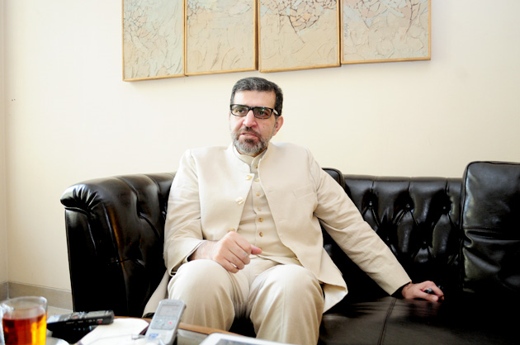
The Law School of the Islamic Azad University in Mashhad hosted a Q and A on Iran’s foreign policy under the 10th government [Mahmoud Ahmadinejad’s] and 11th government [led by Hassan Rouhani] featuring Sadegh Kharrazi, a former Iranian ambassador to France. The following is the translation of a report Sharq daily published on February 1 on some of the comments he made:

Kharrazi said, “The glaring miscalculations of the ninth and tenth governments [both led by Mahmoud Ahmadinejad] led to a decline in Iranian authority. The six resolutions adopted during his presidency put Iran in the crosshairs of foreign threats. The wartime government and the one that followed it to lead the country’s reconstruction drive were a source of authority, but the ninth and tenth governments failed to maintain the country’s powers.

“Instead of building on the legacy it inherited from previous governments, the Ahmadinejad administration opted for adventurism for which the Iranian people paid a price. For instance, the capture of British sailors and the subsequent release of them were merely designed to showcase the authority of the president and brought about nothing of significance for Iran.

“Initial declarations that Israel should be wiped off the map and subsequent expression of readiness to establish relations with that country were other measures which prompted the Supreme Leader to intervene and manage things.”

Kharrazi hailed the Khatami administration’s performance on the foreign policy front as successful and said, “Our rivals were bogged down in the Iraqi quagmire in 2005 and global resentment at them was at their peak. The downfall of Saddam and the Ba’ath Party, the collapse of the Taliban, which is the most dreadful security organization in the world, all came during that period.

“After 9/11 Iran turned into one of the biggest foreign policy players in the world. We were the first country to react to the terror strikes. On November 22 and December 13 two more incidents helped Iran go into the lead as far as peaceful diplomacy was concerned. That was the legacy the reformist government left behind for Ahmadinejad.”

He went on to say, “Iran floated the idea of dialogue among civilizations; Iran had something to share with the rest of the world. If that idea which took aim at the clashes among civilizations had been taken seriously and complied with, so many innocent lives would have been spared.

“As of 2005, not a single resolution had been adopted in Europe or the United Nations against the [Palestinian] resistance or Hezbollah. Thanks to the ninth and tenth governments, Hezbollah was labeled a terrorist entity. For some 30 years, the US dreamed of taking Iran’s case to the Security Council [once following the embassy takeover, once when UN Security Council Resolution 598 was adopted, and once in 2003 because of nuclear allegations]. On all three occasions the US sought to haul Iran before the UN Security Council.

“Eventually because of the hearty noise these individuals made, the US dream was fulfilled and Washington was able to depict Iran’s technical activity as a security case.”

In conclusion, he said, “Up until two years ago the world was talking about adopting new resolutions against Iran. But today nullifying the resolutions is the new talking point. Up until two years ago the world was talking about imposing new sanctions against Iran. But today removal of sanctions is the new talking point.

“The logical tone of the new government, supported and guided by the Supreme Leader, indicates a bright future lies ahead for the country. The ninth and tenth governments received the largest number of warnings, but these things aren’t supposed to be talked about.”

Iran busts Facebook band involved in criminal acts

Facebook

The Islamic Revolution Guard Corps (IRGC) said it has identified and arrested members of a cyber-group involved in propagating obscene contents on the Internet via Facebook.

An IRGC center combating organized cyber-crime said in a statement on Saturday that it has managed to arrest the major elements behind those criminal activities in an operation, codenamed Spider.

Those captured, who received indirect and covert support from the Western governments, had targeted a remarkable number of Facebook users in the guise of cultural and social pages over a span of two years, the statement said.

The Internet group had a mission to “spread corruption, change the Iranian lifestyle and target the families across the country,” it added.

Supreme Leader of the Islamic Revolution Ayatollah Seyyed Ali Khamenei had already warned against hostile moves by enemies of Iran to damage the country’s cultural values, and urged authorities to deal with the issue of cultural onslaught in a wise, calculated manner.

In December 2013, the Leader urged caution in dealing with the cultural onslaught launched against Iran by the enemies – particularly the US – and emphasized the need for vigilance in the face of “activity of hundreds of print and electronic media in the world with the certain aim of affecting the Iranian nation’s mind and behavior.”

A dreamy look at realities on the ground

Rouhani-tv

Kayhan daily on January 31 ran an opinion piece by Hossein Shamsian in which he takes a swipe at President Rouhani’s government for what he says is focusing too much attention on nuclear talks. Shamsian then disputes as half-baked the idea which says “removal of sanctions” would translate into “settlement of the country’s economic problems”.

He also takes a closer look at “the government’s failure to pay attention to [national] production and employment which were among Candidate Rouhani’s top election pledges”.

The columnist then brings under focus the country’s economic woes, partly blaming lack of proper planning for the current troubles Iran is grappling with. The following is a partial translation of what else he has written in the critical piece:

[…]

What is clear, and at the same time undeniable, is the government’s attention to and focus on [nuclear] talks and its efforts to offer salvation [for the country from the bite of sanctions] by lifting the sanctions!

Nobody can deny such a clear proposition. Each week Iranian officials live the big dream of sanctions removal and share their dreams with people despite comments by arrogant Americans on exerting more and more pressure on Iran.

[…]

How can the existing problems be removed under such circumstance? Does playing with words by the [first] vice-president help? What about his articulation of poetic-like statements like “The budget of next year [starting March 2015] is disciplinary, not contractionary”? […]

Isn’t it right that measures should be taken to make smuggling in goods a thing of the past? […]

Isn’t it right that solutions should be worked out for massive tax evasions? […]

Isn’t it right that the government does not want to damage its fictional prestige by cutting the subsidies of high-income people? […]

We do not forget that on the campaign trail Dr. Rouhani made the following sarcastic comment about employment, “That’s right. Jobs have been created, but for the Chinese industries and for Chinese workers!”

The question that arises here is how many jobs have been created for Iranian workers given the alarming rise in imports, and even worse, the smuggling of one-third of all imported items? […]

Certain people in the government have delegated all responsibilities to the Foreign Ministry and defined its [main] mission as establishing ties with the US.

One and a half years have passed since the [eleventh] government came to office with the unique experience of trusting the US, which is the Iranian nation’s number-one enemy.

In the past, maybe it was possible to tell people that talks with “The Headman” [a reference to the US] would rapidly settle their problems, but it is not the case anymore. Today nobody buys what they sell, even the closest people to the government, because 12 months of flexibility have resulted in nothing but impudent and shameless attitudes by Washington.

Constant concessions in return for yet-to-be-kept promises have led the country to the point in which the government has been unable to name an envoy of its own choosing to the United Nations. In a painful process, it had to change its pick for the UN ambassador!

As things stand, isn’t it better to replace ‘agreement at any cost’ with efforts to tap into domestic potential, rely exclusively on people and the youth who are the country’s assets and work toward a solution to the [troubled] economy?

Other than the government, those MPs who are involved in debates [on parliament floor] on the country’s spending package are responsible too.

Kerman holds biggest Zoroastrian Sadeh Festival

Zoroastrian-2

On January 30 each year, Zoroastrians from all over Iran and other countries gather in Kerman, southeast of Iran, to celebrate the Zoroastrian Sadeh Festival by burning firewood outdoors.

Every year, on January 30, thousands of Zoroastrians and even Muslims from across Iran as well as other countries gather in Kerman, the city with the greatest Zoroastrian population, to celebrate the religious feast of Jashn-e Sadeh by burning firewood in an open space to celebrate the coming of spring and the victory of light over the forces of darkness, frost and cold.

Sadeh (meaning ‘hundred’ in Persian) is a mid-winter festival which is celebrated 50 days before Nowrouz, the Persian New Year.

Mohammad Ali Golabzadeh, a researcher who specializes in Kerman studies, told Mehr News that the ceremony is still celebrated like the ancient times in Kerman, Yazd, and some other Iranian cities.

“Although Sadeh is attributed to Zoroastrians, the ceremony itself has its roots in Kerman’s rituals and even Muslims participate in it,” he said, adding that to the majority of Iranians Sadeh is not a religious occasion and people simply gather together to have a good time and celebrate the precious things God has granted humanity.