Saturday, December 27, 2025
Home Blog Page 4948

Iran must continue nanotechnology progress

Leader-Nano

Leader of the Islamic Revolution Ayatollah Seyyed Ali Khamenei says Iran should continue to make more progress in the field of nanotechnology and biotechnology, which can serve as a model for progress in other sectors.

The Leader made the remarks in a Saturday visit to an exhibition displaying Iran’s latest nanotechnology achievements.

Ayatollah Khamenei added that maintaining the elements that have caused progress is necessary to continue making more achievements.

The Leader stated that “accurate planning” and “stability in management” are among the factors that can contribute to continued progress in nanotechnology.

Ayatollah Khamenei added that political motivations should not affect the country’s scientific and research arenas.

The Leader further pointed to the enmity of bullying powers with the Iranian nation due to its independent political, social and intellectual approaches and said, “This hostility exposes itself in different fields. So, we should make ourselves stronger day by day to achieve the necessary strength.”

Berlin Film Festival to screen four Iranian films

Berlin film festival

Four Iranian films are to be screened at the 65th edition of the Berlin Film Festival (Berlinale), scheduled to open in the German capital on February 5, the spokeswoman of the film event, Frauke Greiner told IRNA.

Jafar Panahi’s ‘Taxi’ will be in the running for this year’s top award — the Golden Bear — at the Berlin Film Fest.

Other Iranian movies at the Berlinale include the joint French-Iranian production ‘Paridan az Ertefa Kam’ (A Minor Leap down) directed by Hamed Rajabi and featuring Rambod Javan and Negar Javaherian.

In addition, Ali Ahmadzadeh will showcase his movie ‘Madare Ghalb Atomi’ (Atom Heart Mother) whose cast include famous Iranian actor and actress, Mohammad Reza Golzar and Taraneh Alidoosti.

In the Berlinale children’s section, Iran will show an animation: ‘Mahiye Sorkh Karde’ (Fried Fish) produced by Leila Khalilzadeh.

Iranian films at the Berlinale have made international headlines in recent year after winning the much-coveted Golden and Silver Bears.

Berlionale director Dieter Kosslick has played a key role in admitting Iranian movies to the Berlinale, since being named the director of the Berlin film event in 2001.

A fan of Iranian cinema, Kosslick has said he feels personally touched by Iranian movies.

Kosslick pointed out Iranian cinema always touches ‘his hearts and soul.’

Ali Motahari makes critical analysis of revolution

Ali Motahari

Ali Motahari, a principlist MP representing Tehran in the Islamic Consultative Assembly, has said that the Iranian revolution has sustained losses from modernism, opportunists and power-seekers, blaming the lack of freedom of expression – over the past one and a half years – on the government’s reformist tendencies.

Etemad newspaper on January 31 quoted Motahari as saying that more pressures are heaped on the government because of its reformist approaches. The following is a brief translation of what else Motahari told a Democracy Party Congress on Thursday:

“When I review the media, I see that self-censorship is on the rise. Today the press agencies are more fearful of possible closure and license revocations than during the previous government. This is a serious drawback,” he said.

The former member of the Press Supervisory Board further stressed the need for clarifying the responsibility of the board and its ties with the prosecutor’s office.

“[The late] Imam said that even Communists are allowed to be active in the Islamic Republic. Compare it with the present. We should not extend wartime mentality and decisions to the present,” he said.

“As long as a person or a group does not take up arms, they should not be restricted simply because they hold opposing views,” he concluded.

Motahari then called on moderate reformist and principlist figures to unite and counter extremist and opportunist attitudes, saying that by doing so the country can have better days in the future.

Alimestan Forest in northern Iran in photos

Iran Alimestan Forest

Alimestan, a touristy village at the heart of Amol in Mazandaran Province, is known as Iran’s green gold. Shrouded in a curtain of mist, the region is home to thick and dense forests. Alimestan Peak is another tourist attraction with an elevation of almost 2,510 meters.

The following are the photos Shomalnews.com posted on its website on January 25 of the scenic beauty of the region:


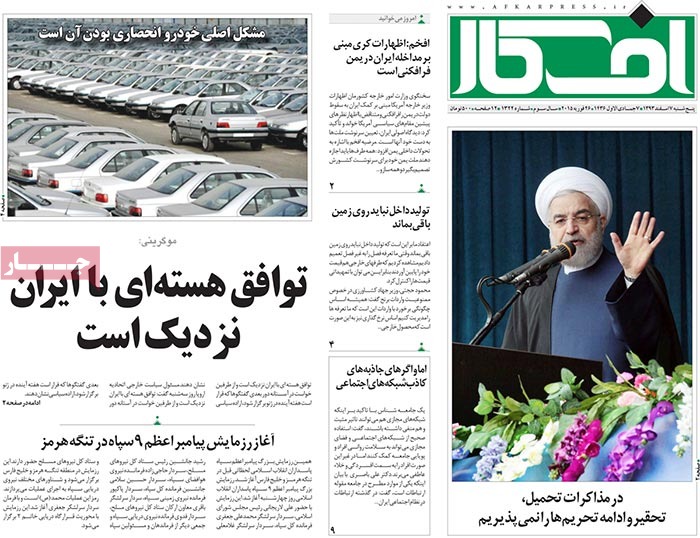
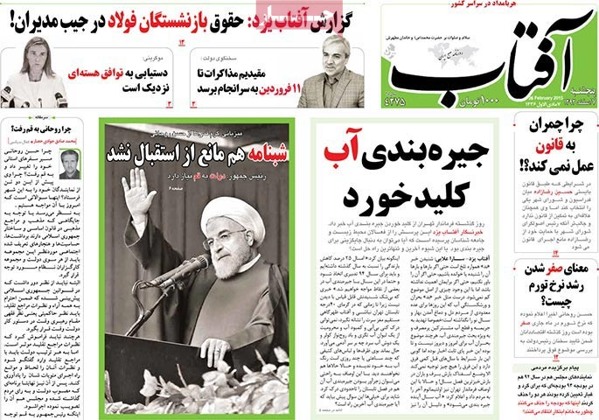
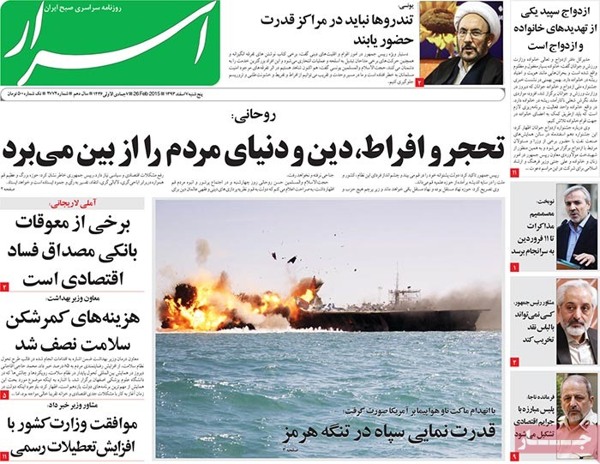
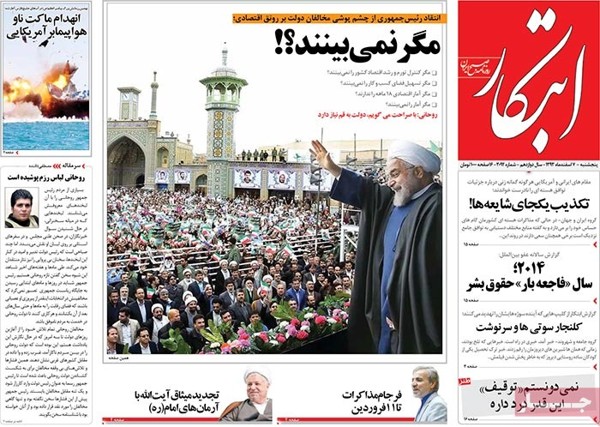
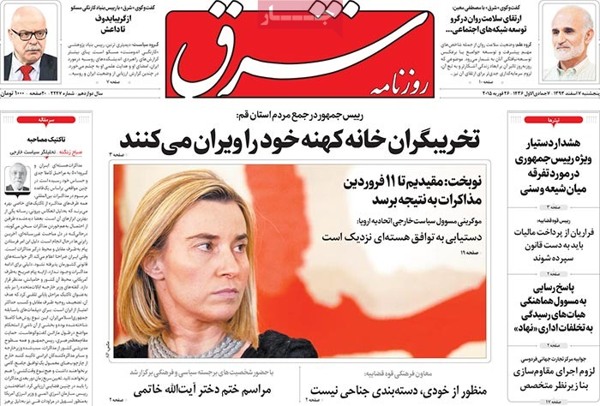
A look at Iranian newspaper front pages on Jan. 31

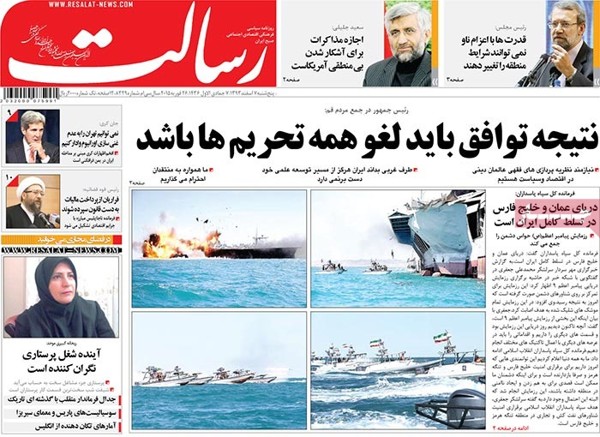
Iranian Newspapers Headlines

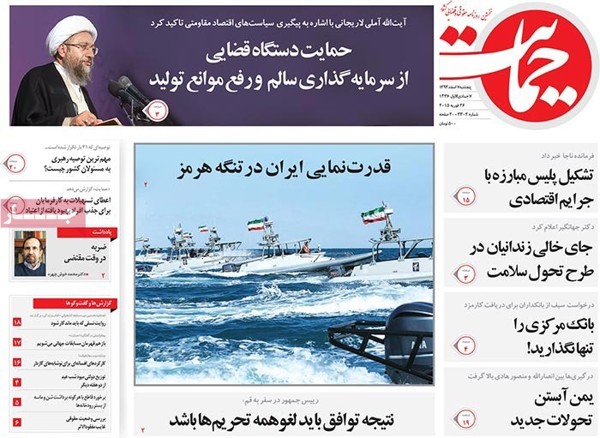
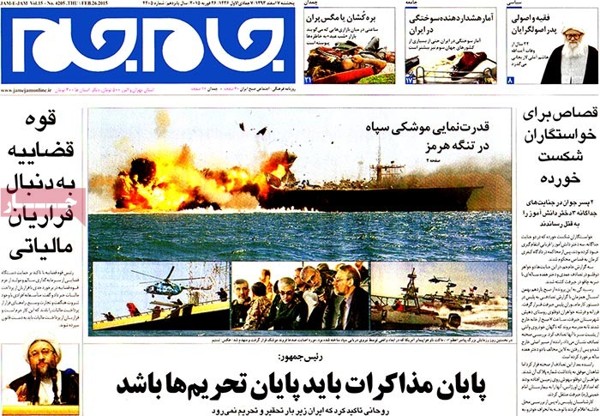
Remarks by President Hassan Rouhani that discrimination against women in sports should become history made headlines in most Iranian dailies on Saturday. Iranian newspapers also put on their front pages comments by Lebanon’s Hezbollah leader Seyyed Hassan Nasrallah in which the cleric lashed out at the Tel Aviv regime and said Hezbollah would retaliate against the Zionist regime if and when it harms the interests of the movement.


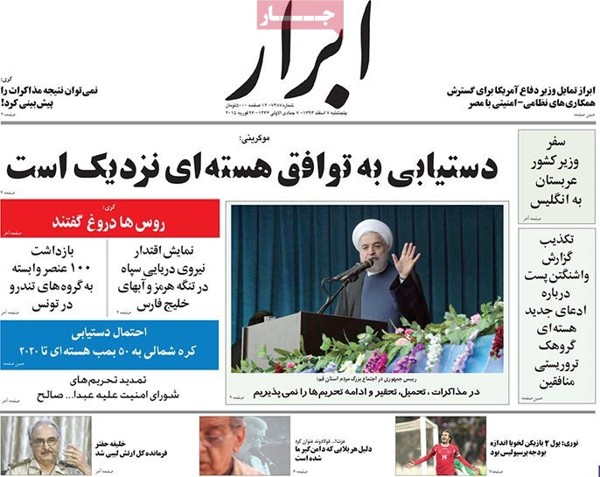
Abrar: “I hope a [nuclear] deal will be clinched by the end of the year [March 21, 2015],” said the director of the Atomic Energy Organization of Iran.


Abrar newspaper 1- 31


Aftab-e Yazd: The Intelligence Ministry has dismissed rumors that the director of a privately-run bank has fled abroad.


Aftabe yazd newspaper 1- 31


Arman-e Emrooz: “Some individuals seek to throw Hashemi and Nategh Nouri overboard,” Ali Motahari, a principlist MP, told a Democracy Party Congress.

Arman-e Emrooz: The third phase of targeted subsidies won’t come into effect next year.


Armane emruz newspaper 1- 31


Asr-e Eghtesad: “The volume of trade between Iran and Russia is to hit $20 billion,” said Ali Akbar Velayati, a special envoy of President Rouhani after submitting a message to Russian President Vladimir Putin.


Asre eghtesad newspaper 1- 31


Asr-e Iranian: “Some think the US provides their most basic needs,” Tehran Friday prayer leader Ayatollah Ahmad Jannati said [in taking a swipe at those who support continued negotiations to cut a deal with the US].


Asre iranian newspaper 1- 31


Asrar: “Imports of gasoline from abroad will stop as of next year [late March 2015],” said a deputy oil minister.


Asrar newspaper 1- 31


Ebtekar: President Rouhani has supported women’s widespread presence in sports.


Ebtekar newspaper 1- 31


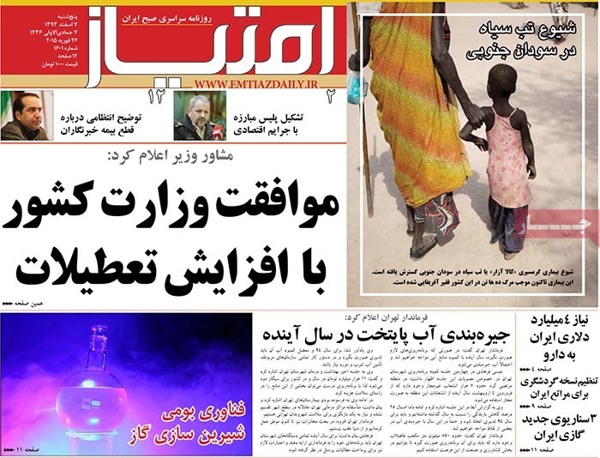
Emtiaz: “World oil giants are waiting for the removal of sanctions to find their way back to the Iranian market,” said the Iranian oil minister.

Emtiaz: Iranian sportsmen and women who bagged medals in Incheon Asian Games in South Korea have been awarded at a ceremony attended by President Rouhani.


Emtiaz newspaper 1- 31


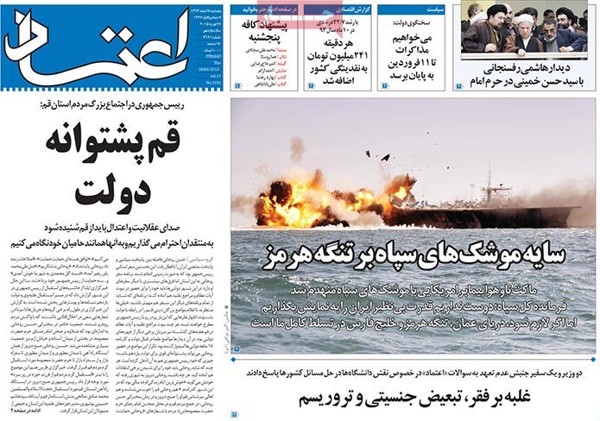
Etemad: Ghasem Soleimani, the commander of the Quds Force of the Islamic Revolution Guard Corps, has met with Seyyed Hassan Nasrallah, the leader of the Lebanese Hezbollah movement.


Etemad newspaper 1- 31


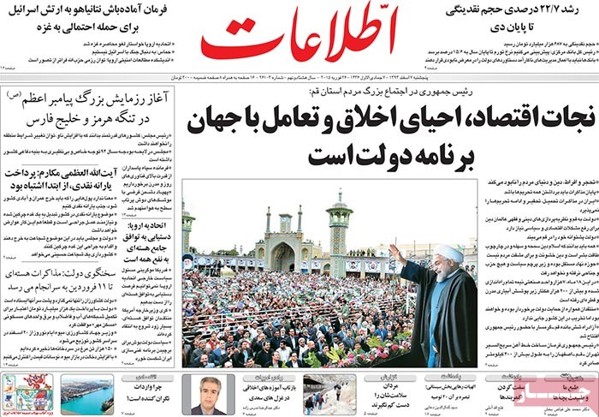
Ettela’at: “Discrimination against women in sports should come to an end,” said President Rouhani.


Ettelaat newspaper 1- 31


Hambastegi: “To help the reformist mentality win in the upcoming elections, we need to seek consensus and put together a single ticket,” said Mohammad Reza Aref, a senior reformist leader.


Hambastegi newspaper 1- 31


Ghanoon: Iran is to host a world gathering of tour leaders in 2017.


Ghanoon  newspaper 1- 31


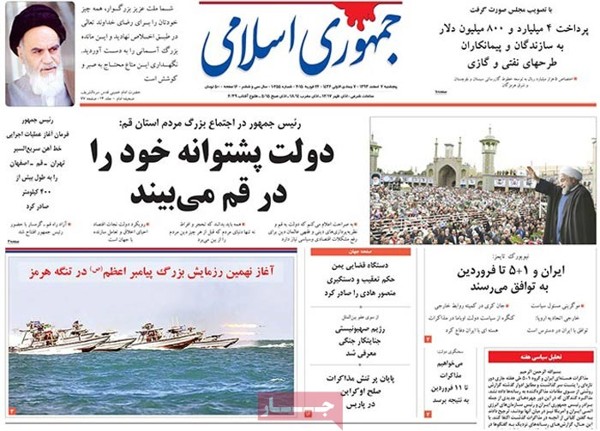
Jomhouri Islami: “Unfortunately, instead of circling the wagons, some are driving people out of the circle of revolution,” said Ali Motahari, a principlist deputy who represents Tehran in the Islamic Consultative Assembly.


Jomhorie eslami newspaper 1- 31


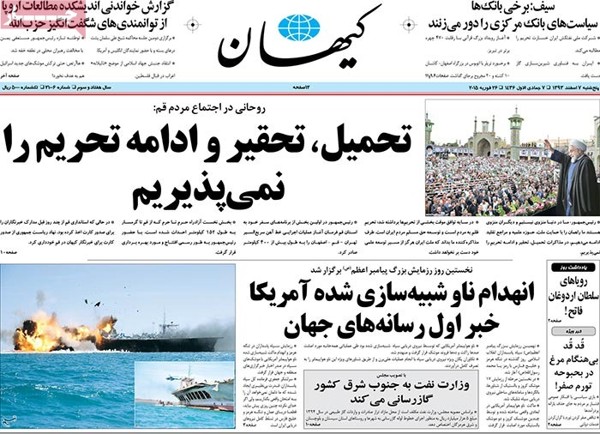
Kayhan: At the expense of Iranian reputation, the government has backed down in the face of US pressures by changing its nominee for UN ambassador [following America’s failure to grant a visa to the previous choice.]


Kayhan newspaper 1- 31


Khorasan: “Each year between $2 billion and $4 billion in low-quality Chinese clothing is smuggled into the country,” said a senior member of the commission that leads the fight against smuggling in goods.


Khorasan newspaper 1- 31


Iran condemns terrorist attacks in Sinai Peninsula

Iranian Foreign Ministry Spokeswoman Marziyeh Afkham

Foreign Ministry Spokeswoman Marzieh Afkham on Friday condemned terrorist attacks in Egypt’s Sinai Peninsula.

Afkham said such terrorist actions “aim to get Islamic countries involved in minor issues and get them distracted from the top priority of the Muslim world which is supporting Palestinian people and defending the Holy Quds.”

Forty-eight people were killed and 105 injured on Thursday in a series of attacks on soldiers and police in north-east Sinai, where the government of Egypt has struggled to contain an 18-month insurgency by terrorist groups linked to ISIL.

The Egyptian army said militants had attacked army and police bases in Arish, the region’s capital, with car bombs and mortar attacks.

Iran welcomes enhanced ties with Saudi Arabia, Lebanon: MP

Broujerdi

“The Islamic Republic of Iran attaches special significance to strengthening security and stability in the region, [including] in Lebanon,” Chairman of National Security and Foreign Policy Committee of Iran’s Parliament (Majlis) Alaeddin Boroujerdi told reporters after a meeting with Lebanese Foreign Minister Gebran Bassil in Beirut on Friday.

He added that the ongoing political developments in the region can help restore security, peace and stability to Lebanon.

Boroujerdi is in Beirut to participate in the commemoration ceremony of six Hezbollah members and a general of Iran’s Islamic Revolution Guard Corps (IRGC) who lost their lives in an Israeli airstrike on Syria’s Golan Heights on January 18.

The Iranian legislator said he had held “constructive and positive” talks with the Lebanese foreign minister on the latest developments in the region and ways to improve Tehran-Beirut relations, particularly in trade and economic sectors.

On January 18, an Israeli military helicopter fired two missiles into Amal Farms in the strategic southwestern Syrian city of Quneitra, close to the line separating the Syrian part of the Golan Heights from the Israeli-occupied sector.

Six Hezbollah members as well as the IRGC general, Brigadier General Mohammad Ali Allahdadi, lost their lives in the Israeli assault.

On Wednesday, Hezbollah killed two Israeli soldiers in a retaliatory attack on an Israeli convoy in northern occupied territories.

Interim political deal likely by March: Iranian nuclear negotiator

Araqchi

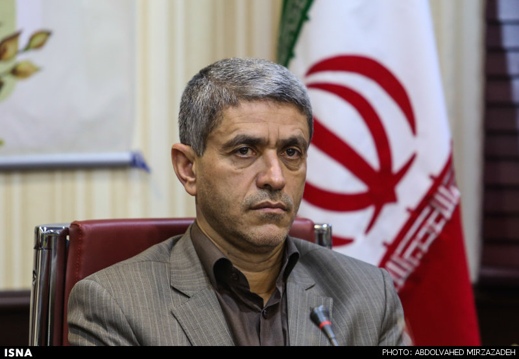
Iranian Deputy Foreign Minister Seyyed Abbas Araghchi described talks with P5+1 over Tehran’s peaceful nuclear program as a difficult “marathon”, but said an interim agreement could be reached by March.

“The marathon of negotiations continues,” Araghchi said after four hours of negotiations with his French, British, and German counterparts on Thursday, adding “We are trying to reach a preliminary political agreement by March”.

Deputy foreign ministers from Iran and the European members of P5+1 (also known as E3+3) held one-day nuclear talks in Istanbul on Thursday.

The talks were part of regular meetings between Tehran and the world powers aimed at settling a decade-long standoff on Iran’s nuclear case.

“Simultaneous negotiation with six countries is difficult,” he stressed, noting that the six countries have diverse opinions on the issue.

The senior negotiator said the Iranian delegation held good negotiations with the three European countries on Thursday, days after their bilateral talks with the Americans.

Araghchi added that talks with the Russian and Chinese sides are also held regularly.

He further described the negotiations as “very useful”, but noted that it is too early to say that progress has been made.

Iran and P5+1 are in talks to hammer out a final agreement to end more than a decade of impasse over Tehran’s nuclear energy program.

What is really going on in Yemen? An expert point of view (PART ONE)

Yemen-map-jpg

A Middle East expert says that Saudi Arabia along with its fellow Persian Gulf Cooperation Council members is seeking to disintegrate Yemen. They are trying to wage North-South wars to dissuade Yemen’s revolutionaries from having a democratic system. The reactionary Arab regimes are fearful of democracy, and not Shiites.
Four years have passed since Yemeni strongman Ali Abdullah Saleh was ousted, but the southwest Asian country is still in the grip of dictatorship because Abd-Rabbu Mansour Hadi, Yemen’s vice-president under Saleh, took over as the head of a transitional government, following in the footsteps of the toppled president.

Mansour Hadi stepped down on January 23. Although the Arab country’s parliament didn’t initially accept his resignation, it has rejected his recent decision to withdraw his resignation.

Houthi Shiites staged peaceful rallies and sit-ins to protest the government’s failure to meet their demands and honor Hadi’s promises, calling for the removal of the president. However, the rallies turned ugly and supporters of Houthis and the tribes backing the Ansarullah movement eventually managed to force Mansour Hadi to quit in two weeks.

Analysts say that the Yemeni case is of paramount significance to new Saudi King Salman bin Abdulaziz, citing speculations that a possible alliance between Shiites in Yemen and Saudi Arabia could pose a grave threat to Riyadh.

Ghannad BashiJafar Ghannad-Bashi, a Middle East expert, believes that Saudi Arabia is not facing the threat of disintegration, but that Yemen is highly likely to fall apart.

Khabaronline’s Zohreh Norouzpour had an interview with Ghannad-Bashi on January 27, putting Yemen’s developments under the microscope. The following is PART ONE of the translation of the interview:


How do you evaluate the downfall of the Yemeni government and the possible takeover by Houthi Shiites? 

Based on what we’ve seen since midsummer, they [Houthi Shiites] are representing the Yemeni people trying to protect their revolution. Houthis who are defending people are not exclusively Shiite; there are also Sunnis in their ranks who support the Ansarullah movement. They are calling for the revolutionary demands of people to be met, among them a regime change, ouster of corrupt government officials, and an end to interference in Yemen by Arab and foreign countries as well as Arab kings and reactionaries.
Ansarullah has so far successfully passed its tests, taking control of the revolution and its leadership. Having faced multiple challenges over four years, Ansarullah, which is massively popular, has managed to land the revolution on the right path, and above all, it has demonstrated good leadership.

Yemen’s popular revolution is very complicated. Tribes are politically active there. Tribal leanings affect the country’s political trends. Yemen used to be two independent countries in the past: North Yemen and South Yemen. Separatist tendencies are still palpable in Yemen; that’s why it is a complicated revolution.
Another challenge is that former President Ali Abdullah Saleh did not leave office outright. His deputy – Mr. Mansour Hadi, the president who was forced to quit – took charge after Abdullah Saleh. Ansarullah held peaceful protest rallies, sit-ins and strikes this past summer. Ansarullah, which has taken the upper hand since the fall, finally achieved its goal: resignation of Mansour Hadi.


What do you mean by complexity of the Yemeni revolution?

When a revolution is in the making against a totalitarian system, supporters of the autocratic rule and people opposed to it line up against each other and in most cases the lineup is clear. But what happened in Yemen broke the ranks of the revolutionaries. The lines were blurred after the resignation of Saleh and the breakdown in the country’s national dialogue. Certain non-revolutionary figures and corrupt officials of the previous regime found their way into the ranks of the revolutionaries. Since Mr. Mansour Hadi hailed from the South, Ansarullah had to keep him in the job to satisfy public opinion in the South. Abdullah Saleh too had appointed him as his vice-president to win the support of the South.

Second, Yemen’s parliament has not been dissolved since 2003 when its deputies were last elected. The fact that parliament didn’t get dissolved and Saleh’s vice-president was named his successor means the very previous government came to power – although on a weaker scale. Divisions made the struggle all the more difficult, and distinguishing between those who were revolutionary and those who were not became difficult. Many army men joined Ansarullah which took charge of security in the capital.

As for parliament, the previous chamber with its anti-revolutionary approach has remained in place. It was about three years ago when Mansour Hadi was named president to take charge for two years during a transitional period for [writing] a new constitution. Now three years have passed with Hadi still in power one year beyond the original term thanks to partisan approval. According to the constitution and parliament, he was not supposed to remain at the helm for four years; rather, he was a holdover from the previous government who had the responsibility to set the stage for drafting a constitution.


Are you saying that the revolution was far from complete?

Revolutions always feature a downfall which is followed by the establishment of a new system. In Yemen the collapse was still in progress when efforts got underway to establish a new system. Measures to establish a new system and the collapse of a failed system are two complicated things which take time to complete. No revolution has ever managed to go through these two processes at the same time.

The collapse has now taken place. Through logical moves, Ansarullah forced Mansour Hadi to leave the political scene [to prepare the ground] for the establishment of a new system. His departure will be followed by the dissolution of parliament which was elected in 2003 for six years. Parliament has met with no mandate since 2009. A parliament with no mandate and an acting president lack credibility in the eyes of people, so they cannot be at the helm of the state.

Britain circulated a motion at the Security Council to confirm Mansour Hadi. London thought the collapse of Mansour Hadi would be to its detriment, so it referred the case to the Security Council which decided that the resigned president should keep his post.

The British and Arabs did not want this system to collapse, but a few days after the Security Council passage [of Britain’s Yemen statement] they changed course, contemplating the resignation of Mansour Hadi instead of implementing the Security Council statement, because they wanted to create a power vacuum in the capital. In that case Sana’a would be swept by tensions, and supporters of Hadi would stage protest rallies in the South. Three southern provinces have declared independence based on plans devised overseas.


Does it mean that Houthis are against the country’s disintegration?

They do not seek the breakup of the country. The West, especially Britain, wanted to create a void in the capital, but it did not happen because Ansarullah is tactfully after forming an all-party revolutionary council to fill the void and assume power. Naturally they will be successful thanks to public support.

Yemen’s disintegration is one of Ansarullah’s concerns. They are concerned about the secession of the South. In fact, the Westerners are after disintegration. One of the West’s strategies to knock down a revolution is to bolster secessionist movements, like what we witnessed in Nicaragua and Iran. In the early years after the revolution in Iran, secessionist movements received backing from the West.

Iran’s IRGC launches new Parmida crew boat

IRGC-Parmida

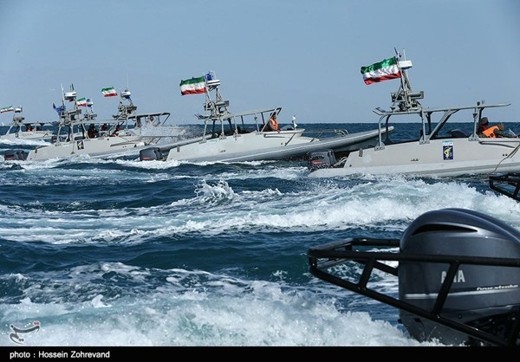
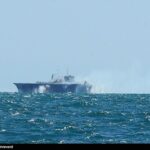
A new model of Iran’s first domestically manufactured crew boat has begun its maiden voyage in the Persian Gulf waters.

The boat was launched in the southern port city of Bushehr on Wednesday in the presence of chief of the Islamic Revolution Guards Corps (IRGC) naval forces Rear Admiral Ali Fadavi.

According to Sepah News, the light vessel, named “Parmida 6”, is specialized in transporting passengers and equipment.

With a maximum speed of 25 nautical miles per hour, the boat has the capacity to carry 73 passengers and eight crew on board.

The first version of the vessel, “Parmida 1,” was built in 2010.

In recent years, Iran has unveiled several domestically made submarines, ships and warships, including the Jamaran destroyer.

Jamaran, a Mowj-class warship, has been designed and built by Iranian experts and has state-of-the-art navigation equipment and complex defensive systems.

Iran has so far launched different classes of home-made advanced submarines, including Fateh, Ghadir, Qaem, Nahang, Tareq and Sina.