Sunday, April 19, 2026
Home Blog Page 4922

Principlist news website dissects parliamentary committee session attended by FM

Zarif

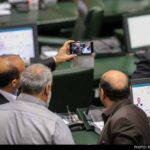
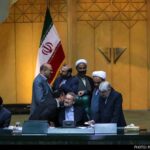
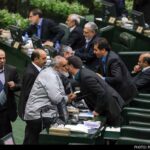
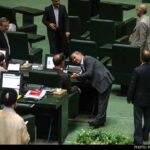
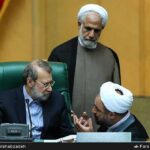
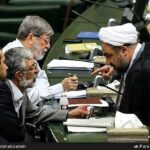
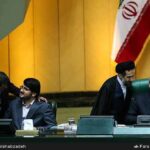
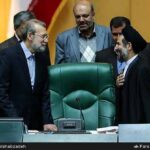
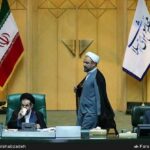
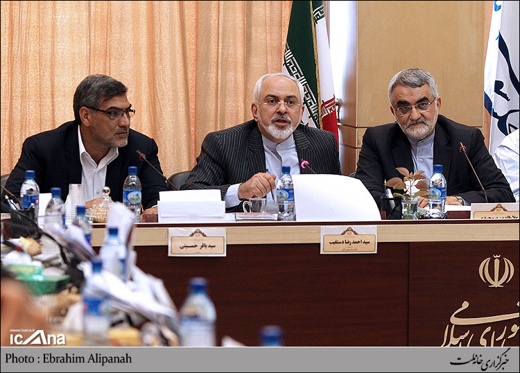
Parliament’s National Security and Foreign Policy Committee met on Sunday to hear Foreign Minister Mohammad Javad Zarif’s explanations about recent nuclear talks in Lausanne, Switzerland and the joint statement they produced.

Alef, a news website run by Ahmad Tavakoli, an influential principlist MP and a onetime presidential candidate, published an opinion piece by Hamid Safari on the parliamentary committee session. The following is a partial translation of the piece:

[…]

There were three main problems associated with the meeting and its coverage.

First, the National Security and Foreign Policy Committee allowed MPs who did not have a seat on the committee to take part in the session and pose probing questions to the representative of the establishment – and not the policymaker – and level baseless allegations against him. […]

The session could have been convened with only members of the committee’s presiding board in attendance. Thus what transpired could have been averted.

Second, for the first time, images of a closed-door session on one of the biggest challenges facing the establishment over the past 36 years were aired by the national broadcaster.

At a time when the Supreme Leader is urging all political factions to throw their weight behind the nuclear negotiators, images of wrangling hit the small screen, suggesting there are deep divisions and tension in the country over such a vital issue. Such images could send the wrong message to the other party and the enemies of the Islamic system.

Third, Islamic Republic of Iran Broadcasting repeatedly aired a report on the meeting which seemed to have given undue prominence to the anger of the foreign minister. Besides, even though the foreign minister was under pressure, he should not have thrown a tantrum.

Certainly the Iranians expect their top diplomat to be more patient, because the three-month period that lies ahead is more difficult than the past 18 months. The negotiating team has a heavier burden to shoulder and is likely to come under more criticism.
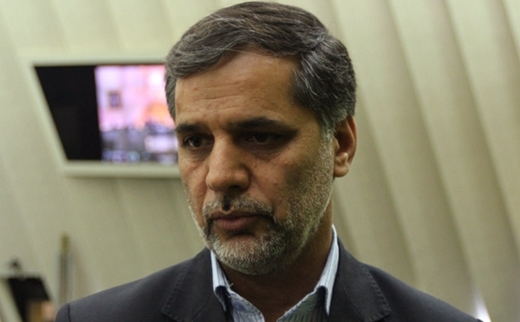
Zarif removed many ambiguities: Senior MP

Hossein Naghavi
Hossein Naqavi Hosseini

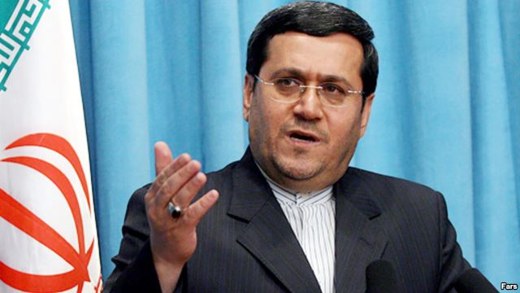
Senior member of Parliament Hossein Naghavi Hosseini said Monday that in his Parliament briefing on Sunday, Foreign Minister Mohammad Javad Zarif had removed many ambiguities about the statement read out at the end of Lausanne talks.
Naghavi Hosseini, the rapporteur of Majlis National Security and Foreign Policy Committee, said that the foreign minister assured the lawmakers that there were no differences between the text of the statement read out by him and the one read out by Ms. Mogherini.

Mr. Zarif also removed ambiguities about US fact sheet, lifting of UN sanctions and mutual guarantees of Iran and the other side, Naghavi Hosseini said.

“We have to accept the fact that Iran negotiates its nuclear case and the two sides sit at the negotiating table to reach an agreement,” Naghavi Hosseini said, adding that in no negotiations, one side receives all concessions while the other side gives all the concessions.

“No one is opposed to negotiations over Iran’s nuclear case because negotiations are the only way out of the nuclear dispute,” he stated.

He said that the negotiating team is expected to make use of the all-out support of the Iranian nation to further balance the received and given concessions in the comprehensive deal to be clinched in the future.

Public can tell well-intentioned critiques from factional ones: Deputy min.

Ghashghavi

Deputy Foreign Minister for Consular and Parliamentary Affairs Hassan Ghashghavi has described as positive the general reaction of parliament to nuclear talks between Iran and P5+1, saying, “Some critiques are tinged with political and factional interests, but public opinion can clearly distinguish a well-intentioned critique from a factional one.”

Ghashghavi was quoted by the Islamic Republic News Agency on April 6 as saying, “We have accepted to live in a country where different voices can be heard and criticism is allowed, that’s why we are not concerned about well-meaning critiques at all.”

As for what happened in parliament’s National Security and Foreign Policy Committee on Sunday, he said, “What disappointed the foreign minister in the session was not the critical comment of a leading MP about the nuclear talks; rather, it was the unsubstantiated reference to a comment by the Supreme Leader.”

The deputy minister went on to say, “At the session, Javad Karimi Ghodoosi attributed some comments to the Supreme Leader in a private meeting with the foreign minister present.”

Ghashghavi added, “In reaction to the insistence by the MP, Zarif said that he would not allow such unsubstantiated quotes which are [reportedly] attributed to the Supreme Leader to be capitalized on at the expense of the respected position of the leader.”

Iranian negotiator defends the nuclear statement

Baidi Nejad

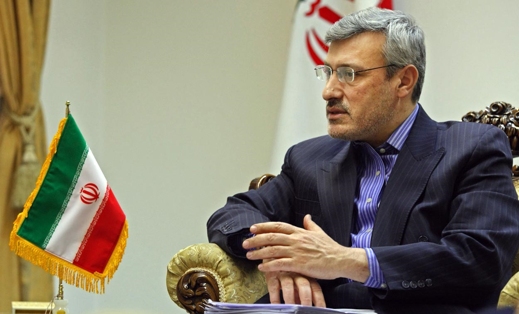
The Supreme Leader and President Rouhani were in on all decisions made in recent talks between Iran and P5+1 in Lausanne, Iranian nuclear negotiator Hamid Baidinejad told IRNA Monday as he criticized those who base their judgment of the nuclear statement on comments and reports by Western officials and media.

He said the intention of Westerners and their media is obviously in line with their enmity toward Iran which is not expected to be resolved with the Lausanne statement, because strategic differences between Iran and the West over the Middle East remain in place.

The Foreign Ministry official went on to say that the Western version of what has happened in the talks is certainly different from Iran’s. “They say we have prevented Iran from developing nuclear arms; whereas, we say we have maintained our peaceful nuclear program.”

Exposed to pressure from some local media, the Iranian negotiating team has to defend its performance by stressing its narrative and this makes the other party angrier, Baidinejad said.

In conclusion, he said all red lines of the establishment have been respected in the talks and the negotiating team has nothing to hide and supports the statement, confident in the fact that it is legally, technically and politically problem-free.

A look at Iranian newspaper front pages on April 6

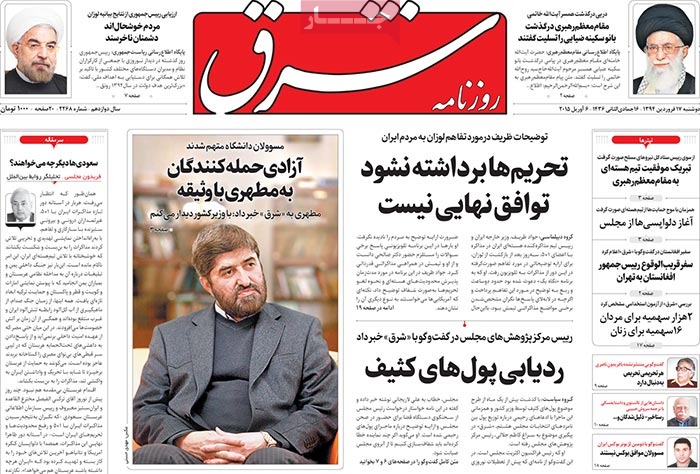
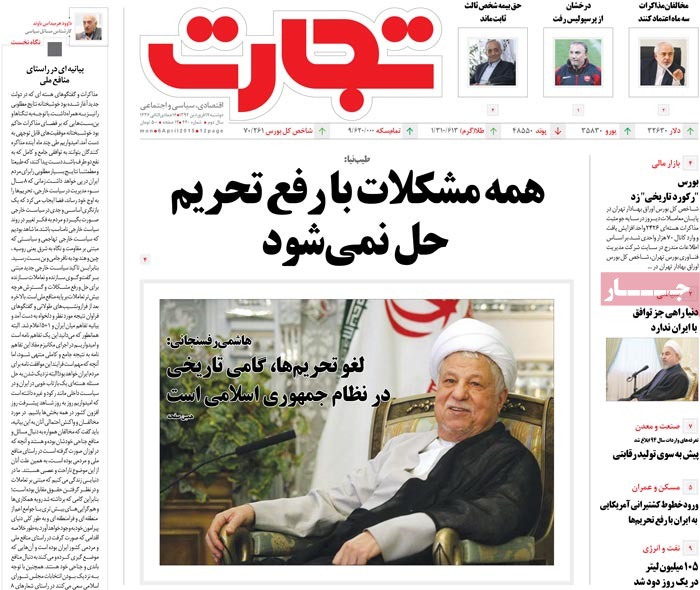
Iranian Newspapers Headlines

The appearance of Foreign Minister Mohammad Javad Zarif before parliament’s National Security and Foreign Policy Committee and comments by President Rouhani and Ayatollah Hashemi Rafsanjani about the nuclear understanding between Iran and P5+1 dominated the front pages of Iranian newspapers on Monday.


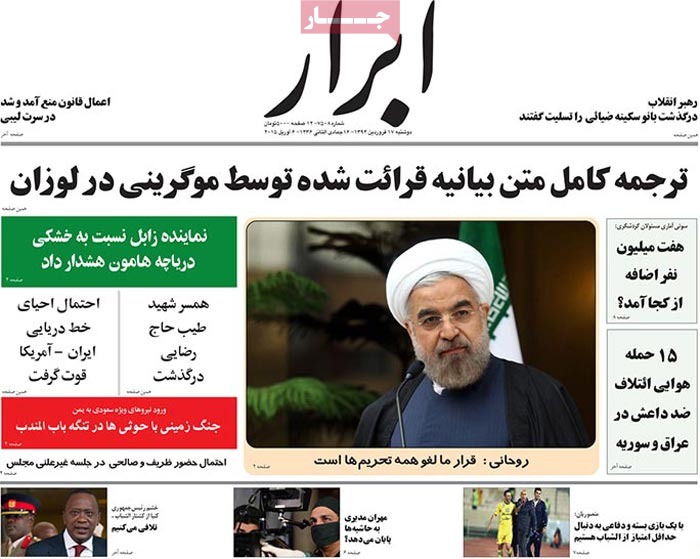
Abrar: Foreign Minister Mohammad Javad Zarif is likely to appear before a closed-door session of parliament Tuesday to expound on nuclear statement Iran and P5+1 issued in Lausanne, Switzerland.


A look at Iranian newspaper front pages on April 6


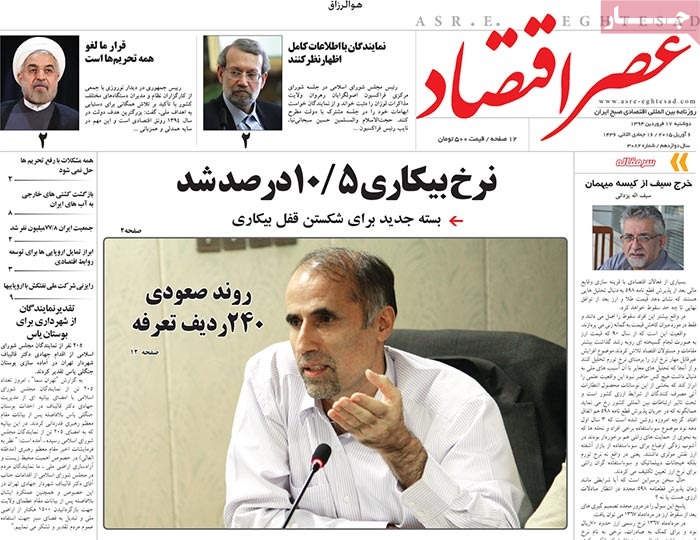
Asr-e Eghtesad: Unemployment stands at 10.5 percent.


A look at Iranian newspaper front pages on April 6


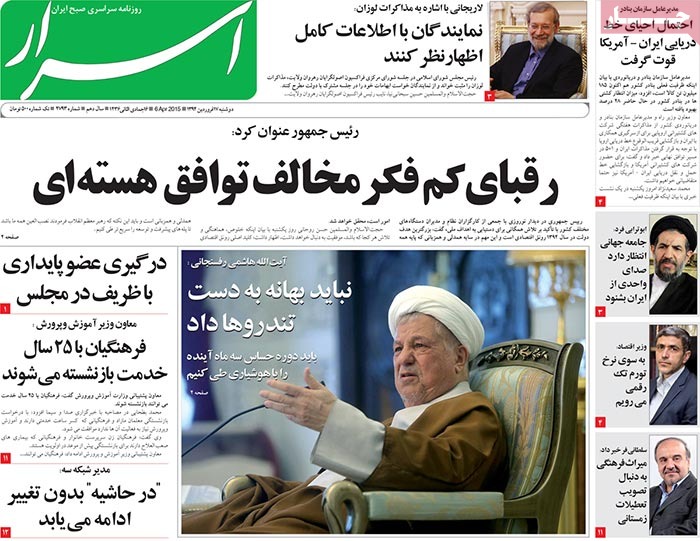
Asrar: Parliament Speaker Ali Larijani has urged fellow MPs to make comments on the nuclear statement Iran and P5+1 issued in Lausanne only when they know all the facts about the talks.

Asrar: The economy minister has said that his ministry seeks to push inflation down to single digits this year.

Asrar:”We should not do things that might play into the hands of hardliners,” said Chairman of the Expediency Council Ayatollah Hashemi Rafsanjani.

Asrar: Foreign Minister Zarif had a heated dispute with an MP during his appearance in parliament.


A look at Iranian newspaper front pages on April 6


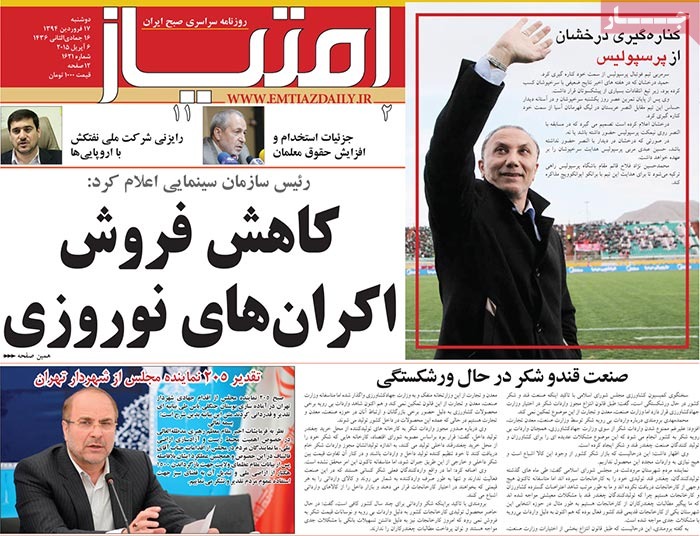
Emtiaz: Hamid Derakhshan has resigned as coach of the capital’s Persepolis Football Club.


A look at Iranian newspaper front pages on April 6


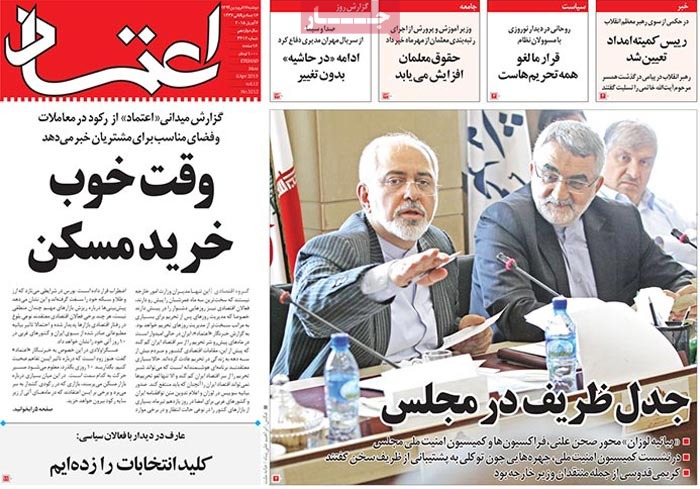
Etemad: During a meeting of parliament’s National Security and Foreign Policy Committee, Tehran MP Ahamd Tavakoli spoke in support of Foreign Minister Zarif who was also on hand for the meeting.


A look at Iranian newspaper front pages on April 6


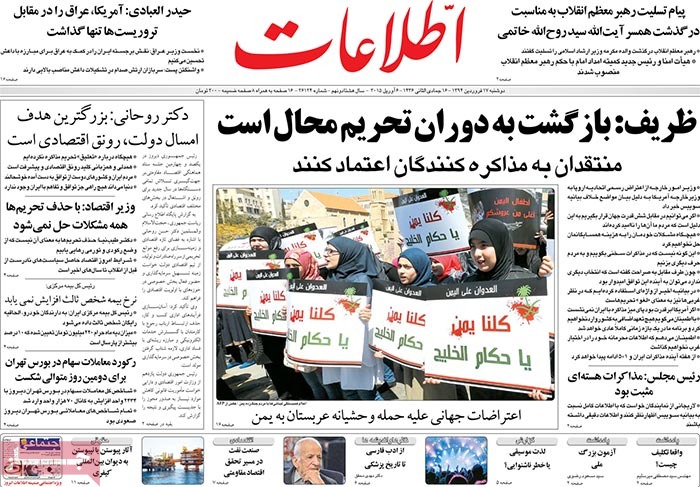
Ettela’at: The economy minister said that termination of sanctions won’t settle the country’s economic problems overnight.


A look at Iranian newspaper front pages on April 6


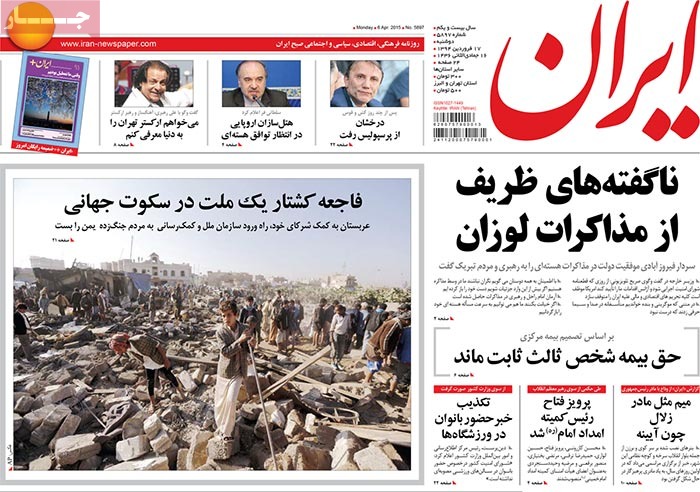
Iran: Parviz Fattah, a onetime energy minister, has been appointed as director of Imam Khomeini Relief Committee.


A look at Iranian newspaper front pages on April 6


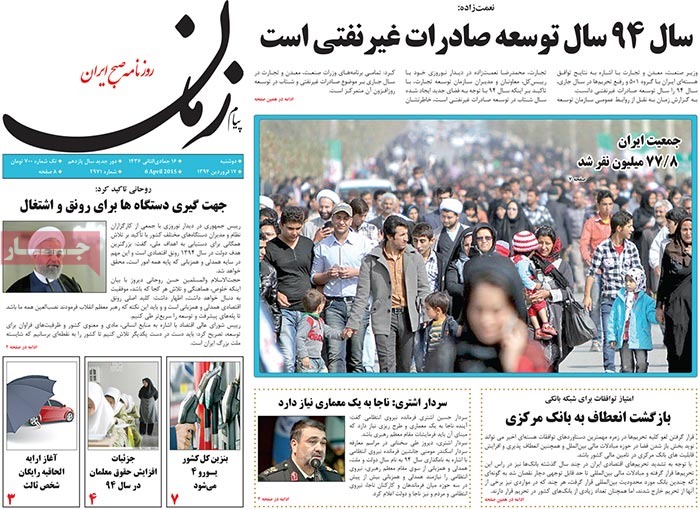
Payam-e Zaman: The minister of industries, mines and trade has said this year the focus will be on expansion of non-oil exports.


A look at Iranian newspaper front pages on April 6


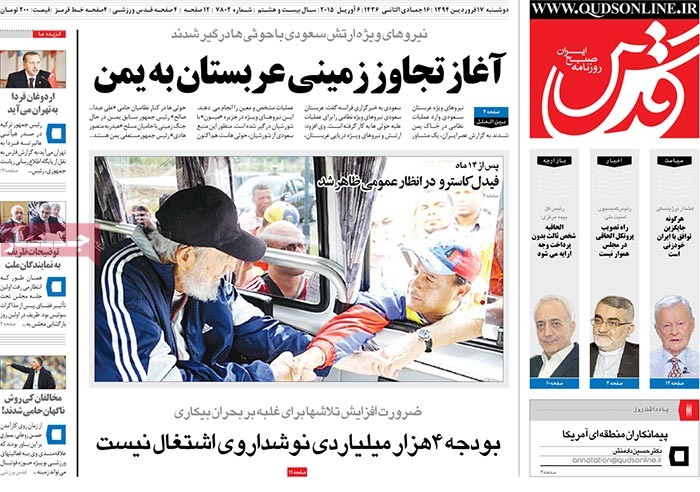
Qods: “Parliament is not poised to approve the Additional Protocol,” said the chairman of the chamber’s National Security and Foreign Policy Committee.


A look at Iranian newspaper front pages on April 6


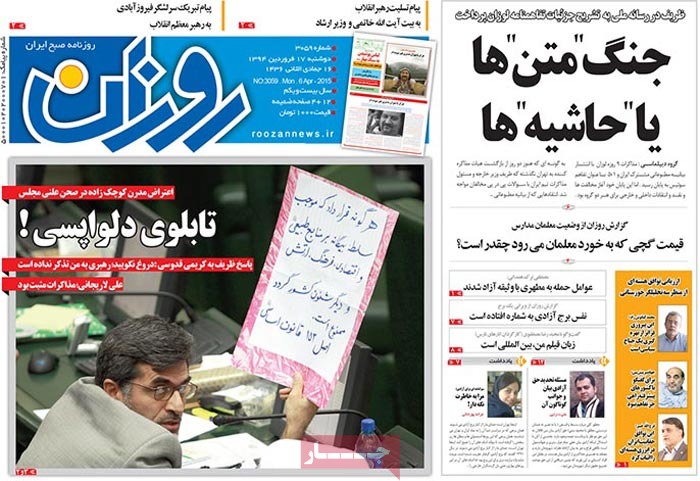
Roozan: “Don’t lie. The Leader has not admonished me,” Foreign Minister Zarif told Karimi Ghodoosi, an MP who spoke against the Lausanne statement during the top diplomat’s appearance in parliament.


A look at Iranian newspaper front pages on April 6


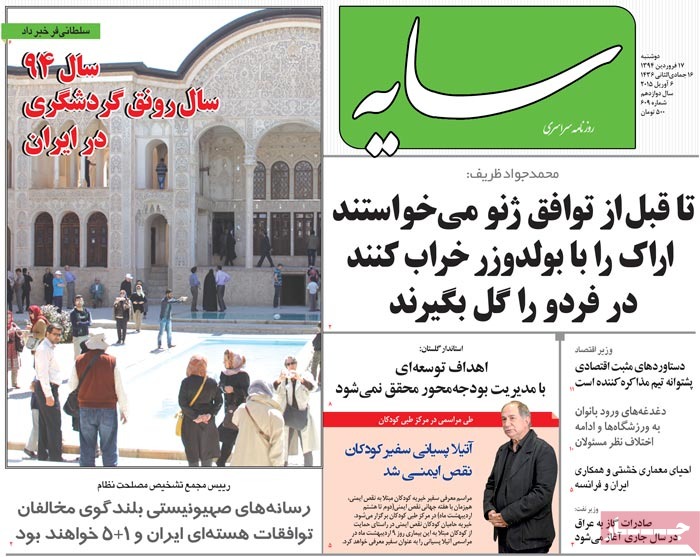
Sayeh: The Iranian oil minister has said that exports of natural gas to Iraq will get underway later this year.


A look at Iranian newspaper front pages on April 6


Sharq: The Afghan ambassador to Tehran has said that the Afghan president will soon pay a visit to Iran.


A look at Iranian newspaper front pages on April 6


Tejarat: “The world has no other option than strike a deal with Iran,” said President Rouhani.


A look at Iranian newspaper front pages on April 6


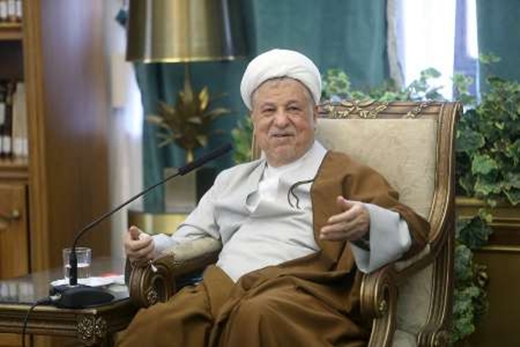
Rafsanjani commends skills of Iranian diplomats in nuclear talks

Rafsanjani

Chairman of the Expediency Council Ayatollah Akbar Hashemi Rafsanjani said on Sunday that the skills of Iranian diplomats removed the wrong mentality of Western states and proved Iran’s transparent and legitimate stand.

In separate meetings with local officials from different organs and Majlis representatives, he praised perseverance of the Iranian nuclear negotiators in the past 18 months.

When the Supreme Leader denounces proliferation and use of nuclear weapons, there will be no room for the Western skepticism, he said.

Calling Lausanne’s framework deal a significant outcome, he said the two sides should avoid provocative slogans which give pretexts to hardliners who seek to create obstacles for Iran and P5+1.

He expressed the hope that the world would recognize Iran’s right to nuclear program within coming three months.

In these series of talks the world put a seal of approval on the peaceful nature of Iran’s nuclear activities in the fields of agriculture, energy, health and civilian application of nuclear energy as part of the country’s legitimate rights which has roots in the patience and resistance of brave Iranian nation and their officials.

Rafsanjani appreciated the support made by the Supreme Leader of the Islamic revolution for the nuclear team and said it will take three months to clinch the final deal which is very sensitive and complicated.

Iran is determined to make use of nuclear energy to secure comfort and enhance living standards, he said.

The arbitrary international sanctions imposed on Iran were thwarted through national patience of Iranian nation, he said.

They imposed the heaviest economic sanctions against Iran but to no avail, he said, adding that they had no option except to sit at the negotiating table.

“We wish to continue nuclear activities with no limits and hope that the IAEA will carry out its duties,” he said.

Highlighting the speech delivered by US president at the US congress where he said that they had no option except to resolve the issue through talks, he said it was very logical of the two sides to express and exchange views at the negotiating table and now political parties and intellectuals of the two sides should exercise vigilance to bar hardliners to take the podium and deceive people by baseless statements.

Golestan environmental police take over stranded bear cubs

Bear-4

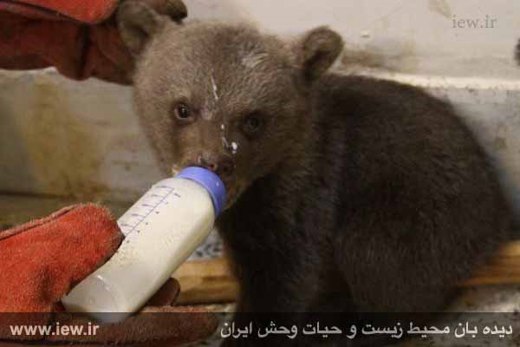
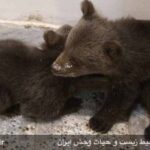
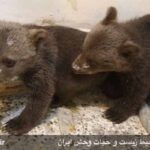
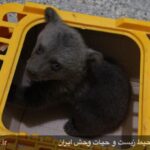
Environmental police in Golestan Province, in northeastern Iran, were dispatched to a provincial village on April 4 after they were contacted by locals who said they had spotted two stranded bear cubs in the vicinity of the village.

The head of the Public Relations Office of the provincial environment department said that the mother of the pair is unaccounted for.

Ahmad Dabaghian added that the cubs’ mother might have been killed by poachers or the locals and that an investigation is underway to figure out what has become of her.

He further said that the cubs which are a few weeks old are being looked after and in a few days a decision will be made as to whether to release the cubs – one male and the other female – back into the wild.

The following is a photo gallery that the website of Iran Environment and Wildlife Watch released of the two cubs:


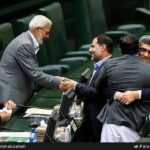
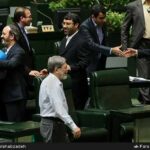
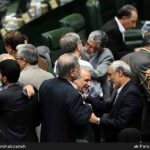
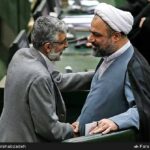
New Year greetings on the floor (Photos)

Iran-Parliament-friendly

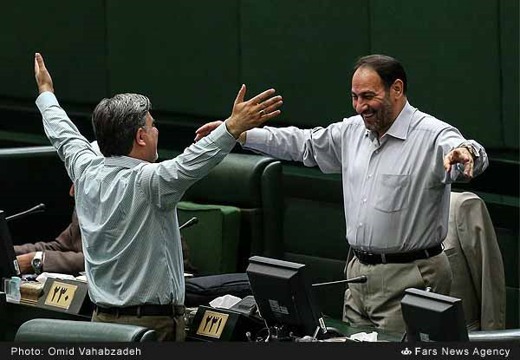
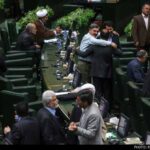
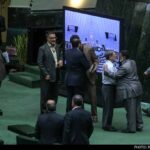
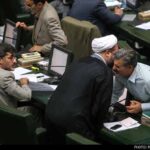
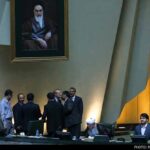
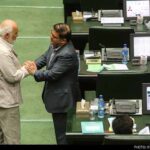
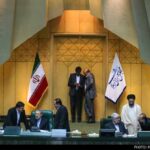
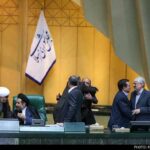
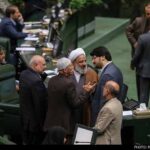
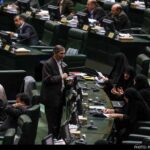
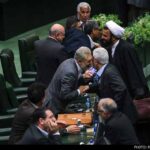
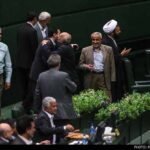
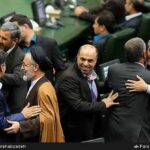
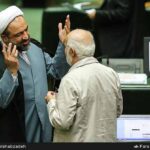
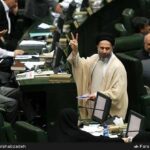
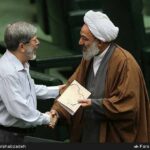
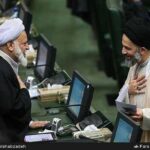
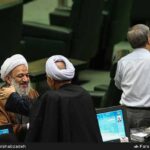
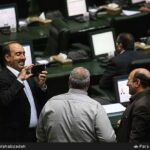
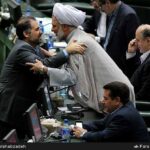
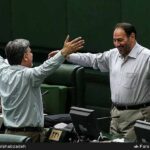
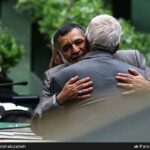
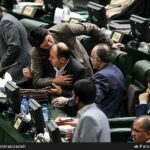
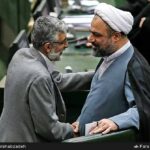
The first session of the Islamic Consultative Assembly was held on Sunday (April 5) with an exchange of hugs and kisses between MPs on the floor.

The Iranian parliament was back in session after a long New Year recess.

The following is a collection of photos Fars News Agency and the Iranian Students News Agency released online of the way the deputies greeted each other on parliament floor:


The beginning of an era or the beginning of the end

Sadegh Zibakalam

Sadegh Zibakalam, a university professor and political analyst, says the fact that Iranians eagerly followed the news on nuclear talks in Switzerland rightfully demonstrated political solidarity between the Iranian people and government.

Sahrq daily on April 5 published an opinion piece by Zibakalam on solidarity between the nation and government, and reactions by the hardline worriers. The following is a partial translation of the piece:

The passionate enthusiasm millions of Iranians showed during the Nowruz holiday to get the latest on nuclear talks – especially the round of negotiations which opened on March 26 in Lausanne, Switzerland [and led to the Lausanne statement] – was indicative, more than anything else, of solidarity between people and the government.

[…]

In recent years, one can hardly find a topic on which people and officials have developed so unanimous consensus. All sides were impatiently seeking to see the nuclear case – whose specter had haunted Iran for more than one decade – produce a definitive satisfactory result.

[…]

When words spread Thursday night that a preliminary agreement has been clinched [between Iran and P5+1], millions of Iranians heaved a sigh of relief. Although the details of the agreement had yet to be announced, Iranians – who had been waiting for months – learned that the talks had not ended inconclusively and parties [to the nuclear talks] had arrived at a preliminary agreement.

[…]

As a matter of course, not all people approve of the Lausanne agreement. A number of hardline figures – generally known as the Worriers [former President Ahmadinejad’s supporters who proclaim to be worried and keep sounding alarms about the state of affairs in the country since the rise to power of the moderate government of Hassan Rouhani] – did not welcome the agreement; neither did certain foreign figures and groups that are unhappy with the Islamic Republic.

The reason behind the failure by the Worriers to welcome the agreement differs from those of the Westerners. For the critics of nuclear agreement inside Iran, the nuclear dispute had turned into part of [their] media hype about tensions with the West, but the agreement has [taken the wind out of their sails and] barred them from making [political] gains out of the nuclear case.

On the one hand, they are busy reviewing the provisions of the preliminary agreement in order to possibly point a finger at certain points which do not favor Iran’s interests and justify their opposition to the [framework] agreement.

On the other hand, the hardliners listen attentively to remarks by US and European officials to get a lot of mileage out of some of comments which are naturally made to instill a sense of victory for the West [into people in their own countries].

The point is that these groups look at any agreement or a win-win solution with disbelief. They do not want to accept that an agreement or a compromise is likely to come with some points which serve the interests of Iran, and at the same time include other points which are to the benefit of the other party. They just dig their heels in, saying everything should be to the advantage of Iran, or else it is to the detriment of Iran.

Iranian hardliners are also concerned that the nuclear agreement could open an “ominous” chapter in the country’s détente with the West. In any manner, if Iran and the West can reach an understanding over the protracted, acrimonious nuclear dispute, the logical question that arises here is: Why not reach an agreement over other bones of contention?

For many hardliners, what is more alarming than the [recent] nuclear agreement or certain provisions of that is the concern or apprehension associated with the possibility that the Lausanne agreement could mark the beginning of a new trend in Iran’s diplomacy.

World has no option except clinch a deal with Iran: President

President Rouhani

President Hassan Rouhani said on Sunday that Iranians and the friendly countries are happy with a nuclear understanding between Iran and P5+1 and all know that they have no option except clinch a deal with Iran. He made the remarks in a meeting with a group of officials.

He said the enemies of Iran are not satisfied with the success of nuclear talks.

Iran has always called for termination of economic, financial and banking sanctions, he said.

The president dismissed accusations that Iran would seek regional hegemony if it came out successful in nuclear talks.

The Islamic Republic of Iran never seeks to invade any country as the Iranian history is good evidence to such principle, said President Rouhani.

“If anyone dares to violate the right of Iranian people, we will defend our rights,” he underlined.

Recent nuclear talks in Switzerland were very complicated and tough in the country’s history, he said.

Referring to presence of global military and economic powers in these talks, he said if the level of talks had not enhanced, there would be no progress.

In this round of talks, the two sides reached agreement on continued activities of Natanz, Fordo and Arak heavy water reactor, he said.

There is no doubt that the two sides took concrete steps but writing of final deal will be a very tough job, he said.

“During talks Iran always called for termination of economic, financial and banking sanctions and there was no word on suspension. Otherwise, there would be no deal,” the president stated.

The world knows that it had no option except clinching a deal with Iran as the great Iranian people are determined to attain their goals and never give up to pressures or sanctions, he said.

He advised the officials to spare no efforts to serve nation and do their utmost to attain economic success and development.