Tuesday, January 13, 2026
Home Blog Page 4911

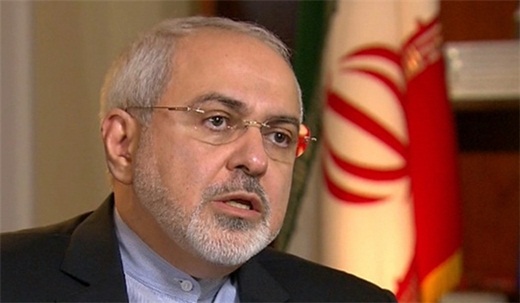
All anti-Iran sanction must be lifted concurrent with nuclear deal: Zarif

zarif5

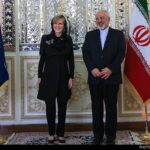
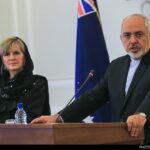
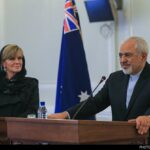
Iranian Foreign Minister Mohammad Javad Zarif says all sanctions against Tehran must be lifted on the day of a possible nuclear deal between Iran and P5+1.

“We’re not talking about phased removal of sanctions. Unfortunately the United States started talking about and using the phrase ‘phased sanctions’ and if you go through the joint statement you will not even see the word ‘suspension’ and you will not see the word ‘phase’,” Zarif said in an interview with Euronews broadcast on Friday.

Iran and P5+1– Russia, China, France, Britain, the US and Germany – issued the joint statement at the end of eight days of intensive nuclear negotiations in the Swiss city of Lausanne on April 2, saying that no Iranian nuclear facility will be shut down or suspended and all sanctions against the Islamic Republic will be lifted once an agreement on Tehran’s nuclear program is signed.

Referring to the statement, Zarif added, “It’s clear that all sanctions, all economic and financial sanctions will be terminated. On the day that we agree… the [UN] Security Council will adopt a resolution, which will terminate all the previous resolutions and will set the stage for termination of all sanctions.”

Less than 24 hours after Iran and P5+1 reached the mutual understanding over Tehran’s nuclear program, the US published its own fact sheet detailing the parameters for the Joint Comprehensive Plan of Action (JCPOA). The sheet, however, had differences with the original joint statement.

However, on April 7, the European Union said the only valid statement regarding the nuclear talks with Iran was the one published in Switzerland. “The general statement, which is valid, is the one which has been agreed on and delivered on the second of April by [EU] High Representative [for Foreign Affairs and Security Policy] Federica Mogherini and Iranian Foreign Minister [Mohammad] Javad Zarif in Switzerland,” said Catherine Ray, Mogherini’s spokesperson, at a media briefing in Brussels.

Although Iran has reiterated that all sanctions have to be lifted simultaneously as soon as the final deal comes into force, the US edition indicates that the architecture of nuclear-related sanctions will be retained for much of the duration of the deal.

Elsewhere in his remarks, Zarif noted that negotiations were sometimes difficult because Western diplomats “had come to believe that sanctions were an asset, were something that they should not relinquish so easily.”

The Iranian foreign minister also mentioned two objectives for the nuclear talks, saying, “One objective was to ensure that Iran’s nuclear program will remain always peaceful and the second objective was to remove the sanctions.”

Iran and the six countries are now expected to start work to draw up a final comprehensive deal over the Islamic Republic’s nuclear program by the self-designated June 30 deadline.

In response to a question about Russia’s recent decision to deliver the S-300 air defense missile system to Iran, Zarif hailed the move as a contractual commitment.

“We had an agreement with Russia… to provide the means for our air defense. These are not offensive weapons, they are defensive weapons that we had ordered a long time ago from Russia, and now they have decided to honor their contract and commitment and deliver.”

He went on to say that the delivery is not against any UN sanctions because Iran regards the bans as “illegal and unjustified.”

On April 13, Russian President Vladimir Putin signed a presidential decree, paving the way for the long-overdue delivery of the S-300 missile shield system to Iran.

The move, which greatly irked the Western governments and their regional allies, came following the mutual understanding on Tehran’s nuclear program in Lausanne.

Iran and Russia have reportedly agreed to examine all technical issues related to the S-300 missile system in the coming months, so that it could be delivered to Tehran by the end of the current year.

Tehran, Beijing will work to broaden defense ties: Iran defense minister

Iran defense minister

Iran’s defense minister says the Islamic Republic and China share a very successful experience of defense cooperation and are determined to strengthen mutual relations in the defense sector.

Brigadier General Hossein Dehghan made the remarks in a meeting with China’s Defense Minister Chang Wanquan in Moscow, Russia, on Friday.

The Iranian official brought up the issue of the ISIL Takfiri terrorists and the extent of their influence in East Asia, which he stated, meant a threat to security of China, the Caucasus region and the Central Asia.

Brigadier General Dehghan, who was in the Russian capital to attend the fourth Moscow International Security Conference, also emphasized that regional countries should improve serious cooperation and interaction to eradicate Takfiri-Zionist groups.

He denounced the West for supporting terrorist groups and violating the rights of nations in the region and warned that insecurity would have its own repercussions for the very governments that support the extremist groups.

He added that a meeting which is scheduled to be held among Iran, Russia and China in the near future would play a very effective role in “countering common threats and settling security problems in the region.”

The Chinese defense minister, for his part, hailed Iran’s proposal for the trilateral meeting and stressed the importance of improving bilateral and multilateral defense and military on global issues.

Iran urges united resistance front against US expansionism

Iran-Russia-Defense Minister

Brigadier General Hossein Dehqan on Thursday hailed Russia for not trusting the United States, saying Tehran and Moscow should insist on adopting policies to foil security threats facing them.

“We support Russia’s correct understanding at the strategic level that the US government could not be a reliable friend and partner,” said Dehqan in a meeting with Russian Defense Minister Sergey Shoygu.

Dehqan, who was in the Russian capital to attend the fourth Moscow International Security Conference, also Moscow’s stance in appreciating the necessity for the establishment of a new global order.

The Russian defense minister, for his part, urged the expansion of ties between Tehran and Moscow, saying constructive relations between the two sides can play an important role in securing regional and global stability.


S-300 missile shield systems
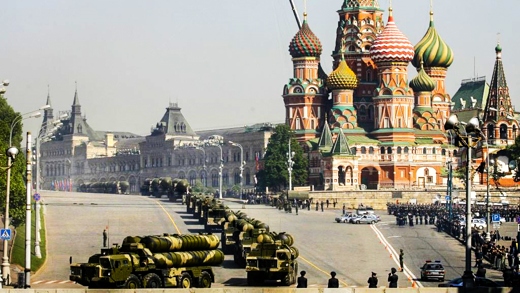
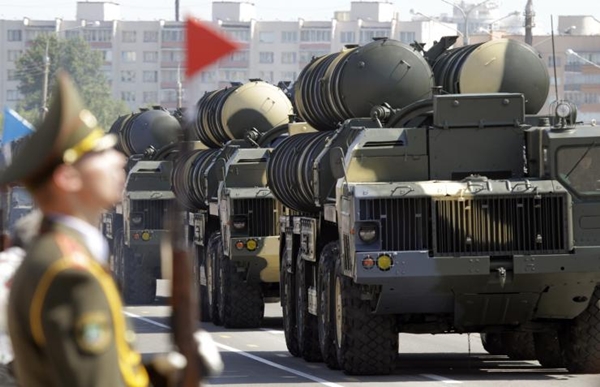
On April 13, 2015 Russian President Vladimir Putin signed a presidential decree, paving the way for the long-overdue delivery of the S-300 missile shield systems to Iran. (©AFP)


Shoygu touched upon a recent military agreement signed between Iran and Russia, calling it a significant foundation on which the two sides could expand their ties.

The Russian defense chief lashed out at Western governments for imposing sanctions on sovereign states, describing them as tyrannical and against international regulations.

Shoygu further took a swipe at the United States for its unilateral policies across the world and called on all countries to to work together closely to confront and foil Washington’s one-sided moves.

He then urged Russia, China and Iran to hold a joint summit in the near future to coordinate their policies for confronting common threats.

The two sides also agreed to examine all technical issues related to the S-300 air defense missile system in the coming months, so that it could be delivered to Tehran by the end of the current year.

On April 13, 2015 Russian President Vladimir Putin signed a presidential decree, paving the way for the long-overdue delivery of the S-300 missile shield systems to Iran.

Russia’s decision to lift S-300 system ban is not to Iran’s benefits

S-300

It is again the question of S-300 system and the viewpoints for and against its supply to Iran. This time people – not officials – have shown reaction. Alef, a news website, has created a new section for its visitors – Interaction with the Readers – asking them to comment on the unfolding developments in the country and across the world.

The following is the translation of remarks by Saeed Ghasemizadeh Tamar, one of the readers, on Moscow’s decision to sell S-300 air defense system to Iran:

Russian President Vladimir Putin has [in a decree] ordered the lifting of a ban on selling S-300 air defense system to Iran. In reaction, the Iranian ambassador to Moscow described the presidential decree as praiseworthy.

Iran is expected to swiftly pursue the $800 million contract based on which it will buy the air defense system from Russia, since reports on a new Russian decision [to supply the S-300 system to Iran] provide no detail about the timing of such a transfer.

If the transfer happens before the final meetings in the nuclear talks between Iran and the US, it could be welcome as good news.

But if Russia under Putin has simply promised to transfer the system and enforce the 800-million-dollar contract [with Iran], Iran is not the target audience of such reports.

It is in fact a message to Israel and its supporters saying, “If an agreement between Iran and the West is finalized, you will find Iran equipped with more arms than before. If you reach a deal, Russia sees no reason to stop selling arms. So be careful that the price you are to pay for agreement with Iran will be more intolerable to you!”

If the nuclear talks with P5+1 are regarded as talks between Iran and the US, Iran – which has a vested interest in the talks – should immediately ask Moscow to openly and frankly explain its intention of sending the air defense system to Iran by signing a contract which revives its former version. If done, this will prevent Russia from playing the Iran card to score points in its interaction with the West.

Bear in mind that this time around, the edge Russia is seeking to gain in its dealings with the West – unlike the past – exactly targets Iran’s interests by trying to overshadow the decision of the other party to the talks [P5+1] on Iran’s nuclear case.

It is simple-mindedness if we say that the purchase [of S-300 air defense system] is independent of the nuclear talks and that Russia can implement the contract [it has signed with Iran] at will.

Russia has to implement the contract, especially for the time being that the purchase of the system is not legally banned. Light needs to be shed on the procedures of the contract as soon as possible.

In case of negligence on our part, Russia will threaten the breakthrough in the nuclear talks only to serve its own benefits, and not those of Iran.

As far as Russia is concerned, can Iran play another game with S-300 air defense system? It may sound ridiculous (because talks only focus on the nuclear issue and the threats remain the same) but to clarify the matter in question we put forward a proposal: What if Iran gives assurances to the Americans that it will drop a decision to buy the Russian air defense system if a nuclear deal is clinched [by July 1 deadline]?

Growing popular expectations, the downside of the nuclear agreement

Hamid Zangeneh, economics professor

An American university professor of Iranian origin says that conclusion of a nuclear deal will not translate into termination of social, economic and political problems in Iran in the short run, calling for efforts to prevent people’s expectations from growing.

Hamid Zangeneh – a professor of economics at Widener University, in Chester, Pennsylvania – has taken an in-depth look at the agreement between Iran and P5+1, saying the growth of public expectations would be a drawback to such an agreement.

The following is the translation of his perspective as reported by Tasnim News Agency on April 8:

Before anything else, I should say that for years I have expressed my opposition – on the airwaves and in my articles – to the sanctions, and have supported in published remarks Iran’s bid to have a nuclear industry, which is the mother of all industries, in line with international regulations.

Some may think that a nuclear deal between Iran and P5+1 will spell an end to Iran’s political, economic and social ills in the foreseeable future. If those in charge do nothing to prevent people from getting it wrong, such interpretation would turn into the Achilles’ heel of the agreement. It would also see people – by and large – grow frustrated and become a plaything in the hands of the opponents.

The first thing public opinion should learn about is that the agreement has yet to be fully drawn up. In the course of three months [before the July 1 deadline] when the parties work to present coherent details, pressure groups can do something to make the talks implode one way or another; this is what the key power centers, especially in the US, have focused their efforts on.

Iranians, who oppose the agreement, fit into at least two categories. One views it as an ideological question which should be dealt with in the long run. The other includes those who have [largely] benefited from the sanctions.

On the American side, those who are against the agreement hold similar views to the Iranian opponents. A number of US Christians think that Jesus will reappear in Israel when the world is plagued by turbulence and anarchy as Israel is targeted by the East.

The philosophy behind the Israeli opposition is different. All in all, they do not want to see something change the existing balance of power. Building on the assumption that Iran can develop an A-bomb and disrupt the existing balance, they are not willing to accept any agreement other than one akin to that of Libya under which Tripoli packed all its systems and shipped them to the US.

Neo-Cons and Republicans serve as an umbrella for all warmongering groups, they may not see eye to eye on why there should be a war, though. A certain group, for instance, is perhaps thinking about regime change or they may seek to upset the balance of the establishment, fish in murky water and carry on with the Cold War, etc.

What matters more is that we should know that the agreement has not reached its final stage yet. For the time being, a press statement has been laid out and it has a long way to go before it becomes a legal text.

If the agreement succeeds in this process, it can open the doors for Iran. Where the doors will open to should be taken into account. It is probably the most important question which should be raised and dealt with in Iran. Perhaps the matter in question has been already studied in different ways, but Iran needs to open up a discussion on it again to put an end to what squanders and misappropriates funds in the country.

The following are the key points the government should take notice of:

1. After signing a deal [with P5+1], Iran will gradually break into the competitive international marketplace.

2. It can consequently get access to state-of-the-art technology.

3. Foreign revenues [Iran can collect from its trade] in other countries such as India and China are an asset for Iran and should not be spent on buying consumer products and the like. The revenues Iran can earn from foreign countries should not be used to raise liquidity in the country and let go of the achievements of the government over the past 18 months, among them, lower inflation.

4. Iran is likely to get the membership of the World Trade Organization (WTO). To make that happen, Iran needs to get ready for producing quality, cost-effective products. Is Iran ready to face tough foreign rivals?

5. Does Iran know what to produce and where to sell them? Is it able to make products which can earn the country at least $100 billion to cover imports? Has the country thought about the marketing methods it should employ [to sell its products]?

6. And finally, how does Iran seek to develop such a mother industry and thus help the entire economy grow?


Zangeneh, who received his Ph.D. from the University of Missouri, is a widely published author, television commentator, and lecturer. He is currently the editor of the Journal of Iranian Research and Analysis. He is also the author of Islam, Iran, and World Stability. Together with Cyrus Bina, he has penned Modern Capitalism and Islamic Ideology in Iran (November 1991).

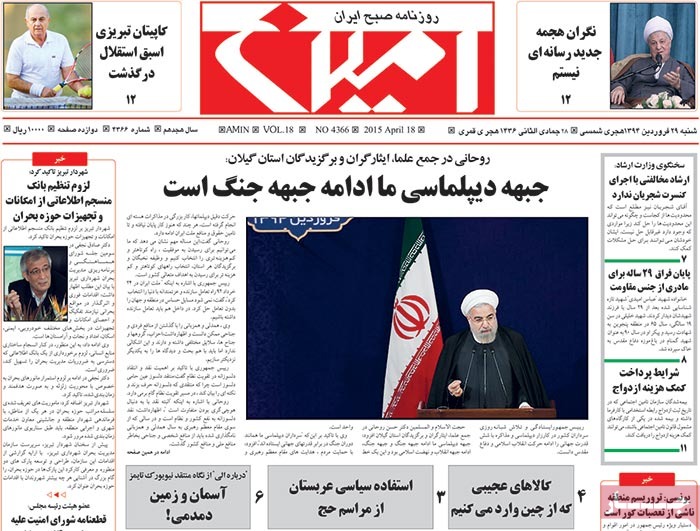
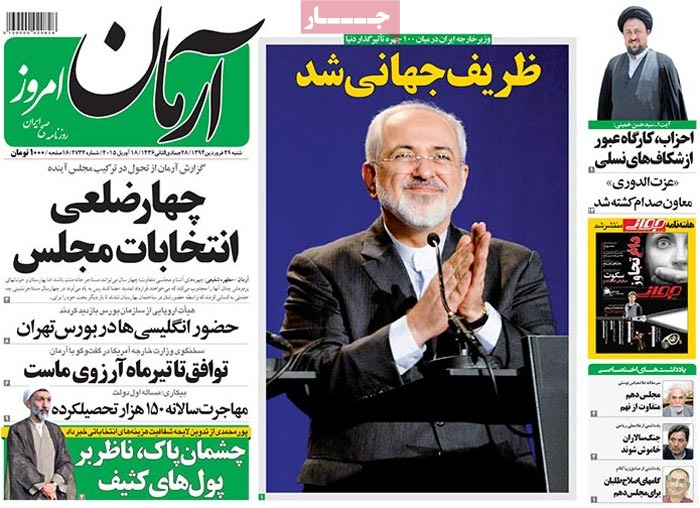
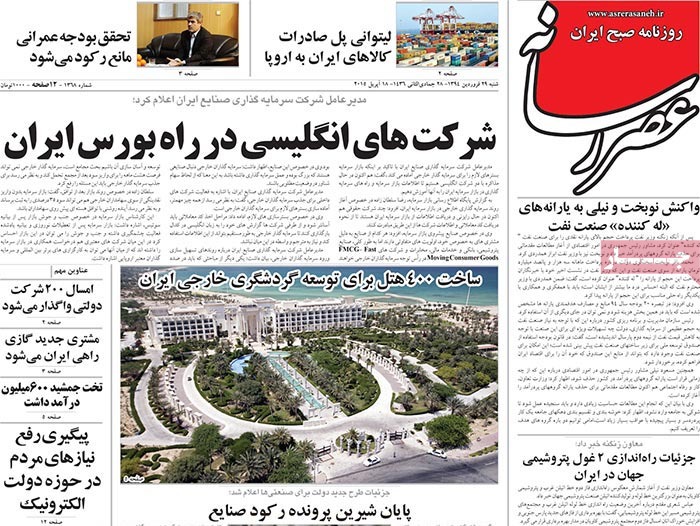
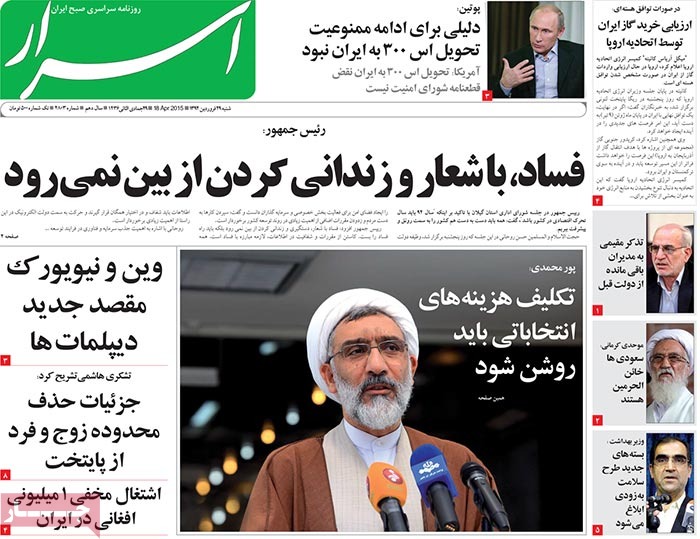
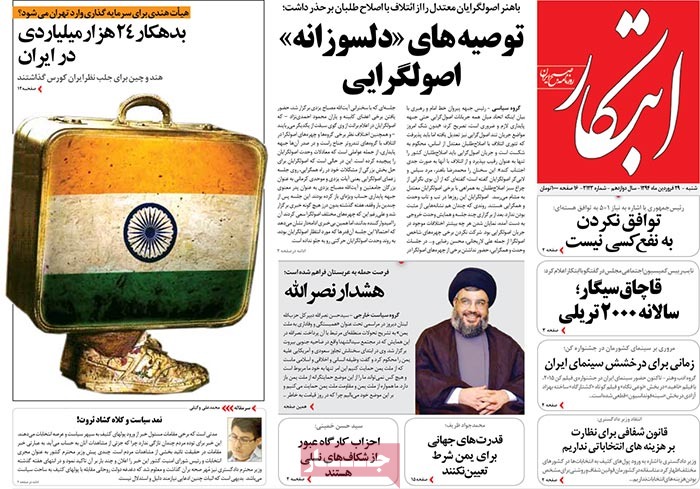
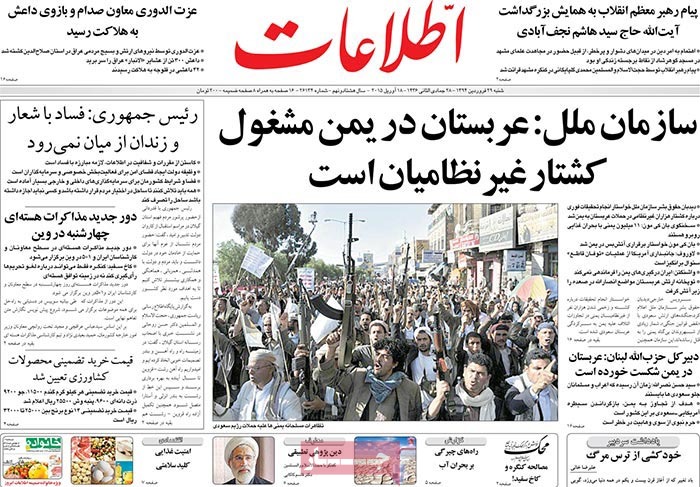
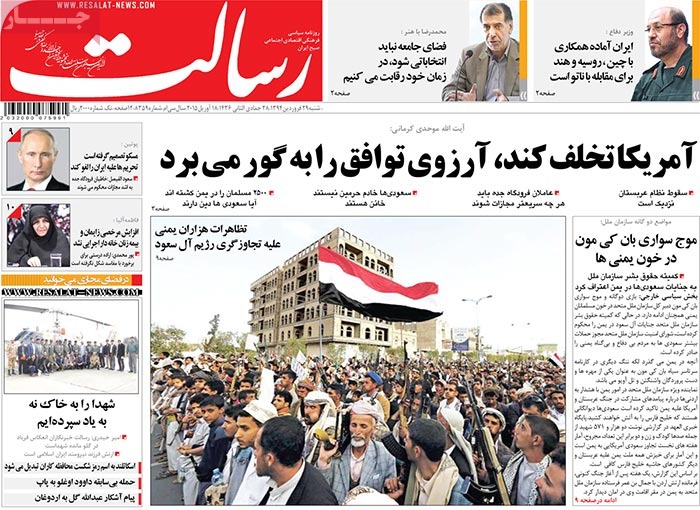
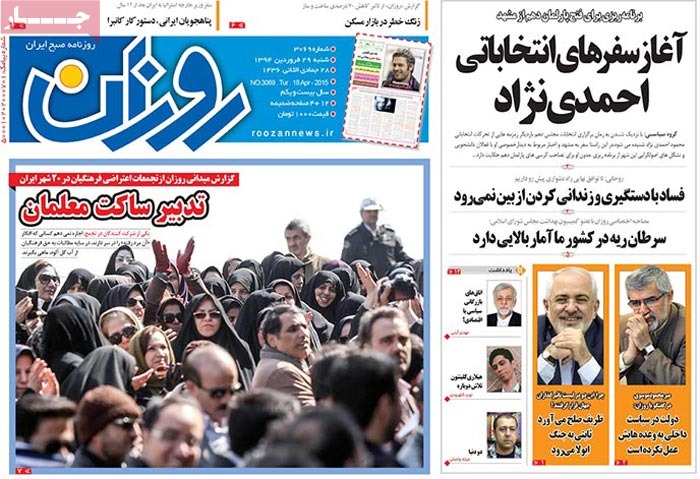
A look at Iranian newspaper front pages on April 16

Iranian Newspapers Headlines

Comment by President Hassan Rouhani that Iran does not care about what the US Congress has decided on a nuclear deal between Iran and P5+1 and that sanctions should be removed once the nuclear deal is struck dominated the front-page headlines in Iranian newspapers on Thursday. Also on the cover of the Iranian dailies were remarks by the chairman of the Expediency Council in reaction to a new media blitz against him.


Afarinesh: “Nuclear talks should end with the announcement of an end to unjust sanctions [against Iran],” said the president in Rasht, northern Iran.


A look at Iranian newspaper front pages on April 16


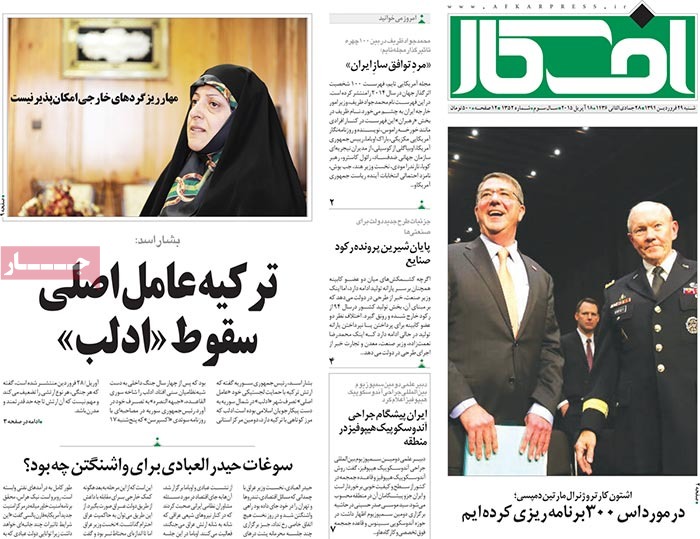
Afkar: The water reserves of Tehran are still far from normal despite the recent rainfall in the capital.


A look at Iranian newspaper front pages on April 16


Aftab-e Yazd: “S-300 air defense system will be delivered to Iran this year,” said the defense minister.

Aftab-e Yazd: “Reports on sexual harassment of two Iranian teenagers [in a Saudi airport] are far from correct,” said the Supreme Leader’s representative for Hajj affairs.


A look at Iranian newspaper front pages on April 16


Arman-e Emrooz: “We should not go after fuss-making,” said President Rouhani.

Arman-e Emrooz: If Saudi Arabia goes ahead with its mistakes, it will get mired deeper in the quagmire of [looming] troubles.

Chairman of the Expediency Council Ayatollah Akbar Hashemi Rafsanjani made the remark in reaction to Saudi airstrikes in Yemen.


A look at Iranian newspaper front pages on April 16


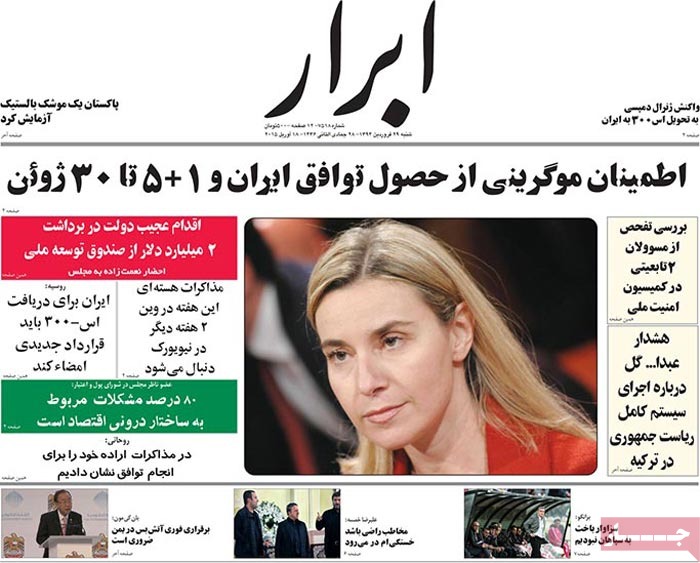
Asrar: “Iran is dealing with the US government,” said Foreign Ministry Spokeswoman Marzieh Afkham in reaction to legislation passed unanimously by the US Senate Foreign Relations Committee on Tuesday giving Congress power to review a nuclear deal with Iran.


A look at Iranian newspaper front pages on April 16


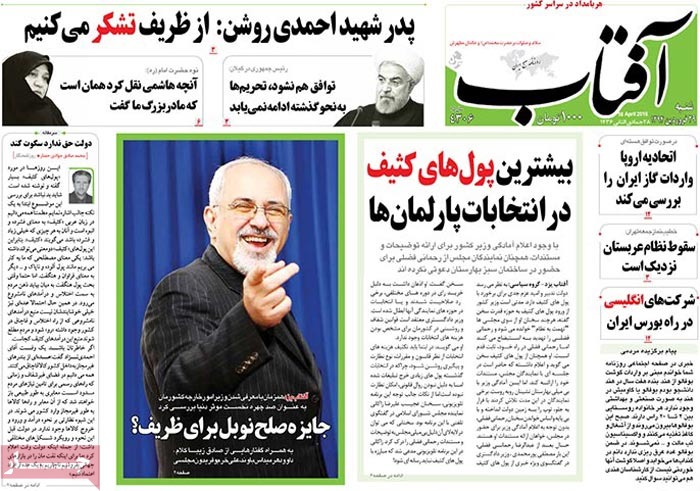
Ebtekar: An option on the table for the Nobel [Peace] Prize

Think tanks believe that Iranian Foreign Minister Mohammad Javad Zarif is tipped to win the prize this year.

Ebtekar: The last word

The Iranian president once again reiterated that conclusion of a nuclear deal [at the end of nuclear talks] should mark the beginning of removing all sanctions against Iran.

Ebtekar: “I am not worried”.

Ayatollah Hashemi Rafsanjani said in reaction to a new media blitz against him.


A look at Iranian newspaper front pages on April 16


Etemad: The puzzle of Carlos Queiroz

The daily unveils, for the first time, the draft contract of the head coach of the national Iranian soccer team.


A look at Iranian newspaper front pages on April 16


Ettela’at: “We have chosen interaction, not confrontation, with the world,” President Rouhani told a crowd of locals in Gilan Province.

Ettela’at: “The international community has a more positive view on Iran,” said President of Spain’s Congress of Deputies Jesus Posada in a meeting with the Iranian foreign minister.


A look at Iranian newspaper front pages on April 16


Financial Tribune: Iran equity market heading toward globalization


A look at Iranian newspaper front pages on April 16


Hemayat: Judiciary Chief Ayatollah Sadegh Amoli Larijani has sounded a warning against seditionist acts which stand in the way of [enforcing] the law.


A look at Iranian newspaper front pages on April 16


Iran: “P5+1, not [the US] Congress, is the one we are talking to,” said President Rouhani in Gilan Province.


A look at Iranian newspaper front pages on April 16


Iran Daily: No deal unless sanctions lifted simultaneously


A look at Iranian newspaper front pages on April 16


Kayhan: The House of Saud under the illusion of dominating the region; yesterday with petrodollars, today with bombs

President Rouhani made the remark in a gathering of locals in northern Iran.

Kayhan: “Carmakers have raised prices with the government support,” said a member of the Competition Council.


A look at Iranian newspaper front pages on April 16


Resalat: “The House of Saud should not be the custodian of the Land of [divine] Revelation,” said Grand Ayatollah Abdollah Javadi Amoli.


A look at Iranian newspaper front pages on April 16


Sharq: “The critics should not play the Supreme Leader card,” said Foreign Minister Mohammad Javad Zarif.

Sharq: The Expediency Council chairman has said that he is not concerned about the media hype [targeting him], adding that extremist currents feel more concerned in such circumstances.

 

A look at Iranian newspaper front pages on April 16


IMF forecasts Iranian economy to grow

IMF

The International Monetary Fund (IMF) has forecast the Iranian economy to grow in the years to come.

In its World Economic Outlook 2015, the international creditor noted, “Growth in the Islamic Republic of Iran is projected to be 0.6 percent in 2015 and 1.3 percent in 2016, a downward revision from the October 2014 WEO.”

The latest report released on Tuesday also expects economic growth in the Middle East and North Africa to drop by 1 percent to reach 2.9 percent this financial year.

The IMF blamed this mainly on the slide in oil prices as well as regional political conflicts.

It said Algeria, Bahrain, Iran, Iraq, Kuwait, Libya, Oman, Qatar, Saudi Arabia, the UAE and Yemen achieved the largest growth last year; which it described as “less than expected and will keep the economies of these countries in a state of emergency.”

The IMF believes oil-exporting countries should implement new programs to meet the reduction in crude prices and search for alternative financial incomes.

The report said that growth remained tepid across the Middle East, North Africa, Afghanistan, and Pakistan last year, and only a modest strengthening is expected this year.

Tehran, IAEA find solutions to remaining issues: Envoy

Reza Najafi

Iran and the International Atomic Energy Agency (IAEA) have come up with a series of “solutions” over outstanding issues in the country’s nuclear program, says the Iranian ambassador to the IAEA.

Reza Najafi made the comments following a one-day meeting between delegates from Iran and the IAEA in Tehran on Wednesday.

“In this meeting, some solutions were found regarding the existing disputes,” Najafi told IRNA, adding that the two topics required further discussions in the next meeting.

The two items are related to the alleged use of “high explosives” in Iran’s western Marivan region and information on “neutron calculations”, Najafi said.

Headed by Vario Ranta, a deputy of IAEA Director General Yukiya Amano, the delegation arrived in the Iranian capital earlier in the day.

The meeting was held under the terms of the Framework for Cooperation Agreement, signed by Amano and Head of the Atomic Energy Organization of Iran Ali Akbar Salehi in Tehran in November 2013.

Iran and P5+1– the US, Britain, France, China, Russia, and Germany – reached a landmark understanding over Tehran’s nuclear program in Switzerland on April 2. The two sides are set to start drafting a final accord slated to be finished by the end of June.

Persian garden Park on a rainy day

Persian garden Park

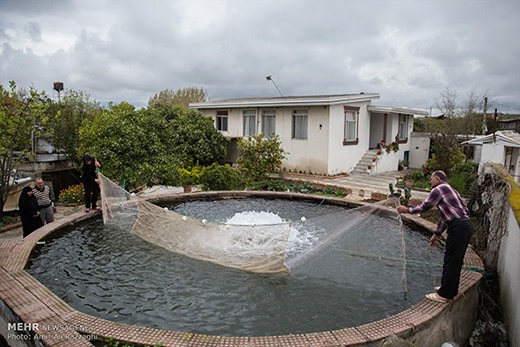
Persian garden Park, which is located in an old neighborhood of northern Tehran, is 3.4 hectares in area. The Persian-style park has become a wonderful sight of the capital, attracting a lot of visitors all year long, in particular on rainy days when flowers seem more lively and amazingly beautiful.

The snapshots below posted online by Tehran Picture Agency  display the beauty of the park on a rainy day:


Iran negotiating with P5+1, not with US Congress: Rouhani

Rouhani-Gilan

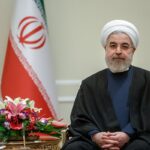
Iranian President Hassan Rouhani on Wednesday stressed that Iran is in talks over its nuclear energy program not with the US Congress but with P5+1 (the five permanent UNSC members plus Germany).

“What the US Senate says, what the US House of Representatives wants, what hardliners in the US seek, and what US puppets in the region say are none of our nation and government’s business,” Rouhani stressed, while addressing a huge gathering of people in Rasht, northern Iran.

He made the remarks in reaction to a legislation passed unanimously by the US Senate Foreign Relations Committee on Tuesday giving the Congress power to review a nuclear deal with Iran.

Rouhani went on to say that Iran is negotiating with all the countries in P5+1 (Russia, China, United States, Britain, France, and Germany), not the US Senate or House.

“We want interaction in return for interaction, goodwill for goodwill, and respect for respect,” he stressed.

The Iranian president reiterated that the world, P5+1, and the US Congress, administration, and president need to know that “there will be no deal if (anti-Iran) economic sanctions are not terminated.”

An announcement of the termination of the “cruel economic sanctions against the Iranian nation” once the deal is signed should be the point where the negotiations end, Rouhani reiterated.

He also reminded that the prospective nuclear deal will be to the benefit of the whole world.

“All European and American, eastern and western companies and even their governments are waiting for a final deal because it would benefit the whole world,” he underlined.

Back on April 2, Iran and P5+1 reached a framework nuclear agreement after more than a week of intensive negotiations in Lausanne, Switzerland, with both sides committed to push for a final, comprehensive accord until the end of June.

The framework provides a series of solutions that will be the basis of a comprehensive Joint Plan of Action.