Monday, December 29, 2025
Home Blog Page 4885

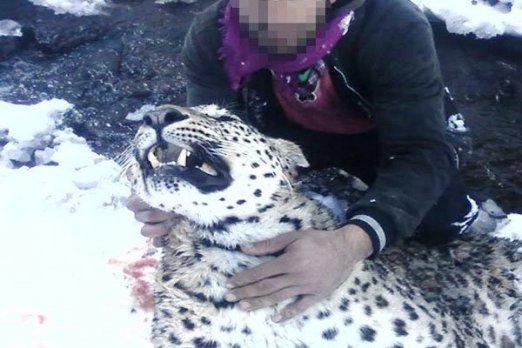
Persian leopard hunter ends up in jail; 42 months behind bars

Persian leopard hunter

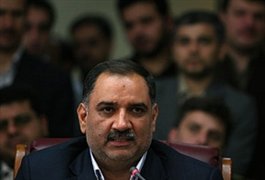
A man who killed a Persian leopard has been given 42 months in prison. Keyvan Hooshmand, the head of Iran’s Environment and Wildlife Watch, broke the news, saying that the poacher has been sent to prison after his sentence was upheld by an appeals court in the northern province of Gilan.

The following is a partial translation of his remarks on the court verdict as reported by Mehr News Agency on December 19:

The environment police identified and arrested the poacher two months after reports came out in June that a Persian leopard had been illegally hunted in the forested areas of Talesh in Gilan Province.

The offender was first sentenced to three years of imprisonment after he admitted to wrongdoing following the discovery of a leopard tale and unlicensed rifle in his residence, and to an additional six-month jail term for carrying a weapon on his person. He was also fined five million tomans [roughly $1,600] for damaging the environment, with his rifle being confiscated.

The poacher appealed the court’s decision. The appeals court in the province rejected the convict’s claims and upheld the verdict handed down by the court of first instance.

Iran’s changed flight routes benefit neighboring countries

airplane

Mohammad Ali IlkhaniIranian aviation authorities have changed some flight paths in keeping with a decision by the Supreme National Security Council, Managing Director of the Iranian Airport Holding Company (IAHC) Mohammad Ali Ilkhani, told Mehr News Agency on December 19. The following is the translation of what else the IAHC chief had to tell the news agency:

The Supreme National Security Council has recently agreed to change the air routes along which planes fly and this has helped the neighboring countries, including Iraq and Turkey.

The decision which has come into effect over the past few months cuts the flight time on certain domestic routes by 11 to 12 minutes.


Purchase of radar systems

Talks between Tehran and P5+1 have seen foreign companies head to Iran. Three European giants have entered talks with Tehran to that end. Iran is planning to buy radar and aid-to-navigation systems from France, Italy and Spain.

Countries which were unwilling to talk to Iran until last year, are now voluntarily coming here to pitch their products. That gives us the opportunity to purchase higher quality items at international tenders.

Western countries cannot ignore Iran. A small country like the UAE purchases a radar system which covers its entire territory as well as part of Saudi Arabia and Iran. Thanks to the vastness of our land, we need to purchase 11 more radar systems. That is many times over the demand of countries located to the south of the Persian Gulf.

We estimate that within the next three years we’ll have to spend between $250 million and $300 million dollars to modernize our radars.

Presently, there are three airports in Tehran and Alborz provinces. We seek to pick an international consultant to help us with the development of Imam Khomeini International Airport and plan a railway network that links Imam Khomeini Airport to Mehrabad Airport which is within Tehran city limits.

A second phase of Imam Khomeini Airport features a new terminal capable of handling 20 million passengers. That is estimated to require as much as $1 billion in investment. We need private capital to complete the project. French and Malaysian companies have put forth expansion plans whose implementation requires international consultation.

Iran condemns Boko Haram’s deadly attack in Nigeria

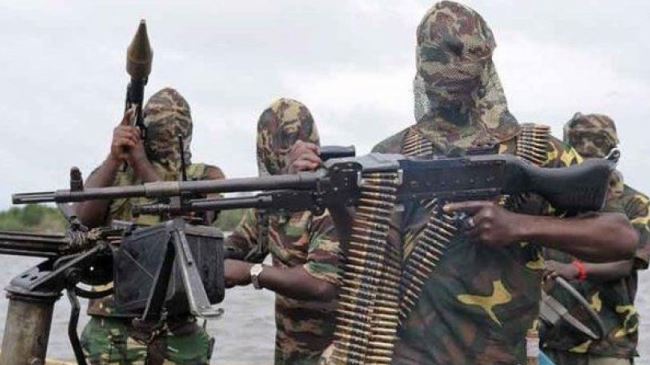
boko haram-militants

According to Thursday reports, Boko Haram militants raided a small village in northeastern Nigeria, killing 35 people and abducting about 185 others, mostly women and young girls.

Afkham lamented the death of civilians in the raid and urged the immediate release of all the abductees.

The news of the incident in the remote farming village of Gumsuri emerged on Thursday but the attack had taken place a few days earlier.

“The terrorists were armed to the teeth,” said a village resident who survived the attack. “They had AK-47 rifles and other weapons. They also had petrol bombs, which they used in setting the village ablaze.”

The village of Gumsuri is 20 kilometers from the northeastern town of Chibok, where Boko Haram militants kidnapped 276 schoolgirls in April. Dozens of the students escaped that attack, but more than 200 of the girls are still held captive.

The mass kidnapping in April drew international outrage and condemnation.

Boko Haram, whose name means “Western education is forbidden,” says its goal is to overthrow the Nigerian government.

Since the beginning of its operation five years ago, Boko Haram militants have raided a number of towns and villages, kidnapping hundreds of people. Their attacks have also left many others killed.

International researchers begin to document evidence about the emergence of modern humans in Iran

modern humans in Iran

On December 10, www.richt.ir, the website of the Research Center of Iran’s Cultural Heritage, Handicrafts and Tourism Organization reported that an archeological project centering on the origin of modern humans has just gotten underway in Lorestan Province in cooperation with international experts. What appears below is the translation of the report the website posted:

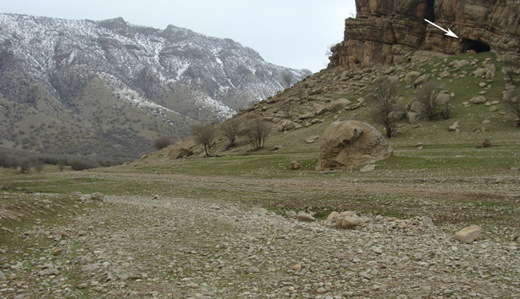
On December 10, 2014, a team of international experts launched archeological excavations at Kaldar Cave in Khorramabad Valley in Lorestan to document the emergence of first modern humans in Iran and shed light on why the Neanderthals went extinct.

“There are different theories as to where modern humans in Europe have originated from. One such theory points at Iran as a likely place for the origination of modern humans. The current excavation has a multidisciplinary nature and includes advanced analysis of stone tools and what remains of flora and fauna,” said the head of the archeological team Behrooz Bazgir.

Reiterating that such excavations are part of a bigger research project, he said, “During the project, archeological sites which could help us broaden our knowledge about the Paleolithic era will be studied.”

“The major objective of this massive project is to learn about the global position of this region in Paleolithic studies. Over the past few decades, there have been significant findings involving preliminary evidence about human settlement in West Asia which has shed further light on the developments of Stone Age in neighboring countries. That in turn has highlighted Iran’s position as a bridge connecting Asia to Africa and Europe,”

The international team brings together researchers from different universities and research centers. Professor Eudald Carbonell of the University of Rovira and Virgili in Tarragona, Spain, Jan van der Made from the National Museum of Natural Sciences in Madrid, Andrea Piccin from the University of Jena in Germany, Marcel Otte from the University of Liege, Belgium, the Max Planck Institute for Evolutionary Anthropology, Italy’s University of Bologna, and the Institute for Human Studies in Burgos, Spain contribute to the project.

The 5-year archeological excavation project at Kaldar Cave is based on a memorandum of understanding (MoU) signed between Director of the Research Center of Iran’s Cultural Heritage, Handicrafts and Tourism Organization Seyyed Mohammad Beheshti and Director of the Catalan Institute of Human Paleoecology and Social Evolution Professor Eudald Carbonell.

Iranian scientific achievements unveiled during National Research Week

Iranian Researchers

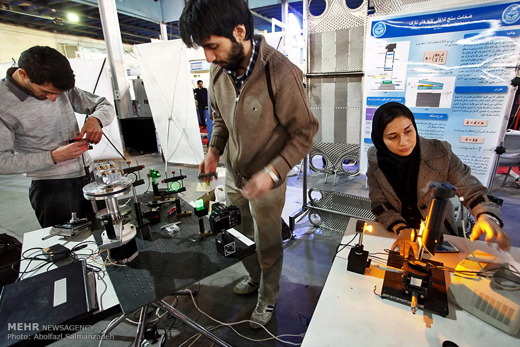
On December 17, Mehr News Agency, filed a report about the 15th Exhibition of Iranian Technological and Research Achievements, held between 14th and 17th of December, to mark National Research Week.

During the exhibition, scientific products ranging from a communications satellite simulator, a smart digital seismograph, and a multipurpose nano-anti-pollution mask to a robotic talking face were on display. The following is a partial translation of the report:

The opening bell of the National Research Week rang out at Palestine Vocational School in Tehran with the ministers of education, the interior and science attendance. At the ceremony, six student researchers were awarded.

Over 350 research centers from different science and technology parks and knowledge-based firms presented their latest achievements in the 15th Exhibition of Technological and Research Achievements of Iran. Also, over 500 technological projects with the potential to be commercialized were presented by different research centers and universities.


talking robotAmong other inventions on display in the exhibition, was a robotic talking face. Inventor of the device Morteza Moradi said, “The robotic face can talk and is mainly used in tourist centers in order to introduce items such as famous statues to visitors. The talking face is able to answer impromptu questions.”


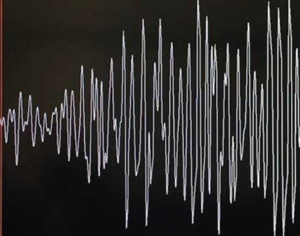
wavesThe intelligent digital seismograph was another device showcased at the exhibition. The equipment is designed to warn people at home to take shelter just before an earthquake hits. Ahmad Pazooki, an expert representing the manufacturer of the device said, “Given that Iran sits on a fault line and is in ever-present danger of being struck by earthquake, the equipment was made. This instrument is a first in Iran and around the world and does not have a similar copy. The equipment which is going through the process of mass production and commercialization will cost less than $200.”

IAEA confirms Iran’s commitment to interim nuclear deal

IAEA-Iran-report

The monthly update report by the IAEA indicated on Friday that the Islamic Republic had not made “any further advances” in its activities at the country’s enrichment facilities and at Arak heavy water reactor.

The report also noted that Tehran’s uranium enrichment did not exceed a fissile concentration of five percent.

On November 25, Iran “temporarily stopped the operations for conversion and fuel manufacturing” at a facility that was checked by the agency from December 14 to 16, the report added.

Despite making progress, Iran and the five permanent members of the United Nations Security Council — China, Russia, Britain, France, and the United States — plus Germany failed to clinch a final nuclear deal by a November 24 deadline during their talks in Austrian city of Vienna.

However, Tehran and the P5+1 agreed to extend their discussions for seven more months until July 1, 2015. They also agreed that the interim deal they had signed in Geneva last November remain in place during the negotiations.

Under the Geneva deal, dubbed the Joint Plan of Action, the six countries undertook to provide Iran with some sanctions relief in exchange for the Islamic Republic agreeing to limit certain aspects of its nuclear activities during a six-month period.

As part of the interim deal, Iran suspended 20-percent uranium enrichment as of January 20 when the agreement came into force. Iran then started to dilute and oxidize its 196-kg stockpile of 20-percent-enriched uranium.


Saudi comments add to market volatility

oil

Crude prices rebounded from the lowest levels since May 2009 as comments from Saudi Arabia’s oil minister Thursday added jitters to the most volatile market in three years.

West Texas Intermediate climbed as much as 3.5 percent in New York and Brent 2.9 percent in London. A measure of expected WTI futures movements and a gauge of options value have been at the highest level since October 2011, data compiled by Bloomberg showed.

Ali Al-Naimi, Saudi Arabia’s oil minister, said Thursday that a slump in prices was temporary; he also said it would be “difficult, if not impossible” for OPEC to curb its oil production amid a glut, the Saudi Press Agency reported. Prices rose immediately after his remarks, before ending the day at the lowest in five years. The nation accounted for about 13 percent of global oil output last year, BP Plc estimates.

Oil markets are experiencing “temporary” instability caused mainly by a slowdown in the world economy, Al-Naimi said, according to the comments published by the Saudi Press Agency. Steady global economic expansion will resume, spurring demand, according to the minister, leading him to be “optimistic about the future.”

OPEC, which supplies about 40 percent of the world’s oil, pumped 30.56 million barrels a day of crude in November, a Bloomberg survey of companies, producers and analysts shows. That exceeded its collective target of 30 million for a sixth straight month.

“The Saudi comments indicate that until we see signs of supply destruction the potential upside for crude seems limited,” Ole Hansen, head of commodity strategy at Saxo Bank A/S in Copenhagen, said by e-mail. “This is the first week in a while where buyers have dipped their toes back in the market.”

In Russia, the world’s largest crude producer, the economy must adapt to the reality of prices that could decline to as low as $40 a barrel, according to President Vladimir Putin. Oil’s collapse may be due to a battle for market share between traditional producers and shale companies, he said at his annual press conference in Moscow Thursday.

Production from the U.S., the world’s biggest oil consumer, expanded to 9.14 million barrels a day through Dec. 12, the Energy Information Administration said. That’s the highest level in weekly data that started in January 1983.

WTI will drop next week, a separate Bloomberg survey shows. Fifteen of 35 analysts and traders, or 43 percent, forecast futures will fall through Dec. 26, while 11 predict a price advance.

Iran will tap all power to solve regional crises: Velayati

Ali-Akbar-Velayati

A senior advisor to Leader of the Islamic Revolution Ayatollah Seyyed Ali Khamenei says the Islamic Republic will employ all of its capabilities to solve regional crises.

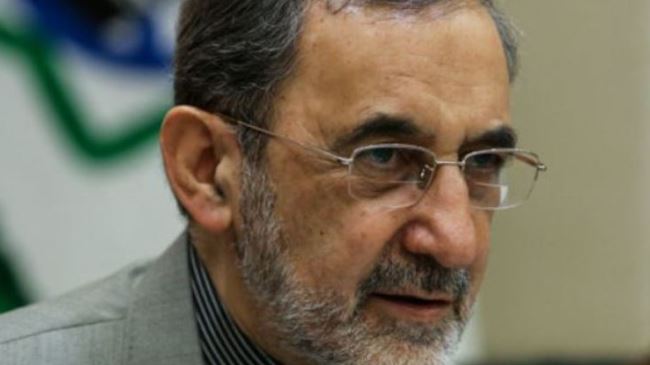
“Iran, while not interfering in the affairs of countries, will make use of its capacity and capability to settle regional problems and maintain unity in the Muslim world,” Ali Akbar Velayati said on Friday.

He added that Iran has never sought to gain dominance over any independent country, saying the Islamic Republic’s very good relations with many regional nations would help it solve the ongoing problems in the region.

Velayati said that based on Iran’s Constitution, Tehran has the duty to support nations against occupation of foreign forces and foreign interference.

“Based on this principle, we have supported the brave resistance of the Palestinian and Lebanese people,” Velayati, who is also the president of the Center for Strategic Research of Iran’s Expediency Council, pointed out.

He noted that Iran has always defended Iraq’s national reconciliation, sovereignty and territorial integrity.

“We also support the people and constitutional government in Syria and believe that the Syrian nation, itself, must settle the problems. No other country and no foreigner have the right to determine the country’s affairs,” the top Iranian official said.

He emphasized that stability would be established in the region by avoiding tribal and ethnic conflicts and called for adopting a rational, fair and Islamic stance on the fight against the Takfiri movements.

The ISIL terrorists control some parts of Syria and Iraq.

They are engaged in crimes against humanity in the areas under their control. ISIL militants have terrorized and killed people of all communities, including Shias, Sunnis, Kurds, and Christians.

Iran Raps “Biased” UN Human Rights Resolution

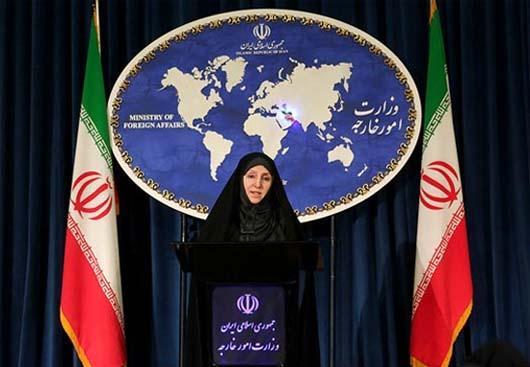
Iranian Foreign Ministry Spokeswoman Marziyeh Afkham

Iran’s Foreign Ministry spokeswoman slammed a UN resolution on the alleged human rights violations in the country, saying the resolution is based upon “biased and unauthentic” sources.

The UNGA approved the resolution based on a recent report by UN Human Rights Rapporteur on Iran Ahmed Shaheed.

In reply, Marziyeh Afkham condemned any “arbitrary and political use of human rights against independent states.”

“The Islamic Republic of Iran fundamentally rejects the introduction, adoption and content of such resolutions,” she said.

“It is regrettable that the United Nations’ human rights mechanisms and tools are abused by certain Western countries which are occasionally known as the flagrant violators of human rights inside and outside their own borders,” she added.

Afkham said Iran has already responded to the claims in the resolution “reasonably and by providing documents.”

She added that such a resolution on the basis of biased sources would have proved entirely unnecessary if those who drafted it had made decisions “impartially and had avoided double-standard attitudes.”

A look at Iranian newspaper front pages on Dec. 20

Iranian Newspapers Headlines

No single news story dominated the front pages of the Iranian newspapers on Saturday. Reformist-leaning dailies covered the comments of former President Mohammad Khatami on moderation and the stance of the reformist camp vis-à-vis subversive elements. The comments of the Russian president that P5+1 are close to securing a deal with Iran also appeared on the front pages of some dailies. And news about a likely cut in interest rates drew attention as well.


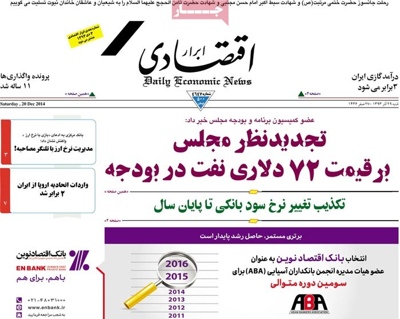
Abrar-e Eghtesadi: EU imports from Iran have registered a 100 percent hike.

Abrar-e Eghtesadi: A member of parliament’s Budget and Planning Committee has said that the chamber will have to tweak the government-proposed spending package’s assumption that oil prices will hover around $72 a barrel next year.

Abrar-e Eghtesadi: Interest rates won’t change by yearend [March 21, 2015].
 

Abrare eghtesadi newspaper 12 - 20


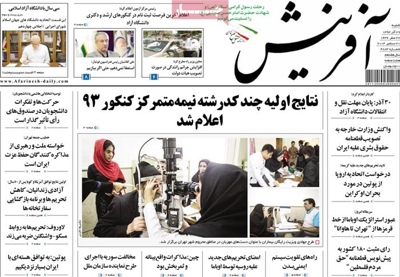
Afarinesh: Compassionate Hands, a Health Ministry plan to examine patients free of charge, has been implemented in a number of poor neighborhoods of the capital.
 

Afarinesh newspaper 12 - 20


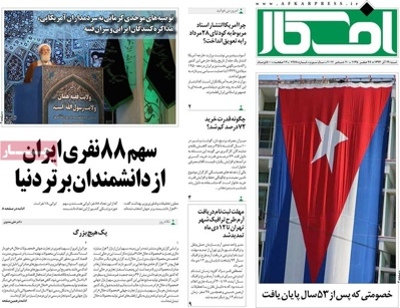
Afkar: “Eighty-eight Iranian scientists are on the 60,000-strong list of top world scientists,” said the Iranian deputy health minister.
 

Afkar newspaper 12 - 20


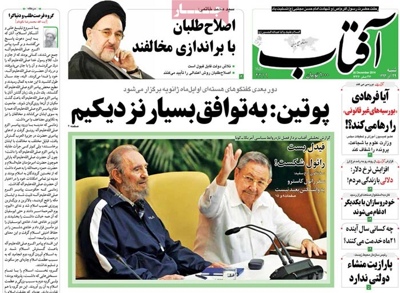
Aftab-e Yazd: “Reformists are opposed to subversion and approve of the moderate approach the government [of President Rouhani] practices,” said former President Mohammad Khatami.

Aftab-e Yazd: President Putin of Russia has said that P5+1 are very close to clinching a nuclear deal with Iran.
 

Aftabe yazd newspaper 12 - 20


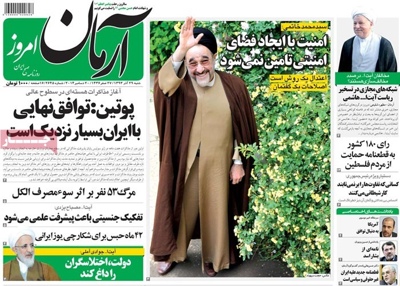
Arman-e Emrooz: An Asiatic Cheetah poacher has been sentenced to 42 months in prison.

Arman-e Emrooz: “Gender segregation results in scientific progress,” said Ayatollah Mesbah Yazdi.

Arman-e Emrooz: “Creation of a security atmosphere won’t ensure security,” said former President Mohammad Khatami.

Arman-e Emrooz: Fifty-three people have died as a result of alcohol abuse.
 

Armane emruz newspaper 12 - 20


Asr-e Rasaneh: High-speed internet is accessible in 12,000 Iranian villages.
 

Asre resaneh newspaper 12 - 20


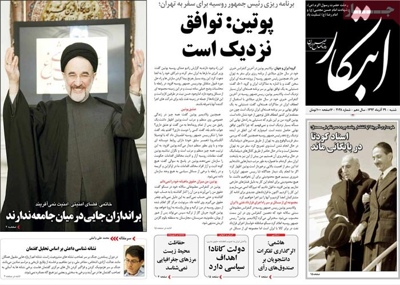
Ebtekar: “Subversive elements have no place in society,” former President Mohammad Khatami said.
 

Ebtekar newspaper 12 - 20


Emtiaz: Iran will be self-sufficient in gasoline production in two years.

Emtiaz: The deputy minister of roads and urban development has said a plan to raise fines for traffic offenders is being reviewed.
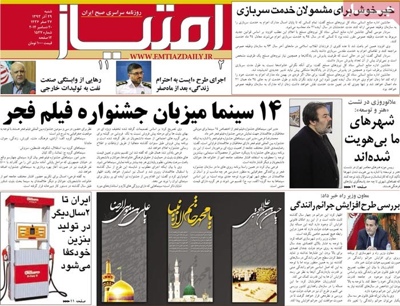
 

Emtiaz newspaper 12 - 20


Ettela’at: “The next round of nuclear talks between Iran and P5+1 will be held next month,” Deputy Foreign Minister Seyyed Abbas Araghchi said.

Ettela’at: The Iranian army will stage maneuvers codenamed Muhammad, the Messenger of God, later in December.

Ettela’at: In Iraq, Kurdish Peshmerga fighters have broken the siege of Mount Sinjar.
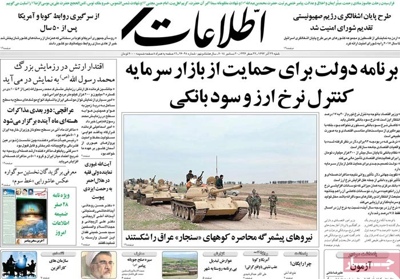
 

Ettelaat newspaper 12 - 20


Farhikhtegan: President Obama’s decision to reestablish ties with Cuba has drawn a smile from the rest of the world, and a frown from Republicans at home.
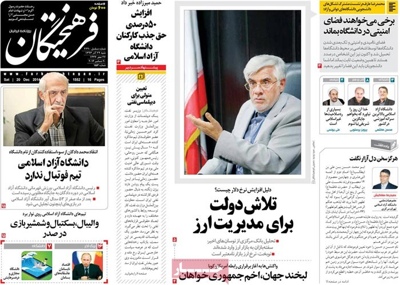
 

Farhikhtegan newspaper 12 - 20


Hambastegi: The health minister has called for runaway expansion of universities to be stopped.
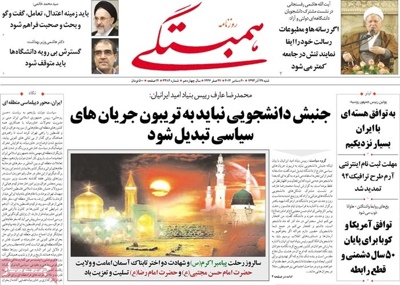
 

Hambastegi newspaper 12 - 20


Iran: At meetings with the Iranian health minister, sources of emulation have thrown their weight behind the Health Transformation Plan initiated by his ministry.
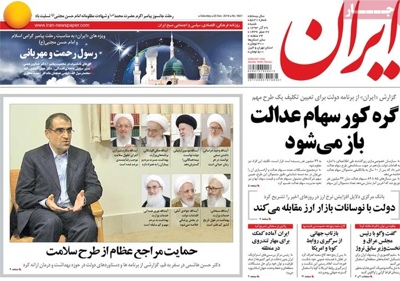
 

Iran newspaper 12 - 20


Jamejam: Russian President Putin is preparing for a visit to Iran.

Jamejam: IS terrorists have suffered losses in three different regions in Iraq.
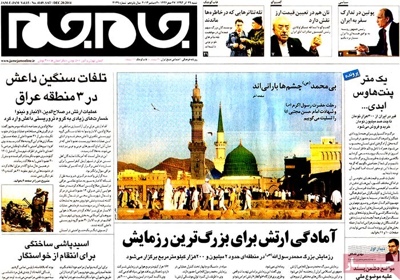
Jame jam newspaper 12 - 20


Javan: Tehran’s Friday prayer leader Ayatollah Movahedi Kermani has urged nuclear negotiators to make sure Iranian dignity is preserved in talks [with P5+1].
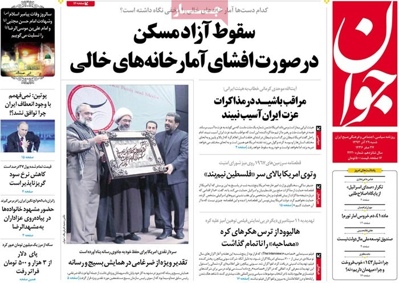
 

Javan newspaper 12 - 20


Jomhouri Islami: As many as 180 UN members have supported a plan that recognizes the Palestinian right to self-determination.

Jomhouri Islami: The minister of economy has said government is considering a cut in interest rates.
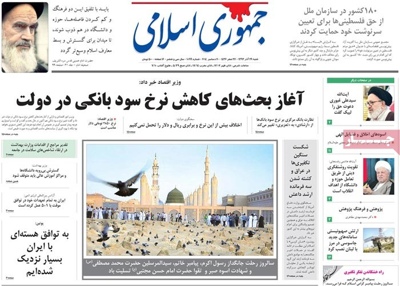
 

Jomhorie eslami newspaper 12 - 20


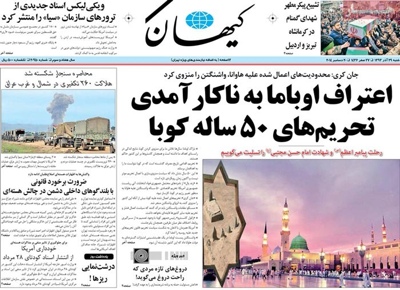
Kayhan: The US has decided not to release a report on CIA’s involvement in a coup in Iran in 1953, fearing it could have an adverse effect on nuclear talks with Tehran.
 

Kayhan newspaper 12 - 20


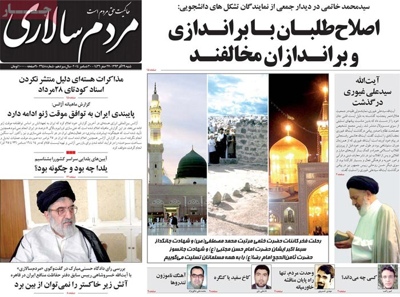
Mardomsalari: A monthly report by the International Atomic Energy Agency has confirmed Iran’s commitment to the Geneva Interim Agreement.
 

Mardom salari newspaper 12 - 20


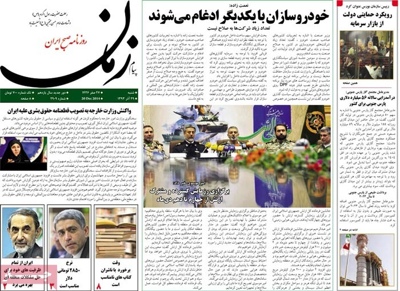
Payam-e Zaman: “Carmakers are likely to be merged,” said the Iranian minister of industries.
 

Payame zaman newspaper 12 - 20


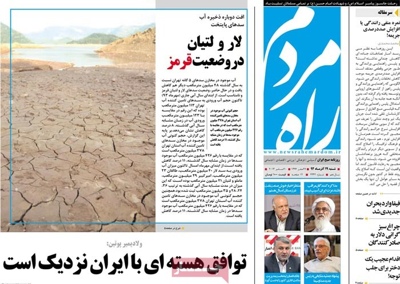
Rah-e Mardom: Water levels behind Latian and Lar dams that supply part of the capital’s water needs have fallen again.
 

Rahe mardom newspaper 12 - 20


Sayeh: Foreign Ministry Spokeswoman Marziyeh Afkham has dismissed an anti-Iranian human rights resolution at the United Nations General Assembly as “fundamentally flawed”.

Sayeh: Ayatollah Seyyed Ali Ghayuri, the Supreme Leader’s representative to the Red Crescent Society of Iran has passed away.
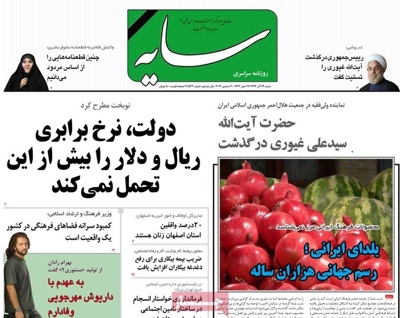
 

Sayeh newspaper 12 - 20


Sepid: Phase One of the Health Transformation Plan is 95 percent complete.
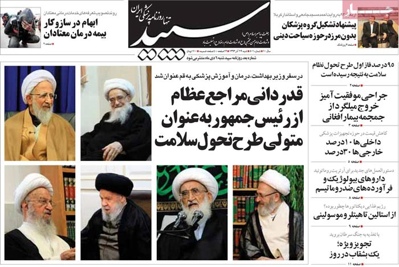
 

Sapid newspaper 12 - 20


Shahrvand: Sony Pictures caved. The Interview won’t be released after a threat by North Korean hackers.
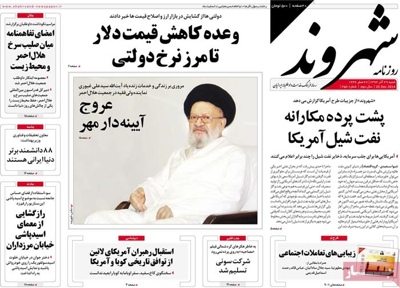
 

Shahrvand newspaper 12 - 20


Tafahom: Iran’s gas revenues are to increase 3-fold.
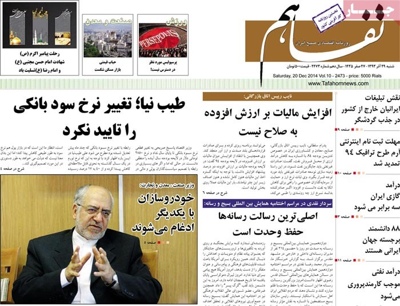
 

Tafahom newspaper 12 - 20