
Sunday, December 21, 2025
Home Blog Page 4878

Iranian Pegasus draws the attention of foreign media (PHOTOS)

Pegasus

In Greek mythology, Pegasus is a winged divine stallion which was a loyal companion of Greek hero Bellerophon.

Frequently-visited foreign websites such as twistedsifter , which are famous for the release of art photos, have lately given special attention to an artwork by Hassan Nowruzi, a 34-year-old Iranian artist.

Nowruzi has created a sculpture of Pegasus out of scrap metal.

The photos of the beautiful sculpture of Pegasus released by Mehr News Agency on April 16:


Iran and Russia, a game of cards

Rouhani-Putin

A decree by the Russian president [on Monday] which removed a ban on the delivery of S-300 missiles to Iran can be praised as the first big achievement after the framework agreement in Lausanne, Switzerland and prior to a final nuclear deal by July 1.

Aftab-e Yazd on April 18 published an opinion piece by Mehrdad Khadir, a journalist, about the air defense system Russia was contractually obligated to provide Iran with, and whether Iran is holding all the cards or it is Russia which is playing the Iran card. The following is a partial translation of the piece:

[…]

Some characterize Putin’s decree as political opportunism, warning Iran against getting entangled in a game of missiles with the Russians, but politics is nothing but taking advantage of opportunities.

This view makes it clear that the Russians are playing the Iran card, trying to fish in [the murky] water [created] in Lausanne. […]

No doubt, the Russians are trying to get a lot of mileage out of the current circumstances. On the one hand, they are worried about a thaw in ties between Tehran and the West, struggling to cement their foothold [in Iran] before anything else; on the other hand, they are seeking a chance to flex their [political] muscle and counter the sanctions imposed by the US for Moscow’s annexation of Crimea and its involvement in the Ukrainian crisis.

Iran, too, can benefit from the status quo. It can convey this message to the US Congress: “If you seek to throw a wrench into the works as far as the nuclear agreement and lifting of sanctions are concerned, there are still other options”.

That President Rouhani can take care of this in a justifiable way, without provoking the rivals, is the craftsmanship of his government.

[…]

Whenever world powers have been locked in a race and whenever consummate, astute national politicians have come into office in Iran, the country has been given the opportunity to take advantage of an emerging rift [between the East and West]. Iran has faced problems [in its diplomacy] whenever either one has been absent.

As a case in point, one can say that the national government of [Dr. Mohammad] Mosaddegh [back in the 1950s] did not face serious challenges so long as Joseph Stalin was in power in the Union of Soviet Socialist Republics and the Americans felt threatened by their World War ally [USSR]. But when the Republicans took over the White House and Stalin died, they hatched a plot to topple Mosaddegh and implemented it in less than six months.

Following Germany’s defeat in the First World War and the Russian Revolution which weakened the USSR, Britain was given a new lease on life and the chance of bargaining faded in Iran.

Again today a government is in power in Iran which can seize the opportunities, and both the US and Russia have again got involved in a rivalry – not like the Cold War, though. […]

If successful, the delivery of S-300 missiles [to Iran] can either be a response to claims by the Worriers [opponents of President Rouhani’s policy of moderation] at home or a step toward removing their concerns. […] The Worriers argue, “If they [the West] have no fear of Iran, they will get emboldened to hatch plots against and target us.” Now they can see that Iran has become safer thanks to the [Lausanne] agreement and can even acquire the air defense system.

Here one stone can kill three birds. First, the building of sanctions has – as the president put it – developed cracks; the delivery of missiles has yet to become a reality, but it has already affected the sanctions. As one of the six countries which have imposed sanctions on Iran, Russia has taken the initial step to lift those sanctions.

The second target are the Israelis; they should not think that they will face a weakened Iran following the imposition of restrictions on its nuclear program. A post-sanctions Iran will be much more powerful, not only on the economic and financial fronts, but also militarily and as far as defense is concerned.

And third, it will aim at the Westerners, especially the US. They need to know that they are Iran’s [partners of] choice in the new era, but there are still other options if they do not want to be Iran’s choice.

This time around, those other options don’t stand on ceremony when it comes to the US for two reasons: First, they [the Russians here] can say that the Iranians honored their [nuclear] promises and it was the other side which did not make good on its commitments. Second, the Russians – bearing the scar of sanctions – can show a spirit of empathy or seek to show additional reaction [to the West].

[…] Irrespective of Russia’s intention, each side is expected to take into account its own interests. Days will come and go and on July 1 two options will be on the table: either a final deal is clinched without any obstructionism from the US Congress; or less likely, Capitol Hill stands in the way [of the final deal] on any ground.

If so, the Russians won’t have to abide by the past restrictions and Iran can go ahead with its $20 billion contract – selling 500,000 barrels of oil per day and get commodities in return.

Therefore, it is not Russia which is playing the Iran card; or, let’s say, it is not only Russia which is playing the Iran card, Iran too can play the Russia card delicately and meticulously.

This play should be tactical and temporary to arouse the jealousy of the Western suitors, not in the form of a permanent marriage with the northern neighbor which – according to what history reveals – has left Iran on its own in the nick of time.

With the return of giant companies, especially oil and automotive juggernauts, Iran’s economy will be given a shot in the arm. When Iran’s frozen assets are released, it can give money and buy the items it needs instead of giving oil and receiving commodities in exchange.

Traditional local ritual in west-central Iran (PHOTOS)

Traditional local ritual

Locals in Mahallat, a city in Markazi Province, get together each year for a traditional ritual where they show their athletic abilities using shovels.

Photos of the ritual by Mehr News Agency on April 18:


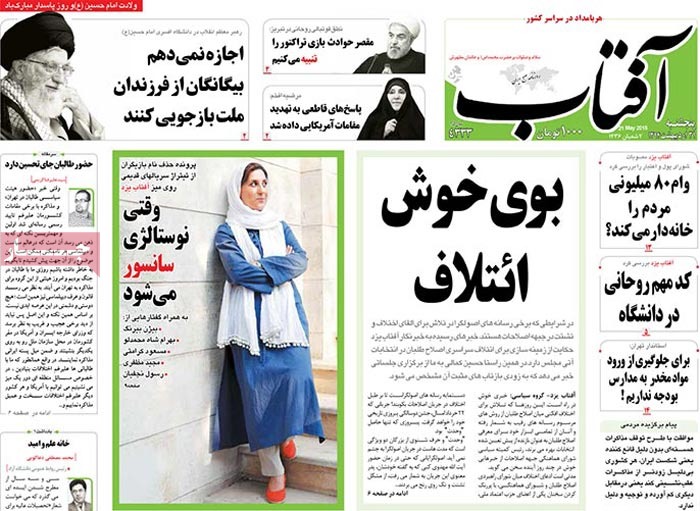
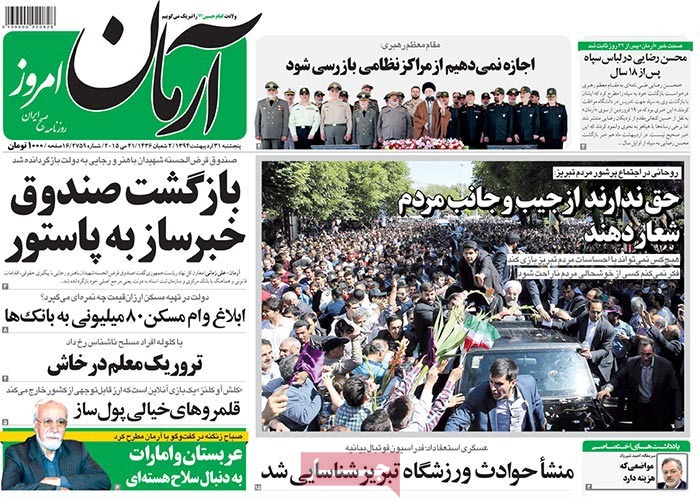
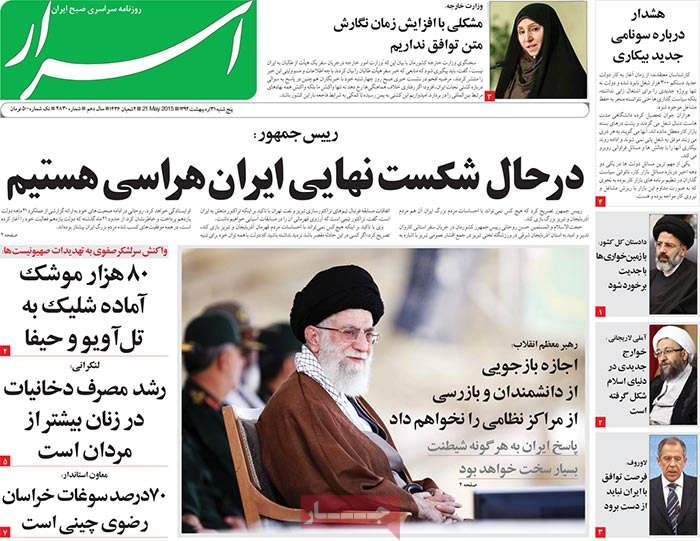
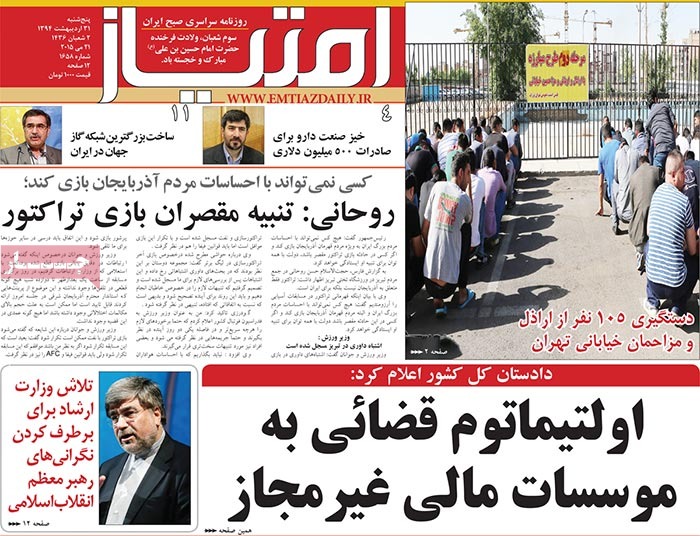
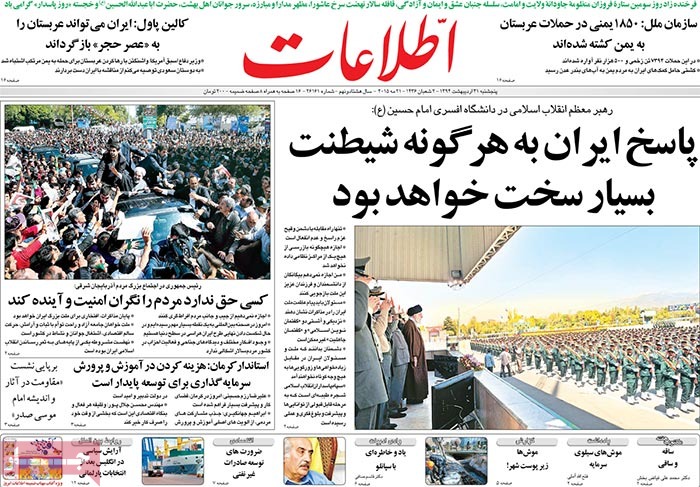
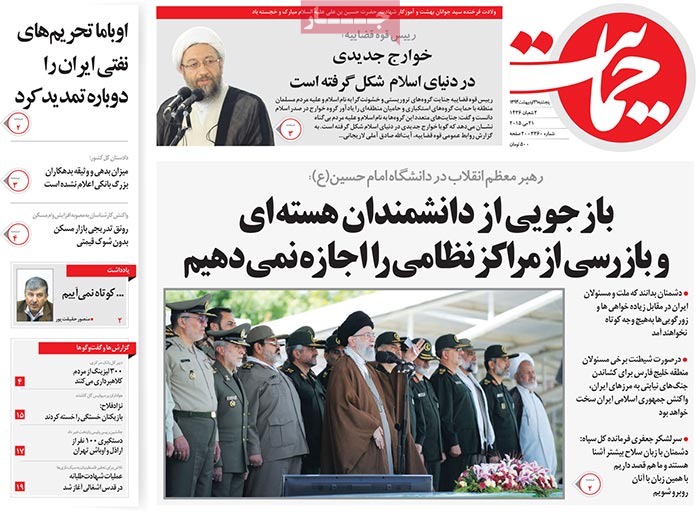
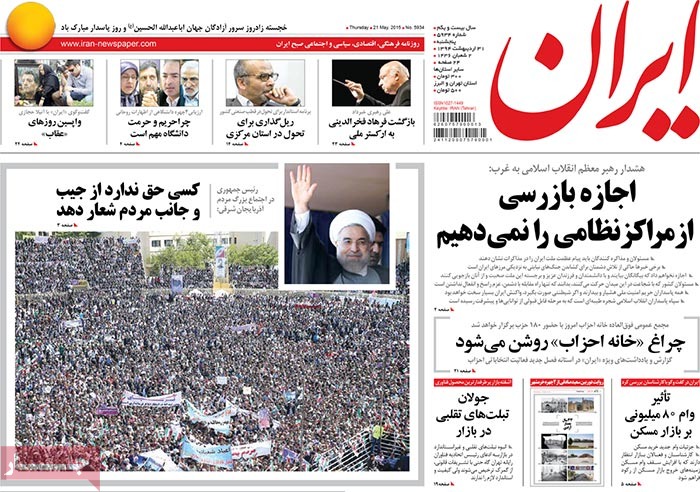
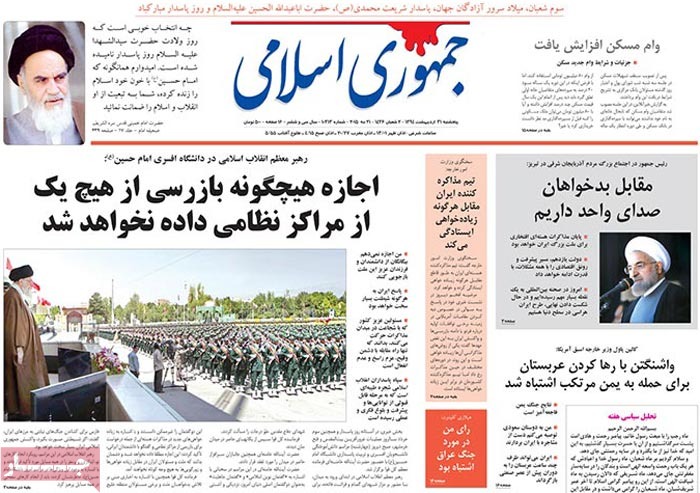
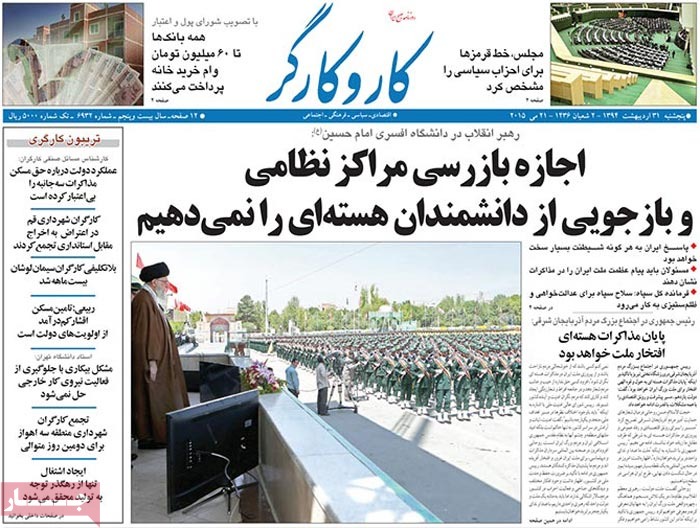
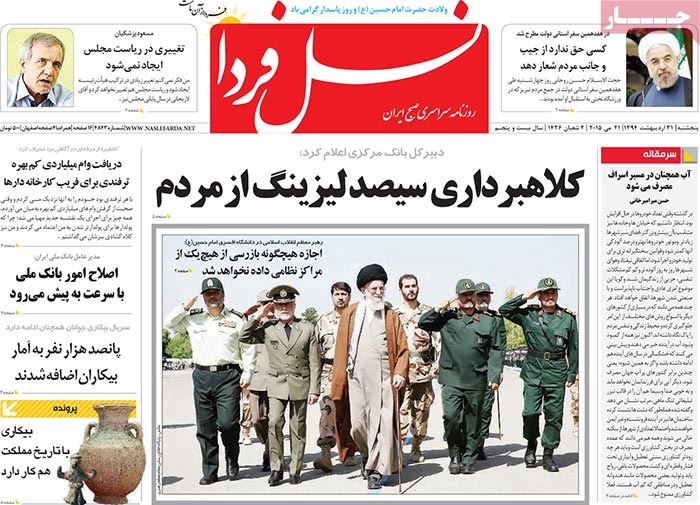
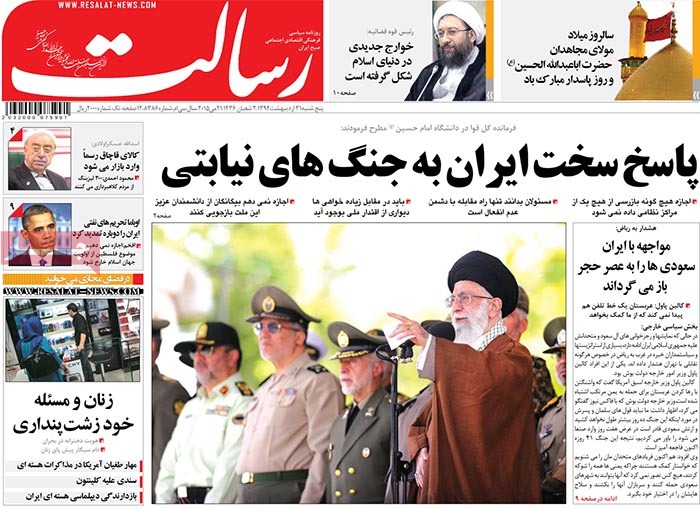
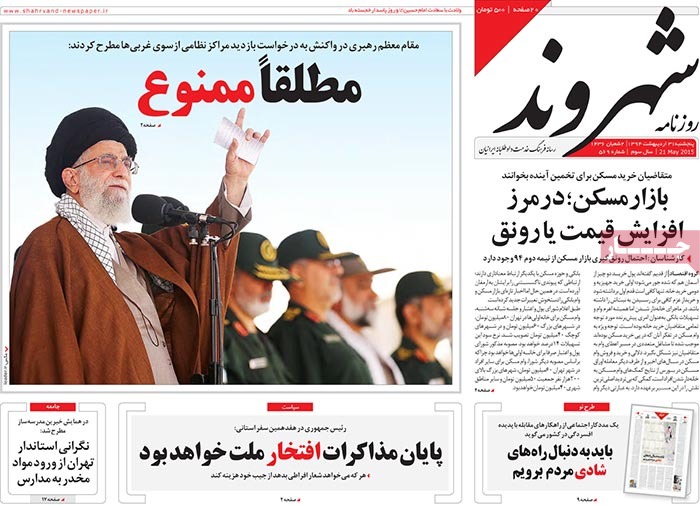
A look at Iranian newspaper front pages on April 19

Iranian Newspapers Headlines

The Army Day parade and comments of President Rouhani at a ceremony in Tehran to mark the occasion dominated the front pages of Iranian newspapers on Sunday. The meetings of the Australian foreign minister with senior Iranian officials also appeared on the covers of the dailies.


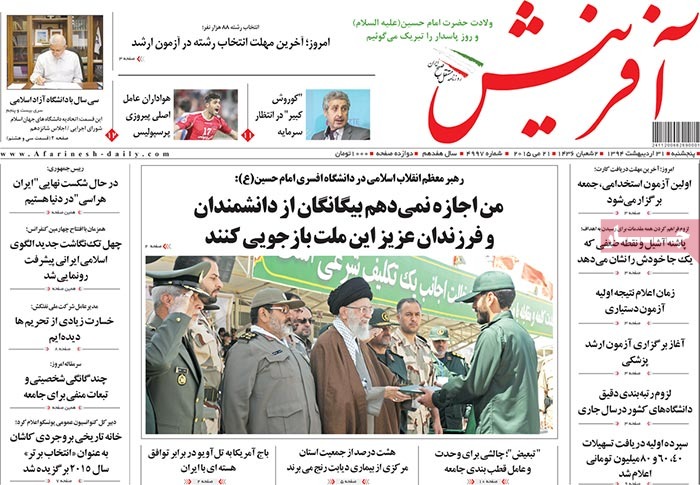
Afarinesh: “Termination of all illegal sanctions after conclusion of a deal is imperative,” said the secretary of the Supreme National Security Council.


A look at Iranian newspaper front pages on April 19


Arman-e Emrooz: Representatives have given the green-light to American firms.

Talks with oil giants have gotten underway.

Arman-e Emrooz: A deputy labor minister has vowed the ministry will create 500,000 jobs.

Arman-e Emrooz: “If a good parliament is not formed, the work of the government will remain unfinished,” said the first vice-president.


A look at Iranian newspaper front pages on April 19


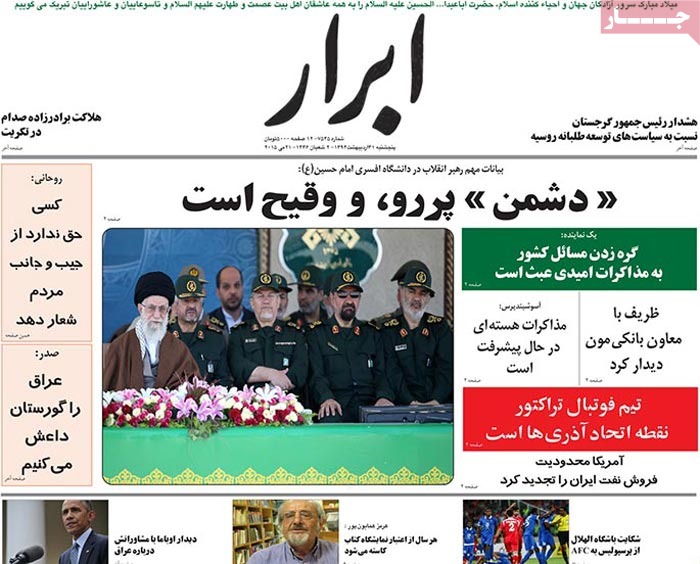
Asrar: One-year banking interest rate has decreased to 20 percent.


A look at Iranian newspaper front pages on April 19


Ettela’at: “The might of the Iranian armed forces serves regional peace and tranquility,” said President Rouhani.

The president made the comment at a parade to mark Army Day.


A look at Iranian newspaper front pages on April 19


Hambastegi: Some 520 towns and cities face water shortage,” said the director of the Crisis Management Organization.


A look at Iranian newspaper front pages on April 19


Hemayat: “Those who allege dirty money is funneled into electoral campaign have yet to produce compelling evidence,” said the Iranian inspector general.


A look at Iranian newspaper front pages on April 19


Iran: Ali Shamkhani has welcomed the return home of Iranian migrants.

It came at a meeting between the secretary of Iran’s Supreme National Security Council and the visiting Australian foreign minister.

Iran: Iranian and European oil managers have met.

Nine companies have expressed readiness to return to Iran.


A look at Iranian newspaper front pages on April 19


Kayhan: In the latest confidence-building measure, the US arrested three Iranian nationals!


A look at Iranian newspaper front pages on April 19


Qods: Parliament has launched an investigation into state officials with dual citizenship.


A look at Iranian newspaper front pages on April 19


Sharq: “Leila Araghian, the 31-year-old architect of the capital’s Nature Bridge has won the most prestigious architecture award in the world.

Sharq: Foreign Minister Zarif has warned the West that if sanctions are not lifted, Iran will resume unlimited enrichment.


A look at Iranian newspaper front pages on April 19


Velayati says Iran, Australia can cooperate in fighting ISIL

velayati

A high-ranking Iranian official says increased cooperation between Iran and Australia can bolster security in the Middle East and facilitate the fight against ISIL.

Ali Akbar Velayati, who is the president of the Center for Strategic Research of Iran’s Expediency Council, said Saturday that Tehran and Canberra have decided to strengthen their “constructive” relations, which he said, could help establish peace and security in the Middle East, especially in Iraq.

“Cooperation between Iran and Australia, as two countries that have good relations, can be very useful for [establishment of] peace and calm in the Middle East and countries in the Oceania,” said Velayati in a joint press conference with the visiting Australian Foreign Minister Julie Bishop.

Velayati, a senior aide to Leader of the Islamic Revolution Ayatollah Seyyed Ali Khamenei and a former Iranian foreign minister, added that joint efforts by Iran and Australia could be very effective in fighting terrorism and establishing security in these regions.

The Australian foreign minister, for her part, called her trip to Tehran as very positive, saying that in her meeting with Velayati, she discussed Iran and Australia’s common objectives including providing support for the Iraqi government in its fight against ISIL terrorists.

Bishop said Australia is determined to take part in the international battle against the ISIL terrorists, adding that Canberra will support the Iraqi government in its fight against the Takfiri group, Press TV reported.

Heading a high-ranking delegation, Bishop arrived in Tehran earlier on Saturday, marking the first visit to Iran by a senior Australian government official in over 12 years. She has held meetings with President Hassan Rouhani, Foreign Minister Mohammad Javad Zarif and Secretary of Iran’s Supreme National Security Council Ali Shamkhani.

Wedding traditions of Turkmens in Iran (PHOTOS)

Wedding traditions of Turkmens

Turkmen people in Iran follow interesting wedding traditions. Wedding celebrations usually last for three to four days.

The following is a photo gallery featuring a Turkmen wedding in the northeast of Iran by Mehr News Agency:

Iran, P5+1 have removed all differences except writing the final deal: Jahangiri

eshagh jahangir
eshagh jahangiri

First Vice President Eshagh Jahangiri said on Saturday that Iran and P5+1 are in the final stages of working out a deal.

In Iran all people fully back the government, even the opponents of the government call for the removal of economic sanctions.

If the Zionist regime, certain Arab governments and the US Congress stop creating obstacles in the coming two months, the comprehensive deal will be clinched, he said.

Media should reflect the realities and avoid creating irrational expectations among people, he said.

Upcoming parliamentary elections should be on the agenda, he underlined, adding that the opponents of the government are determined to disappoint people.

This year is a very tough year as oil prices will remain low and the government revenues from oil are very minor, he said.

Will Zarif win a Nobel Prize? Experts weigh in.

Mohammad Javad Zarif

The name of Foreign Minister Mohammad Javad Zarif is on the lips of many at home and abroad these days, particularly after Time Magazine put the Iranian top diplomat on the list of its top 100 influential figures.

Robin Wright, a journalist and foreign policy analyst with Woodrow Wilson Center, says Zarif has played a role in ending the Iran-Iraq war, in securing the release of American hostages in Lebanon and in the rise to power of a new government in Afghanistan after the fall of the Taliban.

An article in Hindustan Times last week said as a result of their efforts [to hammer out differences and clinch a nuclear deal] Zarif and Kerry stand a good chance to walk away with the 2015 Nobel Peace Prize.

Can the Iranian foreign minister be a candidate for the award? In light of the fact that some Iranian officials always react negatively to the prize, will such nomination spark a torrent of criticism by the so-called Worries [hardliners who support former President Mahmoud Ahmadinejad] against the top diplomat? And if he wins the prize, will he be able to collect it, especially if the prize is jointly won by Kerry and Zarif?

An April 18 issue of Aftab-e Yazd daily featured the answers four prominent experts produced to the questions above. The following is a partial translation of their answers:


Sadegh Zibakalam
Sadegh Zibakalam

Sadegh Zibakalam (Political Science Professor at University of Tehran): I can’t comment on whether or not Zarif will win the Nobel Prize. What I am certain about, though, is that the role of Mr. Zarif in the nuclear thaw which spares the nation a predicament, is similar to what Mr. Rafsanjani did during the war: saving the nation from continuing the Iraq war.

Mr. Zarif has proven that he is a dovish politician who favors détente. I can assure you that when the nuclear case is settled, he will take steps toward détente with the US and the West.

Principlists believe that the Nobel Prize is exclusively given to opponents of Islam and the revolution. If Mr. Zarif wins the prize, many of the things principlists say about the Nobel Prize will lose their credibility and the conspiracy theories surrounding the prize will be doomed.

If Zarif and Kerry jointly win the prize, the step Mr. Zarif wants to take toward détente would automatically materialize and hardline principlists wouldn’t be able to stop the improvement in ties, at least not on the international stage.


Davood Hermidas
Davoud Hermidas-Bavand

Davoud Hermidas-Bavand (Professor of International Law): Winning the Nobel Prize depends on the outcome of nuclear talks and what comes in their wake. If the upshot is positive, that could happen. When a crisis brewing for a long time is averted, what those who have played a role in easing or defusing it do can be described as quite a feat.

If there is a thaw in relations between Iran and the United States, Zarif and Kerry could be serious contenders for the Nobel Prize. Of course, the Nobel Prize for peace is different from literary and scientific awards. One cannot certainly say what factors play a crucial role in determining the winner. But Zarif and Kerry do stand a chance to jointly win the prize.


Ali Khorram
Ali Khorram

Ali Khorram (Expert in International Relations): It is too soon to predict whether Mr. Zarif will win the Nobel Prize. That a magazine puts the name of our foreign minister on the list of its top influential figures or that another publication stipulates about Nobel Prize candidates is not a reliable criterion.

Of course, Mr. Zarif deserves the prize in light of the efforts he’s put in [to settle the nuclear dispute]. But the disadvantages of talking about it too much in advance outweigh its advantages, because that would hand ammunition to opponents to target Mr. Zarif.


Fereydoun Majlesi
Fereydoun Majlesi

Fereydoun Majlesi (University Professor): At the beginning of the talks Iran was viewed as a defendant. However, a look at photos released at the close of the Lausanne talks shows that the defendant has taken on a new role, laughing on the stage with his counterparts. What else can you expect a diplomat to achieve?

Unlike former negotiators who were sullen, Mr. Zarif appeared in the talks with a trademark smile on his face. I believe he does have what it takes to win the Nobel Prize.

Messrs. Zarif and Kerry are likely to jointly win the prize because together they averted a problem that could have had very serious repercussions.

Those who make every effort to throw a wrench in the works, I mean the same people who won no more than 10 percent of the vote but still view themselves as representatives of the Iranian people will make a fuss if Zarif and Kerry are jointly nominated for the Nobel Prize. They will denounce the prize as imperialistic, but the Iranian people will definitely become happy and there will be marked improvement in the stature of Mr. Zarif overseas.

Tehran, Canberra concerned over ISIL: Iran FM

Mohammad Javad Zarif -8

The Iranian foreign minister has reiterated Tehran’s concerns over acts of terrorism and extremism in the Middle East region.

In a joint press conference with his Australian counterpart Julie Bishop in the Iranian capital, Tehran, on Saturday, Mohammad Javad Zarif highlighted that both Tehran and Canberra are concerned over terrorism in the region, including acts of violence committed by the ISIL Takfiri terror group.

Zarirf said the fight against ISIL should be coordinated by the Iraqi government, saying, “Anything Iran does in Iraq is in coordination with Baghdad.”

Zarif noted, “A larger global campaign is required to deal with ISIL.”

Echoing Zarif’s remarks, the top Australian diplomat said Iran and Australia in cooperation with other countries and the Iraqi government should “contribute to the defeat of this terrorist organization (ISISL),” and noted that “a more dangerous form of global terrorism” is jeopardizing the world.

She underscored that every effort should be made to prevent the “spillover of terrorism from Iraq and Syria” to other countries.

Syria has been grappling with a deadly war since March 2011. The violence fueled by Takfiri groups has so far claimed the lives of over 222,000 people, according to the so-called Syrian Observatory for Human Rights.

Human trafficking & situation of asylum-seekers

Elsewhere in their joint news briefing, the two foreign ministers voiced concern over the scourge of human trafficking and stressed the need to take measures to ameliorate the situation of asylum-seekers.

In recent years, the Australian government has been under fire at home and abroad for its strict immigration policies and treatment of refugees.

According to reports released by rights groups and humanitarian organizations, asylum seekers at the Australia-run detention centers live in dangerous and demeaning conditions.

The United Nations High Commissioner for Refugees (UNHCR) has described the living conditions at Australia’s detention centers in Nauru and Papua New Guinea as “harsh,” which “impact very profoundly on the men, women and children housed there.”

Recognition of Iran’s rights

Responding to a question on talks between Tehran and six world nations on Iran’s nuclear program, Zarif said the nation’s rights should be recognized.

“The best way is through recognition of Iran’s rights and mutual respect”, he noted, underscoring that “(The) Military option won’t work in dealing with Iran.”

Iran and the five permanent members of the UN Security Council – the United States, Britain, France, China and Russia – plus Germany reached a mutual understanding in Lausanne on April 2, following eight days of marathon talks.

According to the statement, no Iranian nuclear facility will be shut down while all political and economic sanctions against the Islamic Republic will be terminated.

At the head of delegation, Australian Foreign Minister arrived in Tehran early on Saturday.

President Rouhani regrets int’l community’s inaction on Yemeni crisis

Rouhani15

Iranian President Hassan Rouhani criticized the international community’s inaction on the ongoing catastrophe in Yemen, stressing that the crisis should be resolved politically not through bombing defenseless people.

The Yemeni crisis should be resolved through political means, President Rouhani stressed Saturday in a meeting with Australian Foreign Minister Julie Bishop here in Tehran, adding that dropping bombs on defenseless people will yield no results.

He suggested that the UN could dispatch a fact-finding mission to Yemen to see for themselves that most of those killed in over 20 days of Saudi-led attacks on the war-torn country are innocent civilians.

The Iranian chief executive expressed deep sorrow over the international community’s failure to take action to resolve the Yemeni crisis, saying that there are many hurdles hampering even the transfer of humanitarian aid, including food and medicine, to Yemen.

“We are ready to consult and interact with” countries in the region and beyond and “try our best” to help stop the bloodshed, he further stated.

On March 26, Saudi Arabia and some of its Arab allies began to militarily interfere in Yemen’s internal affairs by launching deadly air strikes against the Houthi Ansarullah movement in an attempt to restore power to fugitive President Abd Rabbu Mansour Hadi, a close ally of Riyadh.

The attacks have killed near 2,600 Yemeni people so far, according to sources in the Arab country.

Rouhani pointed to the spread of terrorist groups in the world and said the Islamic Republic is ready to cooperate with all countries, including Australia, to combat terrorism and extremism.
The Australian foreign minister, for her part, hailed the longstanding relations between Tehran and Canberra and emphasized the necessity for efforts to boost bilateral cooperation in all spheres.
Julie Bishop is Australia’s highest-ranking official who has visited Iran in the past 12 years.