Sunday, December 21, 2025
Home Blog Page 4879

Nuclear case from the perspective of a former top negotiator

Iran's Chief Negotiator Saeed Jalili meets with reporters in Moscow

Concerns among Iran’s enemies about its nuclear program stem from the fact that the Islamic Republic is an independent power on the international stage which stands up to major powers, said Saeed Jalili, the Supreme Leader’s representative in the Supreme National Security Council.

Etemad daily quoted Jalili, who also served as Iran’s top nuclear negotiator under President Ahmadinejad, as saying, “Our production of nuclear energy and our centrifuges are monitored by experts and cameras of the International Atomic Energy Agency (IAEA) and nuclear activities in Iran are for geared for peaceful purposes.”

He added, “The very same countries which develop and use atomic weapons claim to be advocates of the campaign against the proliferation of nuclear arms; those who claim to favor a free-market economy do not allow [Iran to do] financial transactions anywhere of the world.

Like Hitler they opt for pressure. They even resort to hypocrisy to get what they want. That the Leader is pessimistic about them and does not have much trust in such countries has its roots in their arrogant behavior and our past experience.”

Jalili concluded, “The presence on nuclear front of scientists such as Majid Shahriari [a physicist who was martyred in 2010] has heightened their concerns. The Iranian government not only tries to stand up for its nuclear rights; but tries to safeguard all the rights of the Iranian nation.”

Australian, Iranian top diplomats meet (PHOTOS)

Mohammad Javad Zarif

Iranian Foreign Minister Mohammad Javad Zarif and Australian Minister for Foreign Affairs Julie Bishop, who arrived in Tehran early Saturday, held talks on a variety of issues, including Iran’s nuclear program, the global fight against terrorism, particularly IS, and Iranian asylum seekers.

The following are snapshots of her meeting with Zarif followed by a joint press conference released by the Iranian Students’ News Agency on April 18:

Iran in the eyes of Arabs, from yesterday to today

Arab

For years Iran has been one of the most influential players in the flashpoint Middle East region. Recently Iran has – at least from the perspective of regional countries or world powers – turned into a stable country which holds more sway than others in the volatile region, and there is no doubt about it. The region has now woken up to yet another reality: deep hostility toward Iran is growing remarkably [in the region].

Ettela’at daily on April 14 published an opinion piece by Mohammad Masjed-Jamei on the historical friendship and friction between Iran and the Arabs. The following is the translation of the piece:

A cursory look at Arab media – print and broadcast alike – will clearly show such hostility. What matters more are the comments posted by ordinary people, written in articles or expressed in broadcast media which are generally negative, containing hostile content and wording.

Certainly, never in modern times has Iran been as powerful and influential as today, and it has never been the target of suspicion and animosity [by other states]. By and large, what is unfolding in the region is not to the benefit of Iran, its allies and the region which badly needs development on different fronts.

Multiple factors – including historical, political, religious, cultural and tribal – contribute to such animosity. One of the key reasons behind the hostility in question is the way the Arabs look at Iran. Inherently, their look which has grown more negative and hostile over time does not have much to do with ground realities. The point here is that their attitude to Iran since the start of the contemporary times has not been based on what is really happening on the ground.

How do they see Iran and how is their attitude affected by other elements? The factors involved will be briefly explained below. The point is that without developing a proper, conscientious understanding, efforts to ease the mounting hostility and pessimism and set the stage for healthier and more respectful relations will achieve nothing.

1. Iran and the Arabs have experienced the recent history in two different ways, although they have some common points. The experience of Arab nations – when it comes to the modern civilization – is not the same. Countries such as Egypt, Syria and Lebanon have gotten familiar with this civilization from the final years of the 18th century, and Persian Gulf sheikhdoms, Bahrain excluded, have been catapulted from the depth of history into modern times after World War II, particularly in the 1960s. But their experience, especially as far as their identities are concerned, has been inter-affected on different grounds.

Despite different backgrounds, the two different experiences have helped Iran and the Arabs exhibit distinctive characteristics. This is the reason behind the lack of mutual understanding, something which has in recent decades shifted toward divergence. Those – on either side – who call for unity wrongly think that religious beliefs are enough to create convergence. If their appeal [for unity] lacks mutual and keen understanding, it will end up in divergence more than anything else.

The bottom line: we are two different groups with different views on the contemporary world and its realities; on the West, including the US and its characteristics; on regional and international policies and their requirements; on governance and its legitimacy and institutions; on interference in nations’ internal affairs and its examples; on the Islamic history and civilization and the role of Muslim nations in forming such a civilization; and on justice, power and other key concepts. Part of the problem lies with such duality.

We [Iranians] evaluate them [the Arabs] based on our own principles and concepts, and are assessed by them according to their own line of thinking.

2. The Arab and Iranian identities – which have been shaped in modern times – fall into two categories even if we take into account the Islamic identity of the two, because the role Islam has played in the formation of these two identities is different. In one place Islam is viewed as a great heritage which is completely Arabic, and in other place, it is seen as an ideology; in Iran, Islam plays a key role in shaping the national identity and it is part of history, and in the Arab world everything starts with Islam.

Make no mistake, this view’s verity or lack thereof is not the question here. These two different views exist not only among these two groups, but in the ranks of other Muslim and even non-Muslim nations. In addition, the Arab identity applies to all Arabs, even to Christians [living there], whether they have played a part in the formation of the Islamic civilization – such as Egyptians and Syrians – or not – like Qataris and the Emirati people.

The identity carries weight since it is the basis of defining the self, determines the expectations and explains the quality of [our] treatment of others. Given this definition, the Arab homeland spans a vast geographical expanse which – as they put it – does not tolerate any move seen by the Arabs as interference in their internal affairs, especially if Iran is involved in it. After all, it is confrontation with Iran which unifies them, regardless of their affiliation.

3. The way the Arabs view Iran, whether positive or negative, has a historical basis. To them, contemporary Iran is the continuation of Iran under the Achaemenid, Sassanid and Safavid dynasties. A hadith from the Prophet Muhammad which says, “Men from the land of Persia will attain scientific knowledge even if it is as far as the Pleiades” has always stayed in the mind of the elite, and this is an undeniable fact.

This collective memory of nations throughout history can quickly grow in a positive or negative light. In its negative sense which is largely evoked [in the region], Arabs think today’s Iran enjoys and seeks the very features and ambitions of the ancient empires. That’s why they cynically regard anything [Iran does] as being expansionist. They are afraid of Iran’s measures and resort to scare tactics [scaremongering]. This way they prove their good intentions when it comes to serving the Arab ideals.

So any move on Iran’s part, which could be interpreted as an attempt to revive the past empires, will provoke a harsh response.

4. Another question which is more about Iranians, not Arabs, is comprehension of foreign policy issues in an excessively politicized way. The public opinion and mass media in Iran depict any move by regional nations as attempts by foreigners, especially Western countries, to meddle in the country. Many regional problems have regional reasons, but these problems are misused by the Western side because they are externalized by regional players. Our reaction to such problems, which stem from our beliefs, triggers a feedback which is out of touch with realities, and this makes the situation more complicated and unmanageable.

5. Most probably, the conspiracy theory is more popular with the Arabs who see anything Iran does as part of a plot the Westerners have hatched against them in cooperation with the Iranians. When talks between Iran and P5+1 were ongoing in Lausanne, Arab media released articles which highlighted that US Secretary of State John Kerry showed more tendency toward Iranians during the talks, citing his daughter’s engagement to a young Iranian physician, claiming this [engagement] has been used to take revenge on the Arabs.

The use of “Persian Gulf” by John Kerry in his brief Nowruz message to the Iranians was yet another example. This turned into a subject [for the Arab media] to write articles and cite the use of “Persian Gulf” as a reason behind [the West’s] cooperation with Iran to deal a blow to the Arabs. The comments which followed those articles all supported that assumption.

6. A more important factor is the use of concepts and terms by a large number of Arabs when referring to Iran and Iranians. A wave of religious, cultural and political rivalries – especially from the 1960s on – has given rise to racist terms demonstrating vengeful hatred in a bid to satisfy suppressed desires.

Terms such as Ghadesieh [a reference to the Arab conquest of Persia] which was frequently used by Saddam Hossein and is still employed in the media and political literature, Ajam [non-Arab or Persians] and Fors-e Majus [a pejorative term for non-Muslim Iranians] are just a few examples. When it comes to the Iranians however, they have never addressed the Arabs with derogatory terms such as “the ignored, barbaric idolaters”.

It is true that the Iranians were followers of the Zoroastrian faith prior to the advent of the Islamic era, but the faith they practiced was far more virtuous than the systemic idolatry in the Arab world. Back then Iran led a big, honorable civilization which was totally dissimilar to the prevailing ignorance – referred to as a period of paganism in the holy Koran – on the Arabian Peninsula where people would bury their daughters alive and were not civilized.

Unfortunately these terms are usually used by those involved in politics and media work and especially by the clerics or religious figures who have Salafi or [Muslim] Brotherhood-style tendencies. In today’s world, such foul-mouthedness is not used against any nation; religious officials do not describe their opponents this way, even in the toughest conditions, to arouse public sentiments against them. The way they [Arabs] address or talk about Iran is indecent and shameful, and actionable for inciting tribal cynicism and hatred.

Currently, the majority of religious figures across the world call on people to renounce anti-ethnic and anti-tribal views, whereas the Arabs are the ones who promote such viewpoints. Is it something other than social, cultural and intellectual backwardness?

All in all, the elements which shape such a viewpoint are complex, especially at a time when wealthy sheikhdoms on the Persian Gulf have created a giant media network which plays the biggest role in molding the public opinion in the Arab world. What should be done in defiance of the vast propaganda machine is an isolated case which should be dealt with in other articles.

Iran sends 4-step Yemen peace initiative to UN chief

zarif4

Iran’s Foreign Minister Mohammad Javad Zarif demanded the UN chief, Ban Ki-moon, to take immediate action to stop the massacre of innocent people in the Saudi-led war on Yemen, and do his best to resume national talks to form an all-inclusive government and end the crisis in the war-stricken nation.

In his letter to the Ban Ki-moon, the Iranian foreign minister demanded adoption of the necessary moves by the world body to put an immediate end to the bloodshed, describing the conditions on the ground in Yemen as “alarming”.

What follows is the full text of Dr. Zarif’s letter to the UN secretary-general.

In the name of God, the Compassionate, the Merciful

17 April 2015

H.E. Mr. Ban Ki-moon,

Secretary-General

United Nations

New York


Excellency,

I would like to draw your attention to the extremely alarming situation in Yemen, exacerbated by the recent provocative foreign military air campaign. It goes on in flagrant defiance of the most basic principles of international law, flouting the purposes and principles of the Charter of the United Nations, in particular the obligation to refrain from the threat or use of force in international relations.

Foreign military forces have mostly targeted purely civilian infrastructures of Yemen, destroying, inter alia, hospitals, schools, roads, food factories and power plants, and thus depriving civilians of basic necessities. They have also indiscriminately targeted residential areas, including refugee camps, killing and injuring innocent civilians, in particular women and children.

This critical situation is escalating and the humanitarian crisis in Yemen is approaching catastrophic dimensions. It may result in further exacerbation of the already tense circumstances in a region that has been plagued by one of the most barbaric types of extremism and multi-pronged vicious campaign of foreign-backed terrorists. These terrorist groups have been the main beneficiaries, gaining strategic foothold in Yemen aided by the foreign aerial campaign.

Under these circumstances, it is imperative for the international community to get more effectively involved in ending the senseless aerial attacks and establishing a ceasefire, ensuring delivery of humanitarian and medical assistance to the people of Yemen and restoring peace and stability to this country through dialogue and national reconciliation without pre-conditions.

The Islamic Republic of Iran reiterates that there is no military solution to this conflict. The only way to restore peace and stability is to allow all Yemeni parties to establish, without any foreign interference, their own inclusive national unity government. To this end, the Islamic Republic of Iran believes that all efforts, particularly those by the United Nations, should be guided, in conformity with the Charter of the United Nations and fundamental principles of international humanitarian law, by the following objectives:

1. Ceasefire and an immediate end to all foreign military attacks;

2. Unimpeded urgent humanitarian and medical assistance to the people of Yemen;

3. Resumption of Yemeni-lead and Yemeni-owned national dialogue, with the participation of the representatives of all political parties and social groups;

4. Establishment of an inclusive national unity government.

I hope that Your Excellency will urgently use your good offices and conduct consultations with the concerned parties to facilitate and encourage an immediate end to these senseless bombardments and initiation of a genuine dialogue to find a political solution to this tragic crisis.  The Government of the Islamic Republic of Iran stands ready to assist you in advancing this objective.

Please accept, Excellency, the assurances of my highest consideration.

M. Javad Zarif

Minister of Foreign Affairs of the Islamic Republic of Iran

Domestic fish farming (PHOTOS)

Domestic fish farming

Ms. Khalili and her husband started breeding trout at home about 15 years ago and today their fish farm yields 4 tons of fish in each breeding cycle.

A photo gallery of her domestic fish farm in the north of Iran by Mehr News Agency follows:


Armed forces mark Army Day in presence of President Rouhani

Army Day

Different units of the Iranian armed forces staged parades in front of President Hassan Rouhani on the occasion of the National Army Day on Saturday.

The parades were held outside the mausoleum of the founder of the Islamic Republic of Iran, the late Imam Khomeini in southern Tehran.

The latest Iranian military achievements would be unveiled during the parades.

Iranian Air Force fighters will also participate in the parade.

Over 400 reporters from Iran, Syria, Germany, China, Turkey, France, Palestine, Qatar, Iraq, Lebanon, Algeria, Kuwait and Japan would cover the event.

In recent years, Iran has made great achievements in its defense sector and attained self-sufficiency in producing essential military equipment and systems.

Tehran has repeatedly assured other nations that its military might poses no threat to other countries, insisting that the Islamic Republic’s defense doctrine is entirely based on deterrence.

A devoted mother (PHOTOS)

A devoted mother

Shahrbanoo is a selfless mother who has devoted her life to her daughter, Zeinab, who fell from a walnut tree four years ago and sustained spinal cord injury.

Her daughter’s paralysis, high cost of living and being a single mother have imposed a lot of hardship on her, but she is a true fighter who is not giving up.

The following are photos Mehr News Agency released of Shahrbanoo and her daughter:


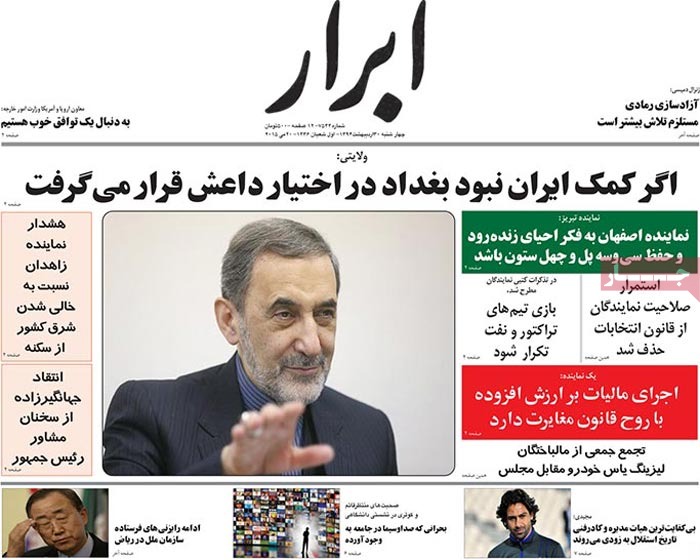
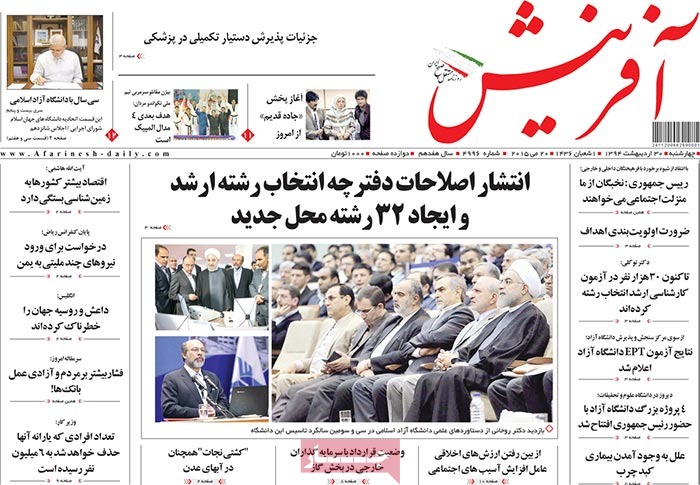
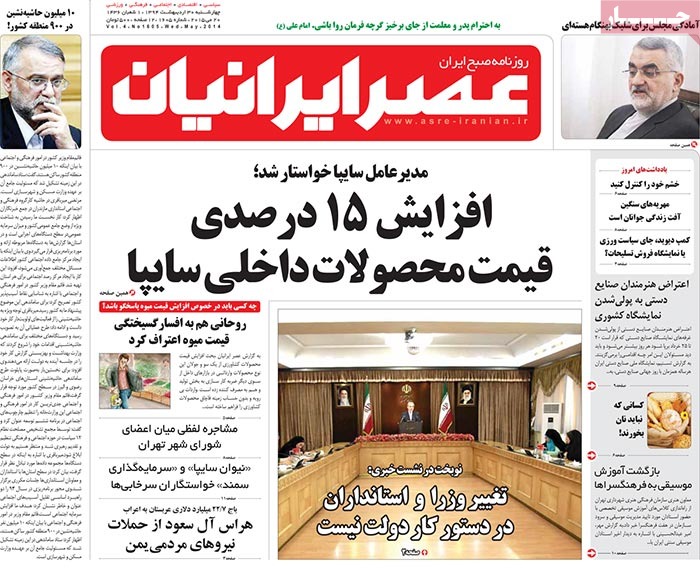
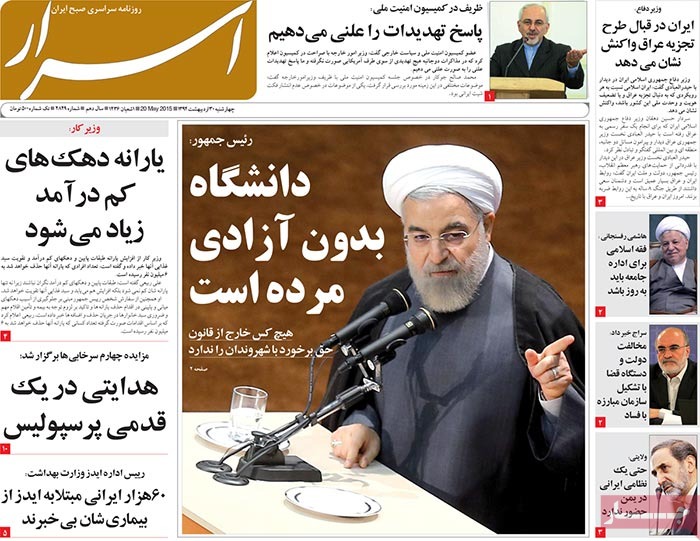
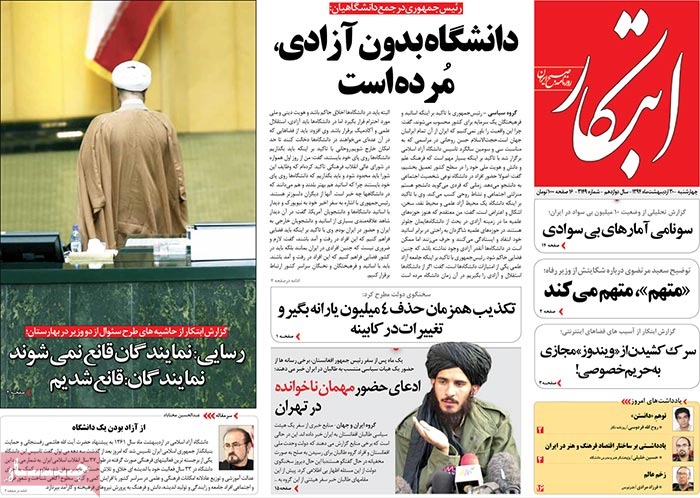
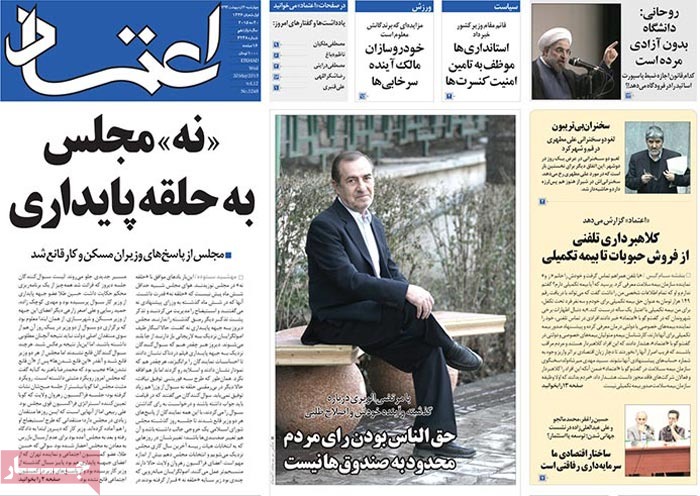
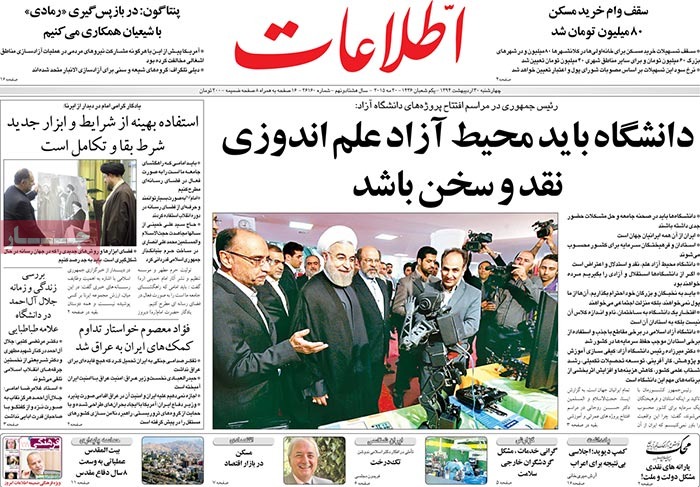
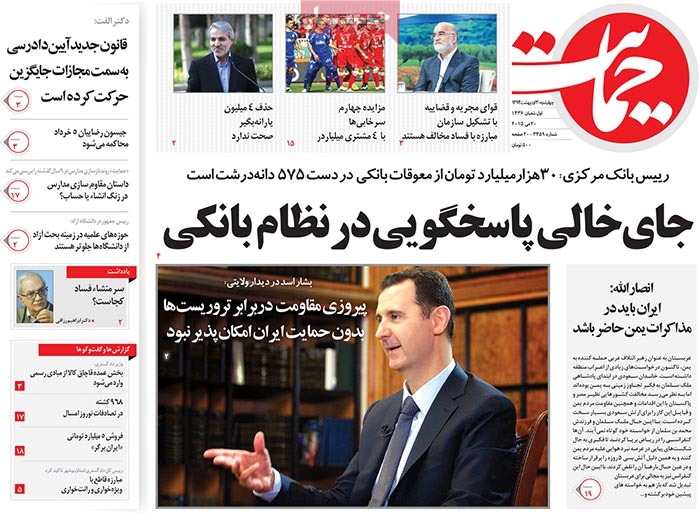
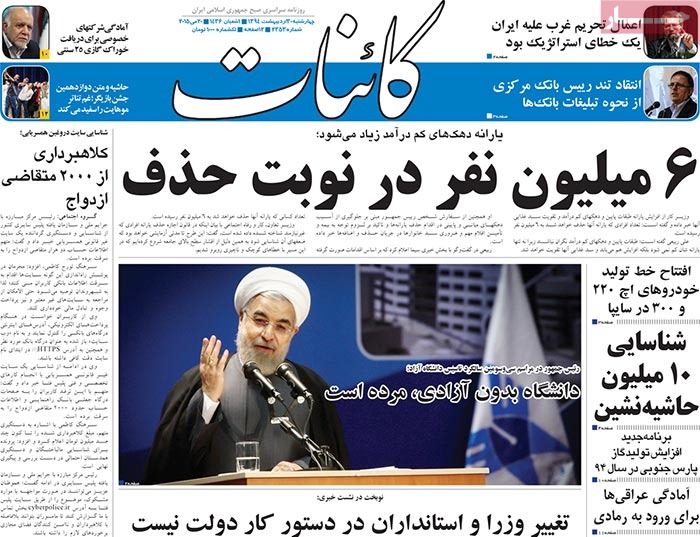
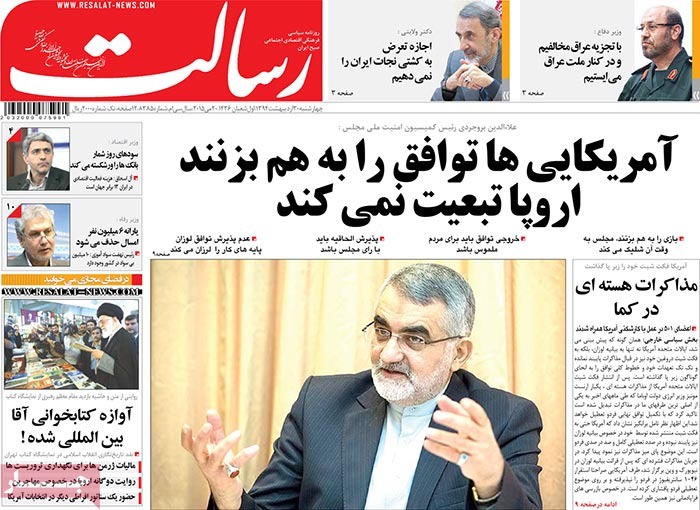
A look at Iranian newspaper front pages on April 18

Iranian Newspapers Headlines

President Rouhani’s comments on nuclear talks with P5+1 dominated the front pages of Iranian newspapers which also put news of the death of a former deputy of Saddam Hussein on their covers. Time Magazine’s inclusion of Iranian Foreign Minister Mohammad Javad Zarif on the list of 100 most influential people in the world also appeared on the front pages of Iranian dailies.


Abrar: Further nuclear talks will be held in Vienna and New York in the weeks ahead.


A look at Iranian newspaper front pages on April 18


Afkar: “Containing particulates which come in from beyond our borders is not possible,” said the Iranian environment chief.


A look at Iranian newspaper front pages on April 18


Aftab-e Yazd: President Rouhani has said that even if a final deal is not struck, sanctions won’t be as strict as in the past.

Aftab-e Yazd: In case a final nuclear deal is clinched, the European Union will consider natural gas imports from Iran.


A look at Iranian newspaper front pages on April 18


Amin: The Ministry of [Culture and Islamic] Guidance does not have any opposition to Mohammad Reza Shajarian holding a concert.

The comment was made by the spokesman of the ministry.


A look at Iranian newspaper front pages on April 18


Arman-e Emrooz:Zarif has become a global figure.

The Iranian foreign minister has landed a place on the list of the 100 most influential figures in the world.

Arman-e Emrooz: The presence of Brits in Tehran Stock Exchange

A European delegation has visited the Securities and Exchange Organization.


A look at Iranian newspaper front pages on April 18


Asr-e Rasaneh: Some 400 hotels are to be built across Iran in a bid to promote tourism.

Asr-e Rasaneh: Up to 200 state firms will be privatized this year.


A look at Iranian newspaper front pages on April 18


Asrar: As many as 1 million Afghans are employed under the radar in Iran.


A look at Iranian newspaper front pages on April 18


Ebtekar: There are no transparent laws to supervise electoral campaign finances, complained the justice minister.


A look at Iranian newspaper front pages on April 18


Ettela’at: Izzat Ibrahim al-Douri, a deputy of Saddam and a senior IS leader, has been killed.

Ettela’at: “Sloganeering and imprisonment won’t eliminate corruption,” said President Rouhani.


A look at Iranian newspaper front pages on April 18


Resalat: “If the US fails to honor its commitments, it will take the dream of a deal to the grave,” said Tehran Friday prayer leader Ayatollah Movahedi Kermani.


A look at Iranian newspaper front pages on April 18


Roozan: Ahmadinejad has hit the campaign trail.

The former president’s bid to help his supporters capture a majority in parliament starts in Mashhad.


A look at Iranian newspaper front pages on April 18


Khuzestan, a hub for water buffalo breeding (PHOTOS)

buffalo1

Khuzestan is a center for breeding water buffalos which need to spend a lot of time in water to survive. Children living on the banks of the Karun River take a dip along with the beasts in the river.

The recent severe water shortage has worried water buffalo breeders in the region about the future.  

The following photos have been provided by the Islamic Republic News Agency:


Saadabad Palace’s kitchen opens to public as a museum (PHOTOS)

kitchen at the Saadabad Palace1

The kitchen at the Saadabad Palace, built by the Pahlavi dynasty in northern Tehran, has been renovated and retrofitted as the Royal Kitchen Museum.

The following are snapshots of the newly-opened museum released by honaronline.ir: