Friday, April 24, 2026
Home Blog Page 4871

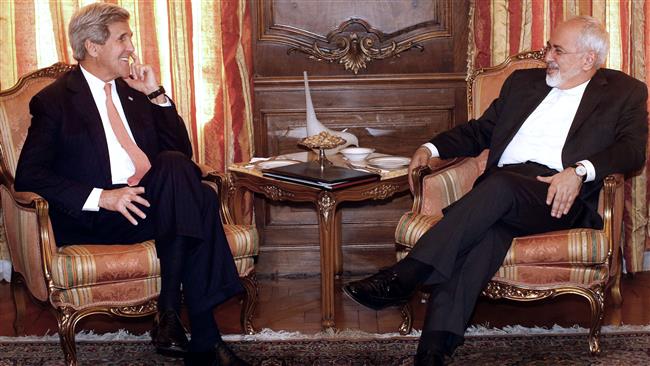
Zarif, Kerry to meet in Geneva on May 30

Zarif - kerry

Iranian Foreign Minister Mohammad Javad Zarif and his American counterpart John Kerry are set to meet in the Swiss city of Geneva amid the ongoing negotiations over Tehran’s nuclear program.

The two top diplomats are due to hold the meeting on Saturday, according to Iran’s Deputy Foreign Minister for Legal and International Affairs Seyyed Abbas Araghchi.

Consultations between Zarif and Kerry will help narrow differences between Tehran and P5+1 over writing the text of a final agreement.

Representatives of Iran and P5+1 began their latest round of talks on drafting the text of a final deal over Tehran’s nuclear program in the Austrian capital of Vienna on Wednesday.

Earlier in the day, Araghchi, who is now in Vienna for talks with representatives of P5+1, said the two sides are working on a timetable to synchronize their undertakings after a final accord is clinched.

The senior Iranian nuclear negotiator said the Islamic Republic would only accept an agreement whose details are “favorable” to Tehran.

Iran and P5+1– the United States, Britain, France, Russia and China plus Germany – wrapped up their latest round of talks in Vienna on May 22.

The two sides have set July 30 as the deadline for a final deal.

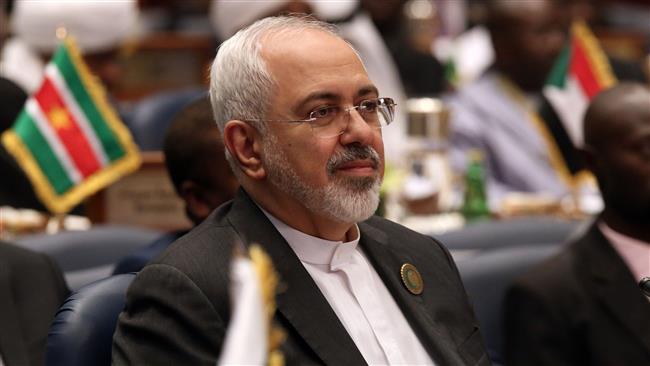
US has failed to suppress ISIL in Iraq: Iranian foreign minister

Zarif-OIC

Iranian Foreign Minister Mohammad Javad Zarif says the US-led international coalition purporting to fight the ISIL Takfiri terrorist group has failed to achieve its goals in Iraq.

“What can be seen in reality is the failure of the coalition headed by the United States in suppressing the ISIL terrorist group,” the Iranian foreign minister said on Wednesday before leaving Kuwait, where attend the 42nd annual meeting of foreign ministers of member countries of the Organization of Islamic Cooperation (OIC).

Since August 2014, Washington and some of its Western and regional allies have been reportedly launching air raids against ISIL in Iraq. Some partners in the US-led coalition have also been hitting purported ISIL positions inside Syria since last September without any authorization from the Arab country or a UN mandate.

Zarif compared the Iraqi people’s achievements in the fight against the terrorist group with those of the US-led coalition, stressing that the Iraqi nation has had a more influential role in the battle against the Takfiris.

“In cases where the Iraqi people have entered [the fight against ISIL] much better advances have been made,” he added.

Zarif also said that during the OIC meeting, he held discussions with Iraqi Foreign Minister Ibrahim al-Jaafari on the developments in the region and especially in Iraq.

“I found Ibrahim al-Jaafari optimistic about the capability of the Iraqi people and government to defend the country and counter the ISIL terrorist group,” Zarif added.

Iraqi forces along with Shiite volunteer fighters are fighting ISIL that has taken large areas of land in the Arab country and is committing heinous crimes against all people there.

The Iranian foreign minister also referred to the ongoing crisis in Yemen, saying most of the foreign ministers of the IOC member states were in favor of a cessation in the Saudi aggression against Yemen and a political resolution for the conflict in the impoverished Arab country.

“Many of the foreign ministers with whom I had a meeting placed emphasis on the peaceful resolution of Yemen’s crisis, the necessity of holding inter-Yemeni dialog, and the inefficiency of military methods [to resolve the crisis],” Zarif said.

“Unfortunately, some political pressure makes some countries remain silent on the developments in the region, regardless of their principled stances,” or even cooperate with movements which are against Islam, he added.

He also said that all countries in the meeting urged an end to the military aggression against Yemen and described the attack on Yemen as “unjustifiable”.

On March 26, Riyadh kicked off its deadly aggression against Yemen without a United Nations mandate and with the aim of restoring power to the Arab country’s fugitive former President Abd Rabbuh Mansour Hadi, and weakening the Houthi Ansarullah movement, which currently controls the capital Sana’a and some major provinces.

Yemen’s Freedom House foundation says Saudi Arabia has killed at least 4,021 people, including 576 children and 261 women, and injured 7,017 others in its aggression against Yemen.

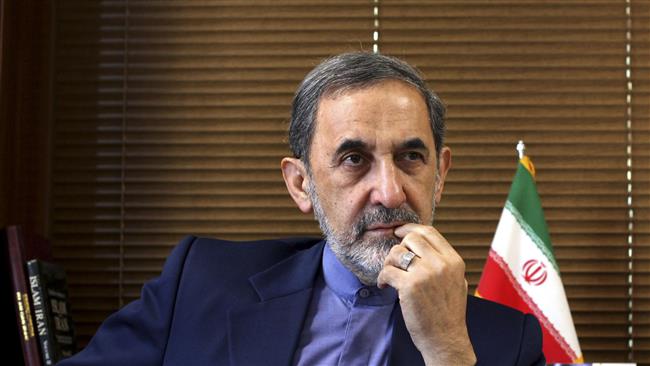
Iran determined to resist West’s excessive demands: Leader’s adviser

Aliakbar Velayati

Head of the Strategic Research Center of Iran’s Expediency Council Ali Akbar Velayati underlined that the excessive demands of some Western states have hampered the progress of Iran’s nuclear talks with six world powers.

Speaking in a meeting with President of China Institute of International Studies (CIIS) Qu Xing, Velayati touched upon the impediments to the progress of the ongoing negotiations between Iran and 5+1 (Russia, China, the US, Britain, France and Germany) over Tehran’s nuclear case.

“The Islamic Republic of Iran is making efforts to resolve the issues (related to the nuclear case) through dialogue but at the same time resists the excessive demands of certain Western countries,” he noted.

Iran and the six powers are in talks to hammer out a lasting accord that would end more than a decade of impasse over Tehran’s civilian nuclear program.

On April 2, the two sides reached a framework nuclear agreement in Lausanne, Switzerland, with both sides committed to push for a final deal until the end of June.

Velayati, who is also an adviser to the Supreme Leader of the Islamic Revolution, and the Chinese official also discussed Tehran-Beijing relations in diverse areas.

He paid an official visit to China to participate in a summit of the Conference on Interaction and Confidence-Building Measures in Asia (CICA) held in Beijing on May 25 and 26.

The Conference on Interaction and Confidence-Building Measures in Asia is an inter-governmental forum for enhancing cooperation towards promoting peace, security and stability in Asia. It is a forum based on the recognition that there is close link between peace, security and stability in Asia and in the rest of the world.

The idea of convening the CICA was first proposed by Kazakhstan President Nursultan Nazarbayev on October 5, 1992, at the 47th Session of the United Nations General Assembly.

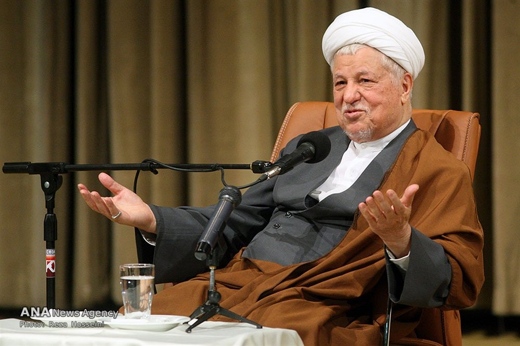
Time has come for the East to grow scientifically

Hashemi Rafsanjani-33

The Chairman of the Expediency Council has said that Iran has played a key role in the development of medical sciences, adding the eleventh government is ready to expand scientific cooperation with the rest of the world.

Ayatollah Akbar Hashemi Rafsanjani made the comment in a national conference on hepatitis on Wednesday and added that Iran is among the oldest countries in the world in which medical sciences have made remarkable progress. The following is the translation of excerpts of the top councilor’s remarks at the conference as reported by the Islamic Republic News Agency:

Rafsanjani said Iranian scientists have been a significant factor in the progress of medical sciences [in the world], adding Iran owes the transformation of its medical sector to the past centuries.

He further said that biotechnology is growing in Iran rapidly and that the Iranian youth are fervently studying and doing research on biotechnology.

[…]

He went on to say that the West experienced big changes in science after the Crusades during which it suffered defeats, but it managed to learn the science from the East.

Ayatollah Rafsanjani also said Europe was in the Middle Ages when the Islamic civilization was being formed, adding back then Iran served as the driving force behind the progress of the world of Islam and the Arab world.

The top councilor then said Iran is the mother of the Islamic civilization, but it is the West that takes pride in having developed such civilization, adding it is now the turn of non-Westerners to take strides toward that end.

[…]

Iran does not need nukes, not now, not ever!

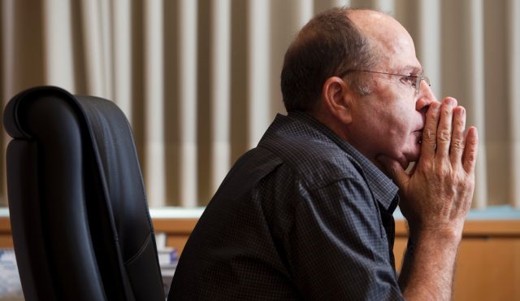
Moshe Ya'alon

A recent speech by Moshe Ya’alon in which the highest ranking Israeli military official invoked the US nuclear bombing of the Japanese cities of Hiroshima and Nagasaki toward the end of World War II to suggest that nukes could be an option when a decision is made on Iran carried a significant message for the Iranians.

He was seeking to pit the proud, patriotic Iranian people against the highest-ranking officials of the establishment prompting them to criticize government policies, and trigger a shift in the Islamic Republic of Iran’s defense strategy toward development of more military weapons. Conceivably, he was also trying to turn “development of nuclear bombs” into a “national demand” [of the Iranians]. Can anybody be more evil-minded than this?

Without doubt, he is certain that a decree by Iran’s highest-ranking religious official [Supreme Leader] Ayatollah Khamenei banning “the production, stockpiling and use of weapons of mass destruction, including nuclear bombs” will be subject to no change. Basically, the Supreme Leader’s decree is based on the Islamic teachings, not on public demands.

Moshe Ya’alon, however, seems to be seeking to provoke the Iranian nation, especially those individuals who have connections at the country’s [top] managerial levels and at the executive, legislative and judicial branches; those who think aggressive and pre-emptive measures in a battle are the best means of defense. Or [he has targeted] those who justify tit for tat (a bomb for a bomb) in taking on the enemies.

The motive behind the baseless remarks by this senior official of the Israeli regime is “to put a crimp [in the nuclear talks] from inside Iran” and sabotage the ongoing nuclear talks. By threatening to nuke Iran and invoking a fateful decision [back in 1945] by President Harry Truman which caused a [big nuclear] catastrophe in Japan and in the wider world (a catastrophe whose painful memories are still engraved in Japanese minds), Israel is trying to throw an obstacle – thanks to its hoped-for pressures from the inside – in the way of the Islamic Republic of Iran.

Israel struggles to make larger segments of the Iranian population insist on the need for continued nuclear activities on a scale larger than before (even if they have to pay a price: more economic pressure and continued unjust sanctions) instead of supporting the [diplomatic] settlement of the nuclear dispute with P5+1 and normalization of Iran’s ties with the West.

It is trying to make this group of people call for possession of “a nuclear bomb” as an integral part of Iran’s defense and security doctrine. Israel really wants to see “the absolute right to peaceful nuclear technology” change over time into “the absolute right to possessing nuclear bombs” and be later legitimized as a defensive weapon.

The Israeli military official is fully aware that yielding to such a demand – especially because it cannot be met unless the Supreme Leader’s religious decree is overridden – is a distant possibility. However it is not unlikely for a few low-ranking officials or some journalists who draw on national and patriotic zeal, or a hardline medium – even though in the form of an appeal to senior officials – to shout for the development of nuclear bombs (or at least for efforts to reduce the nuclear breakout time to less than a year).

Such a radical, unwise reaction [a call for nuclear bombs] can play into the hands of the Zionist regime of Israel to adopt obstructionist measures to prevent Iran from normalizing its ties with the international community.

The hawks in the Israeli government and the despotic Arab rulers are fearful of a developed Iran run by a government which has come to power through the ballot box. In this country [Iran], there should be no growing economy, no efficient civil society, no democracy, and no successful experience whatsoever; that is what they want.

These politicians are more concerned about a secure, developed and democratic Iran [which enjoys an Islamic-style democracy] than an “atomic Iran”. That’s why they [Israeli and Arab politicians] want to see Iran isolated for good.

Pledges by Arab officials who gathered at Camp David [for a summit with the US president earlier this month] to match Iran in nuclear capabilities are a step toward ratcheting up the pressures on Iran. They [Western politicians] know better than anybody else that for princes (numbered at around 4,000) military techniques and flying fighter jets, of course not F-35 jets, are the first priority.

Above all, [they are concerned about] a society in which people voluntarily go to battle fronts and put their lives on the line [for the sake of their homeland], and the country does not hire paid mercenary soldiers to manage its war (a case in point is Yemen where Saudi officials have been trying to recruit soldiers from Egypt, Pakistan, etc. to fight the Saudi war).

They have certainly realized that they cannot emerge victorious by throwing money at the problems. Knowledge can be bought, but mercenary scientists are not trustworthy, because there are always people [out there] who are willing to shell out more.

With the July 1 deadline approaching, efforts which aim to dampen the mood and resort to threatening rhetoric – either due to unawareness about ground realities in today’s world or because of intentional hostile attitudes – are launched simply to draw extreme reactions from inside Iran.

In the meantime, White House officials too have time and again fallen into the trap of the enemies of “a nuclear deal between Iran and P5+1”, and made acquisitive, oath-breaking and tenuous comments which put their efforts [to strike an agreement with Iran] at risk of breaking down.

Their comments [usually] make front-page headlines in Iranian newspapers which back constant confrontation with the West and highlight it as a strategic revolutionary obligation. These newspapers report that there are coordinated anti-Iran efforts by US officials, particularly the hawks, and Netanyahu. They tend to introduce the West, especially the US administration, as untrustworthy saying establishment of normalized ties with Washington seems highly unlikely. What they say is borne out by the conflicting remarks of US officials.

Apparently Western officials, especially the Americans who claim to be serving the greater good of the world, need to be honest with their own conscience and throw light on their stance in their privacy. Providing answers to the following questions would reveal what should be done:

Do they really want to see the world in peace? Is it possible to establish peace and calm in today’s interconnected and organic world without restoring peace and security in the Middle East? Is it possible to imagine a Middle East without Iran, which is a key player (courtesy of what they’ve witnessed within years and months, and thanks to what they know about Iran’s recent and distant history including a pre-Islamic Revolution Iran and the change from a monarchy to an Islamic Republic, and according to what they have read – since the start – about the role of Iran and the Persians in the course of human history)?

Is it possible to ignore Iran and Iranians in efforts to establish sustainable security and peace in the Middle East? Should Iran be involved [in efforts to restore security and calm to the Middle East] simply because it is “evil” and part of “an axis of evil” (as the former US president put it) or it should be included because it is powerful, selfless and patient when it comes to resisting the evil and countering evil-doers?

If the answer to the first question is in the affirmative and if those who claim to support human rights and democracy are really after peace and security (not necessarily for themselves which seems impossible and unachievable), their answers to the questions that follow the first one would be “no”, because global peace and security are tied to the peace and security in the Middle East. The latter becomes a reality if and when Iran – its people and [popular] government which has come to power thanks to the revolution –participate in such efforts in an active and highly motivated fashion.

The world needs Iran’s cooperation, either for removing the obstacles standing in the way of establishing peace and security or for ensuring and strengthening the peace and security of the world which direly needs a review of the principles and structures of its order from a fresh, culturally-rich perspective.

Iran’s culture and civilization has the potential. Take a look at the [Cylinder known to be the world’s first] charter of human rights by Cyrus the Great or take heed of the meaning of a poem by Saadi, Iran’s famous poet, which has become a fixture at the entrance to the United Nations building [The sons of Adam are limbs of each other; Having been created of one essence. When the calamity of time affects one limb; The other limbs cannot remain at rest. If thou hast no sympathy for the troubles of others; Thou art unworthy to be called by the name of a human] and you will admit that Iran’s cultural richness is no exaggeration.

The history of Islam following its debut in Iran has already witnessed cultural interactions between the Arab societies and the Iranians immediately after the dawn of the Islamic period. Iranians had vigilantly realized that the invading Arab tribes carried a valuable human message, although the messengers were bad-tempered and indecent.

As history has shown the world’s wise rulers rationally seize the unrepeatable opportunities which come their way to advance the [cause and] progress of human civilization and guide the world – even if one single step – toward the materialization of human dreams with flexibility, patience and farsightedness.

As a Persian proverb goes, “Silence is the right answer to the fool”. This editorial does not intend to respond to the baseless claims of Israeli Defense Minister Moshe Ya’alon. What he’s said is foolish and shows his criminal and racist nature. Rather, this is a reminder to those who can take a step toward peace and security in the world to seize the opportunity and see the conclusion of a comprehensive, sustainable agreement in nuclear talks as one such step (a big one) [toward global peace and security].

It is also a reminder to those who seek to be part of efforts to fulfill the dream of a world free of violence and mass destruction weapons – far from the traps laid by the hawks and unwise rulers in the Middle East and key decision-making centers in the countries involved in nuclear talks.

The world needs to enjoy peace and security as well as cultural contacts and human interactions so that it can eradicate poverty in all material and spiritual forms. The planet we are living on is on the verge of destruction despite what it has. Flowers, grass and trees do not grow in Hiroshima and Nagasaki. The one who plants the seeds of feud and hatred takes the world to the brink of death and annihilation.

Let’s not join the ranks of arrogant and ignorant enemies in the world. We are living in a world which is in need of wise management and in-depth understanding of the fact that the line between safe and unsafe atmosphere is blurred. This [the indistinguishability of safe and unsafe conditions] is one of the salient features of a borderless world.


Mahmoud Askariyeh

IFP Managing Editor  

Thousand-and-One-Nights train in Iran (PHOTOS)

Thousand-and-One-Nights

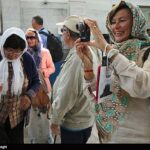
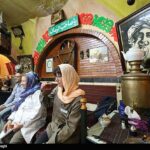
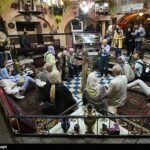
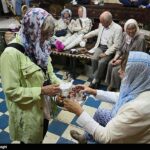
Hezaro Yek Shab (Thousand and One Nights) train carrying a number of foreign tourists has arrived in Zanjan, northwestern Iran.

The Hezaro Yek Shab and Golden Eagle – two luxury trains and part of a tour organized in cooperation with Turkish, Hungarian and Iranian travel agencies – crossed into Iran via Razi Border Crossing.

The train with passengers from Germany, Switzerland, the Netherlands and Turkey on board will have a stopover in Isfahan and Tehran.

Tasnim News Agency has released the following pictures of the trains of foreign travelers in Iran:

Leader: Solving nuclear issue easy if all rely on domestic resources

Leader-Parliament

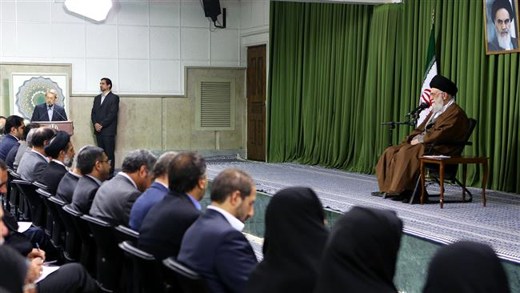
Supreme Leader of the Islamic Revolution Ayatollah Seyyed Ali Khamenei urged the nation to have faith in the belief that reliance on domestic resources will facilitate solving the nuclear issue.

The Ayatollah made the remarks in a meeting with members and the Speaker of the Iranian parliament which took place on anniversary of the legislative body’s establishment after the victory of the Islamic Revolution.

He said that the nuclear issue has become a complicated one but still all should keep in mind that there are other issues as well which will be solved if domestic resources are strengthened and improved.

The Supreme Leader stressed that his views regarding the nuclear issue are the same as the ones asserted before.

Ayatollah Khamenei said the same views have been announced to officials both in writing and verbally.

These are the principal stances of the system in Iran, Ayatollah Khamenei noted.

Our brothers are really working hard, doing their best in such areas and they should go and persist on these stances to safeguard the interests of the country, the Supreme Leader added.

He also noted that while a common rhetoric and harmony is being used about the resistance economy, the main problem which relates to unanimity still persists.

Ayatollah Khamenei said he was aware of the shortage of resources and knew that sanctions were playing a role in this.

He urged officials to work out a way out of the problems and said the main answer to the question is less consumption.

The Ayatollah said priorities should be taken into consideration and all should know that insufficient resources are not a complicated problem which could not be solved.

The Supreme Leader said shortage of resources should not be used as an excuse to stop hard work.

Ayatollah Khamenei said that people should not think disputes with the US and the Zionist regime will be over once the nuclear issue is solved.

He said other issues like the human rights and the like will certainly come up later.

The Leader of the Islamic Revolution further said it is wrong to assume Iran’s problems with the US, the Zionist regime and the west is summed up in the nuclear issue.

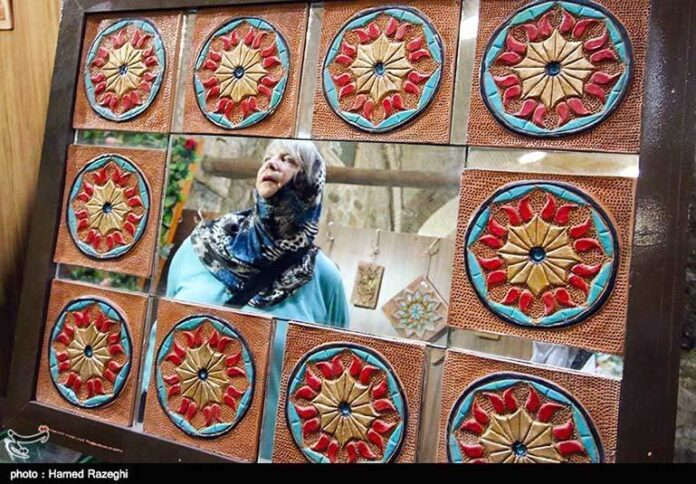
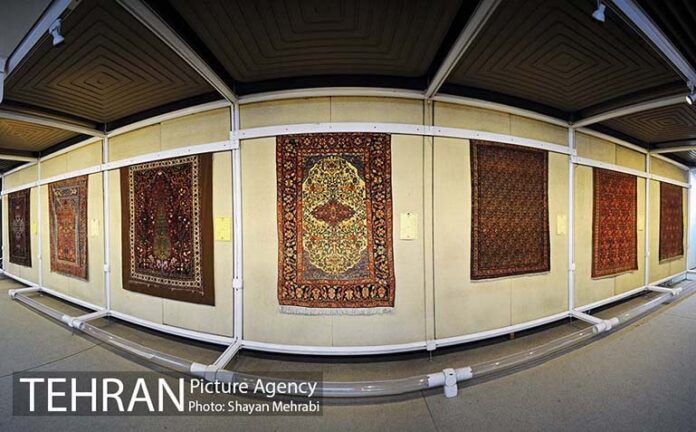
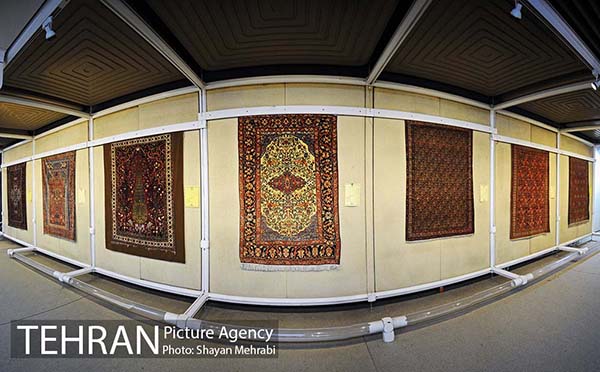
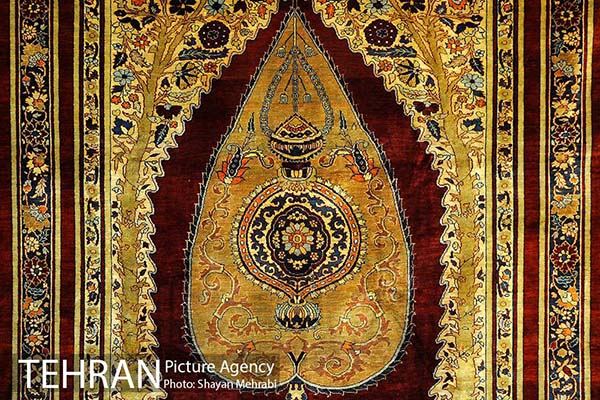
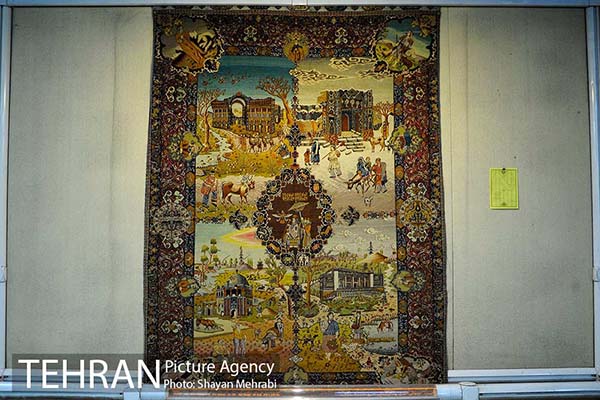
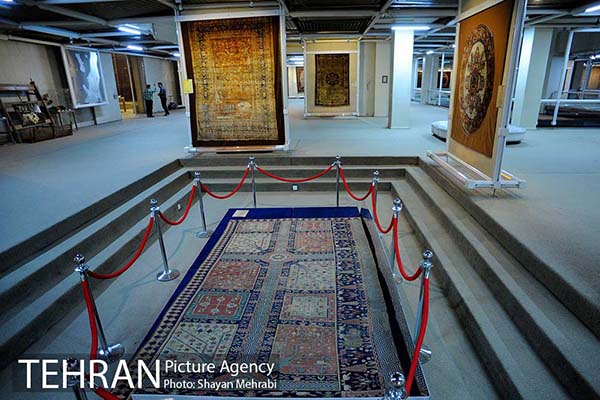
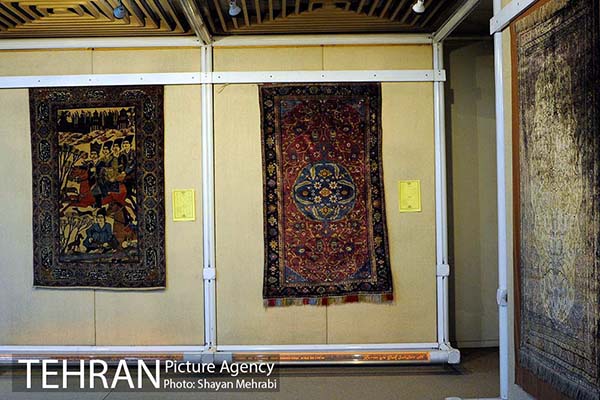
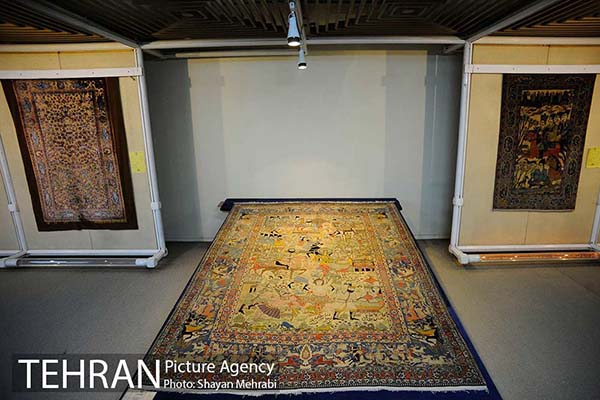
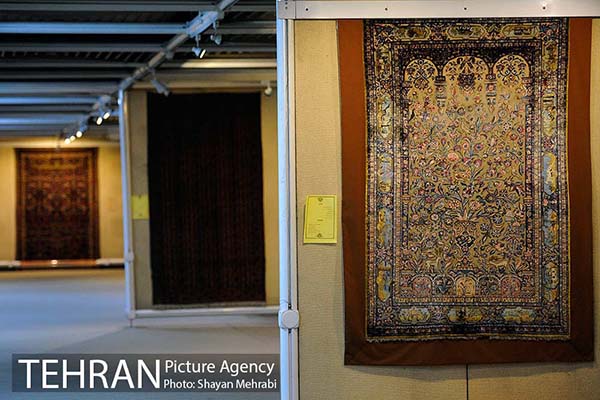
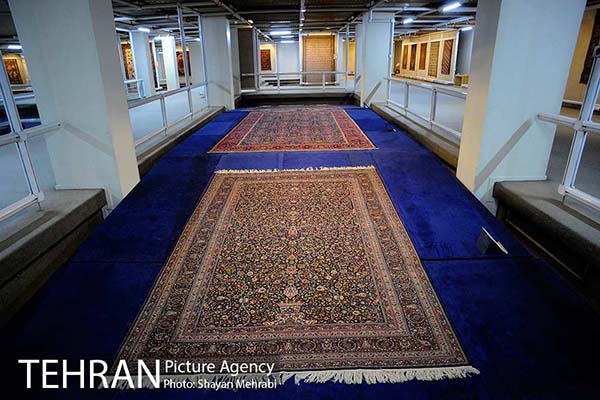
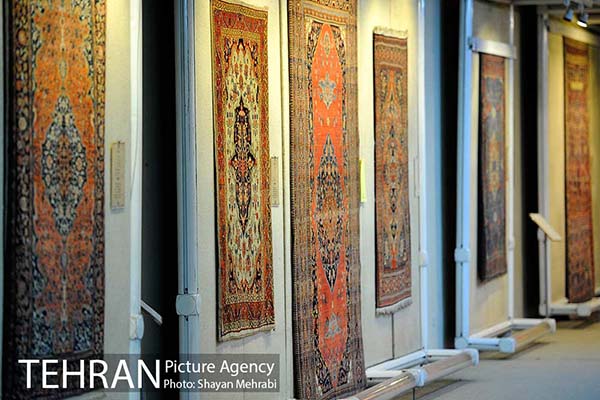
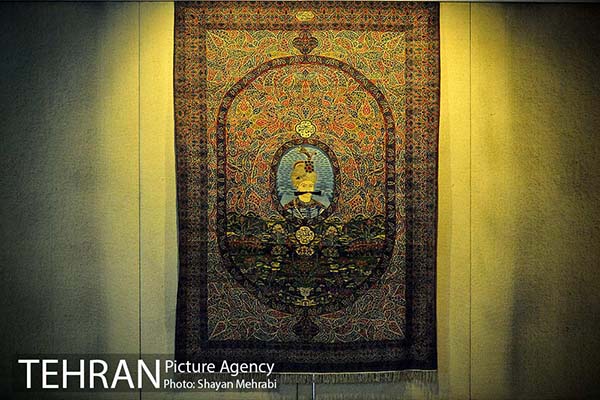
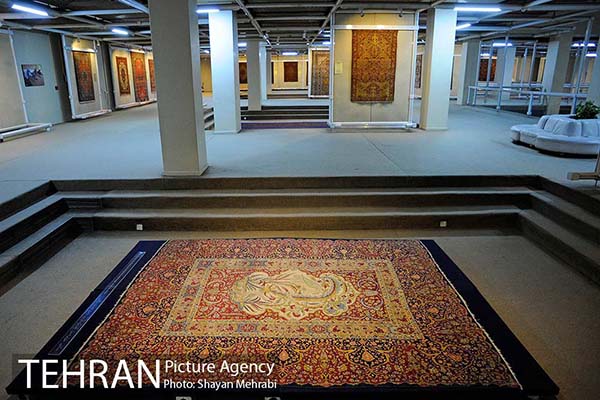
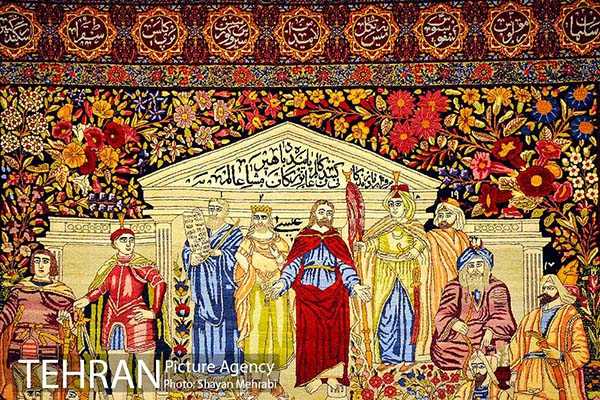
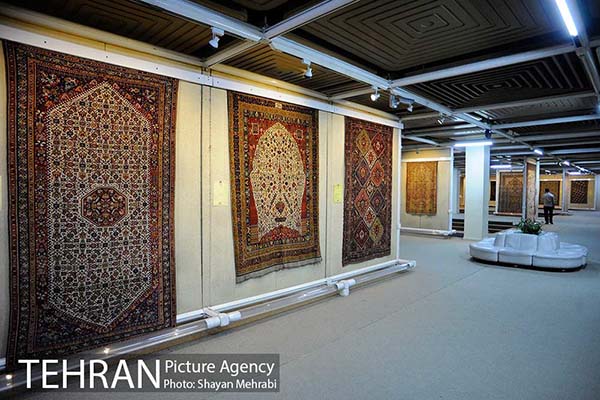
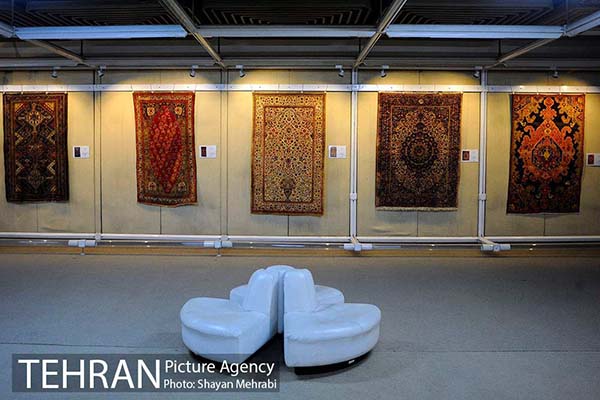
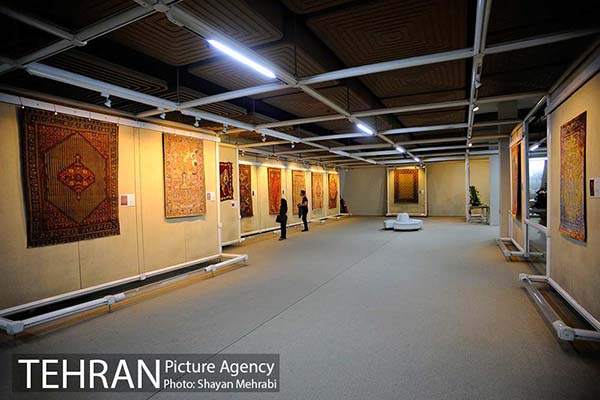
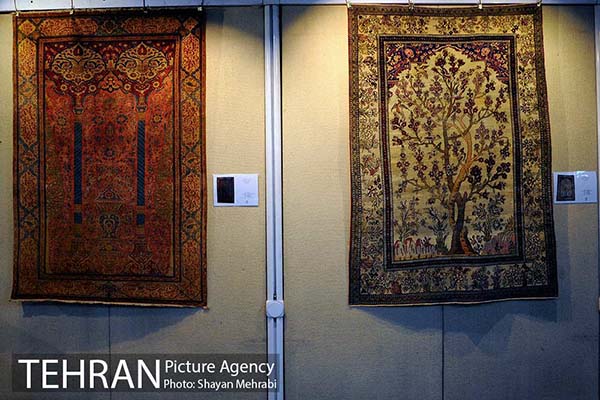
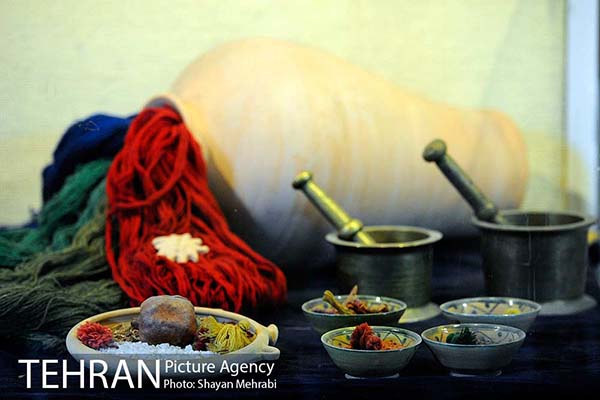
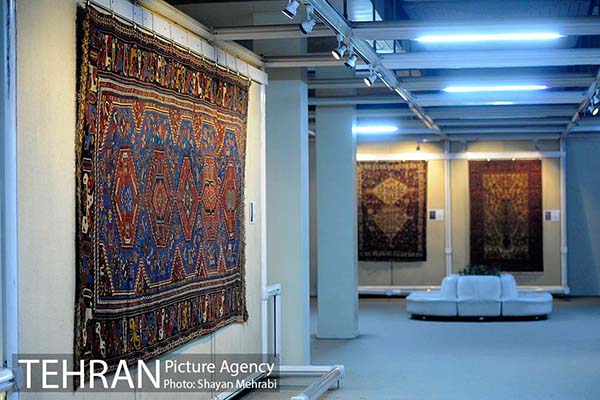
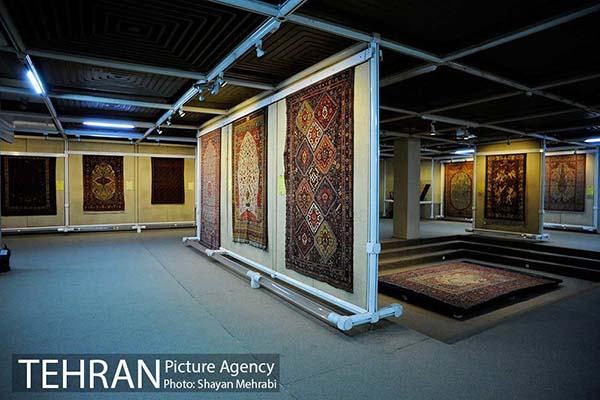
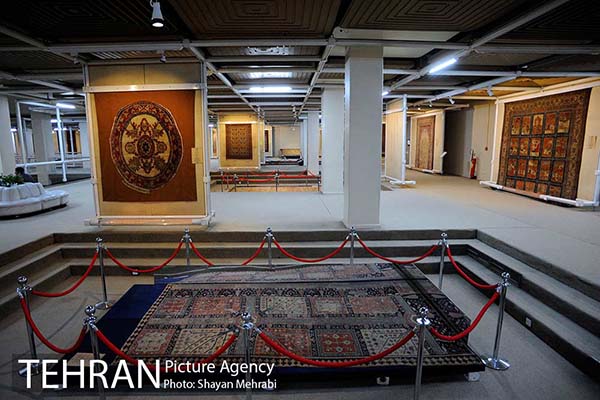
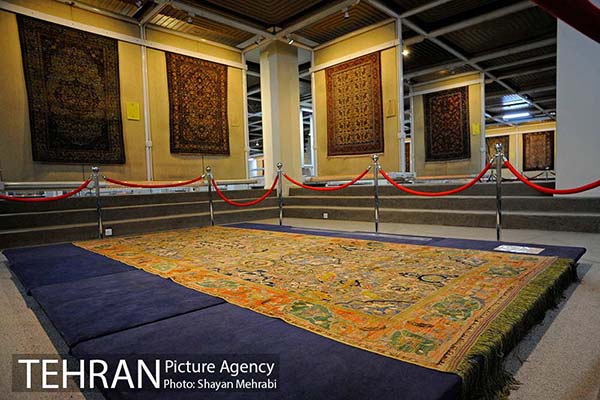
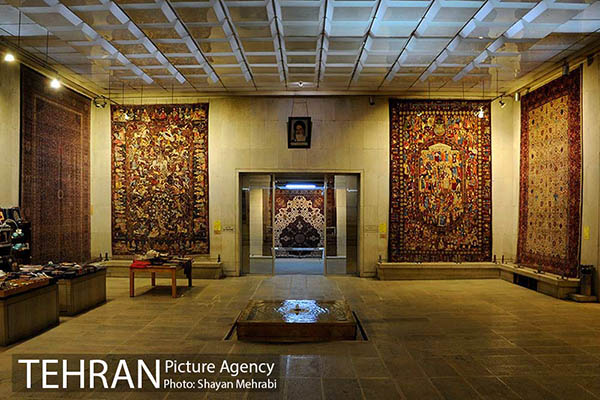
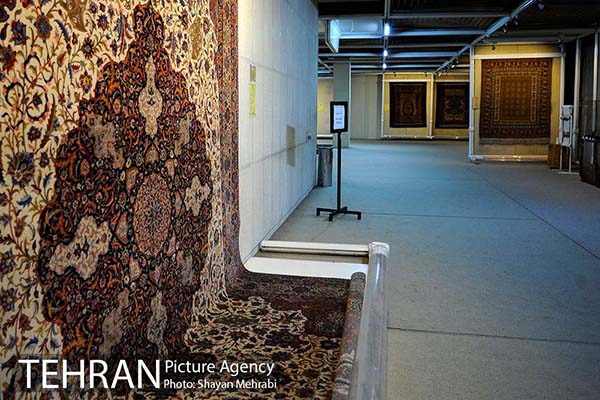
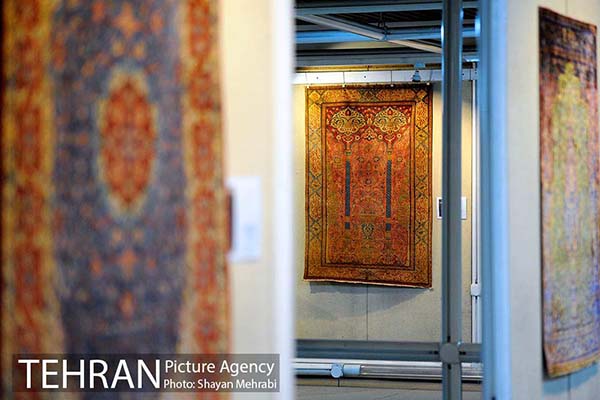
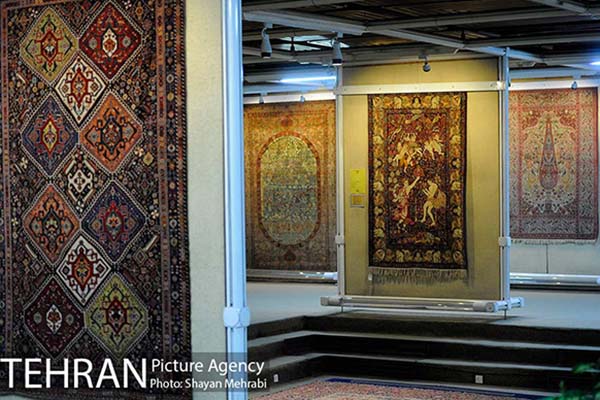
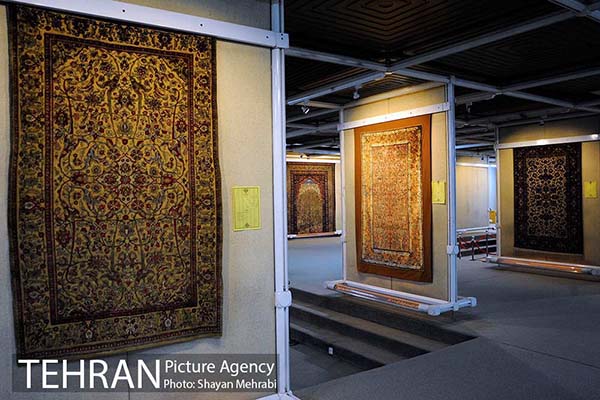
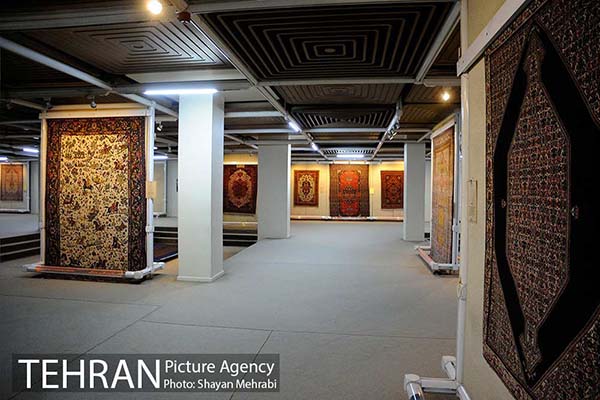
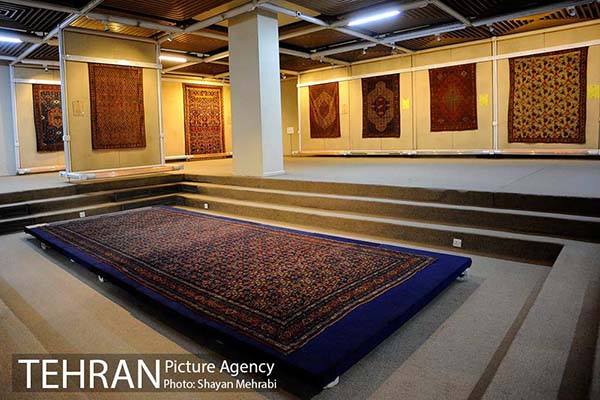
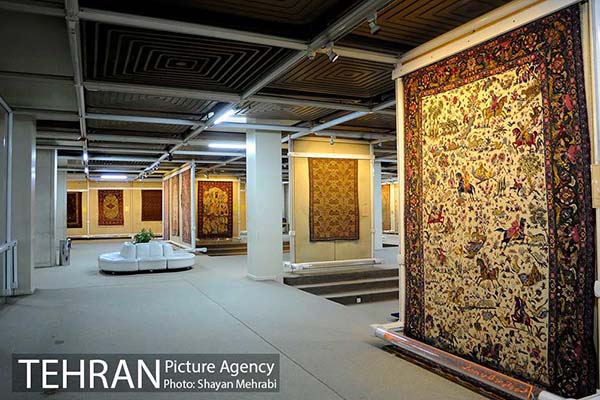
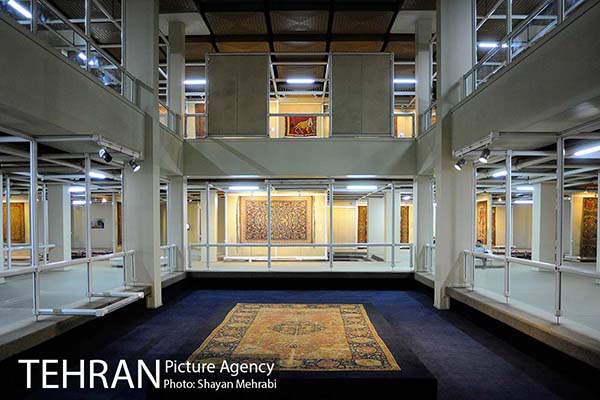
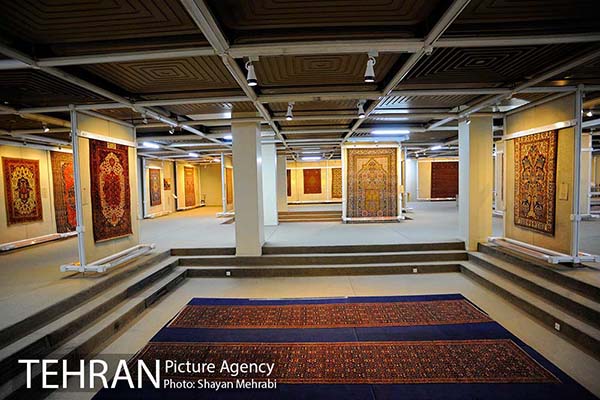
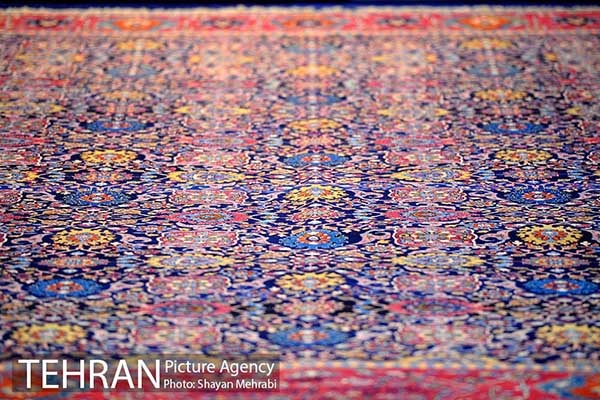
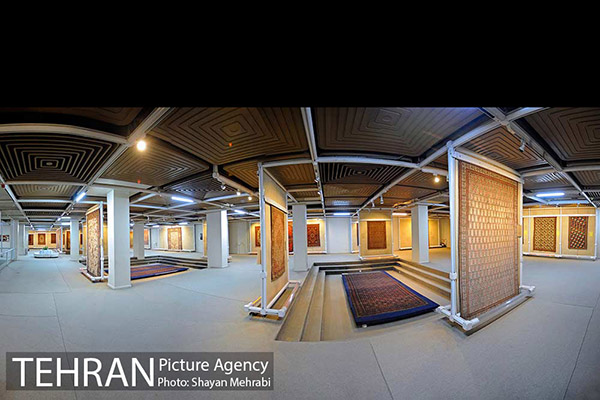
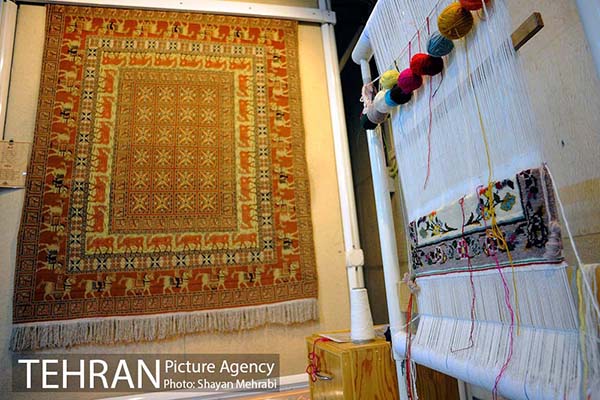
Carpet Museum of Iran in photos

Carpet Museum1

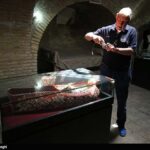
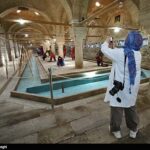
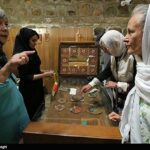
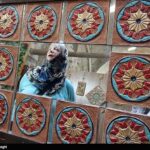
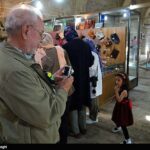
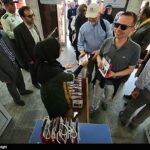
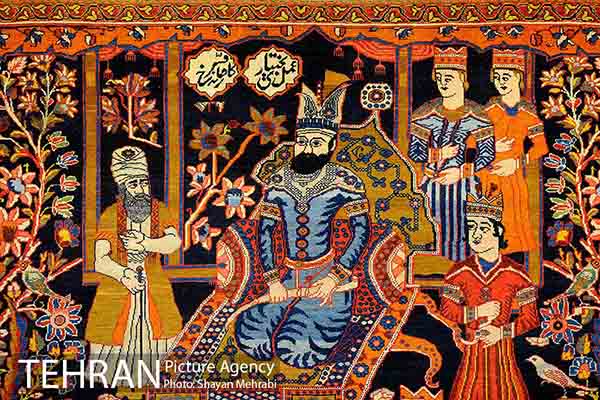
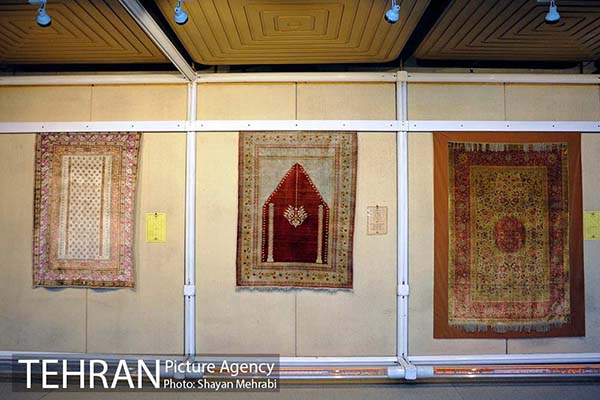
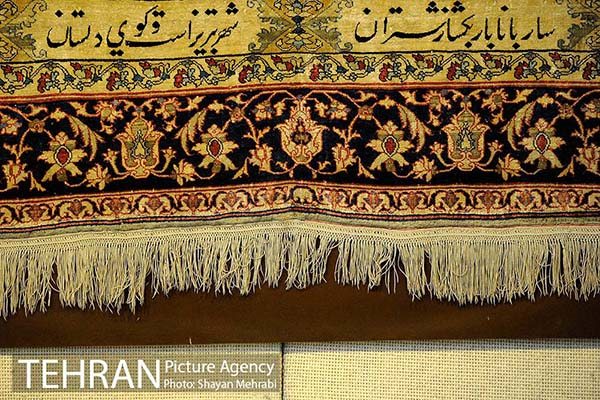
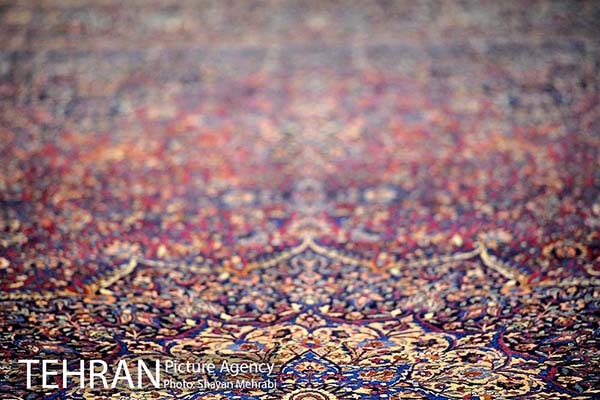
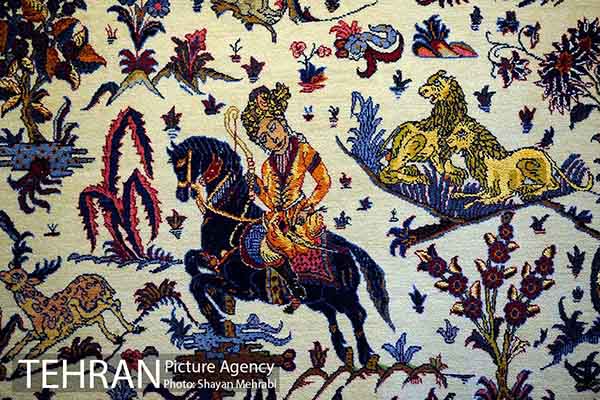
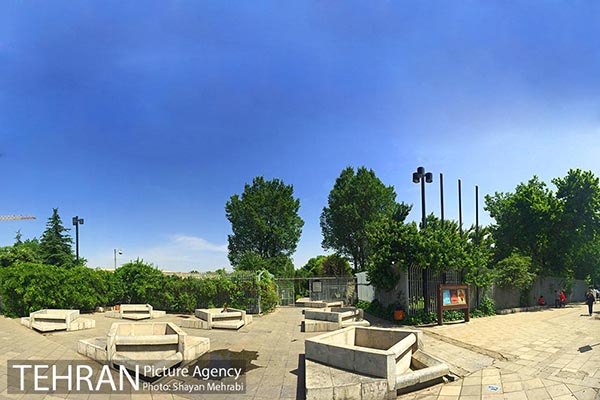
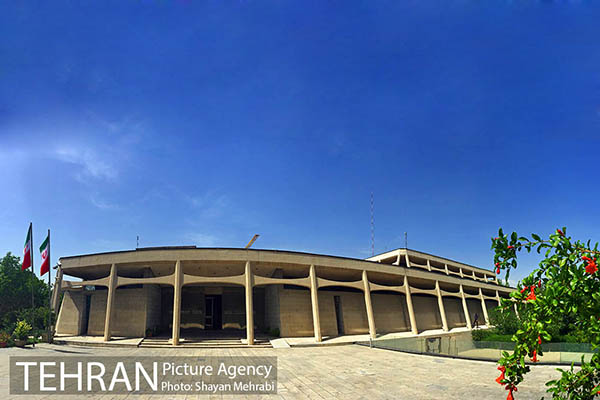
The Carpet Museum of Iran is one of the most important museums in the country and among the most prestigious museums in the world.

Founded in 1976, the museum exhibits a variety of priceless hand-woven Persian carpets from urban, rural and nomadic areas all over Iran.

The following are the pictures tehranpicture.com has posted on its website:

Thank you, General

Police Has No Plan to Quarantine Cities over Coronavirus: Iran

Alef.ir, a news website run by Ahmad Tavakoli, MP, published a note by the principlist deputy representing Tehran in parliament, which details a bitter incident involving violation of a citizen’s rights. The following is the translation of the note in its entirety:

A few weeks ago an incident in Majidiyeh [a neighborhood in eastern Tehran] with a bitter beginning played out to have a very happy ending which saved the faithful, revolutionary law enforcement embarrassment.

A virtuous resident of the neighborhood told me a Christian friend of his who ran a carwash had run into a problem. He said: “Today, a couple of police officers had come to the carwash to have their squad car washed. They saw a poster on the wall which featured words in protest at the massacre of Armenians at the hands of Ottoman Turks in 1914.

‘Why have you posted this on the wall?’ the patrolman asked as he ordered the owner to remove it. The carwash owner said, ‘That is what the Armenian Caliphate has asked me to do.’ The officer made a disparaging comment about the Caliphate. But the Armenian compatriot did not back down. The officer slapped him across the face and together with two fellow policemen hauled him to the office of the carwash where they beat him up. A number of passers-by captured the brutal beating on their cell phones.

One of the three officers seized the cell phones and took my Christian friend to police custody and mistreated him there too. Following a great deal of supplications, the owners of the phones got their devices back after they removed the videos from their phones. And the Armenian guy was let go too. Thank God the whole incident was captured by the security camera of the carwash.”

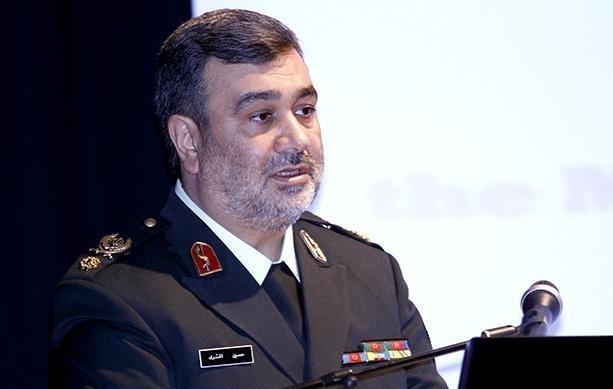
When I learned about what had happened, I called [Police Chief Brigadier General Hossein] Ashtari, but couldn’t reach him or his chief of staff for that matter. Left without a choice, I contacted a Revolution Guards and told him what had happened. Apparently all commanders had gathered for a meeting. When contact was eventually made, Hossein, the same guy who told me about the incident in the first place, was ordered to lead an investigation. A couple of days later, the national police commander’s chief of staff saw the video. By order of the police chief, a special investigator began a probe into what had happened. After the inquiry, the three officers and the police station and precinct chiefs were suspended and referred to judicial authorities. An official apology was extended to the Armenian man who had been mistreated.
This swift action in dealing with the misconduct of those who are supposed to protect citizens from injustice greatly impressed the Armenian guy and all other residents of the neighborhood. Afterwards, the officers begged the Christian guy, through intermediaries, to forgive him.

As a Muslim Iranian and a representative of the public [in parliament], I’d like to apologize to this fellow Iranian and thank General Hossein Ashtari and his colleagues for their decisive action. Once again, thank you, General.
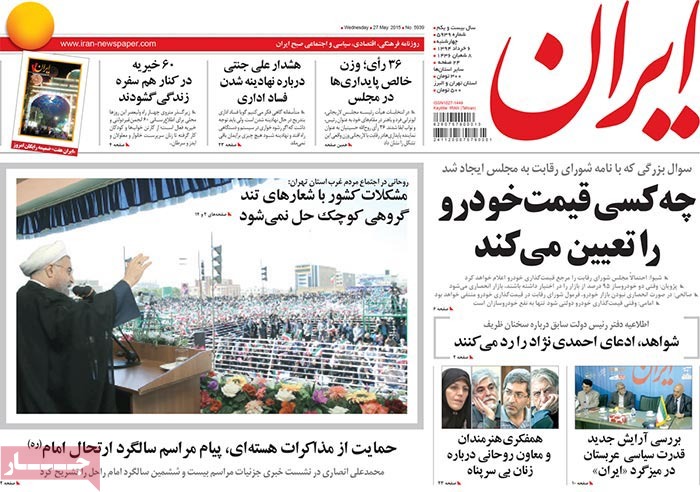
A look at Iranian newspaper front pages on May 27

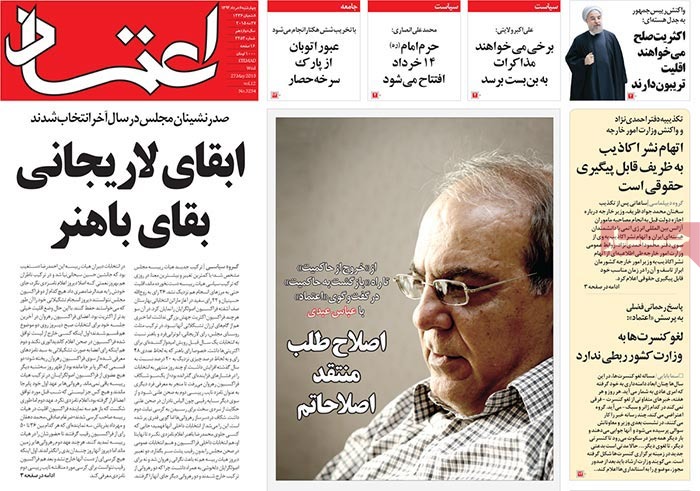
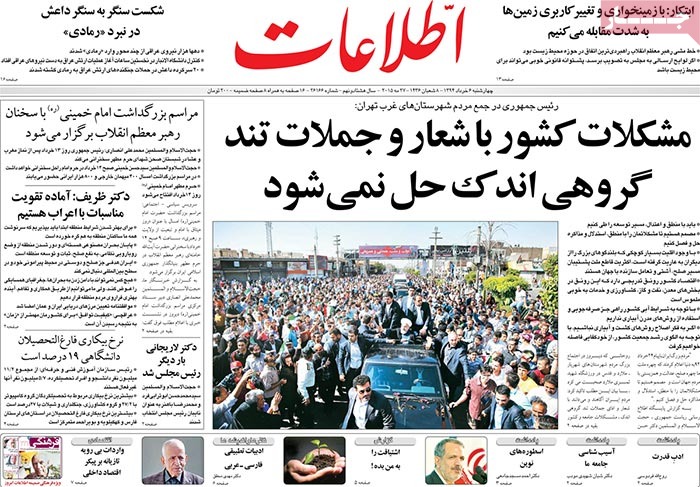
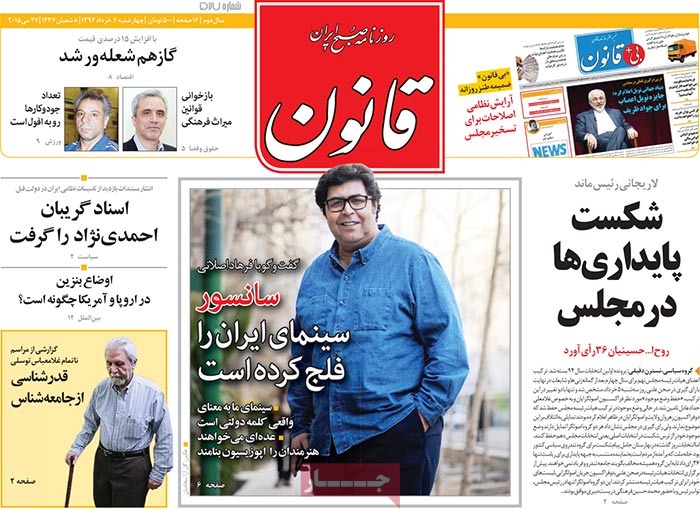
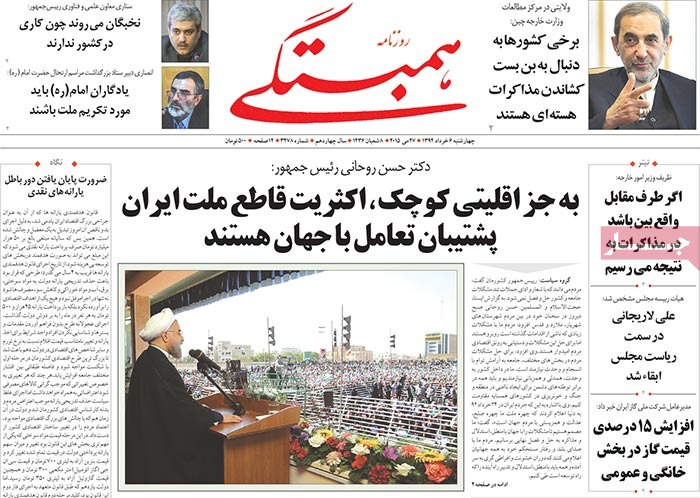
Iranian Newspapers Headlines

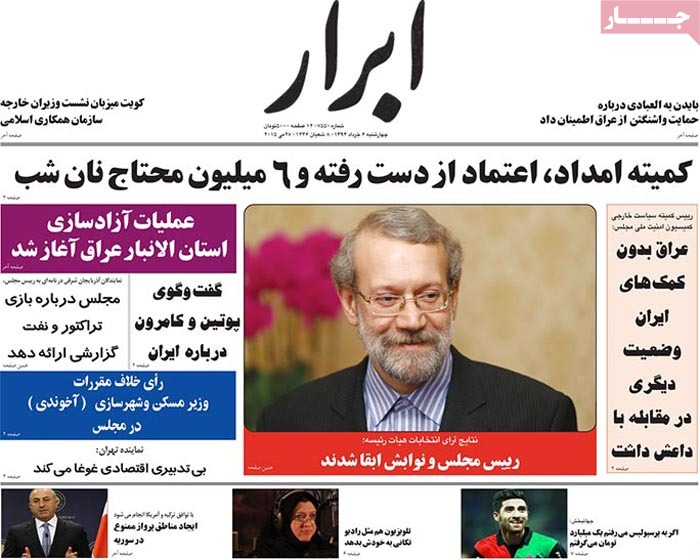
Remarks by President Rouhani during his trip to the west of Tehran Province that the majority of Iranians back his policy of interaction with the rest of the world made front-page headlines in Iranian newspapers on Wednesday. Also in the news was an in-house election in the Islamic Consultative Assembly that reinstated Speaker Ali Larijani and his deputies for the final year of the ninth parliament.


Abrar: Parliament Speaker Ali Larijani and his deputies were reinstated.


A look at Iranian newspaper front pages on May 27


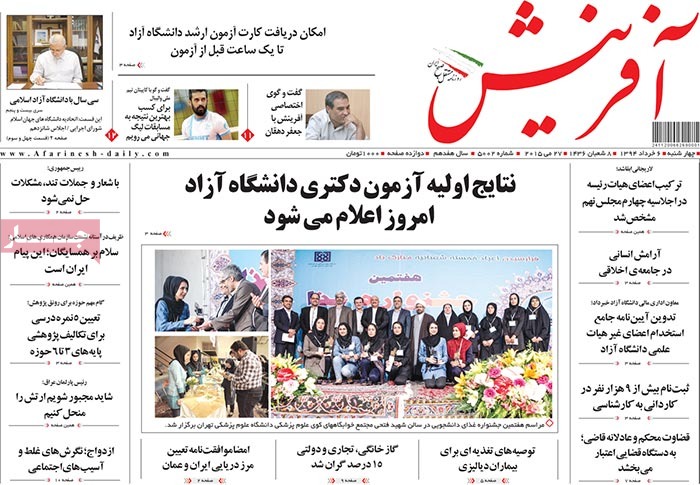
Afarinesh: “Greetings to the neighbors; this is Iran’s message,” said Foreign Minister Mohammad Javad Zarif in the buildup to an OIC meeting.

[Zarif is scheduled to attend the 42nd foreign ministerial meeting of the Organization of Islamic Cooperation in Kuwait.]


A look at Iranian newspaper front pages on May 27


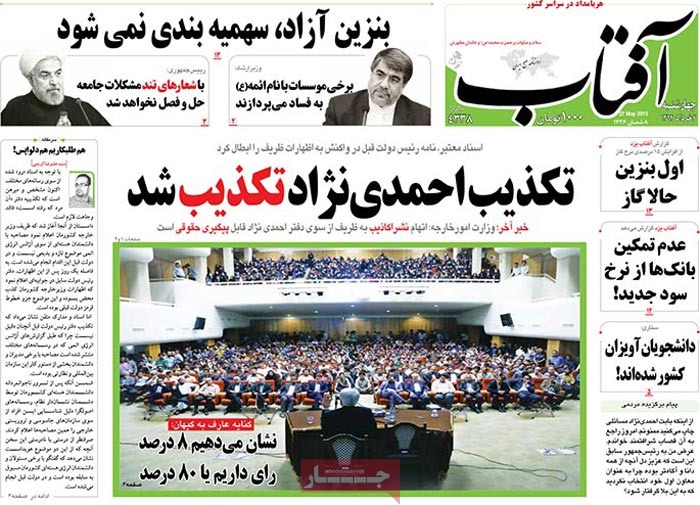
Aftab-e Yazd: Ahmadinejad’s denial was denied.

The Foreign Ministry has said that dissemination of lies attributed to Zarif by the office of [former President] Ahmadinejad is actionable.

[This came after FM Zarif said in an interview that the previous government had allowed Iranian nuclear scientists to be interviewed. In a statement, the office of the former president rejected the top diplomat’s remarks as incorrect.]

Aftab-e Yazd: “We will show whether we have 8 percent of votes or 80 percent [in March elections],” Mohammad Reza Aref, a reformist, said sarcastically in response to Kayhan. [After the 2013 presidential elections, the principlist daily had repeatedly said the reformist camp could garner only eight percent of the popular vote.]


A look at Iranian newspaper front pages on May 27


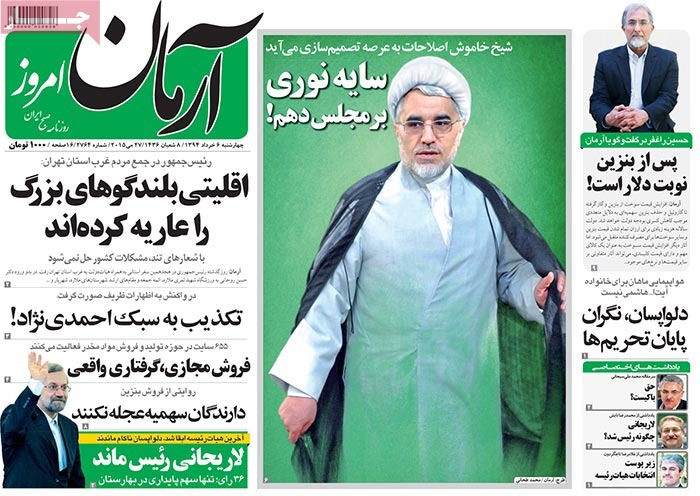
Arman-e Emrooz: President Hassan Rouhani has accused a small group of people of hijacking official microphones.

“Sloganeering does little to solve the country’s problems,” he said.

Arman-e Emrooz: The Worriers are worried about the termination of [anti-Iran] sanctions.

[The so-called Worriers are supporters of former President Ahmadinejad who are opposed to every single move by President Rouhani and reformists.]


A look at Iranian newspaper front pages on May 27


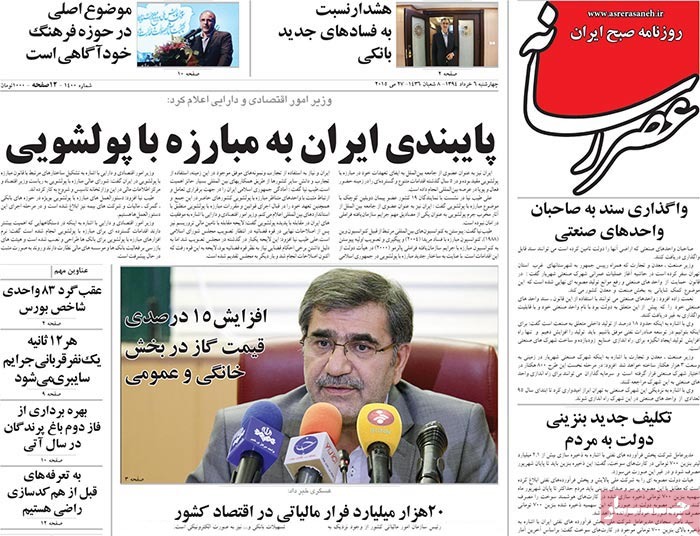
Asr-e Rasaneh: “Iran has remained committed to the fight against money laundering,” said the economy minister.


A look at Iranian newspaper front pages on May 27


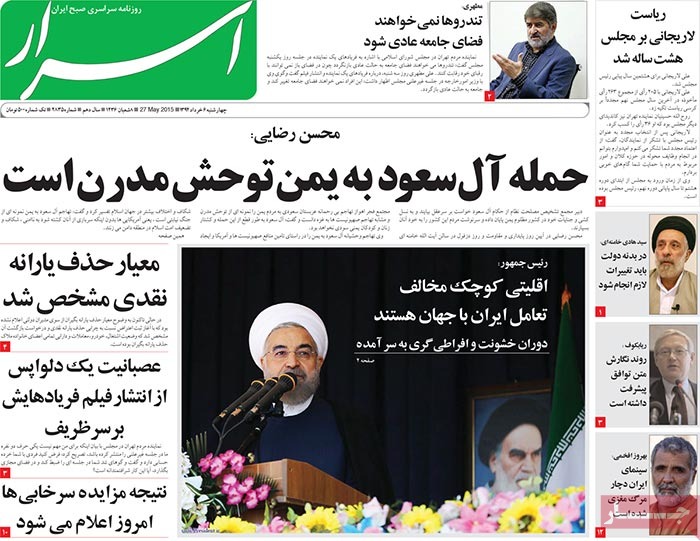
Asrar: “Hardliners do not want to see a normal [tension-free] atmosphere in society,” said Ali Motahari, a Tehran MP.

[He further said, “These individuals want the country to remain in a state of emergency forever so that they could sideline their rivals. Under normal circumstances they are unable to engage in healthy competition with their political rivals.”]

Asrar: [Ali] Larijani’s speakership turned eight.

Asrar: The Saudi aggression against Yemen amounts to modern barbarism,” said Secretary of the Expediency Council Mohsen Rezaei.

Asrar: The anger of a Worrier about the release of a film featuring his shouts at FM Zarif

[Zarif and his deputy appeared before parliament on Sunday to brief the MPs on the latest developments in nuclear talks. The top diplomat got involved in a verbal brawl with two principlist MPs who are the vocal supporters of the former president and critical opponents of President Rouhani and his policies.]


A look at Iranian newspaper front pages on May 27


Etemad: “Some want to see [nuclear] talks hit a snag,” said Ali Akbar Velayati, the Supreme Leader’s advisor.


A look at Iranian newspaper front pages on May 27


Ettela’at: “We are ready to boost ties with Arab nations,” said the Iranian foreign minister.

Ettela’at: President Rouhani has said that sloganeering and blustery rhetoric of a minority of people will not solve the country’s problems.

Ettela’at: “We will seriously deal with [those involved] in land grab and reclamation,” said Iran’s environment chief Masoumeh Ebtekar.


A look at Iranian newspaper front pages on May 27


Ghanoon: “Censorship has crippled the Iranian cinema,” said Farhad Aslani, an Iranian actor.

He also said Iran’s cinema is state-run in the real sense of the world.


A look at Iranian newspaper front pages on May 27


Hambastegi: “Except for a small minority, the overwhelming majority of Iranians support interaction with the world,” said the Iranian president.


A look at Iranian newspaper front pages on May 27


Iran: Minister of Culture and Islamic Guidance Ali Jannati has sounded a warning against the institutionalization of administrative corruption [in the country].

Iran: Support for nuclear talks is the message of ceremonies to mark the demise anniversary of the late Imam.

Mohammad Ali Ansari, the secretary of the committee in charge of commemorating the death of the founder of the Islamic Republic, said in a press conference.


A look at Iranian newspaper front pages on May 27


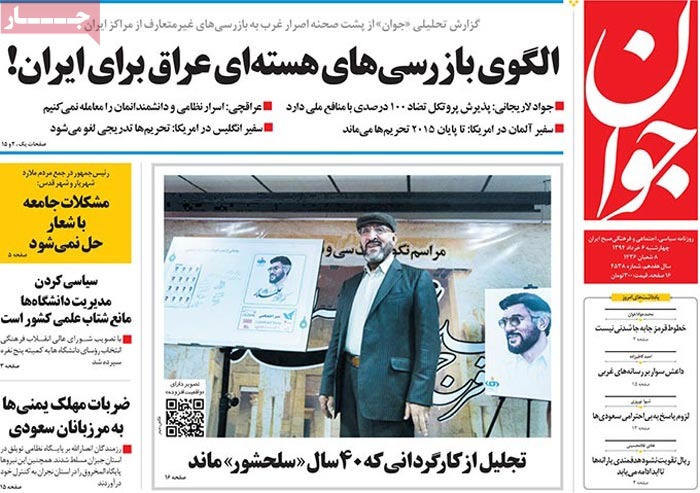
Javan: “We will not trade the country’s military secrets and scientists,” said senior nuclear negotiator Abbas Araghchi.
 

A look at Iranian newspaper front pages on May 27


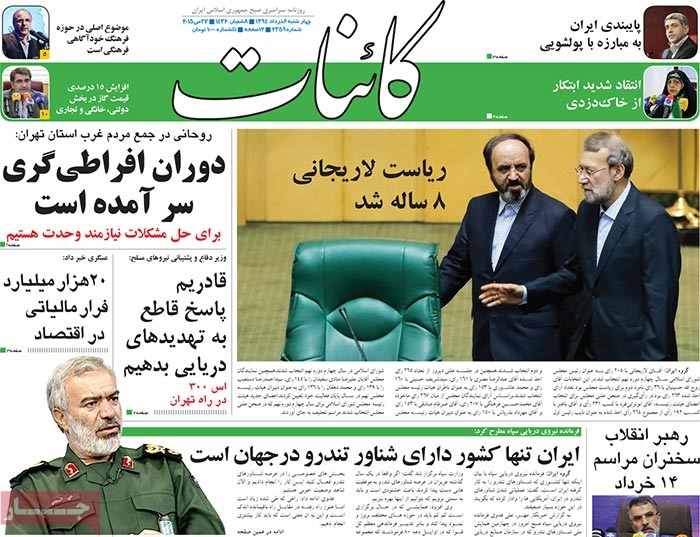
Kaenat: “Days of extremism are gone,” President Rouhani told people in the west of Tehran Province.

“We need unity to settle the country’s problems,” the president further said.


A look at Iranian newspaper front pages on May 27


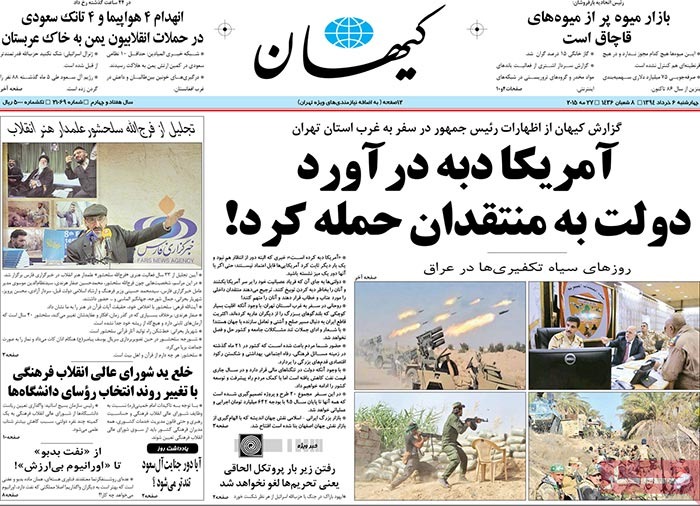
Kayhan: The US backed out; government attacked its opponents.

Kayhan: Black days of Takfiris in Iraq


A look at Iranian newspaper front pages on May 27


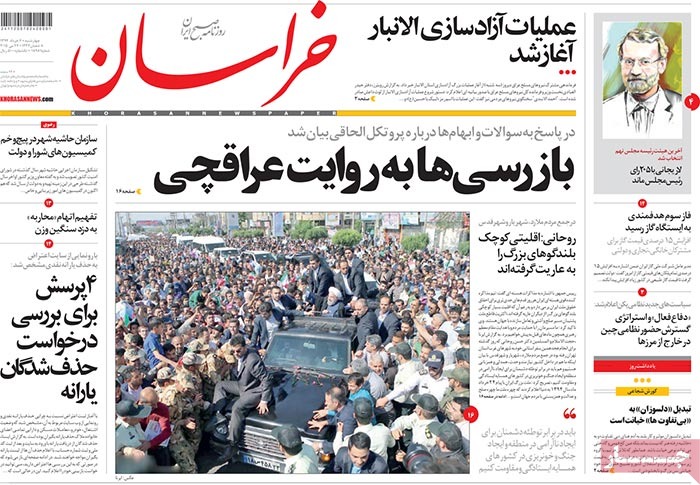
Khorasan: An operation has been launched to take back Al Anbar Province in western Iraq from ISIL terrorists.


A look at Iranian newspaper front pages on May 27


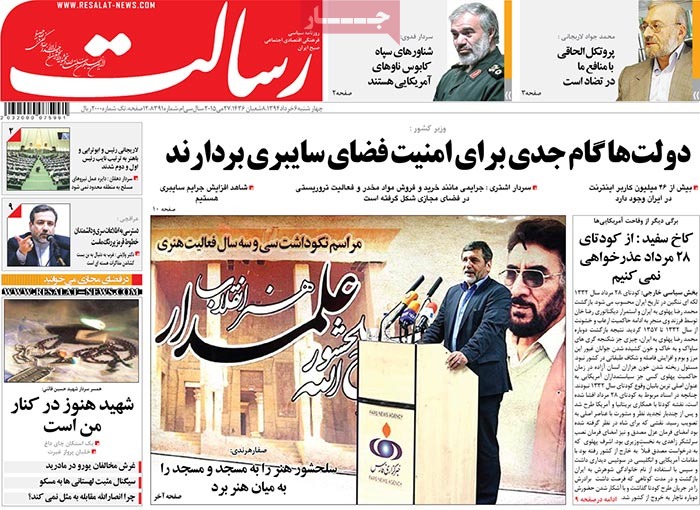
Resalat: Interior Minister: Governments should take serious measures to ensure cyber security.
 

A look at Iranian newspaper front pages on May 27


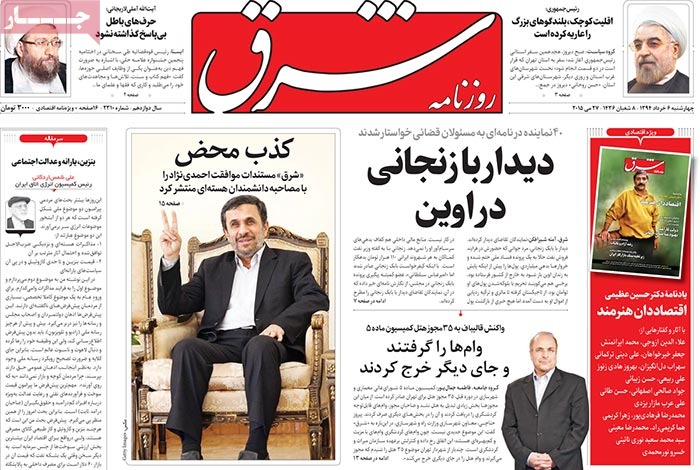
Sharq: Sheer lie

The daily has released documents showing Ahmadinejad’s approval of interviews with Iran’s nuclear scientists.

Sharq: In a letter to judicial officials, 40 Iranian MPs have asked to be allowed to visit Babak Zanjani [who stands accused of massive corruption] in Evin Prison.


A look at Iranian newspaper front pages on May 27