Monday, December 22, 2025
Home Blog Page 4867

Persian Gulf Day, symbol of Iranian unanimity (PHOTOS)

Persian Gulf

The Persian Gulf is a strategic waterway located between Iran and the Arabian Peninsula. In Iran, April 30, which marks the expulsion of the Portuguese from the key waterway, has been named National Persian Gulf Day.

The name of the Persian Gulf is usually distorted by Arab media and replaced with fake titles such as the Arabian Gulf or the Gulf.

Bandar Abbas and Bushehr are to host a 5th Persian Gulf festival on Thursday.

Homayoun Amirzadeh, a senior official with the Ministry of Culture and Islamic Guidance has said, “The event is aimed at safeguarding the name of the Persian Gulf. It provides a platform to display unity and introduce Iranian cultural, artistic, political, economic and scientific talent.”

He added, “The Persian Gulf Day is a never-dying day in Iran’s history, tied to the social and political identity of all Iranians.”

The following are aerial photos of the Persian Gulf released by Tasnim News Agency:


Iranian sportswoman who is crazy about skydiving (PHOTOS)

Skydiving5

Skydiving is a sport which has lately grown in popularity throughout the world. Fatemeh Akrami is an Iranian sportswoman who is crazy about skydiving. She has been doing gymnastics since she was five years old. To her, bungee jumping is child’s play and what really gives her an adrenalin rush is a 4,000-meter jump from a plane.

“When you are up there and the door of the plane opens, you have only five seconds to follow the jumper ahead of you. If you fail to do so, you won’t be able to land on the preplanned spot. It takes from 50 to 60 seconds between jumping and pulling the parachute cord; rookie skydivers are asked to pull the cord sooner,” she said.

Images of an Iranian skydiver released online by khabaronline.ir:

Future holds more infighting in store for Saudi Arabia

Prince-Salman_2251916k

Hamid Reza Asefi, a former Iranian ambassador to the UAE and a Mideast expert, says that a number of factors have contributed to Saudi King Salman’s decision to introduce a major shake-up in the kingdom.

On April 30, the Islamic Republic News Agency published Asefi’s remarks on the recent political developments in Saudi Arabia. The following is the translation of what else the former diplomat said:

The reshuffle in the Saudi ruling elite, which is described by some as a quasi-coup or a political seismic shift, is unprecedented in the Saudi political history.

Saudi-Arabia-Map[The late] King Abdullah, who played the role of an arbiter in Saudi society, managed to keep the House of Saud united, but after his death, with the rise to power of King Salman, fierce infighting and rivalry broke out.

The bickering which has resulted in the recent shake-up has four main factors at its heart:

1. The first cause should be looked for in bitter rivalry between Sudairis and non- Sudairis, which was kept in check under King Abdullah.

2. The leaning of King Salman’s inner circle toward the US is the second factor. Besides the monarch, individuals such as Prince [Mohammed bin] Nayef, Mohammad bin Salman [bin Abdulaziz] and Adel al-Jubeir have American leanings and seek closer ties with Washington.

The US has many plans to further divide the Muslim world for the benefit of the Zionist regime, and Saudi Arabia is serving that cause. That is why the US has intelligence and logistical cooperation with the kingdom in its airstrikes against Yemen. Washington has gone even further and sponsored a UN Security Council resolution in favor of Riyadh.

3. Developments in Yemen make for the third factor. Important figures such as Saud al-Faisal seem to have been unaware of Saudi planning to attack Yemen. Muqrin bin Abdulaziz was apparently dismissed for his Yemeni background.

4. Young, inexperienced politicians taking the helm of the Saudi regional policy are the fourth reason. Their frustration with Saudi failures, as far as regional issues go, has seen them opt for a policy which is heavy on a security mentality.

Future will see more division crop up in the Saudi Royal Family if the kingdom’s regional policies suffer more setbacks.

The recent reshuffle shows that changes are brewing within the Saudi ruling family. Given the stance of King Salman’s associates on regional issues, the shake-up could have more repercussions in the future.

Signs of early modern humans found in a cave in western Iran

3

Archeological excavations in Kaldar Cave in Khorramabad, Lorestan Province, have produced evidence of early modern humans, good at making tools, living in this region.

The evidence can help remove ambiguities surrounding the extinction of Neanderthals if more extensive research is conducted.

According to an agreement struck by the Research Center of Iran’s Cultural Heritage, Handicrafts, and Tourism Organization and the Catalan Institute of Human Paleoecology and Social Evolution (IPHES), a joint Iranian-Spanish team carried out archeological excavations and research into cultural items of the cave and came across new findings which can open up new horizons for scientists in this field, Mehr News Agency has reported.

2

The team discovered layers dating back to the Paleolithic era as well as some intact layers which have existed since the Pleistocene period, the geological epoch which lasted from about 1.8 million years ago to over 10,000 years ago.

The stone tools dug out of the cave shed light on the emergence of early modern humans in this region.

The head of the archeological team said, “If we can discover more tools in other sites across Khorramabad Valley and when the results of analyses performed in Kaldar Cave come out, we can substantiate assumptions that the valley is the point of origin for modern humans.”

Behruz Bazgir added, “Also, the reasons behind the mystery extinction of Neanderthals are highly likely to be unraveled during the excavations.”

Andreu Olle, Ph.D., who works with the Catalan institute, described the archeological site as immensely important with regard to human evolution in Western Europe.

1

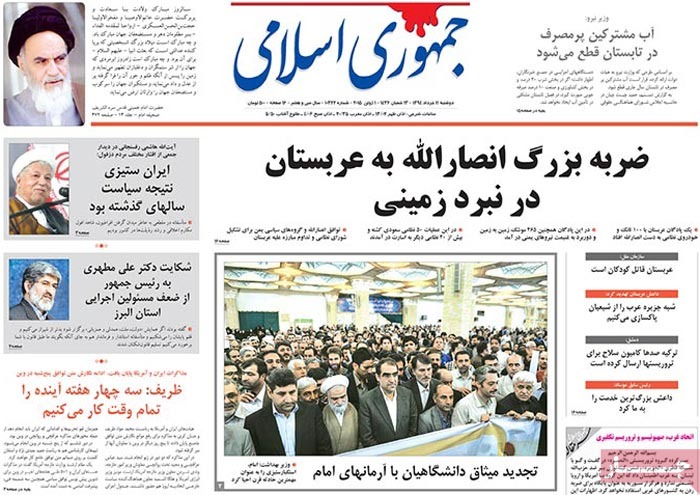
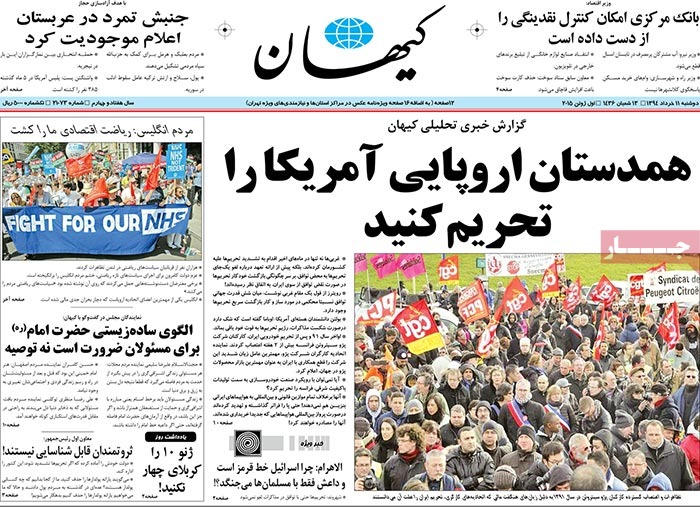
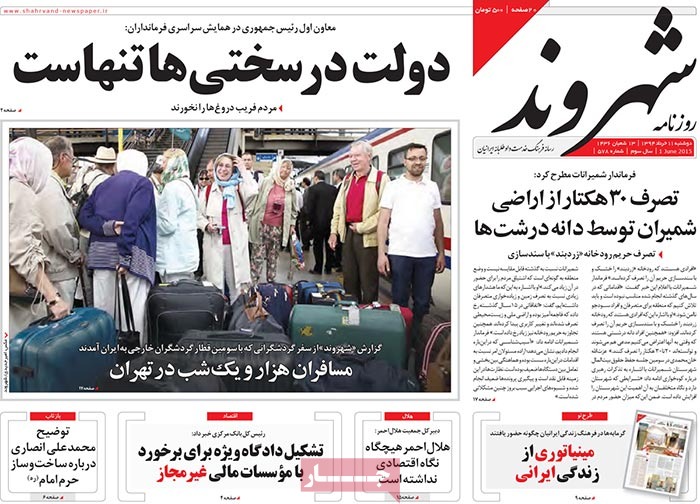
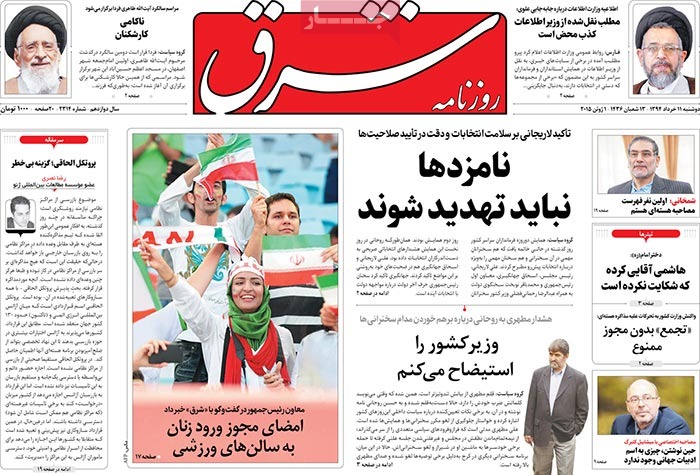
A look at Iranian newspaper front pages on April 30

Iranian-Newspaper-Headlines-02

The Supreme Leader’s comments that the key to solving economic problems is inside the country and his stress on the need for boosting domestic production and a clampdown on corruption in the real sense of the word dominated the front pages of Iranian newspapers on Thursday. Also in the news were remarks by President Rouhani in Shiraz on the removal of unjust sanctions against Iran and FM Zarif’s warning that the parties to the nuclear talks should not lose out on the current chance [for striking a final deal].


Abrar: Spokesman Nejatollah Ebrahimian has said that the Guardian Council has rejected a parliamentary motion that allows present deputies to avoid being vetted again if they seek re-election in the future.


A look at Iranian newspaper front pages on April 30


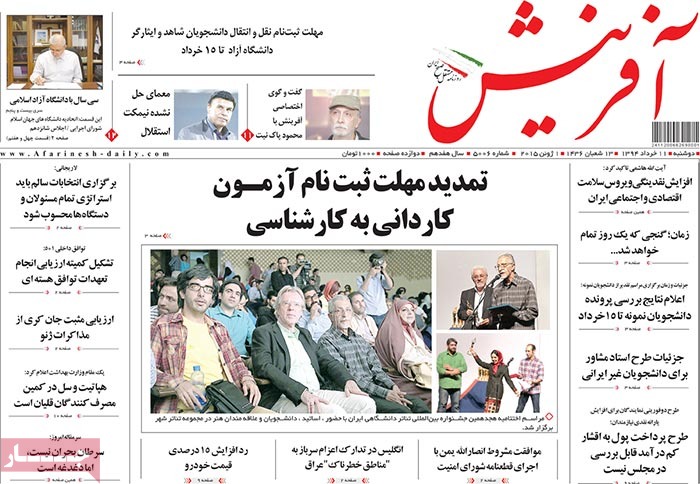
Afarinesh: “We will cancel all unjust resolutions the UN Security Council has released [against the Islamic Republic],” said President Hassan Rouhani.


A look at Iranian newspaper front pages on April 30


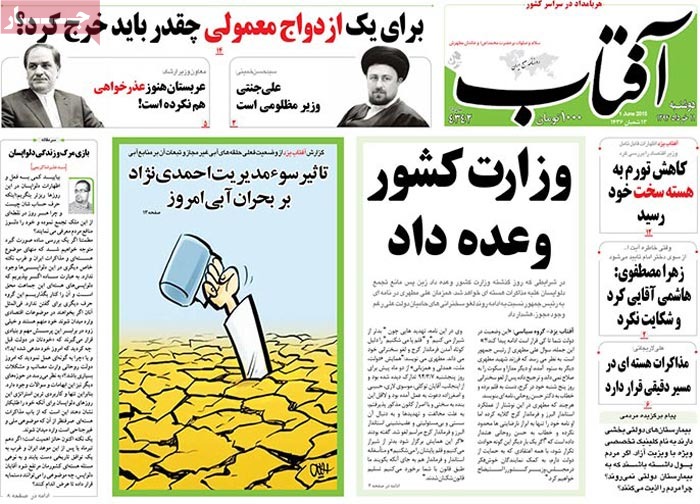
Aftab-e Yazd: Ties between Tehran and Riyadh after seismic changes in Saudi Arabia

Aftab-e Yazd: Supreme Leader of the Islamic Revolution Ayatollah Seyyed Ali Khamenei has urged officials to crack down on corruption in the real sense of the word.


A look at Iranian newspaper front pages on April 30


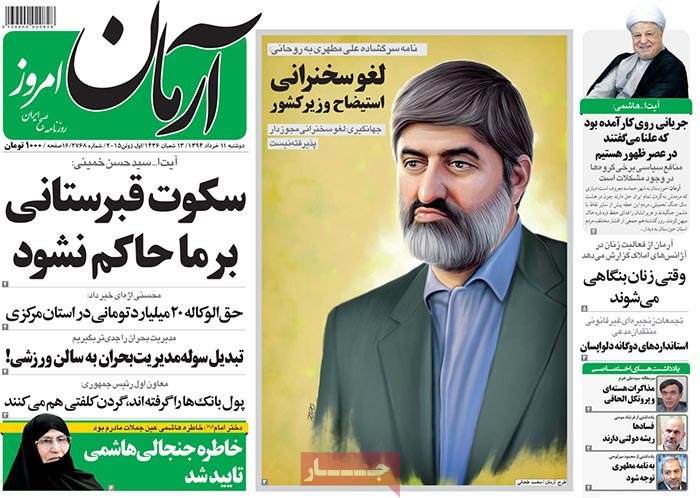
Arman-e Emrooz: “Those who attacked [Tehran MP Ali] Motahari were not from Shiraz,” President Hassan Rouhani told the locals in Fars Province.

Arman-e Emrooz: “The key to solving economic woes is not in Lausanne, Geneva or New York,” said the Supreme Leader in a meeting with a group of Iranian laborers.


A look at Iranian newspaper front pages on April 30


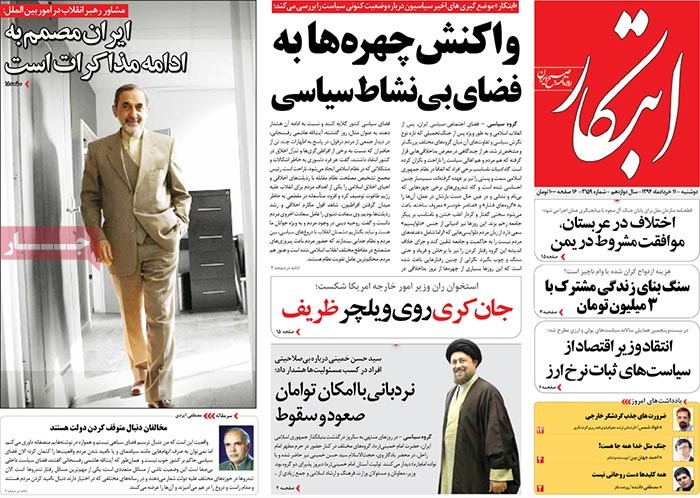
Ebtekar: The symphony of welcome in the city of the great

“Removal of sanctions, not sloganeering, is [something of] an art,” said President Rouhani.


A look at Iranian newspaper front pages on April 30


Etemad: A two-percent decrease in interest rates

The daily has asked experts about their views on the decisions made by the Money and Credit Council.

Etemad: “Sanctions will be removed, whether [US] Senators like it or not,” said Foreign Minister Mohammad Javad Zarif in New York University.


A look at Iranian newspaper front pages on April 30


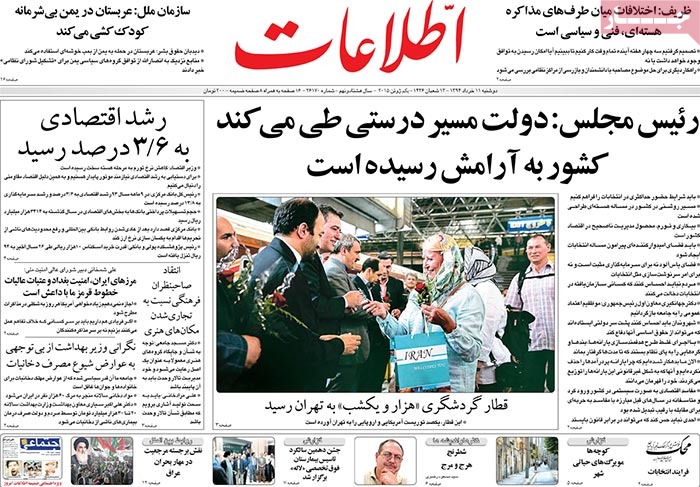
Ettela’at: The replacement of the Saudi foreign minister and crown prince

Adel al-Jubeir was named foreign minister and Prince Mohammed bin Nayef was appointed as crown prince in a Saudi cabinet reshuffle.


A look at Iranian newspaper front pages on April 30


Financial Tribune: Drop in deposit rates


A look at Iranian newspaper front pages on April 30


Hamshahri: “The government is expected to reject the consumption of foreign-made goods as [religiously] forbidden,” said Supreme Leader Ayatollah Khamenei.


A look at Iranian newspaper front pages on April 30


Hemayat: “The fight on corruption needs no publicity work,” said Judiciary Chief Ayatollah Sadegh Amoli Larijani in a meeting with senior judicial officials.


A look at Iranian newspaper front pages on April 30


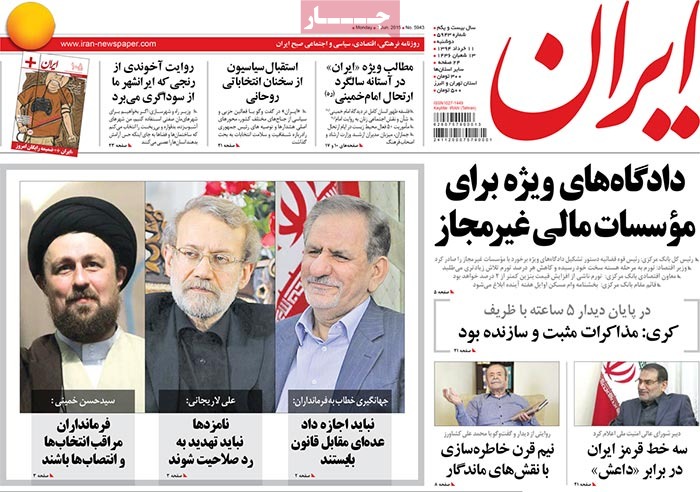
Iran Daily: Saudis prevent landing of Iran medical aid plane in Yemen


A look at Iranian newspaper front pages on April 30


Iran News: German FM eyes Iran visit


A look at Iranian newspaper front pages on April 30


Javan: A political earthquake in the Saudi Cabinet

The Yemen war brought the 40-year-old term of [Foreign Minister] Saud Al-Faisal to an end.


A look at Iranian newspaper front pages on April 30


Jomhouri Islami: “The government is determined to continue to walk down the path which leads to economic boom [in the country],” said President Rouhani in an address to people in Fars Province.


A look at Iranian newspaper front pages on April 30


Kar va Kargar: “Officials should appreciate the workers’ sacrifices and nobility by solving their [pocketbook] issues,” the Supreme Leader of the Islamic Revolution told a crowd of thousands of workers.


A look at Iranian newspaper front pages on April 30


Kayhan: The war in Yemen which aimed to target Ansarullah backfired; Al Saud [family] has suffered casualties!

Kayhan: “Only introducing the thief does not prevent the thief from stealing. The thief should be encountered”.

The Supreme Leader, who made the remark in a meeting with a crowd of workers, was referring to measures to crack down hard on corruption and those involved in it.


A look at Iranian newspaper front pages on April 30


Resalat: “Efforts to boost domestic production form the backbone of measures aimed at solving the country’s problems,” the Supreme Leader told a group of laborers.


A look at Iranian newspaper front pages on April 30


Sharq: A breakdown in [nuclear] talks, missing out on chances

The Iranian foreign minister has described the current chance as historic crossroads.

Sharq: “Religion does not go hand in hand with hypocrisy,” said President Hassan Rouhani in Shiraz.


A look at Iranian newspaper front pages on April 30


Tehran Times: National Museum of Iran showcases artifacts recovered from US Oriental Institute


A look at Iranian newspaper front pages on April 30


Iran’s Zarif: Nuclear deal opportunity should not be wasted

ee

Iran’s Foreign Minister Mohammad Javad Zarif says the opportunity for achieving a nuclear deal between the Islamic Republic and P5+1 “should not be wasted.”

The Iranian foreign minister made the remarks during an interview at New York University on Wednesday.

Zarif said there is a general agreement on the concepts of the deal, “which we call parameters of the agreement.”

Access to Iran’s nuclear facilities

Answering a question on the so-called “enhanced access” by the International Atomic Energy Organization (IAEA) to Iran’s nuclear facilities, referred to in the joint statement adopted by Iran and international powers in early April, Zarif said Iran is ready to provide full transparency with regard to its nuclear facilities.

Zarif said based on an “internationally-defined legal agreement” and based on the Additional Protocol of the Non-Proliferation Treaty, Iran will accept the “highest level of transparency” on the issue.

He added that, however, what Iran is opposed to is the arbitrary visits which not only Iran, but no other country could accept when it comes to its sensitive facilities.

The Iranian foreign minister stated that a 2013 report by the IAEA admits that after Japan, Iran has accepted the highest number of inspections of its nuclear facilities while Japan has ten times more nuclear sites.

He said the final deal would see Iran even provide a more transparent system for the international inspectors, even more transparent than the mechanism stipulated in the Additional Protocol, as the country is basically against nuclear weapons based on a religious decree by the Leader of the Islamic Revolution Ayatollah Seyyed Ali Khamenei and that the country has nothing to worry about.

Sanctions relief

On the issue of the removal of the international sanctions imposed on Iran over its nuclear activities, Zarif said if Iran and P5+1 – the US, the UK, France, China, Russia and Germany – reach an agreement by the end of June, the United Nations Security Council will, a couple of days later, endorse the agreement through a resolution under the Chapter Seven of its the UN Charter.

“(That) will terminate all previous resolutions including the sanctions resolutions,” Zarif said, adding that such a resolution would be binding for the US government.

He said Iran’s opposite party in the nuclear negotiations is the US government and not the US Congress or the US Supreme Court.

The top Iranian diplomat once again emphasized Iran’s stance with regard to the relief of sanctions, saying that they should be lifted as soon as the final deal is reached .

“All steps will only take few weeks to implement,” he said.

Snap-back provision

Answering a question on the so-called snap-back clause mentioned in the Lausanne agreement, Zarif said Iran is concerned about the violation of the commitments by the opposite negotiating side.

He said Iran has not negotiated for such a long time only to reach a document and then simply violate it, saying that the snap-back system is a reciprocal issue and that the two sides should realize that.

Zarif said that, to the admission of everyone, Iran has implemented everything it promised in the Geneva agreement signed in November 2013, but unfortunately, the US has not met all its obligations with regard to the interim deal.

“So Iran will have its own provision of snap-back if the US fails to meet its obligations,” he said, adding that Tehran expects Washington to be fully committed to its promises.

Political will urgently needed

Zarif said the main precondition for reaching a permanent agreement on Iran’s nuclear program is political will, adding that such a will was absent in similar talks between 2002 and 2005, when some powers sought excuses.

The Iranian top diplomat said Iran welcomes the opportunity to use peaceful nuclear technology by all countries, but big powers and the regime of Israel still pose a huge threat to the global peace and security by possessing nuclear warheads.

“The single biggest threat (to global peace) is the presence of nuclear weapons in the US and the second threat is Israel’s possession of the weapons,” Zarif said, adding, “Bibi sits on more than 400 nuclear warheads obtained in violation of the NPT,” but he still calls himself the guru on the issue.

Aggression on Syria has roots in resistance to Israeli occupation

4759_635659466241064471_s

Parliament Speaker Ali Larijani said on Wednesday that the enemies’ aggression on Syria has roots in the resistance of the Syrian nation to the Israeli occupation.

Larijani made the remark in a meeting with visiting Syrian Defense Minister Fahd Jassem al-Freij.

Since Syria has been located in the front line of resistance to the Israeli occupation in the region, the country is under savage aggression by the ill-wishers as well as regional and trans-regional enemies.

As for the developments in Syria, he said that the Syrian people and officials have shown a very brave resistance against domestic and foreign terrorists over the past four years.

He expressed hope that we can witness the eradication of all terrorist groups in Syria through brave resistance of people and the country’s officials.

The destructive activities of terrorist groups do not limit to some countries but in case of ignorance of the regional governments, they will threaten stability and tranquility of all parts in the world, Larijani said.

Ties between Iran and Syria are very friendly, he said, adding that cultural and religious affinities have brought the two nations much closer.

The Syrian defense minister said, for his part, that the aggression of terrorists on Syria is a plot masterminded by the US and Zionists.

The Syrian official also briefed Larijani on the latest developments in fight against the terrorists in Syria and said that the Islamic Republic of Iran has always backed the Syrian people in hard times, offered humanitarian assistance and honored its ethical responsibility.

The Syrian army has attained significant achievements in the fight against the terrorists and is to implement new plans to this end, said the Syrian minister.

Iran, Red Cross discuss aiding war-ravaged countries

Hossein Amir-Abdollahian

8ae9154d-4780-46b4-aa3f-2ca6b8ce4d3cTop officials from Iran and the International Committee of the Red Cross have held talks on how to optimize aiding crisis-hit countries in the region including Syria, Iraq, and Yemen.

Iranian Deputy Foreign Minister for Arab and African Affairs Hossein Amir-Abdollahian held a meeting with Robert Mardini, the regional director for the Middle East at the Red Cross, in Tehran on Wednesday.

Amir-Abdollahian hailed the Red Cross for its efforts to battle the grim humanitarian situation in Yemen, the Arab world’s poorest country under Saudi aggression since March 26.

He voiced concerns over the situation there, calling for facilitating aid delivery to the impoverished nation.

Mardini, for his part, expressed concerns over the situation, further elaborating on measures by the Red Cross in Syria and Iraq.

The regional director said the organization is trying to do more to help the Yemenis who are in dire need of foodstuff, medicine, and fuel during the Saudi war that has claimed nearly 1,000 lives so far.

Mardini also thanked Iran for sending humanitarian aid to Iraq and Syria, gripped by ISIL Takfiri militancy.

Iran raps Saudi Arabia’s vindictive air raid on aid-carrier plane

afkham

The Iranian foreign ministry on Wednesday blasted Saudi Arabia’s “vindictive and inhumane” air raid on Sana’a International Airport on Tuesday to prevent an Iranian cargo plane carrying humanitarian aid from landing in Yemen.

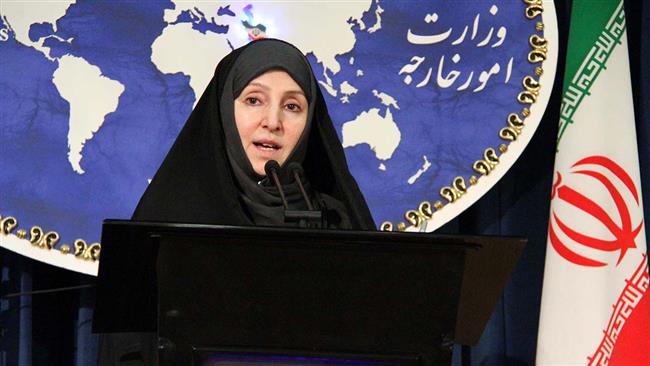
Foreign Ministry Spokeswoman Marziyeh Afkham underlined that the Saudi fighters’ military moves are aimed at increasing pressure on the innocent Yemeni people.

Afkham also called on the international organizations, especially the Red Crescent, to prepare the ground for sending food and medical aid to the Yemeni people.

Her remarks came after an Iranian plane which was bound for Sana’a Airport was intercepted by the Saudi fighters before landing in Yemen’s airport on Tuesday.

Sources in the Yemeni capital said the Saudi warplanes targeted the airport seven times to make the Iranian plane avoid landing and return to Iran.

The air strikes also set fire to an aircraft belonging to the al-Saeeda airlines.

The sources said the cargo plane was due to take humanitarian aid to Yemen and take several civilians, who were critically wounded in the recent Saudi bombings, back to Tehran to receive medical treatment.

The plane’s pilot, Captain Behzad Sedaqat, told the Iranian state-run TV on Tuesday night that “15 minutes after entering Yemen’s airspace, Saudi fighter jets came to escort us insisting that we change our flight plan and go to Saudi Arabia”.

“Then they once again warned us to go to Saudi Arabia and land in an airport there, but we refused,” the captain said, adding that the Saudi fighter jets have even threatened to shoot the plane down and told him that the cargo plane had no other way, but to change the flight plan accordingly.

“But when we defied and approached the Sana’a International Airport, the Saudi warplanes targeted the airport with rockets and bombs, and when we found out that we couldn’t land in there we decided to return,” said the captain who went to the Omani capital, Muscat, to refuel the plane before returning to Iran.


a1


a2


Saudi jet fighters on Thursday prevented an Iranian cargo plane carrying humanitarian aid from entering Yemen’s airspace. The Iranian civilian plane carried humanitarian aid, including medical equipment, for the Yemeni people who have been under the Saudi-led airstrikes for almost a month now.

For the second consecutive day, the Saudi fighter jets intercepted an Iranian airplane carrying humanitarian aid from entering Yemen’s airspace. Iranian cargo plane carrying food stuff and medical equipment for the Yemeni people was shooed away from Yemen’s airspace on Friday.

In response, the Iranian foreign ministry summoned the Saudi charge d’affaires in Tehran on Friday to protest against the Arab country’s continued blocking of Iran’s cargo planes carrying humanitarian and medical aid to Yemen.

In the absence of the Saudi ambassador to Iran, the country’s chargé d’affaires was summoned to the foreign ministry after the Saudi warplanes prevented the cargo planes of the Iranian Red Crescent Society (IRCS), carrying pharmaceutical aid and also the wounded Yemenis who have been treated (in Iran), from entering Yemen’s airspace despite obtaining the needed permissions from Saudi Arabia.

Deputy Foreign Minister for Arab and African Affairs Hossein Amir Abdollahian warned Riyadh of Tehran’s tough reaction after Saudi fighter jets alarmed Iranian cargo planes, carrying humanitarian aid, to keep off Yemen’s airspace.

“Riyadh’s behavior and its siege of Yemen and preventing the dispatch of humanitarian aid will not remain unanswered,” Amir Abdollahian said on Sunday.

“Saudi Arabia is not entitled to decide for others in the region,” he added.

Iran has already sent five consignments of humanitarian aid to Yemen, including a total of 69 tons of relief, medical, treatment, and consumer items

[…]

Iran urges UN humanitarian relief efforts in Yemen

afkham

Iran’s Foreign Ministry called on the United Nations secretary-general’s new special envoy for Yemen to take immediate action to deliver humanitarian aid to people of the Arab country, affected by more than a month of Saudi-led military strikes.

Iranian Foreign Ministry Spokeswoman Marzieh Afkham on Tuesday expressed hope that Mr. Ismail Ould Cheikh Ahmed would take “effective and constructive steps” for putting an end to the military campaign against Yemen and initiating dialogue among the Yemeni groups and parties.

She also slammed military action on Yemen as a “big mistake.”

“The Islamic Republic of Iran deeply believes that the crisis in Yemen should be resolved politically and based on dialogue among Yemenis in order to establish an inclusive government,” Afkham added.

On April 25, UN Secretary-General Ban Ki-moon appointed Ismail Ould Cheikh Ahmed of Mauritania as his Special Envoy for Yemen after Jamal Benomar of Britain stepped down from the role.

While Yemen has been gripped by political conflicts and Saudi-led military attacks on the impoverished country have also aggravated the situation, Iran has proposed a four-point plan, which entails Yemeni-Yemeni talks to end the crisis.

On March 26, Saudi Arabia and some of its Arab allies began to launch deadly airstrikes against the Houthi Ansarullah movement in an attempt to restore power to the fugitive former President Abd Rabbuh Mansour Hadi, a close ally of Riyadh. The Saudi-led coalition announced on April 21 that its military operation “Decisive Storm” has ended, but hours later, airstrikes and ground fighting resumed.

According to the spokesman of the Yemeni Army, the Saudi-led war on the Arab country has killed more than 2,000 people, most of them civilians.