Wednesday, December 31, 2025
Home Blog Page 4862

Iran’s new aircraft successfully passes wind tunnel test

Borhan

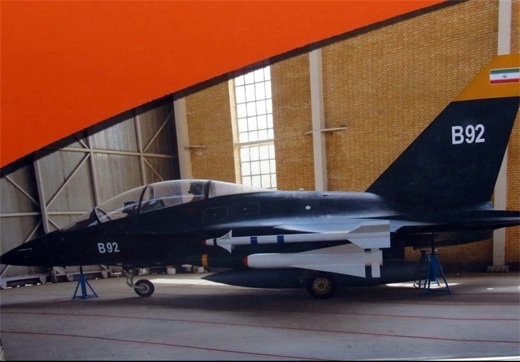
Iranian experts have successfully tested a new domestically-made fighter aircraft, named ‘Borhan’, in the country’s national wind tunnel facility.

The Borhan fighter, which is also known as B92, has been completely manufactured by the Iranian military experts and has successfully passed wind tunnel tests.

Currently, 70 percent of the detail design of the fighter, which is an updated and optimized version of the Shafaq fighter, has been completed and its mock-up has been also manufactured.

Some changes have been made in the design of the aircraft to boost its capabilities, compared to the Shafaq fighter, including its vertical tail as well as the airfoil of its wings.

The Iranian military experts and technicians have in recent years made great headways in manufacturing a broad range of indigenous equipment, making the armed forces self-sufficient in the arms sphere.

Tehran has always assured other nations that its military might poses no threat to regional countries, saying that the Islamic Republic’s defense doctrine is entirely based on deterrence.

Critics say reformist meeting failed to discuss issues of national importance

Reformists confrance

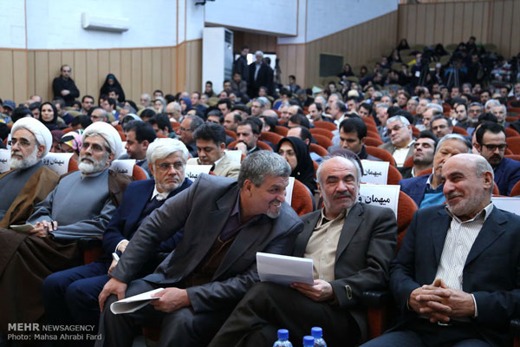
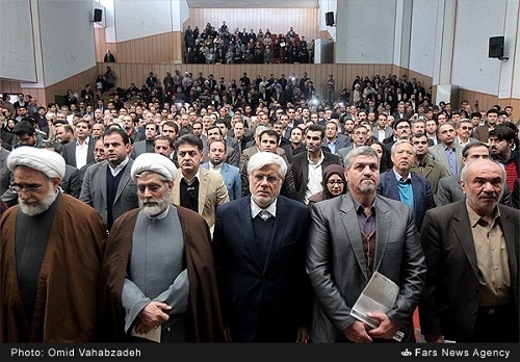
Reformists got together in Tehran on Thursday (January 15) for a meeting delayed for almost two years and focused on general questions such as the Constitution and the upcoming parliamentary elections.

Mehdi Fazaeli, a political expert, says one drawback to the meeting of reformists was that they failed to pay careful attention to issues of public concern.

Fazaeli was quoted by Fars News Agency (FNA) as saying that the meeting failed to take heed of the country’s key issues which center around national and public interests as well as people’s lives. What comes below is the partial translation of his remarks followed by the comments of a member of the Assembly of Experts:


Mehdi Fazaeli
Mehdi Fazaeli

Mehdi Fazaeli, a political expert

What the speakers raised in the meeting [of reformists] was repetitive and offered nothing new or serious. Their speeches focused exclusively on political issues such as the Approbatory Supervision, parliament and an end to the house arrest [of Karroubi and Mousavi]. These issues are repeated by the reformists from time to time.

The reformists refused to talk about the country’s key questions which cover people’s livelihood, national interests, culture and international economy. This is a downside of a meeting which intended to bring together different faces and generations of reformists and discuss serious issues.

The fact that reformist big shots were no-shows in the gathering was yet another drawback. Earlier reports had said that Messrs. Hashemi [Rafsanjani], Khatami, Nategh Nouri and Jahangiri as well as Ms. Ebtekar were to attend the meeting, but they all failed to show up.

Their absence can be critically analyzed. It shows that these big names do not take the reformists camp seriously.


Ayatallah Mamdoohi
Ayatollah Hassan Mamdouh

Ayatollah Hassan Mamdouh, an Assembly of Experts member

[…]

Government officials did not attend the meeting of reformists although they had been invited over. Actually they saved face by not showing up in such a meeting.

Tumbling oil prices have opened up an opportunity for Iran

Teyebnia

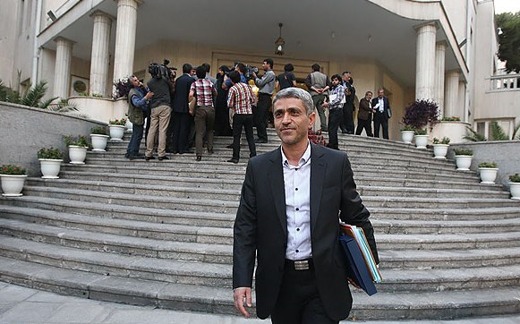
The Iranian economy minister has dismissed reports that the government is to raise taxes to make up for its depleting finances, saying that the Cabinet is after a justice-based tax system, not levying more taxes.

On January 16, the Iranian Labour News Agency (ILNA) quoted Ali Tayyebnia as saying that the government has no plans to raise taxes. The following is the translation of what the minister told ILNA in the central city of Qom where he met with sources of emulation and Shiite clerics:

The minister said that the government is planning to increase taxes for those individuals who have so far evaded or avoided to pay taxes, adding this will go into effect when the tax information system is complete.

As for main economic concerns, he said that the government has worked out detailed plans to curb inflation and create jobs, adding that efforts are being made to regulate monetary and financial resources, and control the country’s monetary base.

Tayyebnia further said that to boost employment, the government is seeking to speed up economic expansion in the first place. He said when production is raised the stage is set for productive employment.

Secondly, the country needs to opt for production methods which can create more jobs for the youth, he stressed.

Asked about the Cabinet’s strategies to cope with sliding crude prices, he said that the government seeks to turn the drop in prices to an opportunity to seriously implement resistance-based economy and help the country cut its dependence on oil revenues.

He went on to say that the government has done proper planning to provide the country’s budget and foreign exchange needs and supply intermediate goods for the production sector.

If sanctions persisted, we would go for 60 percent enrichment: MP

Mohammad Hasan Asafari

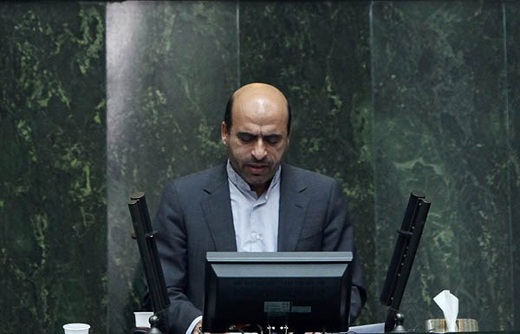
On January 17, the Islamic Republic News Agency (IRNA) quoted Mohammad Hassan Asafari, an MP who sits on parliament’s National Security and Foreign Policy Committee, as saying that a plan has been drawn up to give the green-light to the government to enrich uranium to 60 percent levels in case sanctions persist. The following is a partial translation of what he had to say to the news agency:

If America forged ahead with its sanctions and excessive demands, an initiative which grants the government the go-ahead for 60 percent enrichment would be handed over to the Presiding Board of the chamber.

Over the past month, some 205 MPs have signed a plan which would require the government to enrich uranium to 60 percent levels for submarine fuel and other industrial purposes in case the West, America in particular, failed to abandon their excessiveness and pressed ahead with sanctions.

On Thursday, Parliament Speaker Ali Larijani made reference to the plan without going into detail.

Iranian reformists call for international opportunities to be seized

Reformist campaign

Reformists from different parties and institutions got together in Tehran on Thursday. The get-together, a first in six years after the previous meeting was not allowed to convene under President Ahmadinejad, dominated the front pages of reformist-leaning dailies on Saturday. “The return of reforms”, “Holy alliance of moderation and reformism” and “Reformist flag flies on Parcham Street,” were some of the banner headlines they put on their covers. The following is a partial translation of a statement participants issued at the close of the meeting as reported by the Iranian Labor News Agency (ILNA):

1. We announce to the world that we view unity and public trust as the pillars of our national security. Based on an edict by the Supreme Leader [which bans the production and use of nuclear weapons], we reject any resort to atomic weaponry. We are the flag-bearers and advocates of dialog among civilizations and a violence-free world.

To that end, we strongly decry any act of terror or violence as contradictory to the compassionate mission and principles championed by all prophets, particularly that of the Muslim Prophet. Also, we denounce contradictory behaviors and measures which give rise to the emergence of extremist and violent currents.

2. Now that thanks to public vote and the approach of the Government of Hope and Prudence, valuable and trust-building steps have been taken toward the settlement of the nuclear dispute, and the three branches of government are unanimous in their support for such efforts, we are of the opinion that the world powers should seize every opportunity to get the dispute settled.

Iran’s peaceful nation has been closely monitoring the process and the saboteurs at home and those who miss out on opportunities abroad should make sure the consequences of their actions won’t come back to haunt them later.

Among other things, the statement underlined the following:

1. Recognition of the rightful and legal rights of all ethnicities, followers of divine faiths and religions as well as different political and intellectual views.

  1. Full implementation of the Constitution and avoidance of restrictive and selective approaches toward some articles over others.

3. The need to set the stage for encouraging the highest turnout in the upcoming parliamentary elections, scuttling the methods which restrict the public right to choose and ensuring a fair, legal and competitive race.

4. Respect for senior officials and leaders who are social and national assets of the reformist current and institutionalization of the reformist line of thinking and moderation.

5. Eradication by the government and the judiciary of the main culprits of corruption and monopolies which spark off crises.

6. Respect for the legitimate rights of women.

Ahmadinejad’s unauthorized university up and running

Ahmadi Nejad University

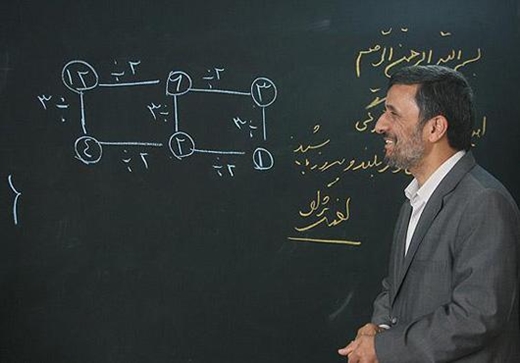
The University of Iranians, the technical university proposed by former President Mahmoud Ahmadinejad, is enrolling students despite earlier reports that its permit had been revoked by the Ministry of Science, Research and Technology.

When in office, Ahmadinejad received authorization from the Supreme Cultural Revolution Council to set up a university which was to focus on information technology, nanotechnology, aerospace and nuclear science.

Mardom-e Emrooz daily on January 17 filed a report on the controversial move of the university to admit students. The following is a partial translation of the report:

The University of Iranians is up and running despite the fact that the technical university has been banned from enrolling students. A website affiliated with the former president has reported that the university’s call for enrollment for online courses on different subjects has been met with warm and unexpected welcome from applicants.

The website goes on to say that the classes have been filled to capacity and university officials are trying hard to handle the students’ affairs and organize the classes. Short-term courses on *Humorism and Principles of Traditional Medicine are among the lessons the applicants have showed great interest in. These two virtual courses will open soon.

The students who take online courses will be given the university’s official certificate when they complete their studies.

[…]

Establishment of a branch in Venezuela; is it hearsay?

Last week when President Nicolás Maduro was on an official trip in Tehran news came out on the establishment of a branch of the University of Iranians in Venezuela in cooperation with Bolivarian University of Venezuela.

The report also said that based on a previous cooperation deal between the two universities, a branch of the University of Iranians will open in Caracas in September 2015.

Reliable sources have not commented on the establishment of a university branch in Venezuela, or any other country for that matter.

Other news suggests that President Evo Morales of Bolivia has invited Mahmoud Ahmadinejad in a letter to visit Lapaz where he is expected to be granted an honorary doctorate at the University of St Andrews.

[…]

*Humorism or humoralism is the study of the four humors – black bile, yellow bile, phlegm and blood – which correspond to one of the human body’s traditional four temperaments.

Home return of 349 historical items biggest gain: Official

Iran-Heritage

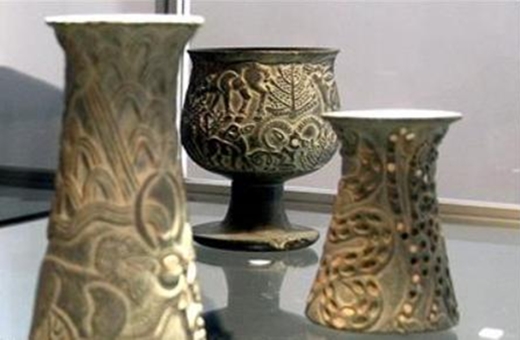
Director of the Cultural Heritage, Handicrafts and Tourism Organization Masoud Soltanifar said the return of 349 historical items to the country has been the biggest gain of its kind so far.

He made the remark in Tehran on Saturday while talking to reporters on the sidelines of a visit by President Hassan Rouhani to an exhibition set up to display 349 historical items which are back home from Belgium.

He said that the historical items belonged to Khurvin, a village in Alborz Province, which were illegally taken out of the country about 50 years ago.

He said Iran pursued the case in different courts for about 35 years and managed to get the final verdict just recently in its own favor.

He said the items dated back to 3,000 years ago.

According to the official, the National Museum of Iran already has 228 items belonging to the period.

A look at Iranian newspaper front pages on Jan. 17

Iranian Newspapers Headlines

Nuclear talks in Europe between representatives of Iran and P5+1 dominated the front pages of most Iranian dailies on Saturday. Calls by senior clerics at their meetings with the economy minister for measures to streamline the economy and rallies in Iran and elsewhere in the world in condemnation of desecration by Charlie Hebdo of Islamic sanctities made front-page headlines too. Reformist dailies dedicated their front pages to a gathering of reformists, a first in six years, in preparation for parliamentary elections in early 2016.


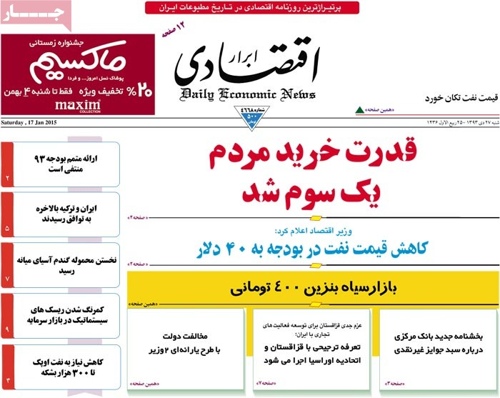
Abrar-e Eghtesadi: Indian oil imports from Iran have increased following the Geneva deal.

Abrar-e Eghtesadi: “[Nuclear] talks have posted progress,” said the Iranian foreign minister.

Abrar-e Eghtesadi: Iran and Turkey have finally reached a deal over tariffs on crossing the border.
 

Abrar eghtesadi newspaper 1- 17


Afarinesh: [Parliament Speaker Ali] Larijani has said that MPs have a new plan on enrichment in case new sanctions are imposed on Iran.
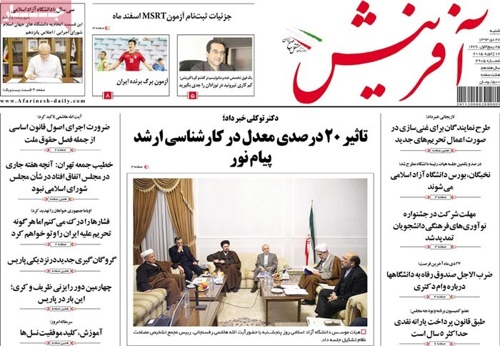
 

Afarinesh newspaper 1- 17


Afkar: Reports that Major General Ghasem Soleimani [who leads the Quds Force of the Islamic Revolution Guard Corps] has been wounded in Iraq have been denied.
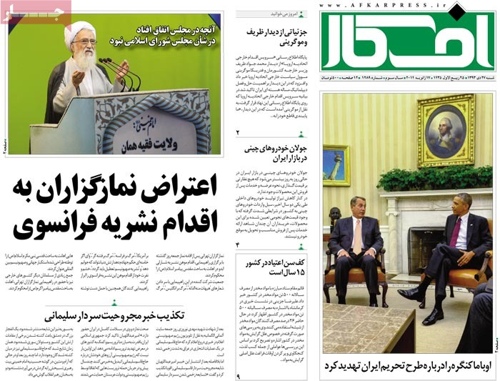
 

Afkar newspaper 1- 17


Aftab-e Yazd: The government has decided to readjust next year’s budget, this time the package will envision oil prices of $40 a barrel.
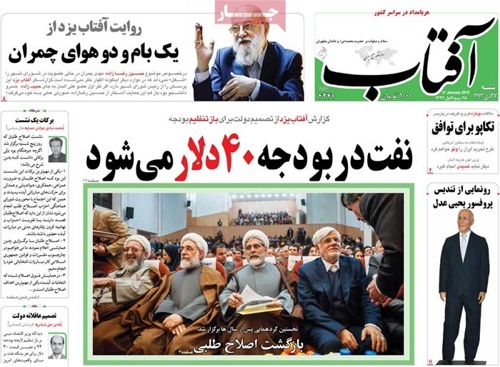
 

Aftabe yazd newspaper 1- 17


Arman-e Emrooz: Iranian Foreign Minister Mohammad Javad Zarif and US Secretary of State John Kerry have held four meetings in three days.

Arman-e Emrooz: President Rouhani has turned down the proposals of two Cabinet ministers on subsidies. The rich will continue to receive cash subsidies.
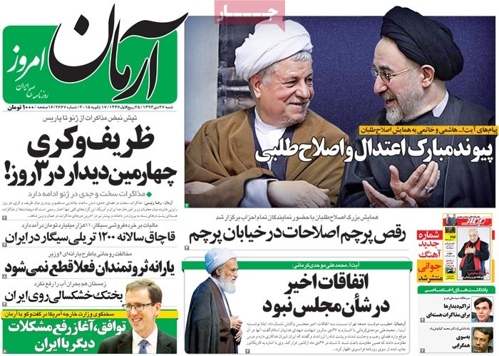
 

Armane emruz newspaper 1- 17


Asr-e Iranian: “New sanctions would mean Iran would pick up uranium enrichment at a level of its choosing,” said Parliament Speaker Ali Larijani.

Asr-e Iranian: Up to 45 percent of Iranian addicts are HIV-positive.
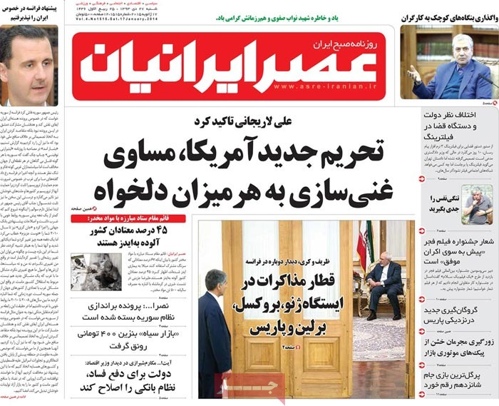
 

Asre iranian newspaper 1- 17


Asrar: “What happened in parliament of late was below the Islamic Consultative Assembly,’ said Tehran Friday Prayer Leader Ayatollah Movahedi Kermani. [He was referring to the brawl that broke out in parliament when principlist MP Ali Motahari was delivering a speech.]
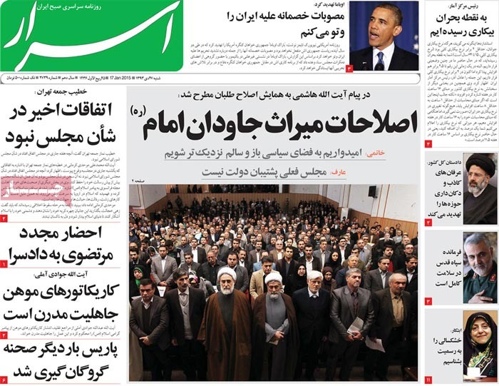
 

Asrar newspaper 1- 17


Emtiaz: Each year some 500 tons of illicit drugs is seized across the country.

Emtiaz: Water levels in dam reservoirs have subsided.
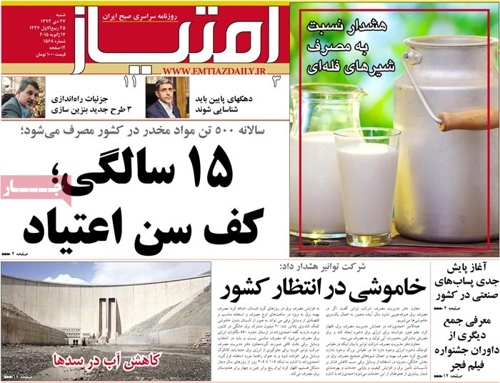
 

Emtiaz newspaper 1- 17


Etemad: An “I love [Prophet] Muhammad” campaign has been launched.
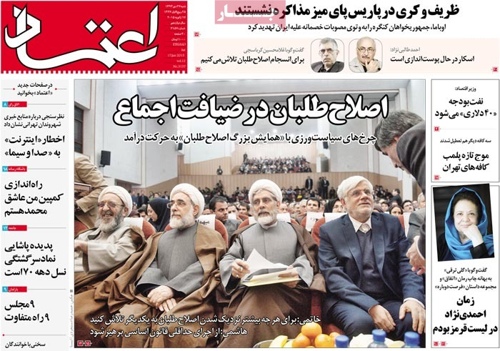
 

Etemad newspaper 1- 17


Ettela’at: After Friday prayers in Tehran, worshippers staged a rally to condemn [the French weekly Charlie Hebdo’s] insults at the Prophet Muhammad.

Ettela’at: At meetings with the minister of economy and financial affairs, sources of emulation have underlined efforts to streamline the economy and regulate banking.
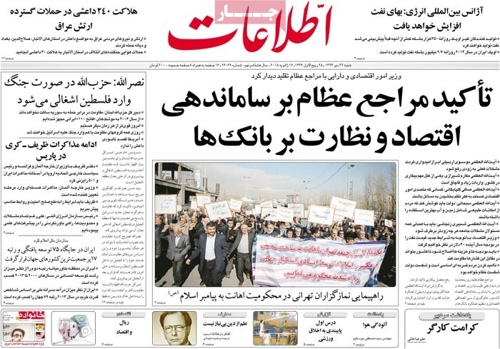
 

Ettelaat newspaper 1- 17


Haft-e Sobh: Two female students have died when ice covering a frozen lake in Ardebil caved in.
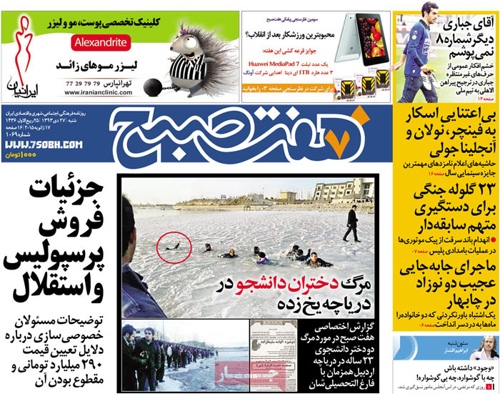
 

Hafte sobh newspaper 1- 17


Iran: Former President Mohammad Khatami and Chairman of the Expediency Council Akbar Hashemi Rafsanjani have sent messages to a gathering of reformists.
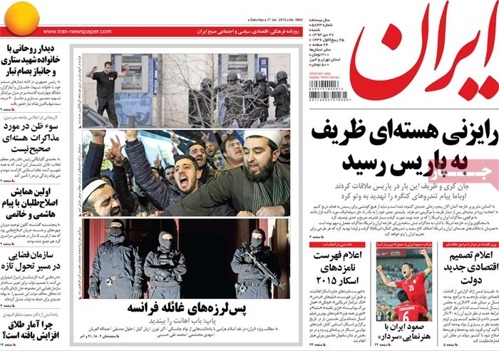
 

Iran newspaper 1- 17


Jomhouri Islami: Muslims in Iran and several other countries have staged rallies in condemnation of a French weekly’s publication of cartoons insulting the Prophet.

Jomhouri Islami: “Republicanism requires powerful parties and political institutions,” said Ayatollah Rafsanjani in a message to a reformist gathering.
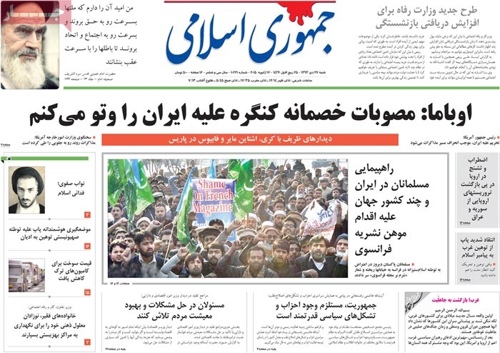
 

Jomhorie eslami newspaper 1- 17


Mardomsalari: “We want a parliament who fights for public demands without being afraid of consequences,” Mohammad Reza Aref, a former vice-president and reformist heavyweight, told a gathering of reformists.
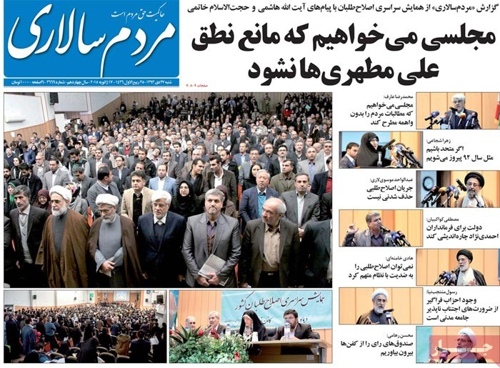
 

Mardom salari newspaper 1- 17


Mardom-e Emrooz: Iran and the US have started drafting the nuclear deal.

Mardom-e Emrooz: “The electoral strategy of reformists is to protect the rights of the people,” said Seyyed Hadi Khamenei [a senior reformist leader].
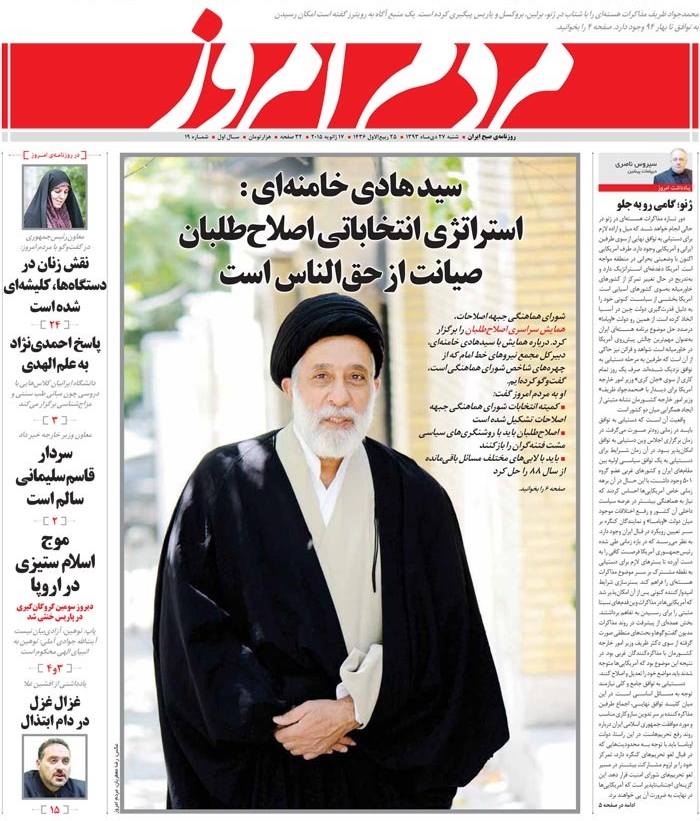
 

Mardome emruz newspaper 1- 17


Payam-e Zaman: “Tax rates won’t increase,” said the minister of economy and financial affairs.

Payam-e Zaman: An exhibition showcasing the country’s laser achievements has opened.
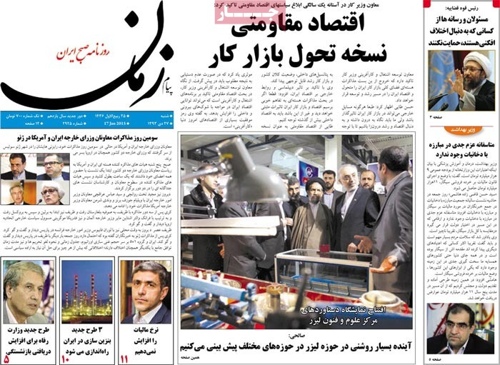
 

Payame zaman newspaper 1- 17


Resalat: “Hardliners should leave the reformist camp,” said Sadegh Kharrazi, a member of the newly-formed NEDA [Farsi initials for a Second Generation of Reformism] Party.
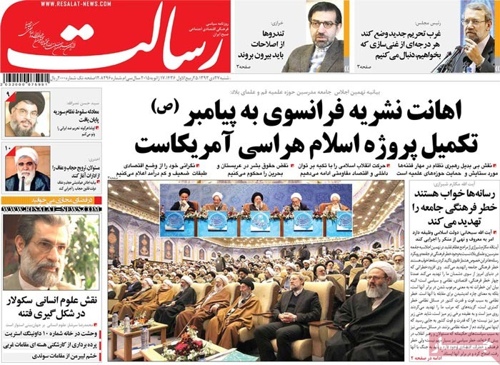

 

Resalat newspaper 1- 17


Iran to enforce preferential tariff with Kazakhstan, Eurasia

Iran-Kazakhstan

Head of the Trade Development Organization Valiollah Afkhami Rad in a meeting with Kazakh Ambassador to Tehran Amreyev Bagdad Kultayevich referred to the agreement of the Kazakh side to implementation of preferential tariff with Iran and said: “We are mutually seeking to provide the preliminaries for preferential tariff with Kazakhstan and Eurasian Union.”

He said the Eurasian Union has been informed of Kazakhstan’s agreement, adding that with examination of the roadmap for Iran-Kazakhstan cooperation and settlement of the existing problems, efforts are being made to enable Tehran and Astana to experience expanded trade activities more than before.

Emphasizing Iran’s determination to develop ties with the neighboring countries, Kazakhstan in particular, he said: “We want you to tell us about any problem in order to take the necessary measures to remove them.”

He referred to the visit of a Kazakh trade delegation to Iran in October and said soon an Iranian trade delegation will visit Astana, adding that Kazakhstan is a big country and neighbor of Iran and thus Iran is ready to set up an exhibition there.

Meanwhile, Ambassador Kultayevich underlined the importance of the agreements which have been reached between the two countries and said the follow-up of the agreements will remove problems sooner and Kazakhstan will not hesitate to render any assistance in this regard.

He called on the Iranian companies which have contracts with his country to take utmost advantage of investment opportunities in Kazakhstan as such privileges are not offered to every country.

In a recent visit of President Hassan Rouhani to Kazakhstan a memorandum of understanding for commercial, industrial, mining and investment roadmap was signed between the Iranian Ministry of Industries, Mines and Trade and the Kazakh Ministry of Development and Investment.

Nuclear talks tough but we remain hopeful

Abbas Araqchi

A senior Iranian negotiator described the latest round of nuclear talks between Iran and six world powers over Tehran peaceful nuclear program as tough but at the same time said he is hopeful about the outcome of the talks.

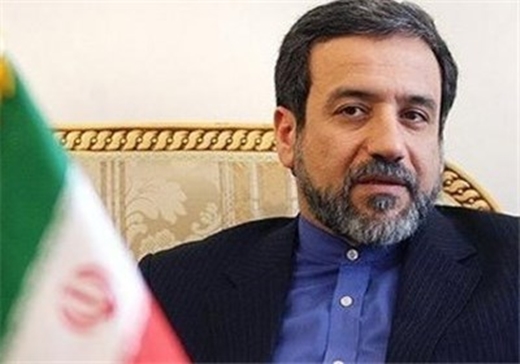
“In these negotiations we have always remained hopeful,” Iran’s Deputy Foreign Minister Seyyed Abbas Araghchi, who is also a top member of the team of nuclear negotiators, said on Friday after deputy-level bilateral talks between Iran and the US ended in the Swiss city of Geneva.

“We hope to bring the negotiations to a conclusion within the remaining time,” he stated.

Araghchi hailed as very important the seriousness dominating the atmosphere of the talks.

“Both we and the other negotiating parties are very serious (in talks),” he told IRIB.

The Iranian diplomat, however, said it is really difficult and tough to find a solution and strike a balance between both sides’ demands.

There are obstacles in the way (of reaching a deal) and there are differences of opinion on different issues, he reiterated.

Araghchi, along with Iranian Deputy Foreign Minister for American and European Affairs Majid Takht Ravanchi, met with US Undersecretary of State Wendy Sherman and Deputy Secretary of State William Burns earlier on Friday.

The latest round of negotiations on Iran’s civilian nuclear program kicked off on Wednesday with a meeting between Zarif and US Secretary of State John Kerry.

On Sunday, January 18, representatives from Iran and P 5+1 (France, Britain, the United States, Russia, China, and Germany) will have a plenary meeting in the Swiss city of Geneva.

Negotiations between Iran and the sextet aim to hammer out a final agreement to end more than a decade of impasse over Tehran’s peaceful nuclear program.

The two sides wrapped up their latest round of nuclear talks in the Swiss city on December 17, 2014, three weeks after they failed to reach a final agreement by a November 24 deadline despite making some progress.

They agreed to extend their discussions until July 1, 2015.