Wednesday, December 31, 2025
Home Blog Page 4863

Home return of 349 historical items biggest gain: Official

Iran-Heritage

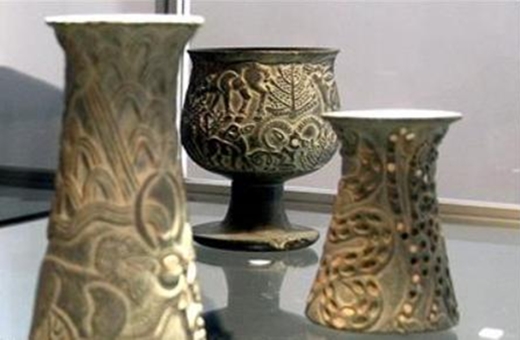
Director of the Cultural Heritage, Handicrafts and Tourism Organization Masoud Soltanifar said the return of 349 historical items to the country has been the biggest gain of its kind so far.

He made the remark in Tehran on Saturday while talking to reporters on the sidelines of a visit by President Hassan Rouhani to an exhibition set up to display 349 historical items which are back home from Belgium.

He said that the historical items belonged to Khurvin, a village in Alborz Province, which were illegally taken out of the country about 50 years ago.

He said Iran pursued the case in different courts for about 35 years and managed to get the final verdict just recently in its own favor.

He said the items dated back to 3,000 years ago.

According to the official, the National Museum of Iran already has 228 items belonging to the period.

A look at Iranian newspaper front pages on Jan. 17

Iranian Newspapers Headlines

Nuclear talks in Europe between representatives of Iran and P5+1 dominated the front pages of most Iranian dailies on Saturday. Calls by senior clerics at their meetings with the economy minister for measures to streamline the economy and rallies in Iran and elsewhere in the world in condemnation of desecration by Charlie Hebdo of Islamic sanctities made front-page headlines too. Reformist dailies dedicated their front pages to a gathering of reformists, a first in six years, in preparation for parliamentary elections in early 2016.


Abrar-e Eghtesadi: Indian oil imports from Iran have increased following the Geneva deal.

Abrar-e Eghtesadi: “[Nuclear] talks have posted progress,” said the Iranian foreign minister.

Abrar-e Eghtesadi: Iran and Turkey have finally reached a deal over tariffs on crossing the border.
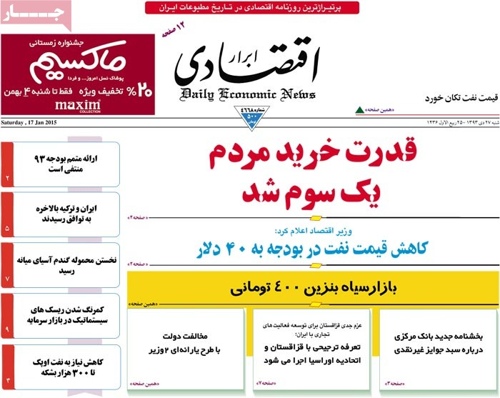
 

Abrar eghtesadi newspaper 1- 17


Afarinesh: [Parliament Speaker Ali] Larijani has said that MPs have a new plan on enrichment in case new sanctions are imposed on Iran.
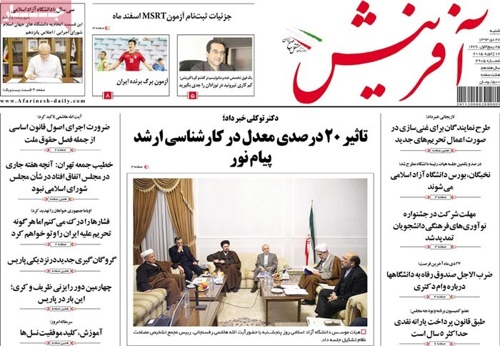
 

Afarinesh newspaper 1- 17


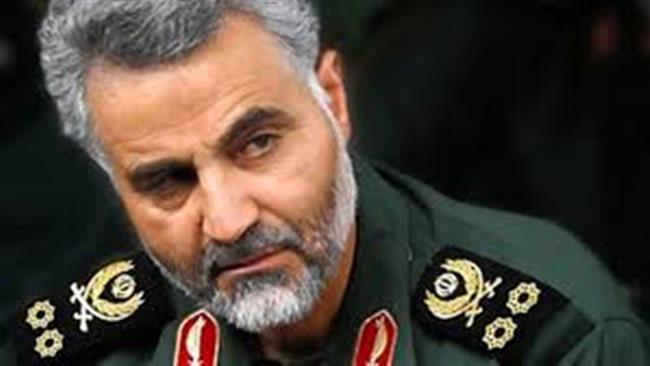
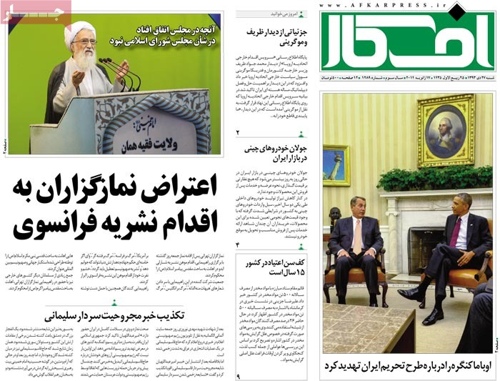
Afkar: Reports that Major General Ghasem Soleimani [who leads the Quds Force of the Islamic Revolution Guard Corps] has been wounded in Iraq have been denied.
 

Afkar newspaper 1- 17


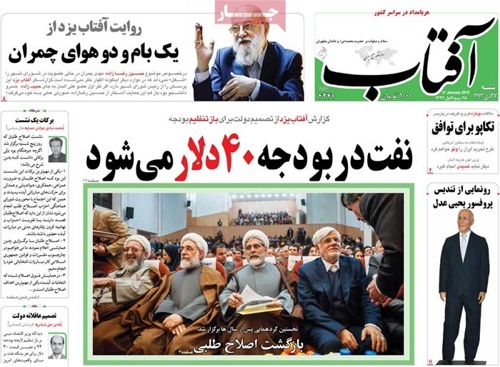
Aftab-e Yazd: The government has decided to readjust next year’s budget, this time the package will envision oil prices of $40 a barrel.
 

Aftabe yazd newspaper 1- 17


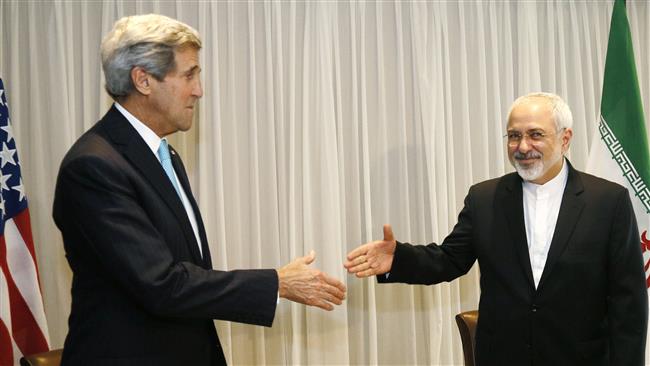
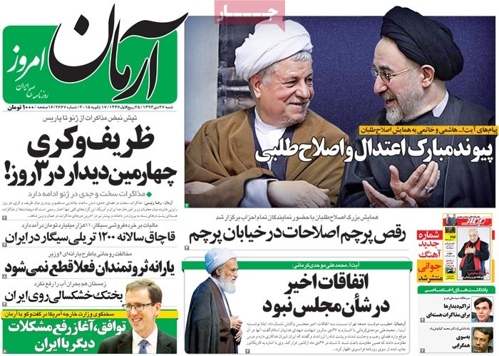
Arman-e Emrooz: Iranian Foreign Minister Mohammad Javad Zarif and US Secretary of State John Kerry have held four meetings in three days.

Arman-e Emrooz: President Rouhani has turned down the proposals of two Cabinet ministers on subsidies. The rich will continue to receive cash subsidies.
 

Armane emruz newspaper 1- 17


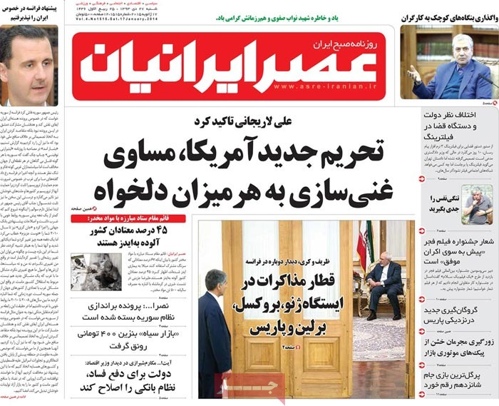
Asr-e Iranian: “New sanctions would mean Iran would pick up uranium enrichment at a level of its choosing,” said Parliament Speaker Ali Larijani.

Asr-e Iranian: Up to 45 percent of Iranian addicts are HIV-positive.
 

Asre iranian newspaper 1- 17


Asrar: “What happened in parliament of late was below the Islamic Consultative Assembly,’ said Tehran Friday Prayer Leader Ayatollah Movahedi Kermani. [He was referring to the brawl that broke out in parliament when principlist MP Ali Motahari was delivering a speech.]
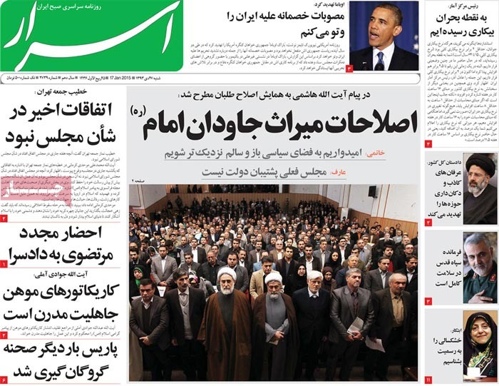
 

Asrar newspaper 1- 17


Emtiaz: Each year some 500 tons of illicit drugs is seized across the country.

Emtiaz: Water levels in dam reservoirs have subsided.
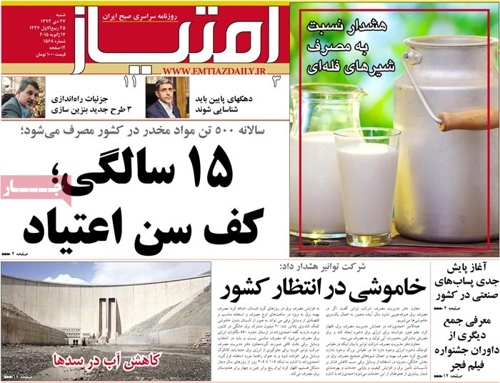
 

Emtiaz newspaper 1- 17


Etemad: An “I love [Prophet] Muhammad” campaign has been launched.
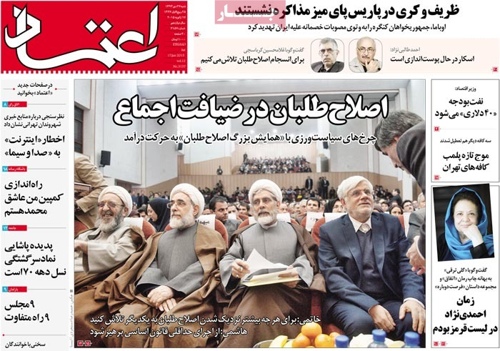
 

Etemad newspaper 1- 17


Ettela’at: After Friday prayers in Tehran, worshippers staged a rally to condemn [the French weekly Charlie Hebdo’s] insults at the Prophet Muhammad.

Ettela’at: At meetings with the minister of economy and financial affairs, sources of emulation have underlined efforts to streamline the economy and regulate banking.
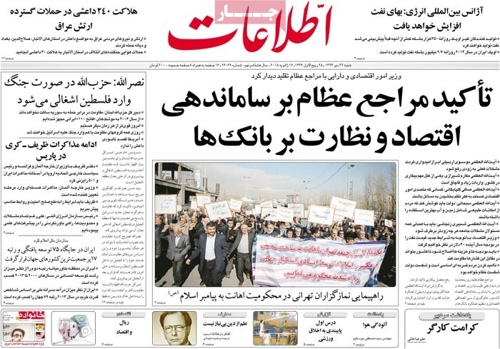
 

Ettelaat newspaper 1- 17


Haft-e Sobh: Two female students have died when ice covering a frozen lake in Ardebil caved in.
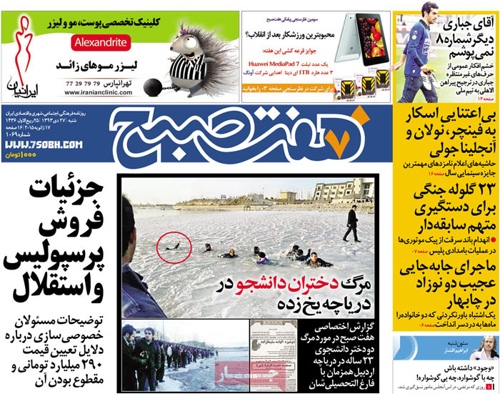
 

Hafte sobh newspaper 1- 17


Iran: Former President Mohammad Khatami and Chairman of the Expediency Council Akbar Hashemi Rafsanjani have sent messages to a gathering of reformists.
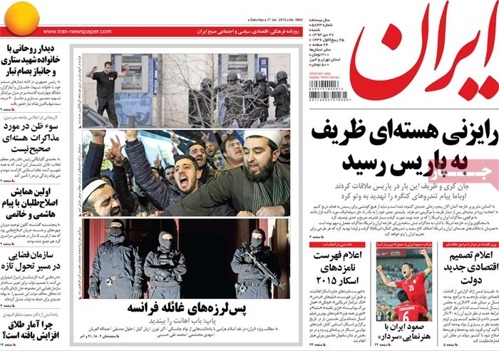
 

Iran newspaper 1- 17


Jomhouri Islami: Muslims in Iran and several other countries have staged rallies in condemnation of a French weekly’s publication of cartoons insulting the Prophet.

Jomhouri Islami: “Republicanism requires powerful parties and political institutions,” said Ayatollah Rafsanjani in a message to a reformist gathering.
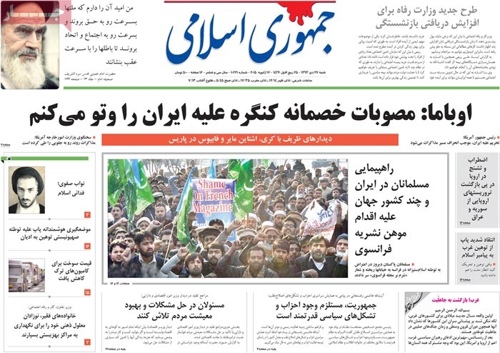
 

Jomhorie eslami newspaper 1- 17


Mardomsalari: “We want a parliament who fights for public demands without being afraid of consequences,” Mohammad Reza Aref, a former vice-president and reformist heavyweight, told a gathering of reformists.
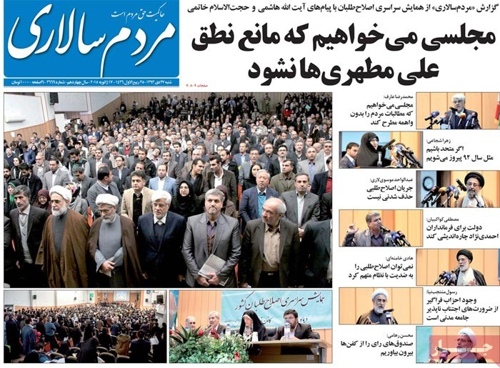
 

Mardom salari newspaper 1- 17


Mardom-e Emrooz: Iran and the US have started drafting the nuclear deal.

Mardom-e Emrooz: “The electoral strategy of reformists is to protect the rights of the people,” said Seyyed Hadi Khamenei [a senior reformist leader].
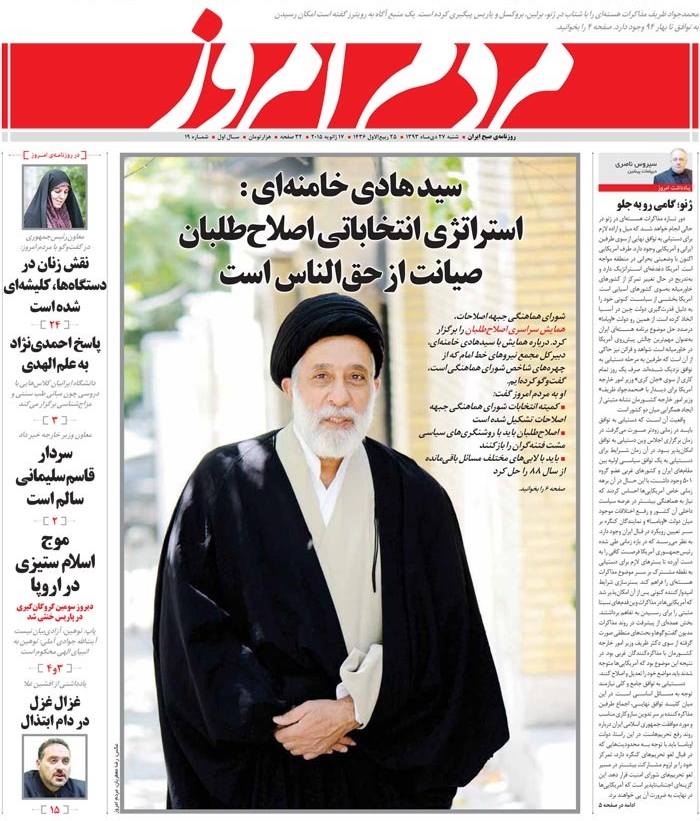
 

Mardome emruz newspaper 1- 17


Payam-e Zaman: “Tax rates won’t increase,” said the minister of economy and financial affairs.

Payam-e Zaman: An exhibition showcasing the country’s laser achievements has opened.
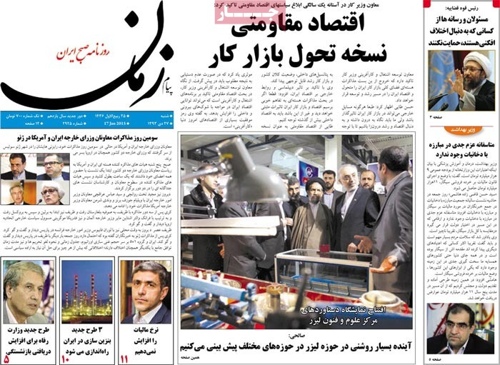
 

Payame zaman newspaper 1- 17


Resalat: “Hardliners should leave the reformist camp,” said Sadegh Kharrazi, a member of the newly-formed NEDA [Farsi initials for a Second Generation of Reformism] Party.
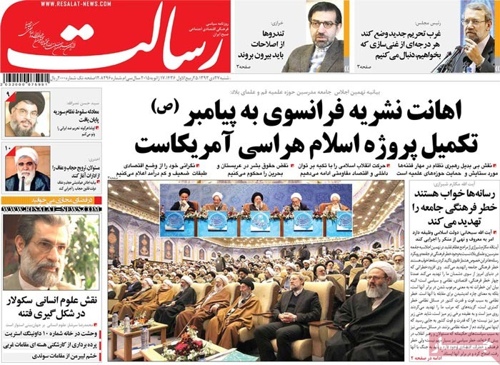

 

Resalat newspaper 1- 17


Iran to enforce preferential tariff with Kazakhstan, Eurasia

Iran-Kazakhstan

Head of the Trade Development Organization Valiollah Afkhami Rad in a meeting with Kazakh Ambassador to Tehran Amreyev Bagdad Kultayevich referred to the agreement of the Kazakh side to implementation of preferential tariff with Iran and said: “We are mutually seeking to provide the preliminaries for preferential tariff with Kazakhstan and Eurasian Union.”

He said the Eurasian Union has been informed of Kazakhstan’s agreement, adding that with examination of the roadmap for Iran-Kazakhstan cooperation and settlement of the existing problems, efforts are being made to enable Tehran and Astana to experience expanded trade activities more than before.

Emphasizing Iran’s determination to develop ties with the neighboring countries, Kazakhstan in particular, he said: “We want you to tell us about any problem in order to take the necessary measures to remove them.”

He referred to the visit of a Kazakh trade delegation to Iran in October and said soon an Iranian trade delegation will visit Astana, adding that Kazakhstan is a big country and neighbor of Iran and thus Iran is ready to set up an exhibition there.

Meanwhile, Ambassador Kultayevich underlined the importance of the agreements which have been reached between the two countries and said the follow-up of the agreements will remove problems sooner and Kazakhstan will not hesitate to render any assistance in this regard.

He called on the Iranian companies which have contracts with his country to take utmost advantage of investment opportunities in Kazakhstan as such privileges are not offered to every country.

In a recent visit of President Hassan Rouhani to Kazakhstan a memorandum of understanding for commercial, industrial, mining and investment roadmap was signed between the Iranian Ministry of Industries, Mines and Trade and the Kazakh Ministry of Development and Investment.

Nuclear talks tough but we remain hopeful

Abbas Araqchi

A senior Iranian negotiator described the latest round of nuclear talks between Iran and six world powers over Tehran peaceful nuclear program as tough but at the same time said he is hopeful about the outcome of the talks.

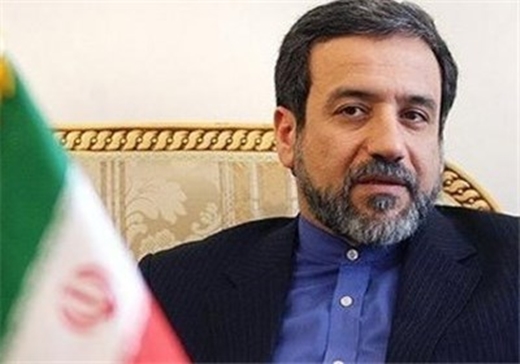
“In these negotiations we have always remained hopeful,” Iran’s Deputy Foreign Minister Seyyed Abbas Araghchi, who is also a top member of the team of nuclear negotiators, said on Friday after deputy-level bilateral talks between Iran and the US ended in the Swiss city of Geneva.

“We hope to bring the negotiations to a conclusion within the remaining time,” he stated.

Araghchi hailed as very important the seriousness dominating the atmosphere of the talks.

“Both we and the other negotiating parties are very serious (in talks),” he told IRIB.

The Iranian diplomat, however, said it is really difficult and tough to find a solution and strike a balance between both sides’ demands.

There are obstacles in the way (of reaching a deal) and there are differences of opinion on different issues, he reiterated.

Araghchi, along with Iranian Deputy Foreign Minister for American and European Affairs Majid Takht Ravanchi, met with US Undersecretary of State Wendy Sherman and Deputy Secretary of State William Burns earlier on Friday.

The latest round of negotiations on Iran’s civilian nuclear program kicked off on Wednesday with a meeting between Zarif and US Secretary of State John Kerry.

On Sunday, January 18, representatives from Iran and P 5+1 (France, Britain, the United States, Russia, China, and Germany) will have a plenary meeting in the Swiss city of Geneva.

Negotiations between Iran and the sextet aim to hammer out a final agreement to end more than a decade of impasse over Tehran’s peaceful nuclear program.

The two sides wrapped up their latest round of nuclear talks in the Swiss city on December 17, 2014, three weeks after they failed to reach a final agreement by a November 24 deadline despite making some progress.

They agreed to extend their discussions until July 1, 2015.

Major General Soleimani in good health in Iran: Diplomat

Ghasem Soleimani

“Major General Soleimani is in good health and the news [that he is wounded] is false,” Iranian Deputy Foreign Minister for Arab and African Affairs Hossein Amir-Abdollahian said on Thursday.

Some Western media reported earlier in the day that the Iranian commander has sustained serious wounds in an attack by the ISIL Takfiri militants in the Iraqi city of Samarra.

“He (Major General Soleimani) is in Iran,” Amir-Abdollahian added.

The Iranian diplomat further said, “The Islamic Republic of Iran will vigorously continue fighting terrorism and helping countries subject to the threat of terrorism.”

Iran has repeatedly stressed that it will not interfere militarily in Iraq and Syria, but the Islamic Republic continues to provide support to both countries against ISIL in the form of defense consultancy and humanitarian aid.

At the onset of the ISIL advances in Iraq, the Islamic Republic took rapid steps to mobilize popular forces in the country.

Tehran has also refused to join the so-called US-led coalition against ISIL in Iraq and Syria.

The Takfiri terrorists have been carrying out horrific acts of violence, including public decapitations and crucifixions, against all Syrian and Iraqi communities such as Shias, Sunnis, Kurds, Christians and Izadi Kurds.

Iran to expedite nuclear program if US fails to lift sanctions

Ali-Larijani

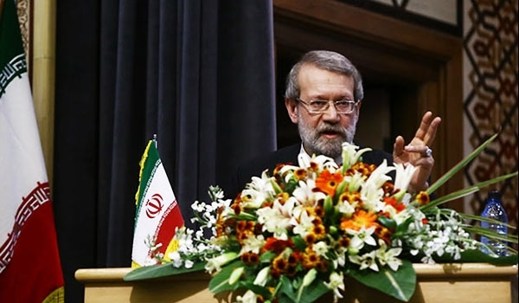
Iranian Parliament Speaker Ali Larijani underlined that Tehran would revive and speed up its nuclear activities, including its enrichment program, in case the US refrains from removing all sanctions against Iran under a final deal.

“A number of Iranian lawmakers are seeking to ratify a bill according to which if new Western sanctions are imposed on Iran, the country will resume nuclear enrichment at any level,” Larijani said, addressing a group of people in the city of Qom on Friday.

On Wednesday, Iranian Foreign Minister Mohammad Javad Zarif cautioned P5+1 (the US, Russia, China, Britain and France plus Germany) not to miss the present opportunity for cutting a final deal with Iran.

Speaking in a televised interview in Geneva, Zarif advised nuclear negotiators to use the opportunity for resolution of the deadlock over Iran’s nuclear program.

Upon arrival in Geneva, Zarif called on his Western counterparts in the nuclear talks to show courage and avoid drawing baseless redlines to make a landmark nuclear deal possible.

“Now we have come to a stage that requires the other side to take its decision in order to enable us to move forward,” Zarif said upon arrival in Geneva where he later met his US counterpart John Kerry on the latest developments in talks between Tehran and the G5+1.

“There need to be some new and comprehensive proposals, and we are ready to bring all issues to final results, but we should see the extent of the readiness of the other side,” he added.

Zarif asked the Western powers to take serious and brave decisions to help the negotiations move forward and produce results and avoid specifying improper redlines.

Iran, EU call for timely nuclear agreement

zarif-eu

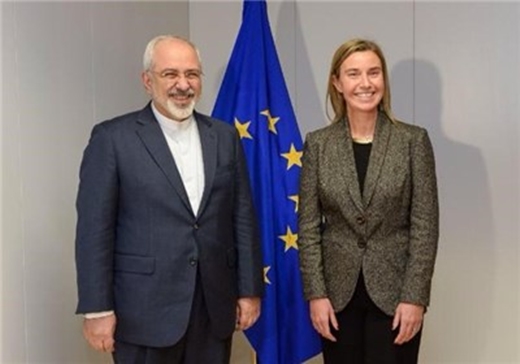
Iranian Foreign Minister Mohammad Javad Zarif and EU Foreign Policy Chief Federica Mogherini called for no delay in reaching a nuclear deal.

During a meeting in the Belgian capital of Brussels on Thursday, the two underlined that there should be no waste of time in reaching an agreement between Iran and world powers on Tehran’s peaceful nuclear program.

“We affirmed our strong commitment to a diplomatic solution which would fully address international concerns about the exclusively peaceful nature of the Iranian nuclear issue,” Mogherini said in a statement after the meeting.

“Negotiations have to be brought to a conclusion in line with the agreed time,” the statement, published on the European External Action Service (EEAS) website, further said.

Zarif and Mogherini also discussed a range of other issues including human rights, the common threat from the so-called Islamic State in Iraq and the Levant (ISIL) terrorist group, and crises in regional countries like Syria, Iraq, and Afghanistan.

The EU foreign policy official highlighted Iran’s role in the region and encouraged Tehran “to use its considerable influence to help create a more inclusive and stable Iraq, which is in the interests of both the EU and Iran.”

She also urged Iran to contribute to a political solution to the Syrian crisis by supporting United Nations Special Envoy for the Syria crisis Staffan de Mistura, according to the EEAS statement.

The latest round of negotiations on Iran’s civilian nuclear program kicked off on Wednesday with a meeting between Zairf and US Secretary of State John Kerry.

On Sunday, January 18, representatives from Iran and 5+1 (France, Britain, the United States, Russia, China, and Germany) will have a plenary meeting in the Swiss city of Geneva.

Negotiations between Iran and the sextet aim to hammer out a final agreement to end more than a decade of impasse over Tehran’s peaceful nuclear program.

The two sides wrapped up their latest round of nuclear talks in the Swiss city on December 17, 2014, three weeks after they failed to reach a final agreement by a November 24 deadline despite making some progress.

They agreed to extend their discussions until July 1, 2015.

Iran, French foreign ministers discuss key developments in Paris

Zarif-Fabius

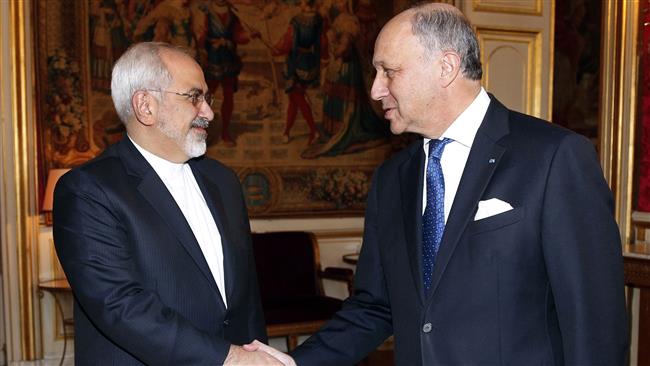
During their meeting in the French capital, Paris, on Friday, Zarif and Fabius stressed the importance of using the current opportunity to solve the nuclear issue.

They also discussed the latest developments in ties between Iran and the European Union and avenues toward the expansion of bilateral relations.

The two sides further urged international consensus for a fundamental, nondiscriminatory and all-out fight against terrorism and also urged an end to direct and indirect support by some countries for known terrorist groups.

The meeting between the Iranian and French ministers came after Zarif held nuclear talks with US Secretary of State John Kerry for the fourth time over the past three days.

On January 14, Zarif and Kerry held three rounds of intense negotiations in the Swiss city of Geneva to help speed up the ongoing negotiations between Iran and the P5+1 group – Russia, China, France, Britain, the US and Germany – over Tehran’s peaceful nuclear work.

Iran and the five permanent members of the UN Security Council plus Germany wrapped up their latest round of nuclear talks in Geneva on December 17, 2014.

The two sides agreed to extend their discussions for seven more months until July 1, 2015.

The scale of Iran’s uranium enrichment and the timetable for the lifting of anti-Iran sanctions are seen as major sticking points in the talks.

Zarif, Kerry to meet in Paris over Iran nuclear program

Zarif-Kerry

According to a US official, Kerry and Zarif will meet in Paris on Friday in to discuss the ongoing Iran-P5+1 nuclear talks.

On Wednesday, Zarif and Kerry held three rounds of intense negotiations in Geneva to help speed up the ongoing negotiations between Iran and the P5+1 group – Russia, China, France, Britain, the US and Germany – over Tehran’s peaceful nuclear work.

US State Department officials said Kerry and Zarif held “substantive” talks in the Swiss city.

The Iranian foreign minister is also scheduled to travel to the EU’s de facto capital, Brussels, as he steps up his diplomatic efforts to facilitate the achievement of a comprehensive deal aimed at ending the longstanding dispute over Tehran’s nuclear activities.

The meetings come as Tehran and its negotiating partners are set to kick off a fresh round of nuclear talks in Geneva on January 18.

Iran and the six states wrapped up their latest round of nuclear talks in Geneva on December 17, 2014, three weeks after they failed to reach a final agreement by a November 24 deadline despite making some progress.

The two sides agreed to extend their discussions for seven more months until July 1, 2015.

The scale of Iran’s uranium enrichment and the timetable for the lifting of anti-Iran sanctions are seen as major sticking points in the talks.

Iran defeat Qatar 1-0 to secure a place in Asian Cup quarter-finals

Iran gatar football

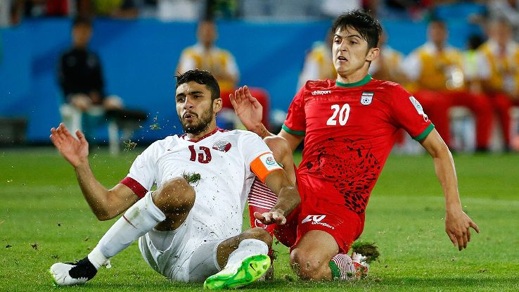
The red-clad Iran beat Qatar 1-0 in Sydney on Thursday (January 15) to reach the AFC Asian Cup quarter-finals.

A solitary goal eight minutes into the second half was enough to send Iran and the United Arab Emirates through to the second phase with one game left to play in the group stage.

Iran’s win prevented the Qatar side from staying in the tournament. Qatar have only reached the quarter-finals twice in eight Asian Cup appearances.

In another match of the day, the UAE beat Bahrain 2-1, cementing their place at the top of Group C.

On Sunday, the three-time AFC Asian Cup winners Iran defeated Bahrain 2-0 in their Asian Cup opener in Melbourne while Qatar’s campaign was rocked by a 4-1 loss to the UAE.

The Iranian squad will line up against the UAE on Monday (January 19) and Qatar will take on Bahrain on the same day.

Iran are now second in the group standing.

In a press conference one day before the match, Iran’s national soccer team coach Carlos Queiroz said the match against Qatar would be a big challenge for Iran.

Prior to Thursday’s match, words spread that the Iranian team were not allowed to sport their white jerseys which bear an image of the Asiatic cheetah with some news agencies reporting that their jerseys have been stolen in Sydney.