Wednesday, December 31, 2025
Home Blog Page 4861

Iran considers Iraq’s security its own: Interior minister

Rahmani-Iraq

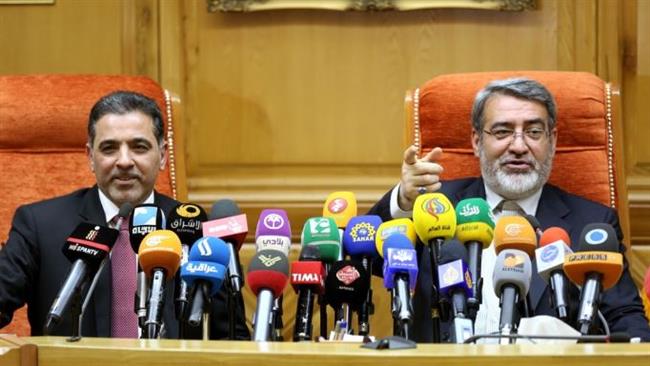
Abdolreza Rahmani Fazli made the remarks at a joint press conference with Iraqi Interior Minister Mohammed Salem al-Ghabban following their meeting in Tehran on Saturday.

Supporting the Iraqi nation and government is among “our religious, neighborly and national obligations,” Rahmani Fazli said.

The Iranian interior minister said that during his meeting with Ghabban, both sides discussed the issues of mutual interests, including security cooperation.

Rahmani Fazli further expressed the Islamic Republic’s full preparedness to share security, military and training expertise with Iraq.

Ghabban, for his part, commended the Islamic Republic’s support for Iraq in its anti-terror fight, saying Iraq is willing to use Iran’s experience in different domains in line with the mutual interests of the two countries.

Iran has repeatedly stressed that it will not interfere militarily in Iraq and Syria, but the Islamic Republic continues to provide support to both countries against the ISIL Takfiri terrorists in the form of defense consultancy and humanitarian aid.

At the onset of the ISIL advances in Iraq, the Islamic Republic took rapid steps toward mobilizing popular forces in the country.

Tehran has also refused to join the so-called US-led coalition against ISIL in Iraq and Syria.

Social Learning Theory to vie for honors at Lanzarote Film Festival

film festival

social learning filmSocial Learning Theory directed by Pouria Heidari has found its way to the International short fiction film section of the 15th edition of Lanzarote Film Festival in Spain.

Social Learning Theory will compete against 24 other titles from other countries such as the US, France, UK, Canada, Venezuela and Tunisia.

Social Learning Theory is a short film which takes a look at the negative and traumatic effects that watching public executions could possibly have on children.

This film was made after three kids lost their lives when trying to recreate what they had seen during public executions in their childish game.

Heidari’s short film enjoys its seventh feature in international film festivals. Previously, it had been screened in Kansas City Film Festival in April, 2014 and nominated for the Best Short Film award.

It will be also screened at the International Children’s Film Festival Bangladesh.

The 2015 Lanzarote Film Festival will take place in Spain from March 16-28.

The section on animated short films of the festival will also feature an Iranian production, Volition by Shakiba Shabani.

Nuclear deal, a first step toward settlement of other problems

Alan Eyre

The ongoing nuclear talks between Tehran and P5+1and whether or not a final comprehensive deal is clinched by the July 2015 deadline are an issue of paramount importance in Iran. The Iranian media usually resort to different sources to expand on the prospects of the talks.

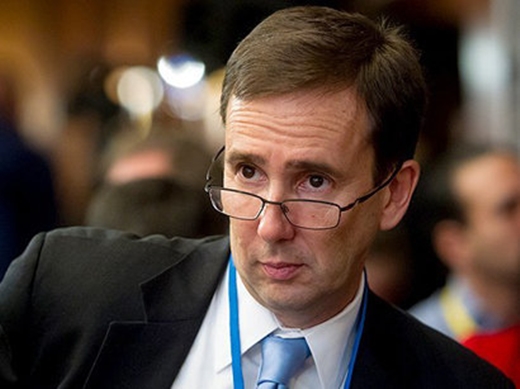
On January 17, Arman-e Emrooz, a reformist daily, published a brief interview with Alan Eyre, a Persian-speaking US State Department diplomat, who speaks on the record for the American administration. Here is the translation of the interview on Iran’s nuclear program and where the White House stands on the talks:


Why did Geneva talks fail to produce results?

It’s too early to pass final judgment on it. It’s no secret that conclusion of a comprehensive deal at the talks is a tough job. If it had been easy, a settlement would have been reached already. God willing, we can reach an agreement through goodwill and perseverance. Our top diplomats and negotiating teams are expected to meet to see how they can take steps toward this goal.

Some blame Saudi Arabia for preventing the conclusion of an agreement. What’s your take on that?

I think it is not true. The fact of the matter is that the entire international community, Saudi Arabia included, wants to see these talks result in a comprehensive agreement to ease concerns about the nature of Iran’s nuclear program.

How much has the US attitude toward Iran changed ever since the eleventh government came to power?

The Obama administration has always said that it seeks to solve Iran’s nuclear issue peacefully through diplomatic means. So the decision – soon after His Excellency Dr. Hojjatoleslam Rouhani took office as president – to pick up nuclear talks in earnest was promising. Apart from the nuclear question, we have other problems with Iran. If we manage to settle the nuclear issue through negotiations, this big step may lead to other steps to remove those problems.

How do you describe the talks held recently?

This round of talks was held in a good atmosphere. The two sides are expected to take part in the talks with goodwill.

What do you think about the results of the talks?

The results are not predictable at all. As always, the talks are being held in an atmosphere filled with earnestness, goodwill and mutual respect. Over the past year, we have made a lot of progress in the talks. We should not overlook such progress or underestimate it.

Clinching a final deal acceptable to both sides is certainly achievable. We try every possibility to arrive at an agreement. We have to wait and see if our efforts are enough. God willing, efforts by all parties [involved in the talks] will be enough so that the conclusiveness [of the talks] could both remove the grave and legitimate concerns of the international community about Iran’s nuclear program and lift the nuclear sanctions imposed on Iran’s economy.

How did the meeting between Messrs. Kerry and Zarif and their 15-minute walk affect the nuclear talks?

Recently the US secretary of state and Iran’s foreign minister met in Geneva and took a walk for a few minutes. Prior to the meeting, US Secretary of State John Kerry had said that the meeting in Geneva would be aimed at setting the stage for the talks on Iran’s nuclear program and helping secure more progress in the talks.

The US secretary of state believed all plans had to be assessed. Mr. Kerry stressed that the plans of the negotiating teams should be specified so that the settlement of these questions could pave the way for the conclusion of a final agreement.

Do you have any interest in traveling to Iran?

Definitely! I have liked Iran for years. I wish to travel to Iran one day so that I can see its beauties for myself. If that ever happens, I will improve my Farsi and can speak much better than this, God willing!

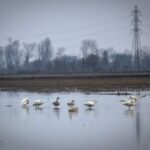
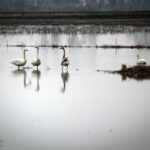
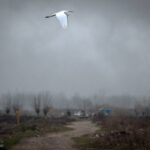
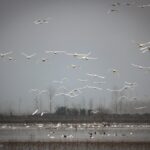
Swans in flight over Sorkhrud Lagoon in Iran (Photos)

Iran-Swan 5

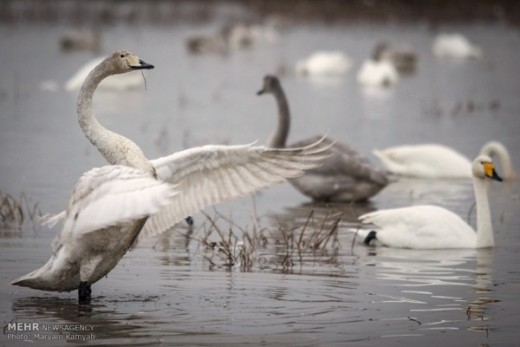
A group of migratory swans have come to the Sorkhrud Lagoon to spend the cold season there. The Sorkhrud Lagoon is 16 kilometers east of Mahmudabad in the northern Iranian province of Mazandaran. A wedge of swans in the sky is what every bird watcher really likes to see.

The following are the pictures Mehr News Agency put on its website on January 10 of the beautiful birds:


A look at Iranian newspaper front pages on Jan. 18

Iranian Newspapers Headlines

The comments of First Vice-President Eshagh Jahangiri on the corruption case involving Babak Zanjani dominated the front pages of Iranian newspapers on Sunday. Reformist dailies covered a letter former President Mohammad Khatami has sent to the UN Secretary General in condemnation of violence and extremism. And news of continued protests across the Muslim world against French satirical magazine Charlie Hebdo appeared on the cover of dailies too.


Abrar: A judiciary order has enjoined Mardom-e Emrooz, a reformist daily, from publishing.
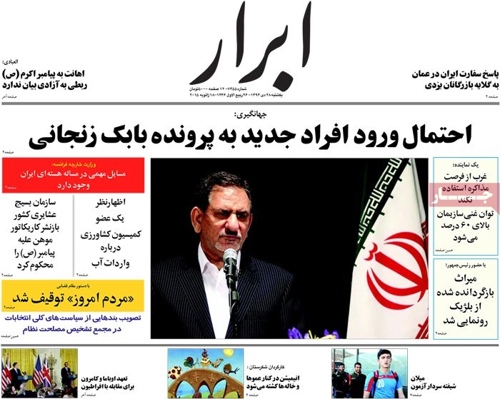
 

Abrar newspaper 1- 18


Afkar: China is the destination of 52 percent of Iran’s export items.
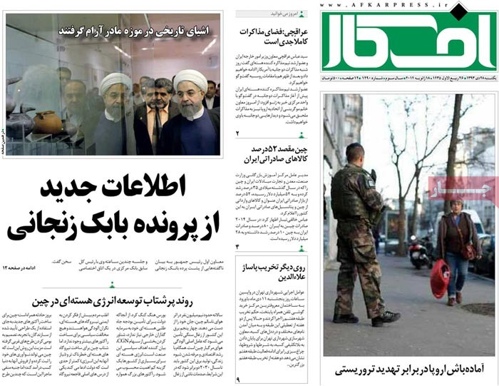
 

Afkar newspaper 1- 18


Aftab-e Yazd: “A nuclear deal is likely to be clinched,” said the head of parliament’s Research Center.
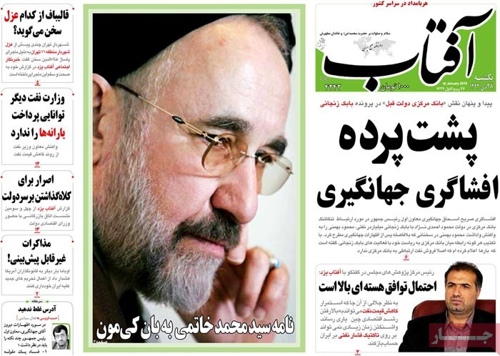
 

Aftabe yazd newspaper 1- 18


Arman-e Emrooz: The Expediency Council has underlined transparency in electoral campaign finances.

Arman-e Emrooz: Each year as many as 155,000 divorces are registered across the country.
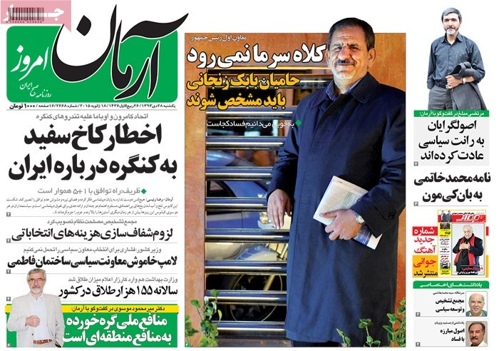
 

Armane emruz newspaper 1- 18


Asrar: “Saudi Arabia is trying to hamper Iran’s progress,” said the chairman of parliament’s National Security and Foreign Policy Committee.

Asrar:“Each year, as much as $20 billion in taxes is evaded,” said an MP who has a seat on parliament’s Budget and Planning Committee.
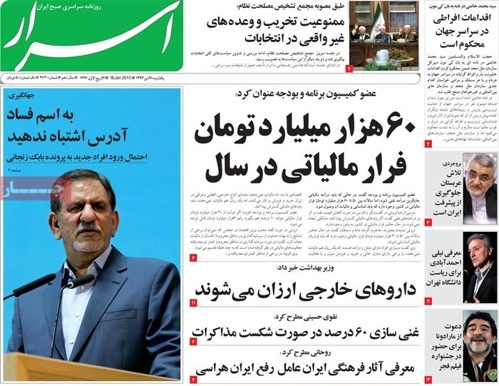
 

Asrar newspaper 1- 18


Ebtekar: “Acts of terror which are carried out in the name of Muslims should be stopped,” said Chairman of the Expediency Council Akbar Hashemi Rafsanjani.
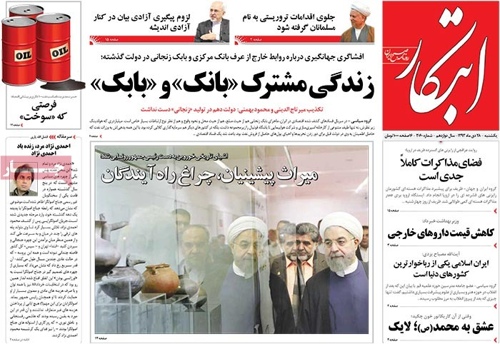
 

Ebtekar newspaper 1- 18


Emtiaz: “Line, Tango and WhatsApp are not going to be blocked for the time being,” said the minister of culture and Islamic guidance.

Emtiaz: “We do not have money to pay out cash subsidies,” said a deputy oil minister.
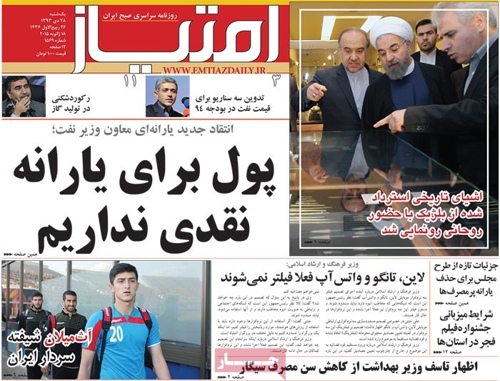
 

Emtiaz newspaper 1- 18


Etemad: Mahmoud Nili Ahmadabadi [who was rejected by parliament when he was proposed by President Rouhani for the post of science minister] is the choice of the science minister to take charge of Tehran University. He has to secure a nod from the Supreme Cultural Revolution Council first.

Etemad: “Some ministers of Ahmadinejad’s Cabinet would meet with Babak Zanjani [who stands accused of corruption]. Zanjani also had meetings with the former Governor of the Central Bank of Iran Mahmoud Bahmani,” said the first vice-president. In response, Bahmani denied any contact with Zanjani.
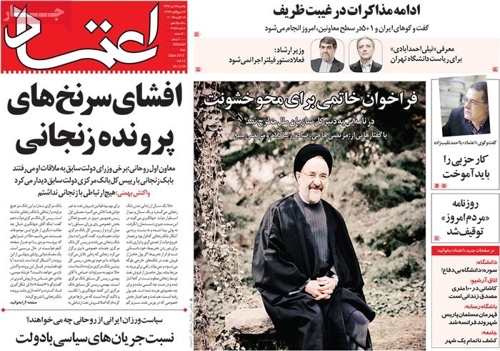
 

Etemad newspaper 1- 18


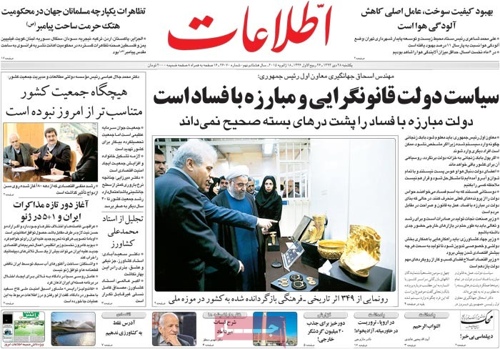
Ettela’at: An improvement in the quality of gasoline is the main reason behind a decline in air pollution.

Ettela’at: “The policy of the government is to adhere to the law and clamp down on corruption,” said the First Vice-President Eshagh Jahangiri.
 

Ettelaat newspaper 1- 18


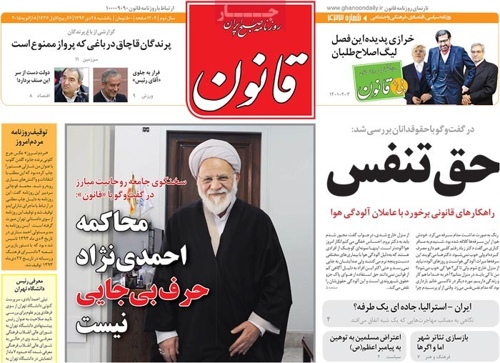
Ghanoon: “Calling for former President Mahmoud Ahmadinejad to be brought before court is not inappropriate,” said the spokesman of the Combatant Clergy Association.
 

Ghanoon newspaper 1- 18


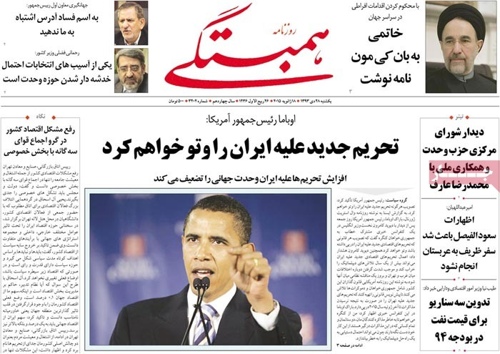
Hambastegi: Former President Mohammad Khatami in a letter to the UN secretary general has decried extremist acts throughout the world.
 

Hambastegi newspaper 1- 18


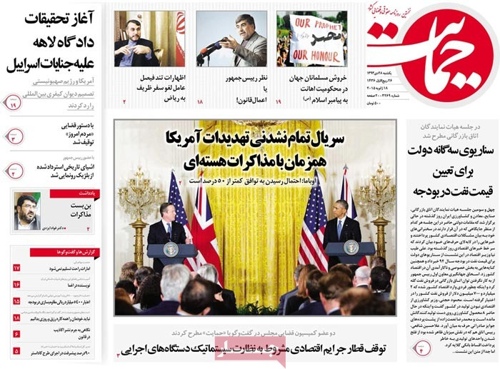
Hemayat: Muslims across the world have taken to streets to condemn insults at the prophet of Islam.

Hemayat: “Strongly-worded remarks by Saudi Foreign Minister Saud al-Faisal prompted a visit by Iran’s Foreign Minister Mohammad Javad Zarif to Riyadh to be called off,” said Deputy Foreign Minister for Arab and African Affairs Hossein Amir Abdollahian.
 

Hemayat newspaper 1- 18


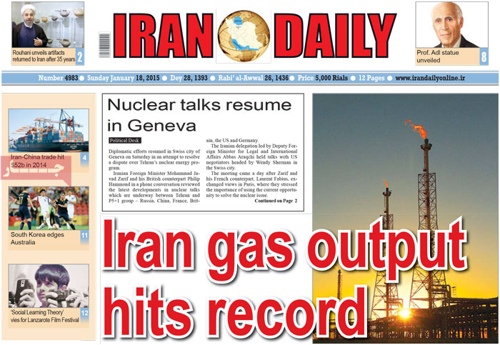
Iran Daily: Iran gas output hits record.
 

Iran daily newspaper 1- 18


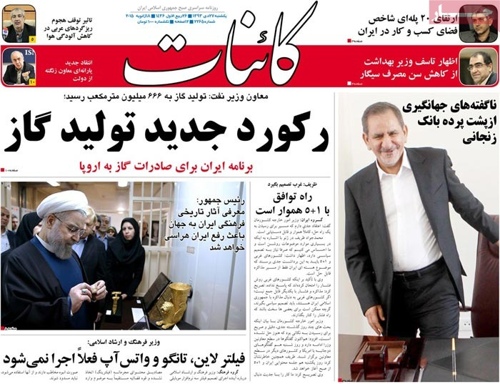
Kaenat: “If the West makes a decision, the stage is set for conclusion of a deal with P5+1,”said Iran’s foreign minister.
 

Kaenaat newspaper 1- 18


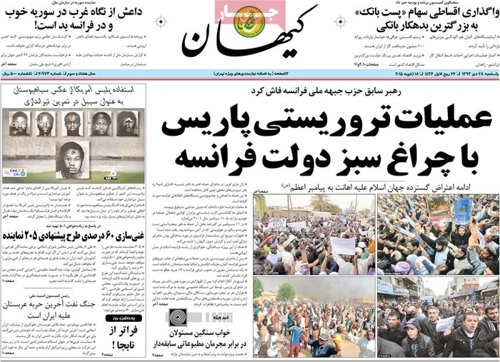
Kayhan which placed the logo of the “I love Muhammad” campaign above its masthead reported that widespread protests across the world of Islam against insults to the Prophet are continuing.
Kayhan newspaper 1- 18


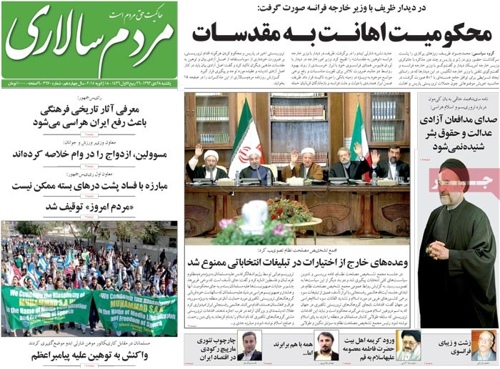
Mardomsalari: In a meeting between Iran’s foreign minister and his French counterpart disrespect for sanctities was denounced.
 

Mardom salari newspaper 1- 18


Payam-e Zaman: “The executive directives of the election law will be reviewed,” said the interior minister.
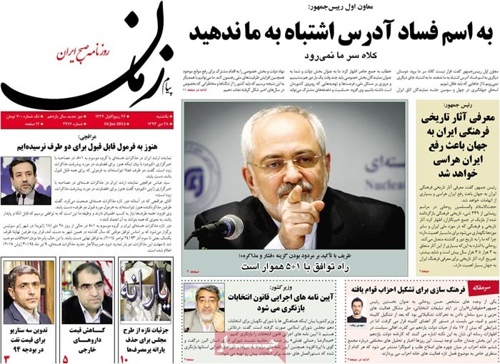
 

Payame zaman newspaper 1- 18


Resalat: “Our diplomacy does not serve the cause of growth and development,” said the head of the Chamber of Commerce, Industries, Mines and Agriculture (ICCIMA).
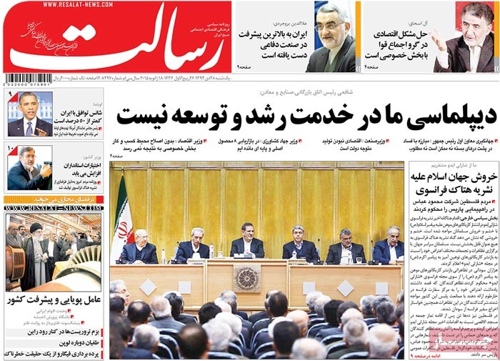
 

Resalat newspaper 1- 18


Tehran Times: Iran foresees three oil scenarios in budget.
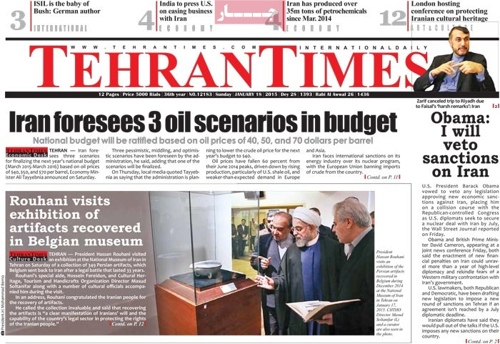
 

Tehran times newspaper 1- 18


German no-frills airline to launch direct flights to Iran

German flight

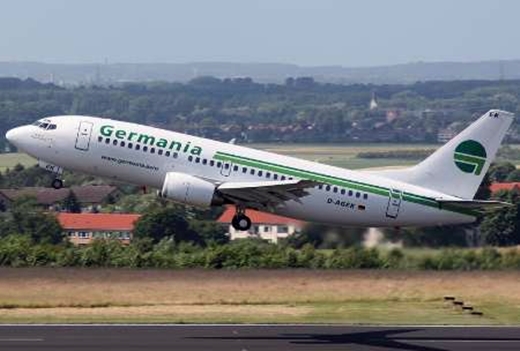
German budget airline Germania will offer direct flights to Tehran and Mashhad starting next month, Germania CEO Karsten Balke told IRNA in an exclusive interview.

“We will have twice-a-week direct flights from Berlin and Dusseldorf to Tehran, in addition to a once-a-week direct flight from Hamburg to Mashhad,” said Balke.

The flights from Dusseldorf to Tehran will begin on February 20, the flights from Berlin to Tehran on February 22 and the Hamburg-Mashhad flights on February 25, he added.

The current one-way airfare will be 220 euros from Berlin’s Schoenefeld Airport, 230 euros from Dusseldorf airport and 250 euros from Hamburg’s airport, according to Balke whose company will deploy the Airbus 319 and the Boeing 737-700 on the route from Germany to Iran.

The return-leg of the flights between Iran and Germany are in a similar price range, airline officials said.

Balke said the easing of the anti-Iran sanctions and the general change in the political atmosphere in Iran were a partial factor in the airline’s decision to launch flights to Iran.

He said the booming Iranian market had tremendous potential given its young population which simply could not be ignored.

Balke said his company was not only eying Iranian expats and German tourists as its potential passengers but also business people, pointing out that many businessmen may especially take advantage of the direct flights between Hamburg and Mashhad.

Germania is also offering flights to other destinations in the Middle East, including the Lebanese capital Beirut.

Iran: Nuclear deal only possible without pressure

Javad Zarif

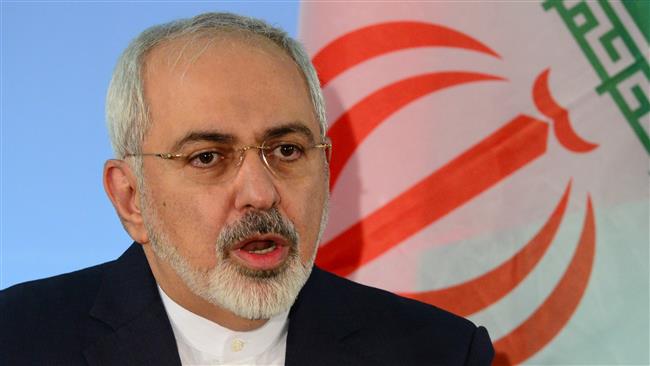
“The policies of pressure and dialog are mutually exclusive,” Iran’s Foreign Minister Mohammad Javad Zarif told the Iranian television on Saturday.

“If Western countries intend to negotiate with Iran, they should make a political decision, which might be difficult for some, and cease applying pressure,” he added.

Also on Saturday, a senior Iranian nuclear negotiator said Iran and six world powers can reach a deal on the Islamic Republic’s nuclear program if the other side shows real determination for an accord.

“We still hope and think that reaching an agreement is possible if the other side has the necessary determination and goodwill,” said Iran’s Deputy Foreign Minister for Legal and International Affairs Seyyed Abbas Araghchi.

A fresh round of talks between Iran and P5+1 – the US, the UK, Russia, China, France and Germany – started in the Swiss city of Geneva early Saturday.

The meeting comes as Zarif has been engaged in four rounds of talks with US secretary of State John Kerry over the past three days.

Zarif also held talks with German and French foreign ministers, during which he urged his European counterparts to play a more active role in the final phases of the negotiations on Iran’s nuclear deal.

In November 2013, Iran and P5+1 clinched an interim nuclear accord that took effect on January 20 and expired six months later. However, they agreed to extend their talks until November 24, 2014 as they remained divided on a number of key issues.

Tehran and the six countries failed to reach a final agreement by the 2014 deadline despite making some progress.

The two sides agreed to extend their discussions for seven more months until July 1, 2015. They also agreed that the interim deal should remain in place during the negotiations.

Iran FM cancelled Saudi visit over Faisal’s Syria remarks: Diplomat

Faysal

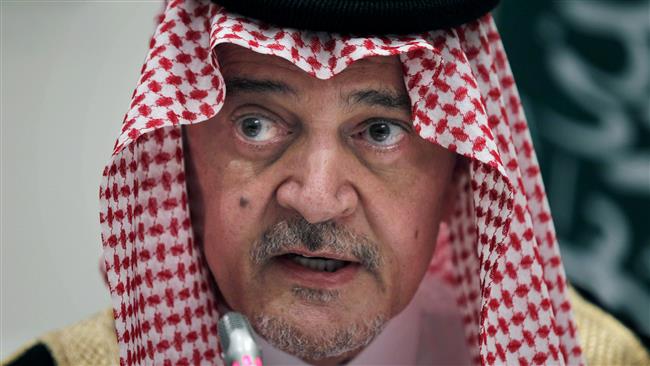
“We were making preparations for Zarif’s visit to Saudi Arabia and a schedule had been set for his trip, but unfortunately, sharp and unexpected remarks of Saudi foreign minister [Saud al-Faisal] prevented this visit,” Iran’s Deputy Foreign Minister for Arab and African Affairs Hossein Amir-Abdollahian said.

Amir-Abdollahian was alluding to last October’s remarks by Faisal who allegedly described Iran as “part of the problem, not the solution” in Syria. At that time, Tehran responded by saying that no other country in the Middle East region has been more committed than Iran to the fight against terrorism.

“Over the past couple of months, we witnessed some progress in our diplomatic talks with Saudi Arabia, but Saudi Arabia behaved in a way that was not favorable to the Islamic Republic of Iran and such behaviors stir concerns in the region,” Amir-Abdollahian added.

The Iranian diplomat advised Saudi officials to revise their current policies so that they would help “solidarity and unity” in the region.

Iran and Saudi Arabia are divided on a number of regional issues such as the situation in Syria and Bahrain.

Tehran has always been critical of Riyadh’s support for the heavy-handed crackdown of the Bahraini regime on peaceful protesters.

Riyadh also supports militants fighting the Syrian government, while Iran stresses the importance of resolving the crisis in Syria through political approaches.

Iran’s new aircraft successfully passes wind tunnel test

Borhan

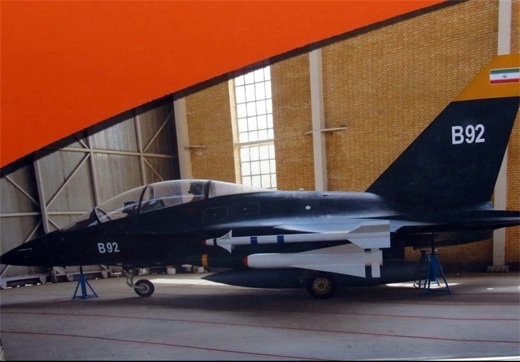
Iranian experts have successfully tested a new domestically-made fighter aircraft, named ‘Borhan’, in the country’s national wind tunnel facility.

The Borhan fighter, which is also known as B92, has been completely manufactured by the Iranian military experts and has successfully passed wind tunnel tests.

Currently, 70 percent of the detail design of the fighter, which is an updated and optimized version of the Shafaq fighter, has been completed and its mock-up has been also manufactured.

Some changes have been made in the design of the aircraft to boost its capabilities, compared to the Shafaq fighter, including its vertical tail as well as the airfoil of its wings.

The Iranian military experts and technicians have in recent years made great headways in manufacturing a broad range of indigenous equipment, making the armed forces self-sufficient in the arms sphere.

Tehran has always assured other nations that its military might poses no threat to regional countries, saying that the Islamic Republic’s defense doctrine is entirely based on deterrence.

Critics say reformist meeting failed to discuss issues of national importance

Reformists confrance

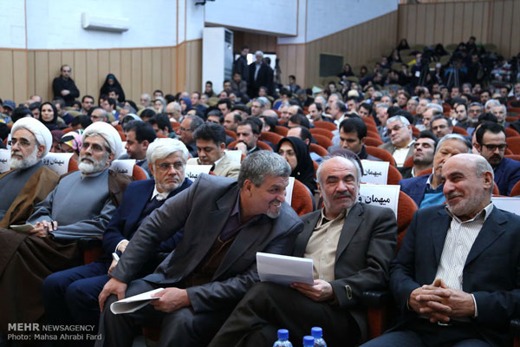
Reformists got together in Tehran on Thursday (January 15) for a meeting delayed for almost two years and focused on general questions such as the Constitution and the upcoming parliamentary elections.

Mehdi Fazaeli, a political expert, says one drawback to the meeting of reformists was that they failed to pay careful attention to issues of public concern.

Fazaeli was quoted by Fars News Agency (FNA) as saying that the meeting failed to take heed of the country’s key issues which center around national and public interests as well as people’s lives. What comes below is the partial translation of his remarks followed by the comments of a member of the Assembly of Experts:


Mehdi Fazaeli
Mehdi Fazaeli

Mehdi Fazaeli, a political expert

What the speakers raised in the meeting [of reformists] was repetitive and offered nothing new or serious. Their speeches focused exclusively on political issues such as the Approbatory Supervision, parliament and an end to the house arrest [of Karroubi and Mousavi]. These issues are repeated by the reformists from time to time.

The reformists refused to talk about the country’s key questions which cover people’s livelihood, national interests, culture and international economy. This is a downside of a meeting which intended to bring together different faces and generations of reformists and discuss serious issues.

The fact that reformist big shots were no-shows in the gathering was yet another drawback. Earlier reports had said that Messrs. Hashemi [Rafsanjani], Khatami, Nategh Nouri and Jahangiri as well as Ms. Ebtekar were to attend the meeting, but they all failed to show up.

Their absence can be critically analyzed. It shows that these big names do not take the reformists camp seriously.


Ayatallah Mamdoohi
Ayatollah Hassan Mamdouh

Ayatollah Hassan Mamdouh, an Assembly of Experts member

[…]

Government officials did not attend the meeting of reformists although they had been invited over. Actually they saved face by not showing up in such a meeting.