Wednesday, January 14, 2026
Home Blog Page 4852

When diplomacy serves the cause of development (PART ONE)

Donyaye Eghtesad daily-06-20

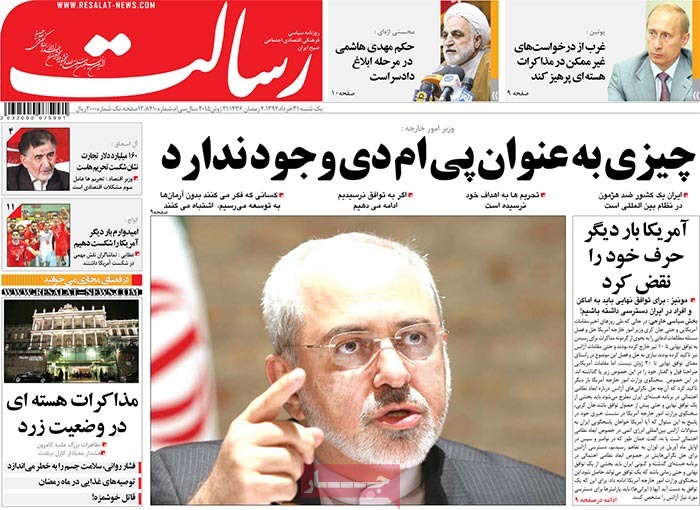
Iran’s foreign minister says nuclear talks are very much likely to continue past the end-of-June deadline. Mohammad Javad Zarif made the comment in an interview with Donyay-e Eghtesad’s Ehsan Abtahi and Hadi Khosro-Shahin on June 18.

In the interview the top diplomat said an ideals-based foreign policy does not run counter to a foreign policy of which national interests are the cornerstone. He added what makes a country successful on the international stage is its ability to render their ideals into international norms.

“Diplomacy is the art of advancing a country’s interests at the lowest cost. Foreign policy should serve the cause of development, rather than being a burden on a country’s development drive,” he said. The following is PART ONE of the translation of the interview:


The president said in a first conference on Iran’s economy that the economy has provided the politics with subsidies to date and today we should do something to direct the subsidies from politics to economy. You said in your confirmation hearing in parliament that foreign policy should be in line with [the country’s] economic interests. Given that you are the very first extremely professional person to have taken over the Foreign Ministry, how much do you think the eleventh government’s foreign policy can serve such a purpose and how much it can be effective when it comes to politics helping the economy? Concerning the talks, how much is it likely for Iran to lead a foreign policy that contributes to its economy?    

An important thing that should be taken into account is that basically there is no one-dimensional issue in human relations. Everything stems from a series of actions and reactions which should all be taken into consideration from a broad perspective. That’s why I do not believe that politics should be either Eastern-leaning or Western-leaning. I think this comes from misunderstanding the politics.

To answer that question, one needs to define diplomacy first. Diplomacy is the advancement of interests on as little cost as possible. It is not an art to spend too much. In other words, spending a lot and reaping benefits would not be remarkable.

The Supreme Leader said in a gathering of [Iran’s] ambassadors and chargé d’ affaires last year, “There may be very powerful governments which push their agenda through diplomacy, not through military means” because the tools of diplomacy are less costly with less pressure exerted on people.

Given these two points, we come to the conclusion that foreign policy should serve a country’s development and should not be a burden on the shoulders of [that] country’s development. The foreign policy machine should try to pursue the same objectives and ideals so that the stage can be set for development and nothing stands in the way of development. There may be some who say the revolution’s objectives should be put aside simply because of economic development.

But if that happens, I think we cannot be an identity to set our goals and then try to achieve them. If that happens, we will turn into a good-for-nothing and ineffective entity on the world stage and will lose our levers of power.

Those who think we can have economic development by ignoring the ideals are in the wrong. But the pursuit of those ideals – in a way that is less costly and provides us with the more power to wield more influence and have a stronger presence [in the international community] – translates into a comprehensive foreign policy which is at the service of development as it helps us not to forget our objectives and ideals.


Iran is viewed as an anti-hegemonic country in international relations. That Iran is an anti-hegemonic player imposes huge costs on the country. Over the past decades, especially during the eight years of Mr. Ahmadinejad’s presidency, Iran’s anti-hegemonic stature was highlighted. China once decided to include economy as a strategic – no tactical – topic in its foreign policy. The question that arises here is: when is economy supposed to be included in Iran’s foreign policy as a strategic issue?   

During the revolution era, we were always an anti-hegemonic player, but it is not good reason for the country’s economy to sustain costs. You are a player in an equation in the international community, I mean in an atmosphere which you have to turn into a balanced situation. If you go and put all your eggs in one basket – like what [Boris] Yeltsin did in the Russian Federation – you will gain nothing.

You will lead nowhere if you lose your identity or turn into a player that is in full compliance with the existing system and order. China, too, is following a detailed planning and it has not discarded its stance, objectives and ideals.

Unfortunately, the Islamic Republic left behind eight years during which the declared, not real policies were carried out in a way that threw obstacles in the way of development and caused the country to pay a price.

This should not make us think that by living up to the ideals, or maintaining ideal priorities and revolutionary tendencies, we cannot secure development. I think we can reach development. Standing on our own two feet is the only way which can help us reach sustainable and reliable development, a sort of development which does not make us collapse from the peak of power to the precipice of debasement once we encounter a small change in the world. Of course, to stand on our own two feet does not mean we should sever ties with the rest of the world; however, it means we should establish ties with the world based on our own identity.

The Supreme Leader has repeatedly said that a country which seeks to stand on its own two feet in the international system should pay a dear price. I believe you can stay longer on the world stage if you stand on your own two feet and stick to your principles and values.

It is also the case when it comes to a resistance-based economy. Such an economy will help the country sustain slighter loss at an international level. We should not use the eight years of the previous government – during which we witnessed several developments unfolding [in the country] – as a model. I do not want to paint a black picture of the time in which I had no role to play and was the target of the government’s compassion [a sarcastic reference to Ahmadinejad’s administration which described itself as a compassionate administration but sidelined everyone who was a bit critical of its policies].


Back to the eight-year presidency of Ahmadinejad; ever since the Islamic Revolution thanks to our country’s anti-hegemonic stance, rejection of some international norms has been one of the hallmarks of our foreign policy. Are the nuclear talks expected to produce a change in our foreign policy? Will economy replace opposition to hegemony as the number-one priority of our foreign policy?

Efforts to set priorities in a way that pits national interests and ideals against each other have their roots in an erroneous foundation. Such misconception is based on the mindset of former US Secretary of State Henry Kissinger who has said Tehran can be a reliable player only if it chooses between an idealist Iran and a nationalist Iran.

In light of the fact that I was personally involved in a debate with Kissinger on this, one of his students posed the very same question to me. I give you the same answer I gave him. ‘Whenever the US can draw a distinction between an idealist US and a nationalist US, it can expect others to do the same thing.’

In the absence of ideals, no country can have a powerful presence on the international stage. At best, they can have a say in issues which are not very important. Such countries cannot be major regional and international players.

As far as the nuclear question is concerned, if our presence is in line with our national interests and ideals in a way that deprives ill-wishers of the opportunity to paint a picture of the revolution that poses a security threat, we will be able to stick to our identity and serve our economic interests at the same time.

Willingness to let go of our identity might help us secure some short-term economic interests. But these interests will be anything but sustainable and won’t help us create a special position for the country to advance in the long run.

Some build on certain Cold War frameworks to suggest that economic development takes precedent over political development; others suggest that economy is more important than idealism in foreign policy. The developments of the Cold War all came against a different historical and theoretical backdrop that cannot be generalized.

In other words, we need to take a serious look at international relations, economy, as well as national and regional status to be able to be a serious actor whose foreign policy serves the cause of development.

Iran will continue to support those who support Palestine the world over

Brigadier General Ramezan Sharif

The head of the Intifada and Holy Quds Central Office in Iran has said that Muslims should relay the following message to the world on Quds Day rallies: the Zionist regime and Zionism are the number-one enemies of the world of Islam.

Brigadier General Ramezan Sharif made the remark in a meeting of Quds Day rally organizers and added that arrogant powers, led by the United States, are pushing hard to wage proxy wars in order to divert the attention of the world, especially the Muslims, from the number-one issue of the Islamic world which is Intifada and the Holy Quds.

The following is the translation of what else the Islamic Students’ News Agency (ISNA) quoted Sharif as saying on June 18:

The Islamic resistance and Islamic Awakening have better conditions and a brighter prospect today, seeking the support of all free-spirited Muslim nations and governments despite efforts by the Zionist regime which has the financial, military and diplomatic support of the US and its regional allies, he said.

Sharif further said that the enemies have totally failed in their attempts against the [Palestinian] resistance and the Islamic Awakening over the past several years, adding the wars the Saudis have recently waged [in the region] are further proof of that.

Grappling with domestic problems after the death of King Abdullah, Saudi Arabia has been also hit by a power struggle within the ruling family, he said.

Thanks to designation by the late Imam Khomeini of the last Friday of the fasting month of Ramadan as International Quds Day, the regional and international spotlight has been turned on the Islamic resistance with a focus on liberating the Holy Quds from the occupation of the usurping Zionist regime, Sharif said.

He went on to say that the late Imam and the Supreme Leader have always pursued the question of Palestine and liberation of the Holy Quds as a basic strategy which unites the world of Islam, adding supporting the ideal of the Holy Quds has been and will be an inseparable part of the Islamic Republic of Iran’s foreign policy.

Sharif also said that we will back the supporters and defenders of Palestine and its ideal no matter where they are and will stand up to Zionism and its allies across the globe.

He further said Iran will support all those who support the Palestinian cause. “If they give up their support or back out on any ground, Iran will act in line with the Supreme Leader’s remarks and carry out its religious and legal responsibility which is support for the oppressed and defiance of the oppressors and occupiers”.

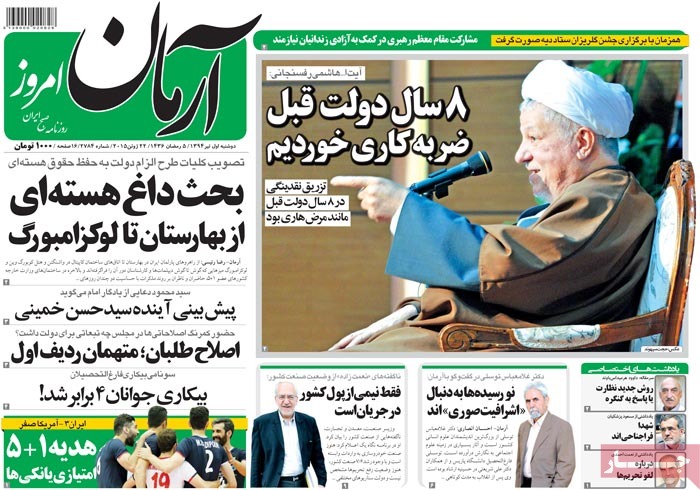
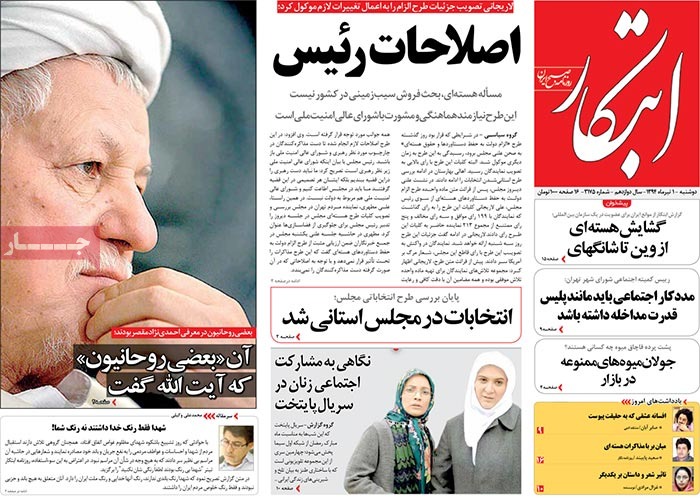
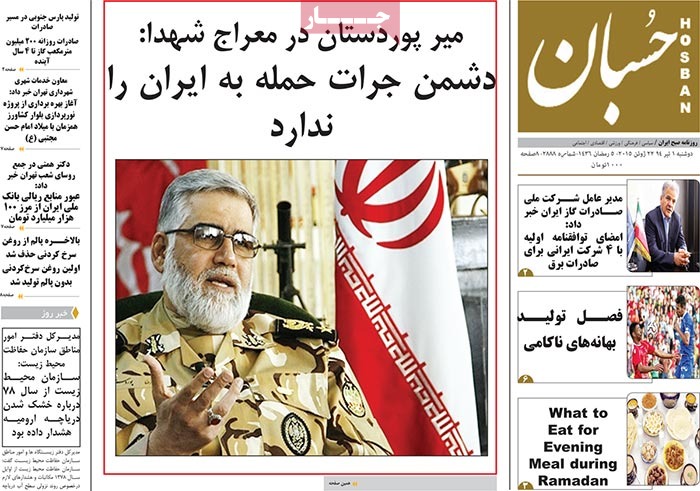
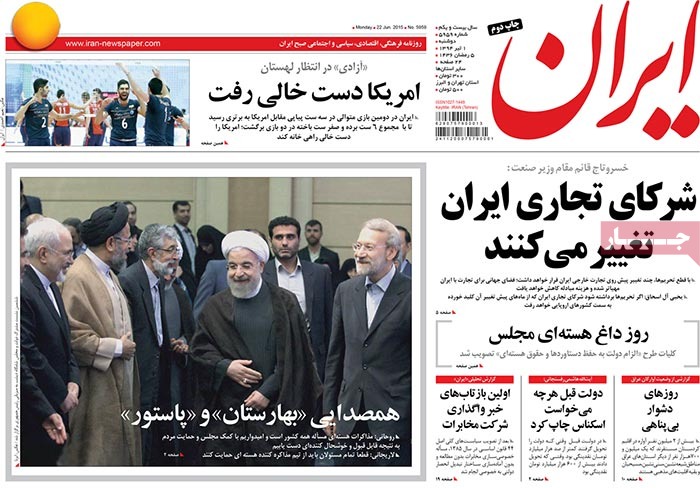
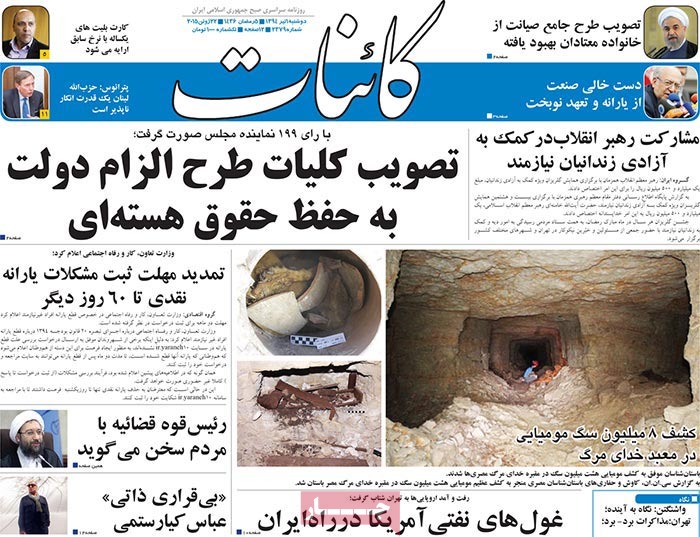
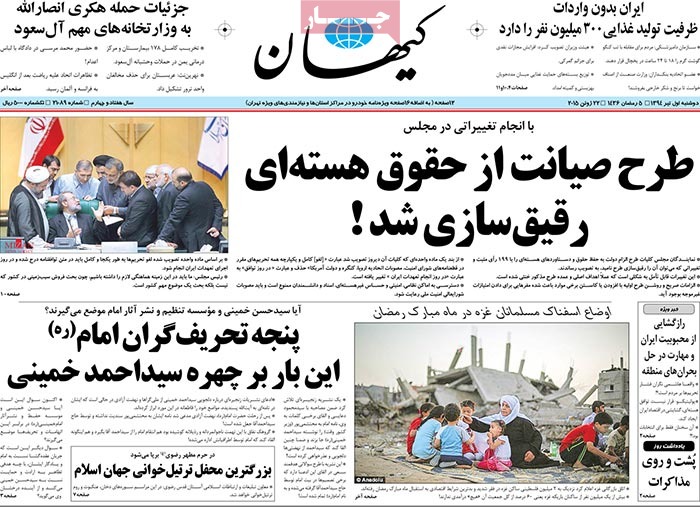
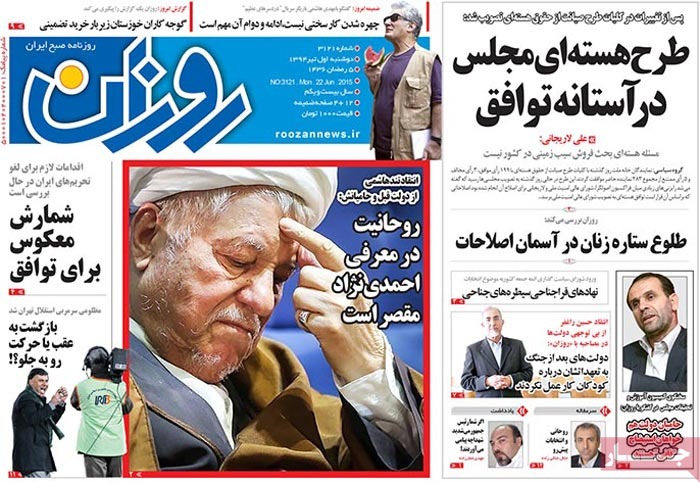
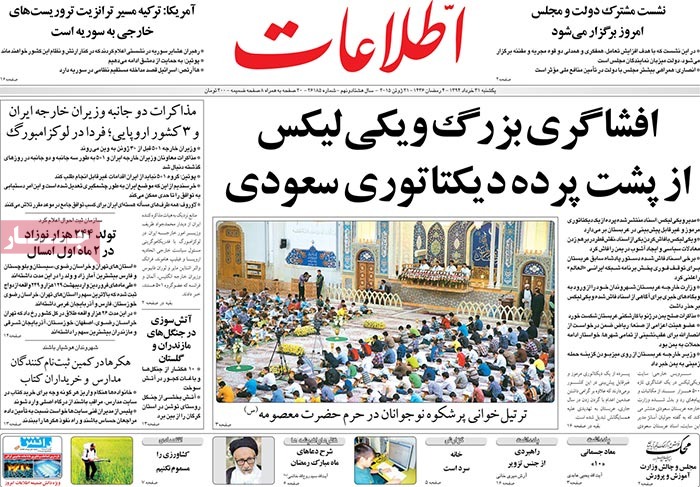
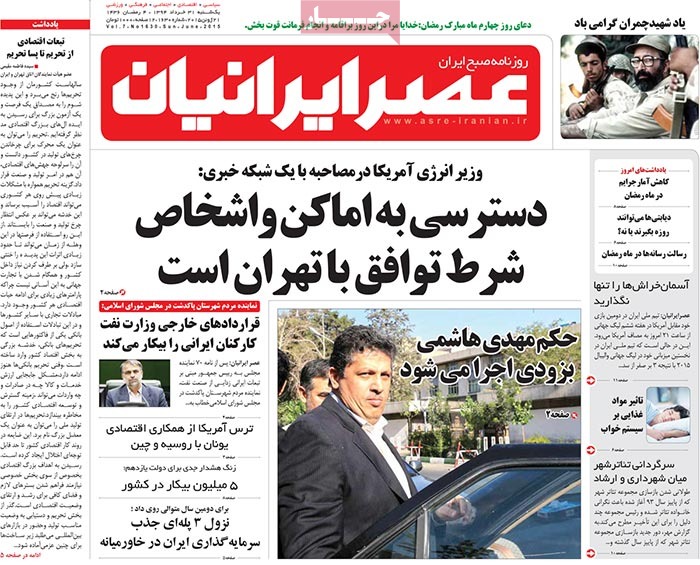
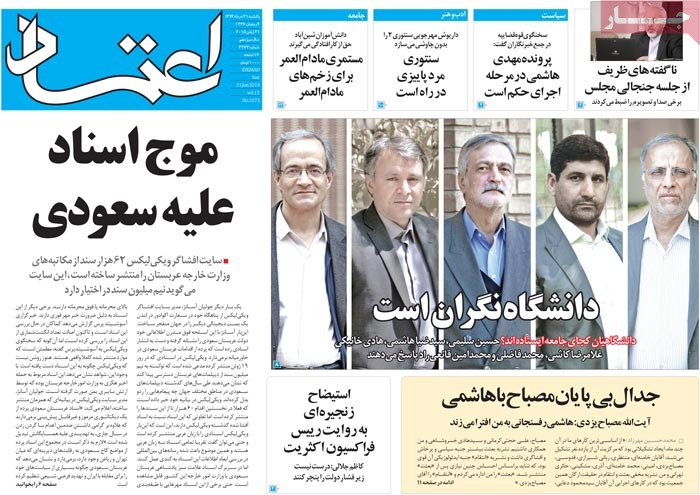
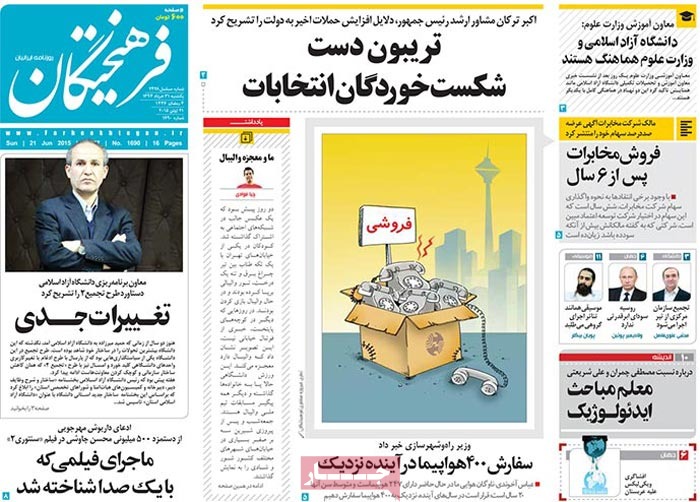
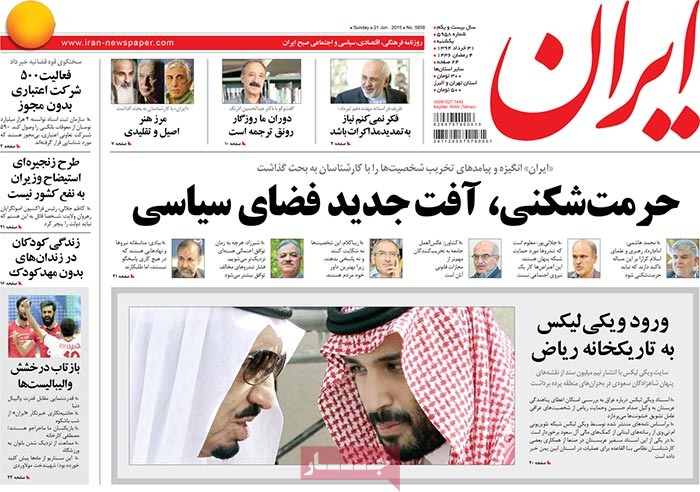
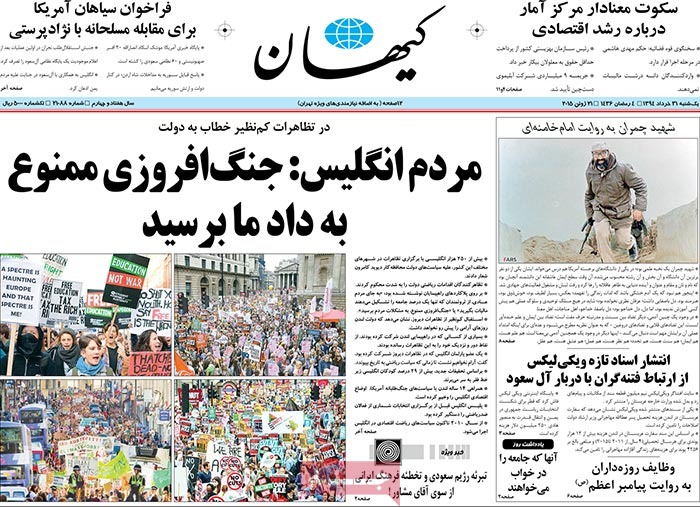
A look at Iranian newspaper front pages on June 20

Iranian Newspapers Headlines

The comments of the Supreme Leader at a meeting with Koranic reciters and the victory of the Iranian volleyball team over the US dominated the front pages of Iranian newspapers on Saturday.


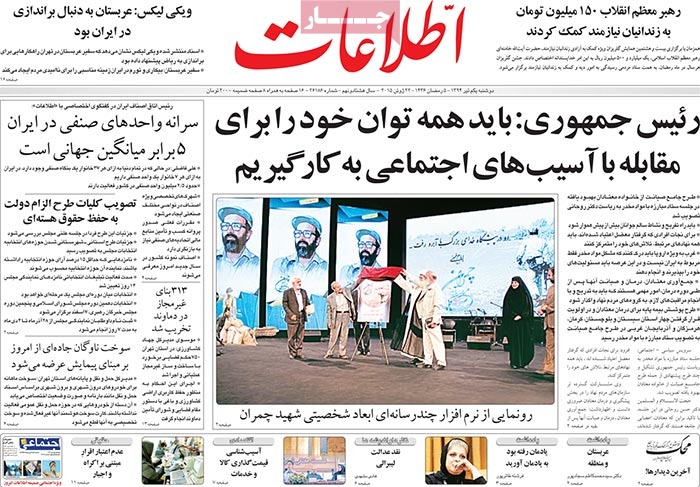
Ettela’at: The Supreme Leader has underlined the necessity of Koranic reciters gaining insight into concepts which appear in the holy book.

Ettela’at: “Terrorist groups are preventing regional countries from boosting their relations,” said President Hassan Rouhani.

The President said that in separate messages he sent to leaders of Islamic countries to congratulate them on the beginning of the fasting month of Ramadan.

In the messages, the President expressed hope violence and conflict stop in the holy month of Ramadan.

Ettela’at: “With national consensus, nuclear talks will produce results,” said President Rouhani’s chief of staff.

Mohammad Nahavandian further said that the administration’s economic policy does not simply rely on termination of sanctions.

He added that the country’s nuclear negotiators are valiant spokesmen of the nation and the public should be firm in rallying behind them.

Ettela’at: With 10 days to go before an end-of-June deadline for a comprehensive nuclear deal between Iran and P5+1, odds of clinching a deal are improving.

The foreign ministers of Iran and P5+1 will converge on Vienna this week to open a final round of nuclear talks.

Ettela’at: “Everyone came to appreciate the grandeur of the epic Iranian soldiers made,” said the families of 175 Iranian soldiers who were martyred during the Iran-Iraq war in the ’80s.

They were referring to the massive turnout of the public for a funeral procession of their loved ones whose remains returned home earlier in June.

Ettela’at: Near simultaneous attacks on mosques in the Yemeni capital Sana’a left 31 people killed.

The so-called Islamic State claimed responsibility for the bombings. It came as Saudi fighters dropped cluster bombs on Yemen.

A bomb targeting a bus carrying Yemeni refugees claimed 23 lives.

Ettela’at:Riyadh and Moscow have signed a nuclear cooperation agreement.

The deal, which covers nuclear and aerospace cooperation, was signed during a state visit to Moscow by the Saudi defense minister.

Meanwhile, President Putin invited the Saudi king to pay a visit to Russia.


A look at Iranian newspaper front pages on June 20


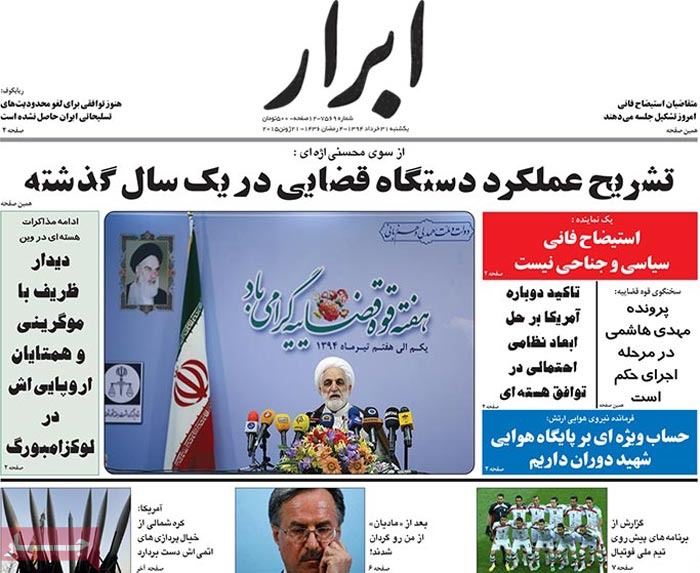
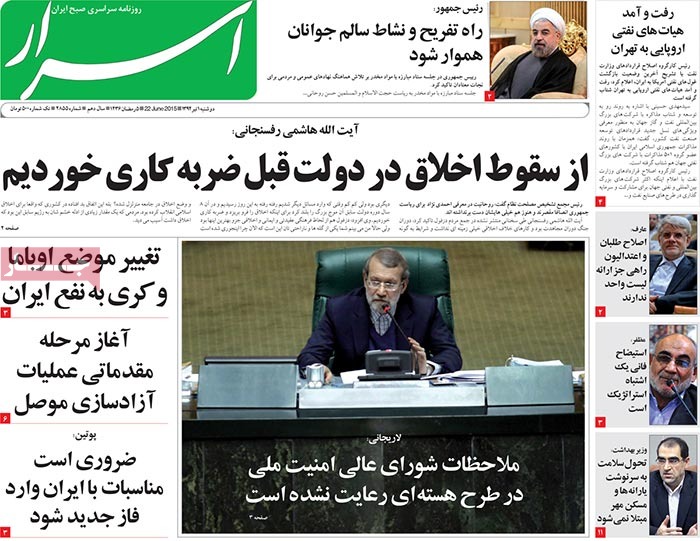
Abrar: Parliament decides this week whether to impeach the education minister.

Abrar: Thieves have broken into the car of Adel Ferdowsipour [the host of the most popular soccer TV show in Iran] and made off with his personal documents.


A look at Iranian newspaper front pages on June 20


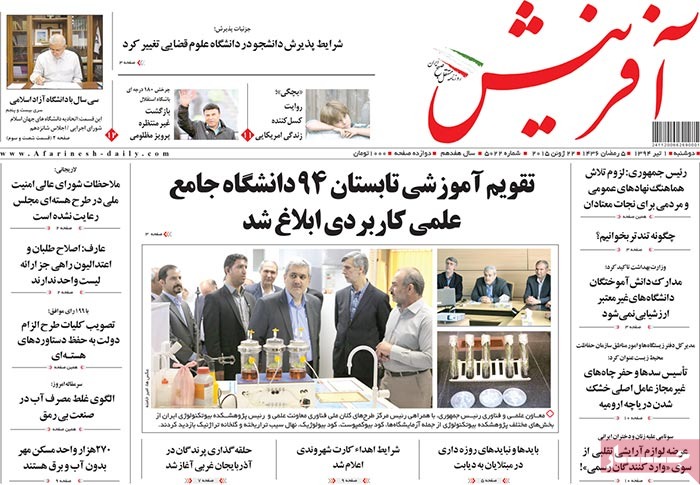
Afarinesh: “Any access to and inspection of military sites is forbidden,” said the Chairman of the Joint Chiefs of Staff of the Iranian armed forces.


A look at Iranian newspaper front pages on June 20


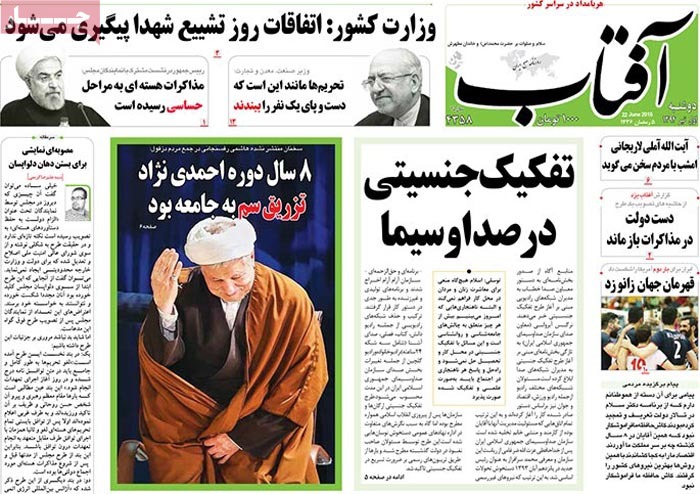
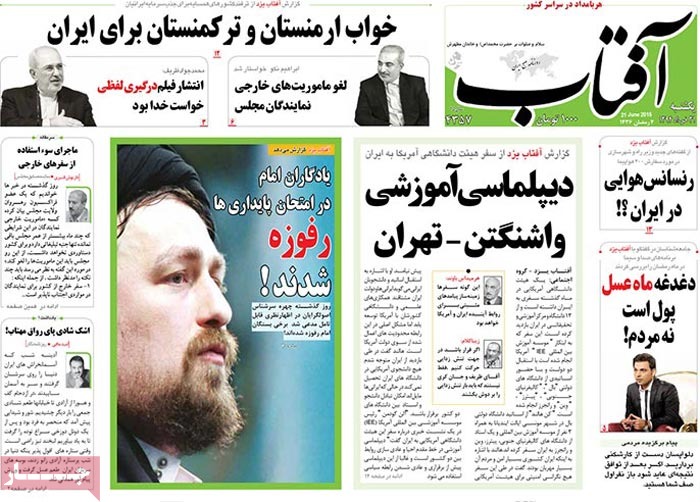
Aftab-e Yazd: “Some are at pains to instill in the public a feeling that executive officials are inefficient,” said Chairman of the Expediency Council Ayatollah Akbar Hashemi Rafsanjani.

Aftab-e Yazd: Insults continue to be hurled at President Rouhani as elegists roam around the political stage.


A look at Iranian newspaper front pages on June 20


Amin: Iran and Iraq share stance in the fight against IS. The announcement was made in a meeting between the Iraqi prime minister and Iranian first vice-president.


A look at Iranian newspaper front pages on June 20


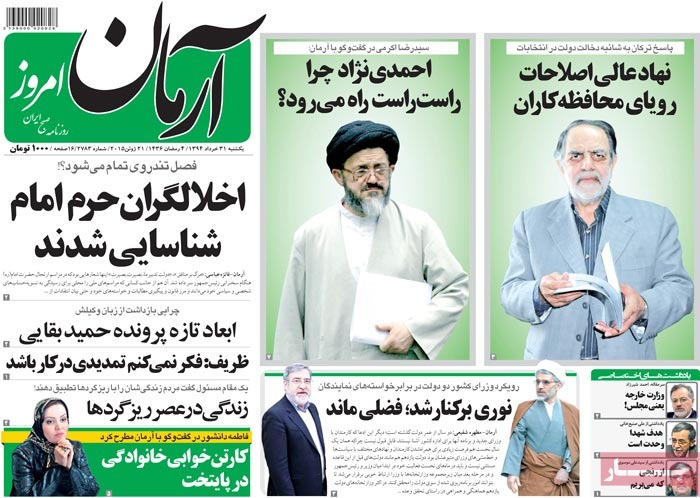
Arman-e Emrooz: An attorney for victims of a spate of acid attacks in Isfahan has talked about [leads that might result in] the arrest of the culprit.

Arman-e Emrooz: The families of 175 war martyrs have protested against hardliners by saying, “Stop taking advantage of the blood of our loved ones to push your own political agenda.”


A look at Iranian newspaper front pages on June 20


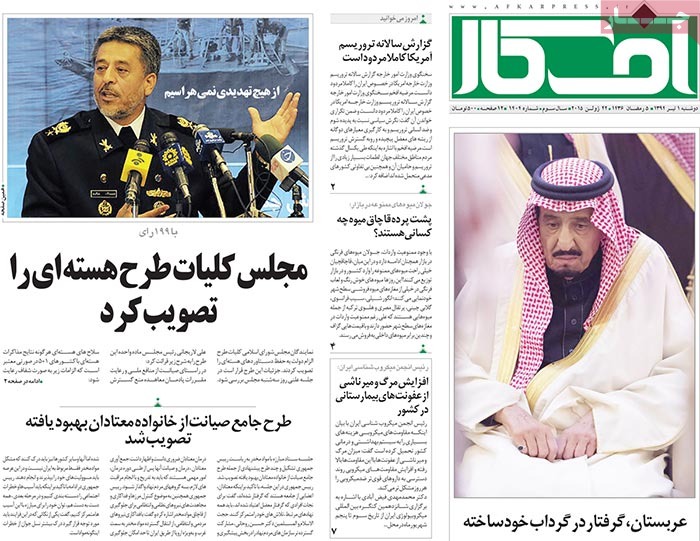
Ebtekar: “The mismanagement of the previous government injected despair into society,” said Chairman of the Expediency Council Ayatollah Akbar Hashemi Rafsanjani.


A look at Iranian newspaper front pages on June 20


Emtiaz: “Because of sanctions, we have been unable to import 1,700 ambulances,” said the health minister.

Emtiaz: Talks are underway with 170 foreign firms to export Iran’s natural gas.


A look at Iranian newspaper front pages on June 20


Etemad: “When I took over the ministry, it was around $2.7 billion in the red,” said Health Minister Hassan Hashemi.
 

A look at Iranian newspaper front pages on June 20


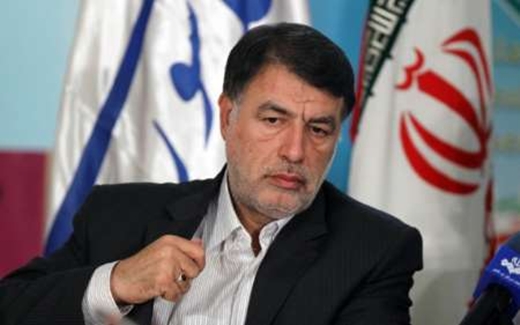
Hambastegi: “We will approve of any deal which is in line with rules and regulations,” said the chairman of parliament’s National Security and Foreign Policy Committee.


A look at Iranian newspaper front pages on June 20


Iran: President Rouhani’s chief of staff has urged opponents of nuclear talks not to dent national unity.


A look at Iranian newspaper front pages on June 20


Jomhouri Islami: “French companies are set to enter the Iranian market,” said the Iranian minister of roads and urban development.


A look at Iranian newspaper front pages on June 20


Kar va Kargar: “Comments which do not take note of expert views and decisions which are factional harm the interests of the public,” said Chairman of the Expediency Council Ayatollah Akbar Hashemi Rafsanjani.


A look at Iranian newspaper front pages on June 20


Kayhan: The water shortage alarm has sounded in 11 provinces.


A look at Iranian newspaper front pages on June 20


Resalat: “Sanctions have not paralyzed Iran; the nation stands up to pressures,” said Ayatollah Movahedi Kermani in Friday prayer sermons in Tehran.


A look at Iranian newspaper front pages on June 20


Sharq: Iran’s national volleyball team has cruised to victory over the US.


A look at Iranian newspaper front pages on June 20


Iranians celebrate victory of volleyball team against US

Iran-US-Volleyball-Tehran17

People in Tehran poured to the streets to celebrate the victory of the Iranian national volleyball team against Team USA. Honking their horns and waving the Iranian flag, Tehranis celebrated the home victory of the volleyball squad.

Iran defeated the USA in straight sets 3-0 (25-19, 29-27, 25-20) in Pool B of the 2015 FIVB World League on Friday (June 19).

The two teams are scheduled to line up against each other again on Sunday.

The following are the photos the Islamic Students’ News Agency (ISNA) released after the game.


Old Telegraph House in Chabahar

Telegraph House00

The Telegraph House is the oldest modern building in Chabahar which was built by the British in 1864, at the end of the Qajar era, to promote sailing and trade and connect India, Jask [a city in Hormozgan Province] and Bandar Abbas.

The beautiful structure with sloping slate shutters and arches has been registered as a national monument.

The following images have been released by different websites:


“Imposing pressure on negotiators unwise; people need peace of mind”

Nahavandian

Chief of staff of the President’s Office Mohammad Nahavandian said Friday that political players and journalists inside Iran should not impose pressure against the country’s nuclear negotiators who are leading a tough job, adding it is unwise to do so.

Speaking with IRNA, Nahavandian stressed that the Iranian nation seriously needs peace of mind today, as well as a thriving economy in which business will yield benefits. Under tough conditions, the Iranian political system is still capable of resisting, he said, adding management of the affairs will be a lot easier both for the system and for the nation after the conditions are improved.

“These words are not hollow mottos, as in practice after the termination of the sanctions our nation can have access to the world markets, which is their basic right, and our businessmen can attract capital and create jobs,” he said.

The Iranian capital and brains need to be kept inside the country, unlike when the sanctions are in place and present an unfavorable condition both for doing profitable business and for the talented people to flourish, he said.

[…]

“In case the sanctions will be terminated, the only way for us to achieve the objectives of our development plans will be relying on our internal potential and trusting in God that will grant us benefits,” he said.

The objective, he said, is that an Iranian investor can compete under similar conditions in which his Turkish, European, or Chinese counterparts work.

“Why should an Iranian exporter have to work under uneven circumstances? It is the government’s responsibility to remove such obstacles standing in the way of the economic activists, and it will do so,” added the official.

First Silk Road rail cargo enters Iran

Silk Road railway

The first cargo carried on the Silk Road railway has entered Iran from the Central Asian nation of Kazakhstan, local officials said.

The cargo, including 45 freight wagons, crossed the Incha-Burun border with Turkmenistan into Iran, local officials in the Golestan province said.

It followed the signing of a cooperation document between Iranian and Kazakh railway officials, head of the Northeast Railway 2 Mohammad Reza Qorbani said.

In their joint session, the mode of cooperation between Iran, Turkmenistan and Kazakhstan and other countries for transit and rail transportation was discussed.

“At the session, existing infrastructure and potential of the Islamic Republic of Iran Railways and neighboring countries, Iran’s development plans and active transit corridors passing through Iran were discussed,” Qorbani said.

They also decided to work on developing the Incha-Burun-Bandar Abbas line as the new Silk Road route, he said.

The railway linking Iran to Turkmenistan and Kazakhstan at a length of 926 kilometers was inaugurated last year.

Iran and Central Asian nations have stepped up work on establishing an integrated freight railway network to link Asia to the Persian Gulf, Europe and Africa.

It is part of an ambitious Chinese plan to revive the Silk Road which would require building of a network of roads, railways, ports and airports.

Central Asian countries plan to carry their bulk and container cargoes from the Incha-Burun border crossing in Iran’s northern Golestan province to southern Iranian port city of Bandar Abbas.

Earlier this month, head of Kazakhstan’s national railway company Askar Mamin visited Iran’s Shahid Rajaee and Bandar Abbas ports.

Head of the Islamic Republic of Iran Railways (IRIR) Abbas Nazari said the Kazakhs were interested in investing in Bandar Shahid Rajaee for construction of silos in order to store its wheat crop in the port and facilitate shipments.

Nazari said Iran, Kazakhstan and Turkmenistan, which are linked by sea in the Caspian Sea, were working on a unified transit tariff.

Iran Navy repels pirate attacks on vessel in Gulf of Aden

Iranian warship Alborz

The Iranian Navy has successfully thwarted two pirate attacks on an Iranian merchant vessel in the Gulf of Aden.

Iran’s naval forces, which escort the country’s merchant vessels and oil tankers in the high seas, first rushed to the help of the ship when pirates on board five speed boats were trying to hijack it, forcing the pirates to flee.

The pirates returned three hours later with 11 boats this time, but their attack was once again repelled by Iranian naval forces.

Iran’s Navy has, in recent years, increased its presence in international waters in a bid to protect naval routes and provide security for merchant vessels and tankers.

Since November 2008, the Iranian Navy has also been conducting patrols in the Gulf of Aden in line with international efforts against piracy to safeguard merchant containers and oil tankers owned or leased by Iran or other countries.

In April, the Iranian Navy’s 34th naval fleet comprising the Bushehr logistic vessel and Alborz destroyer left the southern port city of Bandar Abbas for the Gulf of Aden and Bab al-Mandab Strait to carry out missions in the high seas.

Iran’s Navy has managed to foil several pirate attacks on both Iranian and foreign tankers during its missions in international waters.

A bird’s eye view of Tehran: US volleyball team visits Milad Tower

US Volleyball Team

The US national volleyball team visited different parts of Tehran’s Milad Power on Wednesday (June 17), describing it as one of the key tourist attractions of the Iranian capital which can draw many foreign travelers.

The Iranian Students’ News Agency (ISNA) published a report on June 18 on the US team’s tour of the Tower two days ahead of its first game in the second round of the FIVB Volleyball World League against Iran on Friday night at Tehran’s Azadi Arena. The following is the translation of what members of the US team had to say about the tower and their upcoming match against Iran:

CEO of USA Volleyball Federation Doug Beal said the American people’s knowledge about Iran is limited, adding Iran is home to multiple attractive and must-see places and a large number of tourists travel to Iran to visit its attractions.

As for the Milad Tower tour, he said, “I have visited many towers, including the giant tower in Dubai, but Milad Tower was different, and the US volleyball team found it attractive.”

Beal also said the US team will certainly try to introduce the attractions of the Iranian capital, including Milad Tower, [to the Americans] when it returns home.

He then touched on the game between the US and Iran on Friday and said that we know that a large crowd will turn up to cheer the Iranian side. We hope to play a good game, he added.

Taylor Sander, a member of the US squad, said, “I knew nothing about Milad Tower prior to my trip to Iran. Never could I believe that Iran has the world’s sixth tallest telecoms tower. I’m happy that visiting this attractive tower has been part of the itinerary of our team.”

He further said that he found Milad Tower very attractive. “People in the US are very much interested in towering buildings. Today we could watch Tehran, which is one of the biggest cities in the world, from atop Milad Tower.

Sander also praised the hospitality of the Iranians as yet another attractive part of the trip.


Milad Tower is different for mixing art and architecture

Captain of the US team David Lee, for his part, said Tehran is the city of beauties, adding that Milad Tower is a different tower thanks to the way art and architecture has been mixed in this high-rise, and that it [mix of art and architecture] has added to its attractiveness.

Tehran is one of the cities which has grown rapidly and can turn into a tourist destination for foreign travelers, he said, adding construction of Milad Tower – which is a good example of Tehran’s progress – can create good memories for the tourists.

The US captain then referred to the showdown between his team and Iran and said that the two rival teams are powerful, adding we will definitely see the two teams display a very exciting match on Friday.

At the end of their tour of the massive tower, members of Team USA symbolically signed a volleyball and offered it as a gift to Milad Tower.

[Iran was overpowered by the US in their first and second away matches at 2015 FIVB Volleyball World League with the same 3-1 losses. The Asian champions were also defeated by Poland in their third and fourth matches in the competition, but succeed in earning one point from the European side.

The Iranian squad will line up against the USA on Friday for its first home match. The US has scored 17 points from the first round of the FIVB Volleyball World League is on top of Pool B of the competitions.

A dominant force in Asian volleyball, Iran has become a new powerhouse at the global level, with the FIVB ranking Iran 10th in the latest world standings in September 2014.]

Iran condemns terrorist attacks in Yemeni capital

Yemen-under-attack

Iran’s Foreign Ministry strongly condemned recent deadly bombings in the Yemeni capital of Sana’a, which have killed dozens, saying the Arab country’s oppressed people are targeted by internal terrorism and a foreign military aggression.

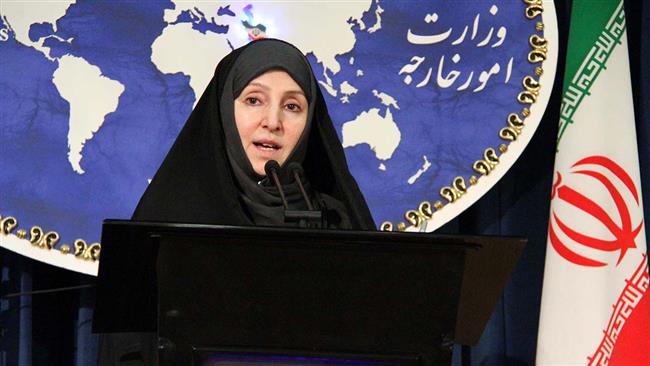
In a statement on Thursday, Iranian Foreign Ministry Spokeswoman Marzieh Afkham decried several bombing attacks that targeted the political bureau of the Houthi Ansarullah movement as well as three mosques in Sana’a a day earlier.

According to media reports, at least 31 people were killed and dozens more were injured in the terrorist attacks, which were claimed by the Islamic State in Iraq and the Levant (ISIL) terrorist group.

Afkham also offered her condolences to the families of victims of the “inhumane” attacks, saying the “oppressed” people are currently fighting in two fronts, which are internal terrorism and the Saudi-led military aggression.

“We hope that we will witness the establishment of a ceasefire (in Yemen) soon and an immediate halt to bombardments,” she said.

Afkham further asked the international bodies to focus on the “continuous and smooth delivery of humanitarian aid to the fasting Yemeni people during the holy month of Ramadan.”

On March 26, Saudi Arabia and some of its Arab allies began to launch deadly air strikes against the Houthi Ansarullah movement in an attempt to restore power to the fugitive former President Abd Rabbuh Mansour Hadi, a close ally of Riyadh.

According to Yemen’s Health Ministry, the airstrikes have killed more than 2,300 people, including 229 women and 411 children. More than 8,000 others have been also injured in the attacks, including 581 women and 766 children.

Saudi-led aerial strikes have targeted 61 hospitals and 13 ambulances.