Monday, December 22, 2025
Home Blog Page 4846

Iran condemns terror attack on Saudi worshippers

Afkham

Iran’s Foreign Ministry on Friday strongly condemned a terrorist bomb attack on worshippers in Saudi Arabia which left people martyred and wounded.
Those behind the terrorist act should be identified and brought to justice, ministry’s Spokeswoman Marziyeh Afkham said in reaction to the fatal suicide attack on Imam Ali (AS) Mosque in al-Qadeeh village located in Saudi Arabia’s eastern Qatif governorate.
She said that efforts should be made to confront all terrorist and extremist groups and cease imposing irreparable costs on regional nations.

The attack on the minority Shiite mosque in the Sunni-ruled Saudi Arabia left 17 killed and 13 others wounded when some 150 worshippers were performing Friday Prayers.

Nuclear negotiators sticking to red lines: Iran’s FM

Zarif

Iran’s foreign minister reaffirmed on Friday that the country’s negotiators firmly stick to the Islamic Republic’s red lines in nuclear talks with the world powers.

“Definitely, the negotiating team commits itself to safeguarding the Establishment’s red lines in all subjects of the nuclear negotiations, including Fordow (nuclear site),” Mohammad Javad Zarif, the country’s chief nuclear negotiator, said in an interview with ICANA on Friday.

Asked about the West’s call for inspection of Iran’s military sites, Zarif said, “I and members of the negotiating team have repeatedly emphasized that we will certainly not allow the Western sides to make excessive demands in the nuclear talks.”

His comments came after Supreme Leader of the Islamic Revolution Ayatollah Seyyed Ali Khamenei on Wednesday stressed that Iran will not allow the inspection of its military sites.

The Supreme Leader ruled out any request for interviews with Tehran’s nuclear scientists, and described it as an instance of “interrogation”.

“I would not let foreigners come (here) and talk to the Iranian nation’s dear scientists… who have expanded this wide knowledge to this stage,” Ayatollah Khamenei explained.

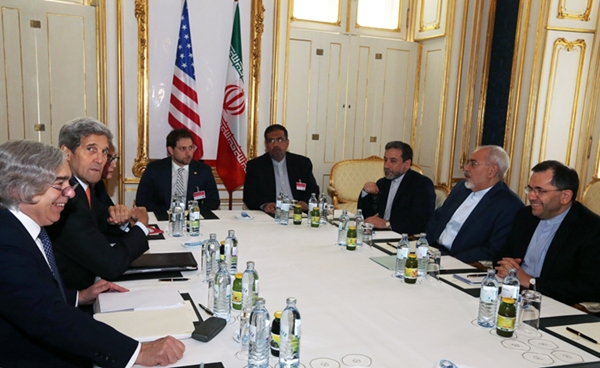
Iran and 5+1 (Russia, China, the US, Britain, France and Germany) on April 2 reached a framework agreement on Tehran’s civilian nuclear program in Lausanne, Switzerland, with both sides committed to pushing for a final, comprehensive accord until the end of June.

According to the Lausanne statement, “Fordow will be converted from an enrichment site into a nuclear, physics and technology center. International collaboration will be encouraged in agreed areas of research. There will not be any fissile material at Fordow.”

Iran ship with humanitarian aid for Yemen docks in Djibouti

Iran ship to yemen

An Iranian ship carrying humanitarian aid for the war-ravaged Yemenis has arrived in Djibouti.

Iran’s Ambassador to Djibouti and Ethiopia Ali Bahraini welcomed the people on board the aid ship, dubbed Nejat (Rescue), upon their arrival in the African country on Friday night.

This is the first Iranian relief cargo for the Yemeni people which has arrived in Djibouti, Bahraini told reporters, adding that the first plane carrying humanitarian aid destined for the crisis-hit Arab country is also scheduled to land in the African country within hours.

We maintain constant contact with the United Nations and the World Food Programme in a bid to dispatch humanitarian aid to the Yemeni port city of Hudaydah in the quickest time possible, the Iranian official stated.

Meanwhile, Iran’s Red Crescent Society Secretary General Ali Asghar Ahmadi said that Iranian officials are “assessing the situation” and will decide on the continuation of the ship’s voyage later on Saturday.

On Wednesday, Iranian Deputy Foreign Minister for Arab and African Affairs Hossein Amir-Abdollahian said that the Iranian ship has been dispatched under “full coordination with the UN” and would head for nearby Djibouti, where the world body has established a delivery hub.

The aid ship, which left the Iranian port city of Bandar Abbas on May 11, is carrying 2,500 tons of basic supplies including flour, rice, medicine, and water. Several international journalists, doctors, and anti-war activists are also aboard the ship.

Riyadh has already blocked earlier Iranian aid deliveries to Yemen. Last month, it prevented two Iranian civilian planes from delivering medical aid and foodstuff to the impoverished people.

Saudi Arabia started its military aggression against Yemen on March 26 — without a UN mandate — in a bid to undermine the Houthi Ansarullah movement, which currently controls the capital, Sana’a, and other major provinces, and to restore power to Yemen’s fugitive former President Abd Rabbuh Mansour Hadi, who is a staunch ally of Riyadh.

A pastime of the deprived which fetches money (PHOTOS)

village in southeastern Iran2

The art of sewing local patterns onto cloth is not only the hobby of locals in rural areas in Sistan and Baluchistan, but is the skill through which deprived people in southeastern Iran eke out a living.

Photos of the daily lives of people in a village in southeastern Iran released online by Mehr News Agency:

Beneath the surface of Iran’s nuclear talks

Iran Talks Flags

With less than six weeks to go before the deadline by which Iran and P5+1 are likely to clinch a comprehensive nuclear deal, nothing has changed on the surface and everything is the same compared with the past 20 months. Below the surface of nuclear talks, however, evidence shows other developments are playing out.

Khorasan daily on May 18 published an analytical review of nuclear talks during three distinct periods since the 2013 presidential elections in the country. The following is the translation in its entirety of the review by Amir-Hossein Yazdanpanah:

Official remarks by Iranian authorities – including members of the nuclear negotiating team and those involved in the talks who have to date refused to release the details of the talks –suggest that a nuclear deal is believed to be around the corner in the final week [before the July 1 deadline].

This comes as the other party to the talks, especially the US, keeps changing its positions and demands. In a new, most surprising move, the Americans went beyond the fact sheet they released hours after the Lausanne statement, saying that they disapprove of certain agreements P5+1 and Iran arrived at during the nine-day-long nuclear talks in late March and early April.

Ali Akbar Velayati [the Supreme Leader’s advisor and the president of the Center for Strategic Research at the Expediency Council] who closely examines the details of the talks says that the Americans have violated the agreements – on Fordow and the UN Security Council resolutions – they accepted a month ago, and they have now put forth new demands.

To reveal the true colors of the other party to the talks, the Americans in particular, the negotiations which opened in 2013 can be analyzed in three main periods.

1) From June 2013 when Hassan Rouhani was elected Iran’s president to November 24, 2013 when a preliminary agreement was clinched in Geneva, Switzerland [also known as the Geneva interim agreement or officially titled the Joint Plan of Action (JPA)].

2) From November 2013 when the Geneva interim agreement was reached to April 2, 2015 when the Lausanne nuclear statement was announced. This period saw the two sides extend the JPA twice (in July and November 2014).

3) From the release of the Lausanne statement in April 2015 to date as nuclear talks are drawing to a close.

Of course other parameters can be used to develop such classification, but what distinguishes these three periods from each other is the behavior of the Americans.

What was announced in the first period – both on and off the record – was the fact that the Americans sent several letters and messages to Iranian officials when the 10th government was still in office to hold direct talks and that one or two sessions of such talks [between the US and Iran] were held in Oman.

Some at the eleventh government, which was new in office back then, were trying to inject a sense of optimism into society about the trend of nuclear talks through their comments and promises. The signs of this optimism were evident when the nuclear team came back home from New York and such atmosphere prevailed in the country until the conclusion of the Geneva agreement.

Although certain government officials started to talk about a crack in the sanctions regime [a few] days after the signing of the Geneva deal, the Joint Plan of Action – as other government officials put it – did not result in the removal of sanctions in practice. *1

In the second period (from the Geneva deal to the Lausanne statement) things grew more real. A few days after the Geneva deal, both the European Union and the US imposed extensive new sanctions against Iran, something which ran counter to their explicit commitments in the deal. *2

Although the Geneva deal had explicitly called for the continuation of [nuclear] talks in good faith, the Americans took the lead in this period and piled more pressures on and made more threats against Iran.

It was exactly in this period that the US acquisitiveness barred – in the final hours of nuclear talks in Vienna in November 2014 – a final deal from being cut and the talks were extended for another seven months.

The pressures and threats made the [Iranian] negotiating team produce stronger responses to the Americans compared with the first period.

In the third period – from April 2, 2015 onward – everything seems to have gathered pace. Not much time remains until the deadline by which the two sides are expected to reach an agreement. In this period too, the Americans have failed to honor the previous agreements on several occasions or as [Director of the Atomic Energy Organization Ali Akbar] Salehi and [Supreme Leader’s advisor Ali Akbar] Velayati have put it the Americans have “backed out”.

What has transpired can be discussed from two angles. First, the closer we get to the end of the talks, the more the Americans reveal their true colors through repeatedly reneging on the previous agreements and raising new issues. Second, they pile still more pressures and make more threats during the final days of [nuclear] talks so that they can get more concessions and force Iran to give up more [than before].

At this juncture, if the country seeks to clinch a “good deal”, a deal that Iran’s negotiators can defend and the country’s senior officials and public opinion can support as an implementable deal, the nuclear team should take into account two key points.

First, the Iranian team should respect the red lines of the Iranian nation – like in the past. Under no circumstances should they [the negotiators] overstep the red lines even if the other party makes different promises.

Second, the nuclear team and executive officials should not be subdued by US pressures and threats. Never should they imagine that their uncompromising stance against the other party’s threats is likely to endanger the [ongoing] talks.

The country’s experience over the past 37 years has proved that if we fail to take a firm stance against threats as far as sensitive issues like the current nuclear talks are concerned, the other party miscalculates Iran’s position and increases its acquisitive demands. It will also ratchet up its threats and there will be no limits on what they seek.

With that being the case, not only can we not expect to have a “good deal” inked, but we should wait to see such talks break down. What is certain is the fact that the Iranian nation – which has ensured respect for its red lines through their steadfastness – will stand up to the US acquisitiveness and hypocrisy and will back the nuclear team so that the country can strike a “good deal” [with P5+1].


*1 See remarks by Morteza Bank in an interview with ISNA, “No sanctions against Iran have been lifted” and comments by Oil Minister Bijan Namdar Zanganeh in a press conference on April 14 saying, “The article on [Iran’s] receiving oil revenues and the insurance of tankers in the Geneva deal has yet to be operationalized”.
*2 For information on post-Geneva deal sanctions, go to a report in Khorasan daily titled “Fifty-five new sanctions slapped by the US following the Geneva deal”, dated August 16.

Disability does not mean inability

Amir Rezaei

Amir Rezaei is a young Iranian inventor and innovator who has lived with disability since childhood. His postmature birth – 30 seconds though – has cost him motor skills, but cerebral palsy (CP) has done little to stop his brain from functioning well. At the age of 28, Amir has registered as many as 130 inventions.

Mehr News Agency has released a report on the life and inventions of the physically challenged Iranian man who is the brains behind a large number of inventions which are his cherished possessions as well. The following is the translation of part of the report:

Amir was born 30 seconds late. His physical disability made his parents reach out to physiotherapists. By the age of 13, he had to do tough exercises for the smallest of movements. At 14, he started to walk. His 13-year efforts paid off in his teens and doctors called it a pure miracle since CP patients can hardly overcome their walking disability.

He went to school like other children studying the same books. As a person with disability, he had few options. He studied the humanities at school and pursued public administration at university. Then he stopped there and did not seek to go to higher levels because – as he put it – he had other important things to do.

Amir is a prolific inventor. He started to like inventors when he was seven. One day he decided to meet his own needs. He made an electric spoon to feed the disabled people. He then sought to patent his inventions.

Later he started to take bigger steps, wishing to make something to meet all people’s needs. A smart locking system was his second invention. Amir says he has been invited by German officials to visit the country after this invention.

“The smart system can be installed on any lock which pops open naturally when its own key is applied. In case another key is slid into the lock, the second lock kicks in, the thief is filmed and 20 people are contacted about the theft. Later the film captured on camera is sent to the homeowner. The second lock will never open; even the homeowner cannot force it open. Only the company that has produced the lock can open it.”

He has entered talks with a sponsor to produce a similar smart lock for automobiles. Amir says his dad takes care of the practical aspects of his inventions and he is only the brains behind the novel devices. He spends a lot of time at his computer doing research and designing work.

Amir says he has a middle-income family but they feel financially strained when it comes to supplying the items he needs for his work.

Amir also tries to be a source of inspiration and motivation for children with disability. Each day he meets these children and talks them out of hiding behind their disability and into trying to rise above their physical restraint.


How many international media have offices in Iran?

Press

One hundred forty-one international media, namely 76 broadcasters, 26 news agencies, 26 publications, 10 photo agencies and three news websites have offices in Iran, the Iranian Students’ News Agency reported on May 19.

Up to 41 of the broadcasters are Islamic broadcasters, among them Al-Manar, Al Mayadeen, Aletejah, Al Forat, Beladi, Al-Ahd, Al Ghadeer, Al-Salam and Al-Quds.

The Syrian Arab News Agency (SANA), the Voice of Afghanistan and Iraq’s al-Nakhil are three of the six Islamic news agencies with offices in Iran. Of the 26 publications, five are Islamic, including the Emirati newspaper of Al-Ittihad and the Lebanese daily of As-Safir.

CCTV, Phoenix, China Radio International as well as Germany’s RTL, ZDF, ARD and Austria’s ORF are some of the international broadcasters with offices in Iran, the report said.

American TV channels CBS, ABC, NBC, and CNN have journalists and correspondents on the ground in Tehran.

Giant international news agencies such as the AP, Bloomberg and Platts, France’s AFP, Russia’s Itar-Tass, China’s Xinhua, Japan’s Kyodo and Germany’s DPA along with key papers such as the Times, the New York Times, the Los Angeles Times, the Wall Street Journal, the Financial Times, Britain-based Al-Hayat, Yomiuri, the Asahi Shimbun, the Mainichi Shimbun, NIKKEI (Nihon Keizai Shimbun) and China’s Wenhui Bao also have Iran-based offices.

Getty Images, Corbis Images and Polaris Images, France’s Sipa Press and Abaca, Australia’s Front Line, Britain’s Panos Pictures and Impact, Germany’s Laif are among the 10 photo agencies which have offices in Iran.

Up to 285 journalists work for these foreign news outlets. More than 190 of them are Iranian, 92 are foreigners, and 40 are women.

Last year [ended on May 20, 2015], some 650 foreign journalists were granted a press visa to cover different national events across the country.

Iran, Russia should join hands to counter Wahhabism: Russian researcher

Javan-Wahabism
Rais_Suleimanov
Rais Suleymanov

Wahhabism has turned into a fundamental challenge in Russia and that has probably led to a shift in the Russian stance on Saudi Arabia over the past two years. To get a better insight into the issue, Javan daily has published an interview with Rais Suleymanov, a distinguished Islamic scholar from Tatarstan and a researcher with the National Strategy Institute, who has published multiple articles about Islam, particularly Wahhabism, in Russia. What appears next is the translation of part of an interview that the daily published on May 18:


What impact have foreign countries had on the spread of Wahhabism in Russia?

Arab countries try to extend their political influence in Russia through the spread of Wahhabism. Saudi Arabia, Qatar and Kuwait are among key promoters and advocates of Wahhabism in Russia. In these Persian Gulf states, Wahhabism is the state ideology. That is why the state reaches out to charities as it tries to promote its ideology of choice.

Besides, even in countries whose state ideology is not centered on Wahhabism, Wahhabi entities are very active. For instance, Egypt’s Wahhabi institutions have established so close relations with the Russians that many Russian nationals who travel there to study at Egyptian universities are hired by these institutions.

That has turned studying abroad into a tool which contributes to the growing influence of Wahhabism in Russia. Many of the young Muslim Russians who have left their country for Saudi Arabia or Egypt to further their education have been swayed by Wahhabi speeches and preaching. They have also read Wahhabi books. So when they return home, they start promoting the beliefs and principles put forth in those books.

Another thing which has played a role in the growth of this ideology in Russia is the books [on Wahhabism] which have been written in Arab countries and or in Turkey and translated into Russian or languages of the ethnic groups living in Russia.


Can Iran and Russia fight Wahhabism? What characteristics should an anti-Wahhabism campaign have?

[…]

The major obstacle lies in the fact that Russian Muslims have little knowledge of Shiite critiques about Wahhabism; Iranian religious figures who have refuted the ideology remain unknown in Russia.

Books written by Iranian clerics such as Morteza Motahari, Abdolhossein Mousavi, and Ali Mohammad Naghavi are available in Russian cities like Kazan, Moscow and St. Petersburg. But none of these books offer information about Iranian critiques about Wahhabism.

Only one book on Wahhabism by Farez Askarzadeh, an Azerbaijan-based author, has been published. The book which is dubbed Dividing Sect was translated into Russian in 2001. Nonetheless, critiquing Wahhabism as an extremist ideology by Iranian clerics is conspicuously absent in Russia.

In a 2009 conference in Kazan, Seyyed Mohammad Reza Zarei, Iran’s second consul, delivered a speech on the problem of Wahhabism and said, “Lots of Islamic books which have been translated into Russian do not serve the interests of Russian Muslims at all and it’s necessary to have proper and authentic translations of Islamic sources. Also, special attention should be paid to the employment of staff members and instructors hired by Islamic training centers in Russia. The process of sending Russian students abroad to take religious courses should also come under scrutiny. In fact, Russian students must be stopped from ending up in training centers which promote fundamentalism and Wahhabism.”

At that gathering we learned that Iranian diplomats were in on what was going on among Russian Muslims and closely monitored what was happening in the Russian Islamic community.

It seems that there are a lot of opportunities for Iran and Russia to cooperate in the fight against Wahhabism.

A look at Iranian newspaper front pages on May 21

Iranian Newspapers Headlines

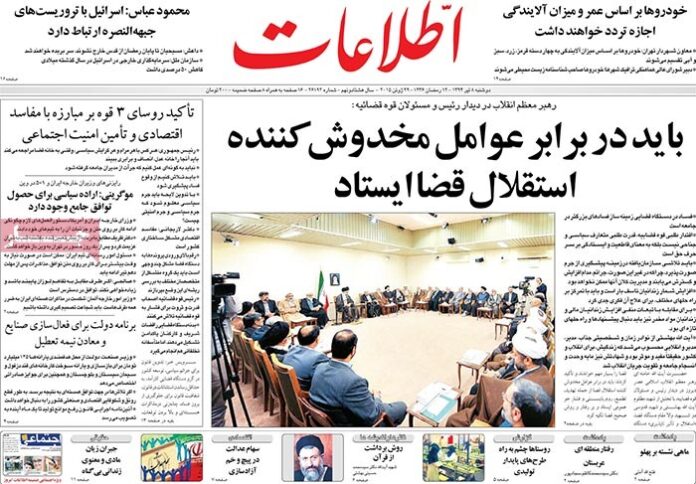
Comments by the Supreme Leader that he would not allow foreign inspections of Iran’s military sites and interrogation of Iranian scientists dominated the front pages of Iranian newspapers on Thursday. President Rouhani, who is in Tabriz, also made front-page headlines by saying no one has the right to chant slogans at the expense of the public.


Abrar: Foreign Minister Mohammad Javad Zarif has held talks with a deputy of the UN secretary general.

At a meeting with visiting UN Under-Secretary General for Humanitarian Affairs and Emergency Relief Coordinator Valerie Amos, the Iranian top diplomat said that the UN should do more to assist the stricken people of Yemen.


A look at Iranian newspaper front pages on May 21


Afarinesh: Some 8 percent of the population of Markazi Province suffers from diabetes.


A look at Iranian newspaper front pages on May 21


Afkar: Cooperation between Tehran and Moscow metropolises is to increase.

Afkar: “They are not allowed to engage in sloganeering at the cost of the public and on behalf of the public,” President Rouhani said.


A look at Iranian newspaper front pages on May 21


Aftab-e Yazd: “I won’t allow foreigners to interrogate the children of the Revolution,” said Supreme Leader Ayatollah Ali Khamenei.

The Leader made the comment during a visit to Imam Hossein Military Academy on Wednesday.

Aftab-e Yazd: “Threats by American officials have been vehemently responded,” said Foreign Ministry Spokeswoman Marzieh Afkham.


A look at Iranian newspaper front pages on May 21


Arman-e Emrooz: Mohsen Rezaei in the outfit of Revolution Guards for the first time in 18 years

[It came after the Supreme Leader gave the green-light to the former commander of the Islamic Revolution Guard Corps to become a Revolution Guards again.]

Arman-e Emrooz: A teacher has been assassinated in Khash by an unknown assailant.

Arman-e Emrooz: The source that triggered the incident in Tabriz has been identified.

[Last Friday, rumors in Tabriz that the home team has been crowned champion of the Premier League triggered bitter incidents in the city.]


A look at Iranian newspaper front pages on May 21


Asrar: “We are on the verge of defeating an Iranophobia project in the world,” President Rouhani said during a visit to Tabriz, the capital of East Azerbaijan Province.

Asrar: “Some 80,000 missiles are ready to target Tel Aviv and Haifa,” said Major General Rahim Safavi, a military advisor to the Supreme Leader, in response to threats by Zionist officials.

Asrar: The growth in smoking among women is greater than men.


A look at Iranian newspaper front pages on May 21


Emtiaz: The judiciary has issued an ultimatum to financial institutes that operate without permit.


A look at Iranian newspaper front pages on May 21


Ettela’at: “Iran’s response to any evil measure would be crushing,” said the Supreme Leader.

[The Leader’s comment came in reaction to efforts by some regional countries to take proxy wars to the borders of Iran.]

Ettela’at: “Individuals are not allowed to make people worried about their security and future,” said President Hassan Rouhani.


A look at Iranian newspaper front pages on May 21


Hemayat: Police in Tehran have arrested more than 100 thugs.


A look at Iranian newspaper front pages on May 21


Iran: Farhad Fakhreddini [a renowned Iranian composer, conductor and founder of Iran’s National Orchestra] has returned to the National Orchestra.


A look at Iranian newspaper front pages on May 21


Jomhouri Islami: “The Iranian negotiating team won’t budge in the face of excessive demands,” said Foreign Ministry Spokeswoman Marzieh Afkham.


A look at Iranian newspaper front pages on May 21


Kar va Kargar: “Helping low-income families have proper housing is a government priority,” said the labor minister.


A look at Iranian newspaper front pages on May 21


Nasl-e Farda: Some 300 leasing companies have ripped off their clients.


A look at Iranian newspaper front pages on May 21


Resalat: President Obama has maintained Iran’s oil sanctions.


A look at Iranian newspaper front pages on May 21


Shahrvand: Tehran provincial governor has expressed concern about drugs finding their way into schools.

Shahrvand: “The end of negotiations will be a source of pride for the Iranian people,” President Rouhani said.


A look at Iranian newspaper front pages on May 21


Rouhani: Gov’t introducing peace-loving, civilized Iranians to world

Rouhani-Tabriz

President Hassan Rouhani said his government is reflecting the positive image of Iranians as a peace-loving and civilized nation to the world.

He made the comments on Wednesday addressing a meeting of businessmen and investors in Tabriz, the capital of the East Azerbaijan Province.

Rouhani stressed the need to strengthen ties with neighboring countries and said that Iran has never shown aggression against [or hostility toward] any country and it will not. The Iranian nation favors peaceful co-existence with its neighbors”.

“We are not after aggression and retaliation and want good ties with the world and neighbors,” he added, referring to Iran’s policies in the wake of the fall of the Soviet Union and Iraq’s invasion of Kuwait.

If there is a problem, Iran wants to settle it and create a better condition, he said.

President Rouhani also elaborated on the government policies on supporting business, financial, industrial and economic activities.