Tuesday, December 23, 2025
Home Blog Page 4829

International community must play role in Iran nuclear talks: Zarif

Mohammad Javad Zarif

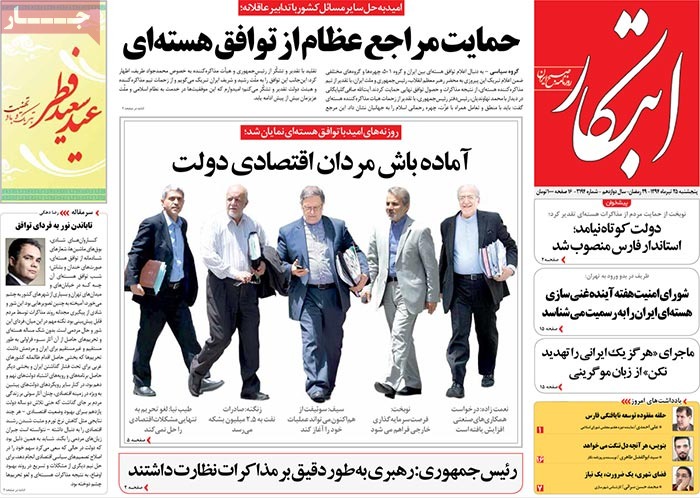
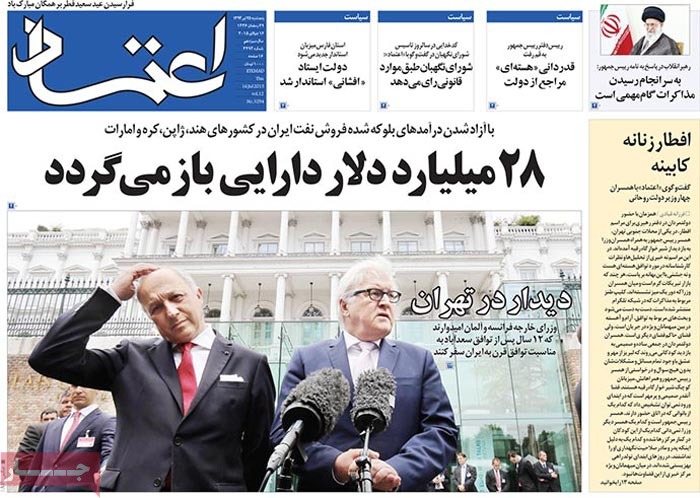
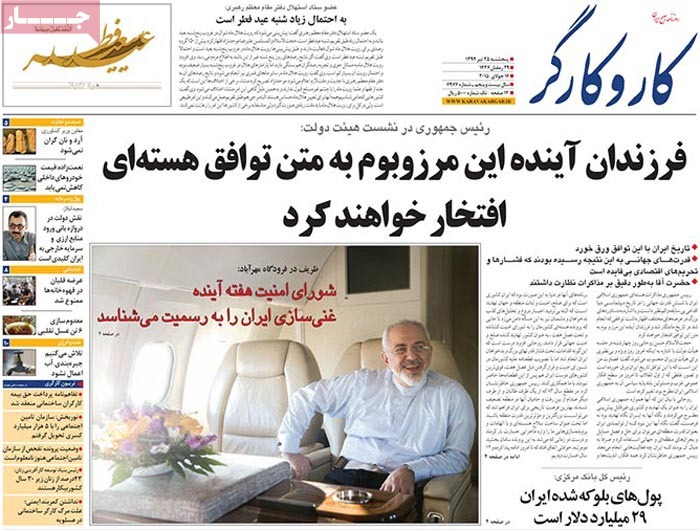
Iranian Foreign Minister Mohammad Javad Zarif has called on the international community to play an active role in the ongoing negotiations between Iran and the P5+1 group of countries over Tehran’s nuclear program.

“The international community should not just observe the [nuclear] talks and it is necessary for it to play a role in this regard, so that the negotiations can bear fruit,” Zarif said in a meeting with Indian Foreign Secretary Subrahmanyam Jaishankar in Tehran on Saturday.

The Indian official, for his part, expressed hope that Iran and the P5+1 group could reach an agreement on the text of a final agreement soon, adding that such a deal could contribute to the promotion of Tehran-New Delhi ties.

Negotiators from Iran and the P5+1 – the United States, Britain, France, China, Russia and Germany – are holding talks on drafting the text of a possible final deal over Tehran’s nuclear program.

On Friday, a senior member of Iran’s nuclear negotiating team said that Tehran andthe opposite side are resolute to speed up the talks.

[…]

Iran reiterates sovereignty over three Persian Gulf islands

Marzieh Afkham

Iran has rejected as “baseless” a statement by the Persian Gulf Arab states supporting the United Arab Emirates’ alleged claim to three Iranian islands.

Iranian Foreign Ministry Spokeswoman Marzieh Afkham said on Saturday that the three Persian Gulf islands ofthe Greater Tunb, Lesser Tunb and Abu Musa are under the sovereignty of the Islamic Republic, stressing that the repetition of unfounded allegations over the territories would not change historical facts.

On Friday, the six-nation [Persian] Gulf Cooperation Council issued a statement at the end of its meeting in Riyadh, Saudi Arabia, supporting the UAE’s claim on the three islands.

Emphasizing that friendly ties with neighbors based on a policy of non-interference and mutual respect top the Islamic Republic’s agenda, Afkham said Iran does not consider any limit to promotion of friendly relations with neighboring countries and welcomes cooperation with those states.

The three islands have been historically part of Iran. Countless historical, legal and geographical documents in Iran and other parts of the world corroborate Tehran’s sovereignty over the islands. The United Arab Emirates has, however, repeatedly laid claim to the islands.

Iran commander warns nuclear negotiators about cyber-espionage

general

A top Iranian military commander has advised the Iranian nuclear negotiators involved in talks with P5+1 to be watchful of potential attempts to spy on the talks.

Head of Iran’s Passive Defense Organization Brigadier General Gholamreza Jalali made the remarks at a news conference on Saturday following recent media reports that traces of spyware widely associated with Israel were found at international hotels hosting talks between Iran P5+1.

Jalali said it is against diplomatic norms to grant enemies access to the venues of negotiations for spying purposes.

He advised Iranian officials involved in the negotiations at foreign venues not to use smartphones when trying to communicate classified information because of the high risks associated with the devices.

On Thursday, Swiss and Austrian officials said they had begun investigating reports that a computer virus targeted the hotels used by the delegates from Iran and P5+1.

The Wall Street Journal reported on Wednesday that spyware, widely believed to be used by Israel, had targeted the computer systems of the hotels hosting the sensitive negotiations.

Experts at Russia-based Cybersecurity Company Kaspersky were quoted by the Journal as saying that the firm had found at the sites traces of malware believed to be used by Israel. The company dubbed it Duqu Bet, and said it was an “improved version” of the Duqu virus, which had previously been used by the Israeli regime.

Negotiators from Iran and P5+1 – the five permanent members of the UN Security Council plus Germany – have held talks at Swiss hotels of Beau-Rivage Palace, Royal Plaza Montreux, Intercontinental and Hotel President Wilson as well as Palais Coburg in Vienna.

Jalali also said 23 countries have currently set up defense and offense mechanisms on cyberspace.

He pointed to the 2010-11 Stuxnet virus cyber-attacks on Iran’s nuclear energy facilities, saying that Iran is set to open a Cyber Defense Center in less than a month to defend itself against such attacks.

[…]

We need to form a strategic coalition with powerful Iran

solana210F5AA23B15

Javier Solana, a former EU foreign policy chief, has said that Iran is the only country which is ready and powerful enough to take on ISIL terrorists, adding we need to form a strategic coalition with Iran which is the most powerful country in the region.

Solana made the remark in a speech at a conference at the European Council on Foreign Relations (ECFR) [a pan-European think-tank which conducts research and promotes informed debate across Europe on the development of a coherent and effective European values-based foreign policy] in Brussels.

The Islamic Republic News Agency published excerpts of Solana’s remarks. What comes below is the translation of what according to IRNA As-Safir (The Ambassador), a leading Arabic-language daily newspaper in Lebanon, quoted him as saying:

Solana said the Saudis are not ready to take on a role in efforts to counter ISIL, adding they are engaged in Yemen [a reference to the Saudi aggression against Yemen] and are not seeking to get involved in defeating the terrorist group.

Egypt too is busy defusing its infighting and cannot play an effective role in the fight against terrorism, he said, adding Iran is the only remaining country [in the region which can have a role] especially after signing a nuclear deal [with P5+1] which will increase its role significantly.

The former EU foreign policy chief went on to say that the state of affairs in Iran and the entire region will change fundamentally after the conclusion of a nuclear deal, adding the deal will also meet with strong reactions.

The talks are likely to continue as long as a nuclear deal is produced, Solana said, adding Saudi Arabia is the first side which shows negative political and economic reactions to a breakthrough nuclear deal.

He further said the Saudis will pile more pressures on the US and the EU in order to prevent Iran from turning into a key regional player, adding this will be a big battle.

Economically, the Saudis can also jeopardize the oil market to cause Iran’s oil revenues to drop and disrupt its exports after the removal of sanctions.

Francisco Javier Solana de Madariaga is a Spanish physicist and Socialist politician. After serving in the Spanish government under Felipe González (1982–1995) and Secretary General of NATO (1995–1999), he was appointed the European Union’s High Representative for Common Foreign and Security Policy, Secretary General of the Council of the European Union and Secretary-General of the Western European Union and held these posts from October 1999 until December 2009.

Iranian woman killed in hit and run in Canada

maryaminsetweb

Maryam Rashidi, an Iranian woman who was a resident of the Canadian city of Calgary with her husband and six-year-old son, was killed after two young thieves ran her over in a gas station she worked for.

Fararu on June 13 released a report on the death of Maryam, 35, a chemical engineer from Sharif University of Technology, who migrated to Canada a year ago. The following is the translation of the report:

Maryam moved to Canada last year after graduation and working at Bandar Imam Petrochemical Company. She was killed in a hit and run last Sunday [June 7] after she tried to stop two thieves in a stolen pickup truck from driving away without paying.

Maryam’s husband Ahmad Shamloo, an oil and gas expert from University of Tabriz, says, “I received a telephone call on Sunday and was told that my wife was in the hospital due to serious injuries she had suffered. I rushed to the hospital only to find my wife in coma.”

On that fateful day Maryam gave chase after the gas-and-dash at the station and stood in front of the truck to try to block it from leaving. She was hit and carried along on the hood before she fell off and was run over, according to her husband.

The police have confirmed that the woman has died of her injuries in hospital two days after the incident on Tuesday.

Police also said they have taken into custody two persons of interest after checking the footage of CCTV at the gas station, adding that an investigation has been launched into the incident.

[The thieves face charges that include criminal negligence causing death, hit and run causing death, dangerous driving causing death and possession of stolen property, according to police.]

Rainbow of Hope (PHOTOS)

Rainbow of Hope0

A number of artists were on hand on June 12 for a children’s charity event dubbed Rainbow of Hope.

The event, which was the largest water color workshop in the country, featured a 10-by-1 meter image of the capital in water color.

The following are images of the workshop released by honaronline.ir, a website dedicated to art and art news.

Iran, P5+1 make progress in sanctions relief talks: Russia

nuclear

Russian Deputy Foreign Minister Sergei Ryabkov says Iran and P5+1 have succeeded in making progress in their nuclear talks on the issue of relieving sanctions against Tehran.

“In principle, there has been a shift on certain issues, especially the subject of a future UN Security Council resolution, which is important for us. There is fair progress on the issue of the lifting of sanctions,” he told journalists on Saturday.

Ryabkov, who is Russia’s senior nuclear negotiator at Iran’s nuclear talks, said sanctions against Iran will be suspended and subsequently canceled depending on how the International Atomic Energy Agency (IAEA) certifies Tehran’s measures.

“The pace of the lifting of sanctions should be acceptable for the Iranian side. I think, although, it would be best that they comment on this,” the Russian official added.

Iran and P5+1 – the United States, Britain, France, China and Russia plus Germany – are seeking to finalize a comprehensive deal on Tehran’s nuclear program by June 30.

Iran and its negotiating partners have been working on the text of a final deal since they reached a mutual understanding on the key parameters of a final deal in the Swiss city of Lausanne on April 2.

Ryabkov further said disagreements remain between Iran and the six powers on a number of issues in the nuclear talks; however, the sides are making efforts to resolve all disputes as soon as possible.

Iran has, on several occasions, stressed that it will not bow to excessive demands by the opposite side in the course of drafting the text of a final deal, warning that adopting such an approach by the six world powers could impede a final agreement.

Ryabkov also said P5+1 foreign ministers are likely to hold a meeting in the coming days before June 30 in a bid to settle all remaining minor disagreements, adding they can then focus on just a few major issues of difference with Iran.

The deputy foreign minister noted that political directors of the six countries would also hold a meeting in one week.

Iran arms embargo bone of contention among P5+1

Ryabkov further said that Moscow continues to hold discussions with other P5+1 countries about the pace of lifting the arms embargo against Iran.

“This was expected and we did not think that everything would work out easily here [on the issue of arms embargo]. There is still time to argue on this issue, which is what we will be doing,” he said.

He added that the disputes are “sharp and lacking constructive development.”

Fate of humanity is not tied to nuclear deadline

Prof

Professor Pirouz Mojtahedzadeh, a renowned Iranian political scientist and historian, says nuclear talks should proceed despite the challenges and obstructionist measures inside and outside the country.

Prof. Mojtahedzadeh, who is also a prominent Iranologist and geopolitics researcher, made the comment in an interview with khabaronline.ir and added that efforts to serve the country’s national interests should not be put on hold only because of skepticism voiced by a few people. The following is the translation of excerpts of his remarks:

IAEA and interview with Iranian scientists

It is not a new topic. What sounds new is that such a demand [interview with the nuclear scientists] is to be set as a precondition in the talks between Iran and P5+1 for a final agreement. It has drawn Iran’s protest. Even certain members of P5+1 expressed opposition to new demands after the Lausanne agreement in April.

What the International Atomic Energy Agency (IAEA) has asked is not new and has nothing to do with the previous and ongoing rounds of talks. The IAEA has made such a demand because it has made it clear for the Iranian government and the world that it is seeking to prove that Iran has no weapons program in its nuclear industry.

To prove this, they [the Westerners] say the areas they want should be inspected, asking for the nuclear scientists and engineers to be interviewed. Whether this demand is outrageous or legitimate, I don’t have the slightest idea. Nobody knows. It is up to Iran and the agency to hold special talks and discuss whether inspection is necessity or not. In other words, the Iranian government should ask the agency to explain why they seek to interview Iran’s nuclear scientists. […]

IAEA and its responsibility

The agency says a number of issues have remained hidden during the inspections its experts have carried out. The IAEA seeks to clarify those issues by interviewing Iranian scientists. It is clear that the one who makes a claim has to prove it by submitting compelling evidence.

The issues the agency has raised without producing the required evidence are old excuses which have been repeatedly used over the past 20 years. Nonetheless, Iran has always responded to these challenges. At this juncture, we will gain nothing if we seek to condemn somebody. We need to enter talks with the agency. The Iranian government or its representative at the IAEA should ask the agency why it wants to interview the scientists and what doubts it wants to clear up by interviewing the personnel of Iran’s nuclear industry.

Assessment of nuclear talks

Talks are proceeding despite major stumbling blocks. Talks will go ahead as before, but [US Secretary of State] John Kerry’s broken leg could complicate the situation and hamper the talks. Negotiations have started recently and different events may delay the talks. The issue cannot be assessed properly. What has happened to the US secretary of state will certainly affect the talks. […]

Nuclear talks and July 1 Deadline             

Those who have imposed the deadline are the ones who should do something for the time limit caused by the deadline. The [July 1] deadline is not the end of the human race; in other words, the fate [of humans] is not tied to that day [the deadline]. The one who has set the deadline can extend or change the target date. […]

Additional Protocol and nuclear talks

The protocol is a separate case with a precedent. Signing the protocol does not have anything to do with the talks. The question of signing the Protocol and parliament’s approval of it was raised when Mr. Khatami was president. It is a separate question with no bearing on nuclear talks. If the West seeks to tie it – as a precondition – to the talks, it would be wrong. It is also the reason why certain members of P5+1 have opposed making new demands.

The course nuclear talks have taken is related to the Lausanne agreement which has said nothing about the Additional Protocol. If one country desires to go beyond the Lausanne agreement and float the protocol, with some inside Iran supposing such a desire as a life-and-death condition, they need to know that the talks are pursued under the supervision of the Supreme Leader. When he is closely watching the talks, such doubts could be questionable.

Future of nuclear talks

All in all, I’m still optimistic about the progress in and conclusiveness of the talks despite obstructionist measures in Iran and the US, especially measures by Israel and the Jewish lobby to hamper the efforts. The national will of the two countries wants to see the problem [Iran’s nuclear dispute with the West] settled so that the Iranian nation can free itself from the yoke of the inhumane behavior [imposition of sanctions against Iran].

The so-called Worriers need to know that the Iranian nation has clearly tasked – in the [2013] elections – the eleventh government with solving the problems the country is facing in its foreign relations.

I believe that a bright future lies ahead. I don’t know about the details. Even the negotiators cannot say exactly when they are to sign a deal. Those who set a deadline should be careful about the time limit. Those who have set it should capably try not to miss the deadline. They have said that if the intended results are not achieved by the deadline, they would think about a better timeframe.

I don’t want to say that an agreement would turn the world into a better place to live in. My stand is what I’ve repeatedly said in domestic and foreign media since the start of the new round of talks: the biggest achievement of the talks and a possible agreement is Iran’s stepping out of the deadlock. We are not to gain more than this. The plight Iran has been through makes us desire an agreement which would spell an end to that plight.

When locked in a stalemate and isolation, we cannot properly engineer a better future for the generations to come. When Iran is free from sanctions, it can more generously get big jobs done financially, legally and internationally. The agreement will lead us to nothing, but it can take us down a path which would lead to what we seek.

Hezbollah takes on Takfiris in Syria to defend Lebanon’s freedom and sanctities

soleiman-f

Suleiman Frangieh, the current leader of Lebanon’s Marada Movement, says Hezbollah is defending the freedom of thought and the sanctities of all Lebanese.

Frangieh, who is also a Member of Parliament for the Maronite seat of Zgharta-Zawyie in north Lebanon, made the comment in an interview with MTV Lebanon and added Hezbollah is fighting the Takfiris – which pose a threat to all Lebanese – in Syria to support what remains of the Christians in the Middle East.

The Islamic Republic News Agency (IRNA) on June 11 published Frangieh’s remarks in the interview on the Takfiris and Hezbollah’s measures to counter them. The following is the translation of what the Christian politician said:

Frangieh said Hezbollah alone is engaged in the fight [against ISIL] in Al-Qalamoun [a Mediterranean seaside town of the North Governorate of Lebanon in the Tripoli District] to defend the Christians and Lebanon, adding the foreign sides have brought no benefit for us.

Simply our own willpower is defending us, not the international security umbrella [over Lebanon that was supposed to protect it from regional tensions], he said, adding Hezbollah is defending Lebanon, the freedom of thought and the sanctities of the Lebanese.

He further said the Takfiri movement knows no border and if it penetrates Lebanon in the future, it would leave nothing of moderate Christians, Shiites and Sunnis [in this country].

As for a recent meeting between Samir Farid Geagea, the terrorist leader of the Lebanese Forces Party, and General Michel Aoun, the leader of the Free Patriotic Movement, he said if the agreement between Geagea and Aoun comes in line with our policies, that would be acceptable to us, but we will take a different stand if their agreement serves the purposes of Geagea.

He said he would support a Geagea-Aoun agreement, but reiterated that the policies of the Marada Movement will be subject to no change.

Frangieh also said his movement lends support to the Axis of Resistance [a term used by the Libyan daily newspaper Al-Zahf Al-Akhdar in response to US President George W. Bush’s claim that Iran, Iraq and North Korea formed an “axis of evil.”], adding measures against Syria are the worst policy one can adopt today.

“From among a secular system and a Takfiri system in Syria, I – as a Maronite Christian – would pick the secular government, and I would pick Bashar al-Assad, a friend of mine, if the options are two secular systems,” he said.

“We only agree to election of a powerful president in Lebanon,” he said, stressing that we agree to Michel Aoun’s plan to hold a referendum in Lebanon providing that the vote is transparent and includes all Lebanese, not simply the Christians.

Frangieh went on to say that Future Movement [the largest member of The March 14 Alliance which is led by MP Saad Hariri, the younger son of the assassinated former Prime Minister of Lebanon Rafik Hariri] does not accept General Aoun as president and it also rejects a member of Aoun’s inner circle taking over as Army commander.

“This party is engaged in gamesmanship and maneuvering, thus our party has every right to take measures to satisfy its own legitimate demands,” he said.

Shapur Cave (PHOTOS)

Shapur Cave0

Shapur Cave is located in southern Iran, about 6 km from the ancient city of Bishapur.

The walls of the cave bear engraved images that date back to the Sassanid era. It seems that the cave has once served as a venue for religious functions.

The following are images of the cave released by Irandeserts.com