Thursday, December 25, 2025
Home Blog Page 4823

Iran dismisses claims of rights violations in US report

Marzieh Afkham

Iran has categorically rejected the allegations of civil rights violations raised against the Islamic Republic in a recent report by the US State Department, stressing its commitment to respecting human rights.

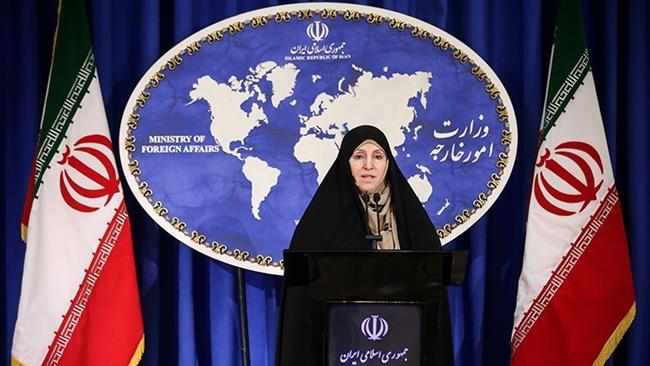
Foreign Ministry Spokeswoman Marziyeh Afkham on Friday slammed the State Department’s claims as “repetitive,” saying the report was drafted at a time when the US sees the highest number of human rights violations against people of color and widespread protests against such abuses, and while Washington’s allies are busy committing heinous crimes against their own people.

Afkham made the remarks after the US State Department issued an annual report on human rights conditions in the world in 2014 on Thursday, accusing Iran – among other countries, including Russia and China – of restricting civil liberties.

She further said police brutality, widespread discrimination against African-Americans, a crackdown on religious minorities as well as Washington’s unconditional support for Israel’s crimes are among the numerous cases of human rights violations in the US, which have drawn criticism from major international rights institutions.

Afkham called on Washington to assume its own domestic responsibilities instead of interfering in the affairs of other countries under the pretext of advocating human rights.

She also termed the instrumental use of issues like human rights and the fight against terrorism as a great challenge facing the international community.

“It is completely clear that such reports, which are prepared with certain objectives, serve as leverage for exerting pressure and bargaining as well as excuses for meddling in the domestic affairs of the other states,” she said.

The Iranian Foreign Ministry official also censured Washington for threatening to keep in place the sanctions imposed against the Islamic Republic over human rights issues, saying such bans are “illegitimate and lack legal standing.”

Afkham underscored that the Iranian government abides by its domestic and international commitments and makes efforts to upgrade the rights of its citizens on the basis of the sublime Islamic values and regardless of the claims made in such reports.

Iran condemns Friday terror attacks in Kuwait, Tunisia, France

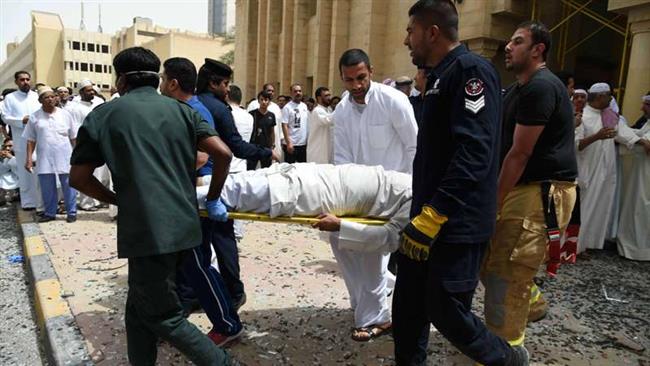
Kuwait Attacks

Iran’s Foreign Ministry has denounced Friday’s deadly attacks in Kuwait, Tunisia, and France.

Foreign Ministry Spokeswoman Marzieh Afkham on Friday strongly condemned the terrorist attack on a Shiite mosque in the Kuwaiti capital, and reiterated that “Takfiri terrorism is the most significant menace to regional nations.”

At least 25 people were killed and over 200 others injured in the bombing that was carried out during the weekly Friday prayers at Imam Sadeq Mosque in Kuwait City.

Regarding the raid in Tunisia, the Iranian official said such terrorist acts are aimed at tarnishing the image of Islam and destabilizing Islamic countries and the region.

She also called for collective and urgent measures to eradicate terrorism and counter extremist groups.

At least 37 people were also killed in an attack by two unidentified gunmen in the Port El Kantaoui tourist complex, 10 kilometers (6.2 miles) north of the town of Sousse in Tunisia. An exchange of gunfire was reported between the attackers and security forces.

One of the gunmen is said to be killed and the other remains at large.

The ISIL terrorist group has claimed responsibility for both attacks.

Afkham also condemned a deadly attack in France, saying that such terrorist measures are not compatible with the teachings of Islam.

A truck driver, reportedly carrying a flag of the ISIL Takfiri group, crashed into a gas factory located in the small town of Saint-Quentin-Fallavier, about 40 kilometers (25 miles) from the city of Lyon, and hung his employer’s severed head on a factory gate.

The Friday terror raids have triggered strong reactions and criticisms from various world leaders and bodies.

UN Secretary General Ban Ki-moon slammed the “appalling” attacks in France, Kuwait and Tunisia, saying that those responsible should be brought to justice.

Russian President Vladimir Putin offered condolences to his Tunisian counterpart Beji Caid Essebsi, and to Kuwaiti Emir Sheikh Sabah al-Ahmad al-Jaber al-Sabah.

The White House also denounced the “heinous attacks” in the three countries.

Many Islamic bodies and organizations, including the Lebanese resistance movement Hezbollah, Egypt’s top Muslim authority al-Azhar, and the Houthi Ansarullah movement of Yemen, also censured the act of terror in Kuwait.

Following the attacks, Italy and Spain raised their terror alert level.

“No country is without risk, we have raised the level of alert to re-sensitize those units charged with protecting sensitive places,” Italian Interior Minister Angelino Alfano said on Friday, without specifying to what grade he had increased the level.

Spain’s Interior Minister Jorge Fernandez Diaz also said he had decided to raise the terror alert level from medium to high over security concerns about potential attacks on Spanish soil.

When diplomacy serves the cause of development (PART FOUR)

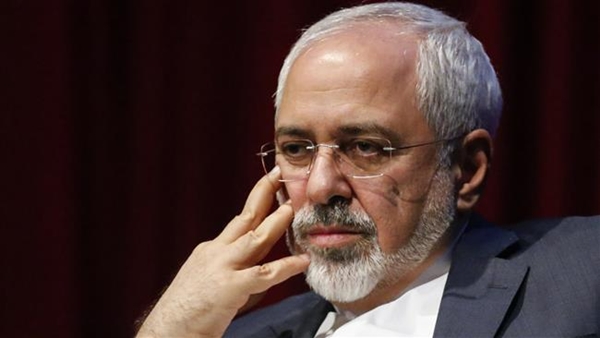
zarif

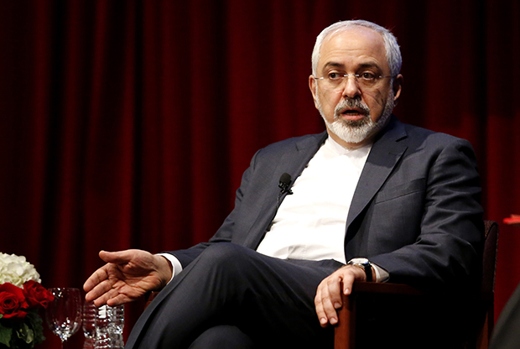
Iran’s foreign minister says nuclear talks are very much likely to continue past the end-of-June deadline. Mohammad Javad Zarif made the comment in an interview with Donyay-e Eghtesad’s Ehsan Abtahi and Hadi Khosro-Shahin on June 18.

In the interview the top diplomat said an ideals-based foreign policy does not run counter to a foreign policy of which national interests are the cornerstone. He added what makes a country successful on the international stage is its ability to render its ideals into international norms.

“Diplomacy is the art of advancing a country’s interests at the lowest cost. Foreign policy should serve the cause of development, rather than being a burden on a country’s development drive,” he said. The following is PART FOUR of the translation of the interview:


Mohammad Javad Larijani [the head of the Iranian Judiciary’s Human Rights Council] has recently said that the Americans want to draw out the talks until the UN General Assembly meets in New York. He builds on that assumption to suggest that chances of a deal by the end of June are no more than 10 percent.

I don’t see any reason for that. As a reasonable person, if Mr. Larijani sees things that way, he definitely has his own reasons for such assumption. I am not aware of any such reasons. Nor are the Americans saying that they want the talks to be drawn out until the General Assembly. As I said we don’t have any problem either.

In order to turn our ideal power into genuine influence, we have to transform our positions to global norms. To achieve that, we need to have knowledge about the tools and the rules of the play, not simply force our hand by the rules of the play. As I said we need to know about these rules. There are a lot of differences between playing with and without knowledge about those rules.

Let me give you an example. When Dr. Rouhani attended the first General Assembly in the capacity of president, extremism, which has now turned into a hot-button issue in the world, was not as widely debated. He built on his genuine knowledge of regional realities and international tools to put forth a plan to counter violence and extremism. And the General Assembly voted for his World Against Violence and Extremism (WAVE) initiative.

Since President Khatami’s Dialog among Civilizations initiative, we had been unable to turn anything into an international norm until WAVE came along. WAVE was an indication of our might as we held on to our ideals. I mean, WAVE was based on our ideals, so was Dialog among Civilizations which argued against the application by some of their domineering approach to impose their views on others.

The Dialog among Civilizations initiative suggested that the shelf life of the paradigm of global dominance had expired and that a new collaboration paradigm had to be worked out. That was based on our ideals. In fact the General Assembly voted for an ideals-based resolution.

More recently we said that the world should form a united front against extremism and violence; that was based on our ideals too. These are the things we are doing in pursuit of our ideals and the noble discourse of our revolution. We have been successful on that front. The Imperative of a Comprehensive Strategy to Fight Violent Extremism, one of my articles, published by a famous US journal earlier this month offered an opportunity to identify international realities and turn local ideals into global norms.

Then [when local ideals turn into global norms] the countries which make a stand against our ideals would be identified as threats to international security. In other words, we won’t be accused of posing a threat to international peace and security; rather, countries which defy our norms are dismissed as violators of peace. That is how discourse can change on an international scale.


There are signs that Iran and the US are holding talks on issues other than our nuclear program. Yemen is a case in point. You recently paid a visit to Oman. There are speculations that your visit was in line with broader Iran-US dialogue.

I visited Oman for regional issues and for talks with officials of neighboring countries. Actually, I went there for an issue related to the Persian Gulf. We have been in talks with Omani officials on that issue for a long time. I have published articles in The New York Times and Asharq al-Awsat on the necessity of creating a dialogue mechanism in the Persian Gulf region. The country that contributes most to that initiative is Oman. The same issue has come up for discussion during President Rouhani’s visit to Muscat, Sultan Qaboos’ Tehran visit and the numerous visits I have paid to Oman.

Of course, Iran and Oman have close positions on Yemen and need to make consultations on that issue. I have visited Oman a few times to discuss the developments of Yemen. Before flying to Pakistan and Kuwait I visited Muscat. Those are the areas of cooperation between Iran and Oman.


Oman may convey our messages to the Americans? Is that a possibility? Did you deliver any messages?          

We can deliver any such message to the Americans ourselves. We have direct channels of communications.


Have you talked about Yemen and Saudi Arabia on the sidelines of nuclear talks with the Americans?

There is a difference between talking about something and holding negotiations about it. When two diplomats sit in a room on a day when the defenseless people of Yemen are being targeted from air, they definitely say that the airstrikes should come to a halt. But we have not held official talks on Yemen.


Does that mean you have talked about Yemen?

As I said, we have talked about it. But there were no official negotiations.


You believe that China has managed to stick to its ideals and at the same time enhance its interaction with the rest of the world. Can Iran do the same thing after the nuclear dispute is done and over with? Unfortunately, some believe that the prolonged period of non-interaction, especially during the eight years [under Ahmadinejad], has seen the emergence of regional and international beneficiaries whose interests lie in confrontation between Iran and the rest of the world. Can that be resolved?

I believe that the confrontation should be settled. What I’m saying is that such confrontation has nothing to do with our ideals. The interests of some at home and in the region might be tied to showdown between Iran and the rest of the world; it has nothing to do with our ideals, though.

For instance, the Zionist regime might want Iran to be entangled in confrontation with the world in order to be able to continue its crackdown on the Palestinians. But in order to contribute to the Palestinian cause, we have to deny them [the Zionists] this opportunity. In other words, the Zionist regime should not be allowed to identify Iran as the enemy of the world.

If a group wants to clamp down on the Shiites in Bahrain or assist IS in its fight against the Syrian people and identify Iran as an enemy of the world in the process, our ideals tell us not to allow it to do so.

Some have a misunderstanding of ideal interests and act as if our interests lie in being viewed as a threat on the international stage, a threat anyone who tries to approach should be stopped.

On the contrary, our ideals lie in not being viewed as a threat. We do not pose a threat to the world. We are not extremists. Extremists pose a threat to the world. Why should we allow the advocates of extremism to identify us as a threat?

Had they not wrongfully identified Iran as a threat to the world, they would not have been able to so easily support extremists in Iraq and Syria for years. Today no one can easily support IS and Al-Nusra Front. The same countries readily supported these two entities for years and sold their stance to the world under the guise of Iranophobia. Our ideals dictate us to stop them.


Is that possible?        

It is already done. Today the world sees IS, not us, as a threat. That means we can dig holes in the discourse that identifies Iran as a threat. That is success on our part. Let me reiterate that pursuing such a goal would amount to success on the resistance front.


What about other variables? I don’t want to name names, but anytime we have moved in the direction of détente, suspicious incidents abroad have interfered with our measures.     

That is exactly what I believe in. Foiling it requires vigilance. Anytime we launch such a move, certain actors have entered the equation, trying to interfere with our march by making huge investments. I have noticed that. The reason is that the massive interest of the Zionist regime and others lie in identifying Iran as a threat.

Iran-P5+1 talks progressing hard, slowly: Iranian negotiator

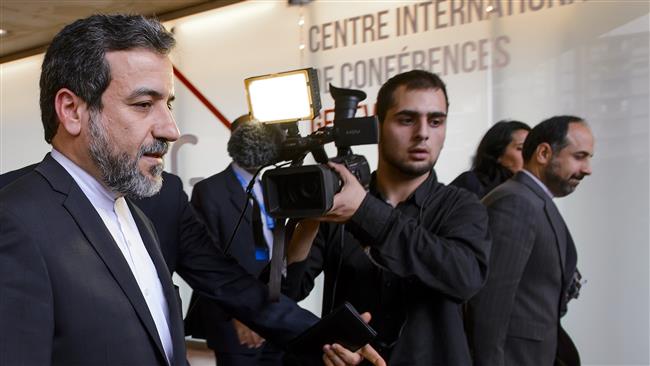
Seyyed Abbas Araghchi

Seyyed Abbas Araqchi, who is Iran’s deputy foreign minister for legal and international affairs and a negotiator at the talks, told IRIB News on Friday that bilateral and multilateral meetings are constantly being held between and among the delegations from the negotiating parties in the current round of the talks in the Austrian capital of Vienna.

He said Iran’s negotiating partners themselves sometimes hold different positions “on sensitive issues,” adding that it is difficult for them to reach a unified position.

“All in all, things are progressing hard and slowly,” the Iranian negotiator said.

Responding to a question about reports that 90 percent of the text of the possible deal has been completed, Araqchi said no figures and percentages can be provided at this time.

“As you know, there is a main text, and there are several annexes; work on each of these [texts] has proceeded on different percentages,” he said, explaining, though, that there has been more progress on the main text.

Araqchi also said that Iranian Foreign Minister Mohammad Javad Zarif will arrive in Vienna on Saturday to take part in the negotiations.

He also said the two sides currently have no plans to stretch the talks past the June 30 deadline. “An extension [of the talks] is currently not on our agenda.”

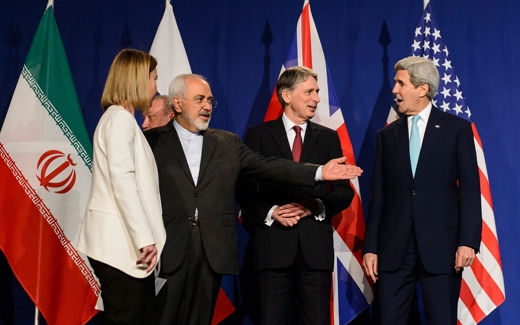
Iran and the P5+1 – the US, the UK, France, China and Russia plus Germany – are holding talks to finalize the text of a possible deal over the Islamic Republic’s nuclear program. The two sides reached mutual understanding on the key parameters of the potential deal in the Swiss city of Lausanne on April 2.

Meanwhile, a source close to the negotiations has said that US Secretary of State John Kerry, EU foreign policy chief Federica Mogherini, German Foreign Minister Frank-Walter Steinmeier, British Foreign Secretary Philip Hammond and French Foreign Minister Laurent Fabius will join the talks on Saturday.

However, there is no word yet on whether Russian Foreign Minister Sergei Lavrov and Chinese Foreign Minister Wang Yi will also be present for the talks on Saturday, according to the source.


A nuclear deal is certain to be clinched, says an expert

Iran nuclear deal

Faraji RaadAn Iranian expert in international affairs says that Iran and P5+1 will definitely strike a comprehensive final deal.

Abdolreza Farajirad, a former Iranian ambassador to Norway and Hungary, made the comment in an interview with fararu.ir on June 24 and added that the remaining obstacles which stand in the way and outside pressures by the Zionist and Arab lobbies can only delay the nuclear deal for a few days. The following is the translation of what else he said in the interview:

We are in the home stretch before the end-of-June deadline when intensive and prolonged nuclear talks are to come to an end, with sensitivity about the hurdles that lie ahead growing by the day.

Although there are concerns about such hurdles which come with the territory in any talks, I think the talks will eventually produce a result.

The two sides have managed to remove most of the obstacles during the previous rounds of talks with only one or two remaining. Differences over post-deal inspections [of Iran’s nuclear sites], especially access to undeclared sites among them military facilities, seem to be the major obstacle standing in the way of an agreement between Iran and P5+1 in the remaining time.

The two sides have so far managed to overcome serious and insurmountable obstacles and they [seem to] have the mechanisms available which could remove this obstacle [inspections of military sites] too.

If Iran and P5+1 fail to reach an agreement in the remaining days before the deadline over inspection of military centers, they can seriously think of a third way in order not to miss out on a golden opportunity that has opened up for striking a final deal.

Thanks to technological advances, there is no need for the physical presence of UN experts in the center(s) the International Atomic Energy Agency (IAEA) seeks to inspect. In other words, Iran can send its trustworthy individual – supported by electronic imaging devices [which are capable of scanning the location] – to military sites, for instance, and that individual can do the [environmental] sampling, obviating the need for the physical presence of IAEA inspectors.

This method can meet the demand of P5+1 on inspections of military sites on the one hand, and can take into account Iran’s considerations on the other.

There are ample solutions to remove the remaining obstacles to the conclusion of a final deal. The two sides can take heed of such solutions if they are really determined to have a comprehensive deal clinched in the final days [of nuclear talks].

That the two sides are standing their ground in the few days before the deadline and try to have their own views accepted by the other side is quite natural. In any talks which are held at an international level, each side tries to leave the negotiating table gaining more concessions.

Even insistence by the two sides in the eleventh hour [of the talks] seems unlikely to cause them to lose out on their chance of cutting a deal. In the end, either side will take at least one step back in order not to miss this opportunity and achieve a final comprehensive deal, although the conclusion of a deal may be postponed for a few days.

The remaining obstacles together with outside pressures, including obstructionist measures by the Arab and Zionist lobbies, can delay the conclusion of the final deal only for a few days.

Unlike the Arab lobby, the Zionist lobby has made sure that conclusion of a deal is definite thus the Zionists do not go to any extreme lengths – like what they did in the past – to affect the talks one way or another because they know that their struggles will have no effect on the firm decision of the two sides, especially the US.

That’s why the Zionist lobby has piled its pressure on the French to throw an obstacle in the way of the talks and has become dismayed by the US and what Washington can do to render a deal with Iran unachievable.

The Arab lobby, however, is still hopeful that it can derail the talks in the few days before the deadline by applying pressure on the P5+1 members, especially the French and the Russians, promising financial incentives and spending petrodollars.

Throwing money at problems cannot – both in the long- and medium- term – play a role in setting macro strategies and policies. The dollars the Arabs spend seem unlikely to be able to do something to prevent a definite Iran- P5+1 agreement from happening. Their money can only postpone the conclusion of this agreement a few days.

Iran police seize 135 tons of narcotics in three months

Iran's anti-narcotics police chief Ali Moayedi

Iran’s anti-narcotics police chief Ali Moayedi says around 135 tons of narcotics has been confiscated in the country in three months [March 21- June 21].

The general made the comment in a press conference on Wednesday and added that the number shows a 25 percent increase over corresponding period last year. The following is the translation of excerpts from his remarks as reported by the Islamic Republic News Agency (IRNA):

He said that the anti-narcotics police have confiscated all manner of drugs in border areas in Sistan and Baluchestan, Kerman and Hormozgan provinces, adding that part of the drugs has been seized before crossing the border into Iran.

The general further said that ten armed drug traffickers have been killed in police operations and 25 injured, adding police carried out more than 520 combat operations across the country in the three-month period, 41 percent growth over previous years.

Moayedi then put the number of dealers arrested in the first quarter of the Iranian year at more than 92,000, saying that the figure shows a two percent rise over the similar period in the year to March 21, 2015. He said that around 80,000 cases have been filed for the drug traffickers with the Judiciary in the same period, posting a four percent increase.

[…]

The anti-narcotics police chief went on to say that his forces have also captured a drugs smuggler who had been released on around $300,000 bail returning to the drugs trade. He said that the 40-year-old drug smuggler who had been sentenced to life imprisonment was rearrested in Tehran along with his brother a few days ago in possession of 115 kg of heroin.

[…]

A look at Iranian newspaper front pages on June 25

Iranian Newspapers Headlines

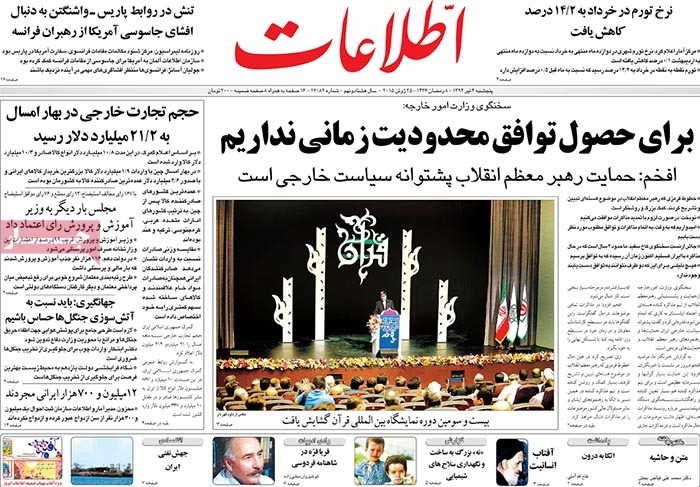
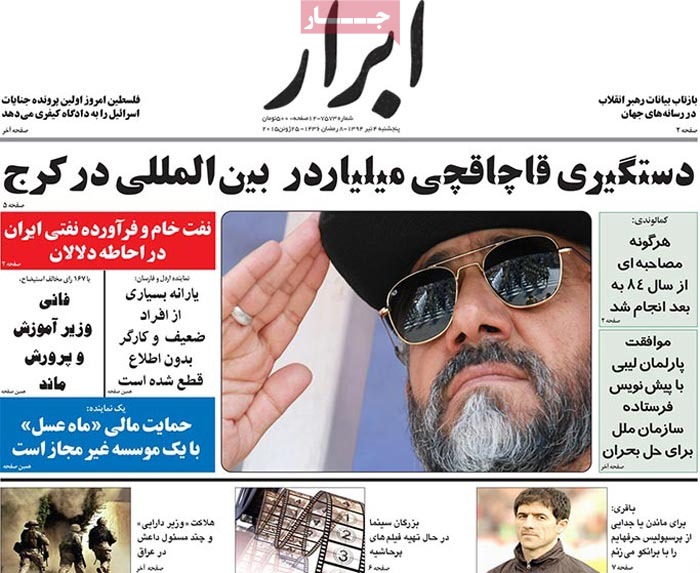
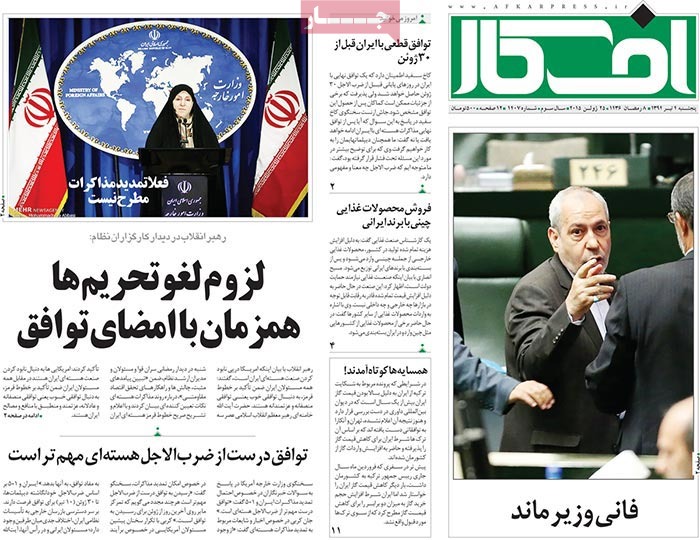
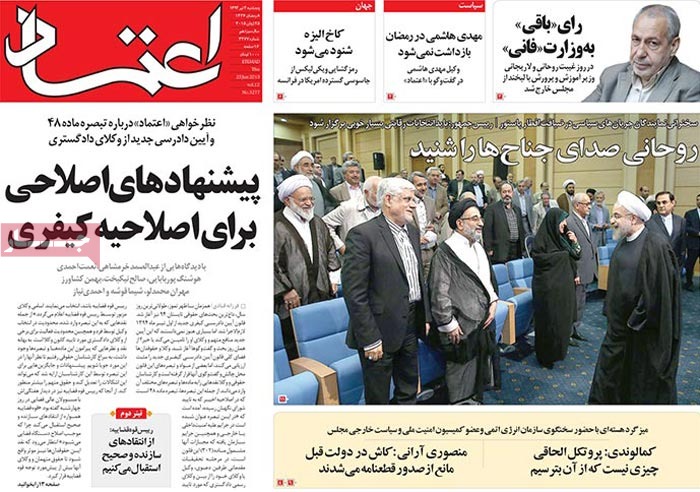
Another vote of confidence by the Islamic Consultative Assembly to Education Minister Ali Asghar Fani at the close of his impeachment hearing dominated the front pages of Iranian newspapers on Thursday. Also in the news were the comments of Foreign Ministry Spokeswoman Marzieh Afkham on the home stretch of the nuclear talks between Iran and P5+1.


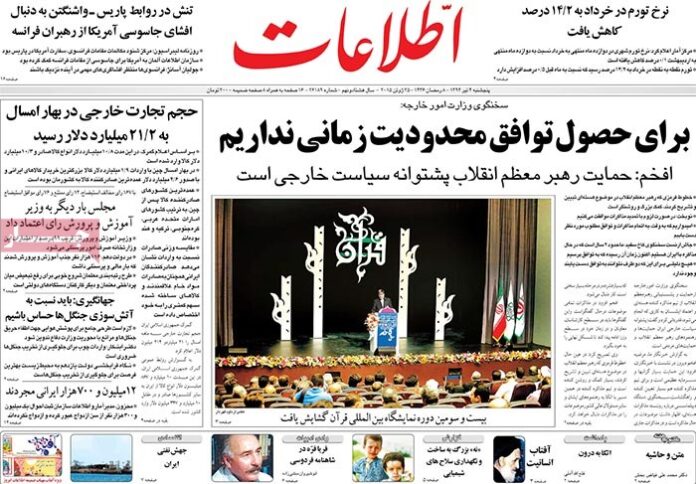
Ettela’at: “To reach a [nuclear] deal, we don’t face time constraint,” Iranian Foreign Ministry Spokeswoman Marzieh Afkham said.

She further said that the support of the Supreme Leader is an asset to the country’s foreign policy.


Abrar: A billionaire international drug trafficker has been arrested in Karaj.


A look at Iranian newspaper front pages on June 25


Afkar: “Extension of nuclear talks is not on the table yet,” said the Iranian Foreign Ministry spokeswoman.


A look at Iranian newspaper front pages on June 25


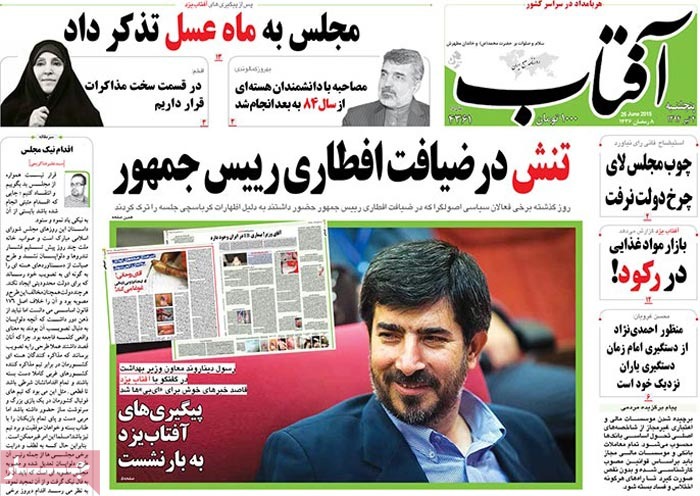
Aftab-e Yazd: “Interviews with nuclear scientists started in 2005,” said the spokesman of the Atomic Energy Organization of Iran.

Aftab-e Yazd: “We are at a difficult stage of nuclear talks,” said Foreign Ministry Spokeswoman Marzieh Afkham.

Aftab-e Yazd: Tension in the Iftar banquet of the president.

A number of principlists walked out when [former Tehran Mayor Gholamhossein] Karbaschi made comments.


A look at Iranian newspaper front pages on June 25


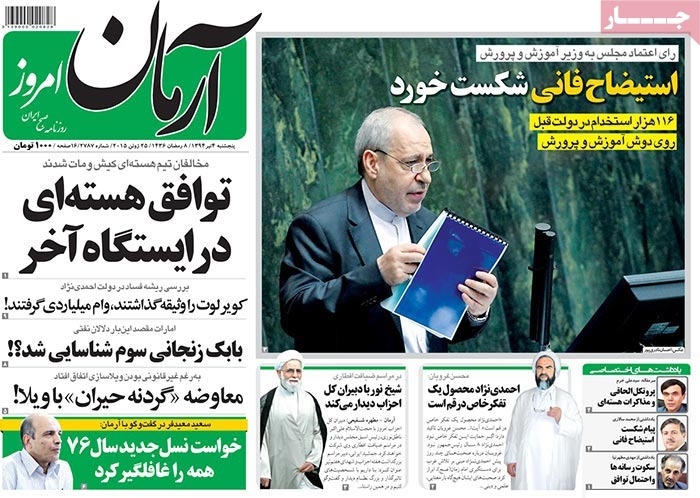
Arman-e Emrooz: Nuclear talks are in home stretch; the opponents of the nuclear team have been overwhelmed.

Arman-e Emrooz: The impeachment of the education minister failed.

That the previous government hired 116,000 new personnel has placed a burden on the shoulders of the ministry.


A look at Iranian newspaper front pages on June 25


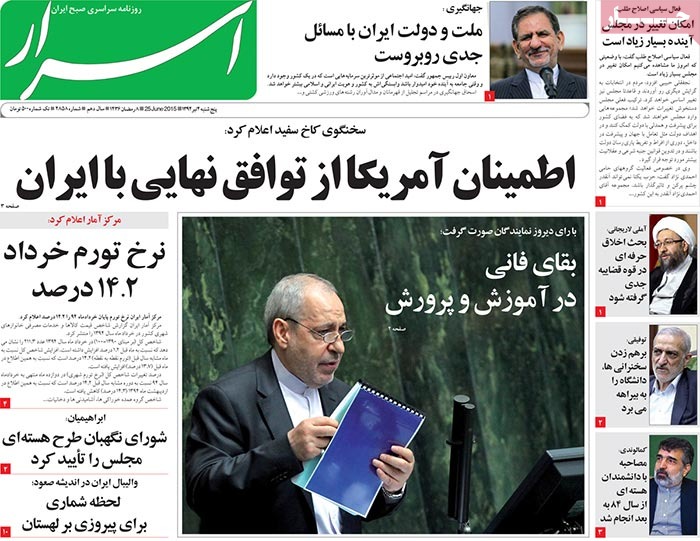
Asrar: The Guardian Council has approved the parliamentary act that calls for protection of the nuclear achievements of the nation.


A look at Iranian newspaper front pages on June 25


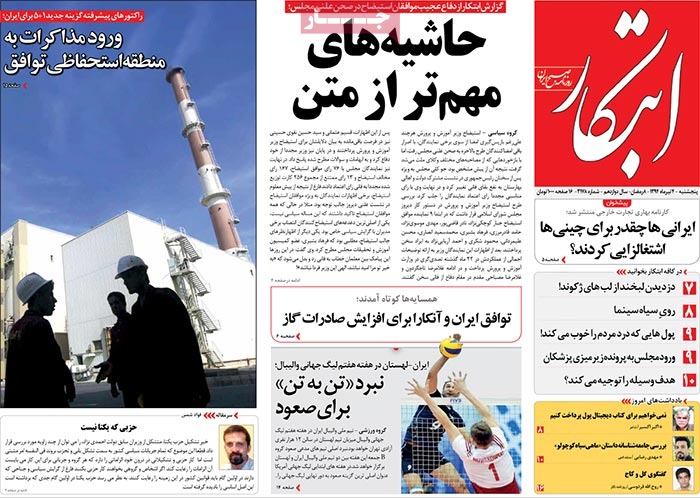
Ebtekar: Tehran and Ankara have agreed on an increase in Iran’s exports of natural gas to Turkey.

Ebtekar: Hand-to-hand combat to advance to the next round [of the FIVB World League]

Iran will line up against Poland at Tehran’s Azadi Arena on Friday.


A look at Iranian newspaper front pages on June 25


Etemad: President Rouhani listened to the voices of political factions at an Iftar banquet he hosted.

In the ceremony, the president called for the upcoming parliamentary elections to be very competitive.

Etemad: The spokesman of the Atomic Energy Organization of Iran and a member of parliament’s National Security and Foreign Policy Committee have taken part in a nuclear roundtable.

Kamalvandi: The Additional Protocol is nothing to be afraid of.

Mansouri Arani: I wish the previous government had prevented the release of [anti-Iran] resolutions.


A look at Iranian newspaper front pages on June 25


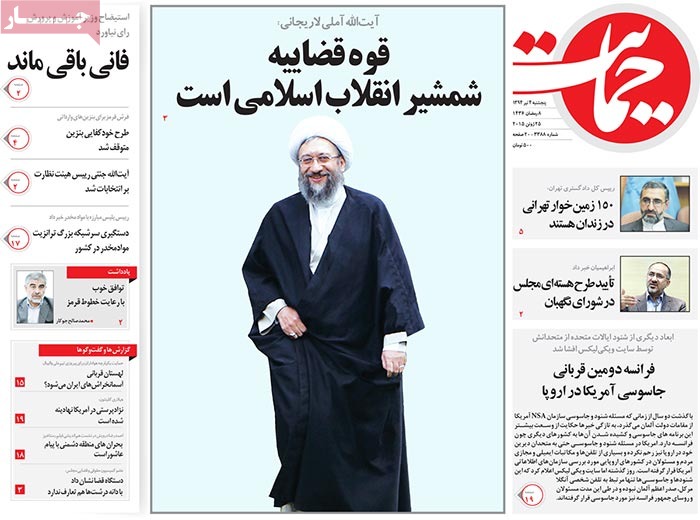
Hemayat: Ayatollah Ahmad Jannati has been named as chairman of the Election Supervision Board.

Hemayat: “Some 150 land-grabbers are in jail,” said the head of Tehran Justice Department.


A look at Iranian newspaper front pages on June 25


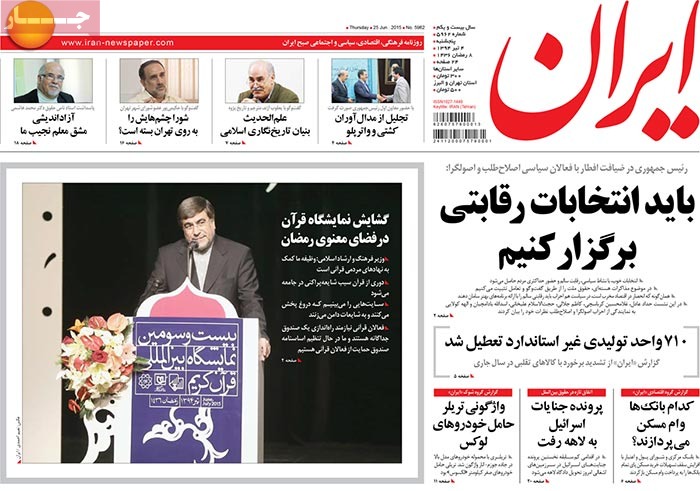
Iran: An international Koranic Exhibition has opened in Tehran, with the minister of culture and Islamic guidance delivering a keynote speech.


A look at Iranian newspaper front pages on June 25


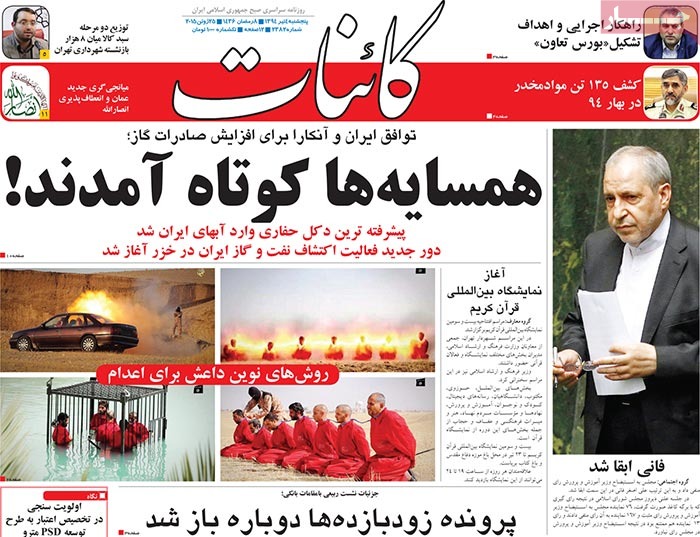
Kaenat: Police have seized more than 135 tons of narcotics in the three months to June 21.


A look at Iranian newspaper front pages on June 25


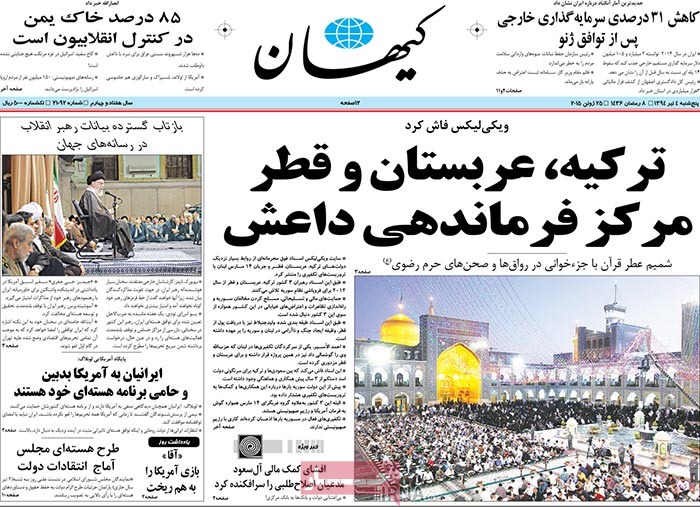
Kayhan: Foreign investment in Iran has dropped 31 percent since the Geneva Agreement.


A look at Iranian newspaper front pages on June 25


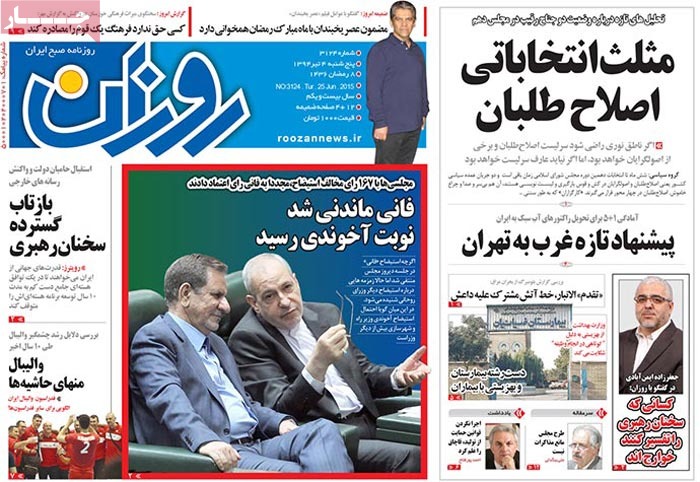
Roozan: Fani has been reinstated as education minister; it is now [minister of roads and urban development Abbas] Akhoundi’s turn to be impeached by parliament.


A look at Iranian newspaper front pages on June 25


Highlights of Ettela’at newspaper on June 25

Ettelaat-daily-25-june

 “To reach a [nuclear] deal, we don’t face time constraint,” Iranian Foreign Ministry Spokeswoman Marzieh Afkham said.

She further said that the support of the Supreme Leader is an asset to the country’s foreign policy.

♦ Inflation rate in the month to June 21 fell to 14.2 percent.

 Following revelations [by WikiLeaks] that the US has spied on French leaders, relations between Paris and Washington have been strained.

The founder of the whistleblower website has said that the French should wait for more important revelations in the future.

 Iran’s foreign trade in the spring rose to $21.2 billion.

During the three-month period, Iran exported $10.8 billion in various goods and imported $10.3 billion.

 Parliament has given another vote of confidence to the education minister.

In his speech before parliament, Ali Asghar Fani said that the bulk of his ministry’s budget goes to personnel affairs, blaming the large number of employees hired when the 10th government was in office.

♦ The first vice-president has urged officials to be more sensitive to bushfires.

His comments came as the director of the Environment Protection Organization said to prevent the destruction of forests, imports of timber is a necessity.

 Some 12.7 million Iranians are single.

An official with the National Organization for Civil Registration has said that some 1.2 million individuals have passed the age of marriage and [are unlikely to get married ever].

 Ocalan’s niece enters Turkish parliament

When diplomacy serves the cause of development (PART THREE)

Mohammad Javad Zarif

Iran’s foreign minister says nuclear talks are very much likely to continue past the end-of-June deadline. Mohammad Javad Zarif made the comment in an interview with Donyay-e Eghtesad’s Ehsan Abtahi and Hadi Khosro-Shahin on June 18.

In the interview the top diplomat said an ideals-based foreign policy does not run counter to a foreign policy of which national interests are the cornerstone. He added what makes a country successful on the international stage is its ability to render its ideals into international norms.

“Diplomacy is the art of advancing a country’s interests at the lowest cost. Foreign policy should serve the cause of development, rather than being a burden on a country’s development drive,” he said. The following is PART THREE of the translation of the interview:


Does the enhanced access, which has been included in the Lausanne statement, go beyond the Additional Protocol?

Iran is a signatory to the Safeguards Agreement. If a deal is to be clinched, we are expected to opt for the Additional Protocol which is an optimal international mechanism. What they [the Western nations] say does not matter, what will be done will be within the framework of international rules.


Does it mean that Iran’s nuclear case will be dealt with as a normal case within the framework of the Safeguards Agreement after the conclusion of a deal? Or will Iran be treated as a special case when it comes to inspection and verification [of its conformity with internationally recognized principles]?

I do not want to talk about the details of the events that unfolded in the past. In September 2003, the IAEA described Iran’s case as a special one. In November 2004, the agency announced that the special case is moving toward settlement. Once again in November 2011, the agency and its Board of Governors identified Iran’s case as a special one. These are the changes. I hope the measure [a reference to nuclear talks] Iran has taken can see the country’s dossier treated as a normal case.


Earlier you said in an interview that after the conclusion of a deal, a new resolution should be issued within the framework of Chapter VII of the United Nations Charter. Given that resolutions cover many issues, among them nuclear questions and missile capabilities, what is expected to be included in the new resolution? Will Iran’s missile program be included in the new resolution?

I believe that the question of missile [capabilities] has nothing to do with Iran’s nuclear case. We have always said that the question of Iran’s defense is separate from the talks. The question has yet to be settled and we are still negotiating. It is good to know that Resolution 1696, which was the first resolution issued against Iran, came under Article 40 of Chapter VII [of the Charter of the United Nations]. Resolutions 1737 to 1929 – namely Resolutions 1737, 1747, 1803, 1835 and 1929 – have all been issued under Article 41 of Chapter VII.

Article 41 authorized the UN Security Council to apply economic pressures [The Security Council may decide what measures not involving the use of armed force are to be employed to give effect to its decisions, and it may call upon the Members of the United Nations to apply such measures. These may include complete or partial interruption of economic relations and of rail, sea, air, postal, telegraphic, radio, and other means of communication, and the severance of diplomatic relations].

For about eight years, Iran’s case has been under review within such a framework. Removal of the sanctions against Iran should come within the framework of the same Article [41 of Chapter VII]. Under Article 41, there is no other option but to have a new resolution issued so that unjust sanctions against Iran can be removed and unjust resolutions issued against Iran can be nullified. Talks are still ongoing on how to make such a decision and what can be included in such a resolution.


Think tanks such as The Washington Institute [for Near East Policy (WINEP)] have released articles some of which read Mr. Obama will have at least one year after the conclusion of a comprehensive deal to show to the US Congress and those in Iran opposed to a nuclear deal whether or not Iran is committed to the verification process. These think tanks say that Obama needs between six months and a year to convince opponents of a deal that Iran’s sanctions will be lifted gradually. How long have you considered for sanctions to be removed?

This is a misinterpretation, I think. Unfortunately some interpretations are far from correct. What has really happened during the talks is being reversed, but what matters here is that Mr. Obama will remain the US president no more than one year after the nuclear deal is implemented. During this period, he can show that things are progressing smoothly – just like the proper implementation by Iran of the Geneva agreement, for instance – and thus build more trust in the ranks of opponents.

During his presidency, Mr. Obama can make sure that Iran is implementing the agreement and sell it to the opposing party. This does not mean that a long time is needed for sanctions to be lifted. Sanctions should be lifted immediately after the implementation of the agreement.


Lifted or suspended?

Lifted. What the US laws says is not our concern. The US administration should stop implementing the sanctions. This is the term used in the agreement: it needs to stop the implementation of sanctions. We do not want to get involved in political bickering inside the US. We hold the US government responsible and do not care what happens in Congress or what the president does. The US president is constitutionally authorized to stop the implementation of these sanctions.

If a deal is clinched, the domestic responsibility of the US president will be seen as the president’s international responsibility. Thanks to the ongoing talks and the comments which have been made [by those involved] we can make sure that such a measure [to stop the implementation of sanctions] by Obama will be the commitment of the US administration, the result of which would be: no sanctions will be slapped on anybody [or any nation].

You said if a deal is clinched, does it mean that a deal could be unachievable? Is it likely for the agreement to elude us?

An agreement could be unattainable as long as it is not announced.


Mr. Rouhani has recently said that an agreement is within reach.

For sure it is within reach. You know a deal is accessible providing that the other side comes to terms with realities and does not make acquisitive demands. Talks would have been unnecessary if I had been able to say that an agreement would definitely be clinched.

Does the other side still make acquisitive demands?

Iran does not make such demands, but the other side does. It has always made acquisitive demands and is now asking for excessive things, but we prove that Iran will stand up to acquisitiveness. From day one we showed our opposition and we will continue to do so. The frameworks we set on day one are the frameworks we are offering today.


Mr. Obama has recently said in an interview that he has a “personal interest” in making sure world powers and Iran could reach a deal. It means he has personal reasons for this [a deal]. The US administration seems very interested in inking such a deal, but many are concerned that the deal could be fragile citing that the Obama administration will be replaced possibly by a Republican government. They are not hopeful about the future and are very concerned about the fragility of a deal. Where do you stand on that?   

I’m sure if a deal is clinched, no governments in the US can violate that, and if they violate the deal, nobody around the world cares. We should not forget the fact that when the US government was much powerful than today – in the 1990s – it imposed extensive unilateral sanctions against Iran, but even its closest allies failed to implement those sanctions [back then].

Unfortunately today the US administration has managed to include the unjust sanctions in the UN Security Council resolutions. When there is a deal, no sanctions can be included in the UN Security Council resolutions; if so, the US government would be violating the Security Council resolution. I’m sure this will not happen, and if it does it will not affect economic players. I predict with absolute certainty that if we can reach a deal, the next US government cannot violate it, and in case Washington violates such a deal, it will have no bite.


How likely do you think it is for the talks to be extended? Another question on the discrepancy between a foreign policy based on idealism and one based on national interests: You’ve written in your book that all countries have ideals in their foreign policy, but the fact of the matter is that they need to create [and adopt] norms; in other words, they need to turn their ideals into norms on the world stage. How successful have we been in turning our ideals into norms globally? 

When it comes to extension [of the talks], I believe that a good agreement should be struck. We feel no strain because of time constraints. The Americans have limited time based on the congressional bill, but Iran does not. If we reach an acceptable agreement, everything will be ok, if not we can continue [the talks]. I do not think an extension is our option, but we may need more time to reach an agreement.


How likely is it for the talks to drag on?

Maybe we may need a few days more than the July 1 [deadline]. I did not agree to the extension of talks even in November and said we needed to continue the talks. When we extend the talks, everybody waits for the final weeks to focus on the topic of the talks. In Lausanne, efforts were stepped up three weeks to go before the deadline.

Once again one month and a half was wasted; of course, we are not to blame for that. It was like cramming on the eve of an exam. We want to continue [the talks] until we reach results. I think it is a better way than extending the talks. Extension has not been a good option in any round of the talks. We have time and we need to seize this opportunity. If no deal is clinched by July 1, it could happen on July second or third, anytime we can reach a reasonable agreement.

Iran’s Guardian Council approves bill on protection of Iranian nuclear achievements

Nejatollah Ebrahimian

Iran’s Guardian Council has approved a bill that stipulates all sanctions imposed on Tehran over its nuclear program must be lifted as soon as a nuclear deal with P5+1 comes into effect.

The spokesman of the Guardian Council said Wednesday that the bill, which gained the yes vote of the Iranian lawmakers a day earlier, was “extraordinarily” discussed and gained the required approval from the supervisory body.

Nejatollah Ebrahimian told the Iranian national TV that the bill, with a majority of votes, was not identified as contrary to the Constitution.

During an open session of the Iranian Parliament on Tuesday, 214 of 244 lawmakers voted in favor of the single-article bill, which imposes some restrictions on how the representatives of the International Atomic Energy Agency (IAEA) could inspect Iran’s nuclear sites after a deal is reached between Tehran and P5+1 on the Iranian nuclear program.

The bill also demands that all sanctions imposed on Iran over its nuclear program be lifted as soon as one such deal comes into effect.

The Iranian administration, which currently represents Iran in the nuclear negotiations, should not accept any restrictions on the country’s research and development of nuclear technology for peaceful purposes, the bill stipulates.

According to the bill, any final nuclear agreement with the six world powers will be valid only if the stipulations in the bill are complied with.

Iran’s parliament had passed the general outlines of the bill on Sunday.

Representatives of Iran and P5+1 – the United States, Britain, France, China and Russia plus Germany – have been negotiating to finalize the text of a deal over the Islamic Republic’s civilian nuclear program.

Under the Iranian Constitution, the Guardian Council, a 12-member body consisting of six legal experts and six Islamic jurists, is tasked with vetting legislative and presidential candidates, supervising elections and overseeing the bills passed in parliament for conformity with Islamic principles.