Thursday, December 25, 2025
Home Blog Page 4822

To curb US-made terrorism requires int’l cooperation: MP

Boroujerdi-Korea

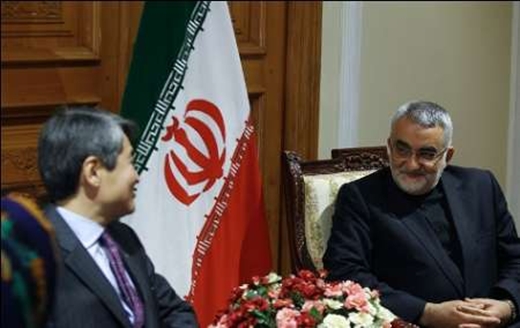
Chairman of Parliament’s National Security and Foreign Policy Commitee Alaeddin Boroujerdi said the US and its allies made a big mistake by supporting terrorist groups in the Middle East and curbing these groups now requires international cooperation.

He made the remarks in a meeting on Saturday with the visiting South Korean Vice Foreign Minister Cho Tae-yong during which the MP said Tehran and Seoul have the potential to upgrade their bilateral relations.

Boroujerdi said Iran and South Korea can build on their high-level parliamentary and executive contacts and extend it to promotion of trade, cultural and scientific cooperation.

The lawmaker referred to the high standard of human rights in Iran compared to other countries in the region and said basic rights of women are violated in many countries.

He also condemned recent terrorist attacks in Kuwait, Tunisia and France and said such incidents show that terrorism remains a grave threat to global peace and tranquility.

He also slammed the Saudi-led air raid aggression on neighboring Yemen and said killing civilians, including children and women, is condemnable.

The South Korean official said the purpose of his visit to Iran is consultation on activating potential bilateral cooperation areas.

Cho welcomed expansion of ties in cultural, arts and scientific areas and said his respective country believes that on human rights issue, each country’s traditions and customs should be regarded separately and not treated with similar standards.

He agreed with the Iranian position that the IS terrorist group has to be fought based on international cooperation and said South Korea supports humanitarian assistance to Syria.
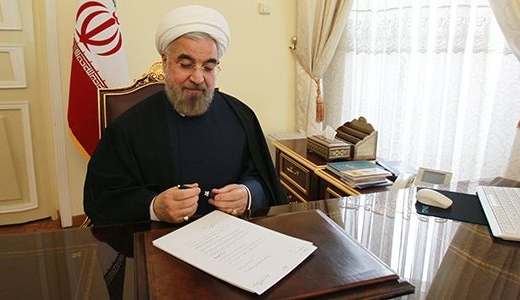
President Rouhani slams attack on Kuwaiti Shia mosque

President Rouhani Invites Malaysian King to Visit Iran

Iranian President Hassan Rouhani has slammed Friday’s terror attack on a Shiite mosque in Kuwait which claimed the lives of more than two dozen people.

The Iranian president hit out at the attack on Imam al-Sadeq Mosque in a letter of condolences to Kuwaiti Emir Sheikh Sabah al-Ahmad al-Jaber al-Sabah on Saturday.

At least 27 people were killed and over 220 more injured when an explosion rocked the mosque in Kuwait City’s busy al-Sawabir district.

A Saudi national is reportedly being held responsible for the attack and several suspects have been detained by police for questioning over the bombing which was claimed by the ISIL terror group.

Rouhani offered condolences to the Kuwaiti emir, government, and people, and said the world can build on the teachings of Islam as well as public participation, increased efforts, and cooperation to eradicate terrorism and violence and allow security and peace to prevail in the region.

Iran’s Foreign Ministry Spokeswoman Marzieh Afkham said earlier in the day that three Iranians were killed and several injured in the terrorist attack on the Kuwaiti mosque.

Kuwait declared a national day of mourning Saturday and held a mass funeral for the victims of the attack.

Such actions in a place of worship during the holy month of Ramadan are designed to defame Islam and to create division among Muslims, President Rouhani noted.

Leader slams US over terrorism against Iran

Leader

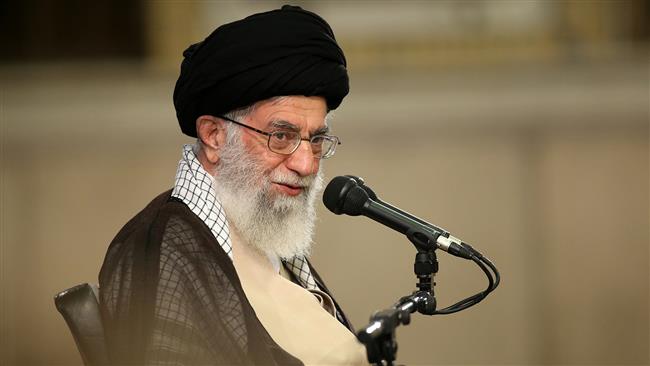
Leader of the Islamic Revolution Ayatollah Seyyed Ali Khamenei has slammed the US and its allies for carrying out terrorist attacks against Iranians in the past.

In a speech in the presence of the families of Iranian martyrs in Tehran on Saturday, the Leader said the shooting down of a passenger plane in 1988 was one of the acts of terror the US committed against Iran.

Ayatollah Khamenei said knowing one’s enemies is one of the crucial requirements of the current era and warned against attempts to whitewash the crimes of the enemies.

“Those who want to cover up the evil enmity of the US and some of its allies through media and propaganda ploys are in fact betraying the nation and state,” the Leader said.

“Through awareness of the extent of the enemy’s hostility, the Iranian nation should be prepared to confront and counter [its plots] in the soft war arena, such as in cultural, political and social spheres,” the Leader said.

Velayati: Stop supporting terrorist, Takfiri groups

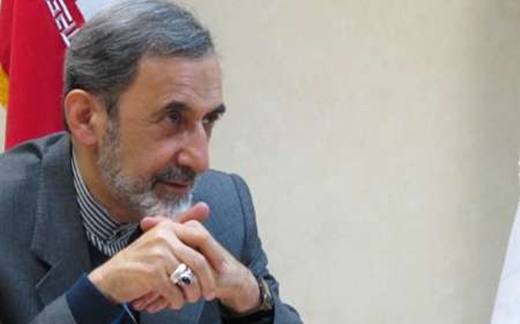
Velayati

Head of the Expediency Council’s Strategic Research Center, Ali-Akbar Velayati, said in Tehran on Saturday that countries supporting the terrorist and Takfiri groups should immediately end their support.

‘A day will come when the terrorist and Takfiri groups turn against their own supporters; the countries (supporting the groups) should stop their support as soon as possible,’ Velayati told South Korea’s Vice Foreign Minister Cho Tae-yong.

Velayati said that Tehran expects Seoul to warn countries that support terrorist groups that terror acts by Takfiri groups will backfire on their supporters in the future.

He said ISIL group is one of the most dangerous Takfiri groups and a threat to all countries and all people, including Christians, Muslims, Buddhists and Jews.

Velayati pointed to the dark record of ISIL terrorist group in Syria and said ISIL has turned Syria into a test ground for its terrorist operations and today in Syria it does not show mercy on anybody, including women, men and civilians.

For his part, Cho Tae-yong said that exchange of meetings between Iranian and South Korean officials will be effective in expansion of bilateral relations.

He said Iran and South Korea have had positive, durable and constructive relations since 1962.

He noted that he sought further expansion of Iran-South Korea relations, believing that the world’s future depends on cooperation among important countries.

Cho is the first South Korean vice foreign minister to visit Iran in a decade.

[…]

Iran gives Venezuela $500 million credit line

Venezuela

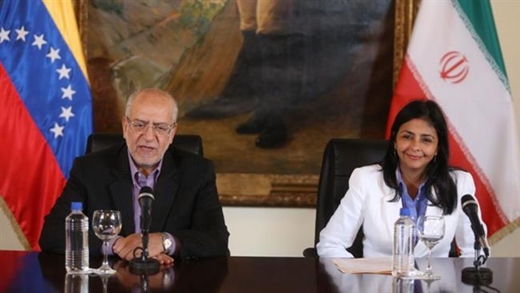
Iran has agreed to a $500 million credit line for Venezuela to finance joint investments there, President Nicolas Maduro has announced.

He made the announcement after meeting Iranian Minister of Industry, Mine and Trade Mohammad Reza Nematzadeh in Caracas where the two sides signed six agreements to expand financial, economic, industrial and technological cooperation.

Among the agreements, there are plans for joint production of commodity goods, including detergents and other hygiene materials in Venezuela and Iran’s sales of medical drugs and surgical equipment to the country.

Maduro said the two countries had also agreed to a “comprehensive plan” to develop a joint program in nanotechnology in which Iran is among the top seven world countries.

He said the deals would ensure a higher level of cooperation and deepen the bonds between the two nations.

Moreover, Iran agreed to transfer its expertise to Venezuela in combating an “economic war” on the Latin American country, Maduro said, apparently referring to Iran’s experience in facing years of US-led sanctions.

“We are facing an economic war of monumental proportions; a brutal war (but) we are here attending to our people,” Maduro said as he invoked the vision of the late President Hugo Chavez for “the government’s union with the people and struggle against imperialism”.

The Venezuelan head of state also hailed relations with Iran as “an example of alliance between two brother nations”.

“Today we have mutual trust in our relations and we work together with results. Working with Iran has gone well and our cooperation has been a great success since Hugo Chavez began a strategic alliance and brotherhood with Iran,” Maduro said.

Relations between Iran and Venezuela — both critics of US policies — have expanded in recent years. Iran is involved in a series of joint ventures worth several billion dollars in energy, agriculture, housing, and infrastructure sectors in Venezuela.

Iran’s main industrial projects in Venezuela include a car assembly plant, a tractor manufacturing complex and a cement factory.

The Islamic Republic has also built more than 3,000 residential housing units for less privileged citizens in Venezuela, with 7,000 more to be completed.

Both countries are hugely rich in resources. Venezuela possesses the world’s biggest oil deposit while Iran owns the fourth largest oil and first largest gas reserves of the world.

Maduro has announced his intention to visit Tehran to attend a summit of Gas Exporting Countries Forum planned for Nov. 23.

Iranian Minister Deplores Minimal Int’l Cooperation in Combating Drugs

Rahmani Fazli

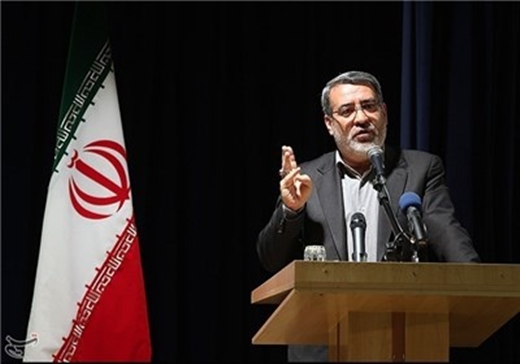
Iranian Interior Minister Abdolreza Rahmani Fazli expressed regret that the international cooperation with the Islamic Republic in the war against illicit drugs has remained at its minimal level.

Speaking at a ceremony marking the International Day against Drug Abuse and Illicit Trafficking on Saturday, Rahmani Fazli pointed to Iran’s proximity to Afghanistan, which produces 80 percent of the world’s traditional narcotics, and said being a neighbor to the country is one of the root causes of the spread of illicit drugs in Iran.

“Unfortunately, (international) cooperation with Iran in the fight against narcotics is at the lowest,” the interior minister said.

He further emphasized that if the international bodies and other countries cooperate with Iran, the campaign against illicit drugs will definitely reach its objectives.

In recent decades, Iran has been hit by drug trafficking, mainly because of its 936-km long border with Afghanistan, in which more than 90% of the world’s opium is produced.

According to the UN Office on Drugs and Crime, the Islamic Republic is netting eight times more opium and three times more heroin than all other countries in the world combined.

The war on drug trade originating from Afghanistan has claimed the lives of nearly 3,700 Iranian police officers over the past 30 years.

Iran building major port near Hormuz Strait

Hormuz Strait

Iran is building a multi-purpose port near the Strait of Hormuz with 700 million euros of foreign investment, the state news agency IRNA reported on Thursday.

The new port on the shores of Suza on the Qeshm island “will definitely become a shipping hub for international trade and transit”, deputy head of the Qeshm Free Zone Organization Farzin Haqdel said.

The Qeshm island on the Persian Gulf lies along the North-South Transport Corridor which provides a rail, road and sea route for moving freight across Iran, Pakistan, India, Russia, Central Asia, the Arabian Peninsula and Europe.

“The new port in Suza can turn into one of the biggest and most discussed international ports in the world due to many advantages it has, including a draught of 50 meters,” Haqdel said.

The draught in the coastal city of Suza is such that it can naturally accommodate very large bulk and crude carriers, which is a huge advantage in international shipping, he said.

The Strait of Hormuz is the world’s most important oil route, providing passage to over 33% of all seaborne traded oil. More than 17 million barrels of oil and oil products are shipped through the passage daily. The narrow strip of water in the Iranian territories links big oil producers such as Saudi Arabia to the Gulf of Oman and the Arabian Sea.

Foreign interest is rising in Iran’s southern shores. India is developing the port of Chabahar through building multi-purpose container and cargo terminals in order to open a route to Central Asia.

Iran and Central Asian nations have also stepped up work on establishing an integrated freight railway network to link Asia to the Persian Gulf, Europe and Africa.

Earlier this month, head of Kazakhstan’s national railway company Askar Mamin visited Iran’s Shahid Rajaee and Bandar Abbas ports.

Head of the Islamic Republic of Iran Railways (IRIR) Abbas Nazari said the Kazakhs were interested in investing in Bandar Shahid Rajaee for construction of silos in order to store their wheat crop in the port and facilitate shipment.

Last week, the first cargo carried on the Silk Road railway entered Iran from Kazakhstan in a boost to China’s ambitious plan to revive the ancient route.

Haqdel said Qeshm’s advantages and potential in trade and industry have led to a flow of foreign investment in infrastructure which will transform the island’s face in the near future.

Nuclear deal possible if other side stops excessive demands: Zarif

Iran-Zarif
Iran-Zarif

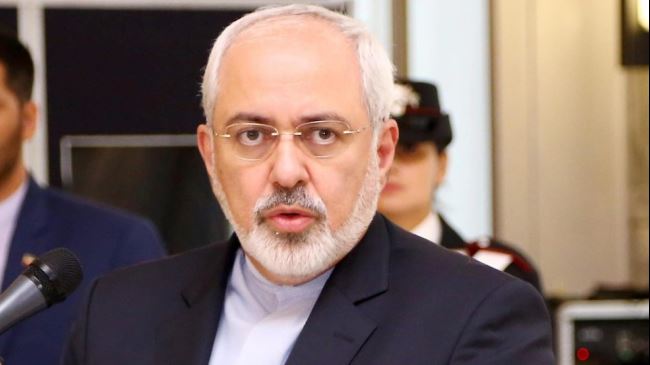
Foreign Minister Mohammad Javad Zarif said it is necessary that the other side in nuclear talks ‘accept the realities’, adding that if they recognize the rights of Iranian people and stop excessive demands, then a nuclear deal would be within reach.

Upon arriving in Vienna on Saturday morning, Zarif said the other side should fulfill all of its commitments on lifting the sanctions.

Expressing hope that reaching a good deal is possible, Zarif said, ‘We’ve come to Vienna to strike an agreement within the next few days, although time is not important and a good deal is more important than a deadline.’

Zarif is in Vienna to be part of the final stage of nuclear talks between Iran and six world powers (US, Britain, France, Russia, China, and Germany). The two sides have planned to sign a comprehensive agreement by June 30, to end a long dispute on Iran’s nuclear activities.

US Secretary of State John Kerry is scheduled to confer with Zarif later on Saturday.

AIIB can be instrumental in Asian development projects: Economy minister

Ali Tayyebnia

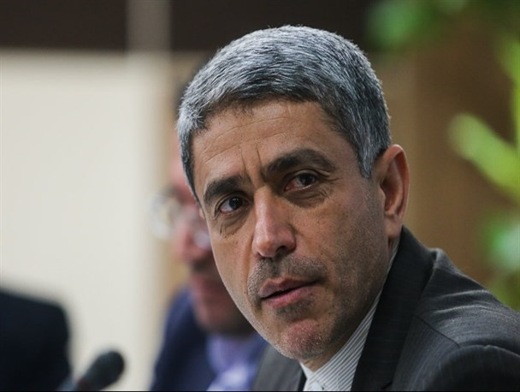
Iranian Minister of Economy and Financial Affairs Ali Tayyebnia said the Asian Infrastructure Investment Bank (AIIB) can play a very important role in bankrolling infrastructure projects across the Asian continent.

According to Economic and Finance News Network of Iran, upon arrival in the Chinese capital to sign the documents of the newly-founded bank, the Iranian economy chief told reporters that the bank’s Articles of Association is expected to be signed by its founding members. “That would open a new chapter in the activities of the Asian Infrastructure Investment Bank.”

He went on to say that as a founding member of the Asian Infrastructure Investment Bank, Iran tries to “play an effective role” in the activities of the bank.

He concluded that the Asian Infrastructure Investment Bank can complete the activities of other banks when it comes to financing development projects.


57 countries join the Asian Infrastructure Investment Bank

The Asian Infrastructure Investment Bank is the first international banking system in Asia and the following countries have officially joined it: China, India, Malaysia, Indonesia, Singapore, Thailand, Kazakhstan, Saudi Arabia, Kuwait, Oman, Qatar, Brunei Darussalam, Cambodia, Laos, Myanmar, the Philippines, Vietnam, Mongolia, Uzbekistan, Nepal, Sri Lanka, Bangladesh, Pakistan, the Maldives, New Zealand, Jordan, Tajikistan, Luxemburg, Switzerland, Britain, Australia, Austria, Brazil, Denmark, France, Germany, Italy, the Netherlands and Spain.

Iran’s membership of the bank is in line with measures to realize the principles of the resistance-based economy by effectively tapping into the potential of regional and international economic organizations and promoting a more prominent role of nations in the region’s economy.

China first proposed the formation of the Asian Infrastructure Investment Bank in 2013. The seed money of the bank stands at $50 billion to be provided by member states.

Some 75 percent of the bank’s capital is to be provided by Asian nations and the remaining 25 percent by non-Asian countries. The share of each country’s contribution to the bank’s capital depends on its GDP.

Chinese officials say the Asian Infrastructure Investment Bank has been established to compensate for the shortage of credit for investment in Asian development projects and is in line with China’s new economic strategies and policies to interact with fellow Asian nations, especially those of Central Asia.

The Asian Infrastructure Investment Bank is not to serve as a rival for other regional and international banks; rather, it is meant to supply the capital that cannot be provided by other banks such as the Asian Development Bank (ADB). That is why the chairmen of the World Bank and ADB have welcomed its establishment and have signaled readiness to cooperate with it.

A look at Iranian newspaper front pages on June 27

Iranian Newspapers Headlines

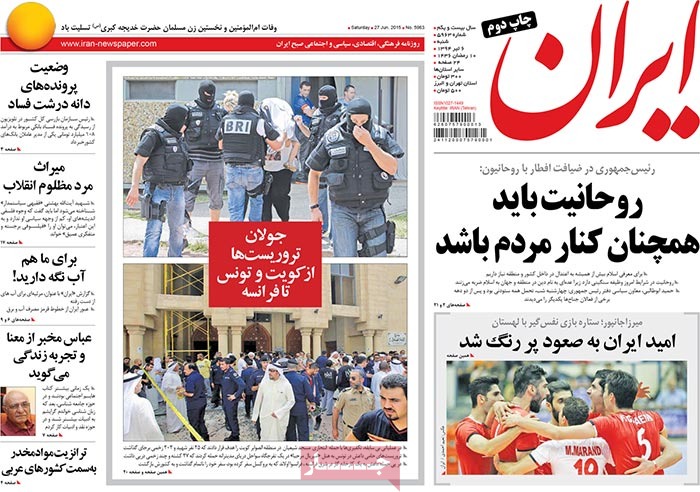
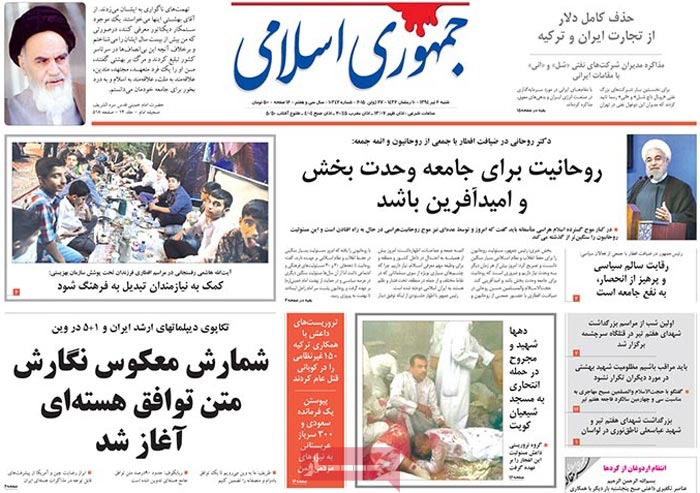
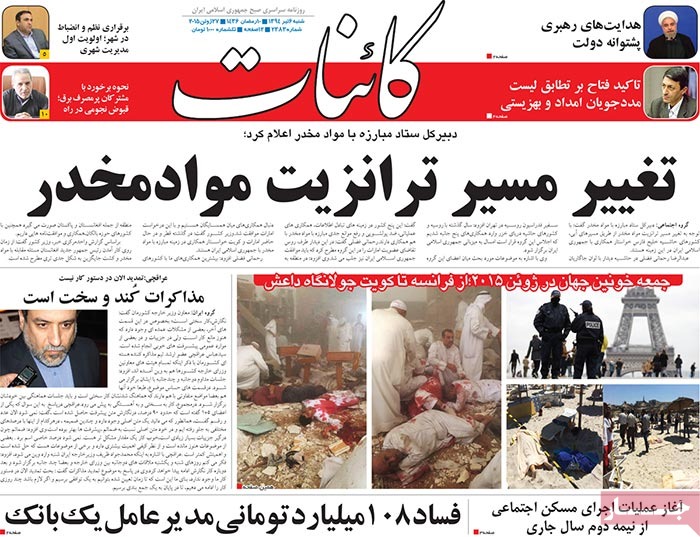
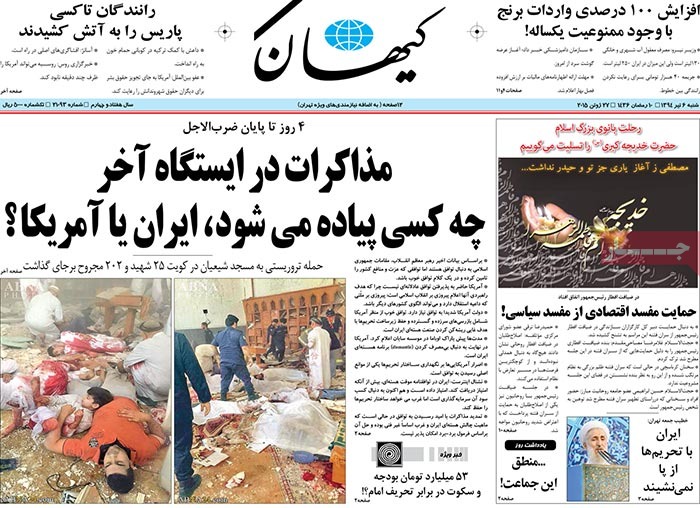
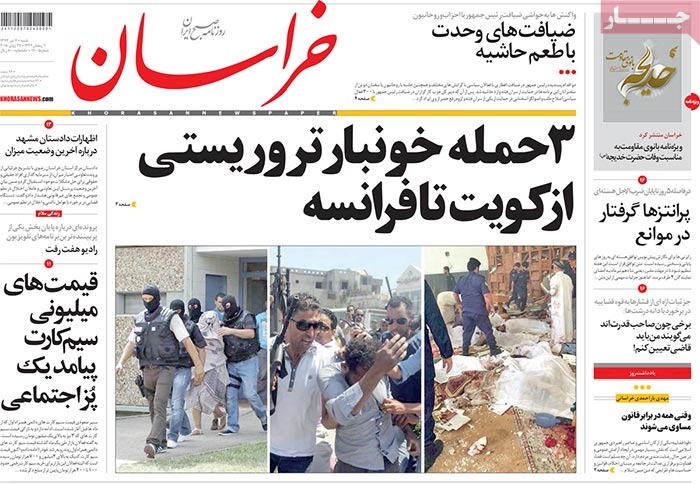
Terrorist attacks in Kuwait, Tunisia and France which claimed scores of lives dominated the front pages of Iranian newspapers on Saturday. The comments of Foreign Minister Mohammad Javad Zarif about the home stretch of nuclear talks also appeared on the covers of dailies.


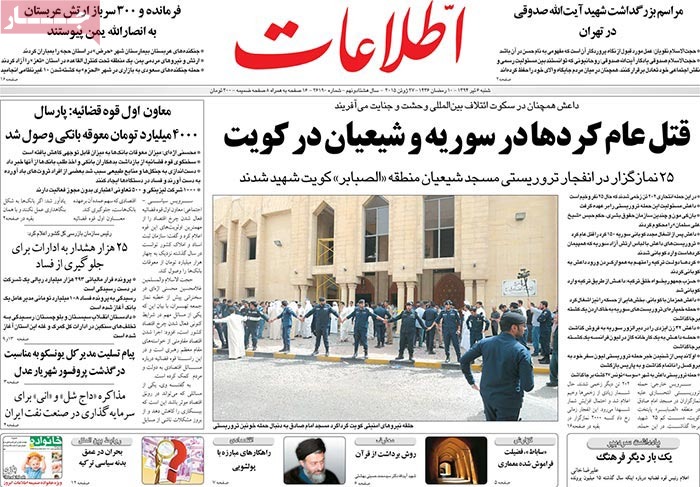
Ettela’at: The massacre of Kurds in Syria and Shiites in Kuwait

A terrorist attack on Imam al-Sadeq Shiite mosque in Kuwait has left 25 worshippers martyred and 202 others wounded, 25 of them critically.

IS terrorist grouping has claimed responsibility for the deadly attack.


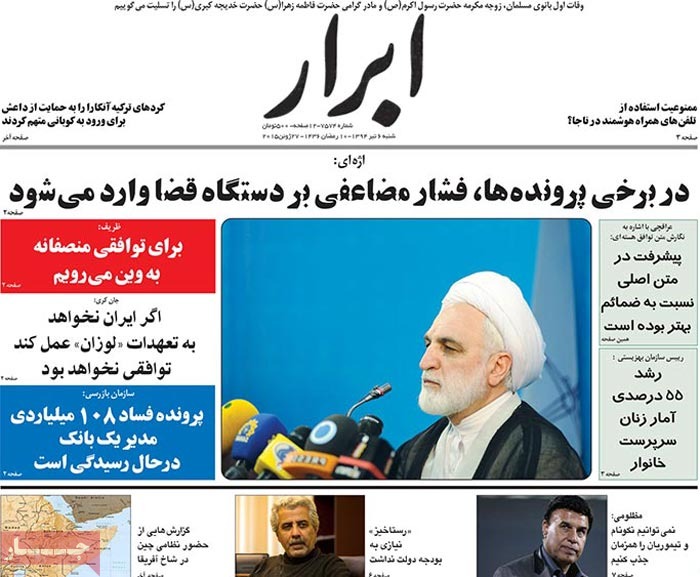
Abrar: “In some cases, the judiciary is exposed to extra pressure,” said Judiciary Spokesman Gholamhossein Mohseni Ejei.


A look at Iranian newspaper front pages on June 27


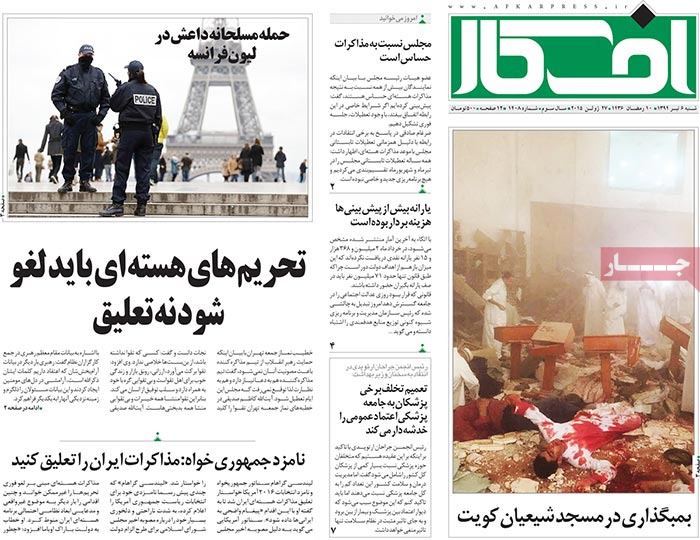
Afkar: “Nuclear sanctions have to be terminated not suspended,” said Tehran Friday Prayer Leader Ayatollah Kazem Sedighi.


A look at Iranian newspaper front pages on June 27


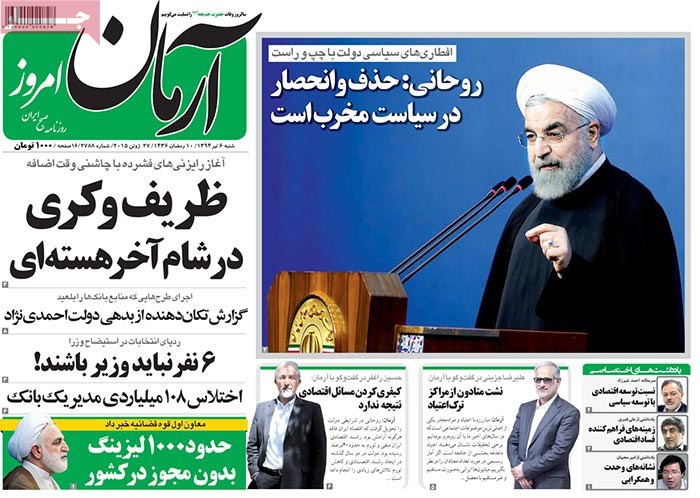
Arman-e Emrooz: “Elimination [of opponents] and monopoly are destructive in politics,” said President Rouhani.

Government threw Iftar banquets attended by politicians from the left and right.

Arman-e Emrooz: “Some 1,000 unauthorized leasing companies are operating across the country,” said the deputy judiciary chief.


A look at Iranian newspaper front pages on June 27


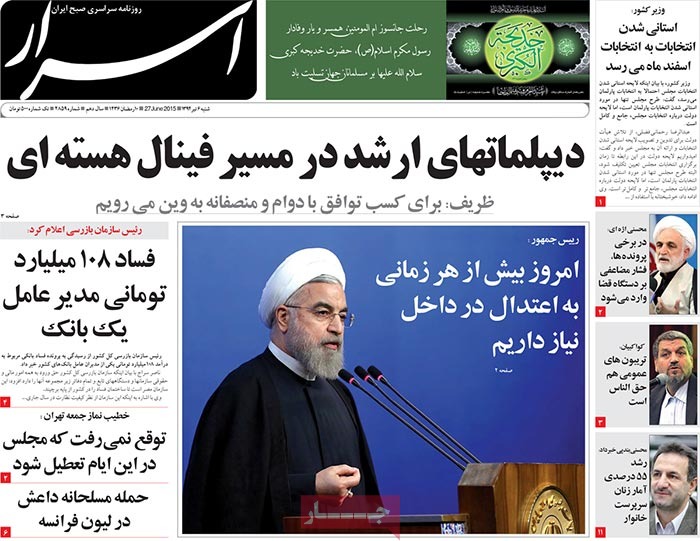
Asrar: The inspector general has revealed a new corruption case: $36 million fraud by the managing director of a bank.

Asrar: “Today, we need more moderation at home than ever before,” said the President.


A look at Iranian newspaper front pages on June 27


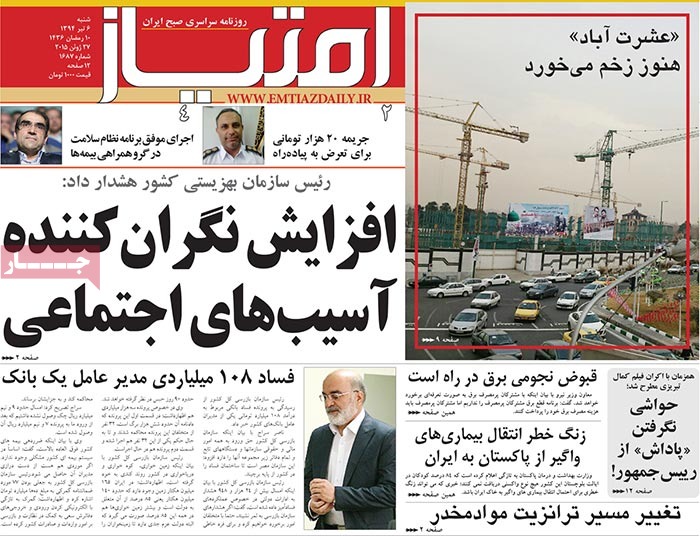
Emtiaz: The director of the State Welfare Organization has warned about a rising trend of social harms.


A look at Iranian newspaper front pages on June 27


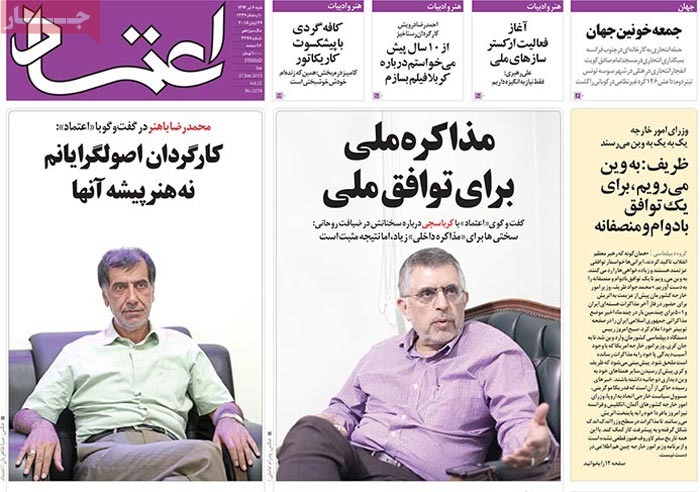
Etemad: “We are going to Vienna for a lasting fair deal,” said Iranian Foreign Minister Mohammad Javad Zarif.


A look at Iranian newspaper front pages on June 27


Iran: The Iranian national volleyball team’s hopes of advancing to the next round of FIVB World Leagues got a boost in Tehran Friday after Iran defeated Poland 3-2.


A look at Iranian newspaper front pages on June 27


Jomhouri Islami: IS terrorists have massacred 150 civilians in Kobani in cooperation with Turkey.

Jomhouri Islami: Countdown is on for drafting a final nuclear deal between Iran and P5+1.


A look at Iranian newspaper front pages on June 27


Kaenat: President Rouhani has hailed the Supreme Leader’s guidance as an asset to his government.


A look at Iranian newspaper front pages on June 27


Kayhan: A 100 percent increase in rice imports despite a one-year ban on imports.

Kayhan: The final stop of the nuclear talks; who gets off the train; Iran or the US?


A look at Iranian newspaper front pages on June 27


Khorasan: Three deadly terrorist attacks in Kuwait, Tunisia and France


A look at Iranian newspaper front pages on June 27


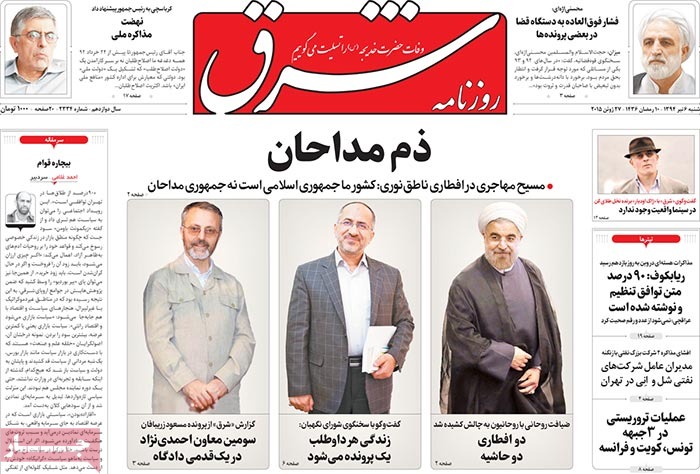
Sharq: A third lieutenant of Ahmadinejad is close to being summoned to court.

It comes after an investigation into corruption in the Martyrs Foundation reportedly implicated Masoud Zaribafan.


A look at Iranian newspaper front pages on June 27