Thursday, December 25, 2025
Home Blog Page 4815

Iranian official: 70% of technical annex to nuclear deal written

Talks-vienna

A senior Iranian official announced on Sunday evening that drafting the technical annex to the final nuclear agreement between Tehran and P5+1 is nearing completion with only a few items left.

“70 percent of the technical annex to the final nuclear deal between Tehran and the six major world powers has been drafted,” an Iranian diplomat in the nuclear talks underway in Vienna said.

The source, who asked to remain unnamed, further pointed out that the technical annex – which is one of the five annexations of the final agreement – covers issues such as “nuclear research and development, Fordo nuclear enrichment center, Arak heavy water reactor, and the type of the centrifuges that will be used by Iran for the production of stable isotopes”.

He added that “the technical annex is about 32 pages, and only a few items have been left open”.

“According to the technical annex, all the nuclear activities of Iran will continue,” he emphasized.

Yet, the negotiator expressed cautious optimism about attainment of a final nuclear deal.

The Iranian negotiator also categorically rejected reports by the AP and The New York Times saying that Iran has agreed to send its enriched uranium stockpile to Russia, saying there are four options on the table which are still under discussion, including dilution of the enriched uranium, exchanging it with raw uranium plus the enrichment costs, and selling the excess fuel.

He said one of the six parties to the talks has even offered to purchase Iran’s excess nuclear fuel.

The diplomat further regretted the International Atomic Energy Agency’s (IAEA) reliance on unauthentic intelligence with regard to PMD (possible military dimensions), and said it regrettable that the UN nuclear watchdog agency’s assessment of this issues has dragged on for almost a decade.

As for the IAEA Director-General Yukiya Amano’s recent visit to Tehran, he said, “Amano was told Tehran wants the IAEA to rapidly present its report on the PMD allegations and close the case.”

The diplomat reiterated the untruthful nature of the PMD allegations, and said it is not at all a difficult job for Tehran to prove that these claims are all baseless and wrong.

Amano said on Saturday in uncertain remarks that his organization might eventually prepare a report on allegations about possible military dimensions of Iran’s past nuclear activities by the end of 2015.

The Iranian negotiator also added that “the IAEA deputy director will arrive in Tehran on Sunday night to resolve the PMD issue as soon as possible,” official added.

An informed source told FNA earlier that the delegation is slated to hold talks with the Atomic Energy Organization of Iran (AEOI) officials over the PMD allegations.

Iranian officials have repeatedly underlined Tehran’s determination to reach a final deal with P5+1, and called on the other side to adopt a realistic approach toward a final deal.

Larijani urges UN to stop Saudi aggression against Yemen

Mohammad Javad Larijani

Secretary of Iran’s Human Rights Council Mohammad Javad Larijani on Sunday called on the UN to take serious action to end the Saudi aggression against Yemen.

In separate letters to the UN Chief, Ban Ki-moon and UN High Commissioner for Human Rights Zeid Ra’ad Al Hussein, Larijani referred to the grave humanitarian situation in Yemen and called for serious action on the part of the UN to put an end to the Saudi aggression against Yemen.

Larijani, in the letters, urged Ban and Ra’ad Al Hussein to fulfill their duty as per Rome Statute 1998 criminalizing the use of force and aggression on sovereign nations.

He said perpetrators of aggression and use of force should be held accountable before The Hague-based International Criminal Court.

Larijani expressed outrage at the killing of more than 3000 people, including 700 women and children, and maiming more than 10,000 innocent civilians by Saudi airstrikes.

Larijani said under Article 23 of the Geneva Convention IV, the International Humanitarian Law, the governments are required to allow free shipment of medical and food supplies to the people trapped in conflict.

He said that the IHL 1949 envisaged respect for the people’s right to have food and drinking water in the course of armed conflicts.

Many Yemeni citizens are incapable of meeting their main food requirements, said the official, adding that practices of the coalition formed against Yemen are flagrant violations of Article 54 of the first additional protocol to the four Geneva Conventions and are considered war crimes and crime against humanity based on the IHL 1949.

He said that refusal to allow shipment of humanitarian supplies amounts to collective punishment of the Yemeni people.

Larijani said any intervention on part of any government or coalition is manifest breach of the Rome Statue 1998.

“I should recall that use of force in any form is forbidden under the international law,” he said in the letter.

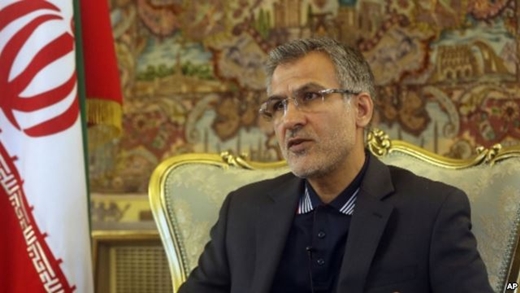
Time for political decisions on nuclear deal: Iran negotiator

Takhte Ravanchi

An Iranian nuclear negotiator says time is ripe for “political decisions” on a final deal between Iran and the P5+1 group of countries over Tehran’s nuclear program.

“If no agreement is reached [between Iran and the world powers], it would not be the end of the world. A good and lasting agreement needs political decisions and the time is now ripe for that,” Majid Takht-e Ravanchi said on Sunday.

The Iranian deputy foreign minister said that the West should show more flexibility in the nuclear talks, adding, “Iran has shown enough flexibility so far.”

He said Iran would never yield to the West’s excessive demands just for the sake of an agreement, adding that a final deal is within reach if the six countries stop making such demands.

Marathon nuclear negotiations between Iran and the P5+1 countries are picking up steam as the sides are making efforts to iron out disagreements with just two days left before the July 7 deadline for a comprehensive deal.

[…]

Kerry statement

The US secretary of state made a statement about progress in the nuclear talks on Sunday.

Addressing the reporters in Vienna, John Kerry said “it is now time” to finalize a historic nuclear deal with Iran.

“It is now time to see whether or not we are able to close an agreement,” Kerry told reporters, adding that at present, the negotiations “could go either way.”

Viewpoints of Hashemi Rafsanjani on the Supreme Leader

22222

Chairman of the Expediency Council Ayatollah Akbar Hashemi Rafsanjani is of the opinion that there is no replacement for Ayatollah Khamenei at present and that the Supreme Leader has a pivotal role in the sustainability of the Revolution and in ensuring the security of the country.

In an interview with the Arabic-language daily Al-Vefagh, the top councilor talked about a wide range of issues, including his relationships with the Supreme Leader, Iran-Saudi Arabia ties and cross-border relations between Iran and Iraq. On July 5, Alef.ir published a Farsi version of the interview. The following is the translation of PART ONE of the interview which focuses on the Supreme Leader:

The chairman of the Expediency Council said Ayatollah Khamenei is the backbone of Iran’s management and everyone should help the Leader.

When asked about his friendly and deep relationship with the Leader, he said, “We have been friends ever since we were young. I am five years his senior. We first met when we attended a seminary course taught by Ayatollah Damad. The Leader was younger than me; later our friendship deepened and we grew close during our fight against the Pahlavi regime and even closer after the victory of the Revolution.”

The top councilor added, “We worked together on different matters, including during the war, on any question one could think of. We have maintained this relationship to this day. I along with a group of people appointed as members of the Expediency Council by the Leader prepare the macro-policies of the establishment, which are part of the Leader’s responsibility under the Constitution. He orders them implemented, if he approves of them.”

Hashemi went on to say, “That is the most important part of our job [at the Expediency Council]. We are also tasked by the Leader with overseeing the implementation of the macro policies to make sure that they are well enforced. As for other ordinary questions, we talk during the meetings that we have.”

On his good friendship with the Leader, Hashemi added, “We are so close; we like each other very much. One such example [of our deep friendship] came along when I paid a bedside visit to the Supreme Leader after his surgery. The meeting in hospital was very friendly.”

Top MP: Prospect of nuclear talks is promising

larijani7

The speaker of the Islamic Consultative Assembly says that positive steps have been taken toward the settlement of disputes which have emerged in nuclear talks between Iran and P5+1.

Ali Larijani made the comment in a meeting with the ambassadors of the Islamic nations in Tehran on Saturday and added that the prospects of the talks are bright. Entekhab.ir on July 5 released a report on his remarks which also featured the ominous phenomenon of terrorism in the region. The following is the translation of part of Larijani’s remarks in the meeting:

Nuclear talks

Nuclear talks between Iran and P5+1 are rather complex. Iran is trying to help talks proceed successfully. Inside the country, all government branches and officials see eye to eye when it comes to the advancement of the talks.

The Islamic Republic of Iran has always tried to achieve a positive result from the talks. The prospect of nuclear negotiations is positive and great steps have been taken to settle the disputes. Iran is walking down the right path.

Options on the table

Comments by American officials that all options remain on the table in dealing with the Iranian nation have domestic consumption and are simply theatrics [by politicians]. Such behaviors are not constructive. By making ill-considered comments, the Americans have caused huge losses to themselves and to the region. We hope the talks can produce positive results for the region and set the stage for patching up the differences. The positive outcome of the talks will ensure sustainable security in the region.

Terrorism and extremism

Today several Islamic countries have been entangled in terrorism and the energy the Islamic community should spend on solving the question of Palestine has instead been used up for solving infightings [in different countries].

Certain powerful countries, which have a hand in the creation of terrorist groups, are trying to foment crises in Syria, Iraq and Yemen. It is regrettable that the Islamic community has been in the grips of such a disaster, which prevents Muslim nations from mobilizing their efforts to counter the Zionist regime.

Plots are at work to disintegrate Muslim nations for which the weakness of Muslims is to blame. History has shown that a divided Muslim community serves the interests of colonial powers. The Islamic Republic of Iran has always highlighted Muslim unity.

The countries that took the wrong direction in dealing with terrorism and supported the terrorists are highly expected to correct their past mistakes.

Iran is seriously determined to take on terrorism and will offer a helping hand to any country which seeks to tackle this ominous phenomenon. The responsibility lies with all nations, Islamic and non-Islamic, to fight terrorism.


Where did it all go wrong with IRIB?

seda-sima

A medium which is expected to act in line with national interests in covering Iran’s nuclear talks with P5+1, is ignoring the country’s interests and has overtaken foreign media in beating the drums of cynicism [about the final result of nuclear talks].

Nuclear talks are at their final stop with the world waiting to see what comes out of Vienna. Certain media outlets spare no effort to paint a black picture of what is unfolding in the Austrian capital. Pessimistic news stories come as a surprise when they are aired by a national medium which is funded by the country’s public budget.

Fararu.com on July 4 published an analytical report on where Islamic Republic of Iran Broadcasting (IRIB) stands when it comes to nuclear talks, saying that the national broadcaster has overlooked the country’s national interests and expediency, swimming against the tide of the Islamic Republic’s policies – which are aimed at the settlement of Iran’s nuclear case through talks.

The following is the translation of excerpts of that report which also includes an expert view by Hassan Beheshtipour:

At a time when Iranians are following news on a daily basis eagerly waiting for good news, IRIB is trying – in its different news programs – to convince its viewers that any agreement [with P5+1] would be a bad deal.

A case in point is a report entitled “A good Iranian agreement and a good US agreement” that has been aired in all news bulletins of the Islamic Republic of Iran News Network (IRINN) making a distinction between a good deal from the viewpoints of the Iranians and Americans, disputing the president’s stress on a win-win situation in nuclear talks.

[…]

Selection and broadcast of pessimistic reports and headlines are not all. The experts different IRIB channels host are chosen from among the opponents of the talks, who lash out at government’s nuclear policies whispering “We cannot succeed [in the talks]”, with the proponents who can defend the talks conspicuous by their absence.

A producer of a program in which Seyyed Mehdi Tabatabaei – the guest – had defended the Iranian nuclear team has been reprimanded, according to khabaronline.ir.

With Iran and six world powers getting closer than even before to a nuclear deal, IRIB’s managers have reportedly ordered the producers of religious programs at radio and TV services as well as news shows not to talk about the peace treaty signed by Imam Hassan. [In a bid to serve the interests of the faith, the second Shiite Imam signed a peace deal, renouncing his right to official leadership of the Muslim community.]

IRIB rejected the report as sheer lie, with the head of the broadcaster’s Public Relations Office saying that IRIB is seriously pursuing the nuclear issues. The performance of the national broadcaster, which has been repeatedly criticized by the president, shows that it is banging the drums of defeatism more than any foreign media.

Hassan Beheshtipour, an expert in nuclear issues, says the performance of the broadcaster should be assessed by looking at its different programs.

“As a viewer, I should say that the warnings the national broadcaster airs on the news on nuclear talks outnumber the hopeful remarks it releases.

“We should avoid generalization [when it comes to the performance of IRIB on nuclear talks] and we need to first review different news bulletins – case by case – in a [special] period and then pass judgment.

“It is my impression that at news bulletins which are broadcast at 14:00 PM, 20:30 PM and 21 PM local time, the promising parts which indicate talks are likely to result in a deal are less than the parts which sound notes of warning [that the talks may end without producing a deal].

“Generally speaking, I don’t think making programs on the downsides of the talks is something bad; rather, it seems necessary because it can be as a wake-up call. But a proper balance should be struck between the parts which issue warnings and the ones which beam hopeful pieces of news [on nuclear talks].

“For instance, reports of Iran repatriating 13 tons of frozen gold and of Britain removing seven Iranian real entities from its list of sanctions can be screened along with news stories that sound a note of caution.

“I still believe that we need to examine IRIB’s programs carefully and in a case-based fashion in order to make [impartial and] fair judgment on the workings of IRIB.

IRIB out of tune with government and people

“We are living in a society in which multiple [distinctive] voices are heard with different people holding and expressing different views. IRIB has nothing to do with people’s political leanings and viewpoints; rather, it pursues its agenda according to the macro policies of the establishment.

Why so alarming than promising?

“Like other media outlets, there are editors-in-chief, journalists and managers of different channels at IRIB who act in line with the general policies of Islamic Republic of Iran Broadcasting – which are outlined by the Supreme National Security Council – but at times they act selectively.

“The selective approach by editors and managers of IRIB channels in choosing the newsworthy items becomes remarkably evident when we are reminded that Peyman Jebelli, who is now a deputy to IRIB president for news affairs, used to serve as a deputy to Saeed Jalili – the secretary of the Supreme National Security Council when President Ahmadinejad was in office.

Iftar tables set by wives of ambassadors of Islamic countries to Iran

0000 (1)

At a ceremony dubbed “Ramadan, Legacy of Muslims” held on July 4 in Tehran’s Milad Tower, the wives of some ambassadors of Islamic nations to Iran, including Indonesia, Pakistan, Malaysia, Algeria, Lebanon, Afghanistan, Bangladesh and Oman, put on display the meals served in their countries for Iftar [breaking fast at sundown].

Images of the event released online by the Islamic Republic News Agency:


Sultan Qaboos approves Iran-Oman Maritime Border Demarcation deal

6b851c5d344a06c2c95dffc08a566124

Sultan Qaboos of Oman approved an agreement by Tehran and Muscat on Saturday to demarcate their maritime borders in the Sea of Oman.

The agreement was signed by Iranian Foreign Minister Mohammad Javad Zarif and Omani Interior Minister Hamud bin Faisal bin Said al-Busaidi in Muscaton Sunday.

The Iranian foreign minister is in Oman on a one-day visit to the Arab country.

According to the agreement, Tehran and Muscat agreed on demarcation of 450 kilometers of their common sea borders.

Iran and Oman had demarcated their maritime borders in the Strait of Hormuz in the 1970s.

During the meeting, Zarif said that Iran and Oman have very good relations and this agreement demonstrates the kind of ties Iran is keen to have with all its neighboring countries, especially in the Persian Gulf.

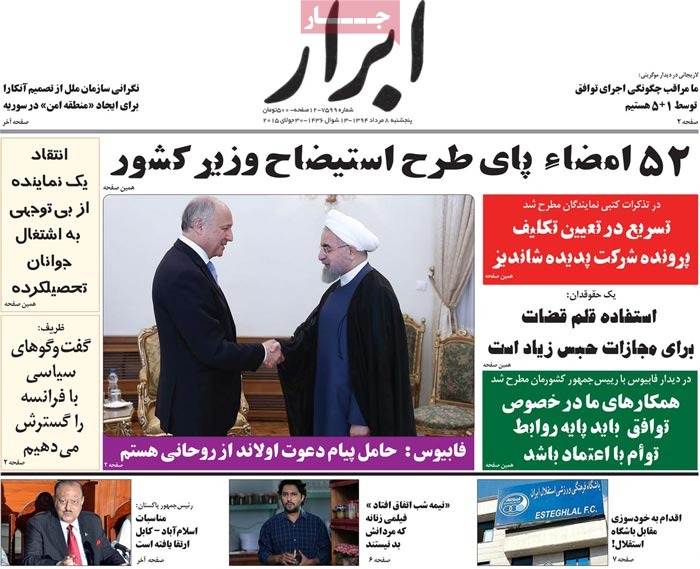
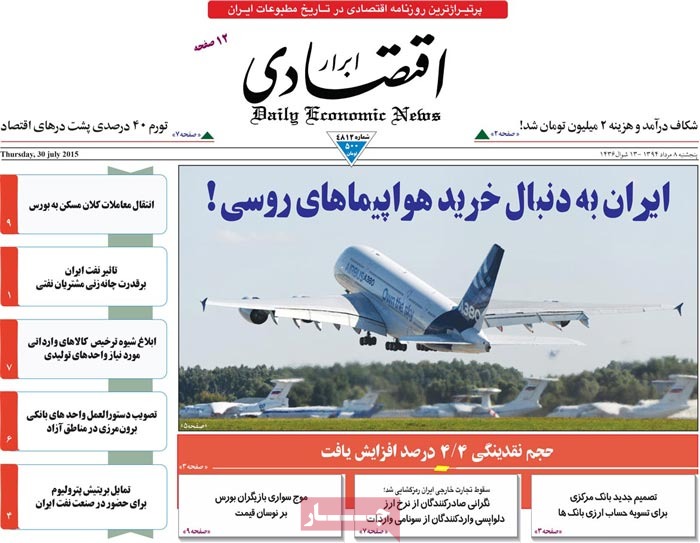
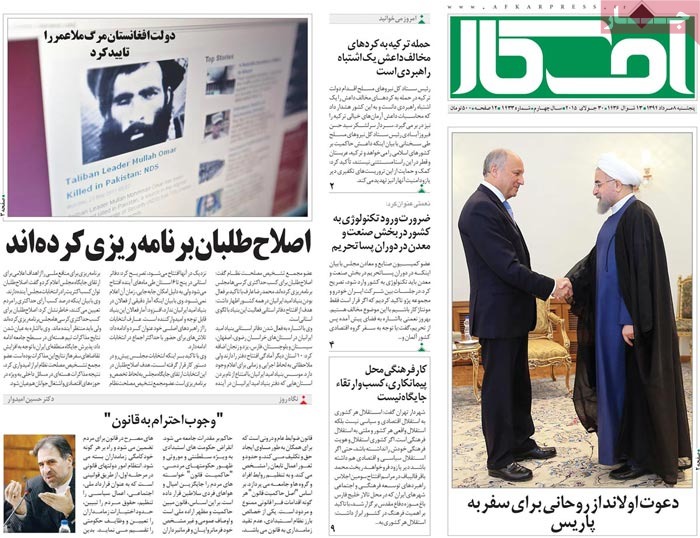
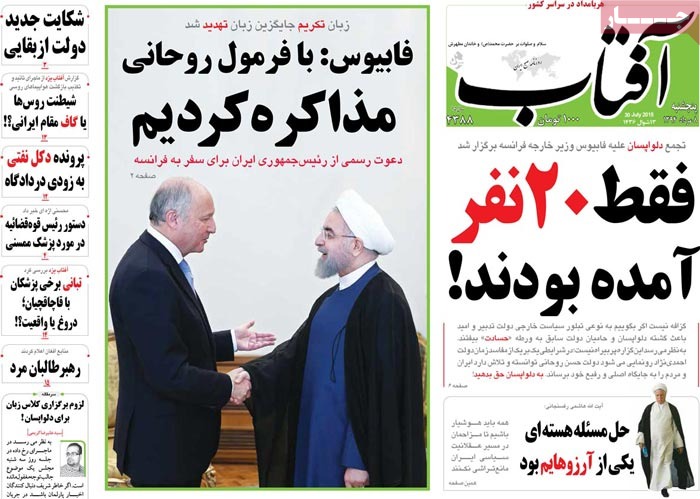
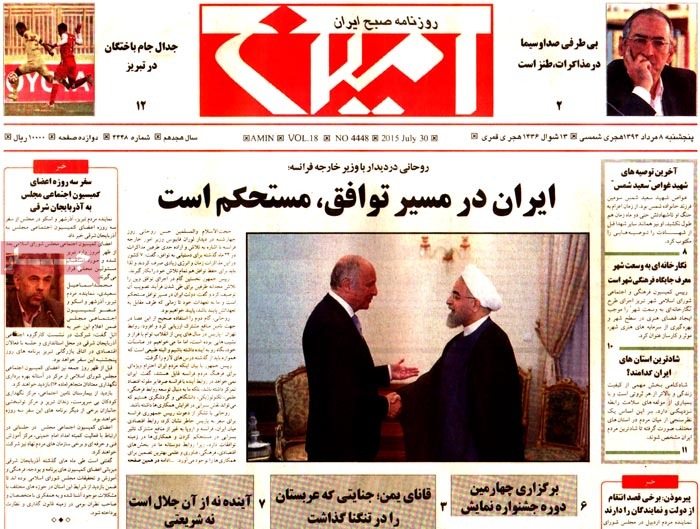
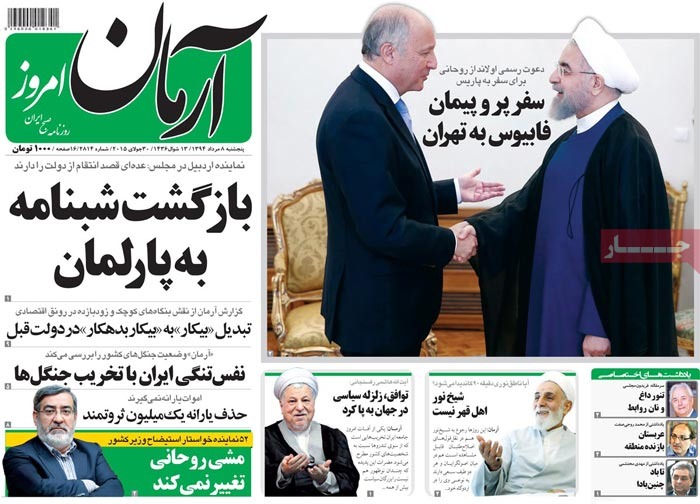
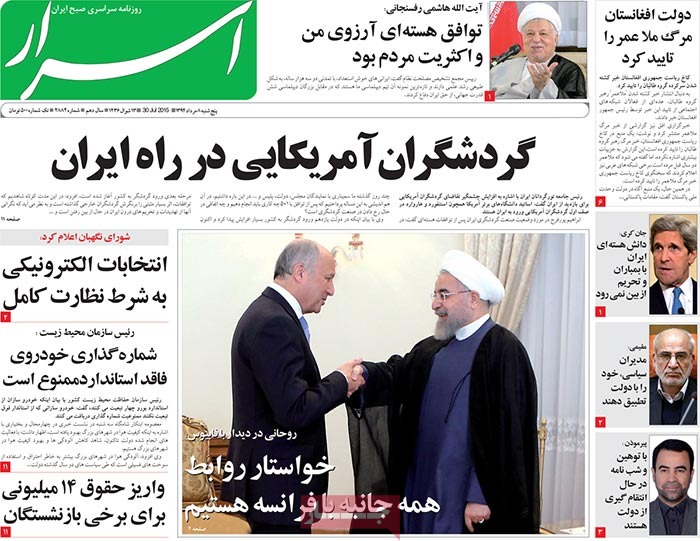
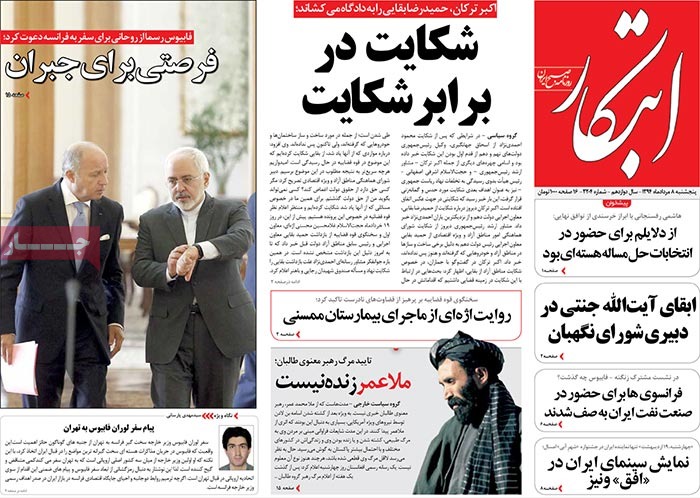
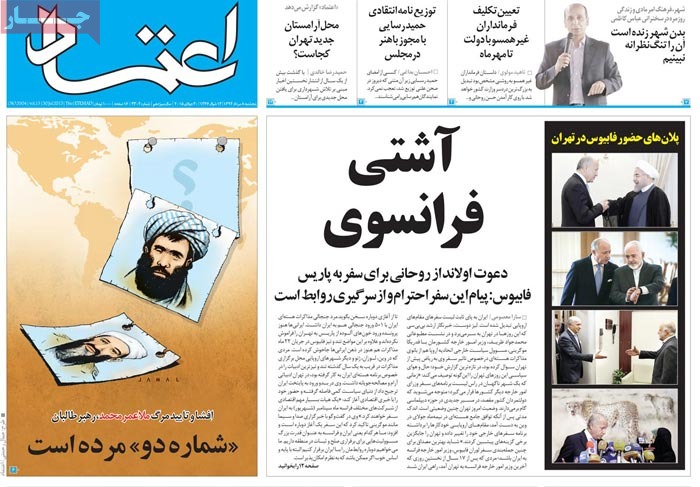
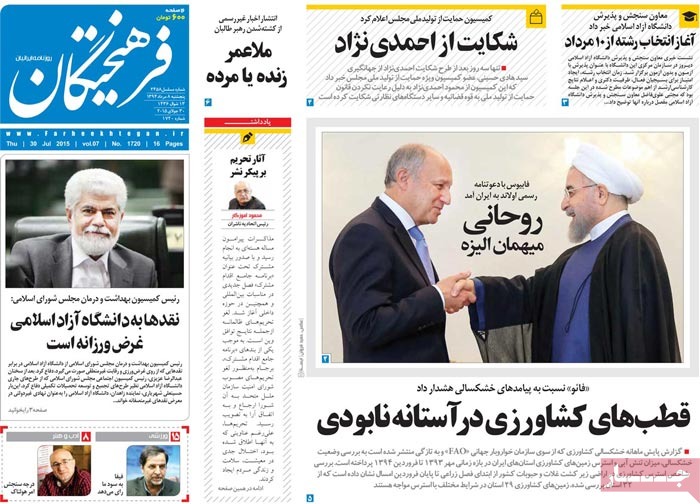
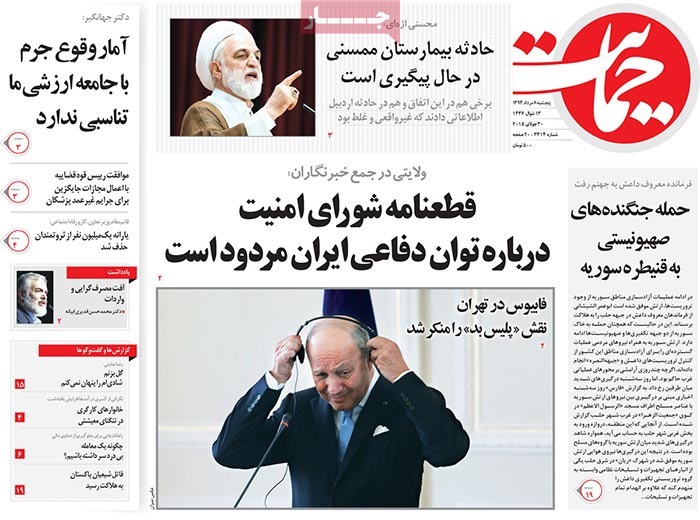
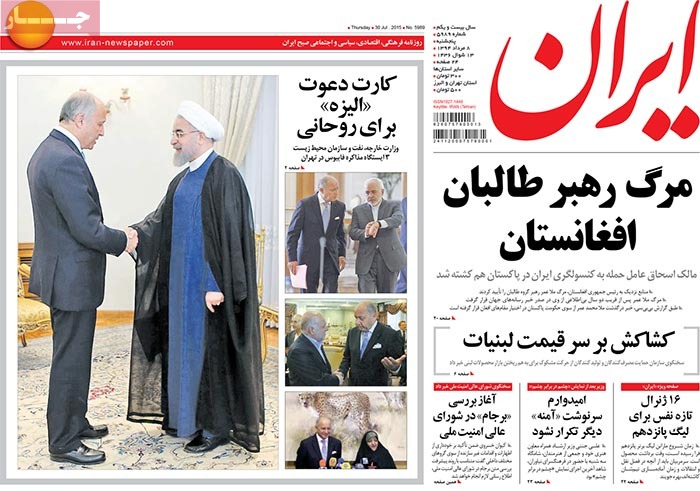
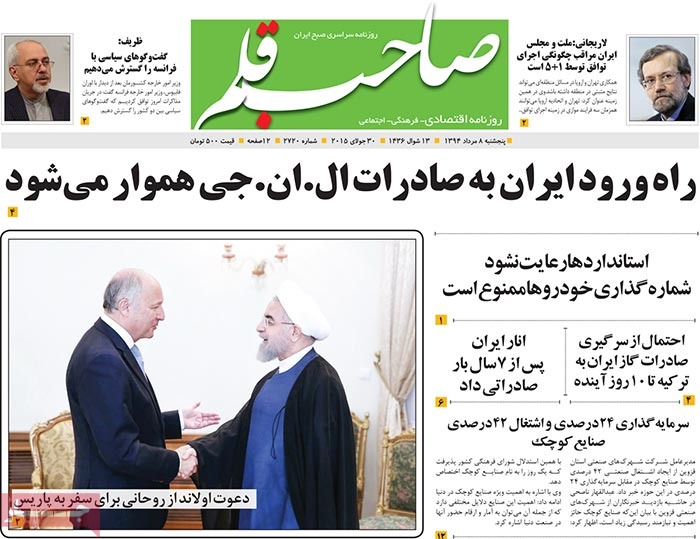
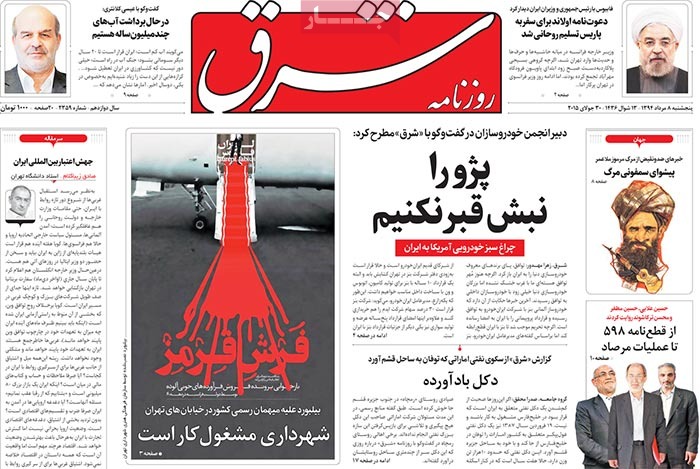
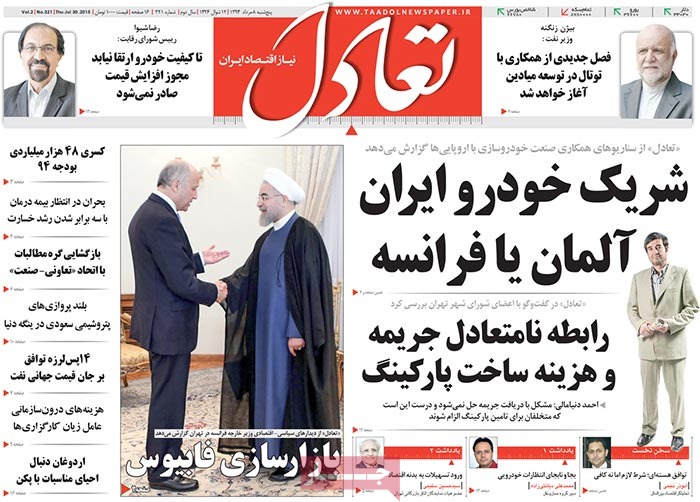
A look at Iranian newspaper front pages on July 5

Iranian Newspapers Headlines

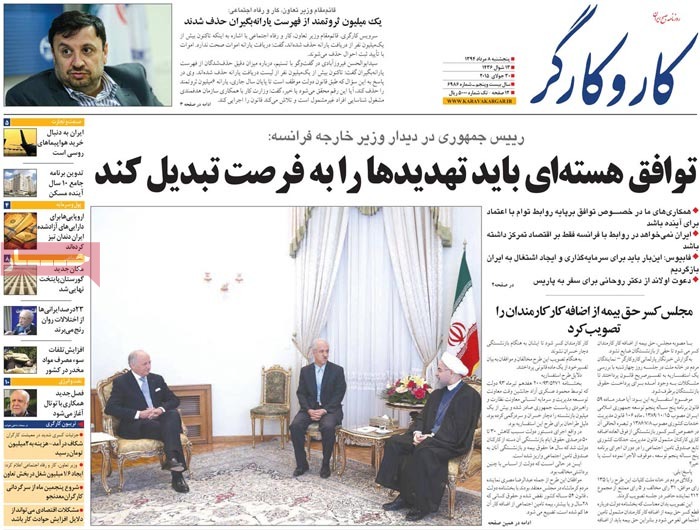
The Supreme Leader’s comments underlining efforts to accelerate the country’s scientific drive and an order by the president to revamp the country’s banking system and capital market dominated the front pages of Iranian newspapers on Sunday. Also in the news were the comments of Major General Firuzabadi in support of the nuclear negotiating team.


Ettela’at: “Under no circumstances should the country’s scientific drive lose its momentum,” the Supreme Leader said at a meeting with university professors.

Ayatollah Khamenei further said universities should serve as a forum for political understanding and awareness and that politicking deals a blow to the main mission of universities which is to strive toward scientific progress.


Abrar: Iranian Foreign Ministry Spokeswoman Marzieh Afkham has condemned the crimes Boko Haram has committed in Nigeria.

Abrar: A senior US nuclear negotiator who took part in talks with Iran when Ahmadinejad was in office has said that when Jalili was Iran’s top negotiator, he mostly focused on the history of Islam and Iran in nuclear meetings with foreign diplomats.

Abrar:An MP has said that more than one oil derrick went missing [when Ahmadinejad was in office].


A look at Iranian newspaper front pages on July 5


Afarinesh: Oman’s Sultan Qaboos has signed a maritime border demarcation deal with Iran.


A look at Iranian newspaper front pages on July 5


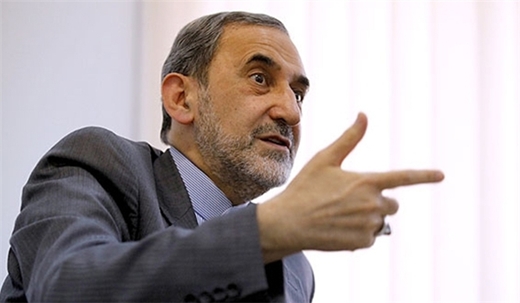
Afkar: “Terrorism has grown in the region on the back of American and Israeli support,” said Ali Akbar Velayati, a former foreign minister.
 

A look at Iranian newspaper front pages on July 5


Aftab-e Yazd: “Some simpletons are contributing to the ‘Shiite Crescent’ plot,” said Mohammad Sadr, a senior advisor to the foreign minister.
Those who say after Yemen the Saudi-led coalition will train its guns on three Iranian islands in the Persian Gulf do not appreciate foreign policy.


A look at Iranian newspaper front pages on July 5


Arman-e Emrooz: A final step toward a final deal

The green-light of the International Atomic Energy Agency at the crossroads of a deal


A look at Iranian newspaper front pages on July 5


Asr-e Iranian: The Iranian MPs have called on the negotiating team not to bring home an unsigned deal.


A look at Iranian newspaper front pages on July 5


Asrar: Chairman of parliament’s Research Center Kazem Jalali said he was terrified when he heard a report on the country’s water resources.


A look at Iranian newspaper front pages on July 5


Ebtekar: “Up to 95 percent of the comprehensive nuclear deal has been finalized,” said Hossein Mousavian, a former Iranian nuclear negotiator.


A look at Iranian newspaper front pages on July 5


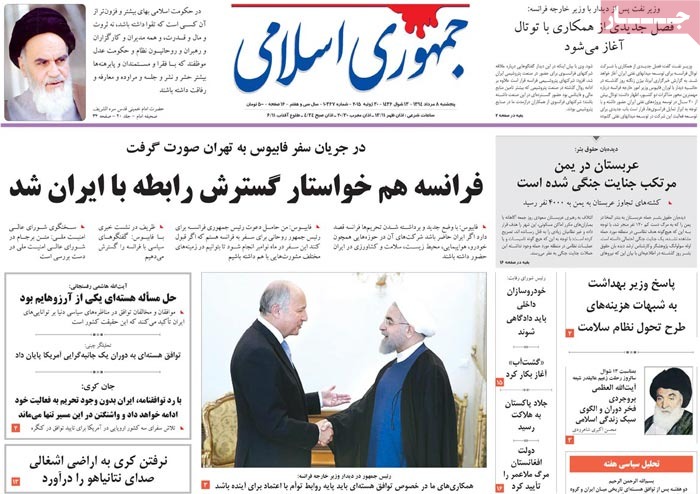
Jomhouri Islami: “All radio pharmaceuticals needed in the country are produced inside the country,” said a senior Health Ministry official.


A look at Iranian newspaper front pages on July 5


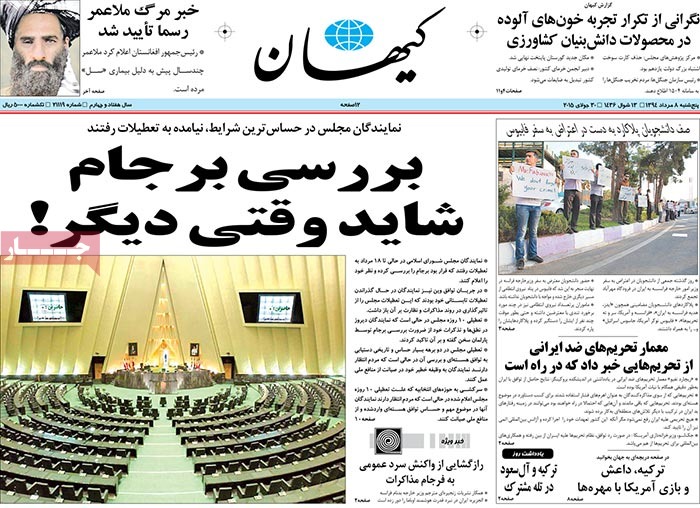
Kayhan: Nuclear talks in Vienna, final days or endless extensions?


A look at Iranian newspaper front pages on July 5


Khorasan: According to a report released by The Guardian, Britain seems to have had advance knowledge about Saddam Hussein’s decision to use chemical weapons against Iran.

Khorasan: A buyer has stepped forward to purchase the telecommunications company.


A look at Iranian newspaper front pages on July 5


Rooyesh-e Mellat: “The Constitution recognizes the citizens’ right to protest,” said Tehran MP Ali Motahari.


A look at Iranian newspaper front pages on July 5


Sharq: “We will break the hand that signs a bad deal,” said [hardline MP] Hamid Reza Rasaei.

The Worriers [staunch supporters of Ahmadinejad who are opposed to anything President Rouhani and his administration do on the local and international fronts] are working out a new post-deal scenario.


A look at Iranian newspaper front pages on July 5


Highlights of Ettela’at newspaper on July 5

ettelaat-july5

“Under no circumstances should the country’s scientific drive lose its momentum,” the Supreme Leader said at a meeting with university professors.

Ayatollah Khamenei further said universities should serve as a forum for political understanding and awareness and that politicking deals a blow to the main mission of universities which is to strive toward scientific progress.

 “I swear that this government wishes well for the people and the Revolution,” said Chief of Staff of the armed forces Major General Firuzabadi.

He further said just like soldiers who need the thoughts and prayers of the public as they launch an operation, people should pray for nuclear negotiators.

He also urged the Iranians to throw their weight behind Iran’s nuclear negotiators.

 A coup by 13 IS leaders against Al-Baghdadi [the kingpin of the terrorist grouping] has failed.

Al-Baghdadi has ordered the execution of all 13. In another development, 60 terrorists of the Al-Nusra Front were killed by IS in a mosque in Syria.

 In a letter to his deputy, President Rouhani has ordered the country’s banking system and capital market overhauled.

The financial problems caused by lack of fiscal and monetary discipline dating back to the time when there was a massive inflow of oil revenues coupled with banking and financial sanctions are standing in the way of economic growth, the president said in the letter.    
 “I see emergence of reason over illusion,” said Iranian Foreign Minister Mohammad Javad Zarif of nuclear talks between Iran and P5+1.
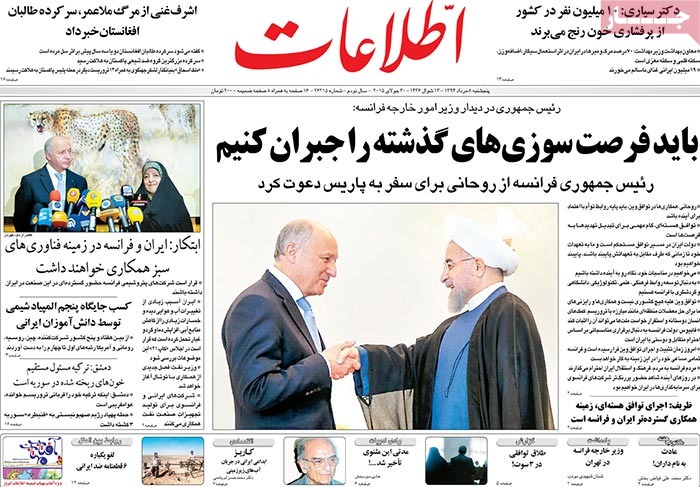
The top diplomat further said, “We have never been closer to a lasting outcome.”    

 The United Nations has said that Israel should be tried for war crimes.

Forty-one of the 47 countries with a seat on the UN Human Rights Council voted for an anti-Israeli resolution.