Thursday, December 25, 2025
Home Blog Page 4813

Where does Rafsanjani stand on the Shiite-Sunni issue, regional matters and Iran-Saudi ties?

grand mufti

Chairman of the Expediency Council Ayatollah Akbar Hashemi Rafsanjani says that Iran and Saudi Arabia can work together to bridge the Shiite-Sunni divide plaguing the region.

In an interview with the Arabic-language daily Al-Vefagh, the top councilor talked about a wide range of issues, including his relationships with the Supreme Leader, Iran-Saudi Arabia ties and cross-border relations between Iran and Iraq. On July 5, Alef.ir published a Farsi version of the interview. The following is the translation of PART THREE of the interview which focuses on the problems and prospects of Tehran-Riyadh ties:

WikiLeakes and documents on Saudi Foreign Ministry

This [the release of diplomatic memos by the whistleblowing website WikiLeakes] is a harmful trend. Similar information leaks dealt a blow to the US too. The one behind these leaks is now being used as leverage. Saudis have suffered as a result of these leaks, apparently more than others.

Saudi Arabia is a closed country [to the outside world] with its foreign relations, talks, correspondence and documents remaining unknown [to the public]. No one knows what is going on inside the kingdom. When Saudi information was leaked, it played into the hands of those who sought to tell lies, citing the faked versions of these leaked documents. They [those taking advantage of the leaked information] tell what they want and deliver a blow [to the kingdom] anytime they wish. They make a comment and it takes time before Saudi officials deny their comments. As a result people buy that.

Sedition surfaced at one point and snowballed. Saudi Arabia has to pay a dear price for the leaks, with the negative impacts of such leaks not diminishing anytime soon. The positive measures it [Saudi Arabia] has taken are not publicized, but its incorrect decisions are blown up [out of all proportion].

Saudi aggression on Yemen and nuclear talks

I have no idea about any possible relationship between Saudi attacks in Yemen and Iran’s nuclear talks! In the new group which has come to power in Saudi Arabia, I only know Salman. I saw him at a party in Riyadh. He had invited me and we talked. That’s it. I do not know the other newcomers. […]

I don’t know why they [the Saudis] made such a mistake [airstrikes on Yemen]. They did so because they apparently thought the Houthis were Shiites. The Houthis, however, are not twelve-Imam [Twelver] Shiites; they are mainly four-Imam Zaidiyyahs. If the Saudis are worried about the Shiites, they should be worried about Iran, Lebanon, Iraq, Syria and a large number of other [Muslim] countries.

They made a big mistake in Yemen. Bahrain is a good example [of Saudi mistakes]. The Saudis deployed forces in Bahrain, which is an Arab nation and a member of the Persian Gulf Cooperation Council, to fight against the Shiites. Accordingly, they have concerns in Yemen, especially because the Yemenis have territorial claims on the kingdom. I do not know their exact motives. Perhaps they’ve been provoked to do so. If [the ousted president] Mansour Hadi had been able to stay [in power] in Yemen, he would have remained there. How can he build on Saudi assistance to cling to power?

Saudi Arabia and a nuclear deal

If the Saudis are concerned about the agreement Iran is likely to clinch with P5+1, they need to act in good faith when it comes to such a deal. Saudi Arabia and other regional countries are making a mistake. Iran has banned [the development of] nuclear bombs. Why should they be afraid of us? They should be afraid of Israel.

The Saudis have bought 3,000-km range missiles from China and other countries. They possess highly advanced hardware such as planes, missiles and radar systems. They also have a military base there [in Yemen]. Saudi Arabia knows that Iran does not pose a threat. If Iran had intended to cut ties with Saudi Arabia, it would have made an issue of the killing of more than 400 Iranian pilgrims at the 1987 Mecca incident [at the hands of Saudi police during Hajj rituals], but Iran behaved differently only to help mutual ties with the kingdom remain unstrained.

Ties between Iran and post-revolution Egypt      

Why Iran and Egypt do not have balanced relations [even after an Arab Spring revolution in Egypt and the rise to power of two presidents] is a question the Egyptians should answer, because Iran is seeking to develop ties. We see the Egyptians as people who love the household of the Muslim Prophet. We have no problem with the Egyptian people, especially because we are not neighbors to have [border-related] issues.

There are reasons behind such [cold] relations: First, the Americans, who hold sway in Egypt and support its army, do not approve of Tehran-Cairo ties; Second, Egypt has to cooperate with Saudi Arabia and some other countries; and third, Egypt disapproves of Iran’s presence in Syria, Lebanon and recently in Iraq. We faced similar problems in Afghanistan. They [the Saudis] supported the Taliban and Iran frowned upon their support. I personally talked with King Abdullah, telling him that Riyadh was making a big mistake.

[…]

The threat of a religious war in the region

We are now at a [critical] time with the Shiites under attack in certain regional countries. They treat the Shiites as their rivals, trying to undermine the Shiites in different ways, but the fact is that the Shiites pose no threat or challenge to them.

According to Shiite politics and mindset, they [the Shiites] do not want to get involved in confrontation with their fellow Muslims. It is a big mistake on the part of some regional countries; instead they can count on Iran which is their best friend. Presently I sense danger, and fear that the mounting differences which sometimes lead to the killings [of Muslims in this region] could deepen [even more].

Prospects of Tehran-Riyadh ties

A few years ago when the previous government was in office, I traveled to Saudi Arabia. I was asked to settle the issues Iran had with Saudi Arabia during my visit. After a dinner banquet hosted by King Abdullah, we talked until past midnight. The king’s close advisors, including his foreign minister and Prince Muqrin and others, were also on hand for the meeting. We discussed the differences and arrived at a solution: formation of seven joint commissions.

The first commission was to deal with religious affairs; in other words, the clerics from the two sides were supposed to hold meetings to discuss and work out solutions to the differences between the Sunnis and Shiites. The officials in two countries too were expected to support the viewpoints of the commission so that the problems standing in the way could be removed.

The second commission was tasked with handling mutual ties and cooperating with the executive commission. We also decided to hold one joint commission for Lebanon, one for Syria, one for Iraq, one for Afghanistan and one for other countries. These seven commissions were to meet on a regular basis and bring the viewpoints of the two sides closer together, and the two countries’ high-ranking officials were to supervise the performance of these commissions.

It was a sound decision we made to remove the differences in the region. After I came back to Iran, I realized that those who were to pursue these affairs were unwilling to make them happen. Later [then Saudi Foreign Minister] Mr. Saud Al Faisal came to Iran to pursue what we had already decided on. His first trip was somehow successful, but then everything fell apart due to the problems they had in the kingdom and we faced here in Iran.

I’m sure that if we initiate a joint plan with Saudi Arabia, we can bridge the differences between the Shiites and Sunnis all over the Islamic world. For instance, in Syria which is an independent country, neither Iran nor Saudi Arabia is allowed to fix the destiny of the Syrian people. We should remain vigilant not to allow Shiite-Sunni differences to emerge in that country. We have to let the Syrian government and people solve their own issues. We can simply help them settle their problems.

This holds true for Iraq, Lebanon and other [Muslim] nations. I think even now we can revive what we decided almost six years ago and work out a solution [to Muslim differences] in line with the current situation in the region.

Rare Pallas’s cats seen in northeastern Iran (PHOTOS)

22821_194

After sightings of a leopard-like animal by the locals in a town in North Khorasan Province, the provincial Environment Department sent some experts to the area to gather information about the unknown animal.

The search produced photos of a Pallas’ cat (Otocolobus manul) with its four kittens which are rare in Iran’s wildlife.

Snapshots of a rare small wild cat with its kittens posted online by  iew.ir :


President breaks fast with social workers, physically challenged (PHOTOS)

asli

At an Iftar feast hosted by President Rouhani at Tehran’s Islamic Summit Conference Hall on Monday, the president as well as a number of officials broke their fast with social workers of the Welfare Organization and the Imam Khomeini Relief Committee.
Also in attendance at the ceremony were some physically challenged individuals
Snapshots of the gathering in the fasting month of Ramadan released online by Mehr News Agency:


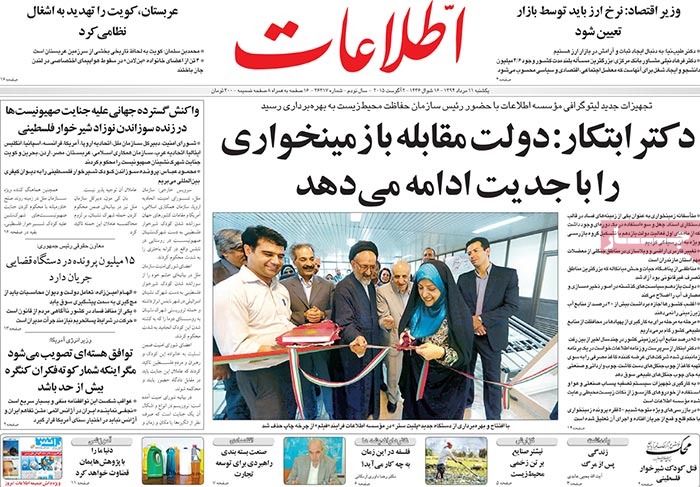
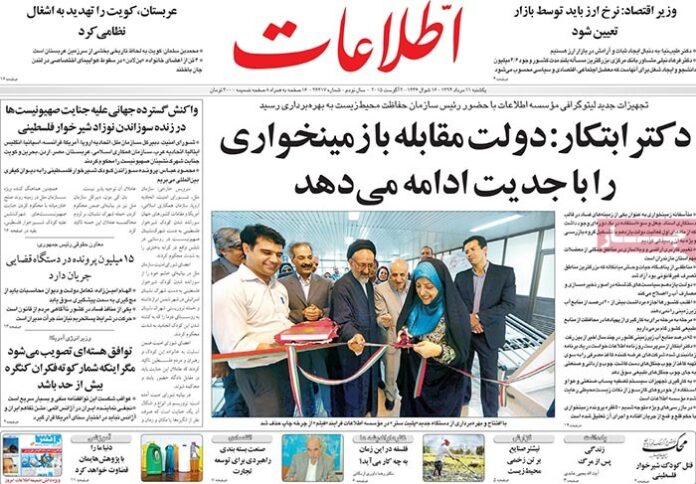
Highlights of Ettela’at newspaper on July 7

Ettelaat-July7

 A final push by Iran and P5+1 to clinch a deal.

A source close to the Iranian nuclear negotiating team has said that in certain areas serious differences remain to be settled.

None of Iran’s nuclear activities will come to a halt when the Joint Comprehensive Plan of Action produces the intended result.

 The littoral states of the Caspian Sea are to ensure the security of the landlocked sea.

The commander of the Iranian Navy said an agreement is being drafted under which the five countries bordering the Caspian Sea will take charge of Caspian security without foreign presence.

 Tehran’s Shahid Beheshti University has hosted a gathering dubbed “Palestine, a symbol of resistance and pivot of Islamic solidarity”.

 “Imam Ali [the first Shiite Imam] did not walk off the path of justice and ethics in dealing with oppression and immorality,” said the President.

Hassan Rouhani further said, “Our main responsibility is to make sure that the ideals of the martyrs, that is to say, the integrity and independence of the nation, are guaranteed.”

 Tens of thousands of Yemeni people have staged a rally in protest at the silence of the international community in the face of Saudi crimes.

It came as Yemeni forces fired 39 missiles at a Saudi military base in Dhahran.

 The public has been urged to take part in Quds Day rallies.

The rallies which get underway at 10:30 will be held in 770 towns and cities across the nation on Friday [July 10].

 The country’s expert capacity will be fully tapped in drafting the Sixth Development Plan.

The director of the Management and Planning Organization said that the 6th plan will be realistic, flexible and effective. Efforts will be made to rid the plan of the defects of previous plans.

 A sudden increase in master’s and PhD admissions has dealt a blow to the quality of education,” said the President of Tehran University.

 Tehran’s subway will be extended to Mehrabad Airport in two months.

Distrust is in the DNA of ties between Iran and the US

Iran-Us-Nuclear-talks

A former Iranian diplomat says that creation of a crack in the thick wall of distrust between Iran and the US – not thickening that wall – was one of the preliminary underpinnings of putting the prolonged nuclear talks between Iran and P5+1 in order.

That according to Nosratollah Tajik, a former Iranian ambassador to Jordan, who wrote an opinion piece about the reason why trust has gone missing between the two countries. “I am certain that Iran and the US have not properly assessed each other in almost four decades [of strained ties], but why they have failed to do so is mysterious,” he added.

The following is the translation of his piece Sharq daily published on July 6:

Miscalculations by Iran and the US about each other’s role and capabilities as well as bargaining power – not for offering any concessions but for granting fewer concessions at later stages of the game – all support this assumption. If Iran had attached more importance to the sway the US held in international developments, it should have strategically forged a way to interact with Washington before getting engaged in nuclear talks.

That Iran had to gradually reduce its problems with the United States in different stages so that it could readily secure its regional foothold in the short- and medium-run does not require thumbing through history books [and taking lessons].

It was not long ago that the great American DNA scientist, Ms. Wendy Ruth Sherman, the Under Secretary of State for Political Affairs and a member of the US team in nuclear talks said, “I don’t trust the people who sit across the table from me in these negotiations,” in response to Senators who asked her why she trusted Iran’s President Rouhani. “We know that deception is part of the DNA in Iran,” she added.

This is how the Americans look at Iran and, at the same time, expect Iran to have trust in them! According to this quote [from the US official who leads her country’s team in nuclear talks with Iran], lack of trust in the Iranian side is the default assumption for the Americans in nuclear talks. That’s why they have gradually toughened the conditions to nail down a good deal.

If the US had been in pursuit of an agreement in the real sense of the word, it would have been perhaps possible to – despite a wrench others throw into the works – design a balance strategy to organize the issues between the two countries at a time when the governments in Iran and the US have displayed a relative interest in patching up their differences.

Basically, one way to learn about the future trends of the things is to [walk in the other side’s shoes and] see the issues through its eyes. The way the other side looks at the events may not be necessarily correct; the Iranian negotiating team was expected to occasionally walk in the shoes of one member of the other side so that it could see the talking point from different angles, especially through the eyes of the influential members of the other side.

Unluckily in such an atmosphere, the parties involved in the US-Iran ties seem to have gone through one of the epoch-making periods in foreign policy since two years ago, without having a clear-cut strategy to overcome or at least minimize the existing distrust. This would have plenty of effects on the lifestyle and welfare of people in Iran and the wider region.

If the identity crisis – known as Arab Spring or Islamic Awakening – which has plagued the Middle East and North Africa is added to the question above, the strategic mistake the two countries have made in not establishing [diplomatic] ties will become by far more dangerous.

A hurricane is brewing in the Mediterranean Sea, sweeping across the region toward arid and oil-rich lands, with the US trying hard to ride its wave to be able to better ensure the security of the Zionist regime and guarantee the [safe] transfer of energy from this region [to other parts of the world].

If the two countries were supposed to engage in moving toward détente, identifying each other’s power and establishing positive interaction for the sake of regional de-escalation, they had better let studies and research centers and elite in the two countries pursue crucial efforts to restore trust between the two nations in the first place, so that the daunting task of DNA analysis, which is technical, is not left to the diplomats!

Such a stage has not been set for university lecturers, elites and research institutions, and the government has ignored the role they can play and the impact they can have.

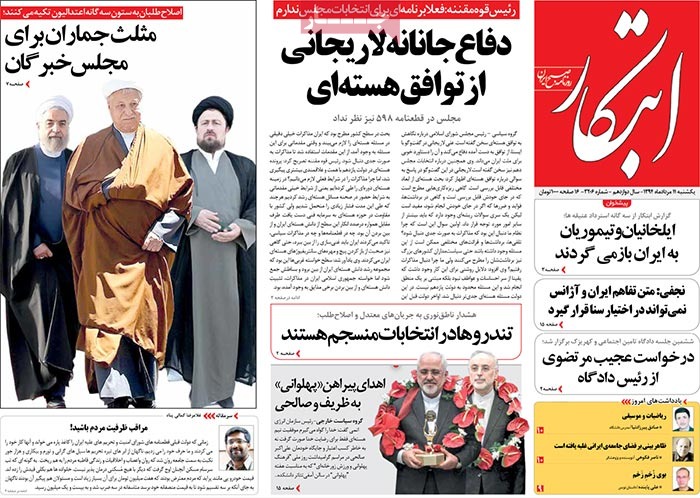
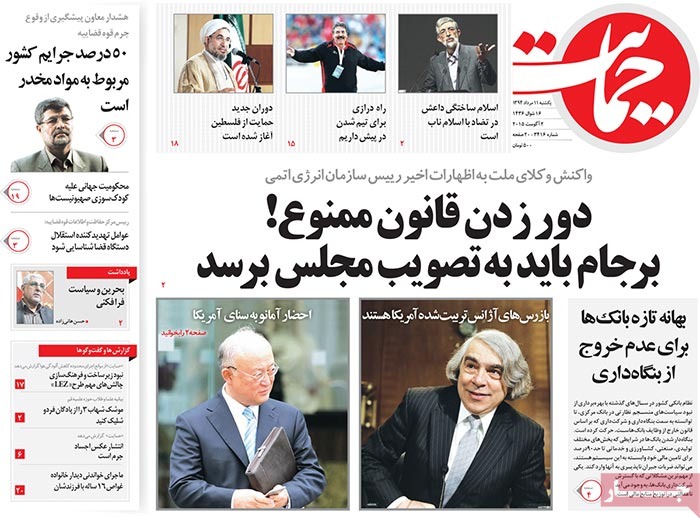
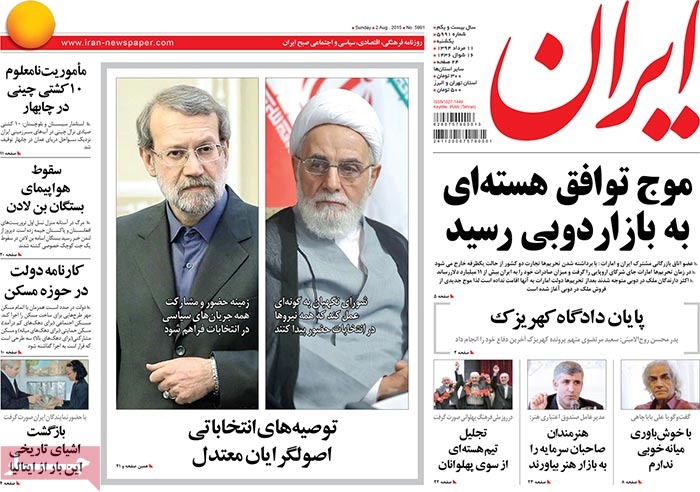
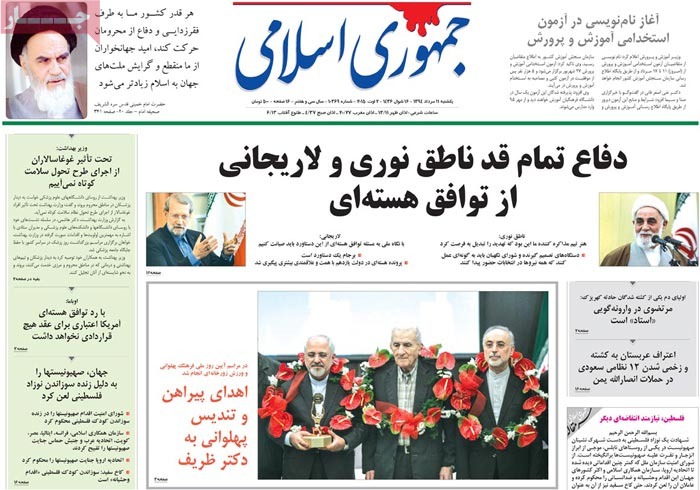
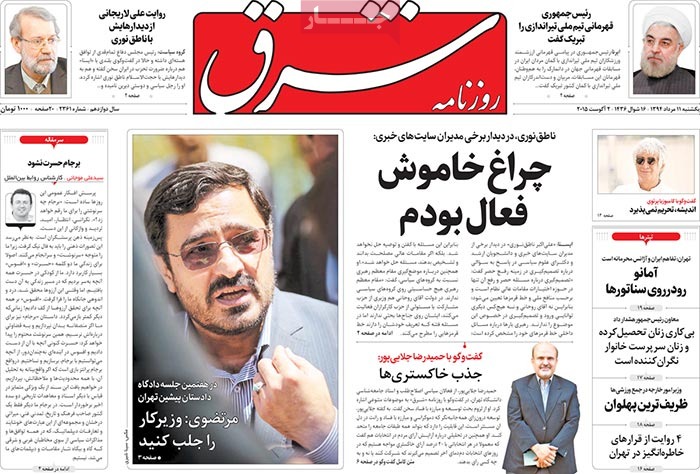
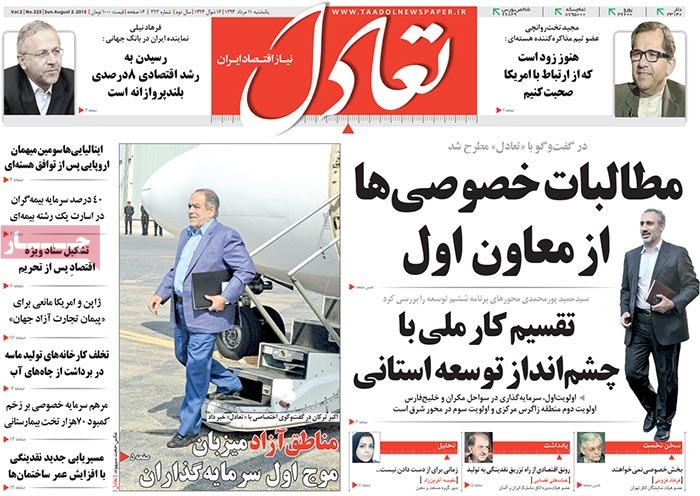
A look at Iranian newspaper front pages on July 7

Iranian Newspapers Headlines

Nuclear talks between Iran and P5+1 and the results of the Greek referendum on austerity measures dominated the front pages of Iranian newspapers on Tuesday.


Ettela’at: A final push by Iran and P5+1 to clinch a deal.

A source close to the Iranian nuclear negotiating team has said that in certain areas serious differences remain to be settled.

None of Iran’s nuclear activities will come to a halt when the Joint Comprehensive Plan of Action produces the intended result.


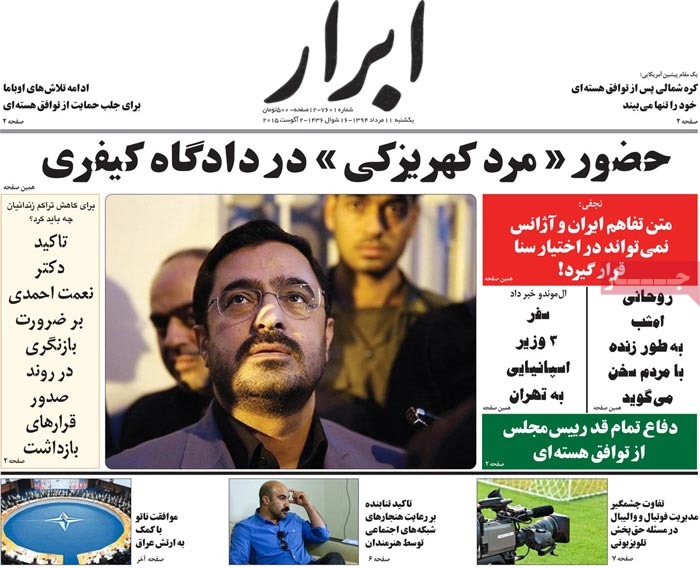
Abrar: The minister of roads and urban development is now more likely to be impeached.

It came after the Ministry of Roads and Urban Development failed to deliver a report to MPs on the crash of an Iran 140 plane.

Abrar: In Britain, the Sunday Times has reported that President Barack Obama will pay a visit to Iran.


A look at Iranian newspaper front pages on July 7


Afkar: A senior German trade delegation is about to visit Iran.


A look at Iranian newspaper front pages on July 7


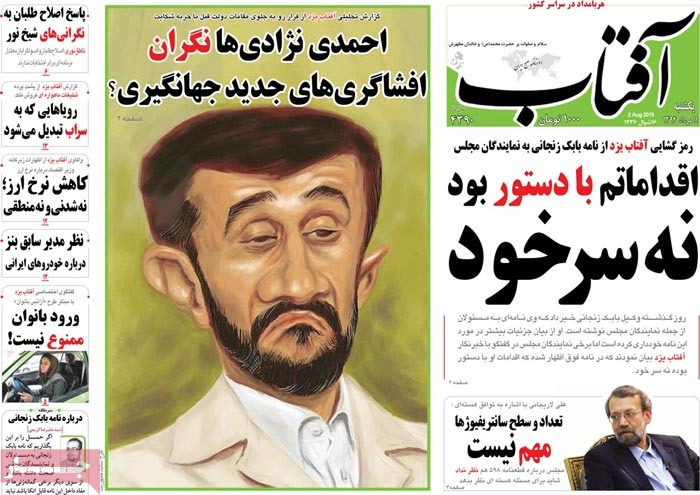
Aftab-e Yazd: Hamid Rasaei [a hardline MP who is very critical of President Rouhani and his policies, both domestic and foreign] has once again traveled to Europe to promote Islam.

Aftab-e Yazd: “Ahmadinejad won’t be successful on the political front,” said Mohammad Khoshchehreh [a onetime confidant of the former president].

“In a tactical move not to be questioned, the former president acted as if he was active and progressive,” Khoshchehreh said in an interview with the daily.


A look at Iranian newspaper front pages on July 7


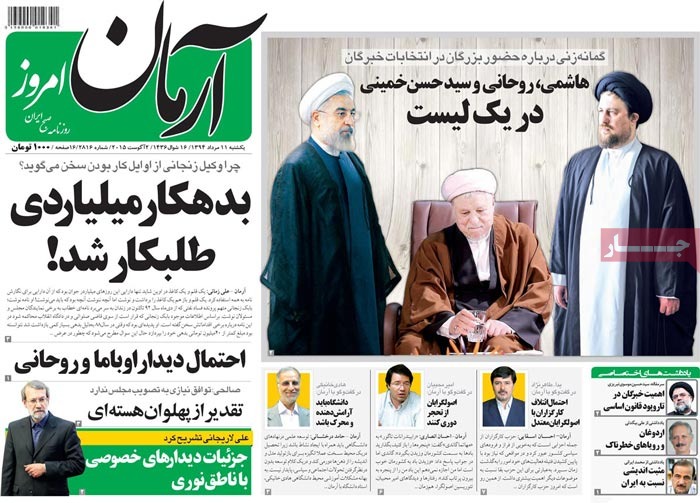
Arman-e Emrooz: Countdown is on; very crucial 48 hours lie ahead.

The foreign ministers of P5+1 are all in Vienna [for nuclear talks with the Iranian delegation].

Arman-e Emrooz: “An unsigned deal won’t be binding,” said Heshmatollah Falahatpisheh, a former MP.

“Termination of sanctions at the UN Security Council will be binding, though,” he further said.


A look at Iranian newspaper front pages on July 7


Asr-e Rasaneh: French investors will travel to Iran; the French seek to modernize the airports of Tehran and Mashhad.


A look at Iranian newspaper front pages on July 7


Asrar: “Saudi Arabia is propping up terrorist movements in the region,” said Vice-President for Parliamentary Affairs Majid Ansari.

Asrar: “The government has no plans to organize festivities [after signing a nuclear deal],” said the spokesman of the Interior Ministry.

Asrar: Shahindokht Molaverdi, vice-president for women and family affairs, says there has been correspondence with the chairman of the Expediency Council to increase the number of female MPs in the Islamic Consultative Assembly.


A look at Iranian newspaper front pages on July 7


Emtiaz: Archeologists have unearthed 7,000-year-old graves in the southwestern province of Khuzestan.


A look at Iranian newspaper front pages on July 7


Hosban: “Iran is to double its crude exports,” said a deputy oil minister.


A look at Iranian newspaper front pages on July 7


Iran: The value of gold and foreign currencies against the rial is on the decline.

The stock exchange, which has barely been in positive territory this year, is gaining momentum, hopeful that a nuclear deal will be struck soon.


A look at Iranian newspaper front pages on July 7


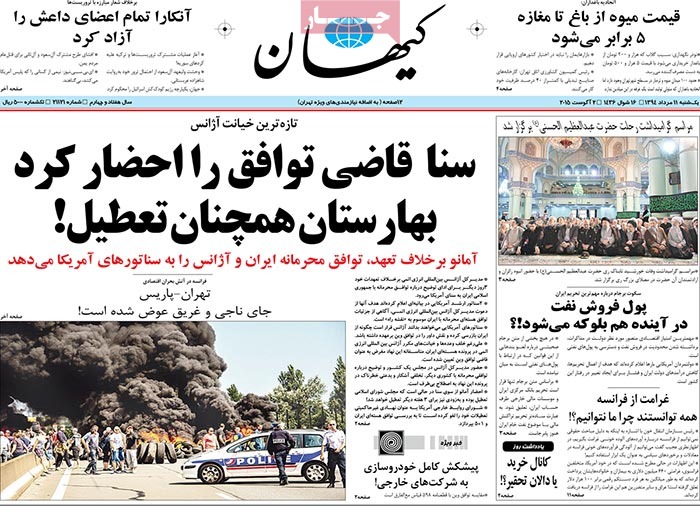
Kayhan: Greece took revenge on the European Union; the Eurozone was rattled.


A look at Iranian newspaper front pages on July 7


Payam-e Zaman: Iran’s oil production in the Persian Gulf has increased.


A look at Iranian newspaper front pages on July 7


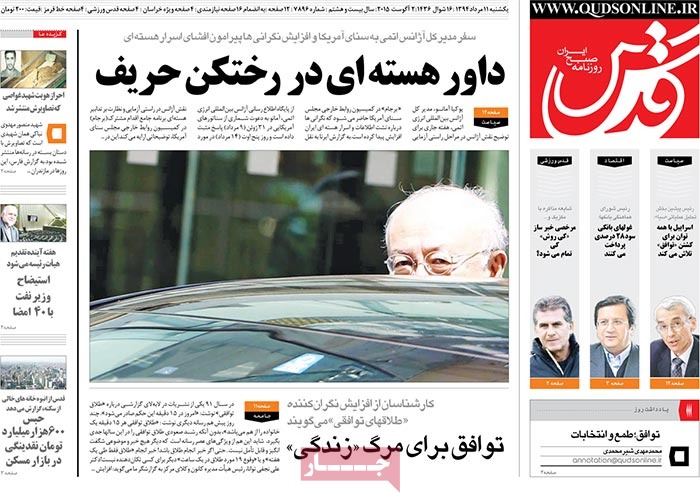
Qods: “Iran won’t accept a tentative lifting of sanctions,” said the chairman of parliament’s National Security and Foreign Policy Committee.


A look at Iranian newspaper front pages on July 7


Setareh Sobh: Populism has triumphed over wisdom and farsightedness in Greece.

In a referendum, more than 61 percent of Greeks have said no to European austerity programs.


A look at Iranian newspaper front pages on July 7


Source rejects Reuters report on Iran’s demand for removal of missile sanctions

reuters

A source privy to the nuclear negotiations underway between Iran and the six world powers in Vienna strongly rejected a Reuters report alleging that Tehran is holding up talks due to its persistent demand for an end to the UN missile sanctions.

Reuters alleged in a Monday report that a dispute over UN sanctions on Iran’s ballistic missile program and a broader arms embargo were among issues holding up a nuclear deal between Tehran and six world powers on Monday.

“This report is nonsense and void of reality,” an Iranian diplomat told FNA.

Reuters claimed that an unnamed Western official has told the news agency that “The Iranians want the ballistic missile sanctions lifted. They say there is no reason to connect it with the nuclear issue, a view that is difficult to accept”.

“There’s no appetite for that on our part,” the report added.

Reuters further alleged that “Iranian and other Western officials have confirmed this view”.

“The Western side insists that not only should it (Iran’s ballistic missile program) remain under sanctions, but that Iran should suspend its program as well,” an Iranian official said, the report claimed.

“But Iran is insisting on its rights and says all the sanctions, including on the ballistic missiles, should be lifted when the U.N. sanctions are lifted,” it added.

[…]

Parthian necropolis unearthed in northern Iran

Iran archaeology

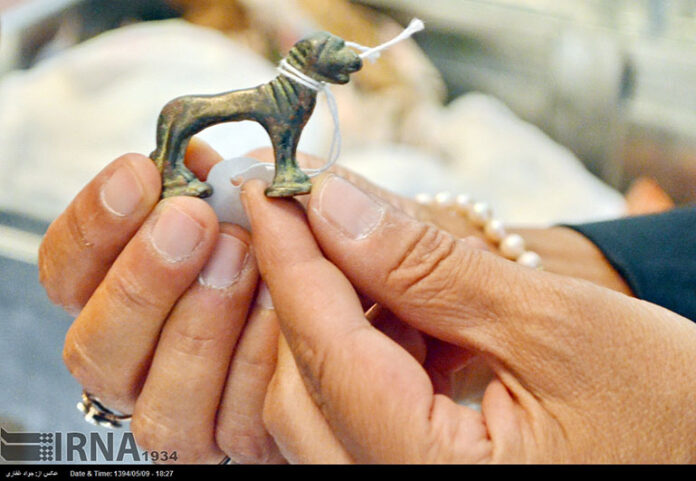
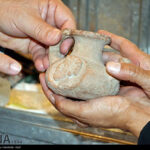
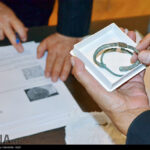
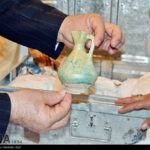
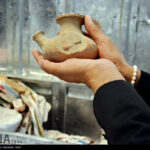
Excavations in northern Iran have led to the discovery of an ancient cemetery dating back to the Parthian Empire.

Vastmin is a village in the northern province of Mazandaran which in recent days has attracted the attention of those interested in culture, history and archeology as a historical site of Arsacid age was unearthed during excavations last month.

A village of 57 (according to 2006 census) now upstaged Kiasar, the nearby city which is the capital of Chahardangeh District, in Sari County with a population of 3,590.

The diggings for pipe-laying operations to build Damghan-Neka gas pipeline led to the discovery as workers came across some ancient antiques in the construction area and informed the local authorities of ICHTO (Iranian Cultural Heritage, Handcrafts and Tourism Organization).

Following the report, the research department of the organization issued a two-months-long warrant permitting excavations between June 6 and August 6.

The supervisor of the excavating team Abdolmotalleb Sharifi told the reporters that out of 15 catacombs discovered so far, just nine are not damaged and the rest are either vandalized by antiques smugglers or destroyed by bulldozers digging for pipe-laying.

The catacombs are comprised of chambers 0.7 meter in width, 1.7 meters in length, and 2 to 2.5 meters in height.

Sharifi also referred to a dome in the western wing of the necropolis with a height of 1.5 to 1.7 meters.

Hints at the site suggest that after the burial of the body, the belongings of the dead were also put in the chamber, and then the hole used for burying was blocked by mud and stone.

According to the findings, the chambers were used more than once and the clues show that at least three corpses were buried in each chamber.

Iran, IAEA firm to boost ‘technical interaction’

IAEA-1

Iran and the International Atomic Energy Agency (IAEA) have discussed ways to improve “technical interaction” in line with the Islamic Republic’s red lines.

A five-member IAEA delegation, which arrived in Tehran on Monday, held intense and constructive negotiations with Iranian officials, said Atomic Energy Organization of Iran (AEOI) spokesman Behrouz Kamalvandi.

He added that during the Monday talks, the IAEA team and Iranian officials reached an agreement which is “completely within the framework of national interests and security considerations and in accordance with the Islamic establishment’s red lines.”

“The agreement will facilitate technical interaction between Iran and the agency,” Kamalvandi said.

He added that Iran and the UN nuclear agency are determined to expedite joint cooperation with the purpose of solving outstanding issues.

The AEOI official said that the day-long IAEA delegation trip, which came just a few days after the agency’s Director General Yukiya Amano paid a visit to Tehran, shows the two sides’ resolve to strengthen constructive cooperation.

Kamalvandi expressed Iran’s readiness to continue cooperation with the IAEA based on the agency’s general regulations.

Amano held talks with Iranian President Hassan Rouhani and the secretary of the Supreme National Security Council, Ali Shamkhani, on July 2.

In a statement issued after the visit on July 3, Amano said Iran and the IAEA have a “better understanding” in some areas but added that more work is required for the resolution of outstanding issues, including the so-called possible military dimensions (PMD).

None of the reports released by the IAEA have said that Iran’s nuclear program is geared toward non-civilian purposes. Nevertheless, the United States and some of its allies falsely accuse Iran of pursuing non-civilian objectives in the nuclear program.

Iran, one of the first states to join the nuclear Non-Proliferation Treaty (NPT), signed the Safeguards Agreement with the IAEA in 1973. The accord came into force in 1974.

Iran’s president to attend BRICS, SCO summits in Russia

Rouhani-1

Iranian President Hassan Rouhani is scheduled to visit Russia Thursday to attend the summits of Shanghai Cooperation Organization (SCO) and BRICS, his office said.

President Rouhani will make the trip at the official invitation of his Russian counterpart Vladimir Putin, Parviz Esmaeili, the deputy for communications and information at the president’s office, told Tasnim on Monday.

The Iranian chief executive is going to have a tight schedule during his two-day stay in the Russian city of Ufa, Esmaeili added.

On the first day, President Rouhani will take part in the BRICS (Brazil, Russia, India, China and South Africa) summit as a special guest and will also deliver a speech, he noted.

The president is also scheduled to address the SCO summit as a keynote speaker on the second day, Esmaeili went on to say.

Among Rouhani’s other plans in Russia will be holding bilateral meetings with heads of a number of SCO and BRICS members.

Beside the SCO and BRICS summits, Ufa will also host a simultaneous meeting of members of the Eurasian Economic Union.