Wednesday, December 24, 2025
Home Blog Page 4796

Iran’s IAEA envoy rejects reports of ‘secret annexes to JCPOA’

iaea2

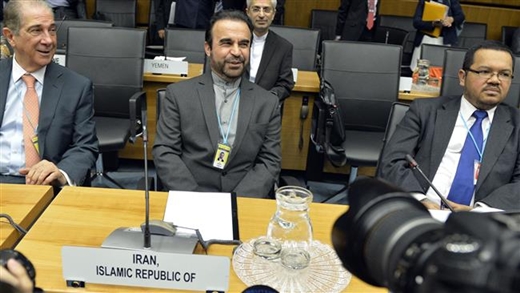
Iran’s envoy to the International Atomic Energy Agency (IAEA) has rejected foreign media reports claiming that Iran and the agency have signed secret agreements as annexes to the text of the Joint Comprehensive Plan of Action (JCPOA) concluded by Iran and the P5+1.

On Friday, Reza Najafi said that Iran and the IAEA signed a roadmap in the Austrian city of Vienna on July 14, which comprises “two separate sets of steps” to be taken by the two sides.

“These sets of steps include technical details, and are considered completely confidential,” said the Iranian official, emphasizing, however, that the roadmap, whose content is confidential, is not a part of JCPOA.

Therefore, calling the sets of steps “secret annexes to JCPOA” is wrong, Najafi said.

He also said that it is natural for the IAEA and its member states to have agreements with confidential content.

Iran and the IAEA announced the signing of the roadmap on the same day that the Islamic Republic and P5+1 – Russia, China France, Britain, the US and Germany – successfully concluded their marathon talks in Vienna and finalized JCPOA.

After signing the roadmap, IAEA Director General Yukiya Amano said it “sets out a clear sequence of activities over the coming months, including the provision by Iran of explanations regarding outstanding issues. It provides for technical expert meetings, technical measures and discussions, as well as a separate arrangement regarding the issue of Parchin [site].”

On Thursday, White House Press Secretary Josh Earnest also said that the agreements between Iran and the IAEA do not “represent some sort of side deal” to JCPOA.

On Wednesday, JCPOA turned into an international document after the UN Security Council unanimously endorsed a resolution under which the IAEA will continue to verify Iran’s compliance with its nuclear-related commitments under JCPOA.

Iran stands first in region in transplantation: Minister

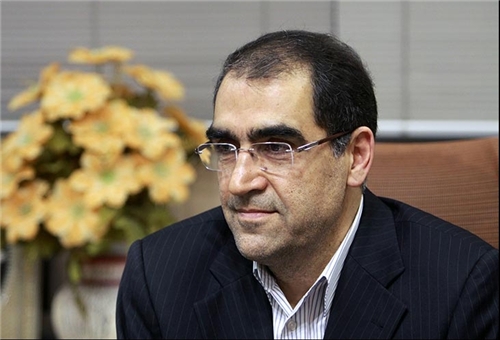
Seyed Hassan Hashemi - Iran Health Minister

Minister of Health Hassan Hashemi said Thursday that Iran stands first in the region in transplantation of body organs.

Speaking in the national conference on health NGOs at Tehran’s Milad Tower, the minister referred to the agreement between Iran and P5+1 and said the agreement is a prelude for other activities, especially medical in the country, adding that the agreement has scored a historical trend.

He said the nuclear agreement is a great task that has been accomplished and all know that good developments will take place in different sectors of the country, including health.

The minister noted that sanctions imposed high pressures on the people in the field of food and medicine and claims that medicine is not among items under sanction are a mere lie.

He pointed to the role of people with regard to treatment and health and said NGOs are the way of salvation in the field of health and treatment, adding that at present 600 NGOs have been registered in the country of which 100 are public and 500 are related to different and specific diseases.

He said currently 96% of the required medicine is manufactured inside the country and noted that medicine imports have dropped by 30% and expressed hope that it will further decrease.

Iran’s annual gold production to hit 7 tonnes

Gold

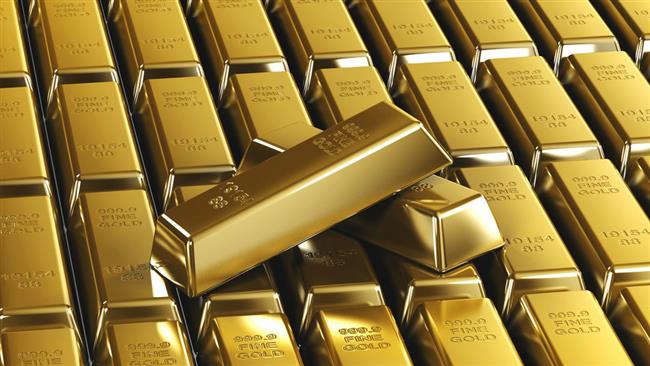
Zarshuran, the Middle East’s biggest gold deposit, will yield 6 million metric tons alone, with another 700 kg coming from mines in East Azarbaijan Province and 300 km from Arghash in Nayshabour.

Production from Zarshuran in the Iranian city of Takab in West Azarbaijan began in November 2014 with the inauguration of a facility capable of processing 3 metric tons of gold on top of 2.5 tons of silver and one ton of mercury per year.

According to the Mehr news agency, the plant is undergoing expansion which will double output by 2017. Initial estimates have put recoverable gold deposits in Zarshuran at 55 metric tons, which could rise to 110 tons by further drilling in the anomalies.

Last year, Iran’s gold production surpassed 4.1 metric tons.

Another gold deposit in Takab, named Aq Darreh, yielded 2.2 metric tons of gold a year before production stopped in 2011.

In 2006, Anglo-Australian miner Rio Tinto pulled out of the Sari Gunay gold mining project in Iran’s Kurdestan after deciding it was not commercially viable.

The company had initially estimated to produce 4 million metric tons of ore per year from the mine over 12 to 18 years before concluding that the reserves were too small to continue with the project.

Iran’s Ministry of Industry, Mine and Trade has identified as many as 15 mines so far, capable of yielding 320 metric tons of processed gold.

The provinces of West and East Azarbaijan, as well as Isfahan and Razavi Khorasan hold the country’s biggest reserves for production of gold.

Time ripe for Iran, France to bolster cooperation: Rouhani

Rouhani-Francois Hollande

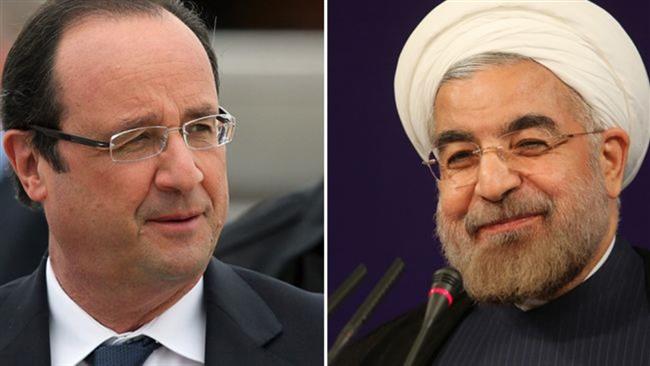
Rouhani made the remarks in a telephone conversation with his French counterpart, Francois Hollande, on Thursday, underscoring the enormous potential that Iran and France have for expanding cooperation in different fields.

“Over the past 10 years, the two countries have lost many opportunities to deepen and expand relations, and now is the time to redress the past,” Rouhani said. 

The phone conversation came over a week after Iran and the P5+1 group of countries – the United States, Britain, China, France, Russia and Germany – succeeded in finalizing the text of the Joint Comprehensive Plan of Action (JCPOA) in the Austrian capital, Vienna, on July 14.

Under the JCPOA, limits will be put on Iran’s nuclear activities in exchange for, among other things, the removal of all economic and financial bans against the Islamic Republic.

On July 20, the United Nations Security Council unanimously endorsed a draft resolution upholding the JCPOA. All 15 members of the world body voted for the draft resolution in New York, setting the stage for the lifting of the Security Council sanctions against Iran.

Rouhani further described the commitment of all sides to fulfilling their obligations as the most important factor for the success of the executive process of the negotiations, adding, “It is necessary for the members of the P5+1 group to try to take the next steps of the nuclear agreement.”

Referring to the situation in the Middle East and the destruction terrorist groups are wreaking on the region, Rouhani said Iran seeks the cooperation of the European countries, including France, to counter terrorist groups in Syria, Iraq and Yemen.

“The establishment of peace and stability in the region is Iran’s main objective, and we are ready to cooperate with other countries, including France, in this regard,” Iran’s president added.

Rouhani further referred to the deplorable situation of the Yemeni people, who have been under relentless Saudi aggression since late March, saying, “Airstrikes by a neighboring country against the Yemeni people are unacceptable and I hope that the massacre of Yemeni people is condemned by France and the European Union.”

Rupert Colville, the spokesman for the United Nations High Commissioner for Human Rights, said on July 21 that at least 1,693 civilians had been killed and 3,829 others injured since 26 March in Yemen. However, local sources say over 4,500 people have lost their lives in the Saudi onslaught.

The French president, for his part, appreciated efforts by President Rouhani during the nuclear talks between Iran and its negotiating partners, saying French Foreign Minister Laurent Fabius will soon visit Iran to strengthen bilateral relations.

Hollande also stated that all parties to the nuclear agreement should work for its implementation, and that Paris is ready to expand its ties with Iran in the fields of energy, oil, and air transportation.

Hollande said his country is ready to cooperate with Iran in the fight against terrorism, stressing that a political solution should be sought to end the violence in Yemen and Syria.

The French president added that his country is ready to cooperate in the fight against terrorism and ISLI Takfiri group in Iraq.

Iranian, Austrian officials review technological cooperation

81692969-70050096

Vice-President for Science and Technology Sorena Sattari met and conferred with the Austrian President Heinz Fischer on bilateral cooperation in scientific and technological issues.

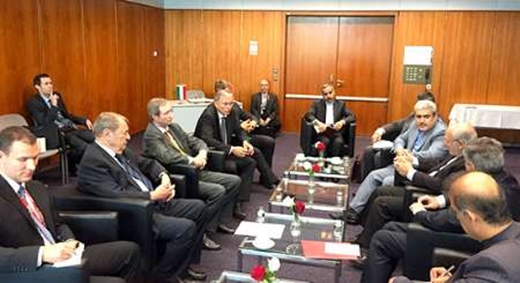
Sattari, who is now in Vienna, has already addressed the closing ceremony of the two-day Iran-EU conference dedicated to “EU-Iran – Post Sanctions Era” in the Austrian capital.

During his address, Sattari referred to Iran’s great potential and focused on developing markets in the country.

He further encouraged the participants to make investment in Iran.

He also referred to Pardis Technology Park in Iran that can be considered a place for transferring modern technologies.

During his stay in Vienna, Sattari inked two trade agreements with European companies.

Also, he met with a number of Austrian officials.

Iran, Europe finalize $2 billion of projects

Iran-EU Flags

Minister of Industry, Trade and Mine Mohammad Reza Nematzadeh is leading the Iranian delegation at the two-day conference to discuss opportunities for cooperation with officials from Austria, France, Germany, UK and other countries.

“We are looking for a two-way trade as well as cooperation in development, design and engineering. We are no longer interested in a unidirectional importation of goods and machinery from Europe,” he told the conference.

After the finalization of nuclear talks, European leaders and representatives of major industries are in a race to size up business opportunities in the energy-rich Iran.

Deputy Economy Minister Mohammad Khazaei told the conference that the Iranian government had already granted license for more than $2 billion of projects with the Europeans.

“We are recently witnessing the return of European investors to the country. Some of these negotiations have concluded, and we have approved and granted them the foreign investment licenses and protections,” he said.

“Even in the past couple of weeks we have approved more than $2 billion of projects in Iran by European companies.”

Nematzadeh said oil and gas, metals and car industries were the industries in focus.


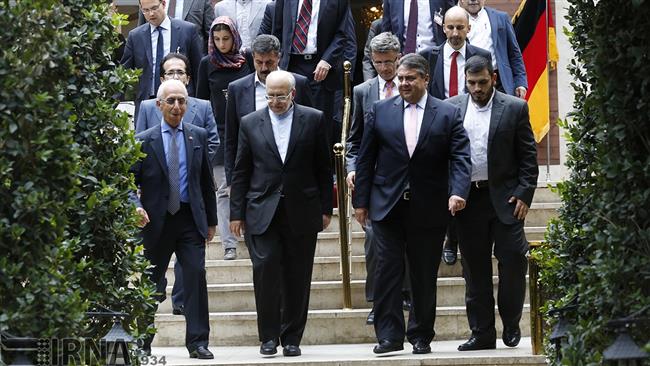
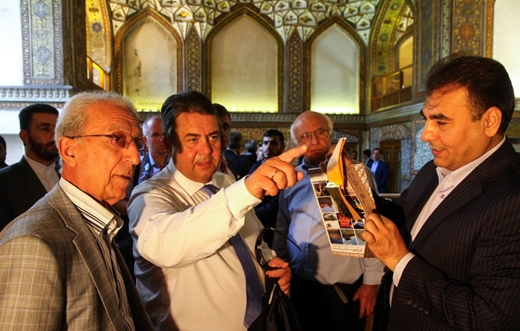
Iran's Industry Minister Mohammad Reza Nematzadeh (2nd L) and German Economy Minister Sigmar Gabriel (2nd R) are leaving a meeting after talks in Tehran.
Iran’s Industry Minister Mohammad Reza Nematzadeh (2nd L) and German Economy Minister Sigmar Gabriel (2nd R) are leaving a meeting after talks in Tehran.


According to Deputy Minister of Petroleum Hossein Zamaninia, as many as 50 oil and gas projects worth $185 billion have been marked out for presentation to prospective investors within 2-3 months along with the new contract models.

The Iran Oil Contract (IPC) addresses some of the deficiencies of the traditional buy-back deals, taking short- and long-term interests of the foreign entities to heart, he said.

Iran’s priority is to improve recovery from its ageing oilfields and develop both onshore and offshore reserves shared with its neighbors in the south and the west. For those fields, Zamaninia said, Iran was ready to sign contracts for a period of 20-25 years.

By 2025, Iran aims to produce 3 million vehicles through joint ventures with auto parts manufacturers, with 1 million units intended for exports including to Europe, Nematzadeh said.

On Sunday, German Economy and Energy Minister Sigmar Gabriel led a delegation of state officials and representatives of the country’s biggest companies on a three-day visit to Iran.

French Foreign Minister Laurent Fabius will visit Tehran on July 29 with the aim to revive relations. France’s main business lobby group, the Medef, is sending a delegation of about 80 firms to Iran at the end of September.

Meanwhile, Italian Economic Development Minister Federica Guidi will head a team of 300 traders on a two-day visit to Iran on August 4.

Switzerland’s Deputy Foreign Minister Yves Rossier arrived in Iran on Tuesday and held discussions with several Iranian officials.

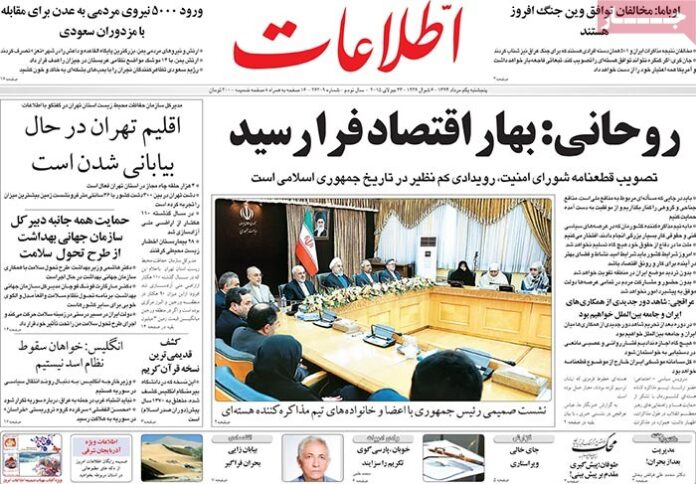
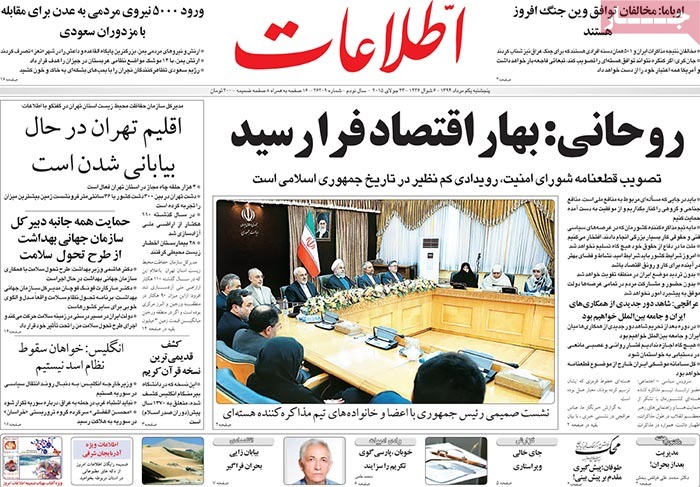
Highlights of Ettela’at newspaper on July 23

Ettelaat23

 “The spring of the Iranian economy has arrived,” President Rouhani said.

He further said that the adoption by the UN Security Council of Resolution 2231 is unprecedented in the history of the Islamic Republic.
 The president has held a meeting with members of the nuclear negotiating team and their families.

 President Obama has said, “The warmongers are trying to scuttle the Vienna accord”.

He has further said that the same people who are now against the deal Iran and P5+1 struck in Vienna last week are “the same folks who were so quick to go to war in Iraq”.

 Some 5,000 popular forces have arrived in Aden to take on Saudi mercenaries.

The Yemeni Army and popular forces have overrun Alqaeda and IS bases in the city of Taiz.

 “Tehran is getting desertified,” said the director general of Tehran Environment Protection Department.

 The director general of the World Health Organization has thrown her weight behind Iran’s Health Transformation Plan.

The Iranian health minister has said that the plan is being implemented in cooperation with the WHO.

 Britain has said that it does not want the downfall of Assad’s government in Syria.

The British foreign secretary has said that London favors political transition in Syria.

 The oldest handwritten copy of the holy Koran has been discovered.

The copy found in University of Birmingham dates back to 1,370 years ago.

Why did Professor Samii accompany German vice-chancellor?

Samii-German

Professor Majid Samii, a distinguished Iranian neurosurgeon and medical scientist, says his trip to Iran in the company of German Vice-Chancellor Sigmar Gabriel is not for economic or political purposes, stressing that he is in Iran only to boost friendship between the two nations.

The Iranian scientist – who is the head of the world renowned International Neuroscience Institute (INI) based in Hanover – said this to reporters on Tuesday and added that it was the vice-chancellor’s idea that he accompany the German delegation to Iran. Fararu.com on July 21 released a report on his remarks. The following is the translation of what else Prof. Samii told reporters:

Professor Samii said, “The German people treat me with respect. The Iranians too show a feeling of friendship and devotion to me. It was the idea of the German vice-chancellor that I accompany him in his trip to Iran and signal this message to the Iranian nation that a new chapter of relations will open for the two countries”.

The renowned Iranian neurosurgeon went on to say, “I act as the ambassador of both Iran and Germany. Personally, I have no economic and political links with Iran. I have not made and will not make any political statement”.

He further said that the stage has been set for Iran and Germany to work together, adding that Iran has the capacity to make scientific and economic progress. He also said Iran’s cooperation with the German government will certainly produce positive results on scientific and medical fronts.

He added that the Germans and Iranians have so far been unaware of their potential, but the two countries got closer thanks to joint scientific and industrial projects they have undertaken.

“I view myself a resident of Isfahan. Our half-day trip to Isfahan revolves around sight-seeing and a meeting with the governor general before we head back to Germany,” said Prof. Samii.

“The German vice-chancellor, who is a friend of mine, asked me to accompany him on his Iran visit. The trip will also take us to Isfahan where we seek to see Iran’s historic and artistic works and their antiquity [firsthand].

“The head of the German Chambers of Commerce and Industry together with presidents of German giants such as Siemens AG [a German multinational conglomerate company] and Volkswagen Group [a German multinational automotive manufacturing company] are on the German team to Iran,” he said.

“These companies are seeking to immediately transfer their technology to Iran. They do not look at Iran as a consumer; rather, they seek to establish cooperation with Iran,” he added.

The Iranian scientist also said that the high-ranking German team has now learned about the intelligence of the Iranians and they now believe that Iran can make scientific and industrial progress like Germany.

He said that Iran’s biggest neurology center, which is being constructed in Tehran, will become operational next year (in spring). […]

A look at Iranian newspaper front pages on July 23

Iranian Newspapers Headlines

Comments by President Rouhani and senior nuclear negotiator Abbas Araghchi in support of the nuclear deal Iran struck with P5+1 on July 14 dominated the front pages of Iranian newspapers on Thursday.


Ettela’at: “The spring of the Iranian economy has arrived,” President Rouhani said.

He further said that the adoption by the UN Security Council of Resolution 2231 is unprecedented in the history of the Islamic Republic.

Highlights of Ettela’at newspaper on July 23

A look at Iranian newspaper front pages on July 23


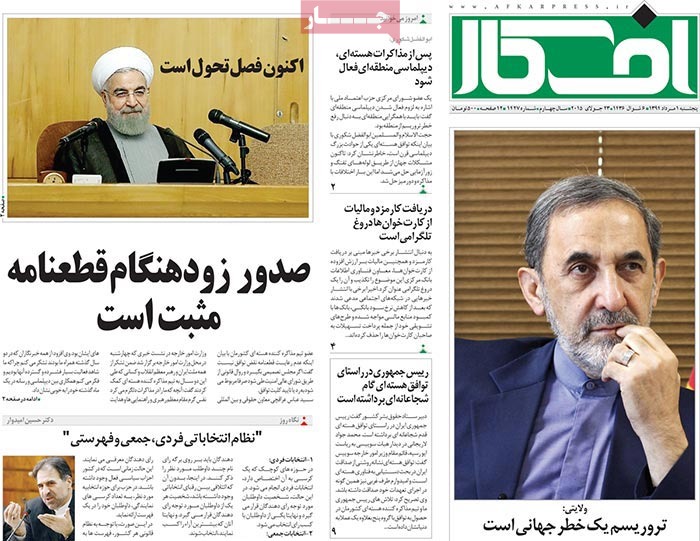
Afkar: “President Rouhani took a bold step in securing the nuclear deal,” said Mohammad Javad Larijani, the head of the Human Rights Council.
 

A look at Iranian newspaper front pages on July 23


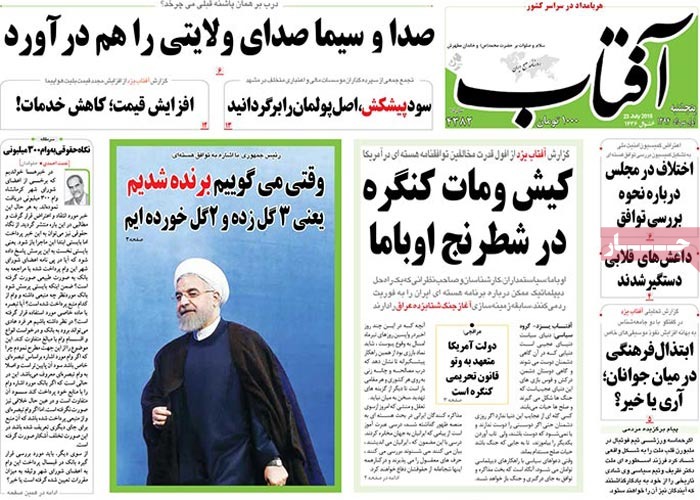
Aftab-e Yazd: Division in parliament on how the nuclear deal should be reviewed

The National Security and Foreign Policy Committee has objected to the formation of a Nuclear Review Committee in the Islamic Consultative Assembly.
 

A look at Iranian newspaper front pages on July 23


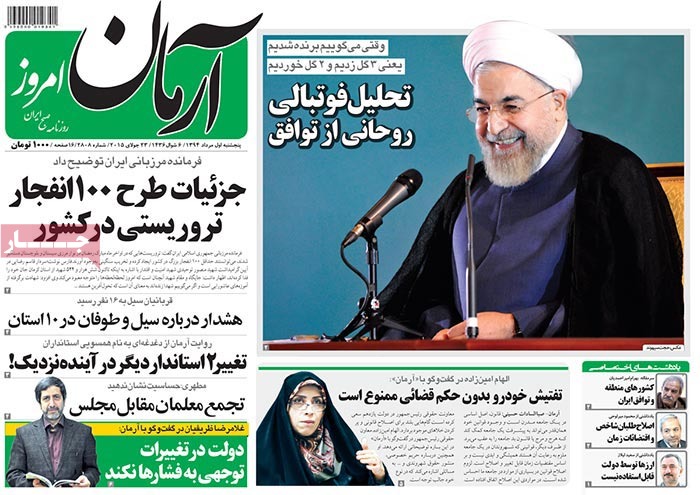
Arman-e Emrooz: The border guard chief has elaborated on a terrorist gang bust.

The terrorists who were arrested in the border area in Sistan and Baluchestan Province in the final days of the holy month of Ramadan could have set off at least 100 big explosions across the country.

Arman-e Emrooz: Two more governors general are likely to be replaced in the near future.

The daily has a report on a new government concern about provincial governors not acting in line with the policies of the Rouhani administration.

Arman-e Emrooz: “Searching the cars without a court order is against law,” said the legal deputy of President Rouhani.
 

A look at Iranian newspaper front pages on July 23


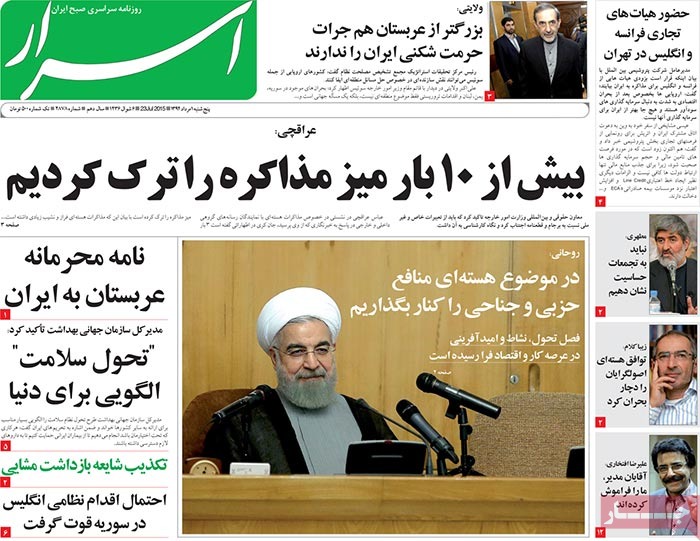
Asrar: “On the nuclear issue, let’s put aside partisan and factional interests,” said President Rouhani.

Asrar: Rumors that the former president’s chief of staff Esfandiar Rahim Mashaei is in custody have been refuted.
 

A look at Iranian newspaper front pages on July 23


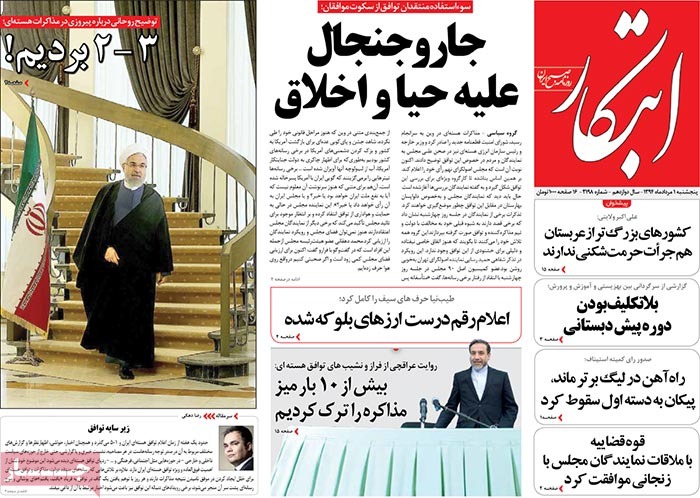
Ebtekar: “We walked away from the talks more than 10 times,” said Iranian diplomat Abbas Araghchi of the ups and downs of nuclear talks with P5+1.

Ebtekar: The Judiciary has agreed to MPs meeting with Babak Zanjani [a young billionaire who stands accused of massive fraud when Ahmadinejad was president].
 

A look at Iranian newspaper front pages on July 23


Etemad: President Rouhani’s account of the nuclear win, soccer-style: “We scored three goals and conceded only two.”

“Those who favor political and cultural openings can be more hopeful from now on,” said President Rouhani.
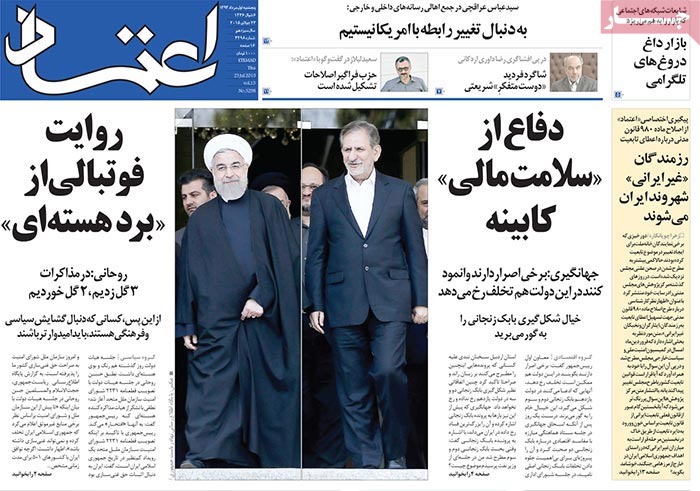
 

A look at Iranian newspaper front pages on July 23


Hosban: “After sanctions, a new chapter of economic cooperation with the rest of the world will open,” said Iranian nuclear negotiator Abbas Araghchi.
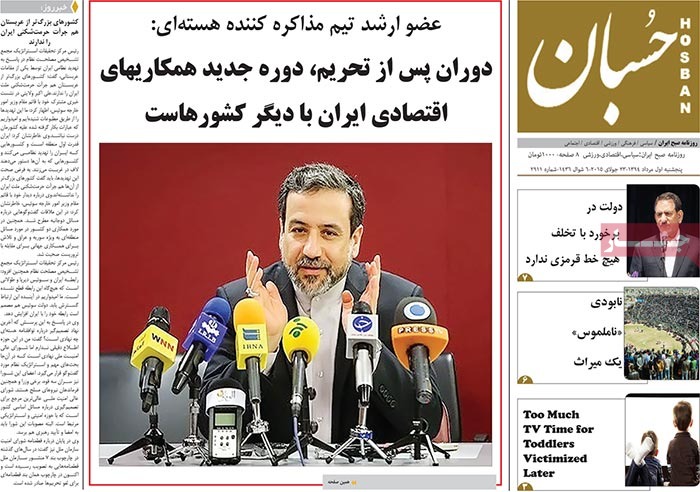
 

A look at Iranian newspaper front pages on July 23


Iran: “Don’t stick to your political interests at the expense of national interests,” Ali Akbar Velayati, an advisor to the Supreme Leader, said in comments aimed at the opponents of the nuclear deal.
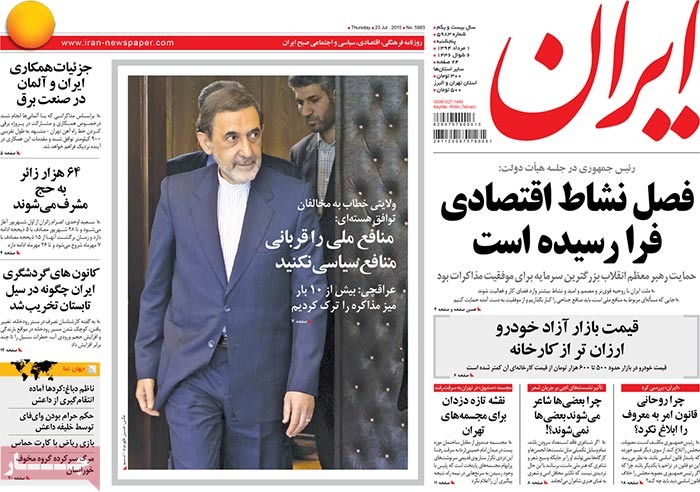
 

A look at Iranian newspaper front pages on July 23


Jomhouri Islami: “The nuclear deal between Iran and P5+1 is a harbinger of a new era in international developments,” said the presidents of three main universities in the capital.

Jomhouri Islami: “The performance of the nuclear negotiating team is a source of pride for the Iranians and those who love the Islamic Revolution,” President Rouhani said.
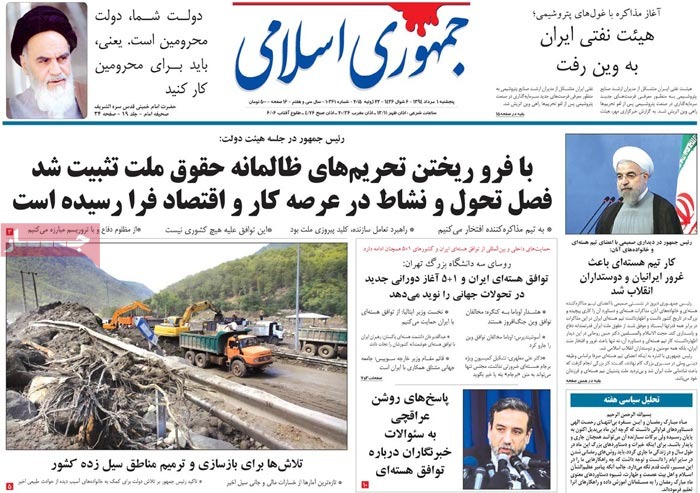
 

A look at Iranian newspaper front pages on July 23 


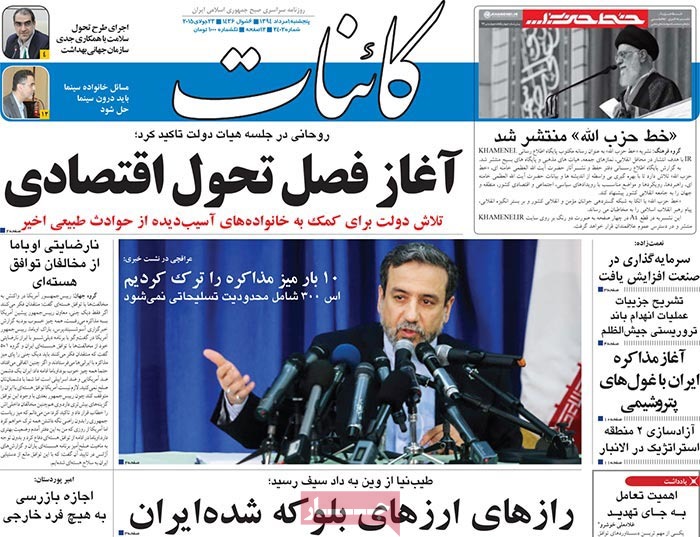
Kaenat: “The arms restrictions do not apply to S300 air defense system,” said Iranian nuclear negotiator Abbas Araghchi.
 

A look at Iranian newspaper front pages on July 23


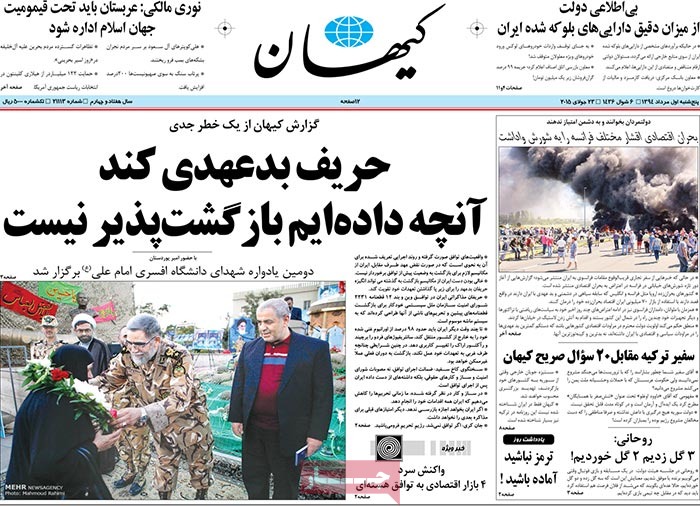
Kayhan: Government does not have an exact figure on Iran’s frozen assets.

Kayhan: “If the other party fails to honor its commitments, what we are giving away is not returnable,” the daily has said in a report on what it calls a “serious threat”.

Kayhan: Four economic markets have shown a lukewarm reaction to the nuclear deal between Iran and P5+1.
 

A look at Iranian newspaper front pages on July 23


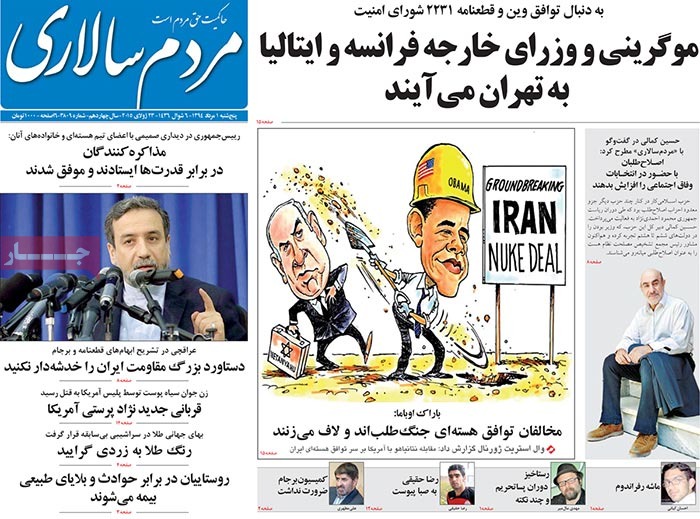
Mardomsalari: The EU foreign policy chief and the foreign ministers of France and Italy will arrive in Tehran shortly.

Mardomsalari: Villagers are to be offered insurance on natural disasters.

Mardomsalari: “Don’t tarnish the great achievement of the Iranian resistance,” said Abbas Araghchi, a nuclear negotiator, to opponents of the Iran-P5+1 nuclear deal.
 

A look at Iranian newspaper front pages on July 23


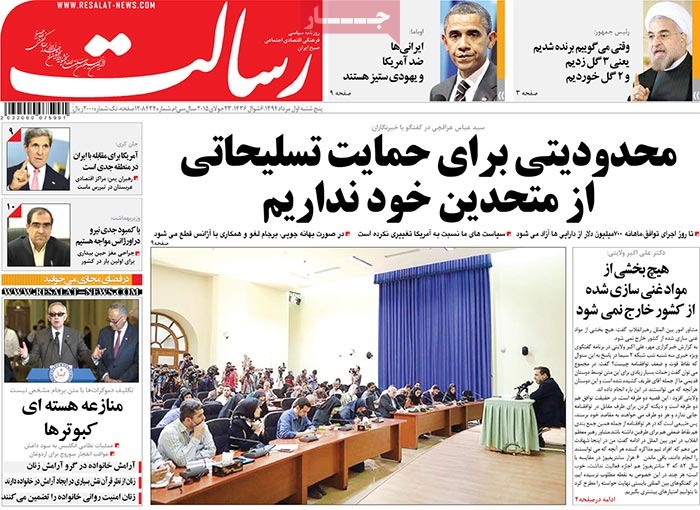
Resalat: “Iran faces no restrictions in lending arms support to its allies,” said Iranian nuclear negotiator Abbas Araghchi.
 

A look at Iranian newspaper front pages on July 23


Setareh Sobh: “The national medium [a reference to state radio and TV organization] has turned into a factional medium,” said Ali Akbar Velayati, the Supreme Leader’s advisor.

Setareh Sobh: “A second storm is on its way,” the Meteorological Organization has warned.

[It came after a deadly storm which brought heavy flooding caught the residents of Tehran and Alborz provinces off guard, killing more than a dozen people.]
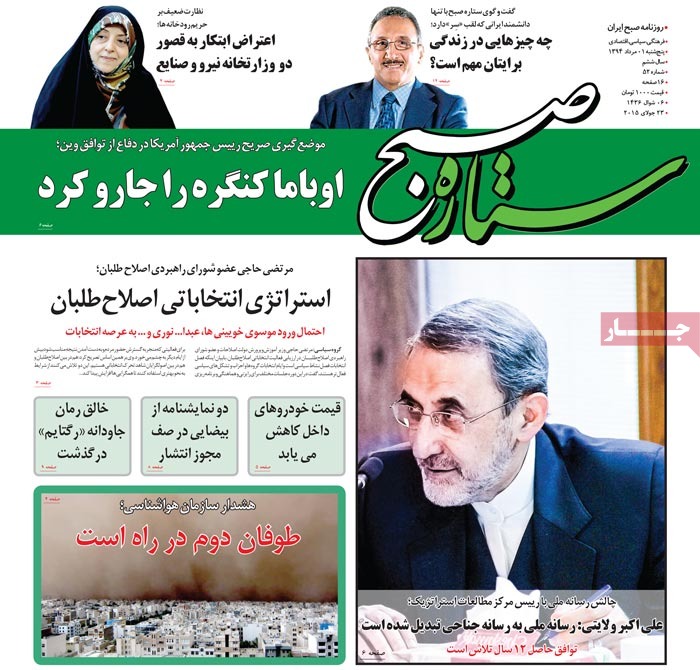
 

A look at Iranian newspaper front pages on July 23


Sharq: Parliament Speaker Ali Larijani has hailed the nuclear deal as a national achievement.
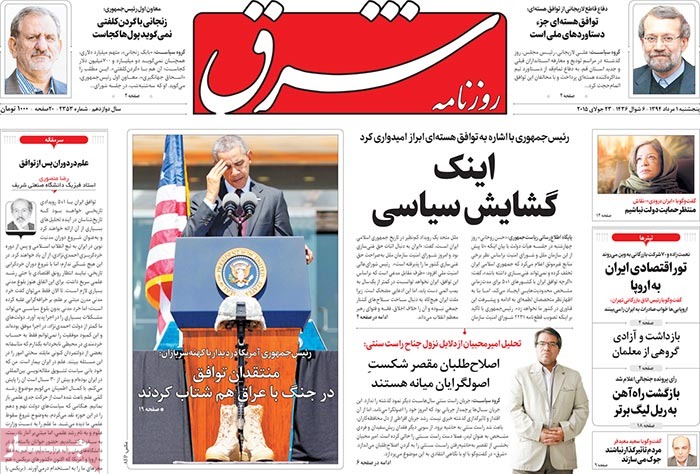
 

A look at Iranian newspaper front pages on July 23


Taadol: An Iranian economic delegation led by the industry minister is in Vienna today to push for expansion of Iran-Europe economic ties.
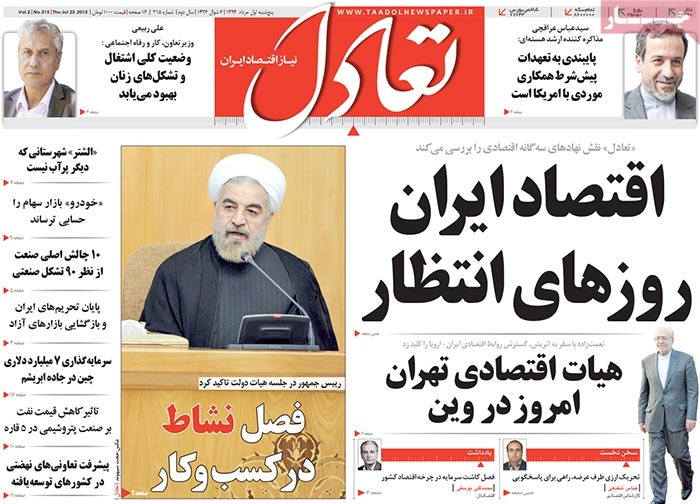

 

A look at Iranian newspaper front pages on July 23


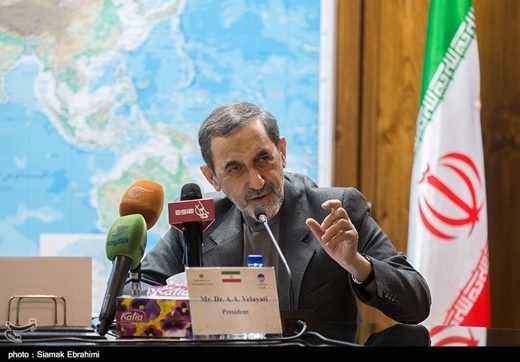
Iran’s Velayati warns against spread of terrorism

Ali Akbar Velayati

Head of the Strategic Research Center of Iran’s Expediency Council Ali Akbar Velayati expressed concern over the spread of terrorism in the world, saying that terrorist groups must be dealt with “decisively”.

The current crises in Syria, Yemen and Lebanon as well as the campaign against terrorism are not regional but global issues, Velayati said in a Wednesday meeting in Tehran with Yves Rossier, the secretary of state at the Swiss foreign ministry.

Terrorist groups in Arab countries are dangerous to all nations around the world, especially to those that sponsor these groups, he said.

The Iranian official further called on all European countries to actively contribute to the fight against terrorism in the region, saying that if today, the fight against terrorism is not pursued decisively, they will penetrate into Europe and other parts of the world.

In recent years, the threat of terrorism has intensified in the world, with groups like ISIL committing heinous crimes not only in the region but elsewhere in the world, including Europe.

In a recent terrorist attack in France, a man with links to the Takfiri ISIL terrorist group beheaded his employer and tried to blow up a gas factory near Lyon, France’s third largest city, on June 26.

On the same day, ISIL militants carried out deadly terrorist attacks in Tunisia and Kuwait, killing scores of people.