Thursday, December 25, 2025
Home Blog Page 4718

Deal is round the corner: Former British ambassador to IAEA

81672470-70016413

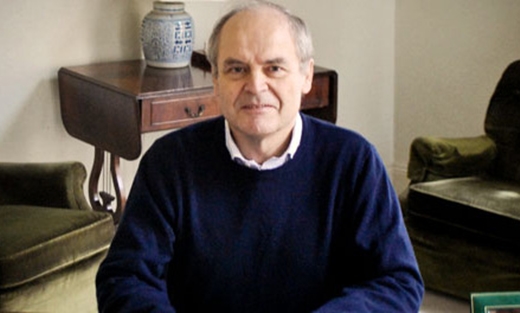
Peter Jenkins, former British Ambassador to IAEA suggests that all signs indicate that a deal is inevitable and that achieving an agreement is in Britain’s interest.

The retired British diplomat expressed his willingness for the success of the nuclear negotiations between Iran and P5+1 and suggested that a deal is round the corner.

Following is the full text of an interview with Mr. Jenkins delivered by IRNA:

Do you think that the negotiations will be successful in the extra time?

I think it’s quite likely that there will be a success; if I had to bet on it I would certainly bet on it being a success if not by Tuesday, then by Wednesday or Thursday.

The Americans are under some pressure to have an agreement by Tuesday because they want to be able to present the agreement to Congress before the 9th July.

All the signs that are over the last week there show that there has been significant progress in relation to one of the remaining obstacles to an agreement; which was how to handle the so-called possible military dimension and the need of the IAEA for better cooperation from Iran to resolve that issue.

Also Mr. Amano was in Tehran in the course of the week and what he has said sounds encouraging.

So it looks as if the issues have been resolved and the resolution at that issue has opened the way to the resolution of the sanctions issue.

And all the other major issues seem to have been previously resolved in other words, how many centrifuges that Iran would operate during the confidence building period, what the stock of low enriched Uranium in Iran would be in the confidence building period, and what kind of modernization to the design of the Reactor of ARAK would be undertaken.

What persuades the West to have a deal with Iran?

For many years there has been a fear that Iran wanted to acquire nuclear weapon.

Rightly or wrongly that fear becomes entrenched in the minds of the Western politicians and officials well over a decade ago and for some times the West believed that the solution to their concern was to persuade Iran to completely abandon the enrichment of Uranium, in other words to dismantle whatever facilities had for enriching Uranium.

It took them a long time that eventually they came to understand that Iran was not prepared to do that and that the only way that could be achieved would be by actually invading Iran and physically dismantling the facilities.

That was a deeply unattractive way forward; so they finally came to understand that the best thing was to negotiate an agreement which would enable them to acquire greater confidence in the assurances that had been coming ever since 2003 from people like Dr. Rouhani now President Rouhani, the assurances that Iran did not want nuclear weapons.

So at first the West was very skeptical when they were told that Iran did not want nuclear weapons, they come around to thinking that maybe that is the case but let’s give ourselves a period to acquire some degree of certainty that it’s the case.

What impact would the deal have on other issues apart from the nuclear matter? Would this help reopening of the British embassy in Iran? Does the West look at the deal as a means of influencing the region?

As far as the British-Iranian relationship is concerned, my understanding is that there has been quite a lot of progress over the last year towards the reopening of embassies and what has been holding it up [are] fairly technical issues; so I do not think that concluding a deal would make a great deal of difference to that.

But it does pave the way for more cooperation between Iran and the West especially the US over Iraq in particular, possibly in bringing an end to the civil war in Syria.

It would therefore be very positive and helpful.

If the negotiation fails for any reason (e.g. Sabotage of its enemies), what would be the impact?

I think it is very unlikely that the negotiations will fail in a sense that there would be a complete collapse and the two parties will walk away in opposite directions and say we never want to talk to one another again; I think that’s almost inconceivable.

They might fail to meet the latest deadline but if they do, then I think they will give themselves still more time and set yet another deadline.

All the signs are that they made so much progress and have eliminated so many of the obstacles that had divided them and that they don’t have a long journey and long way to go in order to get an agreement.

Having said all of that of course there are in the US people who would love the talks to fail and what they would then press for is an increase in the sanctions.

However, my own belief is that they would have some difficulty in persuading the rest of the world to go along with that; I am not sure if even the Europeans would be ready to support the Americans in adding to the burden of sanctions on Iran.

What if the US Congress blocks the deal?

Congress cannot be ignored by the US administration; however I don’t think there would be a total collapse and a throwing away of all that has been achieved.

I think almost certainly that the administration would want to find some other way of cementing in place of whatever has been agreed with Iran and would also want to consult the Iranians how to proceed at that point.

On the other hand, the ambassadors of Britain, France and Germany have been quite active this year in making known to Congress that Europe is now strongly committed to achieving the kind of nuclear deal that looks likely to emerge this week.

There is absolutely no doubt that they will be very disappointed if Congress were to block that deal. However, I think rather than walking away and going off in a different direction, what they would do is work even more closely with the administration to try and find a solution to the problem that has been created by Congress.

What is Britain’s position in achieving the deal?

Because of our constitutional arrangements, the government always has majority in the parliament and therefore parliament tends to be much readier to fall in with whatever policy the government wants the country to follow.

The British ambassador has also been an active advocate of the deal that is emerging and the British government is now strongly committed to achieving this kind of deal.

They are of course not strongly committed to achieving any kind of deal but I think realize that the kind of deal that is emerging is a good deal; it’s a deal that is in Britain’s interest and it’s a deal that is in the interest of the whole international community.

A look at Iranian newspaper front pages on July 6

Iranian Newspapers Headlines

Nuclear talks in Vienna between Iran and P5+1 and the comments of the chairman of the Expediency Council about a wide range of issues including his relationship with the Supreme Leader dominated the front pages of Iranian newspapers on Monday.
 

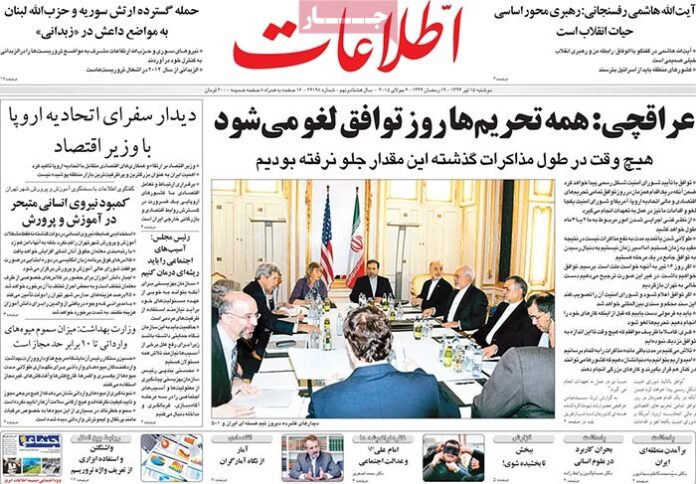
Ettela’at: “All sanctions will be lifted on the day a deal takes effect,” said Iranian nuclear negotiator Abbas Araghchi.

He further said: “Never during the course of the past talks did we make so much progress. The deal will be made official with the approval of the UN Security Council. On our side, implementation of technical issues will take 2-3 months.”

Araghchi also said that there will be an agreement if the negotiating team clinches what the Iranian people want by July 7, if not, it prefers to return home empty-handed.


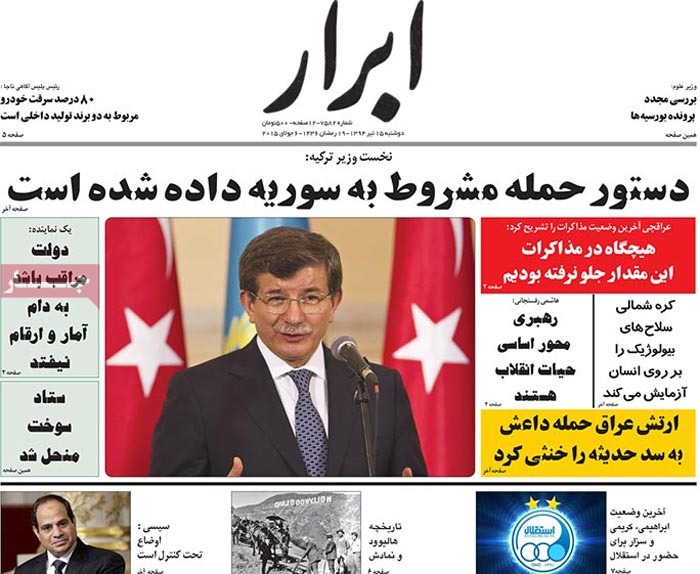
Abrar: The Iraqi army has foiled an attack by IS terrorists on Haditha.

Abrar: “A tentative order for an attack on Syria has been issued,” the Turkish prime minister said.


A look at Iranian newspaper front pages on July 6


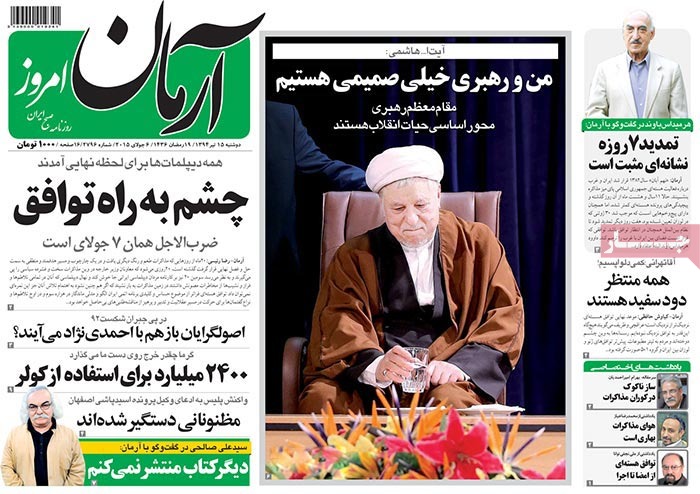
Arman-e Emrooz: “Some suspects have been arrested in connection with a rash of acid attacks in Isfahan,” police said in reaction to comments by a lawyer for the victims of the 2014 attacks.


A look at Iranian newspaper front pages on July 6


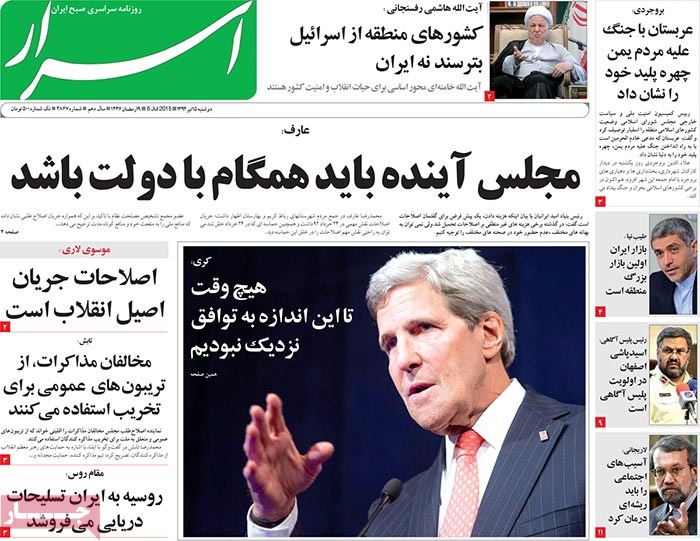
Asrar: “Regional countries should be afraid of Israel, not Iran,” said Expediency Council Chairman Ayatollah Akbar Hashemi Rafsanjani.


A look at Iranian newspaper front pages on July 6


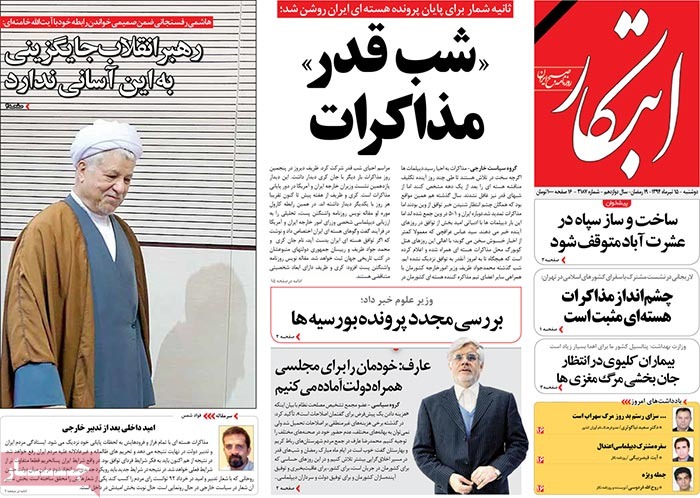
Ebtekar: [Unauthorized] construction by the Islamic Revolution Guard Corps at the capital’s Eshratabad Square has come to a halt.

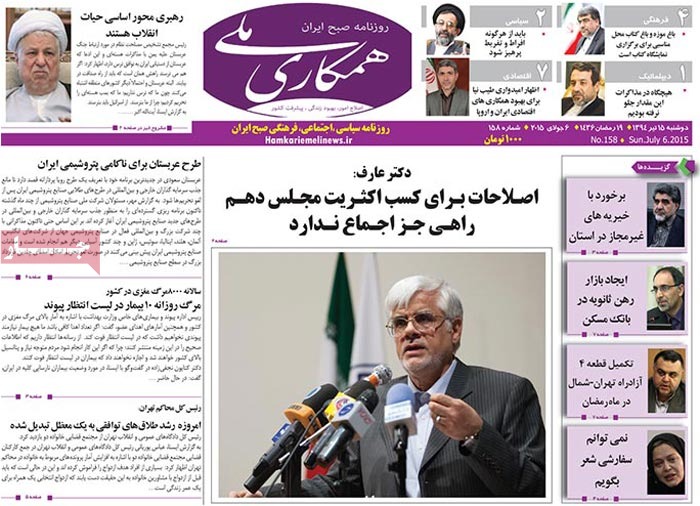
Ebtekar: “We are preparing ourselves for a parliament which acts in line with the wishes of the government,” said Mohammad Reza Aref, a reformist leader and a onetime vice-president.


A look at Iranian newspaper front pages on July 6


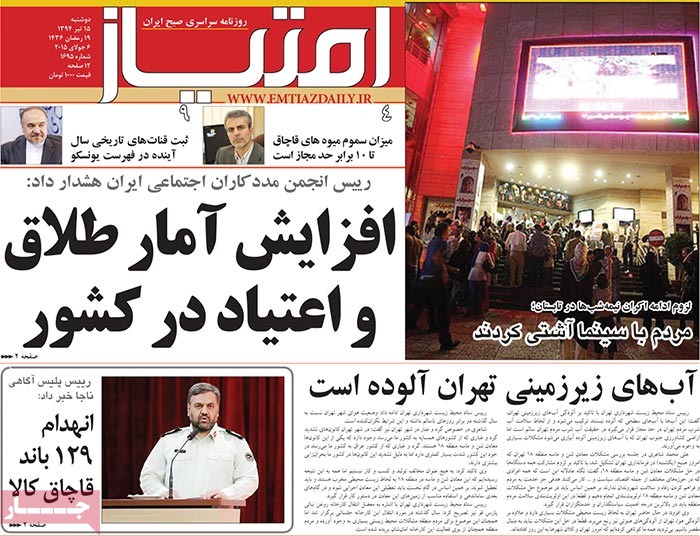
Emtiaz: The chief of the Criminal Investigation Department of the Iranian police has said that 129 rings smuggling in goods have been busted.


A look at Iranian newspaper front pages on July 6


Hamkari-e Melli: Each year as many as 8,000 Iranians are pronounced brain dead. And each day ten patients who are on organ transplant waiting list pass away.


A look at Iranian newspaper front pages on July 6


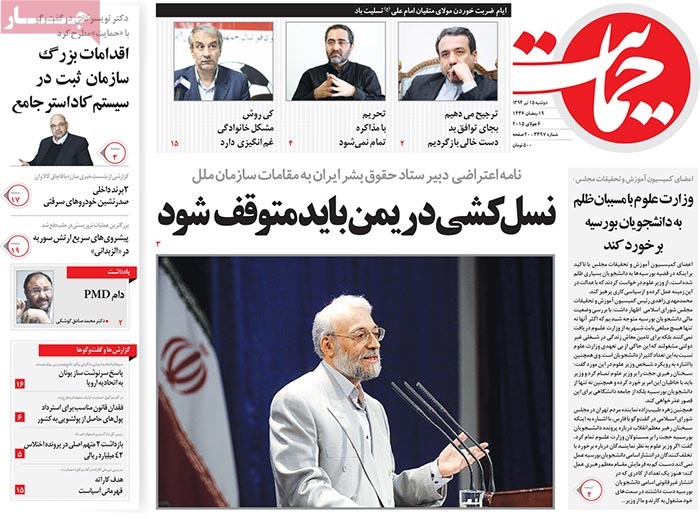
Hemayat: “Genocide in Yemen should come to an end,” said the secretary of Iran’s Human Rights Council.


A look at Iranian newspaper front pages on July 6


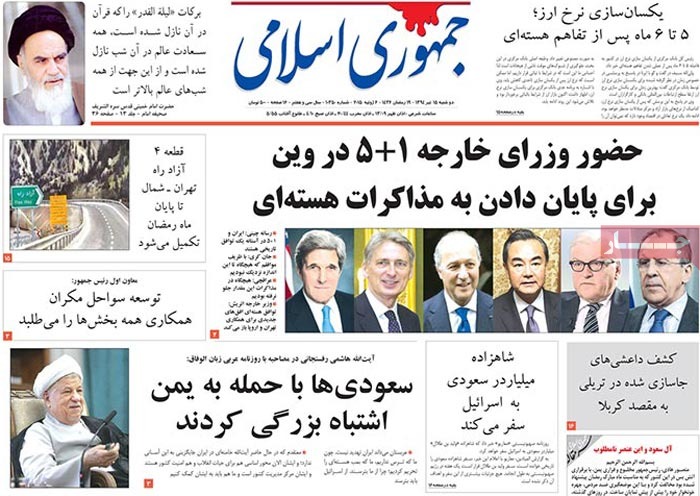
Jomhouri Islami: “The Saudis committed a major mistake by attacking Yemen,” said Ayatollah Hashemi Rafsanjani.

Jomhouri Islami: A Saudi billionaire prince is to pay a visit to Israel.


A look at Iranian newspaper front pages on July 6


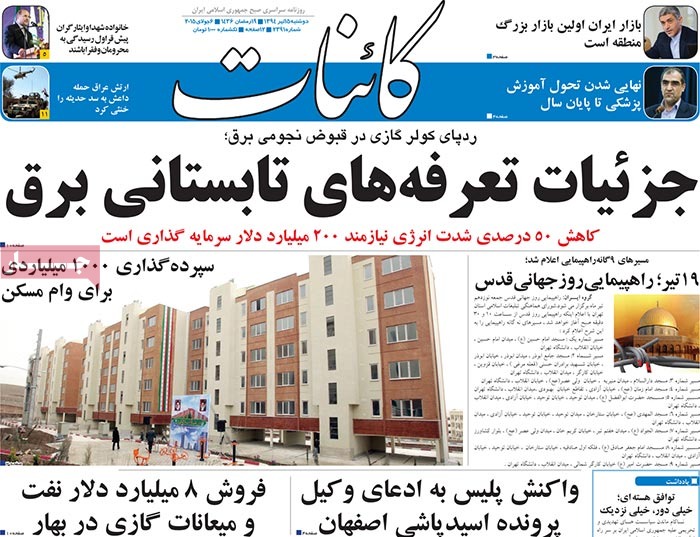
Kaenat: Iran exported more than $8 billion in oil and gas condensates in the spring.


A look at Iranian newspaper front pages on July 6


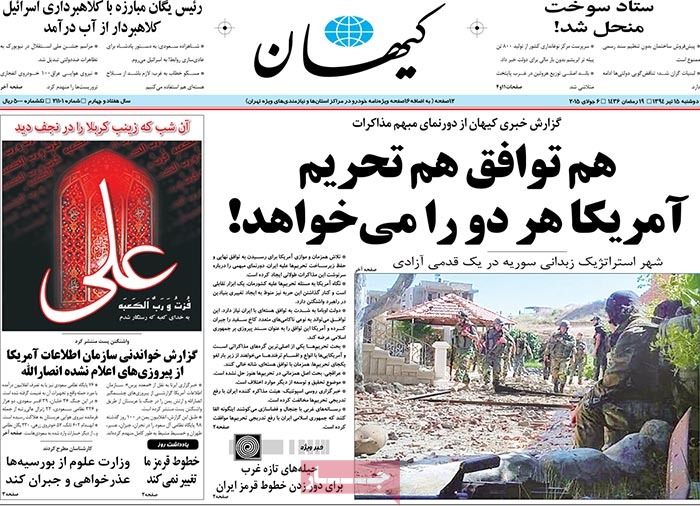
Kayhan: A deal and sanctions, the US wants both.

The daily reports on the vague prospects of the talks.


A look at Iranian newspaper front pages on July 6


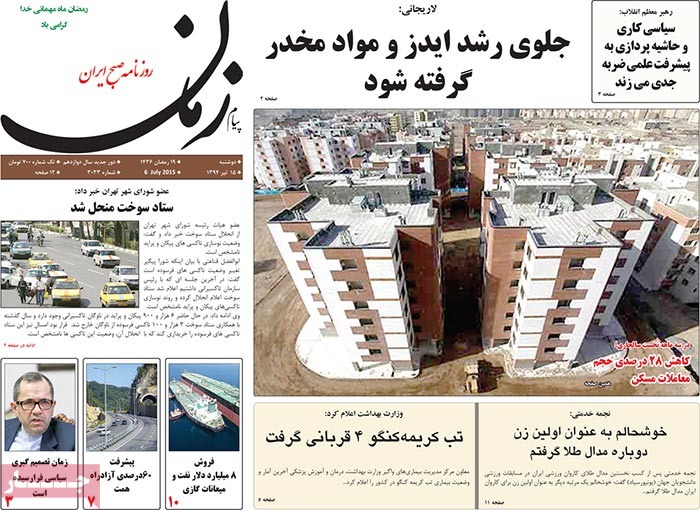
Payam-e Zaman: Parliament Speaker Ali Larijani has called for efforts to contain HIV/AIDS and the scourge of drugs.

Payam-e Zaman: The department [the previous government set up to oversee the sales of fuel in gas stations] has been dissolved.


A look at Iranian newspaper front pages on July 6


Highlights of Ettela’at newspaper on July 6

Ettelaat july-7

 “All sanctions will be lifted on the day a deal takes effect,” said Iranian nuclear negotiator Abbas Araghchi.

He further said: “Never during the course of the past talks did we make so much progress. The deal will be made official with the approval of the UN Security Council. On our side, implementation of technical issues will take 2-3 months.”

Araghchi also said that there will be an agreement if the negotiating team clinches what the Iranian people want by July 7, if not, it prefers to return home empty-handed.
 Chairman of the Expediency Council Ayatollah Akbar Hashemi Rafsanjani has said that the Supreme Leader plays a pivotal role in the survival of the Islamic Revolution.

In an interview with the Arabic-language daily Al-Vefagh, the former president said he has a very close relationship with Ayatollah Khamenei.

 The Syrian Army and Lebanon’s Hezbollah have staged a massive attack on IS positions in Zobdani, which had been under the control of the terrorist grouping since 2012.

♦ EU ambassadors based in Tehran have met with the Iranian economy minister.

At the meeting, Ali Tayyebnia underlined efforts to promote Iran-EU economic cooperation.

♦ “Skilled workforce is conspicuous by its absence in the Education Ministry,” said the spokesman of Tehran Education Department.

“The unregulated hiring initiated by the previous government has not only not solved the problems of the Education Department, but exacerbated them,” he said.

 “The root causes of social harms should be identified and targeted,” said Parliament Speaker Ali Larijani.

He further said that the Welfare Organization needs to tap into public potential to be able to fulfill its responsibilities.

 The Health Ministry has warned that the pesticides used in the cultivation and preservation of some imported fruits are 10 times the permitted level.


FM Zarif asks people to pray for nuclear team

Zarif-Vienna-Ghadr-9

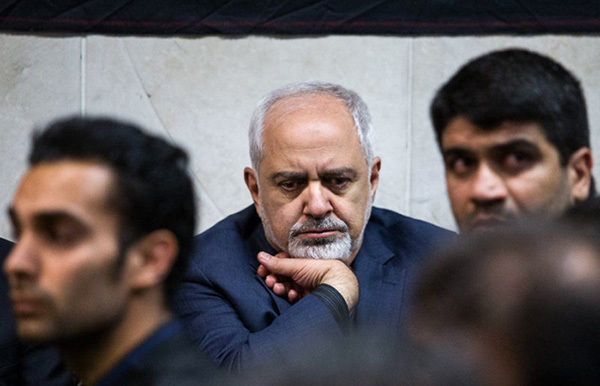
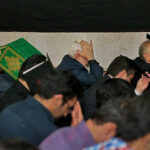
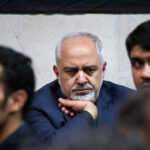
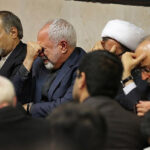
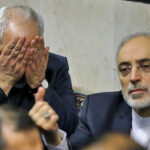
Foreign Minister Mohammad Javad Zarif said late Sunday that some gaps still remain between the two sides in nuclear talks, asking people to pray for the expediency of the country, Islam and Muslims.

After attending a religious vigil in Vienna to mark the 19th night of the holy month of Ramadan, the top diplomat told reporters that the result of the talks still remains unknown, adding the Iranian team is doing what is needed.

The clocks are ticking and the two sides are working against time in Vienna to reach an agreement by the extended deadline of July 7.

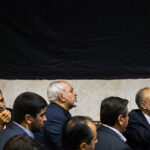
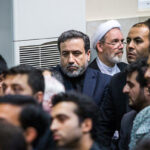
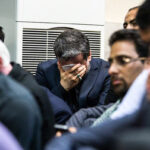
The following are a series of photos fararu.com released on July 6 of the religious ceremony in the Austrian capital with the foreign minister and his accompanying team attending:


Abu Azrael in holy shrine of Imam Reza

Abu Ezrail

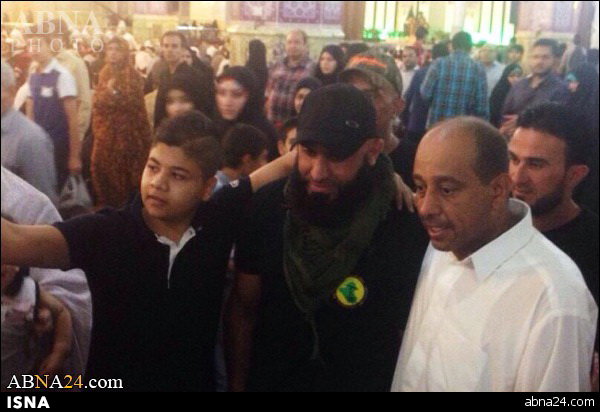
Ayyub Faleh al-Rubaie – a university lecturer, a Taekwondo champion and the popular face of the fight against ISIL in Iraq – has paid a visit to the holy shrine of Imam Reza in Mashhad and received a warm welcome by the locals.

A commander of the Kataib al-Imam Ali, an Iraqi Shiite militia group of the Popular Mobilization Forces that is fighting ISIL in Iraq, Rubaie is known as Abu Azrael and has a long record in fighting Takfiri terrorists and has turned into a nightmare for terrorists.

He first came under the spotlight when foreign media described him as Iraq’s Rambo [or the Angel of Death], releasing photos of him with sword and ax fighting ISIL terrorists.

He taunts and mocks the extremists on social media, saying he has dispatched them in droves with an arsenal that would satisfy any video-game aficionado: a scoped rifle, hand grenades and, when things get dicey, an ax or sword.

The following are the pictures the Iranian Students’ News Agency (ISNA) released online on July 5 of the Angel of Death in the holy Shrine of the eighth Shiite Imam in northeastern Iran:


Iran vows to double oil exports after sanctions lifted

oil ship

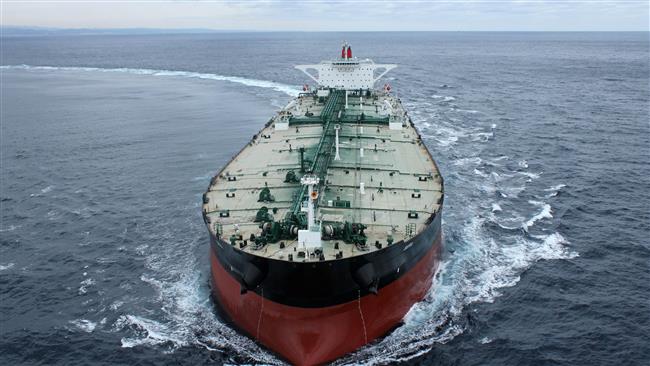
Iran said on Sunday that it has serious plans to increase its oil exports to almost double the current levels after sanctions against the country have been lifted.

Mansour Moazami, Iran’s deputy oil minister for planning and supervision, has been quoted by the media as saying that Iran’s oil exports would reach 2.3 million barrels, compared with around 1.2 million barrels a day today.

“We are like a pilot on the runway ready to take off. This is how the whole country is right now,” Moazami has told the Wall Street Journal.

He added that Iran is presently pushing to convince fellow members of the Organization of the Petroleum Exporting Countries (OPEC) to renew its quota system.

Iran is already in contact with former oil buyers in the European Union—traders such as Vitol Group and big oil producers such as Royal Dutch Shell PLC, Total SA and Eni SpA—and existing importers in Asia to help absorb the potential new shipments, the Journal report has added quoting Iran’s Ministry of Petroleum and the companies.

At its last meeting on June 5, Oil Minister Bijan Zanganeh informed other OPEC ministers Iran’s production would increase if sanctions are lifted and offered to reinstate the quotas.

[…]

Iranian official: 70% of technical annex to nuclear deal written

Talks-vienna

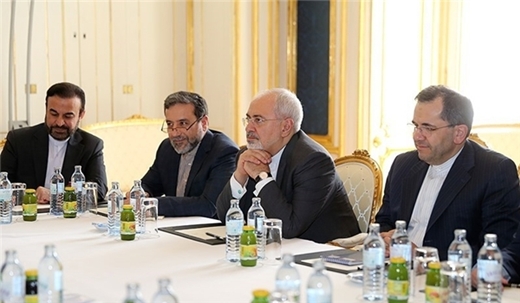
A senior Iranian official announced on Sunday evening that drafting the technical annex to the final nuclear agreement between Tehran and P5+1 is nearing completion with only a few items left.

“70 percent of the technical annex to the final nuclear deal between Tehran and the six major world powers has been drafted,” an Iranian diplomat in the nuclear talks underway in Vienna said.

The source, who asked to remain unnamed, further pointed out that the technical annex – which is one of the five annexations of the final agreement – covers issues such as “nuclear research and development, Fordo nuclear enrichment center, Arak heavy water reactor, and the type of the centrifuges that will be used by Iran for the production of stable isotopes”.

He added that “the technical annex is about 32 pages, and only a few items have been left open”.

“According to the technical annex, all the nuclear activities of Iran will continue,” he emphasized.

Yet, the negotiator expressed cautious optimism about attainment of a final nuclear deal.

The Iranian negotiator also categorically rejected reports by the AP and The New York Times saying that Iran has agreed to send its enriched uranium stockpile to Russia, saying there are four options on the table which are still under discussion, including dilution of the enriched uranium, exchanging it with raw uranium plus the enrichment costs, and selling the excess fuel.

He said one of the six parties to the talks has even offered to purchase Iran’s excess nuclear fuel.

The diplomat further regretted the International Atomic Energy Agency’s (IAEA) reliance on unauthentic intelligence with regard to PMD (possible military dimensions), and said it regrettable that the UN nuclear watchdog agency’s assessment of this issues has dragged on for almost a decade.

As for the IAEA Director-General Yukiya Amano’s recent visit to Tehran, he said, “Amano was told Tehran wants the IAEA to rapidly present its report on the PMD allegations and close the case.”

The diplomat reiterated the untruthful nature of the PMD allegations, and said it is not at all a difficult job for Tehran to prove that these claims are all baseless and wrong.

Amano said on Saturday in uncertain remarks that his organization might eventually prepare a report on allegations about possible military dimensions of Iran’s past nuclear activities by the end of 2015.

The Iranian negotiator also added that “the IAEA deputy director will arrive in Tehran on Sunday night to resolve the PMD issue as soon as possible,” official added.

An informed source told FNA earlier that the delegation is slated to hold talks with the Atomic Energy Organization of Iran (AEOI) officials over the PMD allegations.

Iranian officials have repeatedly underlined Tehran’s determination to reach a final deal with P5+1, and called on the other side to adopt a realistic approach toward a final deal.

Larijani urges UN to stop Saudi aggression against Yemen

Mohammad Javad Larijani

Secretary of Iran’s Human Rights Council Mohammad Javad Larijani on Sunday called on the UN to take serious action to end the Saudi aggression against Yemen.

In separate letters to the UN Chief, Ban Ki-moon and UN High Commissioner for Human Rights Zeid Ra’ad Al Hussein, Larijani referred to the grave humanitarian situation in Yemen and called for serious action on the part of the UN to put an end to the Saudi aggression against Yemen.

Larijani, in the letters, urged Ban and Ra’ad Al Hussein to fulfill their duty as per Rome Statute 1998 criminalizing the use of force and aggression on sovereign nations.

He said perpetrators of aggression and use of force should be held accountable before The Hague-based International Criminal Court.

Larijani expressed outrage at the killing of more than 3000 people, including 700 women and children, and maiming more than 10,000 innocent civilians by Saudi airstrikes.

Larijani said under Article 23 of the Geneva Convention IV, the International Humanitarian Law, the governments are required to allow free shipment of medical and food supplies to the people trapped in conflict.

He said that the IHL 1949 envisaged respect for the people’s right to have food and drinking water in the course of armed conflicts.

Many Yemeni citizens are incapable of meeting their main food requirements, said the official, adding that practices of the coalition formed against Yemen are flagrant violations of Article 54 of the first additional protocol to the four Geneva Conventions and are considered war crimes and crime against humanity based on the IHL 1949.

He said that refusal to allow shipment of humanitarian supplies amounts to collective punishment of the Yemeni people.

Larijani said any intervention on part of any government or coalition is manifest breach of the Rome Statue 1998.

“I should recall that use of force in any form is forbidden under the international law,” he said in the letter.

Time for political decisions on nuclear deal: Iran negotiator

Takhte Ravanchi

An Iranian nuclear negotiator says time is ripe for “political decisions” on a final deal between Iran and the P5+1 group of countries over Tehran’s nuclear program.

“If no agreement is reached [between Iran and the world powers], it would not be the end of the world. A good and lasting agreement needs political decisions and the time is now ripe for that,” Majid Takht-e Ravanchi said on Sunday.

The Iranian deputy foreign minister said that the West should show more flexibility in the nuclear talks, adding, “Iran has shown enough flexibility so far.”

He said Iran would never yield to the West’s excessive demands just for the sake of an agreement, adding that a final deal is within reach if the six countries stop making such demands.

Marathon nuclear negotiations between Iran and the P5+1 countries are picking up steam as the sides are making efforts to iron out disagreements with just two days left before the July 7 deadline for a comprehensive deal.

[…]

Kerry statement

The US secretary of state made a statement about progress in the nuclear talks on Sunday.

Addressing the reporters in Vienna, John Kerry said “it is now time” to finalize a historic nuclear deal with Iran.

“It is now time to see whether or not we are able to close an agreement,” Kerry told reporters, adding that at present, the negotiations “could go either way.”

Viewpoints of Hashemi Rafsanjani on the Supreme Leader

22222

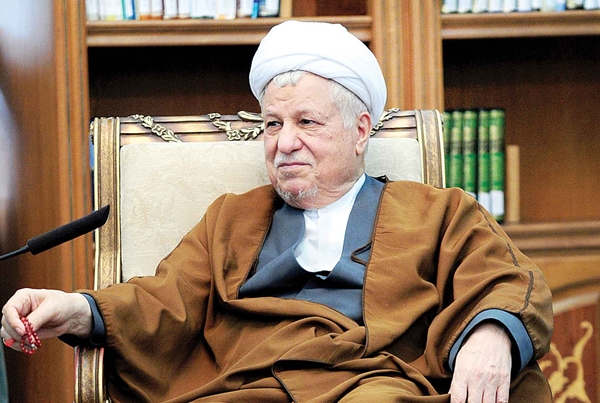
Chairman of the Expediency Council Ayatollah Akbar Hashemi Rafsanjani is of the opinion that there is no replacement for Ayatollah Khamenei at present and that the Supreme Leader has a pivotal role in the sustainability of the Revolution and in ensuring the security of the country.

In an interview with the Arabic-language daily Al-Vefagh, the top councilor talked about a wide range of issues, including his relationships with the Supreme Leader, Iran-Saudi Arabia ties and cross-border relations between Iran and Iraq. On July 5, Alef.ir published a Farsi version of the interview. The following is the translation of PART ONE of the interview which focuses on the Supreme Leader:

The chairman of the Expediency Council said Ayatollah Khamenei is the backbone of Iran’s management and everyone should help the Leader.

When asked about his friendly and deep relationship with the Leader, he said, “We have been friends ever since we were young. I am five years his senior. We first met when we attended a seminary course taught by Ayatollah Damad. The Leader was younger than me; later our friendship deepened and we grew close during our fight against the Pahlavi regime and even closer after the victory of the Revolution.”

The top councilor added, “We worked together on different matters, including during the war, on any question one could think of. We have maintained this relationship to this day. I along with a group of people appointed as members of the Expediency Council by the Leader prepare the macro-policies of the establishment, which are part of the Leader’s responsibility under the Constitution. He orders them implemented, if he approves of them.”

Hashemi went on to say, “That is the most important part of our job [at the Expediency Council]. We are also tasked by the Leader with overseeing the implementation of the macro policies to make sure that they are well enforced. As for other ordinary questions, we talk during the meetings that we have.”

On his good friendship with the Leader, Hashemi added, “We are so close; we like each other very much. One such example [of our deep friendship] came along when I paid a bedside visit to the Supreme Leader after his surgery. The meeting in hospital was very friendly.”