Tuesday, December 23, 2025
Home Blog Page 4711

Japan, Germany seek long-term economic, industrial cooperation with Iran

production20line1

Trade delegations from Japan and Germany have recently visited Iran to weigh economic opportunities in Iran and the outlook of economic and industrial cooperation with the Islamic Republic of Iran.

Tasnim News Agency on October 7 published a report on Iran’s economic and industrial cooperation with Japan and Germany and what these two foreign teams were looking for in Iran. The following is the translation of part of that report:

Japan and Iran

Chairman and Chief Executive Officer of JETRO, the Japan External Trade Organization, Hiroyuki Ishige has said that his agency is seeking to find Iranian partners to produce automobiles and car parts inside Iran.

The Japanese manager made the remark on the sidelines of a meeting with the head of Iran’s Chamber of Commerce and added, “We are also seeking to enter partnership with Iran in other areas such as food industries and environmental issues. We have started to review such partnerships and we will take the necessary executive measures once the stage is set for such cooperation”.

He went on to say that as many as 30 big economic, industrial and production companies from Japan – among them oil, gas and petrochemistry companies as well as automotive manufacturers like Mitsubishi and Suzuki – are now in Iran.

These companies are trying to hold direct talks with the Iranian sides, boost bilateral trade ties and remove the problems standing in the way of developing relations between the two nations, he added.

The JETRO chief further said that red tape and failure to respect the intellectual property rights of companies are the hurdles to cooperation between the Japanese companies and Iran, and expressed hope that such hurdles will be removed soon.

He also welcomed cession of economic affairs to the private sector in Iran and said that the private sector accounts for up to 99 percent of companies involved in economic activities in Japan.

Iran and Germany

President of Lower-Saxony’s Chamber of Industry and Commerce Horst Schrage has said that Iranian automotive companies have expressed readiness to enter talks with Germany on renovation of the Iranian car industry and provision of car parts.

Schrage said on the sidelines of a meeting between a German delegation and the managing director of Iran’s Bank of Industry and Mine (BIM) that the German side is willing to open talks with Iran on different fronts, including agriculture, food industries, automotive industries and car parts.

[…]

He further said, “Trade with Iran is not the only objective of the German side; rather, we want to set the stage for long-term cooperation with Iran.”

“We are trying to make proper planning for long-term investment in Iran,” he added.
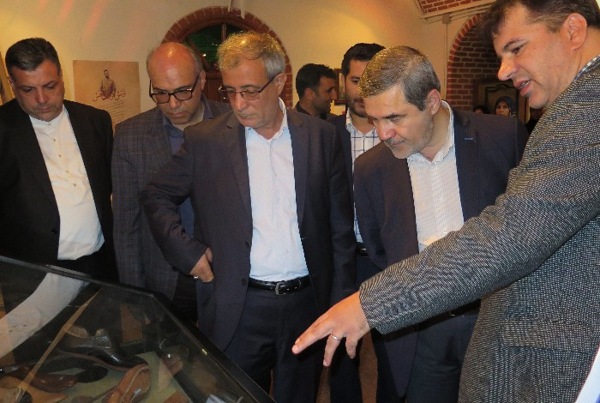
Iran’s first shoe museum opens in Tabriz

Museum-Shoes

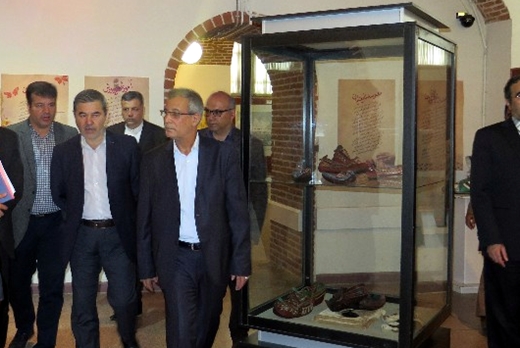
Iran’s first footwear museum opened in Tabriz, capital of East Azerbaijan Province, on October 6.

On the same day Fars News Agency filed a report on the country’s first shoe museum. What comes next is the translation of part of the report:

At the opening ceremony, the head of the Tourism Expansion Organization, an affiliate of Tabriz Municipality said, “Shoemaking has a long history in Tabriz which is globally famous for the quality of its leather shoes. Therefore, the first shoe museum has opened here to highlight the important role shoes play in the health of people.”

Tabriz-Shoes


The official added, “Different cities and countries across the world – Toronto (Bata Shoe Museum), France (Musée International de la Chaussure de Romans), Vancouver (Museum of Anthropology) – have exclusive shoe museums. As a city with a long history in this industry, Tabriz did have the potential to have one such museum too.”

The official concluded, “The museum puts on display 200 valuable pairs of shoes from different historical eras and ethnic groups along with a pair similar to the world’s first leather shoes discovered in a village near Tabriz which was 5,500 years old.”

[…]

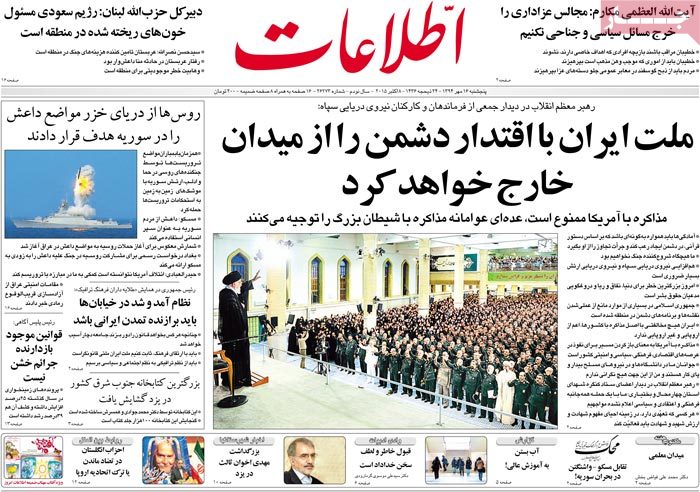
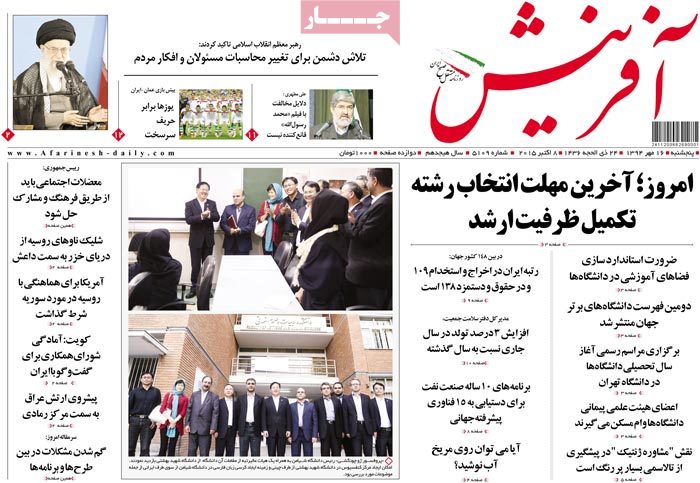
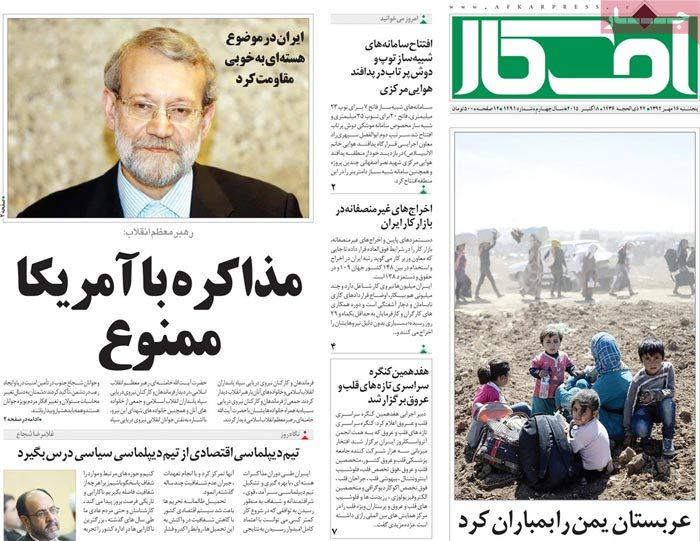
A look at Iranian newspaper front pages on October 8

Iranian Newspapers Headlines

Comments by the Supreme Leader that “talks with the US are not allowed” dominated the front pages of Iranian newspapers on Thursday.


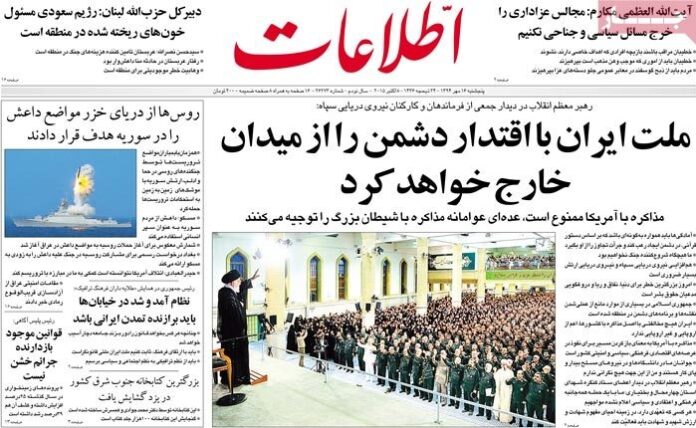
Ettela’at: “The Iranian nation will drive the enemy from the field with a vengeance,” said the Supreme Leader at a meeting with IRGC Navy commanders and staff.

Ayatollah Khamenei further said, “Talks with the US are forbidden; some are unwisely justifying negotiations with the Great Satan.”


Afarinesh: Kuwait has said that the Persian Gulf Cooperation Council stands ready to hold talks with Iran.


A look at Iranian newspaper front pages on October 8


Afkar: “Iran held its ground well in the nuclear case,” said Parliament Speaker Ali Larijani.


A look at Iranian newspaper front pages on October 8


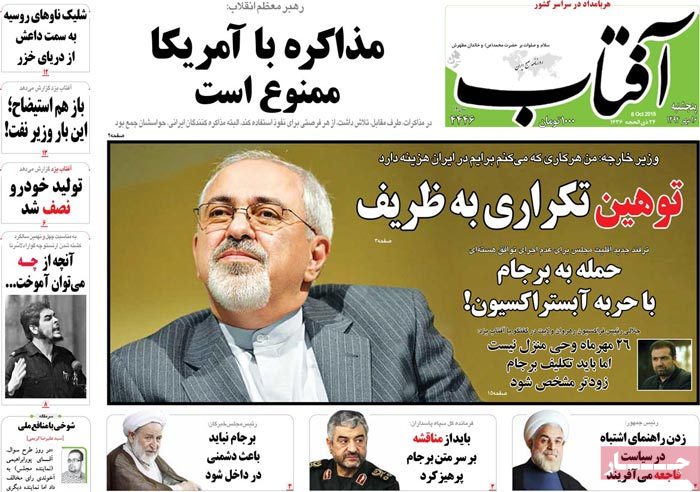
Aftab-e Yazd: Zarif has been insulted once again.

“Everything I do costs me at home,” said Foreign Minister Zarif in an interview with The New Yorker.

Aftab-e Yazd: Targeting the Joint Comprehensive Plan of Action through obstructionism; a new ploy by the minority in parliament not to implement the Iran nuclear deal.

Aftab-e Yazd: Car production has been cut in half.

Aftab-e Yazd: “The Joint Comprehensive Plan of Action should not generate enmity inside Iran,” said the chairman of the Assembly of Experts.

Meanwhile, the commander of the Islamic Revolution Guard Corps said that disputes over the wording of the Joint Comprehensive Plan of Action should be avoided.


A look at Iranian newspaper front pages on October 8


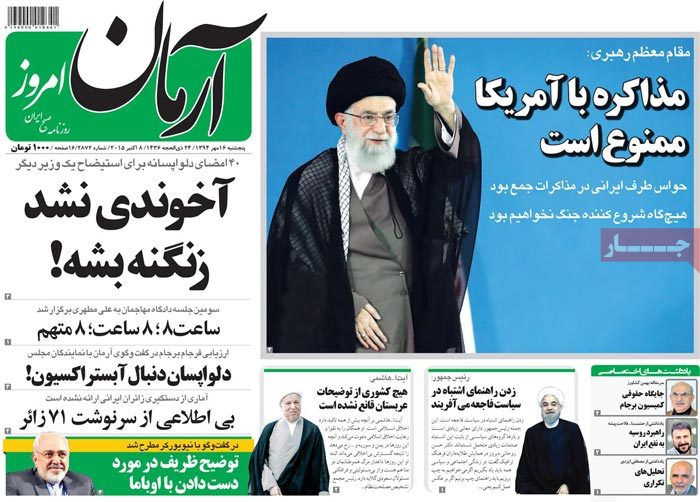
Arman-e Emrooz: Now that [Minister of Roads and Urban Development Abbas] Akhundi survived the vote of no-confidence, let’s put [Oil Minister Bijan Namdar] Zanganeh in the crosshairs.

Forty Worriers [supporters of the former president] have signed a motion to impeach another minister.

Arman-e Emrooz: “No country has found the explanations offered by the Saudis convincing,” said Chairman of the Expediency Council Ayatollah Akbar Hashemi Rafsanjani.

Ayatollah Rafsanjani’s comments came as authorities said that 71 Iranian pilgrims are still unaccounted for and that there have been no figures on Iranian pilgrims that might have been arrested by Saudi authorities.


A look at Iranian newspaper front pages on October 8


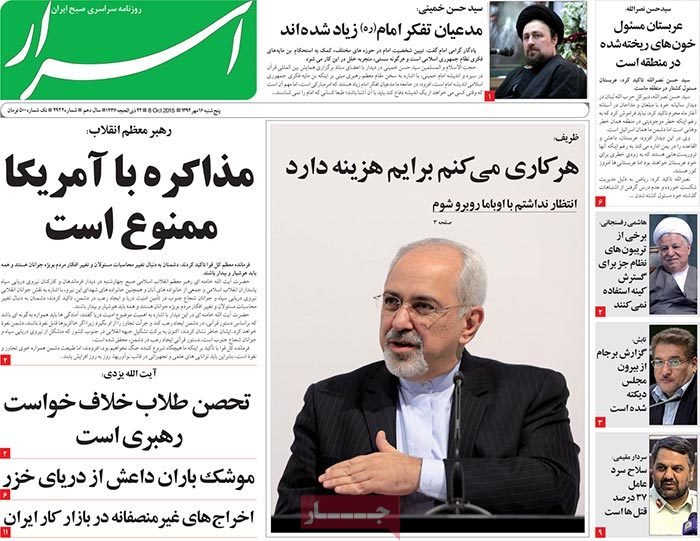
Asrar: “Some are using official tribunes only to promote vengefulness,” said Ayatollah Akbar Hashemi Rafsanjani.

Asrar: “The sit-in of seminary students [in protest at the Joint Comprehensive Plan of Action] is against the wish of the Leader,” said Ayatollah Mohammad Yazdi, the chairman of the Assembly of Experts.


A look at Iranian newspaper front pages on October 8


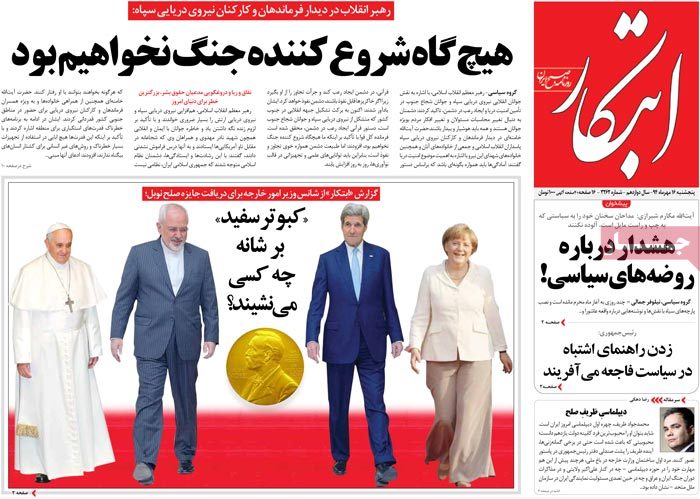
Ebtekar: “We will never launch the first strike,” the Leader said in a meeting with IRGC Navy commanders and staff.

Ebtekar: On whose shoulder will the white dove land? Angela Merkel? John Kerry? Mohammad Javad Zarif? Or Pope Francis?

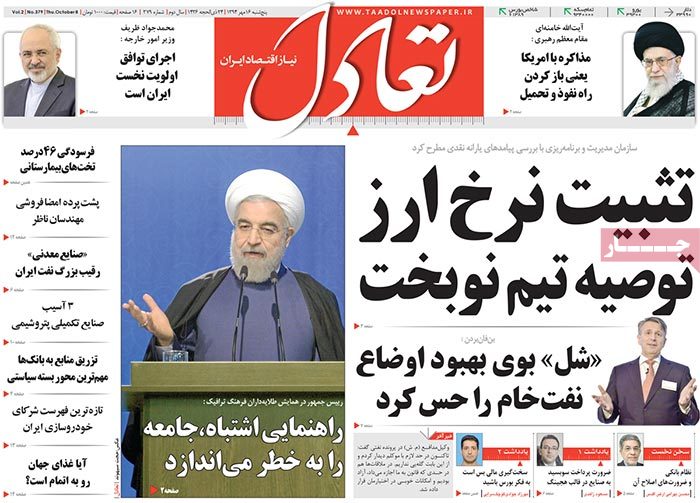
Ebtekar: “Wrong signals in politics are catastrophic,” said President Rouhani.


A look at Iranian newspaper front pages on October 8


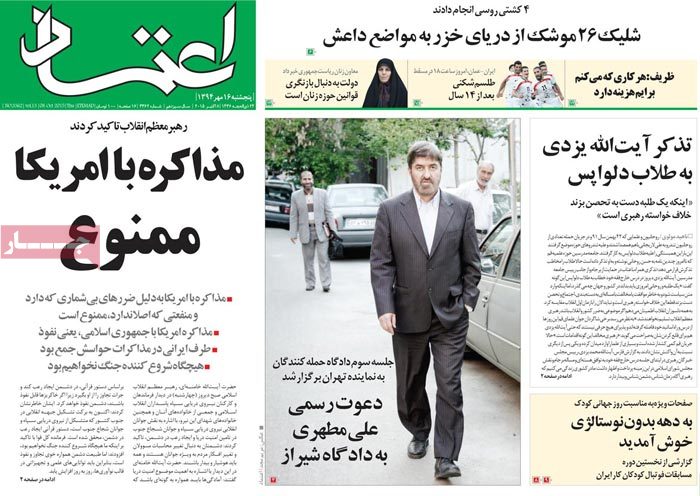
Etemad: Ali Motahari has been summoned by a Shiraz court to appear in the hearing of his attackers.

A third session has been held in the trial of individuals who attacked the Tehran principlist MP in early 2015 in the southern city of Shiraz.

Etemad: “Government seeks to review the laws governing women’s affairs,” said vice-president for women and family affairs.


A look at Iranian newspaper front pages on October 8


Hemayat: The attorney general has said that a special court is to be set up to gather complaints by the families of the victims of the Mina tragedy.


A look at Iranian newspaper front pages on October 8


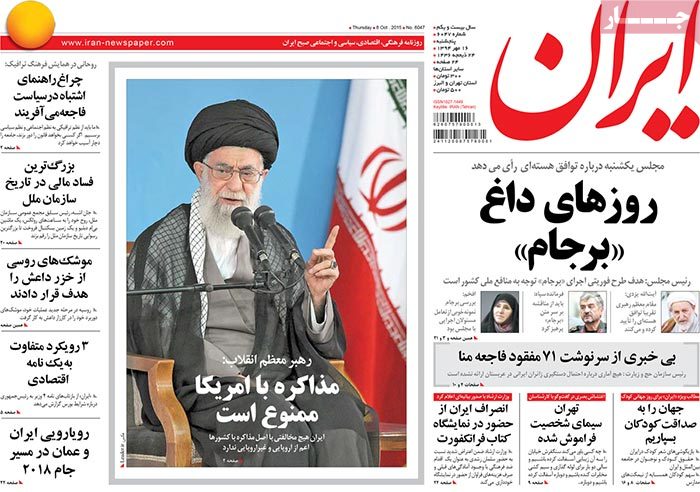
Iran: In protest at the invitation of Salman Rushdie, Iran has decided to boycott Frankfurt Book Fair.


A look at Iranian newspaper front pages on October 8


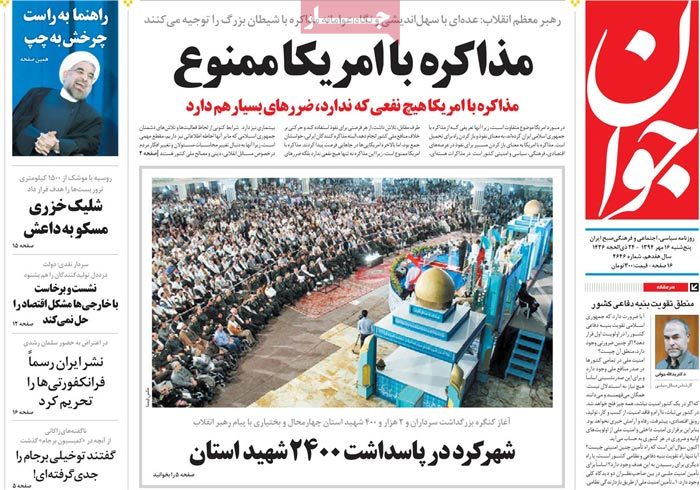
Javan: “Holding talks with foreigners won’t settle the country’s economic woes,” said the commander of the Basij force [an affiliate of the Islamic Revolution Guard Corps].


A look at Iranian newspaper front pages on October 8


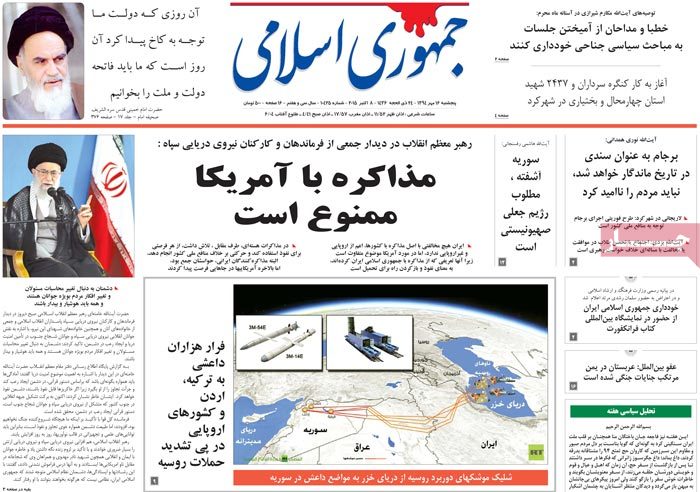
Jomhouri Islami: Following an escalation of Russian attacks, thousands of IS terrorists have fled to Turkey, Jordan and European countries.

Jomhouri Islami: Ayatollah Hossein Nouri Hamedani [a source of emulation] has said that the Joint Comprehensive Plan of Action will go down in history and that people’s hopes should not be dashed.


A look at Iranian newspaper front pages on October 8


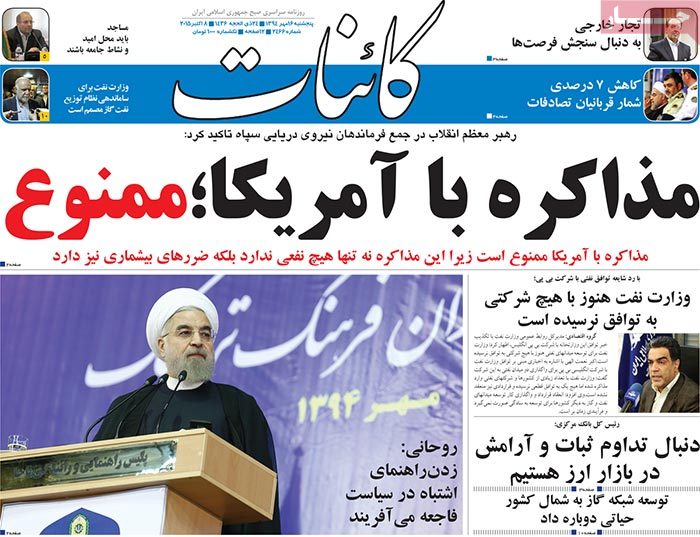
Kaenat: The Oil Ministry has rejected rumors that it has struck a deal with BP.

Kaenat: Road accident fatalities have plunged seven percent.


A look at Iranian newspaper front pages on October 8


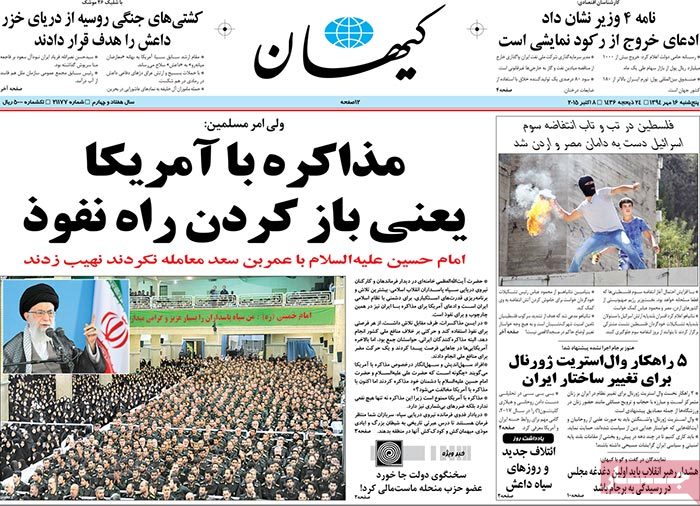
Kayhan: “Talks with the US would amount to paving the way for infiltration,” said the Supreme Leader.


A look at Iranian newspaper front pages on October 8


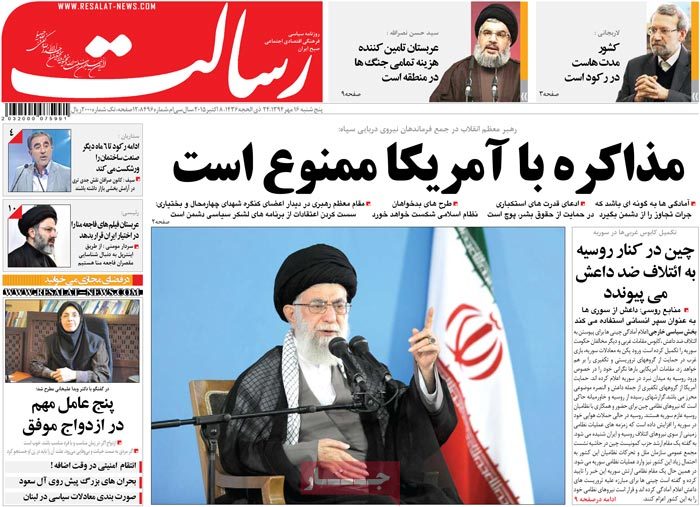
Resalat: “The country has been in the grips of stagnation for a long time,” said Parliament Speaker Ali Larijani.


A look at Iranian newspaper front pages on October 8


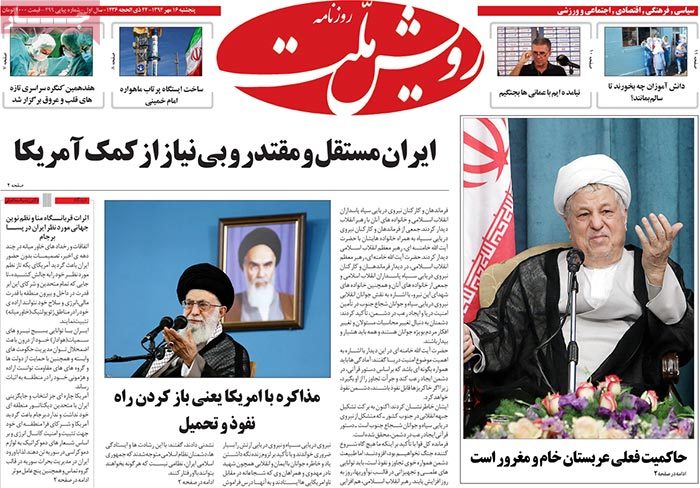
Rooyesh Mellat: The chairman of the Expediency Council has said that the current rulers of Saudi Arabia are “inexperienced and selfish”.


A look at Iranian newspaper front pages on October 8


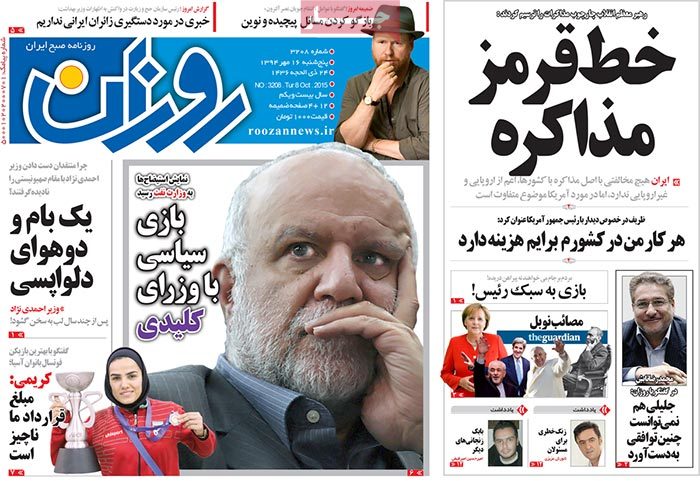
Roozan: Political gamesmanship involving key ministers

The impeachment gambit has found its way to the Oil Ministry this time.


A look at Iranian newspaper front pages on October 8


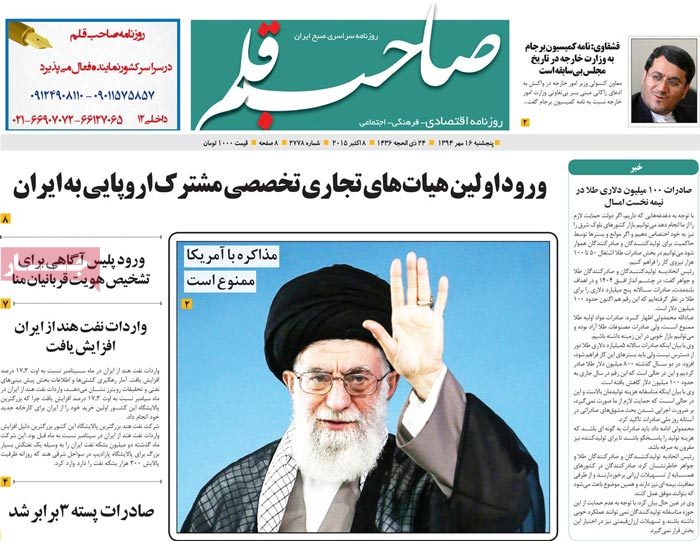
Saheb Ghalam: Pistachio exports have increased three-fold.


A look at Iranian newspaper front pages on October 8


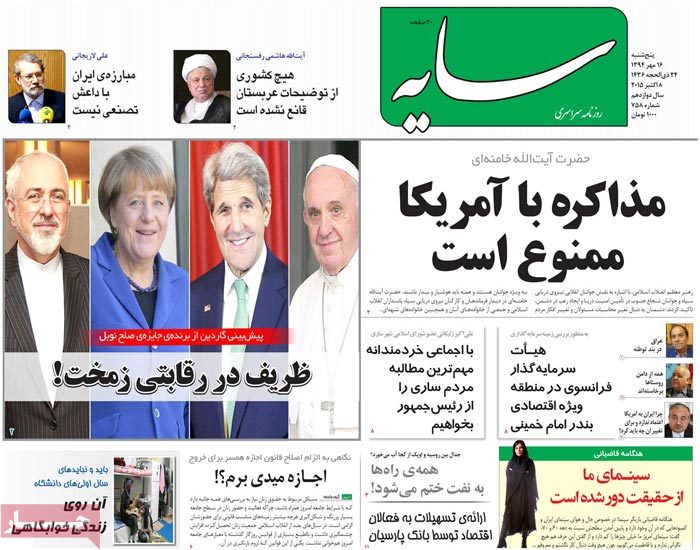
Sayeh: “Iran’s fight against IS is not theatrical,” said Ali Larijani, the speaker of the Islamic Consultative Assembly.


A look at Iranian newspaper front pages on October 8


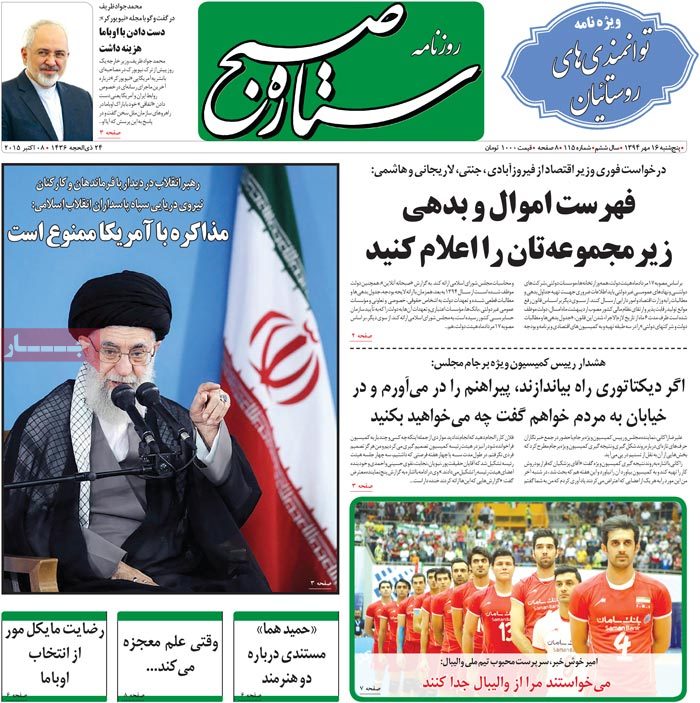
Setareh Sobh: The economy minister has asked Major General Hassan Firouzabadi [the chief of staff of the armed forces], Ayatollah Ahmad Jannati [the secretary of the Guardian Council], Ali Larijani [the parliament speaker], Ayatollah Sadegh Amoli Larijani [the Judiciary chief] and Ayatollah Akbar Hashemi Rafsanjani [the chairman of the Expediency Council] to provide a list of the assets and debts of the institutions they are in charge of.

Setareh Sobh: “If they seek to have a dictatorship, I’ll take off my shirt and tell people on the street what they intend to do,” said the chairman of parliament’s JCPOA Review Committee.


A look at Iranian newspaper front pages on October 8


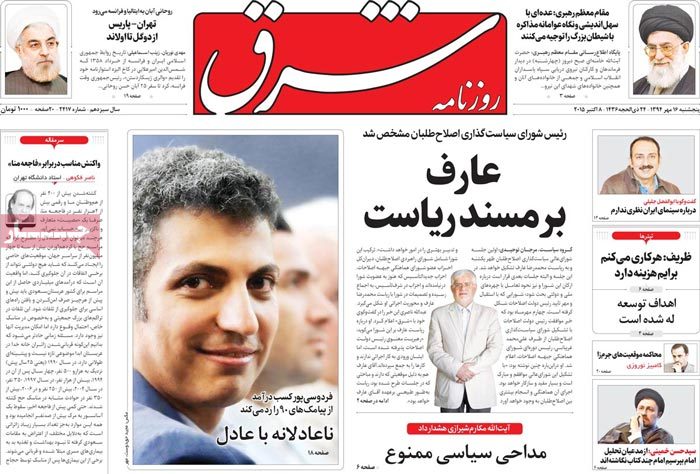
Sharq: Mohammad Reza Aref has been named as chairman of the policymaking council of reformists.


A look at Iranian newspaper front pages on October 8


Taadol: “Implementation of the nuclear deal is our first priority,” said Foreign Minister Mohammad Javad Zarif.


A look at Iranian newspaper front pages on October 8


US reluctant to defeat Daesh due to its allies’ interests: Zarif

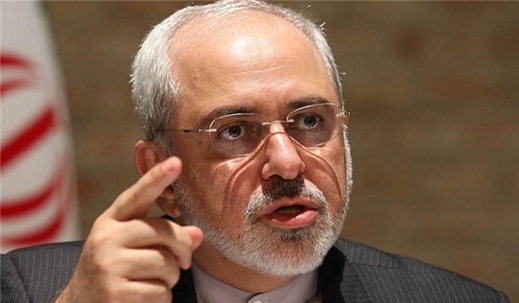
Mohammad Javad Zarif

Iranian Foreign Minister Mohammad Javad Zarif said the US government is hesitating to defeat the Daesh [the Arabic acronym of IS] terrorist group because such a move may contradict the interests of its regional allies.

He made the comments in a meeting in New York organized by University of Denver’s International Studies Center prior to his departure for Tehran, after attending United National General Assembly session.

On the nuclear deal between Iran and P5+1, he said that the outcome of the agreement will be either a win-win or lose-lose situation rather than one side losing and the other winning.

“This is what is expected from other conflicts, from Syria to Iraq and Yemen,” he added, “It may seem speculation to some, but we managed to do it in the nuclear issue and made a success.”

Calling for a change in the manner of dealing with regional crises, Zarif said, “The assumption that there would be a single winner in dealing with region’s unrests has to be put aside. Some regional countries may have such an assumption, but it is a myopic belief that will end up with everyone’s failure.”

Warning that extremism in the Middle East will not be limited to the geographical borders of Syria or Iraq and that it is a common threat to the world, he said, “In countering extremism, violence, and terrorism, one has to take into account every aspect and to deal with the root causes.”

Referring to the support for Wahabbi extremists by some regional states, Zarif said, “As long as certain countries and sections of their population support any group out of the conception that it can weaken Iran, they will fail in seriously dealing with the threat.”

He said Iran is ready to cooperate with regional countries so long as they will become aware of the threats posed by Daesh.

Also referring to the fact that Daesh terrorists who commit crimes such as beheading their captives are speaking in fluent English and French, he said, “Most of the terrorists are young people who were brought up in western countries and later turned to terrorists.”

The Iranian top diplomat raised questions about the source of financial support for Daesh and asked, “Who is buying oil from this group or is providing financial funds and equipment to it?”

“When Iran was under sanctions and if it sold one barrel of oil beyond the limit set for it, it was considered a redline and all buyers and banks that provided transaction facilities were fined. Now, one can ask if such measures were applicable in the case of Iran, how come they cannot be employed to control the areas under Daesh control.”

On the crisis in Syria, Zarif called for a comprehensive solution so that political reform and an end of clashes can be achieved.

He cautioned that the fight against Daesh will not terminate in the near future and said a political process should start in line with efforts to end violence.

Last year, he added, when the US launched air raids on Syria without permission of the government and people of Syria, no one was surprised.

He said Russia’s intervention in Syria should not be an issue either, because it is one of UN Security Council members and is entitled to the same rights and responsibilities that the US enjoys.

“The only difference is that the Russians embarked on the attacks based on the request of the government of Syria,” he said.

Highlights of Ettela’at newspaper on October 8

Ettelaat newspaper-8-oct

“The Iranian nation will drive the enemy from the field with a vengeance,” said the Supreme Leader at a meeting with IRGC Navy commanders and staff.

Ayatollah Khamenei further said, “Talks with the US are forbidden; some are unwisely justifying negotiations with the Great Satan.”

 Ayatollah Nasser Makarem Shirazi [a source of emulation] has said that elegy services should not be dedicated to political and factional questions.

 The secretary general of the Lebanese Hezbollah has said that Saudi Arabia is to blame for the blood spilled in the region.

Seyyed Hassan Nasrallah further said that Riyadh is financing the wars raging in the region.

 Russian warships targeted IS terrorist positions in Syria from the Caspian Sea.

As Russian warplanes bombed terrorist positions in Hama and Idlib, the Syrian Army rained down surface-to-surface missiles on terrorists.

 The president has said that the traffic system of the country should be refined to befit the Iranian civilization.

 The biggest library in eastern Iran has been inaugurated in Yazd.

 “The existing rules are not sufficient to prevent violent crimes,” said the head of the Criminal Investigation Department of the Iranian police.

Iran deputy FM urges UN to save Yemeni lives against Saudi aggression

Amir Abdollahian-UN

A senior Iranian diplomat has called on the UN to carry out its responsibility to safeguard the lives of Yemeni people, who have been under relentless Saudi aggression for almost seven months.

“Attacks on residential areas, schools, and hospitals are in flagrant violation of humanitarian laws and rules,” Deputy Foreign Minister for Arab and African Affairs Hossein Amir-Abdollahian said Wednesday.

Amir-Abdollahian made the remarks at a meeting with a delegation from Yemen’s Supreme Revolutionary Committee in Tehran, and added that the UN must take the necessary steps to safeguard civilian lives, especially women and children.

“The crisis in Yemen does not have a military solution and the only solution goes through respecting the views and rights of all Yemeni sides by the country’s neighbors,” he added.
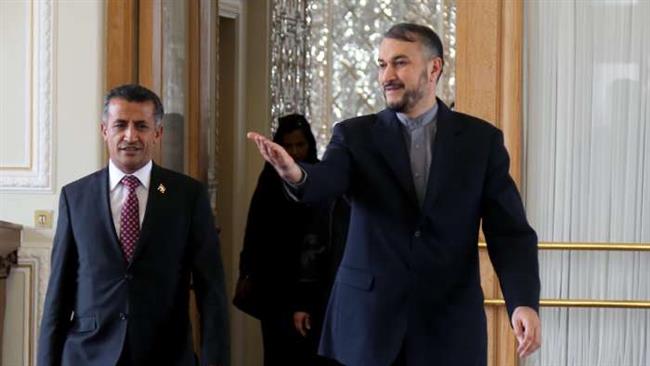
For his part, Nayef al-Qayes, the deputy head of the Yemeni committee that arrived in Tehran on Monday, said that all Yemeni parties are currently fighting for sovereignty and defending Yemen against meddling by foreign countries.

[…]


Talks with US banned because of disadvantages: Leader

Supreme Leader

Supreme Leader of the Islamic Revolution Ayatollah Seyyed Ali Khamenei says holding negotiations with the US is banned as it has countless disadvantages and no benefits.

The Leader made the remarks in a meeting with commanders and staff members of the Islamic Revolution Guard Corps (IRGC)’s Navy as well as their families in Tehran on Wednesday.

“The problem currently facing the country is due to certain individuals who are quite thoughtless or quite credulous and don’t understand these realities,” said Ayatollah Khamenei in an apparent reference to those who favor talks with Washington.

Holding talks with Washington would be tantamount to “infiltration” and paving the way for imposing its will, the Leader noted.

Ayatollah Khamenei further said the enemies had planned to make the Persian Gulf region insecure for Iran, but the naval forces of the IRGC made the plot backfire and the waters “became insecure for the enemies themselves.”

Paintings by Adolf Hitler on display in Tehran

Art

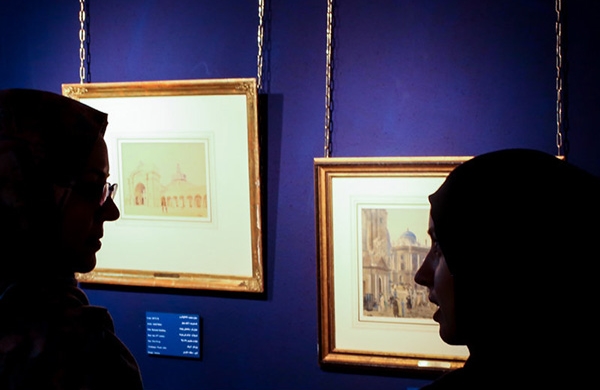
An exhibition dubbed “Color, Canvas, Architecture” opened at Tehran’s Dafineh Art Gallery on October 5. The event showcases 25 artworks by Iranian and foreign artists, among them two paintings by Adolf Hitler.

What follows is the translation of part of a report the Iranian Students’ News Agency filed on the exhibition:

The paintings on display are owned by a culture center affiliated with the museums arm of the Mostazafan Foundation.

The standout items on display are two watercolor paintings by Adolf Hitler. The two paintings by the notorious dictator were created when he was in Vienna.

According to the authentication certificates of the paintings, they are estimated to have been painted in the first decade of the 20th century.

One of the paintings features a church along with a theater and the other shows a building which is probably an old university.

Artworks by French painter Eugene Flandin, Sergei Kolesnikov, Mehdi Taeb, Esmail Ashtiani, Garcia Rodriguez, Yervand Nahapetian, Houshang Seyhoun and Atashzad are also on display at the expo.

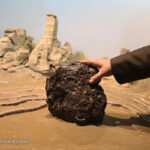
Meteorite found in Iran desert unveiled (PHOTOS)

Meteorite_000

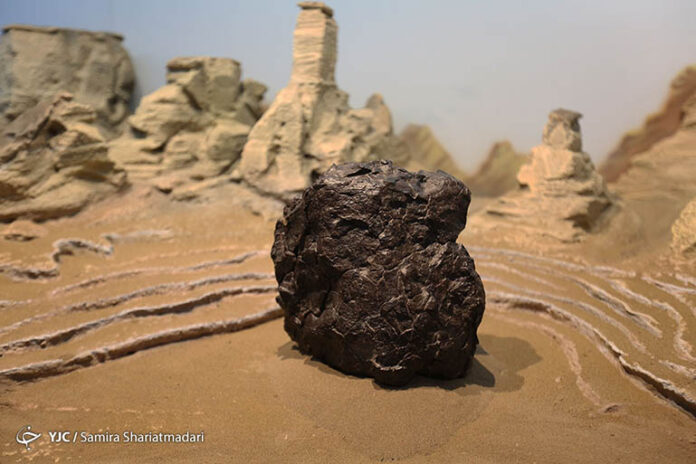
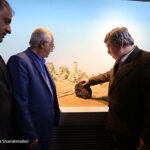
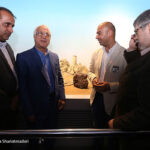
A meteorite discovered in the Lut Desert in south-central Iran in 2013 has been unveiled. The display of the meteorite, a second found on Iranian soil, came 134 years after a first meteorite was discovered in suburban Tehran (April 18, 1881).
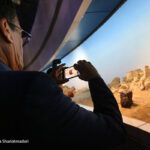
The newly-unveiled dense meteorite weighs 17 kg and was discovered during a desert expedition.

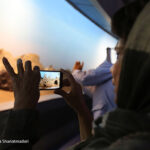
Images of the ceremony released online by the Young Journalists Club:

Anti-Iran threats are changing dramatically: General

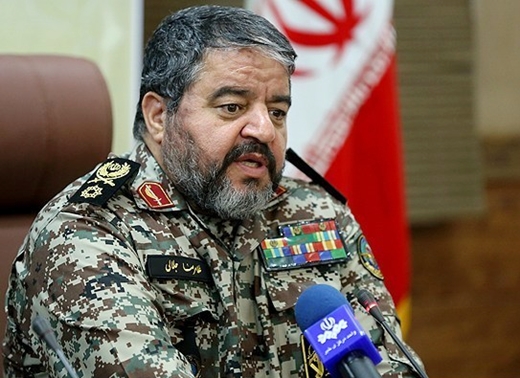
Jalali

New threats to Iran in the aftermath of the Joint Comprehensive Plan of Action (JCPOA) should be identified, said the head of the Passive Defense Organization, citing the fact that threats will be transformed after JCPOA takes effect.

At a press conference on October 6, Brigadier General Gholamreza Jalali enumerated the eight new approaches his organization has adopted to fend off cyber, environmental, radioactive, chemical and economic threats against the country.

What comes next is the translation of part of his remarks filed in a report by Mizan Online News Agency on Tuesday:

The brigadier general said stepped-up efforts to gather information on infrastructure as well as industrial espionage are among threats that will crop up in the post-JCPOA era, adding, “A committee to monitor the implementation of JCPOA as far as US measures are concerned must be formed so that it can examine every move by the Americans.”

He said that some remarks by the Americans can amount to violation of JCPOA, adding, “We have handed in our views about JCPOA threats on different fronts to parliament’s JCPOA Review Committee and we will present our views to the chamber in the future.”

Jalali went on to say, “We need a document mapping out our defense strategies in the face of economic war and the document is expected to be devised with the help of the government.”

The head of the Passive Defense Organization referred to suspicious movements which seem to be part of an economic war and said, “Those who denounce as nonsense agricultural self-sufficiency and independence, either intentionally or unintentionally, are going down the path which contributes to the strategy of the enemy.”

He said that Iran has information interaction with some countries when it comes to cyber threats and added, “In the cyberspace, we can interact with countries such as Russia, China and India with whom we share convergent ideas.”

On the Mina tragedy where a lot of pilgrims, including Iranians, died, he said, “An investigation needs to be conducted into whether there has been any foul play. However, there is evidence that the incident was not accidental.”

Jalali added, “Whether the stampede was deliberate or not, grudge by Saudi officials toward Iranian pilgrims has been in evidence.”

He said that the dead and injured were treated the same and concluded, “Hajj rituals should be managed through contribution by Muslim countries and those in charge should convince Islamic countries to contribute to the management of Hajj.”