Monday, December 22, 2025
Home Blog Page 4650

A look at Iranian newspaper front pages on Sept. 5

Iranian Newspapers Headlines

The Supreme Leader’s remarks on the Joint Comprehensive Plan of Action and the removal of sanctions in a meeting with members of the Assembly of Experts dominated the front pages of Iranian newspapers on Saturday. Also on the cover of the dailies was the shocking image of a drowned Syrian kid whose lifeless body on a Turkish beach dropped a political bombshell across the world and troubled the conscience of the world’s public opinion.


Ettela’at: The Supreme Leader has urged officials to be sensitive and vigilant in the face of enemy plots.

Speaking at a meeting with members of the Assembly of Experts, Ayatollah Khamenei said, “If sanctions aren’t going to be lifted; there will be no deal. This issue needs to be clarified.”


Abrar: “The addiction age of girls [in Iran] has decreased to 13,” said the vice-president for women and family affairs.


A look at Iranian newspaper front pages on Sept. 5


Abrar-e Eghtesadi: A 47 percent rise in Iran’s imports from the US


A look at Iranian newspaper front pages on Sept. 5


Aftab-e Yazd: The president’s warning to his minister

Following bitter remarks by the minister of industries, mines and trade on a campaign against the Iranian cars which provoked strong reactions from different groups inside the country, President Rouhani issued a note of warning to his minister.

In reaction, Mohammad Reza Nematzadeh offered apologies to people and ordered domestic carmakers to try to improve the quality of their products.

Aftab-e Yazd: Chairman of the Expediency Council Ayatollah Akbar Hashemi Rafsanjani has said that two rounds of talks with the US in the previous government produced no result.


A look at Iranian newspaper front pages on Sept. 5


Arman-e Emrooz: “Parliament should be involved in the review of the Joint Comprehensive Plan of Action,” said the Supreme Leader.

Arman-e Emrooz: “The student movement is expected to shout [loud and clear] the ideals of society,” said the grandson of the late Imam Khomeini.


A look at Iranian newspaper front pages on Sept. 5


Ebtekar: The world hears your voice: the world still in a state of shock for the eternal sleep of the Syrian child.

[A reference to the shocking images of a three-year-old Syrian boy whose body was washed up on a Turkish beach a few days ago and shocked the world.]


A look at Iranian newspaper front pages on Sept. 5


Eghtesad-e Pooya: Rivalry between Renault and Peugeot for presence in Iran


A look at Iranian newspaper front pages on Sept. 5


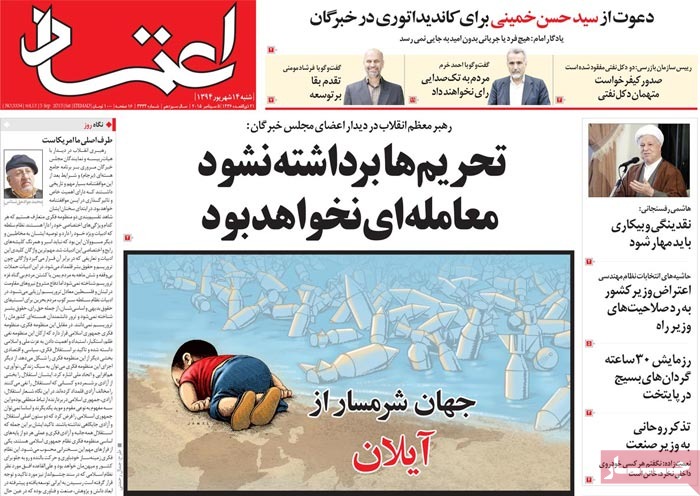
Etemad: “There would be no deal if sanctions are not lifted,” said Supreme Leader Ayatollah Seyyed Ali Khamenei in a meeting with members of the Assembly of Experts.
 

A look at Iranian newspaper front pages on Sept. 5


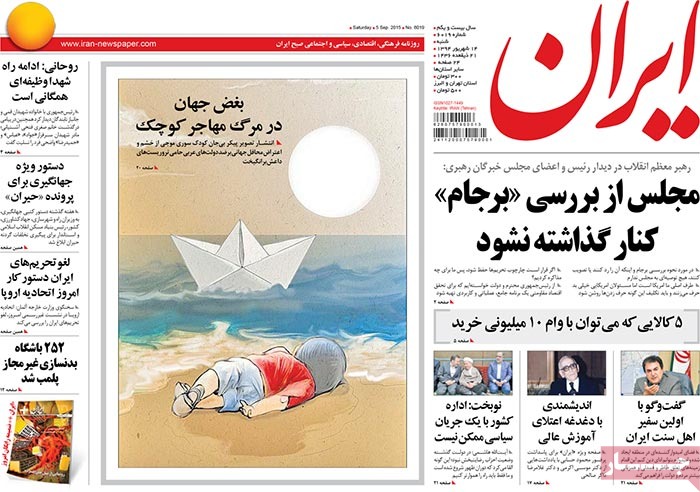
Iran: “It is impossible to run the country by one single political group,” said Government Spokesman Mohammad Bagher Nobakht.
 

A look at Iranian newspaper front pages on Sept. 5


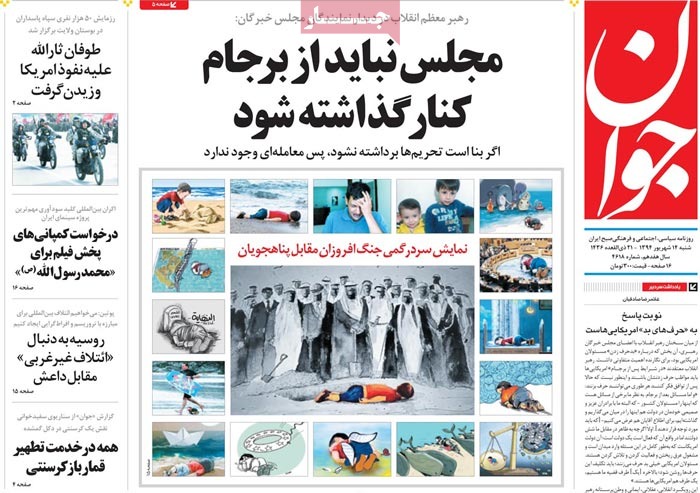
Javan: A show of confusion by war-mongering people against refuge seekers

The daily has given extensive front-page coverage to the news of the lifeless body of a drowned three-year-old Syrian child.
 

A look at Iranian newspaper front pages on Sept. 5


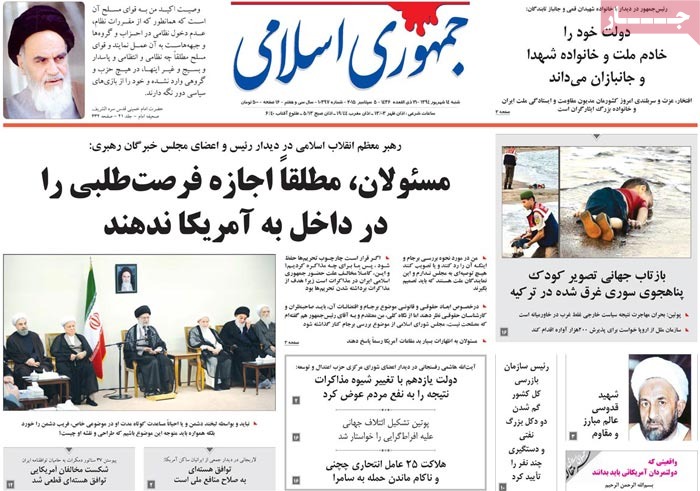
Jomhouri Islami: The Supreme Leader has called on officials not to let the United States pursue its opportunistic agenda inside Iran.

Jomhouri Islami: Ayatollah Akbar Hashemi Rafsanjani has said that the eleventh government tapped into a different diplomatic method in nuclear talks and changed the result in Iran’s favor.
 

A look at Iranian newspaper front pages on Sept. 5


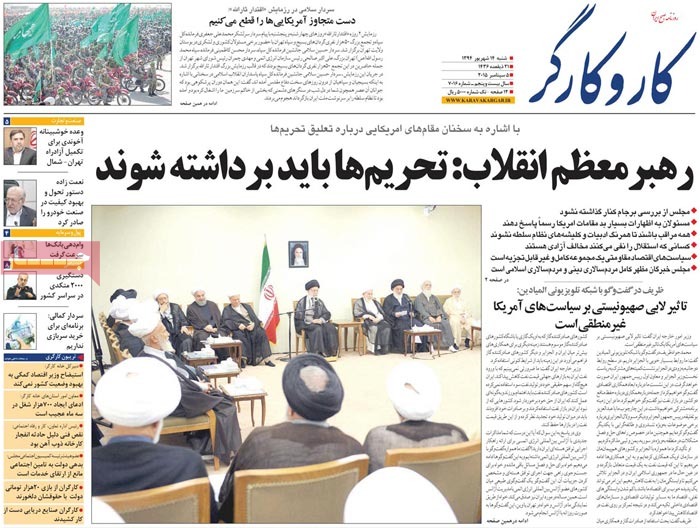
Kar va Kargar: “The influence the Zionist lobby holds over US policy is far from logical,” said Foreign Minister Mohammad Javad Zarif in an interview with Lebanon’s Al Mayadeen.
 

A look at Iranian newspaper front pages on Sept. 5


Kayhan: The Supreme Leader: Members of parliament should decide on the Joint Comprehensive Plan of Action.

Ayatollah Khamenei: If the sanctions regime is to remain in place, what did we hold negotiations for?

Ayatollah Khamenei: US officials mouth off; something must be done about it.

Kayhan: “The presence of foreign teams in Iran will have no impact on the country’s economic state,” said the chairman of Tehran Chamber of Commerce, Industries, Mines and Agriculture.

Kayhan: Despite his countless crimes, the killer of Shiites in Pakistan was exonerated!


A look at Iranian newspaper front pages on Sept. 5


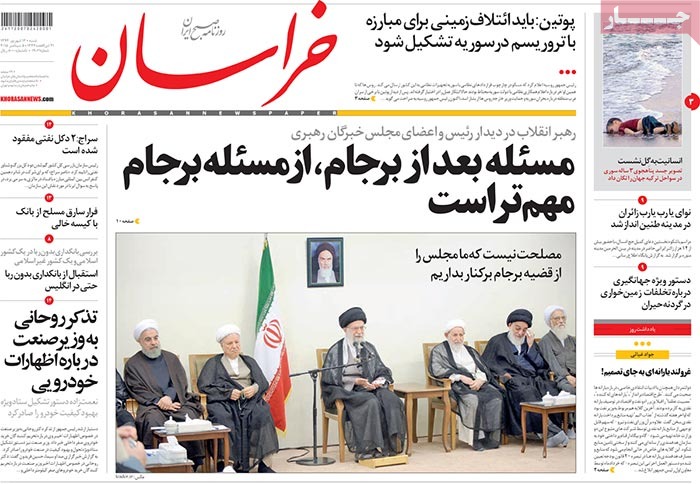
Khorasan: Russian President Putin has said that a ground coalition should be formed to take on terrorism in Syria.
 

A look at Iranian newspaper front pages on Sept. 5


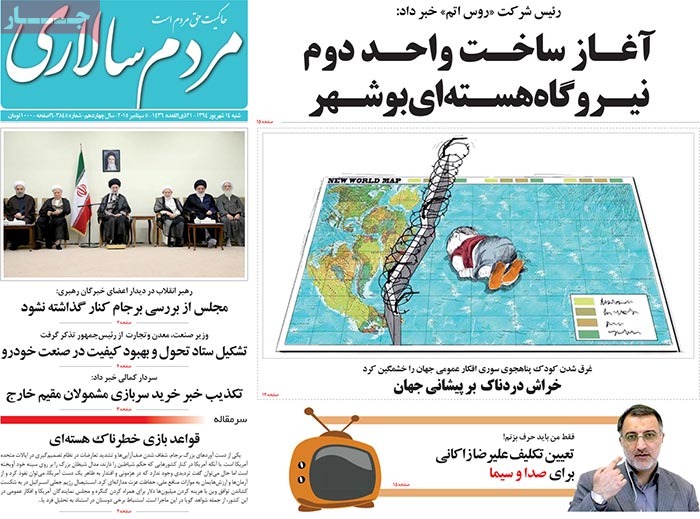
Mardomsalari: Rosatom State Atomic Energy Corporation announced that construction of Unit Two of Bushehr Nuclear Power Plant gets underway.

Mardomsalari: “Only I should speak.”

Alireza Zakani decides what IRIB [the national broadcaster] should do.

[This comes after Zakani, a Tehran MP, refused to appear in a TV program and talk face to face with Hamid Baeedinejad, a senior Iranian nuclear negotiator.]
 

A look at Iranian newspaper front pages on Sept. 5


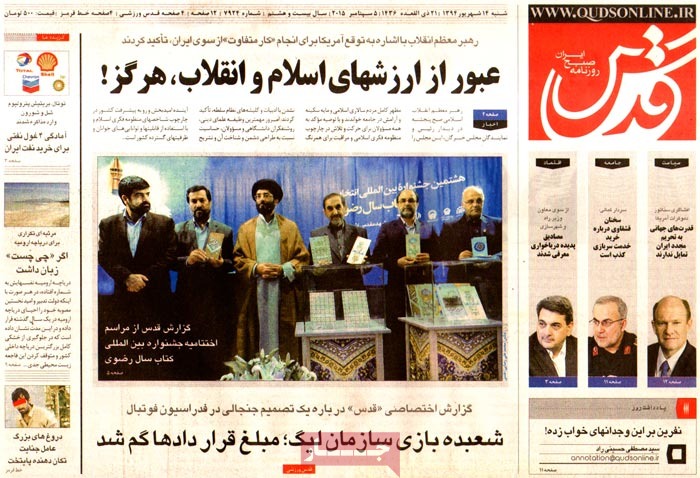
Qods: The Supreme Leader stressed in a meeting with members of the Assembly of Experts: A strong no to compromise on the values of Islam and the revolution.
 

A look at Iranian newspaper front pages on Sept. 5


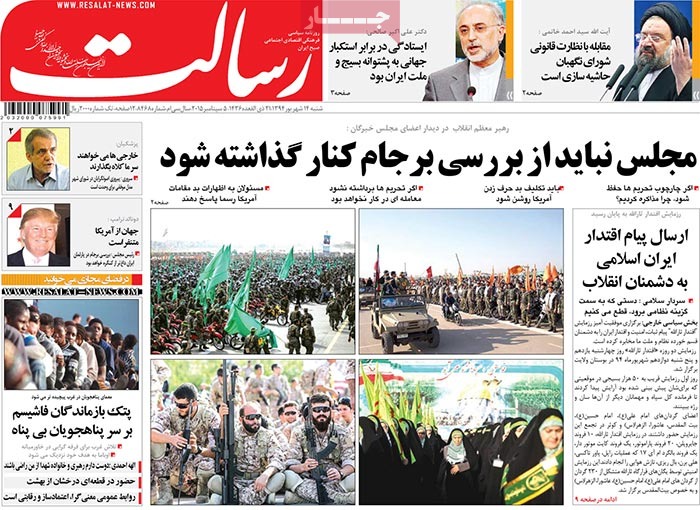
Resalat: Tharallah drills came to an end, sending the message of Iran’s might to the enemies of the revolution

Resalat: “Standing up against the Guardian Council’s legal right to supervise the elections amounts to nothing but making a fuss,” said Ayatollah Ahmad Khatami.
 

A look at Iranian newspaper front pages on Sept. 5


Roozan: In a meeting with the grandson of the late Imam Khomeini, university students welcomed a run by Seyyed Hassan Khomeini for the Assembly of Experts.


A look at Iranian newspaper front pages on Sept. 5


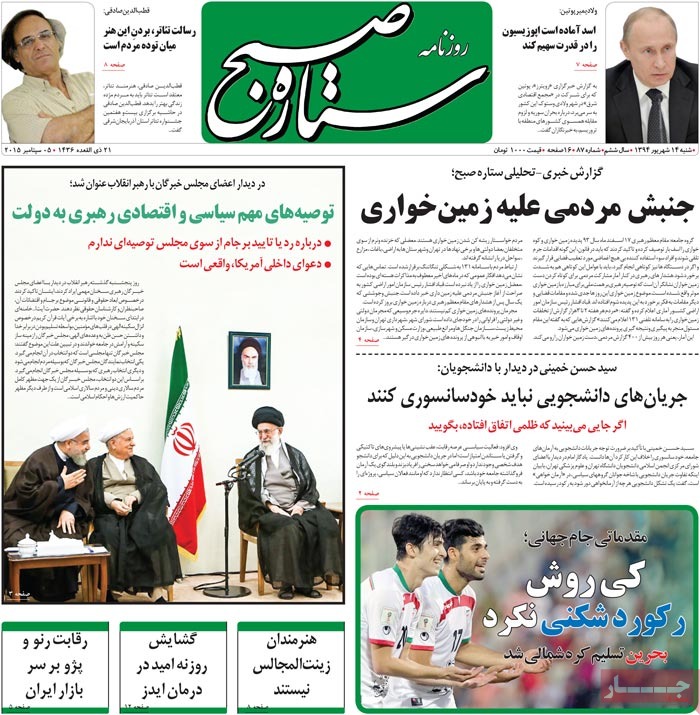
Setareh Sobh: “Students should not plunge into self-censorship,” said the grandson of the late Imam at a meeting with university students.  
 

A look at Iranian newspaper front pages on Sept. 5


Sharq: “The sanctions imposed by the US and European governments should be removed,” said the Supreme Leader.

Sharq: “If you feel that a person has been treated unfairly, [come forward and] speak out,” said the grandson of the founding father of the Islamic Republic.


A look at Iranian newspaper front pages on Sept. 5


Siasat-e Rooz: Genocide in the 21st century; Western countries continue their systemic killings of refuge-seekers.

 

A look at Iranian newspaper front pages on Sept. 5


MP: Parliament can set conditions for implementing JCPOA

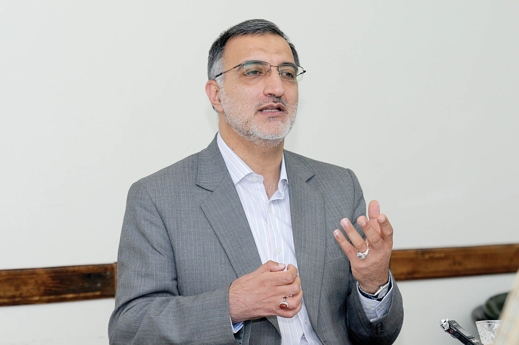
Zakani

The head of parliament’s JCPOA Review Committee has said that the Islamic Consultative Assembly is not expected to simply say ‘yes’ or ‘no’ to the Joint Comprehensive Plan of Action (JCPOA); rather, it can set conditions for its implementation.

Alireza Zakani, a Tehran MP, made the comment in a TV news bulletin and added that under international law, parliament can put forward its own interpretation of the Iran nuclear deal so that the government can build on that to put JCPOA in force. The following is the translation of part of his remarks as reported by Khabaronline.ir on September 3:

Zakani said that the JCPOA Review Committee in parliament has already started its review of the Iran nuclear deal before it receives a government bill on the deal, adding that the committee will introduce a motion on the nuclear deal if the government fails to submit a bill for discussion on the floor.

He said that parliament was in recess last week, but his committee met every other day during the week and members of the committee are to visit the country’s nuclear sites.

Asked about possible rejection by P5+1 members of the likely changes the Iranian parliament will introduce to the text of JCPOA, the MP said that our hands are not tied. “We will simply release a report on the text of the deal, but we will have an expert review of the articles of the deal. Parliament can reject the deal if the deal’s disadvantages outweigh its advantages. Otherwise, the chamber can set conditions in order to minimize its weak points.”

“Parliament can also release a detailed statement for the implementation of JCPOA,” he said, citing talks with international law experts.

Zakani went on to say that parliament should comment on JCPOA in the three-month deadline set for the implementation of the deal since its conclusion, adding that the Review Committee will put out its report by October 29. He said that we have enough time to review the deal on the floor.

The Tehran MP also said the JCPOA Review Committee – which hosted Saeed Jalili [Iran’s chief nuclear negotiator during Ahmadinejad presidency] and Abbas Araghchi last week – had serious discussions with the related officials, adding that it will invite Messrs. Ali Shamkhani [Secretary of the Supreme National Security Council], Ali Akbar Salehi [Director of the Atomic Energy Organization], Mohammad Nahavandian [President Rouhani’s Chief of Staff], the economy minister and the governor of the Central Bank of Iran for its next sessions.

Iran will retaliate if P5+1 reneges on JCPOA promises: Larijani

Larijani

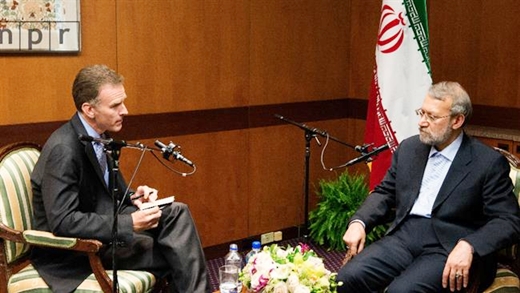
The speaker of Iran’s parliament has said that Tehran will “retaliate” in case the world powers break their commitments under the Joint Comprehensive Plan of Action (JCPOA) over the Iranian nuclear program.

In an interview on Thursday with the US National Public Radio (NPR), Ali Larijani said that he believes those “who want to wreck” JCOPA “are going to find new ways to perforate” the agreement.

He stated that Washington tried to put pressure on Tehran during nuclear negotiations, but finally came to recognize Iran’s legitimate nuclear rights following the Islamic Republic’s unwavering resistance.

He also described as “acceptable” the conclusion of Iran’s nuclear talks, however, adding that it is far from being perfect.

“My overall view is that it’s an acceptable deal. I believe we can use this deal as a step we can take to move forward. And at the same time it’s not flawless,” he added during the interview, which will be aired on September 8.

According to Iran’s senior lawmaker, improving the economic status will top Tehran’s agenda after the implementation of JCPOA and removal of anti-Iran sanctions.

“We should not spend our energy in areas which cannot bring about palpable or concrete changes in the livelihood of the people. We should try to focus on the economy and make a difference there,” he stated.

Larijani lashed out at US officials’ hostile rhetoric at the present time when, he said, both sides should be “paving the ground for the ratification and the implementation” of the nuclear accord.

“Every day it seems that your secretary of defense wakes up in the morning, opens the window, he shouts something at Iran and says that the military option is still on the table. If you really want to have war, then just go with it. Why are you just talking about it all the time?” he noted.

[…]

Larijani further hinted at a possible prisoner swap between Washington and Tehran over the case of Jason Rezaian, The Washington Post’s correspondent who is standing trial in Iran over espionage and other security-related charges.

“There are practical ways of course. For example, there is a number of Iranians in prison here [in the US]. Definitely for matters of this sort, one can come up with solutions. I think your politicians know about those ways,” the Iranian official stated.

His remarks came days after Iranian Foreign Ministry Spokeswoman Marzieh Afkham called for the release of 19 Iranian nationals languishing in US jails on charges of bypassing anti-Iran sanctions.

Iran calls for international scientific collaboration: Minister

Farhadi

The Iranian minister of science, research, and technology has said that the Islamic Republic invites scientists from all over the world to initiate a “collaborative program” with Iranian scientists.

“More than 35 years since its revolution, Iran is embarking on a new era of international interaction and cooperation. On the road to becoming a nation with scientific clout, Iran takes the role of science for peace, progress, and dialogue very seriously,” Mohammad Farhadi wrote in an editorial published in the Science Magazine on Friday.

“Today, Iran is in a position to fine-tune its development model and move toward qualitative improvement of its science and technology,” the minister wrote.

Farhadi also said that scientific cooperation among countries is most effective through establishing direct contacts among scientists rather than through government-driven agreements, hence the Iranian government encourages and supports collaborations initiated by individual scientists from within the country or in any part of the world.

“Prospects for collaboration in the natural sciences, humanities, engineering, and medical and biosciences are all on the horizon,” Farhadi further wrote, adding that Iran urges its universities to become international in all aspects of science and education.

He also gave an account of Iran’s current educational and scientific profile. According to the science minister, Iran has about 4.5 million university students, 2,500 higher education institutions, 36 science and technology parks, 400 nongovernmental scientific associations, more than 800 research centers, and 1,000 scientific journals.

Farhadi added Iranian scientists publish about 30,000 international scientific papers annually, a growth of at least 20-fold since the Islamic Revolution in 1979.

Iran closely watches hostile moves: Air defense commander

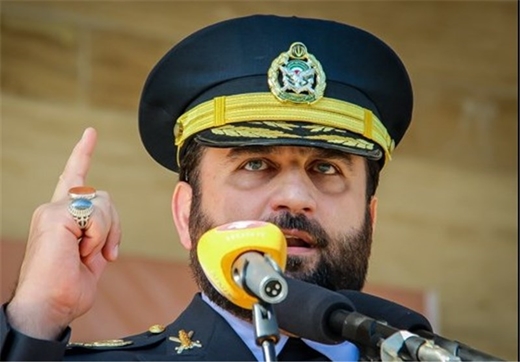
General Farzad Esmaili

Iran keeps a close watch on the enemy’s aerial threats in distances as far away as 3,000 km outside the country’s borders, Air Defense Commander Brigadier General Farzad Esmaili said.

Thanks to the homegrown air defense gear, from radars to missiles, Iran’s Air Defense can detect the “enemy’s breath” in distances beyond 3,000 km, the general said in an address to Tehran’s Friday prayers.

He explained that Iran’s “defense line” is not confined to the geographical borders, because the bulk of threats and invasions are carried out through the air, with the use of planes or long-range missiles.

Given an increase in the number of the trans-regional countries’ bases around Iran, the Air Defense sites have been established in 3,700 spots across the country to protect islands, oil platforms, gas fields and the nuclear sites, the commander added.

His comments came a day after inauguration of Iran’s homegrown intelligent air defense command and control system, dubbed the Great Prophet (PBUH).

Iran has in recent years made great headway in manufacturing a broad range of military equipment, including the air defense systems that use cutting-edge technologies.

Tehran has repeatedly stated that its military power is defensive in nature and poses no threat to other countries.

Iranian speaker calls for int’l efforts to stop destruction of artifacts in Iraq, Syria

139404121031219605614404

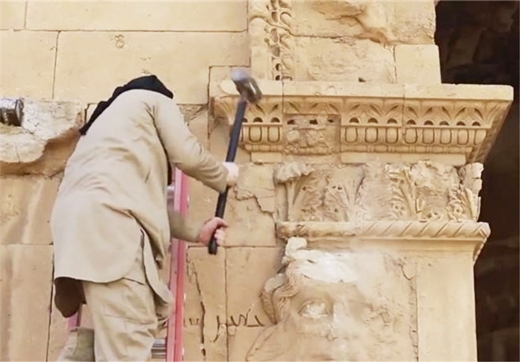
Iranian Parliament Speaker Ali Larijani voiced deep concern over recent moves by the Islamic State in Iraq and the Levant (ISIL) terrorist group to destroy ancient artifacts in Iraq and Syria, calling for international efforts to stop the heinous acts.

Speaking in a meeting with Director of the Metropolitan Museum of Art Thomas P. Campbell in New York, Larijani denounced the destruction of archaeological sites in Iraq and Syria, and said as long as terrorists remain in the region such destruction will continue.

“To halt the destructions, global efforts should be made,” the Iranian parliamentarian said.

“The world pays no attention to the human heritage,” Larijani said, adding, “But we will do our best (to save the heritage).”

ISIL’s demolition of the Saint Elian Monastery in the central Syrian province of Homs is the latest in a long campaign that has destroyed or extensively damaged some of the Middle East’s most spectacular archaeological and cultural sites.

Some of the world’s most precious cultural treasures, including ancient sites in the cradle of civilization, are in areas controlled by the group and at the mercy of extremists bent on wiping out all symbols of culture and history. The militants have also targeted churches, mosques and museums.

The rampage, targeting priceless cultural artifacts often dating back thousands of years, has sparked global outrage and accusations of war crimes.

The militants are also believed to be selling ancient artifacts on the black market in order to finance their bloody campaign across the region.

Afghan president calls for expansion of ties with Iran

81747646-70143238

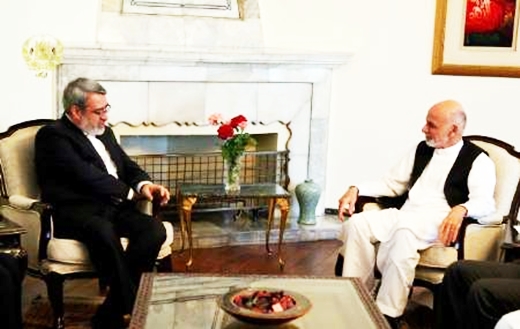
Afghan President Mohammad Ashraf Ghani in a meeting with Iranian Interior Minister Abdolreza Rahmani Fazli on Friday called for expansion of Kabul-Tehran relations.

“Kabul has always been looking for strengthening of trade ties with Tehran,” President Ashraf Ghani said.

President Ghani added that minor differences between the two countries in some issues should not hinder the expansion of cooperation.

Rahmani Fazli, for his part, emphasized the importance of improving security in Afghanistan, expressing the Islamic Republic’s readiness to help restore peace in the war-torn country.

“Afghanistan’s security is important to us; Tehran understands the country’s situation and will cooperate to restore peace to Afghanistan,” Rahmani Fazli said.

He said that Tehran and Kabul enjoy amicable relations and added that as a close neighbor, the Islamic Republic believes that “a threat to Afghanistan will in fact be a threat to Iran.”

The Iranian minister called on the two countries to have closer cooperation on the economic front and in the fight against terrorism and smuggling of narcotics as well as border control.

Iraqi Kurdistan Seeks Iran Help Against ISIS Chemical Attacks

81746958-70142009

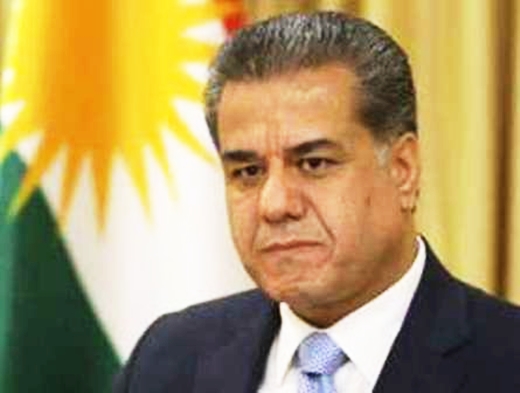
Head of the Iraqi Kurdistan Regional Government’s Department of Foreign Relations Falah Mustafa Bakir has called for Iran’s assistance in dealing with the threat of chemical attacks by the ISIS terrorist group.

“The threat of chemical attacks by ISIS is serious. The Kurdistan Regional Government welcomes the assistance of the Islamic Republic of Iran in this regard,” he told IRNA.

The official said Iran has precious experience in anti-chemical weapons defense which is sought by the Iraqi Kurdistan Regional Government.

Mustafa also said his meeting with the visiting media advisor to Iranian minister of culture and Islamic guidance was fruitful for expansion of bilateral ties.

Iran held talks with P5+1 for removal of sanctions: Ayatollah Khamenei

Leader

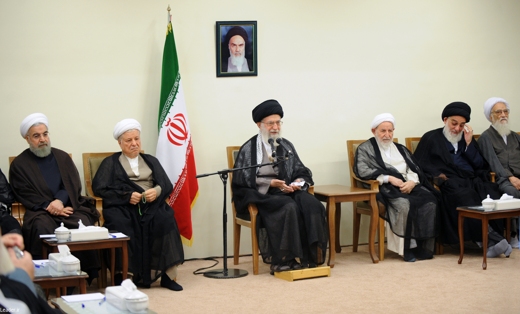
“If the framework of the sanctions is to remain in place [then] what did we negotiate for? This is completely against the reason why the Islamic Republic of Iran partook in negotiations, since the goal of the talks was the removal of the sanctions,” Ayatollah Khamenei said in a meeting with members of Iran’s Assembly of Experts on Thursday.

On July 14, Iran and the P5+1 countries – the United States, Britain, France, China, Russia and Germany – finalized the text of a nuclear agreement dubbed the Joint Comprehensive Plan of Action (JCPOA) in the Austrian capital Vienna.

Under the JCPOA, limits will be put on Iran’s nuclear activities in exchange for, among other things, the removal of all economic and financial bans against the Islamic Republic.

The Leader said the potential removal of the sanctions was the main reason Tehran gave some concessions at the talks, “Otherwise, there would be no need for us to take part in the negotiations. We could continue our work and could increase the number of our centrifuges to 50,000 to 60,000 from the current 19,000 in a short while and continue 20-percent [uranium] enrichment, and speed up research and development.”

“Should the sanctions remain in place, then there would be no deal either. So this issue must be resolved,” Ayatollah Khamenei said and also rejected the idea that the bans be “suspended” instead of being “lifted.”

The Leader further insisted that Iran’s Majlis (parliament) be involved in the examination of the JCPOA.

“I have no recommendation for the Majlis regarding the manner of the review or whether they should ratify or reject it. It is the representatives of the nation who should decide,” said Ayatollah Khamenei.

The Leader also referred to the comments made by American officials, which were irrelevant to the issue of nuclear agreement.

“They (American officials) say the JCPOA has offered some opportunities to the United States both inside Iran and outside the country and in the region,” Ayatollah Khamenei said.

“One of the US policies in the region is to annihilate and fully destroy the forces of resistance and fully dominate Syria and Iraq and they expect that the Islamic Republic enter this framework. Such a thing would never transpire,” the Leader said, ruling out any negotiation with the US unless on the nuclear issue.

“One should not be duped by the enemy as a result of its smile or probable short-term assistance in a certain issue. We should always find out what the enemy’s plotting and scheme are,” the Leader said.

Director of The Godfather praises Muhammad, the Messenger of God

Muhammad Movie
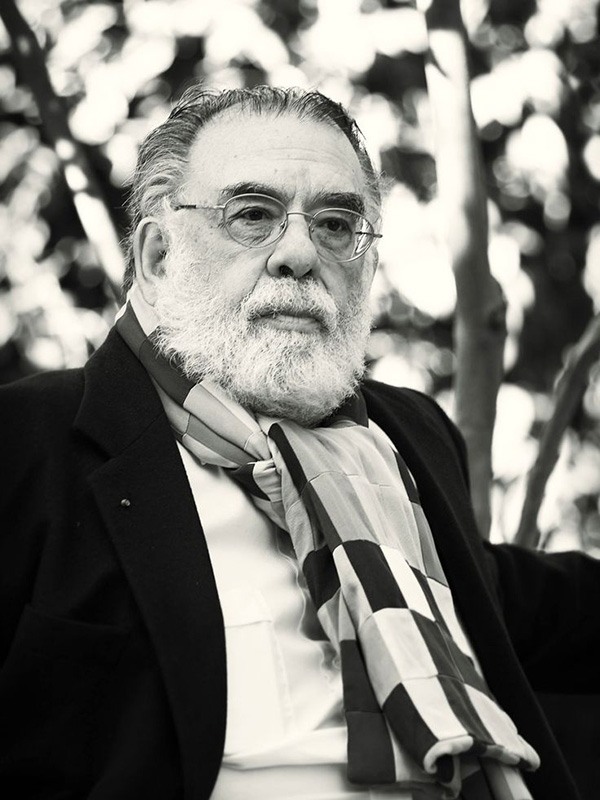
Francis Ford Coppola

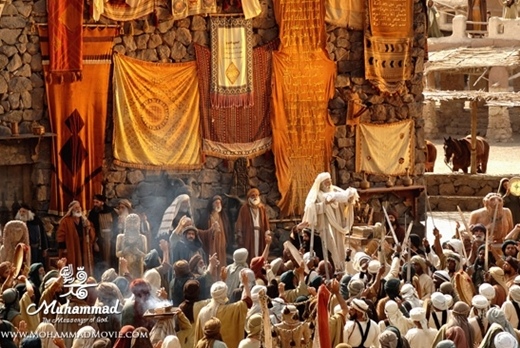
The private screening of Muhammad, the Messenger of God, a film by Iranian director Majid Majidi, at the American Film Institute has drawn a warm welcome from a group of 135 big names in the cinema industry in Los Angeles.

Fars News Agency on September 2 released this report quoting the website of the Iranian movie on the life of the Prophet Muhammad (Peace Be Upon Him) and said that Vittorio Storaro, an Italian who was in charge of Muhammad‘s cinematography, screened the Iranian movie for his American counterparts who widely welcomed it. The following is the translation of the report:

Muhammad, the Messenger of God premiered at the opening ceremony of the Montreal World Film Festival (MWFF) in late August and then it was screened in the movie theaters across Iran and other countries – where it was given an enthusiastic welcome. The latest screening of the movie was in the US where the American movie-goers stood in long lines to watch the Iranian movie.

A group of 135 well-known figures in the film industry were present for the private screening of Muhammad, the Messenger of God at the American Film Institute in Los Angeles.

According to Storaro, a big number of people could not watch the film. Francis Ford Coppola – an American filmmaker who has directed The Godfather – was among the audience of the private screening and highly praised the movie.

Those who watched Muhammad expressed their interest in the film, with many saying that Muhammad has a big capacity to establish interfaith peace [in the world].

On Tuesday the Montreal World Film Festival dedicated two extra screening times for Muhammad, the Messenger of God. Nonetheless, many fans failed to watch the movie and asked those in charge to allocate extra show time.

[Muhammad, the Messenger of God is the first part of Iran’s big-budget trilogy on the life of the Prophet Muhammad (PBUH). A number of internationally-acclaimed professionals, including Academy Award winning visual effects supervisor and filmmaker Scott E. Anderson, three-time Oscar-winning Italian director of photography Vittorio Storaro and renowned Croat production designer Milijen Kreka Kljakovic collaborated in making the film.]