Wednesday, January 14, 2026
Home Blog Page 4625

Perhaps a small exhibition, but surely with great goals and achievements

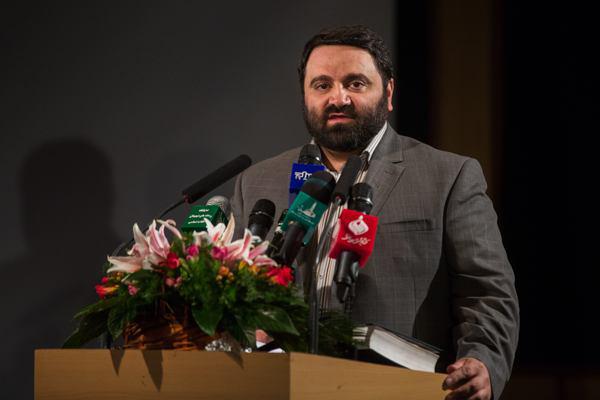
Mansour Amini emphasized the boundary-crossing function of cyberspace in stimulating the world’s curious minds, especially the youth of today. He also stressed the need for better exploitation of this channel for scientific exchange and knowledge accumulation. He requested robust support from the relevant authorities, and also asked that considerable attention be paid in Iran’s 6th Development Plan to the threats posed by new communication technologies.


Referring to the fact that authorities must be vigilant towards enemy threats, the head of the Seraj Cyberspace Organization and the Secretary of the Islamic Revolution Digital Media Fair and Festival said, “The executive authorities in the post-sanction period should trust the revolutionary, talented and elite youth in this field, instead of allowing foreign IT companies to take over.”

He spoke at the opening of the 3rd Fair and Festival on Islamic Revolution Digital Media about the incredible amount of effort by the Islamic Revolution Popular Front in cyberspace, saying “Cyberspace is both a threat and an opportunity.”

Amini continued, “Unfortunately, we don’t yet have something called a National Information Network. In this deplorable situation, cyberspace is neither an absolute opportunity nor an absolute threat. It is our performance which will determine the outcome.”

The Secretary of the Fair called attention to the Supreme Leader’s remarks this year about the capacity and threats of cyberspace. The Supreme Leader had said, “Today we are in a virtual intellectual battle. This battle is not against our interests in any means – in fact it’s in our interests. If we enter this battleground, taking what we need from Islamic thought and using the reservoirs of divine teaching, then victory will surely be ours.”

Amini emphasized the boundary-crossing function of cyberspace in stimulating the world’s curious minds, especially the youth of today. He also stressed the need for better exploitation of this channel for scientific exchange and knowledge accumulation, as well as listing the threats of new communication technologies, which included: “Degrading merit, spreading mental doubt, weakening beliefs, espionage and stealing information, serving Zionism and the inversion of the truth, targeting children and teenagers to disrupt local education, creating feelings of disillusion and humiliation in the youth, in addition to imposing Western thoughts and destroying other societies’ cultures in order to proliferate Western lifestyles.”

Mansour Amini reminded the audience of the necessity of spreading the activities of the Islamic Revolution Popular Front and asked the responsible authorities to take cyberspace threats seriously. He declared, “Today, our concerns with cyberspace are not political – they are about attacks on people’s beliefs and faiths.”


The Fair – Small but Great

The head of the Seraj Cyberspace Organization described the outstanding technical and vocational empowerment of thousands of Iranian specialists in new information and cyber communication technologies. He said that the main goal of this festival is to create an opportunity, through the Seraj Organization, for digital cyberspace activists to get to know each other, to exchange facilities and make scientific and professional connections.

He spoke of the diversity of activities in the field among more than 300 units in attendance at the festival, saying, “Unfortunately, limited facilities, and the exhibition location size allowed us to accept only half of the 600 applicants for the 3rd Fair and Festival on Islamic Revolution Digital Media. We have tried to host a spectrum of cyberspace activists to exhibit and introduce their latest achievements over these 6 days. In this fair – which might seem small in quantity but is great in quality and substance – there are participants from online media activists, programmers, information technologists, mobile application producers, animation activists, etc. Some of them have developed unique and creative projects, such as a cyber-program for ending drug addiction. Also, there are workshops being held for visitors during the exhibition, under the subject of “User Education in Cyberspace”.”

Amini emphasized, “The government should consider national empowerment in the post-sanctions era and trust in the power of youth.” He continued, “The executive authorities in the post-sanction period should trust the revolutionary, talented and elite youth in this field, instead of allowing foreign IT companies to take over.”


We Need a National Information Network!

At the end, the Seraj Cyberspace Organization head mentioned that it is not possible to solve defects and problems solely by setting up fairs and festivals, conferences and speeches, but real action also needs to be taken. He said, “Some of the important points to be considered by the related authorities include: starting a National Information Network, providing local services, supporting a healthy competitive environment among those active within new communication technologies, and helping public and private sector resources to have an active presence in international interactions in the field of cyberspace.” He also complained about the government’s lack of attention regarding the National Information Network in the 6th Development Plan, and asked Parliament members to not to forget the importance of this project whilst checking this program.

Amini finished his speech with some remarks from the Supreme Leader, “Big works sometimes take a generation to achieve. We should continue moving forward. There are many projects that would have yielded results today, if we had started them ten years ago.”


IFP has summarized a Tasnim news report, along with information as presented in the exhibition brochure. They are published on this website under a different title and layout.

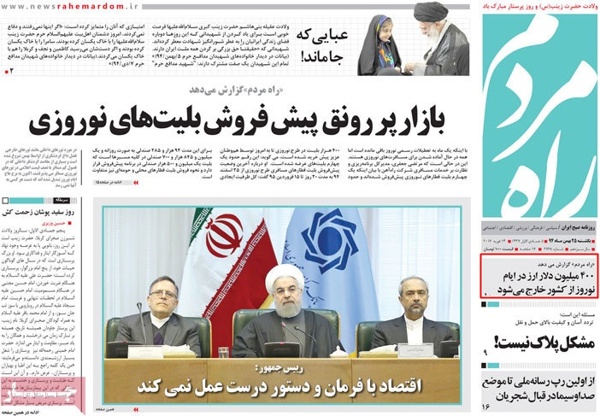
$3m toys imported to Iran monthly

Mohammad Hossein Farjoo told IRNA on Sunday that regarding revenue, toy industry stands after weapon, illegal drugs and make-up trade.

Farjoo said that the annual per capita consumption of toys in Iran was 5 dollars while the world average is thirty-four dollars.

He said that the toy production income for China is more than Iran’s oil revenue for Iran.

He added that some big producers have employed kids in their factory to ask their ideas about the toys to ensure that they would be welcomed by kids.

On supporting toys producers, he said that they should be supported so that more companies enter this field to produce toys easily.

He added that 400 plans have been registered in Iranian Supervisory Council for Toys since the beginning of the current Iranian year, (March 20, 2015)

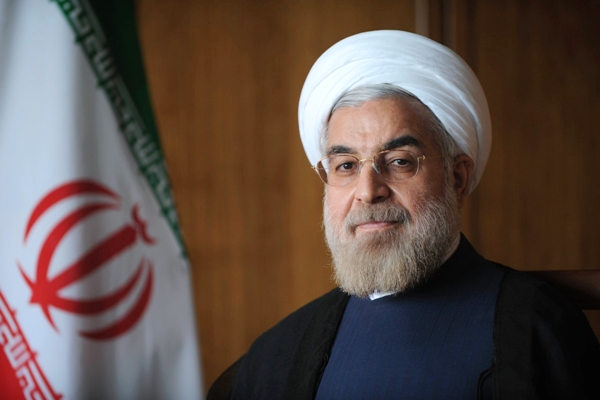
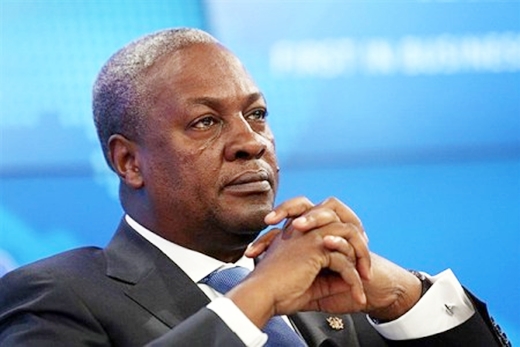
Rouhani welcomes Ghanaian counterpart in Tehran

National anthems of the two countries were played in the ceremony while the two presidents reviewed the parade there.

Ghanaian president, heading a high-ranking delegation, arrived in Tehran on Saturday evening.

He is planned to meet with his Iranian counterpart. He is also due to meet other top Iranian officials.

The president of Ghana is scheduled to attend Iran-Ghana trade meeting.

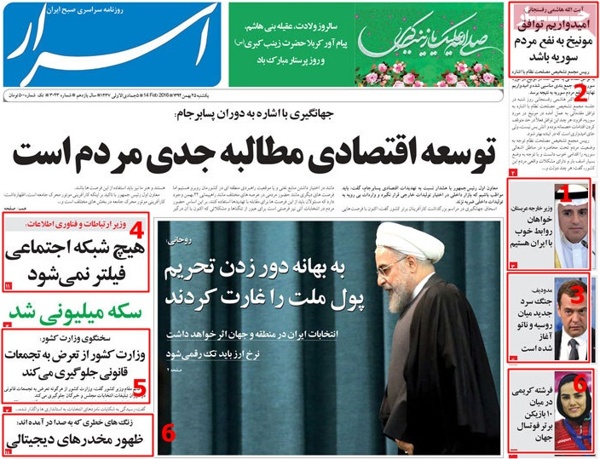
Female Iranian Futsal Player among the World’s Top 10

Female Iranian futsal player Fereshteh Karimi has been shortlisted for the title of the Best Woman Player of the World, thanks to her astounding display of skills at the 2015 Asian Football Confederation (AFC) Women’s Futsal Championship in Malaysia.

The 26-year-old, who currently plays for the Daneshgah Azad club, is vying for the top honour with Brazil’s Amanda Lyssa de Oliveira Crisostomo, Portugal’s Ana Patricia Abreu Azevedo, and Brazilians Luciléia Renner Minuzzo and Carolina Augusta da Silva.

Daniela Sofia da Costa Ferreira from Portugal, Russian player Aleksandra Samorodova, Brazil’s Tatiane Debiasi Croceta and Vanessa Cristina Pereira, along with Spanish futsal player Vanessa Sotelo Quintela make up the other contenders on the list.

Additionally, Iran’s goalkeeper Farzaneh Tavasoli has been nominated for the Best Women Goalkeeper of the World.

On September 26, 2015, Iran’s women’s national futsal team bagged the trophy at the 2015 Asian Football Confederation (AFC) Women’s Futsal Championship in Malaysia, following a victory over the Japanese side.

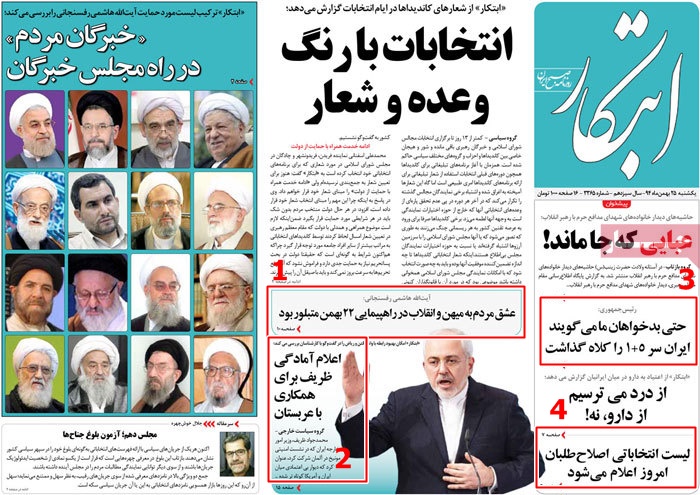
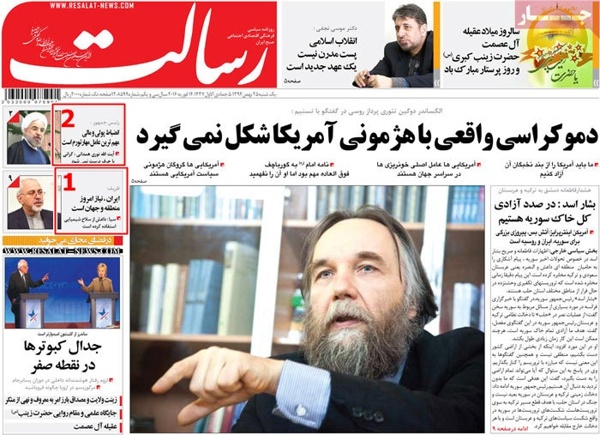
‘Not for US, Saudi to decide for Syrians’

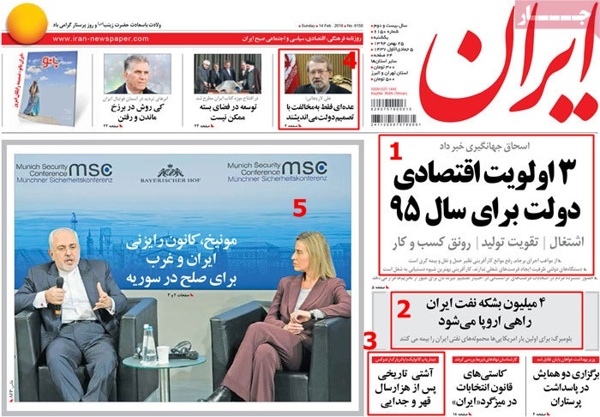
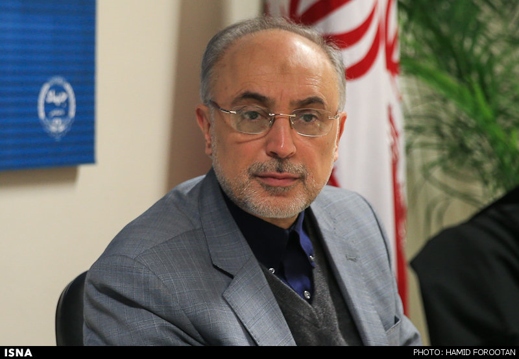
Zarif made the remarks on Saturday while speaking to reporters in the German city of Munich in response to earlier comments by US Secretary of State John Kerry and Saudi Arabia’s Foreign Minister Adel al-Jubeir about Assad’s future and the political situation in Syria.

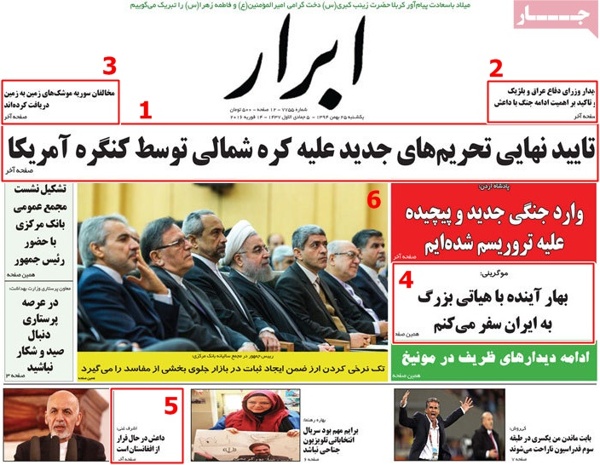
“A political solution will be possible with [the presence of] Assad. Neither we nor they [Saudi Arabia and the US] can make a comment in this regard,” Zarif said at the end of his visit to Germany, where he delivered a speech at the 52nd Munich Security Conference (MSC).

“A decision about the future of Syria must be taken by the Syrian nation. People have the right to express their views and this decision only rests with the Syrians,” he added.

On the eve of the Munich talks, Kerry told The Washington Post that in case of lack of seriousness by Russia and Iran for the resolution of the crisis in Syria, “then there has to be consideration of a Plan B.”

He added that “Plan B” would “lead to a coalition against [the Daesh Takfiri terrorists], and also to support the opposition against Assad.”

The Saudi foreign minister also told CNN in Munich that if the Syrian political process fails, President Assad will have to be removed “by force.”

“I believe Bashar al-Assad is weak and I believe Bashar al-Assad is finished,” Jubeir said.

Zarif-Kerry meeting on JCPOA

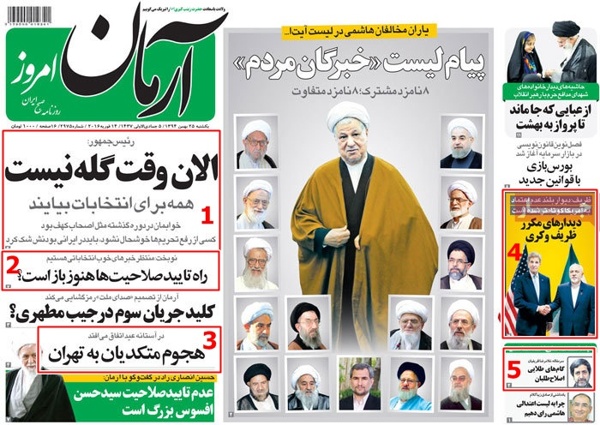
On the sidelines of the Munich conference, the Iranian foreign minister also held a meeting with the US secretary of state, during which they discussed ways to implement a nuclear agreement reached between Iran and the P5+1 group of countries last July.

Iran and the five permanent members of the UN Security Council – the United States, France, Britain, China and Russia – plus Germany started to implement the agreement, dubbed the Joint Comprehensive Plan of Action (JCPOA), on January 16.

After JCPOA went into effect, all nuclear-related sanctions imposed on Iran by the European Union, the Security Council and the US were lifted. Iran, in return, has put some limitations on its nuclear activities.

The nuclear agreement was signed on July 14, 2015 following two and a half years of intensive talks.

Iran, Germany to set up joint international university: Iranian official

Touraj Mohammadi noted that the university’s initiation was decided during the last visit of a German trade delegation to Iran, Mehr news agency reported on Saturday. 

He noted that Iran’s Science and Technology University follows various international initiatives, the latest of which is “becoming a communication portal between Iran and Germany’s universities.”

According to Mohammadi, the university will accept students from all over the world while similar cooperation with other countries is in the planning stages.

He refrained from giving a location, time-table or budget for the university’s establishment.    


Iran urges concerted efforts to end Yemen war

In a telephone conversation on Saturday, Iran’s Deputy Foreign Minister for Arab and African Affairs Hossein Amir-Abdollahian and the United Nations Special Envoy to Yemen Ismail Ould Cheikh Ahmed discussed the latest developments in the war-stricken country.

Amir-Abdollahian said the humanitarian situation in Yemen is worsening as a result of the continued airstrikes against the country, adding that in addition to aid raids, “We are witnessing increasing growth of terrorism in south of Yemen.”

He voiced Iran’s support for efforts by the UN envoy aimed at finding a political solution to the crisis in Yemen and start dialog among Yemeni factions.

The UN envoy, for his part, praised Iran’s constructive approach toward fighting terrorism and supporting a political trend in Yemen.

Ahmed said the UN has launched a fresh round of efforts to broker peace talks among Yemeni groups.

The UN attempts to settle the crisis in Yemen through political approaches have so far failed. In December 2015, Houthi Ansarullah movement and members of the former Yemeni regime held inconclusive talks in Switzerland, which was coincided with the implementation of a UN-brokered truce that was mainly violated by Saudi Arabia.

Riyadh has been pounding Yemen since March 2015 to undermine Ansarullah and reinstate former Yemeni president, Abd Rabbuh Mansur Hadi.

The Ansarullah fighters say Saudi Arabia and the former regime’s loyalists used the negotiations as a cover to intensify their attacks and kill more civilians. They say Riyadh has even stepped up its aggression following the ceasefire.

More than 8,278 people have been killed and over 16,000 others injured since the onset of the Saudi attacks.


Why Saudi Girls File Lawsuits against Their Parents

The Saudi Arabian Justice Ministry announced on Saturday that during the past 4 months, 128 lawsuits have been filed by Saudi girls against their parents, because they have made it hard for them to get married. Statistics show that the number of unmarried girls in Saudi Arabia has increased dramatically in recent years.

The latest figures show that, in 2015, the number of unmarried girls in Saudi Arabia has reached four million, which is one and half million higher than in 2010.

Officials from the Ministry of Justice say that the unmarried girls, most of whom live in Mecca, have said in their law suits against their parents that they want to see an end to old, tribal traditions and rituals that make getting married a difficult process.

Two of the main reasons that Saudi boys are rejecting marriage include the insistence for vast dowries, and overly expensive formalities.

Elections are the only means for power-sharing in Iran

Sadegh Zibakalam

What does the president mean by the second or domestic Barjam [the Farsi term for Joint Comprehensive Plan of Action, or JCPOA]? What requirements are needed for succeeding in domestic Barjam? What should the main goal of domestic Barjam be?

Dr. Sadegh Zibakalam, a university lecture and reformist activist, said in his interview with Fararu News (in Farsi) that what the president means by national Barjam is not exactly clear. If his point is a type of national reconciliation and power-sharing between reformists and conservatives, he is on a wild goose chase, because there is no way that the conservatives will back off. Elections are the only way in which we can hope for the continued participation of reformists and independent individuals in areas which can make a difference.

What follows is a summary of the interview with this reformist activist, as translated by IFP.

“However, looking at the main Barjam (JCPOA) on one side, and the country’s domestic conditions on the other, it seems that what Mr. Rouhani means by national Barjam is a sort of a ceasefire, national unity and national reconciliation between the two major currents of conservatives and reformists.”

“Mr. Rouhani says that the conflicts between the conservatives and reformists are not at all as severe as Iran’s disagreements with the US were. When Iran and the USA can make a deal and reach a sort of ceasefire, then why can’t we move past this hostile attitude toward each other within the country?”

“I believe that Mr. Rouhani is on a wild goose chase, and he won’t be able to realize this idea for the same reasons that Hashemi Rafsanjani couldn’t achieve this national reconciliation.”

“Regarding the national Barjam, we only can see a one-way tendency from people like Hashemi and Rouhani. The conservatives, on the other side of this deal, have no need or desire for this reconciliation. In fact, it’s contrary to their desires and interests to do such a thing.”

“The conservatives were only ready to give up the Executive, which was inevitable anyway, since the president must be chosen by election. However, they won’t give up their power in areas where this imperative doesn’t exist, like in Parliament, where they can stop their opponents.”

Responding to the question, “What should those who are seeking the implementation of a national Barjam keep in mind as being their goal?” Zibakalam said: “If there’s no pressure on conservatives, there’s no reason for them to give over part of their power.”

He quoted the Persian saying, “Rights are for taking, not for giving,” saying, “The reformists should try to increase their power in arenas like Parliament.”

Referring to his own prediction of the success or failure of a national Barjam, he commented, “National Barjam is a waste of time in sectors where it’s voluntary for the conservatives, but in the directly elected sectors, we can take power away from them, just like we did in June 2013, when we took the Executive from them. On 26th February 2016, we should also stop hardliners from entering Parliament, by sending independent individuals as candidates.”

Zarif: Syrians themselves must take decision of Assad’s presidency

Zarif made the remarks before leaving Munich for Tehran in reaction to the statements of US Secretary State John Kerry and Saudi officials about Bashar Assad presidency.

He noted that political settlement of the humanitarian crisis in Syria is possible with President Bashar al-Assad. Nobody can give opinion in this respect.

‘Any decision on Syria’s future should be made by the Syrian nation. They are entitled to say their views and the decision should be made only by the Syrians themselves,’ Zarif said.

Zarif attended International Syria Support Group in Munich which led to an agreement for ending the humanitarian crisis in Syria.

The foreign minister delivered a lecture on significance of Persian Gulf region and its security.

The 52nd Munich Security Meeting attended by heads of state from 23 countries and tens of ministers from various countries is due to work until February 14.