Monday, April 20, 2026
Home Blog Page 4626

‘Not for US, Saudi to decide for Syrians’

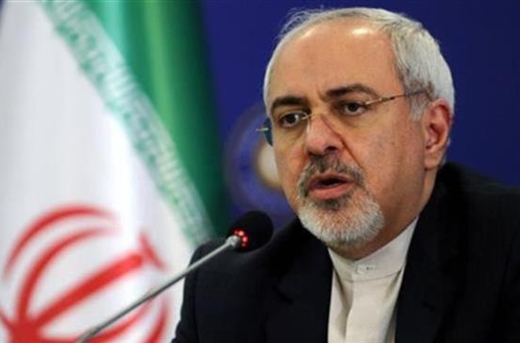
Zarif made the remarks on Saturday while speaking to reporters in the German city of Munich in response to earlier comments by US Secretary of State John Kerry and Saudi Arabia’s Foreign Minister Adel al-Jubeir about Assad’s future and the political situation in Syria.

“A political solution will be possible with [the presence of] Assad. Neither we nor they [Saudi Arabia and the US] can make a comment in this regard,” Zarif said at the end of his visit to Germany, where he delivered a speech at the 52nd Munich Security Conference (MSC).

“A decision about the future of Syria must be taken by the Syrian nation. People have the right to express their views and this decision only rests with the Syrians,” he added.

On the eve of the Munich talks, Kerry told The Washington Post that in case of lack of seriousness by Russia and Iran for the resolution of the crisis in Syria, “then there has to be consideration of a Plan B.”

He added that “Plan B” would “lead to a coalition against [the Daesh Takfiri terrorists], and also to support the opposition against Assad.”

The Saudi foreign minister also told CNN in Munich that if the Syrian political process fails, President Assad will have to be removed “by force.”

“I believe Bashar al-Assad is weak and I believe Bashar al-Assad is finished,” Jubeir said.

Zarif-Kerry meeting on JCPOA

On the sidelines of the Munich conference, the Iranian foreign minister also held a meeting with the US secretary of state, during which they discussed ways to implement a nuclear agreement reached between Iran and the P5+1 group of countries last July.

Iran and the five permanent members of the UN Security Council – the United States, France, Britain, China and Russia – plus Germany started to implement the agreement, dubbed the Joint Comprehensive Plan of Action (JCPOA), on January 16.

After JCPOA went into effect, all nuclear-related sanctions imposed on Iran by the European Union, the Security Council and the US were lifted. Iran, in return, has put some limitations on its nuclear activities.

The nuclear agreement was signed on July 14, 2015 following two and a half years of intensive talks.

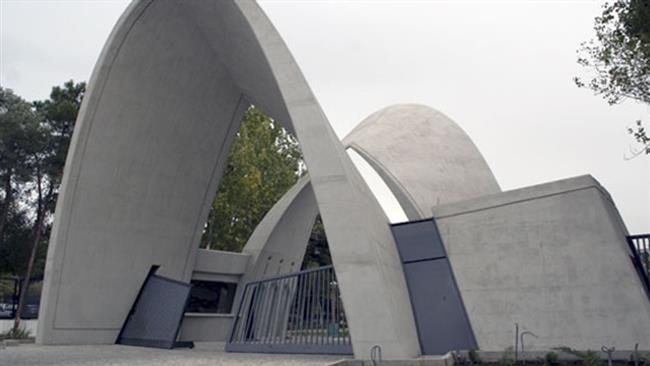
Iran, Germany to set up joint international university: Iranian official

Touraj Mohammadi noted that the university’s initiation was decided during the last visit of a German trade delegation to Iran, Mehr news agency reported on Saturday. 

He noted that Iran’s Science and Technology University follows various international initiatives, the latest of which is “becoming a communication portal between Iran and Germany’s universities.”

According to Mohammadi, the university will accept students from all over the world while similar cooperation with other countries is in the planning stages.

He refrained from giving a location, time-table or budget for the university’s establishment.    


Iran urges concerted efforts to end Yemen war

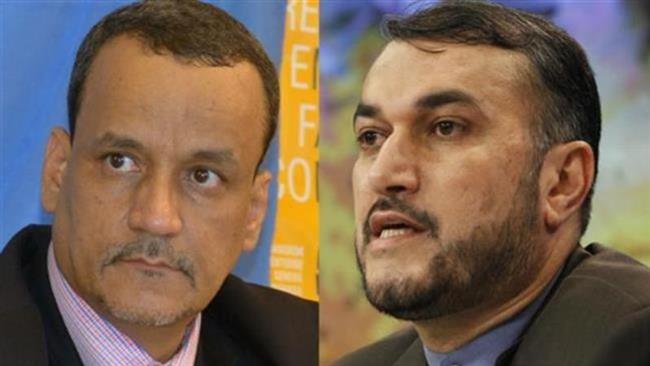
In a telephone conversation on Saturday, Iran’s Deputy Foreign Minister for Arab and African Affairs Hossein Amir-Abdollahian and the United Nations Special Envoy to Yemen Ismail Ould Cheikh Ahmed discussed the latest developments in the war-stricken country.

Amir-Abdollahian said the humanitarian situation in Yemen is worsening as a result of the continued airstrikes against the country, adding that in addition to aid raids, “We are witnessing increasing growth of terrorism in south of Yemen.”

He voiced Iran’s support for efforts by the UN envoy aimed at finding a political solution to the crisis in Yemen and start dialog among Yemeni factions.

The UN envoy, for his part, praised Iran’s constructive approach toward fighting terrorism and supporting a political trend in Yemen.

Ahmed said the UN has launched a fresh round of efforts to broker peace talks among Yemeni groups.

The UN attempts to settle the crisis in Yemen through political approaches have so far failed. In December 2015, Houthi Ansarullah movement and members of the former Yemeni regime held inconclusive talks in Switzerland, which was coincided with the implementation of a UN-brokered truce that was mainly violated by Saudi Arabia.

Riyadh has been pounding Yemen since March 2015 to undermine Ansarullah and reinstate former Yemeni president, Abd Rabbuh Mansur Hadi.

The Ansarullah fighters say Saudi Arabia and the former regime’s loyalists used the negotiations as a cover to intensify their attacks and kill more civilians. They say Riyadh has even stepped up its aggression following the ceasefire.

More than 8,278 people have been killed and over 16,000 others injured since the onset of the Saudi attacks.


Why Saudi Girls File Lawsuits against Their Parents

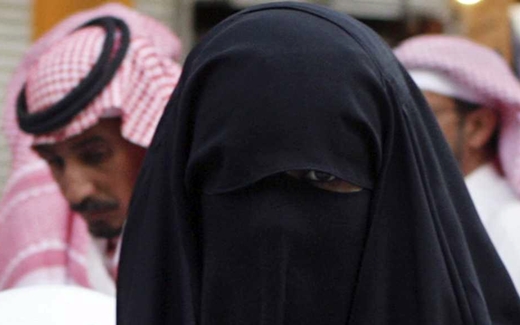
The Saudi Arabian Justice Ministry announced on Saturday that during the past 4 months, 128 lawsuits have been filed by Saudi girls against their parents, because they have made it hard for them to get married. Statistics show that the number of unmarried girls in Saudi Arabia has increased dramatically in recent years.

The latest figures show that, in 2015, the number of unmarried girls in Saudi Arabia has reached four million, which is one and half million higher than in 2010.

Officials from the Ministry of Justice say that the unmarried girls, most of whom live in Mecca, have said in their law suits against their parents that they want to see an end to old, tribal traditions and rituals that make getting married a difficult process.

Two of the main reasons that Saudi boys are rejecting marriage include the insistence for vast dowries, and overly expensive formalities.

Elections are the only means for power-sharing in Iran

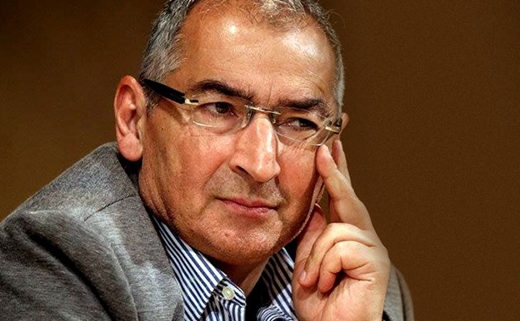
Sadegh Zibakalam

What does the president mean by the second or domestic Barjam [the Farsi term for Joint Comprehensive Plan of Action, or JCPOA]? What requirements are needed for succeeding in domestic Barjam? What should the main goal of domestic Barjam be?

Dr. Sadegh Zibakalam, a university lecture and reformist activist, said in his interview with Fararu News (in Farsi) that what the president means by national Barjam is not exactly clear. If his point is a type of national reconciliation and power-sharing between reformists and conservatives, he is on a wild goose chase, because there is no way that the conservatives will back off. Elections are the only way in which we can hope for the continued participation of reformists and independent individuals in areas which can make a difference.

What follows is a summary of the interview with this reformist activist, as translated by IFP.

“However, looking at the main Barjam (JCPOA) on one side, and the country’s domestic conditions on the other, it seems that what Mr. Rouhani means by national Barjam is a sort of a ceasefire, national unity and national reconciliation between the two major currents of conservatives and reformists.”

“Mr. Rouhani says that the conflicts between the conservatives and reformists are not at all as severe as Iran’s disagreements with the US were. When Iran and the USA can make a deal and reach a sort of ceasefire, then why can’t we move past this hostile attitude toward each other within the country?”

“I believe that Mr. Rouhani is on a wild goose chase, and he won’t be able to realize this idea for the same reasons that Hashemi Rafsanjani couldn’t achieve this national reconciliation.”

“Regarding the national Barjam, we only can see a one-way tendency from people like Hashemi and Rouhani. The conservatives, on the other side of this deal, have no need or desire for this reconciliation. In fact, it’s contrary to their desires and interests to do such a thing.”

“The conservatives were only ready to give up the Executive, which was inevitable anyway, since the president must be chosen by election. However, they won’t give up their power in areas where this imperative doesn’t exist, like in Parliament, where they can stop their opponents.”

Responding to the question, “What should those who are seeking the implementation of a national Barjam keep in mind as being their goal?” Zibakalam said: “If there’s no pressure on conservatives, there’s no reason for them to give over part of their power.”

He quoted the Persian saying, “Rights are for taking, not for giving,” saying, “The reformists should try to increase their power in arenas like Parliament.”

Referring to his own prediction of the success or failure of a national Barjam, he commented, “National Barjam is a waste of time in sectors where it’s voluntary for the conservatives, but in the directly elected sectors, we can take power away from them, just like we did in June 2013, when we took the Executive from them. On 26th February 2016, we should also stop hardliners from entering Parliament, by sending independent individuals as candidates.”

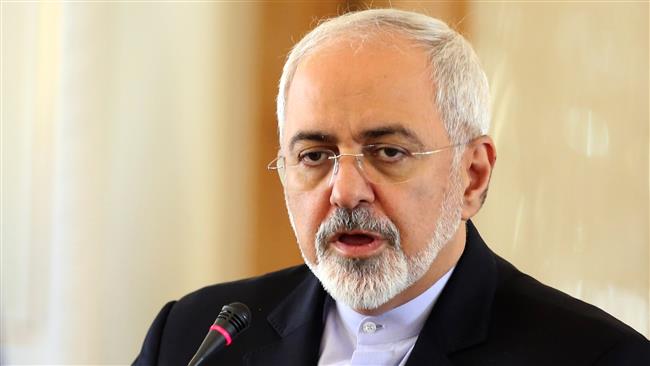
Zarif: Syrians themselves must take decision of Assad’s presidency

Zarif made the remarks before leaving Munich for Tehran in reaction to the statements of US Secretary State John Kerry and Saudi officials about Bashar Assad presidency.

He noted that political settlement of the humanitarian crisis in Syria is possible with President Bashar al-Assad. Nobody can give opinion in this respect.

‘Any decision on Syria’s future should be made by the Syrian nation. They are entitled to say their views and the decision should be made only by the Syrians themselves,’ Zarif said.

Zarif attended International Syria Support Group in Munich which led to an agreement for ending the humanitarian crisis in Syria.

The foreign minister delivered a lecture on significance of Persian Gulf region and its security.

The 52nd Munich Security Meeting attended by heads of state from 23 countries and tens of ministers from various countries is due to work until February 14.

Iran FM discuss regional developments with world dignitaries in Munich

He met with President of Macedonia Gjorge Ivanov, Romanian Foreign Minister Carmen Liliana Burlacu, Foreign Minister of Belarus Vladimir Makei and Foreign Minister of Norway Borge Brende.

In his consultations on the sidelines of Munich Security Conference, Zarif discussedlatest development in the Middle East region.

On Friday afternoon, Zarif also held separate meetings with Foreign Minister of the Netherlands Bert Koenders, Foreign Minister of Ukraine Pavlo Klimkin, former UN secretary general Kofi Annan, President of Slovenia Borut Pahor and Director General of International Atomic Energy Agency Yukiya Amano.

Zarif had meetings with Minister of Defense of Pakistan Khawaja Asif, Foreign Minister of Georgia Mikheil Janelidze and Deputy Secretary General of the United Nations Jan Eliasson on Friday morning.

Upon his arrival in Munich on Thursday, Zarif met with Chinese counterpart Wang YI, UN Special envoy for Syria Staffan de Mistura, Foreign Minister of Oman Yusuf bin Alawi and Secretary General of Organization of Islamic Cooperation (OIC) Iyad Ameen Madani.

After delivering speech in the conference on Friday afternoon, Zarif had a meeting with Prime Minister of Iraq Haidar al-Ebadi.

Munich Security Conference is being held from February 12-14, with 23 heads of states and scores of ministers in attendance.

Unveiling of historical objects at Zanjan museum

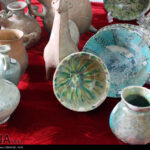
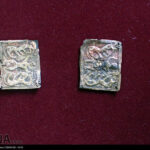
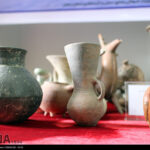
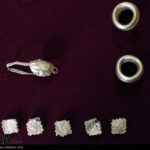
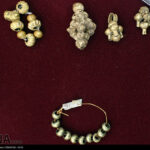
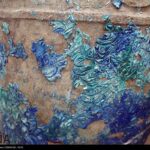
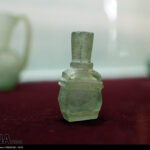
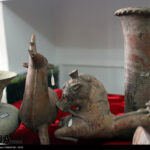
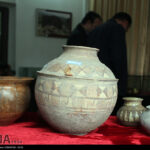
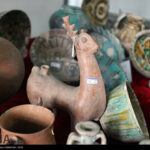
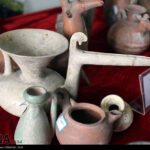
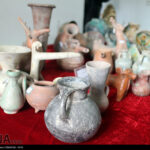
The historical objects seen in this February 9 photo are part of the 204 objects belonged to ancient Iran era which have been recently unveiled at a Zanjan museum. Eighty objects which are in gold, belong to the Achaemenid and Qajar.


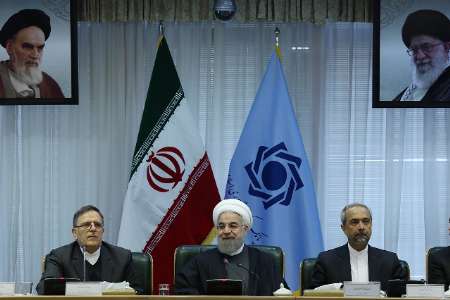
CBI’s 55th annual general assembly convenes

The CBI general assembly made an assessment of the bank’s financial operations during the past Iranian Calendar year, ended March 19, 2015.

In addition to this, the participants overviewed the balance sheet, financial statements and previous enactments made during the period by the CBI general assembly.

CBI Governor, Valiollah Seif also presented his report.

Other participants included Mohammad Reza Nematzadeh, Minister of Industry Mine and Trade, Ali Tayyebnia, Minister of Economy and Finance, Mohammad Nahavandian, Presidential Chief of Staff and Hossein Fereydoun, President’s advisor.

A look at Iranian newspaper front pages on Feb 13

Iran Newspaper front pages

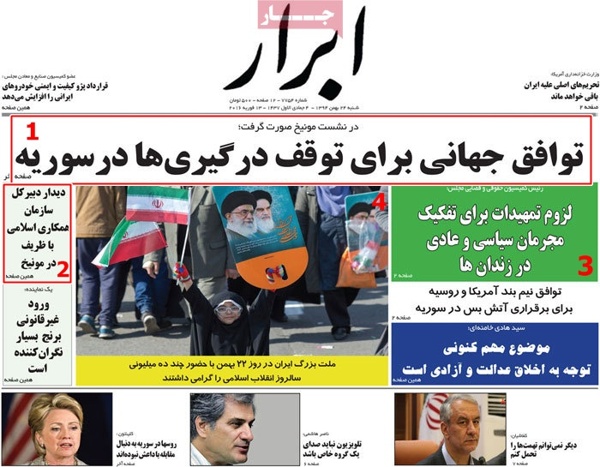
Abrar:

1. Global accord to end Syrian clashes

2. Iran FM meets with Secretary General of Organization of Islamic Cooperation (OIC) Iyad Ameen Madani in Munich

3. MP calls for separating political detainees from other criminals in prisons

4. Millions of Iranians show up for Bahman 22 rally to mark anniversary of Revolution
 

A look at Iranian newspaper front pages on Feb 13


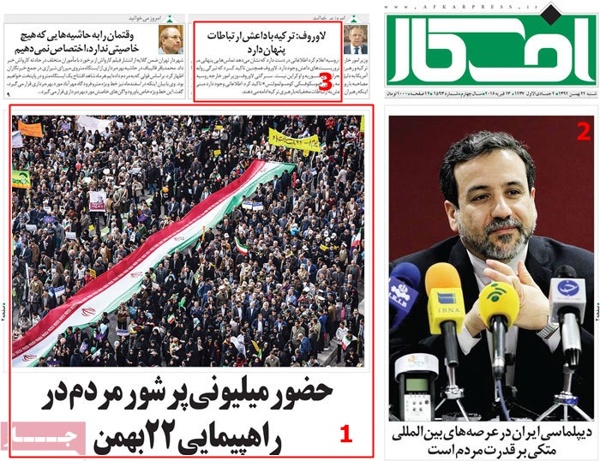
Afkar:

1. Millions mark anniversary of Islamic Revolution on 22nd of Bahman

2. Iran int’l diplomacy depends on power of people

3. Lavrov says Turkey and ISIS in secret talks
 

A look at Iranian newspaper front pages on Feb 13


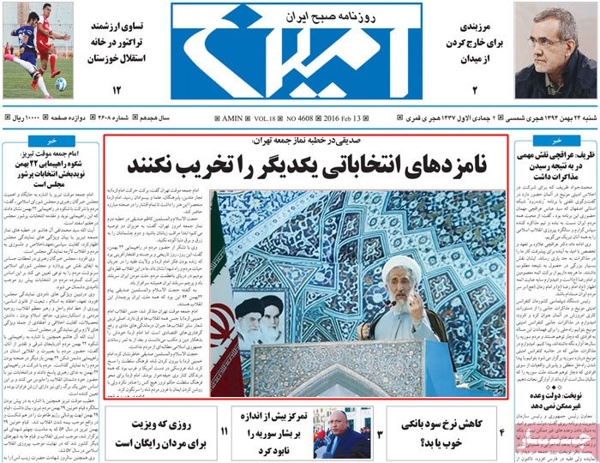
Amin:

Friday Prayer Imam urges hopefuls to refrain from derogation of each other
 

A look at Iranian newspaper front pages on Feb 13


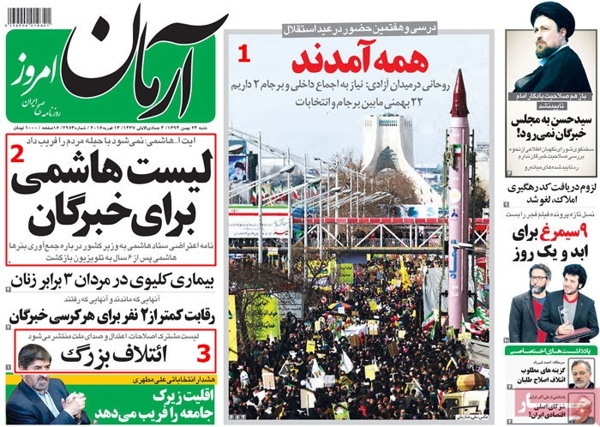
Arman-e Emrooz:

1. Everyone turned up for 37th independence celebration

2.  Hashemi’s List of Assembly of Experts hopefuls

3. The great coalition

The joint list of reformist, moderate and the nation’s voice factions will be released
 

A look at Iranian newspaper front pages on Feb 13


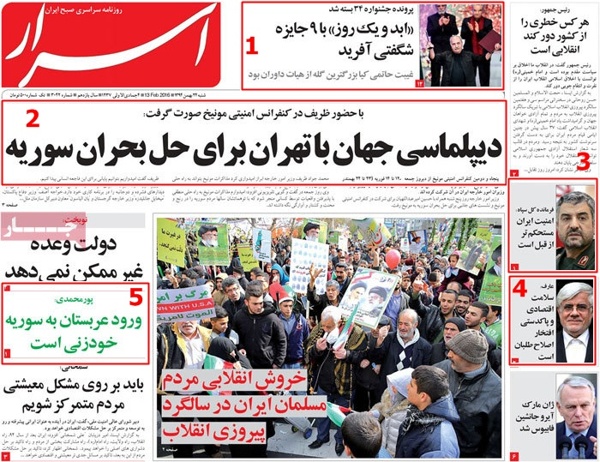
Asrar:

1. “Eternity and a day” bags 9 FIFF Simorgh prizes

2. Tehran joins global efforts to end Syrian crisis

Iranian Minister of Foreign Affairs Mohammad Javad Zarif, having a tight schedule of bilateral meetings during his stay in Germany, held talks with heads of states and ministers on the sidelines of the Munich Security Conference.

3. IRGC Chief: [Iran] Safety firmer than ever

4. Reformists proud of economic health, cleanness: leading reformist figure

5. Entrance of Saudi troops to Syria would be self-harm
 

A look at Iranian newspaper front pages on Feb 13


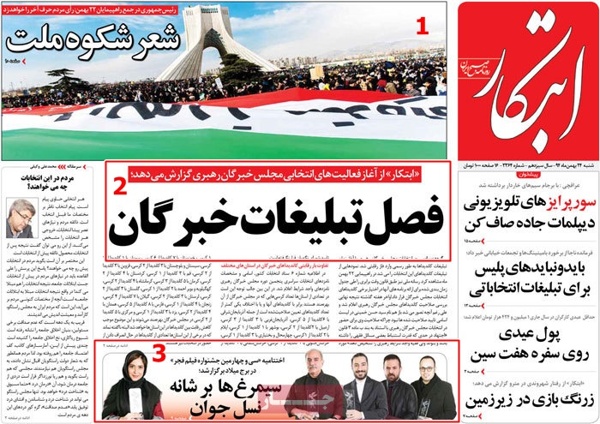
Ebtekar:

1. Tune of nation’s grandeur

Rouhani to 22nd Bahman ralliers: Nation’s vote will say the final word

2. Experts’ election campaigns begin

3. The youth win FIFF Simorghs

Most winners of the 34th Fajr International Film Festival were young talents. The closing ceremony of the festival was held at Tehran’s Milad Tower
 

A look at Iranian newspaper front pages on Feb 13


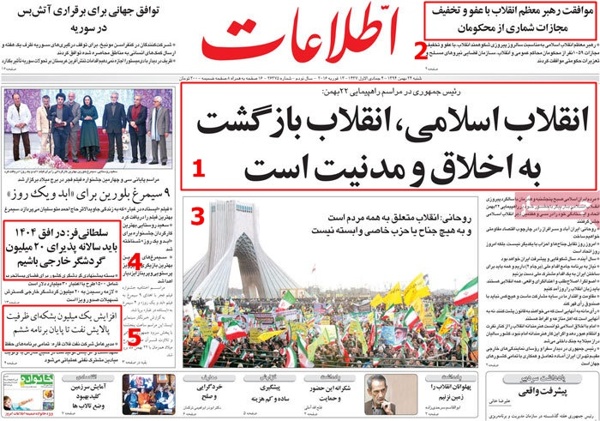
Ettela’at:

1. Islamic Revolution is resurrection of ethics, civilization: President to Bahman 22 ralliers

2. Leader pardons, commutes retributions of convicts

3. Rouhani: Revolution belongs to all nation not certain factions

4. Iran eyes 20m/y tourists by 2025: Tourism Chief

Iranian Vice president and head of the Cultural Heritage, Handicrafts and Tourism Organization Masoud Soltanifar said the country expects to host an annual number of 20 million tourists by 2025.

5. Iran poised to add 1mb/d to crude oil refining capacity by end of 6th development plan
 

A look at Iranian newspaper front pages on Feb 13


Etemad:

1. Rouhani: We vote not to extremists

Iranian President Hassan Rouhani told demonstrators at 22nd Bahman rally that everyone must cast votes to ballot boxes in later February elections even though they may have complaints and be against a political current in the country or even be dissatisfied with them.

2. Ayatollah calls on all eligible voters to cast ballots

Ayatollah Akbar Hashemi Rafsanjani to voters in a televised address after 6 years to come to the ballot boxes in late February elections because the event will be a destiny-maker for the country.

3. Coalition of reformist supporters of Rouhani to release list of parliament candidates: Aref

Mohammad Reza Aref is head of the Reformist Policymaking Council.
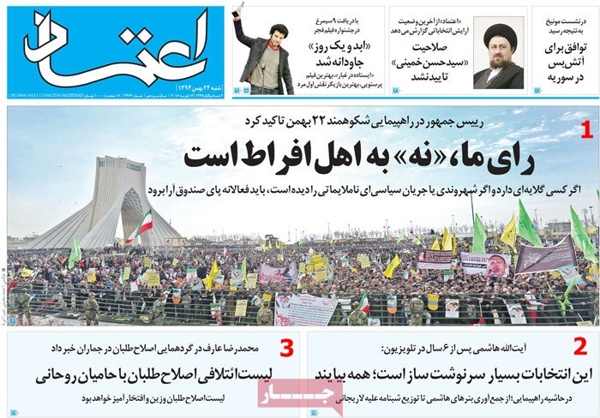
 

A look at Iranian newspaper front pages on Feb 13


Iran:

1.  Syria war pause plan agreed by world powers

2.  Iran opens first sea hotel in Kish Island
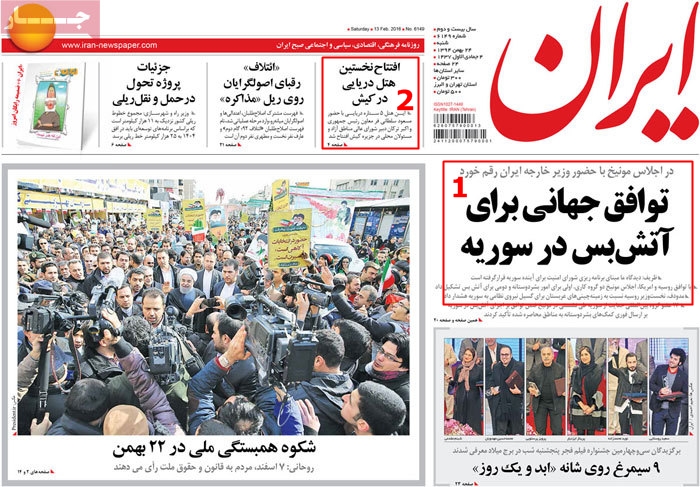
 

Iran


Payam-e Zaman:

1.  Epic: best way to describe Bahman 22 rallies

2.  Spokesman: Gov’t makes no unreal promises

3.  Resources available for unification of forex rate

4.  Iran boost crude oil swap capacity 20 times
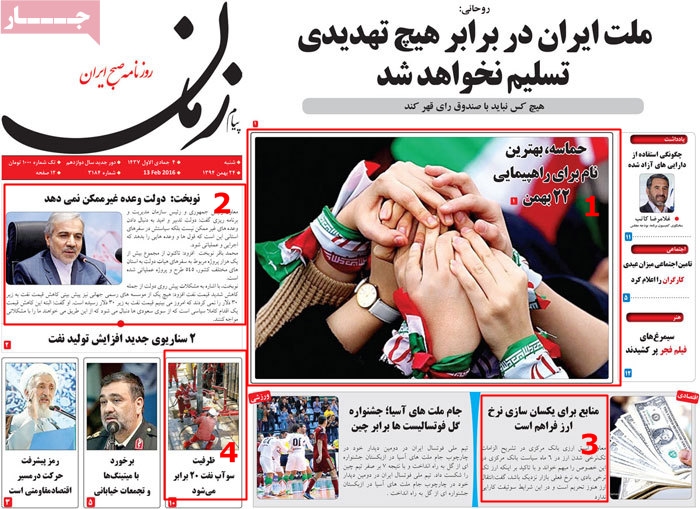
 

Payam


Jomhouri Islami:

1.  World media stunned at number of Iranian nation turned up for Bahman 22 rally

2.  Russia warns boots on ground in Syria could spark world war

3.  Rafsanjani on TV: My views are those Islamic Republic was formed upon
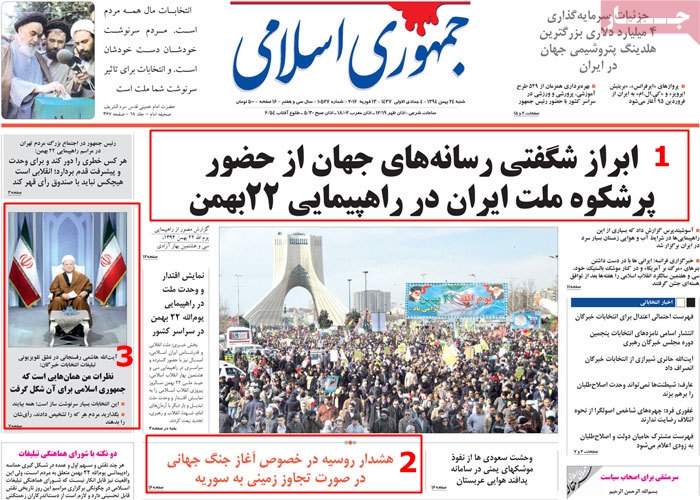
 

Jomhouri


Javan:

1.  Most revolutionary post-sanctions turnout

Trust us instead of foreigners, reads the banner.

2.  Aleppo siege under ceasefire

3.  JCPOA aimed at bolstering Iran moderate factions: Stephen D. Mull, the lead coordinator of Iran Nuclear Implementation at the U.S. Department of State.
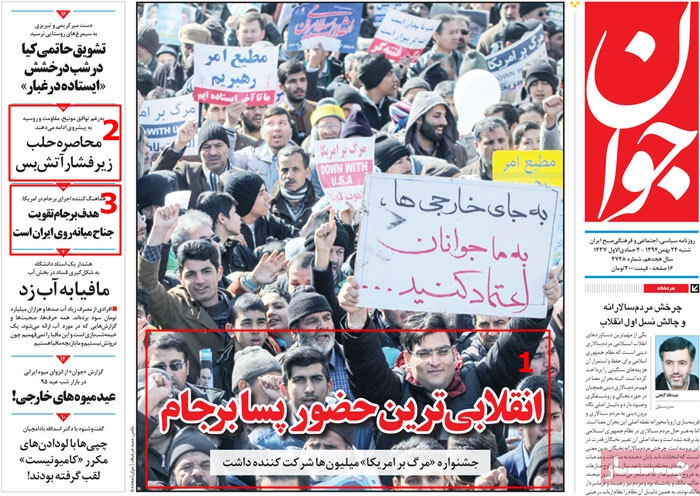
 

Javan


Hemayat:

1.  Still revolutionary

The turnout of millions of Iranians for the Bahman 22 rally “broke the enemies”.

2.  Judiciary Chief: Islamic Iran has a lot to tell superpowers
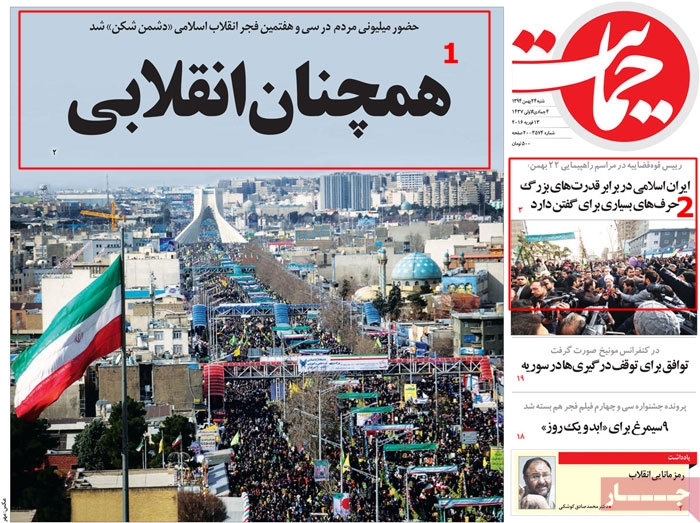
 

Hemayat


Khorasan:

1.  Power of recreating the revolution [was foisted on world powers on February 11 rally to mark anniversary of the Islamic Revolution.]

2.  Queiroz: I will tender my resignation to football federation

3.  Official: Time to respond to nation has started after N. deal

Secretary of Iran’s Supreme National Security Council (SNSC) Ali Shamkhani has said it is about time officials become more responsive to the nation for their actions now that the nuclear deal has been implemented.

4.  World’s largest chemical firms invests $4bn in Iran Petchem sector
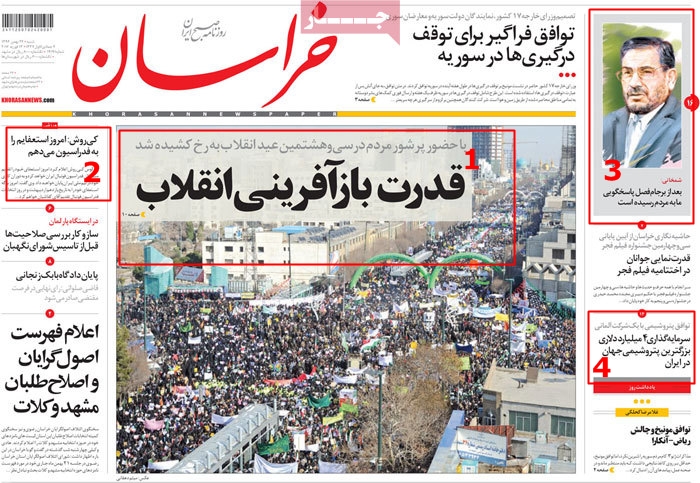


Khorasan


Resalat:

1.  President: Revolutionary is everyone who is concerned about resistance, partnership

2.  US compromise contrary to revolution’s ideals: Ayatollah Khatami

3.  World bows to grandeur of turnout for Bahman 22 rally
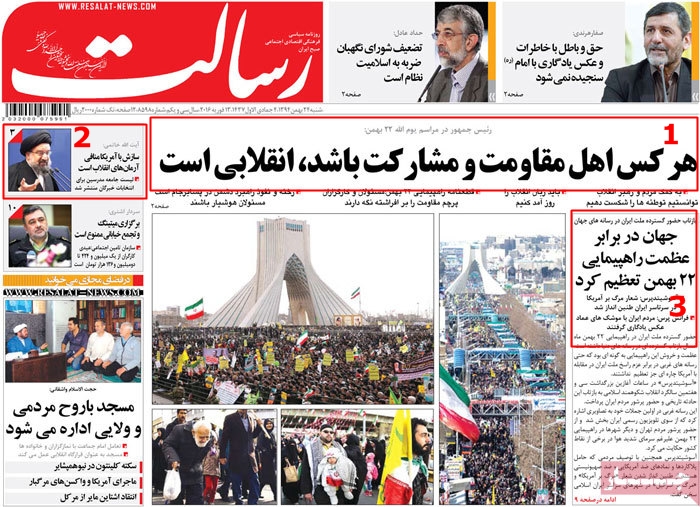
 

Resalat


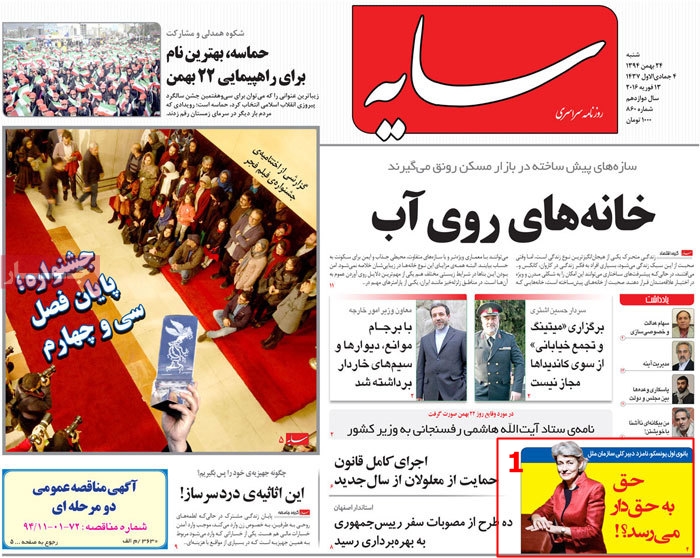
Sayeh:

1.  Finally everyone gets their due: Bulgaria Names UNESCO Boss For UN Chief’s

Bulgaria has nominated UNESCO Director-General Irina Bokova for the post of United Nations secretary-general
 

Sayeh


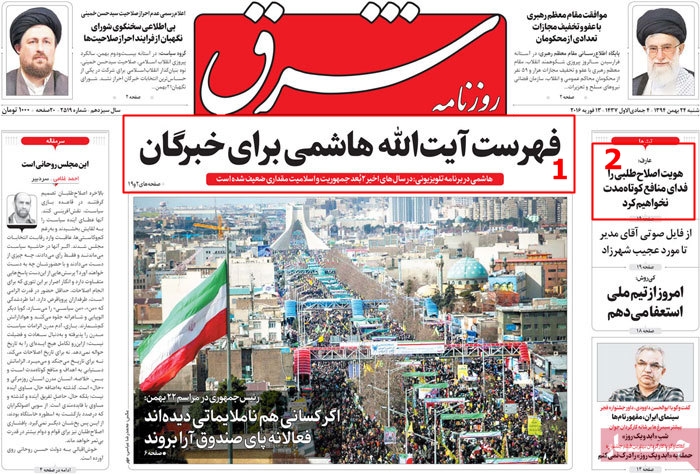
Shargh:

1.  Hashemi’s list of candidates for Assembly of Experts

2.  We will not forgo our reformist identity for short-term goals: Aref
 

Shargh


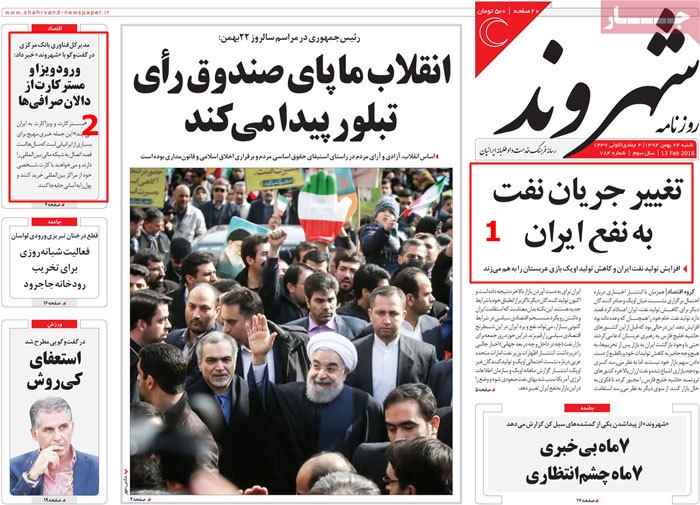
Shahrvand:

1.  Crude oil current suits interests of Iran

Raise crude oil production from Iran and OPEC’s reduction of production disrupts plans by Saudi Arabia.

2.  Visa, Master Card in Iranian exchanges
 

Shahrvand


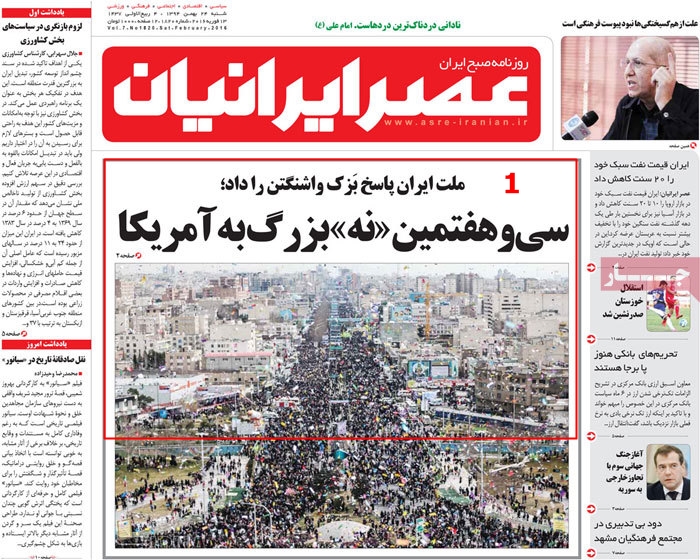
Asre-e Iranian:

1.  37th “big no” to US
 

Asr-e-Iranian


Ghanoon:

1.  What if all days were Bahman 22 (Feb. 11)

Political integrity and social gathering of the nation on revolution’s anniversary
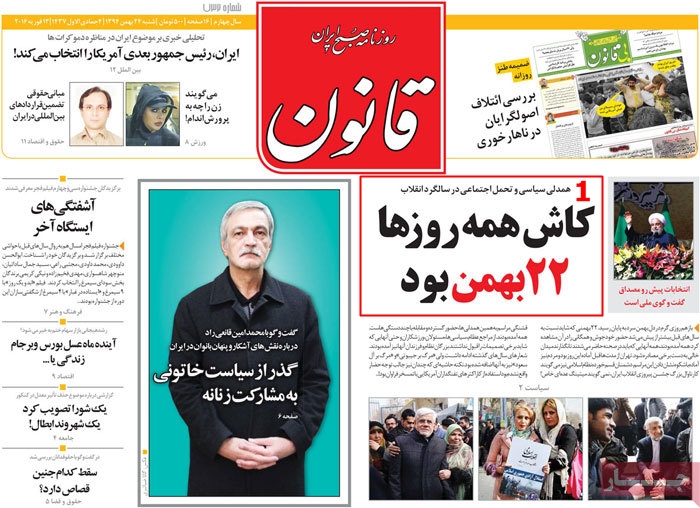
 

Ghanoon


Kayhan:

1.  Iranian nation wakes US dreamers up

2.  US pulls on al-Saud rein; Russia warns of third world war
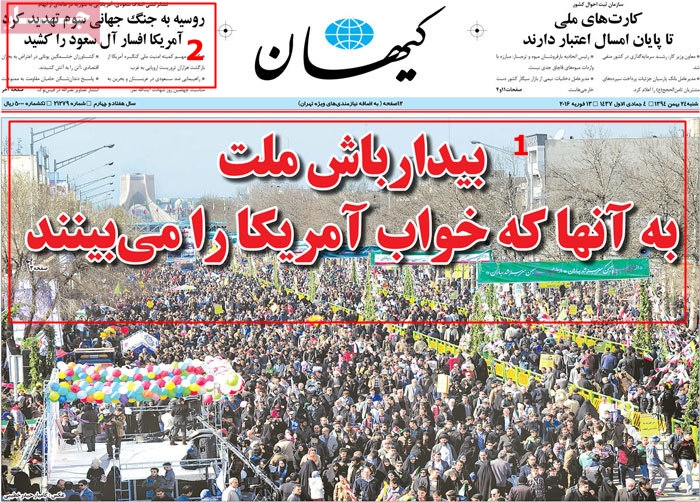
 

Kayhan


Mardom Salari:

1.  Nation on Feb 11 rally: We will vote on February 26 elections

2.  Breached ceasefire in Syria

3.  Zarif meeting s for undoing Syrian knot
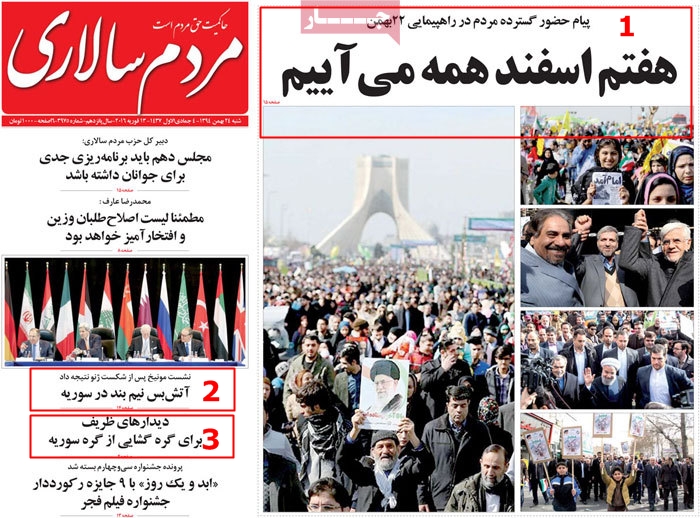
 

Mardom-Salari


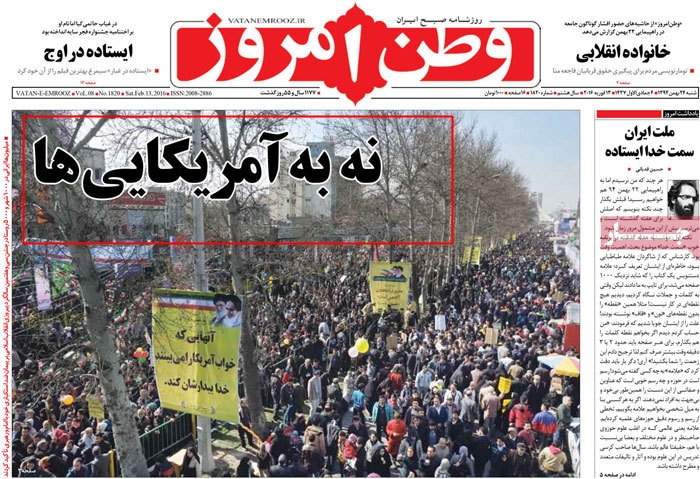
Vatan-e Emrouz:

1.  No to Americans


Vatan-e-emrooz


Haft-e Sobh:

1.  The list, the lobby and nothing else

The country’s political community is fully influenced by the ongoing election campaigns for the late February elections.

2.  There were people as was the commander

Referring to the Bahman 22 rally in which people along with Brigadier General Ghasem Soleimani attended.
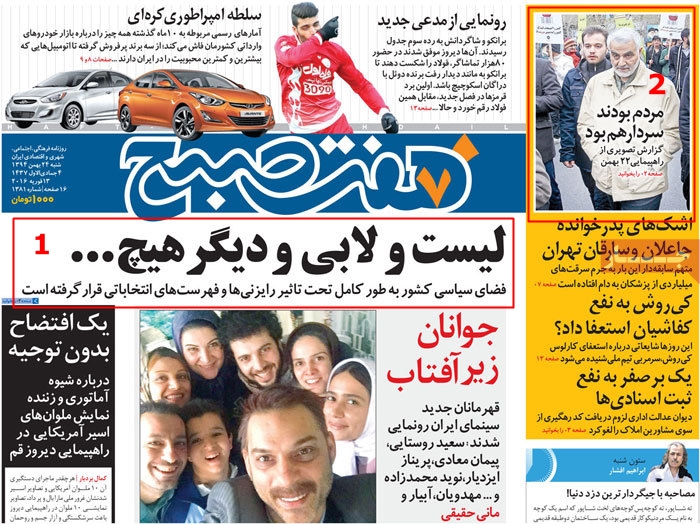
 

Haft-e-sobh


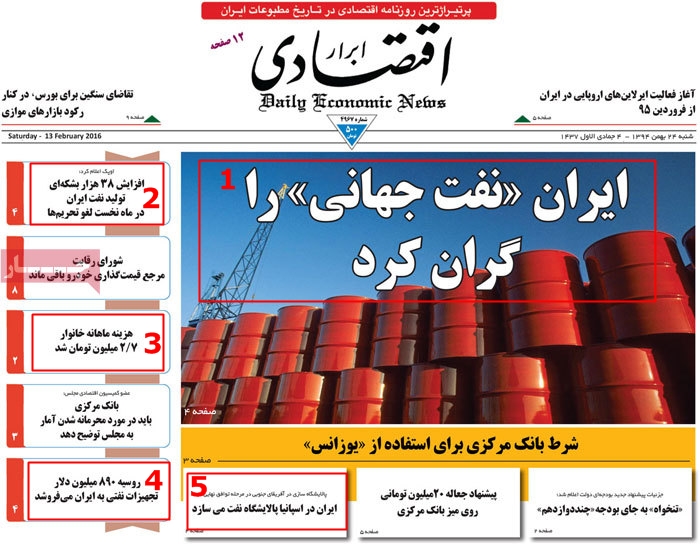
Abrar-e Eqtesadi:

1.  Iran shores up crude oil price

2.  OPEC: Iran adds 38kb/d to crude oil supply one month after sanctions removal

3.  $2,400: monthly cost of living for every family in Iran

4.  Russia to sell Iran $890m of oil equipment

5.  Iran to erect refinery in Spain
 

Abrar-eghtesadi


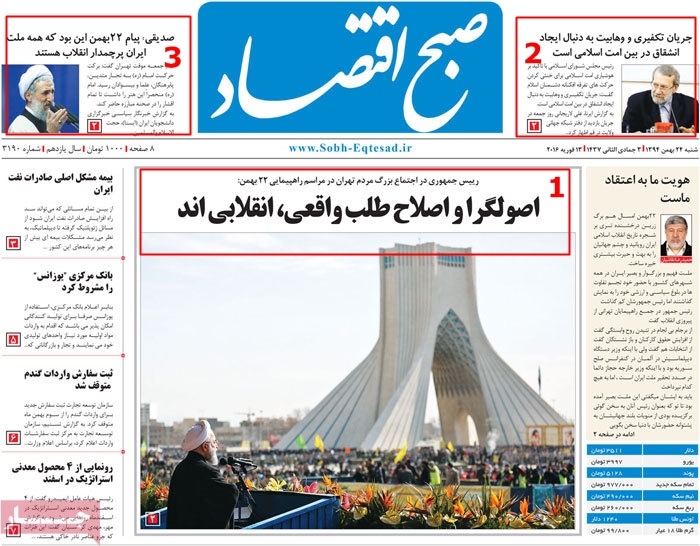
Sobh-e Eghtesad:

1.  Rouhani: Real principalists, reformists revolutionary

2.  Parliament Speaker: Takfiris target chasms in Islamic Ummah

3.  Cleric: Message of Bahman 22 rally: All Iranian nation flag-holders of revolution
 

Sobh-e-eghtesad