Thursday, December 25, 2025
Home Blog Page 4528

Bangladeshi Ambassador: Tehran, Dhaka to forge all-out ties

The people of Bangladesh are celebrating the arrival of the New Bengali Year (April 14). A glance at the history of Iran-Bangladesh relations indicates that the two countries have always enjoyed close ties. Iranian and Bangladeshi officials have always underlined the need to foster and maintain friendly and brotherly relations between the two states.

Iran is willing to forge all-out ties with Bangladesh without any restriction, said Iranian Foreign Minister Mohammad Javad Zarif in a meeting with Bangladeshi Ambassador to Tehran Majibur Rahman Bhuiyan.

Zarif added Iran-Bangladesh relations are serene and progressing.

Bhuiyan has also voiced the avid interest of his country’s officials in broadening consultations with their Iranian counterparts, hoping that Tehran and Dhaka will witness an increase in economic and cultural cooperation in the near future.

People in Bangladesh started celebrating their new year about six centuries ago when the Mughal emperor, Akbar (1605) modified, developed and reintroduced the Bengali Calendar.

‘Pohela Boishakh’, or Nobo Borsho, is the country’s most important celebration which is held annually. People observe this day by wearing local and traditional costumes, going to fairs, known as ‘Boishakhi Mela’ which features musical and cultural events, eat pastry and make wishes for the new year.

Out of Bangladesh’s total population, 89.7 percent are Muslims and the rest are Hindus, Buddhists or Christians.

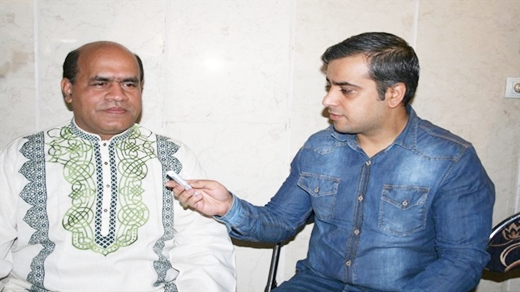
In an exclusive interview with Iran Daily on the sideline of a ceremony to celebrate the arrival of Bengali New Year at the Bangladesh Embassy in Tehran, Bhuiyan expounded on Bengali New Year celebrations as well as political and economic ties between Iran and Bangladesh.

Excerpts of the interview follow:

IRAN DAILY: Would you please tell us about the program?

MAJIBUR RAHMAN BHUIYAN: First, I welcome all of you. The program starts with an exhibition of photographs and a display of our food items and is followed by a cultural program featuring music and poetry recitation. Then we read a very short welcome message from the ambassador explaining the occasion, screen a video on Bangladeshi culture and serve Bangladeshi cuisines for lunch.

Can you tell us about Iran-Bangladesh relations? How do you evaluate the current level of ties?

Relations between the two countries have always been very favorable because, for centuries, we have had connections in the cultural, religious, business and political fields. So at the moment, we have very close relations and lots of goodwill for each other. At present, the Iranian and Bangladeshi governments as well as the two countries’ respective embassies in Tehran and Dhaka are doing their best to translate this goodwill into more expanded and deep cooperation.

How would you evaluate economic and trade relations? What is the current volume of transactions between the two states?

At the moment, trade ties are not very significant. But prospects for increasing trade ties are excellent and numerous. Iranian and Bangladeshi embassies Dhaka and Tehran respectively are in talks with relevant state and private sectors to raise the level of ties by identifying suitable fields for cooperation. Efforts are also underway by both sides to exchange a number of trade delegations.

Given the gradual removal of Western sanctions on Iran, what is your prediction about the expansion of trade ties between the two states in the post-JCPOA era?

It is crystal clear that economic ties will increase since all trade obstacles and restrictions will be eased and, gradually, we will find the opportunity to know how the trade exchanges between the two sides can be increased. I am quite hopeful that economic ties between Iran and Bangladesh will expand.

Given that you are celebrating the arrival of the Bengali New Year, do you have anything special to tell us in this respect?

New Year is a time for renewing ties, exchanging greetings, leaving behind the shortcoming we had in the past, looking forward to good things in the future and thinking about how to move ahead.

What do you make of Iran’s nuclear deal?

I do not have any particular opinion on this issue. Since Bangladesh has always favored peace and stability in the region, it welcomes any move to ensure this.
Iraqi Sunni Coalition Hails Iran’s Support

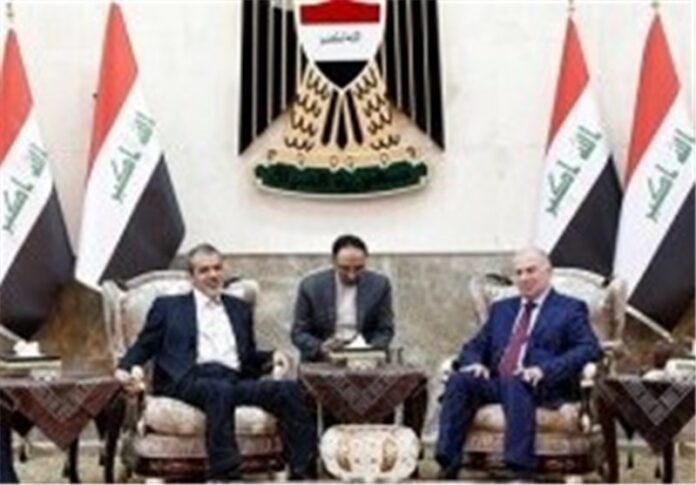
The Unity for Reform coalition announced in a statement that its leader, Usama al-Nujaifi, has held a meeting with Iranian Ambassador to Baghdad Hassan Danaeifar.

According the statement, Mr. Nujaifi, a former parliament speaker, in this meeting praised Iran for its efforts to help Iraq’s leaders address an ongoing political crisis in the Arab country.

The Iraqi politician also emphasized the necessity for maintaining legitimacy of the political processes, partnership in decision making and a real balance of power in Iraq.

Nujaifi further called on Iraqi officials to exercise foresight, take responsibility and respect the constitution in the face of the political crisis that has beset the legislature.

The Iranian envoy, for his part, voiced support for the right of all Iraqi groups to have a role in the political processes.

A political crisis in Baghdad escalated this week when parliament failed to approve a new cabinet lineup presented by Prime Minister Haider al-Abadi.

Following the cabinet vote delay, parliamentarians staged a sit-in on Wednesday, demanding the country’s top political leadership, including the speaker and prime minister, step down.

Meanwhile, negotiations continued late into the night Saturday between Iraq’s powerful political blocs after lawmakers attempting to oust Parliament Speaker Selim al-Jabouri failed to maintain quorum.

UNAIDS lauds Iran for treating people who inject drugs

The report shows that the failure of many countries to adopt health- and rights-based approaches resulted in no reduction in the global number of new HIV infections among people who inject drugs between 2010 and 2014. The world has missed the United Nations General Assembly’s target set in 2011 to reduce HIV transmission among people who inject drugs by 50% by 2015.

“Business as usual is clearly getting us nowhere,” said Michel Sidibé, Executive Director of UNAIDS. “The world must learn the lessons of the past 15 years, following the example of countries that have reversed their HIV epidemics among people who inject drugs by adopting harm reduction approaches that prioritize people’s health and human rights.”

The UNAIDS report presents the evidence base for five policy recommendations and 10 operational recommendations that countries should apply to turn around their HIV epidemics among people who inject drugs. These recommendations include the implementation of harm reduction programmes to scale and the decriminalization of the consumption and possession of drugs for personal use.

Data demonstrate that countries implementing health- and rights-based approaches have reduced new HIV infections among people who inject drugs. In other countries, strategies based on criminalization and aggressive law enforcement have created barriers to harm reduction while having little or no impact on the number of people who use drugs. Imprisoning people for the consumption and possession of drugs for personal use also increases their vulnerability to HIV and other infectious diseases, such as hepatitis B, hepatitis C and tuberculosis, while incarcerated.

UNAIDS has developed the UNAIDS 2016–2021 Strategy to put the world on track to ending the AIDS epidemic as a public health threat by 2030—a target within the Sustainable Development Goals. A critical target within this Fast-Track approach is the expansion of a combination of HIV prevention and harm reduction services to reach 90% of people who inject drugs by 2020.

Achieving this target would require annual investment in outreach, needle–syringe distribution and opioid substitution therapy in low- and middle-income countries to increase to US$ 1.5 billion by 2020—a fraction of the estimated US$ 100 billion already spent each year to reduce the supply of and demand for narcotic drugs. In many middle-income countries with large populations of people who inject drugs, harm reduction is funded predominantly by international donors and private foundations.

The UNAIDS report provides many examples of countries that are delivering better outcomes for people who inject drugs by adopting a health-centred approach.

The free voluntary methadone programme piloted in China in the early 2000s now serves more than 180 000 people. People who inject drugs accounted for less than 8% of people newly diagnosed with HIV in the country in 2013, compared with 43.9% in 2003.

In prisons in the Islamic Republic of Iran, health clinics provide integrated services for the treatment and prevention of sexually transmitted infections and for injecting drug use and HIV, including the distribution of condoms, sterile injecting equipment and opioid substitution therapy. At the end of 2014, 81.5% of people who inject drugs surveyed reported the use of sterile injecting equipment the last time they injected. Newly reported HIV cases among people who inject drugs in the Islamic Republic of Iran fell from a peak of 1897 in 2005 to 684 in 2013.

A peer-to-peer outreach programme in five cities began in 2011 in Kenya encouraging people to use sterile equipment when injecting drugs. At the beginning of the pilot, 51.6% of people who inject drugs reported the use of a sterile syringe the last time they injected; this had risen to 90% by 2015.

In the Republic of Moldova, the prison system has gradually expanded a comprehensive harm reduction programme started in 1999 that includes needle, syringe and condom distribution as well as opioid substitution therapy. Coverage of antiretroviral therapy among prisoners living with HIV increased from 2% in 2005 to 62% in 2013.

In 2000, Portugal passed a law that downgraded the purchase, possession and consumption of small amounts of narcotic drugs from criminal to administrative offences while increasing investment in health-based programmes. In 2013, among a total of 1093 new HIV infections reported, just 78 were related to drug use; in 2000 there were 1497 new HIV infections among people who use drugs among a total of 2825 new HIV infections. A similar downward trend among drug users has been observed for new infections of hepatitis C and B.

As well as being humane and health-oriented, people-centred programmes are also cost-effective and deliver wider social benefits, such as lower levels of drug-related crime and reduced pressure on health-care systems. For example, each dollar spent on Australia’s needle–syringe programme has an estimated lifetime return on investment of up to US$ 5.50 in averted health-care costs. Opioid substitution therapy has been shown to be cost-effective in its capacity to reduce HIV infections—its cost-effectiveness substantially increases when its wider health, economic, psychological and social benefits are taken into account.

“Health is a human right. Investment in people-centred policies and programmes for people who use drugs is the crucial foundation for a global drugs policy that not only saves lives but is also cost-effective,” said Mr Sidibé.

The UNAIDS Fast-Track approach has a set of targets for 2020 that include reducing new HIV infections to fewer than 500 000. It also calls on countries to ensure that 90% of the more than 12 million people who inject drugs worldwide have access to combination HIV prevention services, including needle–syringe programmes, opioid substitution therapy, condoms and access to counselling, care, testing and treatment services for bloodborne viruses, such as HIV, tuberculosis and hepatitis. Achieving these targets will be a significant step towards ending the AIDS epidemic as a public health threat by 2030.

Iran Eyes 3.1 mbd of Refining Capacity

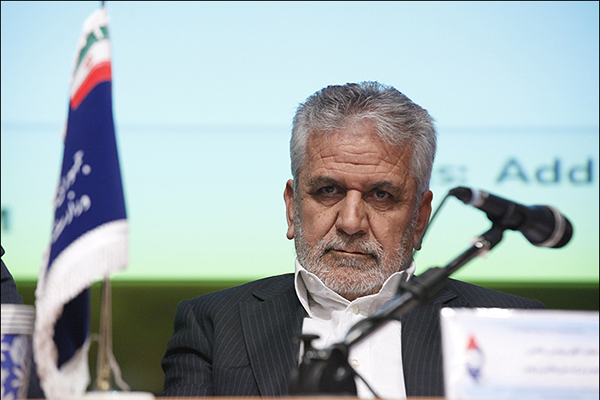
Iran will add 1.8 million barrels per day to its refining capacity to bring it to 3.1 mbd once several refinery projects come on-stream across the country, a senior petroleum official said.
Addressing an expert panel in oil conference in Tehran on Saturday, Abbas Kazemi, managing director of National Iranian Oil Products Refining and Distribution Company (NIOPDC), said some of these projects are Persian Gulf Star Refinery, Siraf Comprehensive Refinery Project and Anahita Refinery.
The refineries will process crude oil, gas and condensates, he said, adding the projects are prefect examples of materialization of the policies of Resistive Economy.

“Promoting energy use optimization, preventing sale of crude oil and gas, strengthening the economy against foreign assaults like sanctions, and bolstering national self-esteem and confidence are some of the policies that NIOPDC is seeking to realize,” the official said.
He further said 24 million liters of the country’s daily gasoline consumption (71ml/d) is Euro-4.

For gasoil, with daily consumption of 79 ml/d, 24 ml/d is supplied from Euro-4 gasoil supplies, he added.

Iranians and Afghans Mourn Together over Horrible Murder of 6-Year-Old Setayesh

It was terrible news, but knowing it had happened in Iran was even worse. 6-year-old Setayesh, an Afghan child, had been killed, and both societies were united in sadness.


As reported by Tasnim News, the news of the murder of a 6-year-old Afghan girl has broken the hearts of both nations.

Almost 5 days ago, the girl went missing. For the people who live in this part of the world, when a girl goes missing it is a reminder of painful, historical events. A few days later her family received the worst news. Setayesh wasn’t alive anymore. She had been horribly murdered.

The story is extremely sensitive and can inflame old hatreds. Those who seek to raise divisions between the two nations are waiting for such inhumane crimes to fan the flames between the nations. Rumours are spread. This mission, however, failed this time. The story turned out differently, and in fact, created unity and sympathy between Iranians and Afghans.

The case progressed quickly with the help of local Iranians. The mystery of the Afghan girl’s murder was solved with Iranian cooperation. The Iranian friend of the culprit found out about the killing, and informed his father. Quickly, the father informed the city’s Imam Jome [The Mullah in charge of Friday prayers], and within a few hours, the police have found and arrested the murderer.

Right after this, the sympathy and unity are clear to see. A big group of Iranian locals pay a visit to Setayesh’s family to let them know that they will stand with them. In another admirable decision, representatives from the Immigration Office, the local governor, Police, and Ministry of Interior send their condolences and sympathy to the Qureishi family, letting them know that they will stand by them to see that justice is served.

The neighbourhood Iranians come together and construct condolences boards to console the broken hearts of the Afghans. The destiny of the two nations are so entwined that it seems like the Iranians have lost their own girls.

Afghans and Iranians gather together. The differences between them have lost their meaning now. Finally, the funeral of Setayesh Qureishi, the Afghan girl (or perhaps better, the Afghan-Iranian girl) takes place. The following is a report of an Afghan woman who was present at the funeral:

“Today was the funeral of an innocent girl whose murder brought the immigrant society together, regardless of their religion or race. I remembered when I heard from the neighbourhood mosque that a girl had gone missing, I hoped that, like in childhood stories, she’d be found and be home in a few hours. She never did, however. What happened to her breaks any human’s heart, but how a teenage boy can commit such a horrible murder is the responsibility of psychiatrists and sociologists. Today, however, was one of the most beautiful days which showed the unity of the immigrants and the Iranians. The ceremony after the funeral was held in two different neighbourhoods for men and women. The same morning, I paid a visit to the Imam Jome’s office. He is a very honest man who has always been very close to the immigrants living in the neighbourhood. He condemned this terrible event too, and said that what had happened has nothing to do with nationality or religion. It has broken the hearts of all of us.

“Iranians said that if it was necessary, they would sell their jewelry to make sure Setayesh and her family’s rights aren’t ignored.” 

“At noon, I went to the ceremony hall. Ladies arrived one after another, from all nationalities or ethnicities. Many Iranians were present at the ceremony with tearful eyes from the very beginning, as if Setayesh had been their own daughter. They all condemned the crime, and were asking for legal punishment. Amazingly, Iranian woman were saying that if it were necessary they would sell their jewelry to make sure Setayesh and her family’s rights aren’t ignored. They all were there to lift a burden from Setayesh’s family. It was great to see hope in her family’s face.

“Setayesh’s family depended on your kindness. Kind-hearted people came from all different parts of Tehran to join the sea of kindness and unity.

“The story is different from what is seen on social media. Iranian women were ready to sell their jewels to pay for the cost of a lawyer, but there are still rumours spread saying that Setayesh’s family were not allowed to have a ceremony. There was a glorious ceremony yesterday, many people came and went. The Imam Jome gave a speech. Representatives from different authorities came and gave their condolences. Despite all that, there are still rumours saying that the story has not been covered by the media, that the murderer is free, and so on. They are trying to sever the unbreakable links of the two nations, but it will never happen.”


Alborz off-road racing

Alborz off-road racers attended a contest on Friday to be prepared for international competitions in Qazvin.


Mogherini: Iran Missile Tests don’t Violate JCPOA

Iran conducted ballistic missiles tests on March 8-9 as part of military drills. The U.S. claimed the tests had violated the UN Security Council Resolution 2231 that endorsed the JCPOA.

Mogherini also said that the JCPOA provided proof that “diplomacy works.”
“In July we said diplomacy works, in January [on the Implementation Day] we delivered it.”
Commenting on Iran fulfilling its commitments to the nuclear deal, the top EU official said, “Iran has delivered its side of the deal and so has the EU by lifting all the nuclear related sanctions against Iran.”
On the issue of human rights, for which Iran has always been criticized by the West, she said, “Our approach to human rights [in Europe] is that we have the highest standard of the world, even compared to our partners.”
She added, “We will always engage in dialogue with Iran, as this is the way in which we support the process that the EU has done.”
Mogherini also said the EU would do all it could to help Iran gain the full benefits of the nuclear deal, including encouraging greater engagement in the country from European banks.
She added the bloc had a “very strong interest” in deepening economic ties, and that greater financial links were a key basis for that. “We are doing all that we can to reassure our financial and banking system” that we “welcome their engagement in Iran,” she said.
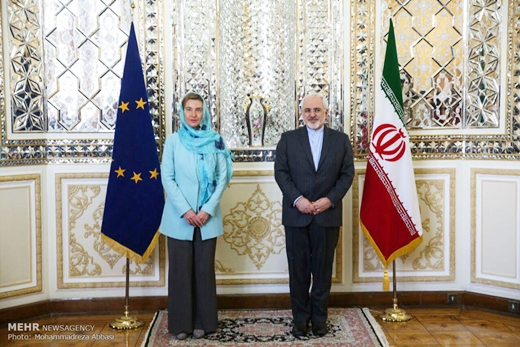
Mogherini, who has been to Iran once before, visited Tehran for a one-day visit at the head of a high-ranking political and economic delegation. She was accompanied by European commissioners for energy, scientific research, technology, environment, education, industry.

Zarif: Iranians need to feel tangible impact of nuclear deal

For his part, Zarif said if Iranians don’t sense the effect of the deal, they would question the benefit of the agreement.
Zarif continued to say that the deal has paved the ground for international cooperation and lessened threats in the region, building a better future for the region and the people of Iran.
Calling the meeting between Iran and the EU “unparalleled”, Zarif said the two sides held talks on various issues and agreed to expand cooperation in the fields of economy and finance, crisis management, transportation, education and cultural exchange, peaceful use of nuclear energy, problems of refugees and displaced people, as well as the campaign against terrorism and drugs.

Opening an EU office in Tehran is on the agenda

Zarif also added that opening an EU bureau in Iran is on the agenda.
On the issue of Iran’s missile tests, Zarif said, “The test doesn’t violate the JCPOA or any of the Security Council Resolutions.”
Zarif said Saddam Hossein shamelessly used different kinds of weaponry against Iranians, therefore, “Iranians have the right to protect themselves.”
He added, “Some of our neighbors, of a much smaller size, spend far more on military weapons than Iran. They need to lower their military expenditure.”
Iran and the EU also issued four statements for cooperation in areas of human rights, science and research, economy, agriculture, transport, energy and climate change, nuclear energy, environment, education, culture, campaign on drug trafficking, and migration.
For instance, in the case of civil nuclear cooperation and the environment, the two sides have agreed on the following:

Civil Nuclear Cooperation

With a view to contributing to the implementation of measures listed in Annex III of the JCPOA, the two sides are launching a first cooperation project in the field of nuclear safety, aimed at assisting the Atomic Energy Organization of the Islamic Republic of Iran and the Iranian Nuclear Regulatory Authority through EU development assistance. In addition, the EU will share with Iran its experience acquired from stress tests carried out within the EU and in third-party countries. Additional options for cooperation in the civil nuclear field include joint fission and fusion research activities, as well as a possible regional nuclear safety conference and a nuclear business forum.

Environment

In recognition of the importance of protecting and conserving the environment and the role of resource efficiency in achieving green growth, and in acknowledgment of Iran’s pressing environmental challenges, the two sides intend to:
– Establish bilateral co-operation to address air, soil and water pollution, water resource management, conservation and the sustainable use of nature, biodiversity, desertification, and waste disposal management issues.
– Exchange experience, with a view to identifying appropriate policy responses, including projects to tackle cross-border pollution.
– Strengthen co-operation in international environmental forums, including in the framework of multilateral environmental agreements.

Iran, EU Resume Environmental Cooperation

The agreement was reached in a meeting in Tehran on Sunday between Iran’s Head of the Department of Environment Massoumeh Ebtekar, and visiting EU Commissioner for the Environment Karmenu Vella.

“Iran is willing to use global experience in the field of green economy in order to forge a link between the environment and development, and move towards sustainable development,” Ebtekar said.

“Dust and sand storms have affected health, the economy and the environment of Asian, African and European countries. There is a need for global cooperation to fight the phenomenon scientifically,” she added.

Referring to the Ramsar, Basel and Stockholm Conventions in Tehran, Ebtekar called on the EU to cooperate with Tehran to remove environmental problems in the region in line with those conventions.

For his part, the EU Commissioner for the Environment said the new opportunity that has been created in the post-sanctions era [which started on January 16 as anti-Iran sanctions were lifted] should be seized for multilateral cooperation on the environment.

“The EU is implementing policies on protecting the environment all over the world, without considering political and geographical borders,” Vella added.

The Ramsar Convention is an international treaty for the conservation and sustainable use of wetlands. It is also known as the Convention on Wetlands. It is named after the city of Ramsar in Iran, where the Convention was signed in 1971.

The Basel Convention is an international treaty that was designed to reduce the movement of hazardous waste between nations.

The Stockholm Convention on Persistent Organic Pollutants is an international environmental treaty, signed in 2001 and effective from May 2004, that aims to eliminate or restrict the production and use of persistent organic pollutants.

Iranians Should Sense JCPOA Results: Zarif

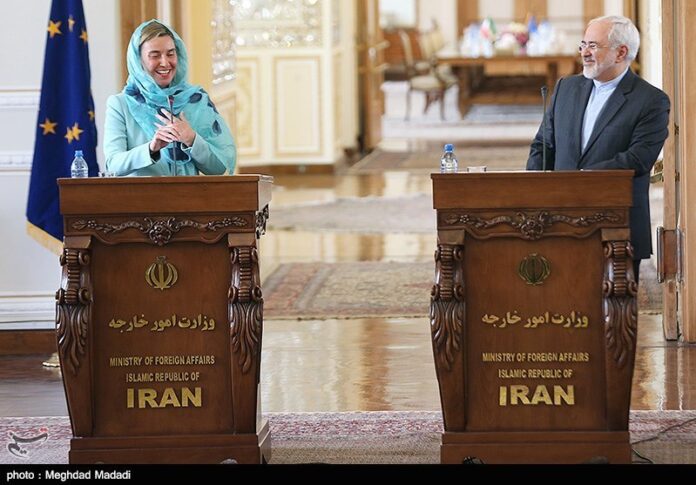
“The people of Iran should sense the results of the nuclear agreement as soon as possible, otherwise they will question the usefulness of the deal for Iranians,” Zarif said Saturday at a joint press conference with the European Union’s Foreign Policy Chief Federica Mogherini in Tehran.

“It is necessary for the other side, particularly the US, to honor its commitments in practice, not on paper,” he stressed.

Since one of the main purposes of the JCPOA was to enable Iran to regain access to international financial systems, Tehran will mount pressure on Washington to set the ground for non-American banks to cooperate with Iran.

The JCPOA excludes American banks, but the US has given a commitment not to hamper relations between other banks Iran, Zarif stated.

He further said that the main field of cooperation between Iran and the EU would be ensuring the implementation of the JCPOA, the lasting nuclear deal between Tehran and the Group 5+1 (Russia, China, the US, Britain, France and Germany) that took effect on January 16.

“We are confident that the European Union has political and economic interests in the implementation of the JCPOA. We will cooperate with the EU on the removal of obstacles and full implementation of the JCPOA,” the top Iranian diplomat went on to say.

Heading a high-ranking economic and political delegation, Mogherini arrived in Tehran on Saturday to meet senior Iranian officials and discuss issues of mutual interest, including the JCPOA and regional developments.

Iran’s Diplomacy, Armed Forces Following Same Goal: Rouhani

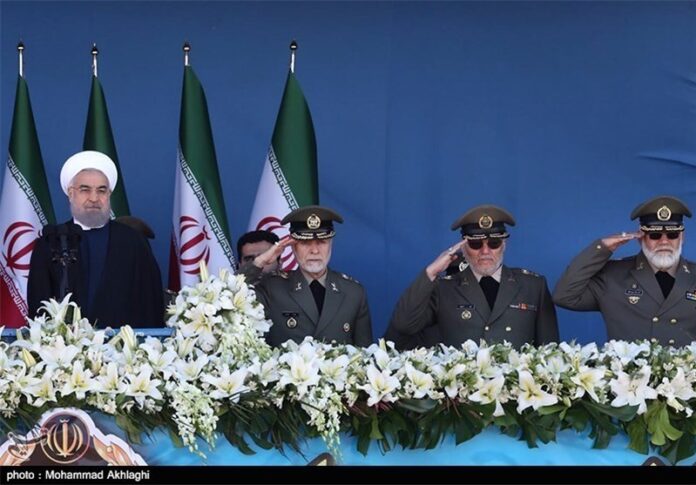
“Our diplomacy and Armed Forces pursue the same goal: national security, national might, stability, and development in the country,” Rouhani said in an address to the Iranian Army’s military parade in Tehran held on the occasion of Iran’s National Army Day.

“We have the book, logic, prudence, and rationality in one hand, and the sword in the other hand, and we see these two beside each other,” the Iranian president noted.

“If the Armed Forces serve to counter any aggression on our national interests, our diplomacy also aims to safeguard the Iranian nation’s rights in the arena of negotiation,” he added, stressing that the country needs soft power and hard power together.

“As Armed Forces well defended the nation’s rights during the eight-year Sacred Defense (Iraqi imposed war on Iran in the 1980s), our diplomats also bravely and powerfully protected the nation’s rights at the negotiating table against world powers,” he went on to say.

President Rouhani said Iran’s objective in the recent nuclear negotiations was to maintain and reinforce Iran’s military might, adding, “Those who say we do not need hard power are naïve people, and those who reject the need for soft power have a short-sighted view.”

He also referred to his recent remarks at the Organization of Islamic Cooperation (OIC) Summit held in Turkey’s Istanbul earlier this week, saying, “There I clearly stated that the Islamic Republic of Iran’s military, political, and economic might is not (aimed at being used) against its neighbors and the Muslim world’s countries.”