Wednesday, December 24, 2025
Home Blog Page 4526

Minister: Iran Internet bandwidth to increase to 12,000 Gbit/s

Iran Official Calls for People’s Massive Turnout in Elections

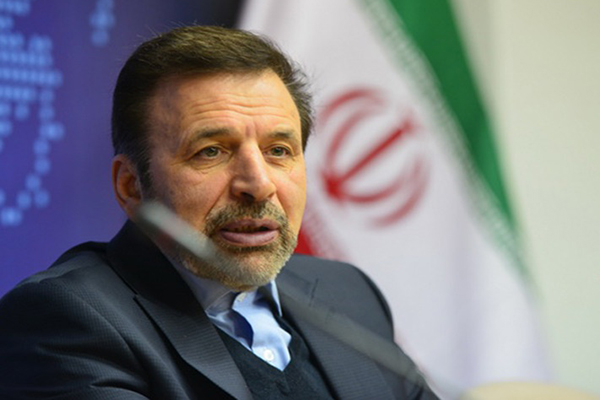
‘President Hassan Rouhani, upon visiting the ICT Ministry in the early days of the New Year (Persian Calendar), called for the necessary measures to be taken for the country’s Internet speed to be increased,’ Vaezi told recently to the Islamic Republic News Agency.

Vaezi said that following the request by President Rouhani, plans for increasing the Internet bandwidth to 10 to 12 thousand gigabits per second were devised and submitted to the President in a report.

The Minster also said that at the beginning of the tenure of President Rouhani’s government, Iran’s Internet bandwidth was 624 Gbit/s.

‘But until the end of the last year (March 19) the Internet speed was enhanced to 4,000 Gbit/s,’ he said.

Iran, Pakistan to Conduct Joint Naval Drills

Speaking to reporters on the occasion of Army Day on Sunday, Admiral Sayyari said the one-day drill will be held in Bandar Abbas, a strategic port city on the Strait of Hormuz in the Persian Gulf.

Sayyari said the country’s naval forces are ready to deal with any foreign threat, adding that Iran will show its friendship to friendly countries in the region, and that “Our interaction with friendly countries will be doubled”.

The Pakistani military flotilla is already berthed at Bandar Abbas.

Meantime, ceremonies to mark Army Day in Iran began on Sunday morning with the participation of President Hassan Rouhani, who reviewed army units marching before him in the mausoleum of the Late Founder of the Islamic Republic Imam Khomeini, south of the capital.

Rouhani lauded the Armed Forces for increasing the country’s deterrence power, and reiterated Tehran’s preparedness to help the neighbouring and Muslim states to fight against the threat of terrorism and Zionism.

“I declare explicitly, as I did some days ago in the presence of Islamic countries’ leaders (at the Organization of Islamic Cooperation (OIC) summit in Turkey) that the military, political and economic power of the Islamic Republic of Iran is not [to be used] against our neighbours and Muslim states. We assume the power of Islamic countries as our power, and our power also belongs to the Muslim states,” Rouhani said, addressing the Army Day Parade.

“Also, I said there (at the OIC conference) if your (Islamic countries’) capitals are endangered by terrorism or Zionism, the Islamic Republic of Iran will be the only power which will give you a positive response, in case you need help,” he added.

Rouhani underscored that the Iranian Armed Forces’ power is not against its neighbours and has a defensive nature, adding that “our power means active deterrence”.

“Of course, we will cut off the hands of aggressors if facing aggression, but we have a logic of peace and brotherhood,” he stressed.

In a statement issued on Saturday, the Iranian Defense Ministry underlined that it would do its best to boost the country’s combat preparedness and deterrence power.

The Defense Ministry vowed to spare no efforts to enhance the defense and military capabilities of the Armed Forces, adding that as always, the priority is to prepare the personnel of the Armed Forces psychologically and militarily, and to enhance defensive capabilities both in quality and quantity.

The statement which was issued on the eve of Army Day stated that the Armed Forces, particularly the Army, will spare no effort to continue to strengthen their defensive power in the face of future foreign threats and aggression.

It maintained that the Armed Forces are also ready to ensure national security and dishearten the enemies under the direct command of the Leader of Islamic Revolution, Ayatollah Seyed Ali Khamenei.

Iran, EU Stress Formation of Energy Trade Forum

Based on the document, Iran and the EU agreed to start high-level talks to create confidence between shareholders of the two sides, create opportunities for investment to provide energy distribution security, and spread the use of clean energy. They also considered consumption management, an efficient and transparent energy market, the transfer of expertise, and encouraging energy trade.

They also emphasized exchanging information about oil and gas demand and distribution, improving investment conditions in Iran, developing Iran’s export infrastructure, and cooperating in upstream and downstream fields.

They vowed to work on strategies for boosting power infrastructures, setting up a transparent legal framework for attracting investment, and developing energy and renewable energy.

The two sides also agreed to form an energy trade forum with the involvement of public organizations and producers to analyze conditions and create a proper atmosphere for investment.

Tehran, Delhi to start cultural talks

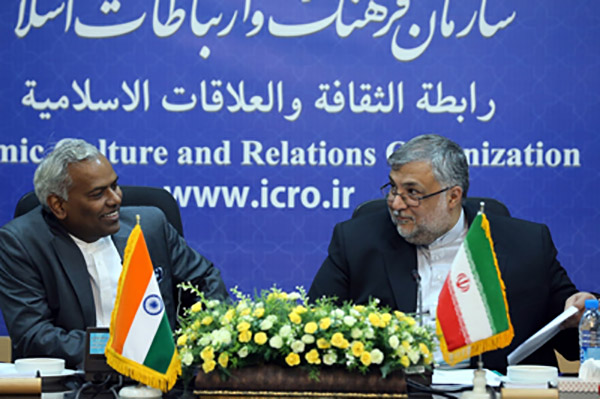
Referring to the fact that cultural agreements between two countries have been previously inked, Abuzar Ebrahimi Torkaman expressed his hope toward creation of a suitable context for developing cooperation and cultural relations.

On Indian PM’s special view on cultural issues, Raja Cikar said that cultural relations between Iran and India are very rich.

On holding some Indian cultural events in Iran, Cikar said that traditional music concerts and a festival to praise Iran-India relations will be held.

On the measures taken by Center for Dialogue between Religions and Civilizations, Torkaman said that bilateral trust and mutual understanding are some of the results of activities carried out by the Center.

AEOI Head: Iran, EU Can Start Nuclear Cooperation from Fordo

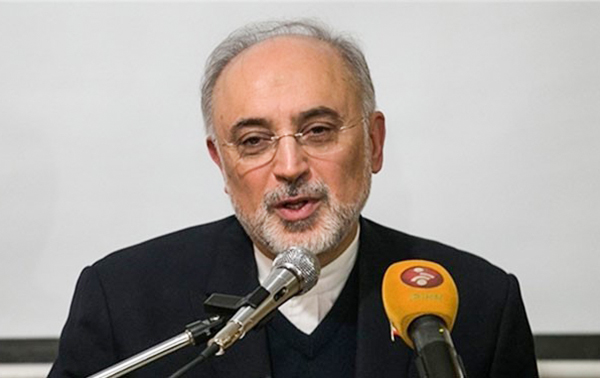
“Various talks and visits have been made between Iran and certain European states after the nuclear deal and this time we are witnessing the presence of an EU delegation within this framework,” Salehi told reporters after meeting the EU energy commissioner in Tehran on Sunday.

“We have held good talks with the EU delegation on nuclear cooperation which can start from the Fordo site,” he added.

Salehi also said that Tehran and the EU have decided to set up an advanced nuclear center in Iran to provide the country and neighbors with related services.

His remarks came after Iranian Foreign Minister Mohammad Javad Zarif announced that cooperation between Tehran and the European Union in the field of peaceful nuclear technology is among the important issues pursued during EU Foreign Policy Chief Federica Mogherini’s visit to Tehran.

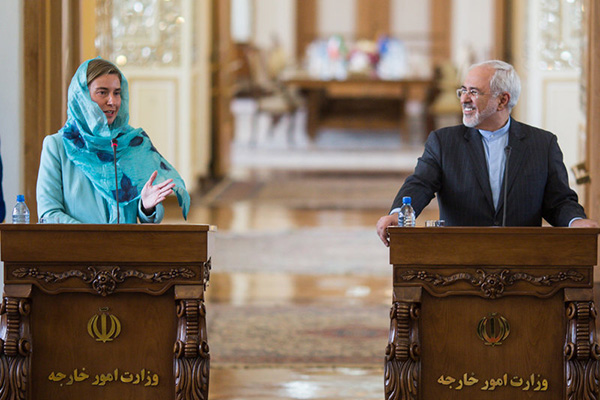
Fields of “cooperation (between Iran and the EU) envisaged in the nuclear deal (between Tehran and the world powers), including cooperation in civilian nuclear industry, will be discussed between the EU energy commissioner and Head of the Atomic Energy Organization of Iran (AEOI) Dr. (Ali Akbar) Salehi” during the EU delegation’s current visit, Zarif said in a joint press conference with Mogherini in Tehran on Saturday.

In relevant remarks last Monday, AEOI Spokesman Behrouz Kamalvandi announced that Tehran and the European Union are due to ink a document to increase cooperation in the field of civilian nuclear technology.

“Cooperation (with other countries) has started in practice and we have exchanged delegations with the EU, China, South Korea, Japan, the far East and countries which enjoy nuclear technology, whose number is not so high; we will interact with all of them and a document is due to be endorsed with the EU which is being compiled,” Kamalvandi said.

Noting that signing a deal with the EU means agreement with all its members, he said the details of the document will be announced after endorsement.

Kamalvandi said that any agreement with the EU includes mutual cooperation and interaction.

Also this month, Kamalvandi announced that the country is holding talks with different foreign states to construct more nuclear power plants.

“The AEOI has presented a 15-year-long plan for Research and Development (R&D) and enrichment to the International Atomic Energy Agency (IAEA) and we want to reach the stage to build at least one nuclear power plant every 15 years,” he said.

“After this stage, we will have a better opportunity in different fields, including increasing the number of power plants, and we are in talks with different countries to attain this goal,” Kamalvandi added.

Late August, Salehi had announced that the country is compiling a 15-year-long plan to further expand its peaceful nuclear know-how and capabilities.

“A 15-year-long plan is being compiled and the plan will be reviewed every 5 years,” Salehi said, addressing a ceremony at Fordo nuclear site near the Central city of Qom.

“One of our plans is to move on the path of commercialization and we hope to gain success in this arena,” he added.

Salehi also announced Iran’s plans to construct a nuclear hospital and two small nuclear power plants in the Southern province of Bushehr to desalinate water.

Also in the same month, President Hassan Rouhani announced that Iran would commercialize nuclear technology as soon as the nuclear agreement comes into practice in near future.

“Our nuclear program has been recognized in the Resolution 2231 and world powers are eager to cooperate with us in this regard,” Rouhani told reporters.

The president added that the Islamic Republic plans to export enriched UF6 and import yellow cake from abroad.

He elaborated that Iran will bring modern technology through cooperation with two countries of the Group 5+1 (the US, China, Russia, France and Britain plus Germany).

A look at Iranian newspaper front pages on April 17

Iran Newspaper front pages

Abrar:

1- Zarif departs for New York on Monday

2- Mogherini: Missile tests by Iran do not violate JCPOA
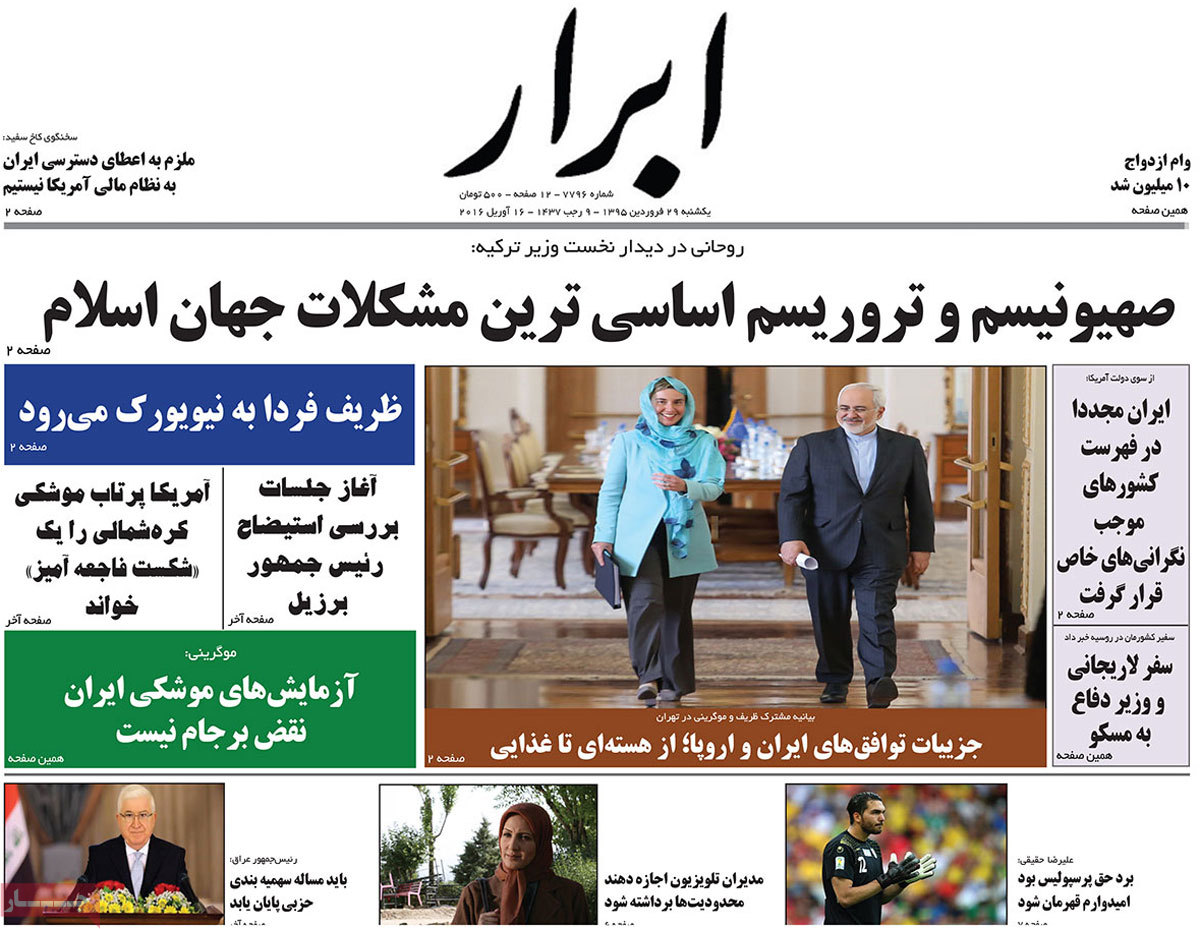
 

A look at Iranian newspaper front pages on April 17


Asrar:

1- Shamkhani on JCPOA: US approach unnecessary
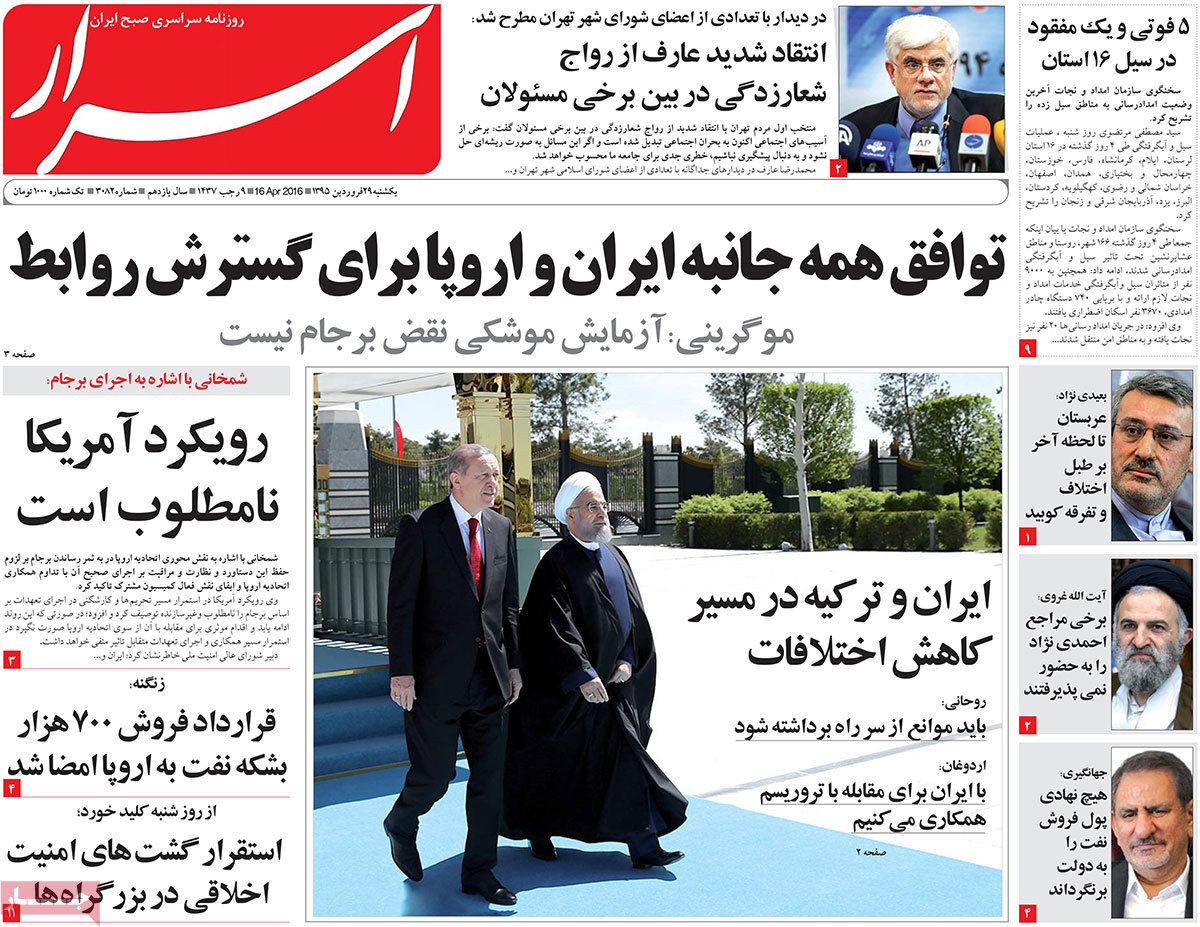
 

A look at Iranian newspaper front pages on April 17


Arman:

1- Parliament approves marriage loan increase to IRR100m.

2- Rouhani: Islamophobia is a plot hatched by Israeli regime
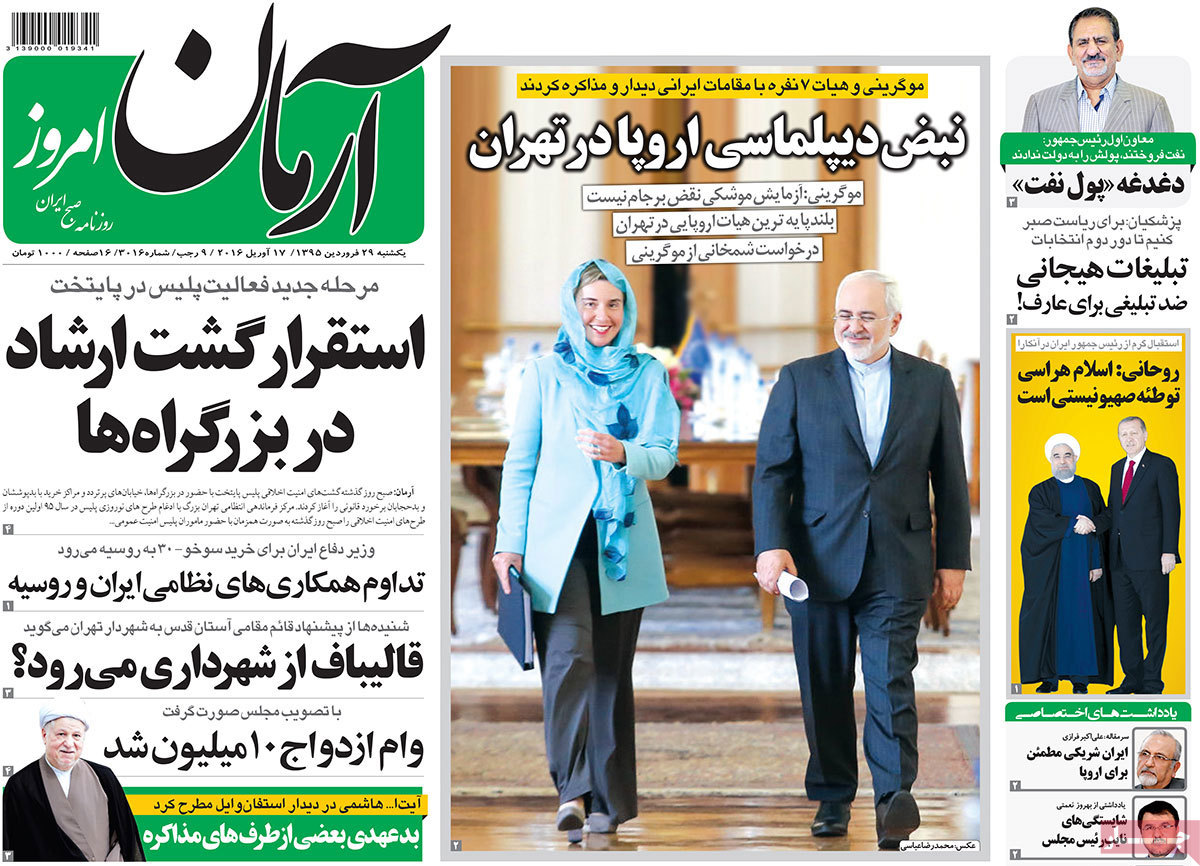
 

A look at Iranian newspaper front pages on April 17


Ebtekar:

1- Highest level talks between Iran and EU in past decade

– Zarif: Iranian people must sense the results of the nuclear agreement as soon as possible
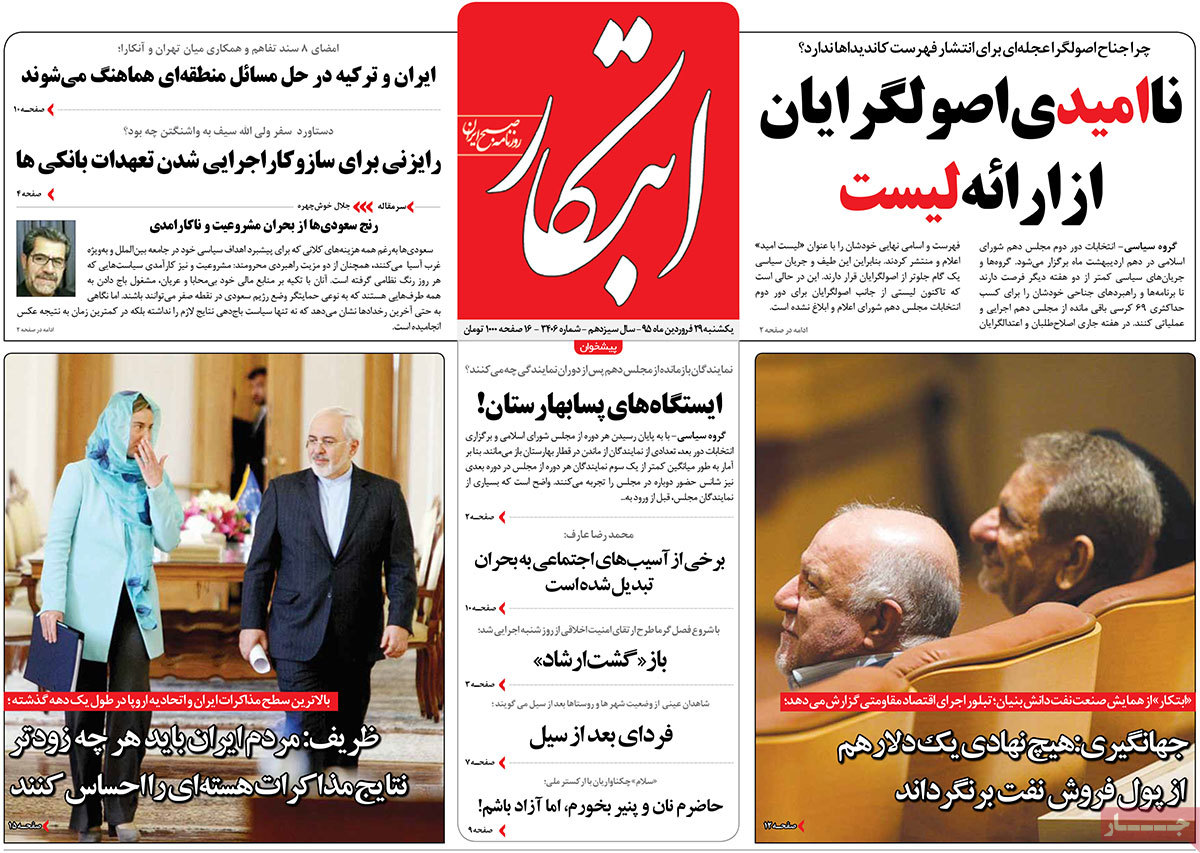
 

A look at Iranian newspaper front pages on April 17


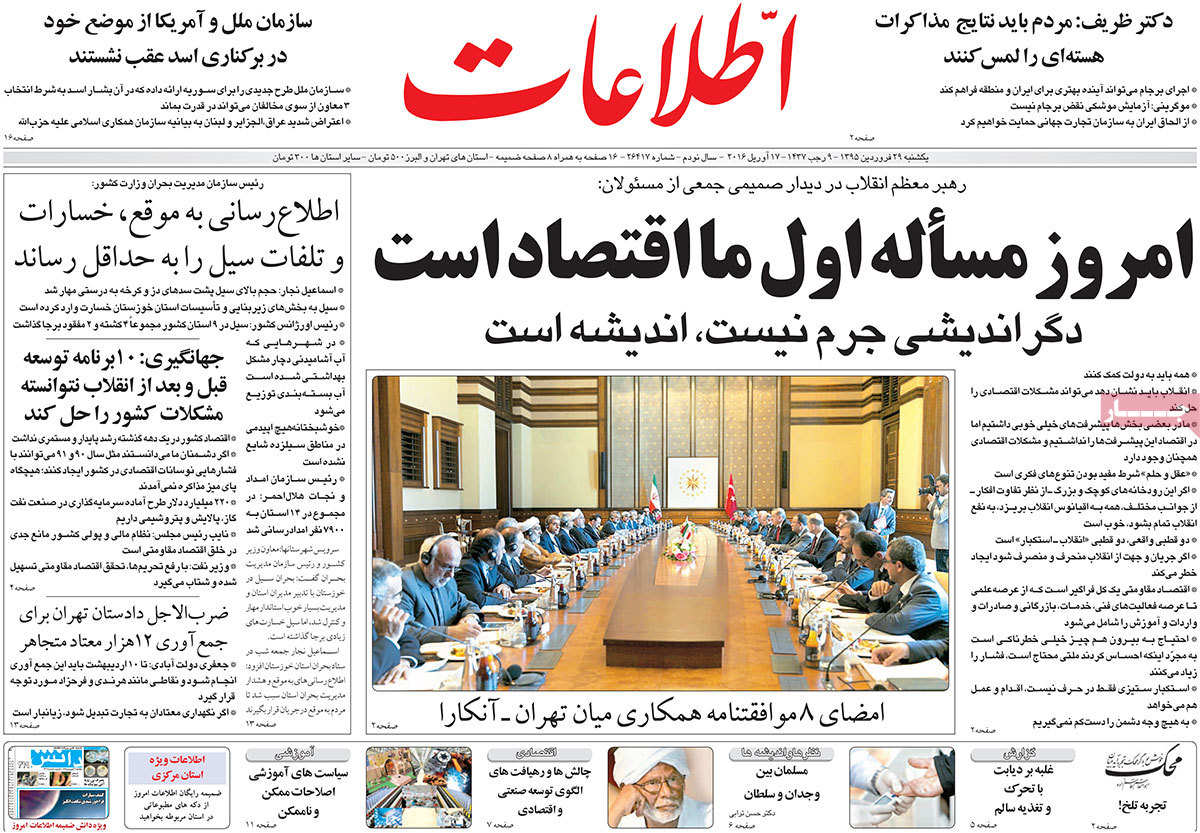
Ettela’at:

1- Crisis Management Organization chief:  Timely flood warning helped reduce casualties and damage

2- Iran and Turkey sign 8 cooperation agreements

3-Supreme Leader in meeting officials: Today economy is first priority
 

A look at Iranian newspaper front pages on April 17


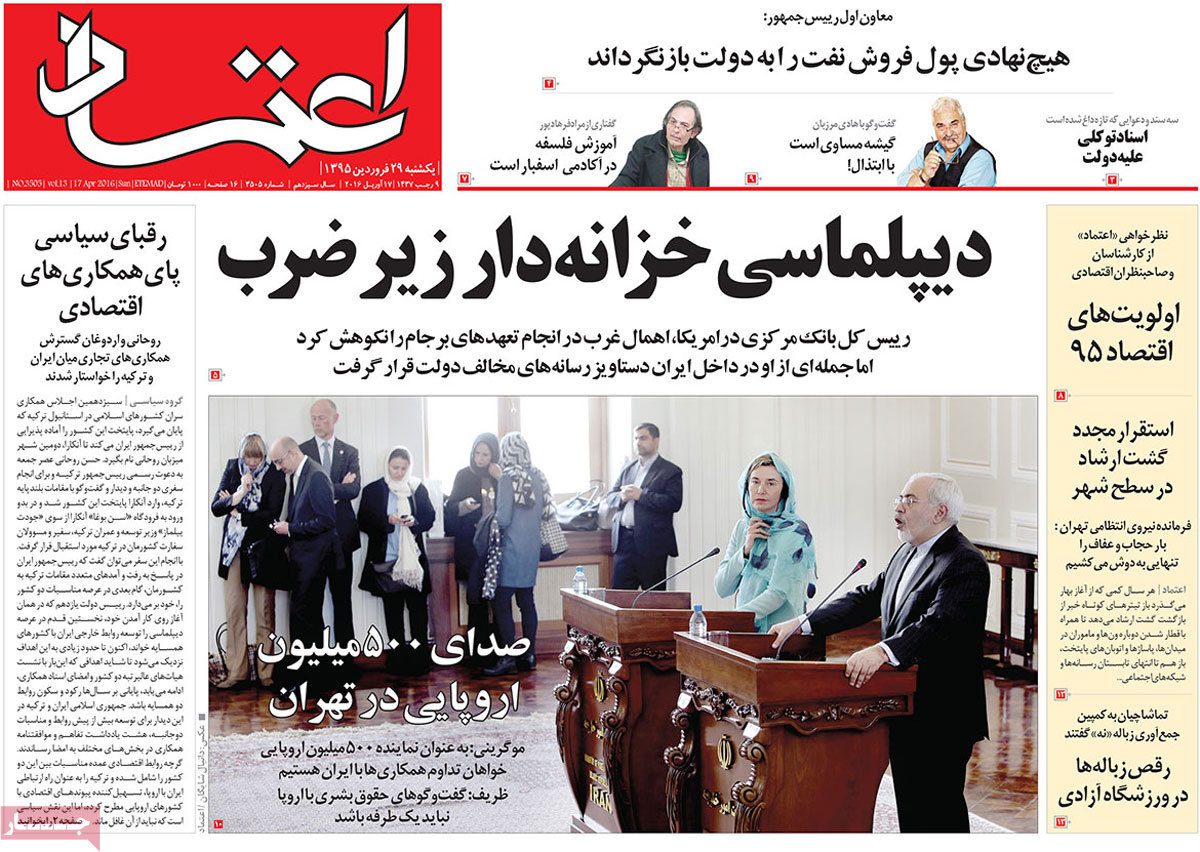
Etemad:

1- Voice of 500m Europeans in Tehran:

– Mogherini, as the representative of 500 million Europeans, wants to promote cooperation with Iran

2- Zarif: Human rights talks with Europe should not be one-sided
 

A look at Iranian newspaper front pages on April 17


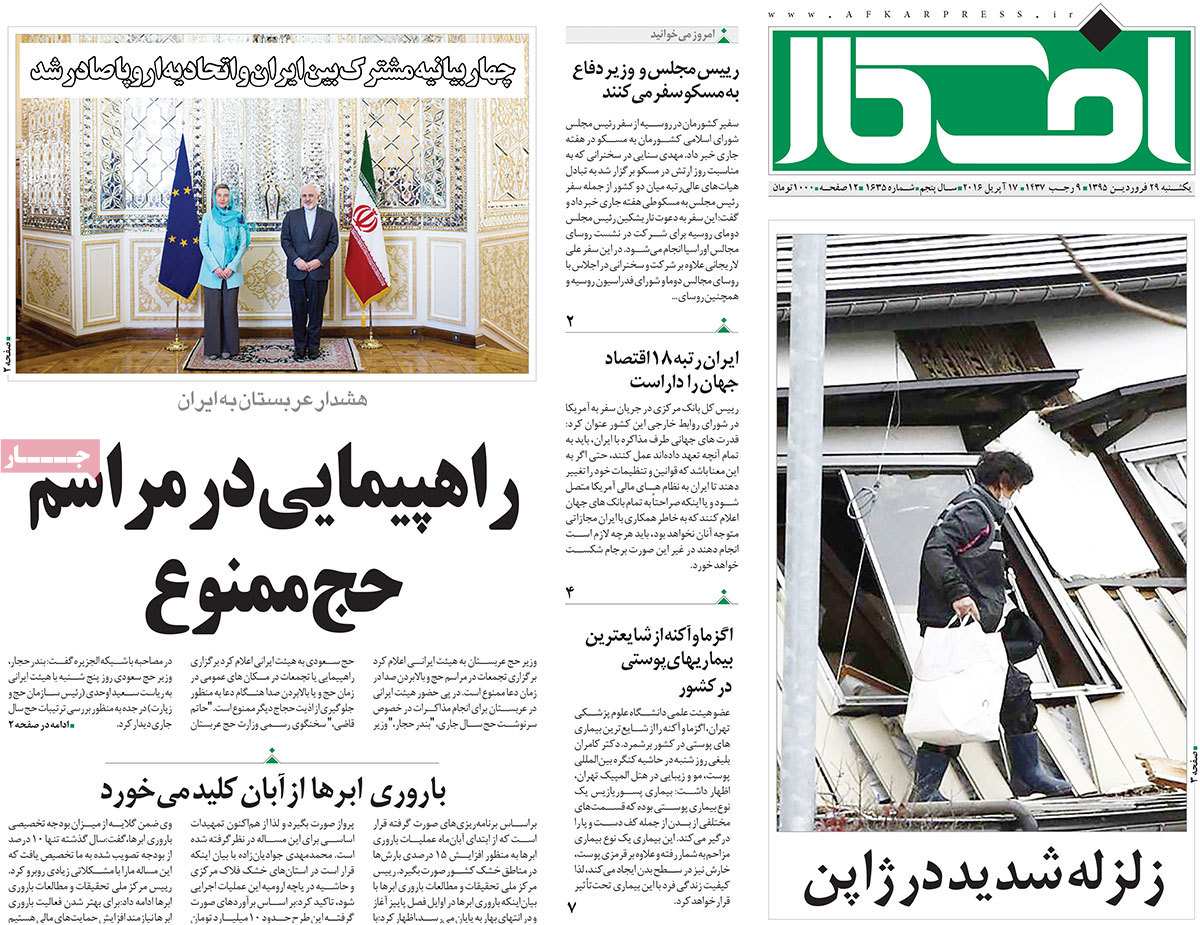
Afkar:

1- Saudi Arabia warns Iran: No rallies during Hajj Rituals

2- Cloud seeding will start from October
 

A look at Iranian newspaper front pages on April 17


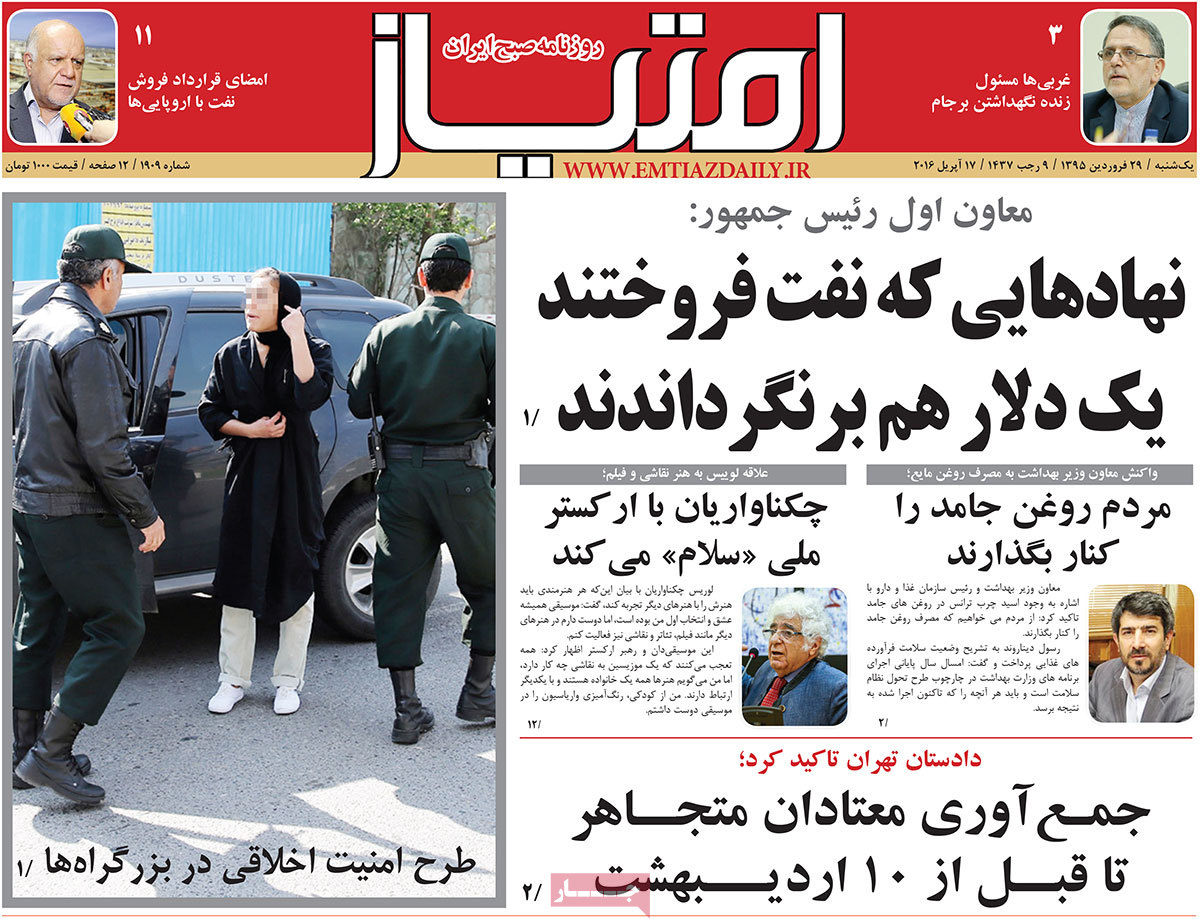
Emtiaz:

Tehran Prosecutor says drug addicts using in public will be arrested in coming weeks.
 

A look at Iranian newspaper front pages on April 17


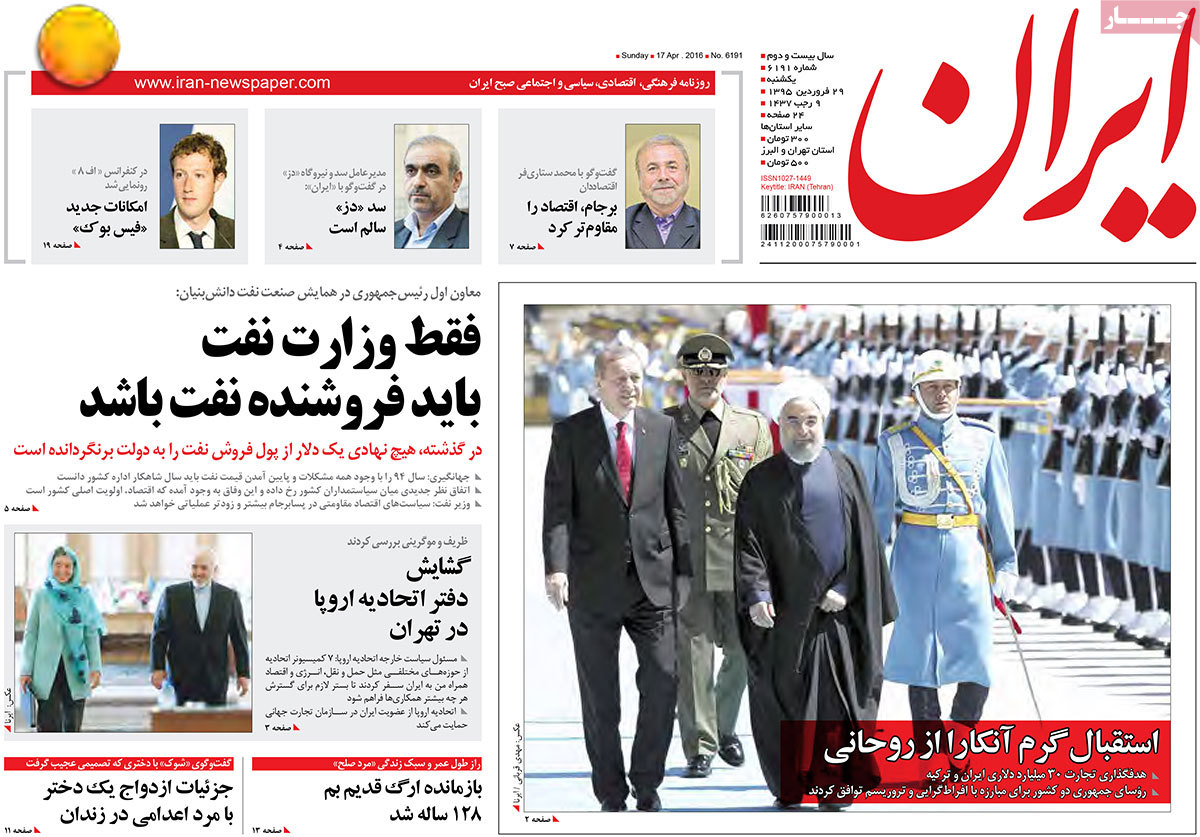
Iran:

1- First Vice President: Only Ministry of Petroleum should sell oil.

–  In the past none of those who sold oil have given a single dollar of their earnings to the government
 

A look at Iranian newspaper front pages on April 17


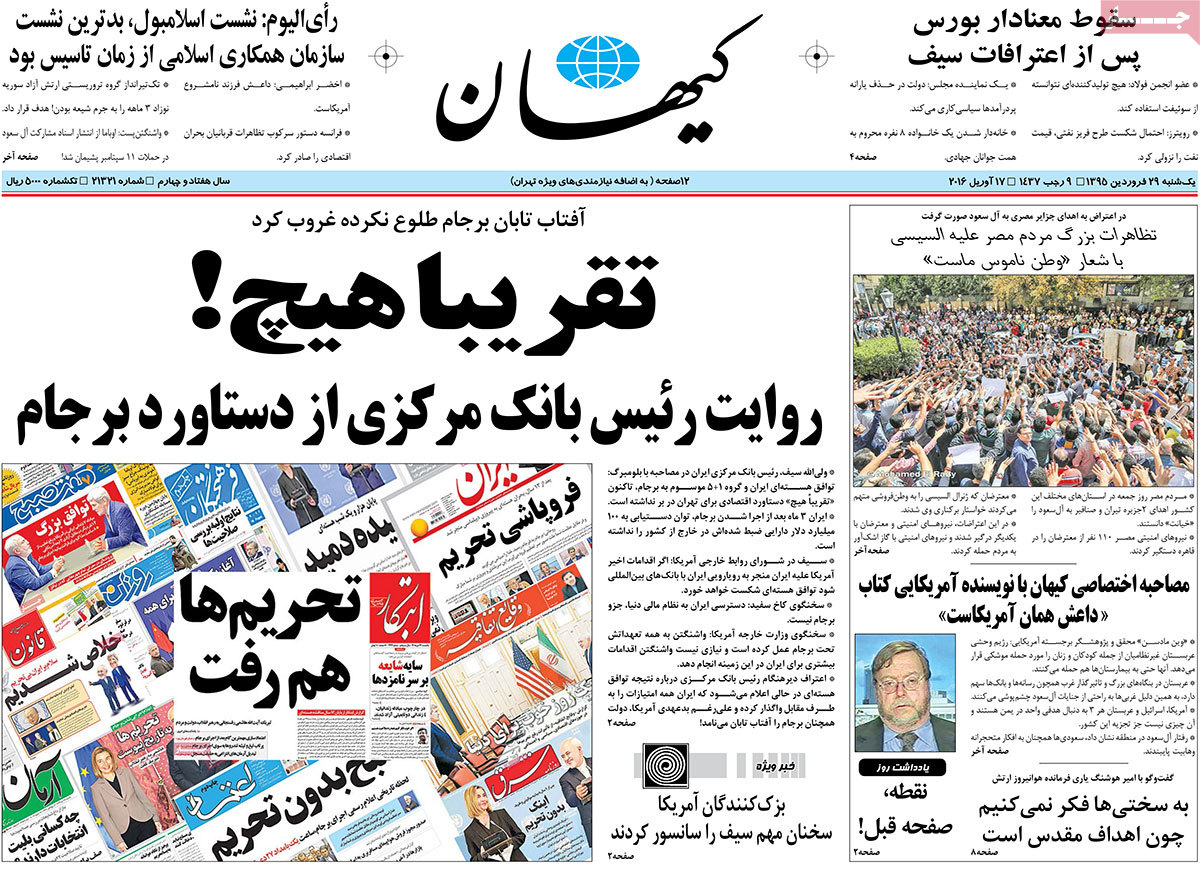
Keyhan:

1- The glowing sun of JCPOA has not risen:

– Governor of Central Bank says JCPOA has had almost no benefits

2- Exclusive interview with writer of a book titled: America is like Daesh
 

A look at Iranian newspaper front pages on April 17


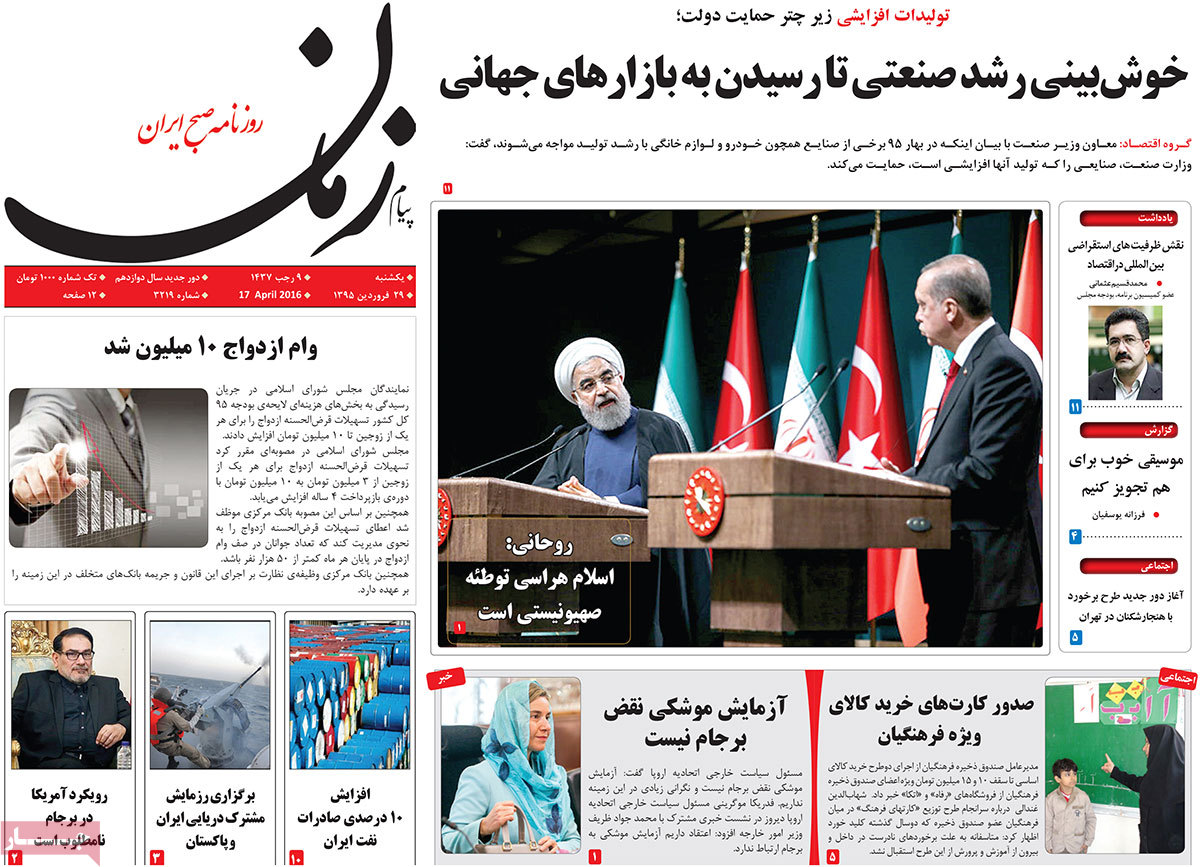
Payam Zaman:

1- Oil export up by 10%

2- Iranian and Pakistani navies to hold joint war games
 

A look at Iranian newspaper front pages on April 17


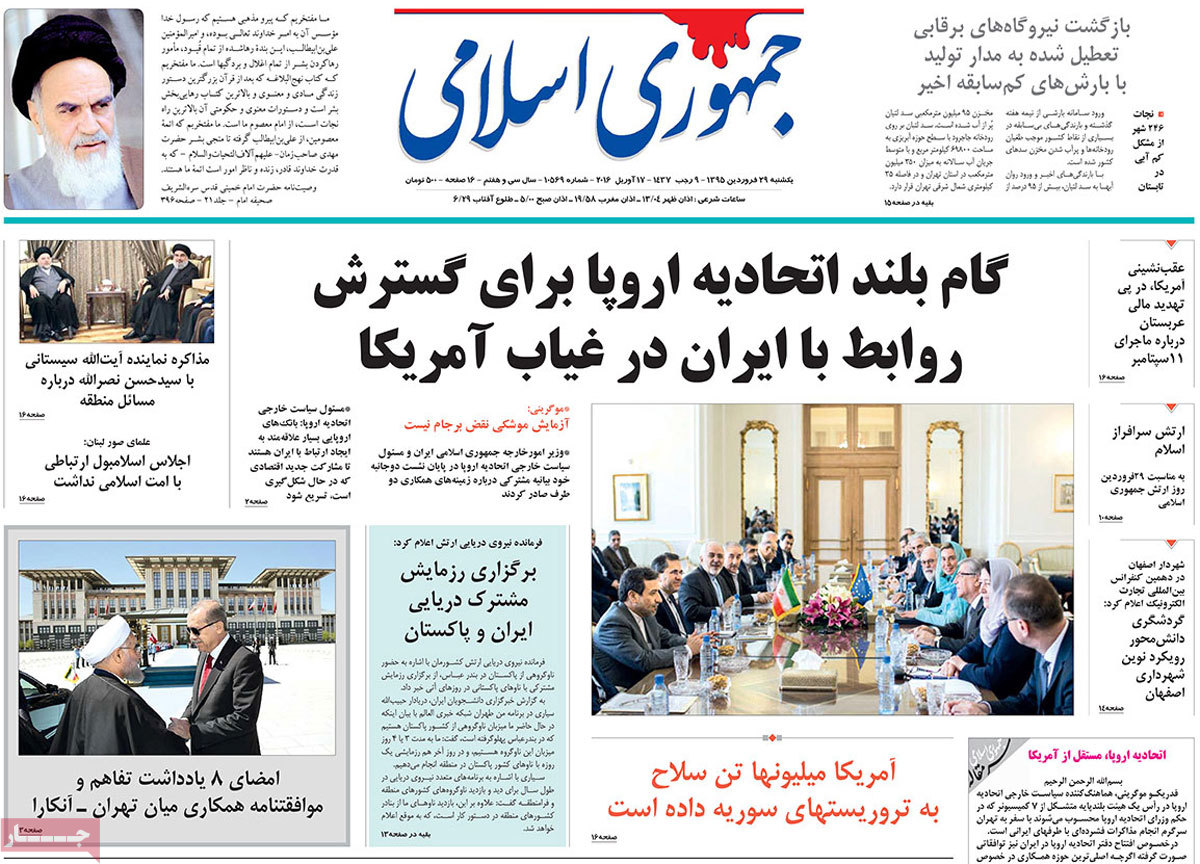
Jomhouri Eslami:

1- Great step taken by EU for boosting ties with Iran in US absence

2- US has delivered millions of tons of military hardware to terrorist groups in Syria
 

A look at Iranian newspaper front pages on April 17


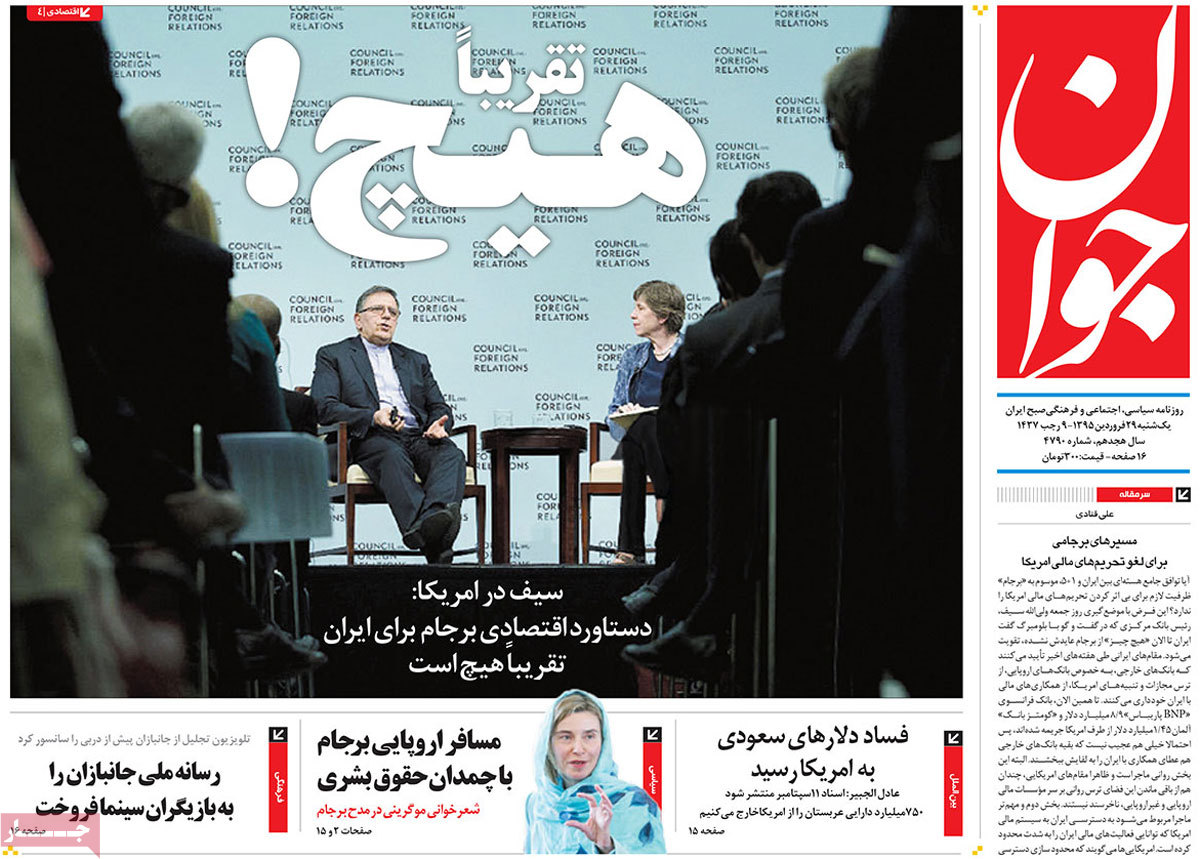
Javan:

1- Almost nothing, says Iran Central Bank governor of results of his talks with US officials in Washington
 

A look at Iranian newspaper front pages on April 17


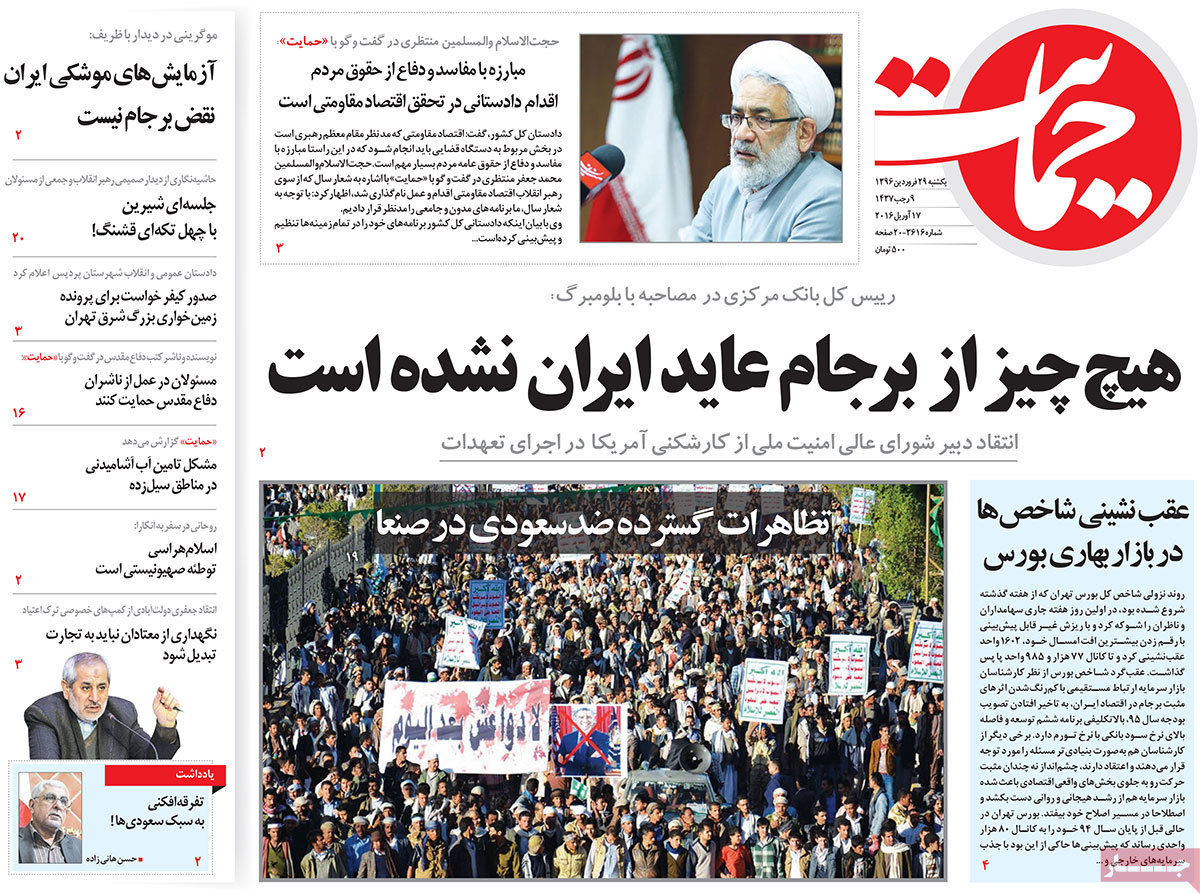
Hemayat:

1- Large anti-Saudi demonstration in Yemeni capital Sanaa

2- Drinking water shortage in flood-stricken provinces
 

A look at Iranian newspaper front pages on April 17


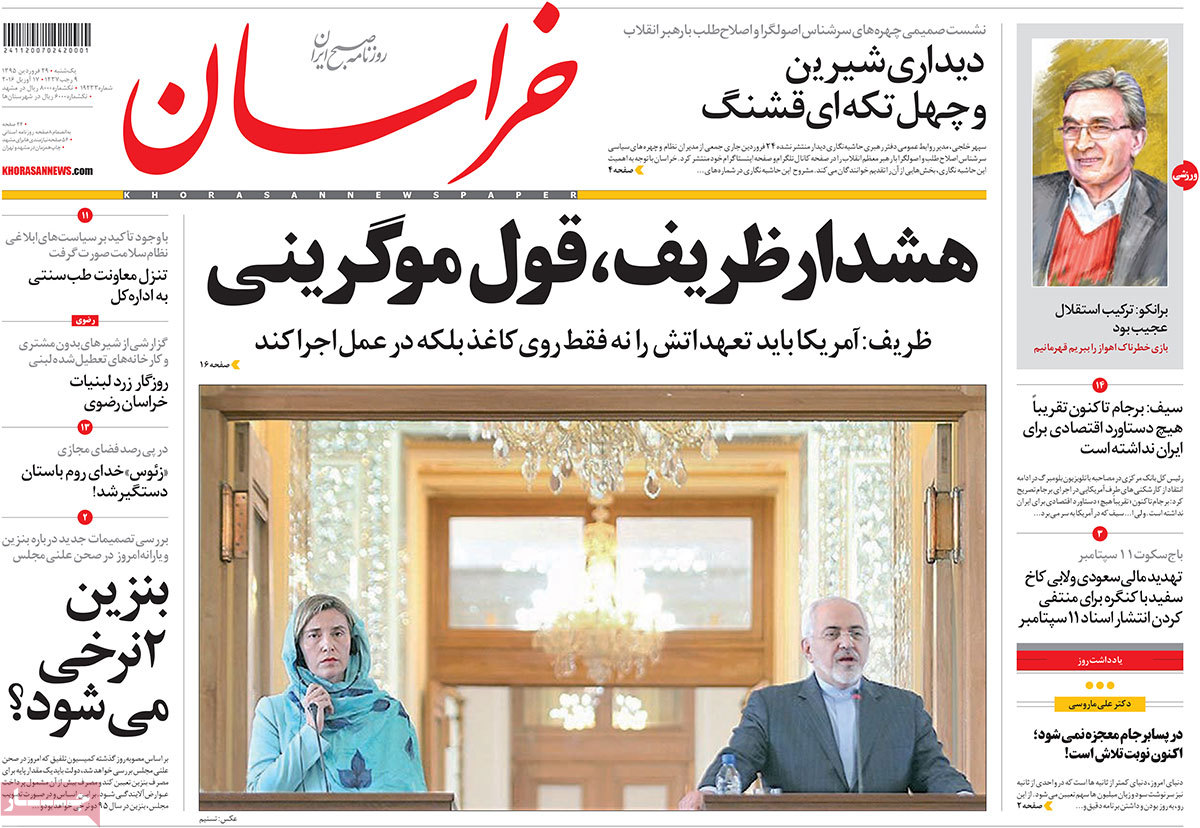
Khorasan:

1- Zarif’s warning, Mogherini’s promise:

– Zarif: US should comply with its commitment in practice and not just on paper

2- Post-JCPOA won’t be a miracle, it is time for hard work
 

A look at Iranian newspaper front pages on April 17


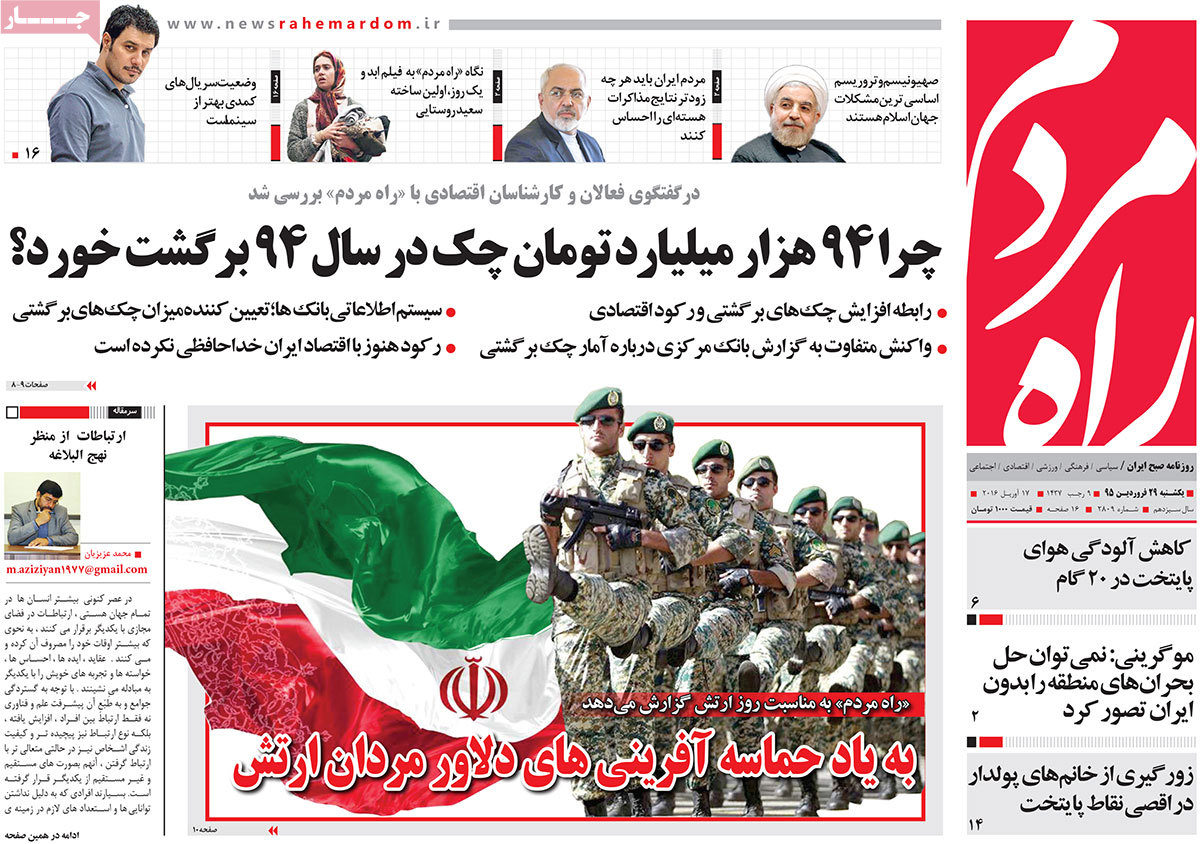
 Rahe Mardom:

1- Mogherini: Regional conflicts cannot be settled without Iranian help
 

A look at Iranian newspaper front pages on April 17


Resalat:

1- Zarif: US should remove practical obstacles preventing banking cooperation

2- Where are regional politicians heading for?
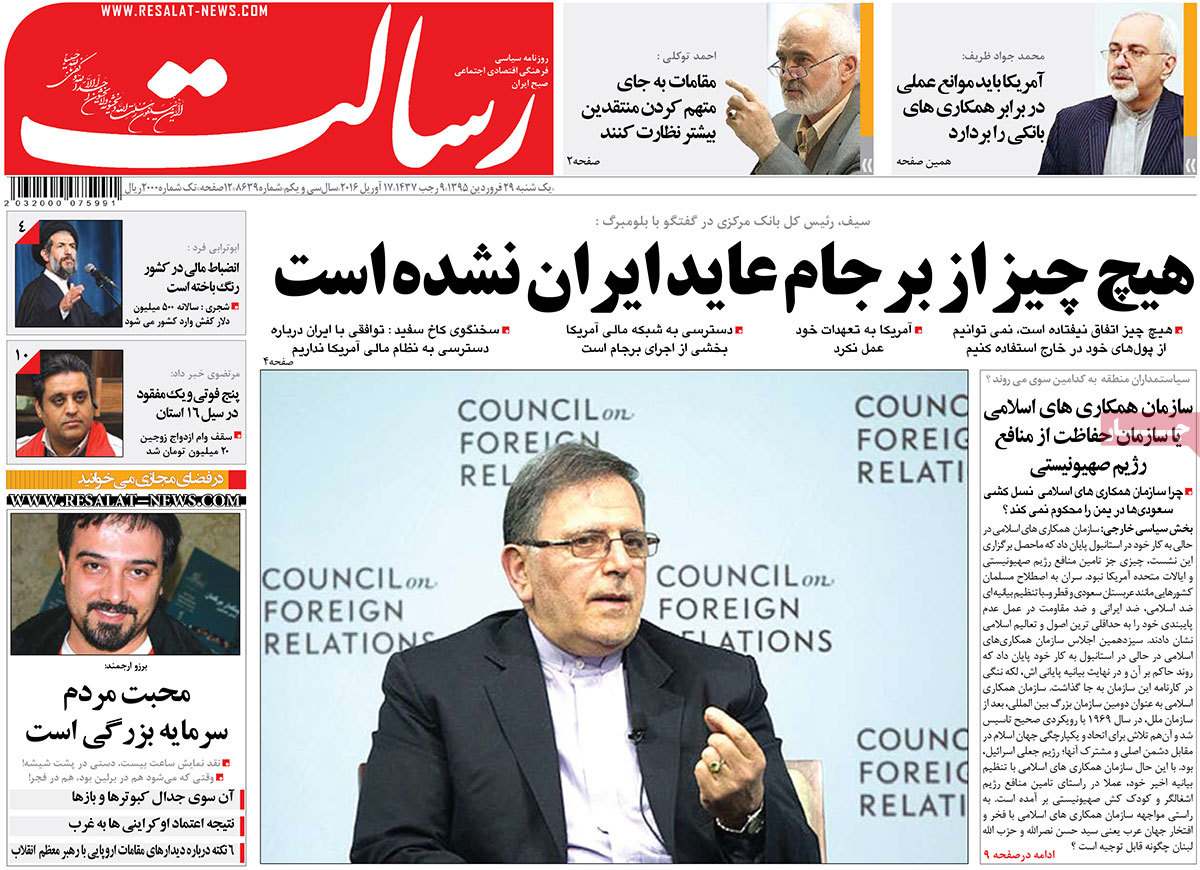
 

A look at Iranian newspaper front pages on April 17


Shargh:

1- Supreme Leader: Revolution should demonstrate ability to tackle economic problems

2- Michael Jackson also involved in oil scandal
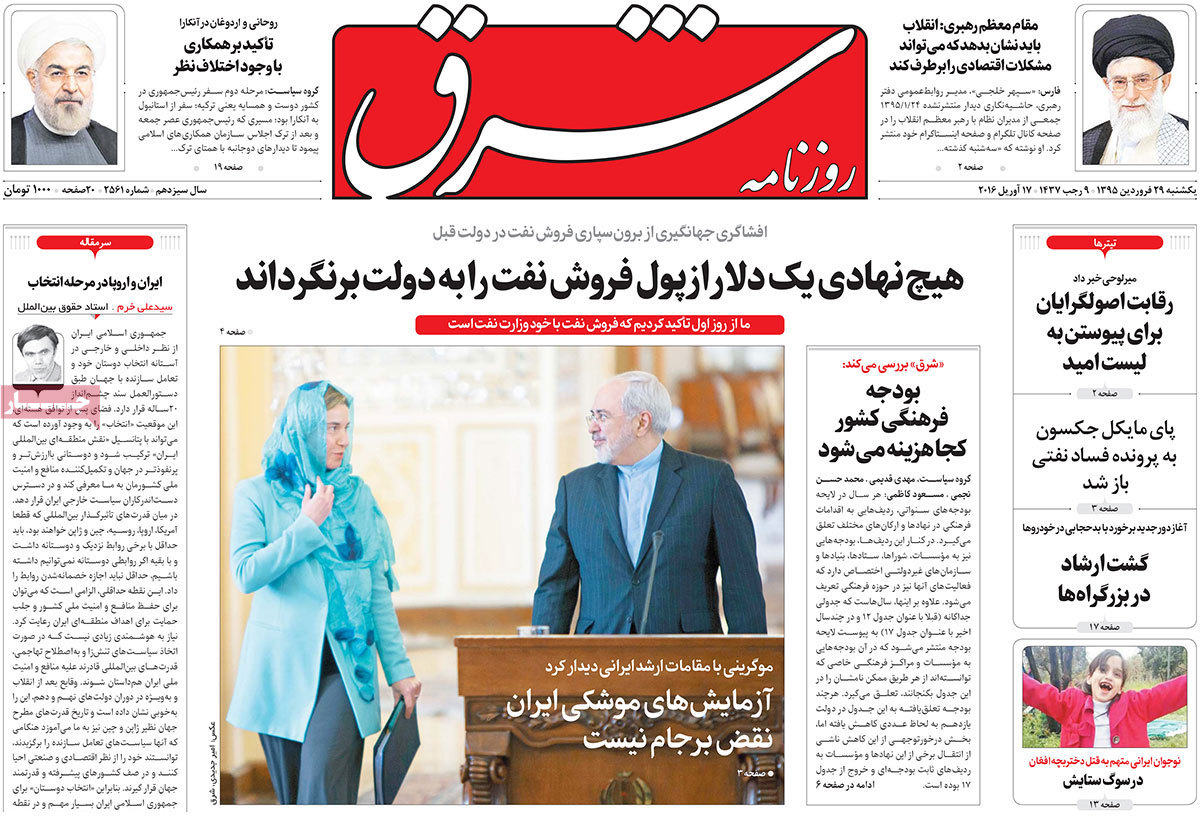
 

A look at Iranian newspaper front pages on April 17


Shahrvand:

1- Analysis of unprecedented presence of Iranians on social media:

– 45 million Iranians are on Telegram

2- Floods show benefits too: 246 towns saved from water shortages

3-    Governor of Iranian Central Bank warns westerners while in US

“If you don’t adhere to your commitments then JCPOA will be gone.”
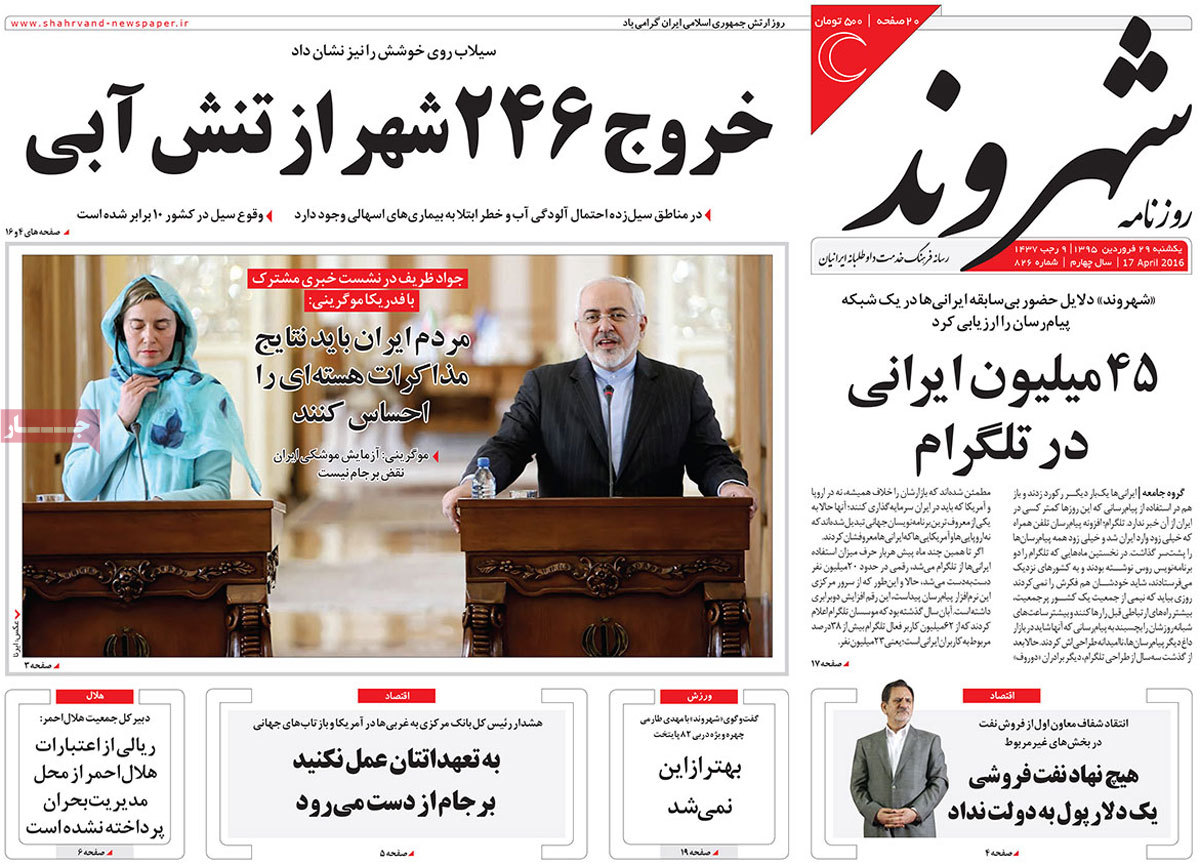


A look at Iranian newspaper front pages on April 17


 Asre Resaneh:

1- IRR1,300 million housing loan

2- Steps taken for resumption of pilgrimage by Iranians to Syria
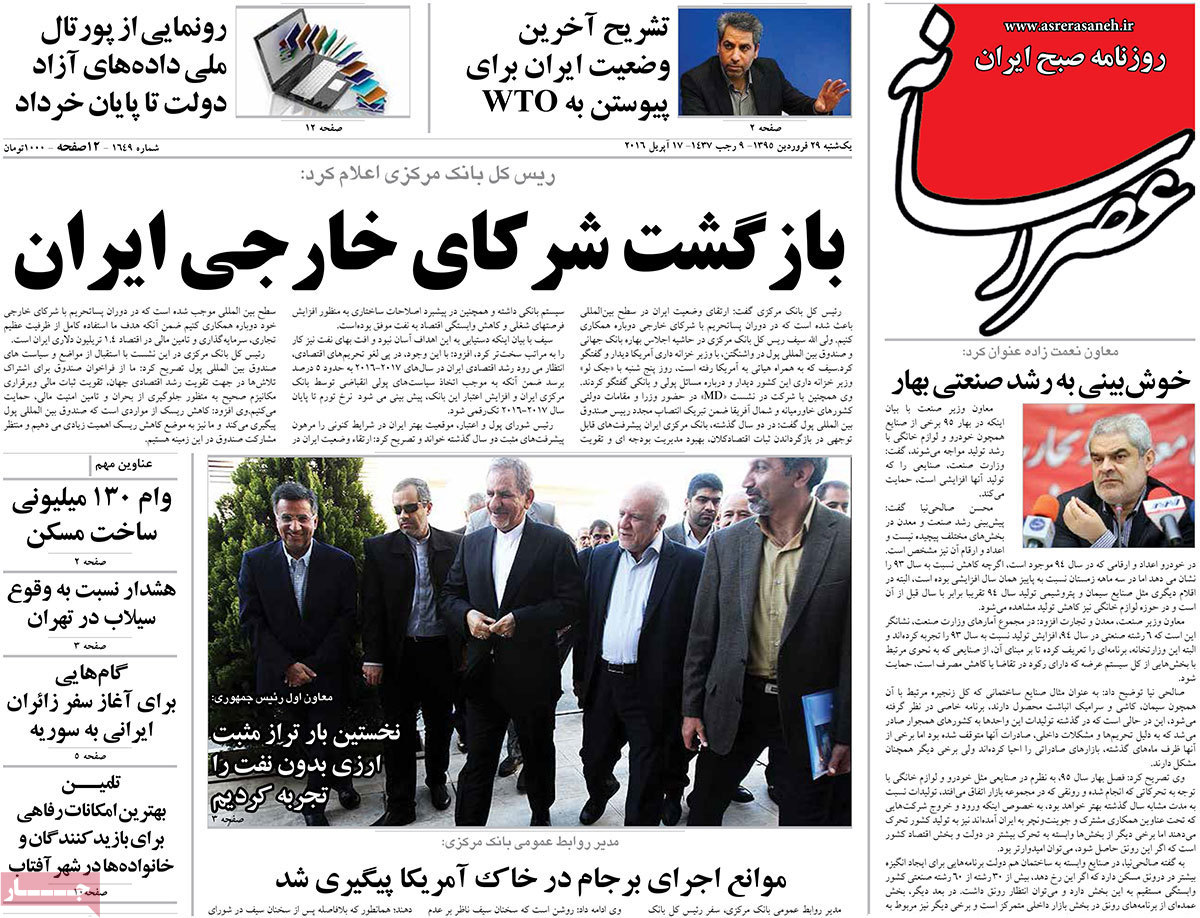
 

A look at Iranian newspaper front pages on April 17


Ghanoon:

1- General Hassan Nami: Getting involved in economic activities will undermine Armed forces’ main mission.

Iranian Armed forces are ready for asymmetrical war
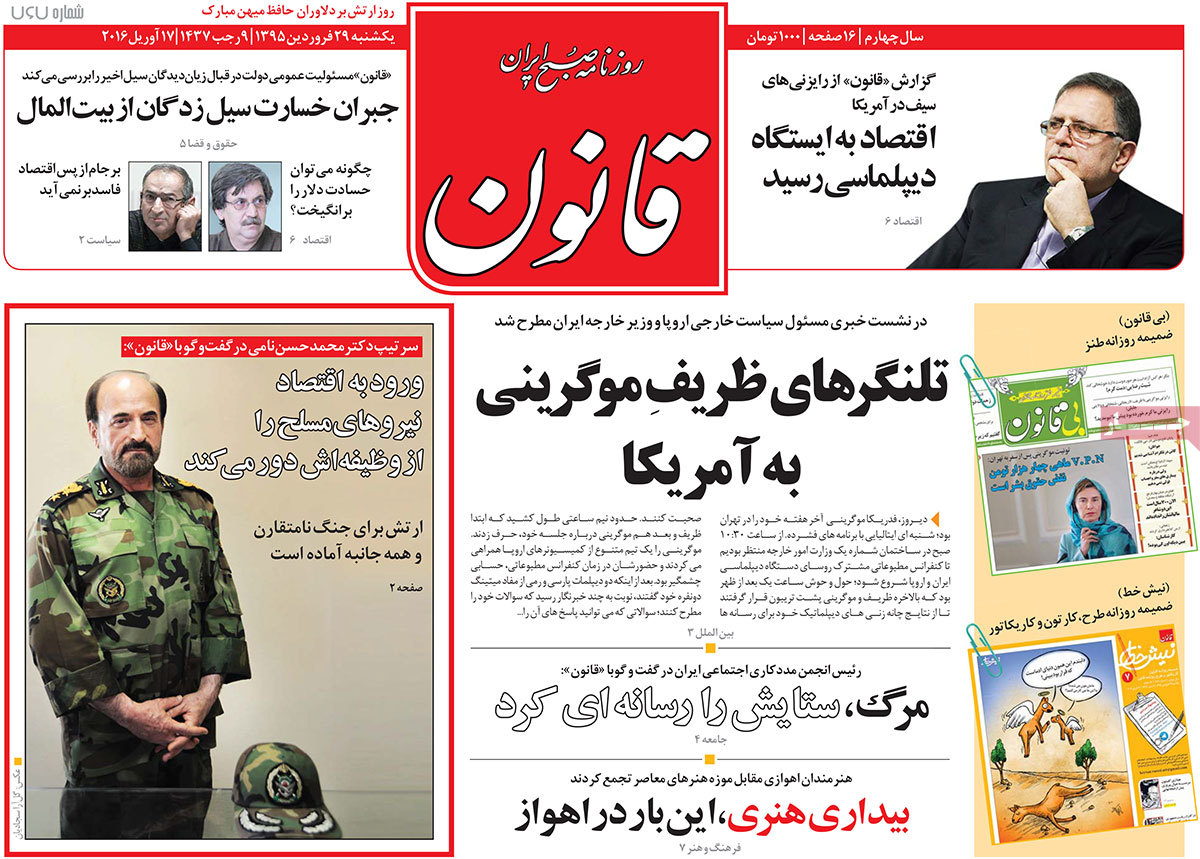
 

A look at Iranian newspaper front pages on April 17


Uruguay vice president to visit Iran in coming days

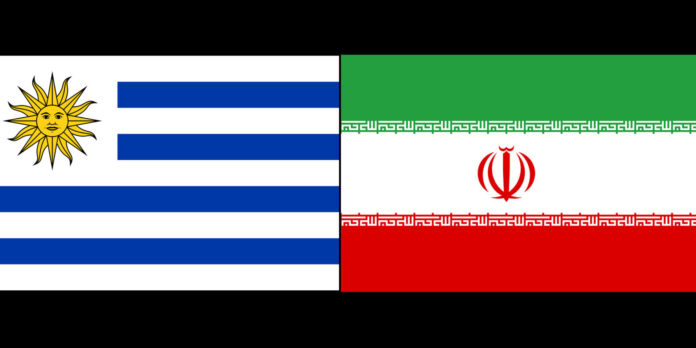
Vice President of Uruguay Raúl Fernando Sendic, accompanied by a high-ranking political-economic delegation comprising a number of cabinet ministers and representatives of private companies from economic and trade sectors, will visit Iran on 25-26 April, 2016, to hold talks with Iranian officials.

This is the first time a high-ranking Uruguayan delegation of this level and scope will visit Iran.

Since Sendic also serves as president of Uruguay Senate, he is scheduled to hold talks with Iranian Parliament Speaker Ali Larijani in a bid to discuss ways for expanding parliamentary cooperation between the two countries.

Iran Has No Plan to Join Oil Output Freeze: CBI Chief

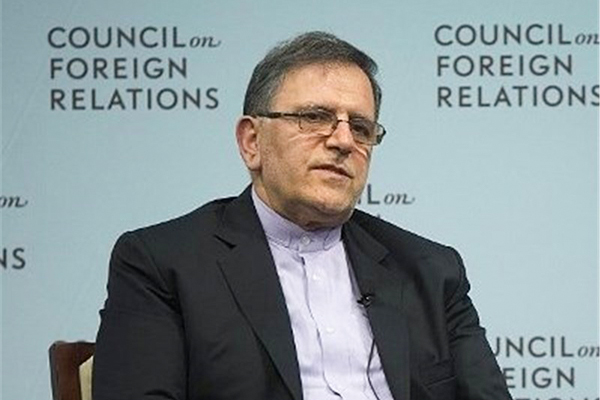
“What Iran is doing right now is trying to get back and secure its share of the market,” Seif told CNBC on the sidelines of an International Monetary Fund meeting in Washington in an interview published on Sunday.

Referring to an upcoming meeting on crude output of fellow OPEC members plus Russia in the Qatari capital, he said, “What Saudi Arabia is asking Iran to do (freezing its oil output) is not a very fair (or) logical request.”

OPEC and non-OPEC producers are set to hold a meeting in Doha on April 17 to discuss a proposed plan to freeze oil output at January 2016 levels.

Iran’s top central banker went on to say that other OPEC members are to blame for the sharp fall in oil prices, which are down more than 37 percent year to date.

“This request is coming from those countries which are responsible for this surplus production in the market, because they have exceeded output beyond their quota, and I think this is not fair,” Seif said.

Iran now reportedly produces around 3.1 million bpd of oil. The sanctions had cut crude exports from a peak of 2.5 million bpd before 2011 to just over 1 million bpd in recent years.

While an initial accord in February between Saudi Arabia, Qatar, Russia and Venezuela to cap production at January levels temporarily helped revive oil prices, analysts believe a freeze would have little impact even if more nations join.

Bangladeshi Ambassador: Tehran, Dhaka to forge all-out ties

The people of Bangladesh are celebrating the arrival of the New Bengali Year (April 14). A glance at the history of Iran-Bangladesh relations indicates that the two countries have always enjoyed close ties. Iranian and Bangladeshi officials have always underlined the need to foster and maintain friendly and brotherly relations between the two states.

Iran is willing to forge all-out ties with Bangladesh without any restriction, said Iranian Foreign Minister Mohammad Javad Zarif in a meeting with Bangladeshi Ambassador to Tehran Majibur Rahman Bhuiyan.

Zarif added Iran-Bangladesh relations are serene and progressing.

Bhuiyan has also voiced the avid interest of his country’s officials in broadening consultations with their Iranian counterparts, hoping that Tehran and Dhaka will witness an increase in economic and cultural cooperation in the near future.

People in Bangladesh started celebrating their new year about six centuries ago when the Mughal emperor, Akbar (1605) modified, developed and reintroduced the Bengali Calendar.

‘Pohela Boishakh’, or Nobo Borsho, is the country’s most important celebration which is held annually. People observe this day by wearing local and traditional costumes, going to fairs, known as ‘Boishakhi Mela’ which features musical and cultural events, eat pastry and make wishes for the new year.

Out of Bangladesh’s total population, 89.7 percent are Muslims and the rest are Hindus, Buddhists or Christians.

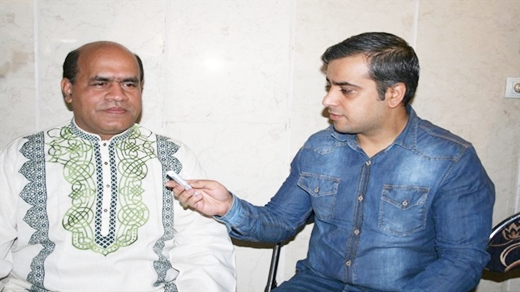
In an exclusive interview with Iran Daily on the sideline of a ceremony to celebrate the arrival of Bengali New Year at the Bangladesh Embassy in Tehran, Bhuiyan expounded on Bengali New Year celebrations as well as political and economic ties between Iran and Bangladesh.

Excerpts of the interview follow:

IRAN DAILY: Would you please tell us about the program?

MAJIBUR RAHMAN BHUIYAN: First, I welcome all of you. The program starts with an exhibition of photographs and a display of our food items and is followed by a cultural program featuring music and poetry recitation. Then we read a very short welcome message from the ambassador explaining the occasion, screen a video on Bangladeshi culture and serve Bangladeshi cuisines for lunch.

Can you tell us about Iran-Bangladesh relations? How do you evaluate the current level of ties?

Relations between the two countries have always been very favorable because, for centuries, we have had connections in the cultural, religious, business and political fields. So at the moment, we have very close relations and lots of goodwill for each other. At present, the Iranian and Bangladeshi governments as well as the two countries’ respective embassies in Tehran and Dhaka are doing their best to translate this goodwill into more expanded and deep cooperation.

How would you evaluate economic and trade relations? What is the current volume of transactions between the two states?

At the moment, trade ties are not very significant. But prospects for increasing trade ties are excellent and numerous. Iranian and Bangladeshi embassies Dhaka and Tehran respectively are in talks with relevant state and private sectors to raise the level of ties by identifying suitable fields for cooperation. Efforts are also underway by both sides to exchange a number of trade delegations.

Given the gradual removal of Western sanctions on Iran, what is your prediction about the expansion of trade ties between the two states in the post-JCPOA era?

It is crystal clear that economic ties will increase since all trade obstacles and restrictions will be eased and, gradually, we will find the opportunity to know how the trade exchanges between the two sides can be increased. I am quite hopeful that economic ties between Iran and Bangladesh will expand.

Given that you are celebrating the arrival of the Bengali New Year, do you have anything special to tell us in this respect?

New Year is a time for renewing ties, exchanging greetings, leaving behind the shortcoming we had in the past, looking forward to good things in the future and thinking about how to move ahead.

What do you make of Iran’s nuclear deal?

I do not have any particular opinion on this issue. Since Bangladesh has always favored peace and stability in the region, it welcomes any move to ensure this.

Iraqi Sunni Coalition Hails Iran’s Support

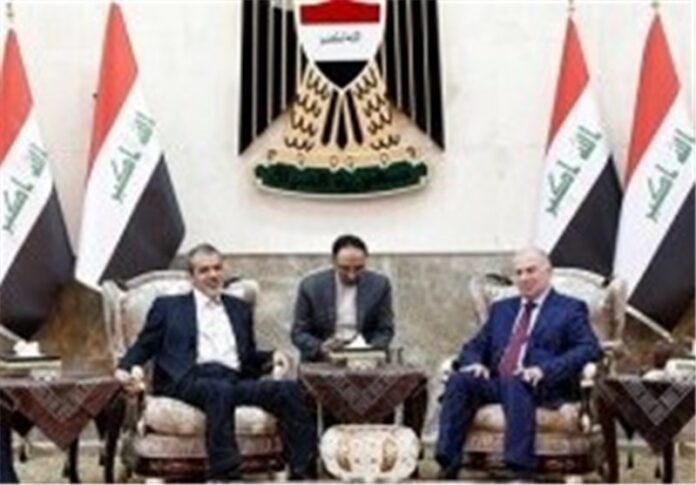
The Unity for Reform coalition announced in a statement that its leader, Usama al-Nujaifi, has held a meeting with Iranian Ambassador to Baghdad Hassan Danaeifar.

According the statement, Mr. Nujaifi, a former parliament speaker, in this meeting praised Iran for its efforts to help Iraq’s leaders address an ongoing political crisis in the Arab country.

The Iraqi politician also emphasized the necessity for maintaining legitimacy of the political processes, partnership in decision making and a real balance of power in Iraq.

Nujaifi further called on Iraqi officials to exercise foresight, take responsibility and respect the constitution in the face of the political crisis that has beset the legislature.

The Iranian envoy, for his part, voiced support for the right of all Iraqi groups to have a role in the political processes.

A political crisis in Baghdad escalated this week when parliament failed to approve a new cabinet lineup presented by Prime Minister Haider al-Abadi.

Following the cabinet vote delay, parliamentarians staged a sit-in on Wednesday, demanding the country’s top political leadership, including the speaker and prime minister, step down.

Meanwhile, negotiations continued late into the night Saturday between Iraq’s powerful political blocs after lawmakers attempting to oust Parliament Speaker Selim al-Jabouri failed to maintain quorum.