Thursday, December 25, 2025
Home Blog Page 4445

Tehran theater to host “The Yalta Game”

Friel wrote the play based on Anton Chekhov’s short story “The Lady with the Little Dog”, which the Russian playwright composed in 1899 in Yalta, a resort city on the southern coast of the Crimean Peninsula.

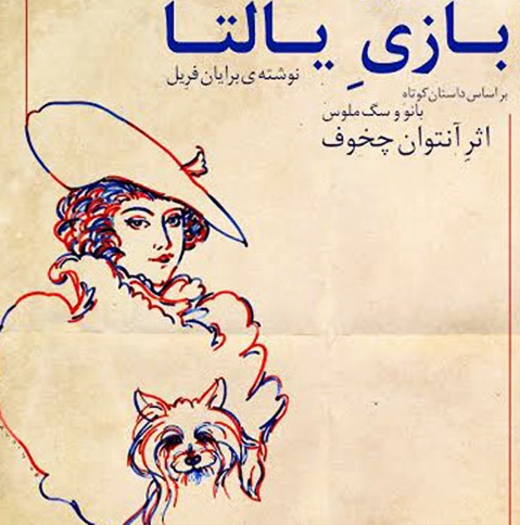
Renowned Iranian painter Aidin Aghdashlu has designed a poster for the play that tells the story of an accountant who vacations alone, leaving his wife and family behind in Moscow.

Vahid Rahbai, Shadi Karamrudi and Mani Monadizadeh are the main members of the cast for the play.

Photo: A poster for “The Yalta Game” by Aidin Aghdashlu

President Rouhani: Muslim world voices of unity and cooperation should be heard everywhere

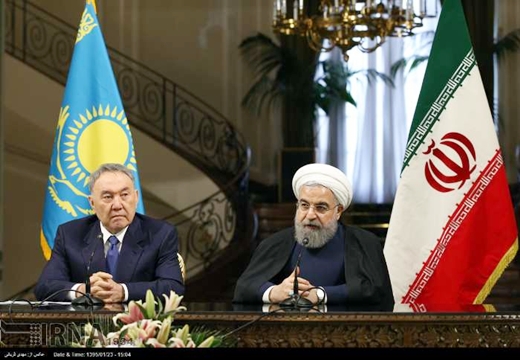
He made the remarks in a meeting here on Monday with Kazakh President Nursultan Nazarbayev in reference to the forthcoming OIC summit in Istanbul.
Rouhani said that since the independence of Kazakhstan in 1991, the two countries have expanded and developed their bilateral ties.
The Kazakh government has always been a friend of Iran during the sanctions era and nuclear negotiations with the G5+1 two rounds of which were held in Kazakhstan and during the implementation of JCPOA Kazakhstan by dispatching 60 tons of yellow cake was of great help in the implementation of program.
President Rouhani said that totally 66 documents on cooperation between the two countries were signed by both public and private sectors, which is a turning point in bilateral relations.
Cooperation between Iranian and Kazakh central banks, banking exchanges, issuing visas to Iranian businessmen and support of both governments for private sectors would be an important step towards development of bilateral economic relations.
He added that in private and public meetings with President Nazarbayev agreements were made on development of cooperation in scientific, cultural, technology and communication fields between the two countries and on expansion of agriculture and trade ties.
The two countries also had agreements in such fields as oil, gas, petrochemical, crude oil swap and oil products, he added.
In the sector of transport and communication, railways companies of both countries would establish connection between Iran, Kazakhstan, Turkmenistan and China.
Rouhani added that cooperation in the field of Caspian Sea environment, maritime transport, tourism and Caspian Sea legal regime were among other issues discussed by the two sides.
The two countries also shared similar stance on regional issues such as extremism, terrorism and disputes between various sects and their danger threatening the Islamic world, and the need to find a political solution to Yemen crisis and establish stability in Afghanistan, Iraq and Syria, President Rouhani said.

German Companies Seek Bilateral Agricultural Ties

Mohsen jalalpour the head of Iran chamber of commerce, industries, mines and agriculture in a meeting with Christian Schmidt the minister of food and agriculture of Germany who is heading a high ranking delegation from agriculture organizations, highlighted the bilateral works and investment in water management projects, conservation of water resources in agricultural process, updating the planting methods to produce organic products.

Jalalpour emphasized the number of meetings with German delegations after JCPOA in Iran chamber of commerce comparison with other EU delegations and said: these missions show the eagerness of German politicians to expand economic ties with Iran.

Head of Iran Chamber highlighted the environmental crisis and shortage of water in next decades for country and region and added: we believe due to mismanagement of water resources in agriculture and industry not only in our country but also in our neighboring countries, we would face obstacles and there are lots of rooms to do research and updating the technologies to avoid side and effects.

Jalalpour mentioned the obstacles of exporting Iranian products like dried fruits and nuts during the sanctions by ministry of food and agriculture of Germany and said: Persian production benefits the high ranking qualities which are approved with consumer feedbacks by requesting our goods, but some restraints avoided to introduce our goods to the chain stores and EU markets. We anticipate being in equal competition with others producers.

For his part German Minister of Food and agriculture Christian Schmidt highlighted the good atmosphere and opening new chapter in economical relations with Iran after JCPOA and said: Some German agricultural activist are in this mission to find their counterparts and fact finding the market to expand their bilateral work with Iranian private sector.

He mentioned the COP21 conference of Paris and said: due to the climate changes of the globe, all participants of conference agreed to control the water resources and in this regards we are ready to transfer the technology to provide the food of 9 billion population of the world.

Considering the scientific ranking of Iran in the world, Schmidt quoted that: in research center of agriculture ministry approximately one thousand scientists and professors are studding in various projects and they are ready to connect with Persian scientific and educational centers to exchange their experiences in agrochemicals, seeds and veterinary.

Official: President Rouhani to visit Turkey this week

Iran Rejects Russia's Mediation, Says Has No Plans for Direct Talks with US

He made the remarks here on Monday on the sidelines of his meeting with Estonian Foreign Minister Marina Kaljvrand.
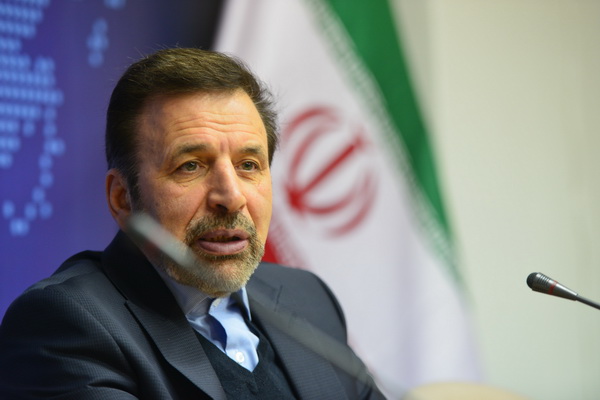
Vaezi told reporters that in the 25th meeting of Iran-Turkey joint economic commission held a few days ago in Ankara, it was agreed that President Rouhani during his Turkey visit would allocate a time for reviewing bilateral economic issues.

Iran’s Centrifuges Can Improve Oil and Gas Industries in the Region

In an interview with al-Alam News Network on Sunday, Kamalvandi said neighbouring countries need to immediately set aside the Western-inspired notion of a threat posed by Iran, and called for the expansion of cooperation to the field of peaceful nuclear energy.


“Iran has plans to promote cooperation with regional countries, particularly Persian Gulf neighbours, on the employment of nuclear technology for peaceful purposes.”


Abundant opportunities exist for cooperation with neighbours, especially in the Persian Gulf region, he added.

Kamalvandi also highlighted a series of plans for closer regional cooperation on the nuclear industry, saying they will be unveiled in future.

More reciprocal visits between Iran and regional countries will prepare the ground for cooperation in various nuclear fields, such as medicine and agriculture, he explained.

The spokesman further noted that Iran’s centrifuge machines can help development of the region’s oil and gas industries at a reasonable price.

Global enthusiasm for nuclear cooperation with Iran has grown after the implementation of the Joint Comprehensive Plan of Action (JCPOA), a lasting nuclear agreement between Tehran and G5+1 (Russia, China, the US, Britain, France and Germany).

The deal has enabled Iran to enter the international nuclear market, leaving it with the option to work with many nuclear countries.

According to Mehr, France, Spain, South Korea and many other countries have expressed willingness to work with Iran in the nuclear industry.

Banking Channels to Allow CBI Access to $6bn of Oil Cash in India

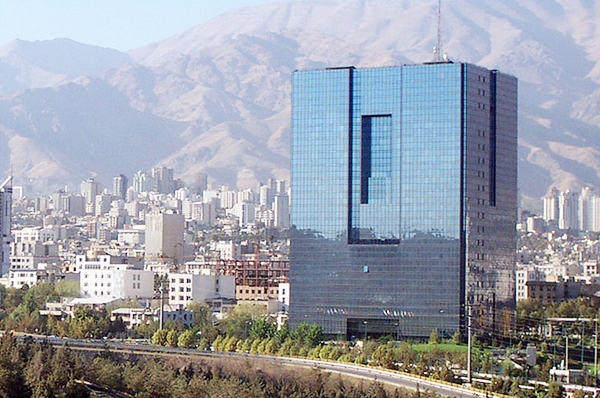
Speaking on the sidelines of the Iran-India business conference at Tehran Chamber of Commerce on Saturday evening, Zangeneh told reporters that Tehran and New Delhi are in talks to add two more banking channels to the current one so that access can be granted to $6bn of Iran’s oil money in Indian banks.

“The Indian side has announced it would immediately repay its debts to Iran once the channel is open,” the official said.

He also said that India has stopped repaying its oil debts to Iran in goods supply.

Asked how the debts will be paid to the CBI, he said they will be paid in euros, not in goods.

Regarding the construction of a gas pipeline from Iran to India, Zangeneh said no understanding has been made in this regard between the two Asian countries, and the Indian side must study the case and present its assessments to Iran.

Iran can export oil to India whether through pipelines or in the form of liquefied natural gas (LNG) cargos.

Farzad B Development

“India has agreed to receive and market the gas extracted from the field,” said Zangeneh about development project of the gas field.

Petrochemical Sector

He said Indian developers have indicated their keenness to finance petrochemical projects in Iran, and that the latter has agreed to supply their plants with petrochemical feedstock in return.

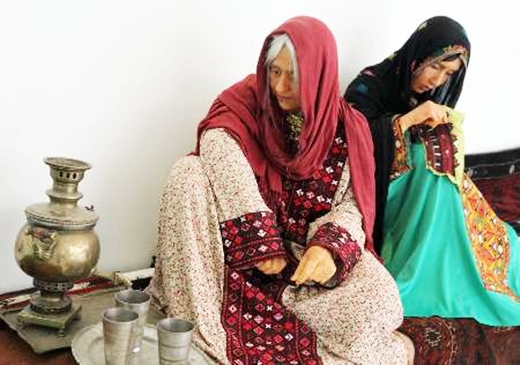
Reyhanabad old public bath to become Museum of Anthropology

Hossein Youssefi told IRNA that the public bath is under reconstruction and plans are underway to transfer it to the private sector and change it into anthropological and archeological museum.
The 300-year-old bath belongs to the Qajari era and was registered as a national heritage in 2007.
Once the bath turns into a museum, he noted, old farming, spinning, and weaving tools as well as other apparatuses used for traditional life in the region, old manuscripts, and cookware will be displayed in the museum.
According to Youssefi, Galougah has 32 registered monuments and 4 tourist promenades that need appropriate infrastructures.
He also noted that the county has no hotels or other tourist facilities. Despite the shortcomings, he added, some 12,000 tourists stayed in Galougah overnight during the Iranian New Year holidays started March 20.
Galougah is located in the easternmost point of Mazandaran Province and has borders with Senmnan and Golestan Provinces.

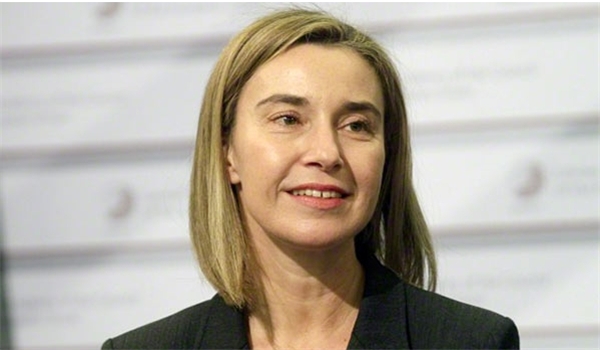
Spokesman: EU’s Mogherini Due in Iran on Saturday

“Ms. Mogherini is due to visit Iran on Saturday April 16 along with a big delegation of EU Commission members,” Foreign Ministry Spokesman Hossein Jaberi Ansari told reporters in his weekly press conference in Tehran on Monday.

“Serious talks will be held between the EU and Iran on political issues and in other fields,” he added.

Stressing the importance of Mogherini’s visit, Jaberi Ansari said, “We are in a new state of relations with the EU after the nuclear deal (between Tehran and the world powers clinched last July).”

Addressing a press conference in Brussels in March, Mogherini had announced her visit to Iran, adding that she would be accompanied by a delegation of European Commission members for discussion on bilateral EU-Iran relations, which have new perspectives in sight following the removal of sanctions on Tehran.

The EU foreign policy chief said she will discuss bilateral ties and regional developments during her upcoming visit to Iran.

In August 2015, Tehran and the six world powers reached a historic deal on Iranian nuclear program, which was set to ensure the peaceful nature of its nuclear program in exchange for the termination of anti-Iran sanctions.

In mid-January, the sanctions were removed after the International Atomic Energy Agency (IAEA) verified Tehran’s compliance with the nuclear agreement. The move makes it possible for Iran to develop relations in different spheres with the European Union.

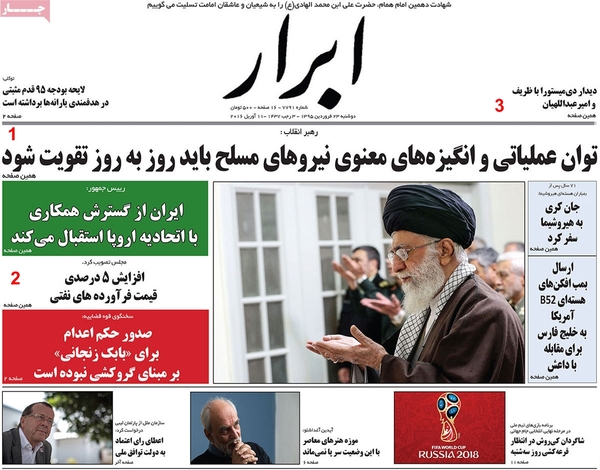
A look at Iranian newspaper front pages on April 11

Iran Newspaper front pages

Abrar:

1- Supreme Leader: Operational capability and spiritual motivations of the Armed Forces should be strengthened day by day.

2- 5% price hike of dairies approved
 

Abrar


Abrar Eghtesadi:


1-    Public budget of government increased by IRR350,000bn

2-    Iranian and Kazakh economic parties sign $1bn memorandum of understanding

3-    Citroen invests in CIPA

4-    Europeans talk with US Treasury about Iran
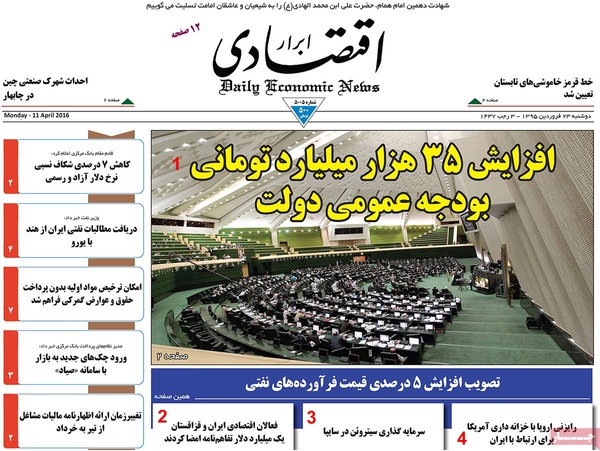
 

Abrar-e Eghtesadi


Afkar:

1-    World largest neurological hospital inaugurated in Iran

2-    Shocking figures on soft drink consumption in Iran

3-    Iran and Kazakhstan sign 49 agreements
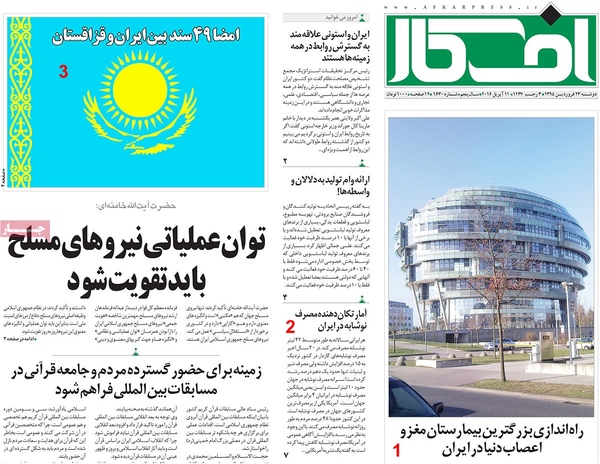
 

Afkar


Aftab:

1-    Spokesman for Headquarters for Combating Drug Trafficking:  Iran is number one in the world in narcotic confiscation

2-    Tangible decline of corruption during Rouhani Administration
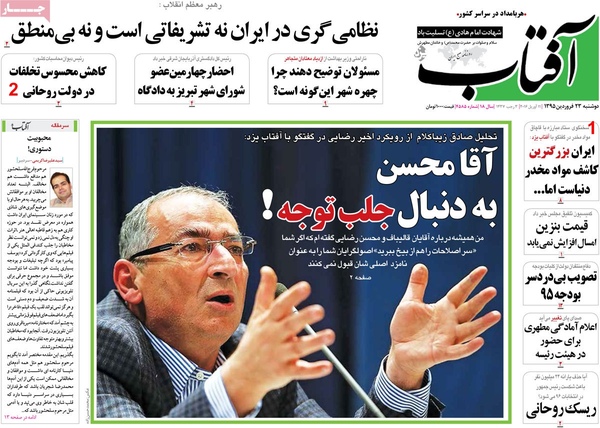
 

Aftab-e Yazd


Asrar:


1-    President Rouhani: Iran welcomes expansion of cooperation with Europe

2-    Supreme Leader: Militarism in Iran is neither formality nor illogical

3-    Iranian Oil Minister: Saudis are not able to boycott Iranian oil tankers

4-    Minister of Culture: We tried our best to encourage those working in Iranian film
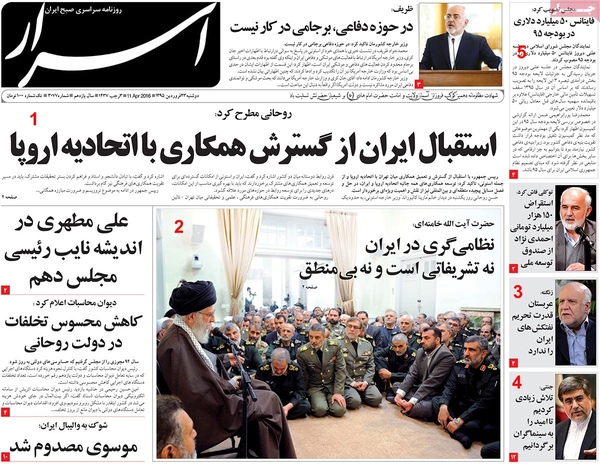
 

Asrar


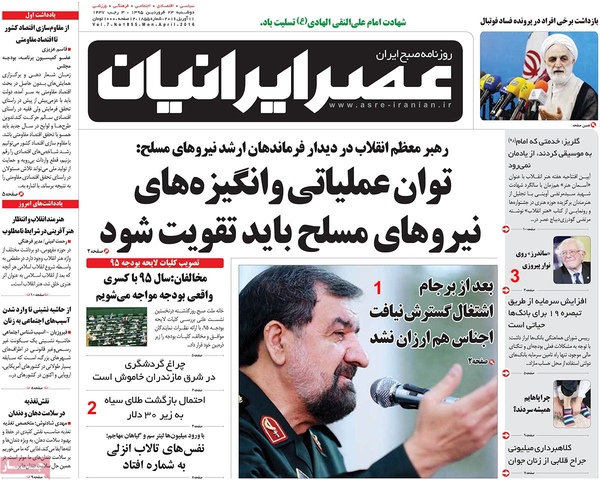
Asre Iranian:

1-    In post-nuclear agreement neither increased employment nor reduced price commodities, says Mohsen Rezaee

2-    Oil price may drop to less than $30 per barrel

3-    Sanders on track for victory
 

Asr-e Iranian


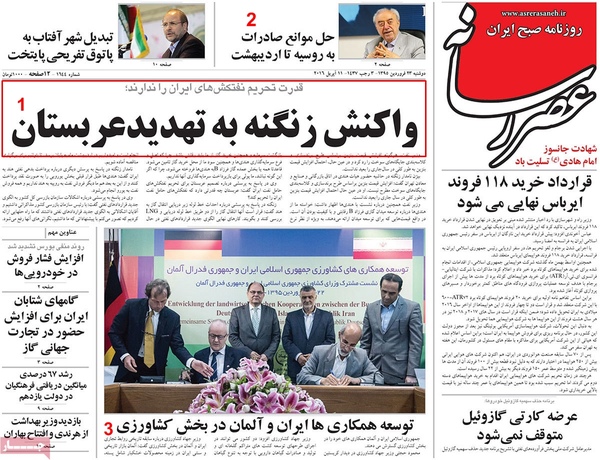
Asre Resane:

1-    Zanganeh reacts to Saudi threat: Saudis are incapable of sanctioning Iranian oil tankers

2-    Obstacles in the way of export to Russia to be removed by next month

3-    Iran and Germany to boost their agricultural cooperation
 

Asr-e Resaneh


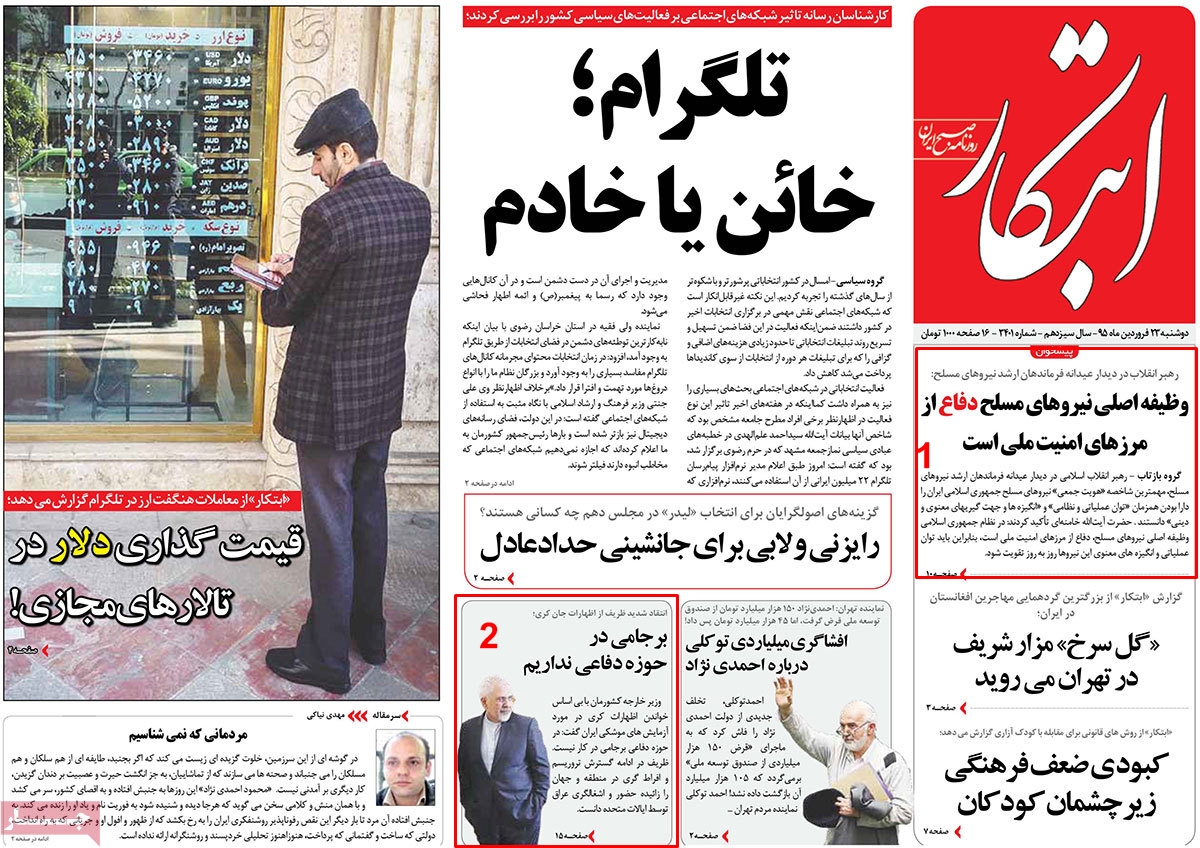
Ebtekar:

1-    Supreme Leader meets military commanders: armed forces to defend national security of borders

2-    Zarif sharply criticizes Kerry: There is no Joint Comprehensive Plan of Action (JCPOA) on defence sector

The Iranian Foreign Minister described John Kerry’s statements on Iranian missile tests as baseless, and said there won’t be a JCPOA on defence. Zarif said the invasion and occupation of Iraq by the US is the main cause of the rise and expansion of terrorism in the world
 

Ebtekar


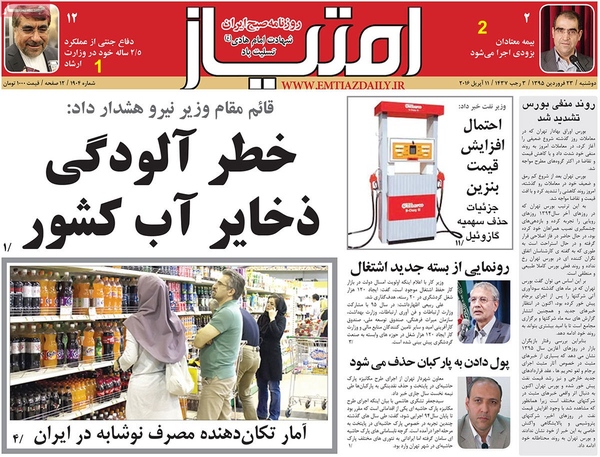
Emtiaz:

1-    Minister of Culture and Islamic Guidance defends his ministry’s performance during his 2.5 year term of office

2-    Minister of Health: Insurance coverage for addicts to become a reality soon
 

Emtiaz


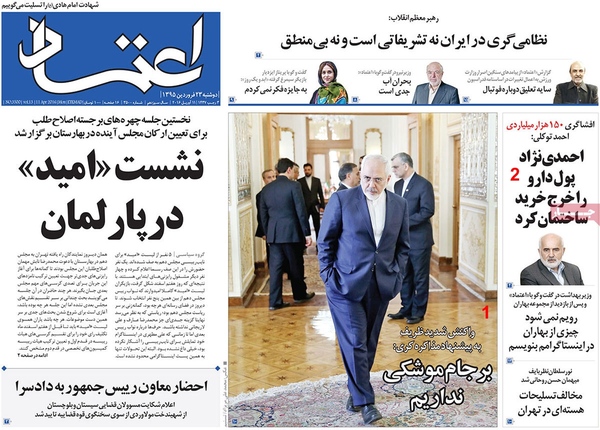
Etemad:

1- Zarif reacts strongly to Kerry’s proposed negotiation: We are not going to have missile JCPOA
 

Etemad


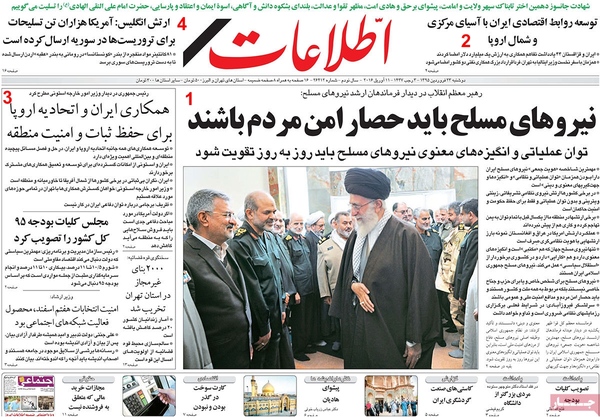
Ettela’at:

1- Supreme Leader: Armed forces should be the safe haven for people

2- Iran to promote its ties with Central Asia and Northern Europe

3-President Rouhani in talks with Estonian Foreign Minister: Iran and Europe should work for stability and security in the Middle East

4- British Army: US has supplied thousands of tons of military hardware to terrorists in Syria
 

Ettela'at


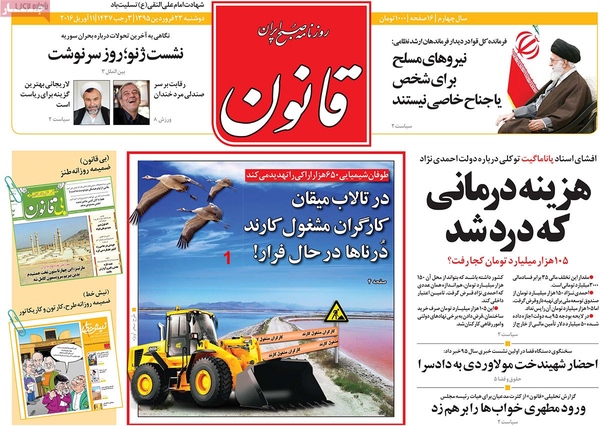
Ghanoon:

1- In Mighan marshland, workers are frightening cranes away
 

Ghanoon


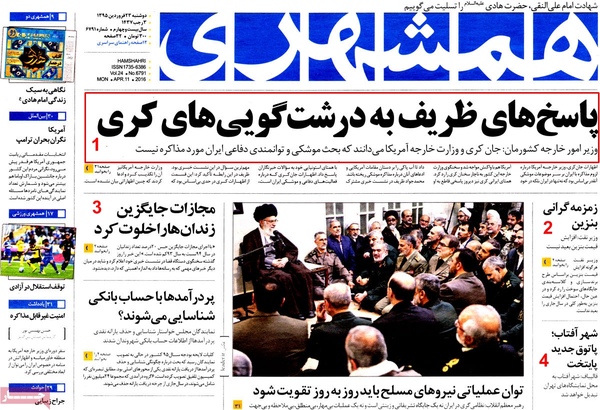
Hamshahri:

1- Zarif responds to Kerry’s tough talk: US Secretary of State knows that our missiles and defense capability are non-negotiable

2- Whispers about petrol price hike: Minister of Petroleum says petroleum price increase is not implemented

3- Alternative punishment has resulted in decline in number of inmates in prisons

4- Shahr e Aftab (City of Sun) a new resort for the capital
 

Hamshahri


Iran:

1- 121 people are in custody in connection to Saudi Embassy attack

2- Parliament approves budget bill generalities for current Iranian year

3-    Supreme Leader: Armed Forces do not belong to any particular individual or faction

4-    Minister of Culture: Government advocates freedom of speech and beyond
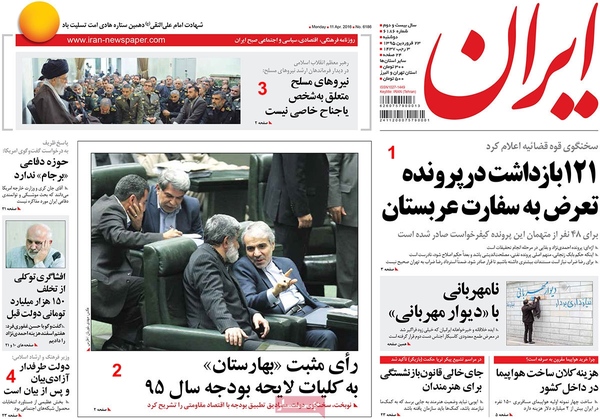
 

Iran


Javan:

1- Supreme Leader: Ideological, spiritual and effectiveness are three features of Iranian Armed forces
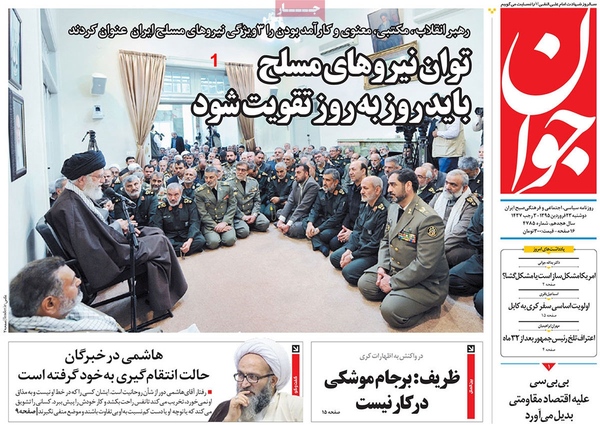
 

Javan


Jomhouri Eslami:

1- Dr. Zarif slams baseless comments by John Kerry

Kerry’s claim about Iranian support for terrorism is baseless, and no one in the world pays any attention to such claims. If the US is serious about defence issues it should first stop supplying weapons which are used for killing Yemeni people.

2- Israel asks for expansion of ties with Saudi Arabia and Jordan

3- Iraqi Police confirms supply of weapon by US to ISIS

4- Terrorists in Syria use chemical weapons against Kurds
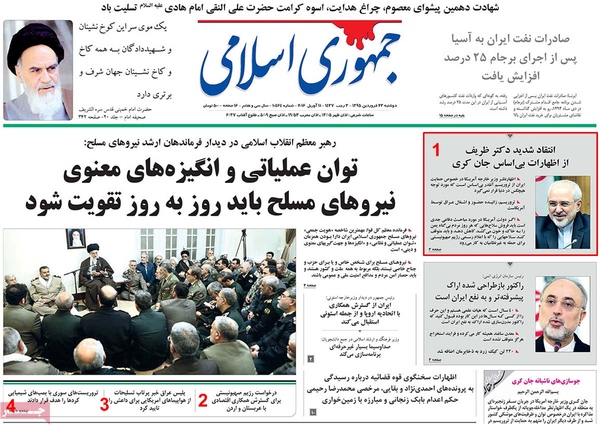
 

Jomhouri Eslami


Resalat:

1- Democracy is sacrificed in US Presidential election: votes by leaders of Democrat Party overrules popular vote

2- Mohsen Rezaee: Creating mirage about nuclear agreement resulted in economic recession
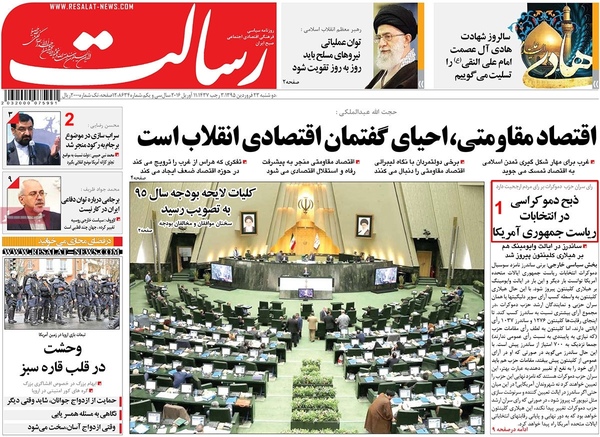
 

Resalat


Shahrvand:

1- Foreign Minister: Americans have accepted that missile activities are separate from JCPOA
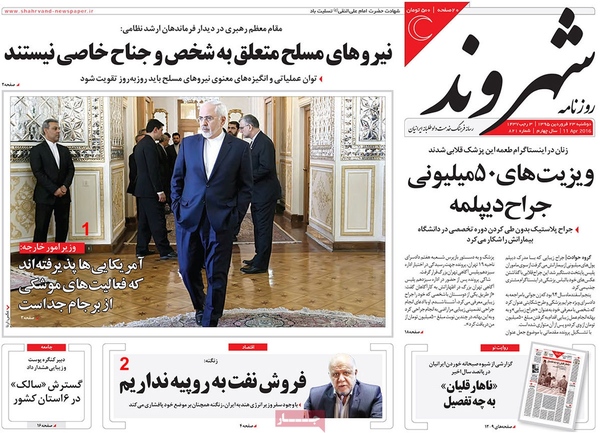
 

Shahrvand


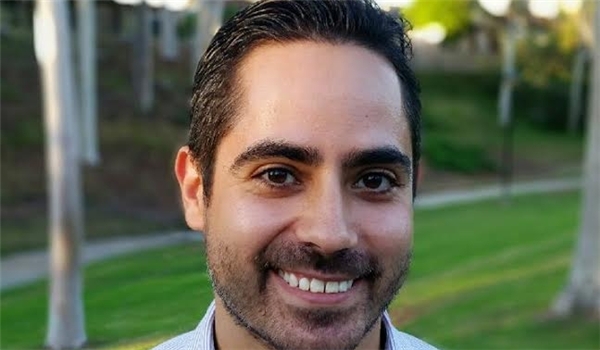
Dr. Nathan Gonzalez: “Wahhabi” Approach Is One that Does Not Respect Cultural Heritage

“As for the ancient ruins of Syria and Iraq, we have to remember that the ‘Wahhabi’ approach is one that, in general, does not respect cultural heritage. We saw that with the Taliban, blowing up Buddha statues in Afghanistan, and with Saudi religious authorities trying to destroy the Prophet Muhammad (PBUH)’s mausoleum in Medina,” said Dr. Nathan Gonzalez in an interview with Fars News Agency.

“Decapitations and crucifixions are unfortunately also a fact of life in Saudi Arabia. So we are talking something bigger, and more established, than just ISIL,” he added.

Dr. Gonzalez, a Middle East analyst with the Foreign Policy in Focus think-tank and a Huffington Post blogger, also maintains that the Muslim world should play a role in exposing the Westerns “to the more uplifting aspects of the religion” so that the US and European public wouldn’t judge Muslims and their beliefs on the basis of the cruel actions of ISIL terrorists.

Nathan Gonzalez, a part-time lecturer of political science at the California State University, Long Beach, is the author of the book “Engaging Iran: The Rise of a Middle East Powerhouse and America’s Strategic Choice.”

FNA talked to Dr. Nathan Gonzalez about the growth of ISIL network in the Iraqi and Syrian cities, their criminal campaign of mass killing and beheading the non-Muslims, destroying the ancient sites and raping the women and the tides of the anti-ISIL coalition.

Q: The anti-ISIL coalition, which the United States and its NATO and Arab partners have spearheaded in Iraq and Syria, hasn’t seemingly been able to push the terrorist group back, and as the number of coalition airstrikes on its strongholds amount to 7,000, there’s no sign of ISIL intending to retreat or limit its operations. Where’s the problem coming from? Has the coalition been able to contribute to the weakening of ISIL or has simply failed?

A: We should not discount the capability of ISIL. They are not amateurs. Many of its top-level operatives come from Saddam’s former regime, and they are very effective at limiting the impact of the airstrikes. They do this by blending into populations and forcing a ground confrontation whenever they can. In this the Iraqi volunteer forces and militias have been very important, and will continue to play a critical role. Neither Americans, nor Iranians I believe, want a large US ground presence in Iraq.

Q: The critics of US policy on ISIL say the White House made a strategic mistake by excluding Iran from the talks on how to fight this extremist cult, while Iran is itself a major part of the solution to this problem, with a vested interest in the elimination of ISIL. Does the US government now believe that it would need Iran’s involvement in the efforts to tackle the ISIL threat?

A: I think there is no question the United States and Iran will have to work closer on this. The leaders in both countries would probably prefer not to, because of the historical enmity. But ISIL is a real threat, and the two countries will have to put aside their differences and coordinate on a more intimate level. I said this back when ISIL was called “Al-Qaeda in Mesopotamia.” Back then it would have helped for the United States and Iran to coordinate anti-Takfiri efforts in Iraq more closely. But that is in the past. Today the climate for cooperation is much better, and both sides should try to make the most of it.

Q: There are different reports of Saudi Arabia funding and arming the ISIL militants, or otherwise financing Jabhat al-Nusra, a front with an ISIL-like ideology. However, there was a report on CNN last year that Saudi Arabia had pledged to President Obama that it would host the US efforts to train and equip Syrian opposition forces to fight ISIL. It sounds truly complicated. It was clear from the outset that the Saudis wished to prop up ISIL as an instrument of power to topple Bashar al-Assad. At the same time, they’re in the US-led, 12-nation anti-ISIL coalition operating in Syria. How is it possible?

A: I have not seen evidence of the Saudi government supporting ISIL directly. The problem is rather one of priorities. For America, ISIL is the worst option. But for the Saudis, Assad is the worst option. For this reason the Saudis will probably not be a reliable partner in the fight against ISIL.

Q: The ISIL terrorists have been capturing civilians, beheading foreign nationals, raping and enslaving the young girls and women and destroying historical sites, including the ancient buildings of the city of Palmyra (Tadmur) in Homs Province. Why have they embarked on such unusual and cruel ploys? What’s the reason behind their violent actions, including the destruction of ancient cities and historical buildings?

A: Part of it may be related to their fear-based tactics, which in many ways come from the culture of Saddam Hussein’s former regime, and in other ways proved effective for Al-Qaeda in Mesopotamia’s organization under Abu Mousab al-Zarqawi. We can say a lot of things about Zarqawi’s barbarism, but he was able to have a profound impact on Iraqi politics despite having relatively few people under his command. On a practical level, this type of violence probably makes defections less likely, and it attracts particular type of sociopath from abroad, the kind that has no connection to the locals and has no qualms about killing and raping. As for the ancient ruins of Syria and Iraq, we have to remember that the “Wahhabi” approach is one that, in general, does not respect cultural heritage. We saw that with the Taliban, blowing up Buddha statues in Afghanistan, and with Saudi religious authorities trying to destroy the Prophet Muhammad’s mausoleum in Medina. Decapitations and crucifixions are unfortunately also a fact of life in Saudi Arabia. So we are talking something bigger, and more established, than just ISIL.

Q: ISIL is promoting itself as an Islamic Caliphate. Few people in the West would care whether the ISIL fighters and its leaders are simply a group of radicalized, malignant individuals who might be only Muslims nominally, or are pure Muslims following Quran and the teachings of the prophet. So, they make such generalizations that Muslims are generally fundamentalists, and judge all the Muslims worldwide on the basis of the atrocities of ISIL. Is it possible to deflect this wrong association and enlighten the Western public about the truths of peace-making, peace-loving Islam?

A: Muslims are a very small minority in the United States. So the few things we hear about Islam are often in the form of political turmoil that happens in the name of Islam. Even something as noble as “zakat” has been used by groups like al-Qaeda to fund terrorism, so the negative associations are what get the most exposure. There are of course many voices speaking out to ensure that people get a more realistic view of the faith, but when people are genuinely afraid, it is difficult to have a rational discussion. Perhaps there is a role that Muslim countries themselves can play in exposing Westerners to the more uplifting aspects of the religion.