
The mosque contains the mausoleum of Shah Nematollah Vali, the renowned Iranian mystic and poet. He died in 1431, aged over 100.
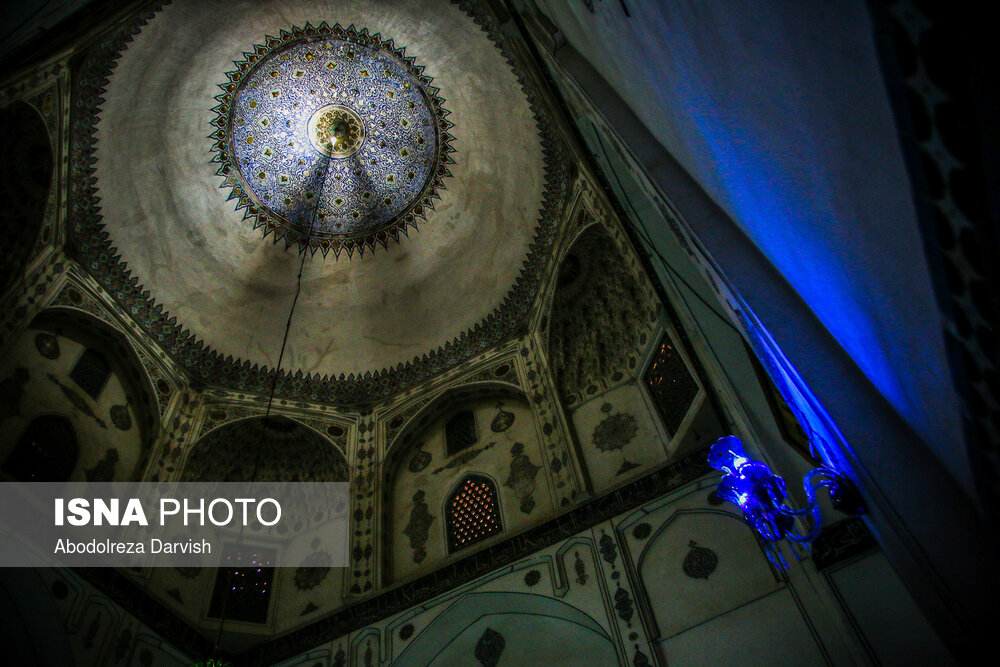
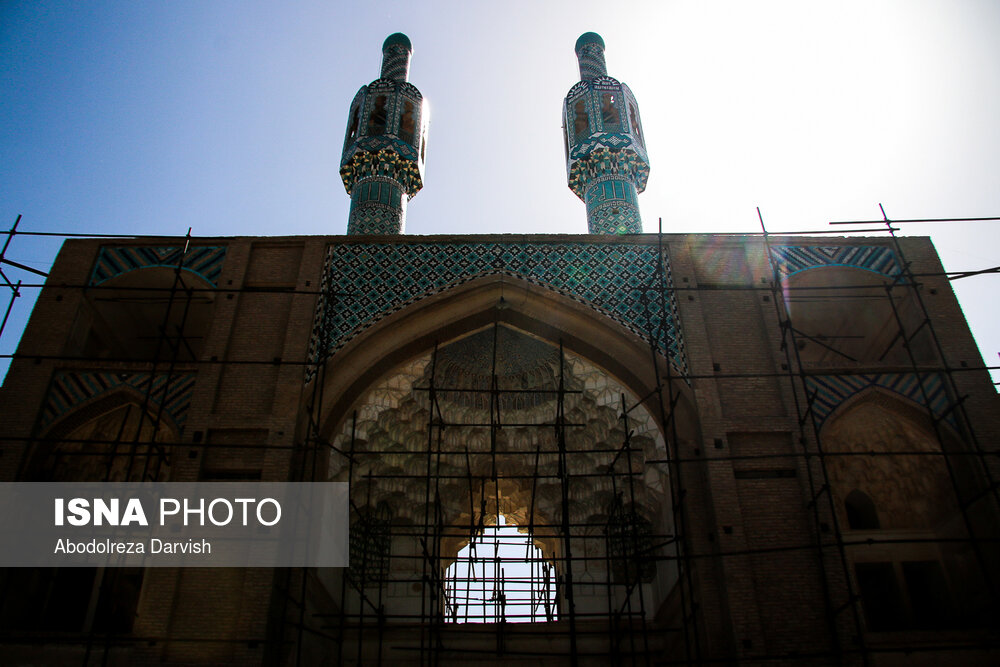
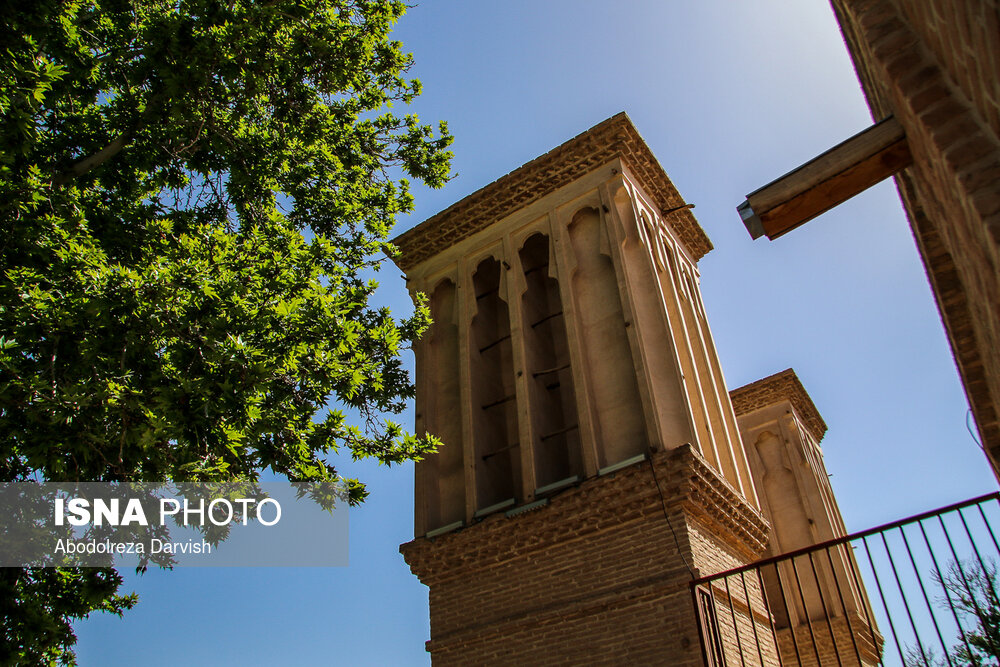
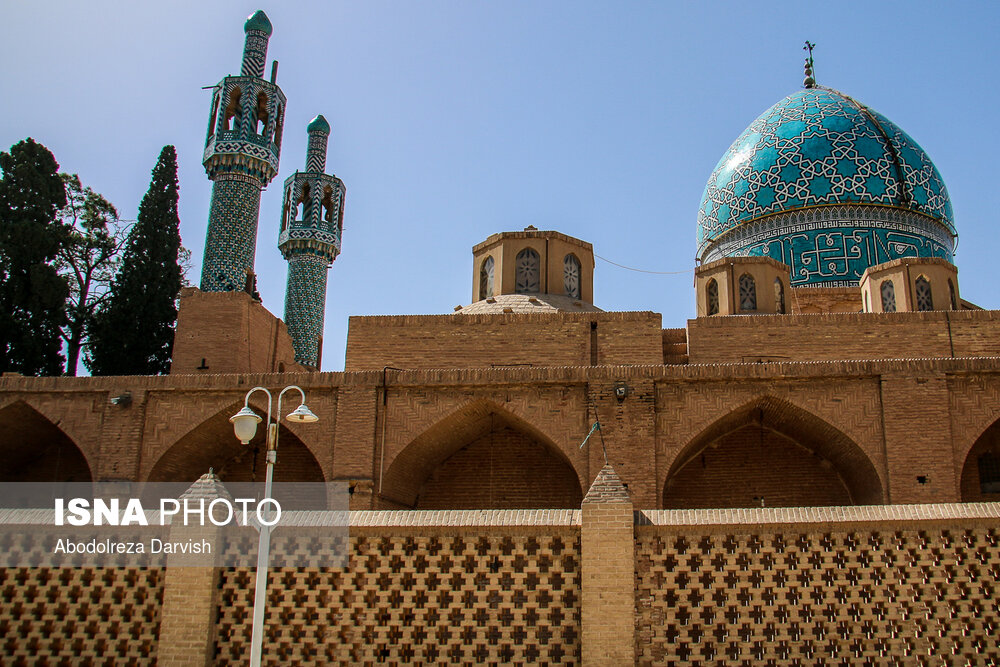
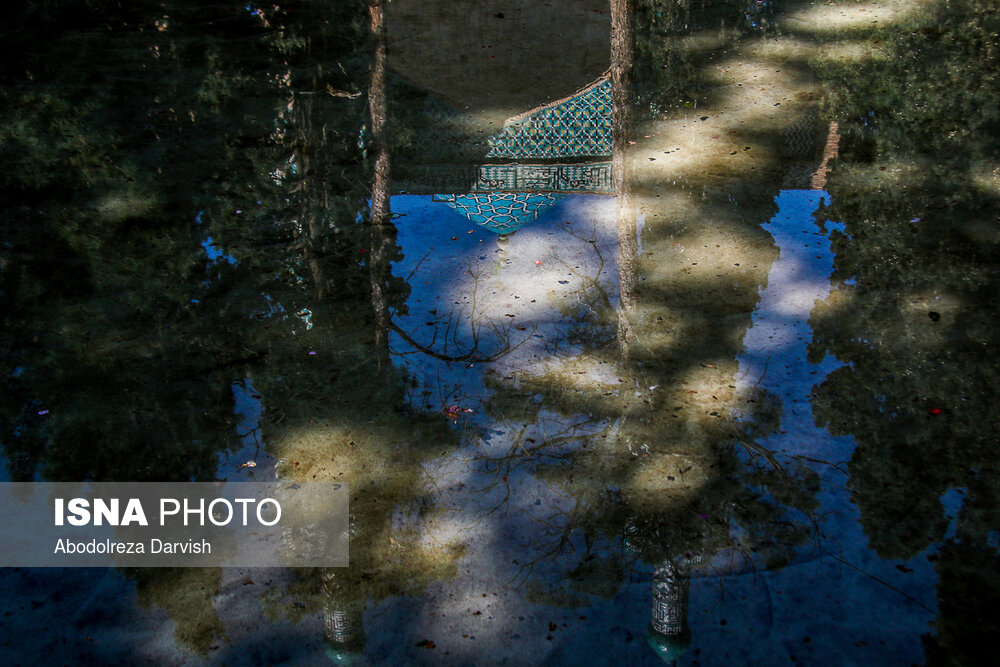
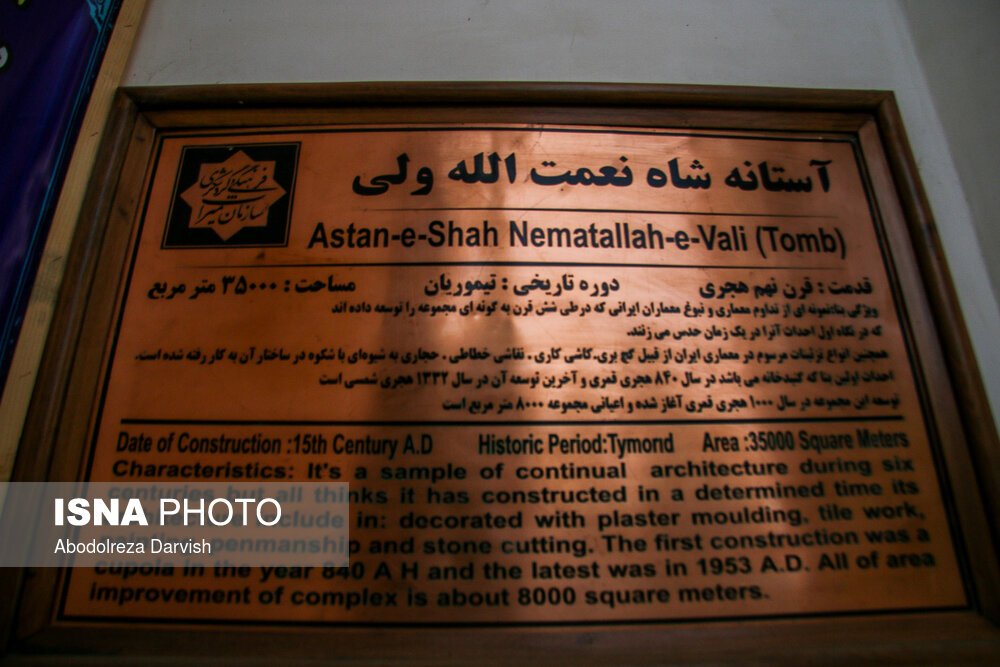


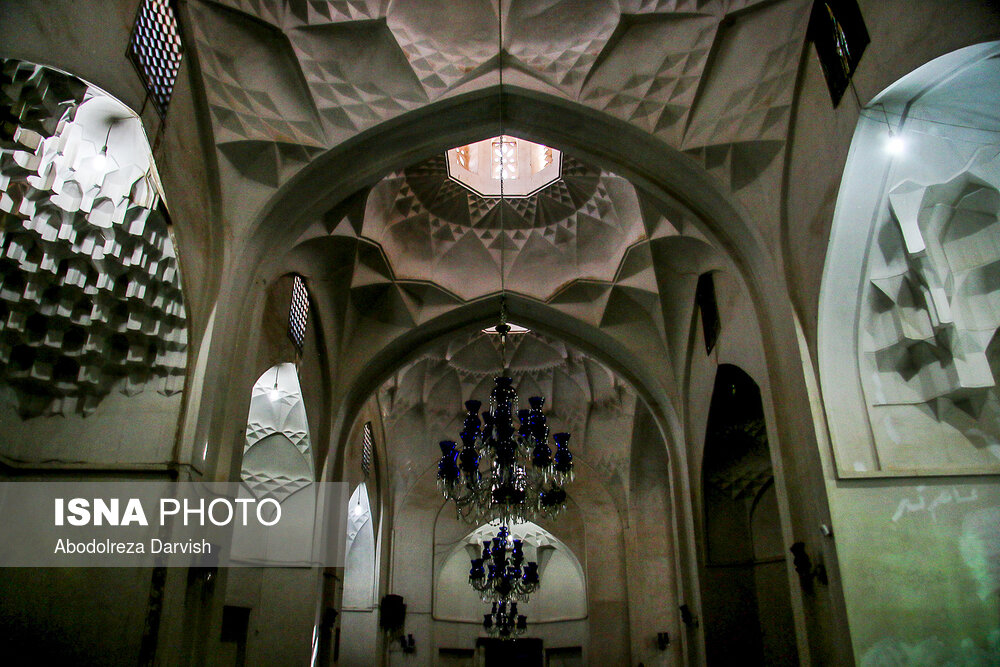
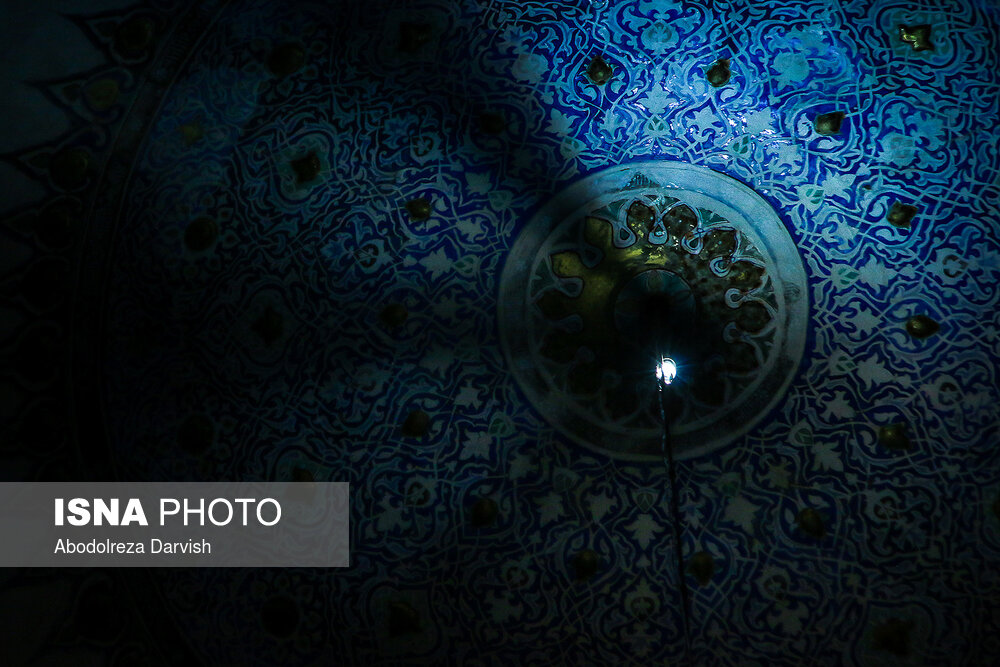
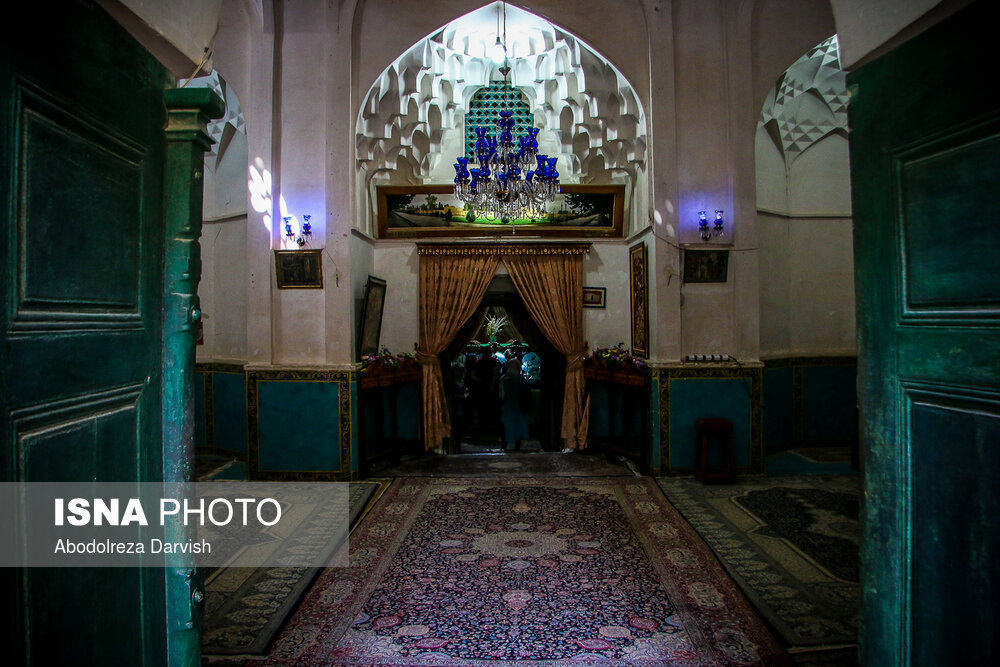
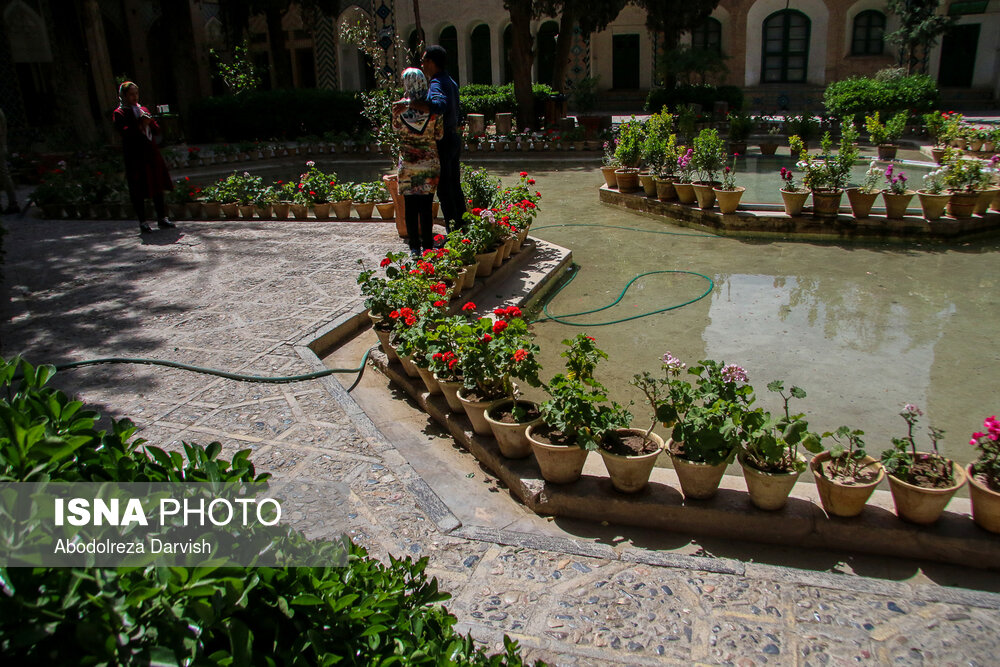

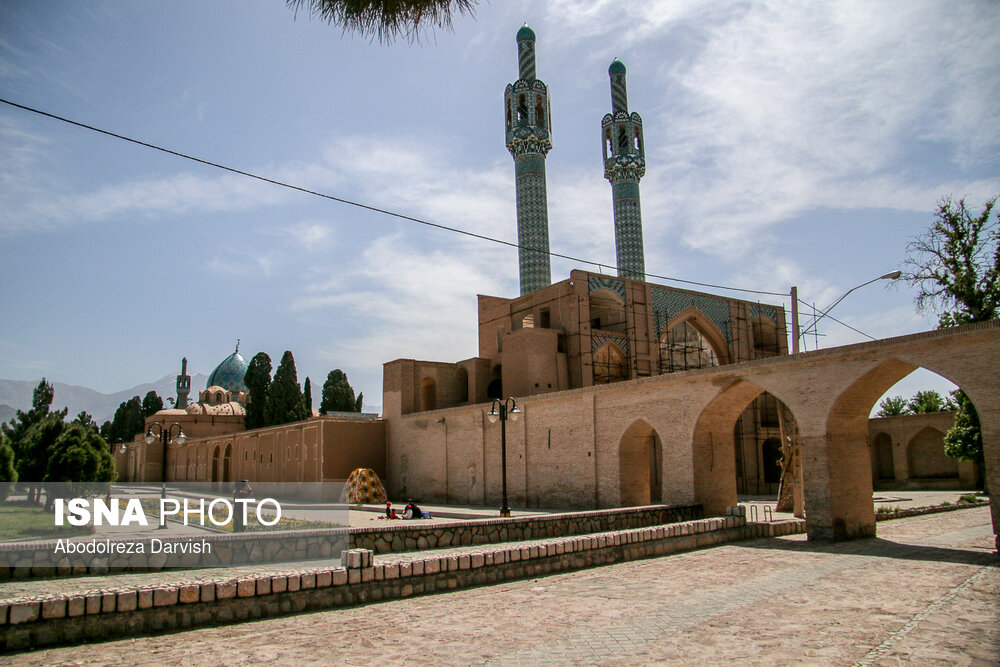
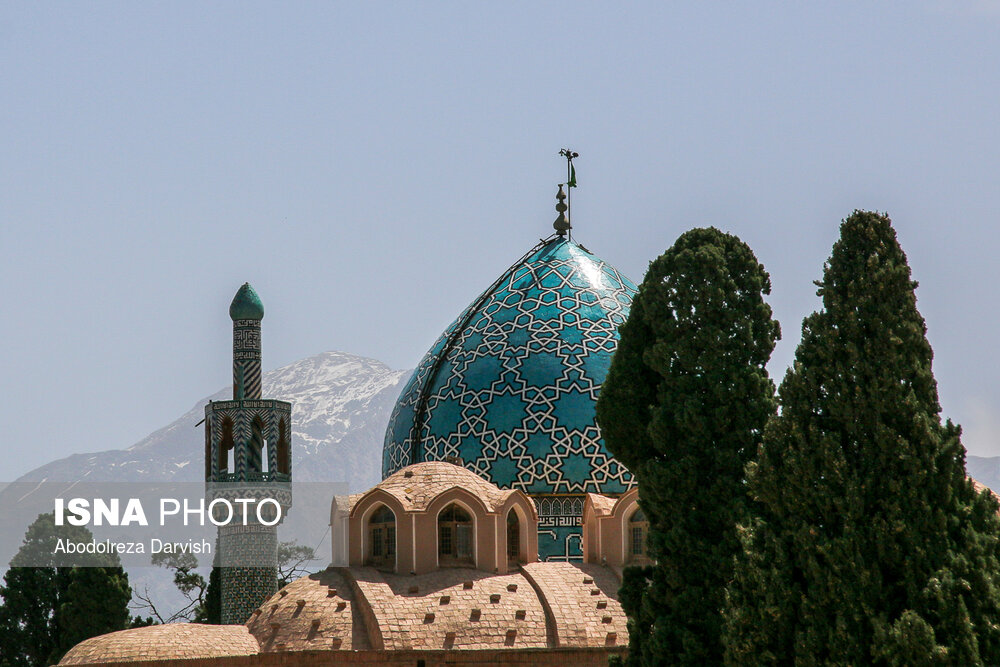
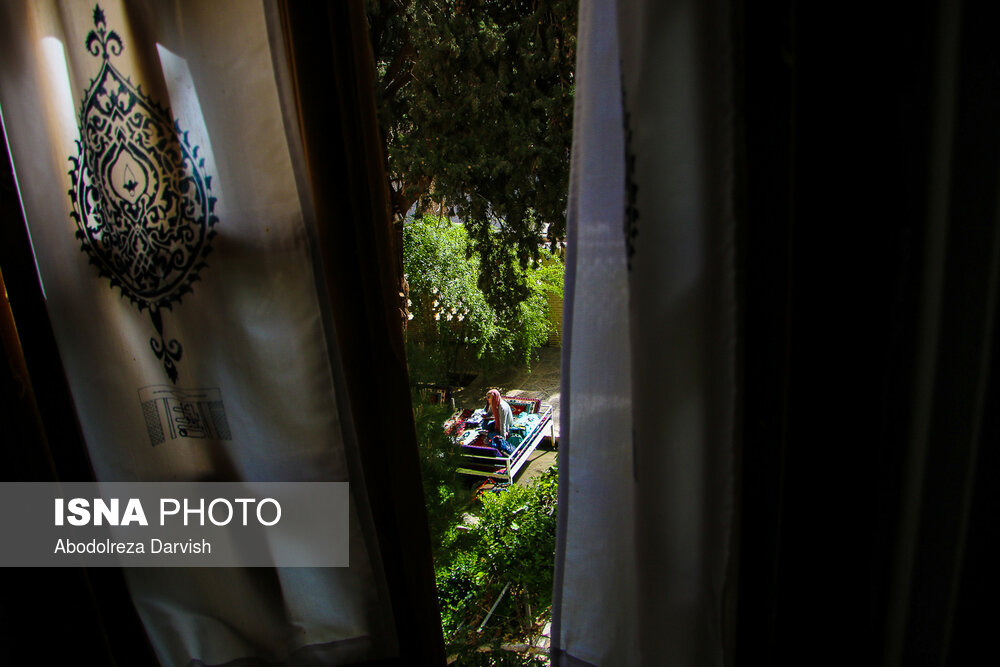
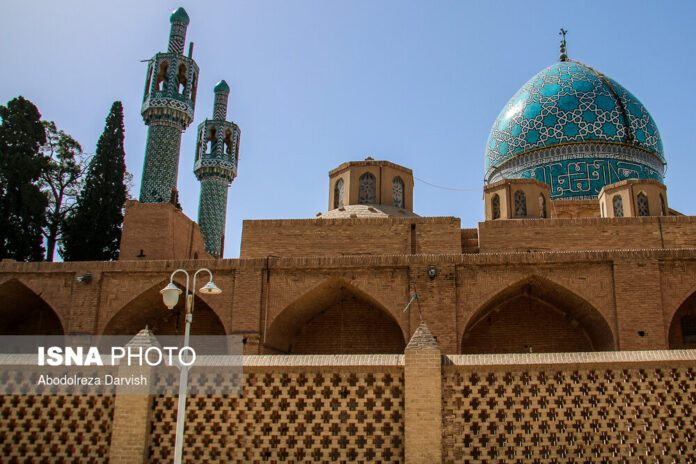
The mosque contains the mausoleum of Shah Nematollah Vali, the renowned Iranian mystic and poet. He died in 1431, aged over 100.

Recent remarks by the Leader of the Islamic Revolution, Ayatollah Seyed Ali Khamenei, on the need for establishment of an Islamic civilization and its features were widely covered by Iranian press on Tuesday.
The US confiscation of Iranian assets and the reactions are still a hot topic across all newspapers. The Iranian government has vowed to reclaim the money, and different factions are trying to pin the blame on each other.
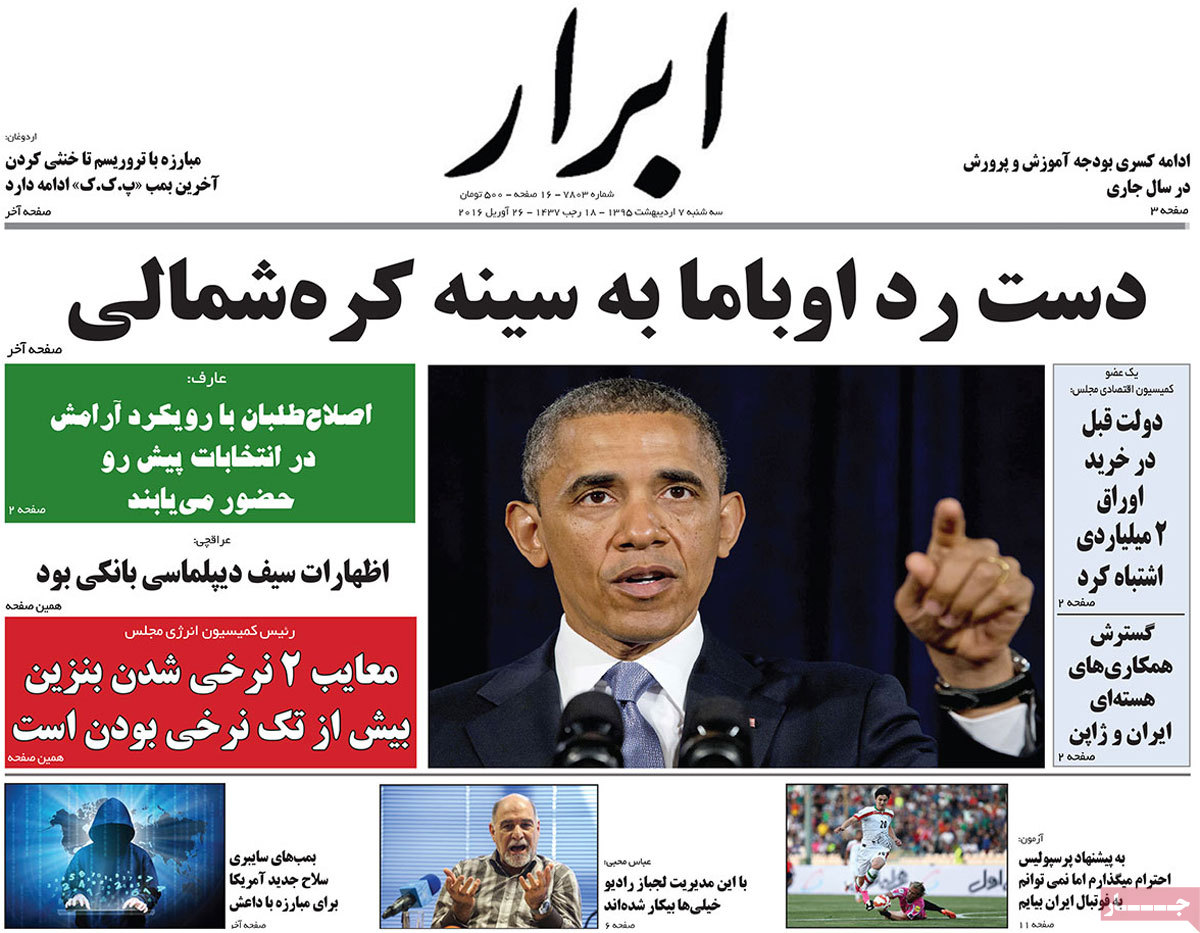
Abrar:
1- Iran and Japan to Expand Nuclear Cooperation
2- Fight against Terrorism to Continue until Last PKK Bomb Defused: Erdoğan
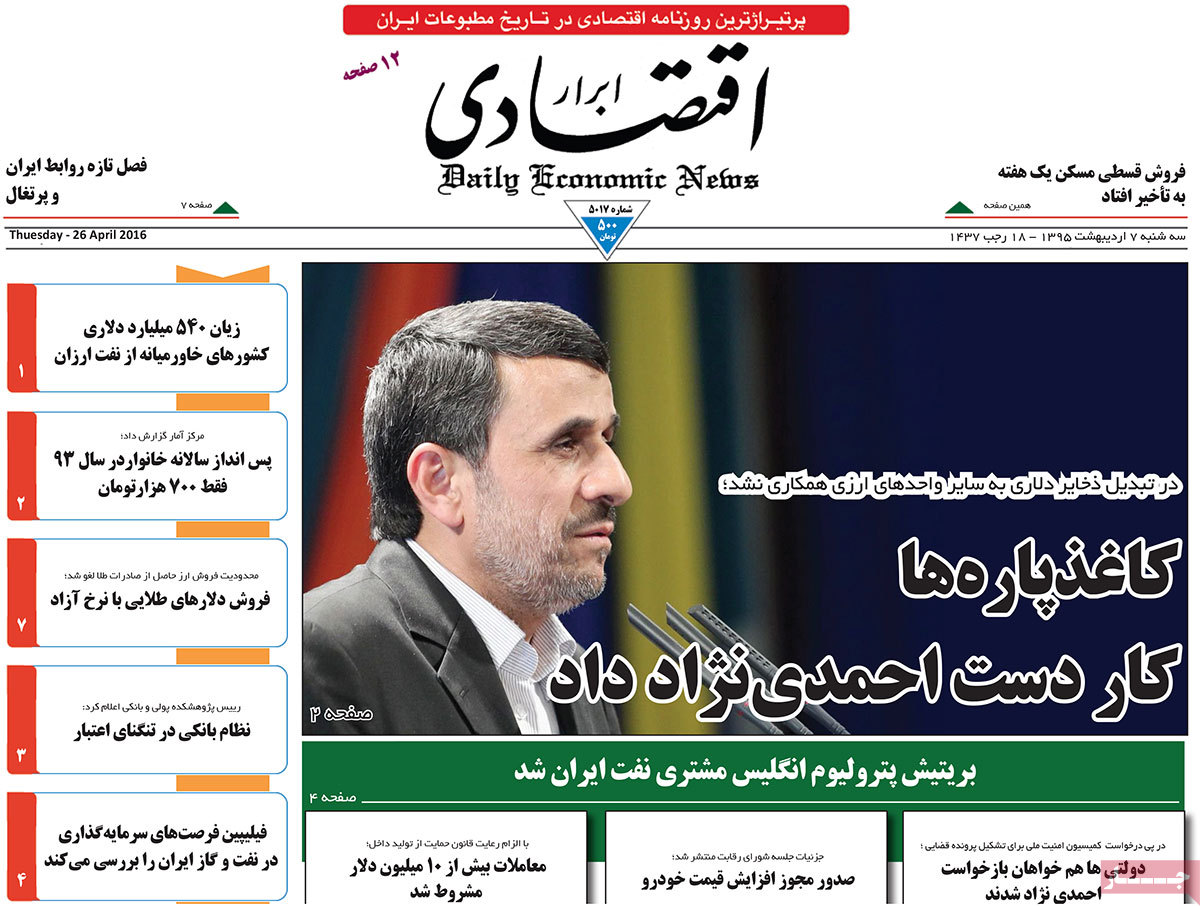
Abrar-e Eqtesadi:
1- BP to Buy Iran’s Crude Oil
2- Iranian Parliament and Gov’t Stress Ahmadinejad’s Accountability over US Seizure of Iranian Assets
3- Philippines Considering Opportunities to Invest in Iran’s Oil and Gas
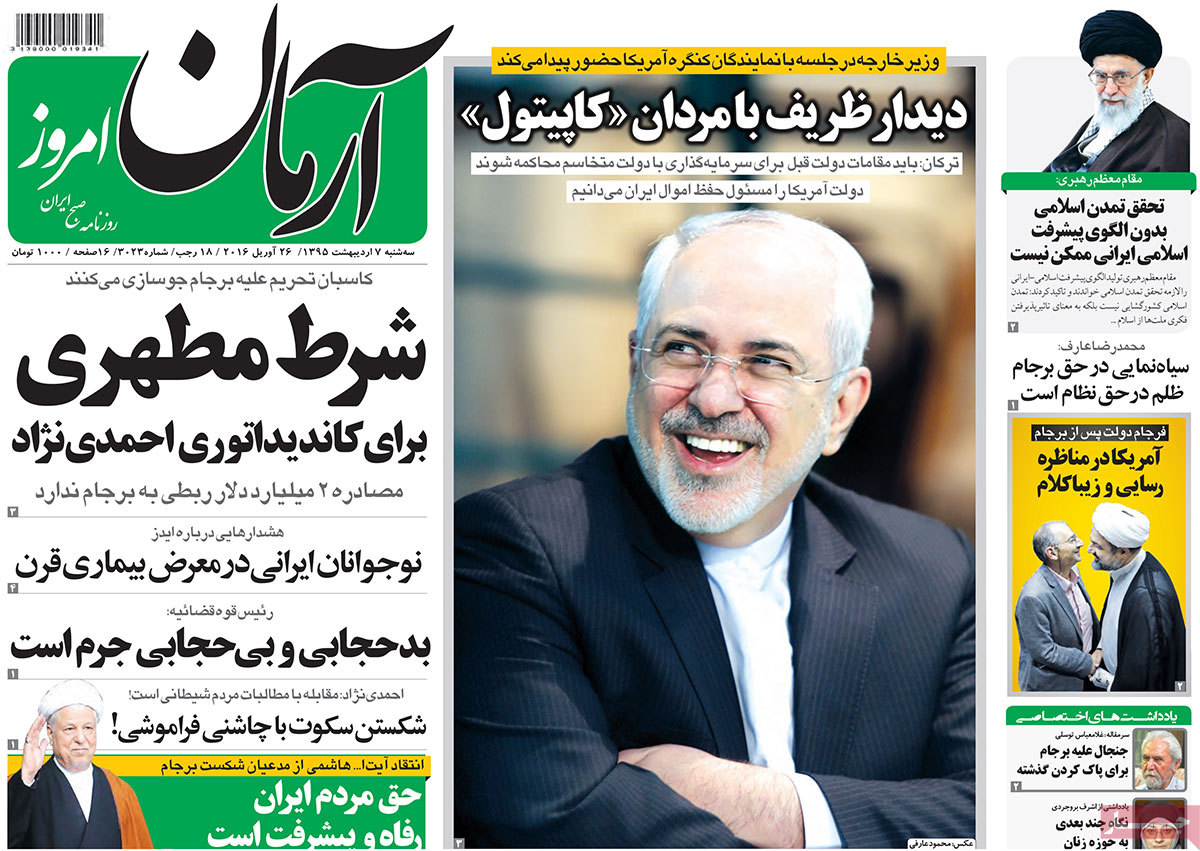
Arman-e Emrooz:
1- FM Zarif’s Meeting with Men of US Capitol
2- Ahmadinejad Gov’t Officials Should Be Prosecuted for Investing in Hostile Country: Advisor
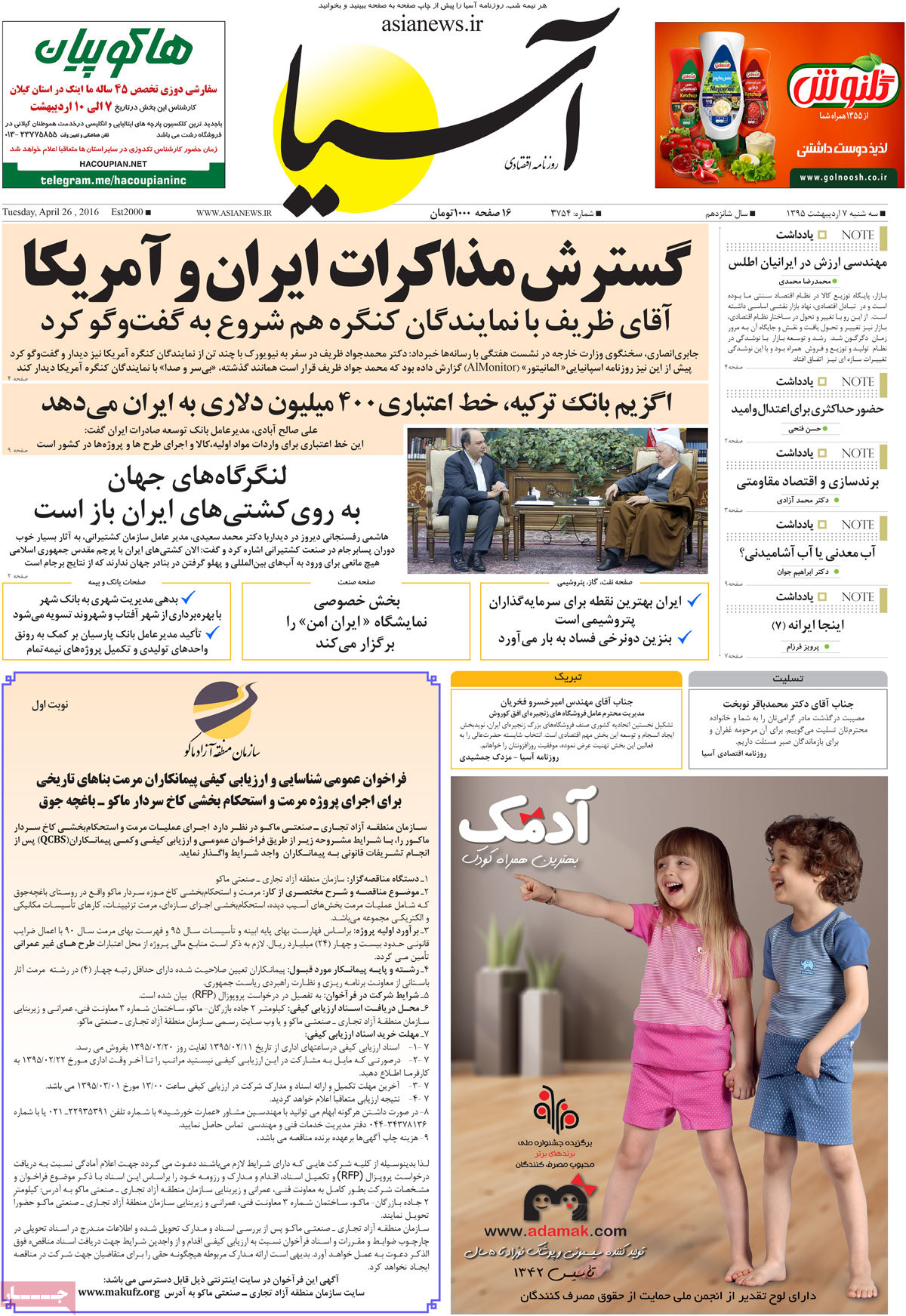
Asia:
1- Turkey’s Eximbank to Establish $400m Credit Line for Iran
2- Iran Private Sector to Hold “Safe Iran” Exhibition
3- World Ports Open to Iran’s Ships
4- Expansion of Iran-US Negotiations: Zarif Starts Talks with Congressmen
5- Iran Best Spot for Petchem Investments
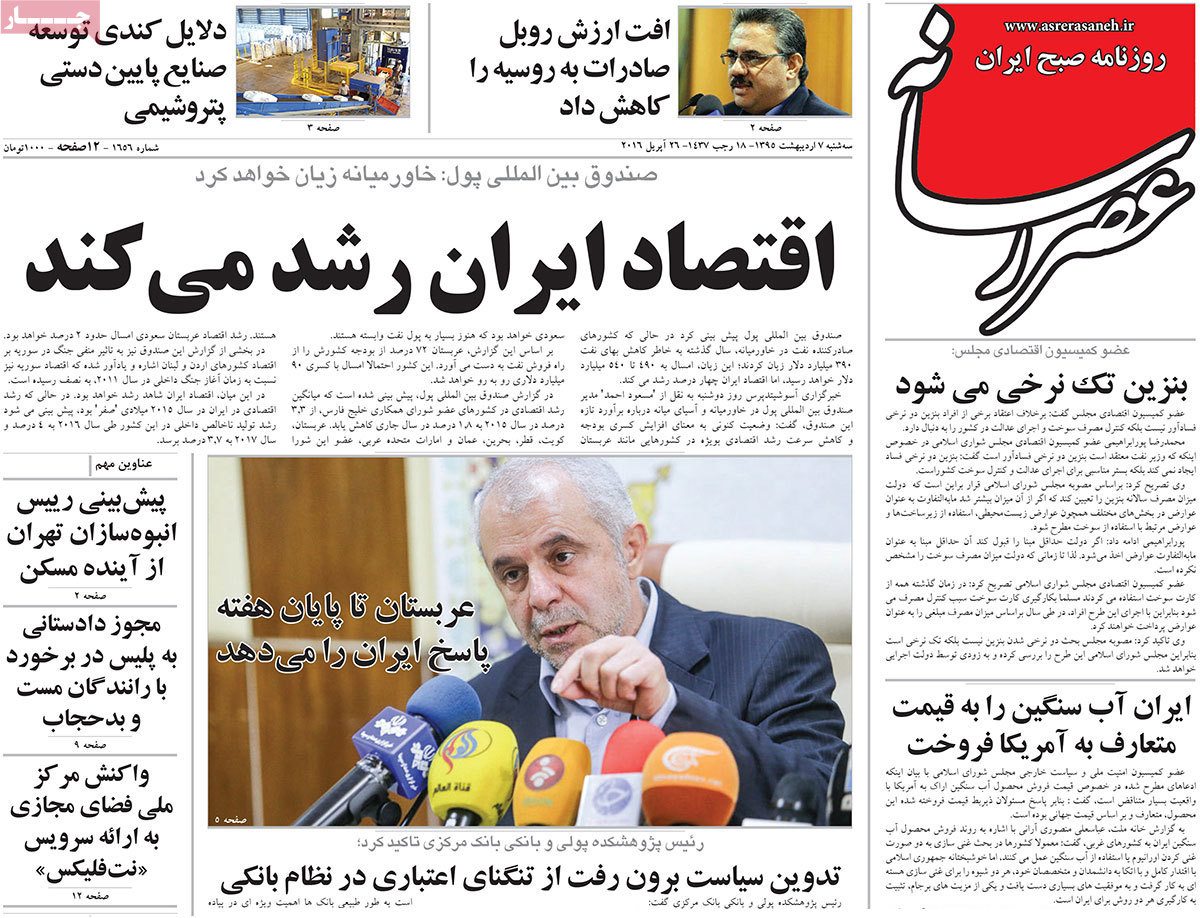
Asr-e Rasaneh:
1- Iran Sells Heavy Water to US at Conventional Price
2- Iran Cyberspace Centre Reacts to Opening of Netflix to Iranian Users
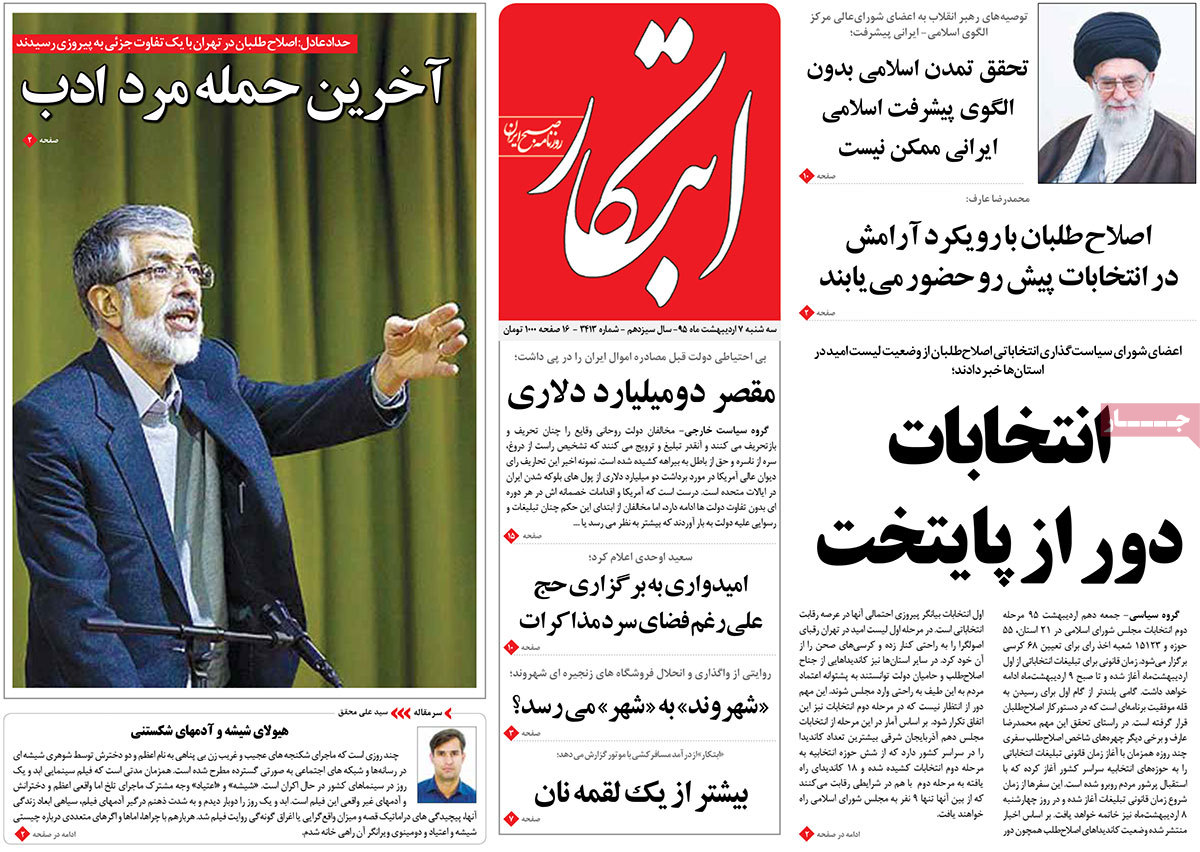
Ebtekar:
1- Iran Hopeful about This Year’s Hajj despite Cold Talks with Saudis
Emtiaz:
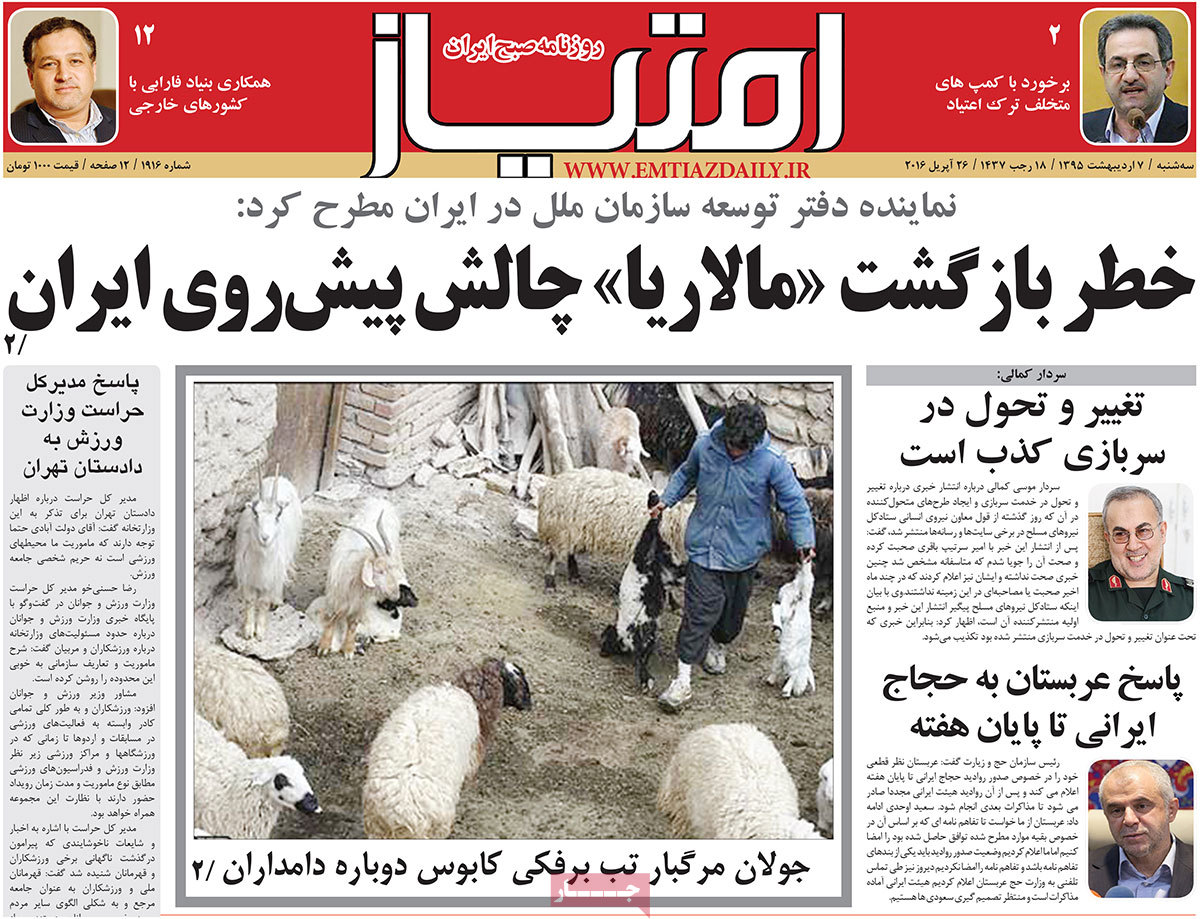
1- Iran in Danger of Malaria Return: UNDP Officer
Etemad:
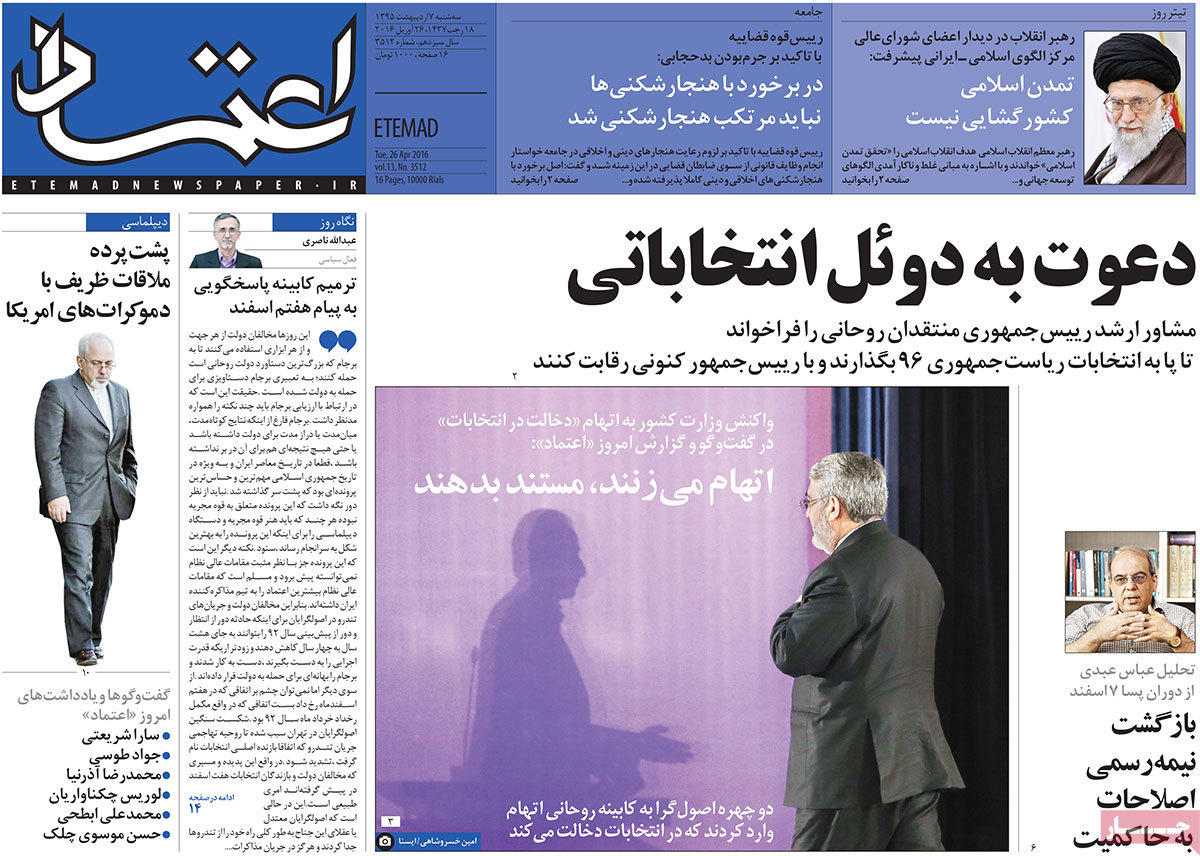
1- Islamic Civilization Has Nothing to Do with Expansionism: Leader
2- Behind the Curtains of Zarif’s Meeting with US Democrats
Ettela’at:
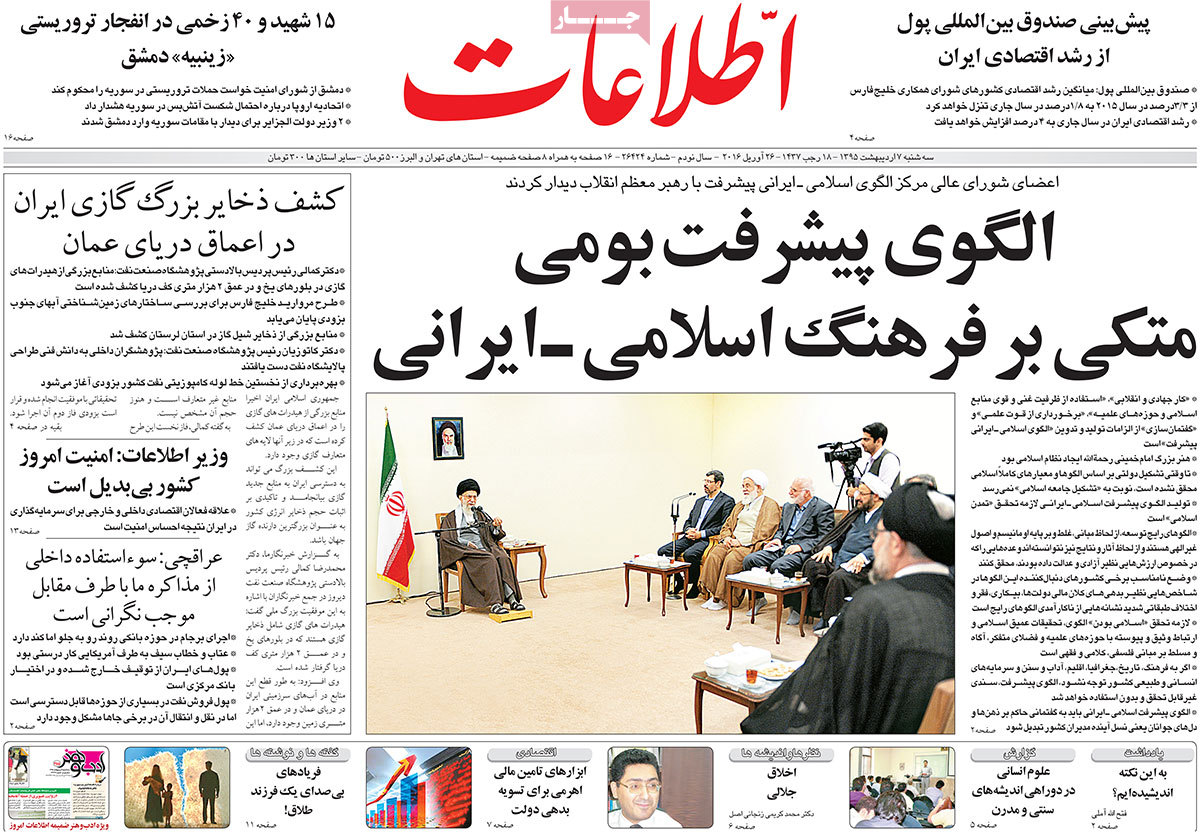
1- Leader Outlines Local Progress Model Based on Iranian-Islamic Culture
2- IMF: Iran’s Economic Growth Rate to Increase to 4% This Year
3- 15 Killed, 40 Wounded in Terrorist Attack near Sayyidah Zaynab Shrine in Damascus
4- Iran Discovers Huge Reserves of Gas Hydrates in Sea of Oman, Shale Gas in Lorestan
Ghanoon:
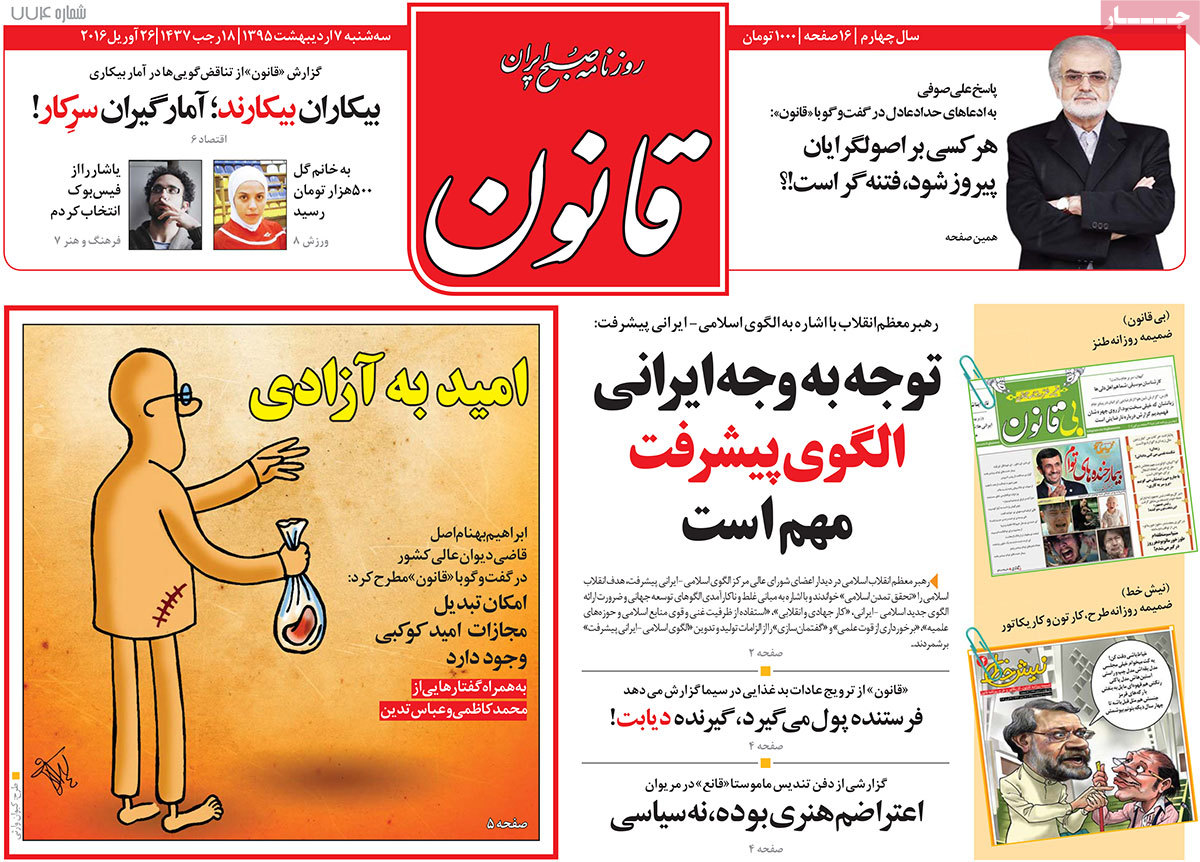
1- Hope (Omid) for Freedom: Possible to Change Imprisoned Scientist Omid Kokabi’s Sentence
2- Kurdish Artist Who Buried His Sculpture: My Protest Was Artistic, Not Political
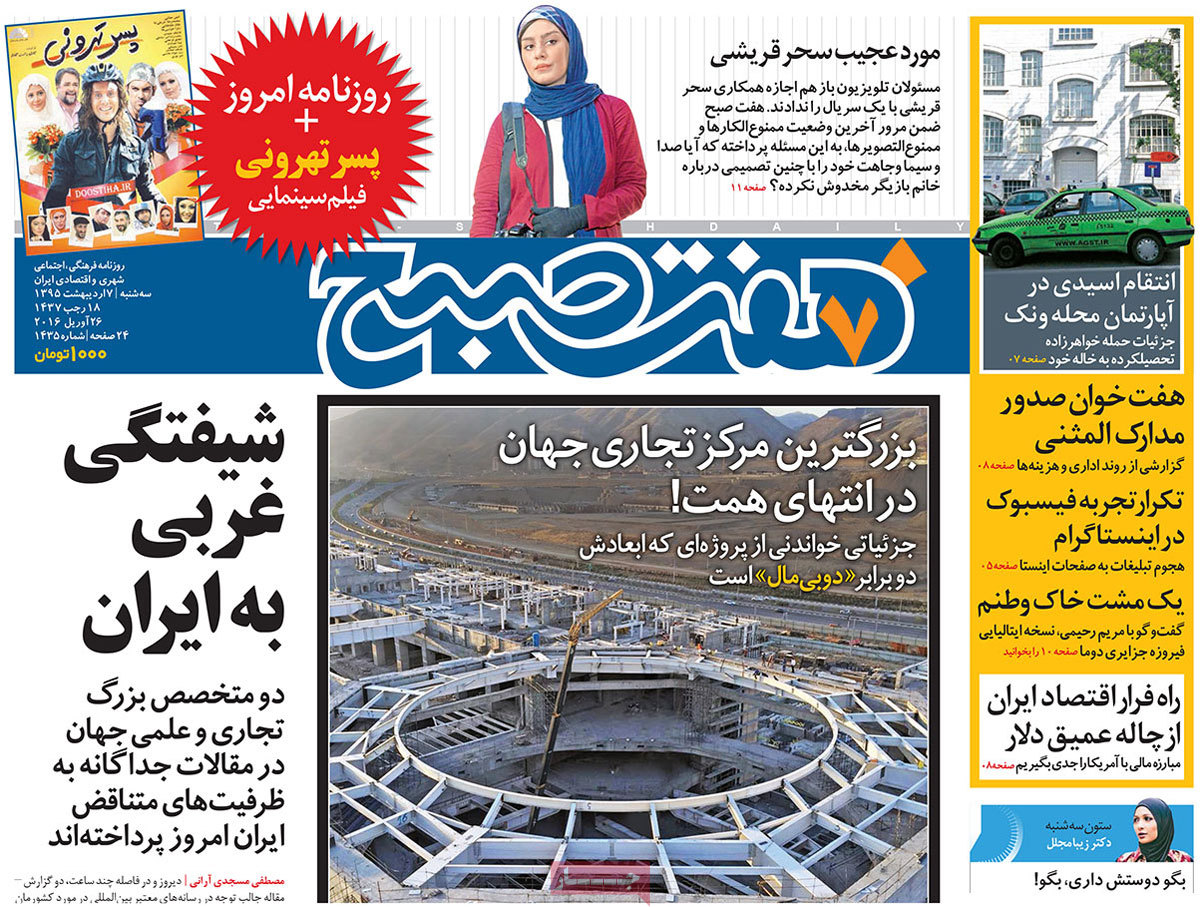
Hafte Sobh:
1- World’s Largest Mall in Tehran: A Project Two Times Bigger than Dubai Mall
2- Western Infatuation with Iran: Int’l Trade Experts Discuss Iran’s Contradictory Capacities
3- Iran Should Take Commercial Fight against US Dollar Seriously
A Route for the Iranian Economy to Escape from the Dollar’s Deep Hole
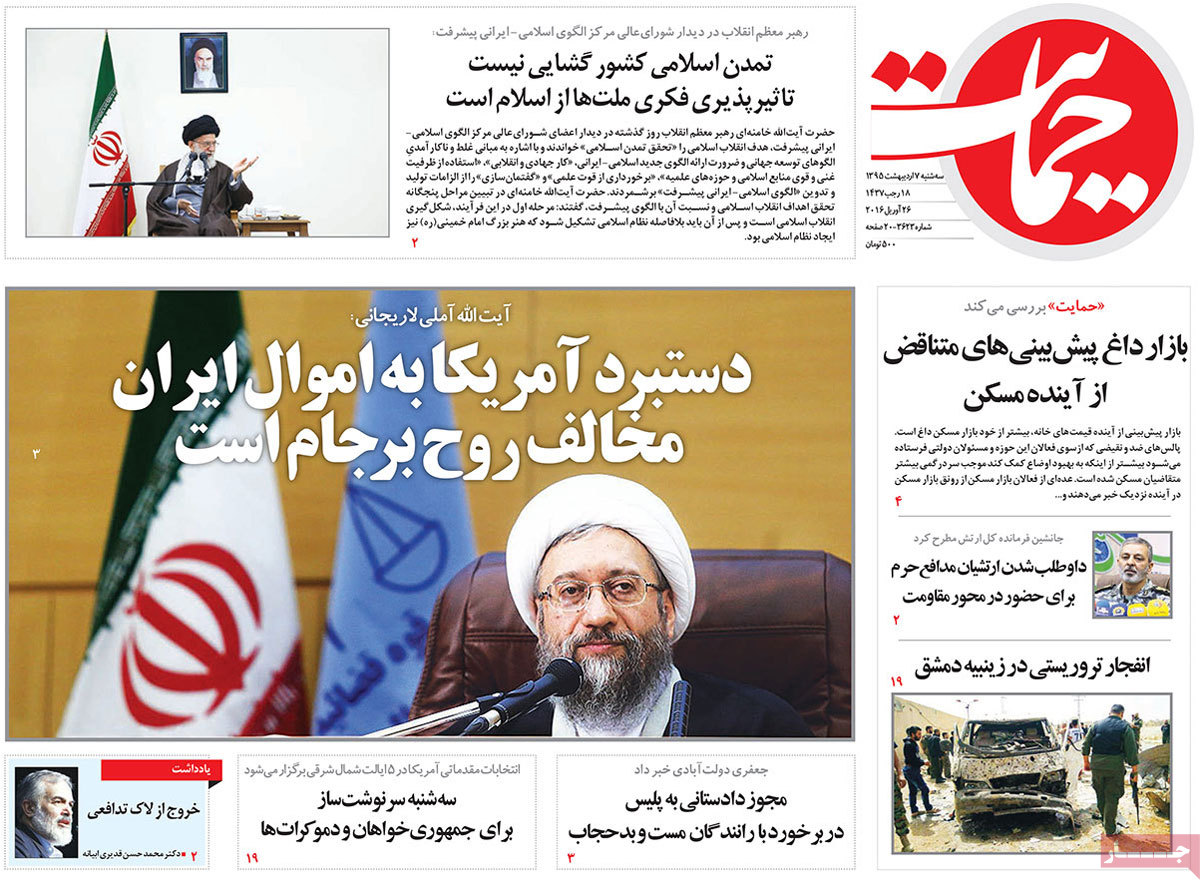
Hemayat:
1- US Confiscation of Iran’s Property against “Spirit of JCPOA”: Judiciary Chief
2- Army Forces Volunteering to Fight Daesh in Syria: Deputy Commander
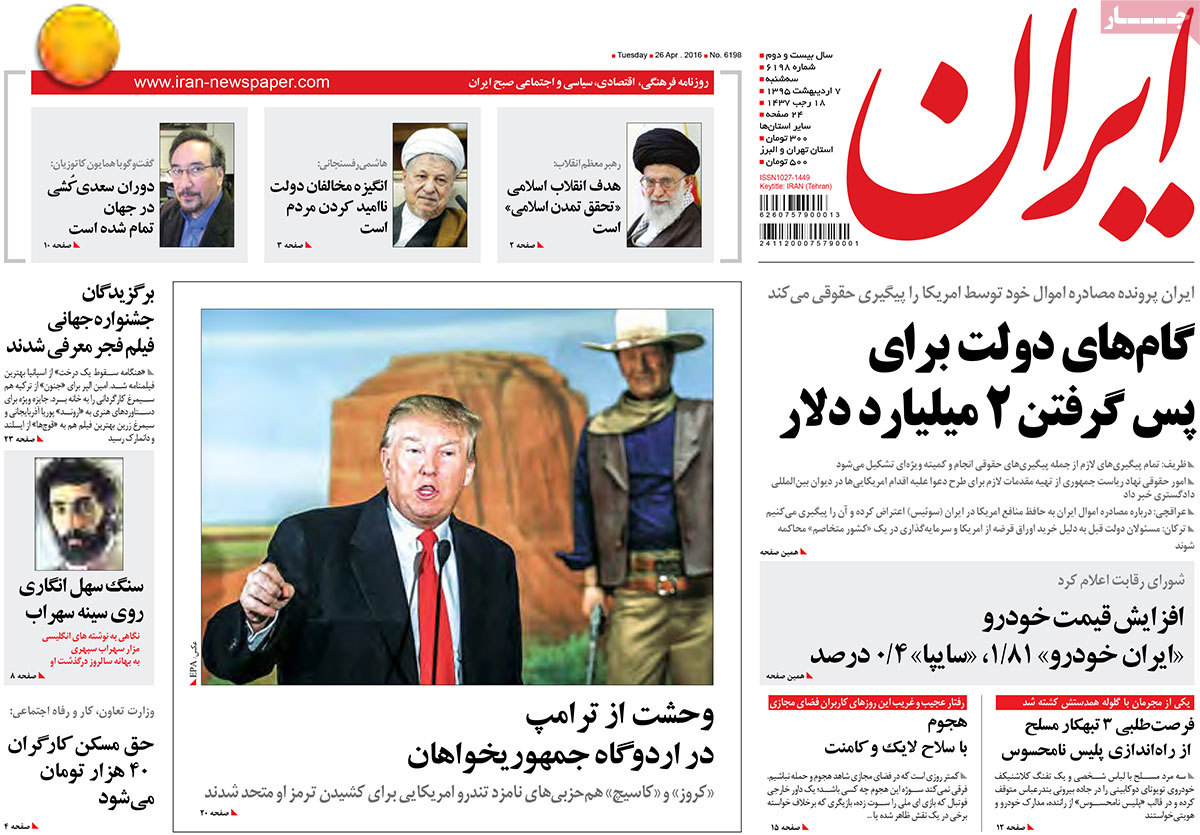
Iran:
1- Iran to Legally Pursue Seizure of Its Assets by US
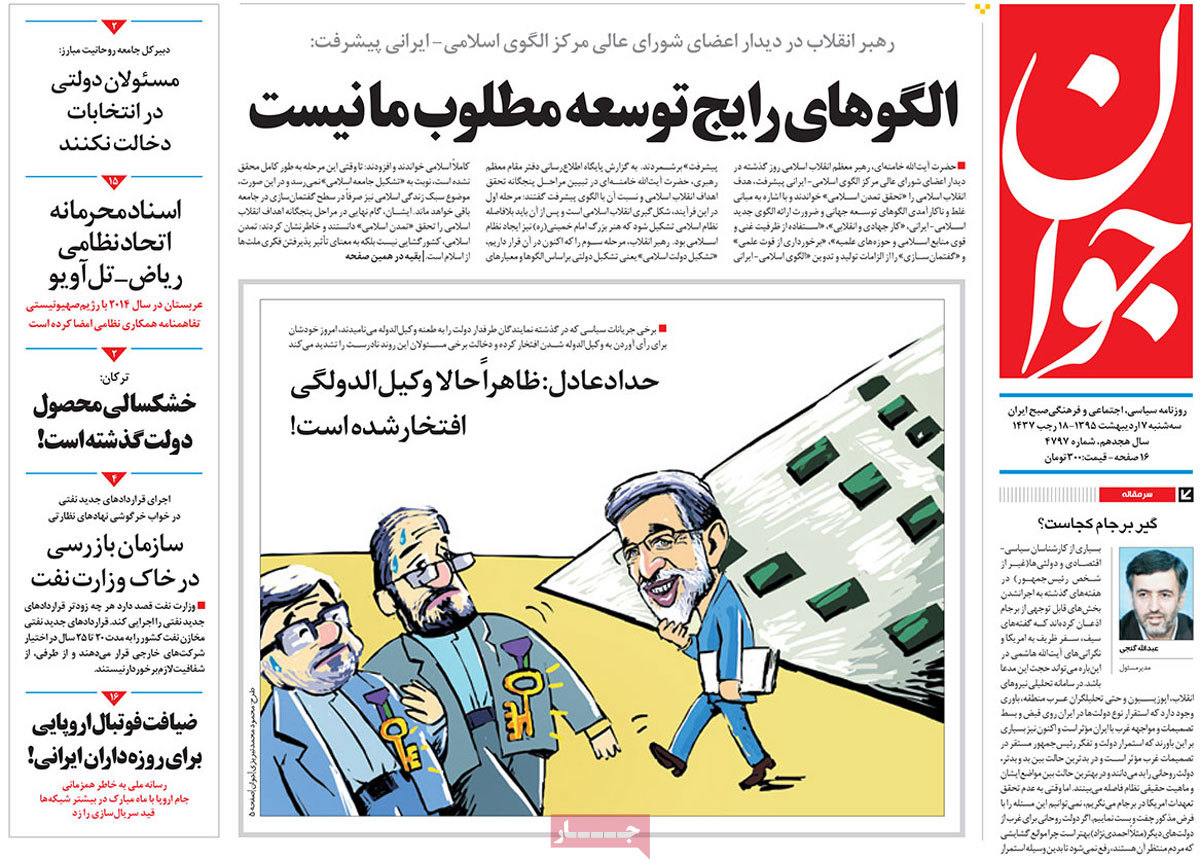
Javan:
1- Secret Documents on Riyadh-Tel Aviv Military Alliance
2- Iran’s State TV to Air Euro 2016 Football Matches Instead of Regular TV Series in Ramadan
(IRIB used to produce several TV series to air during the holy Islamic month of Ramadan when Muslim people fast all day. This year, however, most likely because of financial problems, it seems that it prefers to avoid spending money on TV productions and instead, show the Euro 2016 games, due to begin on June 10, 4th of Ramadan).
Jomhouri Eslami:
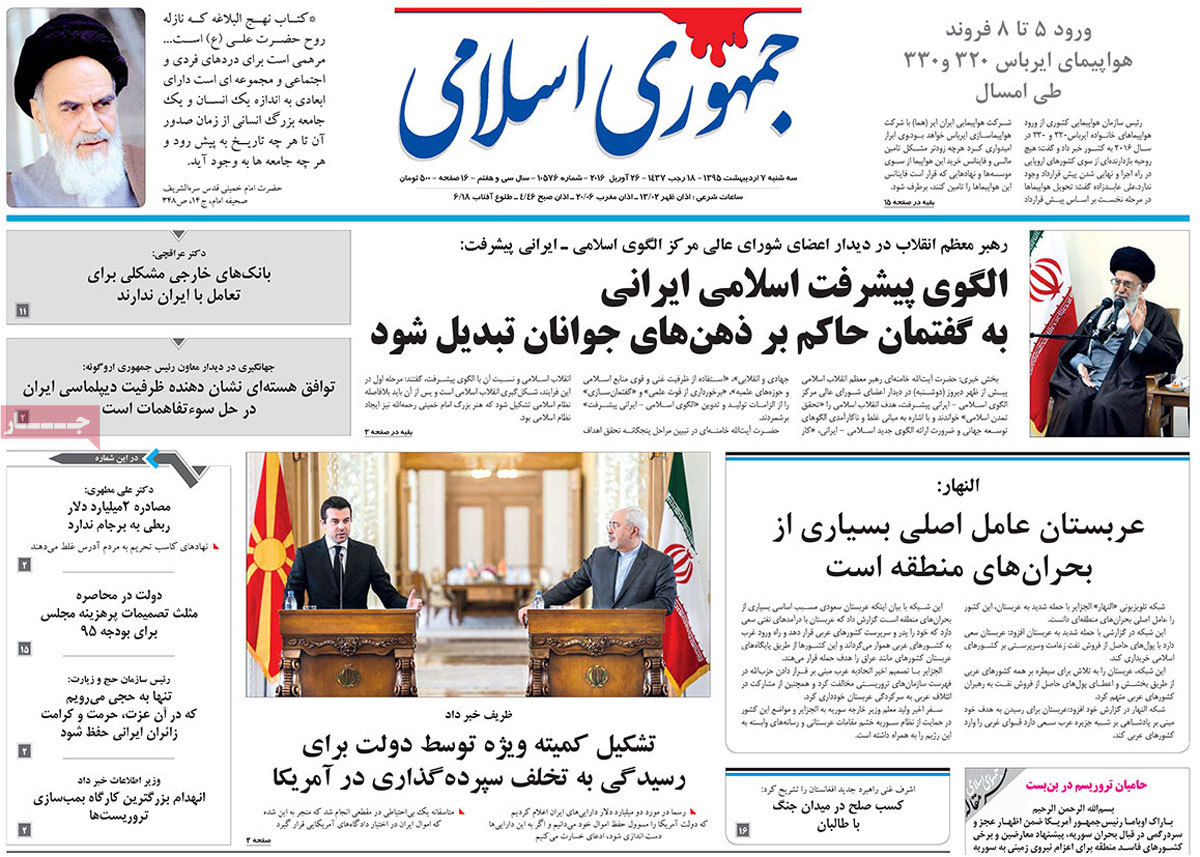
1- Iran to Receive 5-8 Airbus A320 and A330 Planes This Year
2- Saudi Arabia Main Cause of Many Regional Crises: An-Nahar
3- JCPOA Shows Iran’s Diplomatic Capacity to Clear Up Misunderstandings: First VP
4- Iranian Pilgrims to Attend Hajj Only If Their Dignity Is Maintained: Official
5- Sponsors of Terrorism in Stalemate (Editorial)
Keyhan:
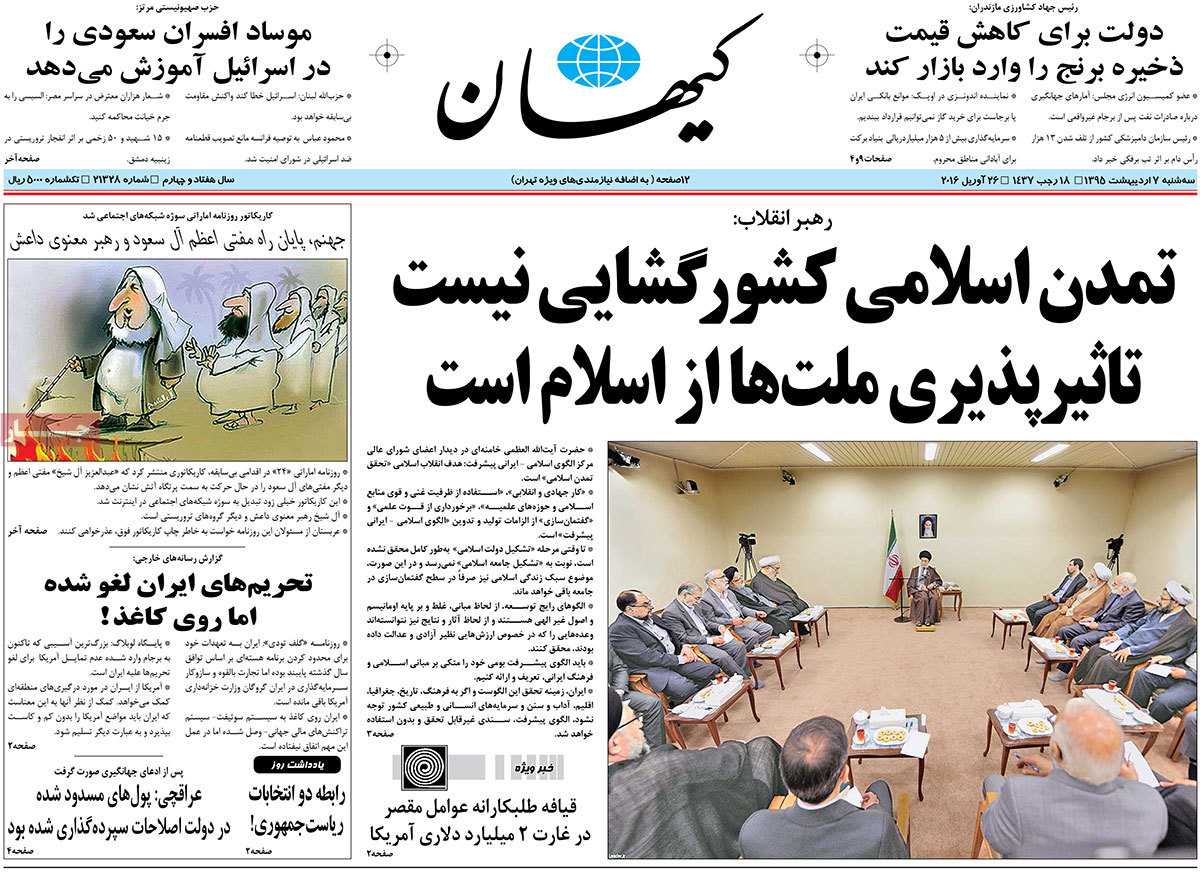
1- Islamic Civilization Is Islam’s Impact on Nations: Leader
2- Mossad Trains Saudi Officers in Israel
3- Iran’s Sanctions Are Terminated, But Just on Paper: Media Reports
4- Deputy FM: Iran’s Frozen Assets Were Deposited during Khatami Reformist Gov’t
Khorasan:
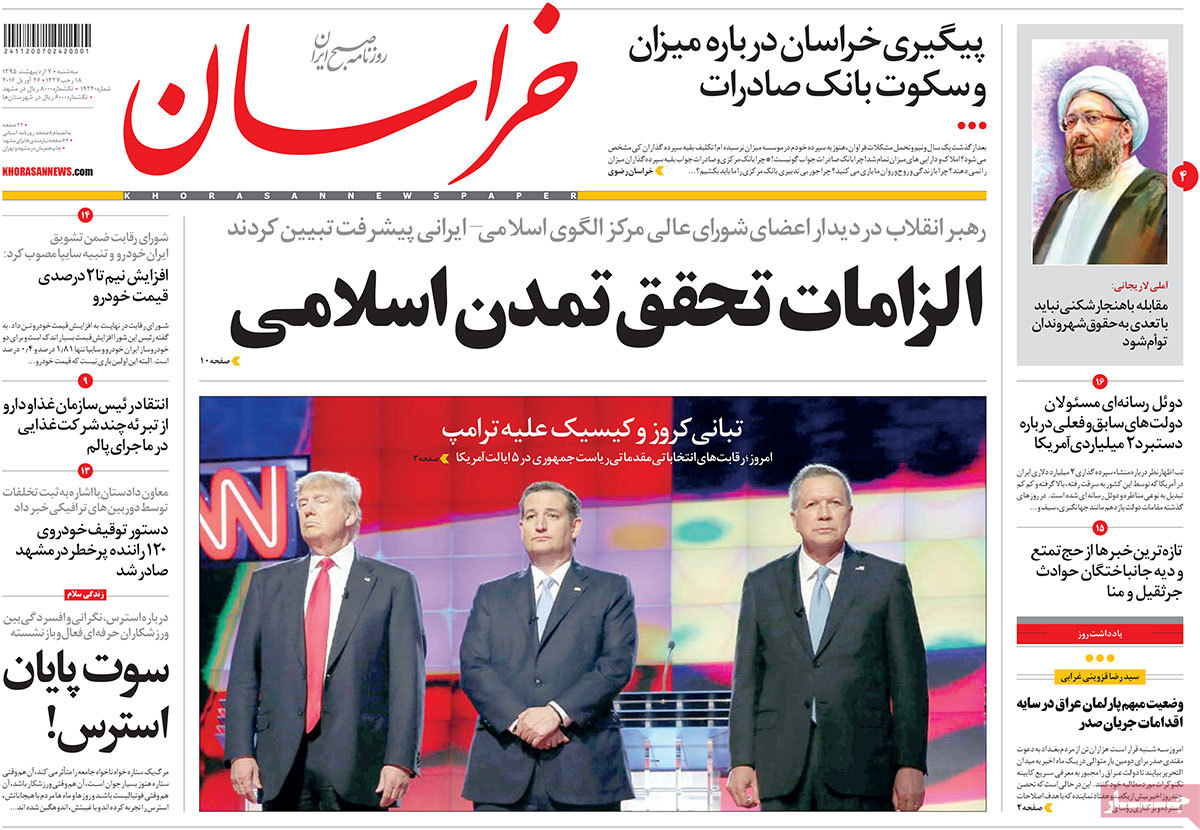
1- Incumbent and Former Gov’t Officials Duel in Media over US Seizure of Iranian Assets
2- Ambiguous Conditions of Iraqi Parliament in Light of Moves by Sadr Movement
3- Cruz-Kasich Alliance against Trump
Mardom Salari:
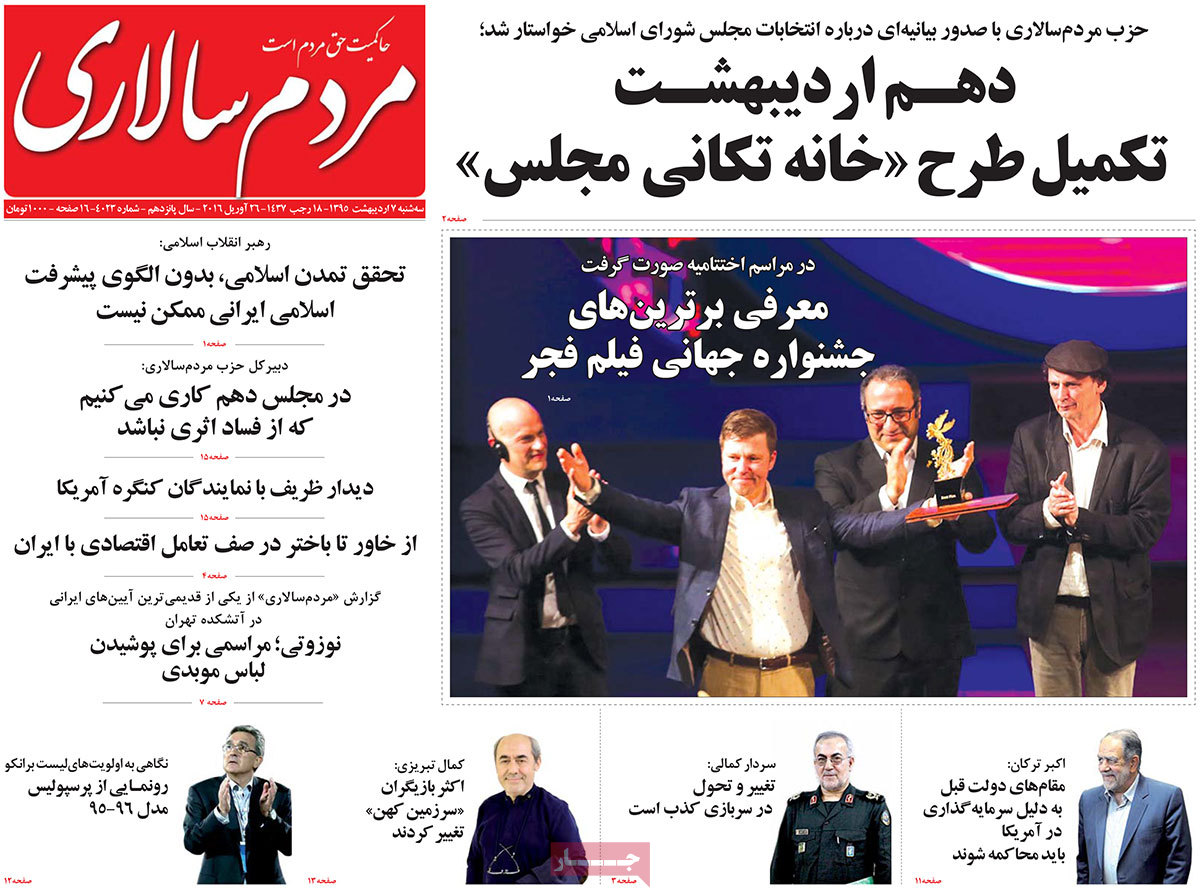
1- Closing Ceremony of Fajr Int’l Film Festival: Winners Announced
2- East and West Queuing Up to Start Economic Cooperation with Iran
3- Nozoti: A Ceremony to Become a Zoroastrian Priest
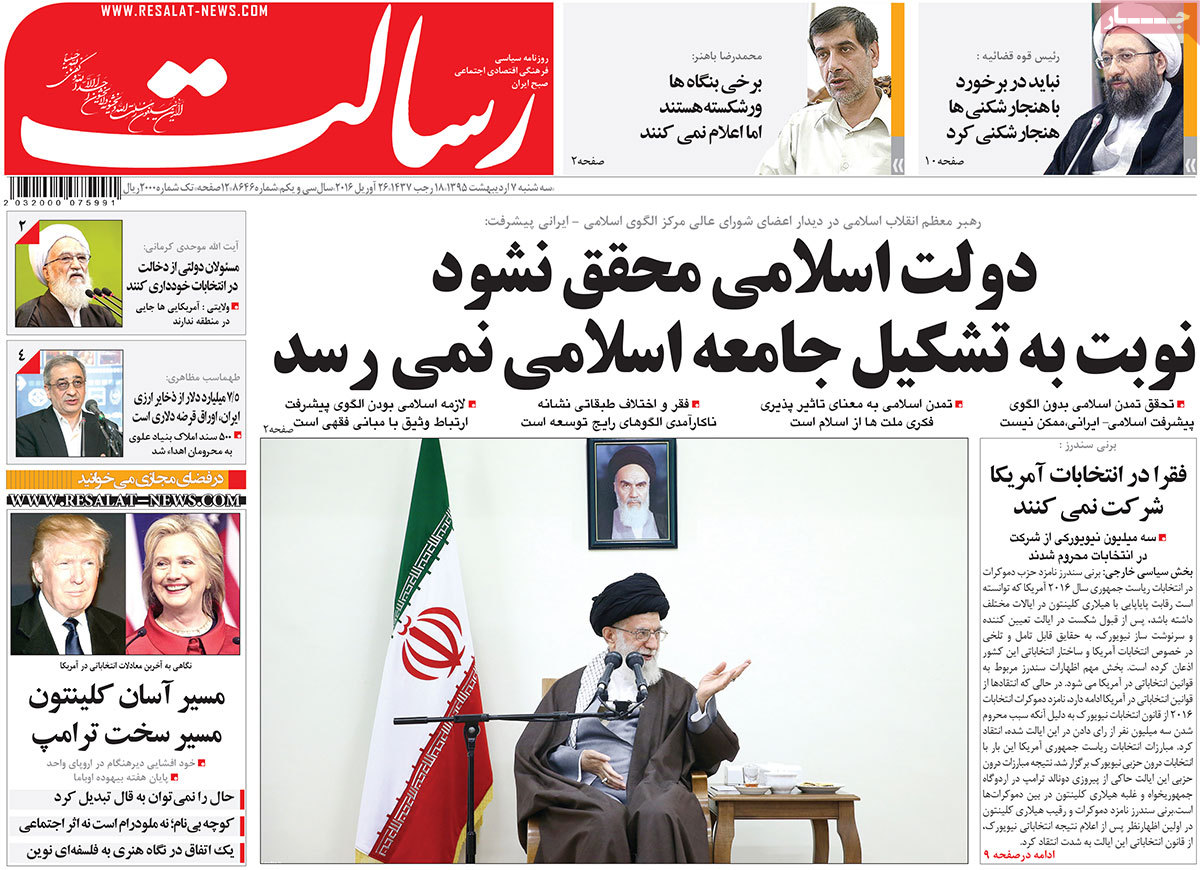
Resalat:
1- Ex-CBI Chief: $75bn of Iran’s Foreign Exchange Reserves Are Dollar-Based Bonds
2- Leader’s Int’l Advisor: Americans Have no Place in Region
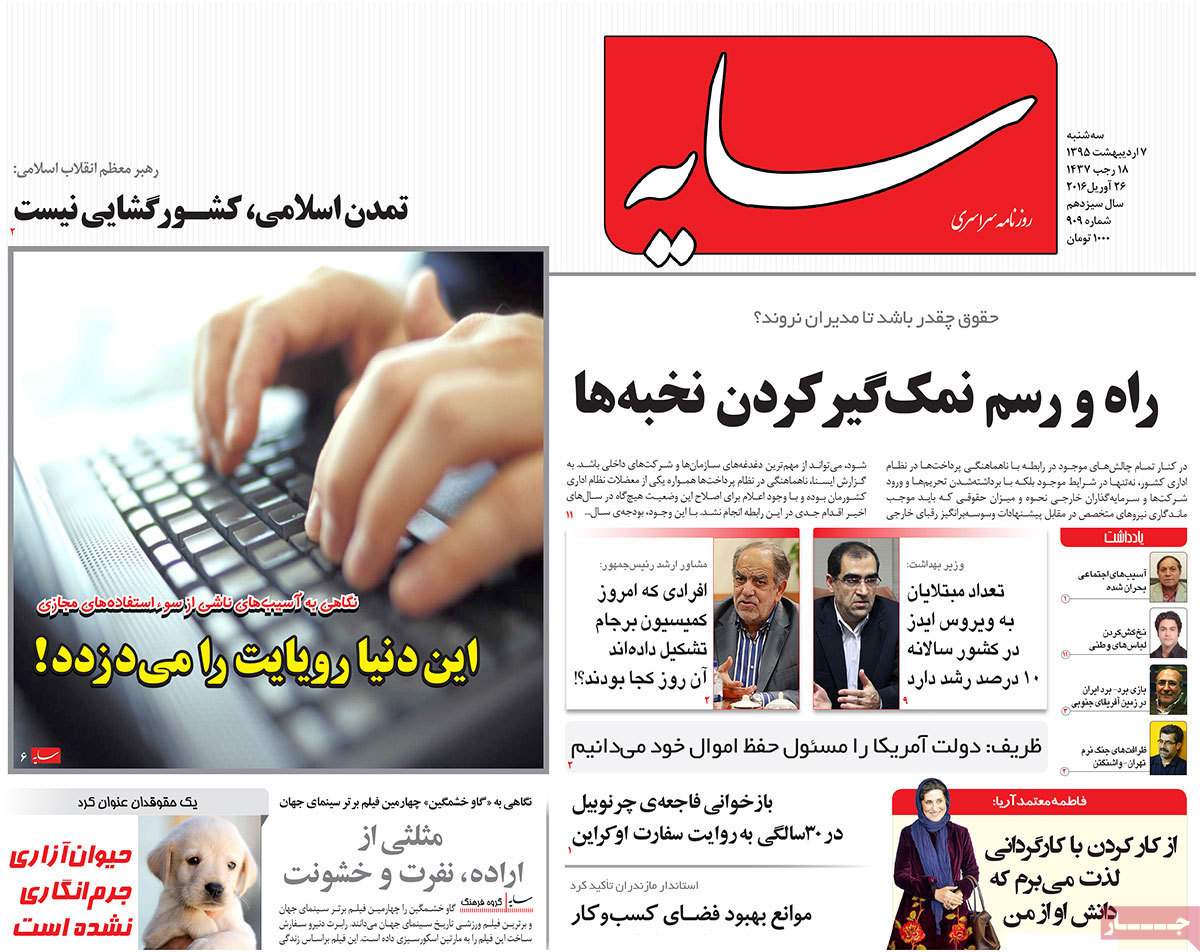
Sayeh:
1- Animal Abuse Yet to Be Criminalised in Iran: Legal Expert
2- Number of Iranians Diagnosed with HIV Rise 10% Annually: Health Minister
3- Iran’s Win-Win Game in South Africa: Ex-Envoy to Pretoria
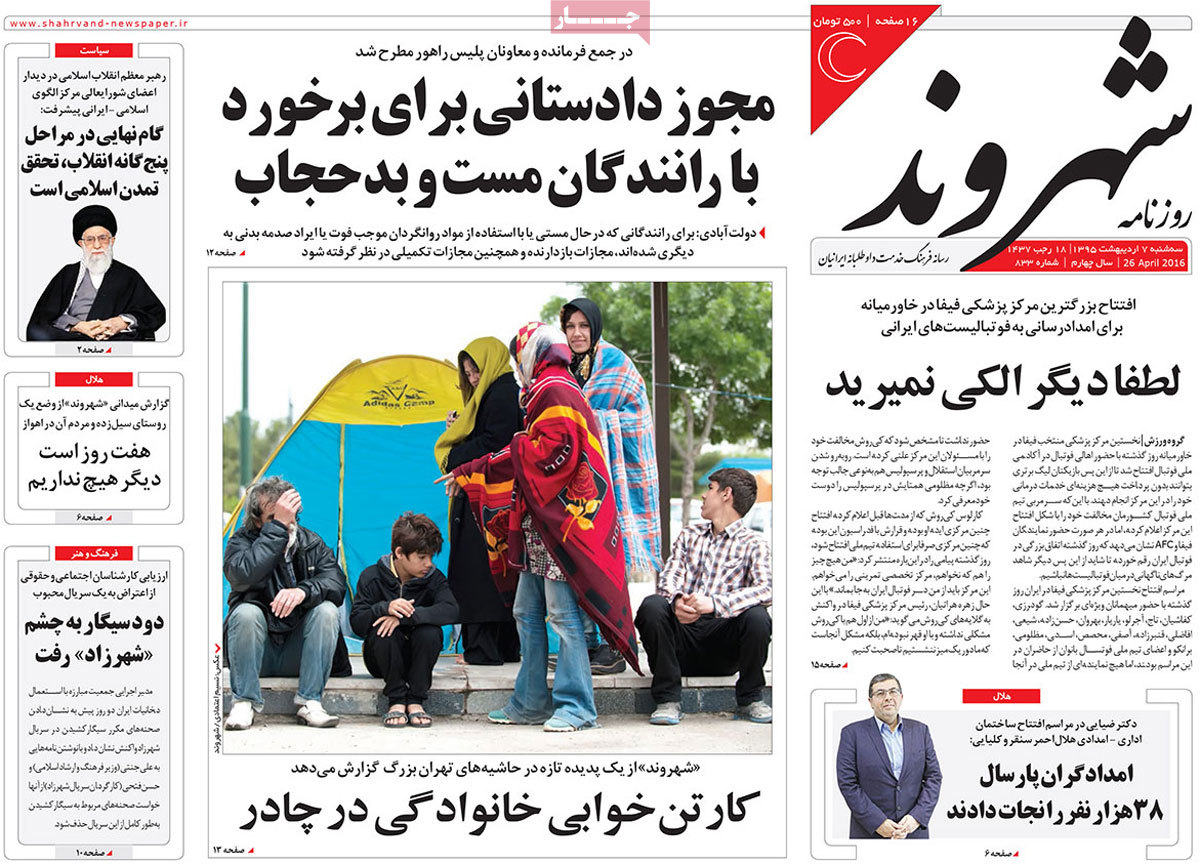
Shahrvand:
1- FIFA’s Largest Medical Centre in Middle East Opens in Iran
2- Police Permitted to Punish Drivers Who Are Drunk or Refuse to Observe Islamic Hijab
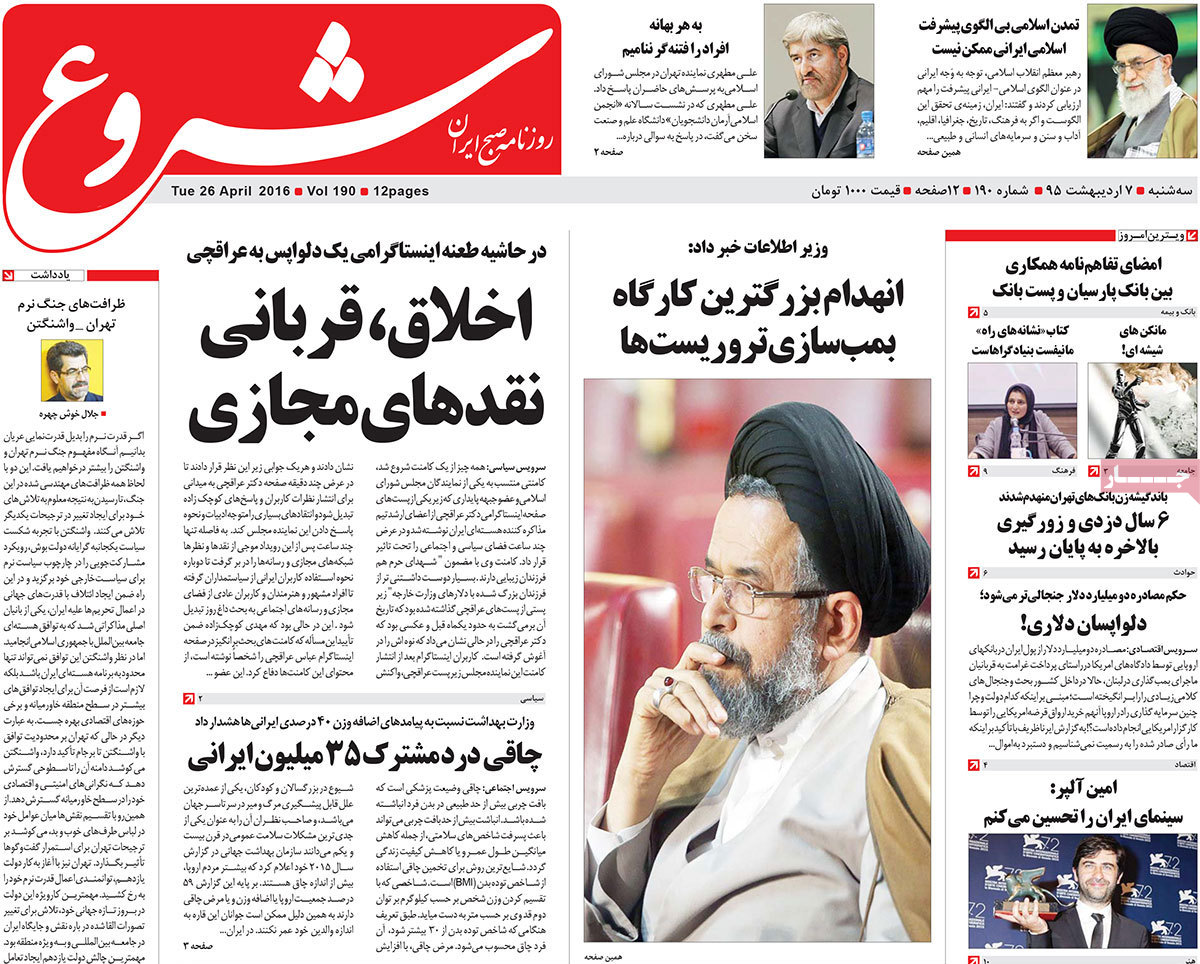
Shorou:
1- 35m Iranians Suffer from Obesity: Health Minister Warns
2- Iran’s Security Forces Smash Terrorists’ Largest Bomb-Making Workshop: Minister
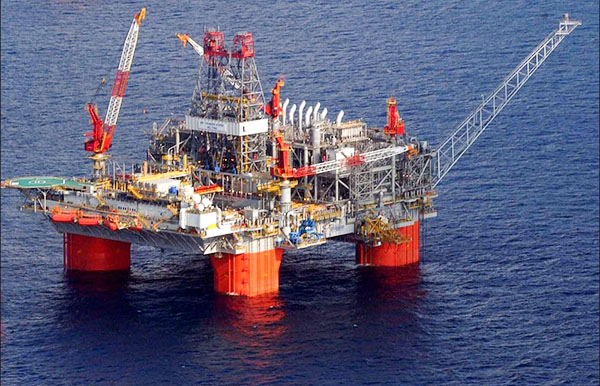
Given the removal of sanctions, new oil agreements were estimated to be inked with major European firms like Shell, BP, Eni, Total and Repsol, though North American companies seem to have overtaken them in launching oil talks with Iran.
Accordingly, over the past few months, several American and Canadian companies have initiated talks on implementing projects in upstream and midstream sections of Iranian oil, gas and petrochemical industries aiming to make investments, sell goods and equipment, offer drilling services as well as to purchase oil products from Iran.
Iran’s Minister of Oil, Bijan Zanganeh, had previously pointed to negotiations held with several American companies like General Electric, stressing, “The talks have been constructive.”
In addition, the Managing Director of the National Iranian Oil Company, Roknodin Javadi, has rejected the existence of legal restrictions or prohibitions on making oil deals or joint investments with North American companies, especially American ones: “Iran is ready to sell oil to all world countries except for the Israeli regime.”
In time for the return of General Electric to the negotiation table, Halliburton of the US has also conducted talks with the National Iranian Drilling Company on offering certain technical services as the likelihood of signing oil agreements with the American firm has increased for launching new drilling projects with Iranian private and state companies.
Managing Director of the National Petrochemical Company (NPC) Marzieh Shah-Daei touched upon certain talks with a number of American companies on running new cooperation in petrochemical industries, maintaining that “No direct talk has been conducted with American oil giants, though one American firm has made proposals thorough its branch in Europe.”
Shah-Daei said the axis of talks with the American-European company had been the purchase of technical knowledge, asserting “Direct investment in Iranian petrochemical industries on the part of American companies is not currently at stake.”
Meanwhile, some managers of Iranian petrochemical firms have reported on receiving proposals from American companies on exports of certain petrochemical and polymer products, like different grades of PVC powder.
Also, as Head of Technology and Research at the Iranian Offshore Oil Company (IOOC) Javad Rostami noted, “The project to examine the economic justification and feasibility of the Binaloud oilfield has been handed over to a Canadian company. Currently, we are looking forward to receiving its final report.”
Head of Oil Industry Equipment Producing Association Reza Khiamian also reported on talks with Canadian oil equipment producers, adding “In addition to the North American countries, some negotiations have been held with European countries like France and Germany.”
Khiamian further enumerated the main axes of talks between Iranian and Canadian companies, including “Knowledge and technology transfer, establishment of a production line for manufacturing advanced industrial equipment as well as investment attraction.”
On Monday, the Director of the DMC Process Project at the Research Institute of the Petroleum Industry (RIPI), Mansur Bazmi, reported on collaborations with a Canadian company on the construction of an oil desalination plant: “Iran and Canada will both participate in the construction the facilities.”
Meanwhile, Iranian oil industry officials refuse to name the American and Canadian sides of the ongoing negotiations, concluding that “The companies involved in the course of negotiations need to remain confidential, for the time being.”
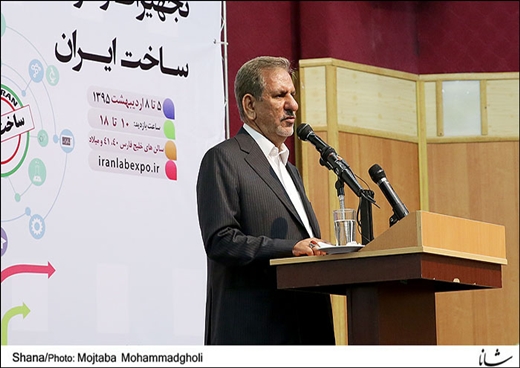
Addressing the opening ceremony of a laboratory equipment exhibition in Tehran, Jahangiri said the administration has been seeking the country’s industrial progress in sectors like steel and oil and gas recovery.
“We need to restore our status in technological development by focusing more attention on the elites and scientists so that they can play their role better in the country’s progress,” said the official.
He said the Rouhani Administration has planned to invest $200bn in the country’s oil sector in a bid to develop the sector technologically.
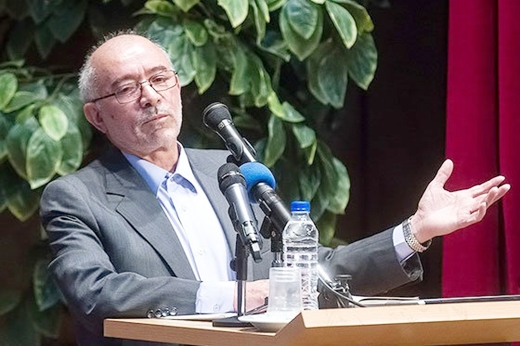
70% of deaths are the unfortunate result of diseases such as diabetes, cancer, heart attack, asthma, and respiratory conditions, IRNA news agency quoted Sayyari as saying.
Almost all these conditions are rooted in a lack of movement, smoking, high blood sugar, high cholesterol, unhealthy diets, and drinking, he explained.
Sayyari lamented the fact that some 10 trillion Rials (nearly $3bn) is being spent annually on smoking, which is one of the leading causes of various diseases.
Salt and sugar consumption can also cause high blood pressure, diabetes, and high cholesterol, he said, adding that 5m Iranians suffer from diabetes, 15m from high cholesterol and 10m from high blood pressure.
Sayyari went on to say that currently there are 422m people with diabetes worldwide, of whom half don’t know they have it. “Every 20 seconds, one leg is amputated as a result of diabetes, even though one can prevent such a catastrophe by taking self-care measures,” he added.
The average amount of sugar intake is 25g per day while there is 30g of sugar in one bottle of cola, he warned, noting that in Iran, people consume some 65g of sugar per day on average.
He further pointed out that the amount of salt Iranians consume is 10-12g per day, whereas normally only 5g of salt is recommended for those under 50, and only 3 g for those above 50.
Consuming 500 calories fewer each day, along with a daily 30-minute walk would help people to lose 500g per week, he suggested.
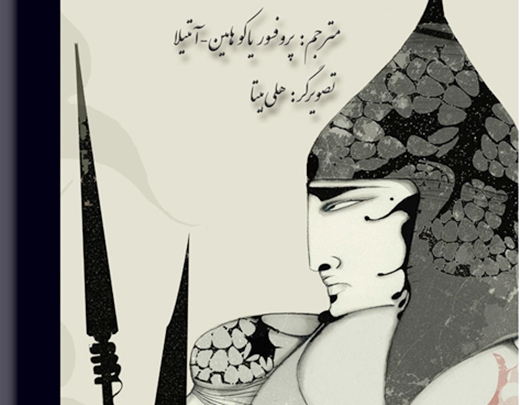
Anttila, Finnish Ambassador Harri Kamarainen, and some Iranian cultural officials attended the ceremony held in the Majlis Library, Museum and Documentation Center.
The professor said that he takes great pride in having translated the Book of Kings (Shahnameh) into the Finnish language, and having made it available for the people of his country.
“My own translation is a prose translation of Shahnameh from Persian into Finnish and it is not complete. I hope to add the second volume to the first to cover the entire book,” he told the participants.
“I chose the version of Shahnameh by distinguished (Iranian) researcher Jalal Khaleqi-Motlaq as my original source. However, I chose to render the selection into prose since I felt that translation into verse would be above my abilities,” he explained.
However, he said that he is planning to choose some short stories from Shahanmeh to translate into Finnish in verse at some other time.
The professor also noted that the book came out last week and he is not sure if the books have been distributed in bookshops across Helsinki yet.
“The epic of Ferdowsi is a window to see what Iranian people see and how they feel, and Finnish people will learn more about Iranians through this book,” he said.
The ambassador for his part called April 23rd a day of joy and celebration, and considered the translation a wonderful treasure to read.
“Through Shahnameh, the people of Finland will learn to know about the history and culture of Iran. Iran has given so much to the world’s civilization. Iranian poets have been the source of inspiration for Europeans, and now my Finnish countrymen will be able to read Shahnameh in their own language,” the ambassador added.
Shahnameh, which is known as the “Book of Kings” in English, is the celebrated work of the epic poet Ferdowsi, in which the Persian national epic found its final and enduring form. It was completed in 1010. The Shahnameh millennium was celebrated on UNESCO’s 2010 calendar of events.
The Majlis Library director Mohammadreza Majidi, and the National Library and Archives of Iran (NLAI) Director Seyyed Reza Salehi-Amiri were among the participating guests at the ceremony.
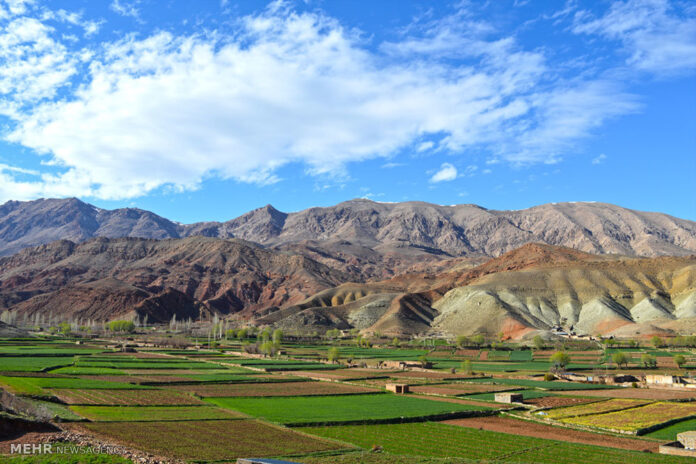
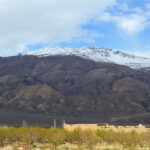
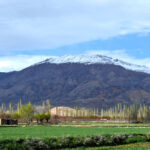
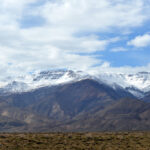
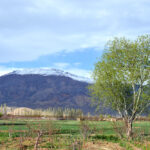
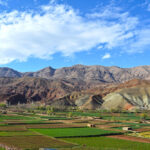
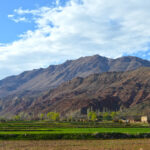
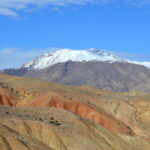
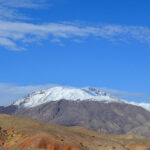
4000-meter Shahvar Mount is the symbol of glory in Shahroud of Semnan province. Shahvar is the highest peak of north east of Iran and the east of Alborz mountain range.
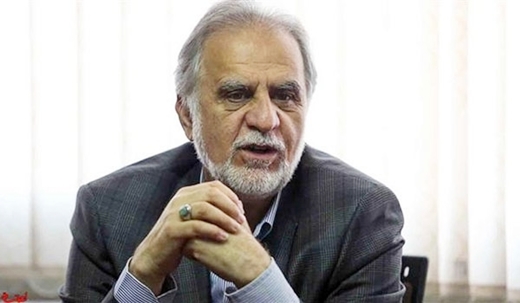
Speaking to reporters on Sunday Apr 24, Karbasian said the country exported 4.1m tons of steel in the past Persian calendar year, which ended on 22 March 2016, thus setting a new record in sales of the strategic product to international markets.
He said the total value of steel exports over the same period stood at $10 billion.
Karbasian added that the record rise in exports of steel had already helped pull many producers out of financial difficulties.
He said that the positive performance of Iran’s steel industry was the result of an intensive campaign by the government of President Hassan Rouhani to support industrial units and encourage their export activities.
Karbasian further said that Iran’s steel success came in face of poor market conditions, and at a time when China and Russia – two other leading international players – had started to adopt the policy of dumping due to a severe plunge in prices.
Iran is currently the largest steelmaker in the Middle East and North Africa, and the world’s 14th largest producer. The country has serious plans to increase its steel production capacity to 55m tons per year, up from the current level of about 17m tons/year, by 2025. The country’s export capacity is also expected to rise to above 13m tons per year.
The country is pushing ahead with the development of several major provincial steel production plants and is already implementing plans to bring in foreign investors like Italy’s Danieli and South Korea’s POSCO to the same effect.
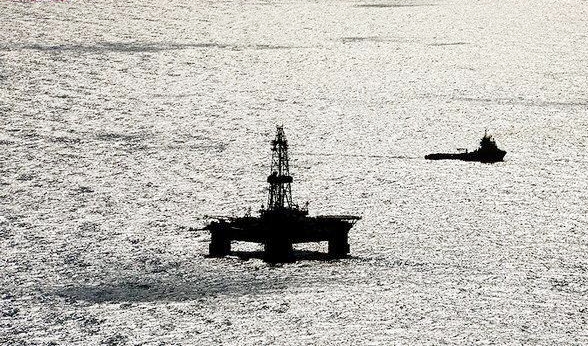
Mohammad Reza Kamali from the Research Institute of Petroleum Industry (RIPI) told reporters on Apr 25 that huge reserves of gas hydrates have been proven in the Sea of Oman, beneath which there are conventional layers of gas.
He also said the project exploring shale gas in Lorestan province in the west of the country is almost half-completed, with non-conventional gas reserves already having been found there.
The official said that Iran enjoys very large capacities in terms of oil and gas shale.
According to the official, the project is a joint venture with the German University of Aachen, during which the university is to transfer the technology and knowledge about shale gas and oil resources to Iran.
Kamali said another project is also underway in the Persian Gulf, in cooperation with prestigious world universities, to study its geological features.
In another project, the official said, the same feature is being studied in Arvadan Palin in the southern province of Khuzestan, which holds Iran’s biggest oilfields.
He said the geological features of Kopet Dag, near the Turkmenistan border, have also been studied, which highlights the link between the energy resources of Iran and Turkmenistan.

“Europe would react very negatively to a US abandonment of the agreement, and continue to pursue expanded economic relations, as long as Iran continued to abide by its terms,” I.M. Destler told Tasnim.
Prof. Destler is a scholar who specializes in the politics and processes of US foreign policymaking. He is co-author, with Ivo H. Daalder, of In the Shadow of the Oval Office (Simon and Schuster, 2009), which analyzes the role of US presidents’ national security advisers, from Kennedy through to George W. Bush.
What follows is the full text of the interview.
Q: Do you think the outcome of the next presidential elections would change US foreign policy?
A: Foreign policy has not been the dominant issue in the campaign, for either party, and it is always uncertain how campaign rhetoric will translate into policy once a new president enters office. Between now and then, I don’t see the campaign as having a major policy effect.
Q: What will be the reaction of a potential Republican winner of the upcoming polls to the Joint Comprehensive Plan of Action (JCPOA) between Tehran and world powers?
A: Both Trump and Cruz have denounced the Iran deal, but what they would actually do is uncertain, since renunciation would leave the United States alone in its dealings with Iran.
In the (unlikely) event that either was elected, he might try to extract some further (at least symbolic) concession from Iran, or toughen the US posture towards Iran in some other way. As for general policy, each has talked of a tougher, more assertive foreign policy generally.
Either one would likely shelve the Trans-Pacific Partnership (TPP) trade agreement if it were not approved before he entered office.
Q: You mentioned Ted Cruz and Donald Trump. What about Hillary Clinton and Bernie Sanders? How would they receive the deal?
A: President Clinton would adhere to the deal. She would provide, for the most part, foreign policy continuity, but perhaps would be more ready to use US military force in the Middle East/Persian Gulf region. She would seek a way to amend the TPP so that she could say she improved it, if it went into force.
President Sanders would adhere to the Iran deal, abandon TPP, and otherwise be less aggressive in policy, I expect.
Q: What would be Europe’s reaction if a Republican takes the Oval Office?
A: Europe would react very negatively to a US abandonment of the agreement, and continue to pursue expanded economic relations, as long as Iran continued to abide by its terms.
© All Content by IFP News ( Iran Front Page ) is licensed under a Creative Commons Attribution 4.0 International License.
