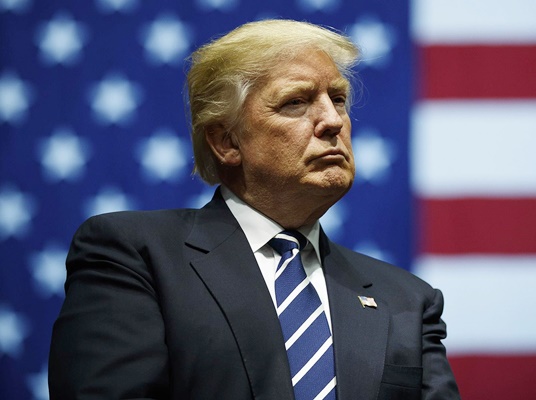
Iranian lawmaker Jalil Rahimi Jahan-Abadi said the new US government has no other option but to pursue the implementation of the JCPOA, which has been devised by the former US administration and the other five world powers.
Nonetheless, he noted, Trump primarily needs to shift public opinion in favour of implementing the JCPOA to modify the poisonous atmosphere he had created around the nuclear deal during his election campaign.
According to a Farsi report by ICANA, he stressed that although Trump ascended to power by uttering threats to rip up the JCPOA, currently, he needs to both change public opinion and fulfil its commitments on implementing the deal.
“The public pressure on Trump is constantly mounting.”
The JCPOA was the outcome of the collective wisdom and efforts by the International Atomic Energy Agency, Iran and major world powers, he noted, highlighting the efforts made by the IAEA to defend the deal.
“The nuclear deal has prevented the aggravation of the crises in the world and Middle East and brought about relative peace in the region. By defending the nuclear deal, the IAEA will endeavour to promote this optimistic view across the world.”
Two Iranian lawmakers, Ali Bakhtiar and Abolfazl Aboutorabi, have slammed a public statement by the Financial Action Task Force (FATF) urging Iran to fulfil its commitments to the body, calling on the state officials to take the necessary precautions in their cooperation with the organization to avoid any problems and losses.
Precautions Are Necessary
According to a Farsi report by ICANA, Bakhtiar said Iran’s increased transaction with the international community requires a number of moves by the country including joining a number of global conventions such as the FATF.
Commenting on a recent anti-Iran statement by the FATF, Bakhtiar noted that, “Iran’s agreement with the FATF has different dimensions. Nevertheless, the Islamic Republic has always honoured its commitments under the agreement and will behave the same in the future.”
He further referred to the concerns voiced by some experts about the implementation of the agreement, and noted that the Iranian officials are required to take security precautions to avoid any probable problems.
“To this end, it is necessary to install firewall systems and other security programs to eliminate any likely threats and prevent acts of sabotage through software applications, particularly, in banking and trade affairs.”
Bakhtiar said currently, the licences for banking software applications used in Iran are issued by European companies.
However, he added, Iran has obliged these firms to observe the security measures.
He stressed that so far, none of these companies have managed to pose any threat to Iran’s banking system.
“For increased interactions with the international community, Iran is required to make a number of moves such as joining global conventions; however, Iranian officials are required to take certain precautions to this end.”
Beware of Great Losses
Commenting on the cooperation between Iran and FATF, Aboutorabi, the other Iranian parliamentarian, said the Iranian Supreme National Security Council (SNSC) has not yet consented to Iran’s accession to the organization and implementation of the bilateral agreement.
He stressed that the FATF agreement is a highly sensitive one, adding Iran’s accession to the agreement will lead to a great loss for the country.
On the FATF’s public statement on Iran, he said accession to this organization and accepting its terms and conditions will entail great losses for Iran.
This will enable the body to exercise strict supervision over Iran’s banking system, has access to the country’s political and economic information and use them for intelligence purposes.
“According to the FATF agreement, the organization will use an American software to oversee Iran’s banking and economic systems. This software would have access to Iran’s trade, financial and economic information and processes and would be able to analyse them. This will enable Americans to create a chaos in the country, whenever they wish to, by fiddling with the accounts.”
“I see no plausible reason for Iran to join the FATF. The implementation of the agreement will definitely work to the detriment of Iran,” he added.
Vaghaye Ettefaghieh daily newspaper has narrated the story of a German engineer who lost his wife, but managed to ease his pain by visiting Iran.
Here is the full text of the Farsi article:
One foot in the coasts of Caspian Sea [in northern Iran], the other on Persian Gulf beaches [in the south]: Thomas, a German engineer, has chosen to live in this way. Such a romanticism definitely wasn’t predicted in the recruitment exam of Siemens, where he worked as the chief engineer. However, he could not continue working there due to his evolved spirit.
The chemical engineer, working in the energy department of Siemens – the huge company with more than 360,000 employees in 190 countries – finally achieved his dream in Iran, on the coasts of its indigo-coloured seas; a fate that steered him toward suicide, depression, intoxication and euphoria.
Why did he come to Iran? Indeed, it is better to ask why it took him so long to do so: “You know, this time we will go to Tehran, Iran; your home,” he said with a strong German accent to his Persian wife, struggling to say the hard-to-pronounce words of “Tehran” and “Iran”, vacation after vacation, losing opportunity after opportunity.
The days passed; the workaholic chief engineer involved himself more and more in his job. His world was reduced to his work office in Cologne, with no time for his own city and country, let alone the homeland of his wife.
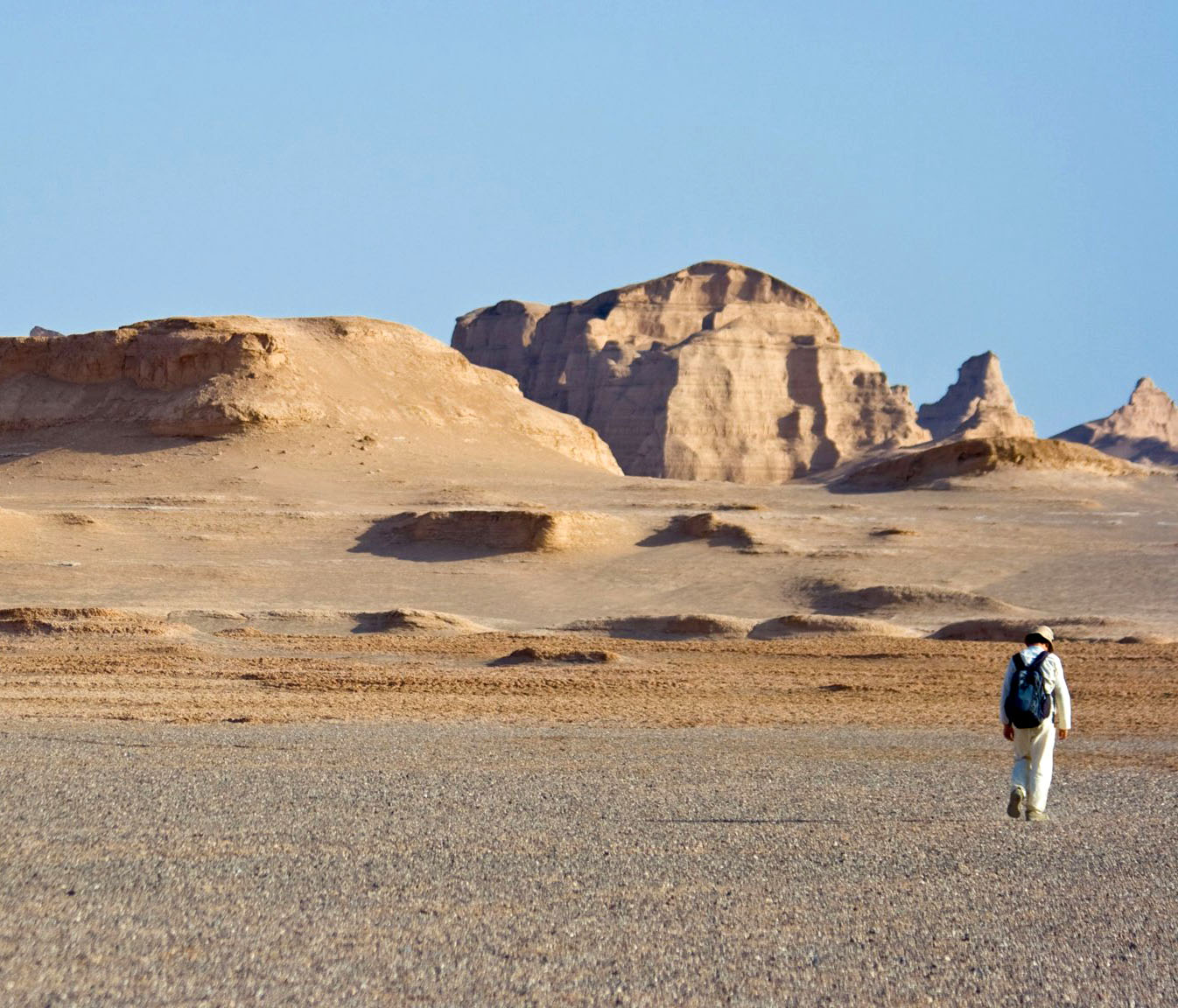
Kaluts near Kerman Iran
Life Hits Its Target
“Like a sharp knife, the life sometimes hits the target,” expressed Thomas. “Maryam died only a few months after being diagnosed with her disease. The incident hit me like a thunderbolt, a heavy strike. Everything ended before you could blink. All was over then.”
“Because of money, job security and so, I lost the days I could spend much more beautifully. Many times, we decided to visit Tehran, but failed to do so for unexpected happenings.”
Some incidents teach the man that a backpack could be enough for a living; the fear, however, doesn’t allow him to abandon everything and take a knapsack instead, leaving him immovable: it is when he is on the bottom of life flow to be forgotten with no further move.
The courage to take such a decision, though, changed Thomas’s life: “I should see Iran. I should know with whom I had lived so many years; why my life was so peaceful beside her. I should know from where she had come; she who affected my life so deeply, and humbly.”
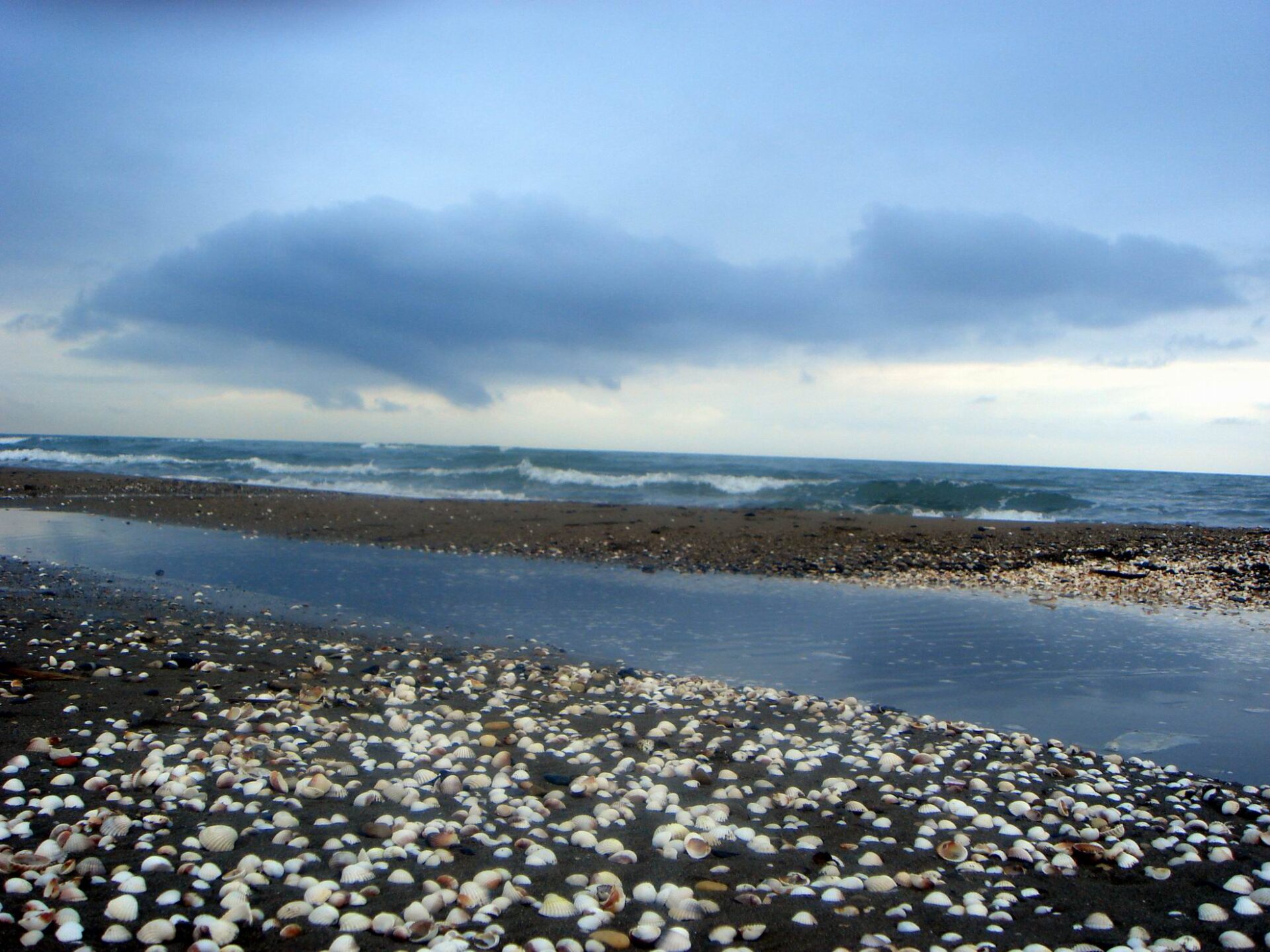
The beaches of the Caspian Sea
Iranian History Astonished Me
“I arrived in Tehran at night, dizzy and confused. I knew nothing about this country. Outside the airport’s passengers terminal, some people asked me ‘Where do you go, sir?’ with their thick Middle Eastern accents and oriental politeness. I had 10 days of vacation, and Iran was very big.”
He had to find some way to revolve his fate in Iran, from the south to the north. So he chose two Iranian coasts:
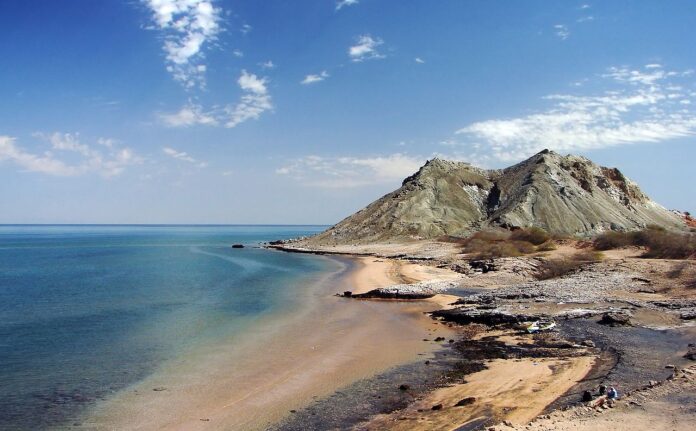
“I took my shoes off in the Qeshm Island coast [in the south]. On the sands, I gazed at the horizon to watch the sunset. I picked up a handful of sands. I did it again after watching the sunrise on the beaches of the Caspian Sea.”
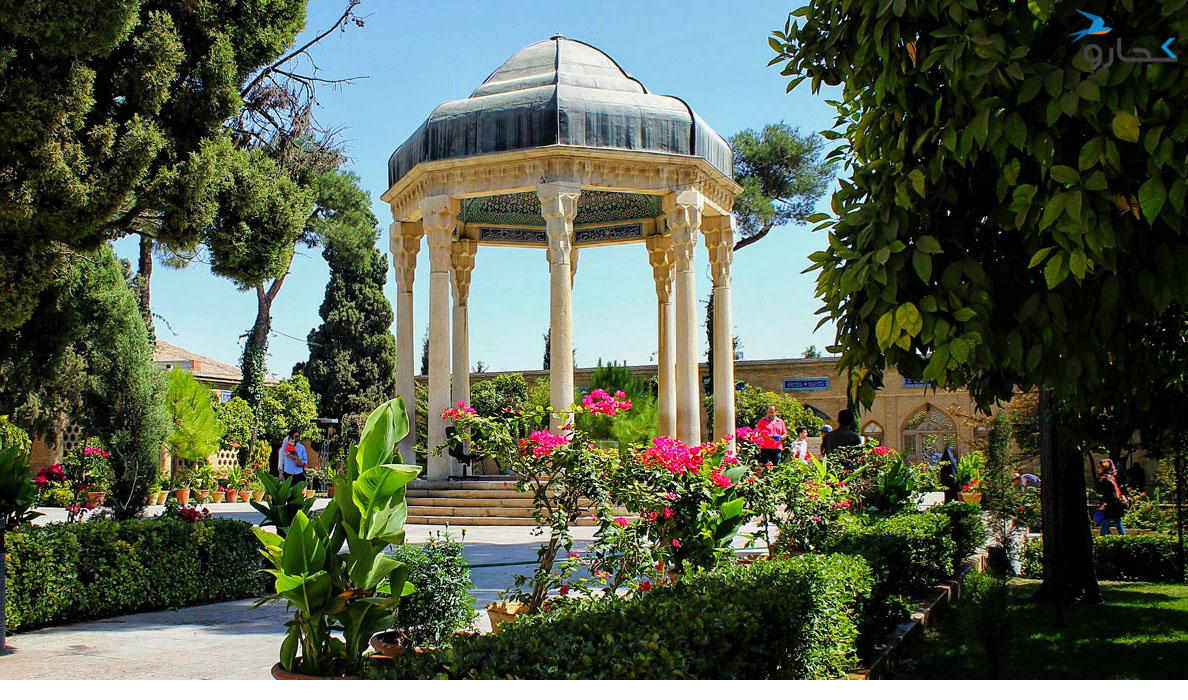
“In the meantime, I saw the beauties of Shiraz: its special ice cream and Faloodeh, the tombs of Hafiz and Saadi, the Persepolis,” he added. “I was astonished by such a wonderful history.”
Tomb of Hafiz – Shiraz
He then visited the mosques, handicrafts and craftsmen of Isfahan. “I saw people with always warmly opened arms. I learned that as a sign of friendship, Iranian men shake warmly their hands, hug and kiss each other on the cheek for two or three times, and it is only them who know they are to kiss two or three times!”
He also referred to the culture of Taarof – the Iranian way of being polite – as an inseparable part of Iranian culture. “Everything is done with Taarof: eating, sitting, coming, leaving. Everything.”
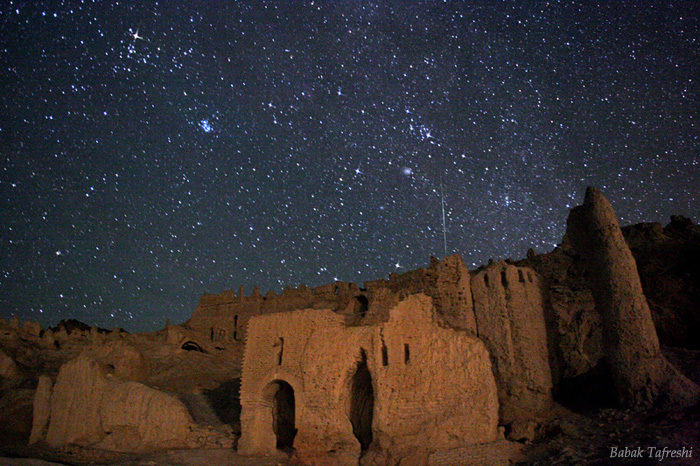
“I became intoxicated with the foods and smells,” he expressed. “There was an incredible amount of cars in Tehran, a sky covered by the stars in the desert, and an unforgettable greenery in the north.”
“All of them led to a change in me, making me understand that I should compensate for the missed opportunities, trying to keep the sweet memories instead of mourning.”
Sky covered by the stars in the desert
Another Way of Living
Undoubtedly, the managing director of Siemens energy department was surprised to read Thomas’ straightforward email: “I would like to inform you that I am resigning from my position … Sincerely, Thomas.”
Thomas, however, was taken back to his childhood by his backpack, Iran and Iranians, and the mementos of the past he carried without having visited their origins; to the days when he wanted to see the entire world, like the fictional travellers.
With his backpack, two packs of sands taken from beaches of Persian Gulf and Caspian Sea, and a framed picture of his wife, Thomas is now visiting different parts of the Earth, extending his world as much as the entire planet.
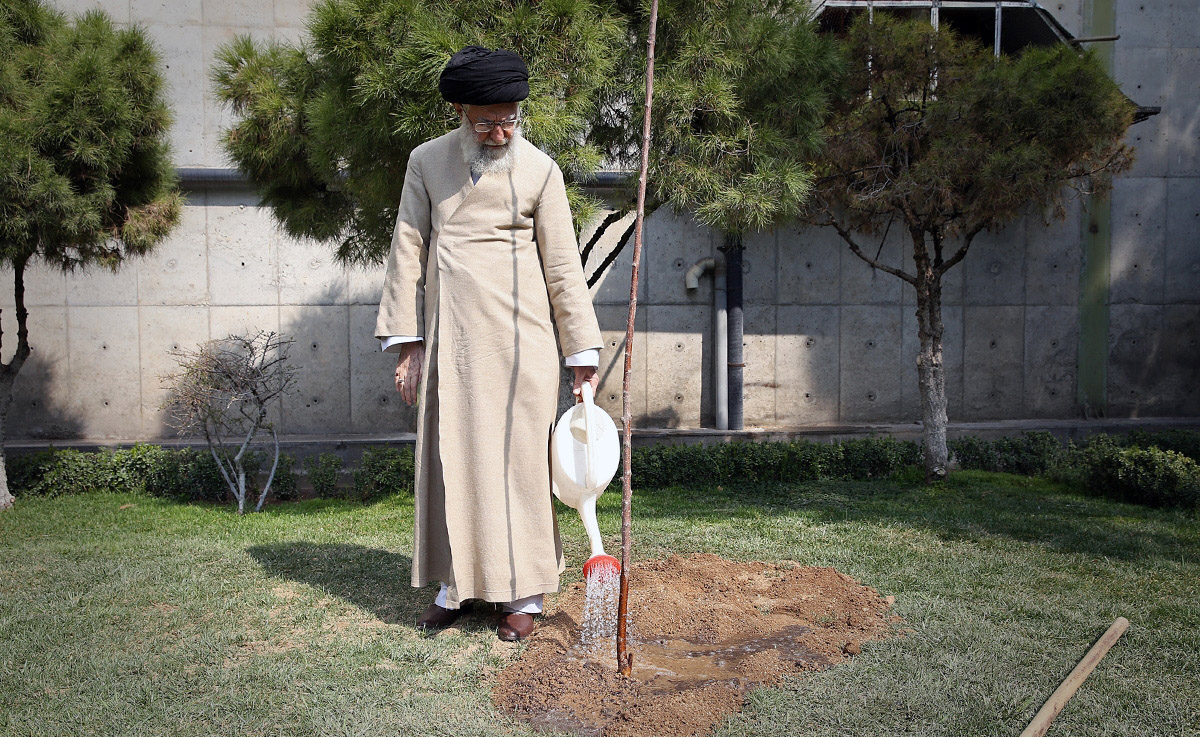
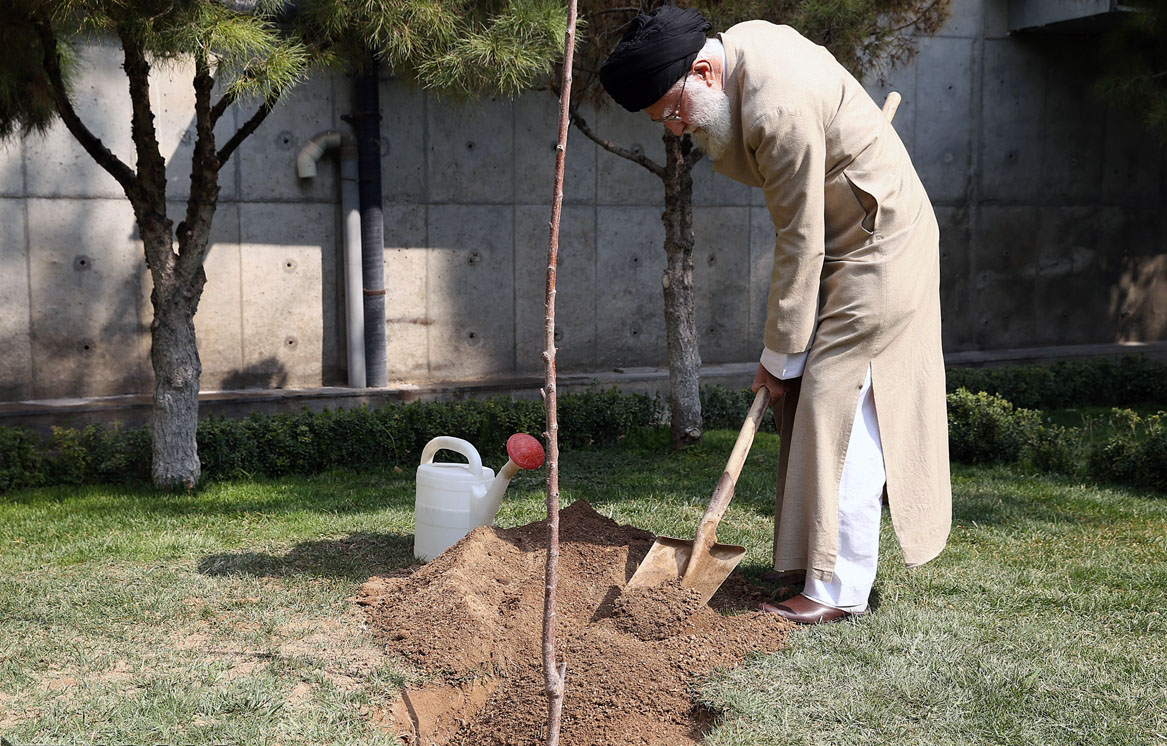
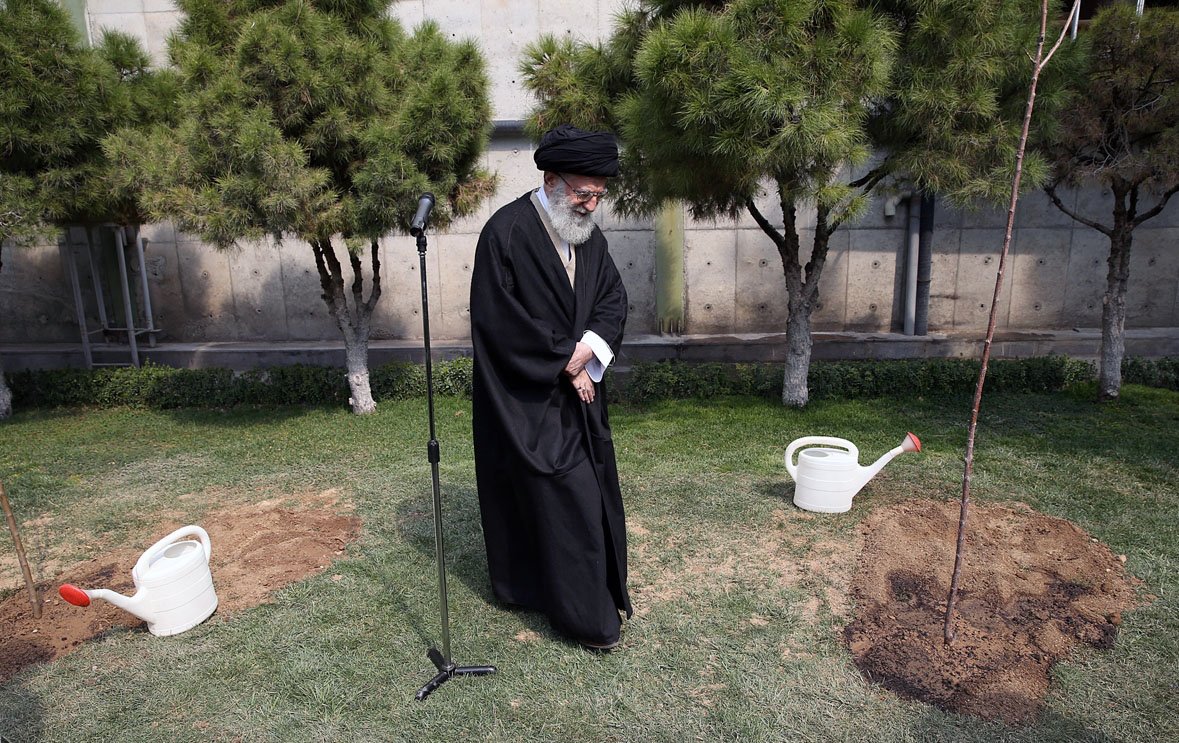
Every year in March, Ayatollah Khamenei plants saplings as a symbolic gesture of respect for the Mother Nature, and highlights the need for collective efforts to safeguard the environment.
After planting a couple of seedlings on Wednesday to mark the Week of Natural Resources, the Leader praised the quality of Iranian fruits and criticized the “wrong move” to import fruits from other countries.
Ayatollah Khamenei called on the government to avoid importing fruits unless in very necessary cases, according to a Farsi report by the Leader’s official website.
The Leader then pointed to the country’s areas rich in green vegetation, including diverse medicinal plants or the thick forests in northern Iran, and bemoaned the fact that some smugglers are exploiting the country’s woodlands and natural resources without regarding the national interests.
“Those forests must be protected from exploitation,” Ayatollah Khamenei underscored, as reported by Tasnim.
The Leader then warned against the consequences of destruction of vegetation, such as dust and particle pollution, air pollution, and unhealthy air in the cities, stressing that protection of plants in Iran is of greater significance given the country’s climate and large desert areas.
Ayatollah Khamenei described the country’s forests, rangelands and croplands as “great national assets”, calling for action against the people damaging the environment for personal benefits.
“The officials in charge of the forests, rangelands and farmlands must attach great significance to their job and strive to protect such great national asset,” Ayatollah Khamenei said on Wednesday, after planting two fruit saplings to mark the national Week of Natural Resources.
Mehdi Hashemi, who commands the IRGC Navay’s Zolfaqar Flotilla, said the American ship was sailing as part of a naval fleet also comprising British vessels, the Fars new agency reported on Wednesday.
It steered out of the course approved for international naval transit in the Persian Gulf, coming within 550 meters (0.3 nautical miles) of IRGC vessels present there on duty, he added.
Hashemi made the remarks after Reuters cited a US official as saying on condition of anonymity on Monday that “a US Navy ship and three British Royal Navy boats were forced to change course when several Iranian fast-attack vessels approached them in the Strait of Hormuz on Saturday.”
The IRGC commander disputed the allegations leveled by the unnamed American official, saying he was “lying” about the incident.
Hashemi denounced the US navy ship’s move as “illegitimate,” adding that the presence of American and British vessels in the Persian Gulf “endangers the security of this strategic region, which provides a huge portion of the world’s energy.”
“Their unprofessional measures fan the flames of tension and insecurity and can lead to irreparable repercussions,” Hashemi asserted.
Security and lasting calm in the region would only come about if extra-regional powers, especially the US and Britain, end such presence in the waters, he concluded.
Iran has repeatedly warned that any act of transgression into Iran’s territorial waters would be met with an immediate and befitting response.
In January last year, Iran’s Navy arrested the crews of two US patrol boats that had trespassed on Iranian territorial waters. Iran released them after establishing that they had done so by mistake.
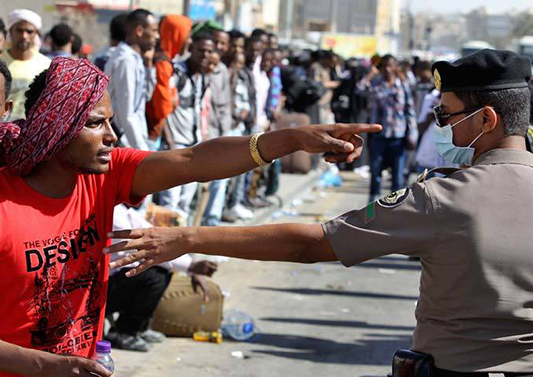
While US President Donald Trump’s new travel ban is still provoking reactions worldwide, Saudi Arabia’s Al-Hayat — a leading daily pan-Arab newspaper — has announced that Riyadh is likely to pass an anti-immigrant law to expatriate 5 million foreign residents.
Trump signed an executive order on March 6 blocking citizens of six predominantly Muslim countries, including Iran, Somalia, Sudan, Yemen, Syria and Libya, from entering the US.
According to a report by IFP, the Consultative Assembly of Saudi Arabia, in its upcoming meeting, will discuss the plan to battle immigration [to Saudi Arabia] with the intention of acquiring illegal citizenship and the possibility of setting up a committee in the Interior Ministry to banish 5 million immigrants, who, as alleged by the Saudi officials, are residing illegally in the country.
Although the drafters of the bill say their anti-immigrant law seeks to prevent the entry of those immigrants to Saudi Arabia who intend to reside illegally and permanently in the country, some analysts hold that the move is made in response to the recent regional security and military developments and to address the crisis caused by Saudi Arabia’s military intervention in Yemen.
These experts maintain that the Saudi move is a strategy to force a major part of the immigrants [currently living in the country] to cooperate with Saudi Arabia in Yemen war and its other intra-regional interventions, vivid examples of which were witnessed during the US invasions of Iraq and Afghanistan in which the White House dispatched and deployed a large number of the immigrants [residing in the country] to and in the Iraqi and Afghan territories.
Among the other factors contributing to the Saudi government’s adoption of the policy is the increasing tensions between Saudi Arabia and Pakistan caused by the latter’s reluctance to aid Riyadh in its regional warmongering.
A while ago, Al Akhbar newspaper – a daily Arabic language newspaper published in a semi-tabloid format in Beirut – listed a number of the signs indicating that the relations between Saudi Arabia and Pakistan are worsening: First, the reluctance of the retired Pakistani army chief General, Raheel Sharif, to agree to Saudi Arabia’s request demanding him to be the supreme commander of the Saudi-led “Islamic military alliance”, also known as Muslim NATO, created by Riyadh in 2015, saying he will only accept the position on the condition of including Iran in the Islamic military alliance; Second, an 8.5-percent drop in the value of the monetary transactions conducted by Pakistani residents of the Saudi Arabia, and third, the arrest of 15 Pakistanis by Saudi Arabia on terrorism charges.
Thus, Riyadh’s threats of exiling the immigrants, a large number of which are Pakistanis, from the country can be perceived as the Saudi government’s response to Islamabad’s non-cooperation.
Foreign Minister Spokesman Bahram Qassemi said Zarif will depart the Islamic Republic of Iran for Qatar later today to meet high-ranking officials of the Persian Gulf littoral state.
He is planned to hold meetings with his Qatari counterpart and the Emir of Qatar Sheikh Tamim bin Hamad Al Thani, Qassemi added, according to a Farsi report by Tasnim.
Zarif’s visit comes as part of Iran’s ongoing efforts to improve its relations with neighbouring states, particularly the Arab countries in Persian Gulf.
Last month, Iranian President Hassan Rouhani made state visits to Oman and Kuwait at the invitation of their leaders.
Rouhani’s one-day tour appeared to be a response to a recent message from the Persian Gulf Cooperation Council (PGCC) for closer ties with Tehran via dialogue.
The message had been conveyed to the Islamic Republic by Foreign Minister of Kuwait Sheikh Sabah Al Khalid Al Sabah who visited the country in late January.
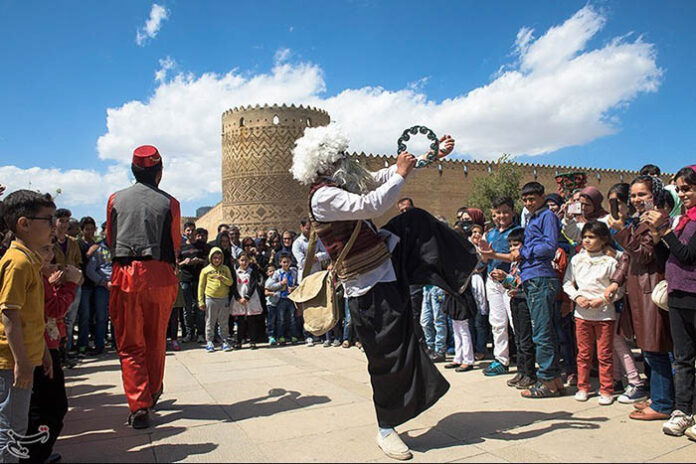
Special Nowruz Ceremony in Karim Khan Zand Citadel, Shiraz
Nowruz, the Persian New Year, has been celebrated for thousands of years at the beginning of spring, on March 20 or 21, by Iranians, as well as some other ethno-linguistic groups in the Western and Central Asia.
According to a Farsi report by Mehr, Nowruz dossier was initially registered in UNESCO’s list of Intangible Cultural Heritage with seven countries involved: Iran, Azerbaijan, India, Pakistan, Turkey, Uzbekistan and Kyrgyzstan.
However, the number will change as the nations where Nowruz is celebrated by some groups of people show their willingness to join the portfolio every now and then.
The dossier was edited in 2014 after five countries – Iraq, Turkmenistan, Tajikistan, Afghanistan, and Kyrgyzstan – made an incorporation proposal; and re-inscribed as a 12-nation dossier in UNESCO Intangible Cultural Heritage during the eleventh session of the Intergovernmental Committee for the Safeguarding of the Intangible Cultural Heritage in Ethiopia last December.
It was during this session that China, Mongolia, Tanzania and Kenya also expressed their interest in getting involved in the dossier.
“The Nowruz dossier must be reedited and observed by the representatives of 12 registered countries and the nations that demand to join it,” said Farhad Nazari, the director-general of Iranian Office for Registration of Historical Works. “So the path to inscription of a multi-national dossier has to be retaken all over.”
Since the dossier’s registration for the first time, Nowruz was due to be celebrated as an intangible heritage in one of the involved countries each year. So was done for some years in nations such as Afghanistan and Tajikistan, then it was forgotten.
Iran, which celebrates Nowruz every year nationwide, decided to invite the ambassadors of other countries to this festival in order to promote it. The international celebration will be held this year in the Golestan Palace – a historical monument in Tehran – as announced by Hassan Talebian, the Deputy Head of Iran’s Cultural Heritage, Handcrafts and Tourism Organization (ICHTO).
Iran is to celebrate Nowruz in 31 provinces at Nowruzgahs – special places for the festival this year on March 20.
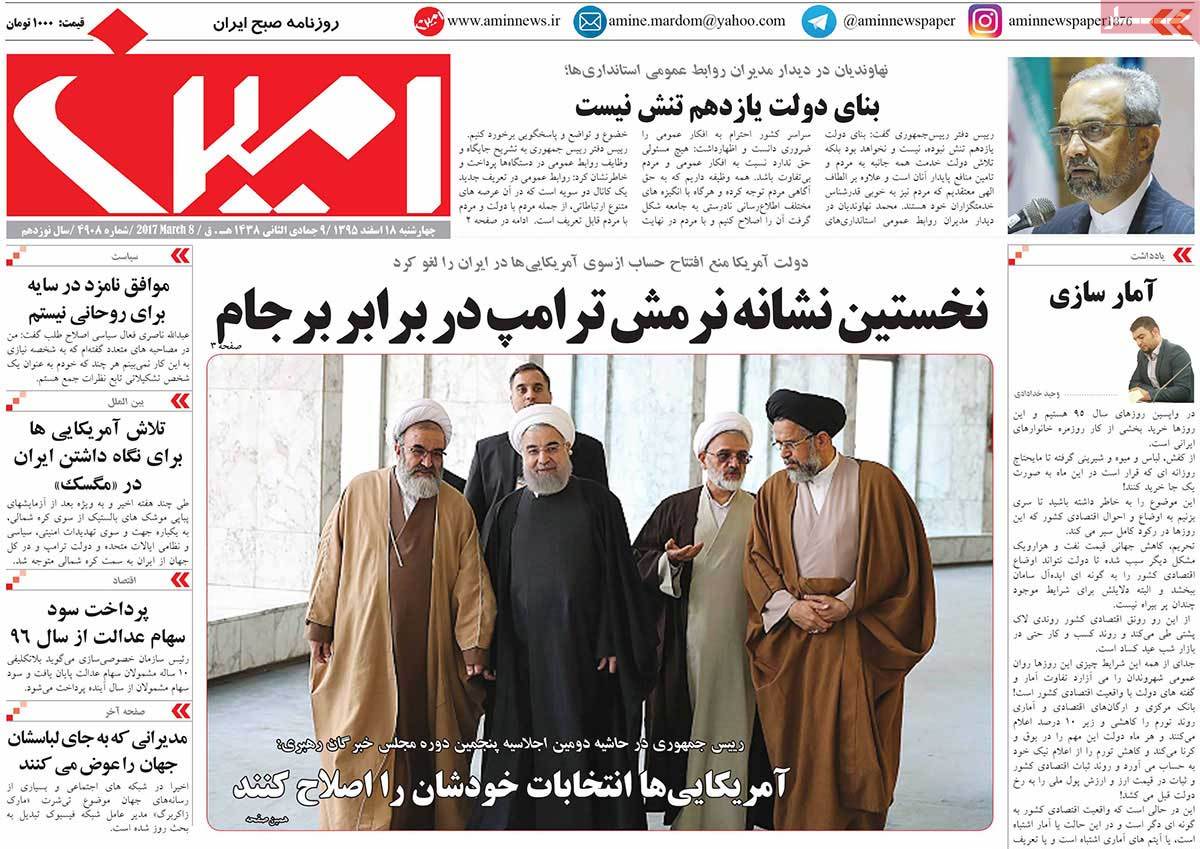
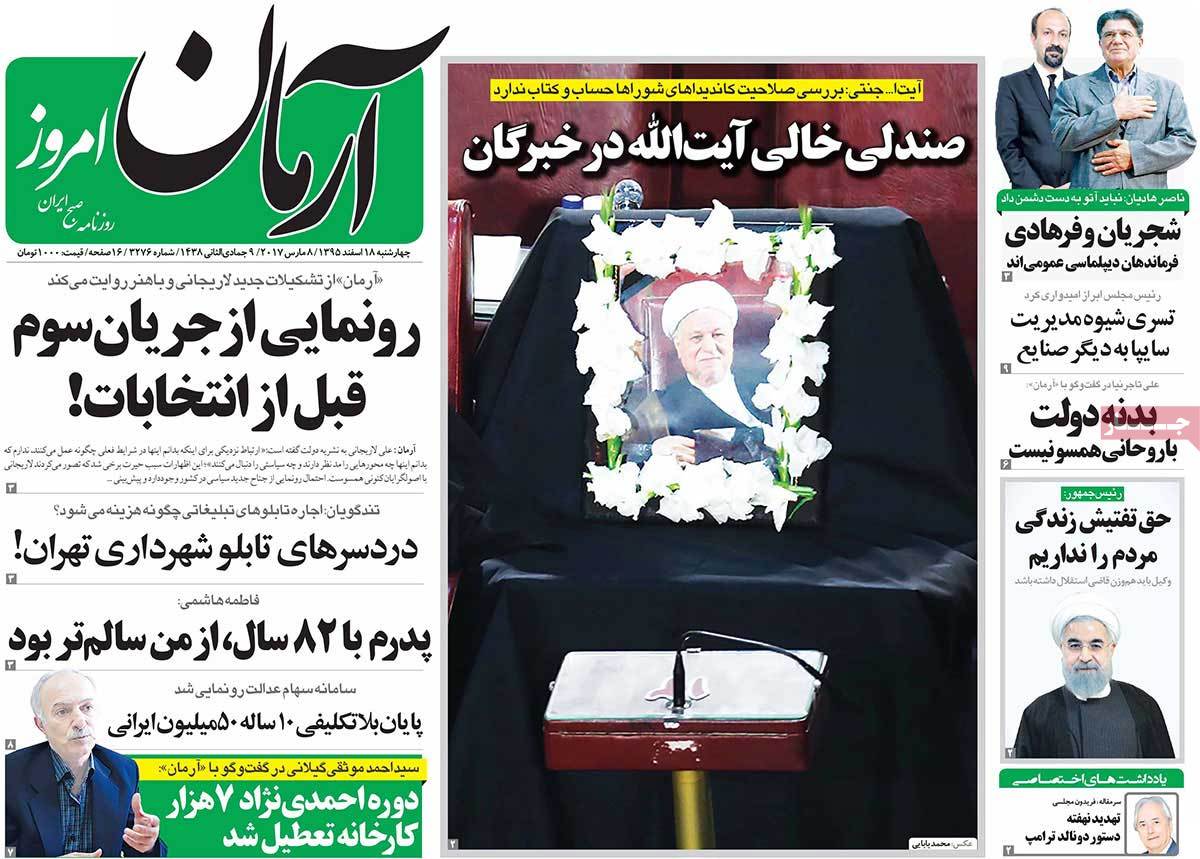
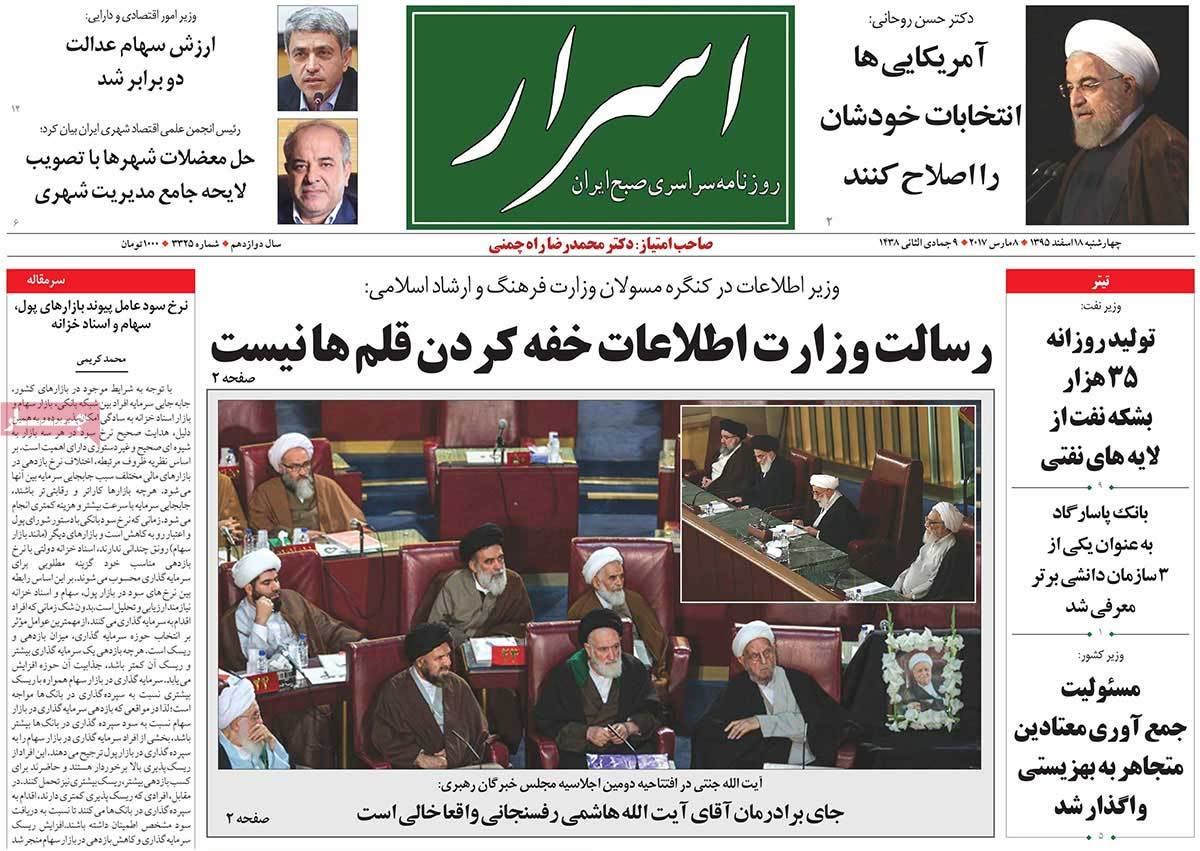
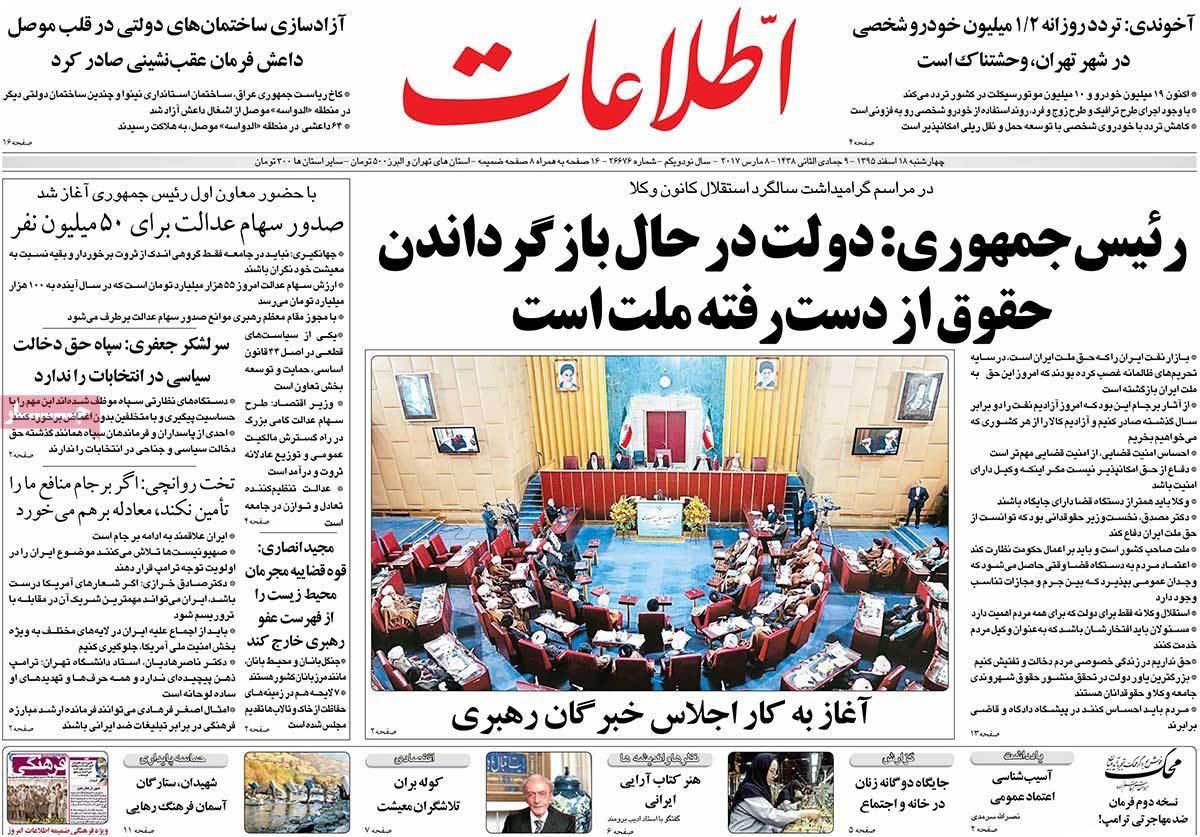
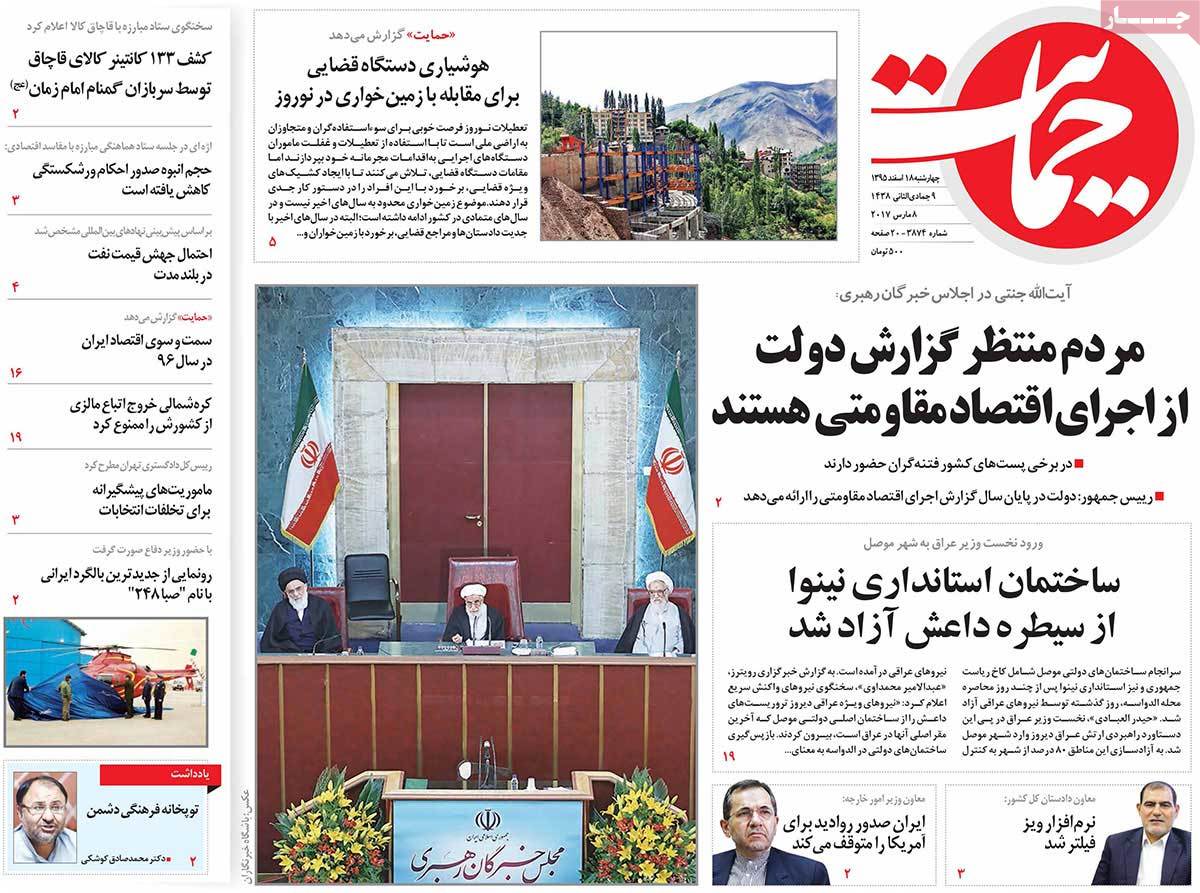
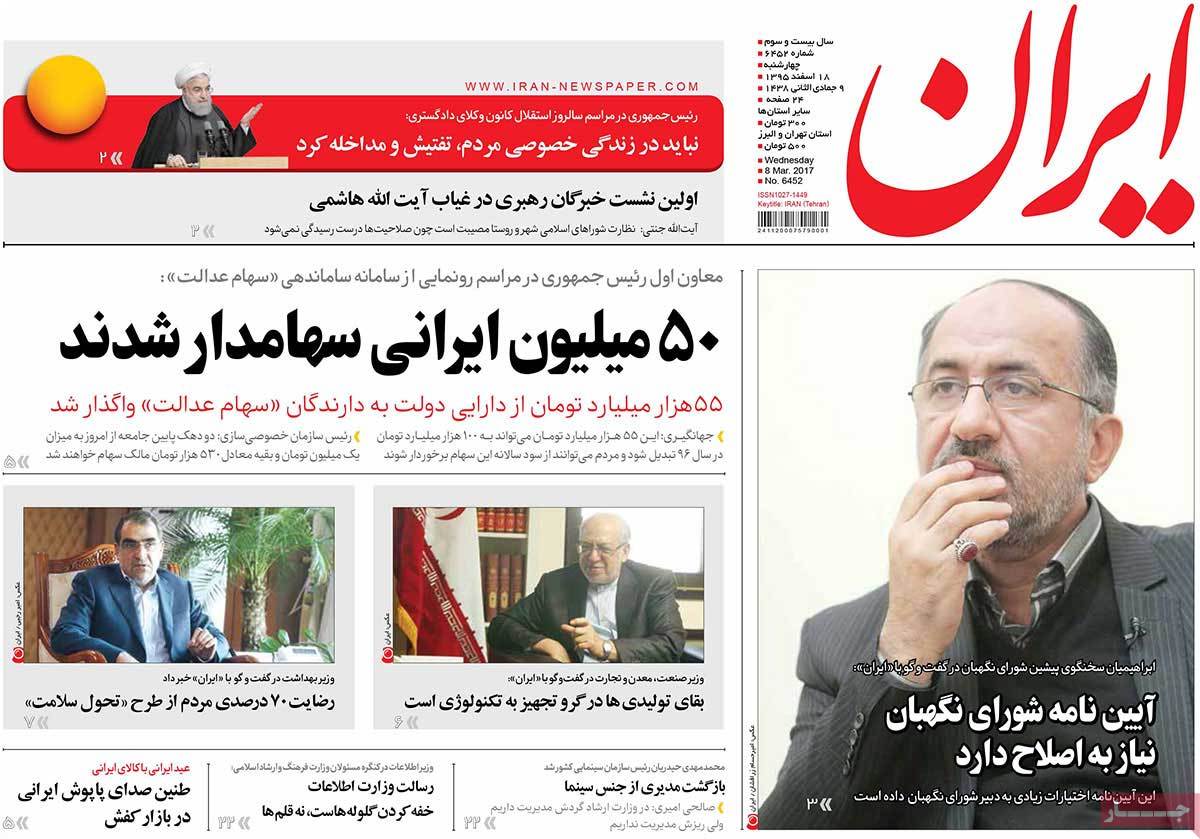
One of the top stories today was the promise made by Iranian President Hassan Rouhani to report about his administration’s performance by the next week.
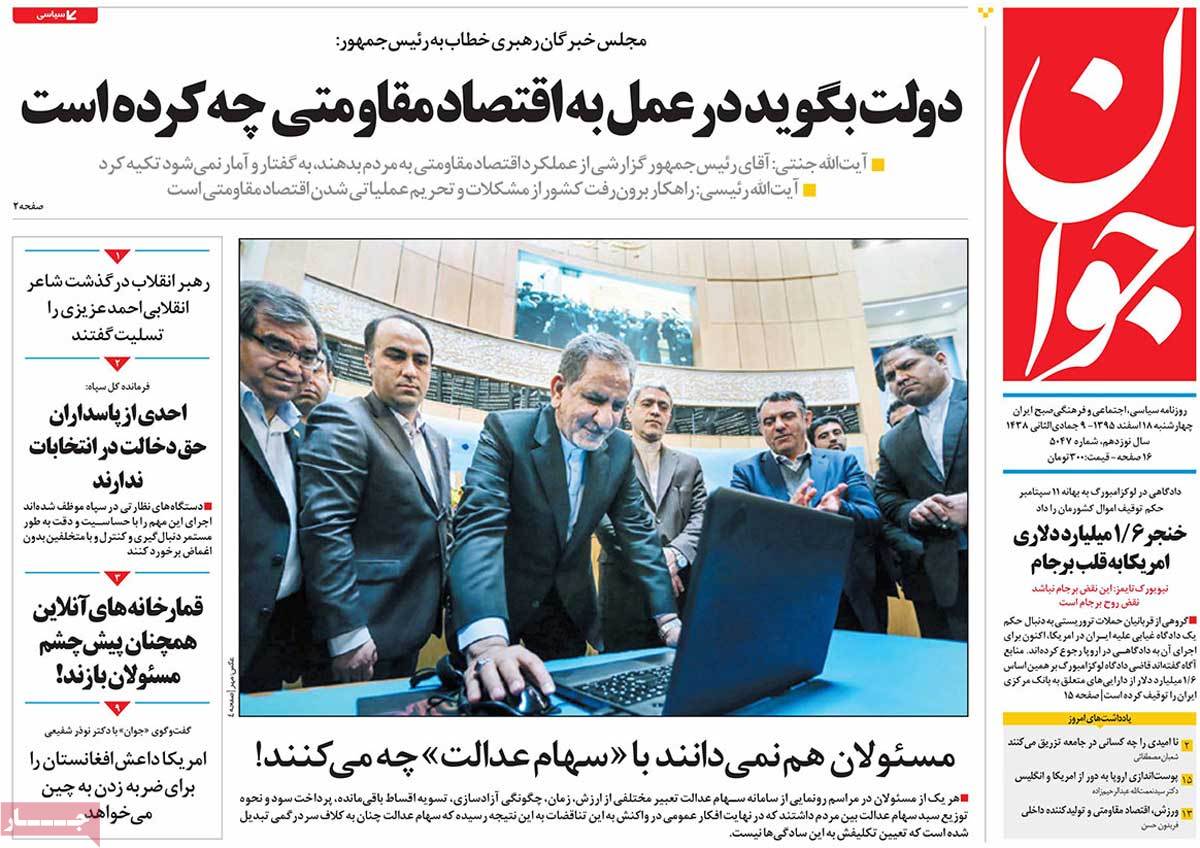
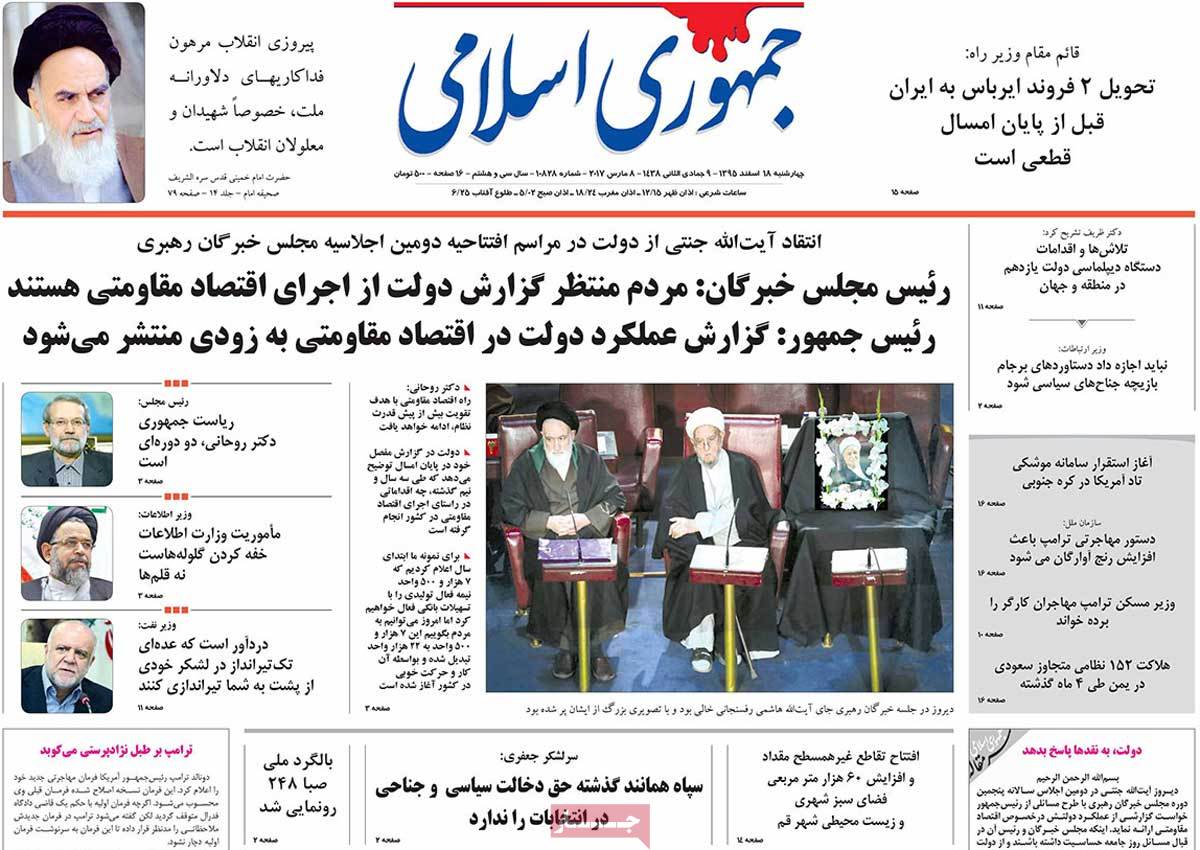
According to today’s newspapers, his report will be particularly focused on how much the government has pursued the Resistance Economy principles outlined by Iran’s Leader. This was a question raised in the Tuesday meeting of Assembly of Experts, where Rouhani was urged to apologise if he has failed to comply with the principles of Resistance Economy.
Rouhani’s criticism of the US report on Iran election also received great coverage. The Iranian president referred to the controversies over the US presidential votes, and urged them to take care of their own election instead of interfering in other countries’ affairs.
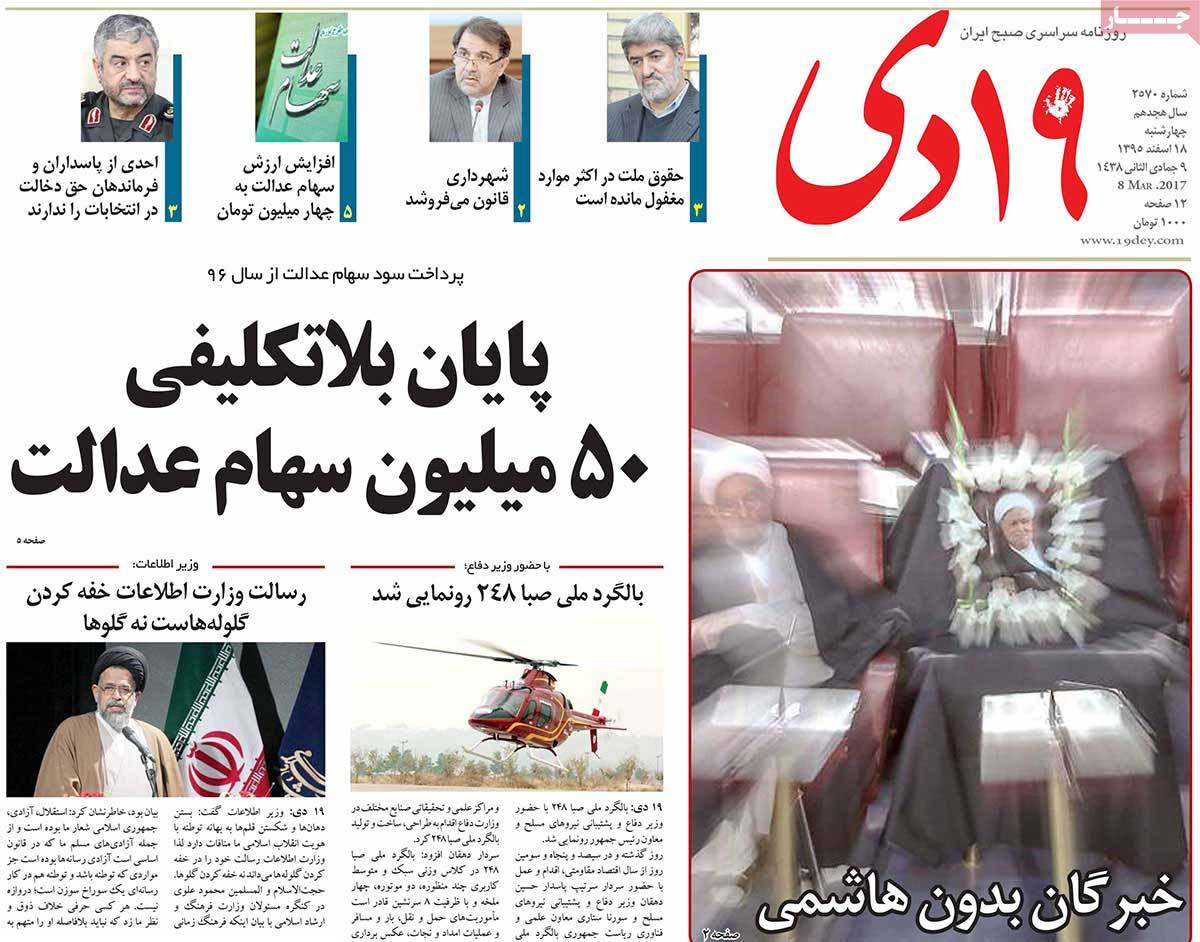
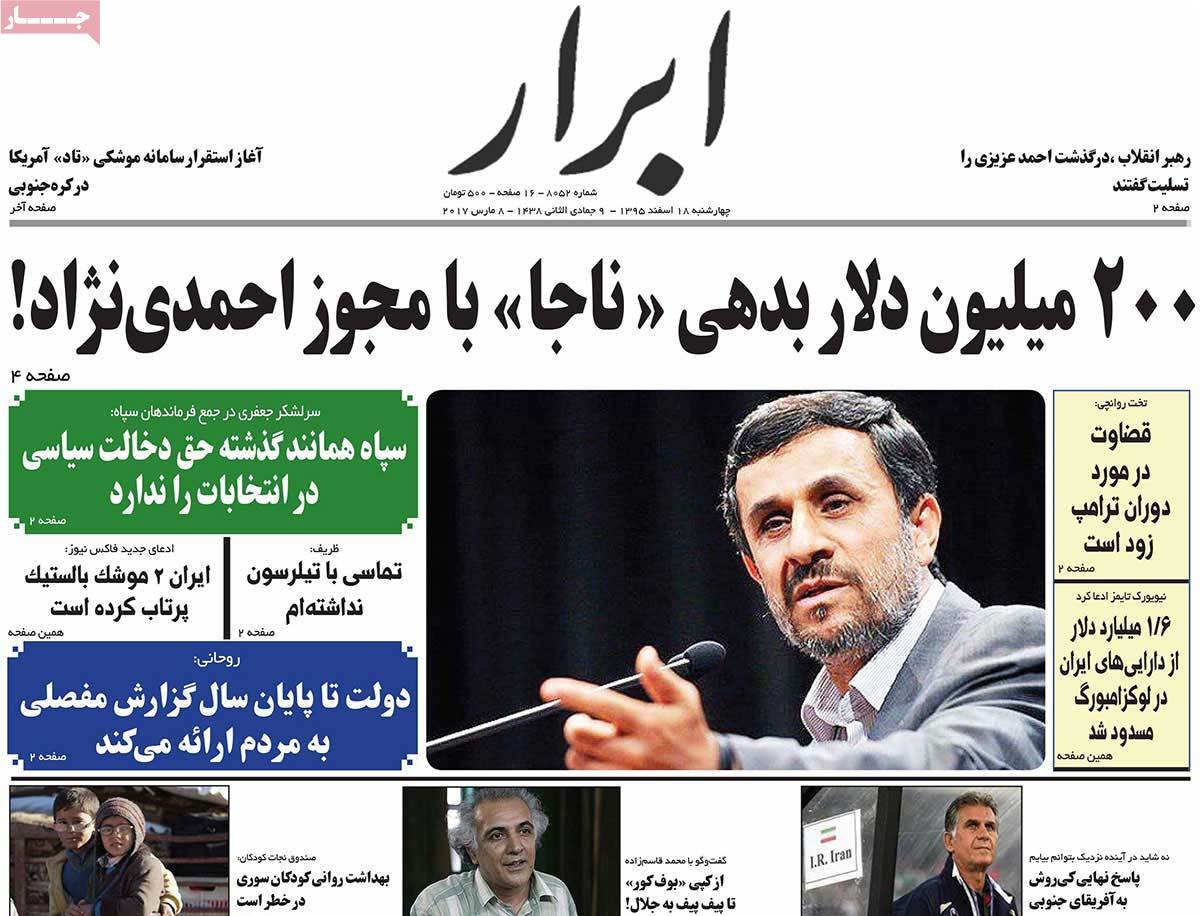
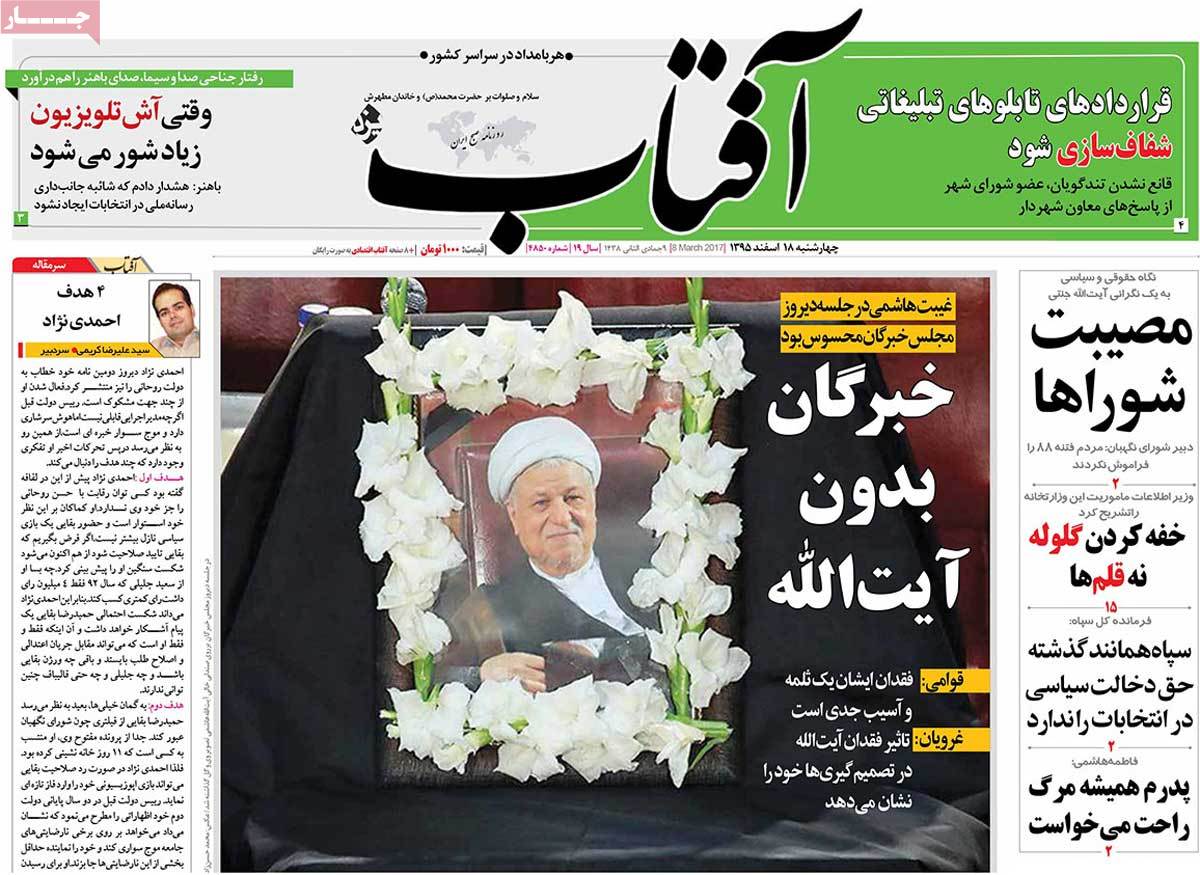
The above issues, as well as many more, are highlighted in the following headlines and top stories:
19 Dey:
1- Intelligence Minister: Ministry’s Mission Is to Silence Bullets, Not Voices
Abrar:
1- Iran’s Police Has Debts of Nearly $200 Million Thanks to Ahmadinejad’s Permit!
2- Zarif: I’ve Had No Contact with Tillerson
3- Rouhani: Government to Report on Its Performance Next Week
4- Deputy FM: It’s Too Early to Judge Trump Era
Aftab-e Yazd:
1- Assembly of Experts without Ayatollah Rafsanjani: Tangible Absence
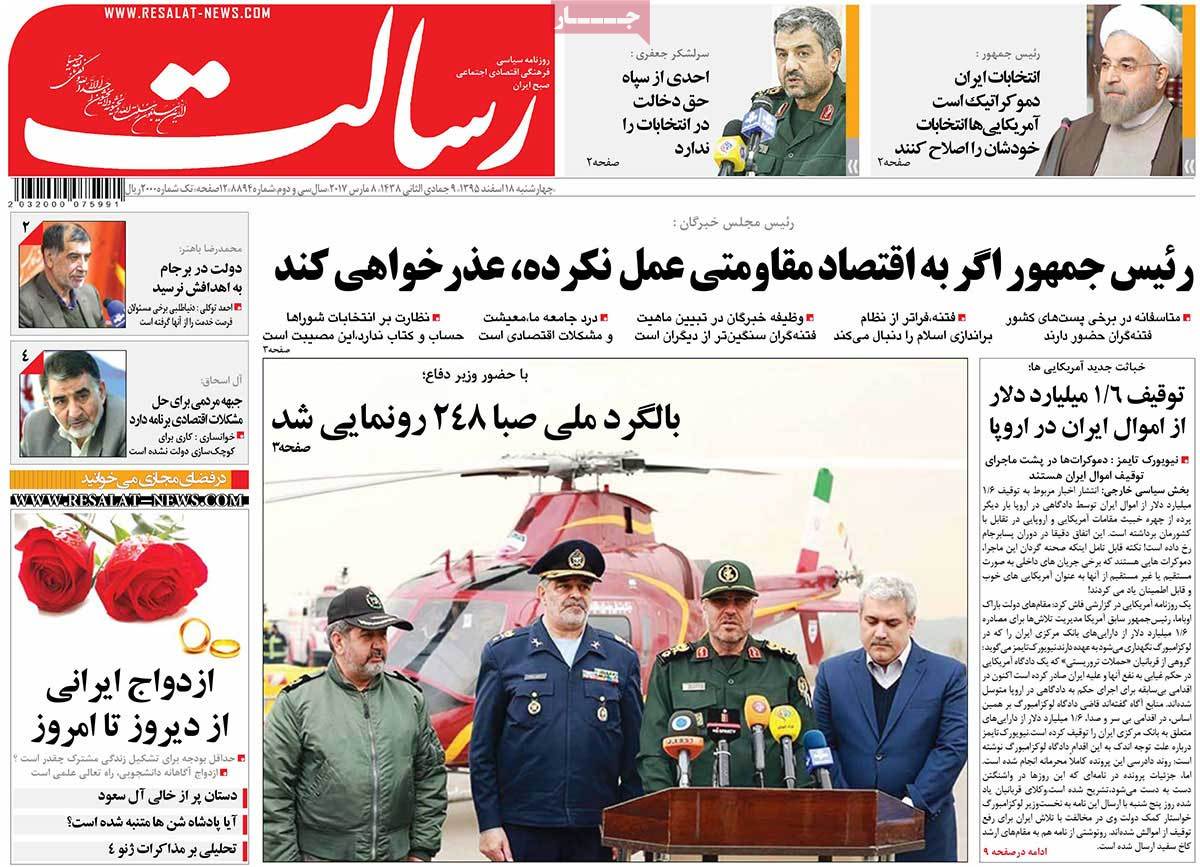
2- Commander: IRGC Staff Not Allowed to Interfere in Election
Amin:
1- First Signs of Trump’s Flexibility towards JCPOA: Americans can now open bank accounts in Iran after the ban was lifted by Trump administration
Arman-e Emrooz:
1- President: We Don’t Have Right to Inspect People’s Lives
2- Rouhani: Lawyers Should Have Independence Just Like Judges
3- 7,000 Factories Shut Down in Ahmadinejad Era
Asrar:
1- Rouhani: Americans Had Better Take Care of Their Own Election
2- Oil Minister: 35,000 bpd Produced from Oil Layers
Ettela’at:
1- Rouhani: Government Trying to Restore Nation’s Lost Rights
2- Deputy FM: Nuclear Deal Will Be Broken If It Doesn’t Meet Our Interests
3- Transport Minister: Horrible to See 1.2m Cars Moving in Tehran Everyday
Hemayat:
1- Deputy FM: Iran to Stop Issuing Visa for Americans
2- Deputy Prosecutor General: Waze Navigation App Filtered in Iran
Iran:
1- 50 Million Iranians Given Shares in Stock Exchange Market: First VP
Javan:
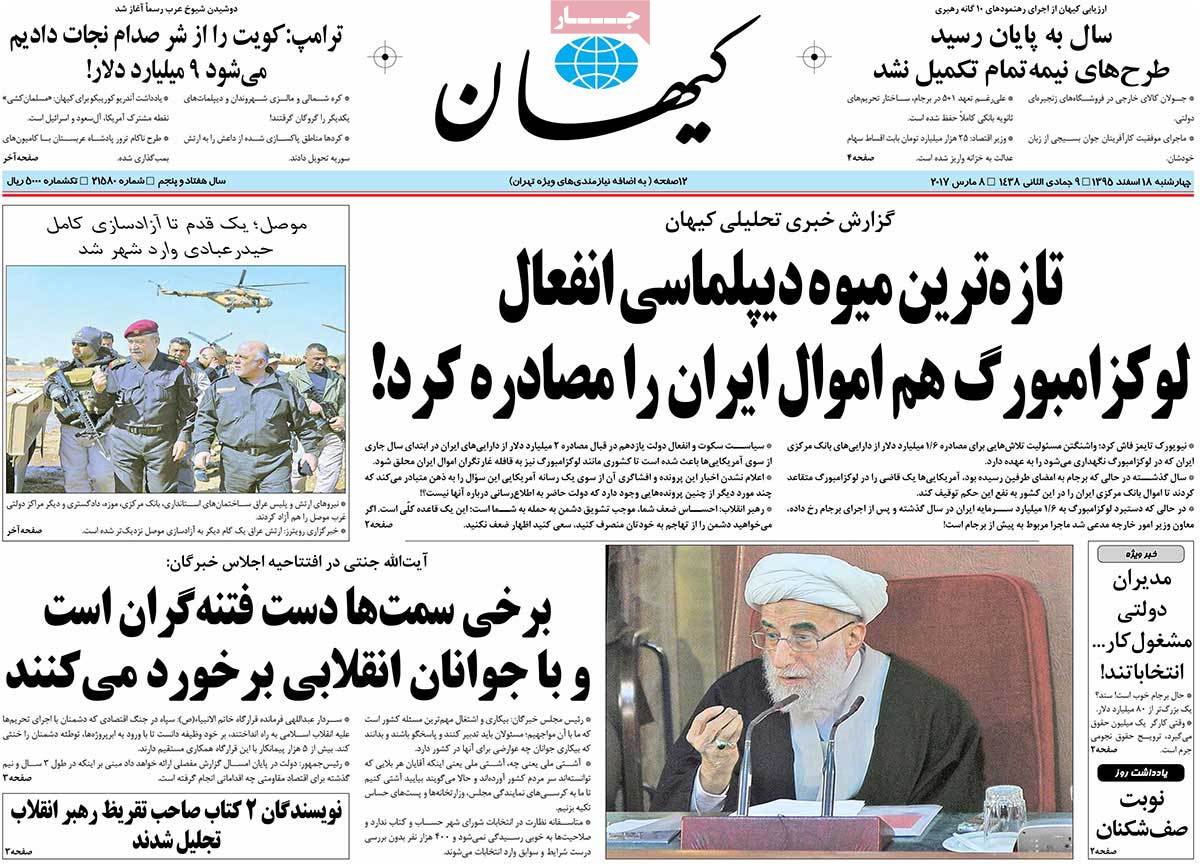
1- Assembly of Experts Calls for Gov’t Report on What It’s Done for Resistance Economy
2- Washington’s Dagger in Heart of JCPOA: Luxembourg court to seize Iran assets worth $1.6bn
Jomhouri Eslami:
1- Deputy Transport Minister: 2 Airbus Planes to Be Delivered to Iran Next Week
2- Parliament Speaker: Rouhani Will Be Re-Elected in May Elections
Kayhan:
1- Latest Fruit of Inaction Diplomacy: Even Luxembourg Is Seizing Iran Assets!
2- Trump Starts Demanding Money from Arab Sheikhs! ‘We rid Kuwait of Saddam, you should pay $9 billion!’
3- Mosul: One Step to Full Liberation; Iraqi PM Arrives in City
Resalat:
1- Homegrown Chopper Saba 248 Unveiled by DM
2- Head of Assembly of Experts urges Rouhani to apologize if he’s failed to implement resistance economy
3- President: Iran’s Election Is Democratic, Americans Had Better Correct Their Own Election
Sayeh:
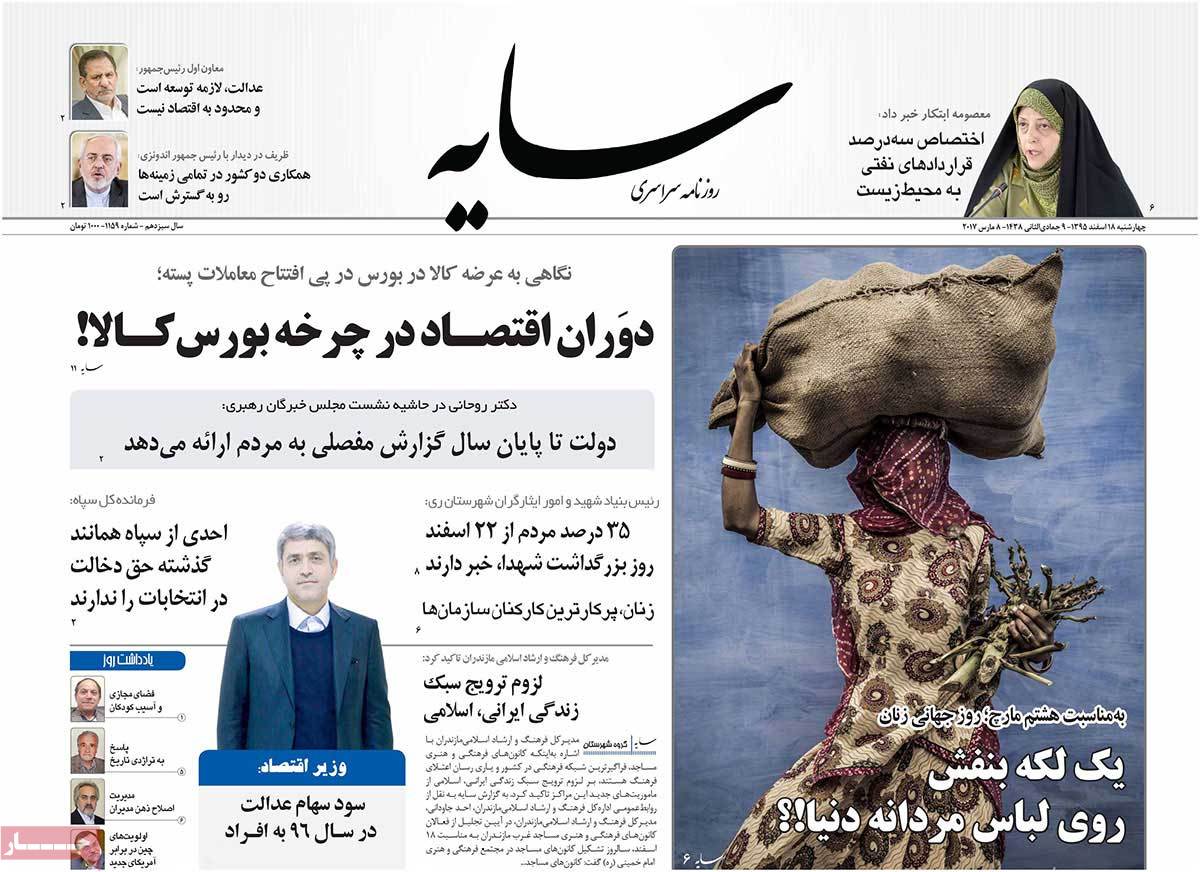
1- Official: 3% of Oil Deals Revenues to Be Allocated to Environment
Seda-ye Eslahat:
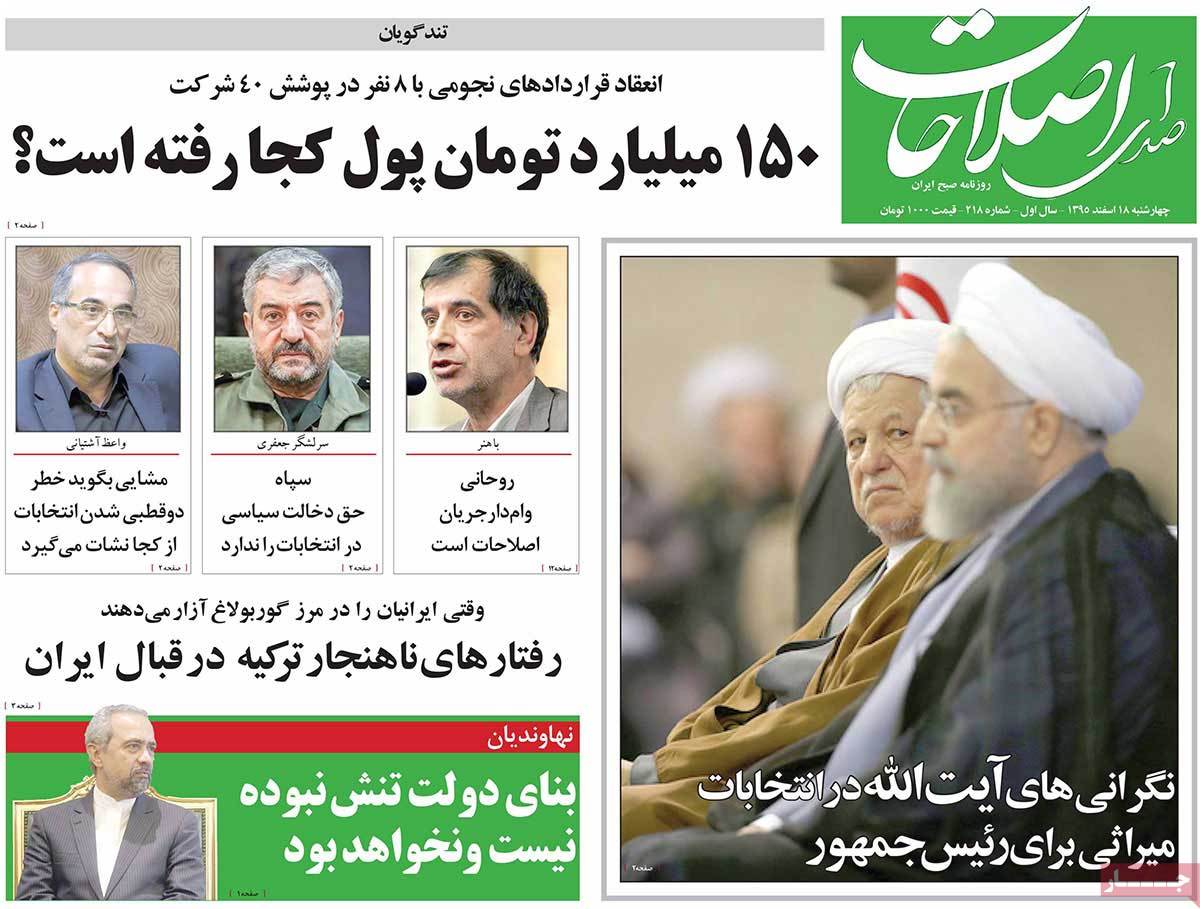
1- Turkey’s Abnormal Behaviour towards Iran: When Iranians are harassed in borders
2- Senior Conservative: Rouhani Indebted to Reformists
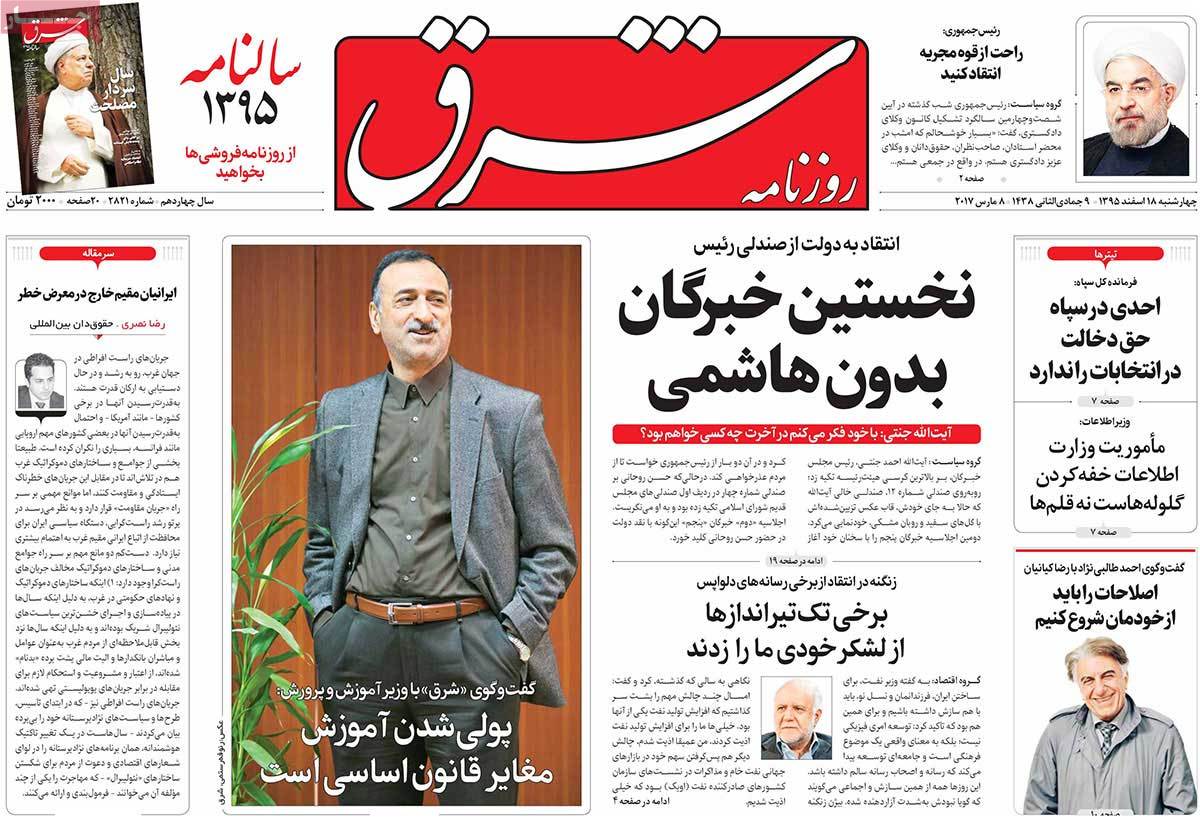
Shargh:
1- It’s against Constitution to Charge Money for Education: Minister
Acclaimed Iranian director Farhadi, the two-time Oscar-winning director of The Salesman and A Separation, has confirmed his next film will start shooting in Spain in September, with a cast including Penelope Cruz and Javier Bardem. It should be ready for next year.
However, Farhadi revealed the high-profile, real-life couple will “not necessarily” play an on-screen couple in the Spanish-language feature.
“Once again there are different couples in my film, not only one,” Farhadi told Screen, of what is a recurring theme of his work.
“The film is again about family and family relationships. But there are also some new aspects in it. Yes [Cruz and Bardem] are in the film but they are not necessarily a couple in the film.”
The non-Spanish speaker said he has written the script for the new film in Farsi and it has been translated into Spanish. “I don’t speak Spanish,” he explained via a translator. “But I have time between now and the shoot to at least become more familiar with the music of the film and do my best.”
The filmmaker, who previously shot The Past in French, said making the film in a foreign language wouldn’t compromise his vision.
“I don’t feel the change of language changes your voice,” he suggested. “[My voice is an] empathy with all the characters, a level of compassion that is general.”
As with all Farhadi’s films, few further details are known about the new feature, except that it is being produced by Pedro and Agustin Almodovar’s El Deseo and sold by Memento Film.


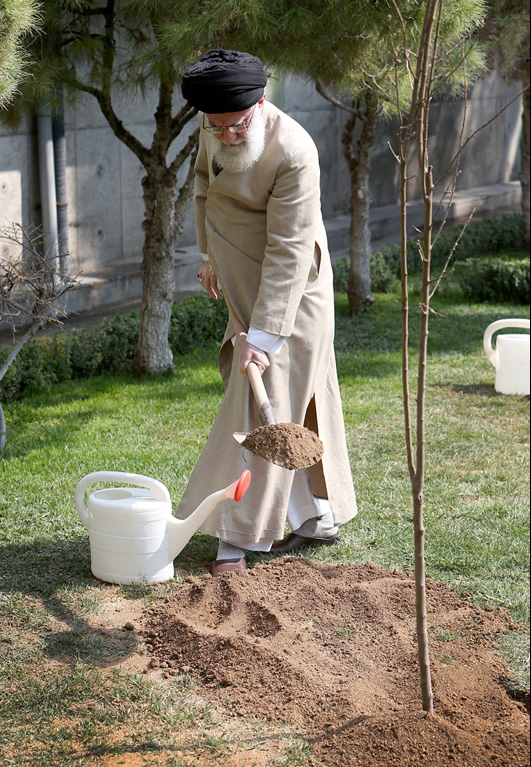 Every year in March, Ayatollah Khamenei plants saplings as a symbolic gesture of respect for the Mother Nature, and highlights the need for collective efforts to safeguard the environment.