Friday, January 16, 2026
Home Blog Page 4104

Iranian FM Holds Talks with Emir of Qatar in Doha

Iranian FM Zarif Holds Talks with Emir of Qatar in Doha
Iranian Foreign Minister Mohammad Javad Zarif (L) meets with Qatari Emir Sheikh Tamim bin Hamad al-Thani in Doha on March 8, 2017.

Zarif, who is in Doha for a one-day visit, and Sheikh Tamim bin Hamad al-Thani discussed the promotion of trade and economic ties. They also exchanged views on regional conflicts and common concerns.

The Iranian top diplomat also met his Qatari counterpart Mohammed bin Abdulrahman bin Jassim Al-Thani.

During the meeting, Zarif underlined the need for further promotion of Tehran-Doha ties, especially in the sectors of economy, banking and joint investment.

The Qatari official, for his part, described his country’s relations with Iran as amicable.

We have always believed that Iran and the Persian Gulf Arab countries can have good ties, al-Thani said, adding that his country favors such a policy.

Zarif’s visit to Qatar comes amid efforts to improve ties between Persian Gulf Arab countries and Iran after relations between Tehran and some of the Arab countries of the strategic region became tense when Saudi Arabia unilaterally severed its diplomatic ties with Iran.

On January 25, Kuwaiti Foreign Minister Sheikh Sabah al-Khalid al-Hamad al-Sabah paid a visit to Iran to deliver Kuwaiti Emir Sheikh Sabah al-Ahmad al-Jaber al-Sabah’s message to Iranian President Hassan Rouhani.

Iran Blasts Kabul Terror Attack

In a statement released on Wednesday afternoon, Qassemi deplored the terrorist attack as “inhumane and barbaric” and offered his deep condolences to the Afghan people and governed as well as the bereaved families of victims of the incident.

The only way to counter the sinister phenomenon of terrorism in the region and Afghanistan is a global consensus and determination to cut the supply routes to terrorists and end the material and moral support for them, the spokesman noted.

The Daesh gunmen wearing white lab coats stormed a military hospital in Afghanistan’s capital on Wednesday, killing at least 30 people and wounding dozens more.

The attack on the 400-bed military hospital, which is located near two civilian hospitals in Kabul’s heavily-guarded diplomatic quarter, set off clashes with security forces that lasted several hours.

Gen. Dawlat Waziri, a Defense Ministry spokesman, says there were “more than 30 killed and more than 50 wounded” in the attack. He said Afghan forces had battled the attackers floor by floor. The ministry said the attackers were dressed like health workers.

Waziri said a suicide bomber had detonated his payload and another attacker was shot dead, and that one member of the security forces was killed and three wounded.

Daesh claimed the attack in a statement carried by its Aamaq news agency.

ISIS Leader May Have Escaped Iraq’s Mosul

ISIS Leader scaped

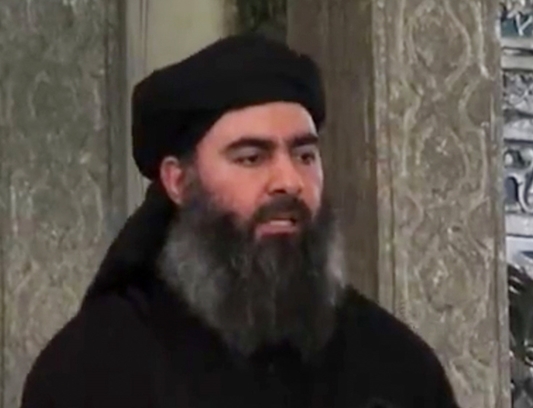
Abu Bakr al-Baghdadi is believed to have escaped the war-torn city in northern Iraq, and according to Fox News, his destination is unknown.

One Iraqi official told Reuters that al-Baghdadi may be hiding north of the Euphrates River amongst Sunni Arab tribes.

“It’s their historic region, they know the people there and the terrain; food, water and gasoline are easy to get, spies are easier to spot,” analyst Hisham al-Hashimi, who advised the Iraqi government, said.

ISIS Leader Can Apply for US Visa, Iranian PhD Students Can’t!

Trump

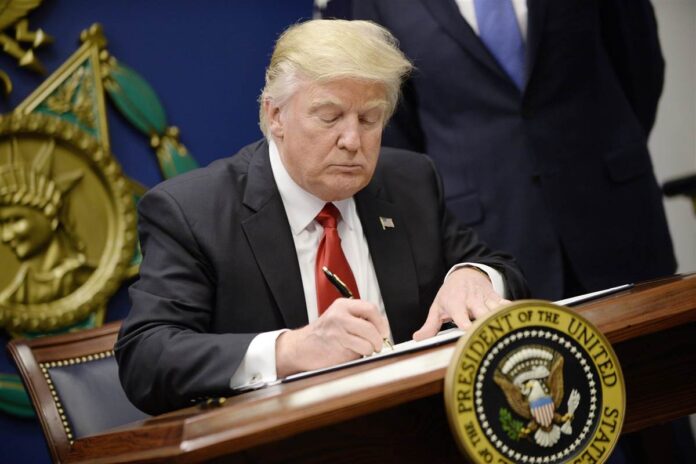
Under this so-called revised travel ban, Osama Bin Laden (founder of al-Qaeda), Abū Bakr al-Baghdadi (ISIS leader), Hibatullah Akhundzada (Taliban leader), and Ayman Mohammed al-Zawahiri (current leader of al-Qaeda) all can apply for a visa appointment at a US embassy, while Syrian child refugees​, ​Iranian PhD students, Somali and Sudanese humanitarian workers are all banned from applying for visa to the United States.

How many terror attacks have refugees carried out in the United States? Not a single one since the Refugee Act of 1980. ​This is because law enforcement agencies have done a terrific job of vetting refugees, a fact that Trump refuses to acknowledge publicly, Huffington Post reported.

A Look at Iranian Newspaper Front Pages on March 9

The top story today was the remarks made by the Leader of Iran’s Islamic Revolution Ayatollah Seyyed Ali Khamenei after planting a couple of seedlings on Week of Natural Resources. The Leader underlined the significance of protecting the country’s forests, and also praised Iranian fruits, calling on the government to stop importing fruits unless in necessary cases.

President Hassan Rouhani’s remarks in northeastern Iranian city of Mashhad also received great coverage. Rouhani talked about the importance of resolve and faith in dealing with foreign threats.

A Luxembourg court ruling to seize Iran’s assets was also a top story today. Some sources say the court has rejected the US court ruling to seize Iranian assets in the European country.

The above issues, as well as many more, are highlighted in the following headlines and top stories:


Abrar:

1- Guardian Council Once Again Rejects Parliament’s Bill on Salaries

2- Central Bank: Luxembourg Court Rejects US Seizure of Iran Assets
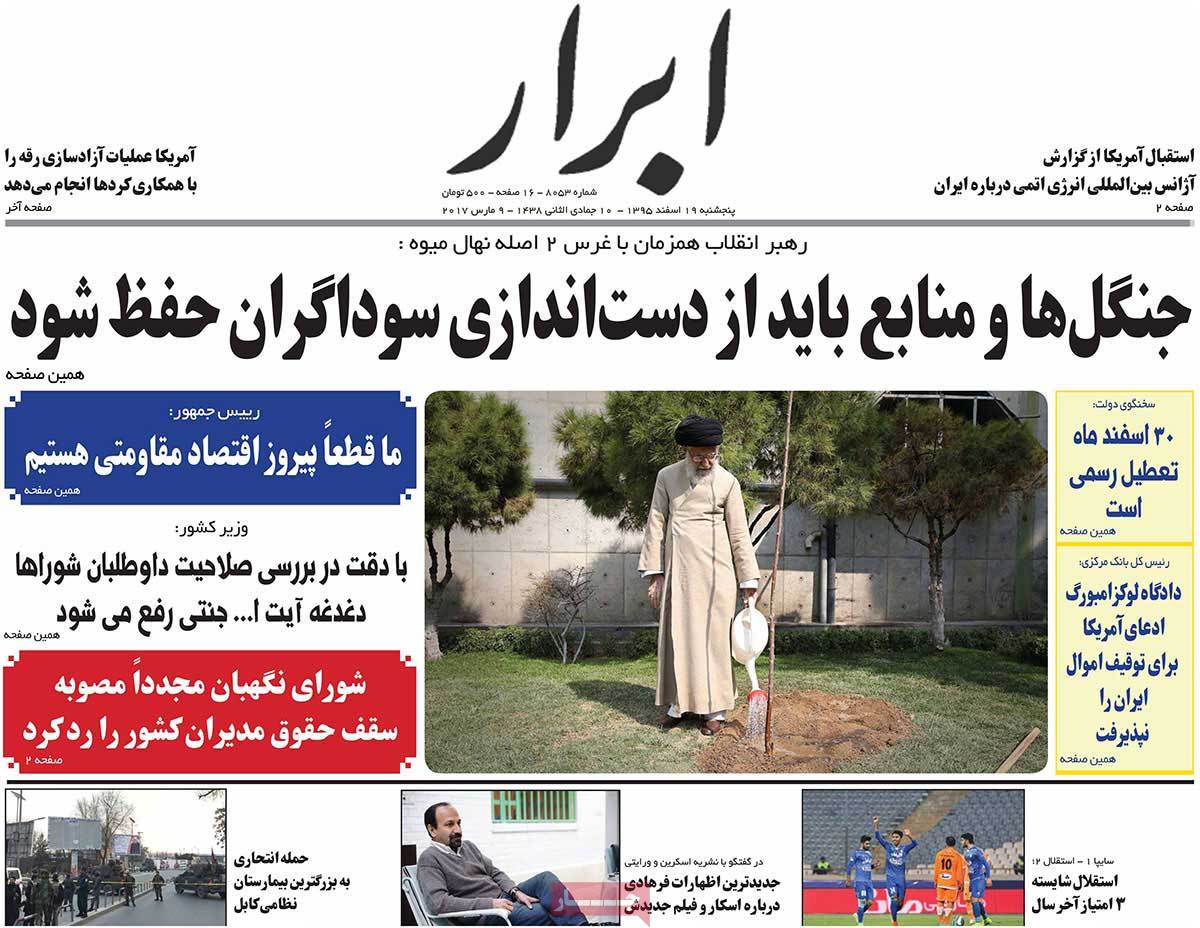
A Look at Iranian Newspaper Front Pages on March 9


Afkar:

1- New Condition for Registering Marriage: Passing Courses on Choosing Spouse
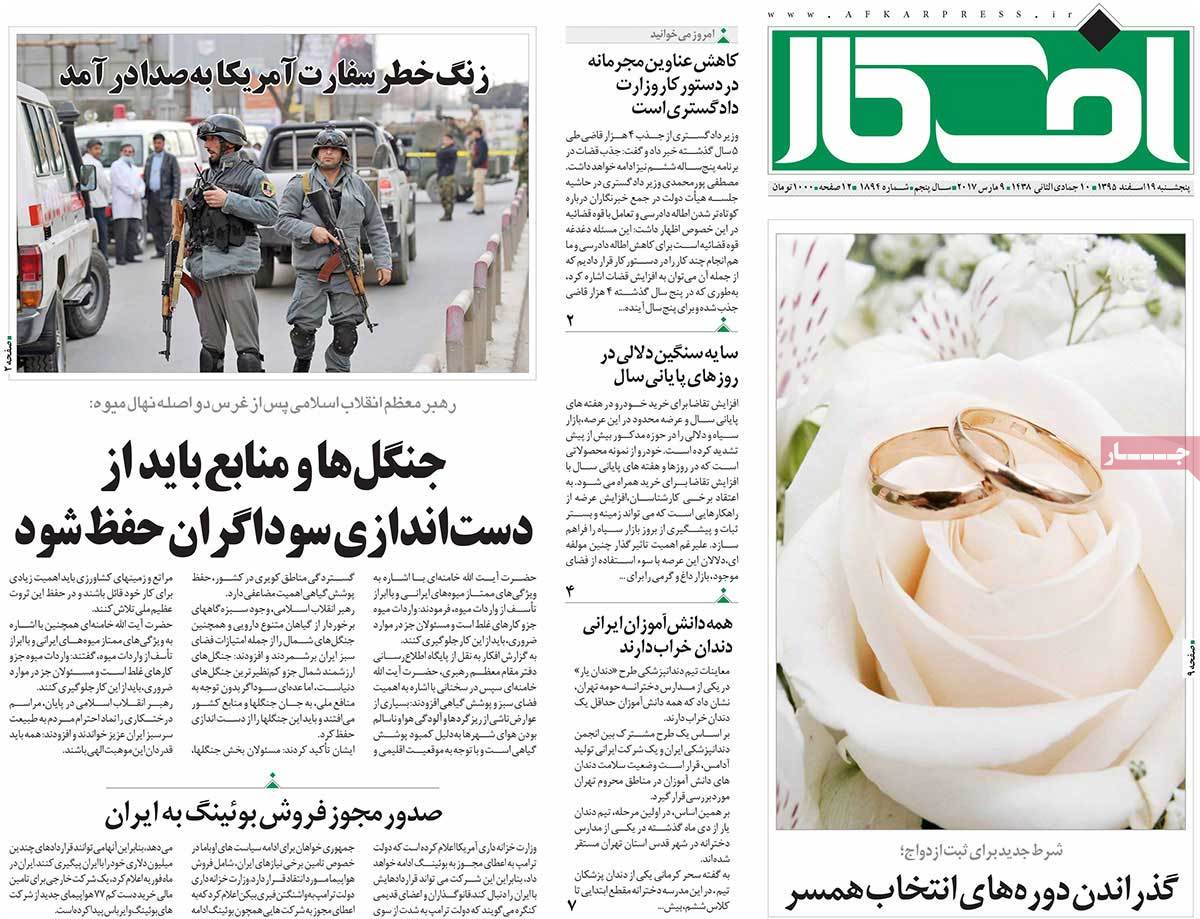
A Look at Iranian Newspaper Front Pages on March 9


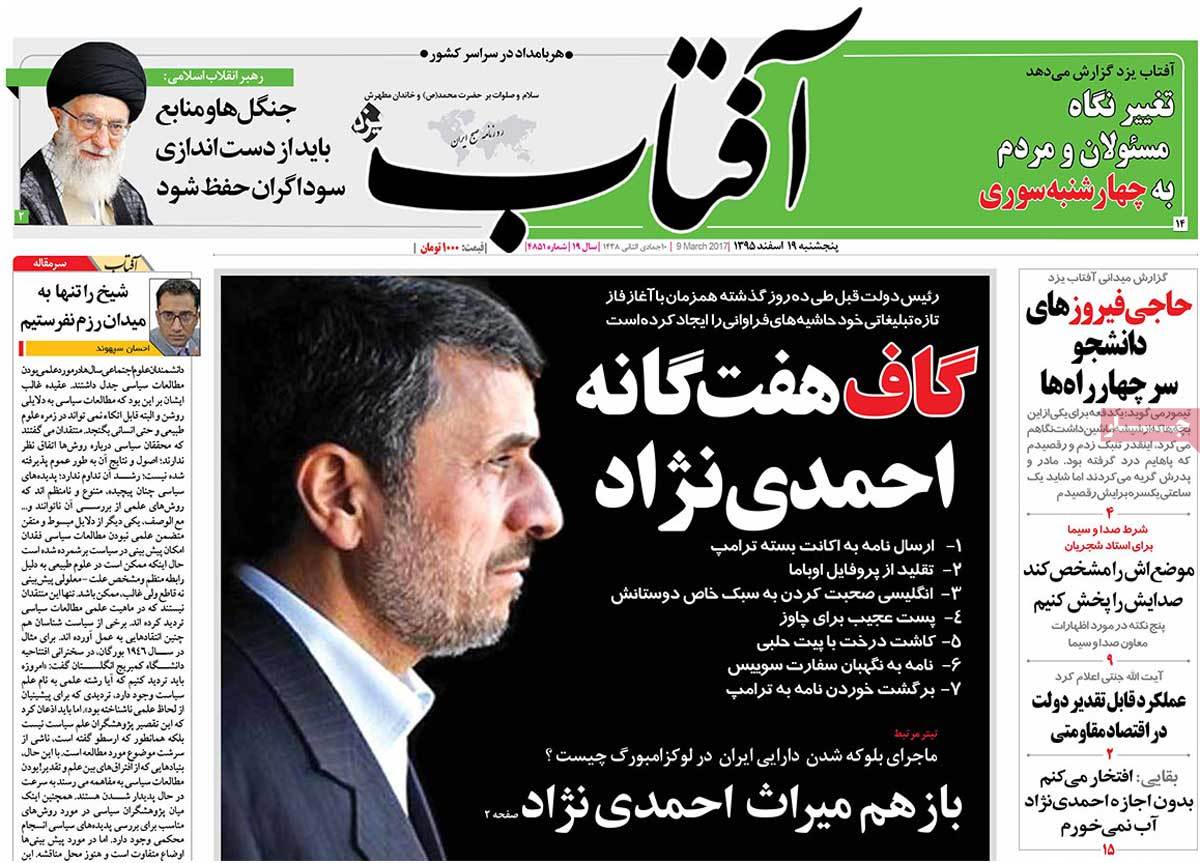
Aftab-e Yazd:

1- Iran’s Leader: Forests, Resources Should Be Protected against Smugglers

2- Seven Goofs by Ahmadinejad

  • In the past ten days, former Iranian president Mahmoud Ahmadinejad has sparked controversy as he started a new phase of campaigning for his friend Hamid Baqaei, who will run for presidency. Ahmadinejad sent a letter to Trump’s closed Twitter account, copied Obama’s bio in his Twitter account, spoke English in the special way his friends do, posted odd tweet for Chavez, planted a tree sapling along with its metal box, and his letter to Trump was delivered to the security guard of Swiss embassy!

3- Hamid Baqaei: I’m Proud I Don’t Even Drink a Glass of Water without Ahmadinejad’s Permission!
A Look at Iranian Newspaper Front Pages on March 9


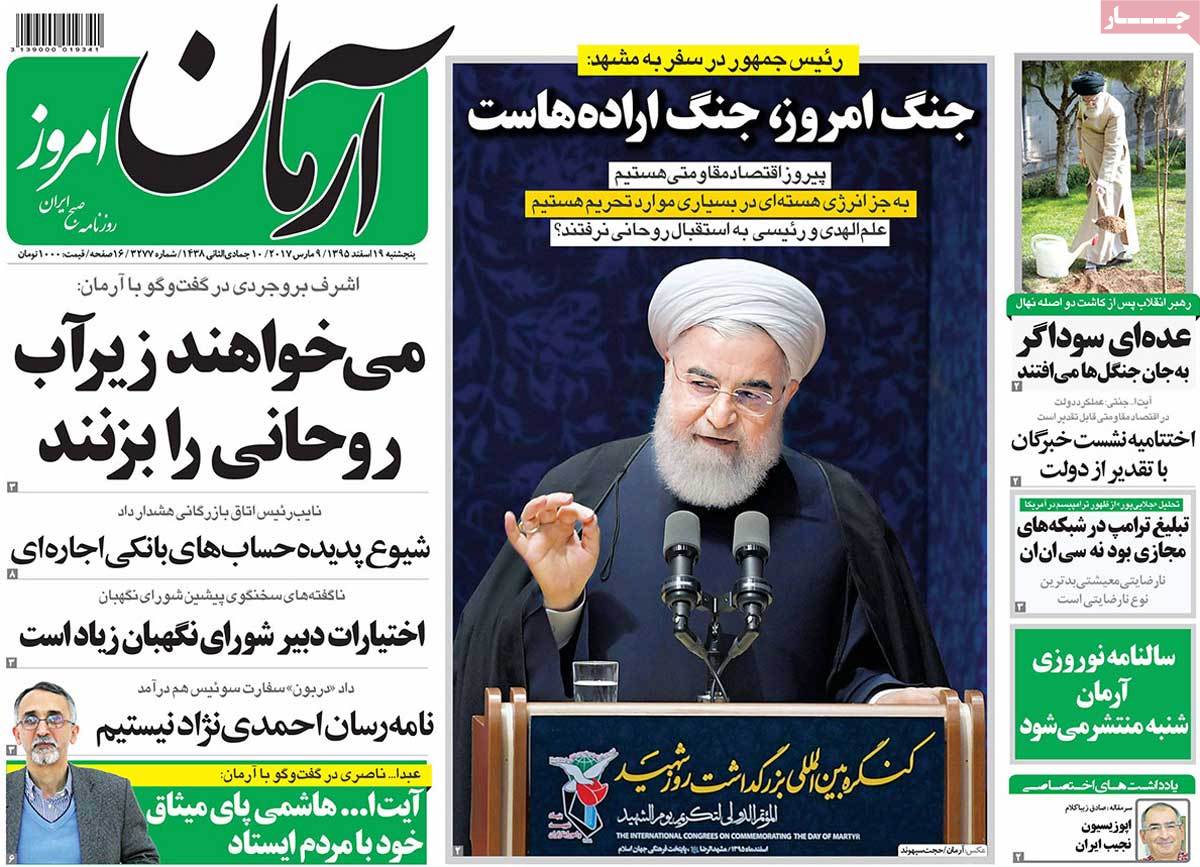
Arman-e Emrooz:

1- President: We’re under Sanctions in Many Cases Except for Nuclear Energy

2- We’re Not Mailmen: Swiss Embassy after receiving Ahmadinejad’s letter to Trump
A Look at Iranian Newspaper Front Pages on March 9


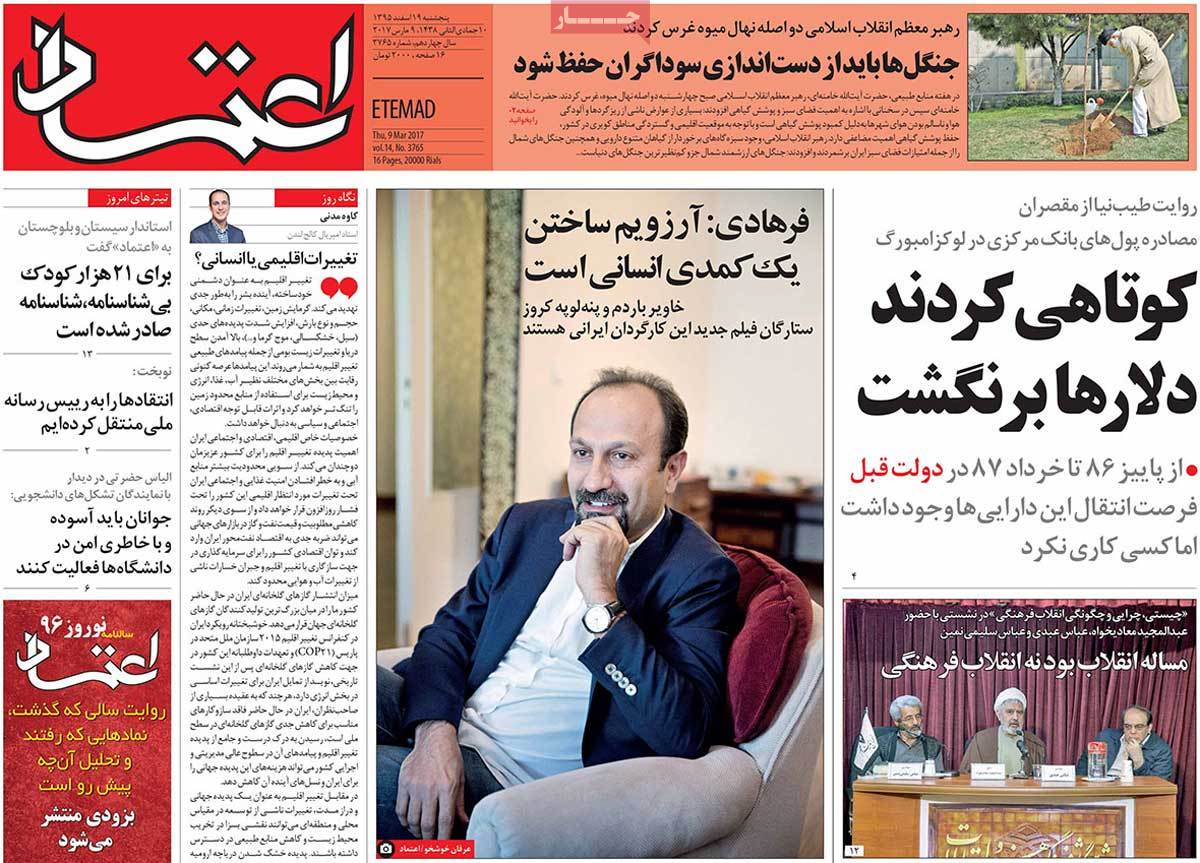
Etemad:

1- Farhadi: Javier Bardem, Penelope Cruz to Appear in My New Film

2- Ahmadinejad’s Gov’t is to Blame for Luxembourg’s Seizure of Iran Assets: Minister
A Look at Iranian Newspaper Front Pages on March 9


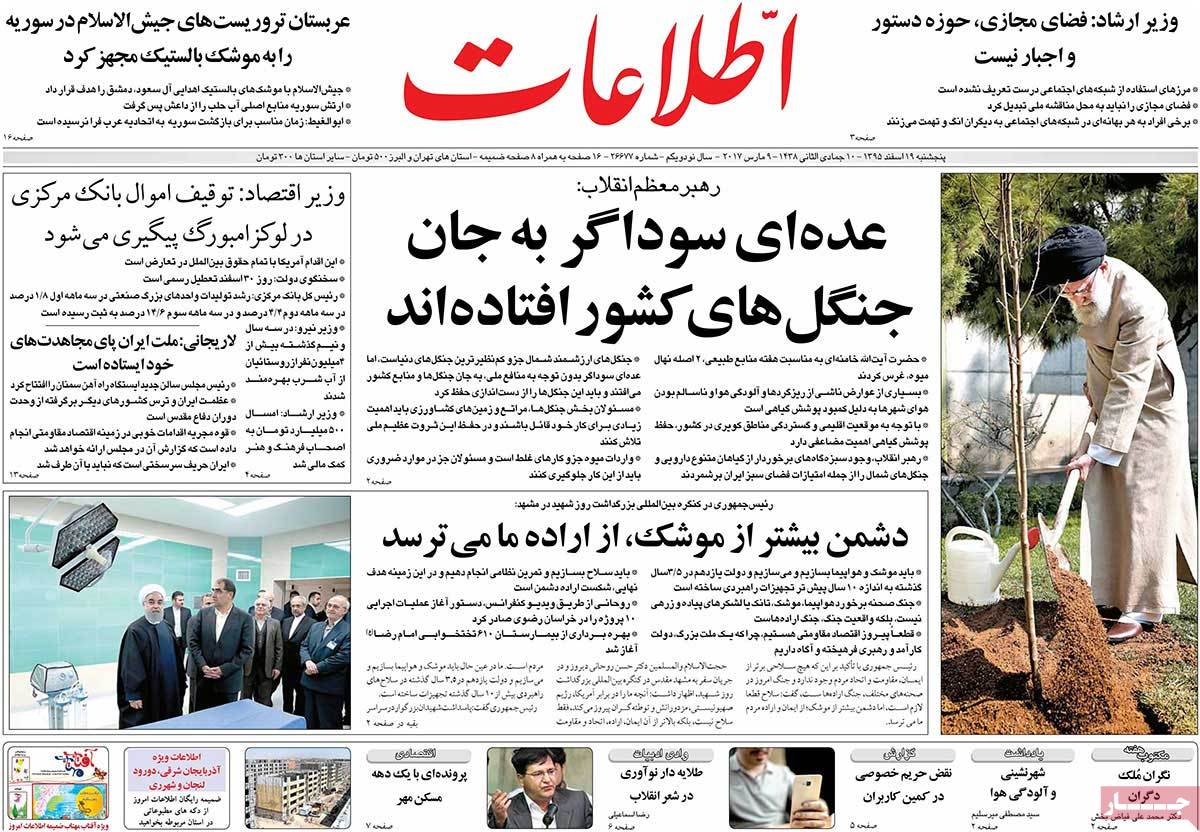
Ettela’at:

1- Leader: A Bunch of Smugglers Are Exploiting Iranian Forests

2- Culture Minister: Cyberspace Is No Place for Orders and Force

3- President Rouhani: Enemies’ Fear of Our Resolve More than That of Our Missiles
A Look at Iranian Newspaper Front Pages on March 9


Iran:

1- Culture Minister: We Won’t Give in to Local Tastes

2- Senior Politician Advises Conservatives Not to Use Opposition to JCPOA as Main Slogan
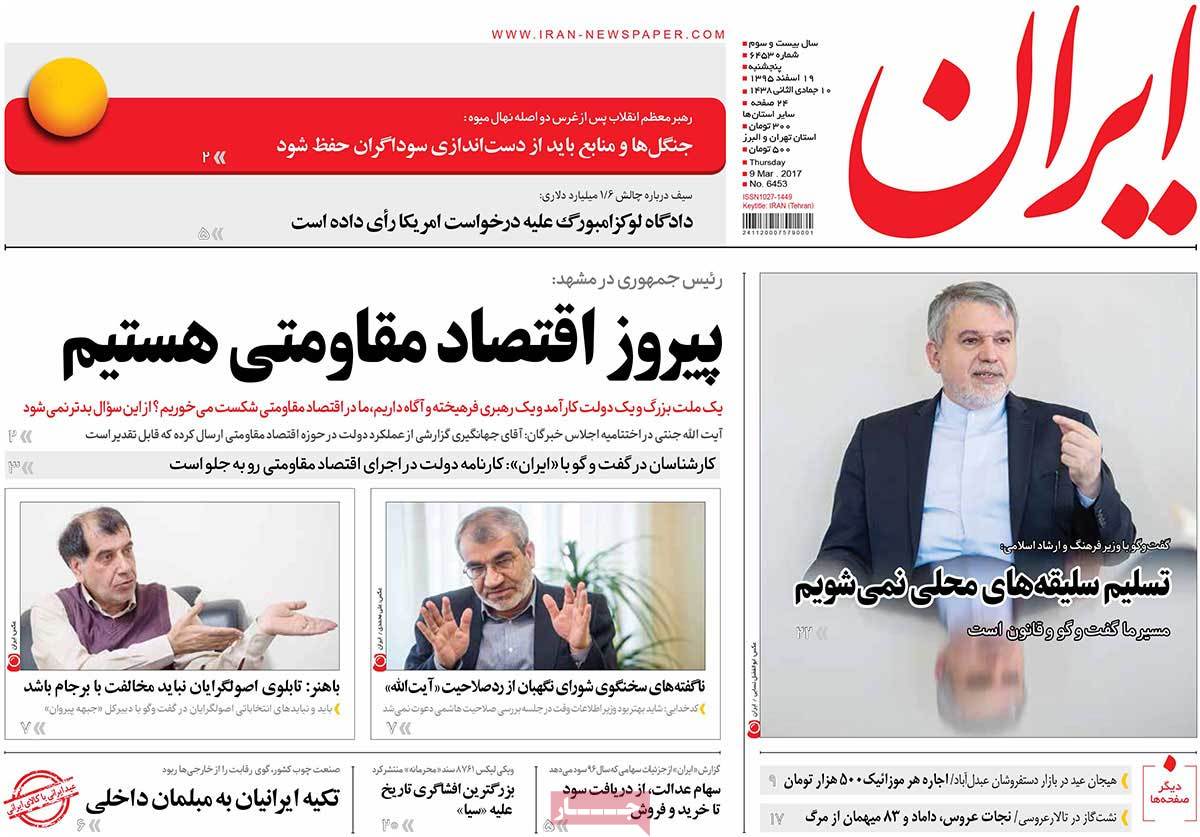
A Look at Iranian Newspaper Front Pages on March 9


Javan:

1- Iran’s Leader: It’s Wrong to Import Fruits

2- Government’s Economic Aide: We’re Practically Not Receiving Taxes from the Rich

3- Voluntary Forces Can Resolve Issue of Dust Pollution If Gov’t Lets Them to: IRGC General
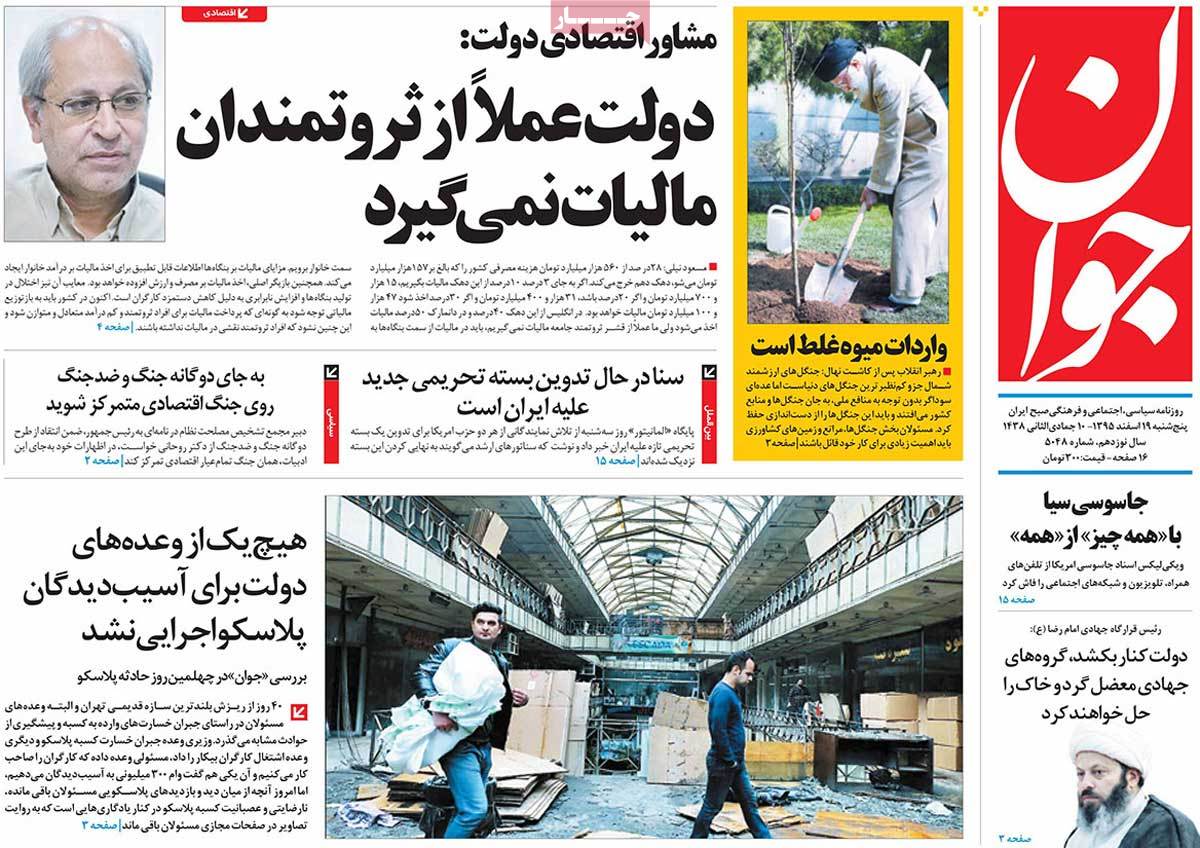
A Look at Iranian Newspaper Front Pages on March 9


Jomhouri Eslami:

1- President: Resolve, Faith, Unity Are Most Efficient Weapons against Threats

2- Most Complicated Phase of Operation to Liberate Mosul Kicked Off
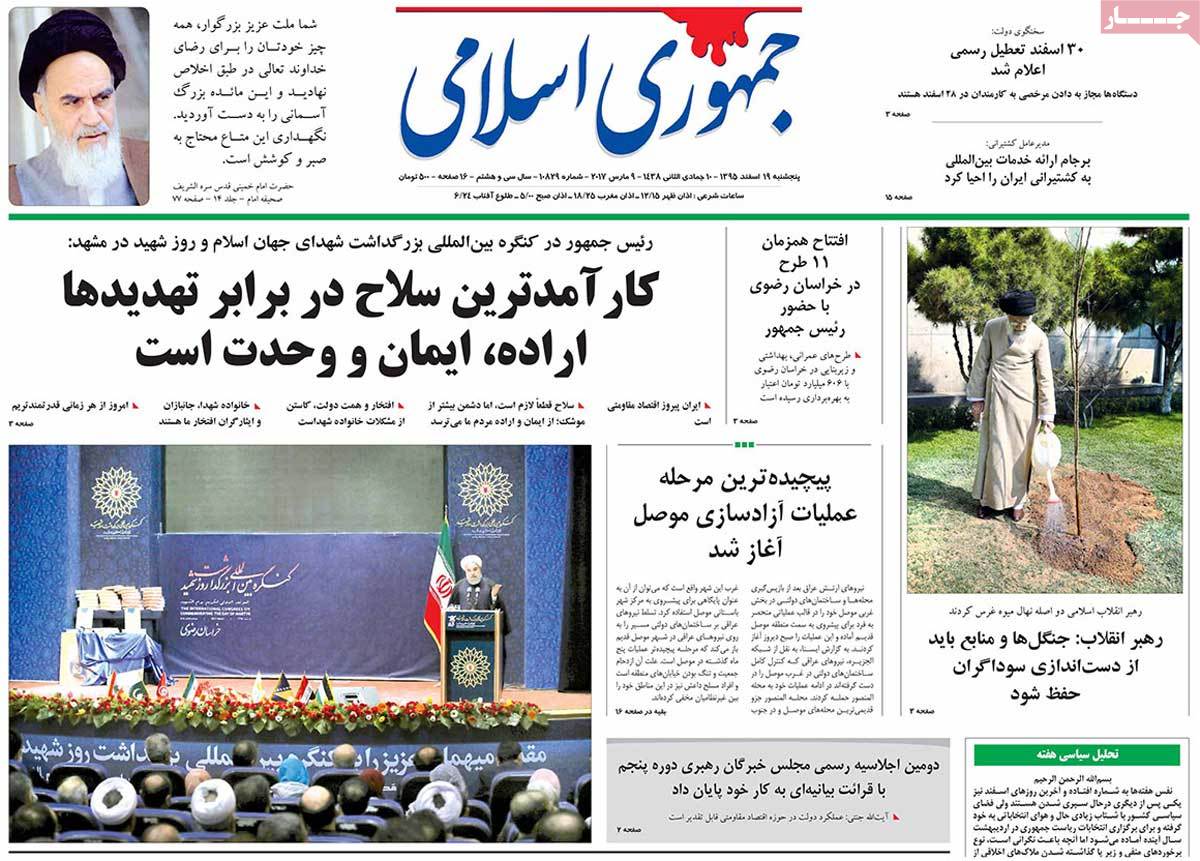
A Look at Iranian Newspaper Front Pages on March 9


Kayhan:

1- Iran’s Leader Urges Gov’t to Prevent Import of Fruits Unless in Necessary Cases

2- Iran’s Loyal Friends All over the World Ready to Sacrifice Lives to Counter US: Bloomberg

3- From Fact Sheet to Luxembourg Case: Government’s Secrecy, Westerners’ Disclosure!
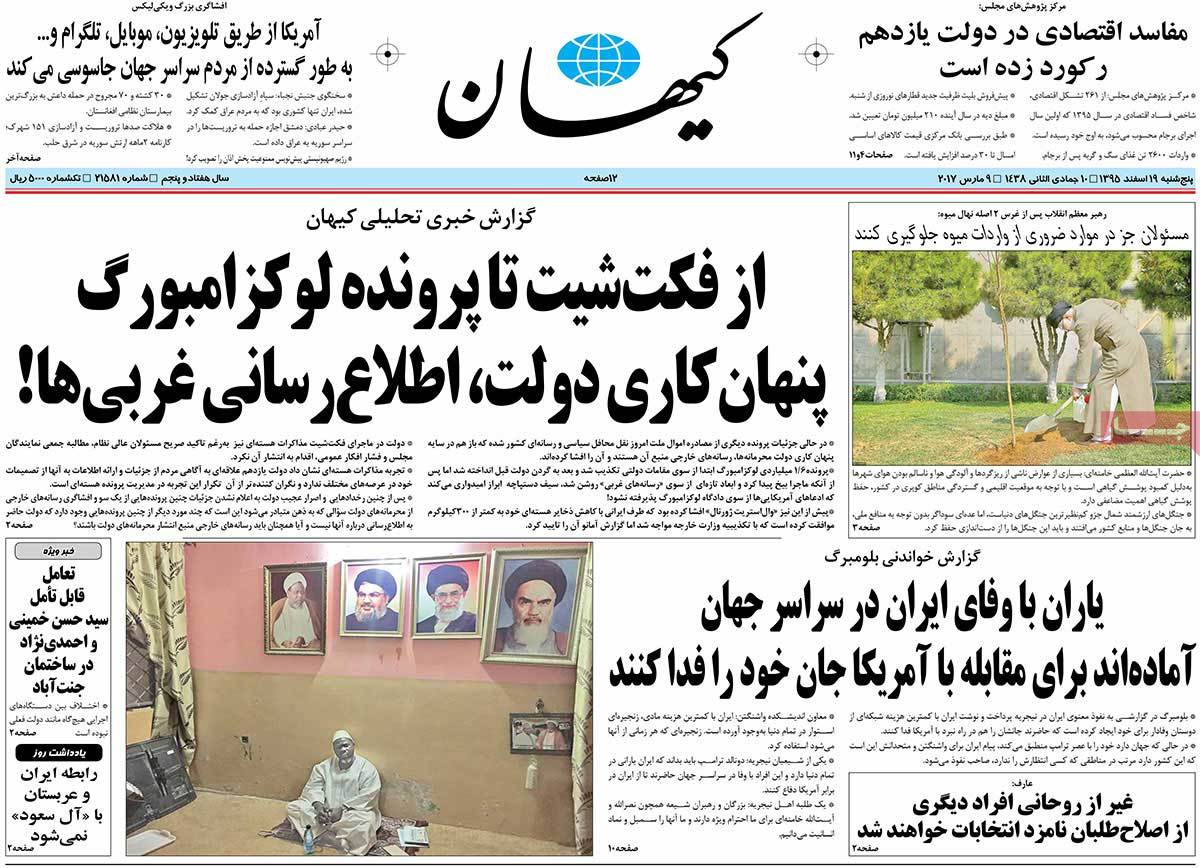
A Look at Iranian Newspaper Front Pages on March 9


Resalat:

1- Ayatollah Khamenei: Dust Pollution Caused by Lack of Vegetation

2- Ayatollah Jannati Slams Gov’t for Spending a Fortune on a Ceremony

3- Whoever Wants to Turn Iran into a Supermarket Shouldn’t Become President: Javad Larijani
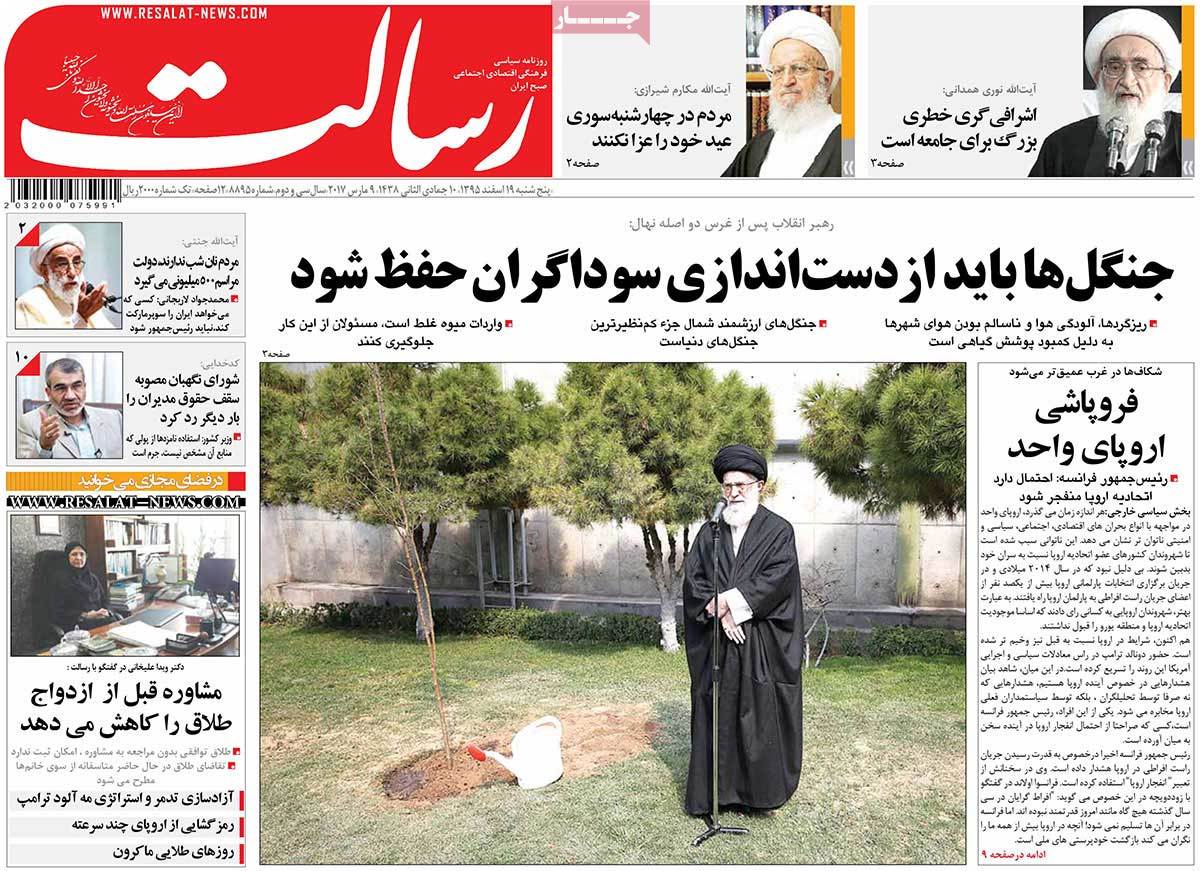
A Look at Iranian Newspaper Front Pages on March 9


Seda-ye Eslahat:

1- Intelligence Minister: It’s Religiously Valuable for Us that Religious Minorities Are Happy
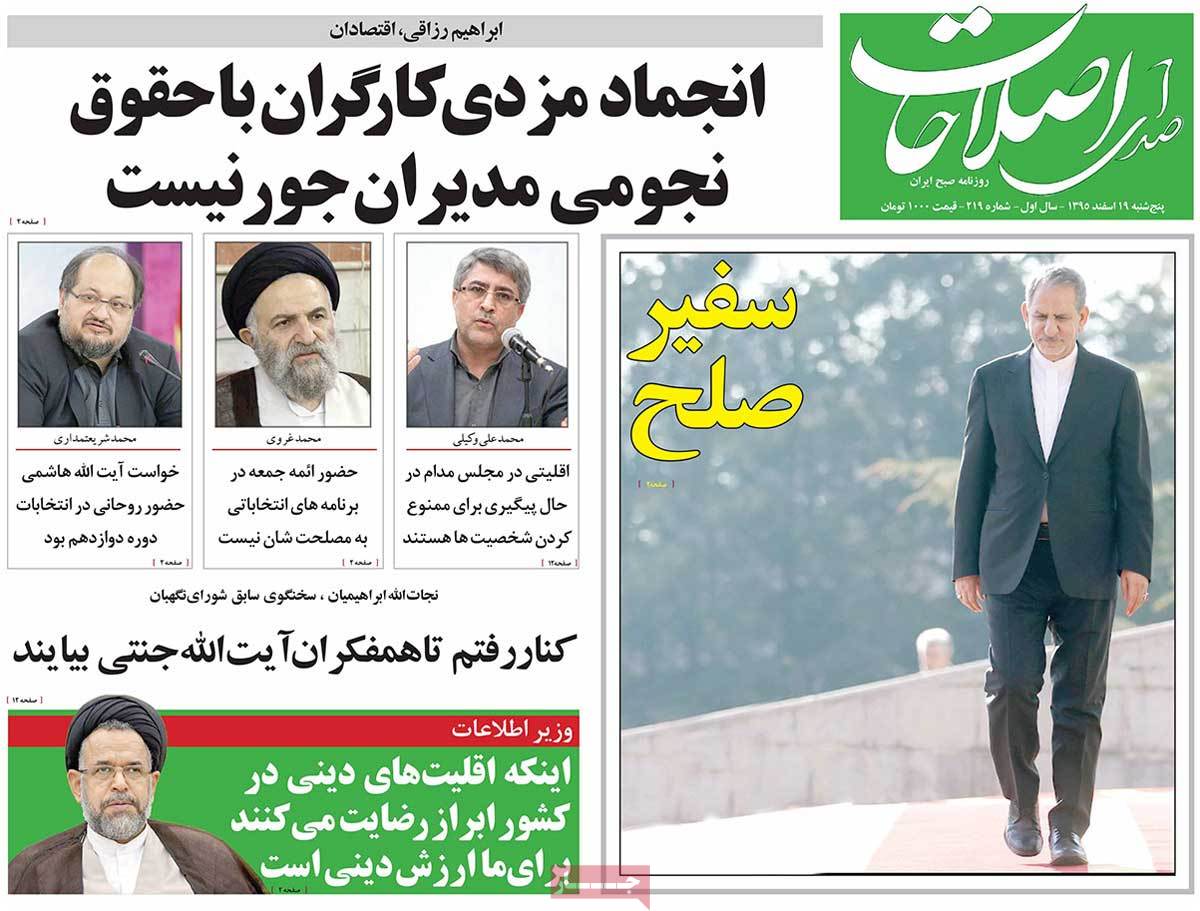
 

A Look at Iranian Newspaper Front Pages on March 9


Vatan-e Emrooz:

1- CIA Theatre! WikiLeaks starts disclosing biggest case of history about horrible US spying on people all around the world
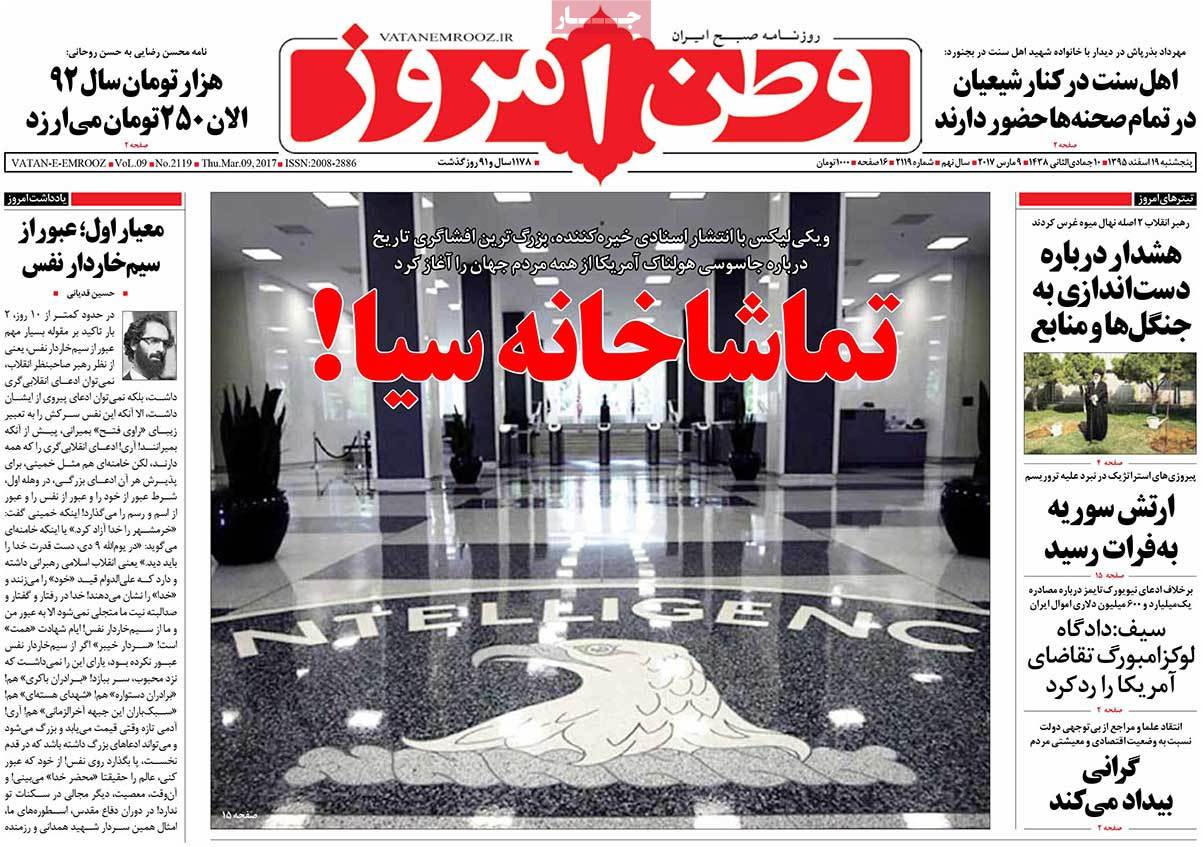

A Look at Iranian Newspaper Front Pages on March 9


Iran, Tajikistan Keen to Boost Mutual Cooperation

iran-tajikestan

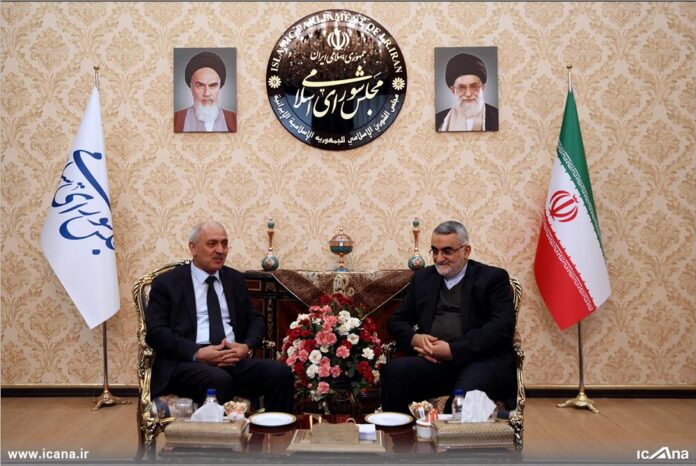
Ala’eddin Boroujerdi, a senior member of Iran’s Parliament, told Tajik Ambassador to Iran Nematullo Emomzoda that age-old cultural and civilizational ties between Tehran and Dushanbe are all the more reason for senior officials from both sides to increase their contacts and consultations.

According to a Farsi report by ICANA, the senior MP touched upon age-old Iran-Tajikistan relations during the meeting.

“Relations between the Islamic Republic of Iran and Tajikistan are strategic ties based on strengthening mutual cooperation,” said Boroujerdi, who chairs the Parliament’s National Security and Foreign Policy Commission.

He said the two countries have numerous commonalities, particularly in the cultural arena, and noted the committee supports any measures aimed at tapping into the existing potential and enhancing reciprocal ties.

He described as significant visits to both countries by Tehran and Dushanbe authorities, urging closer contacts between the two states.

For his part, the top Tajik diplomat congratulated the senior Iranian MP on the 25th anniversary of the establishment of diplomatic relations between the two states and said his country stands ready to forge closer cooperation with Tehran.

He said Iran and Tajikistan have great potential which could be utilised to serve the interests of both nations.

Emomzoda expressed satisfaction over parliamentary meetings and visits between the two sides, and said expansion of such collaboration could help ensure peace and stability in the region.

Trump’s First Positive Move towards Iran Deal Implementation

iran-us-flag

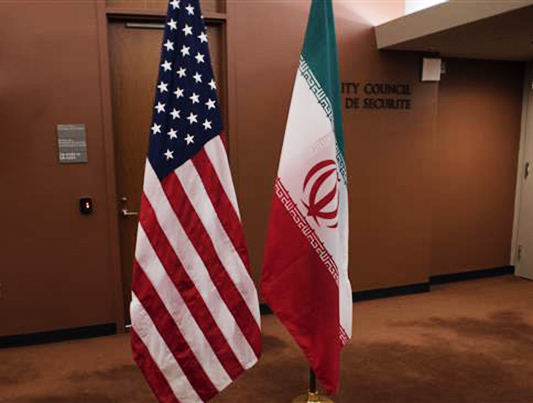
Latest reports reveal that the US Department of the Treasury has permitted the Americans residing in Iran to, in case needed, open accounts with Iranian banks, a move which could be indicative of the new US government’s willingness to fulfill its commitments on the implementation of the nuclear deal, also known as the Joint Comprehensive Plan of Action, signed between Iran and the P5+1.

According to a Farsi report by Donya-ye Eqtesad newspaper, this comes as, prior to the US Treasury’s recent interpretation of the sanction laws, the White House’s laws concerning the possibility of the US citizens opening bank accounts in Iran had been shelved.

Investigations show that the interpretation has been published on an American website affiliated to the country’s sanction experts who are responsible for interpreting the US sanction laws. The website resolves its visitors’ ambiguities about the US [sanctions] laws and regulations based on the country’s legal texts.

Earlier, the Central Bank of Iran (CBI) had also issued a directive authorising the Iranian banks to open rial accounts for foreign individuals and institutions. The directive also set the framework for opening time deposit accounts at Iranian banks by natural and legal persons.

The permit issued by the US Treasury based on its interpretation of the nuclear deal and sanction laws is the executive department’s first pragmatic decision since Donald Trump has come into power as the US president.

Apparently, the move is Trump’s first signal indicating his willingness to create a win-win situation by implementing the JCPOA.

Earlier, Hamid Qanbari, the deputy governor of CBI for supply of foreign currencies, told an expert seminar in Tehran that the US Treasury’s Office of Foreign Assets Control (OFAC) has recently clarified that Americans residing in Iran can have bank accounts in the country.

He added the interpretation was issued to enable the US nationals, who live in Iran and need to open bank accounts, make deposits at Iranian banks.

The new interpretation indicates that although those US nationals who are employed in Iran are still violating the US laws, they can reside in the country, if they wish to without being concerned that their moves to meet their basic needs might be perceived as a breach of the sanctions.

Prior to this move, the incumbent US government, who had adopted a hostile approach to the nuclear deal in its pre-election campaign remarks, had not adopted a clear stance towards the JCPOA. However, the recent interpretation of the sanction laws could be a practical example of the behaviour of the Trump administration’s middle managers towards the nuclear deal.

For the past decades, Iran has been subject to a series of primary sanctions imposed by the US that include tough restrictions on banking activities and the Islamic Republic’s access to the dollar.

Those restrictions were intensified as a series of bans were approved against Iran as a result of disputes over the country’s nuclear energy activities.  Those bans were lifted in early 2016 after the country reached the nuclear deal with the five permanent members of the Security Council plus Germany.  However, US primary sanctions are still in place.

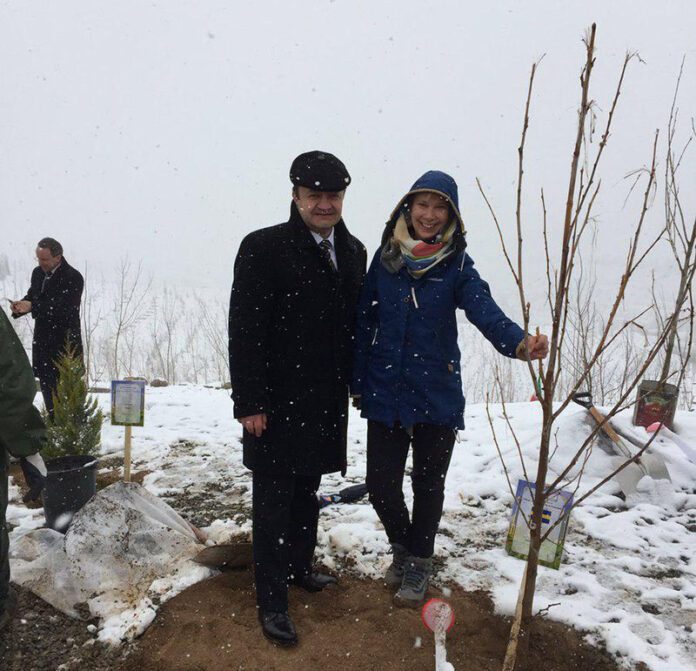
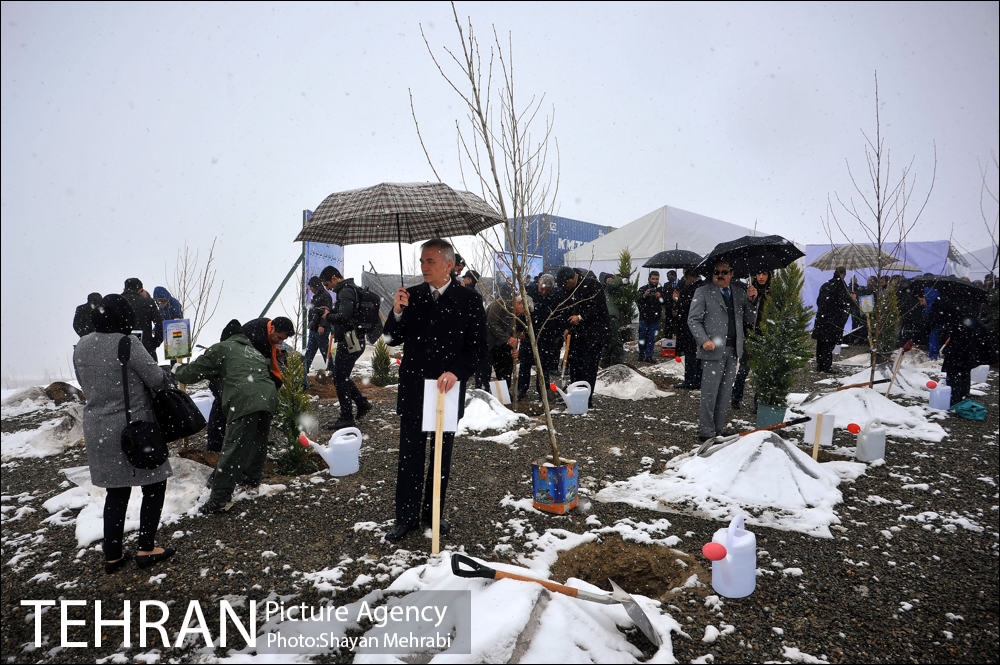
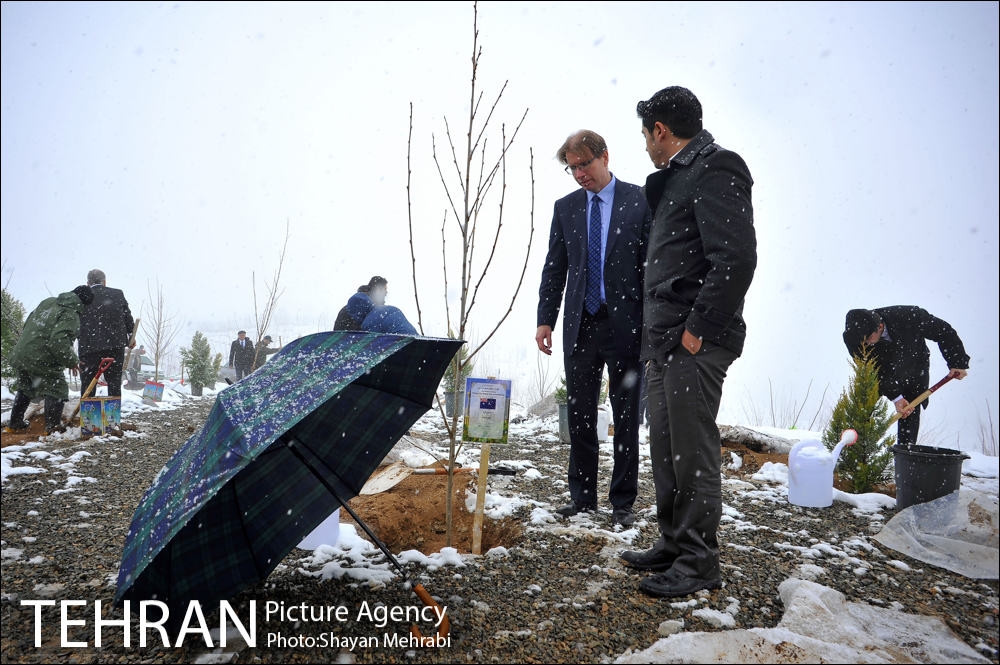
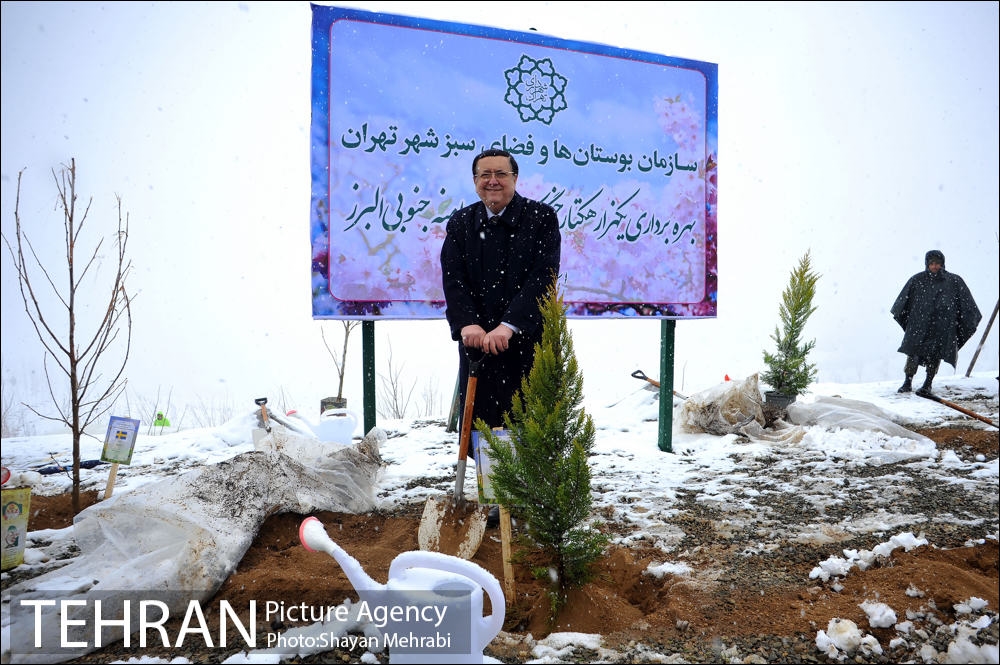
70 Foreign Envoys Plant Trees near Tehran (+Photos)

Tree planting in Tehran

“Tehran, the Cosmopolitan City of Friendship” was the name of an international arboriculture festival, hosted by Shahram Gilabadi, the head of International Communication Centre of Tehran Municipality and Managing Director of Tehran Parks and Green Spaces Organization.

The festival was held on Monday, March 6, at the International Fairground Shahr-e Aftab (City of Sun) in southern Tehran.

According to Gilabadi, 150 saplings were due to be planted in the complex. “70 trees were planted by 70 diplomats, and 30 others are to be planted by members of Iran’s parliamentary groups of friendship with other countries.”

Welcoming the foreign diplomats who came to the Middle East’s largest cultural exhibition centre, Gilabadi also invited them to visit Tehran International Book Fair in Shahr-e Aftab in May.

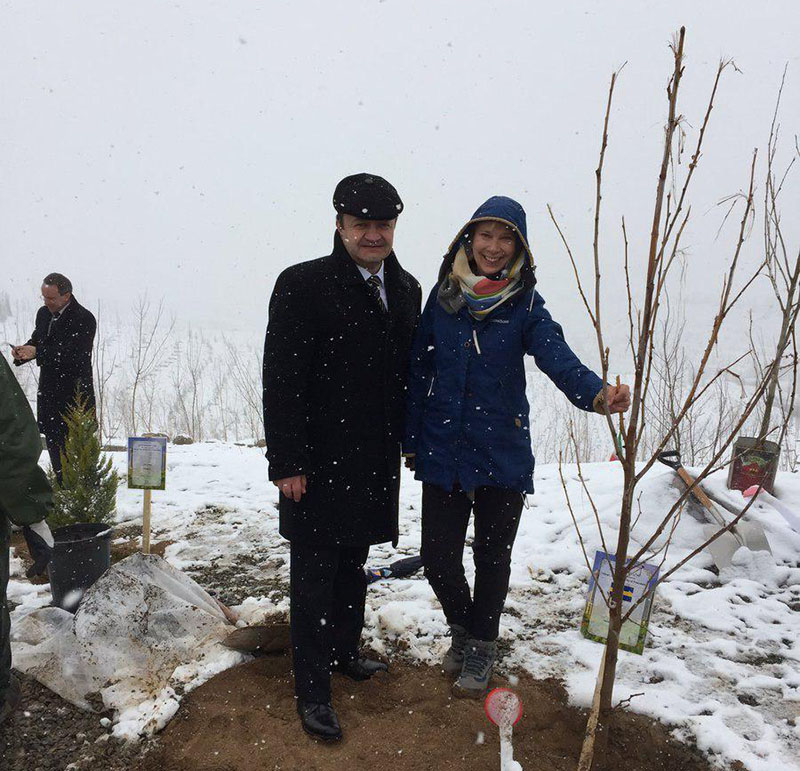
“Tree planting in Tehran, invited by Mayor Ghalibaf. Here with Hungarian colleague János Kovacs,” wrote Helena Sangeland, Swedish ambassador to Iran on her Twitter, posting an image of her and the Hungarian ambassador planting trees.

Here you can see Tehran Picture Agency’s photos of the ceremony:


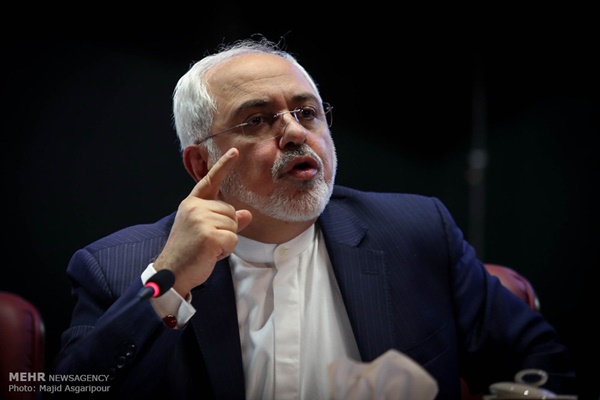
Saudi Arabia Should Drop Delusional Policies: Iranian FM

zarif-mohammad javad

In a recent interview with ISNA, Iran’s FM Mohammad Javad Zarif said problems between Iran and Saudi Arabia will not be solved through mediation.

He said the problem is that Riyadh thinks it should create tension in order to advance its policies in the region.

However, said Zarif, Saudi Arabia should drop its delusional policies and efforts to fuel anti-Iran sentiment in the region.


Here are excerpts from his remarks in the Farsi interview:


At the 2017 security conference in Munich, Iran once again put forward the idea of forming a regional forum for dialogue. This is an appropriate policy that Iran is pursuing. Iran believes its interests will be ensured through cooperation, interaction and dialogue with neighbours.


Some Mideast Countries Playing Blame Game

Unfortunately, some neighbouring countries backed former Iraqi strongman Saddam Hussein during the eight-year war imposed on Iran in the 1980s, and are now supporting terrorists. Their influence in the region has dwindled and their status has been undermined due to their actions. These countries are playing a blame game over their problems and do not want to accept responsibility for their actions. But these moves will not make Iran deviate from its right policies. Engagement with neighbouring countries is a central plank of Tehran’s policy. We should have cooperation and hold dialogue with them, and we will continue this policy.


Neighbours Should Avoid Trying Wrong Paths Again

Iran recommends that its neighbours rethink their previous policies which have only brought about destruction and insecurity for them and for the whole region, and choose the right path. We diplomats say “Diplomats choose the right path after trying the wrong paths.” Some of our neighbours have tried wrong paths enough, and now it’s time they choose the right path.


No Positive Behaviour by Saudi Officials

The letter sent to the Iranian president by the Kuwaiti emir was written on behalf of all Persian Gulf littoral states. It shows Saudi authorities apparently agree with the content of the letter. But we do not see any positive approach and behaviour on the part of Saudi officials. Riyadh continues to stoke tension in the region through its policies rather than seeking to go for dialogue and interaction.

Saudi authorities had pinned their hopes on the negative atmosphere created against Iran before the conclusion of a nuclear agreement between Tehran and the P5+1 countries. That negative climate had been created as a result of anti-Iran resolutions by the UN Security Council. Of course, the anti-Iran propaganda at the time did not affect us because Iran’s growth, development, security and economy are based on local potentialities. So, we were not that much affected by international pressure. Of course those pressures created some problems for us, but failed to force us into submission. Unfortunately, certain regional countries had pinned their hopes on the anti-Iran propaganda at the time. When the pressure was removed after the signature of the JCPOA, they made every effort to restore anti-Iran propaganda.


Some Neighbours Have Illusions

Iran’s neighbours will soon realize that anti-Tehran policies are a nonstarter, and that the best way is to engage in dialogue with Iran. Iran has the region’s best interests at heart and would like to engage in cooperation and dialogue with regional countries. Of course, some other regional countries have illusions and think they can revive the kind of domination that gripped the region in the past. But in the modern era, the region brooks no domination. I am optimistic that regional countries will finally opt for engagement and dialogue with Iran. My optimism emanates from the regional and international realities. The common threat of extremism and terrorism in the region will come back to haunt those who have contributed to the formation and development of terrorist groups and offered them financial, political and arms support. I also believe regional countries will come to understand that the policy of Iranophobia is useless and they will have to go for interaction and cooperation.


Mediation No Solution to Iranian-Saudi Problems

The Saudi foreign minister recently said that Iraq, as a neutral country, can mediate between Iran and Saudi Arabia. I don’t think there is any need for mediation. Of course, we have not opposed countries which have expressed their willingness to play a positive role in establishing relations between Iran and Saudi Arabia. We have not rejected their proposal to act as intermediaries and we have looked at the idea positively. But the point here is not the issue of mediation. The problem is that Riyadh thinks it should create tension in order to advance its policies in the region. However, Saudi Arabia should drop its delusional policies and efforts to fuel anti-Iran sentiment in the region.


Riyadh’s Aggression against Yemen Fuelling Insecurity

Saudi policies which only stoke tension in the region have negative consequences. The Saudi attack on Yemen has only fuelled insecurity and strengthened terrorist groups. I think it is necessary that all regional countries prudently review their past policies and I hope they will realise that regional problems can be solved through dialogue, not by engaging foreign troops in the region. Then, problems can be solved, with or without mediation. Riyadh should drop the illusions based on which it seeks to fuel tension in the region and should go for dialogue and interaction.

Man United Describes Iranian Striker as Rostov’s Star Player

Sardar Azmoun

Manchester United will face FC Rostov in the Europa League Round of 16 on Thursday in Old Trafford.

According to the manutd.com, Azmoun hit a brace at the weekend and also scored against Bayern and Atletico in the UEFA Champions League group stages, as well as contributing to his side’s 4-0 home win over Sparta in the last round.

Dubbed the ‘Iranian Messi’ by fans after moving to Rostov on an initial loan from Rubin in 2015, he was linked with a move to Premier League rival Liverpool in January after helping himself to nine league goals last campaign.