Monday, December 22, 2025
Home Blog Page 4097

Iranian FM Offers Dialogue with Arabs on ‘Anxieties’, Violence

zarif

“Countries in the Persian Gulf region need to surmount the current state of division and tension and instead move in the direction of erecting realistic regional arrangements. It can perhaps start with a modest regional dialog forum,” he said on Sunday.

Zarif addressed the Munich Security Conference, an annual gathering of top diplomats and defense officials, urging Arab states to work with Iran to address “anxieties” and violence across the region.

Iranian President Hassan Rouhani last week traveled to Oman and Kuwait to improve ties, his first visit to the Persian Gulf states since taking power in 2013.

“On regional dialog, I’m modest and I’m focusing on the Persian Gulf. We have enough problems in this region so we want to start a dialog with countries we call brothers in Islam,” Zarif said.

“We need to address common problems and perceptions that have given rise to anxieties and the level of violence in the region,” he added, when asked whether Tehran would also consider a region-wide dialog.

Zarif earlier criticized four-decades of well-financed “Takfiri” ideology which has its roots in Saudi Arabia and is followed by extremist groups such as Daesh, al-Qaeda and al-Nusra Front.

Saudi Arabia unilaterally severed ties with Iran last January after protesters in Tehran and Mashhad attacked its diplomatic premises following the kingdom’s execution of prominent Shia cleric Sheikh Nimr al-Nimr. Some of Riyadh’s allies followed suit and cut or downgraded their ties with Iran.

It was choosing regional enmity, Zarif said, that had in part spawned such extremist outfits such as Daesh and al-Nusra Front.

“For nearly four decades, a well-financed global proliferation of Takfiri ideology based on division, hatred and rejection, which everybody would agree has nothing to do with Islam, has been sold as promoting a so-called ‘moderate Islam’ to confront an erroneously-framed ‘radical Iran,” he noted.

The other contributors to the rise of such groups were “the endemic problem of foreign occupation and invasion,” and their arming and financing by some states in the region, Zarif added.

‘War not the answer’

Addressing other crises in the Middle East, the top Iranian diplomat said conflicts in Iraq, Syria, Yemen, and Bahrain “do not have military solutions,” adding “each requires a political solution, where no genuine actor is excluded.”

As a case in point testifying to “the success of diplomacy over coercion” is the 2015 conclusion of a nuclear agreement between Iran and world powers, he said.

The accord, he said, held “an important political lesson: All parties concerned defined the problem in a mutually acceptable way so that they could find a solution in a mutually acceptable way.”

US threats

Zarif brushed aside new pressure from the United States, declaring that his country is “unmoved by threats” but responds well to respect.

President Donald Trump has adopted a harsh language towards Iran, threatening to “tear up” the nuclear deal, calling Iran “terrorist state number one,” and imposing new sanctions against the Islamic Republic.

Zarif said, “Iran doesn’t respond well to threats. We don’t respond well to coercion. We don’t respond well to sanctions, but we respond very well to mutual respect. We respond very well to arrangements to reach mutually acceptable scenarios.”

“Iran is unmoved by threats. Everybody tested us for many years — all threats and coercions were imposed on us,” Zarif added.

The minister once again dismissed any suggestions Iran would ever seek to develop nuclear weapons. He mocked “the concept of crippling sanctions,” which he said merely ended with Iran having acquired thousands more centrifuges, used for enriching uranium.

Iran has always said it has no interest in nuclear weapons. Asked how long it would take to make one if it did decide it wanted such weapons, Zarif replied: “We are not going to produce nuclear weapons, period. So it will take forever for Iran to produce nuclear weapons.”

The Munich event discusses such issues as the future of the US-led military alliance of NATO, world order and security, terrorism, extremism, and various regional matters.

Important Documents to Be Signed in Iran President’s Russia Visit

Rouhani-Putin

Mahdi Sanaei, the Iranian ambassador to Russia, recently met Leonid Slutsky, the Chairman of the new Russian State Duma’s Committee on International Affairs.

During the meeting, the two parties conferred on the expansion of cooperation between Iran and Russia in such areas as parliamentary relations, according to a Farsi report by Fars News.

Following the meeting, Sanaei said, “Within the last three years, Iranian and Russian presidents have met each other for eight times.”

He then pointed to Rouhani’s upcoming visit to Moscow, and said, “Important documents are to be signed during the Iranian president’s official visit to Russia.”

He also referred to the positive changes in the relations between Iran and Russia in many areas such as political and economic fields, highlighting the shared views of the two countries on global and regional issues.

Slutsky, for his part, said, “There is a spirit of cooperation with Iran in the Russian State Duma.”

“Our positions on key international and regional issues, such as Syria and the Middle East problems, will get closer in the near future, after the meeting between the two countries’ parliamentary committees on international affairs,” the Russian MP added.

Elsewhere in the meeting, the two parties also agreed to extend their parliamentary relations, as well as the cooperation between their inter-parliamentary friendship groups.

Talks between Iran, GCC to Benefit Whole Region: MP

Rouhani

In a Farsi interview with ICANA, Iranian Parliament Member Qassem Jassemi said the talks between Iran and the [Persian] Gulf Cooperation Council ([P]GCC) will both benefit the Middle Eastern states and minimize the US presence in the region.

Commenting on Tehran’s decision to clear up misunderstandings between Iran and the six [P]GCC members, Jassemi said the Islamic Republic welcomes such negotiations as its foreign policy has been based on wisdom, honour and prudence since a long time ago.

“In case efforts to establish diplomatic relations with the countries of the region are within the framework of and in accord with the policies of Iran’s Establishment, they will produce more favourable results. The Islamic Republic of Iran is known as an undisputed regional power. Such contacts and relations will lead to minimized interference of the US and its allies in the affairs of the region.”

Stressing that closer dialogue between Iran and the [P]GCC countries is in the interest of the whole region, he said such interactions and negotiations can produce highly desirable outcomes in case the Islamic Republic’s interests and dignity are safeguarded and upheld over their course.

On Saudi Arabia’s willingness to hold talks with Iran, Jassemi added, “Saudis are undoubtedly rueful at present. We have always established our relations with other countries on the basis of mutual trust and honesty. Iran has always adopted the motto of “Peace and Friendship” in its military exercises in the region.”

Saudi Arabia has always adopted Western ideologies, he said, adding the Arab country has, after a long time, realized that Iran’s Establishment is a rightful and legitimate one.

Is Tattooing a Crime in Iran?

Tattoo

Based on their culture and customs, the majority of Iranians regard tattooing as an anti-value act. However, Iran’s law has not devised any punishment for this traditionally indecent behaviour.

According to a Farsi report by Jomhouri Eslami newspaper, the only punishable tattoos are the ones that contain obscene or nasty images on the face or the visible parts of the body such as hands and arms.

Those who have these types of tattoos will be charged of hurting public chastity.

Religiously, the majority of jurists believe that tattooing is forbidden if it physically harms the person, endangers his health or contains obscenities; it is allowable otherwise.

Iran to Host First UN Meeting on Dust Pollution

khuzestan

“The UN’s first international meeting on dust pollution crisis will be held soon in Iran,” announced Masoumeh Ebtekar, the head of Iran’s Department of Environment, according to a Farsi report by Entekhab.

“Regional and international cooperation is very important to cope with the crisis,” she added. “We endeavor to ratify international resolutions at the United Nations General Assembly to avert the dust problem.”

Iran seeks to benefit from the international community’s technical and specialized capacities, she added.

“We are also willing to cooperate with regional countries, as the majority of the dust comes from Iraq and Saudi Arabia. We recently had a meeting with the Iraqi President on this subject. Our Foreign Ministry is following up the negotiations.”

She also declared that all the origins of Khuzestan’s dust are being identified, and plans are devised to defuse the crisis, and ready to be carried out.

Iran to Probe Allegations about Total’s Information Leak to Qatar

total

Iranian MP Fereydoun Hassanvand says the Iranian Parliament’s Energy Commission and the High Committee of Supervision on Hydrocarbon Resources will be in charge of a probe into allegations concerning France’s energy giant Total leaking confidential information about Iran’s South Pars, in the Southern Iranian province of Bushehr, to Qatar, with which the Islamic Republic shares the world’s biggest gas field.

According to a Farsi report by ICANA, commenting on news about the French company’s passing on of Iran’s secret information to the Qatari side, Hassanvand said, “In case of being true, this will prove that concerns voiced by a number of worried Iranian officials about the flaws of new Iran Petroleum Contract (IPC) were not pointless. They had some complaints, for they were familiar with the nature of certain foreign companies and knew about the IPC’s drawbacks.”

IPC’s shortcomings were evident from Total’s reluctance to participate in Iranian projects prior to getting US President Donald Trump’s green light and the complete removal of Western sanctions on Tehran, he said, expressing satisfaction over the fact that the IPC’s structural problems were identified before sealing any deal.

Total’s refraining from continuing cooperation with Iran in the absence of US consent indicated that there is no guarantee one can obtain compensation from a company withdrawing from a project on the pretext of sanctions [still in place], or sue it for the violation of an agreement in international tribunals, said Hassanvand, who is also the chairman of the Iranian Parliament’s Energy Commission.

He said the Iranian Oil Ministry is required to revise some of its policies and hand over its projects to domestic experts and companies, blaming some Iranian officials for thinking that Total is more trustworthy than domestic firms.

“The officials at the Oil Ministry should acknowledge that they have been wrong about developing partnership with Total and stop being obstinate. The Iranian Parliament’s Energy Commission and the High Committee of Supervision on Hydrocarbon Resources will examine the issue and, in case of identifying any flaws, will follow up the case in the Parliament and Judiciary.”

Total’s move can be sued in International courts, he said, stressing, the domestic economy will sustain massive loss in case confidential information about Iranian plans and projects are made available to the country’s economic rival.

Rain of Starlings in Iran

Sar

The photographers of Russian newspapers Izvestia and Rossiyskaya Gazeta prepare their reports on the arrival of migratory starlings to this country each year in early February.

This year, however, the reports were delayed for a few days, as the starlings didn’t arrive in Aral Sea on time or died on the way, according to a Farsi report by Mehr.

The starlings, departing from the south to arrive in their homeland, Russia, in the middle spring, fall on the ground for unknown reasons. This is very tangible for the residents of Shahroud, Iran: they see one or two dead starlings every time they open the doors of their houses. If you walk across the one-kilometre Mowlavi Street of Shahrud- one of the greenest in the town- you can see the carcasses of 15 to 20 starlings along the way.

Interestingly, cats don’t eat the corpse of these beautiful, small birds, and this arouses suspicion about their illness.

Rain of Starlings Will Go on

“Starlings exist almost throughout Iran and include several subspecies,” explained Elham Tabassi, an environment graduate and activist.

“Only 18cm in length, the starlings are found only in the northern hemisphere,” she noted. “They come from Siberia to southern Iran in September, and come back in the spring. They pass through Shahroud and some other cities on their way.”

“The rain of starlings will go on,” she noted, mentioning that the phenomenon was first reported by a citizen in late January before spreading through the town.

“I started my research by sampling three starling carcasses. Unfortunately, the cause of their death is still unknown,” she added. “The avian influenza is highly probable, as the Director General of Semnan province Veterinary Medicine had warned about it in December. We should wait until the Veterinary Office announces the final results.”

“Why does the body of starlings dry up in less than a second?” she asked.

sar

No Cure for Starlings

“The diagnosis can be partially made using clinical symptoms, but we should also bear autopsy and para clinical actions in mind,” said Hamideh Mohammadi, a vet.

“Unfortunately, in my opinion, there is no cure for the starlings,” she added, “As they migrate in very large numbers, it is impossible to drug them. We only can clean the polluted areas.”

“People must refrain from touching the birds’ carcasses until the cause of death is found.”

An employee of Semnan Veterinary Office believes that the migratory birds used to die in previous years as well.

“It is natural. The cause isn’t the influenza, but the quite cold weather.”

However, Kamalifar, a faculty member at University of Tehran, says “it is ridiculous to suggest that the cold temperature is the cause of starlings’ death.”

“The starlings spend six months a year in Russia and the Balkans, and stay in their flat plains. The feather texture of starlings indicates that they are inhabitants of cold climate. So it is odd to announce the cold temperature as the cause of starlings’ death, it is like saying that the arctic foxes are dead due to the arctic climate!”

sar

“I have not carried out any research on the starling carcasses, so I cannot say for sure if the cause of their death was influenza or another illness.”

“I was informed of the issue after receiving some phone calls and emails from my colleagues in different cities,” Kamalifar added. “There were some cases of starling death in those cities as well.”

The death of migratory birds is no new phenomenon in Shahroud; but why is the cause still unknown?

The starlings, these little birds, fly together in flocks with tens of thousands of members, performing an elegant dance across the indigo sky. However, the people who used to be happy to watch the dance of starlings are in doubt and fear today as they see the apparently ill starling carcasses.

Young Couple Using Internet to Help Poor People

iranian couple

Ayda Pourianasab and Azad Motahari, a young Iranian couple who travel around Iran from village to village, try to help people in deprived areas by publishing photos in social media to solicit donations.

“To be honest, we just wanted to take a tour of Iran at first,” said Azad, the husband, according to a Farsi report by Mehr.

“As we did cooking and baking, we wanted to know the regional dishes and customs. We planned to become familiar with local cultures by visiting the virgin areas,” he added.

“But every time, we faced people who were forgotten and lost in deprivation besides their culture,” he went on to say.

“No village seemed as deprived as the ones of Sistan and Baluchestan,” said Ayda, the wife. “You can’t believe it!”

“We gave dolls to the children, and they didn’t know what it was! They didn’t know that the doll was a toy to play with!”

iranian couple

Online Means to Fight Deprivation

“During our journeys, we gradually thought of an online system to accelerate our efforts to supply people’s needs in deprived regions,” Ayda added.

“We held cooking courses for housewives who were also the breadwinners; then we started to take online orders, and they delivered the food to the clients.”

“It was profitable for us, too,” she said. “So much so that we have launched branches in cities such as Kerman, Kermanshah, Bandar Abbas and Shiraz by extending our online system.”

“We also asked rural women about their skills. In Sistan and Baluchestan, women practice a type of craft titled ‘Baluchi-Doozi’, which we tried to present to others in our Instagram page.”

“After we posted photos of the artworks, even Iranian expatriates who managed galleries in France bought some of them to display in foreign countries.”

iranian couple
Wedding Parties throughout Iran

“These people are so free-hearted!” Ayda expressed. “Despite being poor, they have high respect for their visitors, and do everything they can to make them happy.”

“We had decided to throw no wedding party, and continue our journeys instead,” she added. “Others told us that we would regret it someday. But as we were travelling to different regions in their own local costumes, people welcomed us warmheartedly, holding small parties. Now I can say that I have had wedding parties throughout Iran!”

iranian couple

Providing Facilities for Villages

This young Iranian couple has chosen a good way to raise funds: among the donators, one benefactor has provided money for a rural child’s medical operation that costs nearly $7,800. Besides, there are others who can’t afford more than two or three dollars, and donate it.

“Of the most interesting cases, I can mention two writers. One of them, who is living in France as a translator now, sent his publisher’s paycheck directly to us after his book was released.”

“The other, a poet, gave her publisher our account number instead of hers,” Ayda said.

“Thanks to people’s help, we have provided four villages with full basic facilities.”

Ayda and her husband’s greatest wish is that someday there is no poor person in the world, or in Iran at least. The poverty, as they say, is the root cause of all miseries.

They are endeavoring to realize their wish.

iranian couple

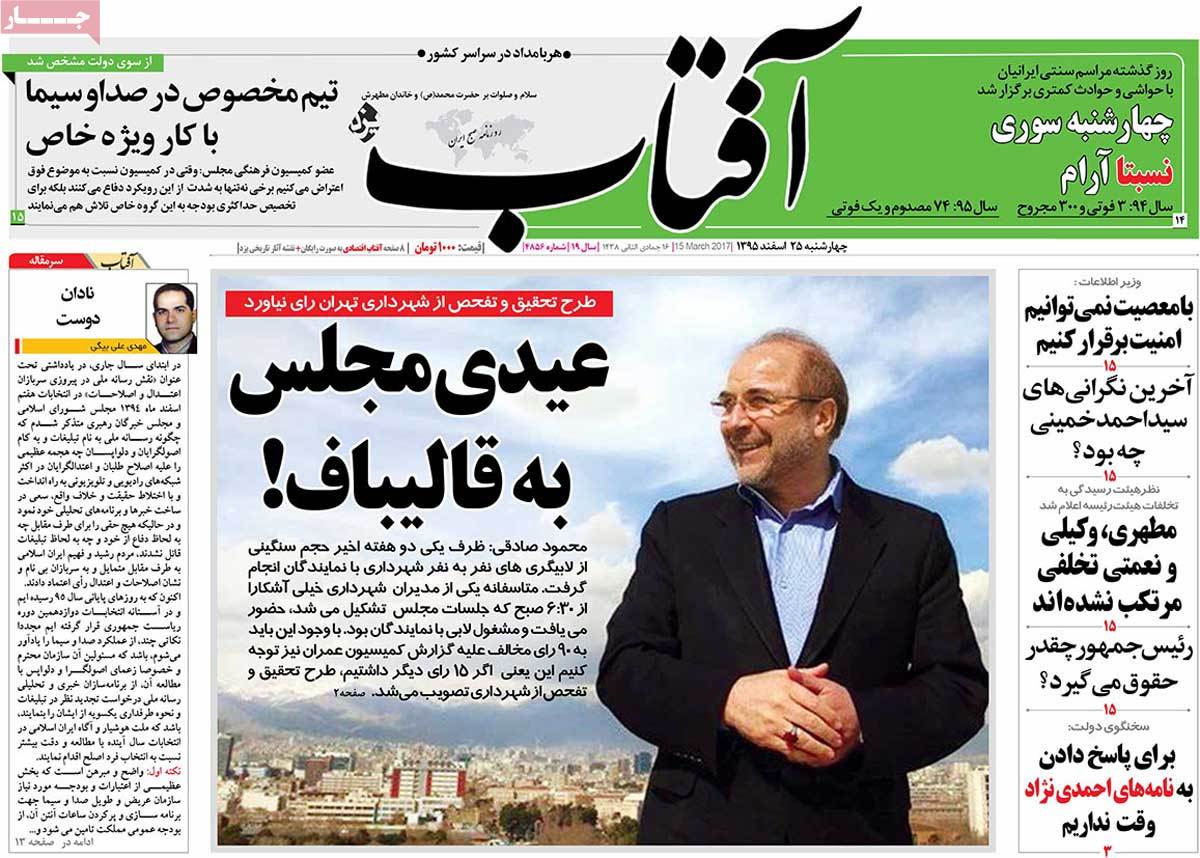
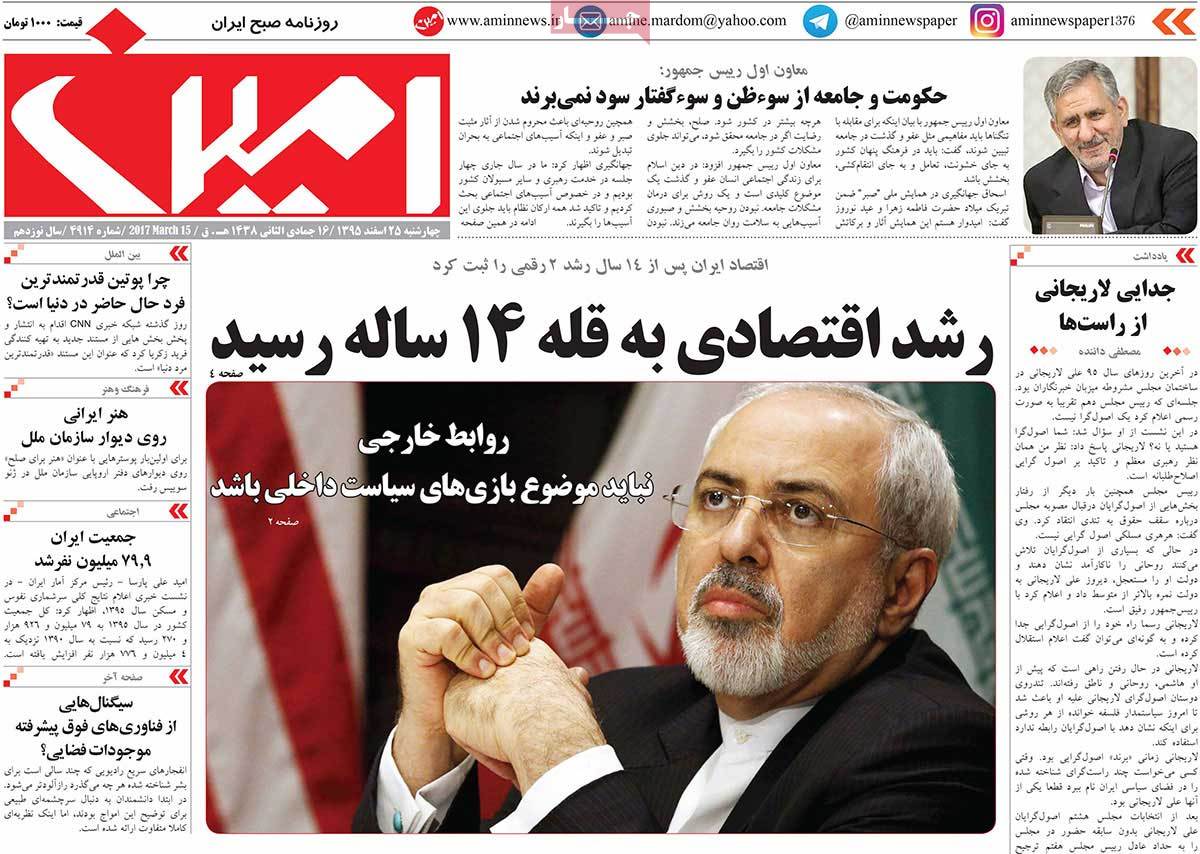
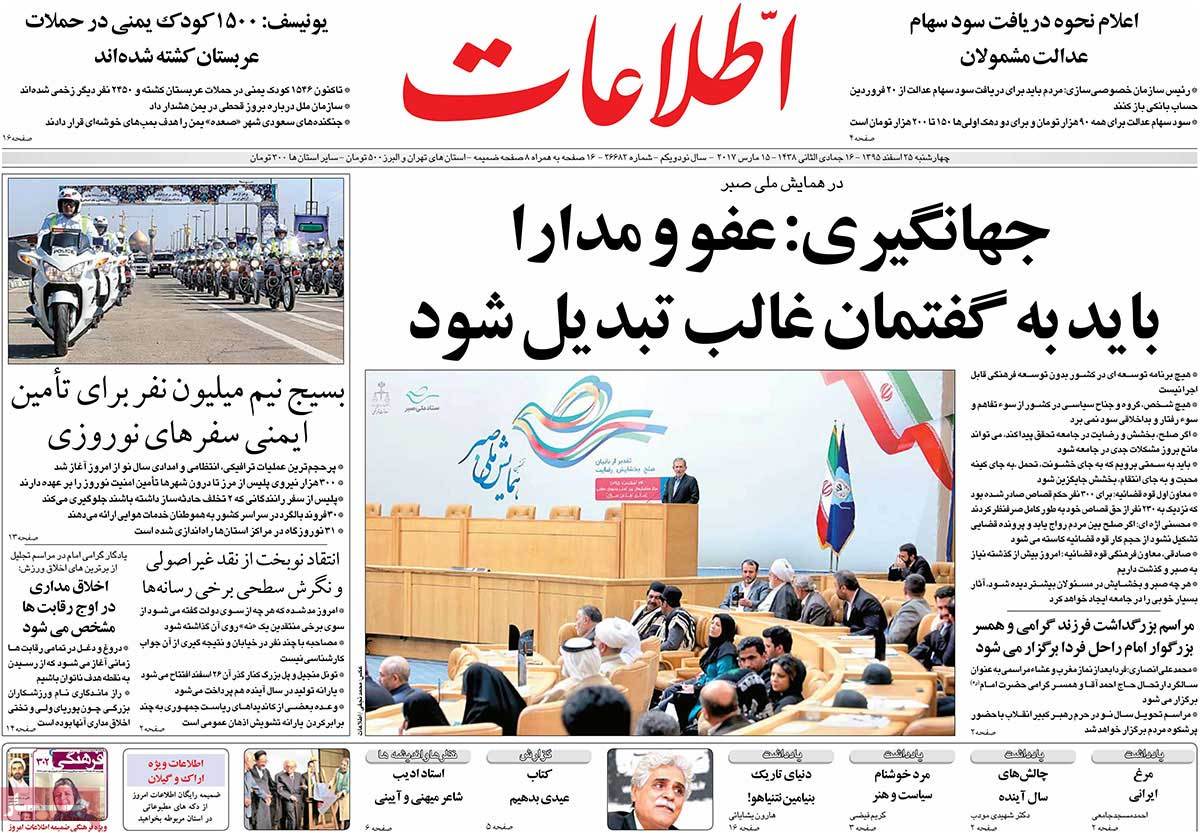
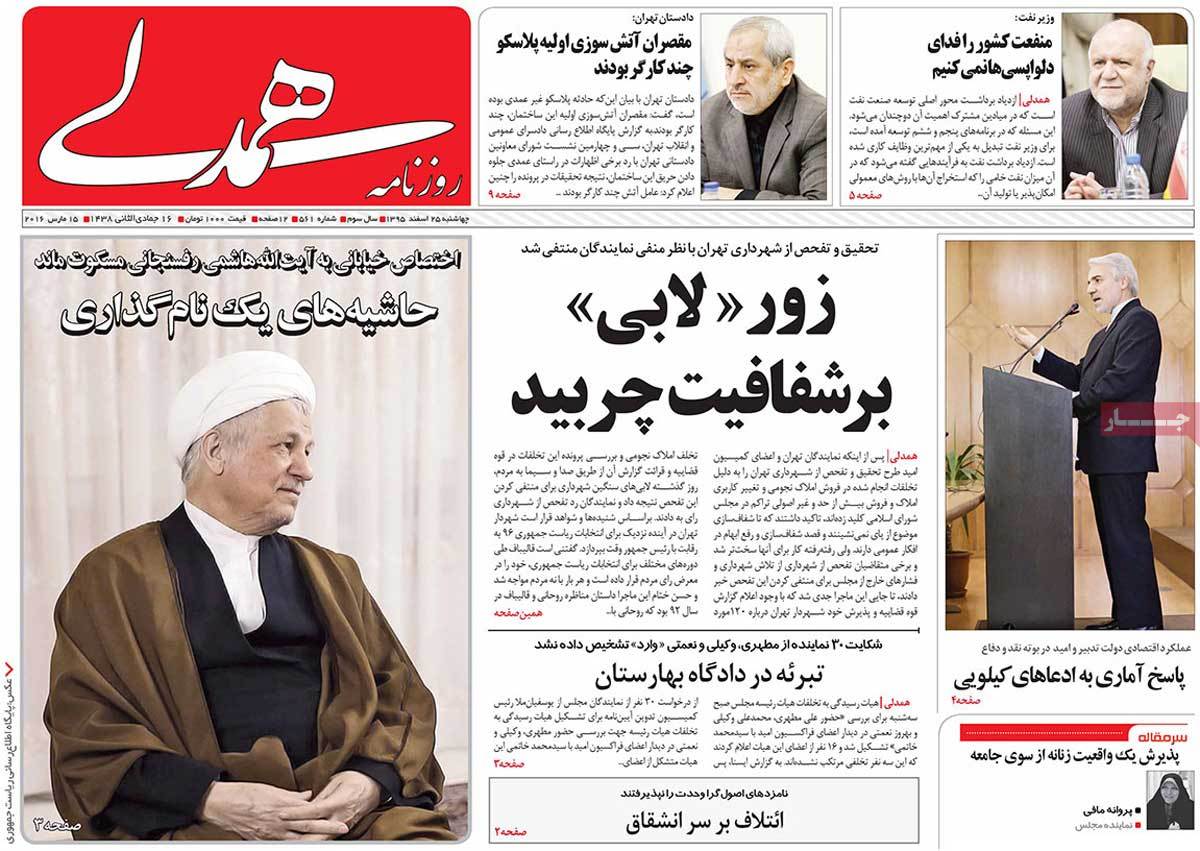
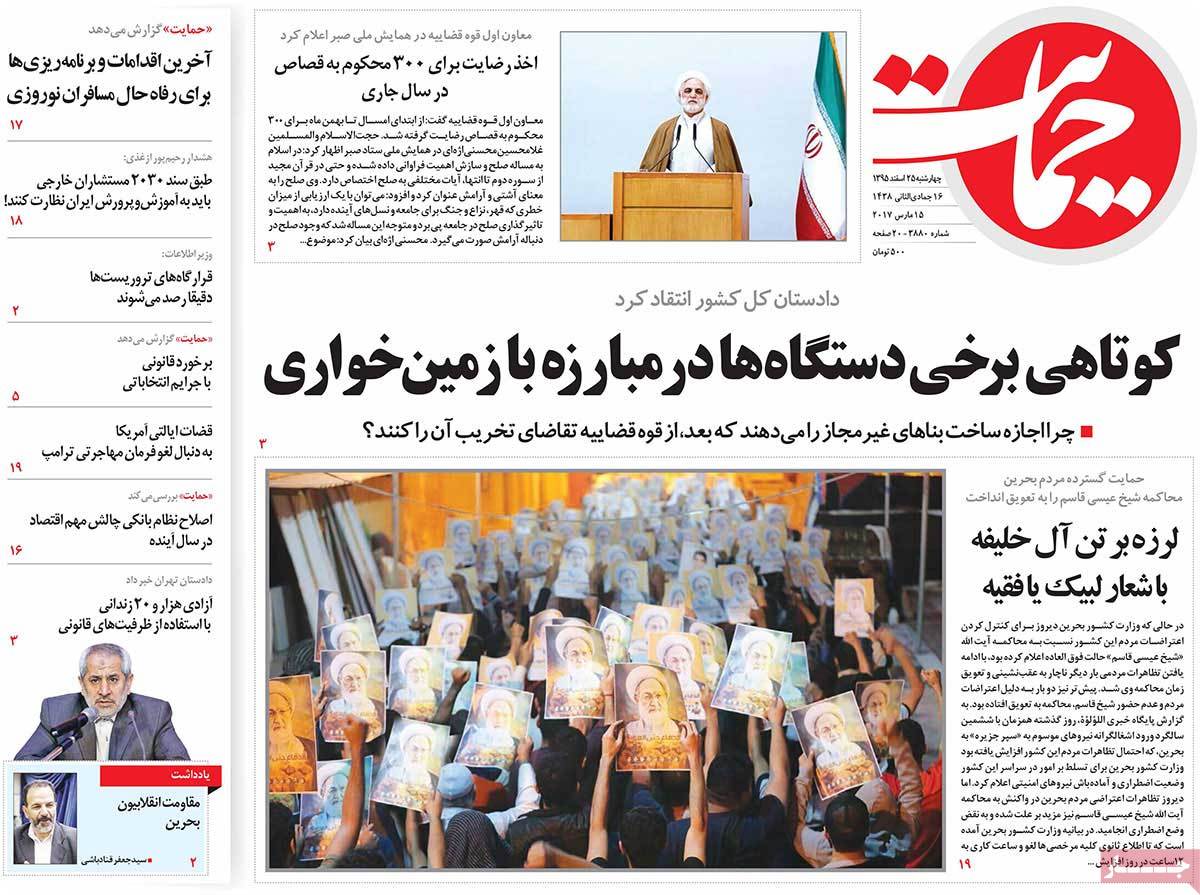
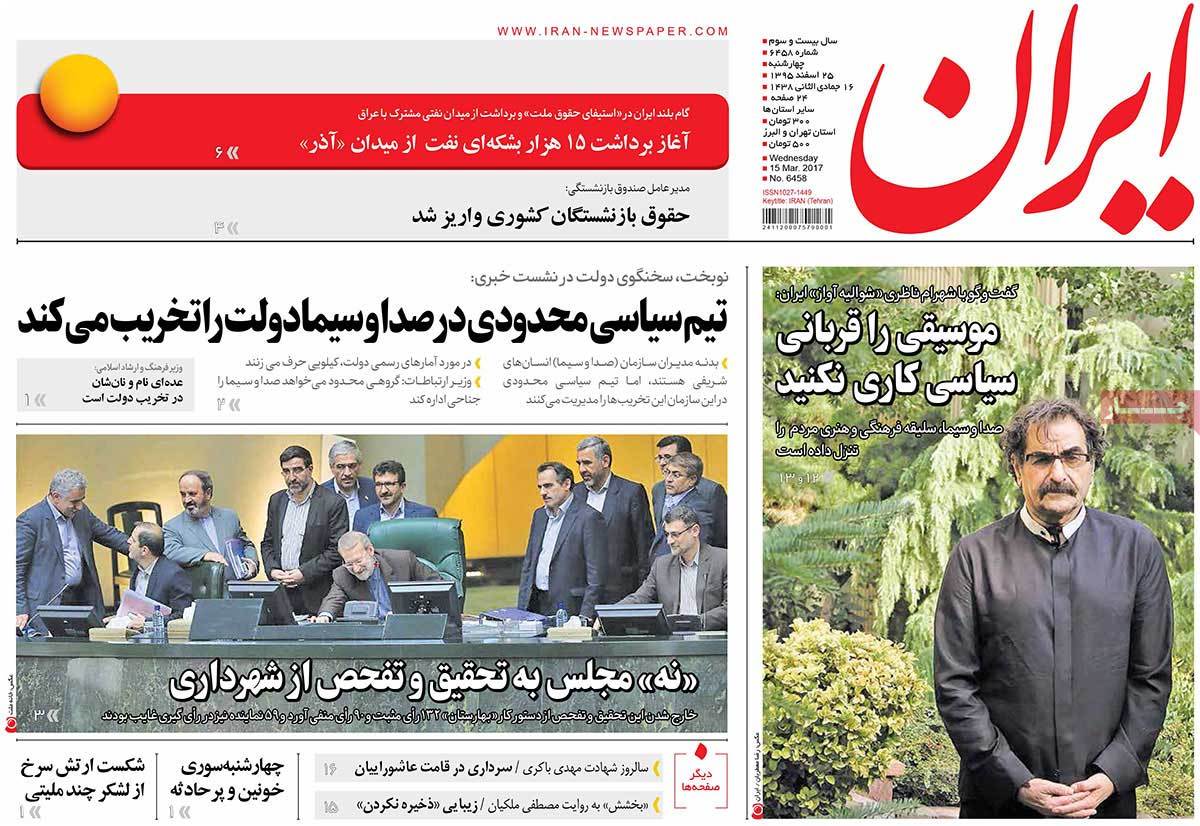
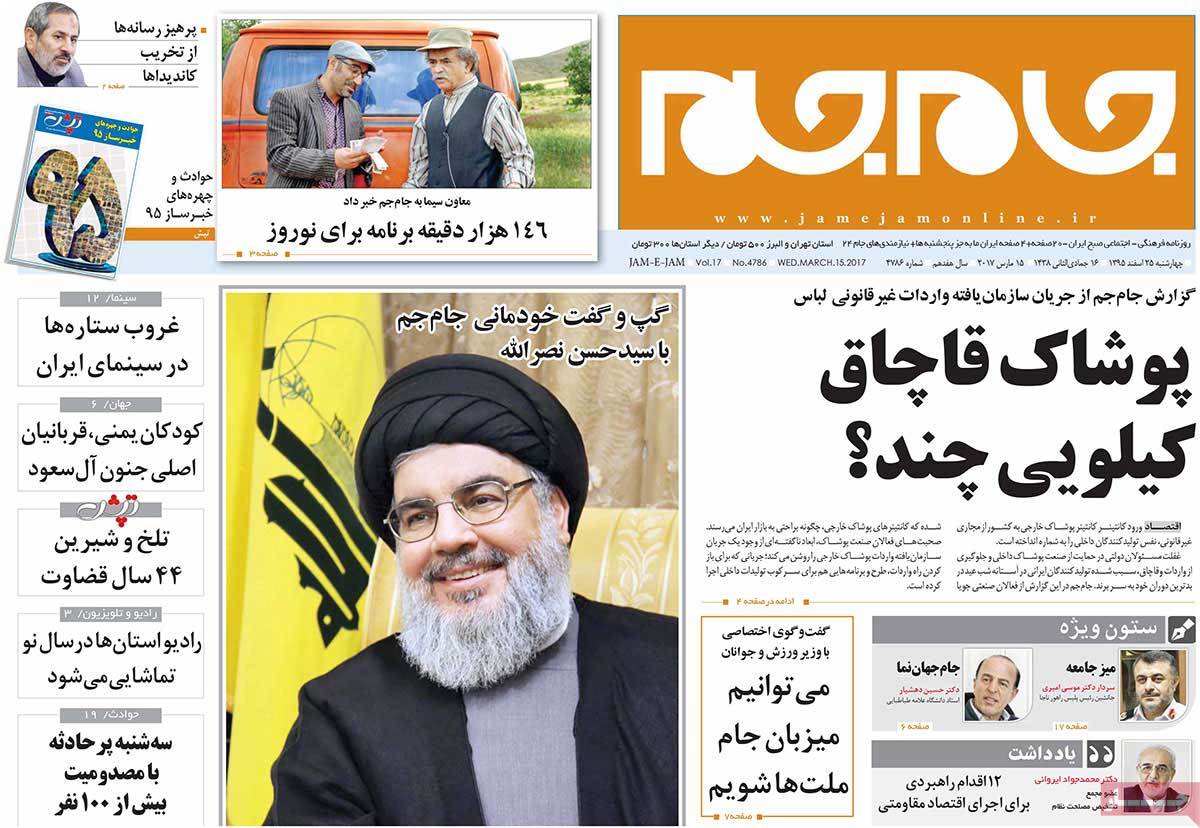
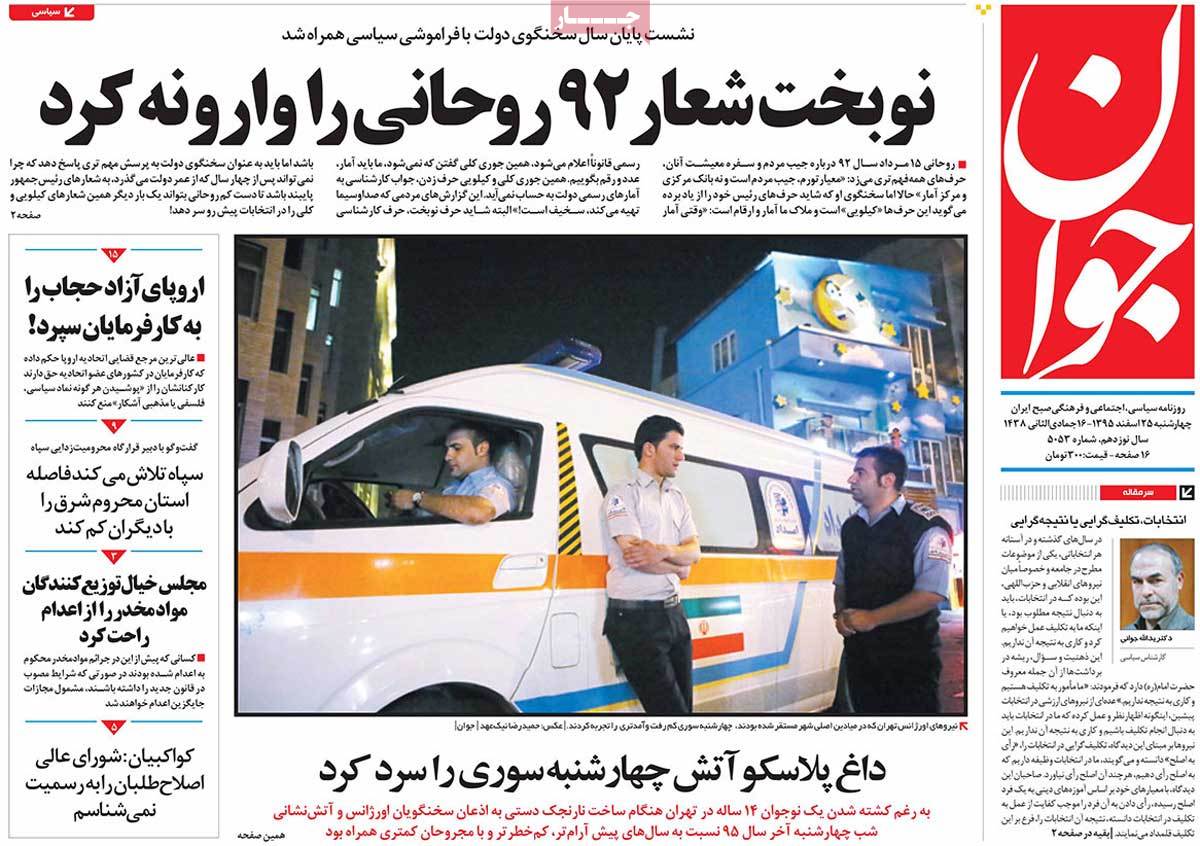
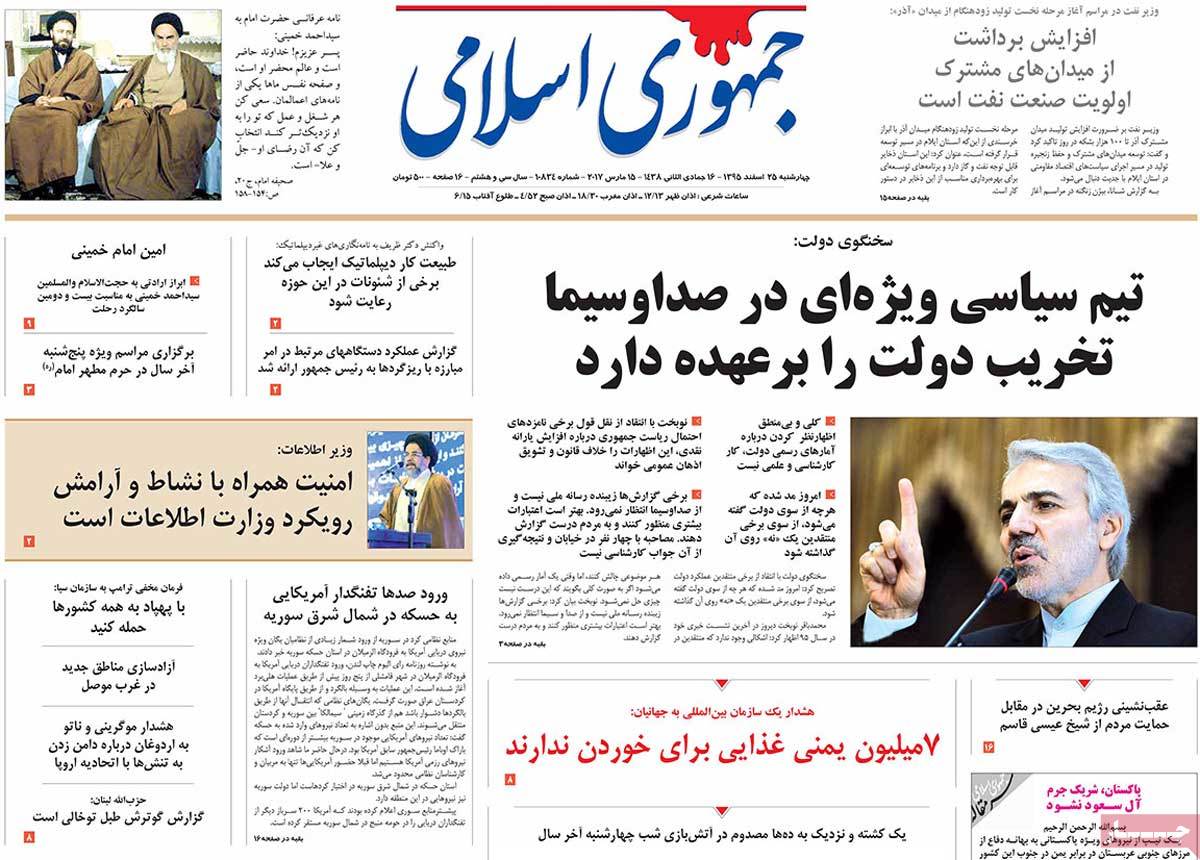
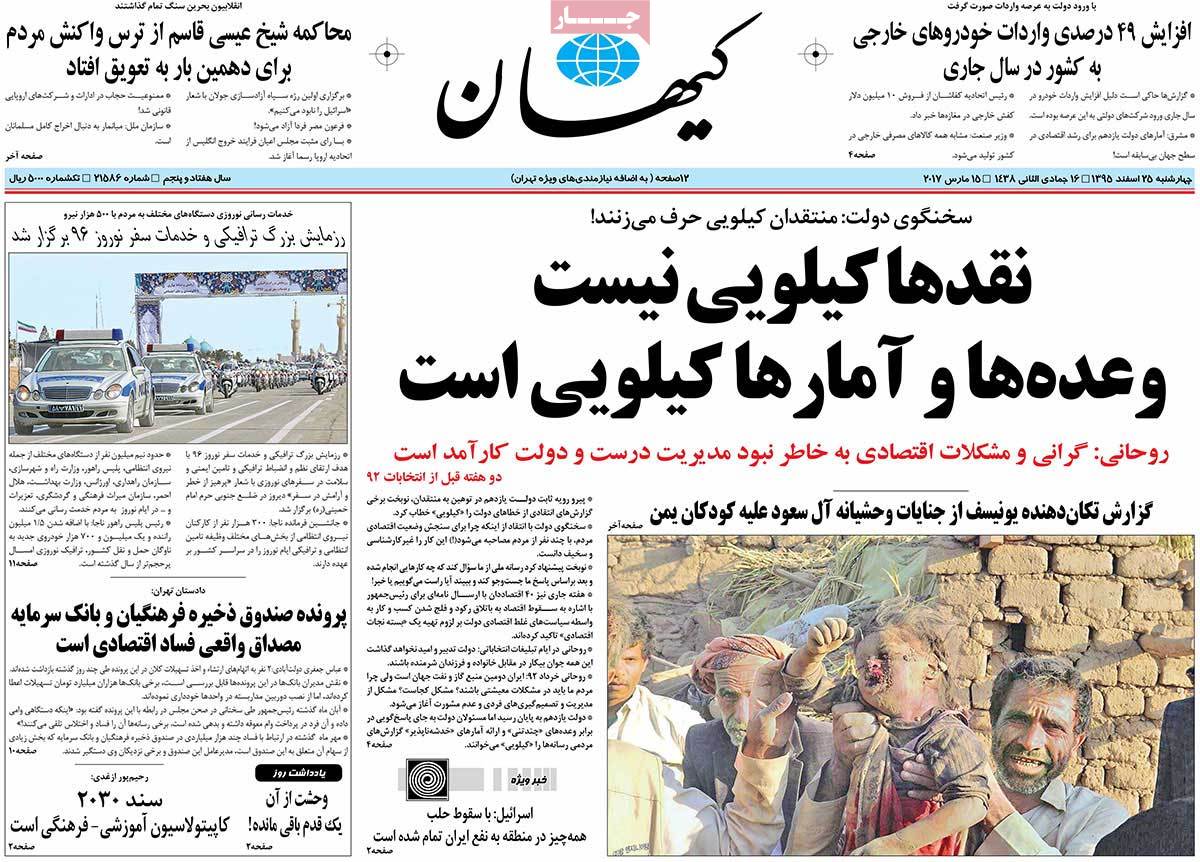
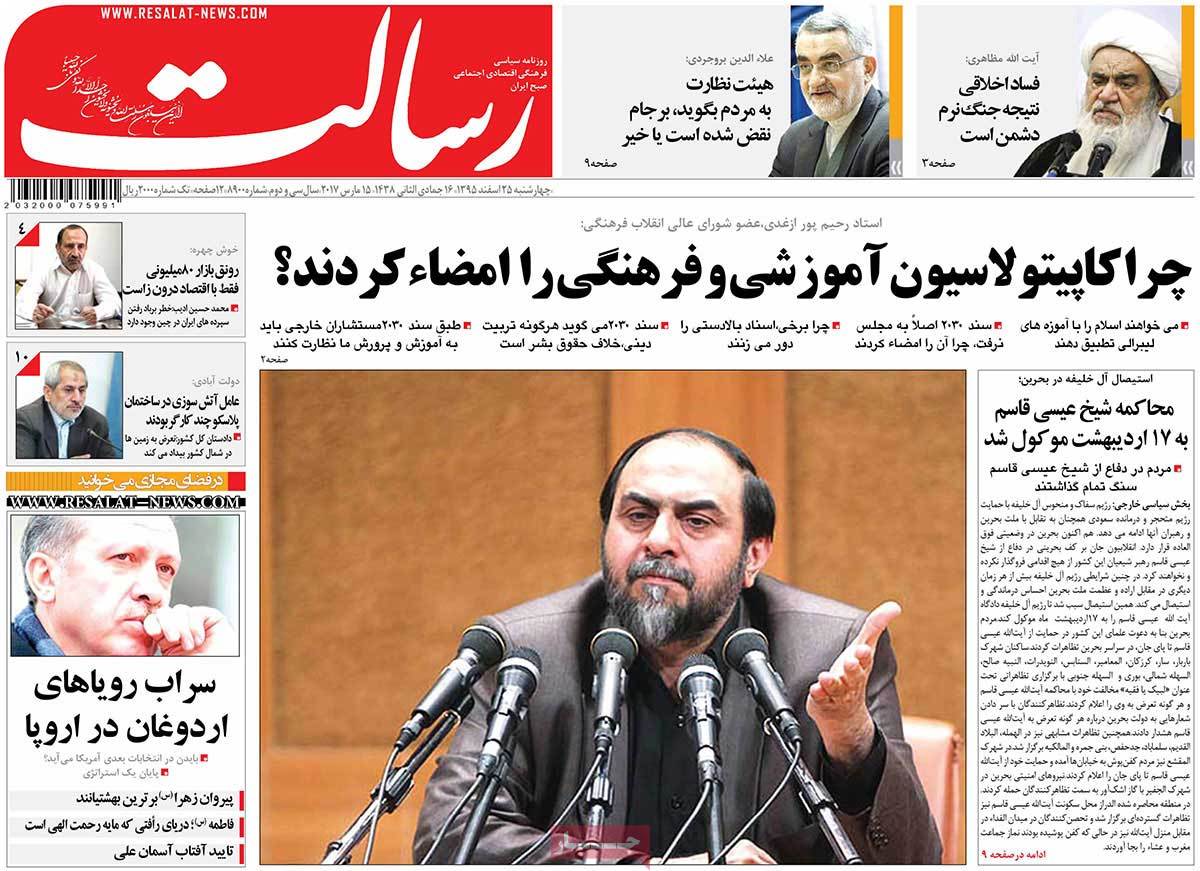
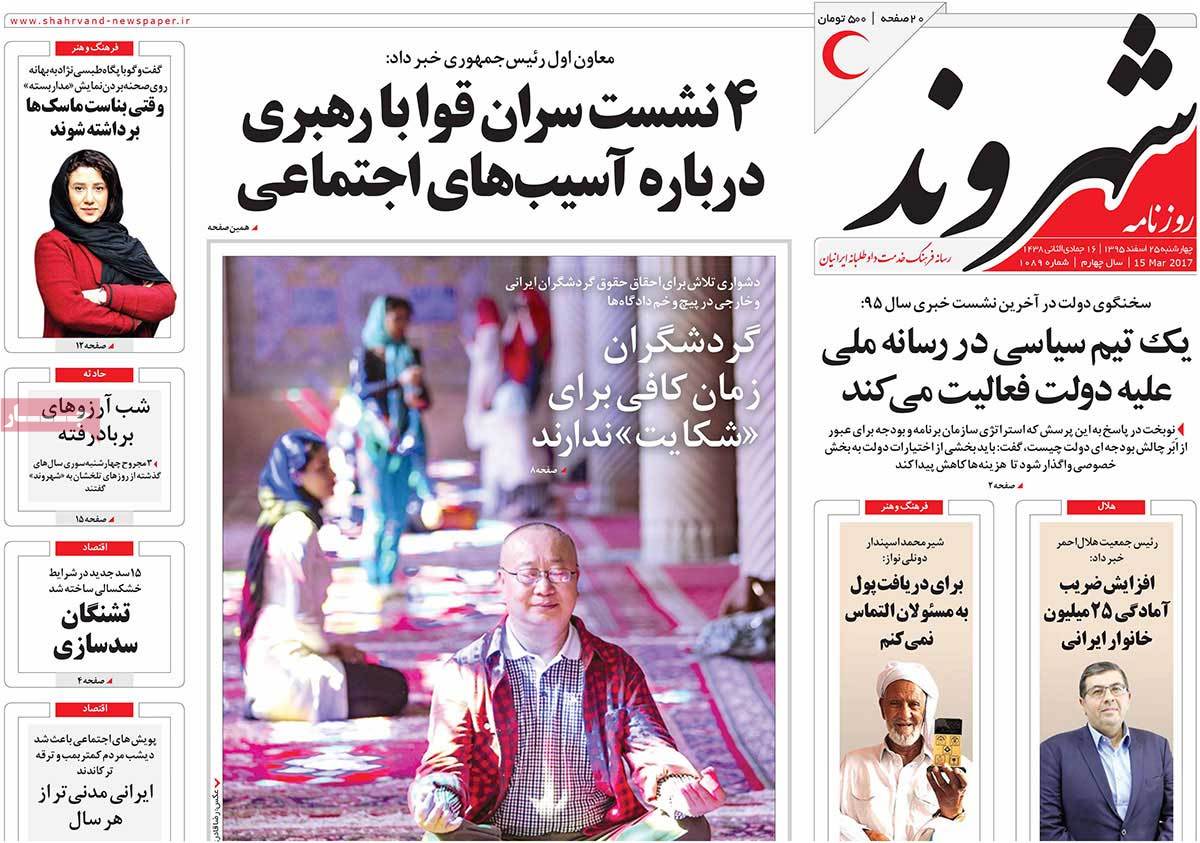
A Look at Iranian Newspaper Front Pages on February 19

Newspapers today continued to cover the ongoing crises in Iran, including the dust pollution in Khuzestan province [southwest] and the flood and heavy snow in southern and northern Iran, respectively.

The ongoing Munich Security Conference also received great coverage. Many newspapers covered the remarks made by various European and world leaders and the harsh criticisms levelled by Europe against the US and its new administration.

Another top story today was the remarks made by Iranian Foreign Minister Mohammad Javad Zarif in an interview with CNN’s Christiane Amanpour on the sidelines of Munich Security Conference.

The above issues, as well as many more, are highlighted in the following headlines:


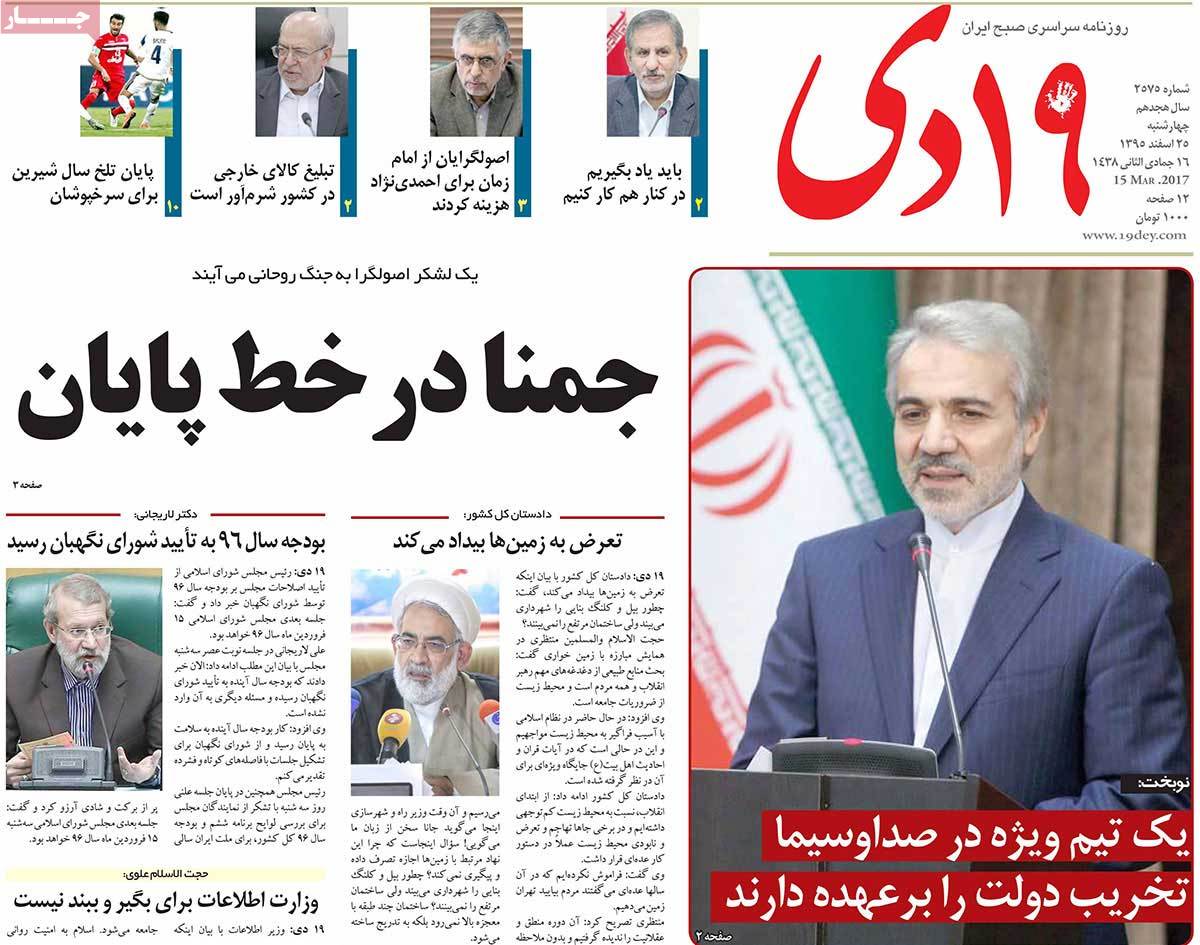
19 Dey:

1- Reformists Looking for Communication with Iran’s Leader

2- Nuclear Deal Put an End to Anti-Iran Sanctions: US VP

3- Iran’s First VP Calls for Mobilisation of All Forces and Equipment to Resolve Khuzestan Crisis

A Look at Iranian Newspaper Front Pages on February 19


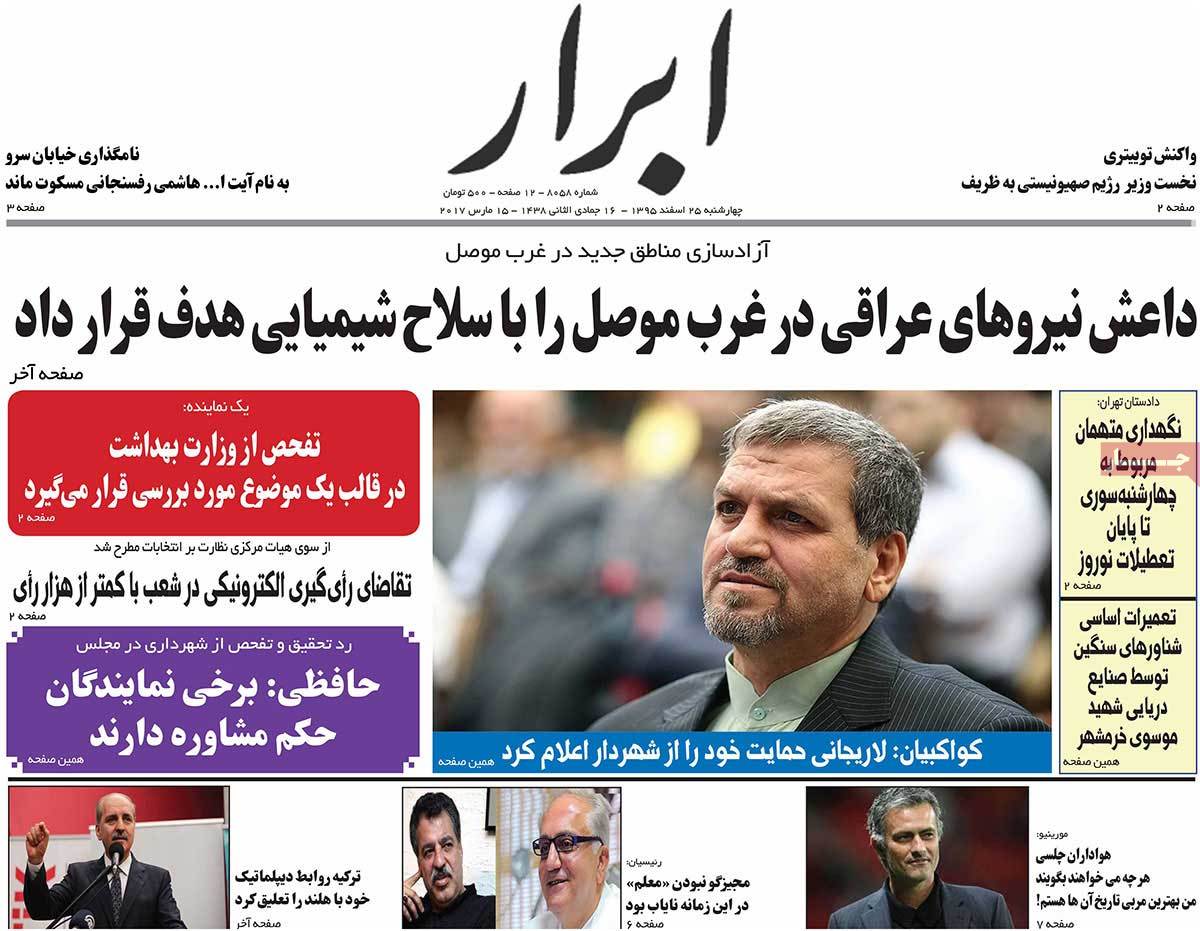
Abrar:

1- Pentagon: ISIS Leaders Fleeing from Raqqa

2- Mogherini: JCPOA Has Achieved Its Goals

3- Ahmadinejad’s VP to Run for Presidential Votes

4- Zarif: Obama Took Part in Iran Nuclear Talks Because He Knew Sanctions Were Futile

5- MP: Names of Culprits behind Plasco Building Collapse to Be Declared by Mid-March

A Look at Iranian Newspaper Front Pages on February 19


Abrar-e Eqtesadi:

1- Transport Minister’s Impeachment Will Mainly Focus on His Inefficiency: MP

A Look at Iranian Newspaper Front Pages on February 19


Aftab-e Yazd:

1- Transfer of Friendship Using Wrestling: US Wrestling Federation and Wrestlers Appreciate Iranian People

2- Underwater Smuggling: Parts of Drowned Ship in Bushehr Coast Dismantled for Sale; When the Italian Luxury Cruiser SS Raffaello Was Internationally Known, No One Thought Its Life Would Get Over in Iran-Iraq War

A Look at Iranian Newspaper Front Pages on February 19


Arman-e Emrooz:

1- Conflict between US and Europe over Nuclear Deal: Europe Once Again Reaffirm Commitment to JCPOA, This Time in Munich Security Conference

2- Hardliners Impeach Transport Minister Akhoundi: Reformists Are Opposed to Impeachment

A Look at Iranian Newspaper Front Pages on February 19


Asr-e Rasaneh:

1- High-Quality Iranian Cars to Be Released in Nowruz [mid-March]

2- Petchem Industrialists Hopeful about Conditions Provided after Nuclear Deal

3- Malaysians to Go on Hajj Pilgrimage through Iranian Roads

4- 90% of Mobile Phones in Iran’s Market Are Contraband

A Look at Iranian Newspaper Front Pages on February 19


Ebtekar:

1- Department of Environment Chief: Khuzestan Dust Pollution Is an International Issue

2- Impacts of US President’s Threats on Iran’s Economy: France Using the Opportunity; Citroen CEO: We Welcome US President’s Anti-Iran Threats as They Scare Our Rivals Away from Iran Market

3- Iranian FM Zarif Holds Meetings with His Counterparts on Sidelines of Munich Security Conference: World Order Is Munich’s Priority

A Look at Iranian Newspaper Front Pages on February 19


Ettela’at:

1- Rouhani: Government to Accompany People of Khuzestan until Full Resolution of Problems

2- 80 Countries to Attend Tehran Conference in Support of Palestine’s Intifada

3- G20 Call for Political Resolution of Syria Crisis

4- Zarif to CNN: Threats and Insults Will Make Iranian Nation United

A Look at Iranian Newspaper Front Pages on February 19


Hemayat:

1- Advocates of Human Rights Continue Their Dirty Game: Canadian Court Issues Anti-Iran Ruling on False Pretext of Supporting Terrorism

2- IRGC General: ISIS Elements Arrested in Northwestern Iran

3- Foreign Ministry Spokesman Condemns Sweden’s Anti-Iran Human Rights Resolution

A Look at Iranian Newspaper Front Pages on February 19


Iran:

1- Zarif to CNN: Nuclear Deal Was Best Deal for Everyone; Trump’s Order Was an Insult to Iranian Nation

2- Iranian Wrestler Komeil Qassemi: I Lost My Hair Because of Stressful Last Match with US Wrestler [Qassemi’s win led to Iran’s world championship]

A Look at Iranian Newspaper Front Pages on February 19


Javan:

1- Pharmaceutical Companies’ Mafia Preventing Treatment of Cancer in Iran: Importers behind Excessive Use of Chemotherapy for Cancer

2- Zarif: World Has Enter Post-West Statge

3- McCain: US Is in Chaos

4- Munich’s Riot against White House: Europeans Not Calmed Down by US VP

A Look at Iranian Newspaper Front Pages on February 19


Jomhouri Eslami:

1- Europeans’ Harsh Criticism of Washington in Munich Security Conference

2- Pope: There’s Nothing Called Islamic Terrorism

3- Merkel: We Should Distinguish between Islam and Terrorism

4- UN Secretary General in Meeting with Iranian FM in Munich: JCPOA Is a Major Factor in Int’l Peace and Stability

5- Russian Jet Fighters Attack ISIS Base in Raqqa

A Look at Iranian Newspaper Front Pages on February 19


Kayhan:

1- Tens of Cities Grappling with Flood, Snow, and Dust Pollution; Need for Mobilisation of Bodies to Rescue People

2- Al Jazeera: Saudi Arabia’s Struggle Pointless, Yemeni People Are Invincible

3- Reformists Scared of Hearing People’s Questions: Continued Reactions to Reformist and Pro-Government MPs’ Plan to Arrest Whoever Asks a Question in Speeches

4- Pakistani Army Attacks Afghanistan Using 200 Missiles

A Look at Iranian Newspaper Front Pages on February 19


Khorasan:

1- ISIS Element’s Horrible Confessions: I Raped 200 Women and Girls and Killed 500

2- Zarif to CNN: We Need Defensive Tools to Show Resistance against Warmongers

A Look at Iranian Newspaper Front Pages on February 19


Payam-e Zaman:

1- Zarif: There’s International Consensus to Keep Nuclear Deal

2- Iran’s Leader Appreciates Iranian Wrestling Team

A Look at Iranian Newspaper Front Pages on February 19


Resalat:

1- Business Official: Iran’s Industry and Production in Deadlock

2- IRGC General: Counterrevolutionary Forces Are in Stage of Armed Conflict against Islamic Republic

3- Zarif: The Only Possessor of Nukes in Middle East Is Moaning about Iran’s Defensive Tools

4- New York Times: Trump Turning US into Ruins

A Look at Iranian Newspaper Front Pages on February 19


Saheb Qalam:

1- IRGC General Rezaei: Without Our Forces in Syria, Iranian Borders Would Become Insecure

2- Foreign Ministry Spokesman: FM Zarif Won’t Meet US Secretary of State

A Look at Iranian Newspaper Front Pages on February 19


Shahrvand:

1- While People Spending Difficult Time Because of Natural Disasters, Iranian Red Crescent Society’s Budget Still in Limbo

2- A Report on Critical Conditions of Subway Operators after Passengers Commit Suicide

A Look at Iranian Newspaper Front Pages on February 19


Sobh-e Now:

1- Drought in Lake Urmia’s Budget: Government Has Not Allocated a Single Penny for Next Year

A Look at Iranian Newspaper Front Pages on February 19


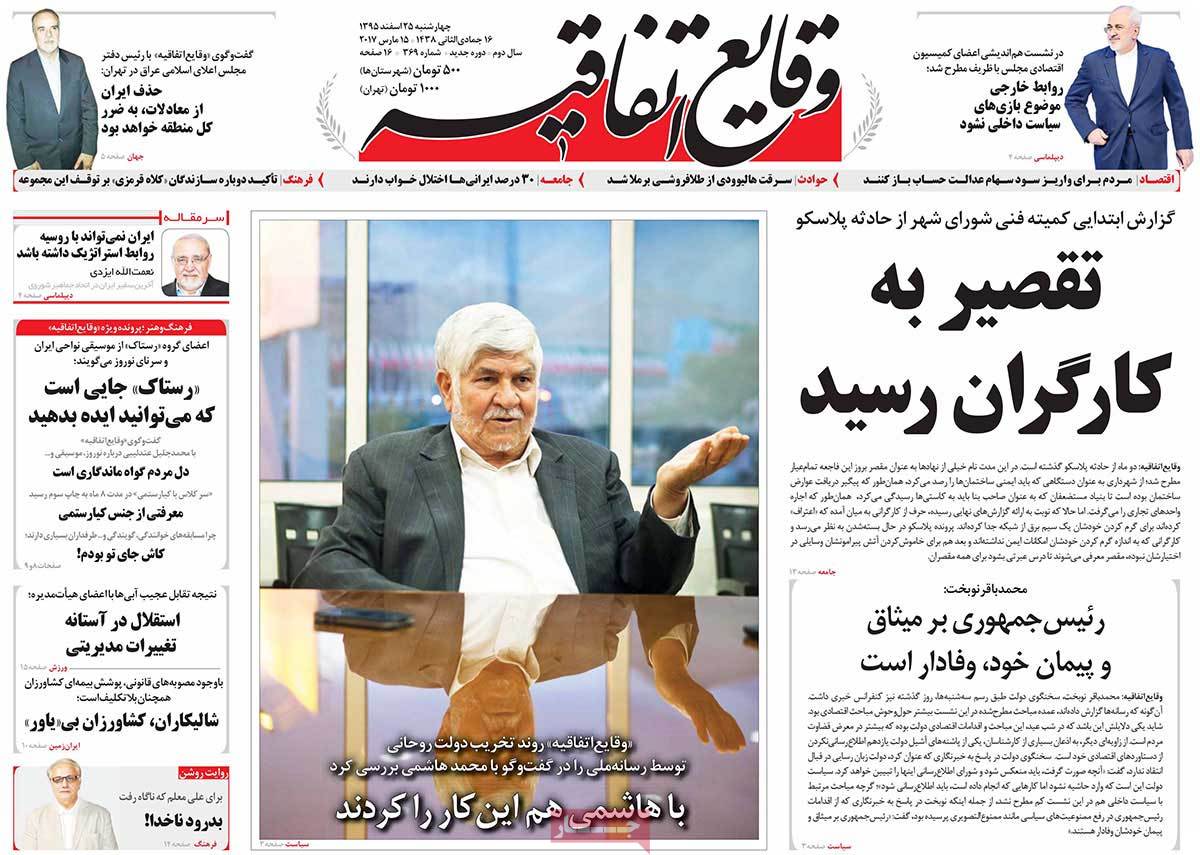
Vaghaye Ettefaghieh:

1- Environment Department Chief: UN to Hold Int’l Meeting in Iran on Fight against Dust Pollution

2- Trump on Verge of Impeachment: Newly-Arrived US Cabinet in Russians’ Trap

3- Loss of $40 Million: A Report on Damages to Iran’s Oil Income Caused by Dust Pollution and Power Failure in Khuzestan Province

A Look at Iranian Newspaper Front Pages on February 19

Iranians to Celebrate Persian Gulf Day by Attending 600-km March

persian gulf - iranian

On the day in 1622, Shah Abbas of the Safavid Dynasty recaptured Hormuz Island in the Persian Gulf from the Portuguese navy and drove the occupying power out of the Strait of Hormuz. The anniversary is observed as National Persian Gulf Day in Iran since 2004.

“Like in the past years, we will organize a program to introduce Iranian ethnic groups. This year, however, the Persian Gulf is the focal point of the event,” Gholam Ali Kazemi Qashqai, executive manager of Iranian Ethnic Groups Festivals, told Mehr News Agency.

On April 16, representatives of Iranian ethnic groups will start their march from Shiraz, capital of Fars Province to reach Bushehr Port, capital of Bushehr Province by April 30.

“We will walk along the coasts of the Persian Gulf along with the 30 individuals from various ethnic groups, and our goal is to celebrate the historical name of the Persian Gulf,” which some Persian Gulf Arab states led by the UAE are trying to distort.

The marchers will go through Sarvestan, Darab, Fasa (all in Fars) and will be hosted by various ethnic groups on the way. “Last year, we planted 30 trees at 30 different spots on our way. We also carried a portable library,” Kazemi Qashqai added.