Monday, December 22, 2025
Home Blog Page 4098

Iranian Film ‘Daughter’ Bags Four More Awards in Belgium

16_four_6

The closing ceremony of the 2017 edition of the event was held in Mons, the capital of Hainaut province in Belgium’s Walloon Region, on February 17, and the Iranian production grabbed four awards.

Competing in the International Competition section with 10 other films from across the globe, ‘Daughter’ won the Grand Prix of the festival, best actor award for Farhad Aslani, CICAE award and CineFemme award, the Iranian cinema website Cinetmag reported.

CICAE (International Confederation of Cinemas of Art and Essay) is awarded by an International Jury of cinema operators and festivals programmers and CineFemme is an association that presents films of authors in preview. It has been a partner of the festival for 18 years.

The film tells the story of an authoritarian and conservative father who is upset by the behavior of his daughter. Living in a southern city of Iran, the young girl leaves her hometown for Tehran without her father’s permission to attend a close friend’s farewell party.

It won the Golden Peacock at the 47th International Film Festival of India and Golden St. George for best film at Moscow International Film Festival 2016.

At the Belgian event, 15 cinema students from Europe and the Middle East met Mirkarimi, 50, and talked to him about his films and directing style.

 Best Short Film

The jury prize for the best short film went to ‘The Silence’ by Ali Asgari and Farnoosh Samadi from Iran.

Premiered in the Short Film Official Competition at 2016 Cannes Film Festival, ‘The Silence’ tells the story of a little girl, a Kurdish refugee in Italy, who refuses to translate the doctor’s words about her mother’s illness and prefers to remain silent.

The short work has already participated in several international festivals worldwide and won awards including best short film awards at Sydney Flickerfest 2017, Hamptons International Film Festival 2016 and Interfilm – Short Film Festival Berlin 2016.

Iran Resumes Power Export to Iraq

energy

The report purported that supplies are back to normal after the government in Baghdad paid $350 million as part of its debt for power imports from Iran which has piled up to $1.3 billion.

Reportedly, an Iraqi delegation traveled to Tehran last week for talks with power officials that culminated in the resumption of electricity export to the neighboring Arab country.

According to an unnamed official at the Energy Ministry, the contract to sell power to Iraq has been renewed until the end of 2017. The official did not give details of the new contract.

“Based on the terms of the contract, if Iraq’s Energy Ministry fails to repay its debts, power export will be discontinued again,” the official added, noting that Iraq is obliged to open a letter of credit to pay for the power it imports.”

Arash Kordi, managing director of Iran Power Generation, Distribution and Transmission Company (Tavanir), said last month that the power export deal between the two governments expired at the end of 2016, refuting claims that Iran had cut supplies due to Iraq’s mounting debt. Iran’s Energy Ministry said last year that Iraqi authorities had agreed to repay the debt by paying $100 million per month. However, the payments ended hardly after three installments.

A spokesman for Iraq’s electricity ministry, Mus’ab al-Mudaris, confirmed in January that the last $100-million payment was made in May “but since then no further payments were made.”

According to reports, Iran had previously cut power supplies to Iraq in April 2015 because of unpaid dues. But exports returned to normal several weeks later after Baghdad pleaded with Tehran to resume supplies as the country faced day-long power outages which had led to nationwide protests.

War-ravaged Iraq is grappling with a chronic shortage of electricity that has caused lengthy blackouts and mass protests against its government, particularly during the hot summer season when electricity demand for cooling soars. The country also depends on Iranian gas to feed three power plants—Rumaila, Shatt al-Basra and al-Najibiyah—to partially offset the blackouts.

Iran is the largest exporter and importer of electricity in the Middle East and exports electric power to Armenia, Pakistan, Turkey, Iraq, and Afghanistan, especially during periods of peak demand. Azerbaijan and Armenia supply electricity to Iran under a swap agreement.

EU, IAEA Reaffirm Commitment to Iran Nuclear Deal

European Union (EU)

Media outlets reported on Friday that the two sides had communicated the stance in a joint statement a day earlier following the fifth meeting of their senior officials.

The deal, officially titled the Joint Comprehensive Plan of Action (JCPOA), was reached after hard diplomatic work by the Islamic Republic and the P5+1 group of countries, comprising the US, the UK, France, Russia, China, and Germany. Under the accord, all nuclear-related sanctions on Iran were terminated, and Iran in return agreed to apply certain limits to its nuclear program and provide enhanced access to international monitors to its nuclear facilities.

In their joint statement, the EU and the International Atomic Energy Agency (IAEA) “reaffirmed support for the JCPOA based on their respective mandates,” the joint release read, detailing the outcome of the EU-IAEA summit.

EU foreign policy chief Federica Mogherini “will remain in close contact with the IAEA regarding continued implementation of the agreement” in her capacity as coordinator of the Joint Commission established under the JCPOA, the statement added.

The Commission, which brings together representatives of the parties to the agreement, is tasked with monitoring its implementation.

“The EU will provide technical support to the IAEA such as equipment and training,” the statement further read.

Read more:

“The EU also informed about its bilateral cooperation with Iran in implementation of Annex III of the JCPOA, particularly in the area of nuclear safety including research,” the statement concluded. Annex III addresses the issue of civil nuclear cooperation.

Mogherini on Friday separately stressed the importance of the nuclear deal, saying it was “delivering on its objectives” and underlined the need for “a full and effective implementation by all sides throughout the lifetime of the agreement.”

Such assertions by the EU and the IAEA are in contrast with the bellicose rhetoric of the administration of US President Donald Trump toward the accord. Trump has called the deal “the worst accord ever” and “one of the dumbest” ones he has come across.

Iranian FM Calls for UN’s More Active Role in Resolving World Crises

qassemi1

“The Islamic Republic of Iran strongly condemns the measure by any country to draft a human rights resolution against our country; and we believe on the basis of our principled policy that such moves are unfair, incorrect and against the realities in the Islamic Republic of Iran,” Foreign Ministry Spokesman Bahram Qassemi said on Saturday.
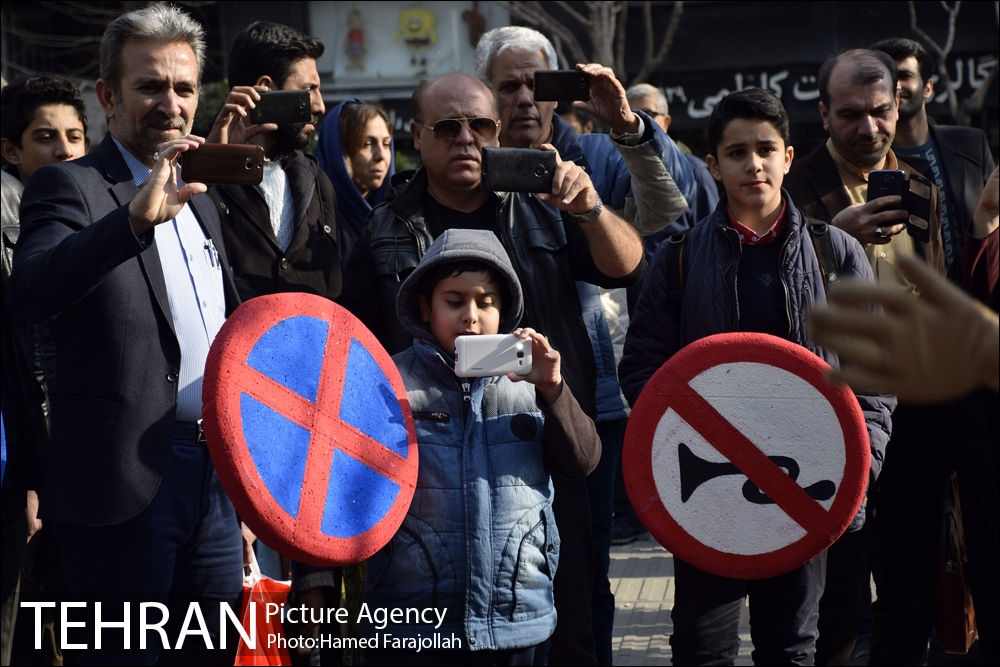
Such anti-Iran moves are taken while many Western states are simply ignoring the massacre of people in Yemen, Syria, and Iraq, or the crimes committed by the “regional supporters of the terrorist groups”, and surprisingly avoid commenting on “certain countries without parliament and election for political reasons,” he added.

The spokesman further rejected media reports trying to link Sweden’s move to present the anti-Iran human rights resolution with the Swedish prime minister’s recent visit to Iran.

He said Sweden is only one of the Western countries in the UNHRC, which passes an anti-Iran human rights resolution in Geneva every year, in a campaign spearheaded by the US and the Israeli regime, for the purpose of fomenting Iranophobia.

The remarks came after Sweden unveiled plans to introduce a UN draft resolution on Iran’s human rights record on March 10.

US Wrestling Team Thanks ‘Wonderful’ Iranian Fans

USA Wrestling Team

US Wrestling Federation - tweetIn a post in its Twitter account, the US wrestling federation thanked Iranian fans who supported American wrestlers during the recent Freestyle Wrestling World Cup in Kermanshah.

“Thank you to the wonderful fans in Iran for cheering on our guys throughout the tournament and being spectacular hosts,” the US wrestling federation said, putting a heart between the flags of Iran and the US.

The 2017 Freestyle World Cup wrapped up on Friday with Iran winning the title for the sixth time in a row.

In the final match, the USA Wrestling Team was defeated by Iranian wrestlers 3-5 in the western Iranian city of Kermanshah in front of vibrant spectators.

Beach Volleyball World Tour Wraps Up in Iran’s Kish Island

Volleyball

The Russian duo Liamin/Krasilnikov defeated Poland’s Kantor/Losiak in the final match to win the top position in the beach volleyball world tour in Kish Island.

The other Russian team, Stoyanovskiy/Yarzutkin, also won their game with Germans Lorenz Schümann and Julius Thole in the match for third place.

Here are photos of the previous rounds released by IRNA:


Simplicity of Iranian Architecture’s Complex Geometry

“The art of creating complexity by using many incredibly simple elements is one that has been mastered in Iran,” Arch Daily says in a recent report about Iranian architecture.

Here is the full text of the report, with photos taken by Ariana Zilliacus:


Iran’s geography consists largely of a central desert plateau, surrounded by mountain ranges. Due to the country being mostly covered by earth, sand, and rock, Iranian architecture makes fantastic use of brick or adobe elements.

Most of the buildings seen in larger cities such as Tehran and Isfahan are constructed using similar brick-laying methods as can been seen in other parts of the world, but certain constructions, usually ones that date further back, contain incredible geometrical treasures. And it doesn’t stop there – old Iranian architecture often contains a layer of tiles over the brick constructions that can create just as mesmerizing geometrical wonders.

The art of creating complexity by using many incredibly simple elements is one that has been mastered in Iranian architecture. In an architectural world where construction has become hidden by layers of plaster and plywood, we could learn a lot from the beauty of Iran’s structural geometry, where skin and structure are (almost always) one and the same.

Complex Geometry of Iranian Architecture


Brick/Adobe

The common brick used in buildings is something we are all quite familiar with; fired clay in the shape of a rectangular cuboid.

Adobe, which most people are less familiar with, is the name for a compressed mixture of sand, silt, clay, water, and sometimes straw, to form the shape of an extruded square that is often seen in Iranian architecture. Different combinations are used to create different forms such as arches or ornamentation. Sometimes the adobe or brick is covered in plaster as protection, creating the impression of a single carved form.


Tiles

Most commonly seen in the Iranian architecture mosques, the brick or adobe domes, arches and decorative entrances are occasionally covered in brightly coloured tiles. The tiles, like the clay elements, are small individual pieces that come together to form a complex, organic geometry. From afar they appear to be one continuous facade, but up close one can easily see the gaps in between each crooked tile.


Wood

Before architects began installing glass in the buildings, windows and doors were often made up of beautiful geometric wooden webs, constructed of hundreds of small, wooden sticks, cut to fit together perfectly – another example of the skilled ways in which Iranian craftsmen took a simple element, multiplied it and arranged it in order to create something incredibly intricate.


Carvings

At Persepolis, a site estimated to be over 2500 years old, exists another example of the complexity achieved by building up a series of elementary components. Along the stone walls of the ruins are carvings of people, soldiers, kings, queens, and animals all very nearly perfect in relation to one another.

The ability to carve the exact same solider over 10 times in a row without using a template or an automatic machine was achieved by carving them out step by step, just like building a wall brick by brick. One craftsman carved out the general form, another defined it, a third carved out the details, and a fourth focused on the beard and hair.

Iran_Carvings


Contemporary Architecture

At the architecture school in the desert city of Yazd, students have explored contemporary ways of combining simple elements in a building with a goal of creating a final structure that is geometrically advanced. Examples include textiles, string, and wires, using the design concepts of traditional Iranian handicraft to produce something just as exciting within modern architecture.

Kuwait Not Interested in Following Saudi Policies on Iran: MP

rouhani

In a Farsi interview with ICANA, Mohammad Javad Jamali Nobandegani weighed in on a message to Tehran by six members of the [Persian] Gulf Cooperation Council concerning holding talks with Iran.

“Considering the current situation in the region and the issues Saudi Arabia has dragged everyone into, the [P]GCC member states are showing an interest in holding negotiations with Iran,” said Jamali Nobandegani, who sits on the Presiding Board of the Parliament’s National Security and Foreign Policy Commission.

He noted the gains achieved by popular and resistance forces have worried opponents.

“Oman and Kuwait have good relations with Iran. In certain cases, Kuwait has wanted to maintain its independence against Saudi Arabia and does not seem to be able to remain defiant alongside Saudi Arabia in the long run,” the legislator underlined.

“Iran as an influential country with numerous elements of power and [the ability to make] cultural and religious contributions stands ready to open up a new chapter in relations with these countries,” said the lawmaker.

The legislator underscored that Riyadh continues to level accusations against Tehran despite sending a message to Iran for holding talks.

He said Saudi Arabia has not forsworn its enmity toward Iran.

“Saudi Arabia’s status has been weakened vis-à-vis Iran, and its hostile moves have been a nonstarter,” said the parliamentarian.

Elsewhere in his remarks, he also said it has been several months that Iran has no ambassadors to Syria and Oman, and asked the government to name an ambassador to Oman.

“Of course, the [Iranian] Foreign Ministry believes a long mechanism is required to pick that person,” he said.

Iranian Diplomat Hails ‘More Peaceful Atmosphere’ in Syria Talks in Astana

Jaberi Ansari

Speaking to IRIB at the conclusion of the Astana talks on Friday, Iranian Deputy Foreign Minister for Arab and African Affairs Hossein Jaberi Ansari said the plenary meeting was held in a more peaceful atmosphere in comparison to the first round of the talks, something that was obvious in the tone of the Syrian opposition groups.

He also expressed the hope that the process of Astana negotiations and efforts by Iran, Russia and Turkey would lead to a swift end to a crisis that has engulfed Syria for six years.

Jaberi Ansari also stressed that Iran has done its utmost in the course of the peace negotiations by “setting aside the problems and differences” – without forgetting them- in order to pave the way for the achievement of a greater goal.

The Iranian diplomat had announced earlier that a communiqué has been finalized by a joint committee monitoring the ceasefire in Syria, which has been established by Iran, Russia and Turkey.

According to a preliminary agreement that would be finalized in diplomatic consultations, the next round of the talks will be held in less than a month, Jaberi Ansari said.

Diplomatic efforts to end fighting in Syria have gained momentum in recent weeks with the announcement of a ceasefire in the Arab country in early January.

The truce, which was negotiated between Russia, Iran, Turkey, the Damascus government and the Syrian opposition, excludes terrorist groups such as Daesh and Jabhat Fateh al-Sham.

The ongoing meeting in Astana is the second time key players have brought the warring sides together, and comes ahead of a new round of UN-led talks on Syria in Geneva on February 23.

Iran’s Leader Thanks Wrestling Team for Efforts Leading to World Title

Leader

In his Saturday message, Ayatollah Khamenei thanked the efforts made by the federation officials, the coaches, and champions of Iran’s national team, which led to Iran’s world title in Freestyle World Cup in Kermanshah, and brought honour and pride for the Iranian nation.

The message was delivered by the Leader’s office to the President of Iran’s Wrestling Federation Rasoul Khadem in a phone conversation today, according to a Farsi report by ISNA.

Iranian national freestyle wrestling team won the 2017 Freestyle World Cup for the sixth time in a row on Friday.

The Iranian team defeated the strong USA Wrestling Team 5-3 in the western Iranian city of Kermanshah in front of vibrant spectators.
Iran had earlier defeated Turkey, Mongolia and India in group action.