Wednesday, April 8, 2026
Home Blog Page 4036

Who Will Rush to Stand by Qatar If War Breaks Out?

Abdel Bari Atwan, the editor-in-chief of Ray al-Youm, has weighed in on the recent clash between Qatar on the one hand, and Saudi Arabia, the UAE, Bahrain, and Egypt on the other hand.

Here is the full text of his article:

We must admit that this disagreement came as no surprise. What did surprise us, however, are its intensity, the manner in which it was expressed, and the measures and steps that have and may still result from it. After all, four of the aforementioned states are supposedly members of the GCC (Gulf Cooperation Council) and the Arab coalition that is fighting the Houthis and the General People’s Congress [Saleh] party in Yemen. In addition, the four states, or two of them at least, have pumped in billions of dollars and thousands of tons of weapons to fan the flames of the bloody conflict raging in Syria, Libya, and Yemen – and are still doing so.

The GCC has previously witnessed many disagreements, and in fact, political and border wars between its members – especially, Qatar and Saudi Arabia. But what is happening today between the abovementioned states may open a wound that would be difficult to close, and create a rift that will be difficult to bridge, at least in the foreseeable future.

The explosive developments began when the Saudi-owned al-Arabiya and the Emirati-owned Arab Sky News broadcast statements attributed to the Emir of Qatar, Prince Tamim bin Hamad Al Thani, during a graduation ceremony of a number of recruits. The Emir allegedly protested against the escalation of the disagreement with Iran, adding that it was unwise to be hostile to it. He also allegedly denounced including Hezbollah and Hamas on the list of terrorist organizations, since both are resistance movements. And he accused Saudi Arabia, the UAE, and Bahrain of inciting against Qatar and accusing it of sponsoring terrorism and its organizations. He also took a stab at Saudi Arabia by saying that ‘the states that claim to be fighting terrorism are those that are religiously most hard-line and are providing pretexts for the terrorists.’ In fact, he went even further by criticizing the hundreds-of- billions of dollars spent on the purchase of weapons rather than on developmental projects, and when he speculated that Trump’s days in office were now numbered.

Al-Arabiya and Arab Sky News picked up these alleged statements and hosted many Egyptian and Saudi analysts who attacked Qatar mercilessly, accusing it of what they portray as terrorism and hosting terrorist organizations, especially the Muslim Brotherhood. Moreover, al-Arabiya broadcasted an audiotape in which the father of Qatar’s Emir, Sheikh Hamad bin Khalifa, is allegedly heard in a phone conversation with late Libyan leader Mu’ammar al-Qadhafi attacking Saudi Arabia and predicting the collapse of the Al Saud regime. It also reported old statements by former Yemeni president Ali ‘Abdullah Saleh revealing that Qatar’s former Emir had asked him for help in waging sabotage campaigns deep inside Saudi Arabia.

Qatar’s giant media empire, of which Al-Jazeera television is the spearhead, was taken by surprise. It did not respond by issuing clarifications or retaliate in kind. Instead, it continued with its usual programs. This lent some credibility to the anti-Qatar campaign for some time. Then came the first clarification from a Qatari official after a number of hours, in the form of a very short statement claiming that the Qatari News Agency’s website had been hacked by unknown parties, and that the statements attributed to Prince Tamim were false.

But adding to the ‘lack of clarity’ was a ‘Breaking News’ item on al-Arabiya to the effect that Qatari Foreign Minister Sheikh Mohammad bin ‘Abderrahman has instructed the ambassadors of Egypt, Bahrain, the UAE, and Saudi Arabia to leave Doha within 24 hours. The Qatari foreign minister firmly denied this, and said that his statements had been taken out of context.

Saudi Arabia, the UAE, and Bahrain took an immediate decision to impose a blackout on Al-Jazeera’s websites and all Qatari newspapers on the Internet. In fact, it is not unlikely for them to resort to jamming Al-Jazeera on the grounds that Qatar’s denial of the statements attributed to Prince Tamim and its insistence that the Qatari News Agency’s website had been hacked were not ‘convincing.’ They did not alleviate the crisis’ intensity or end the campaign on Qatar.

It is worth noting that this crisis in relations between Qatar on the one hand, and the UAE and Saudi Arabia on the other, follows two important developments:

– The first is US President Donald Trump’s visit to Riyadh and his participation in three Saudi – Gulf, Arab, and Islamic – summits. These summits focused on the war on terrorism and on Iran’s role as the latter’s spearhead, accusing it of playing a major role in undermining the region’s stability. Moreover, the US president held a somewhat tense meeting with the Qatari Emir on the summits’ margins.

– The second development was the appearance of a number of articles in US and Western newspapers attacking Qatar. The latest was in Foreign Policy by John Hannah, a former official in the US defence and state departments and one of former US vice-president Dick Cheney’s advisors. He accused Qatar of backing terrorism, inciting the killing of Americans in Iraq, using Al-Jazeera effectively to transform the Arab Spring into an extremist Islamic Winter, and of financing Islamist groups with money and weapons to fight in Syria. He also accuses Qatar of covering up the presence in Doha of Khaled Sheikh Mohammad, the architect of the 9/11 attacks, and facilitating his escape to Afghanistan before the CIA arrested him.

Furthermore, Hannah accuses Qatar of ‘double-dealing’: Of hosting the ‘Udeid Air Base from which US warplanes that struck Iraq where launched, while also siding with Saddam Hussein’s regime and backing him in the media. Hannah also confirms that Cheney had discussed the possibility of moving ‘Udeid Air Base from Qatar, and says that Trump supports this option, while the UAE and Saudi Arabia are candidates for hosting it. He also demanded that Qatar should be punished for sponsoring terrorism.

Prince Tamim was given a ‘cold’ reception at the Riyadh summit. He only spoke with Mr. Fahd bin Mahmoud, the Deputy PM of the Sultanate of Oman and the head of its delegation. He also had a short word with Saudi Crown-Prince Mohammad bin Nayef. Sources inside the summit tell us that [Abu-Dhabi Crown-Prince] Mohammad bin Zayid did not speak to him or shake his hand at all; he bypassed Prince Tamim instead and stood next to President Trump in one of the official pictures.

The fact that the Qatari media empire in its various branches has confined itself to ‘clarifying’ the hacking of the Qatari News Agency’s website, denying the statements attributed to Prince Tamim, and ‘retracting’ the decision to expel the ambassadors of Saudi Arabia, the UAE, Egypt, and Bahrain, suggests that Qatar has uncharacteristically decided to resort to calming down the situation in an attempt to contain the crisis.

However, we believe that the other side may continue to escalate until Qatar ends its support for the Muslim Brotherhood and its media tools, adopt a more hostile attitude towards Iran, and identifies totally and literally with the policies of the Saudi/Egyptian/Emirati triangle.

Gulf sources have leaked reports of a supposed ‘scenario’ that enjoys a US green light for changing the top leadership in Qatar. They add that what is happening today is a prelude to this. However, there is nothing to confirm this scenario, even though it may not be totally unlikely. After all, a coup attempt did occur in 1996, aimed at toppling the former Emir of Qatar and restoring his father to power. It is ironic that the three states – Saudi Arabia, the UAE, and Egypt – were participants in that failed coup attempt, supporting it with money, weapons, and soldiers.

Will history repeat itself? We have no answer. But the crisis is serious and the estrangement is worsening. And nothing can be excluded these days, in light of the Emirati/Saudi alliance that has not refrained from fighting the war in Yemen and has continued to do so for over two years, and is now beating the drums of another war against Iran, threatening to carry the battle deep inside it.

Here, another question seems legitimate: Who will rush to stand by Qatar’s side and defend it? Will it be Iran, which Qatar and the factions allied with it in Syria and to a lesser extent in Iraq have been fighting? Or will it be Turkey, which is now in a state of hostility with all of its neighbours, as well as with the US and most of Europe’? Or will it be the US ‘Udeid Air Base, which together with its soldiers and warplanes, wants to leave Qatar?

At present, we can do no more than raise questions, and admit that Qatar is in a critical and unprecedented position, facing fierce enemies and having a very small number of allies, at a time when reason and wisdom have been set aside.

But please feel free to correct us if we are wrong.
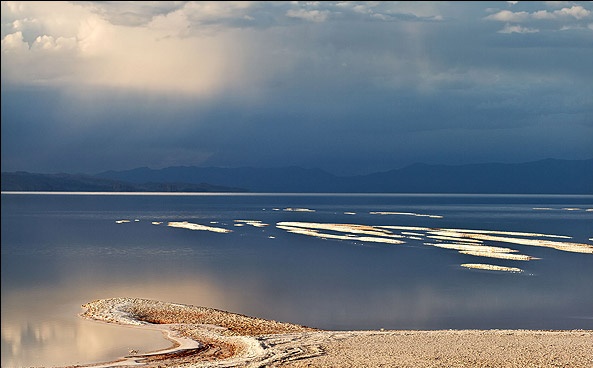
IRGC-Made Tunnel to Revive Iran’s Shrinking Lake Urmia

Iran Lake Urmia

Iran’s Islamic Revolution Guards Corps (IRGC) is making serious effort to keep Lake Urmia from drying up.

IRGC-Made Tunnel to Revive Iran’s Shrinking Lake UrmiaBrigadier General Ebadollah Abdollahi, the commander of IRGC’s Khatam al-Anbia Construction Base, says a 36-kilometre tunnel is being dug to revive the shrinking lake.
“If there are no financial problems, it will be completed in 30 months’ time,” he noted, adding that the tunnel will supply the water needed by Lake Urmia.

“Today, the country is facing major challenges in the water sector, including water shortage, because there is no proper management for water consumption,” he said.

He added people demand Lake Urmia be revived.

“This lake had a miserable condition for years, and water levels had tremendously dropped there, leading to numerous environmental problems,” Abdollahi noted.

The project to supply water to Lake Urmia began in 2010. The tunnel is to take excess water from the Glaas River to the lake aimed at reviving the body of water.

Due to a lack of enough financial resources as well as the hard work involved, the project is not progressing according to the scheduled time frame.

Elsewhere in his remarks, Abdollahi touched upon a project to create a green belt along the borders through agricultural development work.

He said some three thousand projects are underway in northwest of the country covering some 500 thousand hectares of land which are to be turned into a “green agricultural belt” to boost agricultural development, create jobs and endure lasting security along the borders.

Iran Parliament Speaker Felicitates Counterparts on Ramadan

Iranian Parliament Speaker Ali Larijani has, in a message, extended felicitations to his opposite numbers in Muslim countries on the arrival of the holy month of Ramadan.

The full text of the message follows:


May God Almighty’s blessings and mercy be upon you,

I am pleased to offer my heartfelt congratulations to you and the respected parliament representatives on the arrival of the holy month of Ramadan, the month of the revelation of the holy Quran [to the Prophet Mohammad], the month of worshiping God.

I do believe that the holy month of Ramadan is a unique spiritual opportunity to benefit from the endless divine blessings and further consolidate rapport, fraternity and friendship within the Islamic community.

Your Excellency,

I would like to take the opportunity to emphasize once again that a consistent approach should be adopted by Islamic countries in order to tackle the current tough and miserable situation in the Muslim world which is the fallout from growing extremism and Takfiri terrorism. Incontrovertibly, parliamentary consultations will play a key role in helping advance the cause of peace in the Muslim world with a view to the establishment of lasting security, stability and welfare for Islamic nations. To that end, the Iranian Parliament welcomes any constructive interaction and dialogue.

May God Almighty bestow ever-increasing success and prosperity upon Your Excellency and further promote the status of the Muslim world.


Ali Larijani

Iranian Parliament Speaker

France’s Peugeot, Total Looking for Stronger Presence in Iran

Following the holding of Iran’s May 19 presidential election, foreign companies, particularly such French firms as Peugeot and Total, have shown renewed interest in making investment in the Islamic Republic’s automotive and oil industries, as two of its big and profitable businesses.

Ahead of other interested European investors, who seek to start a new round of visits to Tehran to hold talks with Iranian companies and sign contracts with them, French firms have already stepped forward to start cooperation with their Iranian counterparts.

Among the French investors, the country’s auto makers are showing greater enthusiasm to seal deals with Iranians. Although following the signing of the nuclear deal – also known as the Joint Comprehensive Plan of Action (JCPOA) – a number of contracts were signed between Iran Khodro Company (IKCO) and Saipa Group from Iran and their French counterparts Peugeot and Renault, respectively, it appears that France’s automobile industry does not regard these deals as sufficient, seeking to expand cooperation with Iranian auto manufacturers.

Most probably, this insatiable thirst for cooperation was the main drive behind the visit to Iran by Jean-Philippe Imparato, the chief executive of Peugeot, a few days prior to the announcement of the results of the elections in Iran. He visited Tehran to hold talks on the latest condition of IKAP, a 50-50 joint venture company between Peugeot and IKCO, based in Tehran and established in 2016.

Although little is known about the details of his negotiations with Iranians, the IKCO’s official sources said the talks centred on IKAP’s production lines as well as the methods for distributing Peugeot’s new cars in Iran’s market, providing after sales services for the cars and advertising them. Nevertheless, Imparato visited IKAP’s top sales representative in Iran which, per se, shows that Peugeot seeks to have a stronger presence in the country’s market than its European and Asian rivals.

Only one month has elapsed since the mass production of Peugeot 2008 mini SUV began in Iran in a ceremony attended by the country’s President Hassan Rouhani. The pre-sale of the automobile is scheduled to begin in Iran soon. IKCO and Peugeot, which signed a new agreement in the post-JCPOA era, intend to send five products to Iran’s market in the new phase of their cooperation. This comes as, Peugeot, unlike its former type of cooperation with Iran, this time seeks to exercise stricter supervision on the production and distribution of its products in Iran.

The French auto maker’s officials have expressed reluctance to witness the recurrence of the same experience they had in their former partnership with Iran and, thus, this time, intend to display greater sensitivity over issues such as controlling the quality of the cars as well as after-sales services to have a different presence in Iran.


Common Point

In spring 2017, both Iran and France underwent the same change in their domestic policy to begin summer having already held their presidential elections. In Iran, Rouhani, a moderate political figure, was re-elected to be at the helm of the government for another four-year and France sees Emmanuel Macron, from the Socialist party with liberal-democrat ideas, in presidential office. Macron, was the economy and finance minister in the François Hollande’s administration.

Analysts maintain that the new French president will hardly reconsider ties with Iran, predicting that the increasing trend started in the two countries’ trade exchanges following the going into effect of the JCPOA, will continue. This comes as France is currently beset with a host of economic problems and, thus, would benefit substantially from developing trade relations with untapped markets, such as Iran, which have a great potential for generating revenues. Expanded relations with Iran can help France stimulate economic growth and reduce unemployment.


French Auto-Makers, Oil Firms at the Beginning of the Queue

While the two French auto makers are strengthening their foothold in Iran, the European country’s oil companies also seek to foster economic relations with Tehran.

After Iran and the French energy company Total reached an agreement to construct a refinery complex in Bandar Abbas in southern Iranian, which led to the signing of an MoU to carry out the project’s feasibility studies, now the oil giant is in serious talks on cooperating in developing the Phase 11 of the giant South Pars gas field in the southern Iranian province of Bushehr.

On Wednesday (May 24), Total CEO Patrick Pouyanne grasped the opportunity provided by the holding of the 172nd ordinary OPEC meeting in Vienna to hold talks with Iranian Oil Minister Bijan Namdar Zanganeh on the issue. This shows that, in addition to the French car manufacturers, the country’s oil companies are also serious about expanding presence in Iran.


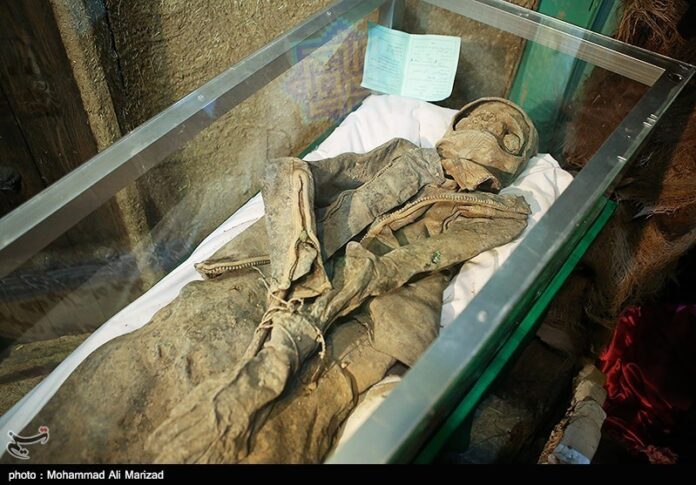
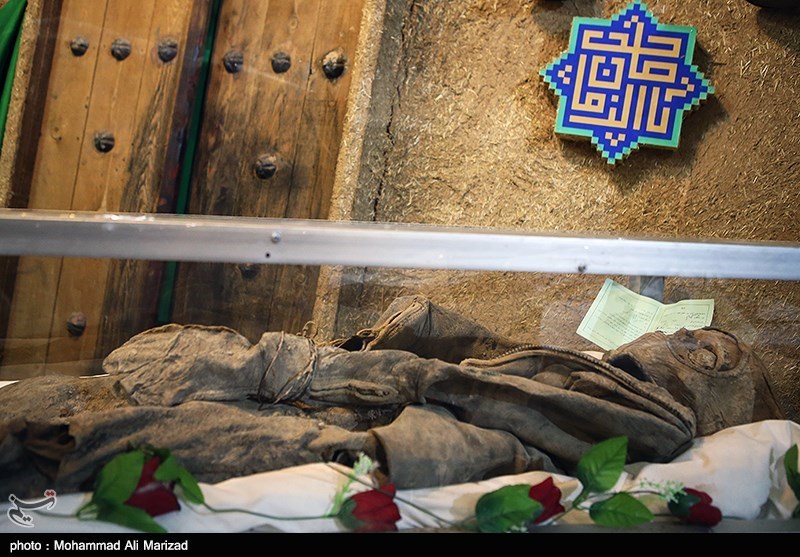
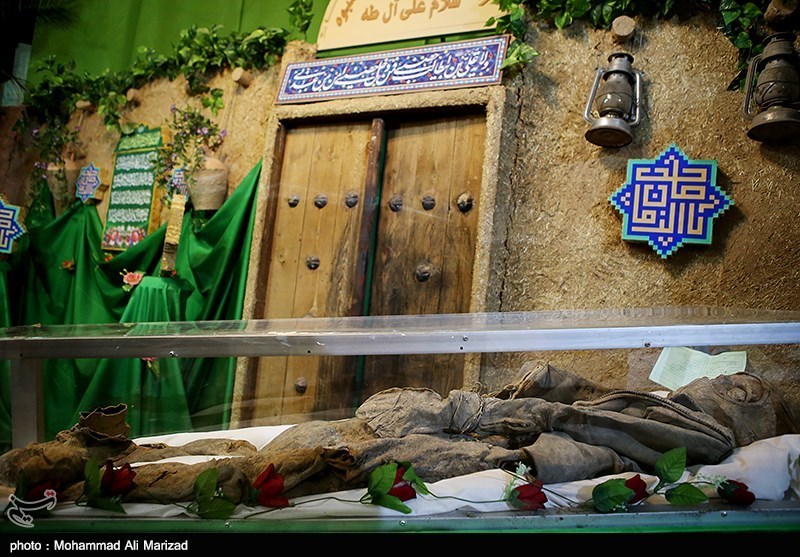
Bodies of 130 Iranian Martyrs Repatriated after Three Decades

On May 25, the recently recovered bodies of 130 Iranian martyrs of the eight-year Iraqi imposed war (1980-88) were transferred into the country via Arvand River, the natural border separating Iran from the Arab state.

These holy bodies belonged to the lionhearted Iranian armed forces who had sacrificed their lives during the war to protect the territorial integrity of their country and defend the honour of their people.

The head of the Missing in Action (MIA) Search Committee of the Iranian Armed Forces, Brigadier General Mohammad Baqerzadeh, said 18 of these bodies belonged to a group of military scuba divers of the Iranian military in Operation Karbala-4, who were found with their hands tied on Umm ar-Rasas Island located 30 km southeast of Iraq’s Madaba.

He added the bodies will be transferred to the Iranian capital of Tehran for identification.

Baqerzadeh said following the identification process, the bodies will be buried in different Iranian cities on July 20, concurrent with the martyrdom anniversary of Imam Jafar Sadiq (PBUH), the sixth Shiite Imam.

The bodies were repatriated one day after the 35th anniversary of the liberation of the strategic port city of Khorramshahr in the southwestern Iranian province of Khuzestan.

The city was recaptured from Iraqi forces under the former dictator Saddam Hussein. On May 24, 1982, Iranian forces retook Khorramshahr from the Iraqis who had occupied the port city early in the war on October 26, 1980.

The repatriation of the bodies also came a couple of years after thousands of Iranians took part in a massive funeral procession around Baharestan Square in downtown Tehran to pay homage to another 270 martyrs of the eight-year war, whose bodies had been repatriated after three decades.

During the funeral procession in June 2015, the martyrs’ coffins were draped in Iran’s national flags.

A total of 175 of the bodies belonged to a group of military divers that had been brought back to Iran on May 18, 2015.

Speaking on the sidelines of that funeral ceremony, Baqerzadeh had noted that some of the retrieved bodies had their hands tied and bore no scars, indicating that the martyrs were buried alive by the forces of the former Iraqi Ba’ath regime during Operation Karbala-4.


Sunni Iranians Show Strong Support for Islamic Republic: Top Cleric

Prominent Sunni cleric Molavi Abdul-Hamid says Sunni Muslims in Iran displayed their unflinching support for the Islamic Republic by turning out en masse in the 12th presidential election.

Abdul-Hamid, who is the Friday prayer leader for the Sunni community in the southeastern city of Zahedan, made the comment in a ceremony held in Tehran to honour President-elect Hassan Rouhani’s campaign managers.

In the ceremony, which was also attended by the president, the senior Sunni cleric congratulated Rouhani on his re-election as president.

“First, we should thank God who helped us emerge victorious in a major test and [arena to make a] choice; today, we have a feeling of dignity and pride against the world,” said the cleric.

He then thanked the Iranian nation for turning out on the election day “with unity and solidarity” and making the right choice to pick a “brave, honest and circumspect person to run the country and implement the constitution.”

“Dr. Rouhani! I congratulate you because you could act in such a way that people cast more votes for you than the previous round and chose you for a second term,” said the Sunni cleric.

He described this presidential election as “memorable,” and said the huge turnout as well as the high number of votes cast for Rouhani was unprecedented.

He then underlined that the Sunni community cares about Iran’s dignity, stature, integrity and security.

He said Iranian Sunnis are members of the great Iranian nation and will make every effort to defend the country’s territorial integrity and dignity.

Warmly applauded by the audience, Abdul-Hamid touched upon the demands of the Sunni community, including the demand that competent Sunnis be assigned to managerial posts across the country.

He said the employment of qualified and competent Sunni people will help boost the dignity of Iran in regional and international equations.

“Members of the Sunni community stand ready to serve [the nation] in any place that the government deems appropriate,” he noted.

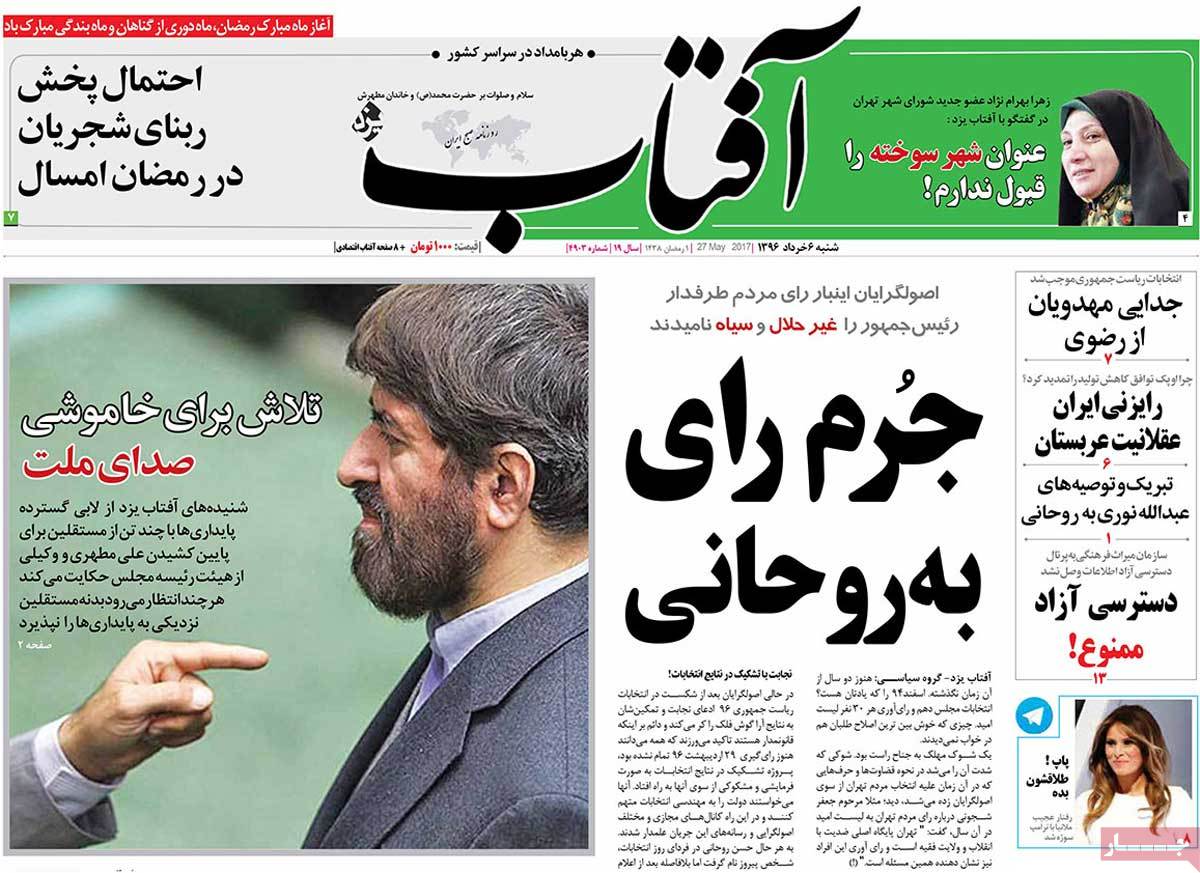
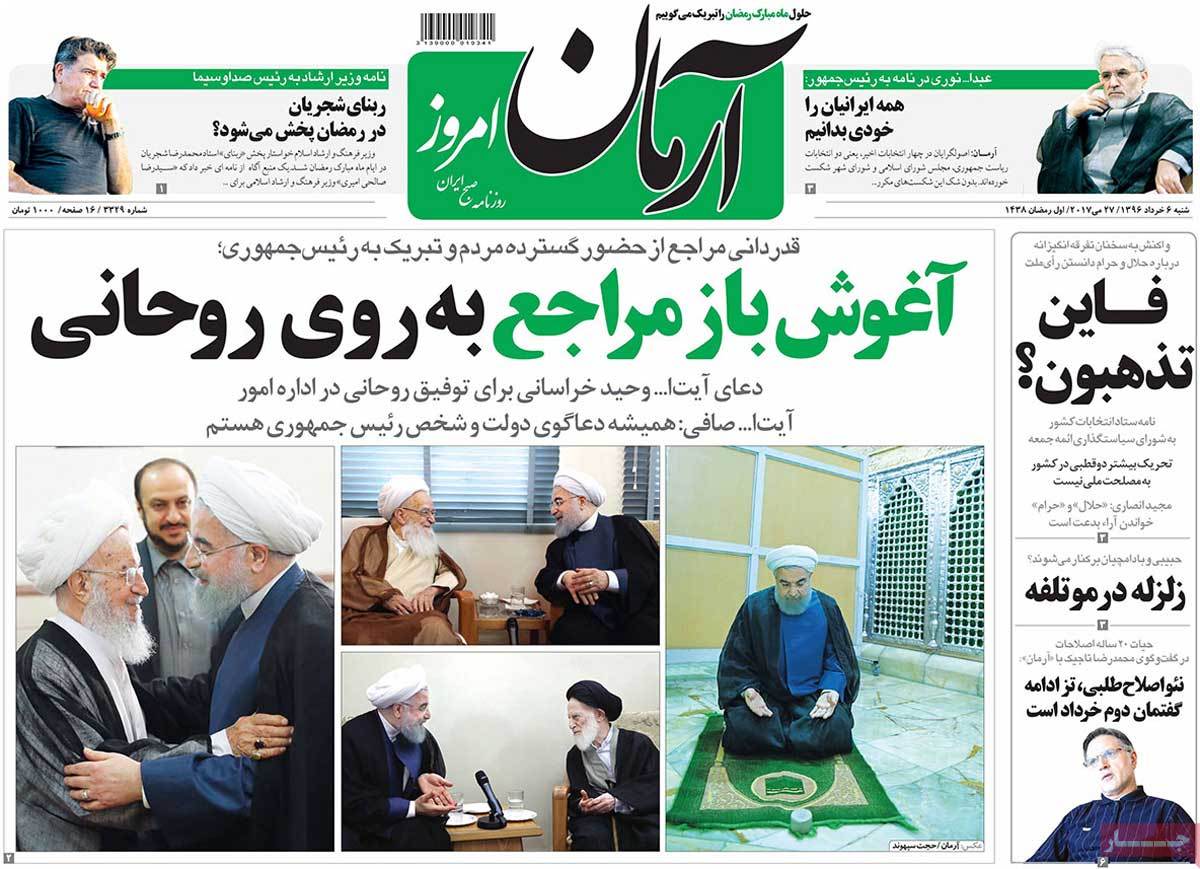
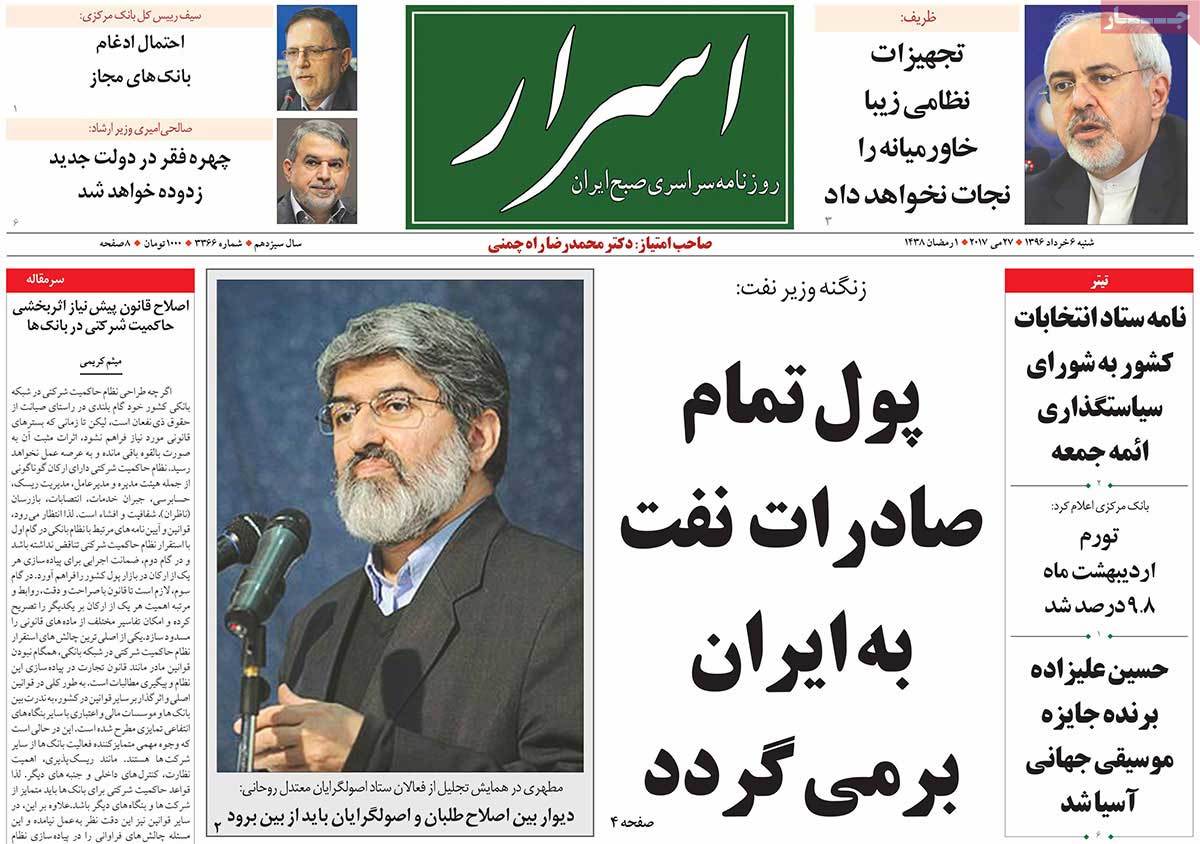
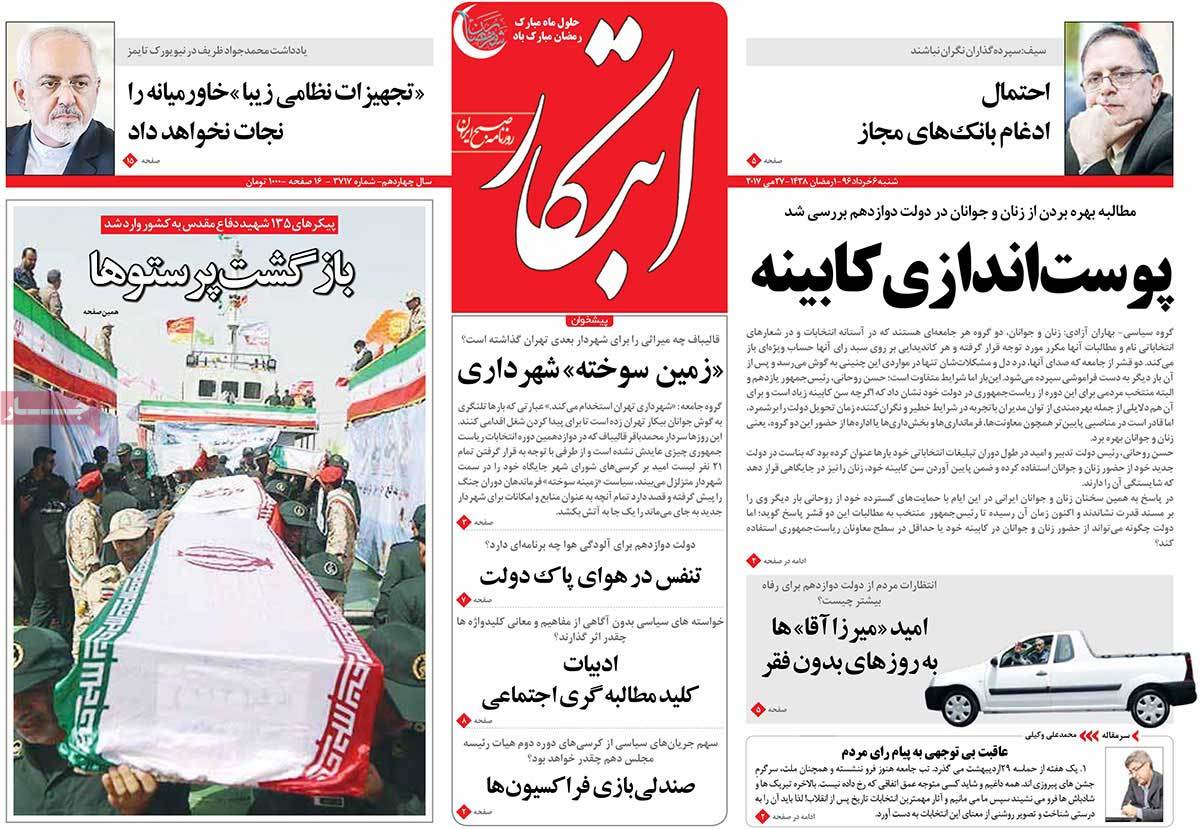
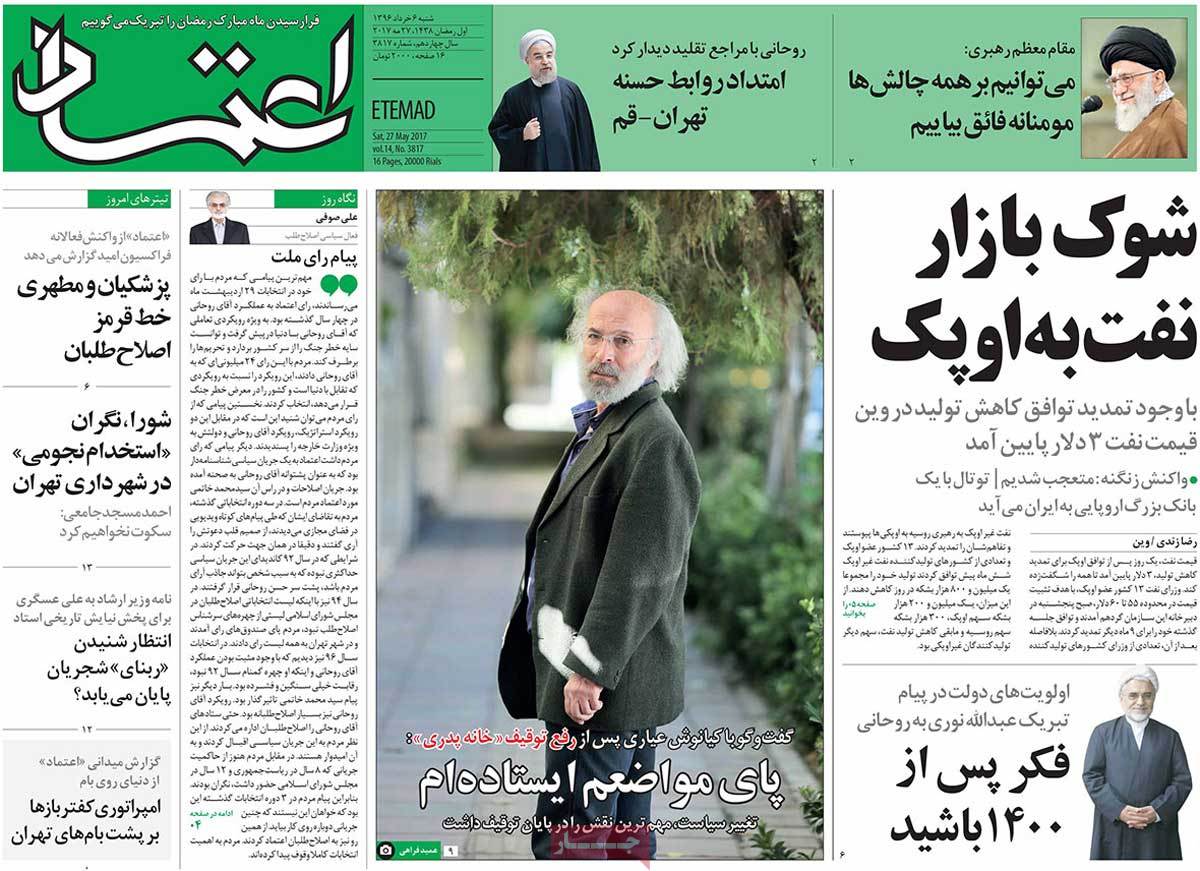
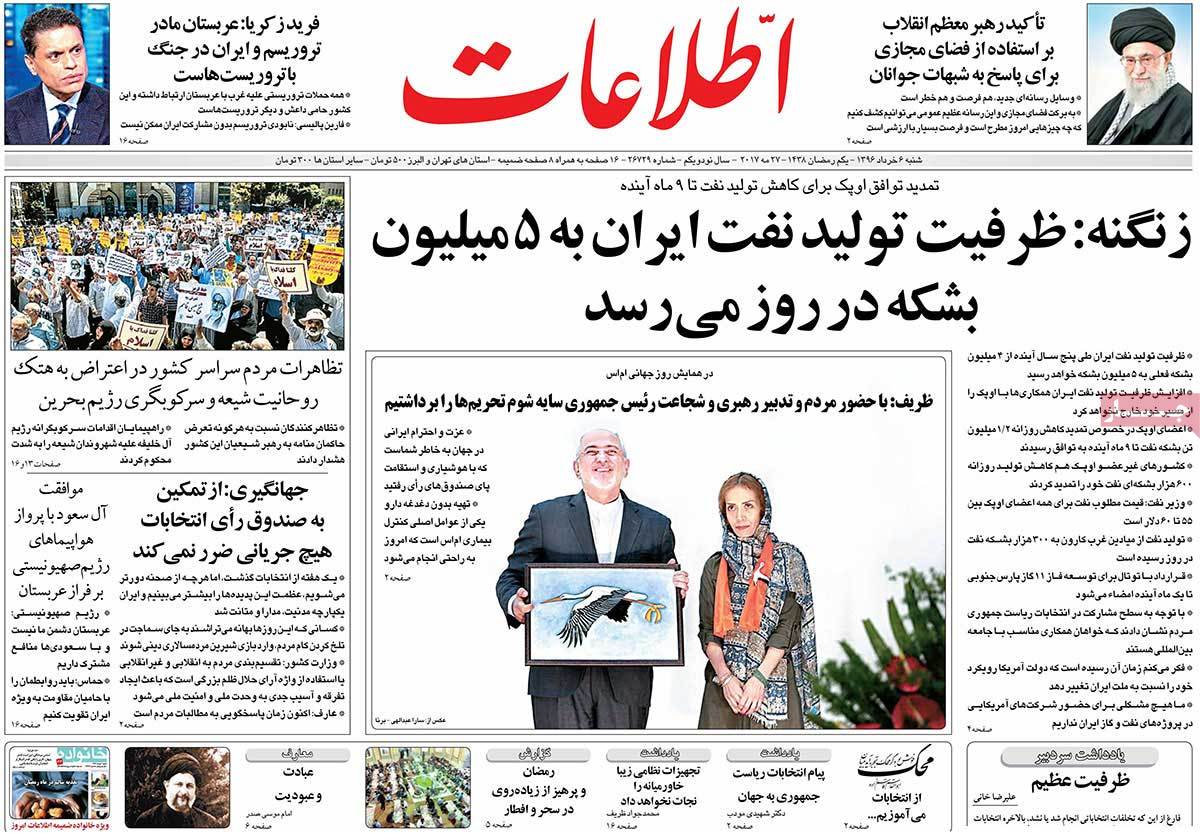
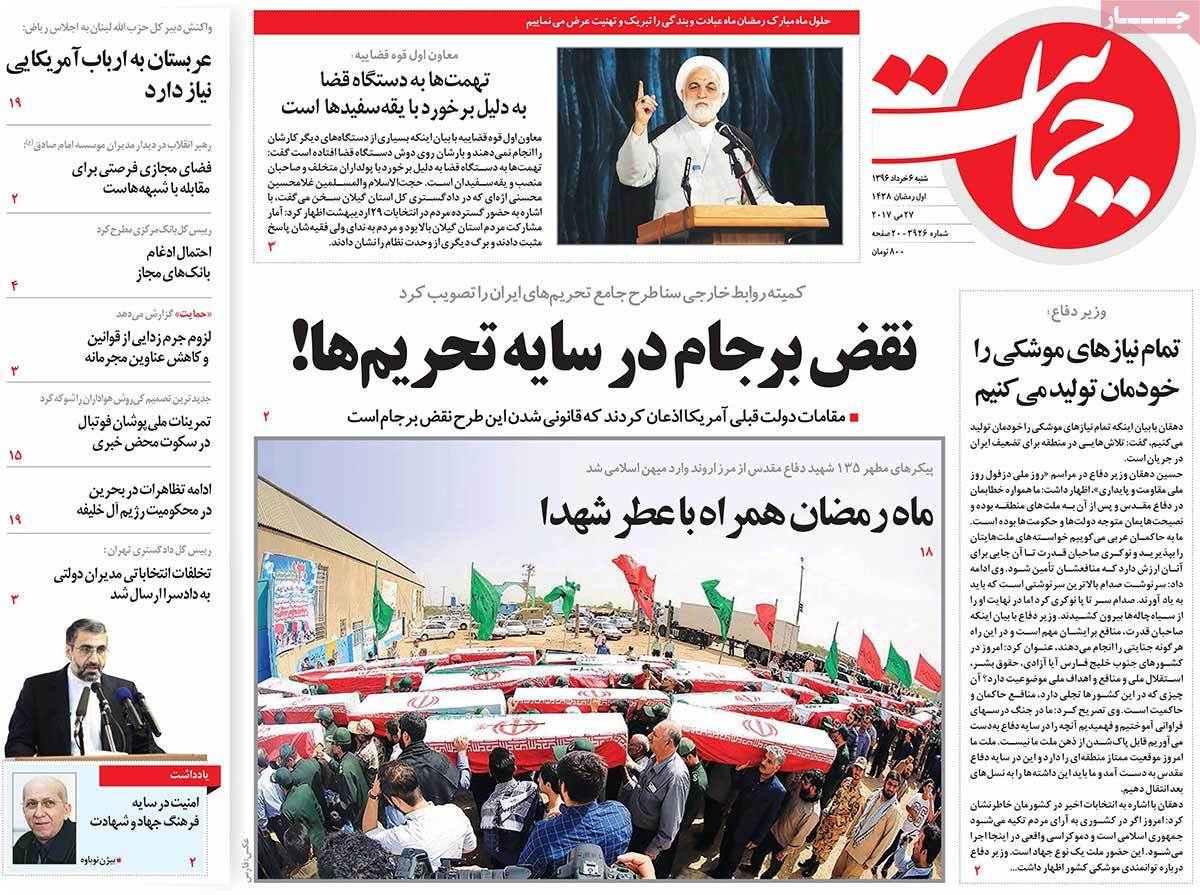
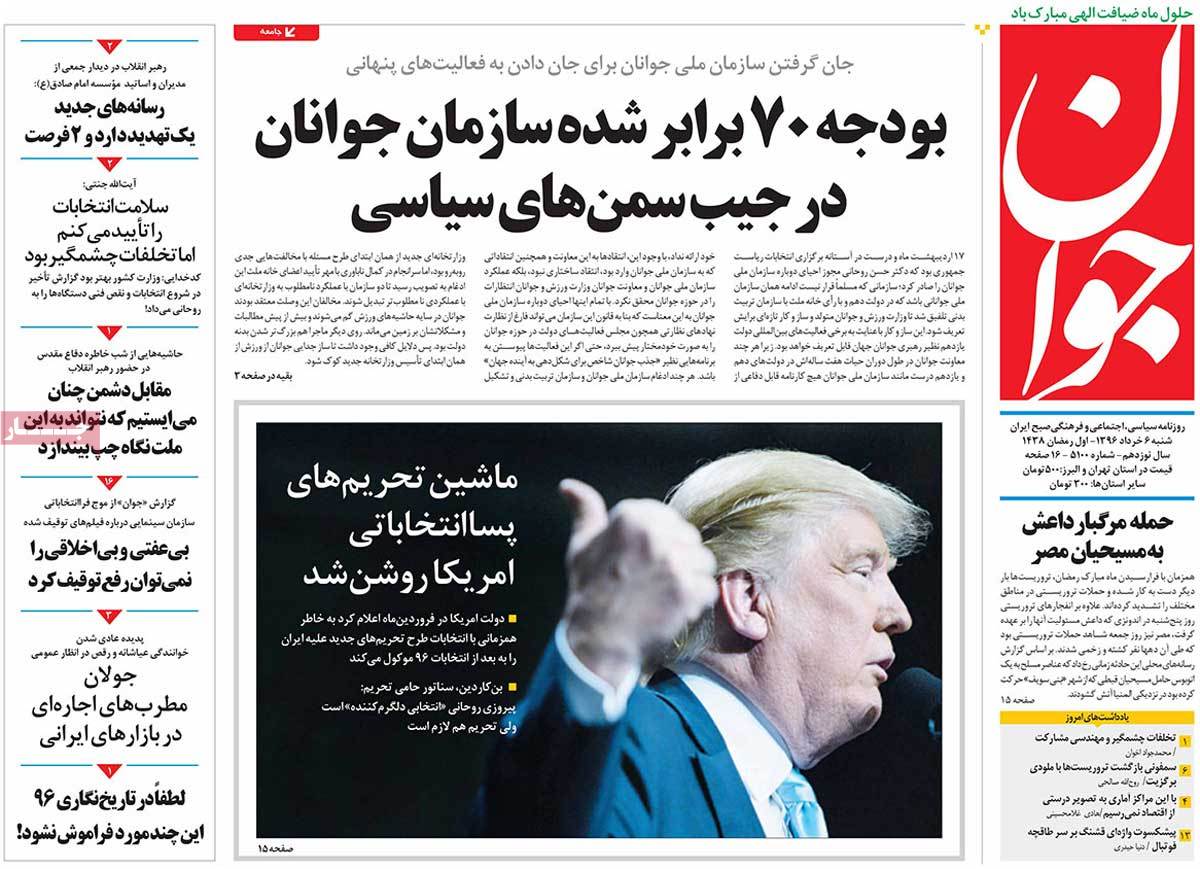
A Look at Iranian Newspaper Front Pages on May 27

The top story today was the fresh anti-Iran sanctions approved by the US Senate. Many conservative papers noted that the US is starting a new round of sanctions after Rouhani’s re-election.

An article by Fareed Zakaria in Washington Post about Saudi Arabia’s support for terrorism and Iran’s role in the fight against terrorists also received great coverage.

The agreement between OPEC members to extend an oil cut deal was also a top story today. Some newspapers also pointed to the decrease in oil price in spite of the OPEC deal.

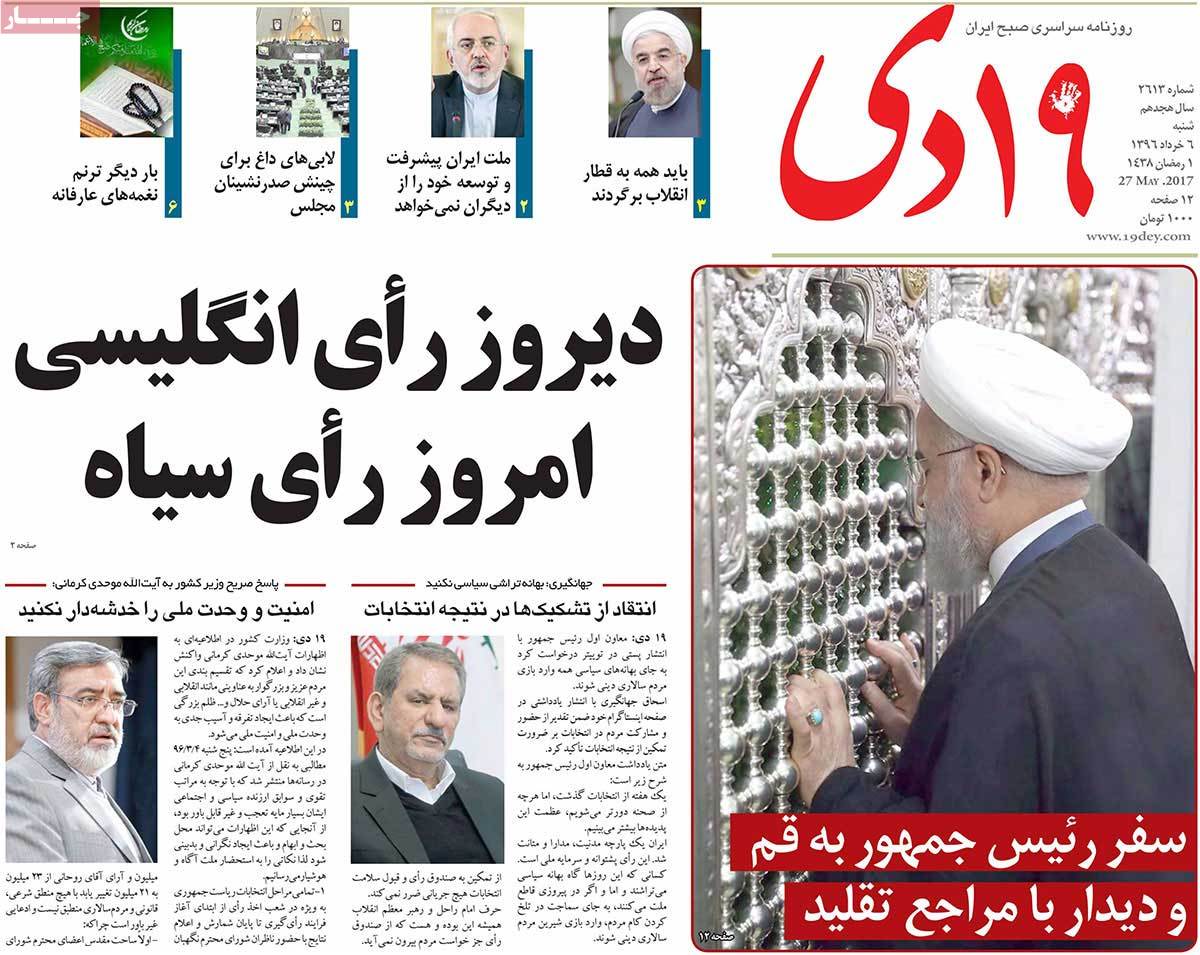
The above issues, as well as many more, are highlighted in the following headlines and top stories:


19 Dey:

1- Zarif: Iranian People Don’t Want Their Progress, Development from Others

A Look at Iranian Newspaper Front Pages on May 27 - 19 dey


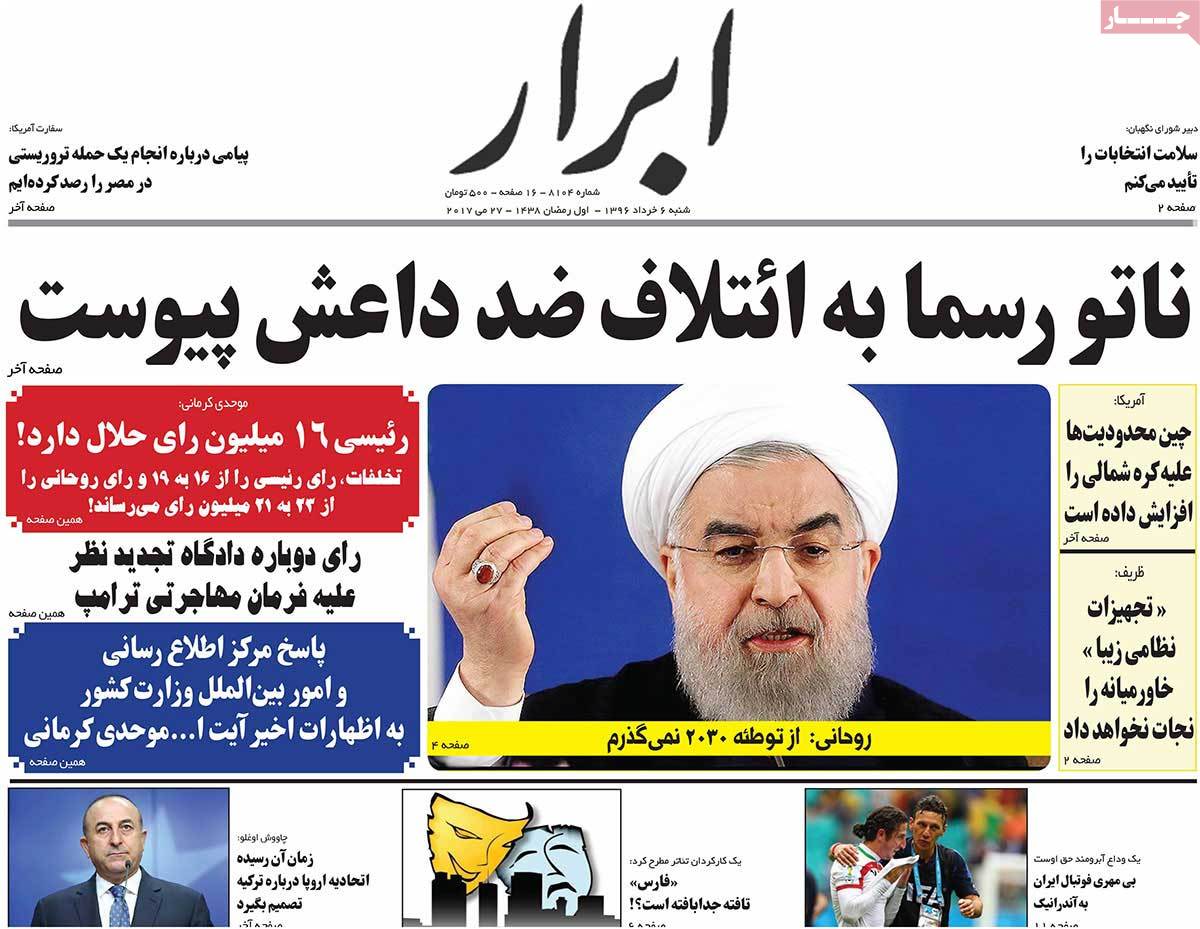
Abrar:

1- NATO Officially Joins Anti-ISIS Coalition

2- US: China Has Increased Restrictions on North Korea

3- Trump’s Travel Ban Once Again Rejected by US Court

4- Cavusoglu: It’s Time for EU to Decide about Turkey [accession to EU]

A Look at Iranian Newspaper Front Pages on May 27 - abrar


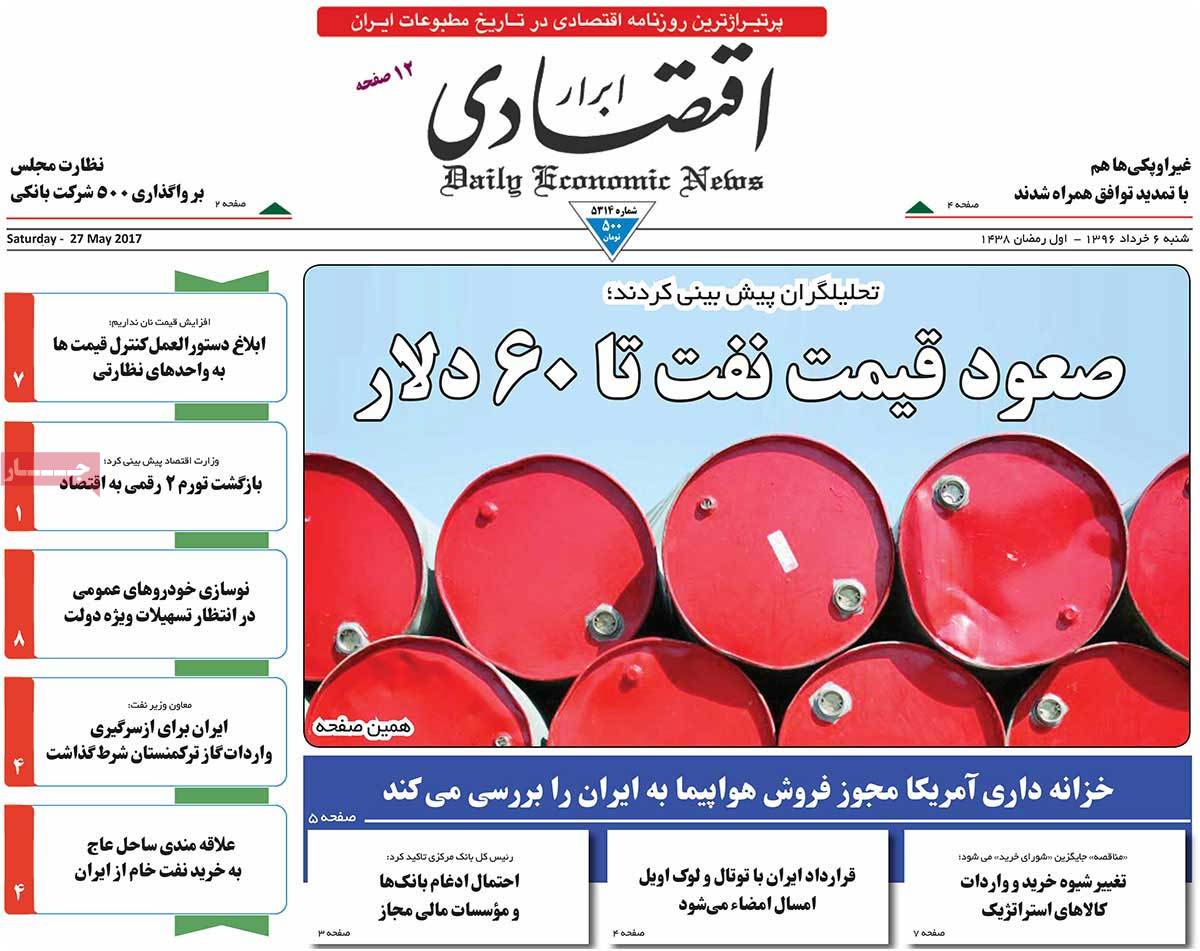
Abrar-e Eqtesadi:

1- Analysts Say Oil Price May Increase to $60

2- US Treasury to Review Permission for Selling Plane to Iran

A Look at Iranian Newspaper Front Pages on May 27 - abrar eghtesadi


Aftab-e Yazd:

1- Iran’s Consultations, Saudi Araba’s Rationality Leads to Extension to OPEC Deal

A Look at Iranian Newspaper Front Pages on May 27 - aftab


Arman-e Emrooz:

1- Clerics in Qom Kindly Support Rouhani

A Look at Iranian Newspaper Front Pages on May 27 -arman


Asrar:

1- Oil Minister: Iran to Collect All the Money for Its Oil Exports

2- Culture Minister: Poverty to Be Eradicated in New Government

3- MP: Wall between Reformists, Conservatives Should Be Removed

A Look at Iranian Newspaper Front Pages on May 27 - asrar


Ebtekar:

1- Zarif: ‘Beautiful Military Equipment’ Won’t Save Middle East

A Look at Iranian Newspaper Front Pages on May 27 - ebtekar


Etemad:

1- Oil Market’s Shock to OPEC: $3 Decrease in Oil Price in Spite of OPEC Deal

A Look at Iranian Newspaper Front Pages on May 27 - etemad


Ettela’at:

1- Minister: Iran’s Oil Output to Reach 5 Million bpd

2- Zakaria: Riyadh is Mother of Terrorism, Tehran Mother of Fight against Terrorists

3- Zarif: We Averted War Thanks to People’s Presence, Leader’s Prudence, Rouhani’s Courage

4- Nationwide Protest Rallies in Iran to Protest at Crackdown in Bahrain

A Look at Iranian Newspaper Front Pages on May 27 - etelaat


Hemayat:

1- JCPOA Violated under Shadow of Sanctions! US Senate Approves New Iran Sanctions

2- Hezbollah’s Reaction to Riyadh Summit: Saudi Arabia Needs American Masters

3- Iran DM: We Produce All Missiles We Need

A Look at Iranian Newspaper Front Pages on May 27- hemayat


Javan:

1- US Starts Imposing Anti-Iran Sanctions after Elections

2- US Senator: Rouhani’s Re-Election is Encouraging, but Sanctions Are Needed

3- ISIS Deadly Attack on Egypt’s Christians

A Look at Iranian Newspaper Front Pages on May 27 - javan


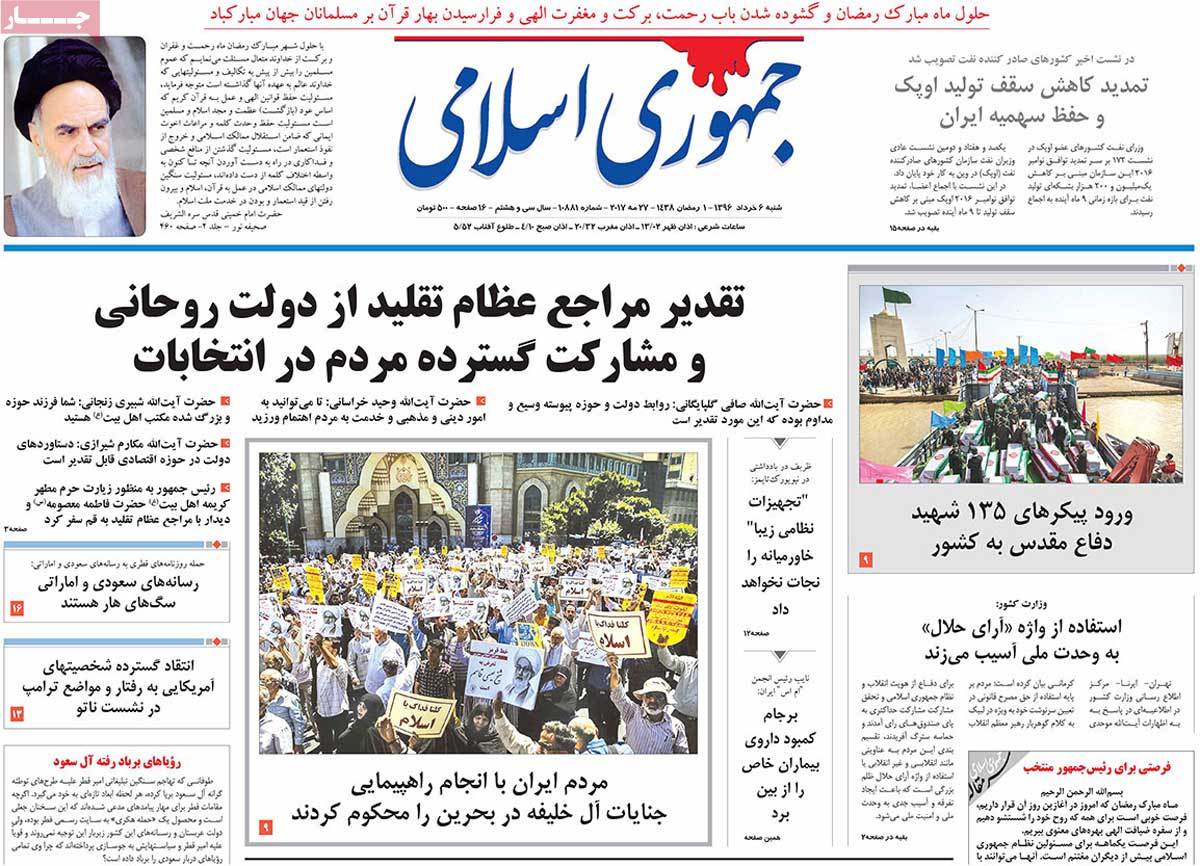
Jomhouri Eslami:

1- Qatari Newspaper: Emirati, Saudi Media Are Rabid Dogs

2- Iranians Condemn Al Khalifa Regime’s Crimes in Bahrain in Nationwide Rallies

3- American Figures Widely Criticize Trump’s Behaviour, Stances in NATO Summit

4- Nuclear Deal Ends Shortage of Pharmaceuticals for Special Diseases: Iranian Official

A Look at Iranian Newspaper Front Pages on May 27 - jomhori


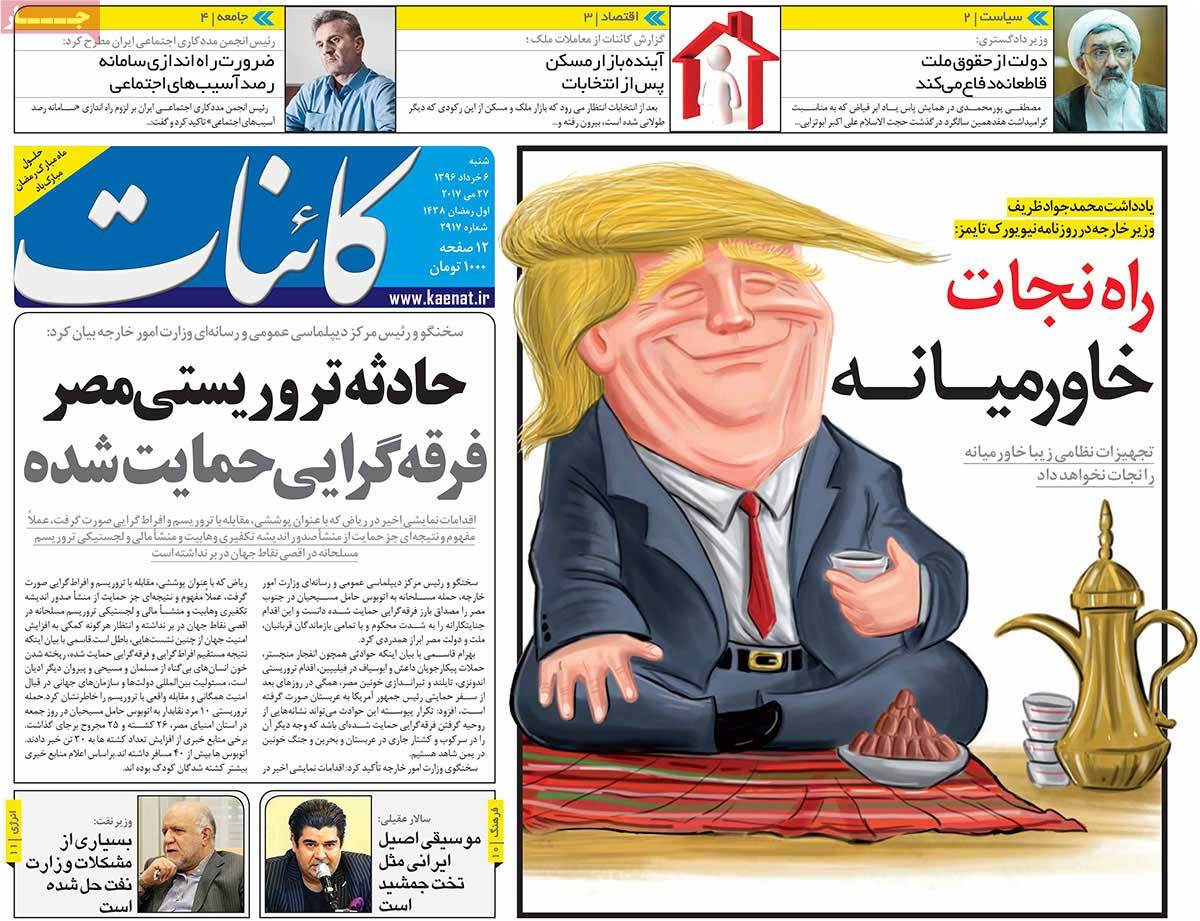
Ka’enat:

1- Iran: Terrorist Attack on Egypt Was Sponsored Sectarianism

A Look at Iranian Newspaper Front Pages on May 27 - kaenat


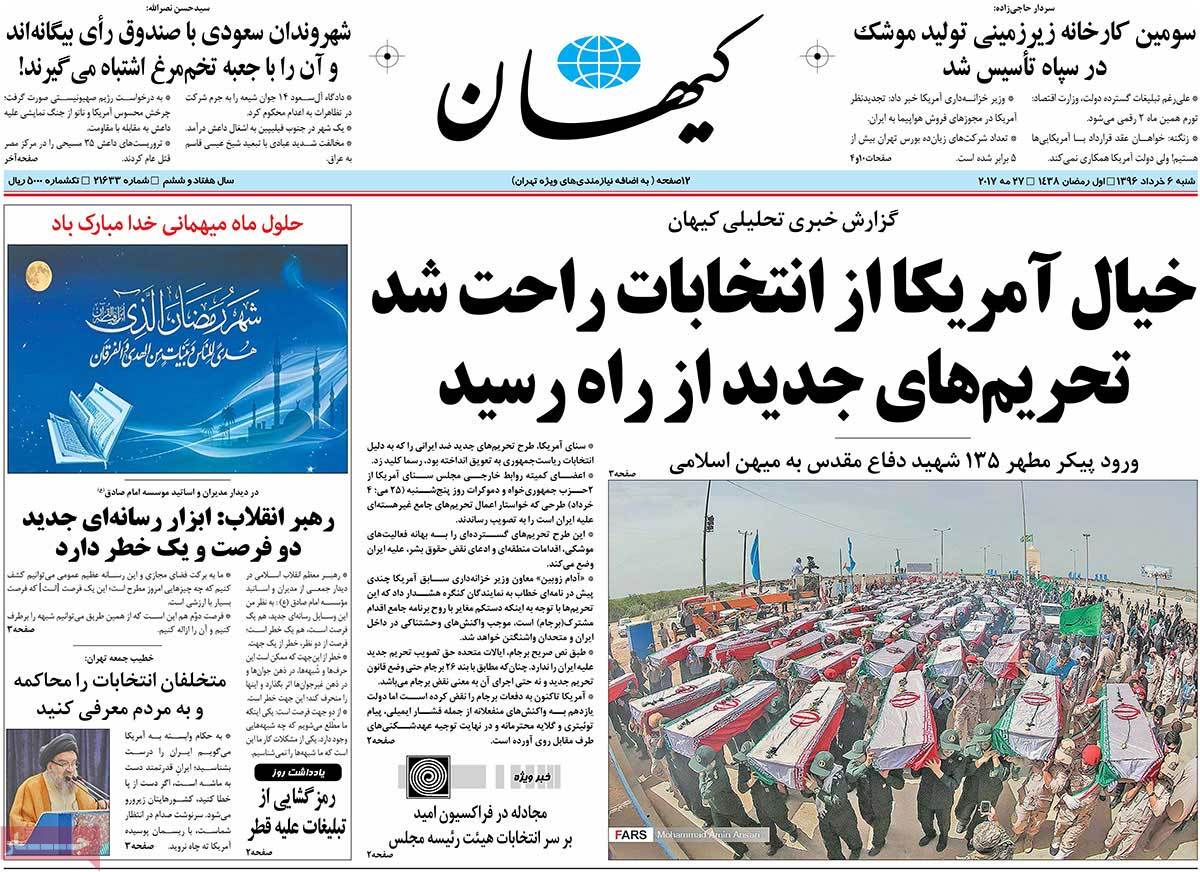
Kayhan:

1- Relieved about Iran Elections, US Imposes Fresh Sanctions

2- Nasrallah: Saudi Citizens Mistake Ballot Boxes for Egg Boxes!

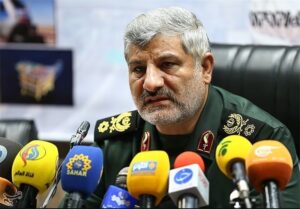
3- IRGC General: Third Underground Missile Production Factory Established in IRGC

A Look at Iranian Newspaper Front Pages on May 27 - keyhan


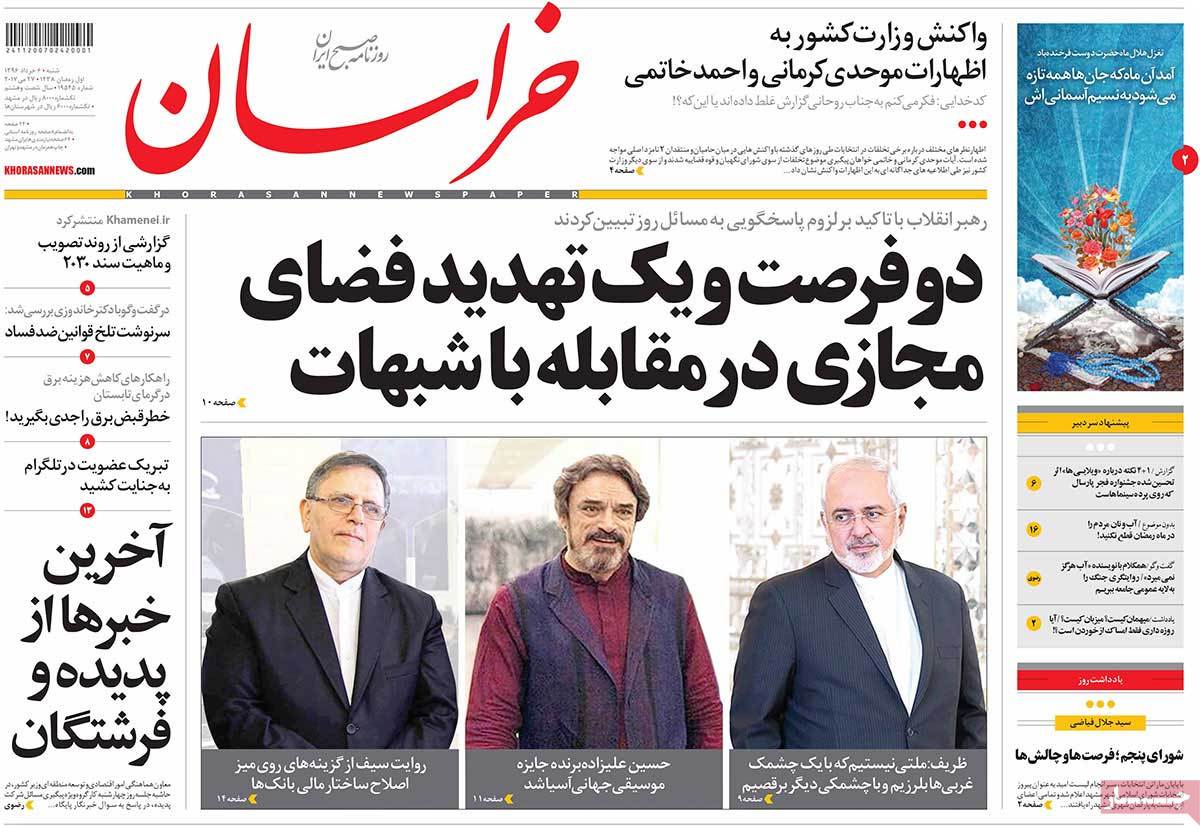
Khorasan:

1- Iranian Maestro Hossein Alizadeh Wins Asia World Music Award

A Look at Iranian Newspaper Front Pages on May 27 - khorasan


Shahrvand:

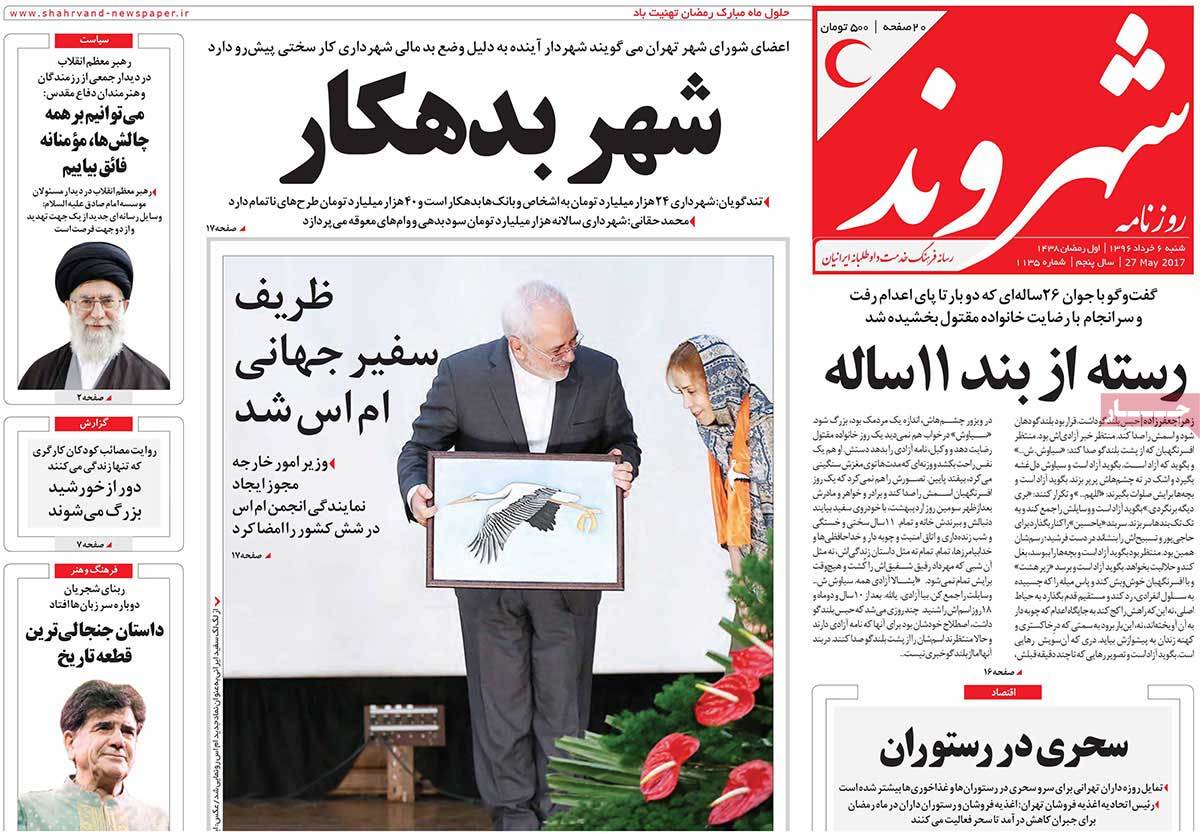
1- Zarif Becomes World Ambassador for MS Disease

2- Indebted City: Next Tehran City Council to Face Difficult Financial Conditions

A Look at Iranian Newspaper Front Pages on May 27 - shahrvand


Shargh:

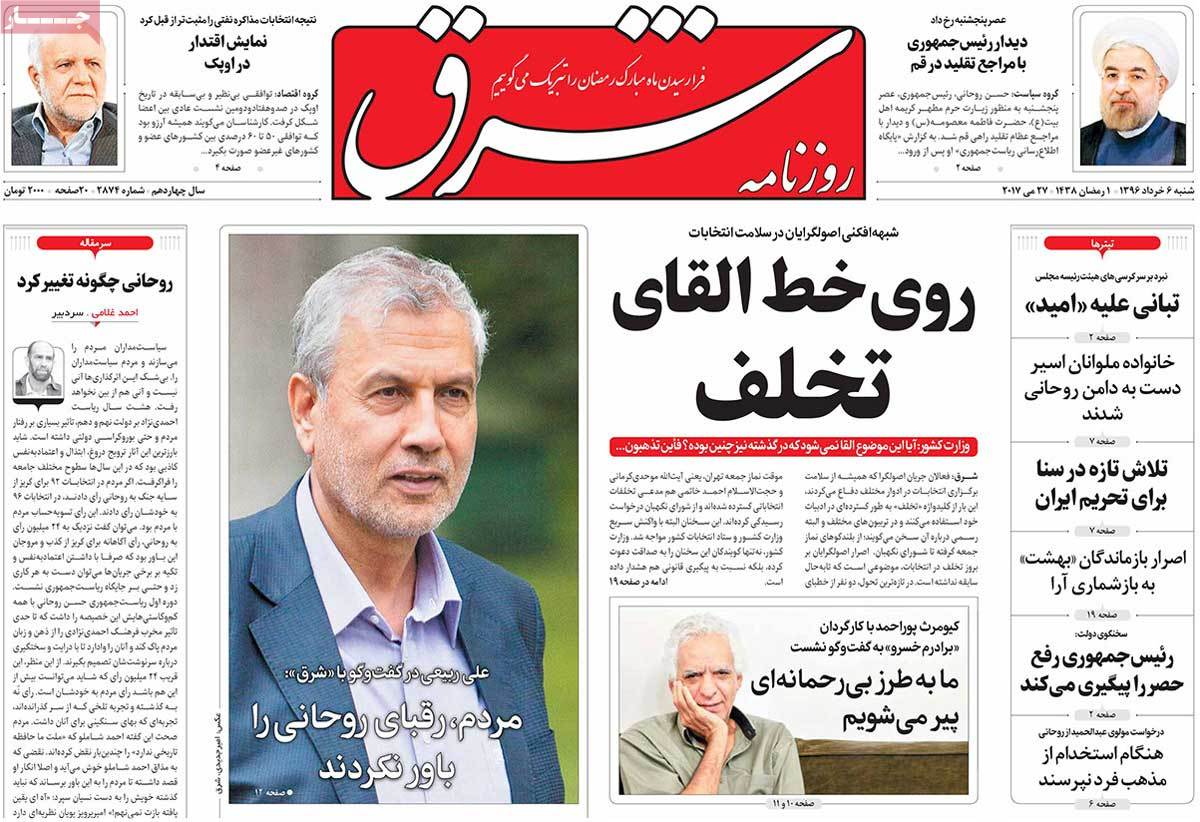
1- Labour Minister: People Didn’t Believe Rouhani’s Rivals

2- Senior Sunni Cleric to Rouhani: Job Applicants Shouldn’t Be Asked about Their Religion

3- How Rouhani Changed [Editorial]

A Look at Iranian Newspaper Front Pages on May 27 - shargh


Vatan-e Emrooz:

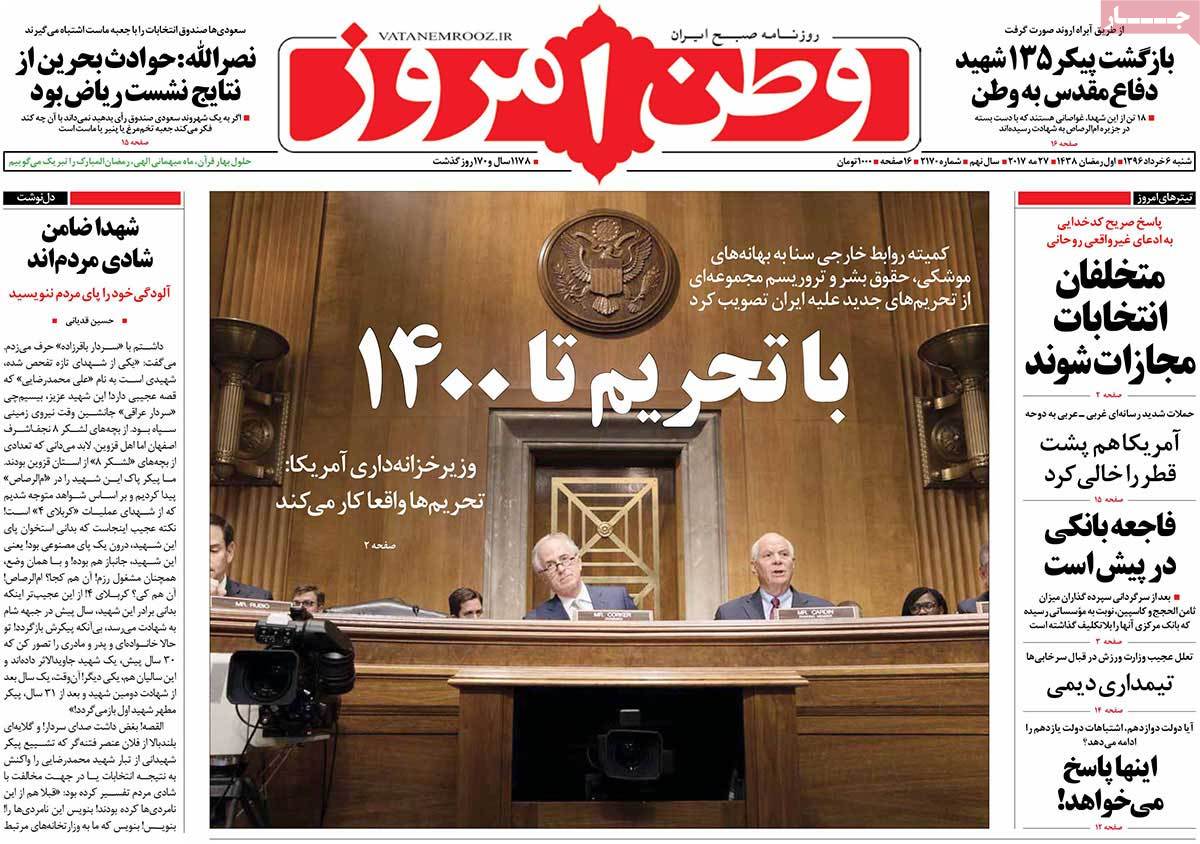
1- With Sanctions until 2021

  • US Treasury Secretary: Sanctions Really Work

A Look at Iranian Newspaper Front Pages on May 27 - vatan emrooz

Iranian Maestro Hossein Alizadeh Wins Asia World Music Award

Organized by the World Music Center (WMC), the biannual event commemorates artists who connect their countries with other parts of the world, especially Asia, YJC reported.

Alizadeh could not attend the ceremony due to prior engagements, and therefore, Iran’s ambassador to Seoul Hassan Taherian received the award which included a special plaque as well as a cash prize of $10,000.

Two years ago, Yo-Yo Ma, the famous Chinese American Musician became the winner of the first round of the award.

Born in Tehran Alizadeh, 65, is a classical composer, researcher, teacher, and tar and setar (Persian instruments) player who has made numerous recordings with prominent traditional vocalists including Mohammadreza Shajarian and Shahram Nazeri.

He has held many concerts in and outside the country and performed with two national orchestras, as well as with Aref Ensemble, Shayda Ensemble, and Masters of Persian Music group.

He studied music at Tehran University of Art. Later, he continued his studies at the University of Berlin, where he majored in composition and musicology.

Alizadeh was nominated for the 2007 Grammy Award along with Armenian musician, Djivan Gasparyan, for their joint collaboration in the album, ‘The Endless Vision.’ In 2008, he was voted as “Iran’s most distinguished musician of the year.”

His collaboration in the composition of over 20 film scores, has won  him the Crystal Simorgh Award at Fajr Film Festival for the movies ‘Gabbeh’ (1995), ‘The Ugly and the Pretty’ (1998), ‘The Song of Sparrows’ (2008) and ‘The Queen’ (2012).

The innovative musician has also created two new musical instruments ‘Sallaneh’ and ‘Shoor-Angiz,’ both derived from the ancient Persian lute ‘barbat’. Alizadeh has also penned several books related to music.

Iran, Russia Discuss Cooperation on Regional Security

Rouhani, Putin Discuss Expansion of Iran-Russia Cooperation

In a Saturday phone call made by Russian President Vladimir Putin, he congratulated his Iranian counterpart Hassan Rouhani on his re-election.

The two sides further underlined the necessity for remaining committed to the nuclear deal between Tehran and world powers, according to a tweet by Hamid Aboutalebi, the political deputy of Rouhani’s office.

Putin and Rouhani also discussed the expansion of Tehran-Moscow political and economic cooperation, and their collaborations in regional security and the fight against terrorism.

Over 86,000 Iranians to Go on Hajj Pilgrimage This Year

Over 86,000 Iranians to Go on Hajj Pilgrimage This Year

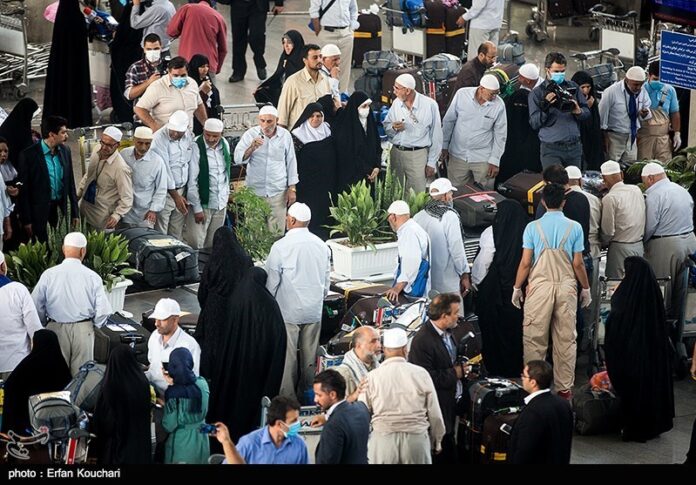
Head of Iran’s Hajj and Pilgrimage Organization Hamid Mohammadi said on Friday that Iranian pilgrims will travel to Saudi Arabia in 600 convoys.

He said Saudi officials have undertaken to ensure the security of Iranian pilgrims during the annual Hajj season.

Mohammadi also noted that all Iranian travelers will be kitted up with homegrown electronic bracelets that would work as ID cards and contain their personal information.

The wearable device is paired with a mobile application, helping the pilgrims to find their convoys in case of getting lost, he explained.

Mohammadi had announced earlier that Iran is the first country equipping its pilgrims with electronic bracelets with extensive features.

Iran announced in mid-March that applicants can go on Hajj pilgrimage this year following negotiations with Saudi officials after a hiatus in the wake of a diplomatic row with the kingdom.

In 2016, more than 1.8 million pilgrims attended Hajj, but Iranians stayed at home after tensions between Riyadh and Tehran boiled over following a deadly crush of people during the 2015 pilgrimage.

On September 2, 2015, thousands of people lost their lives in the deadly crush after Saudi authorities blocked a road in Mina during a ritual, forcing large crowds of pilgrims to collide.

The crush was the deadliest incident in the history of the pilgrimage. According to an Associated Press count based on official statements from the 36 countries that lost citizens in the disaster, more than 2,400 pilgrims were killed in the incident.

Saudi Arabia claims nearly 770 people were killed, but officials at Iran’s Hajj and Pilgrimage Organization say about 4,700 people, including over 460 Iranian pilgrims, lost their lives.