Wednesday, December 24, 2025
Home Blog Page 4035

Women More Receptive of ISIS Recruitment Propaganda

isis-women

Around a third of the members of the ISIS terror group are now women, who have started to receive military training and have become the organization’s choice to continue its dream of establishing the so-called “caliphate.”

A report released by Spain’s Elcano Royal Institute revealed that a growing number of women are joining ISIS, saying that around 500 females have been recruited in the past two years.

Women play a major role in terrorism and it is expanding, sparking concerns among experts that they may take on a more active role in the future, said the Spanish think-tank.

The majority of female members of ISIS have a European nationality and have converted to Islam. Their ages range between 19 and 23, continued the report.

It said that a female cell that was uncovered in the Spanish city of Ceuta relied on the internet in carrying out its operations. Moreover, all of the women sampled in the report received Takfiri teachings that persuaded them to join terror groups.

The report credited the internet with facilitating the access the women had to extremist ideology and to social networks dedicated to recruiting them for the “caliphate project”.

Observers noted that ISIS sees women as easier targets than men for recruitment, according to a report by Awsat. The women can be persuaded to join the group in order to escape the hardships of their daily life.

Gen. Soleimani Thanks Rouhani Gov’t for Medical Aid to Resistance Forces

Gen. Soleimani-Hashemi

The Commander of the Quds Force of Iran’s Islamic Revolution Guards Corps (IRGC), Major General Qassem Soleimani, in a letter on Friday (April 28) expressed his gratitude towards the staff of the Ministry of Health and Medical Education for their efforts to provide the fighters of the resistance front with medical assistance.

In his letter to the health minister, Soleimani wrote, “I sincerely appreciate your genuine efforts and those of the staff of the Ministry of Health and Medical Education who are involved in the fields of promoting education, production of pharmaceuticals and medical equipment and, particularly, providing injured fighters [of Islam] with medical assistance and treatment. It is crystal clear that God witnesses your efforts and endeavours in the Islamic resistance fronts and will reward you duly.”

In his response to Soleimani’s letter of appreciation, Iranian Health Minister Seyyed Hassan Qazizadeh Hashemi, said, “Serving those who jeopardize or sacrifice their lives to ensure other people’s security is an honour.”

According to a Farsi report by IRNA, Qazizadeh Hashemi added in his letter, “The honourable people of Iran will never forget the sacrifices made for ensuring security of their country. Serving those who risk or sacrifice their lives to ensure the security and health of other people is a great honour. We are required to be grateful to those honourable men.”

He said they have made a deal with God and only supplicate the Almighty for their reward.

Qazizadeh Hashemi stressed that, “Today that I am writing these sentences in response to that honourable major general, I have learnt that one of the lionhearted nurses of our homeland, who had been captured by Takfiri groups while serving the decent defenders of the holy shrines of the household of prophet Muhammad, has been freed from the grip of the enemies and returned home.”

Is Pakistan Getting Iran’s Message?

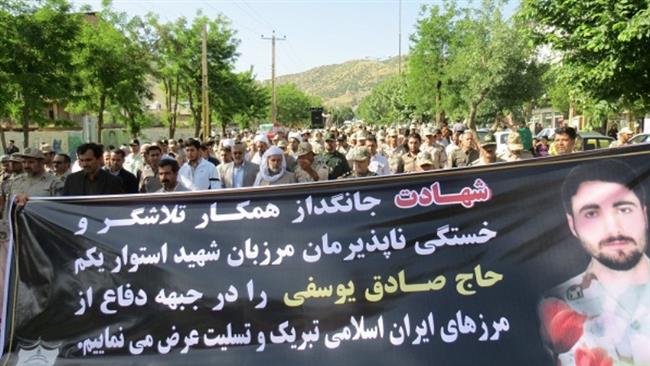
Iranian border guards

The reactions by Tehran officials to the killing of 9 Iranian border guards by terrorists operating on Pakistani soil contain messages which, if Islamabad pays attention to, can help maintain Iran-Pakistan relations and defuse regional tension.

One day after the Iranian guards were shot dead on the country’s eastern border by long-rage weapons operated by terrorists inside Pakistan, Iranian President Hassan Rouhani in a message to Pakistani Prime Minister Nawaz Sharif warned that such incidents may harm cordial relations between the two countries while highlighting that third countries play a role in creating crises between friendly nations.

“Some countries are targeting unity in the Muslim world by launching proxy wars,” said the president in his message to the Pakistani premier.

Maybe reviewing the recent regional developments as well as Iran-Pakistan relations could decode this part of Rouhani’s message. Many observers believe that although Saudi Arabia has failed in its efforts in recent years to attract Pakistan and, for instance, drag it into direct military involvement in Yemen, there are signs which indicate Riyadh, through pressures and incentives, has somehow managed to gain concessions from Pakistan.

A few months ago, Pakistan turned down Saudi Arabia’s offer to choose a veteran Pakistani army general as the commander of the so-called Islamic NATO coalition. Later, the general set conditions for accepting the offer. One of his conditions was that Iran must be part of the coalition. Nevertheless, it was later reported that former Pakistani army chief General Raheel Sharif was appointed as the commander of the Saudi-led coalition this month.

Iran reacted to his appointment immediately. Iranian Ambassador to Pakistan Mehdi Honardoust told Pakistani media that Tehran has “reservations” regarding Islamabad’s giving the go-ahead for the general to join the coalition.

Although Iran’s understanding of Pakistan’s economic situation and of Saudi pressures to get concessions from Islamabad has moderated Tehran’s reaction, observers are of the conviction that Pakistan, too, tried to highlight its interest in maintaining friendly ties and security cooperation with Iran by sending a parliamentary delegation to Iran and making arrangements for members of the security committee of the Pakistani National Assembly to visit Tehran.

All this comes as Iranian observers and policy-makers believe realities on the ground as well as the shots fired from inside Pakistan’s borders are clearer than political messages, and adjust their actions based on these very realities.

This is our understanding of President Rouhani’s message, which conditions “maintenance and enhancement of cordial ties between the two countries” on Islamabad dealing with the perpetrators of the terrorist incident, and which warns against interventionist and opportunistic moves by third countries.

Now, we should wait and see whether Pakistan will interpret President Rouhani’s message in the same way, or it will continue to move on the path delineated by masterminds of failed regional policies.

‘It’s a Lie that Nuclear Deal Averted Threat of War’

General Amirali Hajizadeh

The claim that the nuclear deal signed between Iran and six world powers known as the Joint Comprehensive Plan of Action (JCPOA) has banished the specter of war from the Iranian nation is simply a lie, said a top commander of Iran’s Islamic Revolution Guards Corps (IRGC), according to a Farsi report by Basij Press.

“If we look to the West, then we must hold the begging bowl” and leave the country’s destiny in the hands of Democrats and Republicans, said Brigadier General Amirali Hajizadeh, the commander of the IRGC’s Aerospace Force.

“Some of our officials say if Iran does not reach agreement with the West, a war may break out. They would inculcate this idea into authorities before the JCPOA [was signed.] And after that, some officials said the JCPOA pushed the specter of war away from the [Iranian] nation. Unfortunately, some individuals inside the country unknowingly repeat the statement. This is a lie. It’s an insult,” said the top general.

“If the JCPOA is strong enough, it will protect itself. It needn’t avert a war. This is an insult to martyrs and the Armed Forces and the army and the IRGC. What we regard as security is related to our defence progress. We don’t reject political interaction, but we shouldn’t mislead people, either,” he noted.

“After the war [imposed on Iran by Iraq in the 1980s], we made a lot of efforts and produced weapons. Our researchers worked in a scientific atmosphere. Now they’re saying it was the JCPOA that kept the specter of war at bay! This is a wrong statement. Let’s not mislead anyone,” the senior commander underlined.

“I’m telling you, solving economic problems and [promoting] production and [creating] jobs in the country is thousands of times easier than [solving] complicated military issues,” he said.

The high-ranking IRGC commander stressed that “we should get to know the enemy.”

“We should get to know the US. In the Kuwait war, the United States didn’t dare get into war alone. The US took dozens of countries on board,” the commander said.

“The US goes to war against a country which is either disarmed like Libya, or which Washington is sure wouldn’t respond to its attacks,” he added.

“If they believed there was even a slight chance that Syria would respond, they wouldn’t have attacked,” the top general said.

He then said the US sometimes flexes its muscles to scare others. General Hajizadeh touched upon Washington’s “Mother of All Bombs,” and added, “We have bombs in our defence industries, too.”

“Americans have learned this method from Ottoman [rulers], and now they are rattling sabers to frighten a few. [Their threats were like] cannons which only made noise, but couldn’t destroy anything,” he further said.

“That’s Americans’ modus operandi,” said the general.

“Another method is that they announce our warships have gone to such and such places, but after some time you hear that those vessels have returned. If there is a slight chance that the warships will be attacked, Washington will never do such a thing (dispatch the warships),” he said.

He underlined that Iran will firmly respond to threats.

“We will not accept defeat from anybody. US bases are all around us, and this is a threat,” he said.

He then noted that the US presence in the region comes at a cost.

The commander further said Iranian authorities in the non-military sector should be brave as well if they are going to succeed.

“Otherwise, we will be more and more ashamed every day.”

“If we have a revolutionary spirit, we can turn threats into opportunities,” said the general.

He noted if Iran looks to the West, then the country will have to retreat constantly and see its successes roll back one by one.

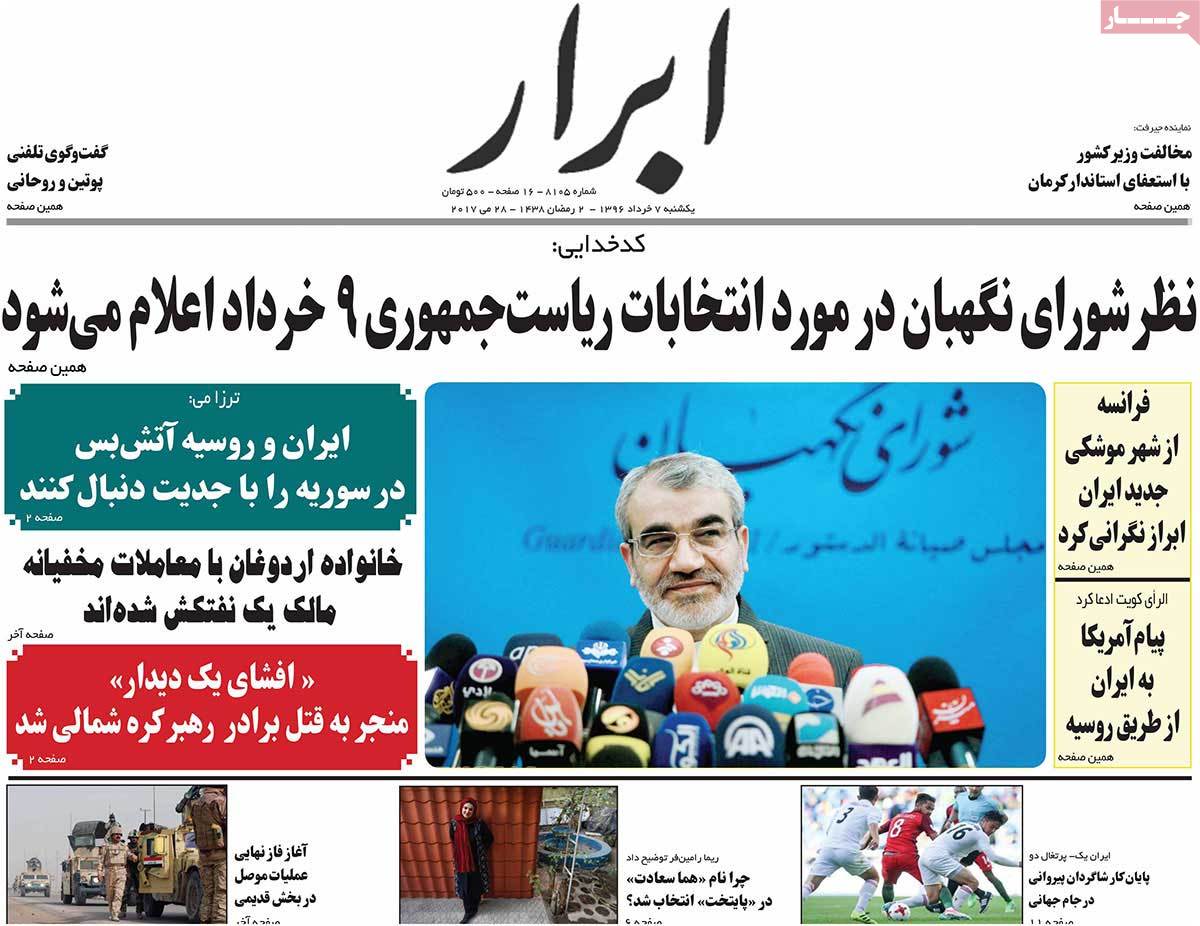
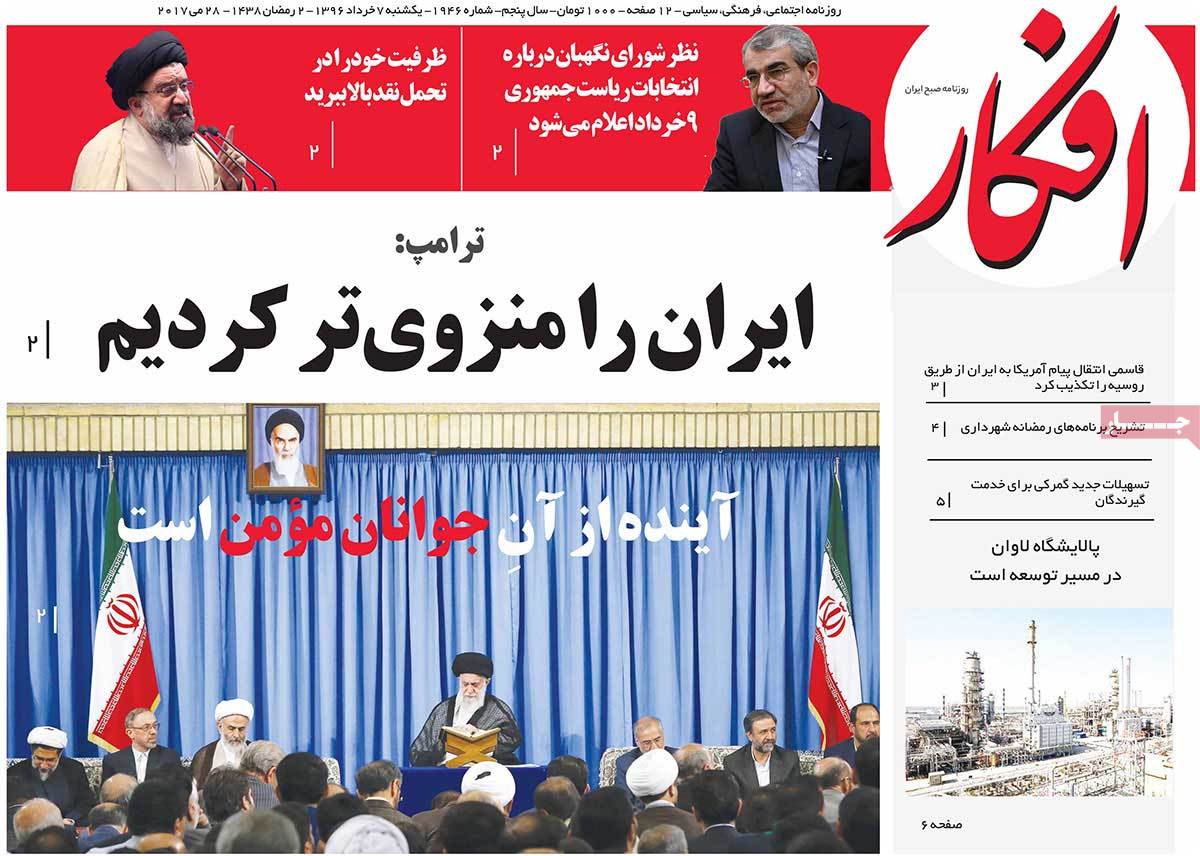
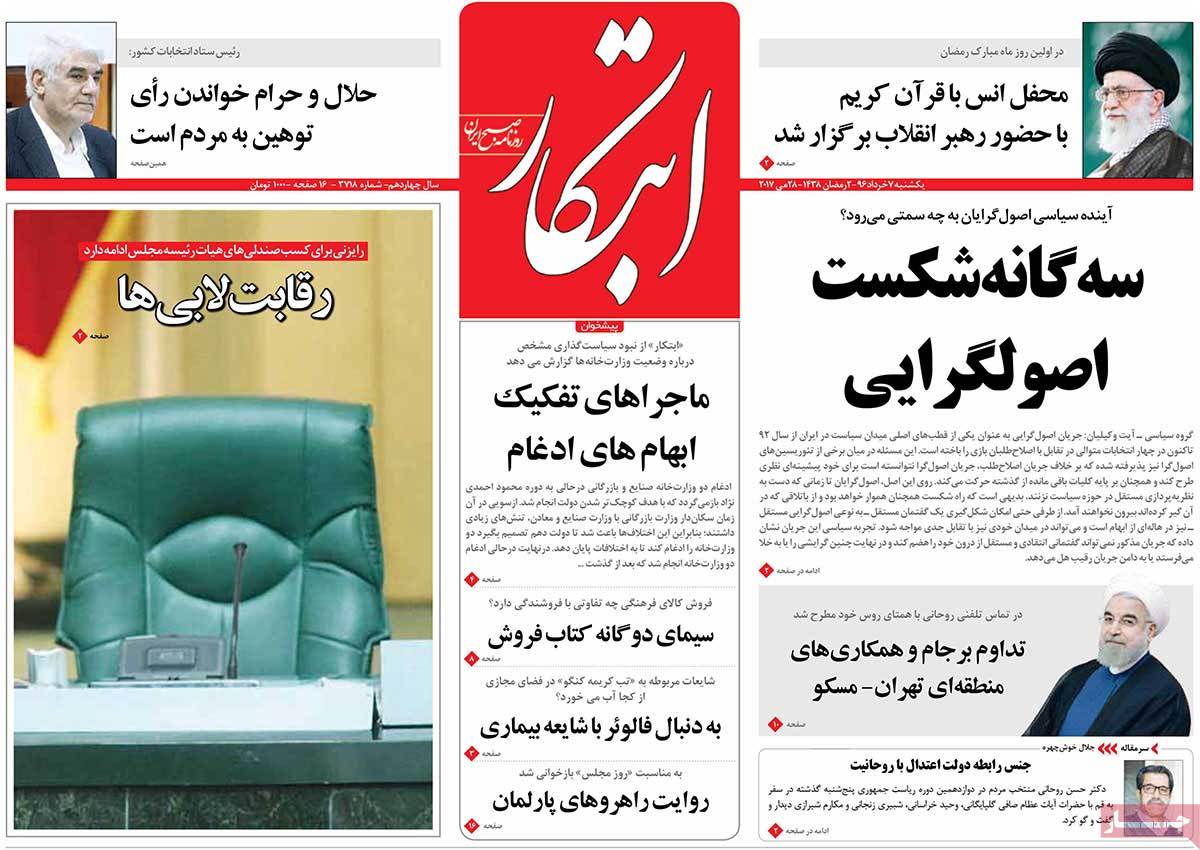
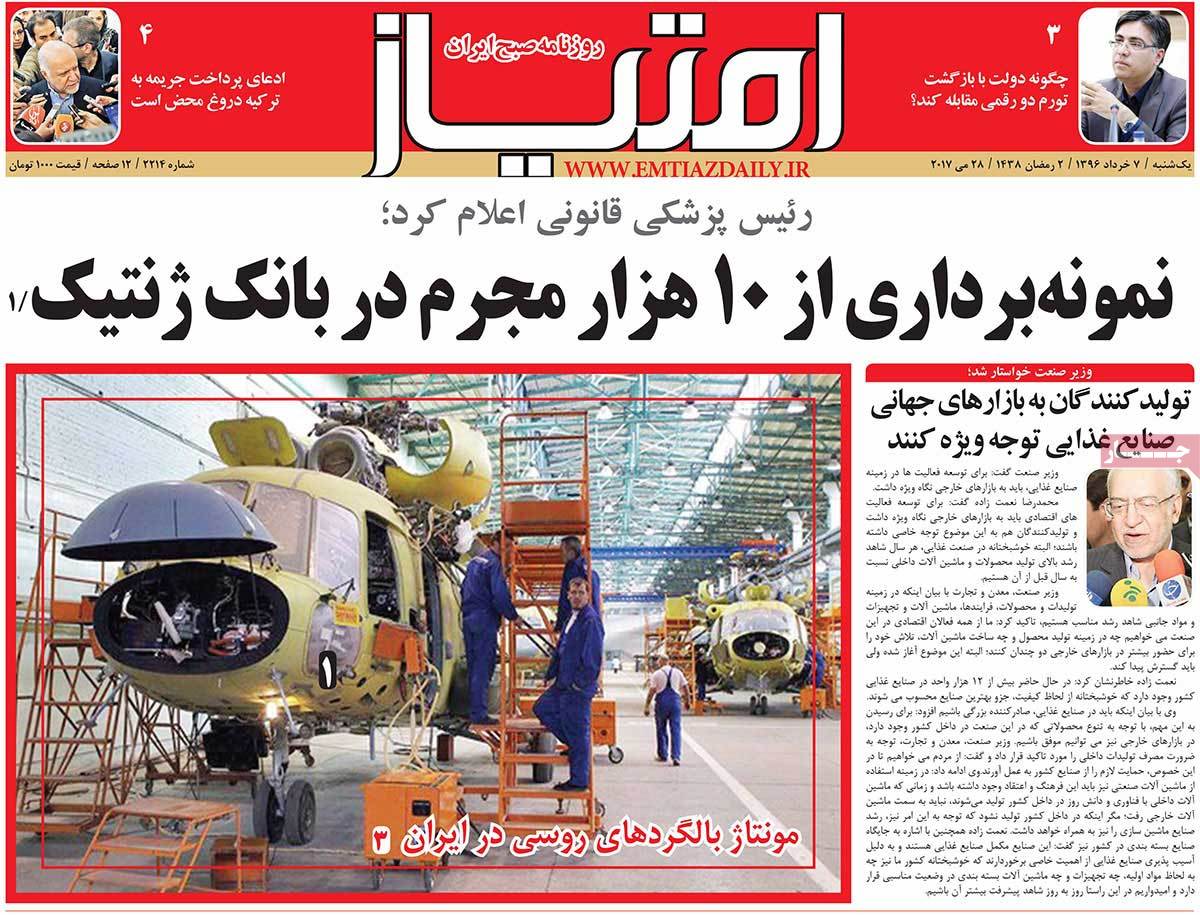
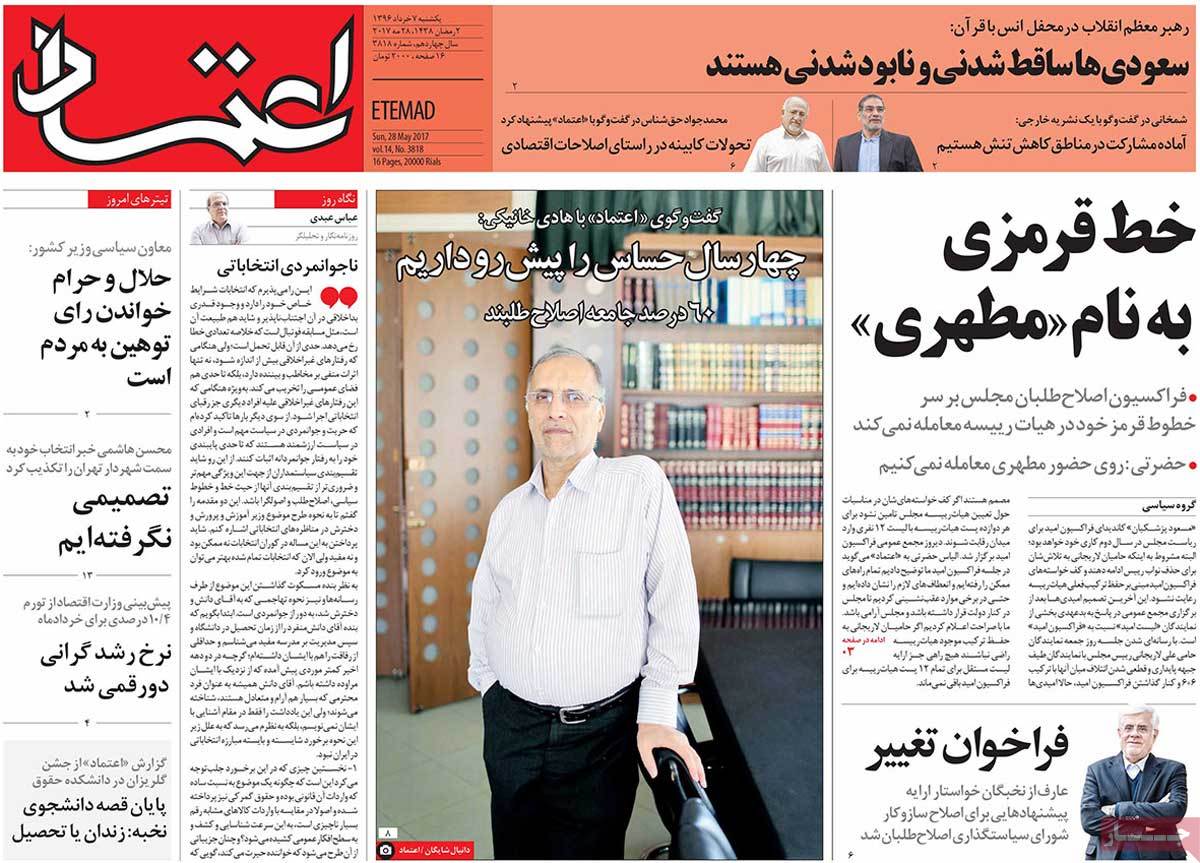
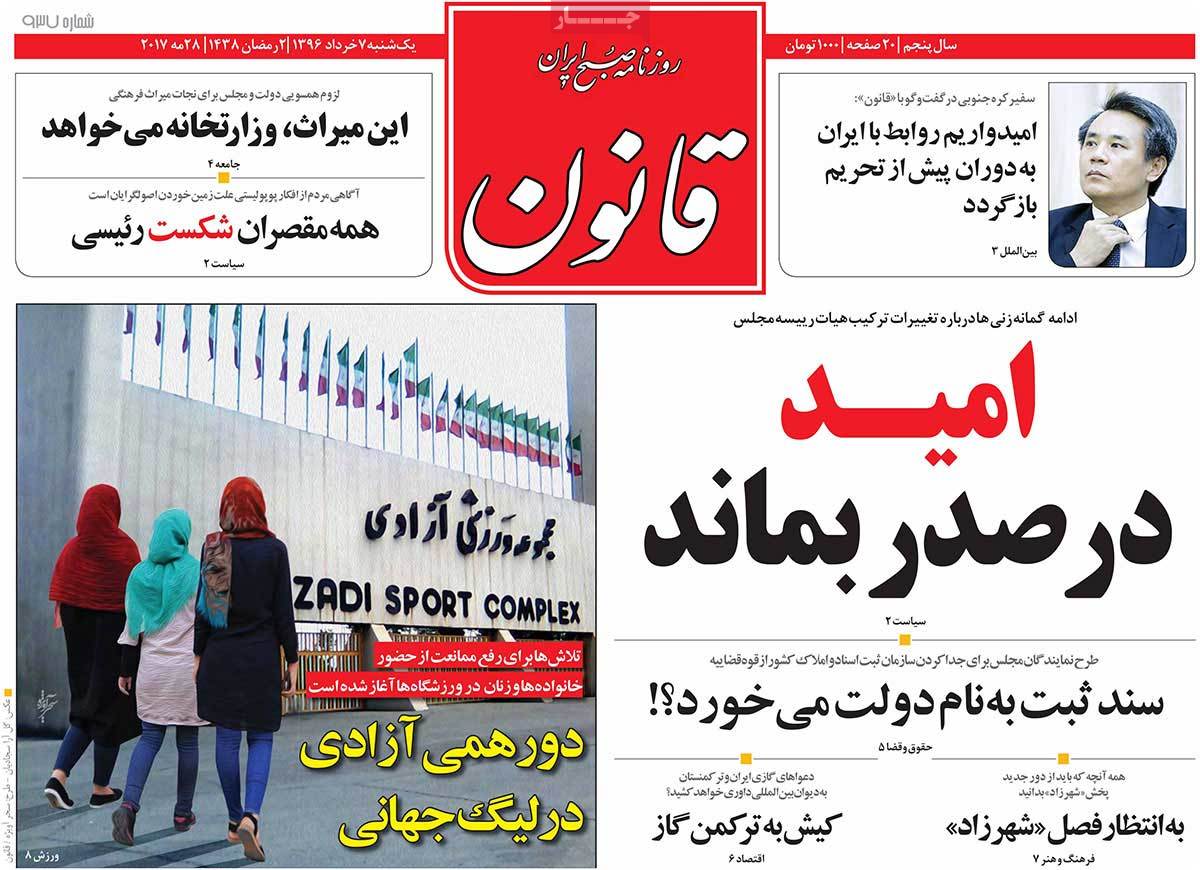
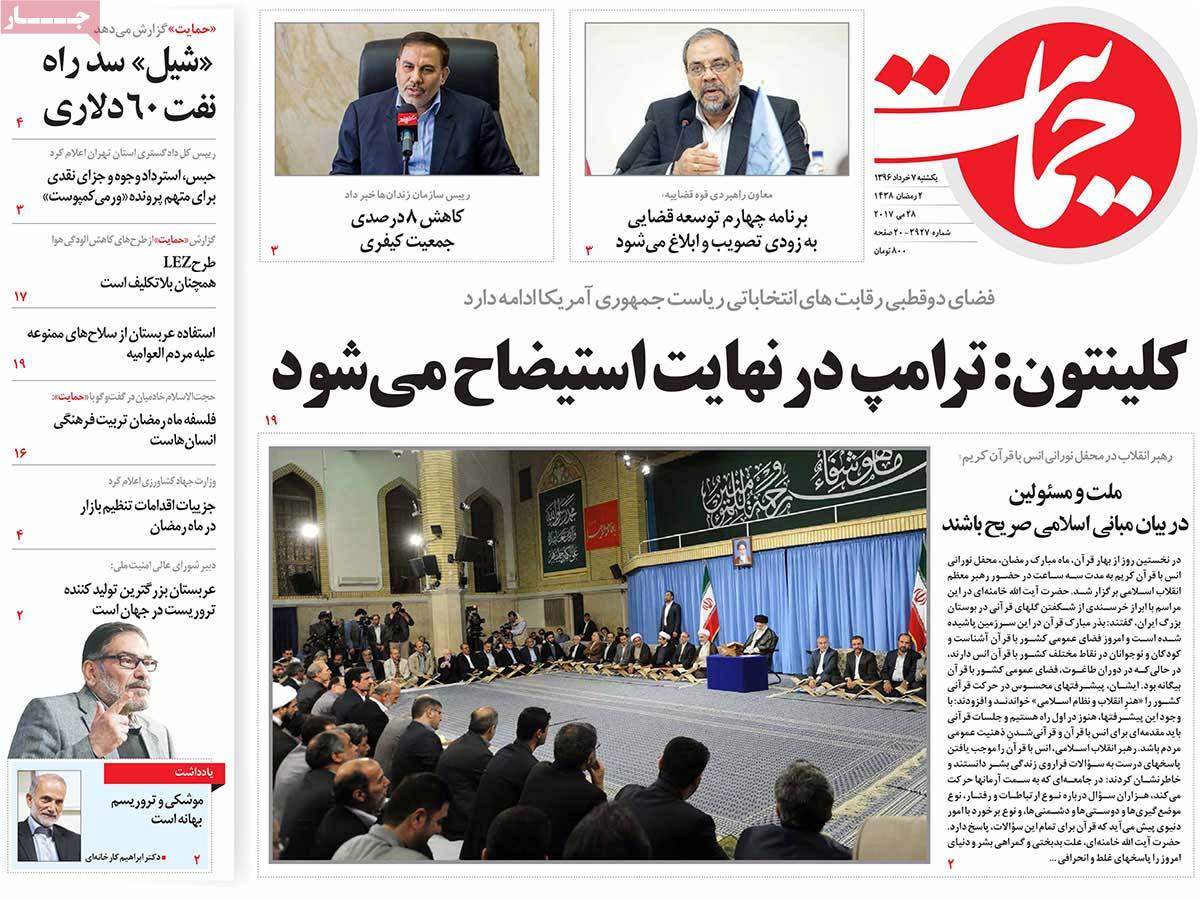
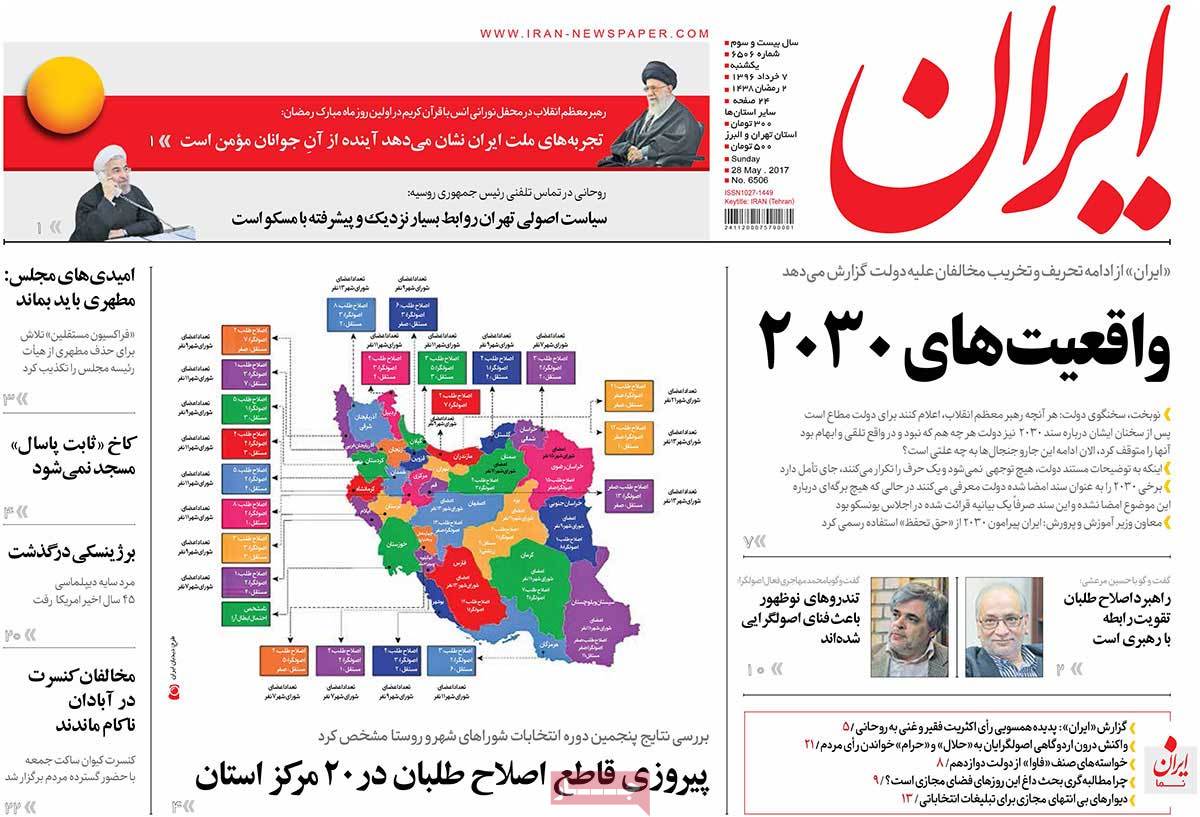
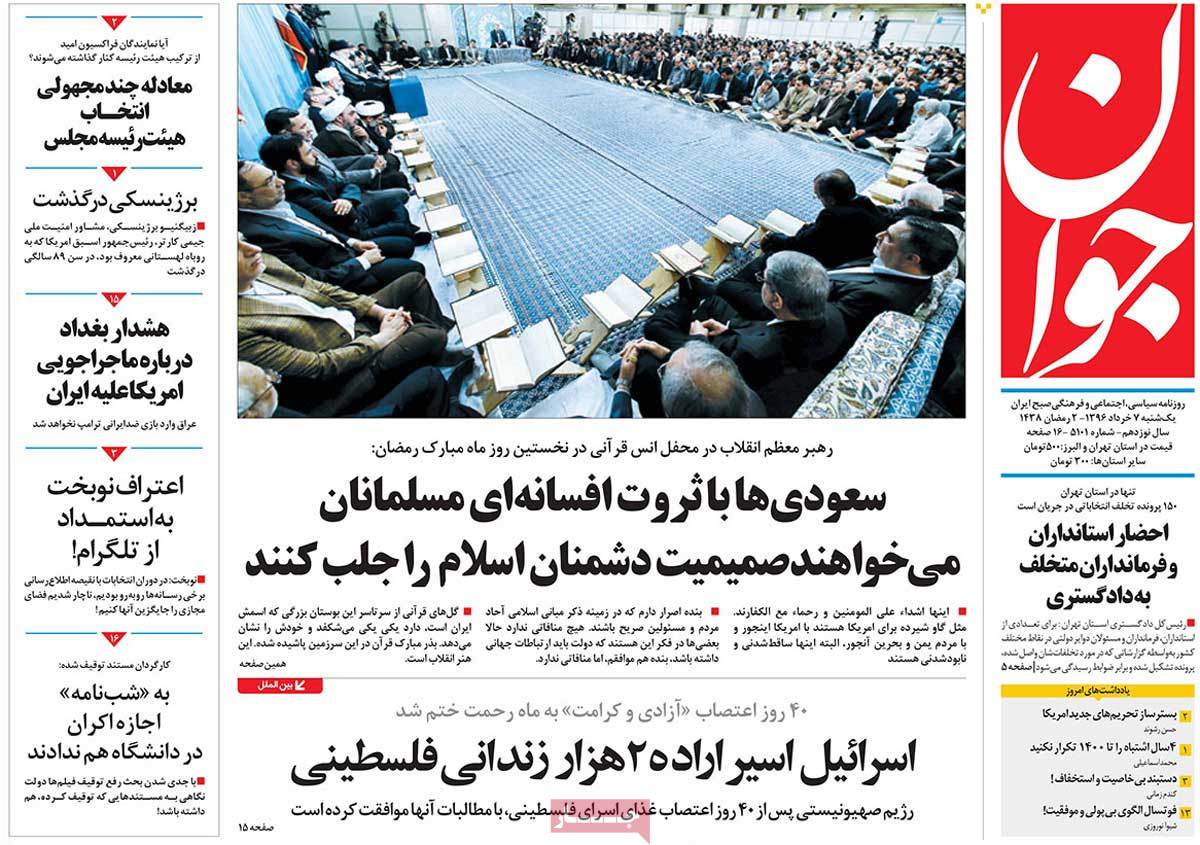
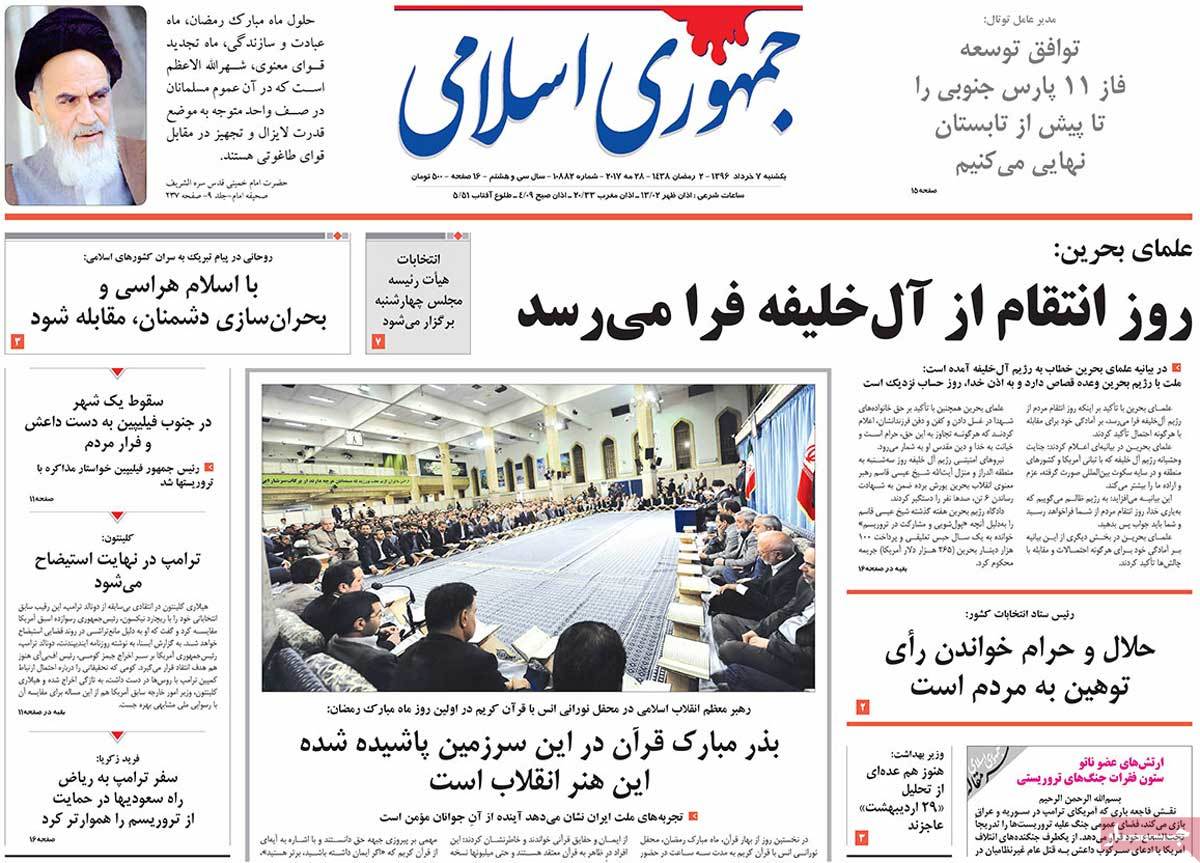
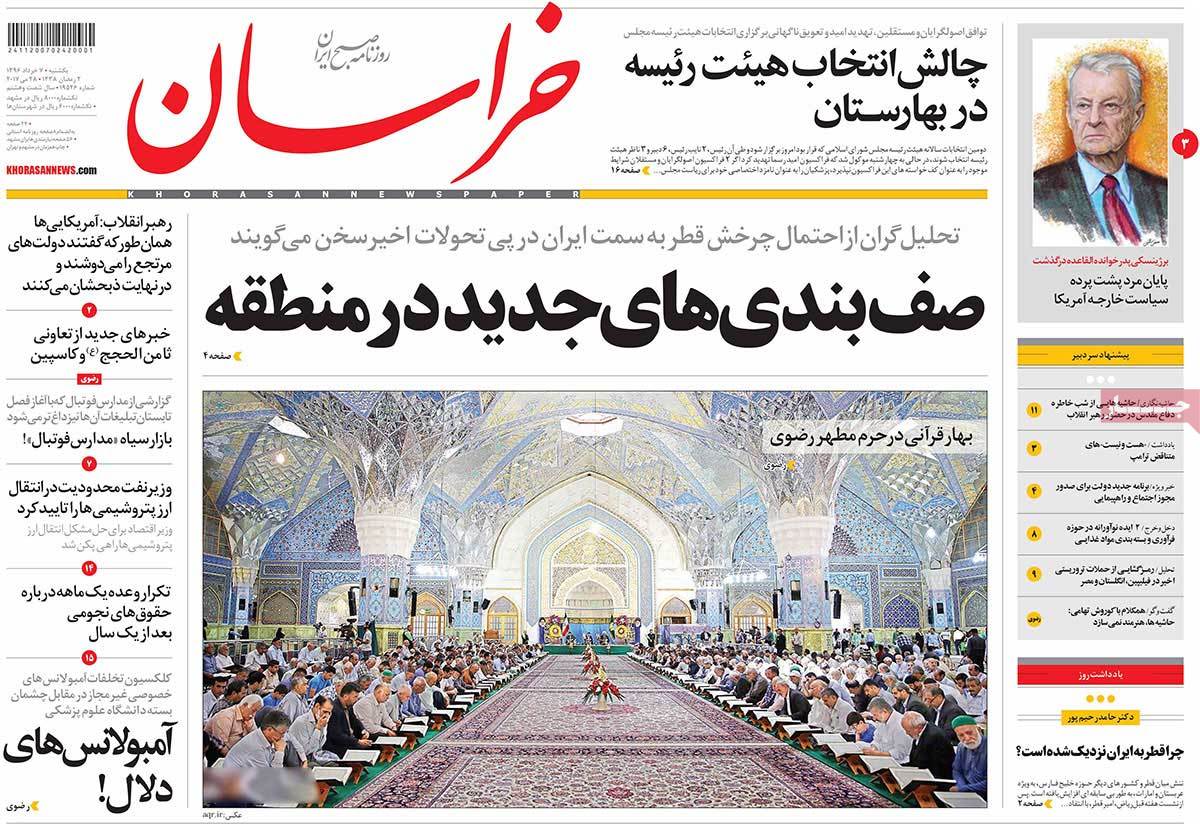
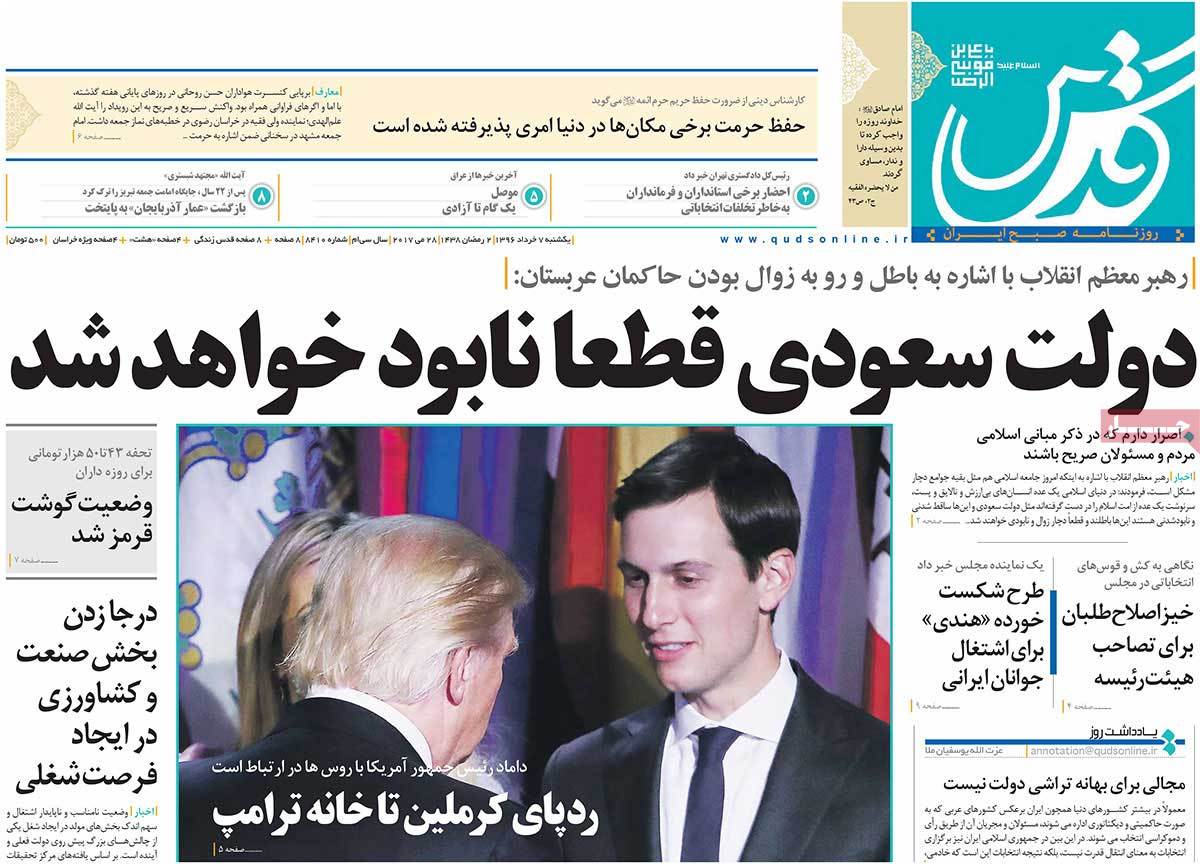
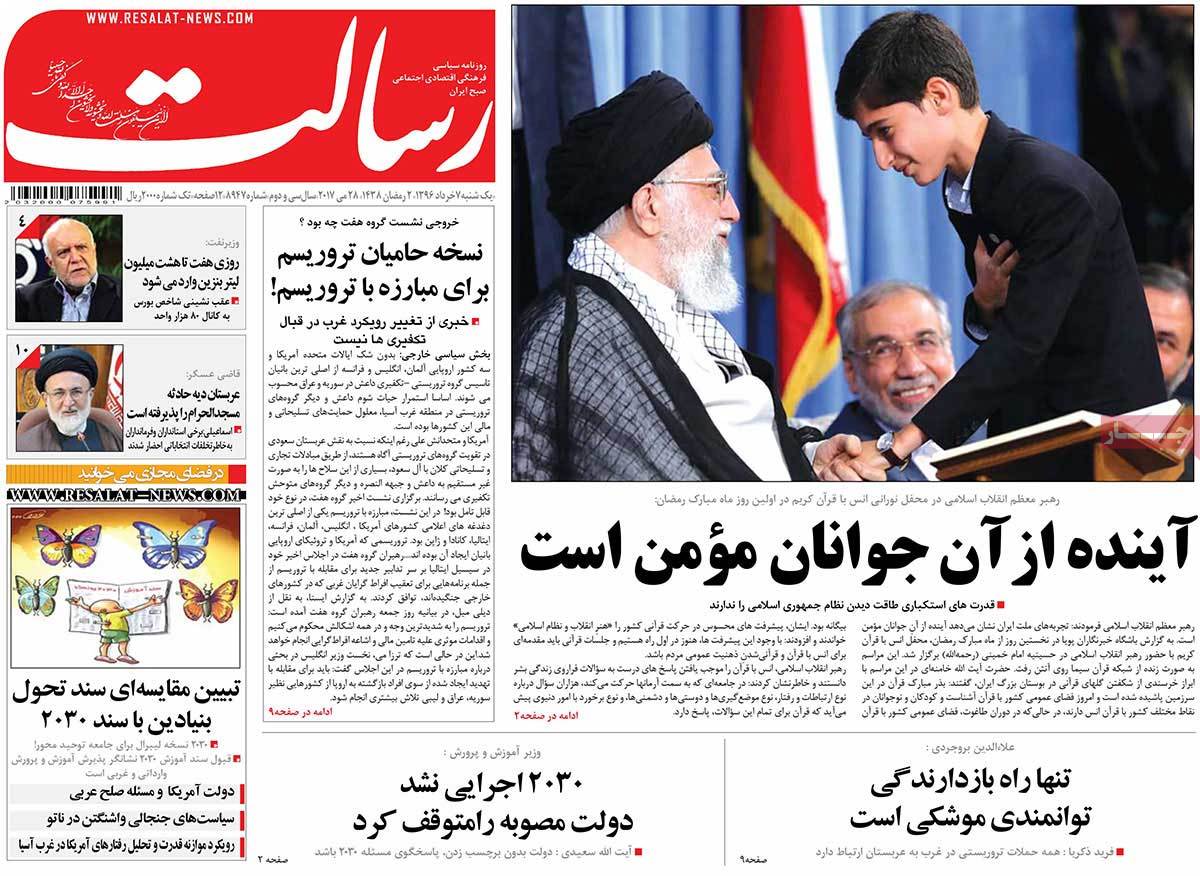
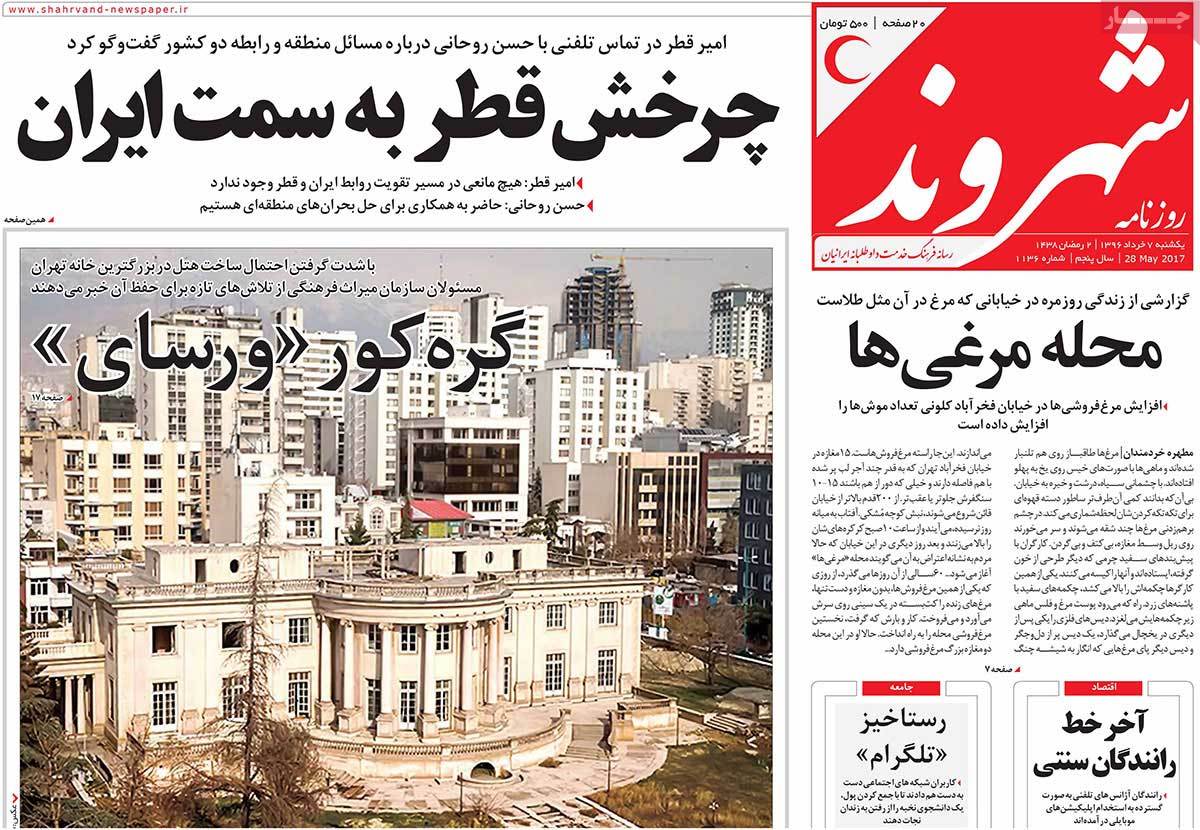
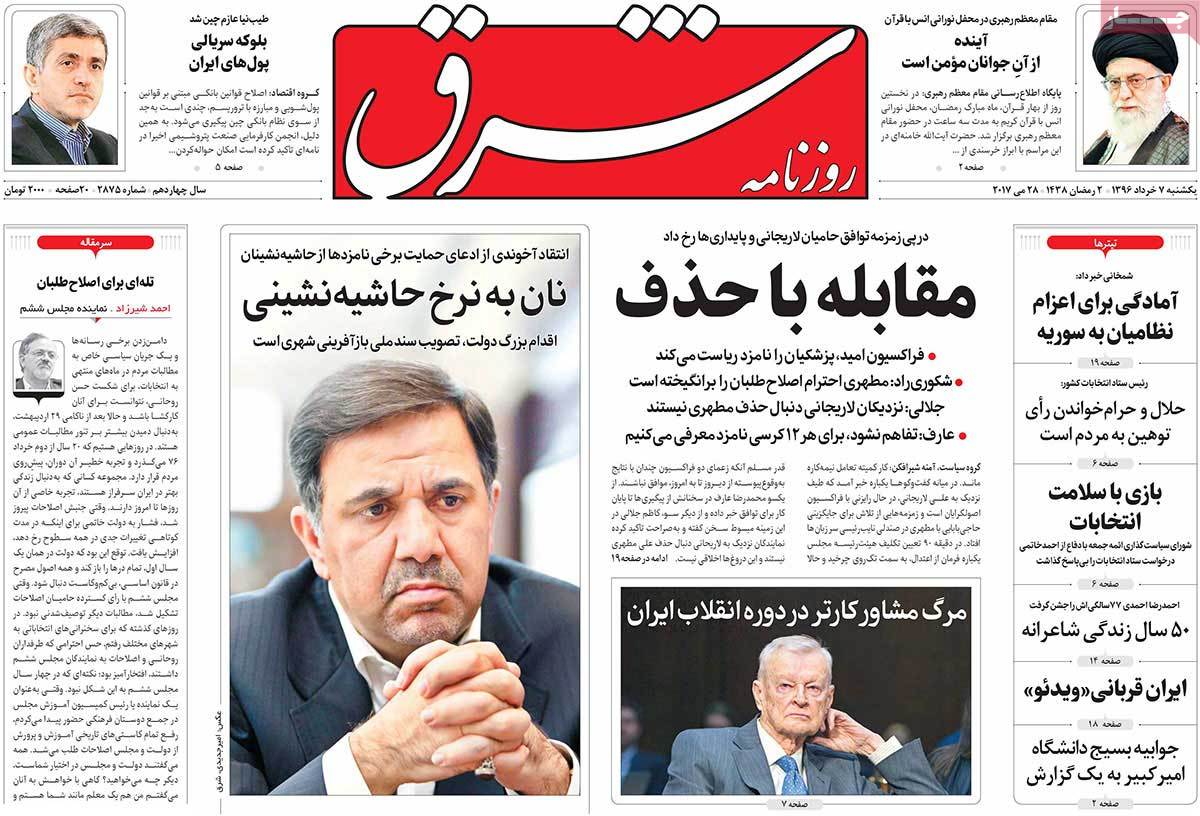
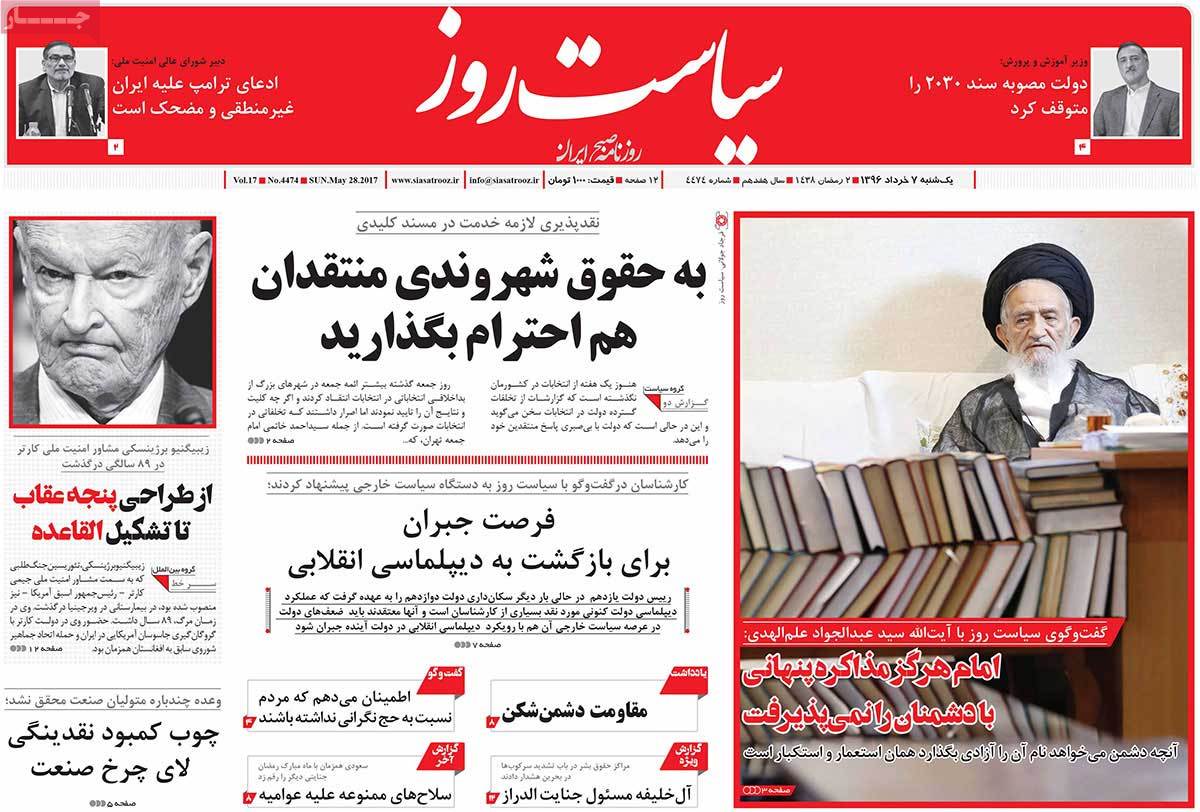
A Look at Iranian Newspaper Front Pages on April 30

The top story today was Iran’s presidential election and all the speculations and reviews around it.

Iranian Foreign Minister Mohammad Javad Zarif’s remarks about the US seizure of Iran’s assets also received great coverage.

The visit of an EU energy delegation to Iran and their meeting with Iranian energy officials was also among top stories today.

The above issues, as well as many more, are highlighted in the following headlines and top stories:


19 Dey:

1- Rouhani: When Were We More Proud: in 2012 or Now?

2- Mirsalim Urges Candidates to Answer Questions in Debates instead of Picking Quarrels

A Look at Iranian Newspaper Front Pages on April 30


Abrar:

1- Zarif: Iran Could Save Billions of Dollars If Meaning of UNSC Resolutions Were Understood

2- Rafsanjani’s Son: Ayatollah Rafsanjani Advised Everyone to Vote in Elections


A Look at Iranian Newspaper Front Pages on April 30


Afkar:

1- Raisi: We Need Serious Change in Iran’s Executive Management


A Look at Iranian Newspaper Front Pages on April 30


Aftab-e Yazd:

1- New Lie by Rouhani’s Opponents after Defeat of Conservatives in Debate

  • People Are Not Ready to Hear New Lies: President


A Look at Iranian Newspaper Front Pages on April 30


Arman-e Emrooz:

1- Rouhani: We Should Continue Rafsanjani’s Path

  • Era of Violence, Extremism is Over: President

A Look at Iranian Newspaper Front Pages on April 30


Asrar:

1- Raisi: It’s Not Acceptable that We Let Aliens Resolve Our Problems

A Look at Iranian Newspaper Front Pages on April 30


Ettela’at:

1- President: We Won’t Leave Path of Justice, Moderation, Reformism

2- Advanced Centre of Nuclear Safety to Be Launched in Iran

3- Iran’s Weightlifting Team Claims Asian Title

A Look at Iranian Newspaper Front Pages on April 30


Iran:

1- Zarif: Nuclear Deal Put an End to Int’l Banditry, Domestic Theft

2- Verification of Claims Raised by Candidates in First Presidential Debate


A Look at Iranian Newspaper Front Pages on April 30


Javan:

1- Social Media Users’ Reactions to First Debate Outweigh Those of Chain [reformist] Papers, Figures

2- Aref: We’ll Decide about Changing Our Candidate from Rouhani to Jahangiri on Last Day

A Look at Iranian Newspaper Front Pages on April 30


Jomhouri Eslami:

1- Raisi: I’m Not Looking for Power, but I Can’t See Parents Embarrassed of Unemployment

2- Mirsalim: Big Lies in Presidential Campaigns to Cause Big Scandals

3- Deputy Minister: Rouhani’s Gov’t Made Greatest Progress in Mehr Mass Housing Project

4- EU Energy Commissioner: JCPOA Increased Iran’s Exports to Europe by 300%

A Look at Iranian Newspaper Front Pages on April 30


Kayhan:

1- Denying, Forgetting Promises in Season of Farewell

2- Even Chief of Statistics Organization Rejects Claim of Creating 700,000 Jobs

A Look at Iranian Newspaper Front Pages on April 30


Resalat:

1- Raisi: Those Who Frustrated People Should Be Accountable

2- Zarif: US Seizure of Iran Assets is International Banditry


A Look at Iranian Newspaper Front Pages on April 30


Sayeh:

1- Everlasting Name of Persian Gulf Cannot Be Distorted [National Day of Persian Gulf]

2- Iran DM: US is Deluded If Thinks It Can Influence Iran Elections

3- Iran Looking for Resilient Economy, Interaction with World: Central Bank Governor

A Look at Iranian Newspaper Front Pages on April 30


German Parliament Bans Burqa for Civil Servants

Burqas and niqabs will be prohibited in selected professions as part of the legislation, which will not come into effect until being approved by the Bundesrat state parliament.

Thomas de Maiziere, the German interior minister, argued that the ban was compatible with integration as debate continues over the arrival of more than a million asylum seekers in the country.

“Integration also means that we should make clear and impart our values and where the boundaries of our tolerance towards other cultures lie,” he said.

“The draft law we have agreed on makes an important contribution to that,” The Independent quoted him as saying.

Some right-wing politicians have called for a full ban on the burqa in public, which has been imposed in France and Belgium, but Mr de Maiziere said the move would be incompatible with Germany’s constitution.

US Deluded If Thinks Can Influence Iran Elections: DM

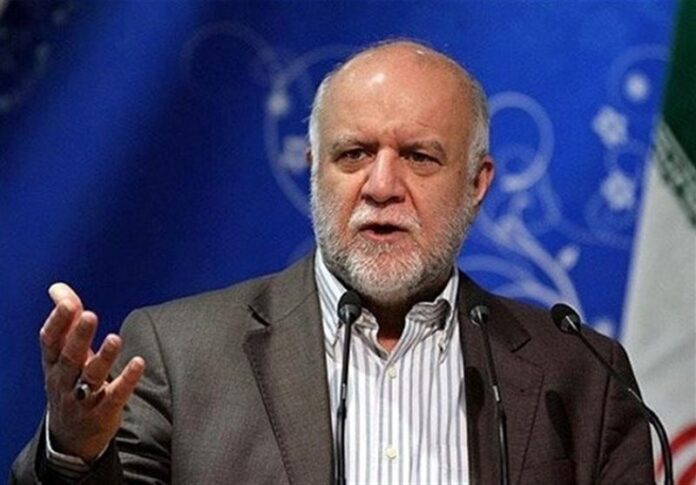
“If the Americans think that they can influence Iran’s election, they are completely deluded because the Iranian nation is a wise nation and knows its enemies and acts contrary to the enemy’s demand,” Dehqan said in an interview with RT Arabic published on Friday.

He added that the US and Britain as well as the various media outlets affiliated to them seek to support one political camp against the other in Iran’s election.

“We are telling them that that is not how things are and our nation makes decisions based on the conditions specific to that time ,” the minister said, adding, “That’s why they do not look to the US or UK in elections.”

Dehqan further emphasized that the Iranian people are fully aware that the West offers no “breakthrough” to them.

“The Iranians are struggling for the realization of their own dignity. This issue has been proven over the past thirty or more years that the Iranian nation is moving along a clear path for the materialization of its goals and will certainly view issues according to their own special conditions and never forget the main objective.”

Iran will simultaneously hold the 12th presidential election and the 5th City and Village Councils Elections on May 19. Some 55 million Iranians are eligible to vote for a new president in what is expected to be a close race.

iran election


Iran’s Interior Ministry on April 20 released the final list of candidates qualified to run in the May presidential election. The six candidates running for the election are Mostafa Aqa-Mirsalim, Mostafa Hashemi-Taba, Es’haq Jahangiri, Hassan Rouhani, Mohammad-Baqer Qalibaf and Seyyed Ebrahim Raeisi.

Leader of the Islamic Revolution Ayatollah Seyyed Ali Khamenei warned on April 19 of hostile attempts aimed at marring Iran’s upcoming elections, calling for a massive turnout in the vote to disappoint the enemies.

Ayatollah Khamenei described a successful election as an “asset” for the nation.

Iran’s Beauties in Photos: Kordestan Province

Here are ISNA’s photos of the beautiful Kordestan:


Fajr Int’l Film Festival Wraps Up in Tehran

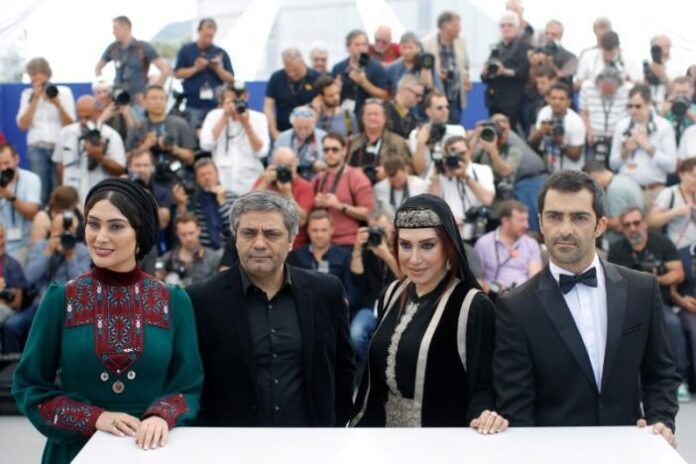
In the closing ceremony attended by Iranian Foreign Minister Mohammad Javad Zarif and Culture Minister Reza Salehi Amiri, the Iranian film in Turkish language ‘The Home’, written, directed and produced by Asghar Yousefinejad won the top prize of the 35th edition of Fajr International Film Festival.

Participating in the main International Competition section ‘Cinema Salvation’, ‘The Home’ won three awards including the top prize of the festival, Golden Simorgh (mythical Iranian bird) for the best film and Silver Simorgh for best script.

Here are Mehr’s photos of the closing ceremony:


According to the public relations office of the festival, awards of the section were presented by the jury members including German filmmaker Florian Gallenberger, American writer, producer and director Jessica Woodworth, Polish filmmaker Lech Majewski, Japanese actress Mieko Harada, Italian film producer and director Uberto Pasolini and Iranian actress Fatemah Motamed-Aria and director Rasoul Sadr-Ameli.

Announcing the name of the winner for the top prize of the event, Motamed-Aria said, “The Golden Simorgh for the best film goes to the movie which surprised us all.”

In February, ‘The Home’, Yousefinejad’s debut feature film, competed in the national section of the Fajr Festival and despite being praised by the critics and the public, it was completely ignored by the jurors.

The movie tells the story of Sayeh who has been not been in contact with her family since her marriage six years ago. But when her father dies, she comes back home only to find that his body has to be sent for an autopsy as per her father’s will. But she refuses to do so.

After receiving his award, Yousefinejad, 48, dedicated it to the late auteur Abbas Kiarostami, who passed away last June and was paid tribute in this year’s festival. “This award is for my master Kiarostami and Tabriz (his hometown, where the story also takes place). Long live Iran.”

The film also won the NETPAC prize designed to promote Asian cinema by spotlighting exceptional films and discovering new talents.


First Presence of NETPAC

This year marked the first presence of NETPAC in the FIFF. The jury included Australian festival director Anne Demy-Geroe, academic Rolando B. Tolentino from the Philippines and Iranian journalist and film critic Houshang Golmakani, Financial Tribune reported.

NETPAC is a worldwide organization of 29 countries. In the past 18 years it has programmed Asian sections of international film festivals, introduced filmmakers from Asia to the world, brought out a compendium of the existing film infrastructure in different Asian countries, organized seminars and conferences and instituted an award for the Best Asian film at various festivals.

The other winners of ‘Cinema Salvation’ who received Silver Simorgh awards were Colombian filmmaker Ivan D. Gaona, for best director prize for ‘Guilty Men’; Bulgarian movie ‘Glory’ collected two awards for the best actress, Margita Gosheva, and best actor, Stefan Denolyubov; and the Silver Simorgh for best short film went to ‘Online Shopping’ by Ghasideh Golmakani from Iran.

The Special Jury Prize for outstanding artistic contribution was presented to Zhu Jinjing, cinematographer and Wang Tou, art director, of ‘Mr. No Problem’, a joint production of China and France.


Asian Film Awards

In the Panorama of Films from Asian and Islamic Countries section, three awards were given. ‘Returnee’ directed by Sabit Kurmanbekov from Kazakhstan was titled the best Asian film. And the best Asian short film award went to ‘Not Yet’ by Arian Vazirdaftari from Iran.

Shahrbanoo Sadat won the best Asian director prize for her movie ‘Wolf and Sheep’, a co-production of Afghanistan, Denmark, France and Sweden.

Receiving her award, Sadat said, “This is indeed a valuable prize for me because although I was born in Tehran and had an ID, I could not go to school due to my Afghan nationality. I hope we are kind with each other.”

Sadat, 27, grew up in a remote shepherd community in Afghanistan. She studied documentary filmmaking in ‘Atelier Varan Kabul’, a French Documentary Workshop in 2009. Her first feature film ‘Wolf and Sheep’ tells the story of a village much like the one where she grew up. It won the top prize at the Cannes Film Festival’s Directors’ Fortnight in 2016.


Interfaith and Muhammad Al Ameen Awards

‘Knife in the Clear Water’ directed by Wang Xuebo from China received the Interfaith Award.

Muhammad Al-Ameen Award for reflection of prophetic ethics and morality was given to ‘Babaei’ by Mozaffar Hosseinkhani Hezaveh from Iran.

Minister of Culture and Islamic Guidance Seyyed Reza Salehi Amiri, Foreign Minister Mohammad Javad Zarif, Director of Iranian Cinema Organization Mohammad Mehdi Heydarian as well as a large number of Iranian cineastes and foreign guests attended the event.

Turkey Appears to Have Blocked Wikipedia

The internet monitoring group Turkey Blocks said on its website that the shutdown of Wikipedia is “consistent with internet filters used to censor content”.

In the past Turkish authorities have denied blocking internet sites, blaming technical problems instead.

But monitoring groups say the shutdowns are deliberate and often come after attacks, controversial government moves or demonstrations against the government.

Turkish users attempting to go to the Wikipedia page are receiving a message that the site cannot be reached, with a “connection timed out” notice, Euronews reported.

“After technical analysis and legal consideration … an administrative measure has been taken for this website (Wikipedia.Org),” the BTK telecommunications watchdog said in a statement on its website.

It cited a law that allows it to block access to individual web pages or entire websites for the protection of public order, national security or the well-being of the public.