Wednesday, April 8, 2026
Home Blog Page 4037

Iran President Congratulates Heads of Muslim States on Ramadan

In his congratulatory messages, Rouhani said all heads, thinkers, and religious scholars of Muslim nations are responsible for explaining and propagating the high aspirations of Islam during the holy month of Ramadan.

Rouhani also called on Muslim states to counter the enemy plots to spread Islamophobia and contribute to the realization of a world without violence and extremism by offering the moderate image of Islam to the world.

“I hope, during this blessed month, we all receive God’s blessing and make further efforts to establish and stabilise peace, calm, and security [in the region] and make all Muslims hopeful about future through our cooperation and solidarity,” he added.

He further wished success, health, and prosperity for heads of Islamic countries and their nations, and expressed the hope that the pains and ongoing problems in the Muslim world would be alleviated during the holy month.

Based on confirmed sightings of Ramadan’s new moon crescent, the first day of Ramadan 1438 fasting will be Saturday, May 27, in more than 30 Muslim countries including Iran, Saudi Arabia, Turkey, the UAE, and Muslim communities in Europe and the US.

However, such countries as Iraq, Bangladesh, Pakistan, and India declared Sunday May 28 to be their first day of Ramadan.

Last year in May, member states of the Organisation of Islamic Cooperation (OIC), at the International Hijri Calendar Unity Congress held in Istanbul, voted in favour of adopting a single unified lunar calendar.

However, they local sighting continues to be the default policy in each country.

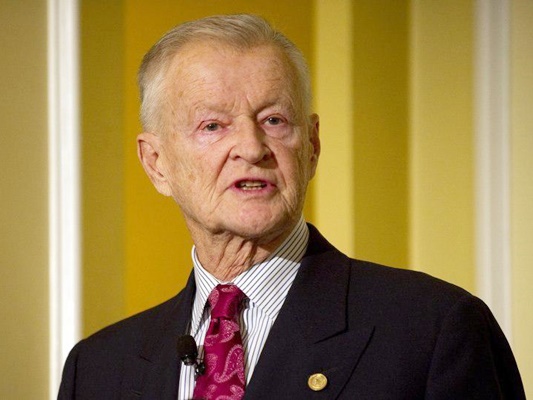
Former US Diplomat Brzezinski Dies at 89

Former US Diplomat Brzezinski Dies at 89

Brzezinski’s daughter Mika made an announcement through Instagram, saying that her farther — a renowned political scientist and a diplomat — “passed away peacefully.”

“My father passed away peacefully tonight. He was known to his friends as Zbig, to his grandchildren as Chief and to his wife as the enduring love of her life,” she wrote on Friday.

The cause of the death has yet to be revealed, Sputnik reported.

The Polish-American diplomat served under Carter from 1977 to 1981. Prior to that, he was a counselor to President Lyndon Johnson from 1966 to 1968.

During the years leading to Iran’s 1979 Islamic Revolution, Brzezinski was one of the staunch advocates of US military support for Iran’s monarchy.

Iran Condemns Terrorist Attack on Christians in Egypt

bahram

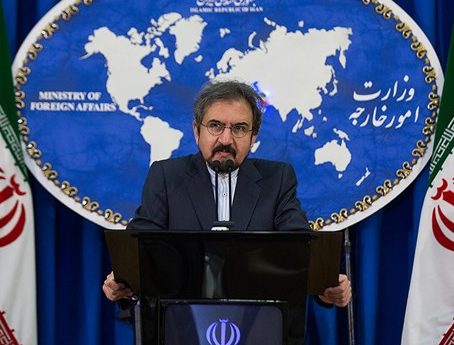
Iranian Foreign Ministry Spokesman Bahram Qassemi said on Friday that the recent terrorist attacks in the British city of Manchester, the Philippines, Indonesia, Thailand and Egypt have all been carried out after US President Donald Trump’s visit to Saudi Arabia.

“The unrelenting repetition of such incidents can be signs of the reanimation of the supported sectarianism whose other side we are witnessing in the ongoing crackdown and killing in Saudi Arabia, Bahrain and the bloody war in Yemen,” he added.

He emphasized that the recent gathering of over 50 states in the Saudi capital Riyadh, held under the pretext of fighting extremism and terrorism, had in fact had no outcome but support for the source of the promotion of the Takfiri ideology of Wahhabism and financial and logistic aid for armed terrorism throughout the world.

It should not be expected that such a spectacle would help enhance security in the world, he said.

The Iranian spokesperson said supported extremism and sectarianism would directly result in the killing of innocent Muslims, Christians and followers of other religions.

Qassemi urged countries and international organizations to fulfill their international responsibilities vis-à-vis collective security and a genuine campaign against terrorism.

He also expressed his sympathy with the Egyptian government, nation and the bereaved families of the victims.

At least 28 people, including children, were killed and over two dozen others wounded after unknown gunmen attacked a bus carrying Coptic Christians on a visit to a monastery south of Cairo on Friday.

According to Egypt’s Interior Ministry, the assailants in three pick-up trucks attacked the bus as it carried visitors to the Saint Samuel monastery in Minya province, more than 200 kilometers from the capital.

The attack came after church bombings in December and April claimed by the Daesh group that killed dozens of Egypt’s Coptic Christians. The Takfiri terrorists have threatened more attacks against the Arab country’s Christian minority.

There was no immediate claim of responsibility for Friday’s attack.

‘Beautiful Military Equipment’ Can’t Buy Middle East Peace: Iran FM

In his op-ed published on Friday in The New York Times, Zarif says responsible leaders in regional and world capitals alike must step up and tackle the momentous challenges at hand to avoid the spread of terrorism and militant extremism.

“Sword dances and lavish banquets aside, fundamental contradictions must be addressed,” he noted.

Here is the full text of his article:


As President Trump was being feted in the palaces of the Saudi royal family after concluding a historic arms deal, Iranians were celebrating the outcome of a hard-fought election. The vote manifested the determination of Iran’s electorate to continue on the path of moderation and constructive engagement based on mutual respect that brought the world the nuclear deal in 2015.

If past performance is an indicator of future success, another $110 billion worth of weapons will neither reduce “the burden” on the American military nor support “the long-term security of Saudi Arabia,” as the State Department argues. The last time the Saudis spent that kind of money was when they provided billions to the Iraqi dictator Saddam Hussein in the 1980s to arm his war of aggression against Iran. Look what that bought them and the world.

At best, Mr. Trump is extorting our Saudi neighbours, milking them for money they do not have. At worst, he could be turning the United States into Saudi Arabia’s mercenary in the Middle East, a rather ignominious position for America considering where 15 of the Sept. 11 hijackers came from. A security crackdown in Saudi Arabia before Mr. Trump’s visit — as well as the Bahraini regime’s deadly attack on a sit-in immediately afterward — suggest that the region’s despots feel that they’ve been given carte blanche to stamp out peaceful dissent.

In other words, something deeply rotten is unfolding in our part of the world.

To avoid the spread of terrorism and militant extremism, responsible leaders in regional and world capitals alike must step up and tackle the momentous challenges at hand. Sword dances and lavish banquets aside, fundamental contradictions must be addressed.

In Yemen, Saudi Arabia is attacking the Ansarullah group, the one force that has proved adept at beating back Al Qaeda in the Arabian Peninsula, the most lethal of the global terrorist network’s franchises. The Saudi-led coalition’s Western backers explain their motive as support for “democracy,” even though the concept finds little favour either in Riyadh or among other Arab allies of the United States.

‘Beautiful Military Equipment’ Can’t Buy Middle East Peace: Iran FMThe absurdities of the tragedy in Yemen are sadly echoed in Syria. There, the forces fighting Wahhabi extremists on the front lines also face perils from Western counterterrorism policy, which is often arbitrary in its distinctions between allies and enemies.

Let me be clear: What President Trump called “lots of beautiful military equipment” won’t drain the swamps in which terrorism and extremist militancy fester. Neither will golden chains or glowing orbs provide a magical solution to the socioeconomic and political challenges that drive radicalization. What will work is a genuine effort to forge inclusive engagement among the regional powers based on a policy of coexistence and acceptance that military solutions are futile.

While Saudi Arabia spends countless millions promoting fear of Iran to distract from its global export of Wahhabism — which inspires the extremist ideology of Al Qaeda, the so-called Islamic State and many other terrorist groups wreaking havoc from Karachi to Manchester — Iran has been aiding the victims of extremism in Iraq and Syria. By helping to prevent the Islamic State from seizing Baghdad and Damascus, Iran is actively promoting a political solution to the conflicts in both countries.

In 2013, Iran proposed an immediate cease-fire and a plan to end the war in Syria. For over two years, Saudi Arabia categorically rejected the premise that the Syrian conflict had no military solution, clinging to the illusion that its extremist proxies would achieve victory on the battlefield by dragging the United States into the war. Innumerable lives later, in 2015, our Syria plan became the basis for United Nations Security Council Resolution 2254.

More recently, the dialogue initiative led by Iran, Turkey and Russia, while far from perfect, has also proved effective as a de-escalation mechanism. The twin-track diplomacy on Syria, where fighting has abated and counterterrorist efforts have made progress, provides a credible formula for conflict resolution elsewhere in the region.

In Yemen, since the first days of hostilities over two years ago, Iran has proposed a four-point plan to end the war, which Saudi Arabia boasted would be over in two weeks. The proposal entails securing an immediate cease-fire, dispatching emergency humanitarian aid, promoting dialogue among Yemeni groups and helping them to establish an inclusive government of national unity with the support of neighbours.

With seven million Yemenis on the brink of a man-made famine and virtually half of Syria’s population displaced, the crises are too urgent to waste time pointing the finger of blame at the parties responsible. Rather, to find a long-overdue end to these calamities, the regional powers must recognize and address the underlying issues that fan violent extremism.

In this vein, the United States and its allies face two choices. They can continue to lend moral and material support, and encourage the perpetrators to intensify their war efforts, though this has proved futile and only brings more death and destruction and further complicates the path to a lasting solution. Or, as Iran has stated from the start, these governments can focus on helping to forge inclusive political solutions with the participation of all the political groups involved.

Back in 1990, when I was a young diplomat, I witnessed how, in the aftermath of Saddam Hussein’s decision to turn against his Arab financiers and invade Kuwait, the foreign ministers of Saudi Arabia and its Arab allies failed to respond to their Iranian counterpart’s offer to explore an inclusive arrangement for regional security. With billions of dollars wasted on arms, and after years of bloodshed, we are back to square one.

If we don’t break this cycle, we will leave only the same momentous task to our children and grandchildren. We must be the generation that learns from history rather than be condemned to repeat it.

Iran Ready to Enhance Parliamentary Ties with UAE


The head of Iran’s parliamentary delegation to the two-day (May 22-23) meeting of the Standing Committee on Staff and Financial Regulations of the Asian Parliamentary Assembly (APA), Fatemeh Zolqadr, says the government of the Islamic Republic of Iran seeks to foster its relations with the regional states and bring greater stability to the region.

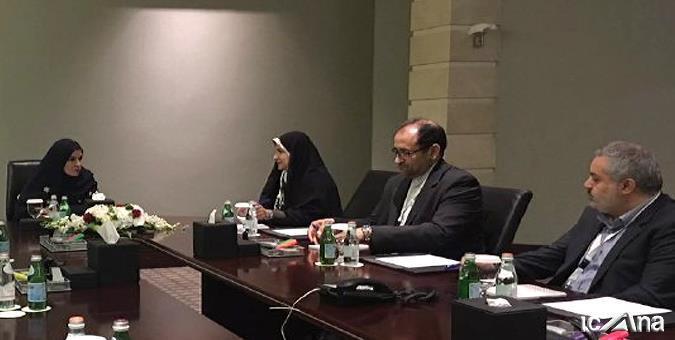
Speaking in a meeting with the speaker of the UAE’s Federal National Council (FNC), Amal Al Qubaisi, on the sidelines of the first day of the APA meeting on Monday (May 22), she expressed satisfaction with her presence in the two-day conference.

Zolqadr added Iran and the UAE share many cultural and historical commonalities, calling on the two countries to develop their mutual friendly and brotherly relations.

The Iranian lawmaker stressed that formation of a joint parliamentary friendship group by Iran and the UAE will help foster friendly relations between the two Middle Eastern states, regretting that currently, Iranian schools and nationals in the UAE do not have an acceptable condition.

“Unfortunately, at present, Iranophobia is being spread in the UAE.”

The Iranian government and the Ministry of Foreign Affairs seek to strengthen the country’s ties with the regional states and ensure greater stability in the region, she said.

Iran Ready to Enhance Parliamentary Ties with UAESpeaking in the same meeting, Al Qubaisi thanked the Iranian parliamentary delegation for attending the APA’s two-day session.
Highlighting the cultural commonalities between Iran and the UAE, she said the two countries should boost their mutual friendly and brotherly relations.

The FNC speaker urged the two sides to endeavour to increase the number of their common points, and bring peace and stability to the region, adding the parliaments of Iran and the UAE can play an effective role to these ends.

She said holding such meetings on the sidelines of the international conferences can greatly contribute to the strengthening of the countries’ mutual relationship.

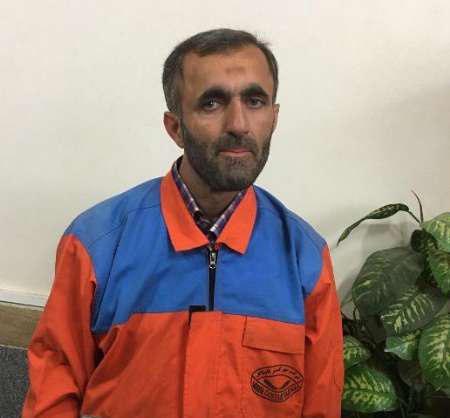
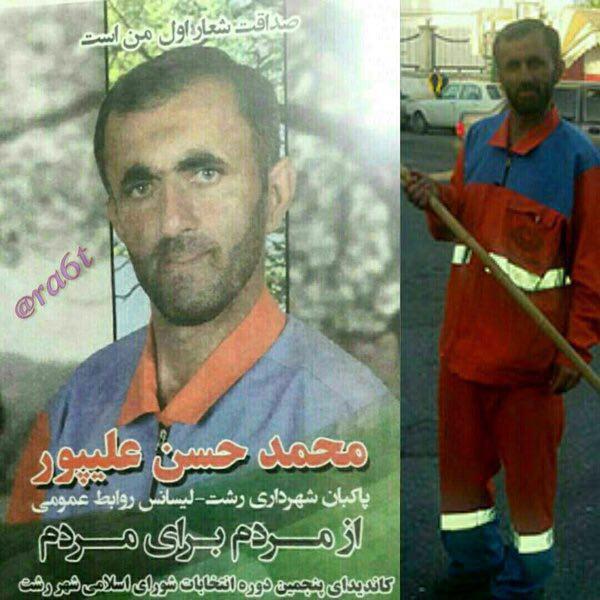
Iranian Street Sweeper Elected to City Council

Iranian Street Sweeper Elected to City Council

Gholam-Hassan Alipour, who is a 42-year-old street sweeper working in the northern Iranian province of Gilan, has garnered enough votes in Iran’s fifth City and Village Councils election, held on May 19, to be elected to Rasht City Council.

Commenting on his success in the vote, Alipour said by running in the local election, he aimed to find an opportunity to solve the problems and difficulties the lower-class people and his colleagues are beset with.

Iranian Street Sweeper Elected to City Council1Alipour, who holds a BA in Public Relations, said, “I am the representative of Rasht’s lower-class citizens. I registered to compete in the local election to resolve the problems and difficulties faced by this social class and my colleagues.”
He added now that he has managed to win a seat in the council, he will have to shoulder a much heavier responsibility compared to the past, as he does not seek to betray the trust of those who have voted for him and, in addition, wants to do his best to resolve the problems of his city and its citizens.

“I am proud to have had the opportunity and honour of sweeping the ground where people tread and bringing the citizens the gift of cleanness. Since the money I receive as salary is extremely clean and legitimate, I am living in perfect peace with my wife and only child.”

He also referred to the high level of education among street sweepers, and said 10 of his colleagues hold BA degrees.

“I will do my best to improve their working condition.”

Iran Starts Implementing Law on Freedom of Information (FOI)

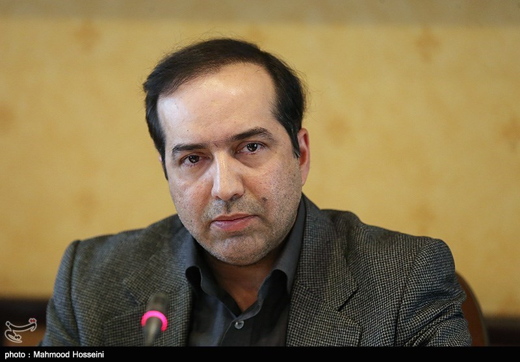
Hossein Entezami

The secretary of the Commission for Publishing and Providing Free Access to Information, Hossein Entezami, declared the test launch of an online system which gives all Iranian citizens free access to the information of state-run as well private organizations and institutes providing public services.

The system, he added, will soon be officially unveiled by the Minister of Culture and Islamic Guidance Reza Salehi-Amiri as well as Minister of Information and Communication Technology Mahmoud Vaezi as part of the government’s efforts to promote Freedom of Information (FOI) in the Islamic Republic.

Entezami added that requests to gain access to such information, submitted by the citizens, will be received as of now – following the launch of the system for a trial period.

He said any Iranian legal and natural person can put in their requests to have free access to public information by registering in an online system, which can be accessed via http://foia.iran.gov.ir. The requests will be responded to in 10 working days.

They are required to create a user account on this website. Other methods for submitting requests are through the government’s E-services offices or by post, he added.

Iran Can Overcome All Difficulties, Challenges: Ayatollah Khamenei

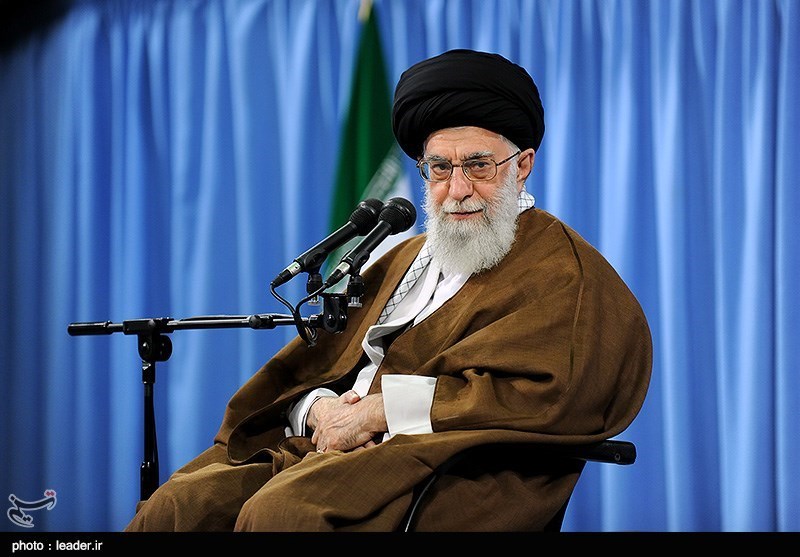
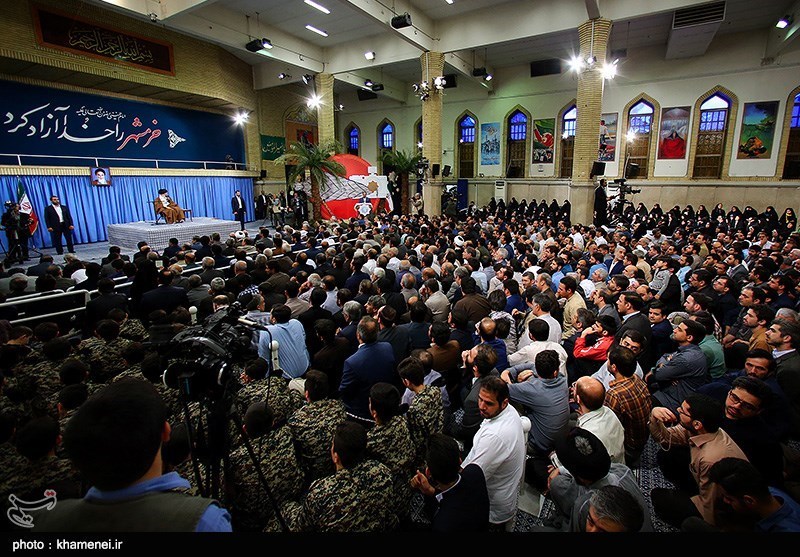
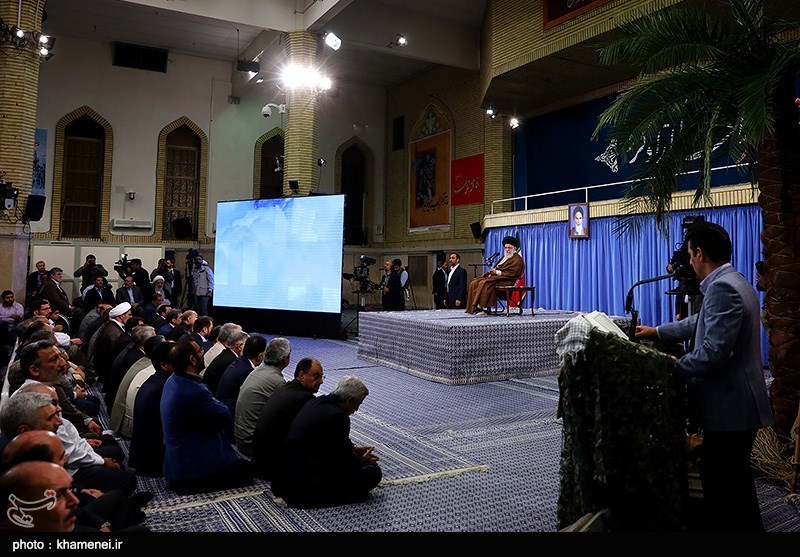
In a Wednesday address to a gathering of war veterans and commanders, as well as artists, filmmakers, writers and narrators producing works of art about the Sacred Defense, Ayatollah Seyed Ali Khamenei hailed the efforts to convey the memories of the war to the younger generation by means of art as a “very valuable and significant job.”

Aside from the financial losses and fatalities in the war, the Leader explained, the Sacred Defense has left major results for the present and future, including the protection and strengthening of revolutionary morale in the society and durability of the Islamic Revolution.

Without the Sacred Defense, the “revolutionary morale would have definitely been threatened,” Ayatollah Khamenei said.

Iran Can Overcome All Difficulties, Challenges: Ayatollah Khamenei

Iran Can Overcome All Difficulties, Challenges: Ayatollah Khamenei

“The Islamic Republic can now claim to (be capable of) rising to all the challenges it is facing, because it has the experience of overcoming numerous tough obstacles during the Sacred Defense era,” the Leader underlined.

Ayatollah Khamenei further hailed the memories of the war as a “national asset”, and likened the works of art about the Sacred Defense to “cement being pumped into the pillars of the Revolution, national identity and country’s progress.”

Iran Can Overcome All Difficulties, Challenges: Ayatollah Khamenei

The Wednesday meeting came on the anniversary of liberation of Khorramshahr, a city in southwestern Iran which had been occupied by Iraq’s Baathist army in the early 1980s.

The energy-rich city was recaptured by the Iranian armed forces on May 24, 1982.

Ayatollah Khamenei has on various occasions emphasized the necessity for cherishing the memories of the Iranian soldiers’ courage and devotion to their motherland during the Sacred Defense, and has cautioned against plots to play down the values of the heroic war.

Egypt, Bahrain Join Saudi Arabia, UAE in Blocking Qatari Media

Egypt and Bahrain have joined Saudi Arabia and the UAE in blocking their citizens’ access to all Qatari media, including the Al Jazeera news network, after Qatar’s state news website published remarks by Emir of Qatar Sheikh Tamim bin Hamad Al Thani in praise of Iran.

The move to block Qatari media came as Qatar’s government clearly declared the statements associated with the country’s Emir were untrue and fake.

The Qatari administration stressed in a statement that its media agency had been hacked, and the hackers had published statements against Persian Gulf Neighbours and allies. But Saudi Arabia’s Al-Arabiya and UAE’s Sky News Arabia started an open coverage to discuss the Qatari stances that praised Iran, Hamas, and Hezbollah.

Qatar had earlier congratulated Iran’s Hassan Rouhani for securing a second term as president of a country which is at odds with Saudi Arabia.

It is also reported that Al Jazeera TV had covered the Bahraini regime’s crackdown on its Shiite citizens, particularly the top cleric Sheikh Isa Qassim.

A Look at Iranian Newspaper Front Pages on May 25

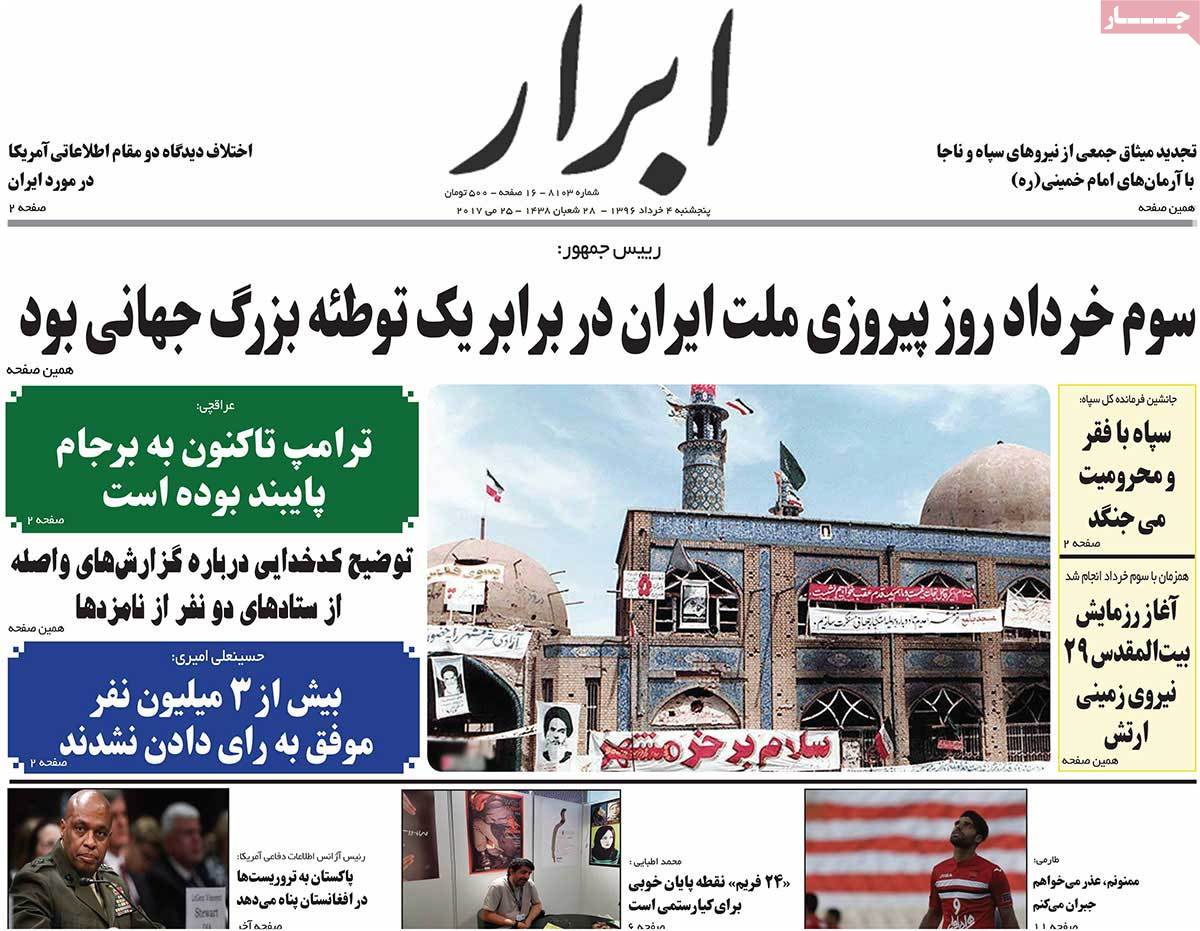
Most Iranian newspapers covered the remarks made by the Leader of Iran’s Islamic Revolution Ayatollah Seyyed Ali Khamenei in a Wednesday ceremony to mark the country’s Sacred Defence in the imposed war against Iraq in the 1980s.

The 3rd of Khordad, May 24, which is the day when the Iranian city of Khorramshahr was recaptured from Iraqi forces in the 1980s, was also widely covered today.

The top story, however, was the Bahraini regime’s crackdown on its citizens, particularly its move to arrest the top Shiite cleric Sheikh Isa Qassim.

The pro-Iran remarks made by the Emir of Qatar, which was later dismissed by Qatari government, and the reactions by Saudi Arabia and the UAE also received great coverage,

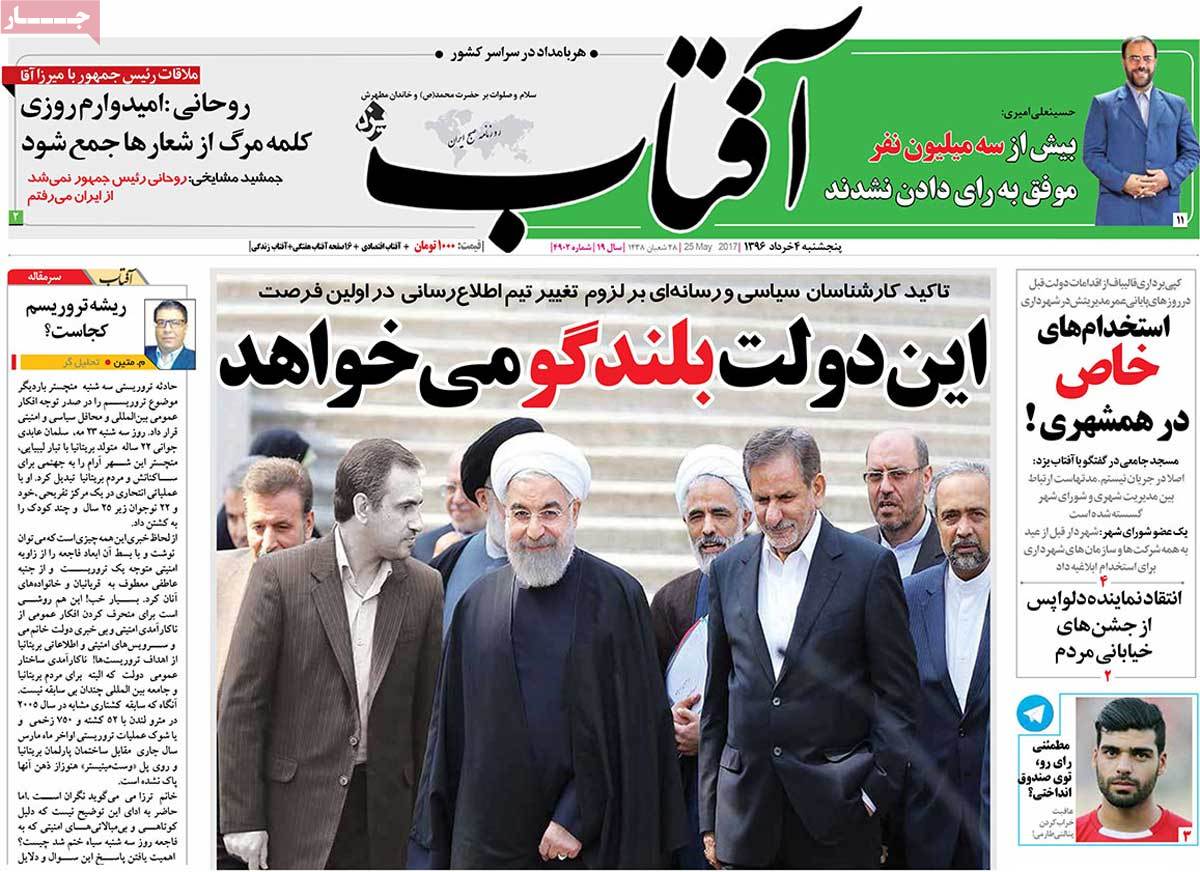
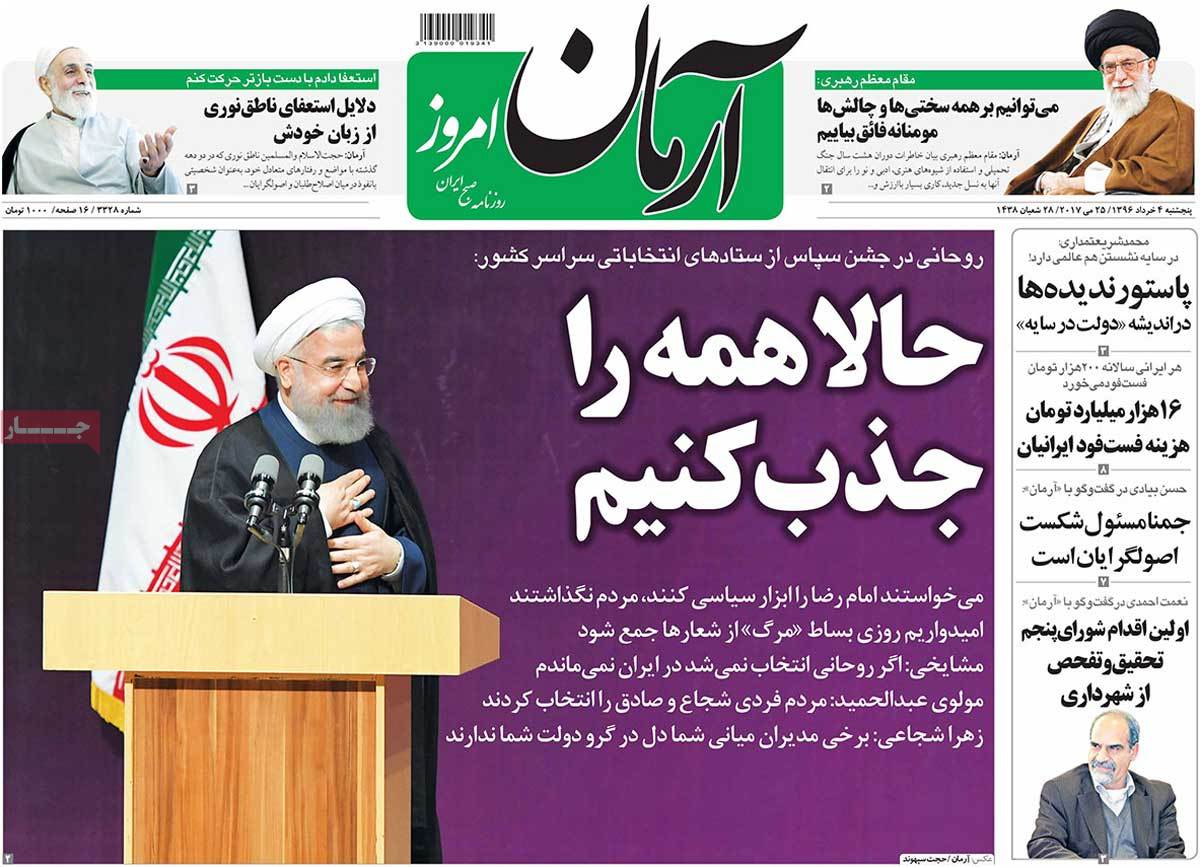
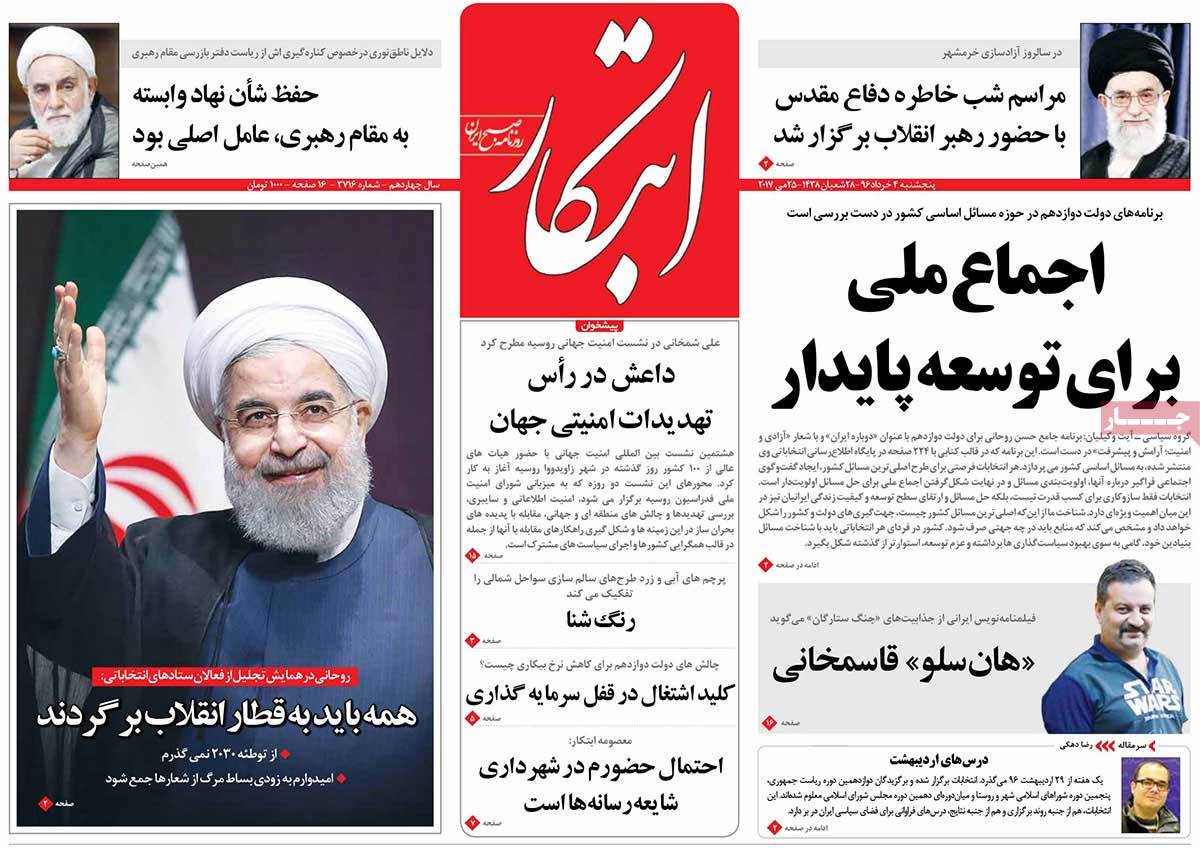
The above issues, as well as many more, are highlighted in the following headlines and top stories:


Abrar:

1- 3rd of Khordad Was Day of Iranian Nation’s Victory over Great Global Plot: Rouhani

[Iran recaptured the city of Khorramshahr on 3rd of Khordad during the Iraqi imposed war in 1980s]

2- Trump Has Been Committed to Nuclear Deal So Far: Iranian Negotiator

3- Lieutenant Commander: IRGC Fighting against Poverty, Deprivation

A Look at Iranian Newspaper Front Pages on May 25 - abrar


Aftab-e Yazd:

1- Rouhani: I Hope One Day No One Chants Slogan of Death to Others

2- Rouhani’s Gov’t Needs a Mouthpiece

  • Experts Underline Need for Changing Government’s Communication Team

A Look at Iranian Newspaper Front Pages on May 25 - aftab


Arman-e Emrooz:

1- Now We Should Attract Everyone: Rouhani

A Look at Iranian Newspaper Front Pages on May 25 - arman


Ebtekar:

1- Ceremony to Mark Iran’s Sacred Defence Attended by Iran Leader

2- Nateq Noori: Resignation from Leader’s Office Aimed at Maintaining Dignity of Office

[He resigned so that he could openly support Hassan Rouhani in Iran’s presidential election]

3- ISIS on Top of World Security Threats: Iran’s Shamkhani

A Look at Iranian Newspaper Front Pages on May 25 - ebtekar


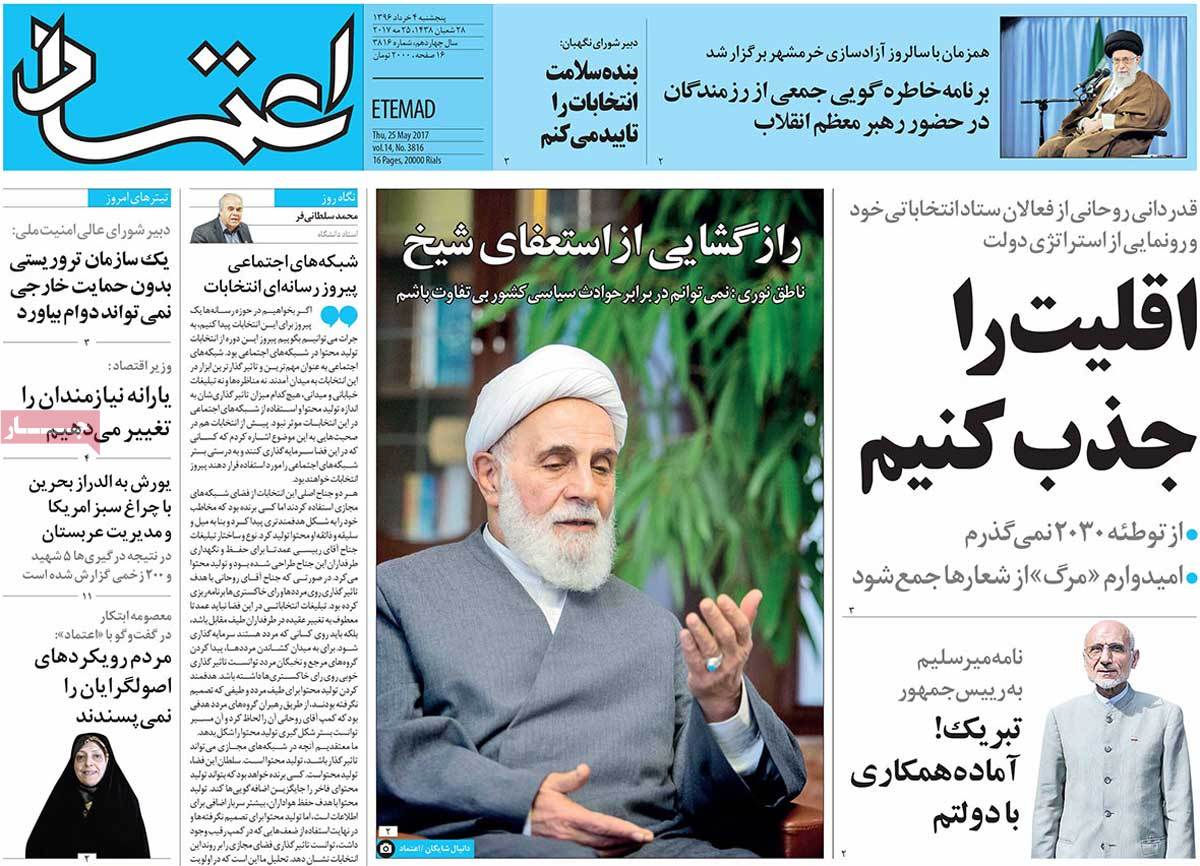
Etemad:

1- Mirsalim’s Letter to Rouhani: Congratulations! I’m Ready for Cooperation

2- Shamkhani: A Terrorist Organization Cannot Survive without Foreign Support

3- Guardian Council Secretary: I Approve of Election’s Health

A Look at Iranian Newspaper Front Pages on May 25 - etemad


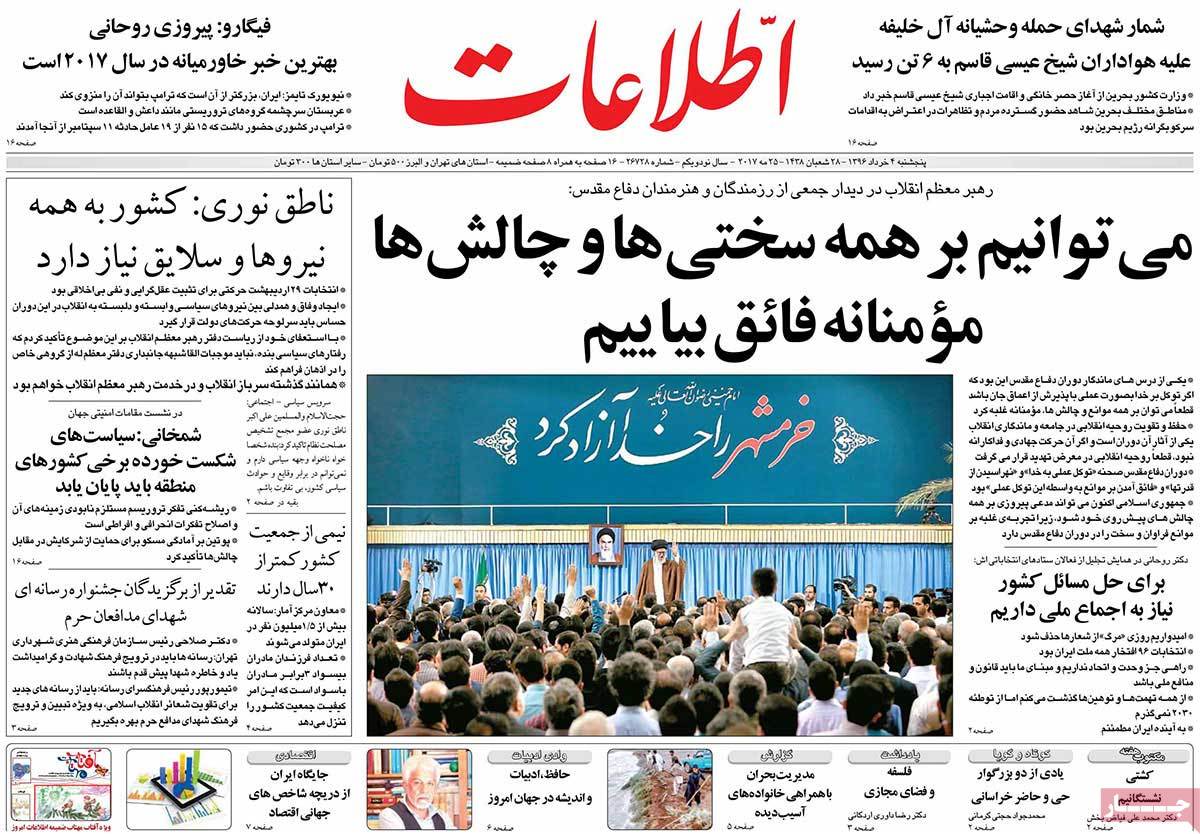
Ettela’at:

1- We Can Overcome All Difficulties, Challenges with Faith: Iran Leader

2- Nateq Noori: Iran Needs All Forces, Tastes Together

3- 6 Killed in Al Khalifa’s Brutal Attack against Sheikh Qassim’s Fans

A Look at Iranian Newspaper Front Pages on May 25 - etelaat


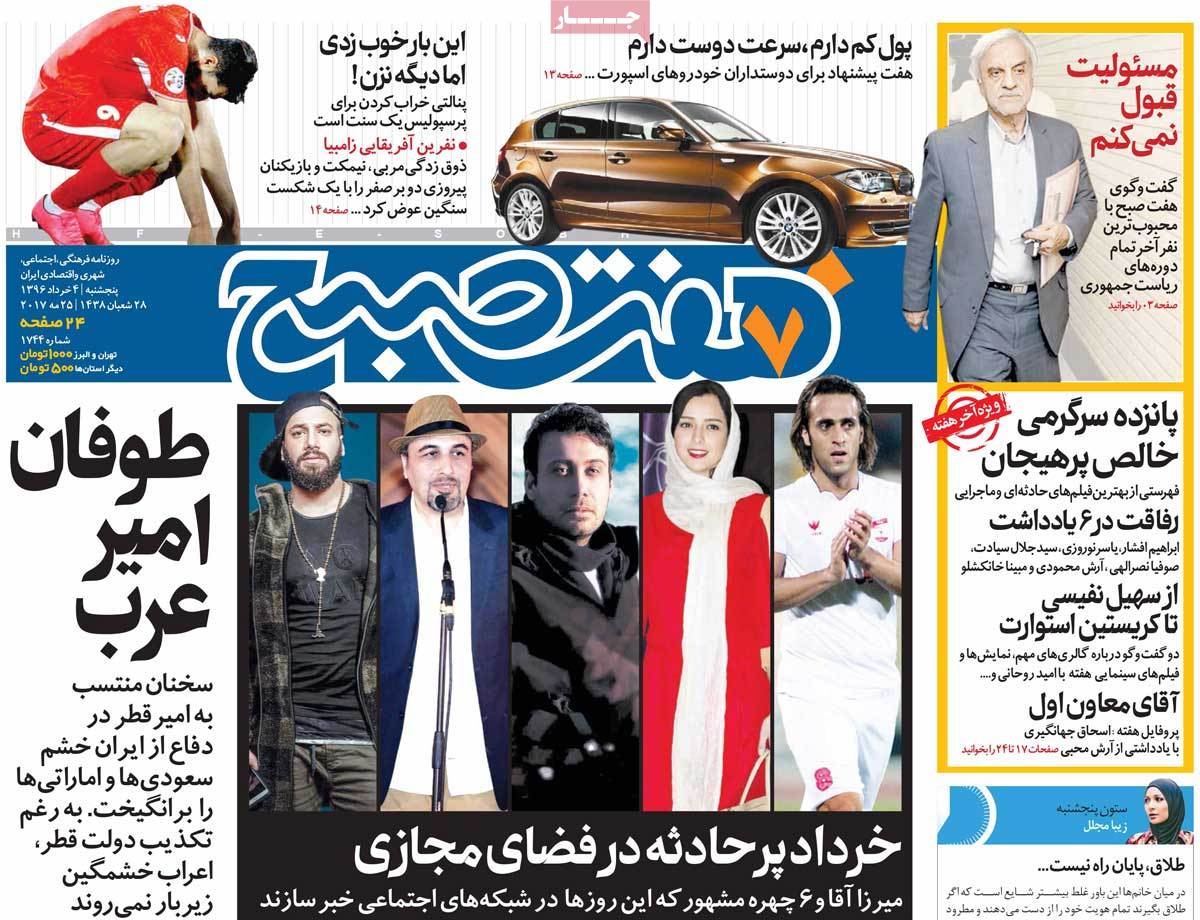
Haft-e Sobh:

1- Storm of Arab Emire

  • Pro-Iran Remarks Attributed to Qatari Emir Outrage Saudis, Emiratis
  • While Qatar Denies Reports, Angry Arabs Don’t Accept

A Look at Iranian Newspaper Front Pages on May 25 - hafte sobh


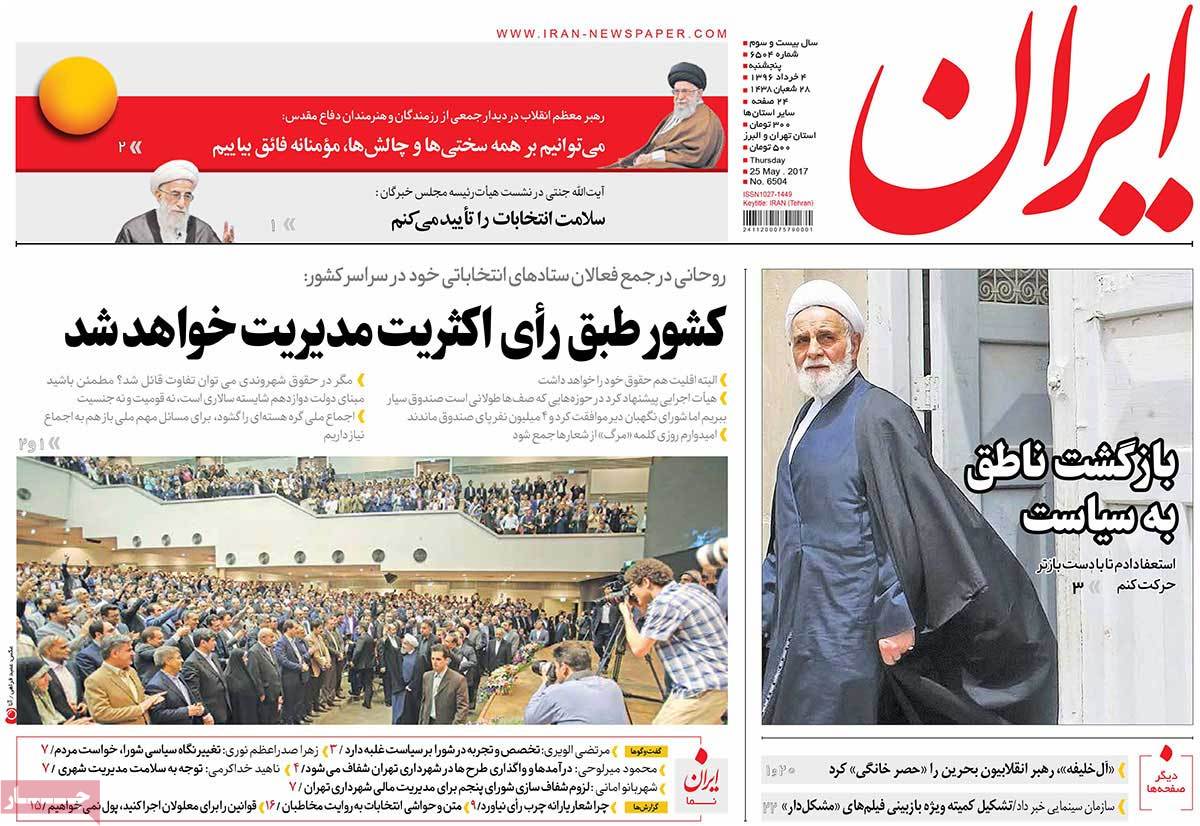
Iran:

1- Rouhani: Iran Will Be Governed Based on [ideas of] Majority of Voters

2- Al Khalifa Puts Leader of Bahraini Revolutionaries under House Arrest

A Look at Iranian Newspaper Front Pages on May 25 - iran


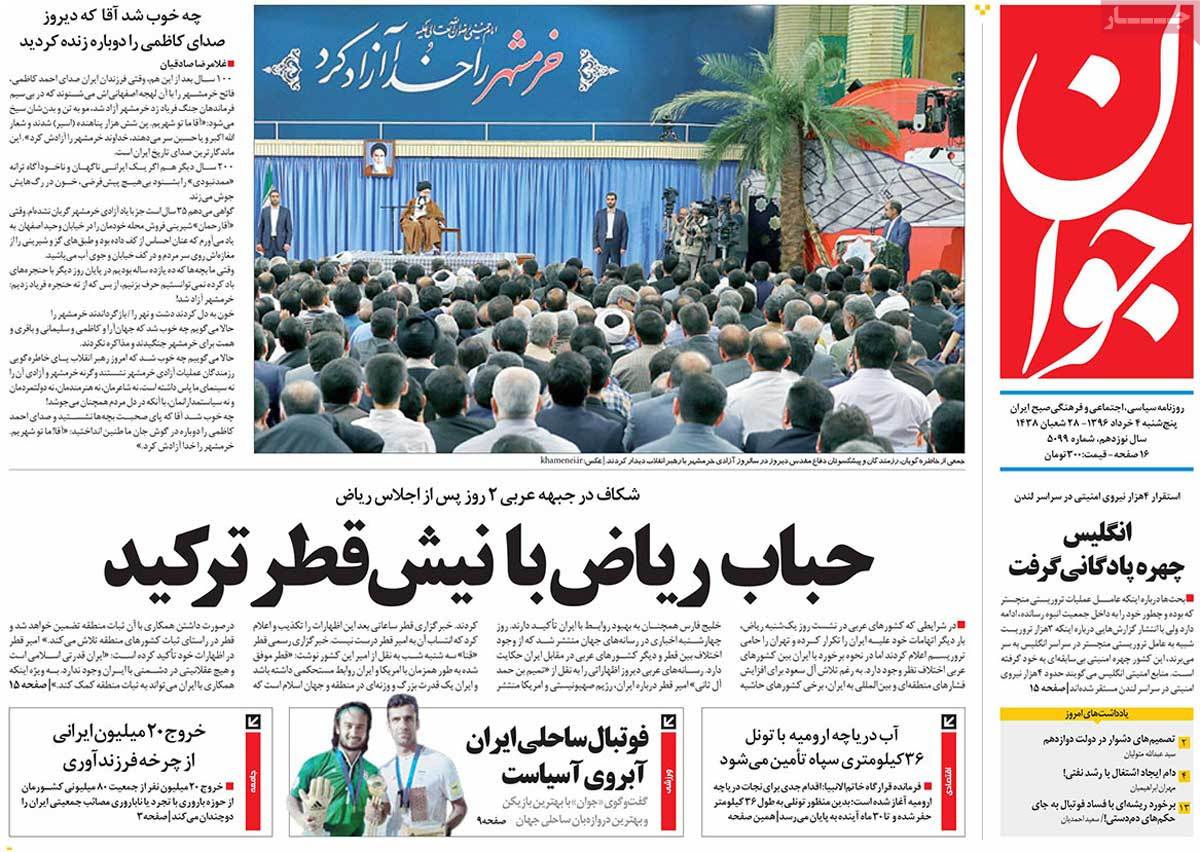
Javan:

1- Riyadh’s Bubble Burst by Qatar’s Bite

  • Gap in Arab Front 2 Days after Riyadh Summit

2- Lake Urmia’s Water to Be Supplied by 36km Tunnel Built by IRGC

3- Britain Looks like Barracks

A Look at Iranian Newspaper Front Pages on May 25 - javan


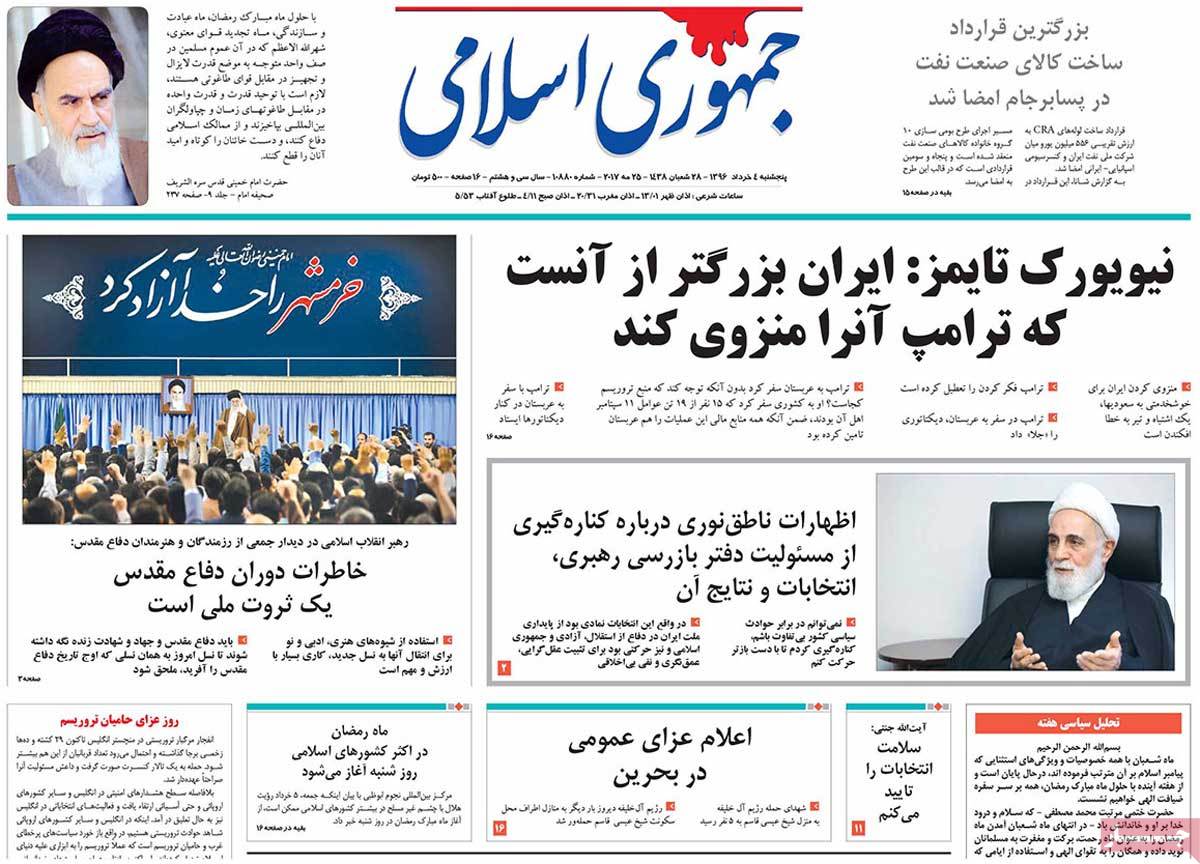
Jomhouri Eslami:

1- Iran Is So Great that Trump Cannot Isolate it: New York Times

2- Biggest Post-JCPOA Deal for Building Oil Industry Goods Signed

3- Public Mourning Declared in Bahrain

A Look at Iranian Newspaper Front Pages on May 25 - jomhori


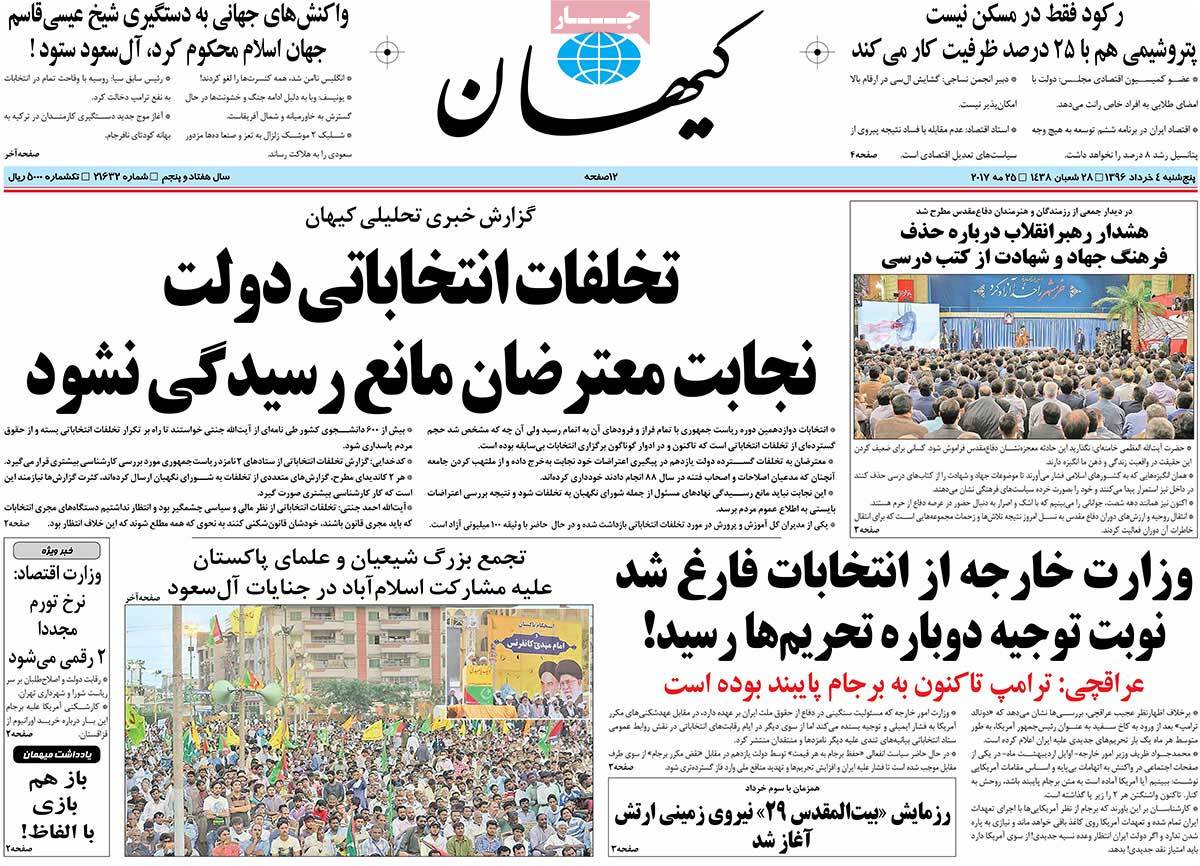
Kayhan:

1- Government’s Electoral Offences

  • Protesters’ Decency Shouldn’t Stop Investigation

2- World Reactions to Arrest off Sheikh Isa Qassim

  • Muslim World Condemns, Al Saud Praises!

3- Relieved from Elections, Now Foreign Ministry Once Again Justifies Sanctions!

A Look at Iranian Newspaper Front Pages on May 25 - keyhan


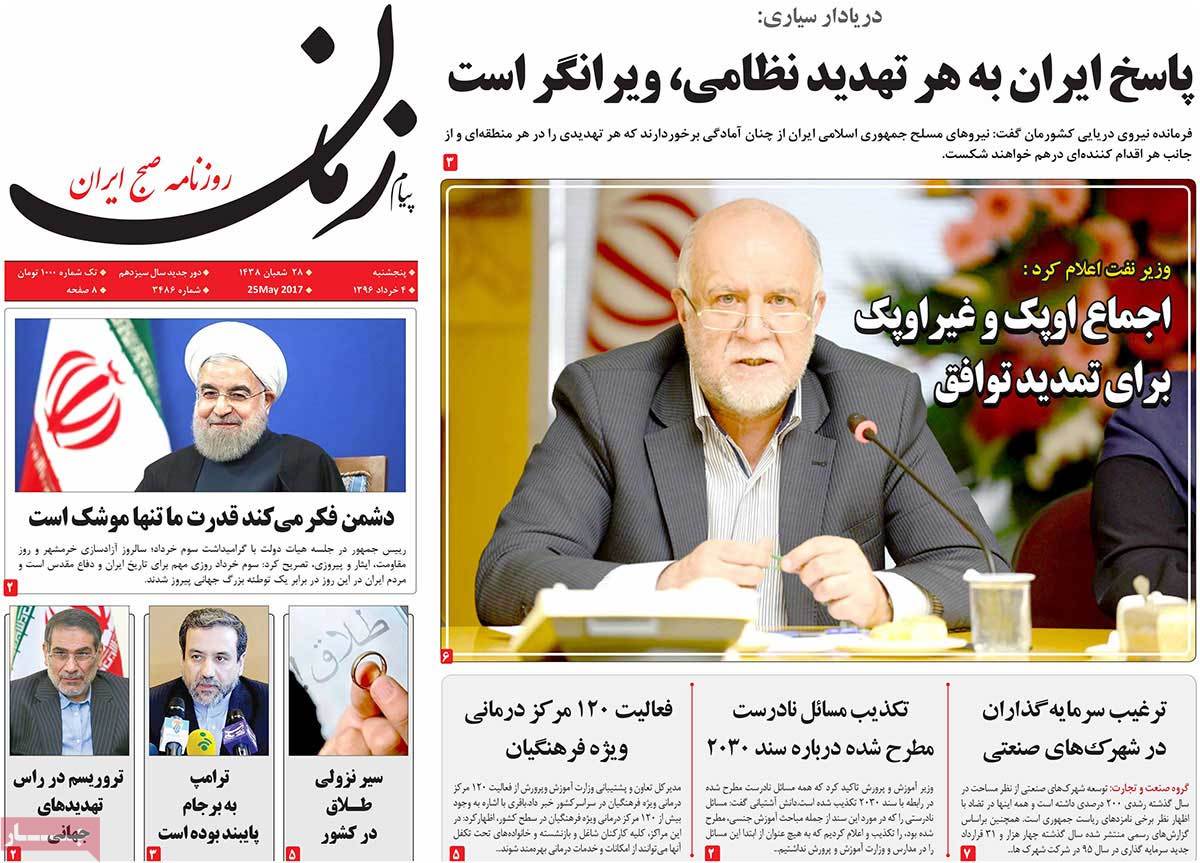
Payam-e Zaman:

1- Iran to Give Crushing Response to Any Military Threat: Navy Commander

2- Iran’s Armed Forces Are So Prepared that Can Crush Any Threat by Anyone

3- Enemies Think Our Power Only Stems from Missiles: Rouhani

4- OPEC, Non-OPEC Members Agree on Extension of Deal: Oil Minister

A Look at Iranian Newspaper Front Pages on May 25 - zaman


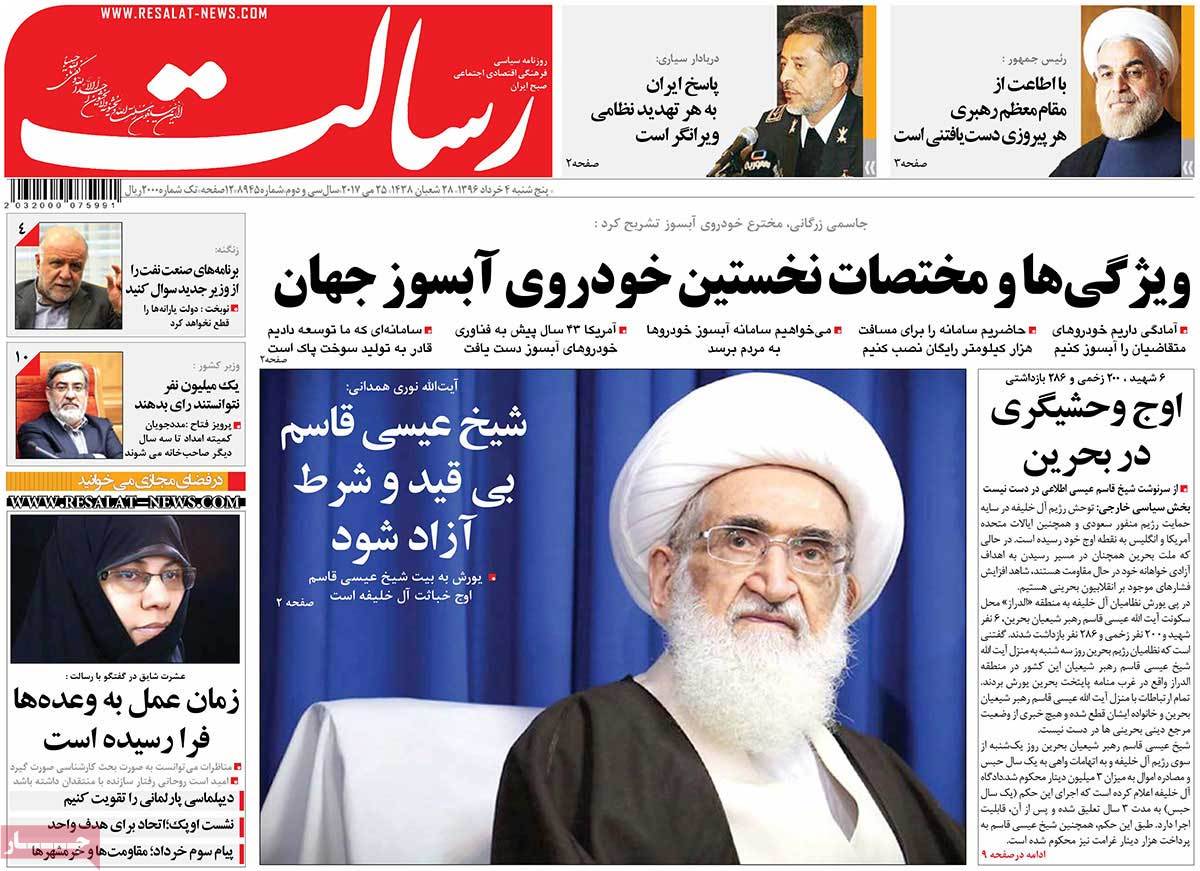
Resalat:

1- Features of World’s First Water-Fuelled Car Developed in Iran

2- Sheikh Isa Qassim Should Be Released Unconditionally: Senior Iranian Cleric

3- Interior Minister: One Million Voters Didn’t Manage to Vote

A Look at Iranian Newspaper Front Pages on May 25 - resalat


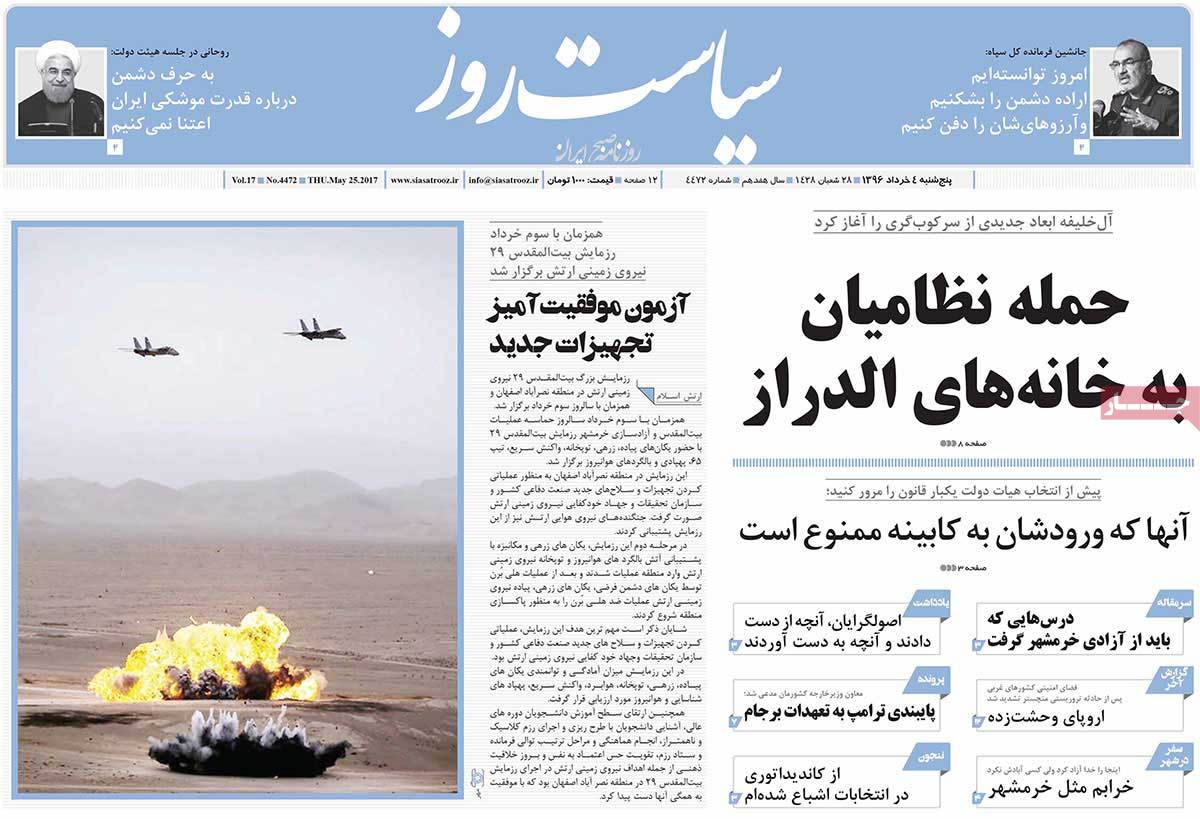
Siasat-e Rooz:

1- Military Attack on Diraz Houses: Al Khalifa Starts New Round of Crackdown

2- Iran’s Army Successfully Test New Equipment

3- We Have Managed to Disappoint Enemies Today: Iranian General

A Look at Iranian Newspaper Front Pages on May 25 - siasatrooz