Friday, April 24, 2026
Home Blog Page 3984

Iranian Inventor Receives Award for Solution to Urban Dust

The Merit Award and Gold Medal Award of Merit of America’s Invention and New Product Exposition (INPEX 2017) have been presented to Khalil Nazari, an Iranian inventor from the northwestern city of Tabriz, for his invention, HL herbal glue, which can replace oil mulch in solving the problem of urban haze.

According to a Farsi report by the Kayhan newspaper, INPEX is America’s largest invention trade show held annually in Pittsburgh, Pennsylvania, in June which provides a forum for inventors to exhibit their inventions and pitch their ideas with companies interested in licensing, marketing or manufacturing their new products. The trade show also hosts contests for domestic and international inventors in 45 different categories.

Commenting on his invention, Nazari said it is a plant-based material which is a suitable and environment-friendly replacement for oil mulch in settling the problem of urban haze and dust particles.

He added his invention has no domestic or foreign counterpart.

“Oil mulch is made of waste oil in fractionating column. A layer of the material is applied to the surface of soil or sand dunes to temporarily help stabilize them. Although oil mulch is a valuable and expensive material, it blackens the dunes and gives off an unpleasant odour that, as wind blows, fills the whole surrounding region. It also raises the temperature of the region and destroys its ecosystem. However, the HL herbal glue is made of herbs and has produced favourable result after being applied to the surface of all kinds of soil and sand.”

The Tabriz-based inventor stressed that his HL herbal glue is absolutely environmentally-friendly and way cheaper than oil mulch.

He noted that the material is also resistant against wind, different climatic conditions and ultraviolet radiation.

“After being applied to the surface of the soil, its temperature plummets [quickly] and, thus, it fails to harm insects and other living creatures. It is not flammable and does not pollute groundwater. It is colourless and odourless.”

Nazari said after holding talks with the crisis management organization of Khuzestan Province, the material has been decided to be tested in one of the lands in the southwestern Iranian province from which haze and dust particles originate.

He added following the mass production and use of the HL herbal glue the problem caused by urban haze and dust particles will be resolved.

UN Hails Iran’s Pioneering Role in Resolving Environmental Woes

Director of the United Nations Environment Programme, Erik Solheim, says the Islamic Republic has good faith in its efforts to tackle the current environment woes in the region.

“I believe that the problem of the sand and dust storms in the Middle East should be resolved by the regional states themselves,” he said on the sidelines of ‘International Conference on Combating Sand and Dust Storms: Challenges and Practical Solutions’ recently held in Tehran.

In response to a question on Saudi Arabia’s absence from Tehran conference, the UN official noted the world body is expected to issue a resolution drawing on discussions raised during Tehran conference.

“All countries including Saudi Arabia are obliged to observe the resolutions,” he added.

Solheim went on saying that the solutions found at Tehran conference are helpful for all states including Saudi Arabia.

“So, the UN would follow it up to make sure all states implement the UN resolutions on environmental crises in the Middle East.”

The UN official also added most of the environmental woes can be resolved if each regional state fulfils its own environmental commitments.

“I don’t play down the role of regional and international cooperation, but to me, sticking to the local environmental standards is more important when it comes to resolving the current problems,” he noted.

Solheim went on saying that the UN can settle the differences between the regional states on the environmental issues, adding the differences could be resolved through dialogue.

He recommended that regional states draw on the UN’s technological and scientific capabilities in combating environmental crises and added the environmental woes of the region cannot be resolved by holding just one single international conference.

He referred to the instability in Iraq and Syria and said the two countries have turned into main sources of the dust and sand storms hitting the whole region over the past few years.

“Now with the retreat of ISIS from the two countries, we hope new efforts can resolve the problem.”

Representatives of 43 countries attended the International Conference on Combating Sand and Dust Storms, which was co-hosted by the United Nations (UN) and the Iranian Department of Environment. The international conference was aimed at reviewing the challenges and practical solutions to the dust pollution that has plagued Iran and several other countries in the Middle East.

Saudi Arabia and its regional allies including Bahrain, Yemen, United Arab Emirates and Egypt refused to take part in the conference. Observers say this is part of the countries’ reluctance to shoulder their responsibility to resolve regional and international problems.

The absence grabs more attentions when it is known that the mentioned countries are the main source of dust and sand storms across the region.

Former Iraqi President in Iran for Talks

Leading a delegation, Talibani is visiting Iran at the invitation of Iranian officials.

The Kurdistan Regional Government’s (KRG) representative in Tehran, Nazim Dabagh, said Talabani received Iran’s official invitation about one month ago.

“We were waiting for an appropriate opportunity to make the arrangements for his visit. This is not a political visit but an ordinary one,” he said.

A member of PUK Political Office, Rozgar Ali, said Iran is very important for Kurdistan Regional Government (KRG) because of its historic standing in the region.

“The visit of Talabani to Iran should be viewed from this point of view,” he said.

He went on saying that the Islamic Republic of Iran has established long-time and deep relations with the KRG over the past decades.

This is Talabani’s first visit to Iran after his brain stroke in 2013, he said, adding the visit is made at the invitation of Iranian officials.

The member of PUK Political Office also went on saying that the relations between Iran and the KRG date back to the fighting between the Kurds and the former regime of Ba’ath in Iraq.

“The relations have become deeper after the Islamic Revolution and Mr. Talabani played a key role in the expansion of ties between the two sides,” he concluded.

Latest Round of Astana Talks, Major Step towards Syria Peace

Participants of this round of talks on Syria could not reach consensus on details of specific zones and participating forces. Tthere was no agreement but the process helped all sides to come closer.

Analysts believe that reaching a conclusion for hammering out de-escalation zones is a time-consuming complicated process after six years long civil war in the region.

However, the Syrian government representatives and the opposition have reached agreement on establishment of ceasefire in the eastern Damascus suburb and northern parts of Homs province and there are only trivial differences on management of Idlib and Dara’a provinces after the ceasefire.

It is expected that differences on management of Idlib and Dara’a provinces is resolved in the upcoming expert level conference due to be held in Tehran on August 1-2.

The achievements came while none of the international meetings held on Syria crisis before the Astana talks made positive effect on resolution of the crisis.

Fifth Round of Astana Talks in Detail

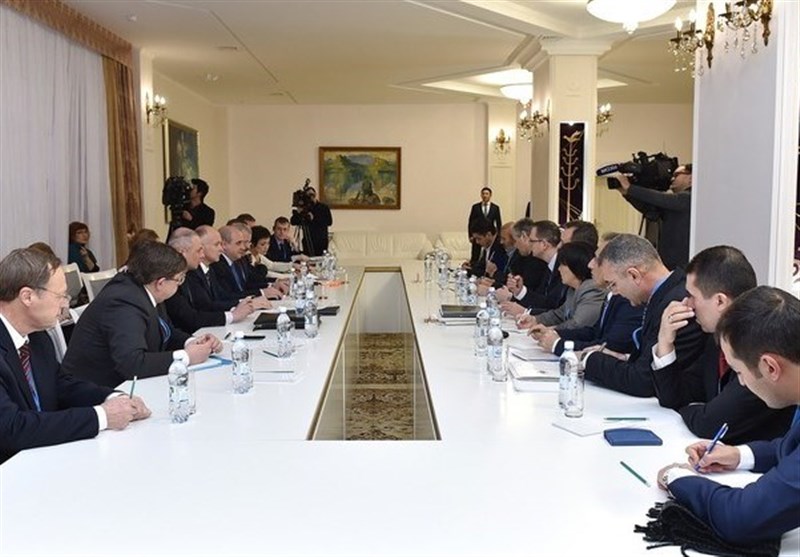
The plenary and final session of the fifth round of Syria peace talks, brokered by Iran, Russia and Turkey, was held in the Kazakh capital on last Wednesday.

Following several rounds of expert-level meetings over the past few days, the final session was attended by diplomatic delegations from Iran, Russia and Turkey, as well as observers in the peace talks. The previous round of Astana talks in May had produced a memorandum of understanding on de-escalation zones in Syria, sharply reducing fighting in the country.

Latest Round of Astana Talks, Major Step towards Syria Peace

The agreement—initiated by Iran, Russia and Turkey—also envisages the creation of conditions for the delivery of medical assistance, restoration of damaged infrastructure and return of displaced civilians to their homes.

According to a joint statement after the Wednesday meeting, the three states formed a working group to finalize an agreement on creating de-escalation zones in Syria.

Sputnik quoted a source at the talks as saying that the parties reached an agreement on only two out of the four de-escalation zones, but will adopt the whole package of documents related to the issue in the next round of negotiations.

“An agreement has been reached on two zones already, on Eastern Ghouta and north of Homs. There is still no agreement on Idlib,” the source said.

According to the source, Turkey had a position different from that of Syria and Iran on the issue of detainees’ release. In the meantime, Al Jazeera quoted Russia’s representative, Alexander Lavrentiev, as saying that documents outlining how the four zones should work “need finalizing” despite being “essentially agreed” between the three key mediators.

Lavrentiev noted that there had been no definitive agreement over the contentious issue of “which specific forces” would police the zones.

New Developments after Fifth Astana Talks

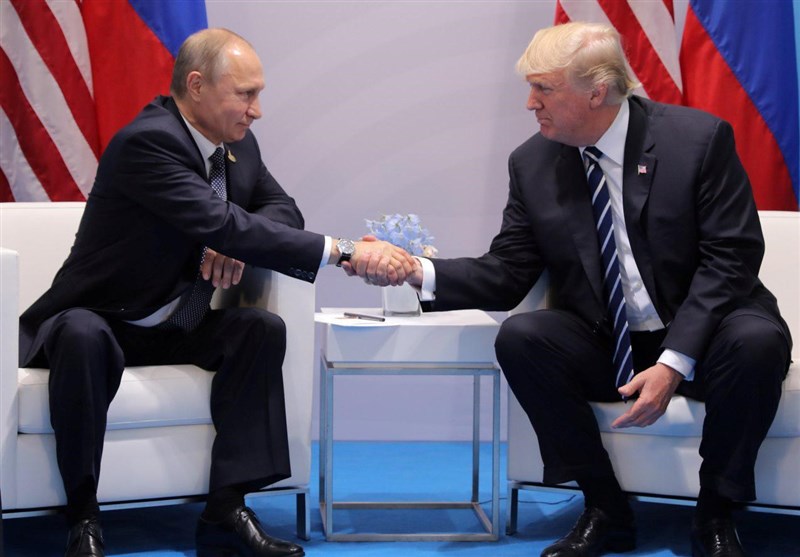
According to US Secretary of State Rex Tillerson, US President Donald Trump and Russian President Vladimir Putin reached an agreement on curbing violence in southwest Syria during their sit-down at the G20 meeting Friday in Germany.

Tillerson, who sat in on the discussion between the two leaders, told reporters the ceasefire was a “defined agreement” and could be a precursor to further cooperation in Syria.

Latest Round of Astana Talks, Major Step towards Syria Peace

“This is our first indication of the US and Russia being able to work together in Syria,” Tillerson said.

The two leaders had a “lengthy discussion of other areas in Syria where we can work together,” he added.

After the meeting concluded, Russia’s Foreign Minister Sergey Lavrov, who was also present at the meeting, said that the US, Russia and Jordan have issued a joint memorandum on establishing a de-escalation zone in southwest Syria, in the regions of Dara’a, Quneitra and Suwayda.

A ceasefire came into effect in this de-escalation zone starting at noon Damascus time on July 9.

The US and Russia “promised to ensure that all groups there comply with the ceasefire” and “provide humanitarian access” Lavrov said. Russian military police — coordinating with the US and Jordan — will initially ensure security around the de-escalation zone.

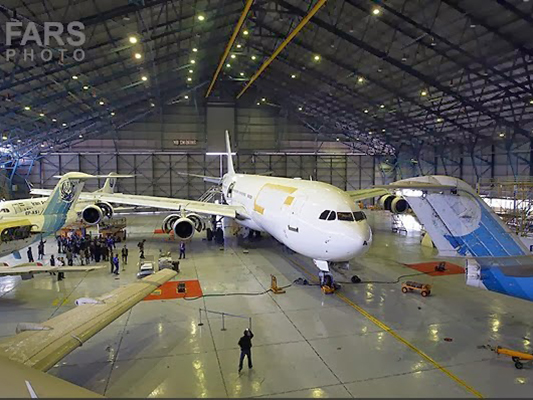
124 Iranian Planes Crippled, Waiting for Spare Parts

124 Iranian Planes Crippled, Waiting for Spare Parts

According to a Farsi report by Nasim Online, nearly 40 percent of the country’s planes are languishing in the hangers across the country. The full text of the report is as follows:

124 planes in Iran are crippled allegedly either due to outdated maintenance checks or shortage of engines and spare parts. The crippled planes are on the verge of being stored as out of service planes, but they can be restored after an overhaul.

In a directive last year, Iran’s Civil Aviation Organization urged the national airliners to exclude old planes from their fleets. The directive paved the way for decommissioning of at least 27 outdated planes from Mehrabad [Tehran], Hasheminejad [Mashhad], and Zahedan airports. The decommissioned planes included Boeing 747, Boeing 727, Fokker 100, Airbus 300, BAE and Falcon 20. The planes belonged to Iran Air (10), Mahan (11), Aseman (5) and Pouya Air (1) airlines.

Iran’s aerial transportation system has been among the most outdated aerial systems in the Middle East over the past four decades. Before the implementation of JCPOA in 2016, there were 124 crippled planes in Iran. On the other hand, the average useful life of 166 operating planes stood at 23 years old.

In the early days of JCPOA implementation, Iran Air (Homa) signed a contract with the French manufacturer Airbus to obtain the mid- and long-range planes through a lease purchase. The value of an earlier contract with Airbus to obtain 228 planes stood at $25bn, but the Iranian side decided to leave out A380 planes from the contract reducing its value to $10bn. The purchased planes are set to be delivered to Iran Air within a 10-year period beginning in 2017. Later, Iran Air signed a $16bn deal with Boeing for 80 planes. The planes are expected to be delivered in ten years. Add to the list, 45 Airbus planes to be delivered to Iran Air Tour, 28 planes to Zagros Air as well as 30 Boeing 737 planes to Aseman.

International standards require the Islamic Republic of Iran to exclude outdated planes from its air fleet. Outdated aerial fleet have already hampered the operation of Iranian airliners making them notorious for their long delays. Back in May, Mehrabad airport had 6,162 flights out of which 3,139 flights were carried out with delay.

According to Iran’s Civil Aviation Organization, Iran Air Tour with 74 percent, Atrak Air with 65 percent and Ata Air with 61 percent had the longest list of delayed flights from Mehrabad airport during May.

At present the number of operating planes produced in 2000 stands at 20 which is a poor standard for Iran’s aviation system. The figure included the planes purchased just recently. Iran’s aerial system needs at least 556 planes by 2025.

One of the main points raised during Geneva talks which led to the clinching of the nuclear deal between Iran and the world powers was repairing 120 crippled planes in Iran. One and a half years after the implementation of the nuclear deal, not only no plane has been repaired, but four other operating planes have been crippled.

So, it seems the JCPOA has not resolved the problems of Iran’s aerial transportation system especially because today providing the spare parts have become much harder compared with previous years.

Relevant officials in the industry maintain that over the past two years, Iran has come under more pressure in civil aerial field.

Most of the manufacturers have already stopped offering services to Iran under various pretexts. Despite the Iranians’ earlier expectations, the JCPOA has not yet relieved sanctions on Iran in civil aerial industry. Another issue which has put Iran’s aerial system in trouble is the limitations on banking systems which have not been removed yet.

Iran to Appoint Woman as Head of Flag Carrier Airline

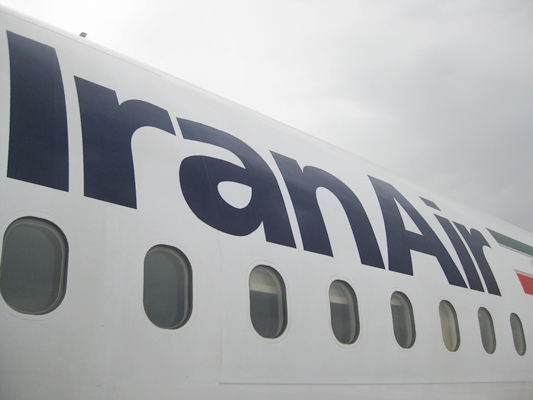
IranAir

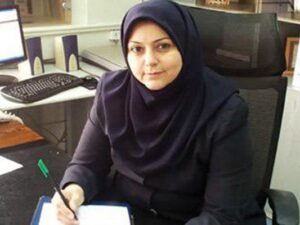
Iran to Appoint Woman as Head of Flag Carrier AirlineFarzaneh Sharafbafi, a current board member at The Airline of the Islamic Republic of Iran (Iran Air), will replace the current CEO Farhad Parvaresh if approved by members of President Hassan Rouhani’s cabinet.
Sharafbafi, the Director-General of Iran Air’s Research Department, will be the first-ever woman to head the national flag carrier, according to a Farsi report by Fars News.

She is also the first Iranian woman with a PhD in aerospace. She has already implemented several aviation projects and has taught various aerospace courses.

After leaving the airline, the former CEO Parvaresh is going to represent the Islamic Republic at the International Civil Aviation Organization (ICAO) in Montreal, Canada.

Mona Lisa’s Smile Revived on Arab Girl’s Face

Mona Lisa’s Smile Revived on Arab Girl’s Face

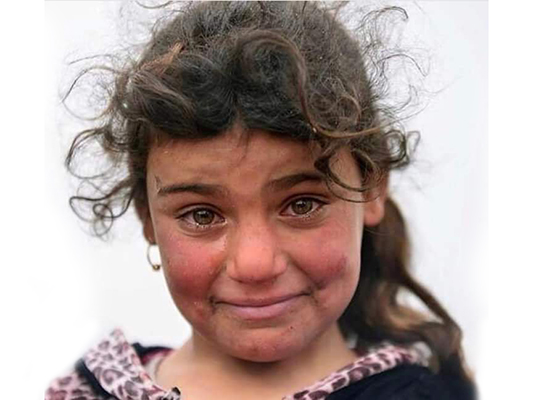
Some 514 years have passed since Leonardo da Vinci created the Mona Lisa, his most famous painting, and now the world is witness to the creation of another Mona Lisa while the painter has been dead for 498 years.

The modern-day Mona Lisa is not an oil painting showing the portrait of a mysterious woman produced by the paintbrush of a distinguished painter using delicate shading.

This time, fear and consternation has led to the creation of real life Mona Lisa, according to a Farsi report by ISNA.

She should be in her mother’s arms now with her braids ornamented with colourful ribbons. The sound of her laughter should be reverberating in his father’s ear. She should be playing childish games, be happy and act like a normal girl of her age. Nevertheless, only God knows how frightened she had been when her mother had been running away from the ISIS terrorists while panting heavily.

In 1503, da Vinci created the Mona Lisa on canvas with a number of paintbrushes and oil paints. He worked on his work of art for four years to be able to paint a mysterious face full of ambiguity.

The ambiguous expression on the face of da Vinci’s Mona Lisa is an outcome of four years of incessant hard work by a painter who left his artwork unfinished in the end. Now, in the early years of the present century, the modern-day Mona Lisa’s picture displays a young girl’s face full of fear and sorrow with a faint smile on it. The girl’s bitter smile is the consequence of an intense fear and speaks of her profound sorrow caused by utter horror.

The Mona Lisa of 21st century is confused and sad. She is scared. Her eyes are filled with tears. She is not old enough to be dubbed Mona Lisa. Nevertheless, no other name suits the innocent face of a young girl that displays these emotions all at once.

The face of the 21st century’s Mona Lisa has caused the heart of millions to ache even though those who should feel the ache fail to do so. It is as if they fail to see the little girl’s bright eyes, let alone to feel sympathy for her.

She is doing her best to smile in this photo which has been taken of her right after she managed to escape the ISIS terrorists.

Humanities on Verge of Extinction in Iran

Humanities on Verge of Extinction in Iran

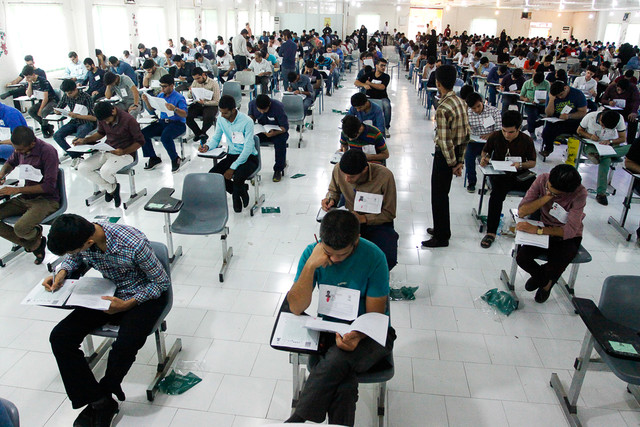
Figures show that out of 930,000 volunteers who had registered to take Iran’s university entrance examination on Friday, July 7, only 184,000 were interested in the humanities.

The fact is deeply worrying as it has the potential to spark off a crisis in the courses pertaining to these academic disciplines in the near future.

Farhikhtegan newspaper, an Iranian paper belonging to the Islamic Azad University, has discussed the risks of failing to pay due attention to humanities and the reasons for the Iranian students’ reluctance to study such academic disciplines at university, in an extensive report titled “Humanities on the Verge of Extinction” published on July 8.

The report says although the Iranian parents’ interest in their children becoming physicians is a salient and undeniable fact, the reduced number of the volunteers for taking humanity courses has heightened concerns more than ever.

The issue is critical enough to lead to a crisis in the field of thought in the country in the near future. The question is why nowadays, Iranian elites are more inclined towards studying courses in engineering and medicine.

Coming up with an answer to this question requires hours of discussion and study by experts. However, the roots can be found by looking deeper into Iran’s education system and the Iranian families’ general culture.

Haddadi, an Iranian researcher in this field, maintains that “an incorrect attitude towards providing [Iranian students with] educational guidance has infiltrated into our educational system, and this has led to the inefficiency of efforts to identify top [Iranian] talents and guide them in the right direction. Our instructors in humanity courses are usually not experts or interested in this field of study and the contents of the educational books are not attractive enough to the students.”

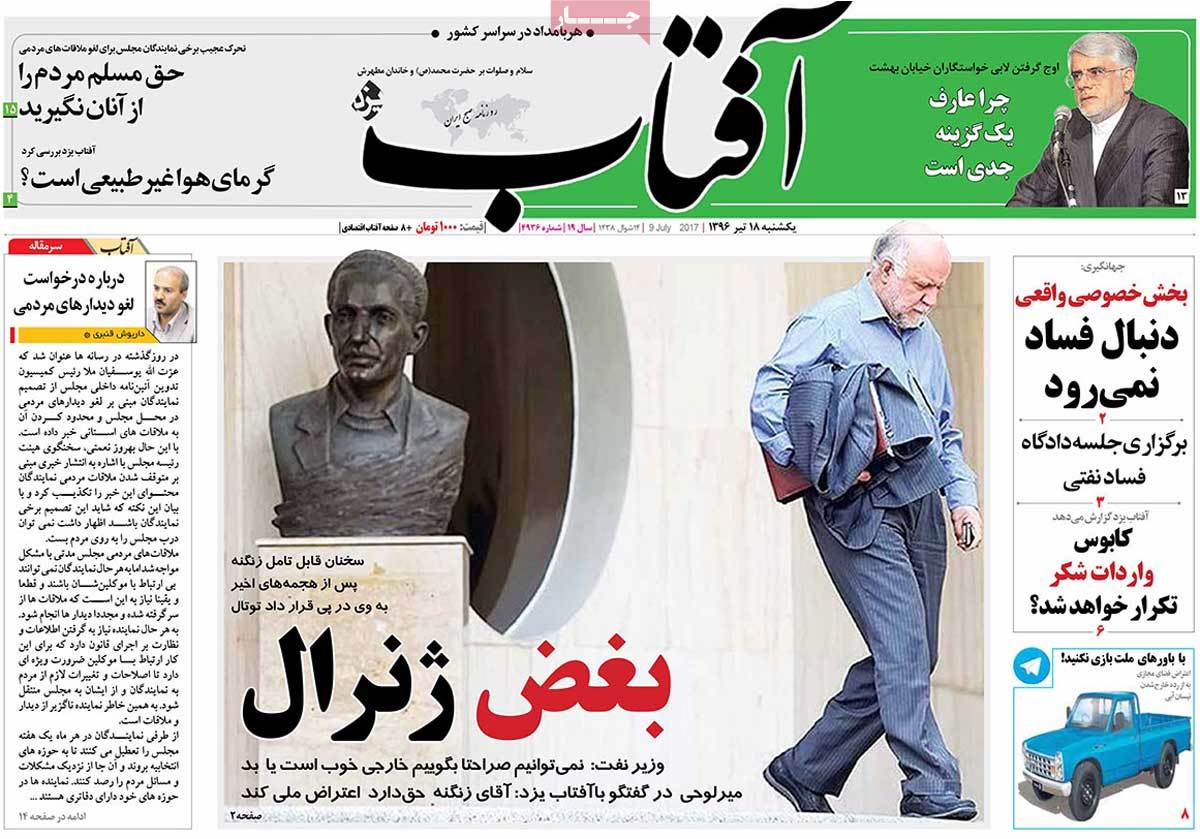
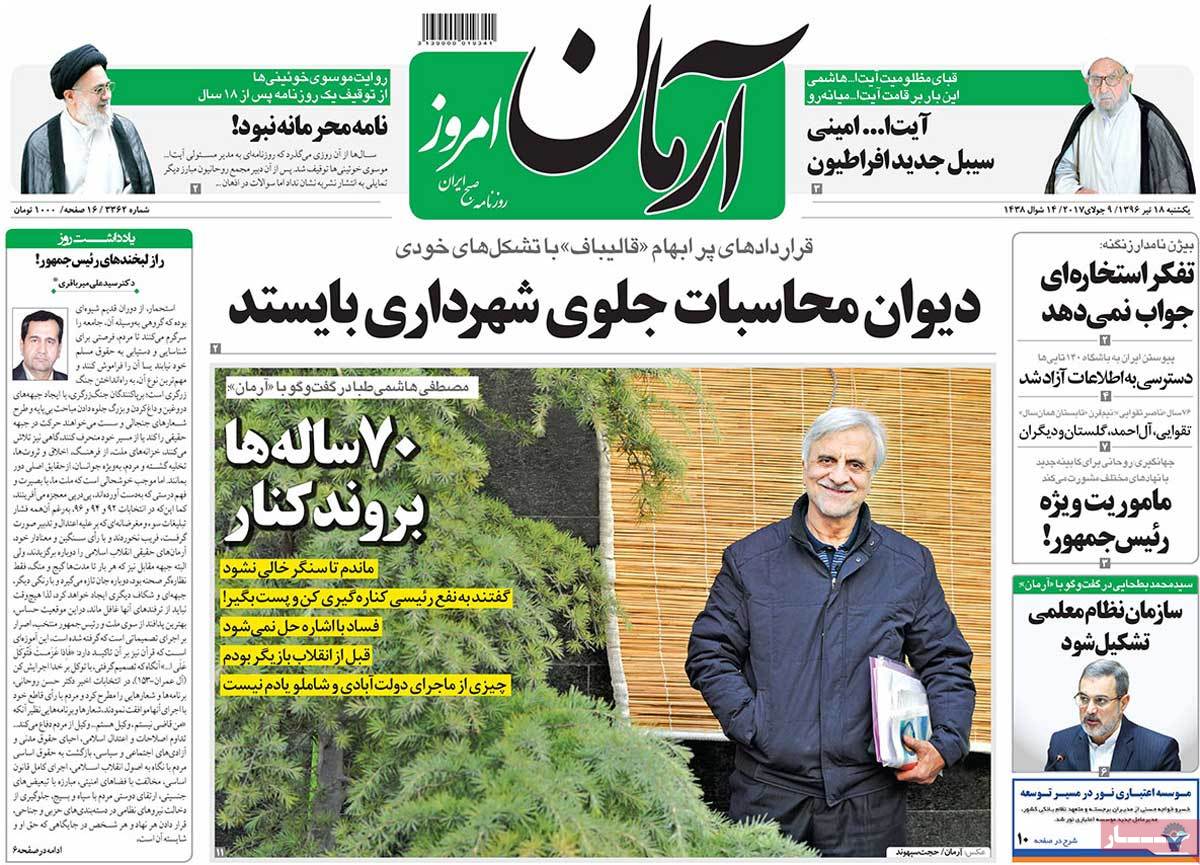
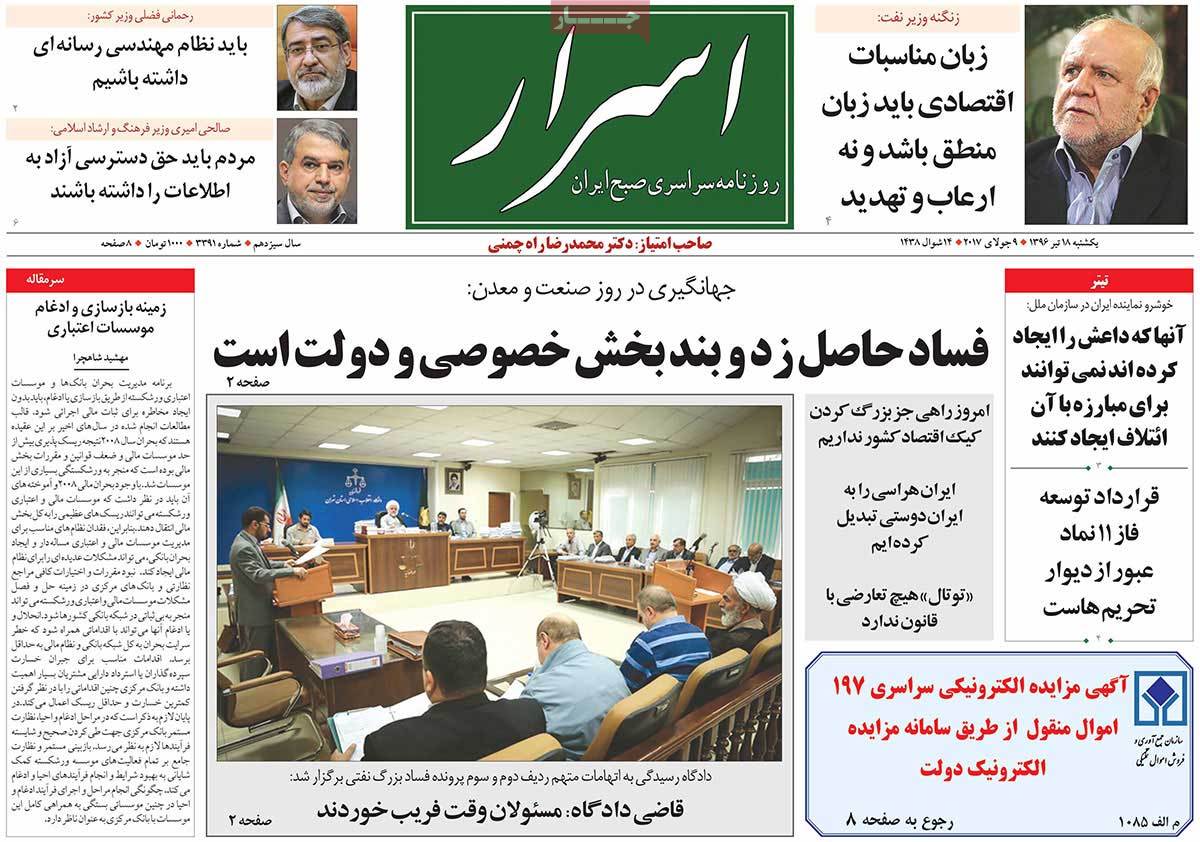
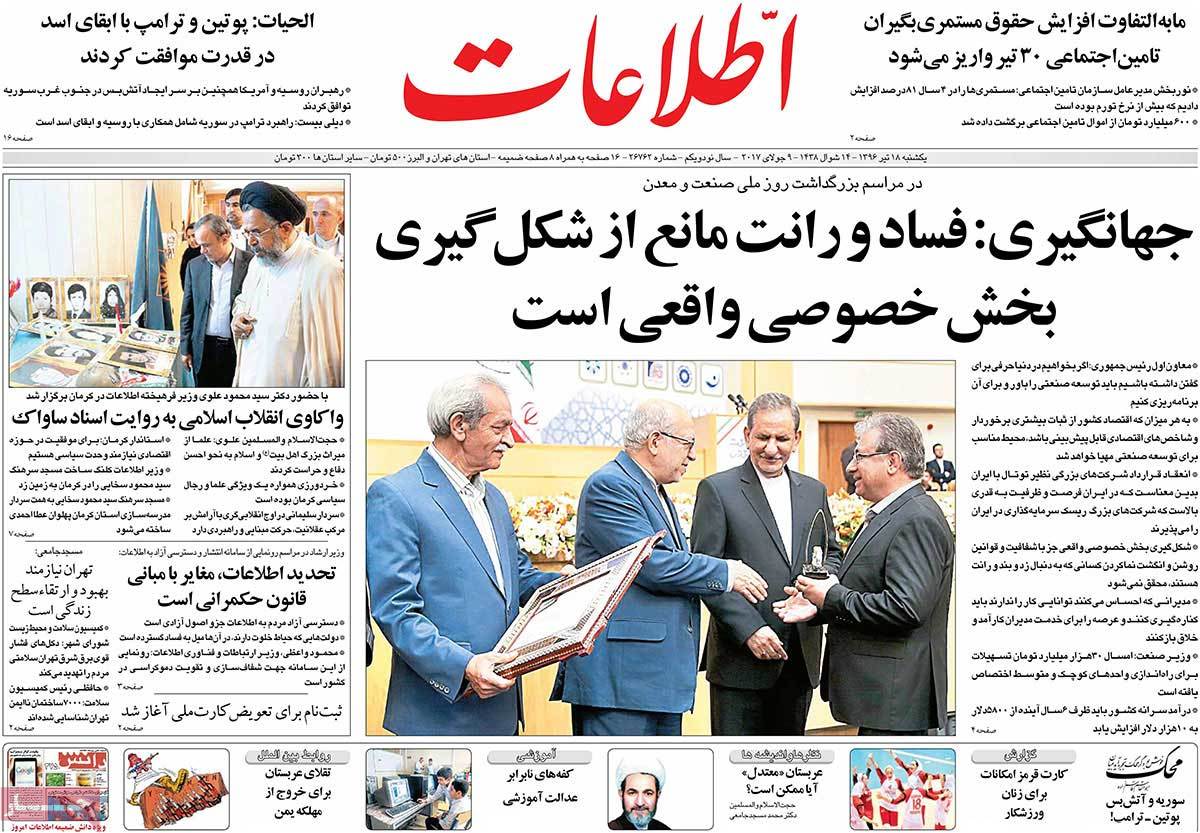
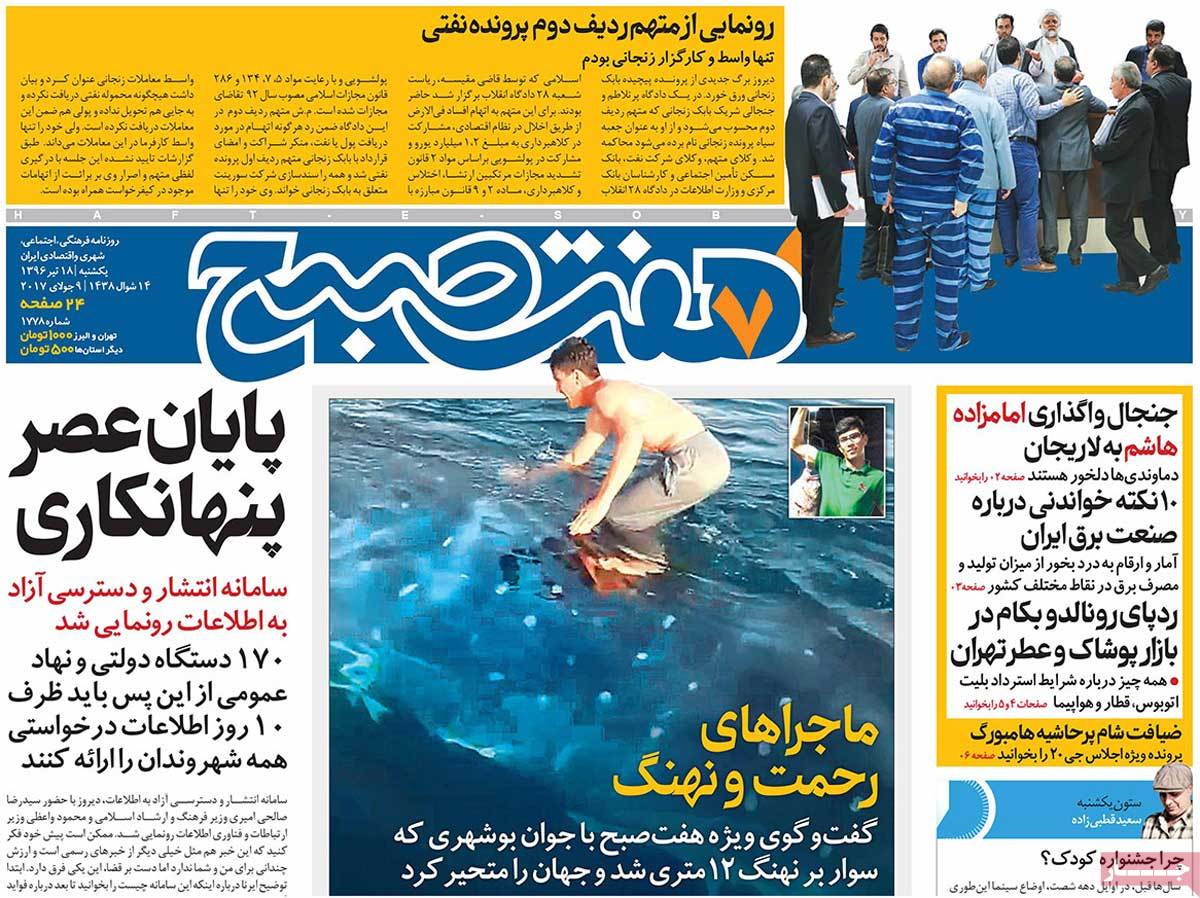
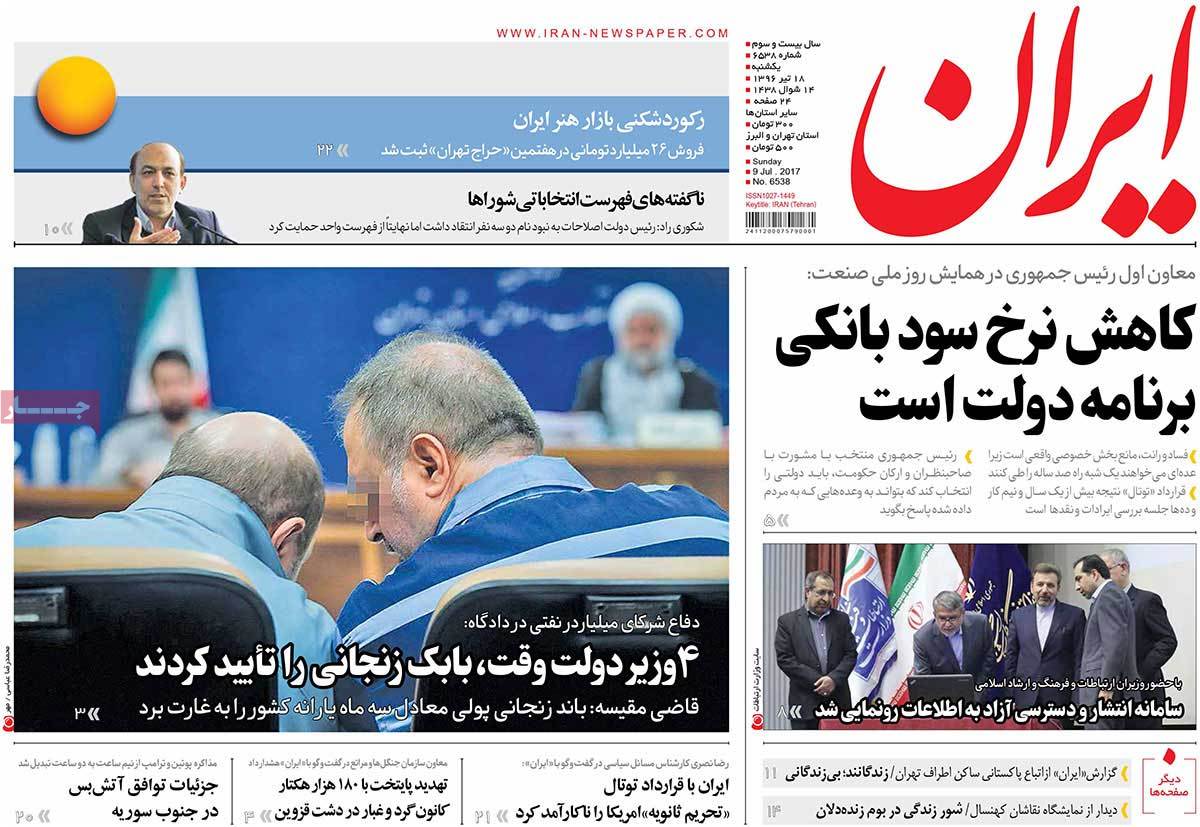
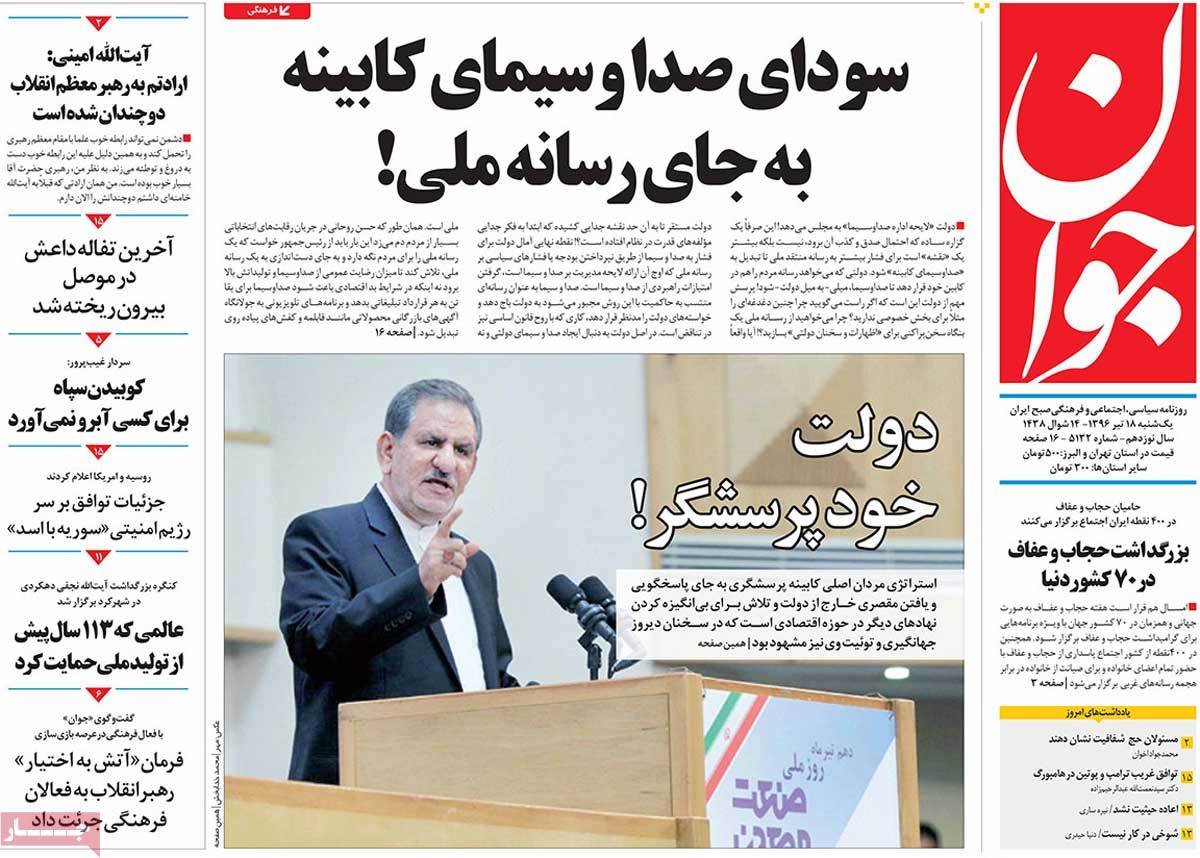
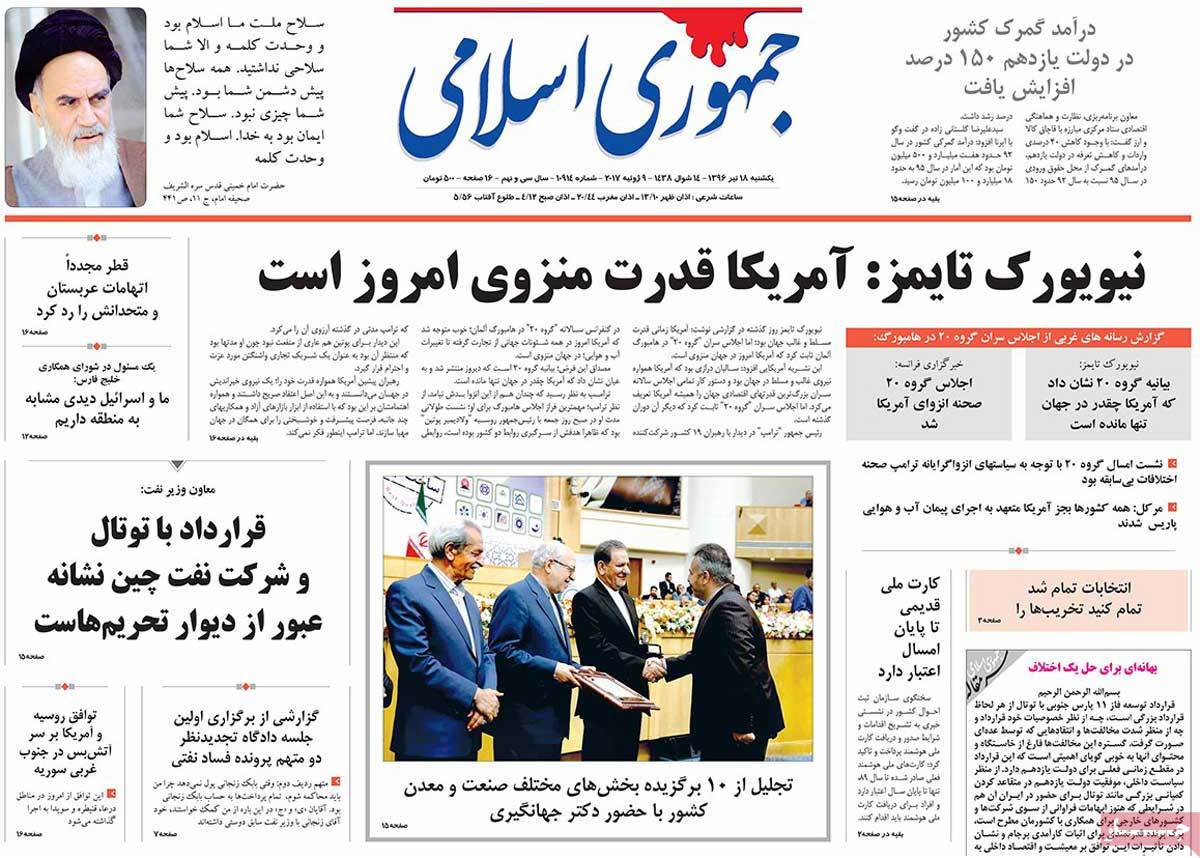
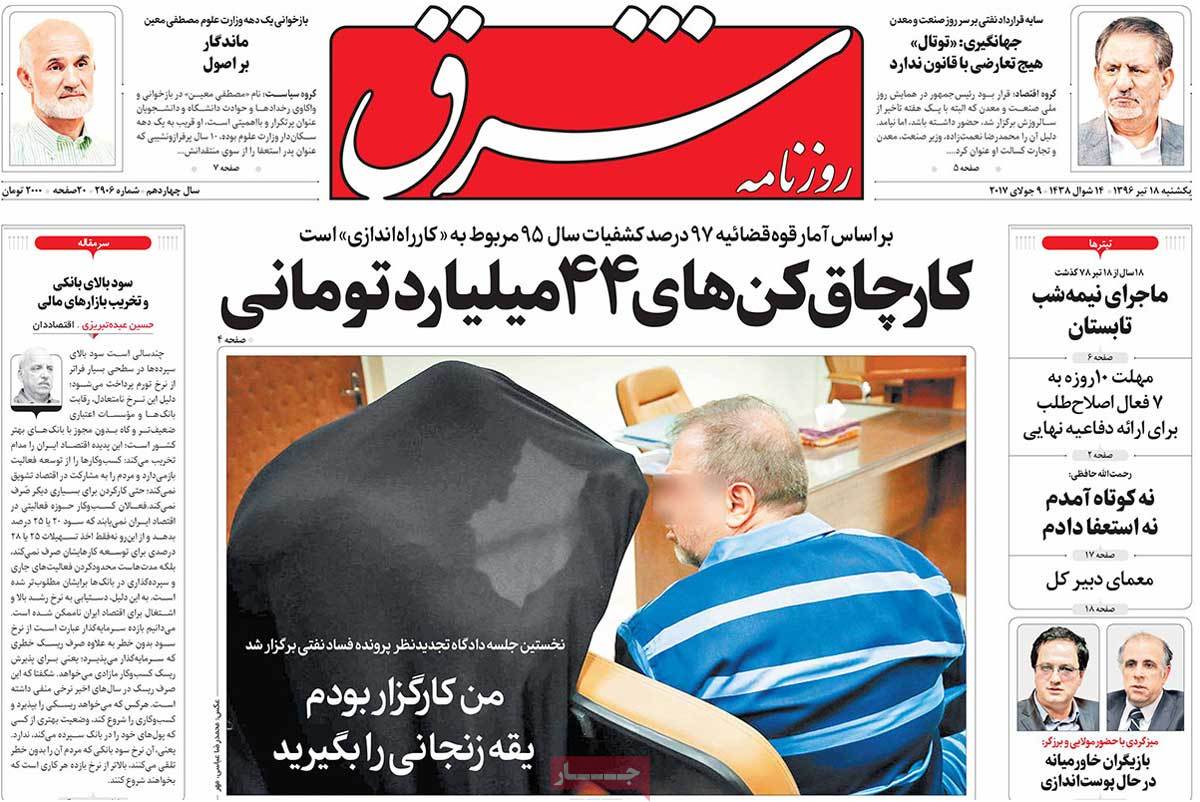
A Look at Iranian Newspaper Front Pages on July 9

Newspapers today covered the remarks made by First Vice-President Es’haq Jahangiri about the need for trusting and reinforcing the country’s private sector.

The huge gas deal with Total also remained a top story after a week. Conservative newspapers criticized the secrecy of the deal, and pro-government papers covered Oil Minister Bijan Namdar Zanganeh’s response to criticisms.

Another top story was the portal unveiled by Rouhani’s administration to provide people with free access to the information of state institutions. The move is part of the government’s efforts to promote Freedom of Information (FOI) and increase transparency.

The above issues, as well as many more, are highlighted in the following headlines and top stories:


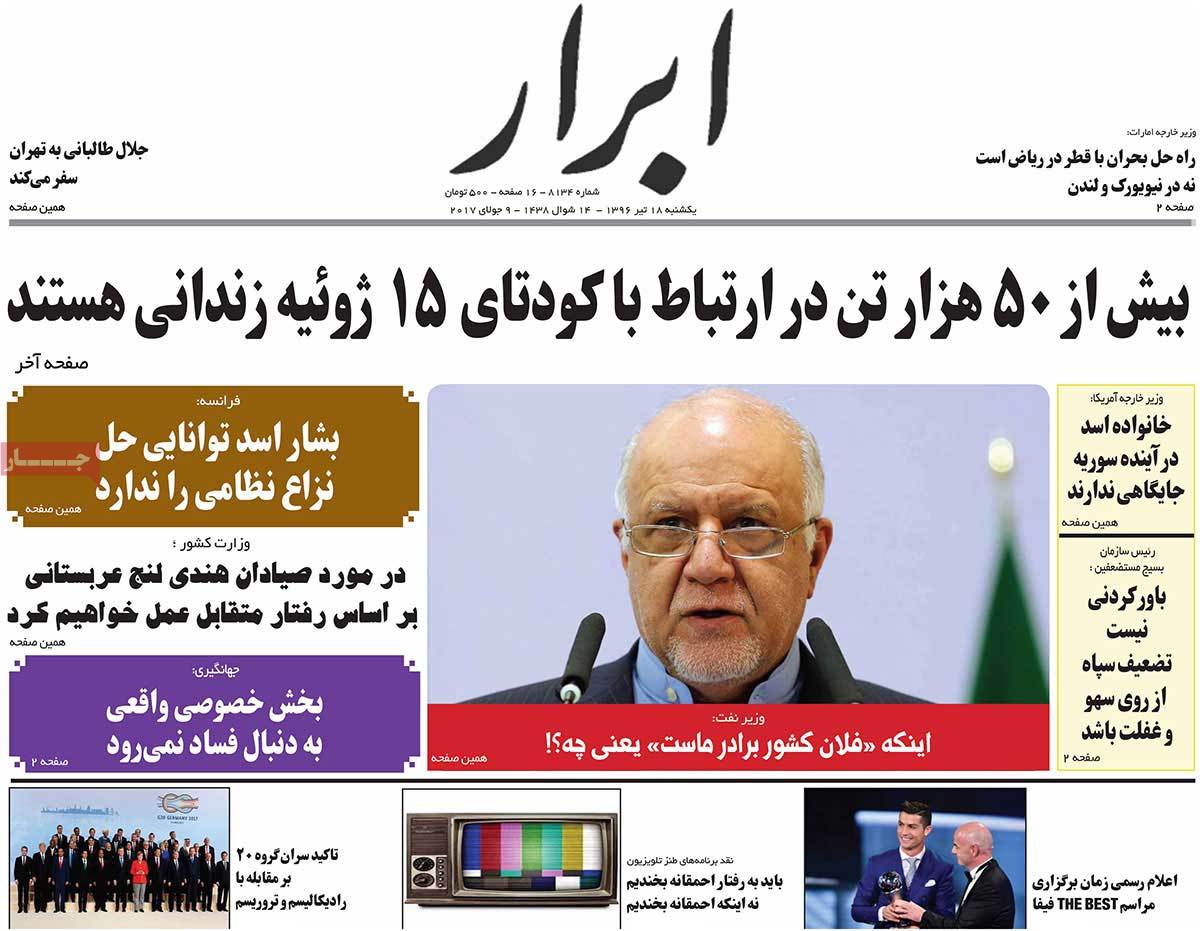
Abrar:

1- Oil Minister: What Does It Mean ‘That Country Is Our Brother’?

2- Iran to Take Reciprocal Measures against Indian Sailors of Trespassing Saudi Boat

A Look at Iranian Newspaper Front Pages on July 9 - abrar


Aftab-e Yazd:

1- The General’s Thought-Provoking Remarks after Attacks on Total Deal [The General refers to Oil Minister Zanganeh]


A Look at Iranian Newspaper Front Pages on July 9 - aftab


Arman-e Emrooz:

1- 70-Year-Old Officials Should Leave Office: Hashemitaba


A Look at Iranian Newspaper Front Pages on July 9 - arman


Asrar:

1- Oil Minister: Logic, Not Intimidation and Threat, Is Language of Economic Ties

2- Culture Minister: People Should Have Right to Freely Access Information

3- First VP: Corruption Result of Gov’t-Private Sector Collusion

4- Iran Envoy to UN: Those Who Created ISIS Cannot Form Coalition for Fighting It

A Look at Iranian Newspaper Front Pages on July 9 - asrar


Ettela’at:

1- Corruption Preventing Formation of Real Private Sector

2- Al-Hayat: Putin, Trump Agree on Assad’s Remaining in Power

A Look at Iranian Newspaper Front Pages on July 9 - etelaat


Haft-e Sobh:

1- Interview with Young Man Who Rides 12-Metre Whale Shark in Persian Gulf

2- Era of Keeping Secrets Over: Portal Unveiled for People’s Free Access to Information

  • All State Institutions Obliged to Respond to People’s Requests within 10 DaysA Look at Iranian Newspaper Front Pages on July 9 - haftesobh

Iran:

1- Partners of Babak Zanjani Defend Him: 4 Ahmadinejad Ministers Approve of Him

2- Judge Moghiseh: Zanjani’s Team Plundered Iran’s Money

3- Reza Nasri: Iran-Total Deal Makes US Secondary Sanctions Ineffective

4- Iran’s Art Market Breaks Records: 7 Million Dollars of Artworks Sold in Tehran Auction

A Look at Iranian Newspaper Front Pages on July 9 - iran


Javan:

1- Rouhani’s Gov’t Trying to Pin Blames on Others Instead of Being Accountable

2- Hijab to Be Commemorated in 70 Countries

A Look at Iranian Newspaper Front Pages on July 9 - javan


Jomhouri Eslami:

1- New York Times: US Isolated Power of Today’s World

2- Deputy Oil Minister: Deal with Total, China Shows Wall of Sanctions Broken

A Look at Iranian Newspaper Front Pages on July 9 - jomhori


Kayhan:

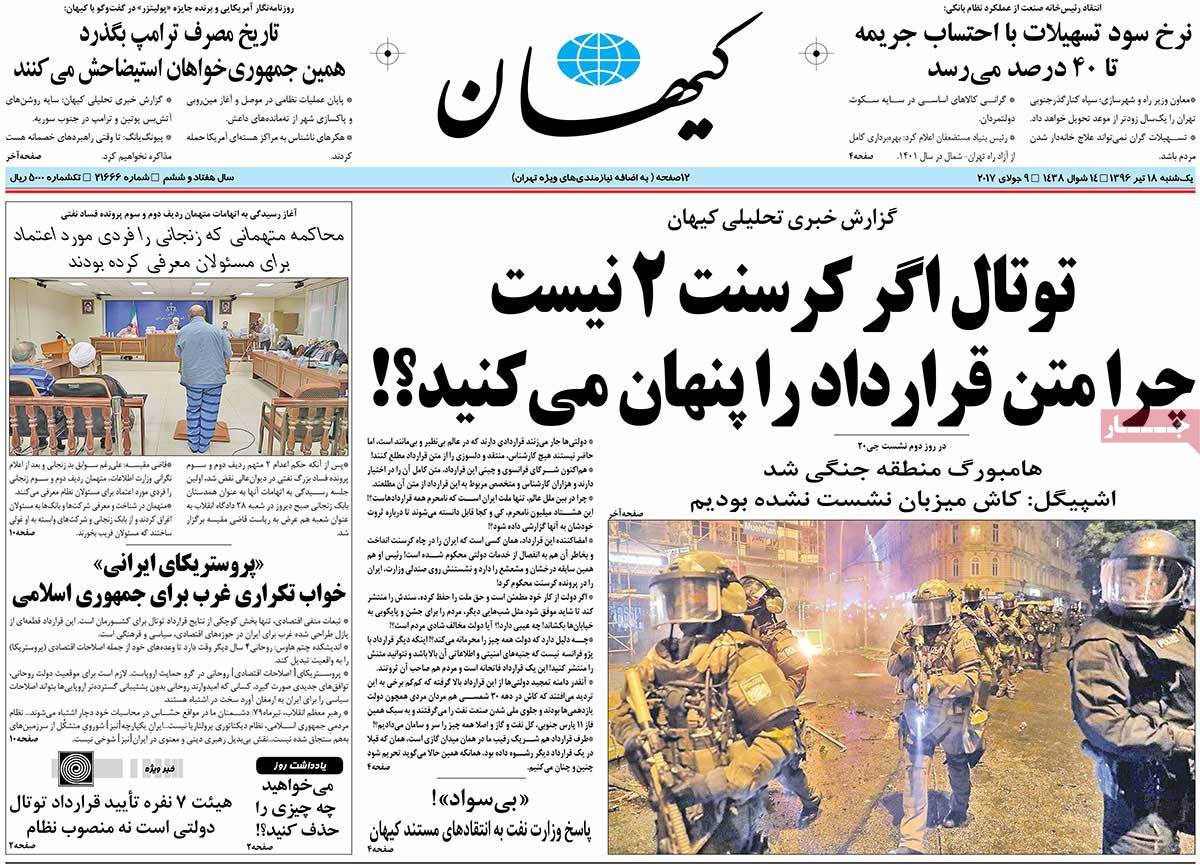
1- If Total Deal Isn’t another Crescent, Why Does Gov’t Hide Its Text?

2- GOP to Impeach Trump Once His Expiry Date Reached: US Pulitzer-Winning Journalist

A Look at Iranian Newspaper Front Pages on July 9 - kayhan


Resalat:

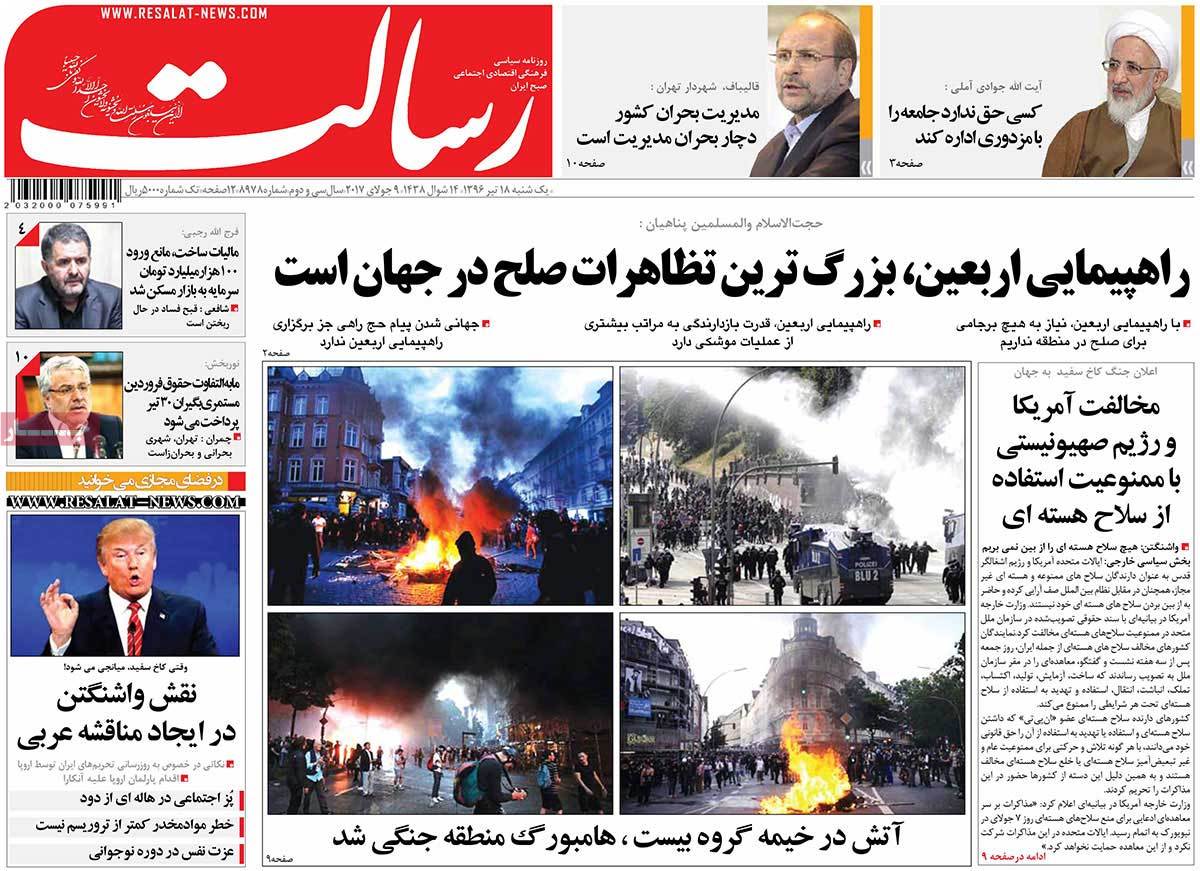
1- Fire on G20 Camp: Hamburg Turns into War Zone

2- Tehran Mayor: Serious Management Crisis in Iran’s Crisis Management

A Look at Iranian Newspaper Front Pages on July 9 - rasalat


Rooyesh-e Mellat:

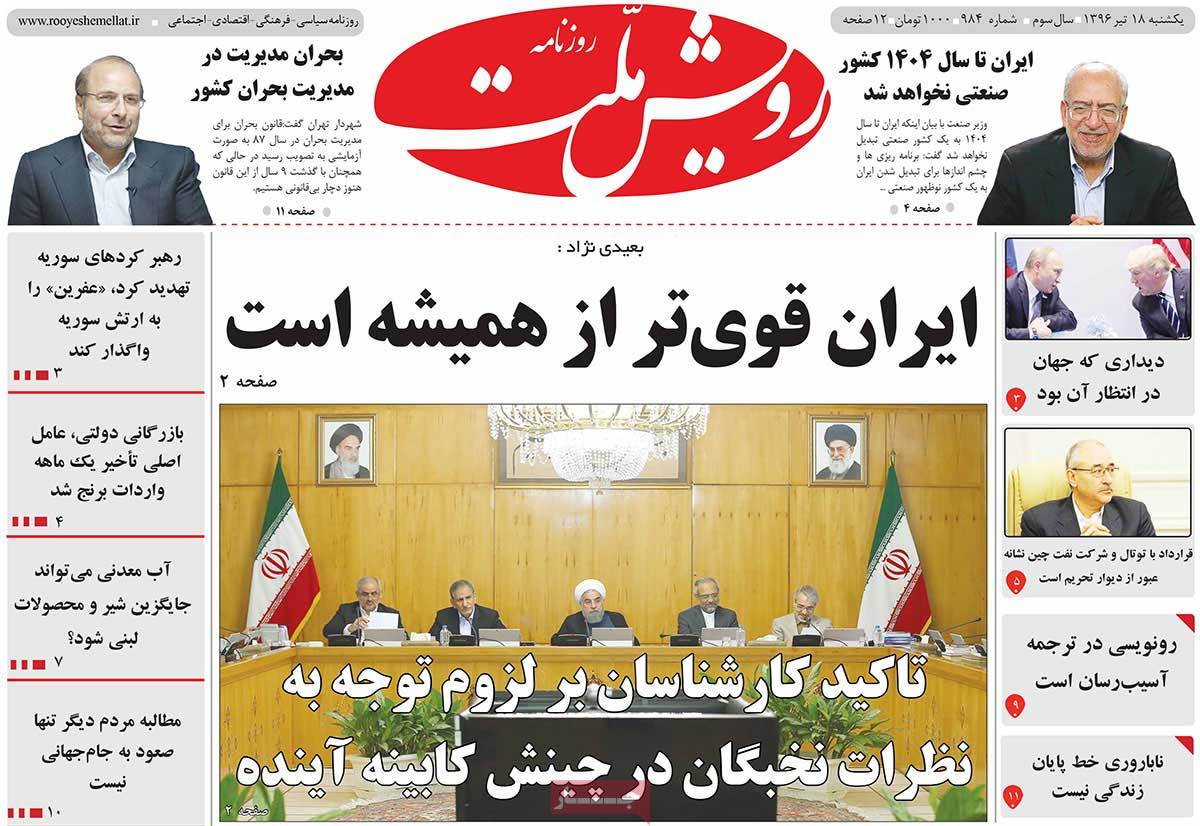
1- Trade Minister: Iran Not to Become Industrial State by 2025

A Look at Iranian Newspaper Front Pages on July 9 - royeshmellat


Shahrvand:

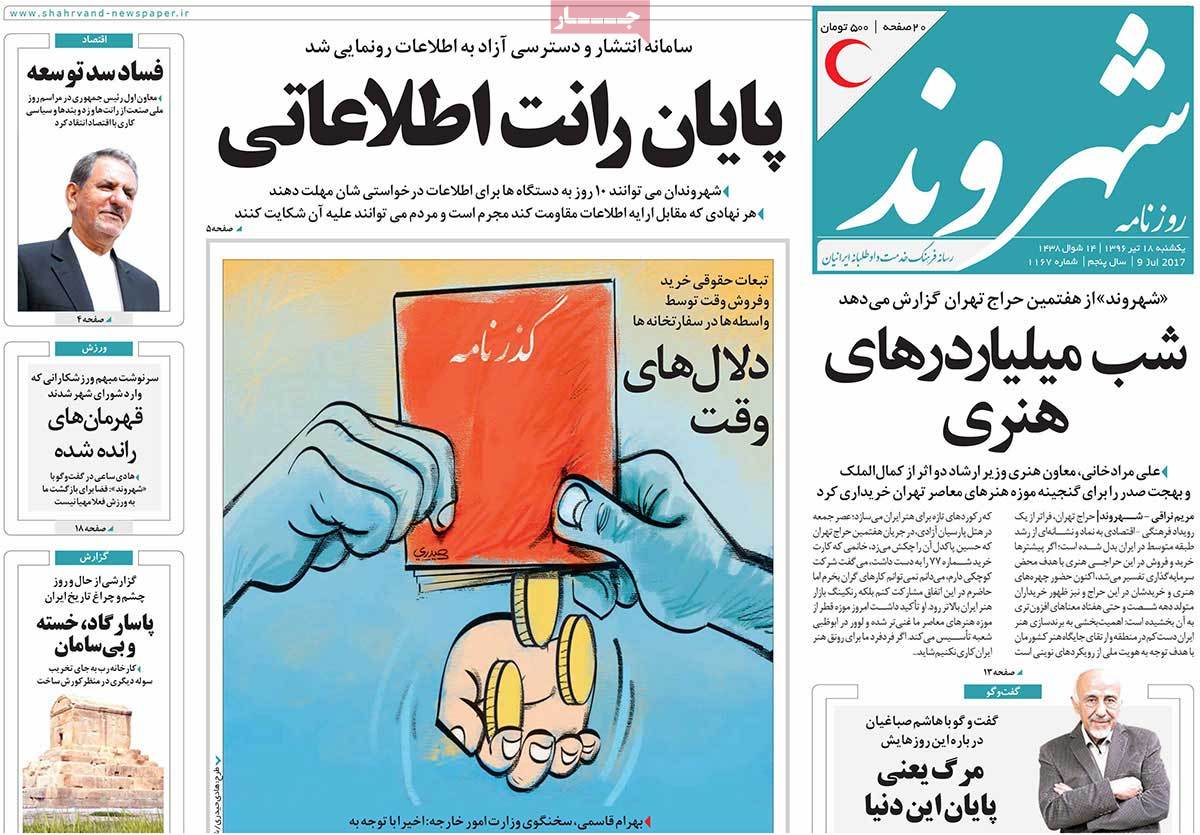
1- Middlemen Making Money by Selling, Buying Visa Appointments

A Look at Iranian Newspaper Front Pages on July 9 - shahrvand


Shargh:

1- Shadow of Oil Deals on National Day of Industry and Mine

2- First VP: Total Deal Not against Iran’s Law

A Look at Iranian Newspaper Front Pages on July 9 - shargh

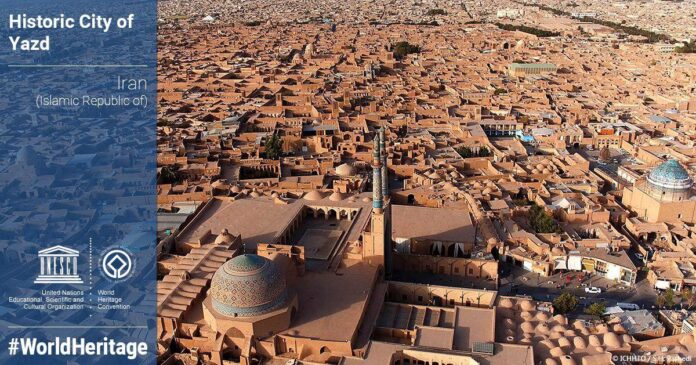
Historical City of Yazd Inscribed as World Heritage Site

yazd

The site was inscribed as a world heritage during the 41st session of UNSCO’s World Heritage Committee in Krakow, Poland, on Sunday, July 9.

The historical structure of Yazd is a collection of public-religious architecture in a very large scope comprising of different Islamic architectural elements of different periods in a harmonious combination with climatic conditions.

Iran had submitted its request for the addition of Yazd to the world heritage list back in 2007.