Saturday, December 27, 2025
Home Blog Page 3809

A Look at Iranian Newspaper Front Pages on November 11

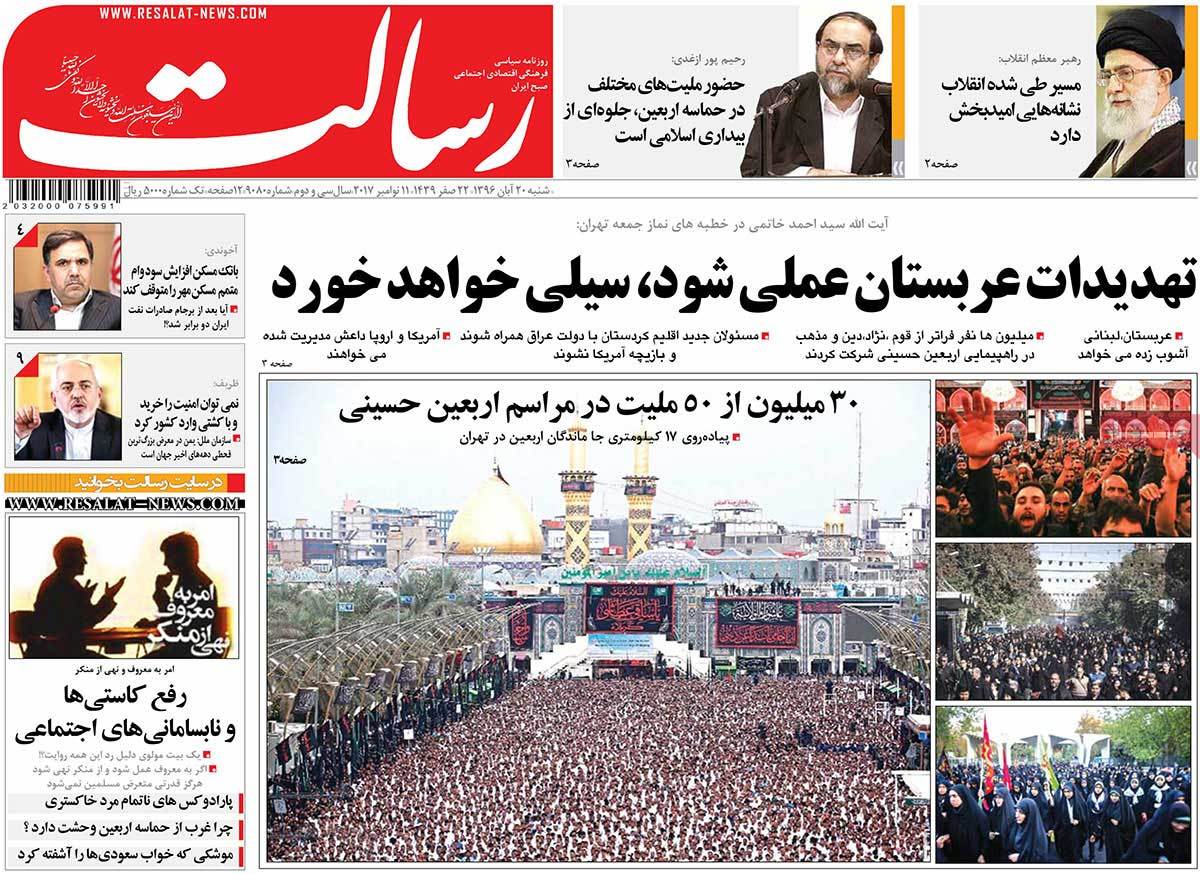
Almost all newspapers covered the participation of millions of Shiite pilgrims from Iran and other countries in the Arba’een pilgrimage, the world’s largest religious gathering, in the Iraqi city of Karbala.

The continued reactions to Lebanese Prime Minister Saad Hariri’s surprise resignation in Saudi Arabia also remained a top story in today’s newspapers. Several papers particularly covered the latest remarks made by Lebanese Resistance Movement Hezbollah Secretary General Sayyed Hassan Nasrallah about Riyadh’s house arrest of Hariri.

The comments made by Iranian Foreign Minister Mohammad Javad Zarif in a security conference in Uzbekistan’s Samarkand, and his meeting with EU Foreign Policy Chief Federica Mogherini also received great coverage.

The above issues, as well as many more, are highlighted in the following headlines and top stories:


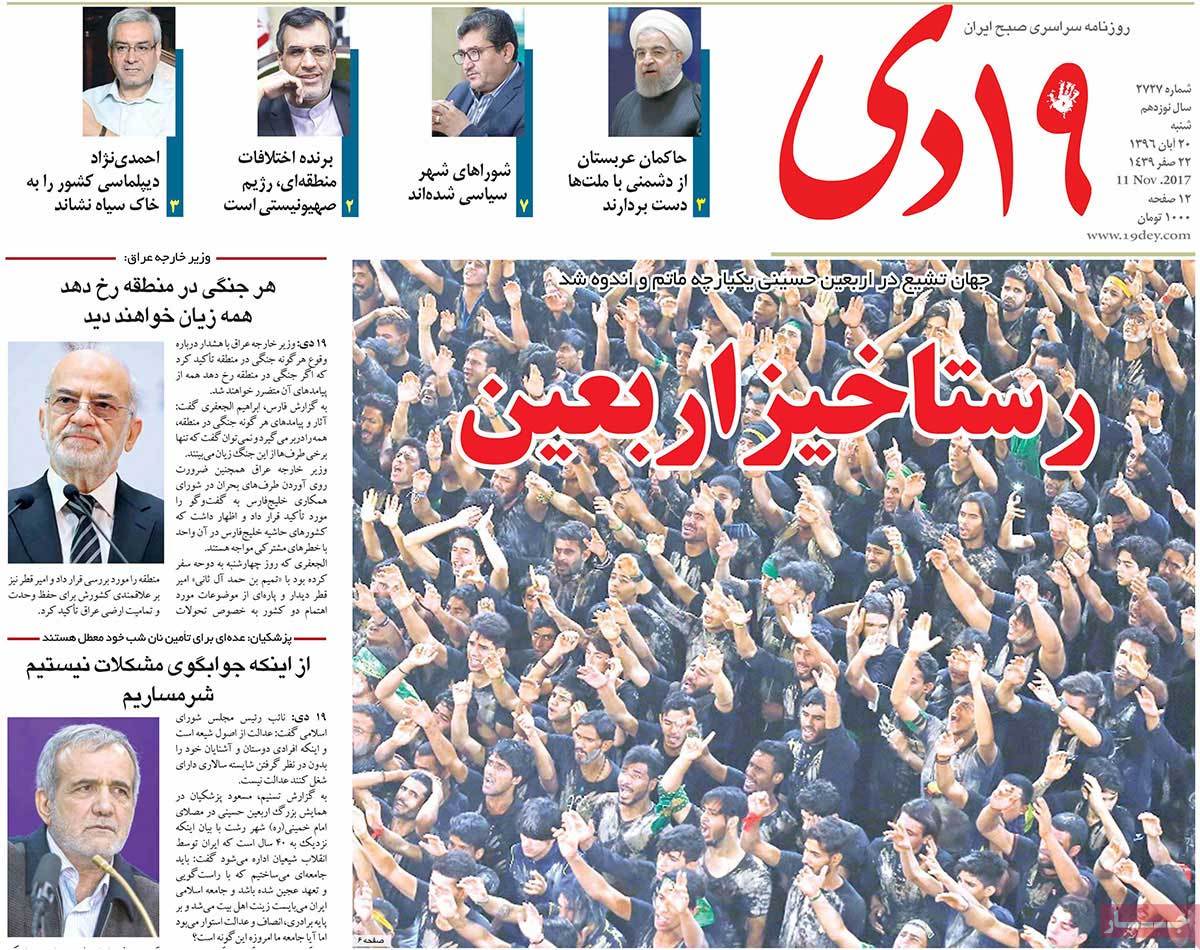
19 Dey:

1- Resurrection of Arba’een: Shiite World Mourn for Imam Hussein

2- Iraqi FM: Everyone to Lose If War Breaks Out in Middle East

3- Iran Deputy FM: Regional Conflicts to Benefit of Israeli Regime
A Look at Iranian Newspaper Front Pages on November 11


Abrar:

1- Lebanon’s Future Movement: Hariri’s Return Necessity for Lebanon Balance

2- Senior Iranian Cleric: Clergymen’s Engagement in Politics Lessens Their Popularity

  • Clerics Used to Be Respected, Popular among Iranians

3- Zarif: Placing Bad Bets on Wrong Choice to Only Lead to Further Crises
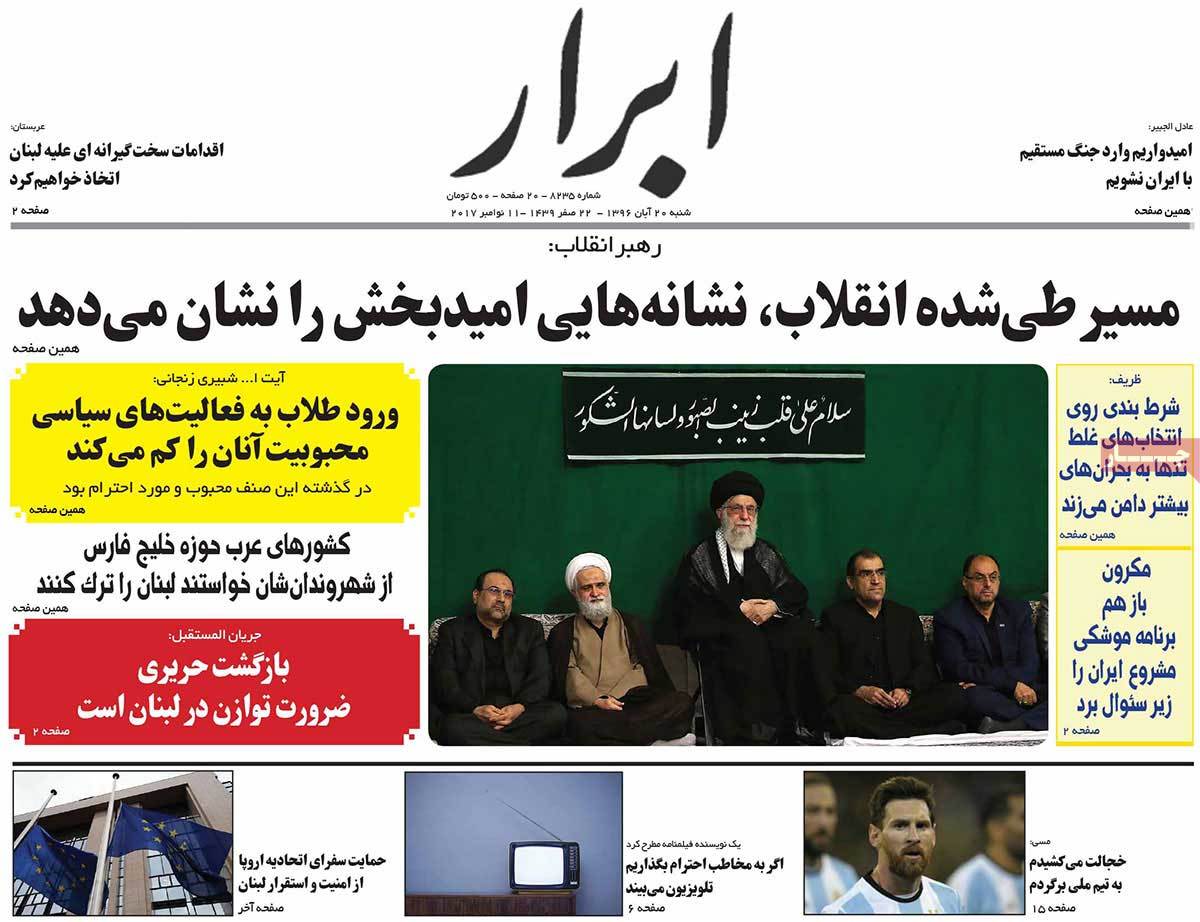
 

A Look at Iranian Newspaper Front Pages on November 11


Aftab-e Yazd:

1- The Current Sensitive Juncture: A Review of Regional Developments in Past Days

2- Iran Leader: Path of Revolution So Far Shows Promising Signs
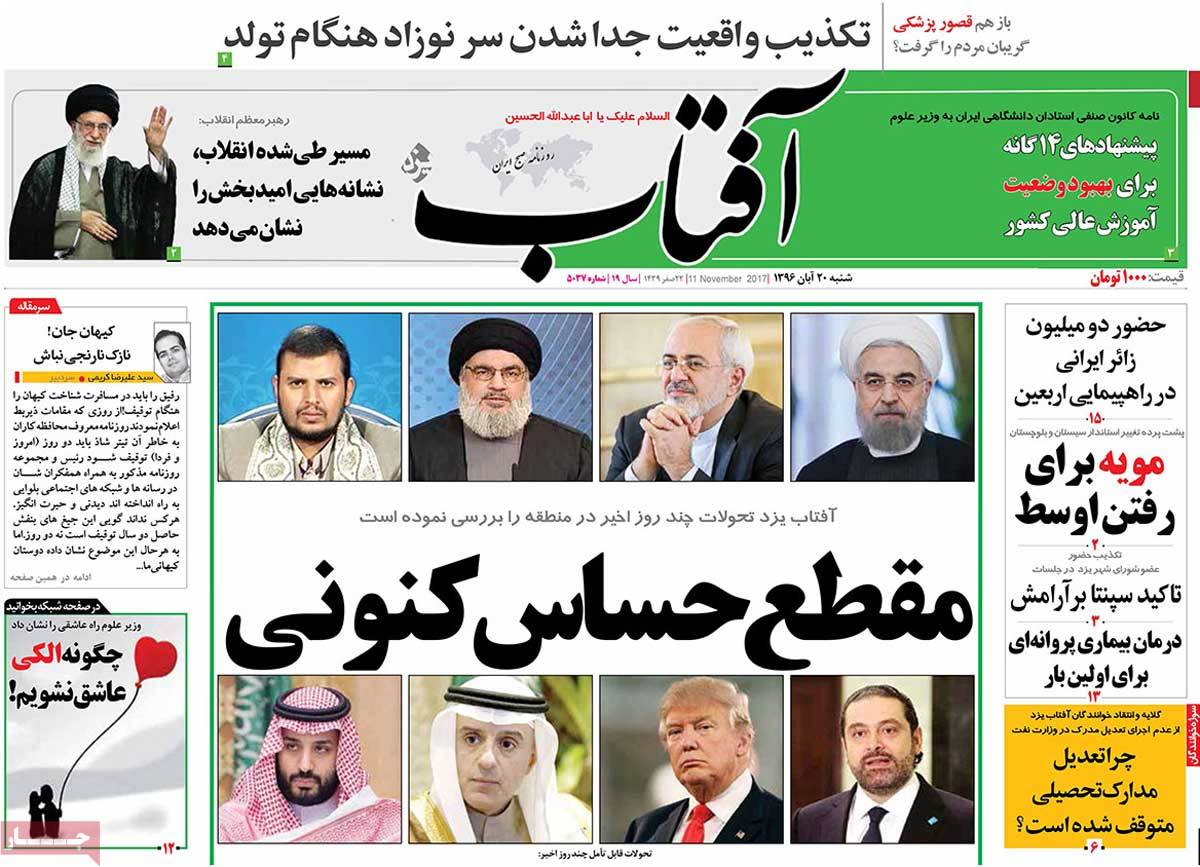
A Look at Iranian Newspaper Front Pages on November 11


Arman-e Emrooz:

1- Saad Hariri Taken Hostage by Saudis

  • Nasrallah: We Support Future Movement, Want Hariri to Return
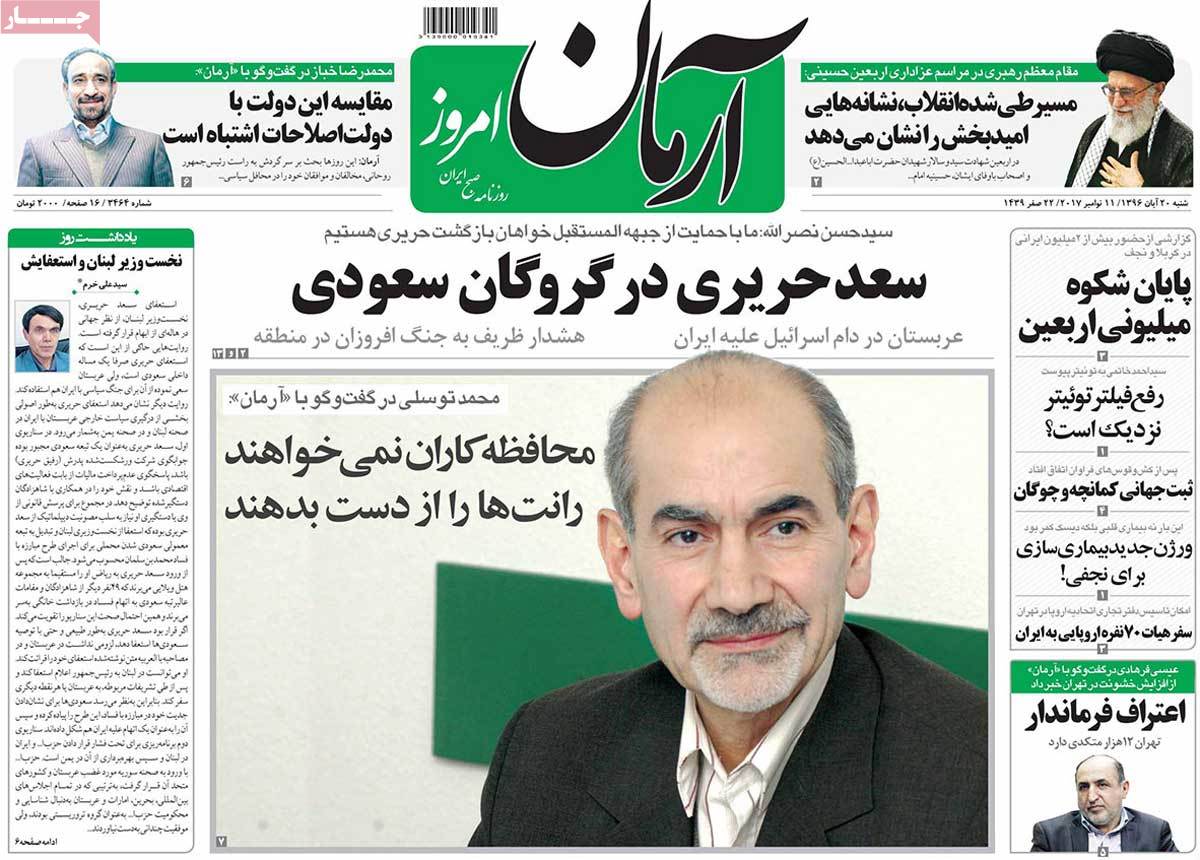
 

A Look at Iranian Newspaper Front Pages on November 11


Asrar:

1- Zarif: Iran Opposed to Development, Use of Nuclear Weapons

2- Mogherini: JCPOA Great Achievement of Int’l Diplomacy
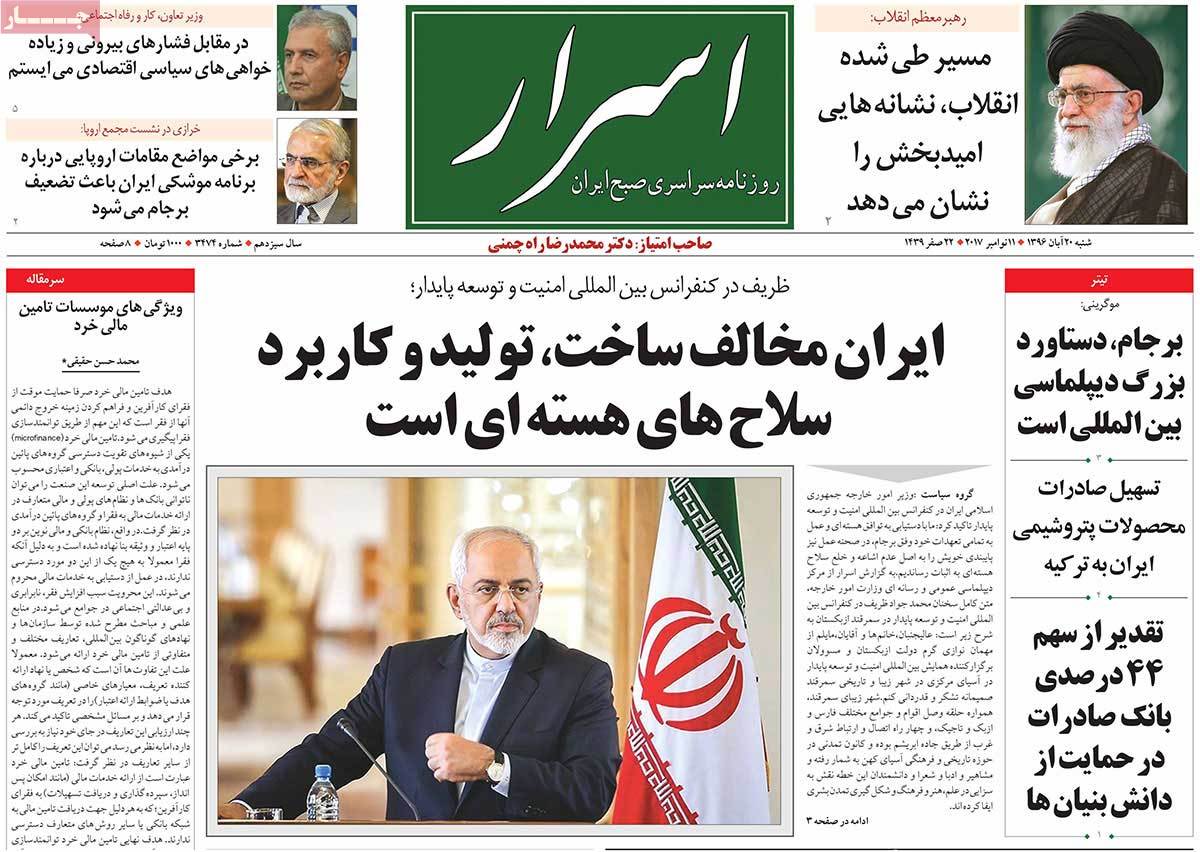
 

A Look at Iranian Newspaper Front Pages on November 11


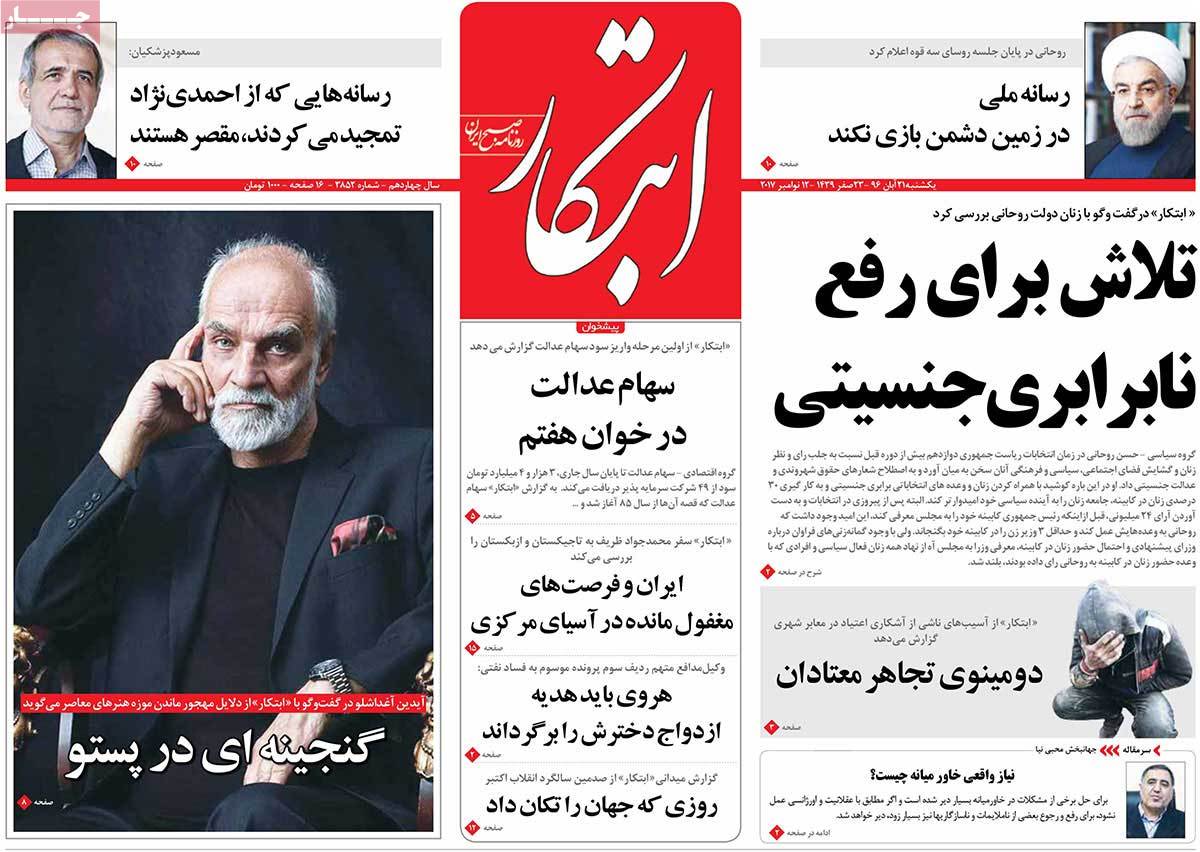
Ebtekar:

1- Rouhani: People’s Massive Attendance in Arba’een Serious Message to Regional Plotters

2- World Security Not Limited to Military Aspects: Zarif
 

A Look at Iranian Newspaper Front Pages on November 11


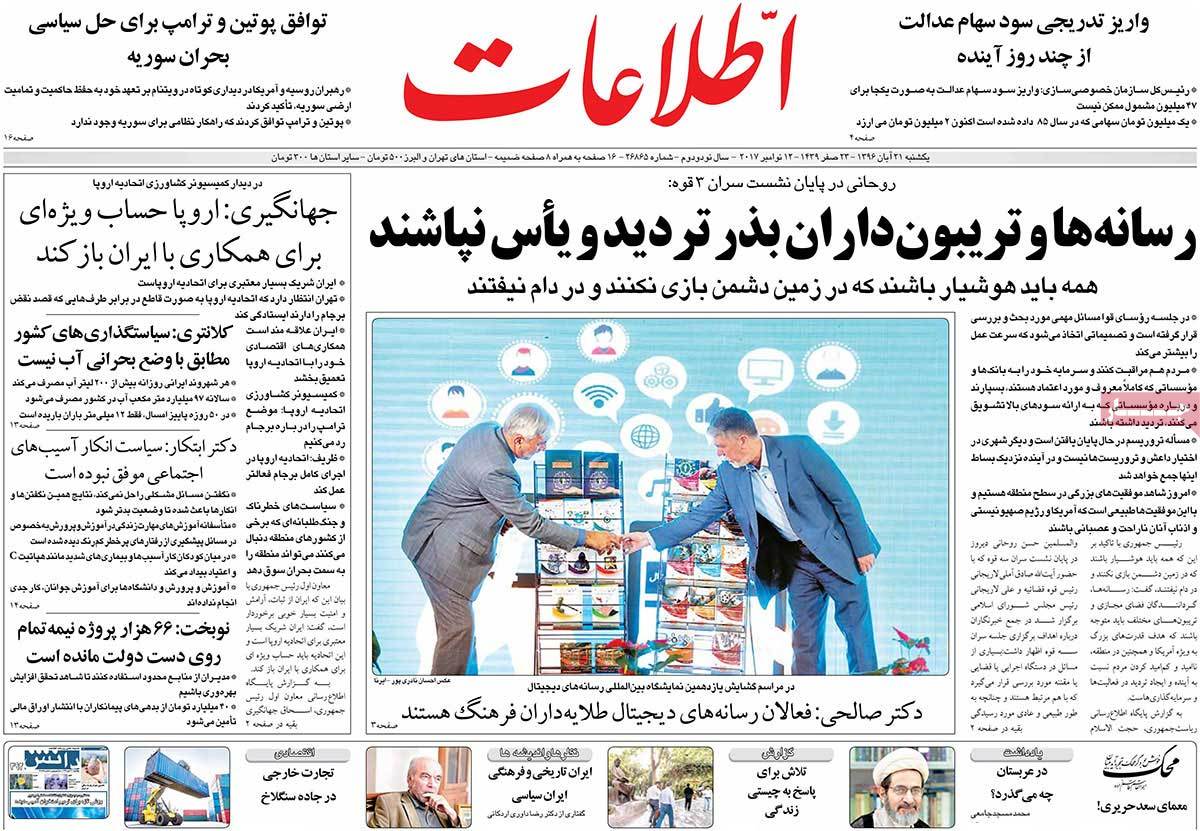
Ettela’at:

1- Muslims’ Biggest Gathering in Iraq’s Karbala: Over 2.5 Million Iranians Attend Arba’een

2- Saudi Arabia Convinced Israel to Attack Lebanon: Nasrallah

3- Iran’s Missile Power Has Nothing to Do with Nuclear Deal: Mogherini

4- Iran FM: Effective Fight against Extremism Needs Regional Countries’ Interaction
A Look at Iranian Newspaper Front Pages on November 11


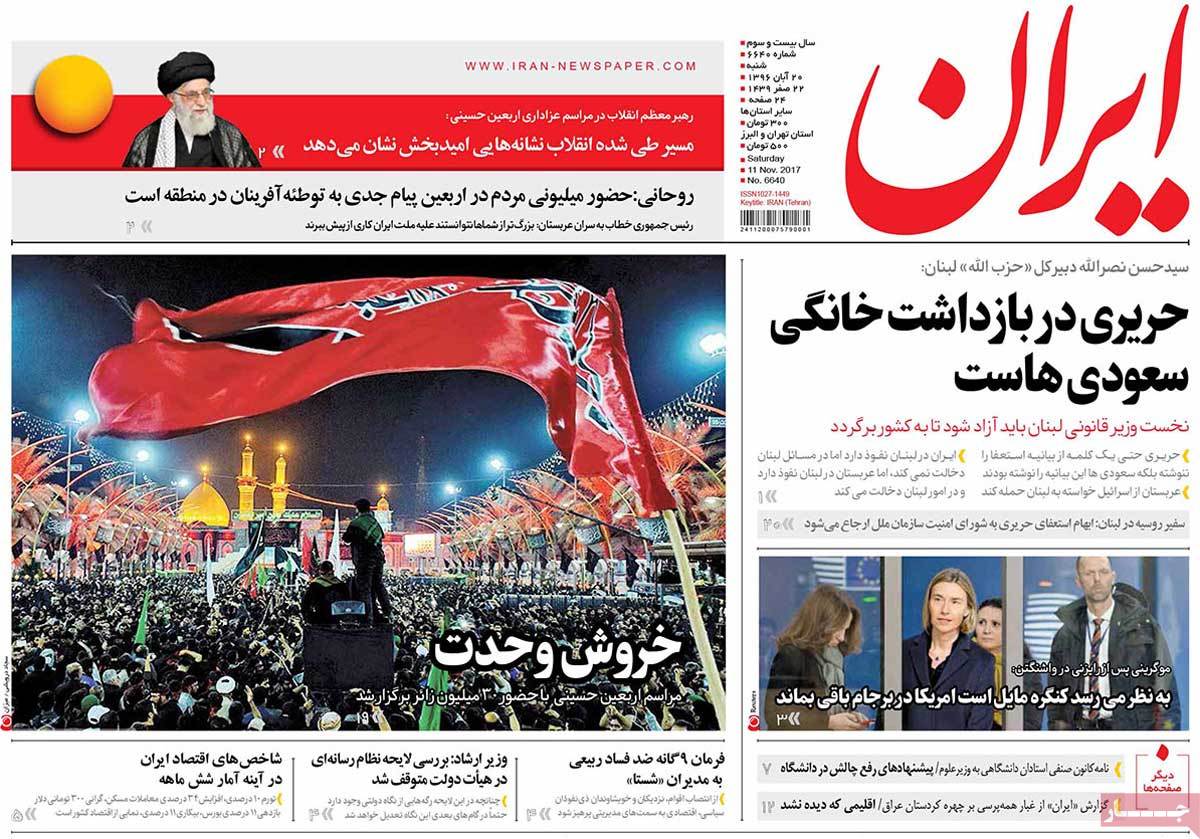
Iran:

1- Nasrallah: Hariri under House Arrest of Saudis

2- Mogherini: Congress Seems Interested in US Staying in Iran Nuclear Deal
 

A Look at Iranian Newspaper Front Pages on November 11


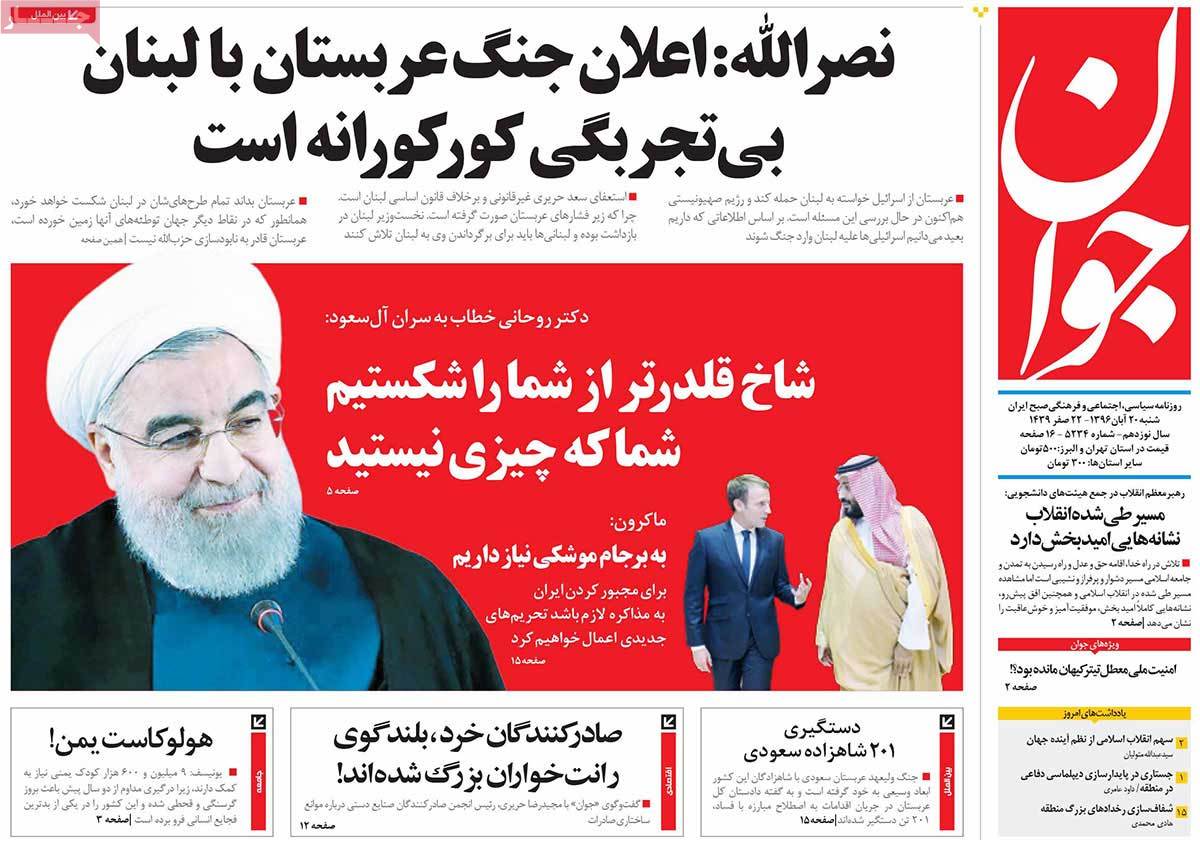
Javan:

1- Rouhani to Al Saud Leaders: We’ve Defeated Enemies Even Stronger than You!

2- Hezbollah Chief: Saudi Arabia’s Declaration of War on Lebanon ‘Blind Amateurism’

3- Macron: We Need another JCPOA on Iran’s Missile Power
A Look at Iranian Newspaper Front Pages on November 11


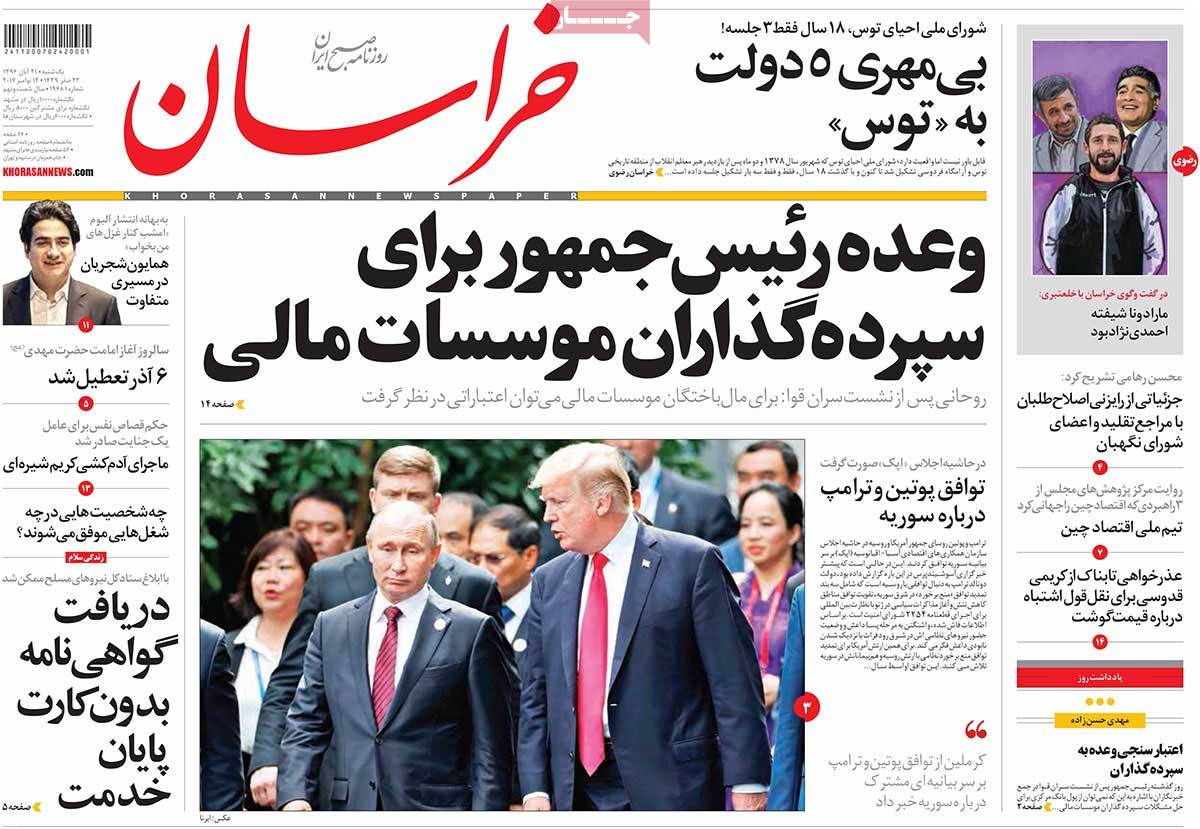
Khorasan:

1- End of ISIS Caliphate in Syria: Bukamal, Last ISIS Stronghold in Syria, Liberated
 

A Look at Iranian Newspaper Front Pages on November 11


Resalat:

1- 30 Million People from 50 Countries in Arba’een Pilgrimage

2- Ayatollah Khatami: Saudi Arabia to Be Slapped in Face If Carry Out Their Threats
 

A Look at Iranian Newspaper Front Pages on November 11


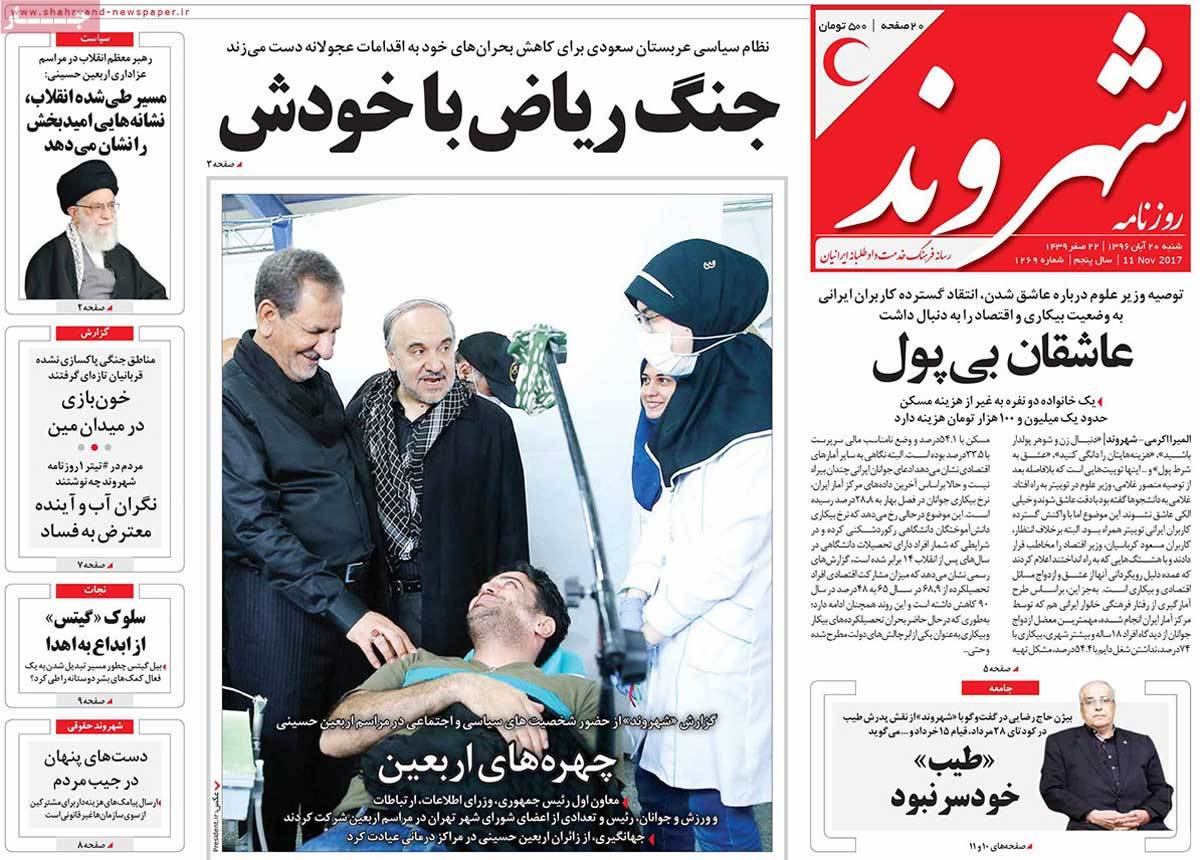
Shahrvand:

1- Riyadh’s War against Itself

  • Saudi Political System Making Hasty Decisions to Decrease Its Crises

2- Political, Social Figures in Arba’een Pilgrimage

  • Iran’s First VP, Several Ministers, Several Members of Tehran City Council in Karbala
A Look at Iranian Newspaper Front Pages on November 11


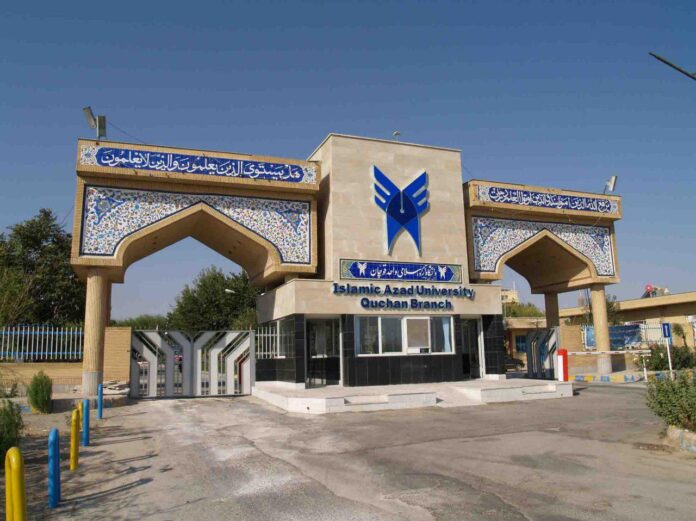
Iran to Establish University in Syria’s Idlib

A deputy head of Iran’s Islamic Azad University, Saleh Eskandari, says “Syrian President Bashar Assad has welcomed the plan to establish a branch of Islamic Azad University (IAU) in Syria.”

Assad has called on the related officials including board of directors of Iran’s IAU as well as Iranian embassy in Damascus to pave the way for the establishment of the university after making legal arrangements with the Syrian ministry for science, he added.

Outlining the details of the MoU in a Farsi interview with Fars News Agency, Eskandari also noted that the MoU was signed in a ceremony attended by Ali Akbar Velayati, an advisor to Iran’s Leader, who was visiting Idlib at the top of a delegation.

He described the presence of Velayati in the signing ceremony as “strategic” and said the agreement was signed between the representatives of Idlib University and Azad University.

“The MoU as well as talks we held with the Syrian officials on the scientific and educational cooperation reveal the fact that the two sides’ relations are not limited to military and security issues. We also have good cooperation in economic and cultural fields,” he noted.

Eskandari went on to say that the signing of the MoU sends a strong message to terrorists as well as the US-led coalition and the Zionists that, due to the resistance of Syria and its allied forces, cities like Idlib are secure enough for a visit by an Iranian delegation and establishment of a university by the Iranian government.

He also referred to the meeting between the Iranian delegation and Syrian president and said during the meeting Assad warmly welcomed the idea of creating an Iranian university in Syria and asked the delegation to make the arrangements as soon as possible.

“President Assad praised the Islamic Republic for its scientific progress as the honour of the Islamic world and expressed hope that Syrian youths would become more familiar with the long history and scientific capabilities of Iran,” he said.

Eskandari then touched on the talks held between Islamic Azad University’s board of directors and head of Idlib University and added in addition to the expansion of scientific and educational cooperation, the two sides are also expected to exchange students and professors.

“Idlib University has 130,000 students and despite the chaos in the besieged city, the university has not remained closed even for one single day,” he added, saying this is mainly due to the resistance shown against the terrorists by the Syrian government and its allied forces backed by the Islamic Republic.

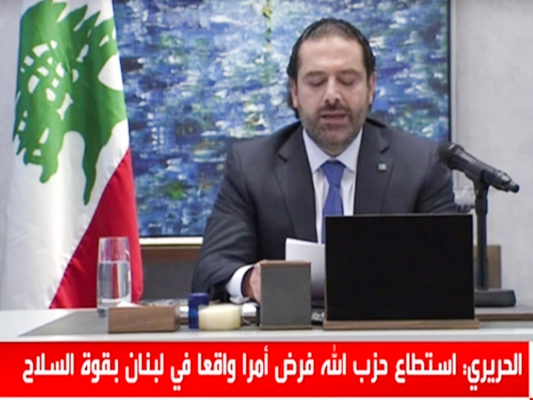
Hariri under Pressure throughout Resignation Video: Expert

Hariri

Nazar Nasrallah, a body language expert, says a review of Hariri’s body language during his resignation video broadcasted by Al-Arabiya TV channel reveals he was under a huge psychological pressure.

Nasrallah referred to the black and blue wrist watch that Hariri usually wears on his left hand and said the absence of the watch was visible during the video.

“The watch may have been taken from him so that he couldn’t make any contact with others because as we know, he usually wears the watch in all his formal and informal meetings.”

According to a Farsi report by ISNA, the expert also pointed to the forward-leaning shoulders of Hariri throughout the video and said human’s shoulders usually lean forward when we are under pressure. This shows that Hariri was not comfortable while reading his resignation letter.

“The issue becomes more important as we remember that Hariri is a veteran politician who has undergone various training courses to deliver speech. But his physical status during the video reminds us of his early days in office when he was politically naive and didn’t know how to present himself to the media.”

He also referred to the eyes of Hariri and said throughout the video, Hariri constantly keeps his eyes open and “it seems he has no control over his eyes.”

According to Nasrallah, this shows either Hariri is lying or is under pressure to lie because the status of his eyes is unprecedented during his speeches.

“Throughout the video, Hariri repeatedly pushed forward his tongue. This shows that he suffered from a dry mouth, another sign of distress and his high internal tension. This comes as he had a glass of water near his hand. Meanwhile, he never opened his mouth fully to utter the words. His voice is low without any sign of confidence. Having finished reading out the resignation letter, he leaves the papers at his hand on the table, a psychological sign that he just wanted to get rid of the condition. It seems the words and sentences were dictated to him and he was threatened,” he added.

According to Nasrallah, Hariri used short sentences instead of long ones in his resignation letter and this is another sign of his distress throughout the video.

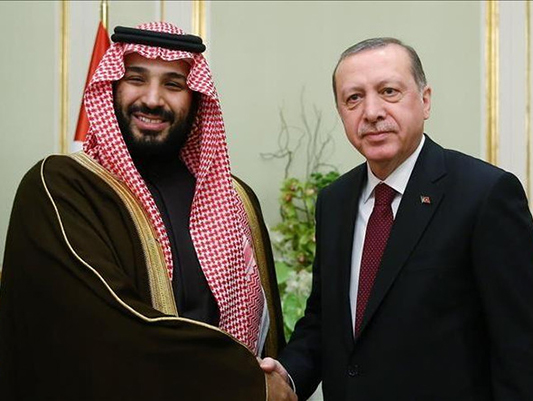
Concept of “Moderate” Islam Originates in West: Turkey’s Erdogan

Erdogan-bin salman

“Islam cannot be either ‘moderate’ or ‘not moderate.’ Islam can only be one thing,” Erdoğan said in a speech at a program hosted in Ankara by the Organization of Islamic Cooperation (OIC) on women’s entrepreneurship on November 9.

“Recently the concept of ‘moderate Islam’ has received attention. But the patent of this concept originated in the West,” Erdoğan said, according to Hurriyet Daily.

“Perhaps the person voicing this concept thinks it belongs to him. No, it does not belong to you,” he added, noting that he was “asked about ‘moderate Islam’ at meetings in the European Parliament many years ago.”

“They are now trying to pump up this idea again. What they really want to do is weaken Islam … We don’t want people to learn about religion from foreign facts,” Erdoğan said, also criticizing the previous practice banning women from driving in Saudi Arabia. The ban was recently lifted with an order from King Salman requesting that driving licenses be issued to women.

“You say ‘moderate Islam’ but you do not allow women to drive. Is there any restriction in Islam banning women from driving? There is no such thing,” he said.

The Saudi Crown Prince had made his “moderate Islam” pledge at the Future Investment Initiative conference in Riyadh on October 25.

“Saudi was not like it is today before 1979. Saudi Arabia and the entire region went through a religious revival after 1979 … But now all we will do is go back to what we were: A moderate Islam that is open to all religions, to the world, and to all traditions and people,” he said.

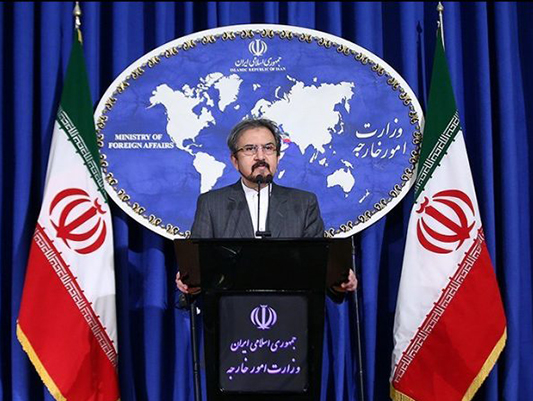
Iran Warns about Saudi Arabia’s “Divisive” Policies

Bahram Qassemi

In reaction to the anti-Iran comments made by Saudi foreign minister in a recent TV interview, Qassemi slammed the “cheap and insulting” remarks, and described them as a continuation of the earlier “baseless and illogical” allegations.

“During the interview, the Saudi foreign minister distorted the realities and once again began a futile attempt, which he had repeatedly made in the past, to distract the world’s public opinion from the destabilizing measures of his country in the region,” Qassemi said in his Saturday statement.

“This comes as the regional states and nations are well aware of Saudis’ divisive policies which are now focused on destabilizing Lebanon following the chaos in the Persian Gulf and Yemen.”

Rejecting all the claims made by the Saudi foreign minister, Qassemi referred to the reckless crimes of Saudi Arabia in Yemen, and said the Saudis have raised the level of their blame-game to its highest level.

“While being the cradle of extremism and a clear symbol of terrorist attacks and stark interference in other countries’ internal affairs, Saudi Arabia deceitfully accuses other states of sponsoring terrorism,” he said.

Qassemi also referred to the latest developments in the region and said the Islamic Republic of Iran has never spared any effort to contribute to the regional and international stability since a long time ago. “But today the security and peace of the region are being challenged by half-baked extremist policies.”

He said the policies are partly aimed at distracting public opinion from the self-made internal and external plights, stressing that coping with the dire consequences of the plights requires the strong will and determination of all regional states.

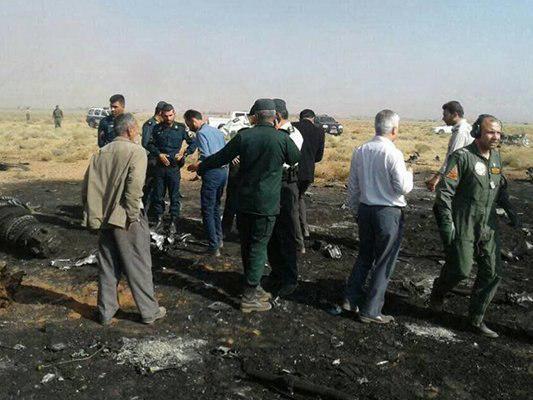
IRGC Fighter Jet Crashes in Southern Iran; Pilot Killed

A statement by the Public Relations Department of the IRGC Aerospace Force says the pilot has lost his life in the crash, which happened on Saturday at 8 am (local time).

According to the statement, the fighter jet was in the middle of military exercises when it crashed.

IRGC Fighter Jet Crashes in Southern Iran; Pilot Killed

‘Iran Ultimate Winner in Region as It Has Boots on the Ground’

In a recent article originally published in Arabic by Kuwait’s Al-Qabas daily, Bakeer has made an interesting assessment of the current situation.

“No one can deny the fact that Iran’s regional influence has reached the highest possible level in the past years. The nuclear deal decreased the pressures on Tehran for its regional activities over the last few years, while its nuclear program continued with international consent,” he noted.

He further notes that the “recent tensions between the United States and the Arab states with Iran can be seen as media tension with no practical effect.”

“Each time the US government has talked about the need for confrontation with Iran, in practice, more opportunities has been provided for Tehran to increase its influence in the region,” Bakeer went on to say.

“Iran moved in to Afghanistan and Iraq during the Bush administration, and during Obama’s office, the country’s influence increased in Syria and Yemen.”

Bakeer predicts that political and economic pressures on Iran will mount, but ultimately the region belongs to the one who has boots on the ground.

“The United States and its Arab allies have backed off in confrontation with Iran in the Middle East since many years ago,” he noted, adding that “the US still has no clear strategy for Syria, so Iran’s influence in Syria would definitely increase.”

“In Iraq, the US coalition provided ground for the victory of ‘Iran-affiliated’ popular forces against ISIS while there is no mechanism for these ‘Shiite’ forces to leave liberated areas,” he went on to say.

“The situation in the camp of the Sunni-Arab states is much worse. These countries are facing many crises domestically and even in relations with each other.”

“The Persian Gulf crisis has dashed down any hopes for the return of Iran’s regional influence to that of before 2003,” Bakeer added.

“Saudi Arabia’s actions against Qatar are completely to the interest of Iran.”

Bakeer has finally referred to Egyptian President Abdel Fattah el-Sisi’s opposition to military action against Hezbollah as the latest indication of the lack of readiness of the Arab-Sunni Front to confront Iran.

Children in Terror-Hit Lands Born with Explosive Belts

 Mahmoud Askarieh, the editor-in-chief of the English-language news website Iran Front Page, has, in an article, warned against the emergence of an “explosive belt” future generation if terrorism is not eradicated. The full text of the analytical piece follows.

The post-IT world has one womb. Members of humans’ future generation are spending their embryonic stage in the same space. Multiple births from different ova are different in appearance, but are of the same essence, and born in the same environment! Isn’t today’s human supposed to be a resident of the global village? Pregnant women in crisis-hit areas in the Middle East are neighbours of American and European mothers.

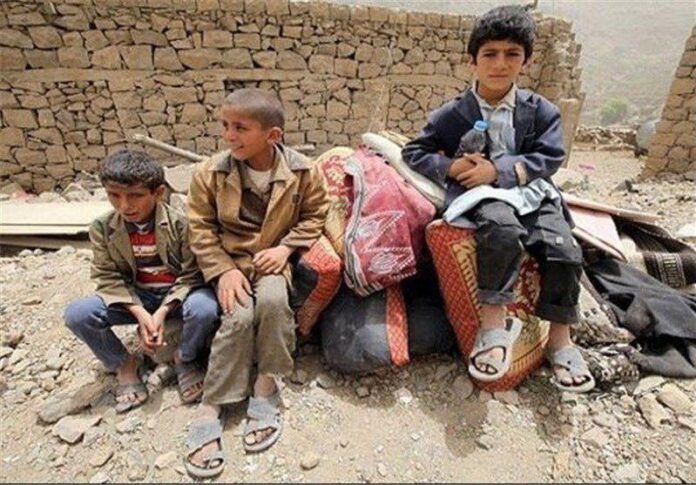
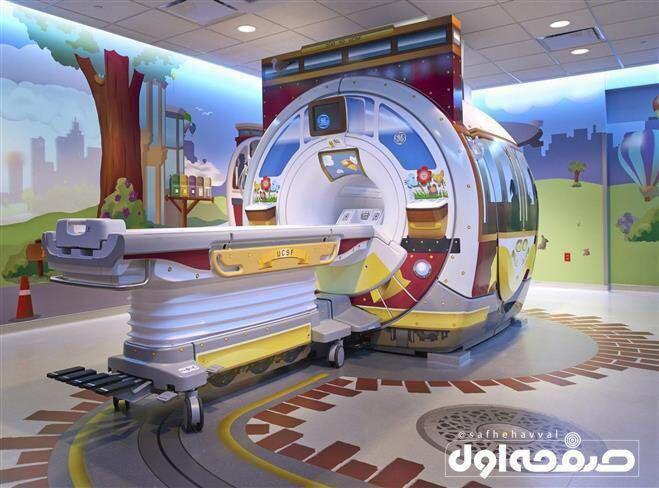
CT scan systems at Pittsburg Hospital in the US state of Pennsylvania have been customized for American children, good for them! This is a humanitarian move which shows America’s very good progress. However, parents whose famine-stricken and cholera-infected children die in their bosoms, or under the debris of buildings destroyed by the Saudi-led airstrikes, or pregnant women in Afghanistan, Syria, Iraq, Myanmar … how will they feel when their share of technological advances is the Mother of All Bombs as well as drones equipped with bombs and rockets, and their benefit from powerful economies is unfair sanctions, and the stopping of ships carrying humanitarian aid to Yemen and trucks carrying food to Foua in Syria and the dispatch of medicines (even those sent by the UN and the International Red Cross)?

Children in Terror-Hit Lands Born with Explosive BeltsThe lifestyle of American and European children being raised in well-to-do families is way different from that of children in Yemen, Gaza, Syria, Afghanistan and the like in terms of nutrition, healthcare, education, etc. However, they have become next-door neighbours thanks to social networks. They are like two cells from the womb of a single mother, the “world” womb! With so much injustice and oppression, what future could be expected for humans? The resources of poor nations are being looted, equal opportunities have been eliminated, and worst of all, there is a return to the gloomy era of building walls between countries. In the early years of the 21st century, we are witnessing a growth in racism in the most advanced countries. Trump is not an individual, but is an iceberg which has emerged on the other side of oceans and admits and takes pride in the fact that he is different from his “self.” This means catastrophe for the human civilization and the dashing of hopes for a better world.

Will terrorism be uprooted? If a number of the sperms and ova in miserable men and women living in death-ravaged lands are born with a sense of revenge (suicide attacks), who will be to blame? Incontrovertibly, military command centres will offer no solution to root out terrorism and take off suicide belts. A joint international think thank is needed.

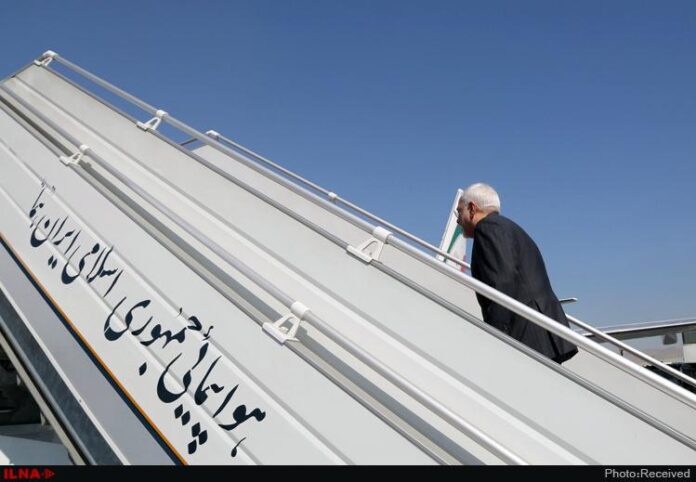
Iran FM Zarif to Visit Philippines Saturday

The visit is aimed at holding meetings with the officials of the Association of Southeast Asian Nations (ASEAN) and also signing a cooperation agreement. The Iranian official would also sign the Treaty of Amity and Cooperation in Southeast Asia.

Zarif will visit Manila after his Central Asian tour, during which he first visited Tajikistan and discussed a range of issues with Tajik officials and took part in the opening ceremony of Iran’s new embassy building in Dushanbe.

The Iranian top diplomat then headed to the historical city of Samarkand in Uzbekistan to attend an international conference on security. He held talks with the Uzbek officials and also the EU Foreign Policy Chief Federica Mogherini.

He later told reporters that in his meeting with Mogherini they discussed the EU’s efforts to fully implement the nuclear deal and their insistence on implementation of the JCPOA.

Zarifd also added that he has stressed Iran’s full compliance with the accord during this meeting saying that the new US administration has not been committed to the deal, and has been creating an inappropriate atmosphere.

“This situation should be handled by the European countries,” underlined Zarif.

“I also stressed that, as the Leader of the Islamic Revolution emphasized in his statements, we welcome the Europeans’ support for the nuclear deal, but Europe needs to be more active and take practical measures regarding the implementation of the JCPOA and the parties’ compliance with their obligations towards Iran,” noted Zarif.

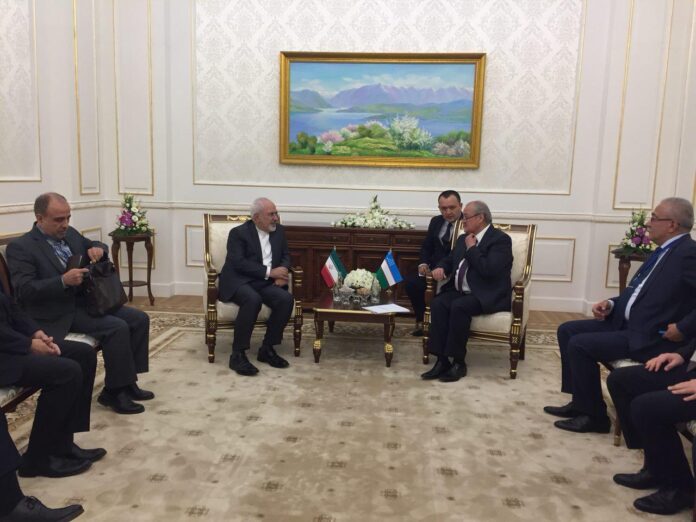
Iran, Uzbekistan Agree on Roadmap for Mutual Cooperation

Iran, Uzbekistan Agree on Roadmap for Mutual Cooperation

In the Friday meeting held in Samarkand, the two sides discussed the development of bilateral and regional cooperation.

Zarif and Kamilov also exchanged views on the new chapter in the two countries’ relations, especially after the Astana Talks.

Easing of customs restrictions next to banking, commercial and transit cooperation as well as collaboration in the fields of science and technology, beside the tripartite cooperation in the sphere of rail transport were among the other issues discussed.

The two sides further reached a general agreement on a roadmap for bilateral cooperation in various fields, in particular economic ties.

The need for joint cooperation in combating the threat of extremist groups was one of the other topics discussed during this meeting.