Thursday, December 25, 2025
Home Blog Page 3763

TV Interview Left Unfinished after Israel Kills Disabled Palestinian

Ibrahim Abu Soraya was the guest of a Palestinian TV channel for an interview on the Palestinians’ outrage at the latest US provocative decision to recognize Jerusalem al-Quds as Israel’s capital; however, the interview was left unfinished after Israeli forces killed him during an anti-US rally in the Gaza Strip.

During protests against the US’ decision on the second Friday of rage in the Gaza Strip, Israeli forces killed at least four Palestinians including Abu Soraya, a Farsi report by Fars New Agency said.

Abu Soraya who had lost his two legs earlier during a Palestinian war against Israel was shot dead on the head by an Israeli sniper during a rally in the impoverished enclave.
Palestine TV had a short interview with Abu Soraya on Friday before the anti-US rally began. During the interview, Abu Soraya underlined he would take part in the rally and fight for the liberation of Jerusalem al-Quds from the Zionists.

Following the interview conducted at Abu Soraya’s home, the Palestine TV reporter said his crew would follow Abu Soraya during the rally and continue the interview on the street. But with the death of Abu Soraya, 29, the interview remained unfinished.

On December 6, Trump announced his decision to recognize Jerusalem al-Quds as Israel’s capital and relocate the US embassy in the occupied territories from Tel Aviv to Jerusalem al-Quds.

The dramatic shift in Washington’s policy triggered demonstrations in the occupied Palestinian territories, Iran, Turkey, Egypt, Jordan, Tunisia, Algeria, Iraq, Morocco and several other Muslim countries.

Jerusalem al-Quds remains at the core of the Israeli-Palestinian conflict, with Palestinians hoping that the eastern part of the city would eventually serve as the capital of a future independent Palestinian state.
Iran, Qatar to Boost Banking Relations

The Persian-language Islamic Republic News Agency (IRNA) has, in an article, expounded on the growing banking relations between Iran and Qatar. The highlights of the article follows.
The Saudi-led Arab coalition severed its diplomatic ties with Qatar in early 2017, prompting Doha to open up its markets to regional exporters such as Iran and Turkey. Qatar’s food imports amount to around $3 billion a year. A third of that used to be imported directly from Saudi Arabia and the United Arab Emirates (UAE) before economic sanctions were slapped on Doha.

Still, a lack of banking relations between Iran and Qatar was the key impediment to Iranian exporters’ strong presence in Qatar’s markets. So, the improvement of mutual banking ties has been on the agenda of talks between the two countries over the past seven months.

Accordingly, Sheikh Abdullah bin Saud Al-Thani, the governor of the Central Bank of Qatar, sat down with Director of the Iranian Association of Private Banks and Credit Institutes Kourosh Parvizian and a host of Iranian bank managers.

In the meeting held in Qatar, Al Thani said the prospects of Iran-Qatar banking cooperation look bright. He said Qatari banks will make every effort to remove the obstacles to the promotion of banking cooperation between the two sides as soon as possible.

Parvizian, in turn, thanked the Central Bank of Qatar for hosting the meeting, and added, “Recently, several Iranian private banks have established a fiduciary relationship with the Qatar National Bank, have opened their accounts and stand ready to offer services to Iranian and Qatari businessmen.

In the meeting, the Qatari side said it will put on its agenda plans to remove the existing impediments to promotion of mutual banking relations.

Another meeting was also held between bank authorities from both countries. In the meeting, they proposed that banking transactions between the two countries be conducted with regional currencies rather than other monetary units such as the Euro.

Iran’s Minister of Industry, Mines and Trade Mohammad Shariatmadari says Tehran-Doha trade currently stands at less than $1 billion, which is planned to reach $5 billion.

Remnants of Ancient Human Unearthed in Central Iran

Head of the Archaeological Excavation Department of Hamadan Province Mohammad Sha’bani said this is the oldest body unearthed in the province.

“The body belongs to a 10-year-old child,” he was quoted as saying in a Farsi report by IRNA.

According to Sha’bani, archaeologists have also unearthed another corpse, and will continue investigating into the new discovery.

“The newly discovered bodies lack any historical belongings,” Sha’bani said, adding during their search operations, the archaeologists have uncovered a column base dating back to an ancient age – possibly Seleucid era – and an oil crack.

Hamadan has been home to one of the oldest civilisations in the world. The remains of an ancient city were unearthed by archaeologists in Hamadan province about five months ago. The series of underground subterranean tunnels dating back more than 2,000 years were discovered near Samen. The tunnels connect 25 rooms that served as houses around the time Jesus Christ would have lived.

Back in October, Iranian archaeologists started investigating two ancient skeletons of a man and a woman discovered in Hamadan. The skeletons were discovered while municipality workers were working on a project to renew water networks. During the digging process, they found two stone boxes similar to coffins.

The historical pieces grabbed the headlines as the most significant signs of Iran’s long history and civilisation. The archaeologists are proceeding with their excavation operations in the region.

Officials are working on a plan to establish a website showcasing the unearthed historic pieces from the region.

Studies on the skeletons had revealed that they belong to the Parthian era, over 2000 years ago.

Iran to Host Meeting of OIC Parliaments on Palestine

Participants at the Monday meeting are scheduled to discuss the latest developments in Palestine following US President Donald Trump’s decision to recognize Jerusalem al-Quds as Israel’s “capital.”

Iranian Parliament Speaker Ali Larijani will deliver a speech at the meeting.

On December 6, the US president defied global warnings and said Washington formally recognized Jerusalem al-Quds as the “capital” of Israel and would begin the process of moving its embassy to the occupied city, breaking with decades of American policy.

Trump’s declaration has sent shock waves throughout the Muslim world, and even prompted warnings from Washington’s allies in the West that it would bring more chaos to the region.

The dramatic shift in Washington’s policy vis-à-vis the city triggered demonstrations in the occupied Palestinian territories, Iran, Turkey, Egypt, Jordan, Tunisia, Algeria, Iraq, Morocco and other Muslim countries.

Representatives from 57 OIC members attended an urgent summit in Istanbul on December 13 on Washington’s contentious declaration on Jerusalem al-Quds.

Jerusalem al-Quds is under Israel’s control. The international community views the regime’s grip on the eastern part of the city, which came after the Six-Day War of 1967, as illegal, and urges talks to decide the fate of the entire city in any future peace deal.

Jerusalem al-Quds remains at the core of the Israeli–Palestinian conflict, with Palestinians hoping that the eastern part of the city would eventually serve as the capital of a future independent Palestinian state.

Iranian “Queen of Snakes” Breaks Record of Kissing Forked Tongues

The story goes back to fifteen years ago, when Faezeh was only seven. Her father read the story of a Chinese girl’s kiss on the head of a poisonous snake in a newspaper, and was encouraged to register Faezeh’s name in the Guinness Book of Records. Faezeh’s father also held the title of “Iran’s Sultan of Snakes” at that time. In fact, he took a brave decision and encouraged his seven-year-old kid to kiss the tongue of a Cobra; a dreadful creature that no antidotes have been discovered for its poison yet!

This was the beginning for a girl, who had become friend with the snakes since she was three, and finally at the age of seven she set a Guinness record.

Little Faezeh was accompanying her father from a city to another to display snakes to the people. When she was 11, the daredevil girl could play with different species of poisonous snakes along with her younger brother for 12 hours in a small aquarium without any problems. Many people assume snakes may become friends with their owners, but the reality is that snakes never can be tamed, and this little girl has experienced snake bites repeatedly.

In a Farsi interview with the Shahrvand newspaper, she has talked about her strange life and her amazing experience in dealing with snakes. “Iran’s Queen of Snakes” is now 20 and is studying psychology at Shahrekord University.

When did you start to feel comfortable with snakes?

Since the age of three, I began to know the snakes and communicate with them. However, after my record at the age of seven, I felt I could become more involved with this creature.

Weren’t you scared when you wanted to kiss the tip of a snake’s tongue for the first time?

At that time I was seven, so I was not afraid of the snakes, as I was curious about animals, especially snakes. My father’s teachings also helped me not to be afraid of the snakes. As far as I remember, I was very eager to set a Guinness record and show everyone what a Bakhtiari girl is like (Bakhtiari is an Iranian tribe).

Apart from that record, you’ve spent 12 hours with snakes. In that 12 hours, were you feeling any fear or something?

Iranian “Queen of Snakes” Breaks Record of Kissing Forked TonguesAt the age of 11, along with my 6-year-old brother, we spent 12 hours in an aquarium with 30 poisonous snakes. My father is an experienced person. When we were at the aquarium he was there, and if something happened, he could help very soon. Of course, you should keep in mind that we had been trained for a long time, and as I was older than my brother, the space inside the aquarium was under my control. I was talking to my brother telling him about my first record, or about the nature and beauties of the snakes. In this way, I calmed him, and we played with snakes not to let them feel we are scared. Because in 50% of the cases snakes bite when they feel you are terrified.

Have you ever been bitten?

Yes. Snake are wild animals and cannot be tamed. Snakes get used to the situation, but they do not get friends with humans because they do not know a friend or foe. My father lost a finger because of the snake’s bite. He was also bitten by a viper once. Even a Cobra bit me when we were at a show in Mashhad city. Thank God and thanks to the experience of my father, who had antidotes, I survived. The worst injury I’ve ever suffered was a few years ago, when a Cobra bit my lip during a show, and I survived again. That was due to the inattention of one of the spectators. Before the show my father warned the spectators against using camera flashes, because the snake’s eyes are sensitive to the flash light. However, the audience did not take any notice of this and the flash lights caused the snake to bite me.

Are you ready to compete with anyone who breaks your record in kissing a snake?

I do not think anyone could break my record. If they could, they would have broken my record till now.

Iran Condemns ISIS Terrorist Attack on Quetta Church

pakistan

In a Monday statement, Qassemi expressed condolences to the Pakistani people and government over the tragedy and sympathized with the families of the victims of the attack.

“The remnants of the Takfiri-Zionist terrorists of ISIS, who have emerged in the Middle East through the backing of some regional and transregional countries and who have suffered definitive defeats in Syria and Iraq, have spread throughout the region and are killing and shedding the blood of innocent people with whatever religion and ideology in any corner of the world,” he noted.

“Having suffered a defeat, they seek to cause panic among the regional nations and undermine their unity by conducting sporadic, indiscriminate and blind terrorist attacks,” said the spokesman.

“Although the largest terrorist group in the world was busted to ill-wishers’ chagrin and with the steely resolve of the governments and nations in the region, their remnants continue to conduct such brutal acts in a bid to keep the terrorist ideology alive to perpetuate chaos and unrest in the region and in the world,” Qassemi added.

Iran Strongly Condemns Saudi Attacks on Yemen

In a Sunday statement, the ministry’s spokesman Bahram Qassemi condemned the recent attacks by Saudi Arabia on civilian targets, including residential houses and shopping malls in different cities of Yemen, as well as the Sunday attack on a wedding ceremony in Ma’rib province, in which dozens of innocent Yemeni citizens including women and children were killed and wounded.

Qassemi also sympathized with the relatives of the victims of these violent crimes, saying that the increased bombardment of residential areas, continuation of the siege, and the closure of maritime, ground, and air borders, besides depriving Yemenis of having access to humanitarian aid and basic needs by Saudi rulers show the disappointment, and repeated failure of this country in achieving its goals of attacking Yemen.

He further criticized the international community’s silence over Saudi war crimes that are committed using US-made weapons saying that attacks on residential areas and civilian targets, and the denial of access to international relief agencies and bodies are obvious violations of the fundamental principles of humanitarian law.

The Iranian spokesman said those who provide the aggressors with weapons are accomplice in the daily crimes of Saudis. Qassemi also called on the United Nations and the countries that are influential in the Yemeni crisis to intensify their efforts to immediately stop the attacks and to take necessary measures to take care of the health and safety of civilians, especially women and children.

Iran Leader’s Aide Slams France for Turning into US “Pet”

Velayati on Sunday referred to two gatherings of the anti-Iran MKO terrorist group held in France, and said that Paris has not been honest with Tehran since the Islamic Republic’s 1979 Revolution by giving the green light to some mercenaries who escaped from Iran.

“Anyone who has betrayed Iran travels to France, and this shows that Paris has problems with independent states,” Tasnim News Agency quoted Velayati as saying in a Farsi report.

Referring to the statements made by US ambassador to the United Nations, the Iranian official said Nikki Haley is an ambassador and does not know anything about military issues.

“I do not understand why she has made such remarks while all the world are making fun of her because Iran has not sent any missiles to Yemen.”

Velayati also responded to a question about Saudi Arabia or the Zionist regime’s ability to build a consensus about the Islamic Republic of Iran and stressed that they cannot do anything.

About the statement issued at the OIC meeting in Turkey, which divided Jerusalem al-Quds into East and West Jerusalem, Velayati asserted that the Iranian president, in all the ceremonies and international assemblies so far, has supported the Palestinian people and adopted a tough stance on the Zionist regime.

He also noted that Palestine belongs to the Palestinians and holy Quds belongs to the Palestinian people.

Iran Congratulates Kazakhstan on Independence Day

In a Sunday message to Kazakh President Nursultan Nazarbayev, Rouhani sincerely felicitated his counterpart and the Kazakh nation on the 26th anniversary of the country’s independence from the Soviet Union.

“Fortunately, in the past years, our relations have grown and deepened in line with our common interests,” Rouhani noted, according to the president’s official website.

“The Islamic Republic of Iran views Kazakhstan as a reliable neighbour and partner and is prepared to consult and cooperate with Astana for consolidating regional stability, security and solidarity.”

“I am confident that, based on the valuable experiences of the past, bilateral relations between the two countries will continue to deepen,” he added.

The Iranian president also wished health and success for Nazarbayev and prosperity and well-being for the brotherly and friendly nation of Kazakhstan.

On December 16, 1991, the Supreme Soviet passed the Constitutional Independence Law of Republic of Kazakhstan. Despite the swift collapse of the USSR, Kazakhstan was the last to declare its independence.

The Independence Day is annually celebrated for 2 days on December 16 and 17. It is marked by festivities in the presidential palace and many Kazakhs dress up in traditional clothes. Yurts (traditional tents) are set up in many villages where local delicacies are served.

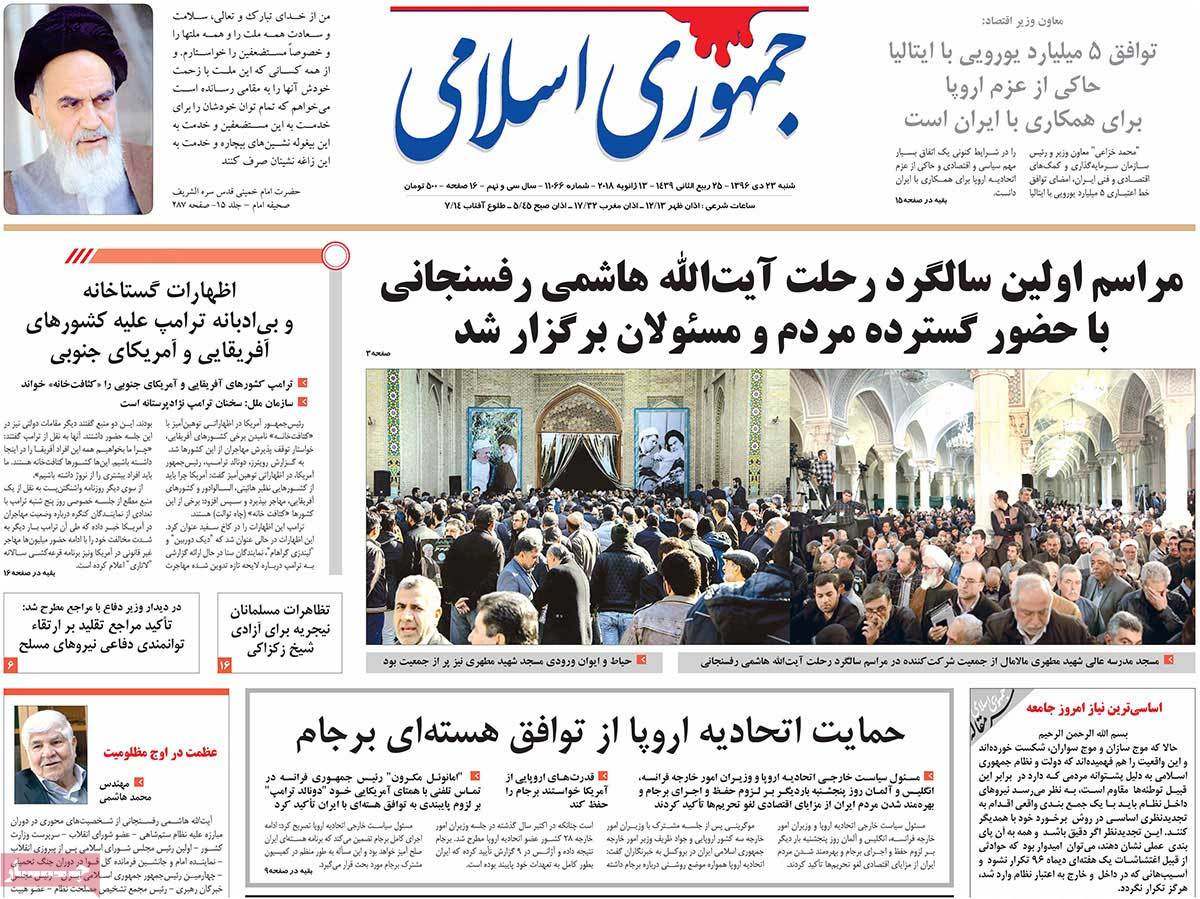
“Iranian Clergy, Seminaries Should Cut Dependence on State Budget”

The Persian-language Jomhouri Eslami newspaper has, in an article, urged the clergy to cut their dependence on state budget and rely on the religious taxes paid by the public. The highlights of the op-ed follows.

The publication of information on budgets allocated to institutions involved in cultural activities, especially those related to the clergy and Islamic seminary schools, has raised many questions in the public opinion.

They are not new questions. For many years, we have asked the question why the clergy and clerical institutions should depend on state budget. But there has been no answer. And if there have been any answers, they have not been convincing. Now that mass media have made it clear to the public opinion, something has to be done and one cannot remain indifferent toward the issue.

There were some top religious figures at the Islamic seminary in Qom who believed the clergy should be independent, and prohibited the use of finances from the government’s coffers. Even now, there are some senior clerics who stress this, and believe the clergy have made a living out of the religious taxes paid by people, and that it has been this very religious bond between people and clergymen which has helped the clergy remain an independent, efficient and sound entity, enabled them to stand up to deviations within governments at sensitive junctures, and helped them fulfill their religious and popular responsibilities.

The same basis should be the yardstick for meeting the costs of seminary schools and the clergy, so that they will remain independent and powerful. Receiving cash from the government, even an Islamic government, makes the clergy independent, and dependent clerics cannot fulfill their real mission. The current differences coupled with confrontations which have downgraded some clerics to a level lower than that of political factions are the result of the same dependence. The clergymen who are not dependent on others’ money and who can make a living through their own efforts will more easily be able to tell the truth, and promote virtue and prohibit vice. Many senior religious figures believed the clergy must not have any expectations from the people who pay their religious taxes to them. The top clerics turned away the people who, by paying money, wanted to cash in on the position, situation and leverage of the clergy. The late Imam Khomeini had such an approach and his demeanor features many cases where he did not allow others to take advantage of the clergy’s position and firmly turned them away. Imam Khomeini’s extraordinary power with which he could stand up to the former Pahlavi regime, and his unique charisma in the eyes of the public which could galvanize people into action and prompted them to enter the scene of the revolution and eradicate the root causes of colonialism and tyranny and establish the Islamic Republic were the result of this very independence and his efforts to safeguard the status of the clergy.

If we want the Islamic Revolution to go on and remain sustainable, we should safeguard the clergy with the same features. The clergy should be independent, and should not depend on state budget for its independence. As for the Institute for the Publication of Imam Khomeini’s Works and affiliated institutions as well as the Imam Khomeini Holy Shrine, which have turned into a hot issue for media, we believe the institutions should turn to the people and wean themselves off government cash. It is noteworthy that Jomhouri Eslami had already warned against the controversy and, ironically enough, came under fire as well. Imam Khomeini is so popular inside and outside Iran that if people know that money is needed to publish his works and further develop his mausoleum, they will pay much more than needed. Of course, officials should have Imam Khomeini’s simple lifestyle in mind and avoid profligacy and extravagance in all areas, especially when it comes to Imam Khomeini’s mausoleum.