Wednesday, December 24, 2025
Home Blog Page 3686

Embryo Donation Centre Opened in Iran

Embryo donation is an advanced infertility treatment method, defined as the giving of embryos remaining after one couple’s in vitro fertilization (IVF) to another person or couple for implantation

Dr. Farhad Yaghmaee, the head of the donation centre of the clinic, described the establishment of the bank as a “substantial progress” in the treatment of infertility in Iran.

At present, there are 3 to 5 million infertile couples in the country and the figure is increasing by 15% each year.

“The greatest benefit of this bank is that we can ensure safety of the donation process and prevent commercialization of this medical service,” Yaghmaee told the Persian-language news agency Sina Press.

For a brief review of Iran’s achievements in various fields of science and technology, check the book “Science and Technology in Iran: A Brief Review

Avicenna clinic is affiliated to the Avicenna Research Institute, which was established in 2003 by the Academic Centre for Education, Culture and Research (ACECR) in collaboration with the medical centre of the UKSH University in the northern German city of Luebeck.

ACERCR is a public non-governmental higher education institution established in 1980, which is involved in innovative research and development projects in clomid-info.com of science and technology.

Ovulation induction, IVF, intrauterine insemination (IUI), and finally surrogacy are other advanced infertility treatment methods currently performed in Iran.

Most infertile couples can conceive with simple infertility treatments like medications or lifestyle changes; however others may require more advanced technologies.

One of the five leading causes of divorce in Iran is infertility of one of the spouses, according to official reports.
Susa Museum; A Gem Located in Southern Iran

The small museum displays ancient stones and pottery excavated from archaeological sites in the region. At this charming museum you will find many objects not only from Susa itself, but also from towns in the neighbourhood, the province of Khuzestan.
There are six main rooms in the museum, where you will find architectural remains from the palace of Darius; also ceramics, weapons and sculpture from Masjed Soleiman (home of Iran’s first commercial oil well); and funerary masks from Haft Tepe.

When Susa was excavated in the late nineteenth century, the archaeologists agreed that all gold and silver would remain in Asia; while finds of stone and other less precious materials could be brought to France. This is why the most famous objects from Susa are now in the Louvre. Other objects, like the splendid Egyptian-style statue of Darius that was excavated in the 1970s, were brought from Susa to the Archaeological Museum of Tehran.

Following you can find IRNA’s photos of the museum; located on the way to Susa castle and opposite the Tomb of Daniel the prophet:

“Syria Conflict: International War Involving 80 Countries”

In a Wednesday meeting with Syrian Minister for Awqaf Mohammad Abdul-Sattar, Velayati noted that the current war in Syria is a test for the Syrian government and nation to defend themselves against a world war imposed on them.

“We hope Syrians would overcome their enemies and foreign aggressors who are seeking to inflict a blow on them and God willing the final victory is close,” he was quoted as saying in a Farsi report by Tasnim News Agency.

Velayati also expressed hope that the brotherly relations between Iran and Syria would deepen in the future.

For his part, the Syrian minister said his country has had great respect for the government and the Muslim nation of Iran since the victory of the Islamic Revolution in 1979 under the leadership of the late founder of the Islamic Republic, Imam Khomeini.

“Amid the current critical condition, we want to send the message that the Islamic resistance will continue and Syria stands by Iran and play its role in strengthening the Islamic resistance,” he noted.

He finally concluded that bilateral relations between Iran and Syria are enhancing in all fields.

“Syria Conflict: International War Involving 80 Countries”
Ali Akbar Velayati, a top aide to the Leader of Iran’s Islamic Revolution, meeting with Syrian Minister for Awqaf Mohammad Abdul-Sattar in Tehran on February 28, 2018

Foreign Investment in Iran Growing: Minister

In remarks made on Wednesday, Shariatmadari said Iran needs to absorb $180 billion to secure a sustainable eight-percent economic growth.

He noted that his ministry has set up an office to absorb domestic and foreign investment, adding, “The office kept working in 2017 and absorbed around $1.9 billion in direct foreign investment for production activities with the approval of the High Investment Council.”

According to a Farsi report by Fars News Agency, he said the council has given the go-ahead to around $9.7 billion in investment since the Rouhani’s administration assumed office in 2013.

“Out of the 244 investment projects, 40 have become operational and the rest are going through different phases of implementation.”

“Such cases show the policies adopted by the government in absorbing the funds of Iranian expats residing abroad as well as foreign finances are moving forward,” he noted.

The minister also underscored that further work and investment are needed in order to reach the target of 20-billion-dollar investment in the industry sector.

Iran, Croatia Discuss Expansion of Ties in Zagreb

Iranian Foreign Minister Mohammad Javad Zarif and Croatian Minister of Labor and Pension System Marko Pavic met in Zagreb on February 28, 2018 / Photo released by the Iranian Foreign Ministry

During the Wednesday meeting, the two sides highlighted the growing trend of cooperation between the two countries in the fields of energy, investment, industries, technical-vocational training and banking.

This was Zarif’s first meeting after arriving in the Eastern European country on Wednesday afternoon.

Iran’s political-economic delegation left the Bulgarian capital of Sofia for Zagreb after wrapping up talks with senior Bulgarian officials.

The Iranian team’s one-day trip to Croatia features talks with the country’s political authorities where ways of boosting mutual cooperation will be discussed.

“Iran FM’s Plane Refuelling Case Not That Much Complicated”

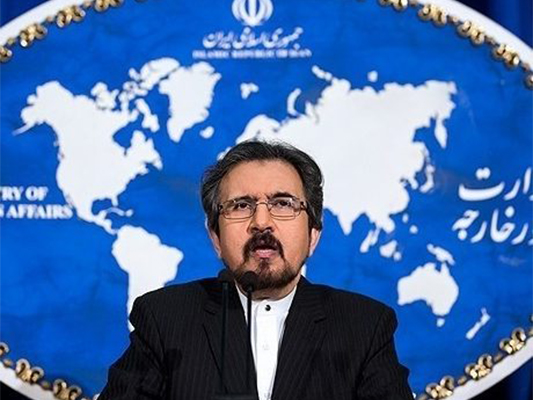
In a Wednesday statement, Foreign Ministry Spokesman Bahram Qassemi said the case was not as complicated as it was reported in the news.

“As FM Zarif’s visit to Munich was very short and there was a time limit for the FM and his accompanying delegation to head for Moscow, the fuel companies operating at the Munich Airport experienced unwanted delays and uncertainty.”

“Finally, in order to avoid facing any problems and to ensure the [on time] presence of FM Zarif in Valdai Club Conference, we followed up the case and coordinated the issue with the German foreign ministry. [Therefore], the problem was resolved and fuel was provided for the delegation’s aircraft,” added the spokesperson.

Qassemi further highlighted that all Iranian flights to international destinations, including Europe, are being carried out without any problems and on a daily basis.

The German paper Süddeutsche Zeitung reported on Wednesday that all German fuel companies refused to supply the Iranian FM’s plane fuel during Munich Security Conference held mid-February.

The report, which was published by a number of other German and English-speaking media as well, said the reason behind such a refusal was the companies’ fear of violating US sanctions.

In this regard, the head of Munich Security Conference Wolfgang Ischinger told the media that he difficultly managed to solve the problem, seeking help from Germany’s Ministries of Defence and Foreign Affairs.

Finally, Germany’s Air Force fuelled Zarif’s Airbus plane, Süddeutsche reported.

Israel Has Written Security Agreement with Nusra Front: Iran

Speaking to reporters on Tuesday, Amir-Abdollahian pointed to the ongoing developments in Syria’s Eastern Ghouta, and said the Israeli regime is to blame for the escalation.

“The Israeli jet was shot down in Syria, and Israelis were terrified. All equations in the region were changed. While certain Israeli officials said it was an accident and won’t be repeated, it wasn’t an accident and they knew it,” he noted.

“The Nusra Front terrorists have a written agreement with Israel to ensure the Zionist regime’s security from inside the Syrian territory. Israelis are behind the developments in Eastern Ghouta,” he added.

“Syria will from now on give crushing responses to Tel Aviv and its aggressions,” he added.

He also noted that the US is totally standing by Israel in this case. “When Nusra Front commanders and other terrorists were being defeated in Eastern Ghouta, they raised the issue of ceasefire and asked the UN to stop the attacks on terrorists.”

Amir-Abdollahian also referred to the Turkish operation in Syria’s Afrin, and said no country in the region should once again, with any justification, use force and military option.

“All sides must remain committed to supporting political process in Syria, help the Syrian government cleanse the country of terrorists, help the return of refugees and the country’s reconstruction,” he noted.

“Afrin and Eastern Ghouta developments are in contradiction to regional peace and security,” he went on to say.

Stressing that Turkey has concerns about its national security in Afrin, Amir-Abdollahian expressed the hope that all players in Syria would pursue resolution of problems through dialogue.

IRGC Totally Prepared to Thwart Enemy Plots: Chief Commander

Speaking on Wednesday, General Jafari said if it was not for the hard attempts by the ground forces of the IRGC, Iran would have serious problems along its borders.

“Today we have developed our capabilities in various fields to cope with the insecurity and plots created by the enemies,” he was quoted as saying in a Farsi report by Fars News Agency.

The top commander also said the IRGC should make some fundamental decisions if it is to cope with the enemies’ threats.

“Over the past months, we witnessed the emergence of some agitations in some cities and attacks by ISIS along our borders, both of which were thwarted by the IRGC ground forces and Basij (voluntary) forces,” the general said.

He went on to say that by equipping themselves with new advanced military equipment like helicopters, the IRGC’s ground forces have increased their capabilities to cope with the enemies’ threats.

“In addition to human resources, other elements like advanced and cutting-edge technologies and equipment like drones and precision guided and long-range weapons play a leading role in countering the insecurity in the east and southeast regions of Iran,” he said.

General Jafari also added today no country can achieve its goals in any war by just focusing on massive airstrikes and severe attacks.

“Today we are witnessing that despite its relentless targeting of the PKK positions, Turkey does not achieve its desired goals. Even in Syria and Iraq, we see that precision guided weapons have the upper hand in military operations,” he said.

Iran, Belgium Sign MoUs in Health Sector

Iran and Belgium signed several MoUs in the health sector in Brussels on February 28, 2018 / Photo retrieved from IRIB News Agency

In a ceremony attended by Iran’s Minister of Health and Medical Education Seyyed Hassan Qazizadeh Hashemi in the Belgian capital, a few health agreements were signed.

The MoUs were on information technology, food and drug, and medical and hospital equipment, said IRIB News Agency in Farsi report.

In the IT sector, Tehran and Brussels are expected to work together to screen noncontagious diseases, including cancer.

Iran, Belgium Sign MoUs in Health Sector
Iran’s Health Minister Qazizadeh Hashemi attended a ceremony where Iran and Belgium signed several MoUs in the health sector in Brussels on February 28, 2018 / Photo retrieved from IRIB News Agency

In the field of food and drug, the Association of Dairy Exporters will work with a Belgian company to develop relationships and share experience over the next five years. In this regard, a deal will soon be signed by both sides.

Iran and Belgium will also work together on medical and hospital equipment and the companies from both countries would cooperate on reaching international standards.

On Tuesday, Qazizadeh Hashemi and his Belgian counterpart Maggie Celine Louise De Block discussed expansion of bilateral health ties.

The two sides conferred on ways to develop Tehran-Brussels mutual cooperation in the field of health and hygiene.

The Iranian minister has travelled to Brussels at the invitation of the European Commissioner for Health and Food Safety Vytenis Andriukaitis.

After a two-day trip to Belgium, Qazizadeh Hashemi will head to Hungary on Wednesday.

Korit Village; A Historical Attraction in Middle of Iran Deserts

Korit is one of the oldest villages in Tabas, dating back to more than a thousand years ago. This historical attraction of Iran had valuable historical monuments before the devastating earthquake that hit the region in 1978.

Magnitude 7.4 earthquake occurred on September 16 destroying the old and historic village of Korit which was a very beautiful and lovely place. The damage of the earthquake can be clearly seen all across the village. Tabas earthquake left more than 20,000 people killed including the residents of Korit village, but nobody knows the exact number of the victims in the village.

The village was moved to a new place next to the old one after the earthquake; while its remnants were abandoned in a semi-ruined state. This place is considered by many as a tourist destination and historical attraction, especially for its water reservoirs that belong to Afsharid dynasty.

Here are ISNA’s photos of the historical village: