Friday, December 26, 2025
Home Blog Page 3668

Rasht Turns into Iran’s First City of White Nights

In a ceremony attended by Iran’s Vice-President Ali-Asghar Moonesan, the plan was officially launched for the first time in Rasht.

“The national plan of White Nights is expected to be launched in other cities of Gilan province in the near future with the aim of attracting more domestic and foreign tourists,” a Farsi report by the IRIB News Agency quoted him as saying.

According to the plan, the cities of White Nights will have special places where tourists can buy handicrafts and other artworks 24 hours a day.

Reza Alizadeh, the General Director of the Cultural Heritage, Handicrafts and Tourism Office of Gilan province said the plan was launched in the Cultural Pedestrian of Rasht.

The plan makes the cultural and tourist activities of the city 24/7 in a bid to attract foreign and domestic tourists. “During the White Nights, the handicraft artists can get in touch directly with the ordinary people for selling their products at an appropriate price.”

He went on to say the White Nights plan is among initiatives developed with the aim of attracting further tourists to Gilan province.


White Nights Create More Jobs

Moonesan, who is also the head of Iran’s Cultural Heritage, Handicrafts, and Tourism Organization, said the White Nights plan has great advantages including job creation.

Speaking to reporters, Moonesan said the plan makes the city more active and provides the people with a new public space.

There are about 75 booths along the Cultural Pedestrian of Rasht which display and sell various handicrafts deeply rooted in the city’s history and culture.

Rahim-Mashaei, Another Ally of Ahmadinejad, Arrested in Iran

The Office of Prosecutor General of Tehran announced on Saturday that Rahim Mashaei, Mahmoud Ahmadinejad’s chief-of-staff, has been arrested by the police with a warrant issued by the office.

The statement has added that the ex-official, who is also a staunch ally of former president, has been arrested for investigation.

A few days earlier, Rahim Mashaei had set fire to a court verdict sentencing Hamid Baghaei, another figure in Ahmadinejad’s trilateral alliance, to imprisonment.

Thousands in Iran May Lose Their Jobs If Telegram Blocked

According to Saeid Mahdiyoon, the Basij commander of Iran’s Ministry of Communications and Information Technology, 180,000 families are currently involved in the online business, which has a total turnover of tens of millions of dollar.

Afshin Kolahi, a deputy head of new and knowledge-based businesses of Iran Chamber of Commerce, recently noted that 10,000 to 15,000 businesses are currently run in Iran completely through the cyberspace.

He says the two numbers are not conflicting, because 10 to 15 thousand Telegram-based businesses can directly or indirectly create jobs for 180,000 families.

There are 754,516 Farsi channels in Telegram with an average daily visit of 2.5 billion, a Farsi report by Shahrvand newspaper said. Out of these channels, 264,347 are regularly updated, according to the data provided by Iran’s National Cyberspace Research Centre.

Seyyed Morteza Mousavian, the head of the IT Development and Digital Media Centre of Iran’s Culture Ministry, says 19,000 channels have been registered by the centre so far.

“9,000 of them either sell their products or offer services,” he added, stressing that such figures only involve those who have officially registered their channels.

If we accept that 180,000 Iranian families are earning a living using Telegram, then almost 0.75 per cent of Iranian families are making money using the messaging app. Given the low costs of creating jobs in the IT sector, this figure can be rapidly raised through the development of the cyberspace in the country.

Mahdiyoon believes domestic and indigenous messaging apps must be supported and reinforced to be used once Telegram stops offering its services to Iranian people.

But is it really possible to replace Telegram with a home-grown version? Why hasn’t any Iranian app been successful so far in recruiting members and developing the number of its users?

Kolahi says blocking Telegram or a prescriptive use of similar Iranian apps or any other limitation will not be successful in convincing people to use an alternative messaging application. “We have repeatedly tested these methods, and wasted financial resources on them.”

“The market must be a competitive one. If an appropriate strategy is chosen in the design and replacement, the indigenous version can quickly find its market. A good product will soon satisfy its users,” he added.

During the days when Telegram was temporarily restricted amid the recent protests in Iran, Kolahi told Shahrvand that only a limited number of Telegram users temporarily switched to Iranian apps, mostly for family chats or receiving educational contents.

“Business owners have not yet made any serious decision to switch to these messaging apps,” he noted, stressing that an online shopping centre usually spends three years on attracting followers.

“Online business owners believe switching to another network like WhatsApp would lead to the bankruptcy of that business as they may lose their customers,” Kolahi said, adding that businesses do not welcome the switching.

With an Alexa ranking of 19 in Iran and over 40 million users in the country, Telegram is one of the most-visited websites in the Islamic Republic, but these days it is intertwined with many economic, social, and even political issues of the country.

Europeans Should Not Tie JCPOA to Iran Missile Program: Larijani

Ali Larijani

In a Saturday meeting with Oman’s Foreign Minister Yusuf bin Alawi in Tehran, Larijani urged the European countries to stick to their commitments under the nuclear deal and pressurise the US into fulfilling its obligations.

“Iran has always remained committed to the nuclear deal and will observe its commitments under the deal but only as long as the other sides continue to do so,” he was quoted as saying in a Farsi report by ICANA.

He also praised the regional role of Oman and Sultan Qaboos as constructive and beneficiary and said Tehran and Muscat have always had good and close relations with each other.

Iran’s Parliament speaker described the regional situation as chaotic and said all regional states should avoid any measure that might exacerbate the current unrest in the region.

“Today, Iran’s missile program has turned into a concern for some states. But the main question is why they are concerned about our program? We have had the missile technology since 30 years ago and during this time we have never fired even a single missile at any country in the region. The technology is not a new achievement for us,” he noted.

Europeans Should Not Tie JCPOA to Iran Missile Program: Larijani
Iran’s Parliament Speaker Ali Larijani meeting with Omani Foreign Minister Yusuf bin Alawi in Tehran on March 17, 2018 / Photo by ICANA

Larijani underlined that Iran’s presence in countries like Iraq and Syria is at the request of their governments. “We have always sought to find political solutions to the crises in these countries.”

“Oman Interested in Expansion of Ties with Iran”

For his part, Oman’s foreign minister said there are appropriate grounds for expansion of economic relations between Iran and Oman.

He said like their political relations, Iran and Oman should raise the level of their economic ties.

“Some countries are worried about Iran’s defence capability and missile programs but there is no reason for this concern. Given the current situation of the region, Iran is entitled to improve its military power as part of a mechanism to defend its own security,” Bin Alawi said.

He also referred to the presence of Iran in Syria and said “as we have announced repeatedly, no country can have presence in a foreign country without the request of its government.”

Bin Alawi underlined that Iran’s presence in Syria is made at the request of Damascus.
He also called for finding political solutions to the current regional crises and added militarism and massacre of innocent people will never lead to peace and security in the world.

Oman’s foreign minister also expressed hope that some regional countries which have adopted aggressive policies toward regional issues change their mind and resort to peaceful means.

He called on regional states to establish cooperation in fight against terrorism.
Bin Alawi then called for further economic ties with Iran and said Oman is interested in raising the level of its financial relations with Iran through expansion of joint rail lines.

2,700 NGOs Working in Iran on Women, Family Affairs: VP

Massoumeh Ebtekar

In an address to a Saturday ceremony in the Centre for Peace and Environment in Tehran, Massoumeh Ebtekar said there are lots of such organizations in Iran which should be viewed as national assets.

“Currently in the field of women and family affairs, we have over 2,700 NGOs and in the environment field, there are about 900 active governmental and non-governmental organizations,” she was quoted as saying in a Farsi report by the Vice-Presidency’s official website.

Ebtekar said these organizations play a key role in the development of Iran.

During the ceremony, she also presented the prestigious Dr. Taqi Ebtekar Award to a number of activists and scientists active in the field of environment.

The Centre for Peace and Security is a non-governmental organization active in the field of environment. The organization was established in 2005 by Dr. Taqi Ebtekar, a former advisor to ex-president Mohammad Khatami.

Each year, the centre rewards scientists and environmentalists for their efforts and initiatives to preserve the environment in Iran.

EU Warned against Joining US in Blackmailing Iran

In a Saturday meeting with Oman’s Foreign Minister Yusuf Bin Alawi, Shamkhani referred to Washington’s illegal stance towards the Iran nuclear deal and the Europeans’ passiveness towards the US as a clear urgency for the regional states to put their focus on finding local solutions for the regional crises.

“The Islamic Republic of Iran will give an appropriate response to Washington’s repeated violations of the JCPOA in due time and will not accept any change to and interpretation of the deal or any measure aimed at restricting it,” he was quoted as saying in a Farsi report by the official website of Iran’s SNSC.

Secretary of Iran’s Supreme National Security Council also warned the Europeans about being played by the US and the Zionist regime and agreeing with their blackmailing Iran under the pretext of preserving the JCPOA.

He said Iran will press ahead with its defence program despite pressure. “Iran will press ahead seriously with its deterrent defence program particularly its missile program within its national security despite political or media campaign.”

He underlined that developing relations with neighbouring states based on cooperation, restraint and mutual understanding has always been among the main principles of the Islamic Republic of Iran.

“The security of the Persian Gulf and the whole region will be guaranteed only through establishing multi-lateral relations, distancing from tension-creating measures and developing new plans based on regional and responsible partnership,” he added.

He then slammed some states for their relentless efforts to create a bi-polar environment and widen the political and security gap in the region.

Shamkhani also expressed deep concern over the massacre of innocent women and children in Yemen by Saudi Arabian and Emirati warplanes.

He warned about the deteriorating humanitarian crises in the oppressed country of Yemen and said Iran and Oman have a similar stance towards Yemen.

“Iran and Oman call for an immediate end to the Yemen invasion, establishment of truce there, sending humanitarian aid and launching intra-Yemeni talks to create new political structures based on the public will of people of Yemen,” he said.

The Iranian official underlined that Yemen’s crisis cannot be tackled by military solutions. “The only way to restore peace and security to the war-torn country of Yemen is building on the current political initiatives with the aim of involving more political and ethnic groups of Yemen in the future political system of the country.”

He also referred to the deep, strong and growing relations between Iran and Oman and said the two sides have considerable commonalities on regional issues.

“The strengthening of constructive and multi-lateral relations with its neighbours based on bilateral interests has been among the main priorities of the Islamic Republic of Iran’s foreign policy,” he said.

Shamkhani said Iran and Oman can expand their ties in different fields including economy, energy and transit and added making joint investments with the aim of developing financial, monetary, port and transportation infrastructures can provide the two sides with more diversified trade and financial capacities in the region and easier access to safe and cheap target markets.

For his part, Oman’s foreign minister praised the regional role of the Islamic Republic of Iran and said Oman has always viewed Iran as a reliable partner and a friend and brotherly state.

“We always praise the role of the Islamic Republic of Iran in protecting the security and stability of the region,” he said.

Bin Alawi referred to the geographical locations as well as scientific, technical, industrial and financial potential of Iran and Oman and said the two sides enjoy a huge capacity to develop economic cooperation and achieve new export markets in future.

“We are ready to adopt joint measures to bridge the unjustified gap in political and economic relations between Iran and Oman,” he said.

He also dismissed as unacceptable any use of military power for imposing one’s political will on others and said “as the experiences of the past years have shown, we need to hold talks instead of launching war and violence to avoid losing our valuable human and financial assets.”

Qayqanaq; Delicious Pancake Indigenous to Iran’s Azarbaijan

Qayqanaq is cooked in the cities of Zanjan and Tabriz. The recipe for, and appearance of this Iranian desert is very similar to foreign pancakes eaten as breakfast.


Ingredients

Flour: 4 spoonfuls

Eggs: 4 eggs

Cinnamon: a teaspoonful

Powdered cardamom: as much as needed

Sugar: 3 spoonfuls

Crushed walnut: as much as needed


Recipe

First beat the eggs. Then add sugar, flour, crushed walnut and cardamom, and fry the mixture. You may add cinnamon or saffron to the snack. Qayqanaq can be made as thin as the pancake or thicker.

Popularity of Iranian Friday Prayers Imam Growing in Tabriz

Seyyed Mohammad-Ali Al-e Hashem, the popular leader of Tabriz's Friday Prayers

Seyyed Mohammad-Ali Al-e Hashem leads Friday Prayers in Tabriz, the capital of the northwestern province of East Azerbaijan.

Recently, he went to a theatre in Tabriz to watch a show featuring the lives of disabled war veterans suffering from psychological problems, reports the Persian-language Iranian Labour News Agency (ILNA).

The play depicts the hidden mental aspects of the war veterans who have suffered serious maladies during their lives, who are grappling with those problems today as well.

The cleric is popular not only because he went to watch a play. Al-e Hashem’s behaviour towards the general public after he was appointed as the Friday Prayer Imam of Tabriz last year has been the focus of attention by media and people alike.

His social conduct, which has been warmly welcomed by people and has received widespread coverage in media outlets and the cyberspace, includes his praising the elite during the sermons of Friday Prayers, following up on issues pertaining to journalists, using public transport in times of severe air pollution in Tabriz, using taxis, visiting universities and having lunch with students at the university restaurant, and going to the stadium to watch football matches, among other things.


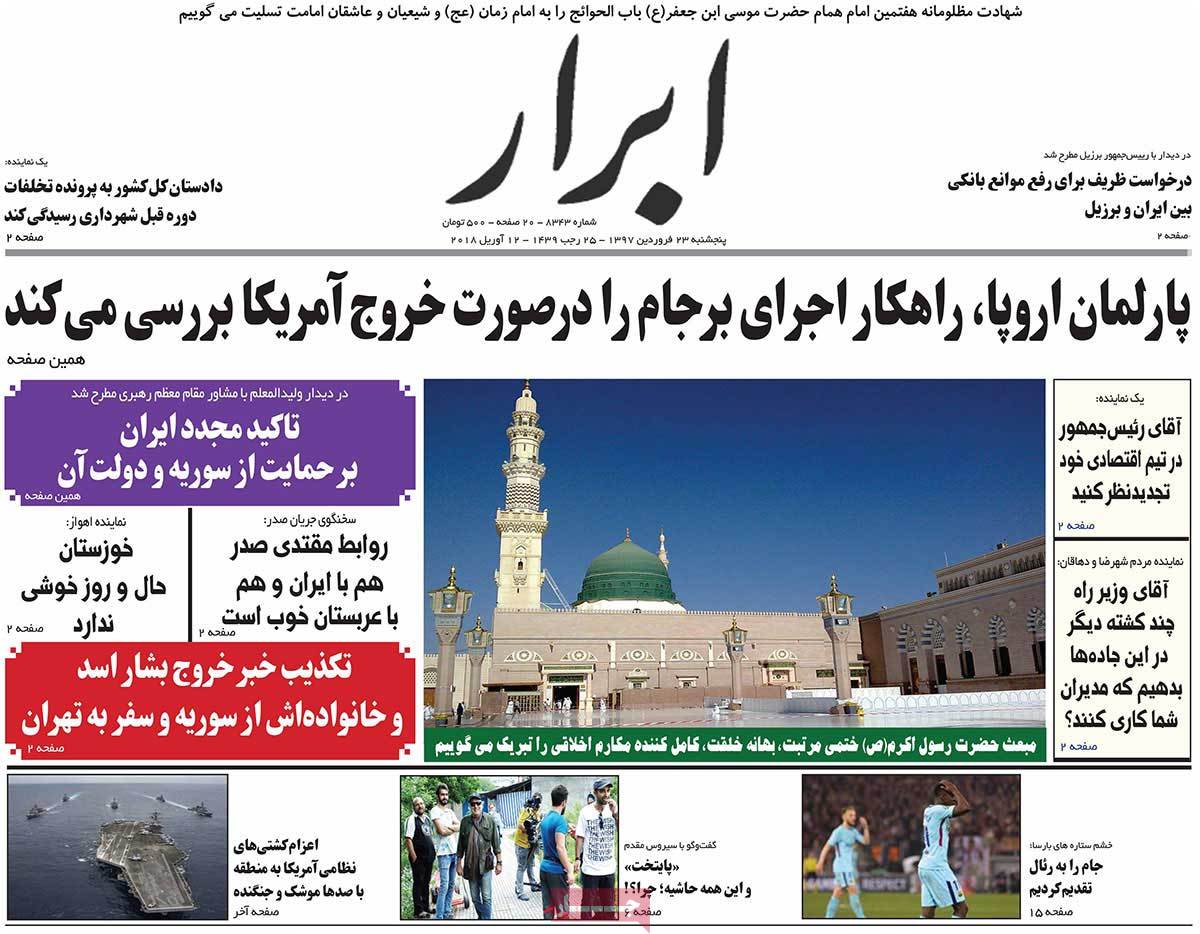
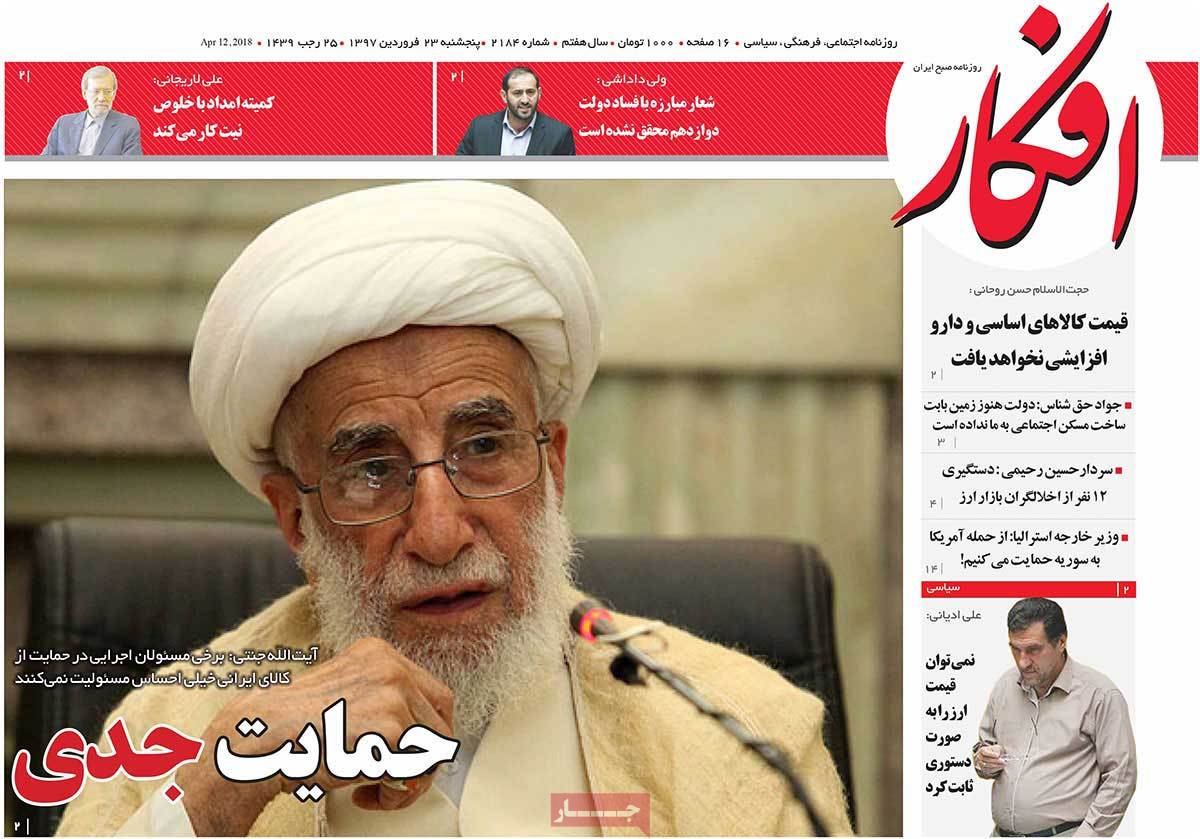
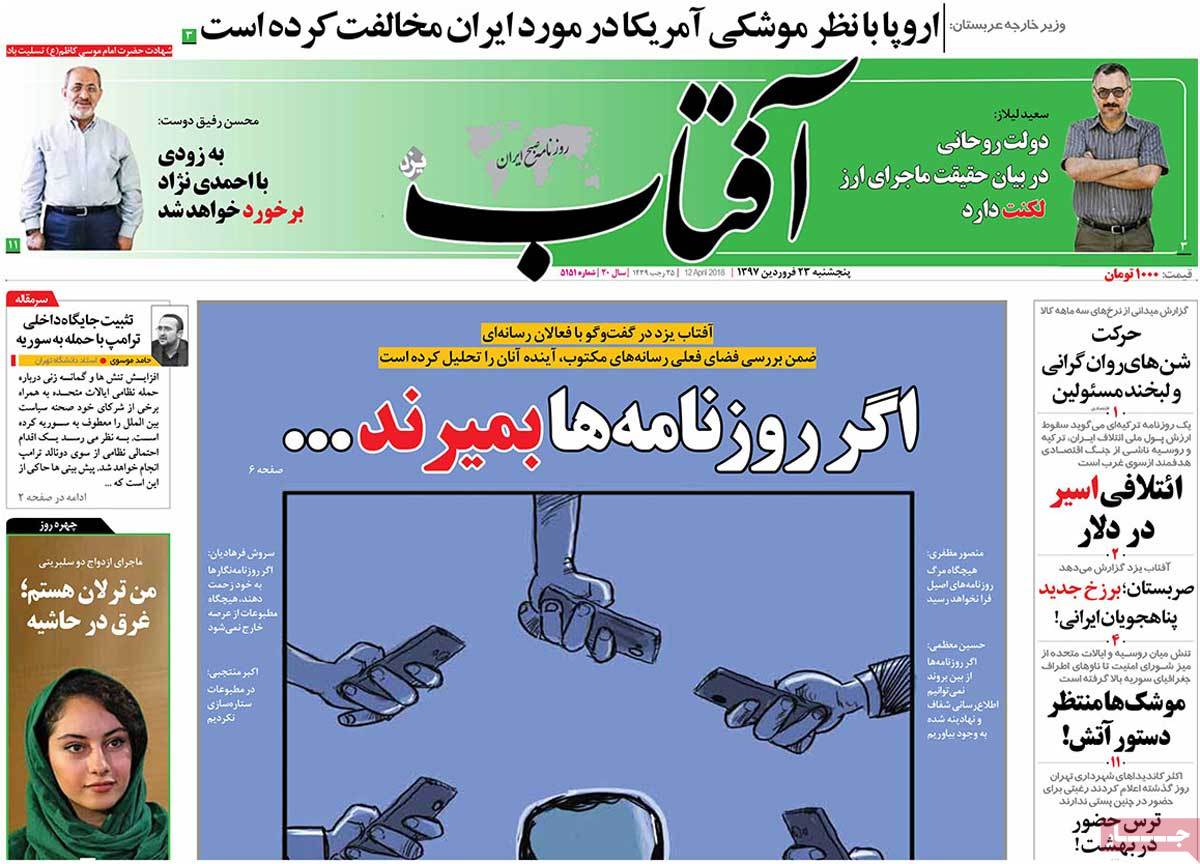
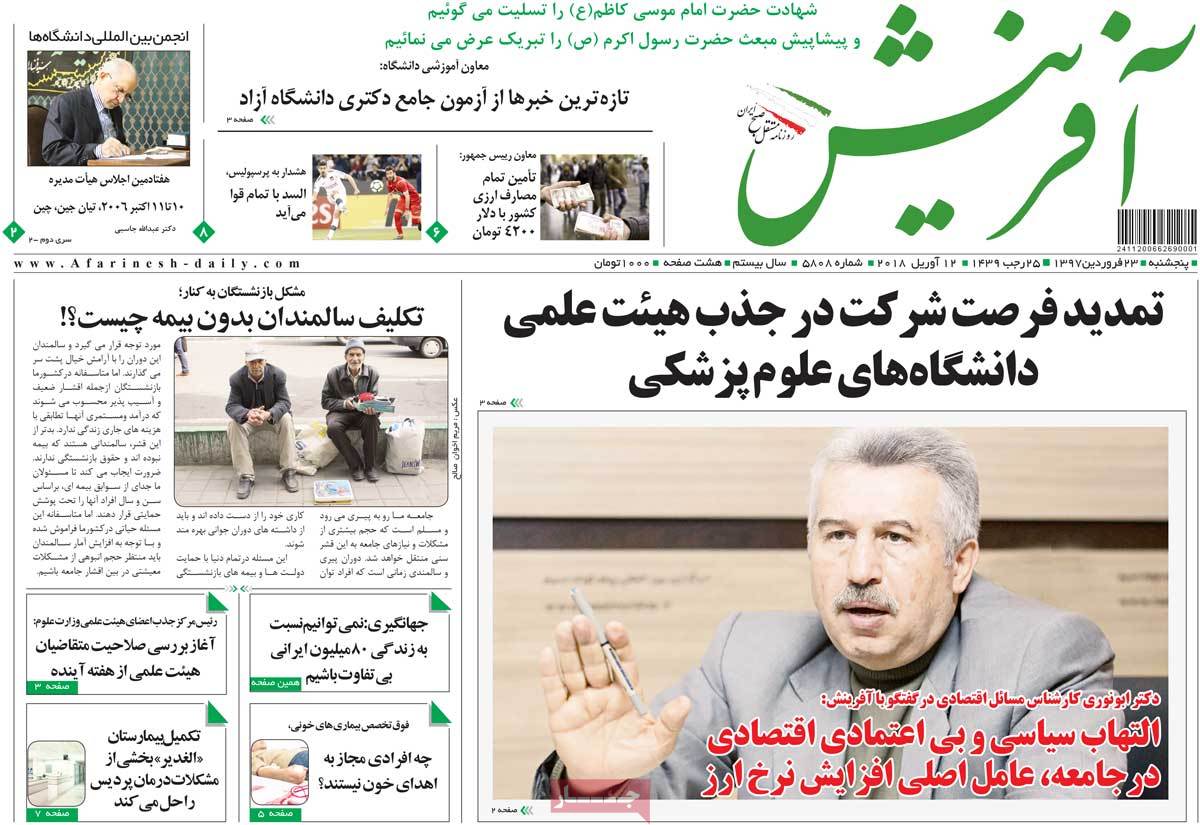
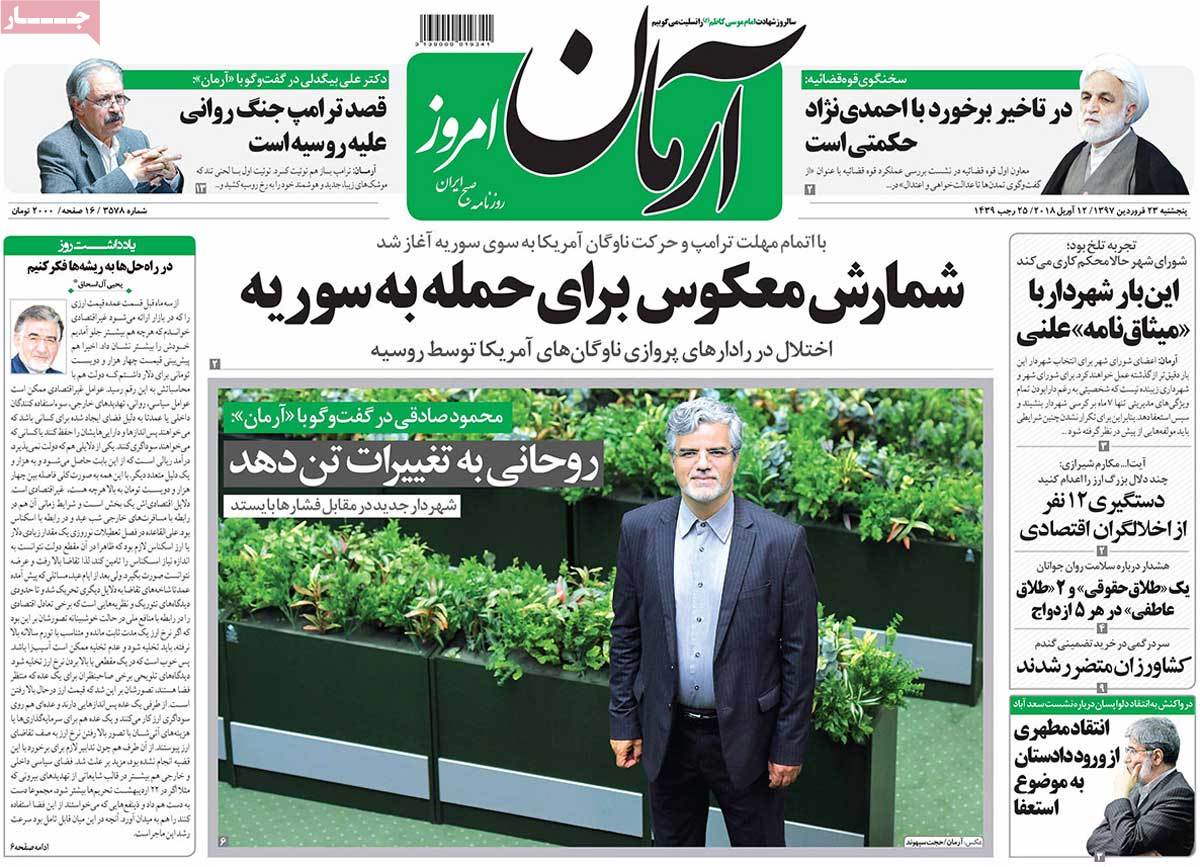
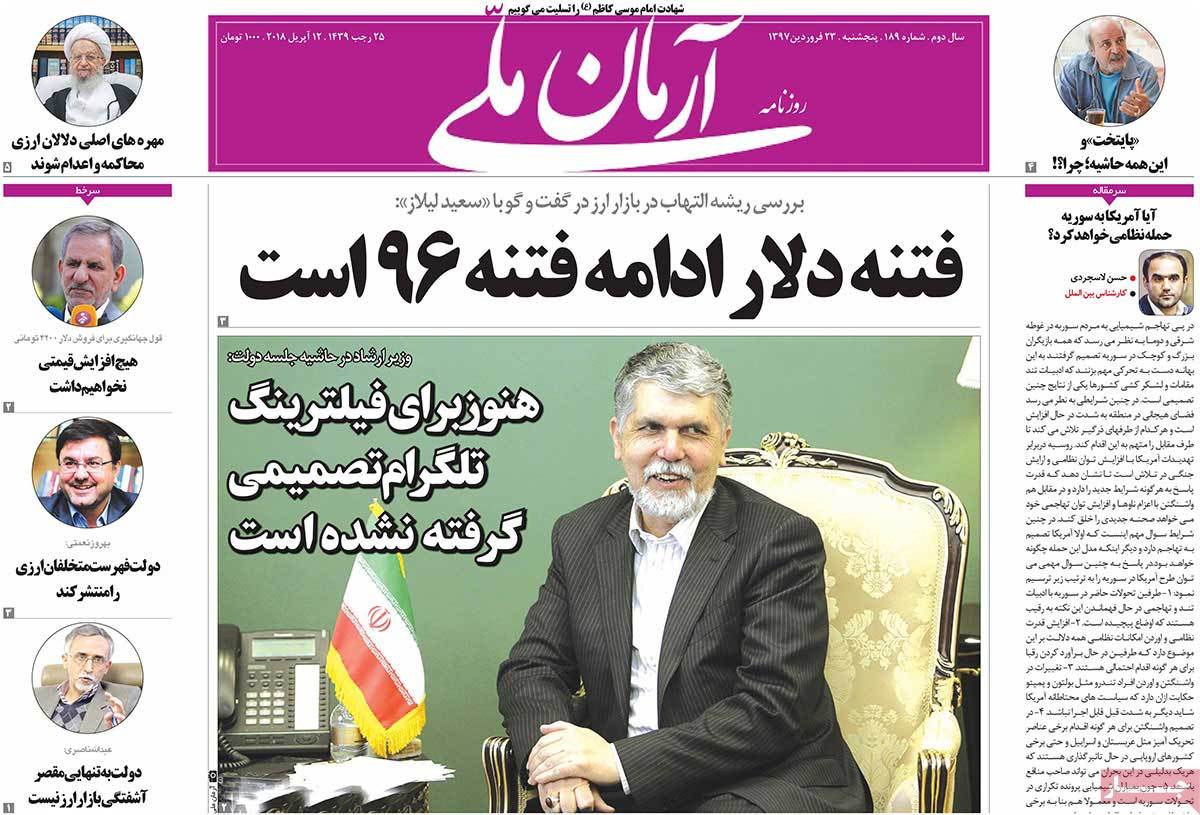
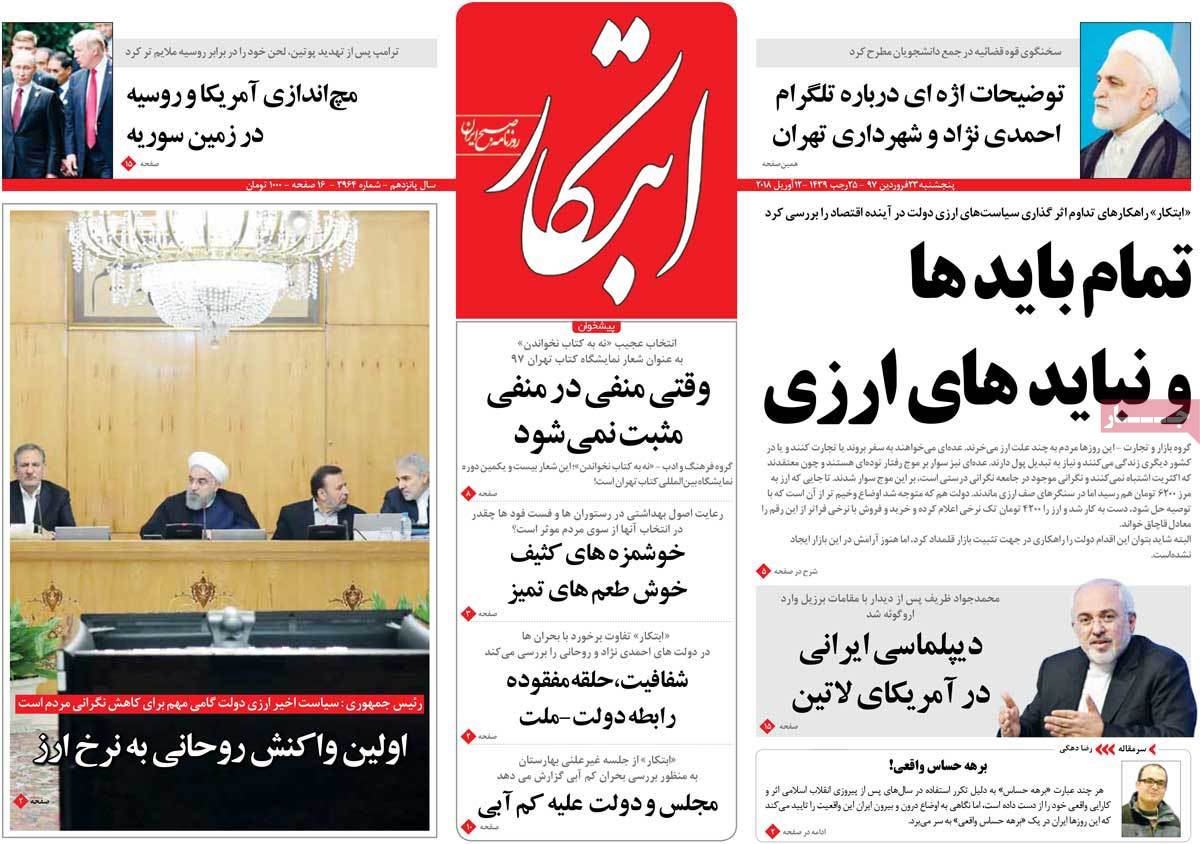
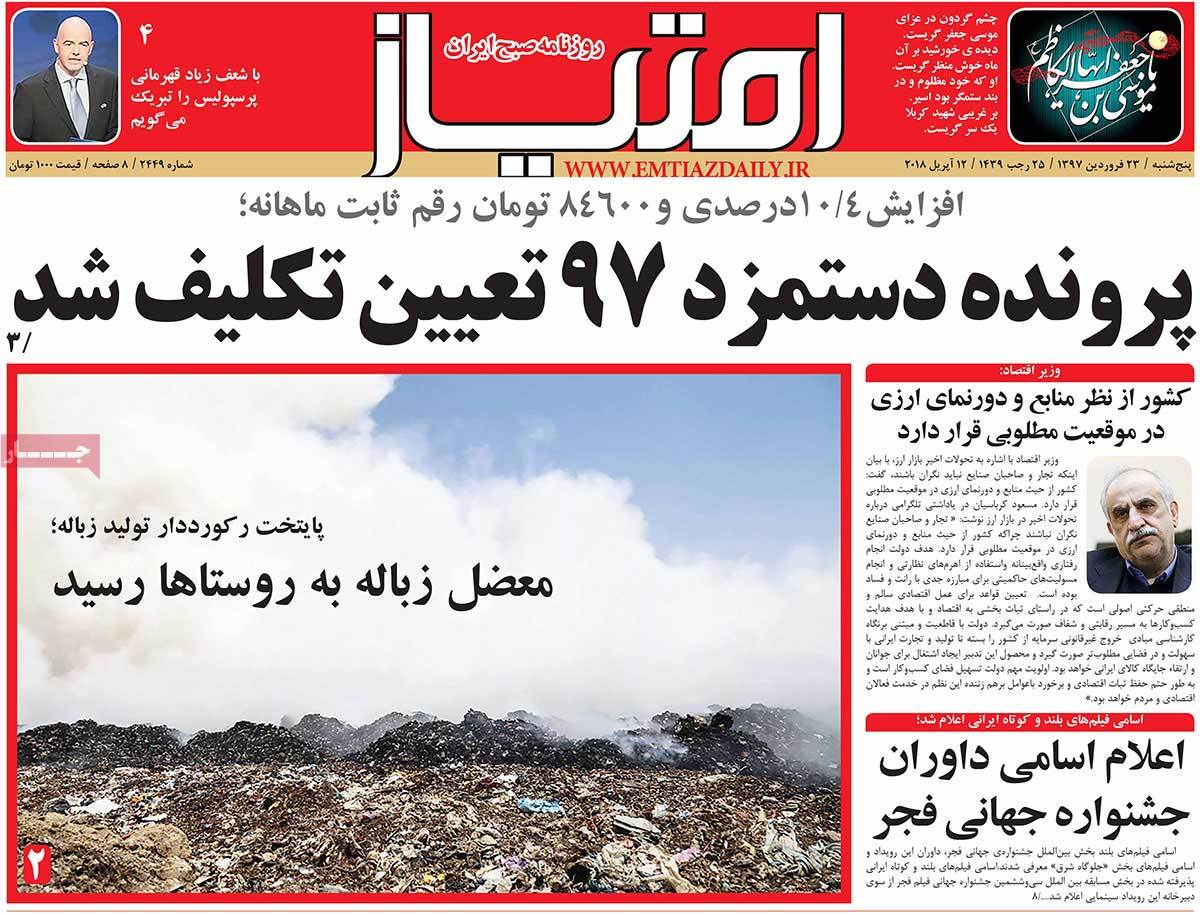
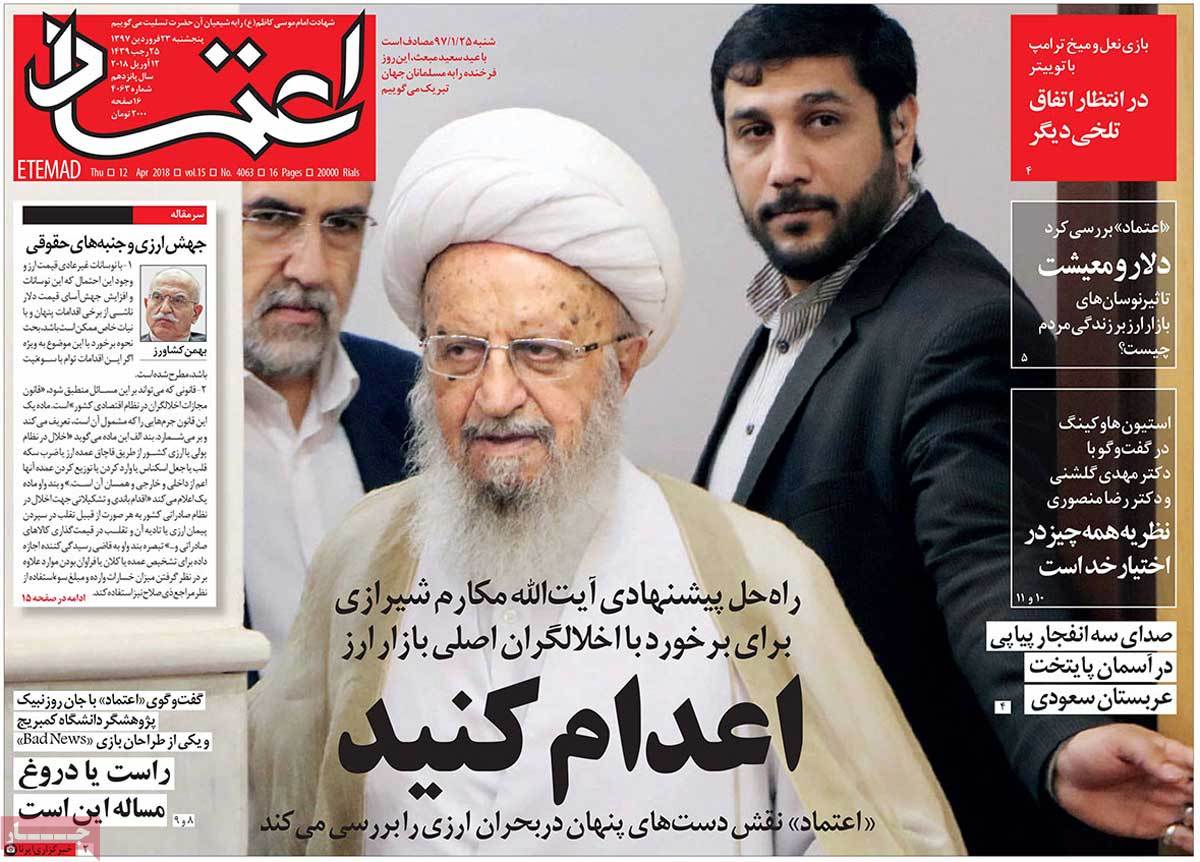
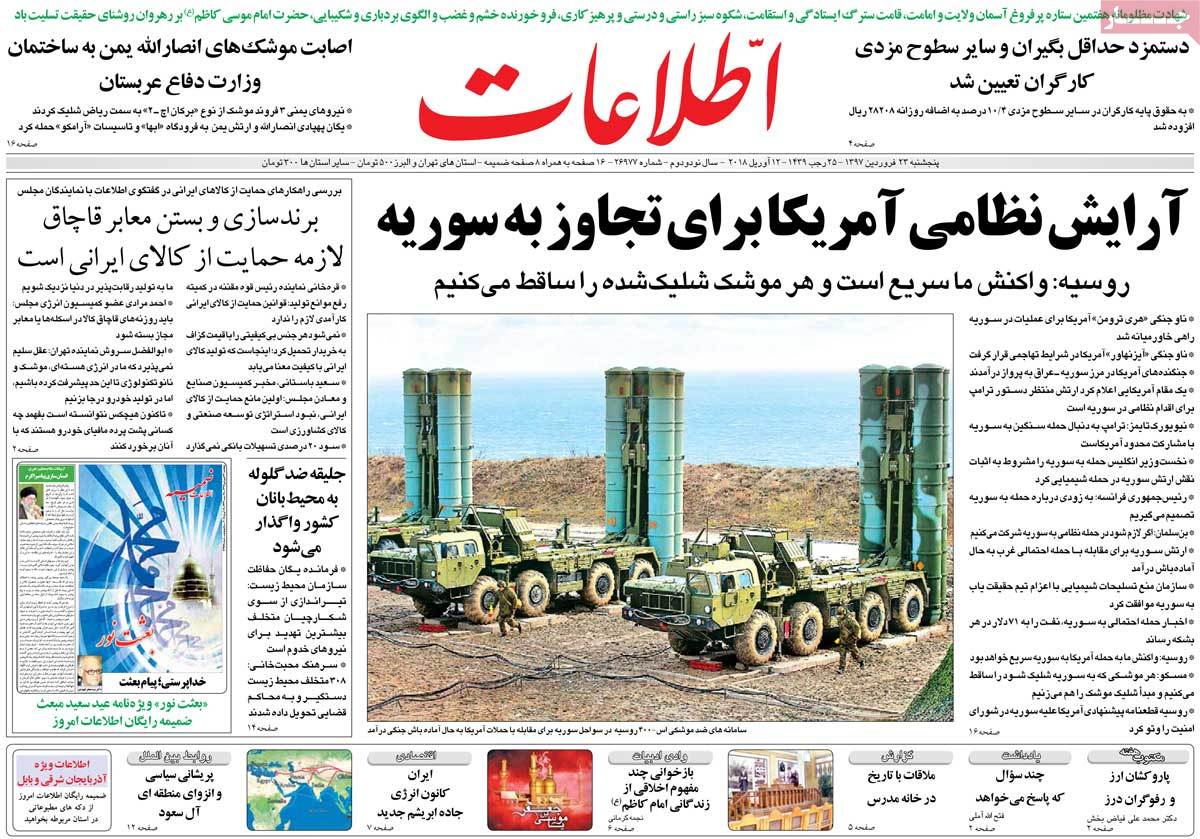
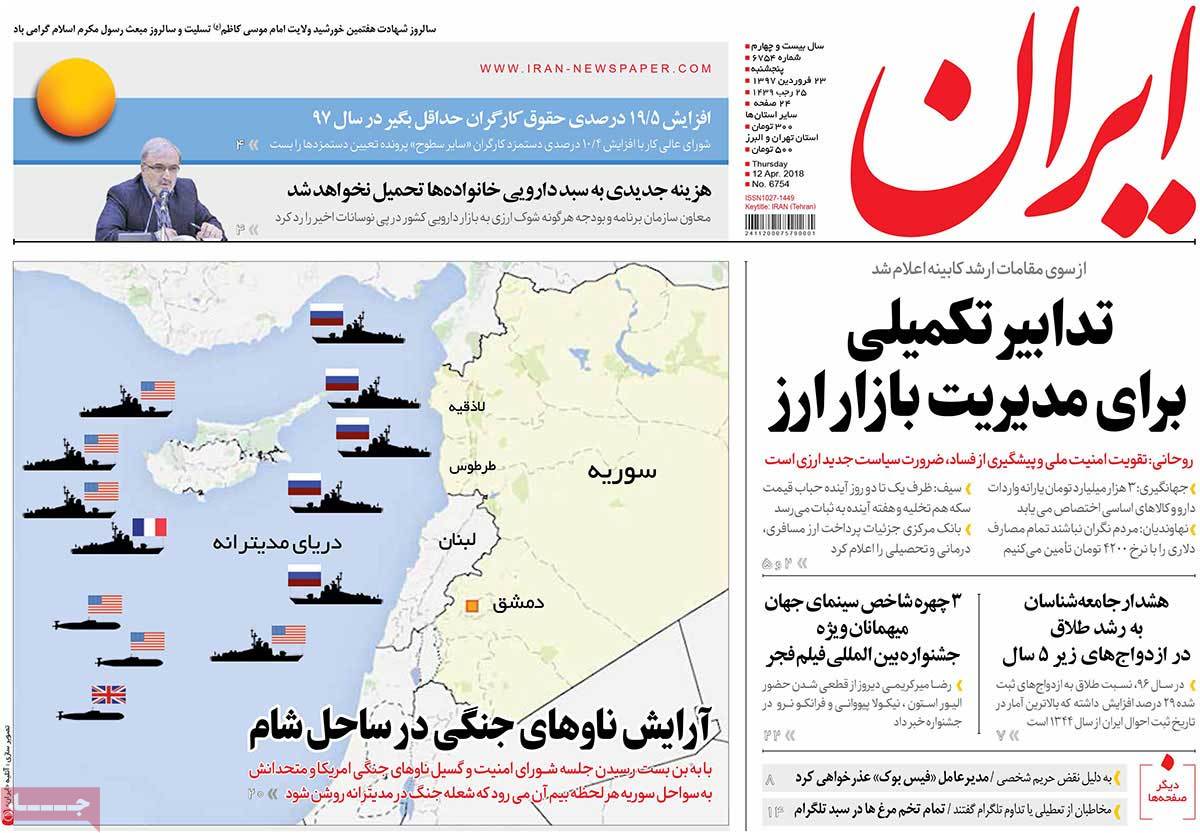
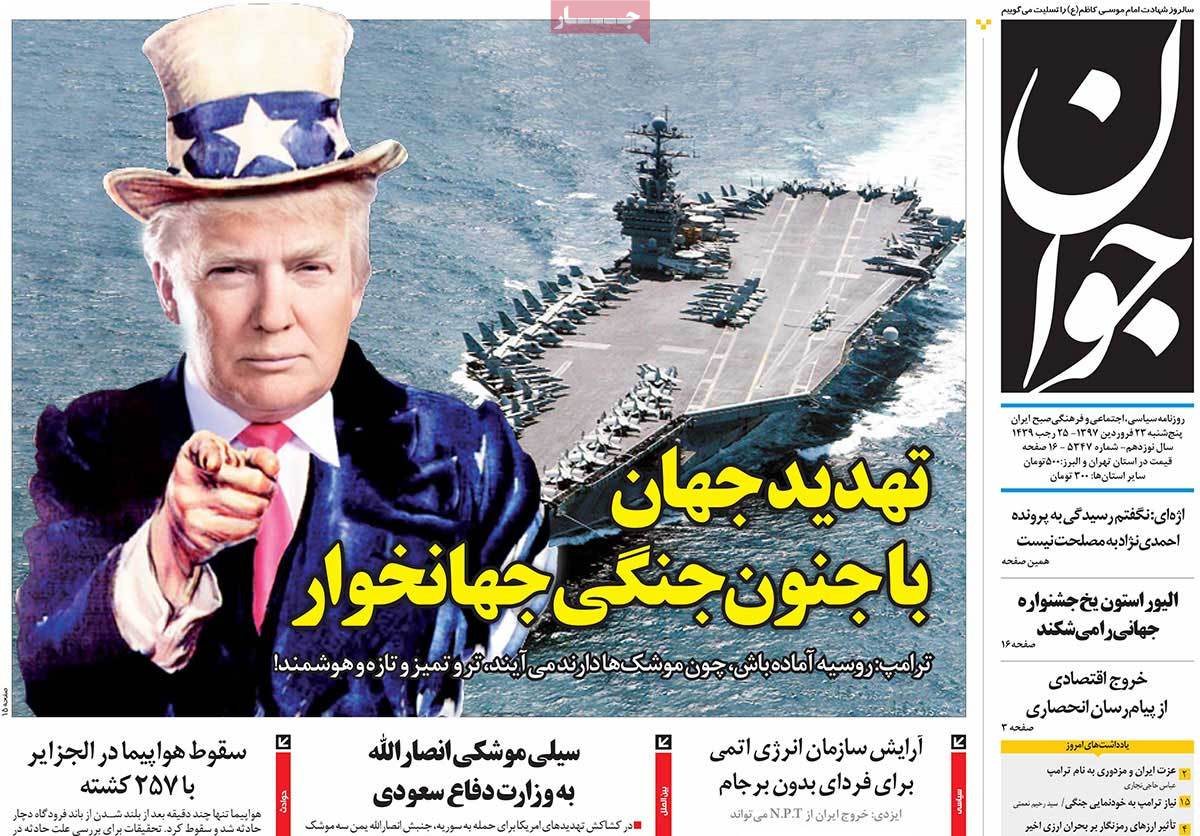
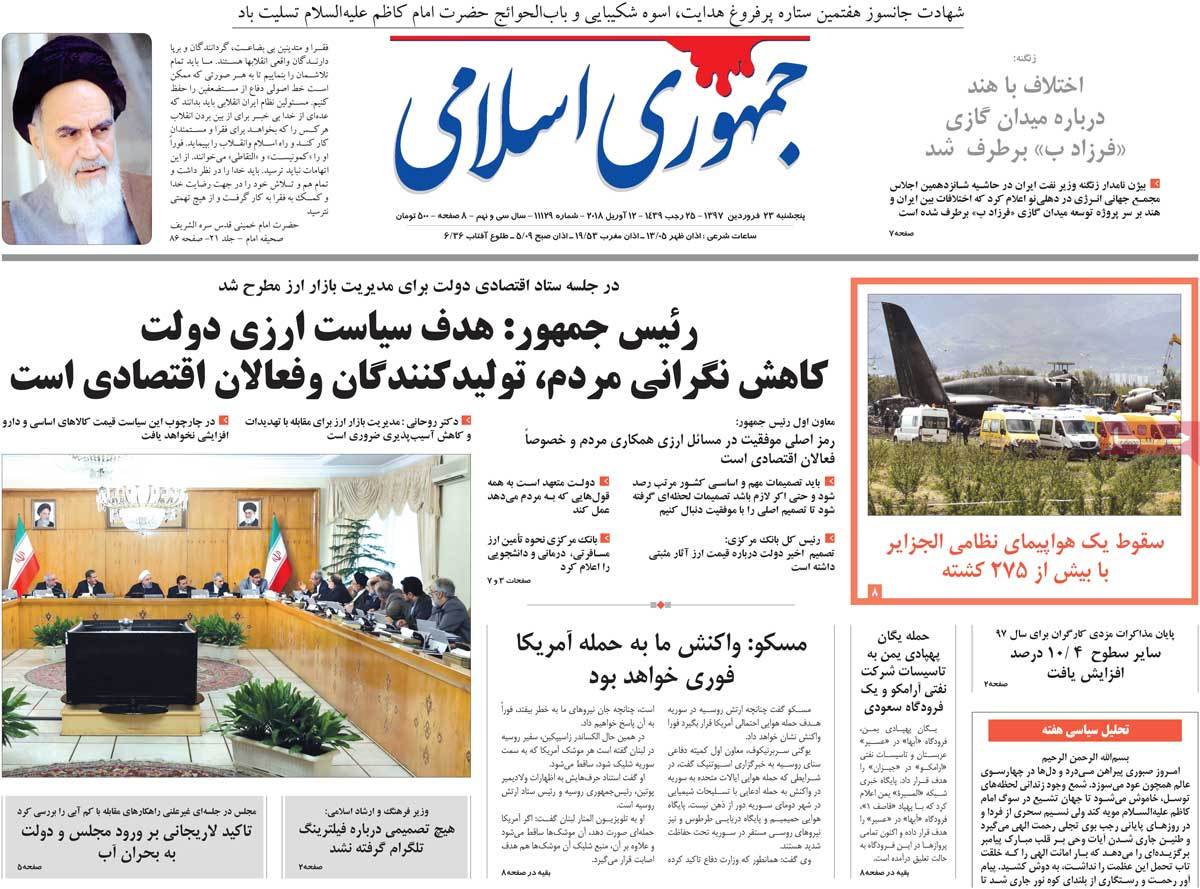
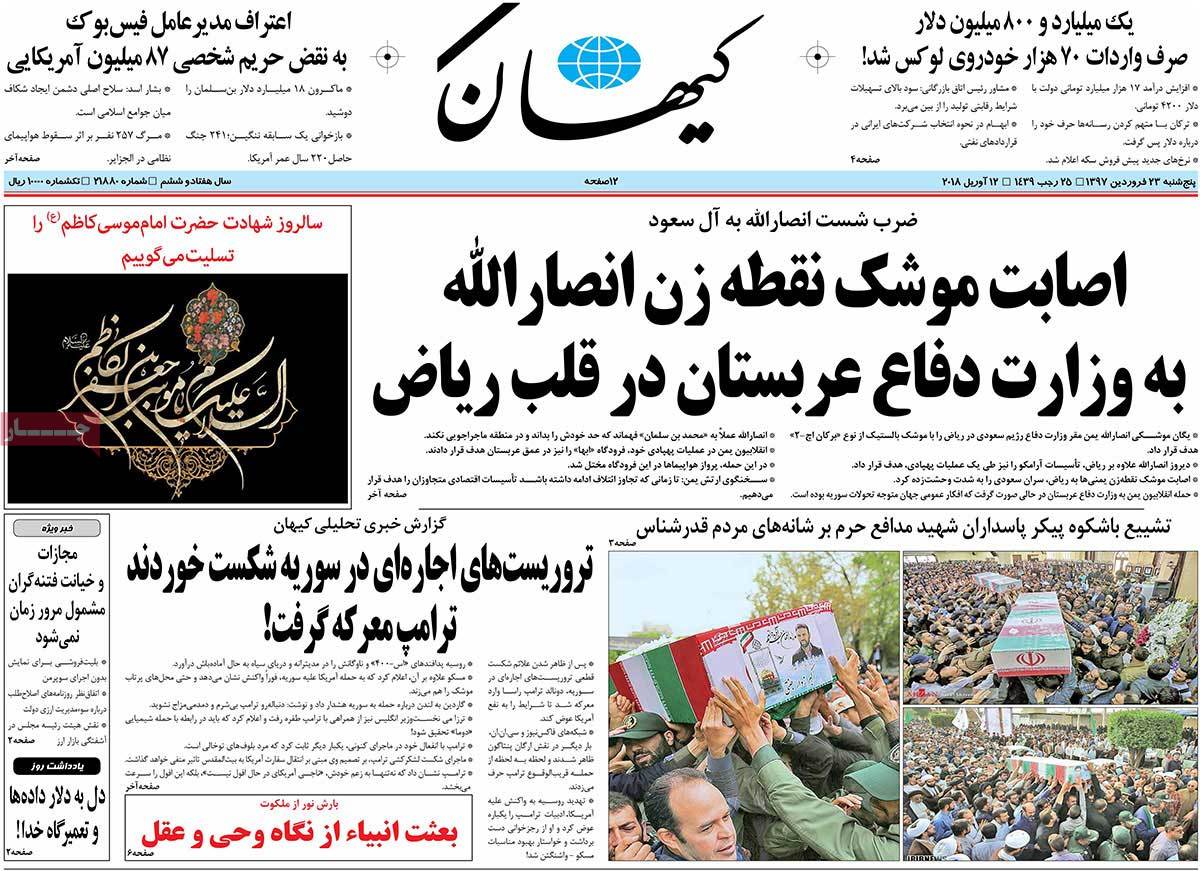
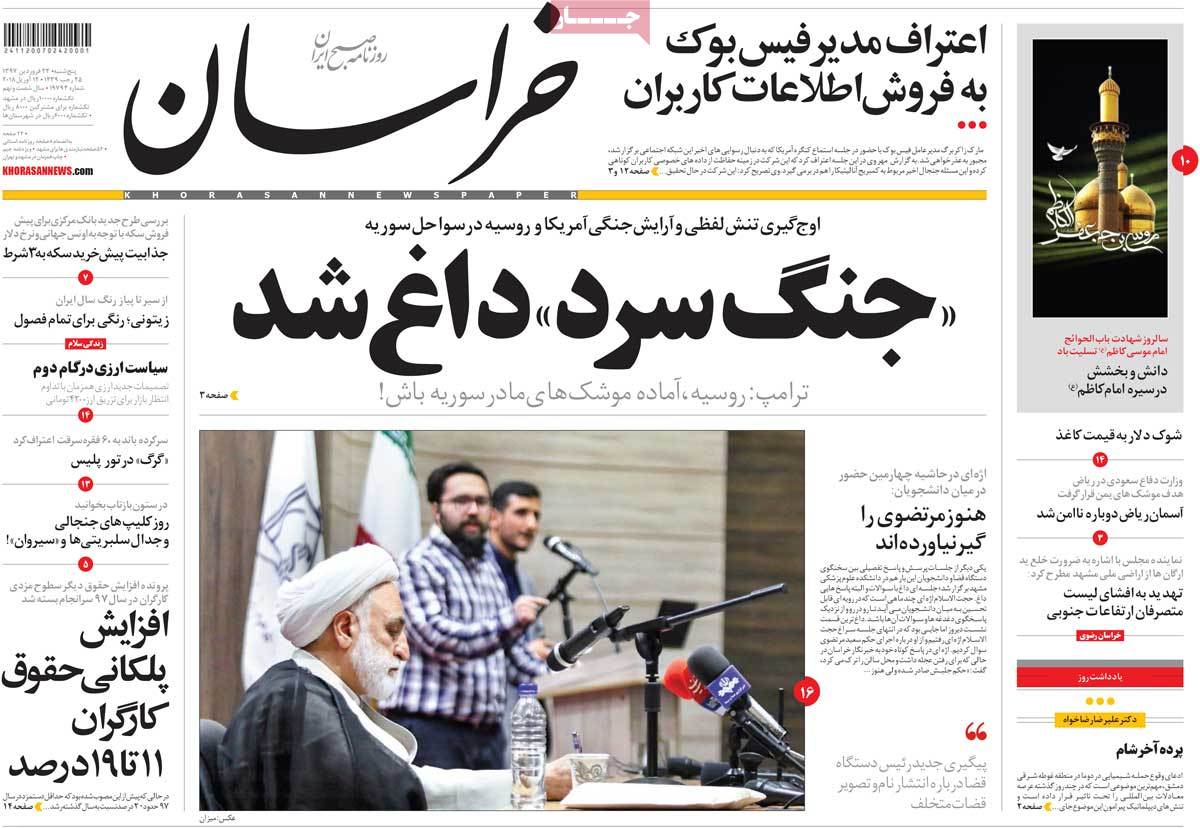
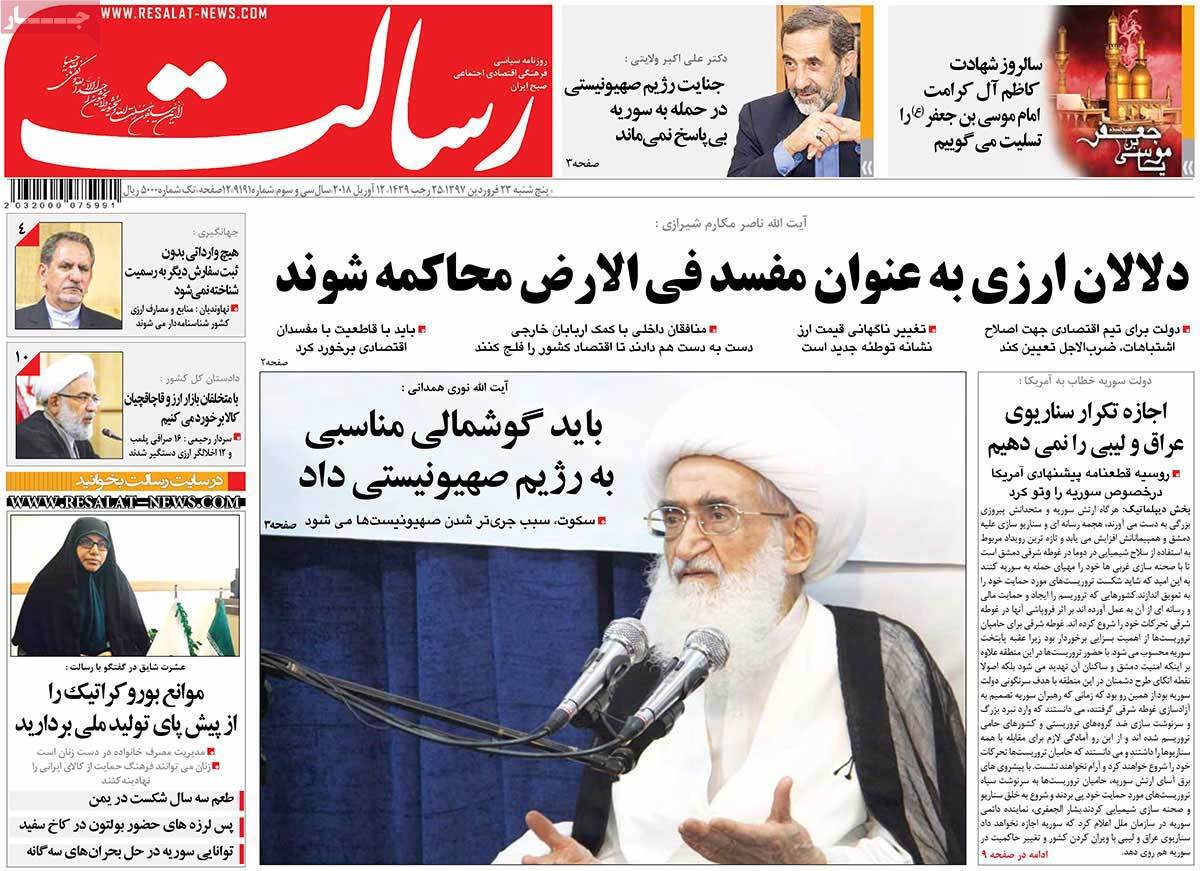
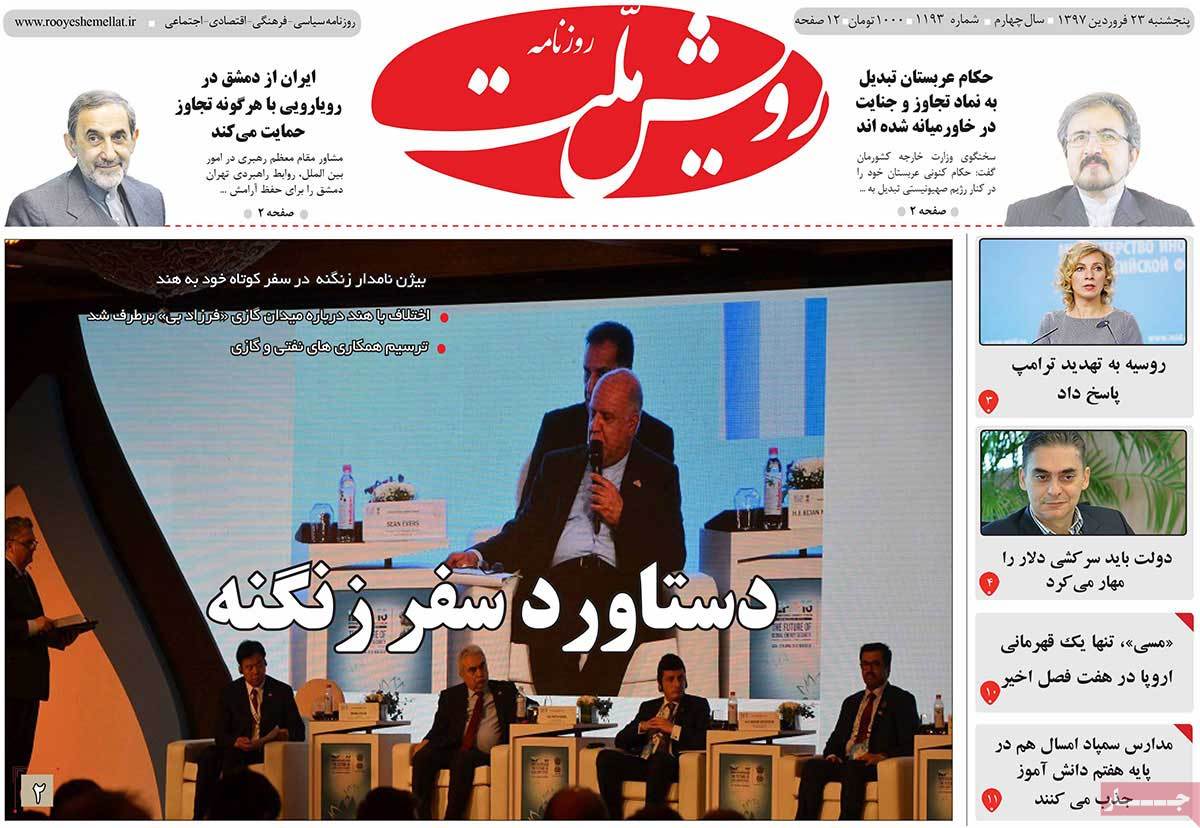
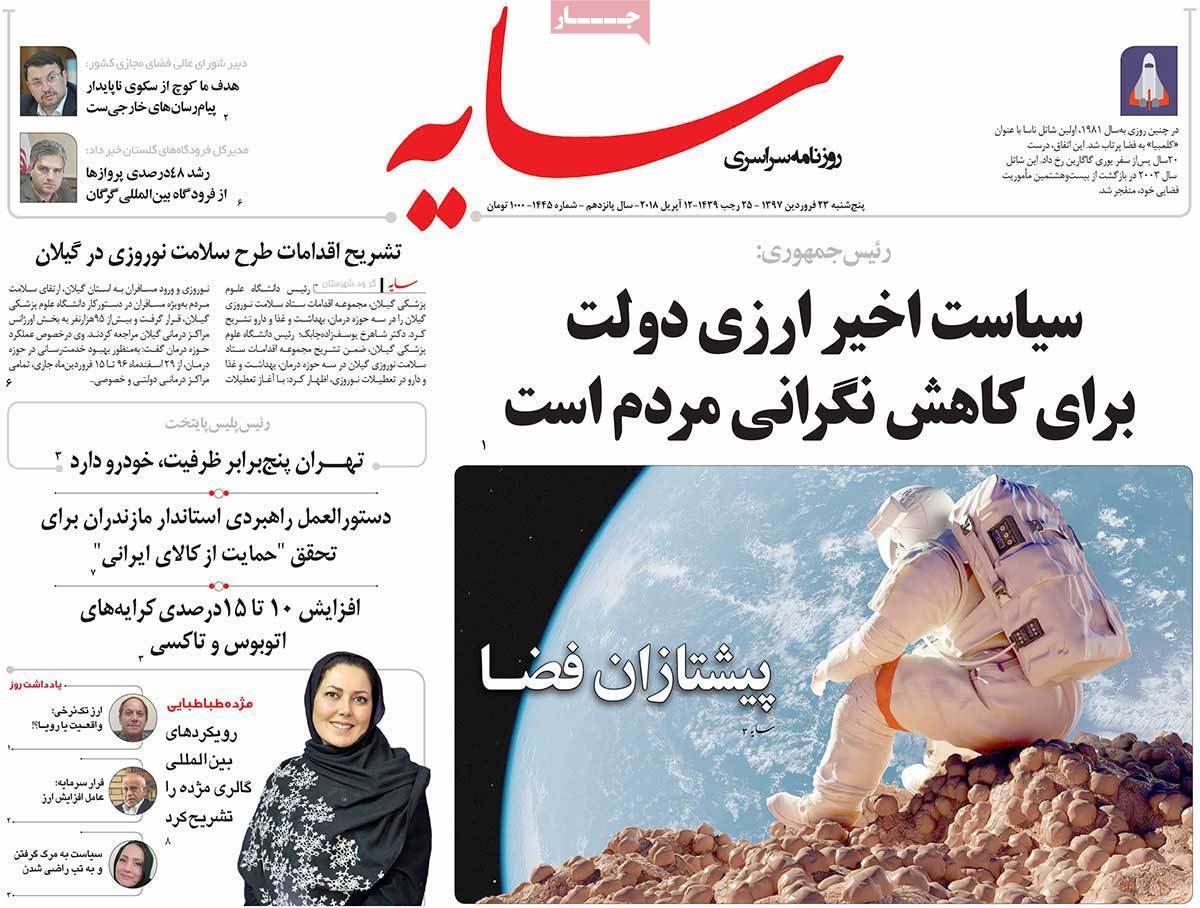
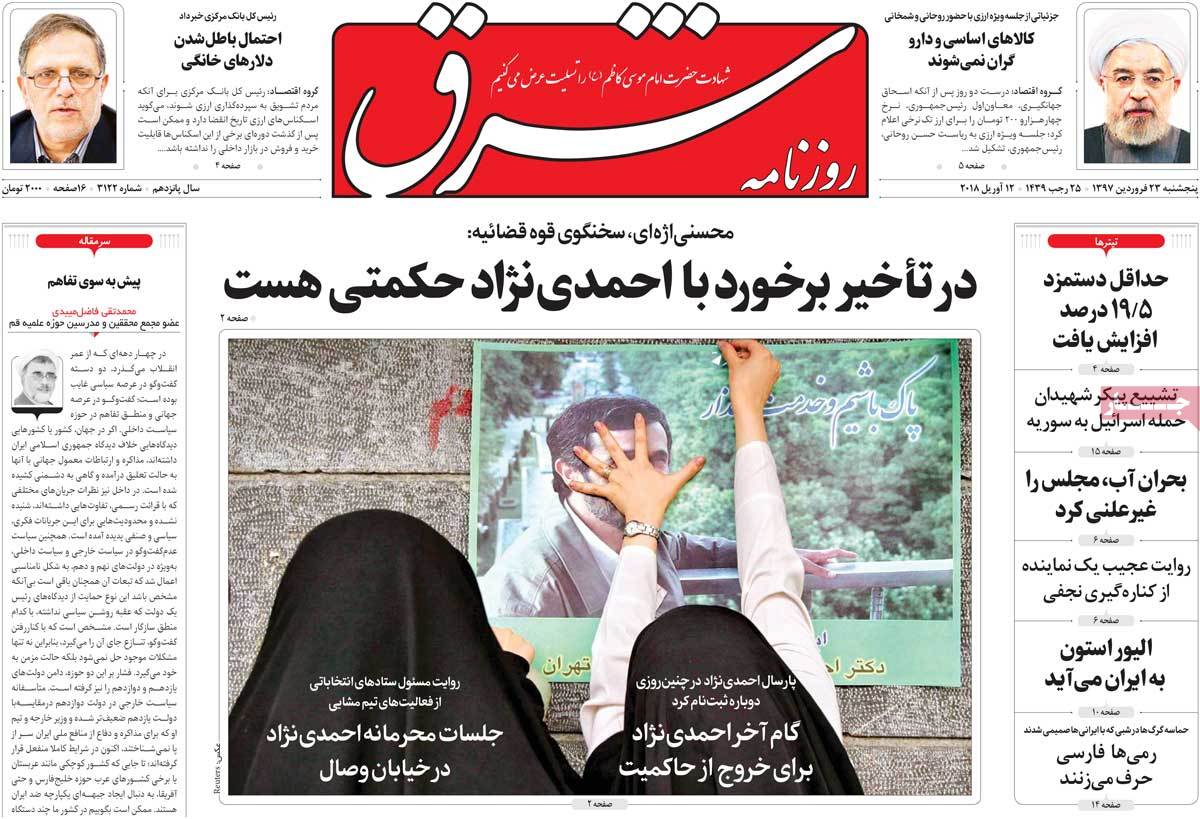
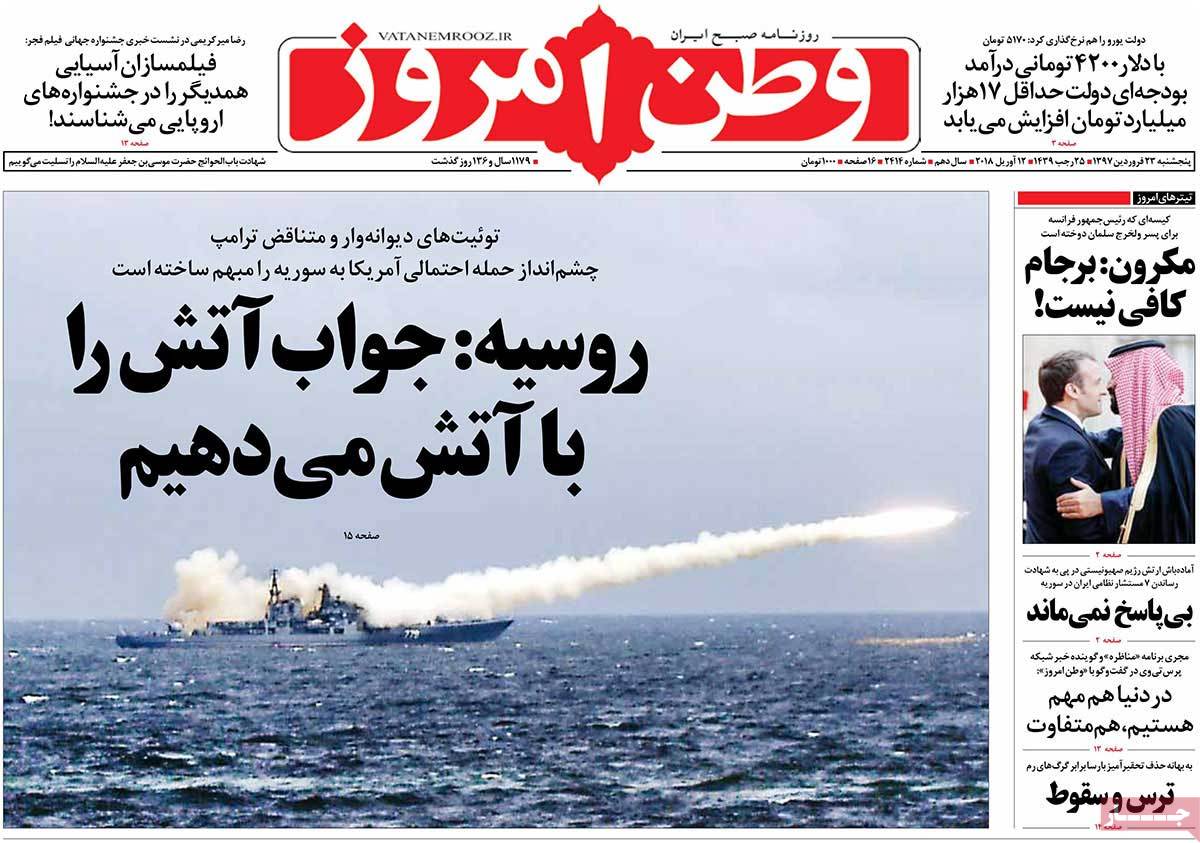
A Look at Iranian Newspaper Front Pages on March 17

A Look at Iranian Newspaper Front Pages on November 18

All newspapers today covered the remarks made by the Leader of Iran’s Islamic Revolution Ayatollah Seyyed Ali Khamenei in a meeting with members of the Assembly of Experts, a body responsible for choosing or dismissing the country’s Leader.

A meeting of the JCPOA Joint Commission in the Austrian capital of Vienna also made headlines on Saturday. Several papers referred to the US pressure on Europe, and the EU’s efforts to appease Trump in order to keep him in the nuclear deal.

The latest round of trilateral talks between Iran, Turkey, and Russia on the Syrian crisis was also a top story today, as the final statement released by the three countries’ foreign ministers received great coverage today.

The above issues, as well as many more, are highlighted in the following headlines and top stories:


19 Dey:

  • Iran Leader: I Believe A Better Future Will Come
  • Syria Crisis Has No Military Solution: Astana Statement

A Look at Iranian Newspaper Front Pages on March 17


Abrar:

  • Iranian, Turkish Military Officials Underline Enhancement of Defence Ties
  • US Navy Spokesman: Iran’s Behaviour in Persian Gulf Has Become Softer!
  • Mattis Accuses Iran of Trying to Interfere in Iraq Elections

A Look at Iranian Newspaper Front Pages on March 17


Aftab-e Yazd:

  • Iran Leader: We’re Aware of People’s Problems, but No Problem Unsolvable

A Look at Iranian Newspaper Front Pages on March 17


Arman-e Emrooz:

  • Europe under Trump’s Pressure
  • EU Proposes New Sanctions against Iran

A Look at Iranian Newspaper Front Pages on March 17


Ebtekar

  • Iran Tests Europe on JCPOA
  • 11th Meeting of JCPOA Joint Commission Held in Vienna
  • Kazakhstan, Watershed in Syria Crisis

A Look at Iranian Newspaper Front Pages on March 17


Etemad:

  • Ambiguous Future of Iran Nuclear Deal
  • Representatives of Iran, P5+1 Meet in Vienna

A Look at Iranian Newspaper Front Pages on March 17


Ettela’at:

  • In Unprecedented Move, Zionists Confess to Being Defeated by Hezbollah in 33-Day War
  • FMs of Iran, Russia, Turkey Underline Joint Fight against Terror Until Syria Liberation

A Look at Iranian Newspaper Front Pages on March 17


Iran:

  • Araqchi: Trump’s Ultimatum against US Commitments under JCPOA
  • Rouhani’s Chief of Staff: Everyone Waiting for Others to Hear People’s Voice

A Look at Iranian Newspaper Front Pages on March 17


Javan:

  • Iran Leader: Islamic Republic’s Monotheistic Nature Makes Enemies Attack Us
  • Araqchi Implicitly Admits: EU Confirms US Violation of JCPOA, but Refrains from Saying It

A Look at Iranian Newspaper Front Pages on March 17


Jomhouri Eslami:

  • Iran Leader: People’s Faith to Become Stronger If We Do What We Preach
  • Western Allies of US Line Up against US

A Look at Iranian Newspaper Front Pages on March 17


Kayhan:

  • Bin Salman Imprisons His Mother Due to Her Opposition to His Kingdom
  • New Sanctions Approved in Washington
  • We Still Looking for Realization of JCPOA Promises in Vienna

A Look at Iranian Newspaper Front Pages on March 17


Khorasan:

  • Iran Leader: Top Clerics, Officials Must Avoid Aristocracy, Worldliness

A Look at Iranian Newspaper Front Pages on March 17


Payam-e Zaman:

  • Zarif Warns US Withdrawal from JCPOA to Be Painful Mistake
  • Iran’s Population Exceeds 81 Million

A Look at Iranian Newspaper Front Pages on March 17


Resalat:

  • Fire in UK-Russia Ties: UN Security Council to Discuss British Spy’s Case

A Look at Iranian Newspaper Front Pages on March 17


Setareh Sobh:

  • A Report on Russia Elections: Results Determined in Advance

A Look at Iranian Newspaper Front Pages on March 17


Shahrvand:

  • Gift of Freedom for Mothers in Prison
  • Charity Concert’s Revenues to Release Female Prisoners
  • VP for Women Affairs: It’s Very Hard for Mothers to Be in Prison
  • Mr Ambassador’s Adventures in Iran
  • German Ambassador Talks of Iranians’ Love for Poetry


A Look at Iranian Newspaper Front Pages on March 17


Shargh:

  • Bin Salman: Iran No Rival to Saudi Arabia
  • Representatives of Iran, US Hold Bilateral Talks in Vienna
  • JCPOA Joint Commission Discusses US Violation of Nuclear Deal

A Look at Iranian Newspaper Front Pages on March 17


Sobh-e Now:

  • Bin Salman’s New Brag
  • IRGC: Riyadh Doesn’t Even Dare to Test-Fire Missiles It Has Rented

A Look at Iranian Newspaper Front Pages on March 17


Ta’adol:

  • Step by Step to Oval Office
  • Special Counsel to Probe into Trump Firm’s Role in Russiagate

A Look at Iranian Newspaper Front Pages on March 17


Vatan-e Emrooz:

  • Saudi Crown Prince, A Feeble-Minded Person Who Talks Nonsense
  • What Is Bin Alawi Doing in Tehran? Speculations about Omani FM’s Visit to Iran
  • Thousands of Civilians Evacuated from Eastern Ghouta

A Look at Iranian Newspaper Front Pages on March 17

“Oman FM’s Tehran Trip Unrelated to Mattis’ Muscat Visit”

“The trip of Mr. Bin Alawi was made according to the schedule and to [help] develop bilateral ties,” said Bahram Qassemi in a Saturday statement.

Bin Alawi arrived in Tehran late Friday to hold talks with Iranian officials.

The spokesman said a constructive atmosphere prevails Tehran-Muscat relations and the two countries are eager to strengthen bonds of friendship.

“During the visit, he will meet the governor of the Central Bank of Iran and managers of governmental and private firms, in addition to political and parliamentary officials,” he said.

Qassemi said the trip is unrelated to an Oman trip by US Defence Secretary James Mattis last Sunday and the developments regarding the 2015 nuclear deal.

“Oman is an independent country that enjoys good relations with many countries. However, Mr Bin Alawi’s trip to Tehran has nothing to do with these issues,” he said.

During his visit to Muscat, Mattis discussed US concerns, particularly those related to the Yemen conflict, with Sultan Qaboos.

Since 2015, Yemen has been the scene of a Saudi military campaign, which Riyadh says aims to push Houti fighters out of the Yemen capital Sana’a and restore to power the fugitive president Abd-Rabbu Mansour Hadi.

The US, a staunch ally of Saudis in the war, has accused Iran of trafficking weapons through Oman to Houthi fighters.

Oman, traditionally on friendly terms with Iran, has often sought to play the role of a mediator in disputes between Tehran and Western capitals.

In 2013, Muscat hosted talks between Iran and Western powers that led to the landmark July 2015 deal.