Speaking in an interview with IRNA on Sunday at the Russian Embassy in Tehran, Jagarian said the Kremlin condemns the BBC’s interference.
The Islamic Republic of Iran has blocked the channel’s website because it encourages illegal rallies and manipulates the Iranian people against the Establishment, a claim which the BBC has denied.
During the Sunday interview, which was held on the fringes of Russia’s presidential election, the Russian ambassador also referred to the UK’s accusation that Russia was involved in the poisoning of a former Russian double agent in Britain.
The top diplomat noted Russia has announced time and again that it has had no interference in Britain’s affairs, nor has it had any motivation to do so.
He dismissed London’s accusation as baseless, saying his country favours good relations with Britain, the US and other countries.
Jagarian said there is no evidence that suggests Russia’s involvement in the poisoning case. According to the top diplomat, the Kremlin has warned London of a firm response if the UK insists on its hostile approach toward Russia.
He then touched upon the West and Washington’s interference in Russia’s election. He said the American daily The New York Times confessed recently that the US has meddled in the internal affairs of other countries on numerous occasions. He said the US even orchestrated a coup back in 1953 against then Iranian Prime Minister Mohammad Mosaddeq.
The Russian diplomat said several governments in Latin America were also toppled by the US.
He said Washington interferes in the domestic affairs of Iran, Russia and other countries, and at the same time accuses other states of interference without presenting any evidence.
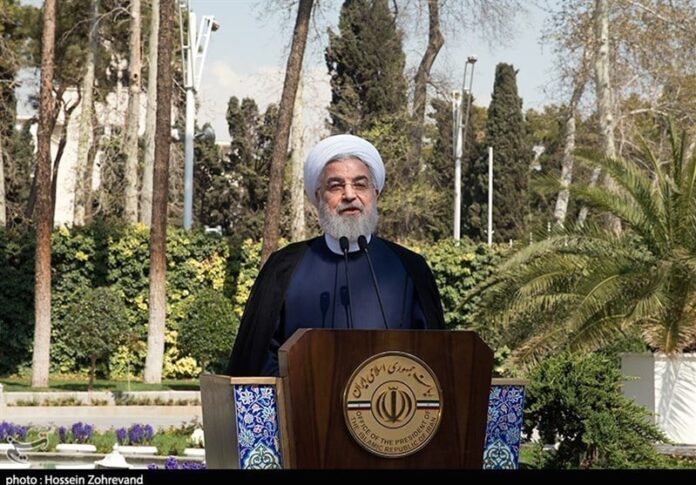
In comments made Sunday at the final weekly Cabinet session of the current year, Rouhani said his administration would keep efforts to strengthen regional security and stability in the new year.
Hoping for positive measures for peace and stability in the coming year, the president said Iran would “vigorously” pursue its policy of constructive interaction with the world “irrespective of the demands of the US, ill-wishers of the Iranian nation, and one or two small countries in the region.”
“We will never back off from national interests and will keep safeguarding national security and interests,” he added.
Rouhani also pointed to the country’s outstanding political achievements in the current Iranian year, saying the world rejected accusations that Iran had failed to honor its commitments under the Joint Comprehensive Plan of Action (JCPOA).
The International Atomic Energy Agency (IAEA), the main entity entitled to verify nuclear commitments, has certified in all of its reports that Iran has fully carried out undertakings under the JCPOA, the nuclear agreement between Iran and the Group 5+1 (Russia, China, the US, Britain, France and Germany), he added.
The president also hailed the fall of the Daesh (ISIL) terrorist group as a major achievement for humanity, paying tribute to those contributing to the fight against terrorism.
During the current Iranian year, which is going to end in two days, Rouhani won a second term in the May presidential election.
The Iranian president maintains that his administration’s foreign policy is based on constructive interaction with the world while it sticks to the country’s red lines.
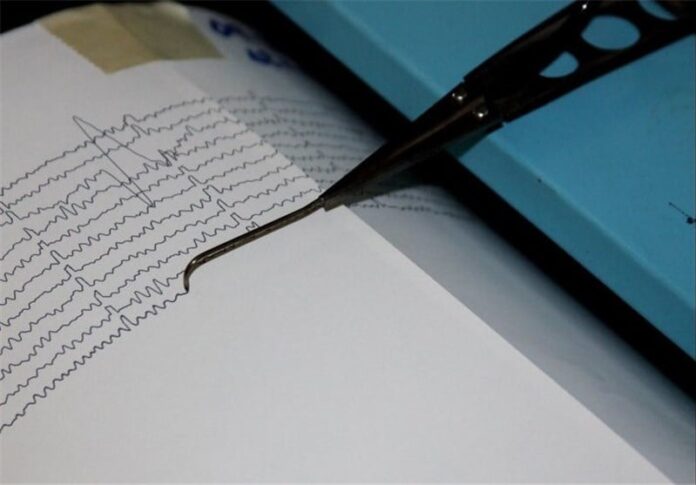
According to the Seismological Center of the Institute of Geophysics of Tehran University, the temblor struck the port city of Bandar Rig in Bushehr Province at around 8 a.m. (local time) on Monday.
Data from the seismological center showed the location of the quake as 29 km from Bandar Rig and with a depth of 11 km.
The quake has caused widespread panic among the locals but fortunately, no reports of casualties have been reported yet, according to Tasnim dispatches.
Speaking to the Tasnim News Agency, Head of Iran’s Red Crescent Society (IRCS) of the Bushehr Province said teams from the IRCS are present at the scene.
Iran is one of the most seismically active countries in the world, being crossed by several major fault lines that cover at least 90% of the country. As a result, earthquakes in Iran occur often and are destructive.
On November 12, the western province of Kermanshah was hit by a major 7.3-magnitude quake that killed 620 people according to the latest toll.
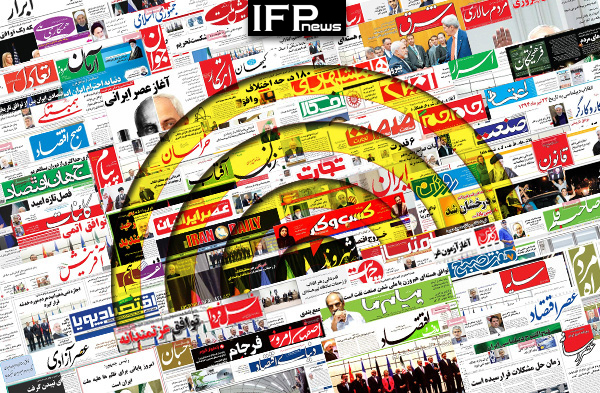
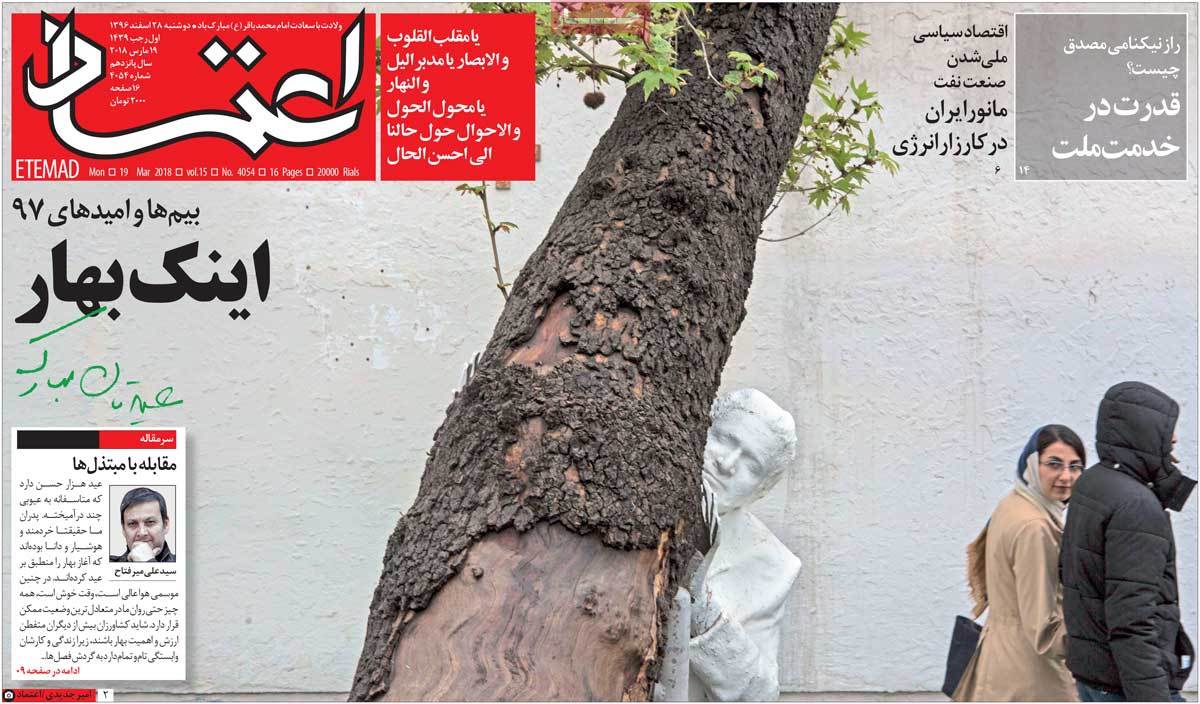
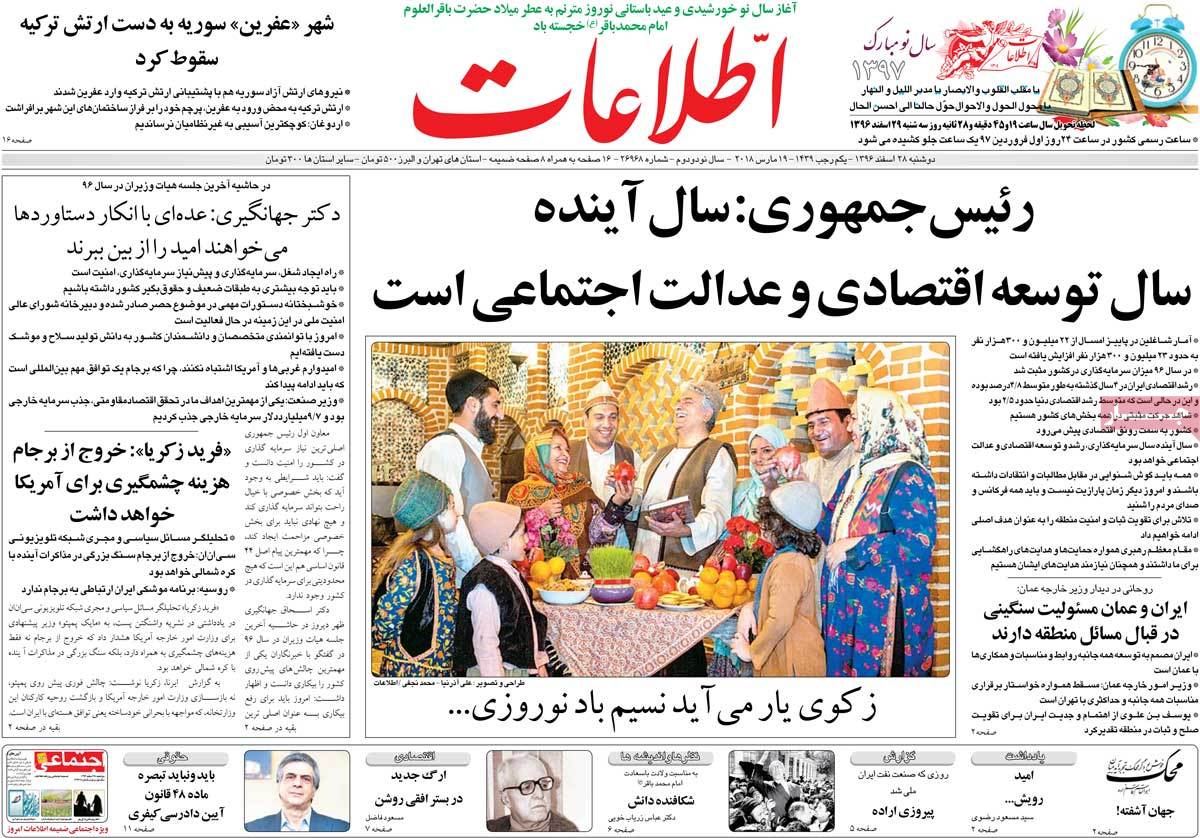
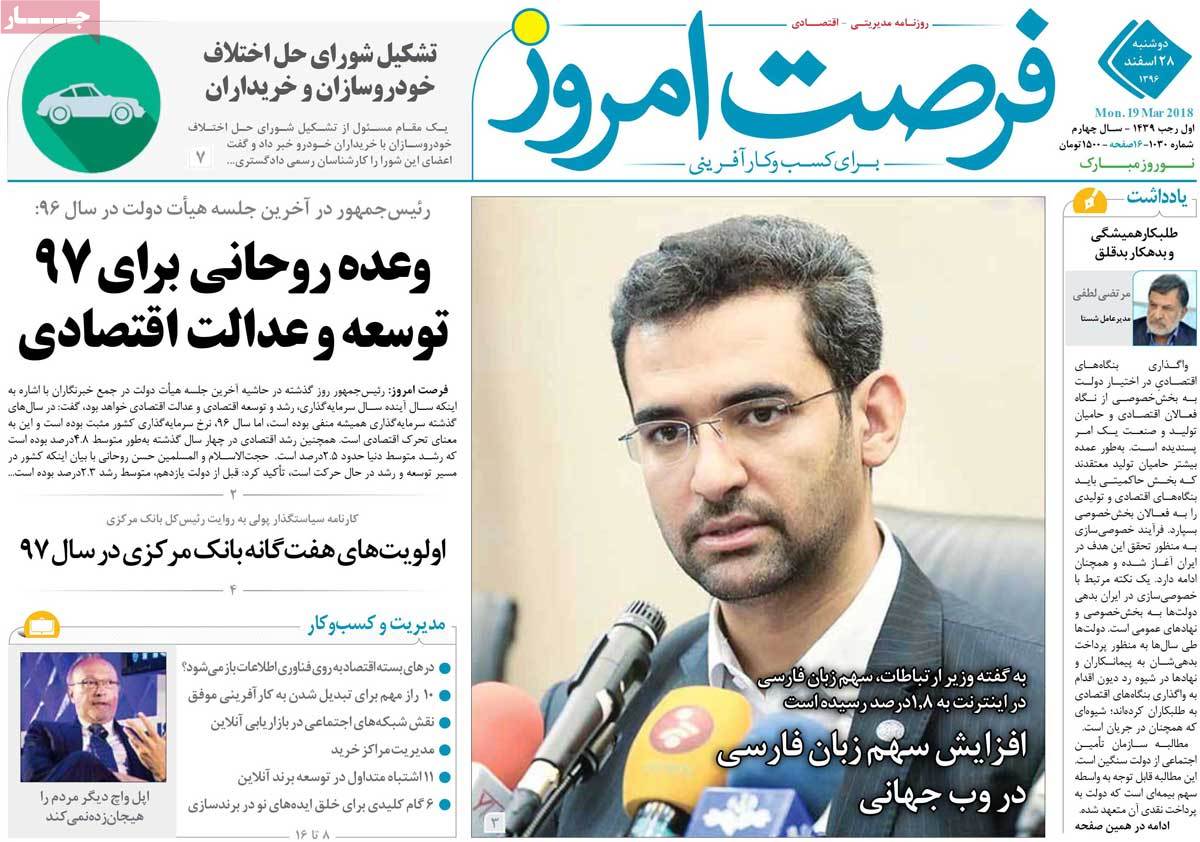
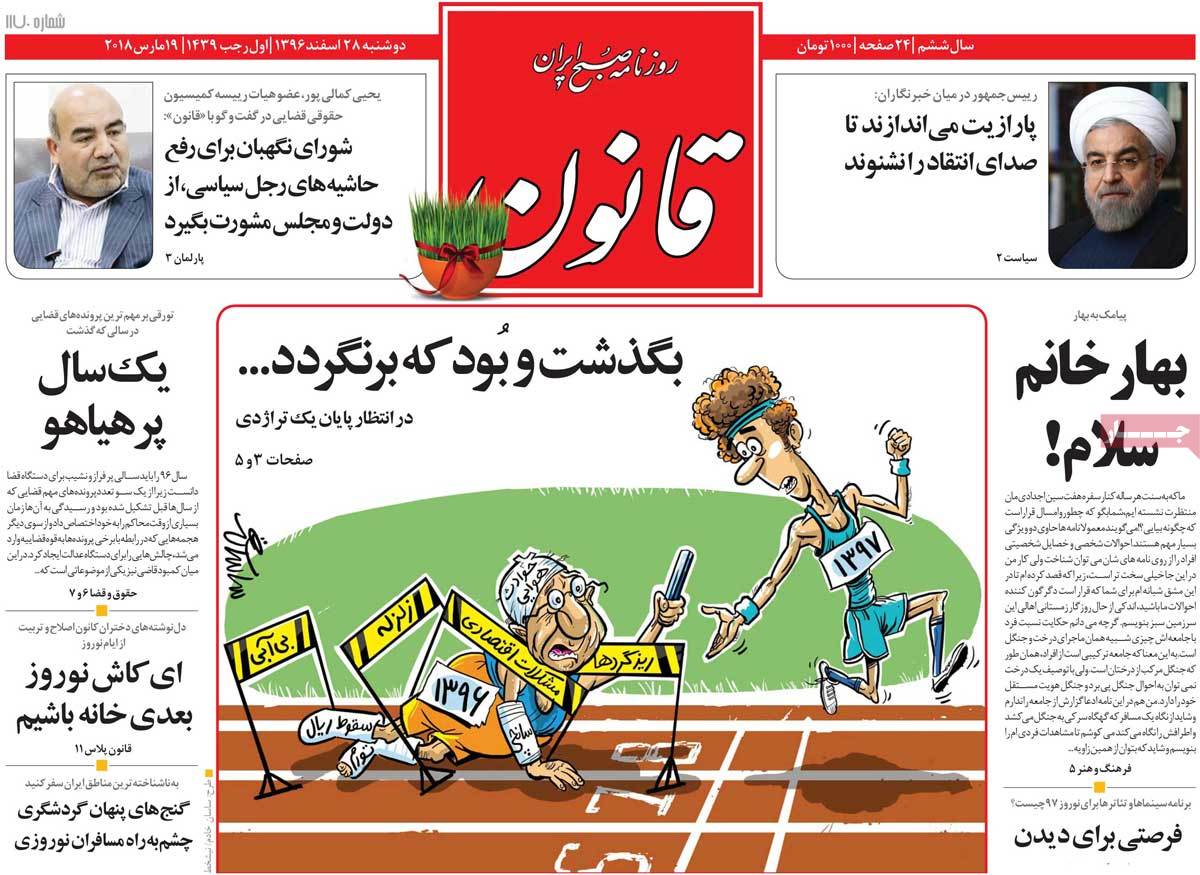
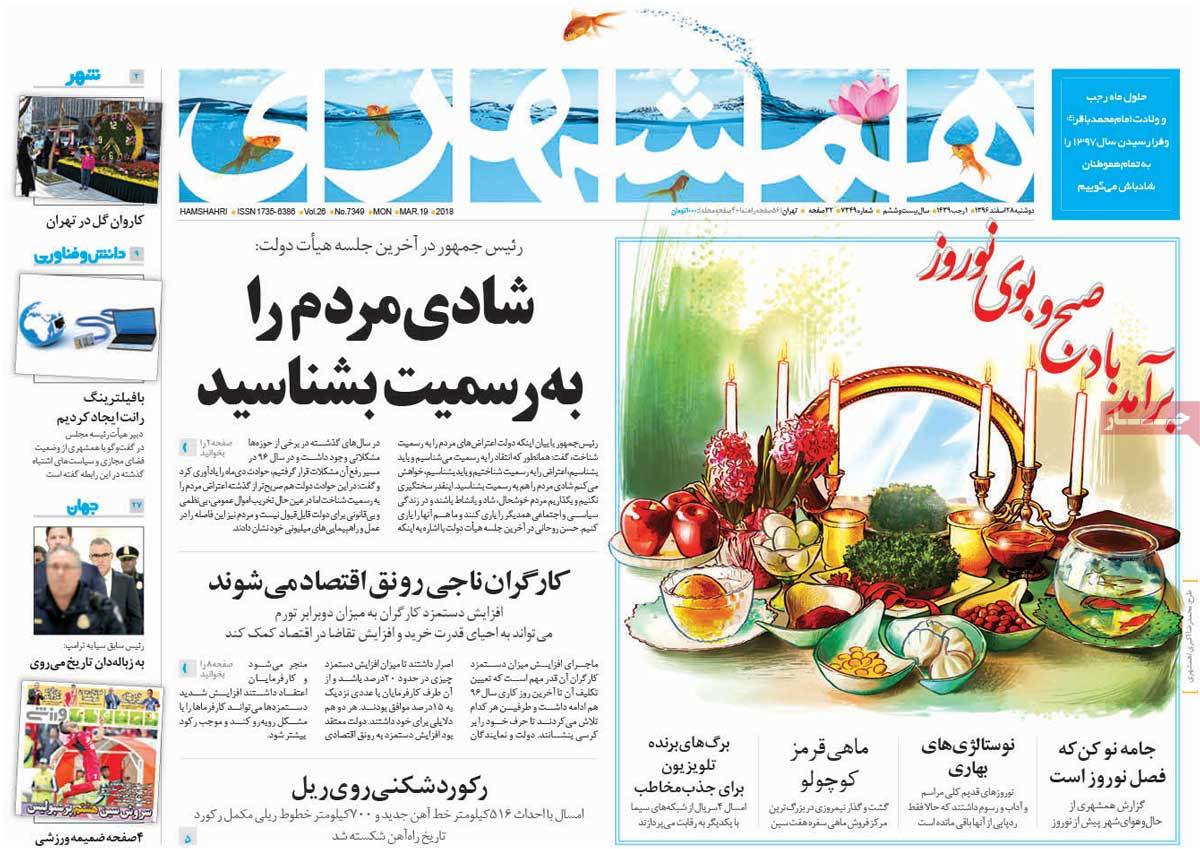
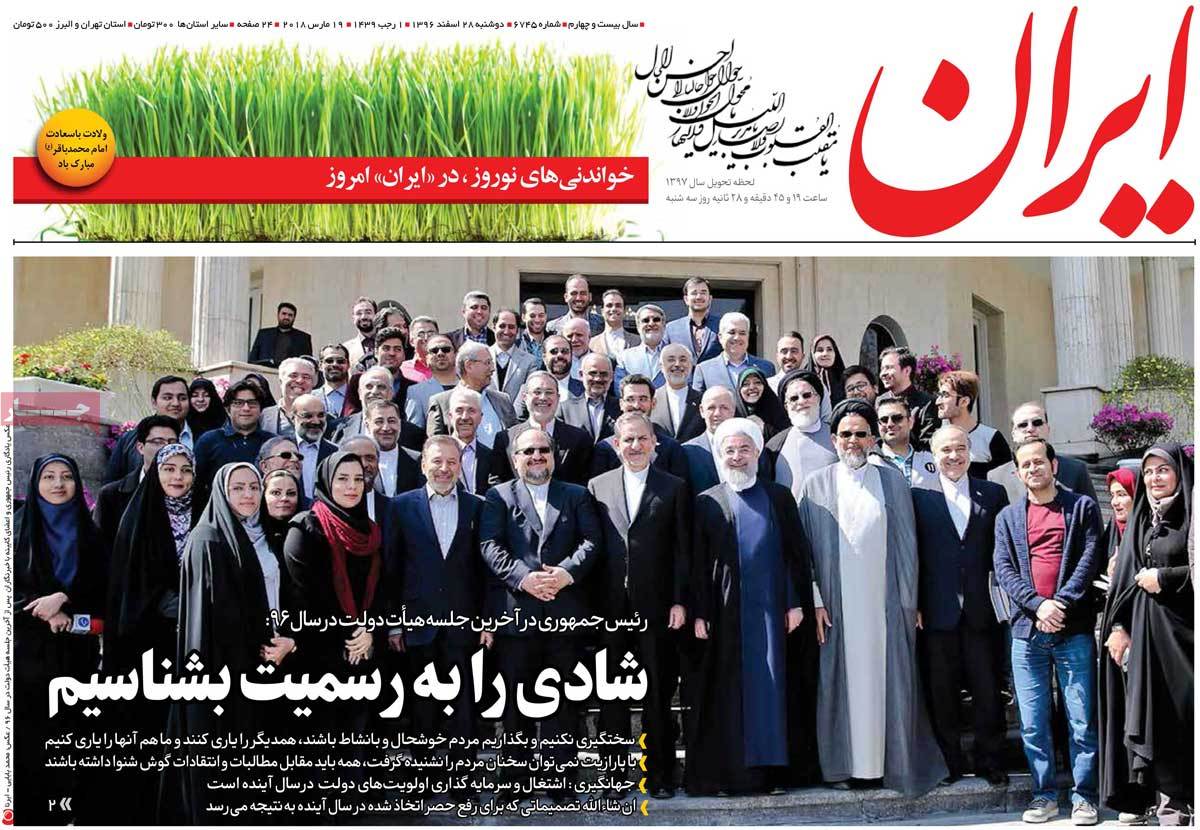
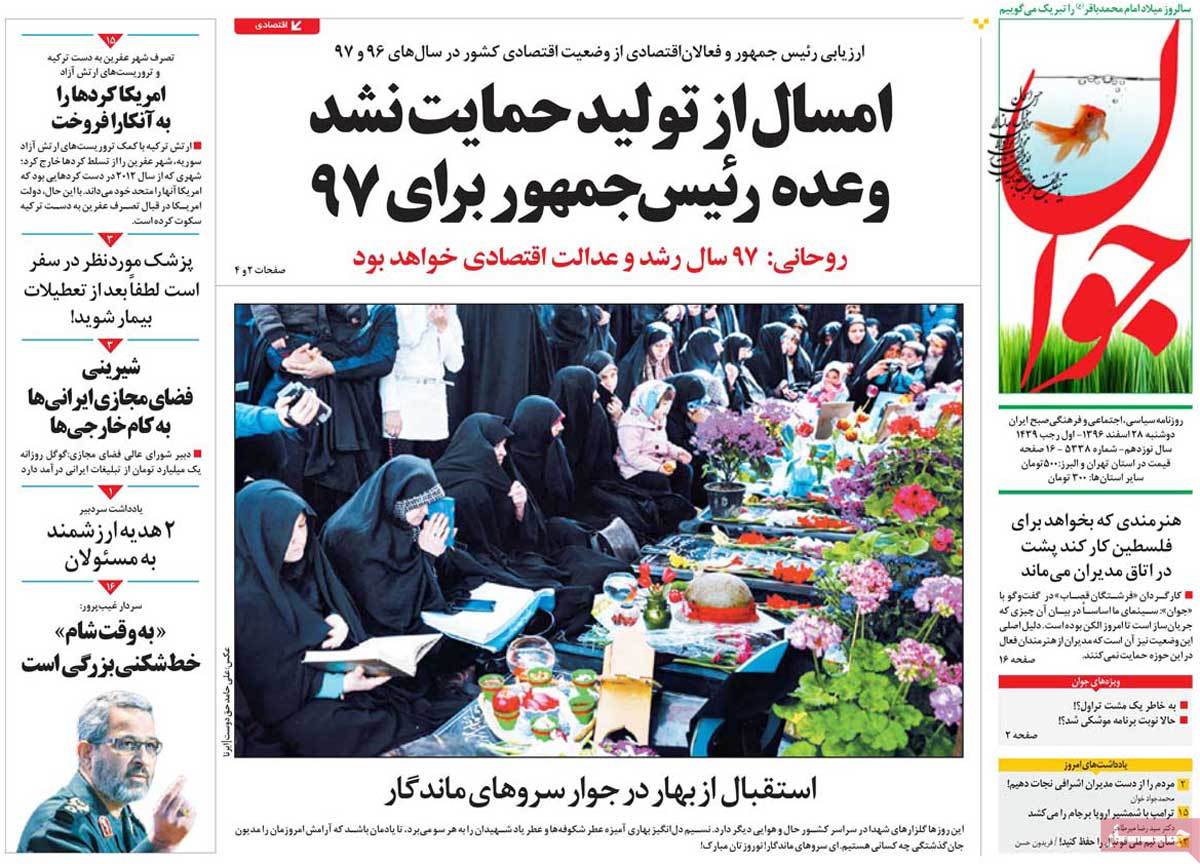
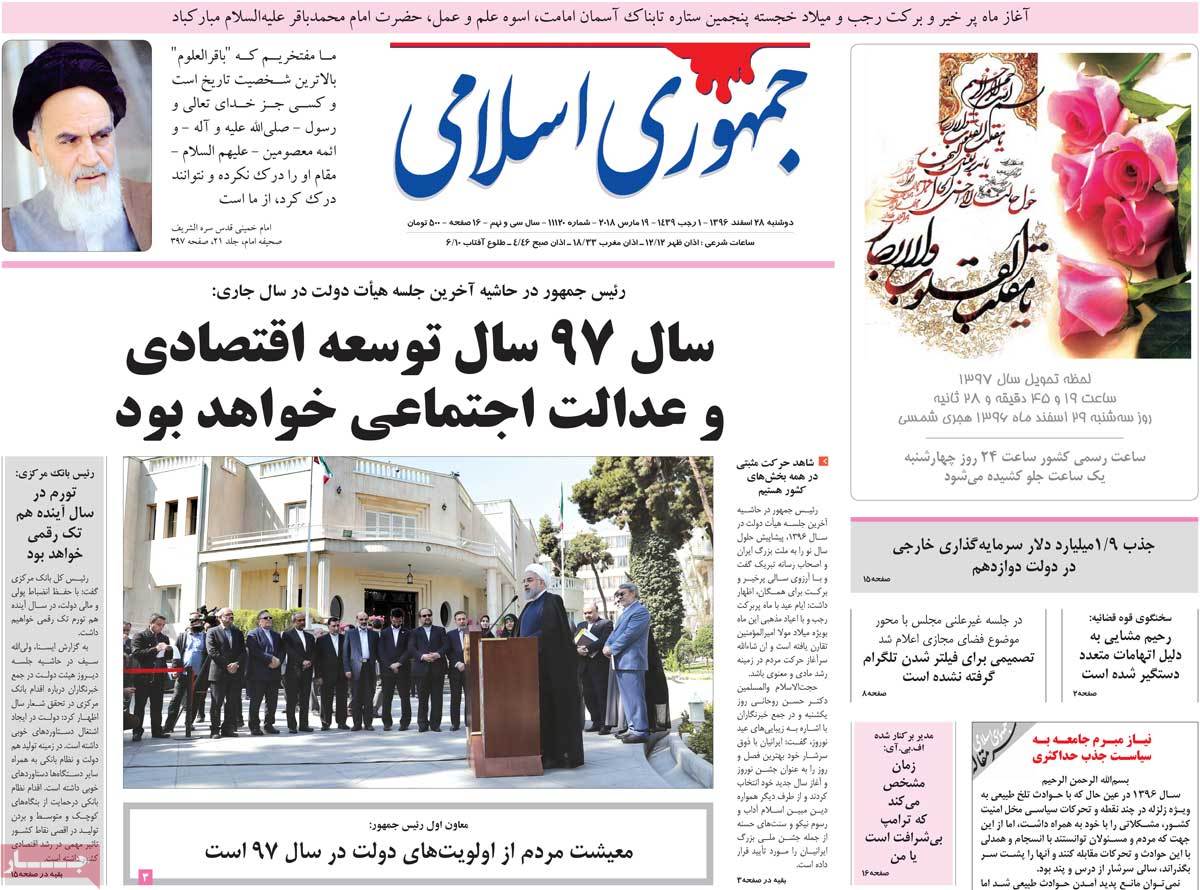
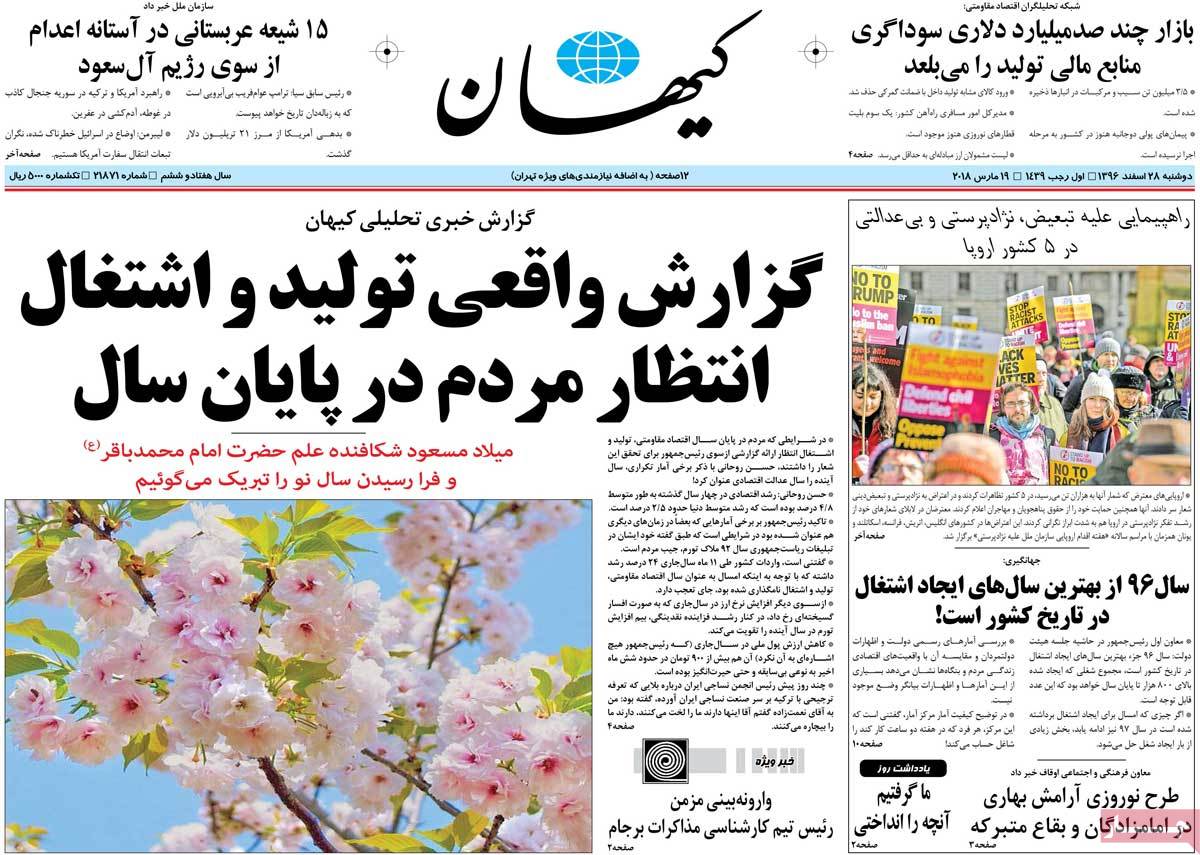
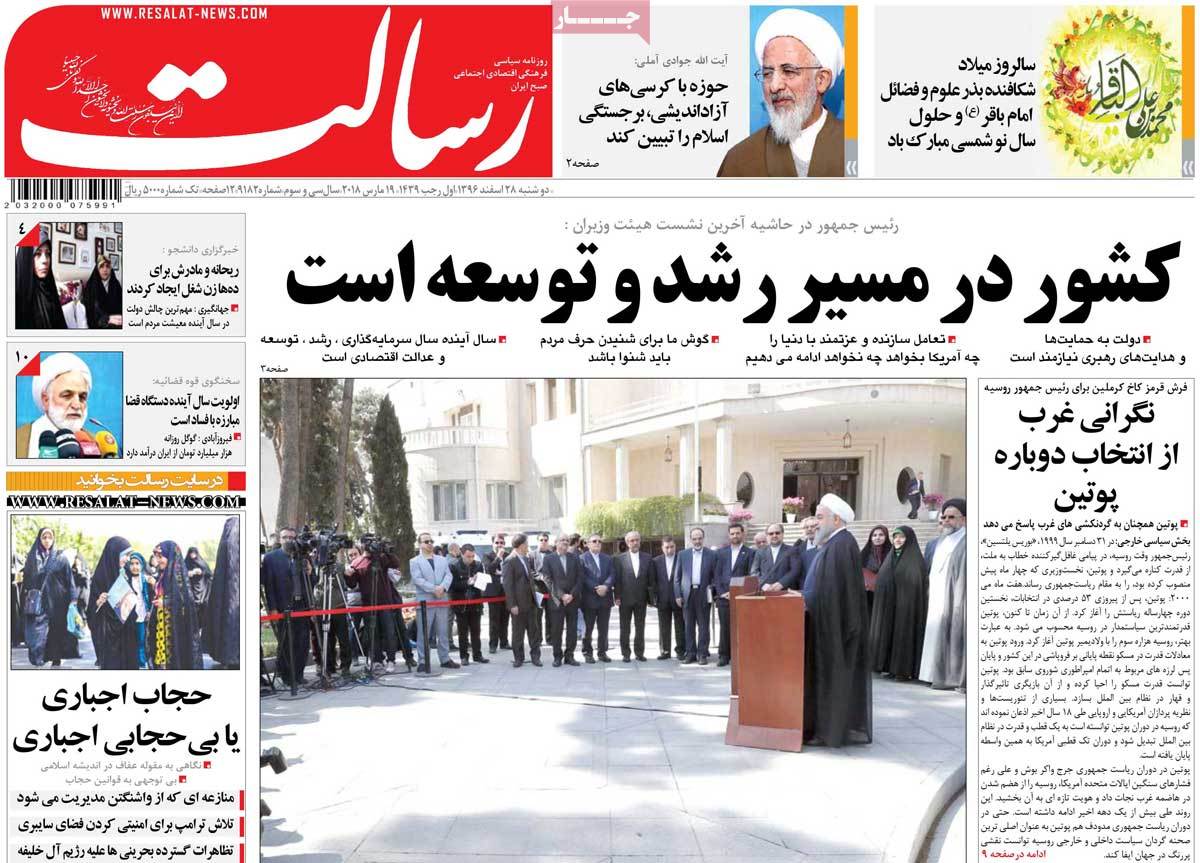
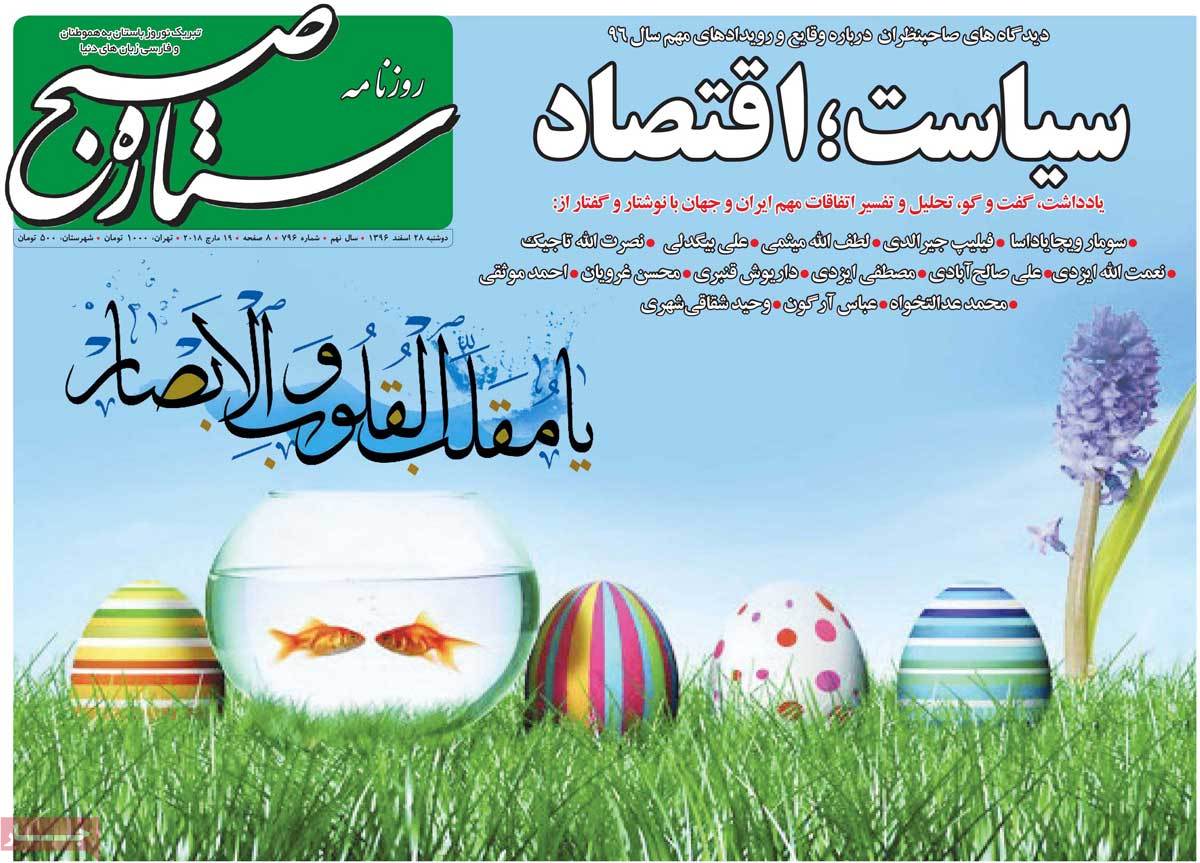
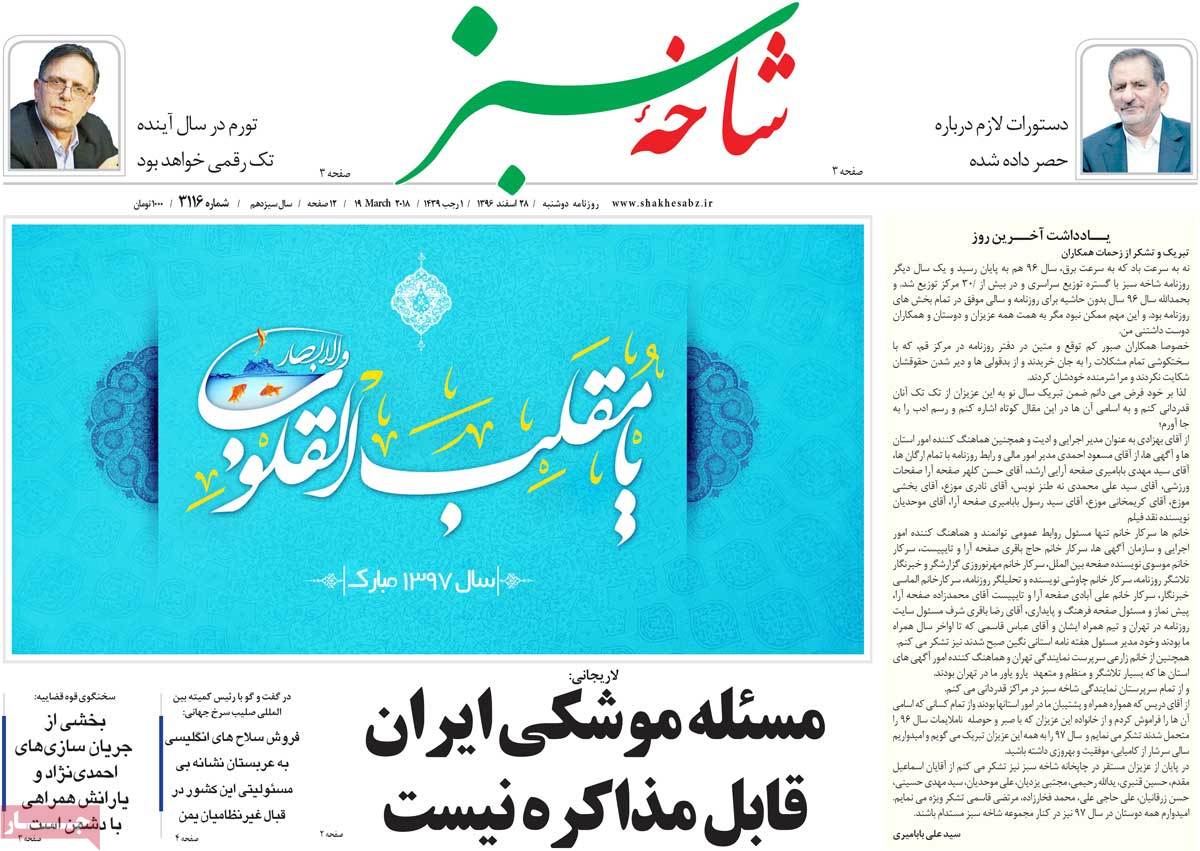
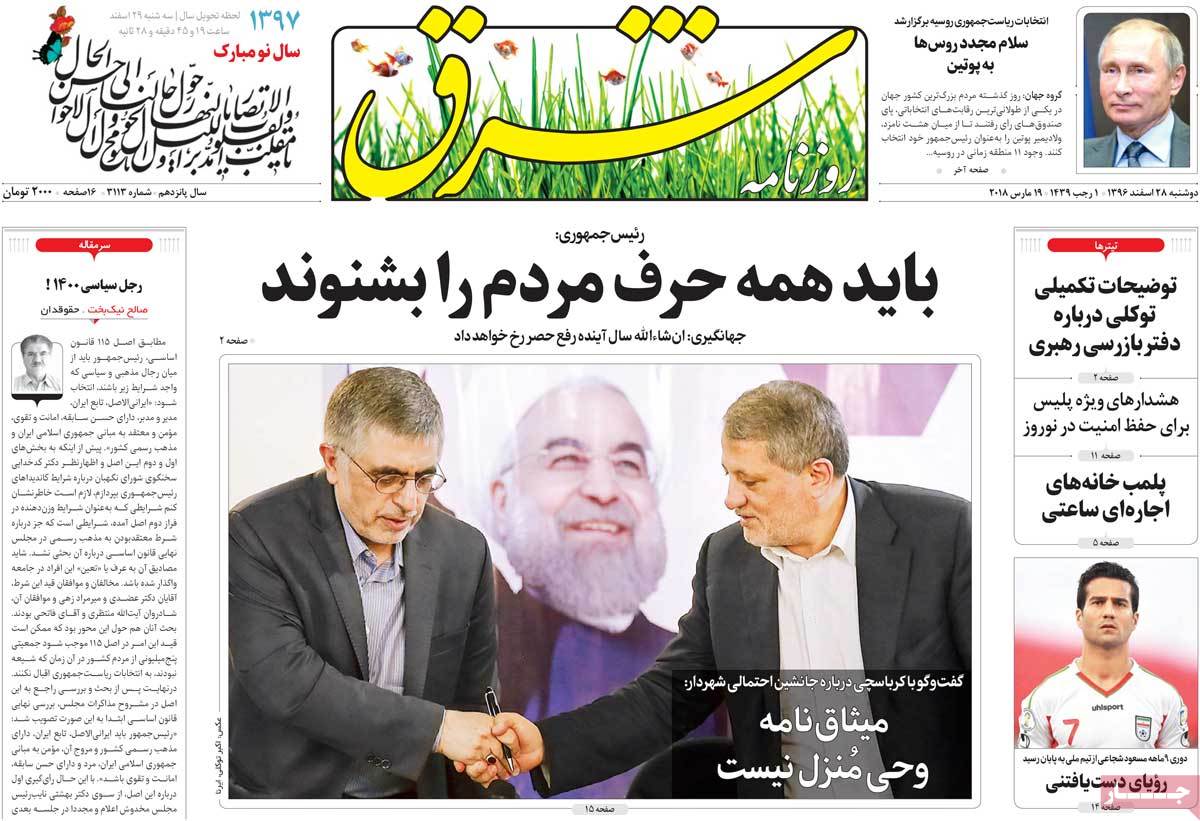
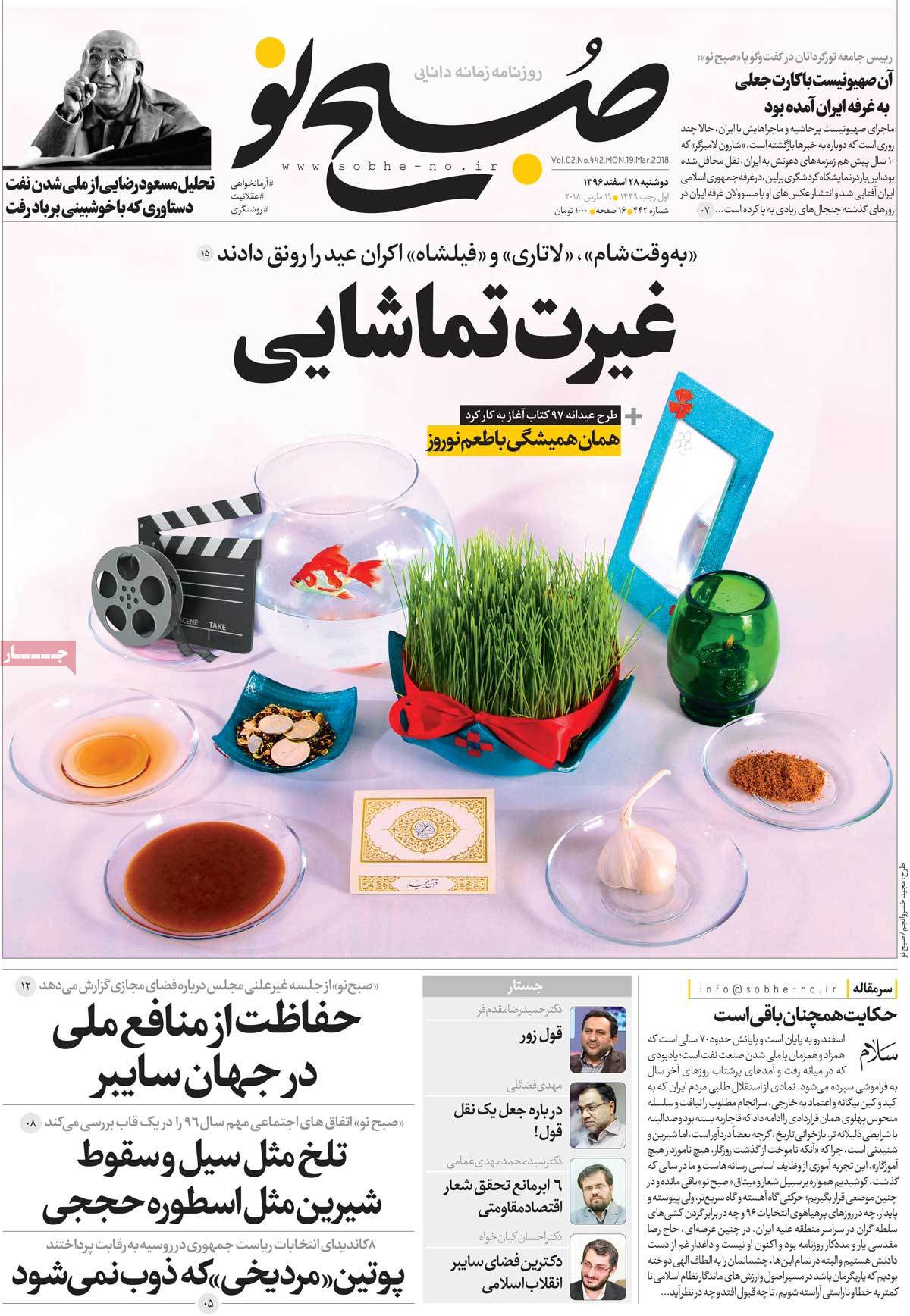
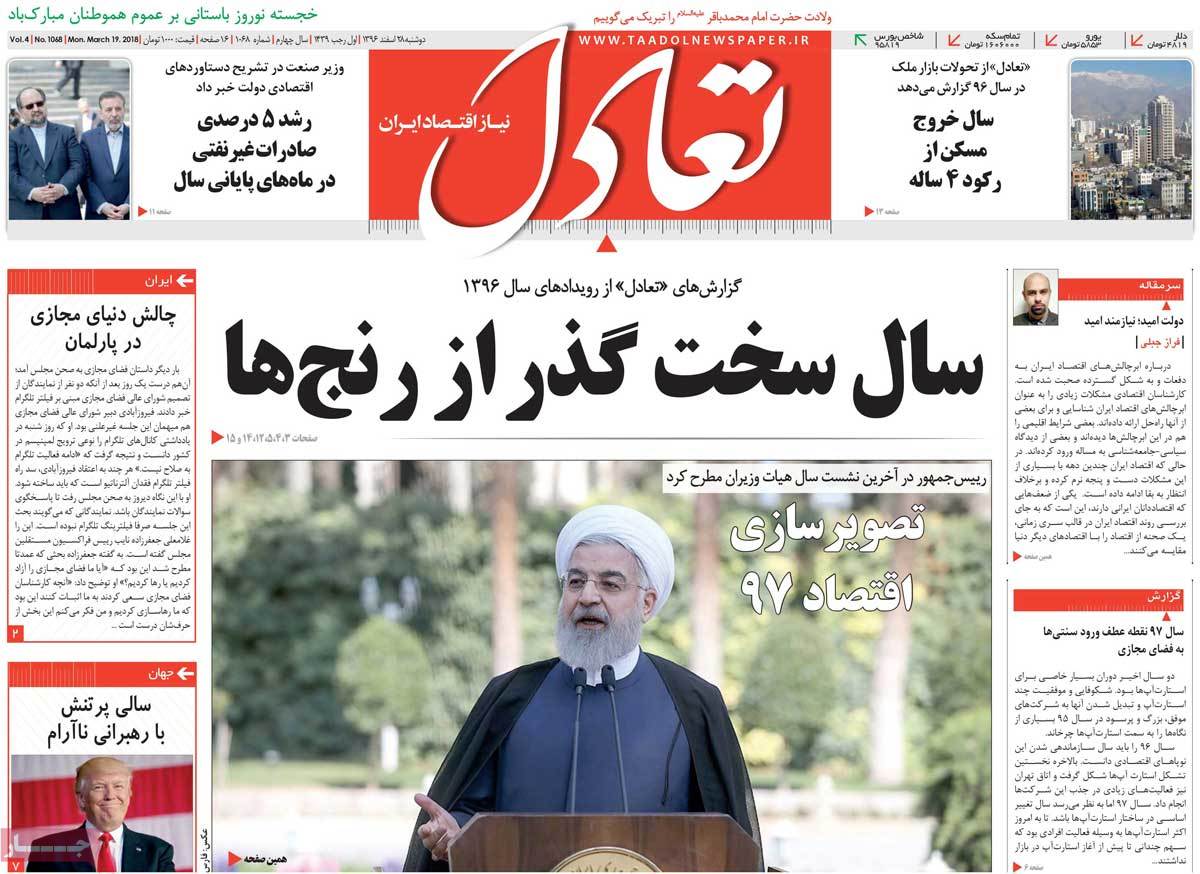
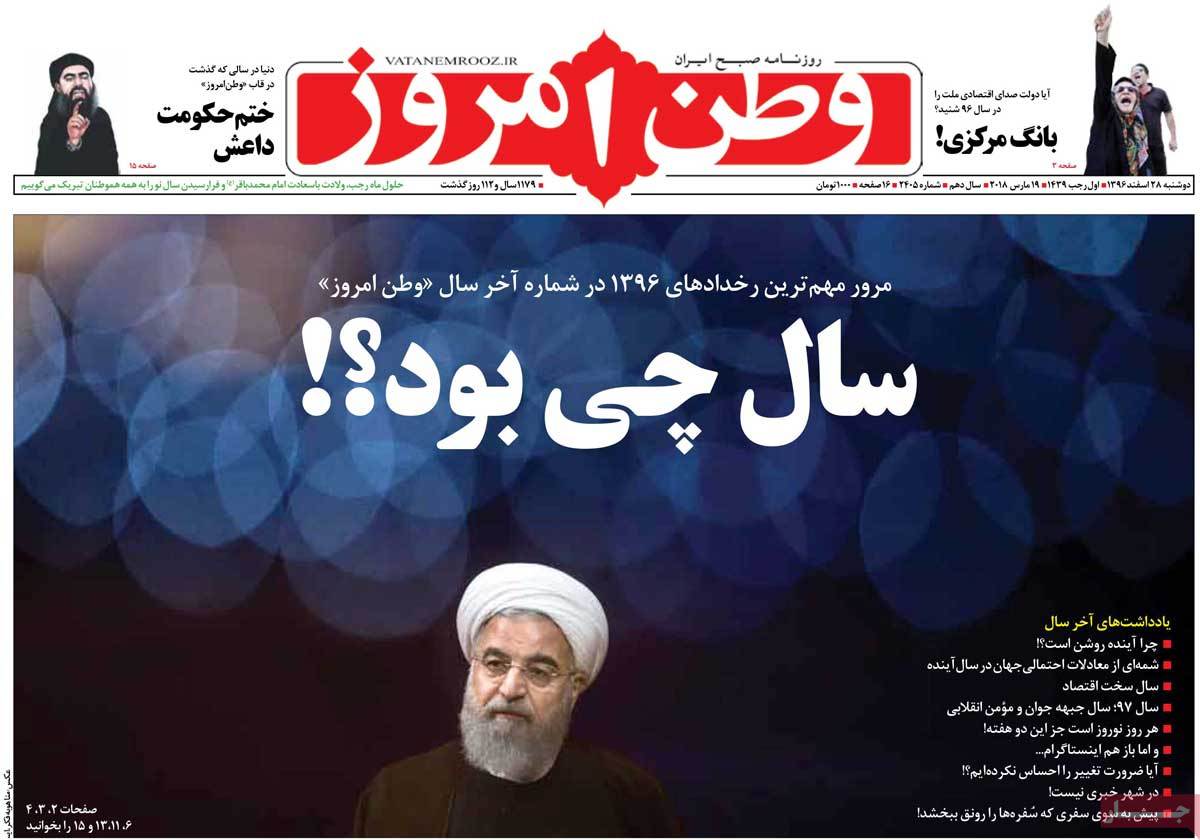
The end of the Iranian calendar year 1396, which had started in mid-March, was the top story of all newspapers today in the last working day of the year.
Several papers pointed to the disastrous and tragic moments of the year, and expressed hope that the New Year would be a better one for all the Iranian people. Many of them also reported all the important events in Iran and other parts of the world during the past year.
Apart from that, other top stories today included the Turkish army’s occupation of Syria’s Afrin, and the remarks made by President Hassan Rouhani and First Vice-President Es’haq Jahangiri about the New Year.
The above issues, as well as many more, are highlighted in the following headlines and top stories:
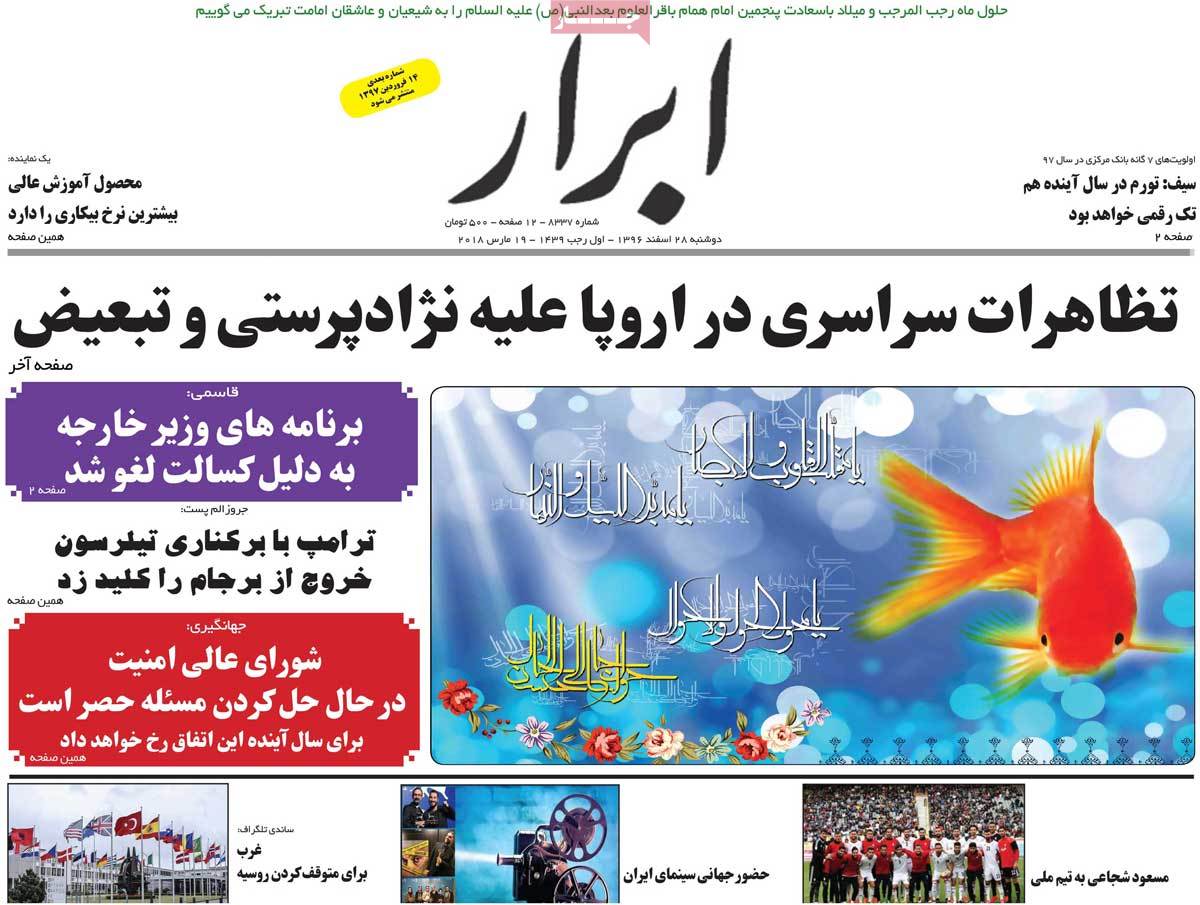
Abrar:
Protest Rallies across Europe against Racism, Discrimination
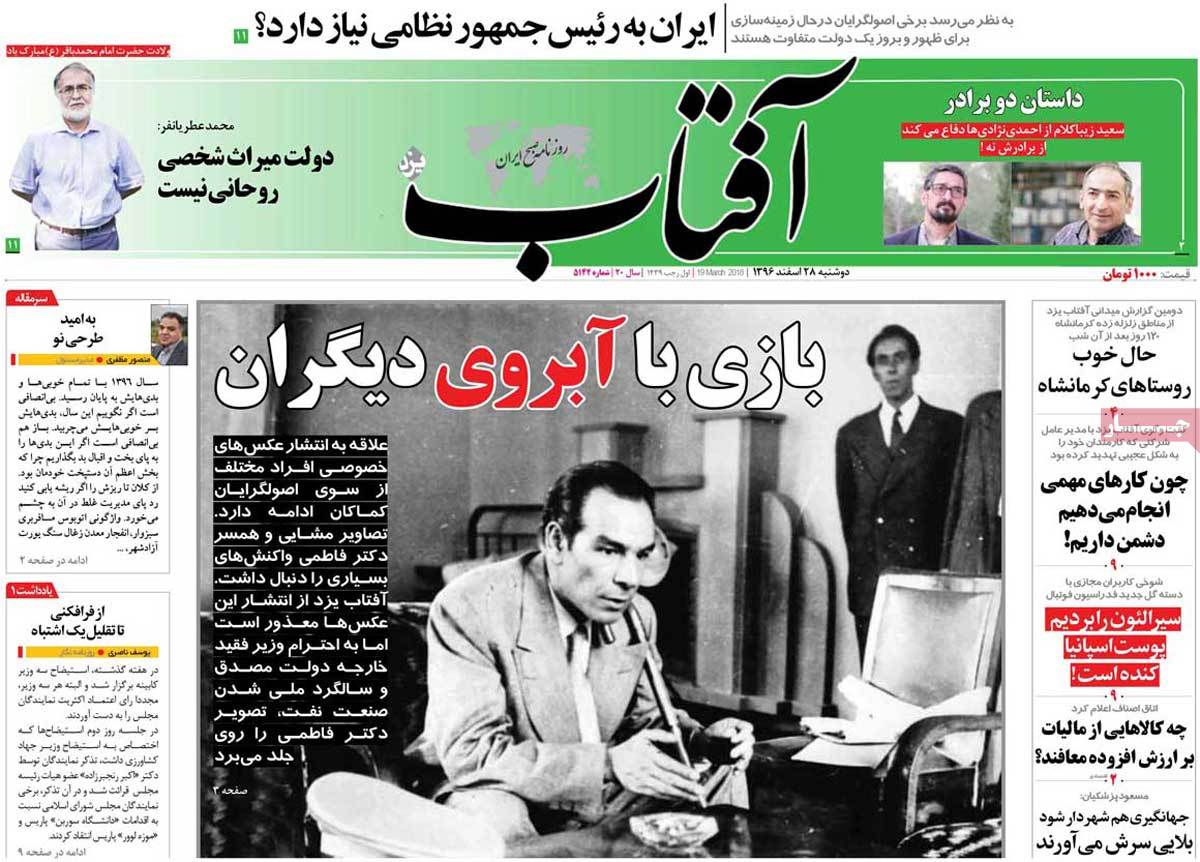
Aftab-e Yazd:
Iran’s Football Federation Mocked for Match against Sierra Leone
We Defeated Sierra Leone, We’ll Crush Spain in FIFA World Cup!
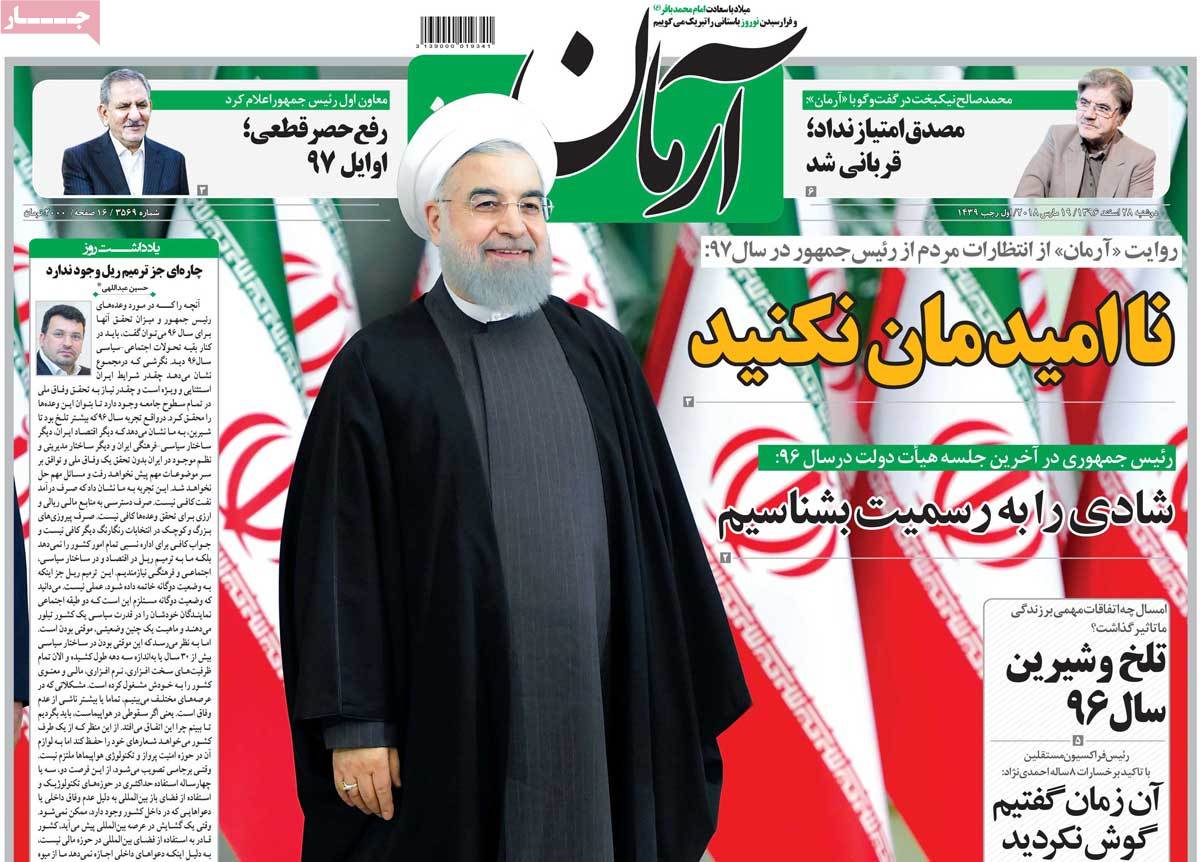
Arman-e Emrooz:
A Report on People’s Expectations from President in New Year
Don’t Disappoint Us
Iran First VP: House Arrest of Opposition Leaders Will Definitely Be Lifted in Coming Months
Rouhani: We Must Acknowledge People’s Happiness
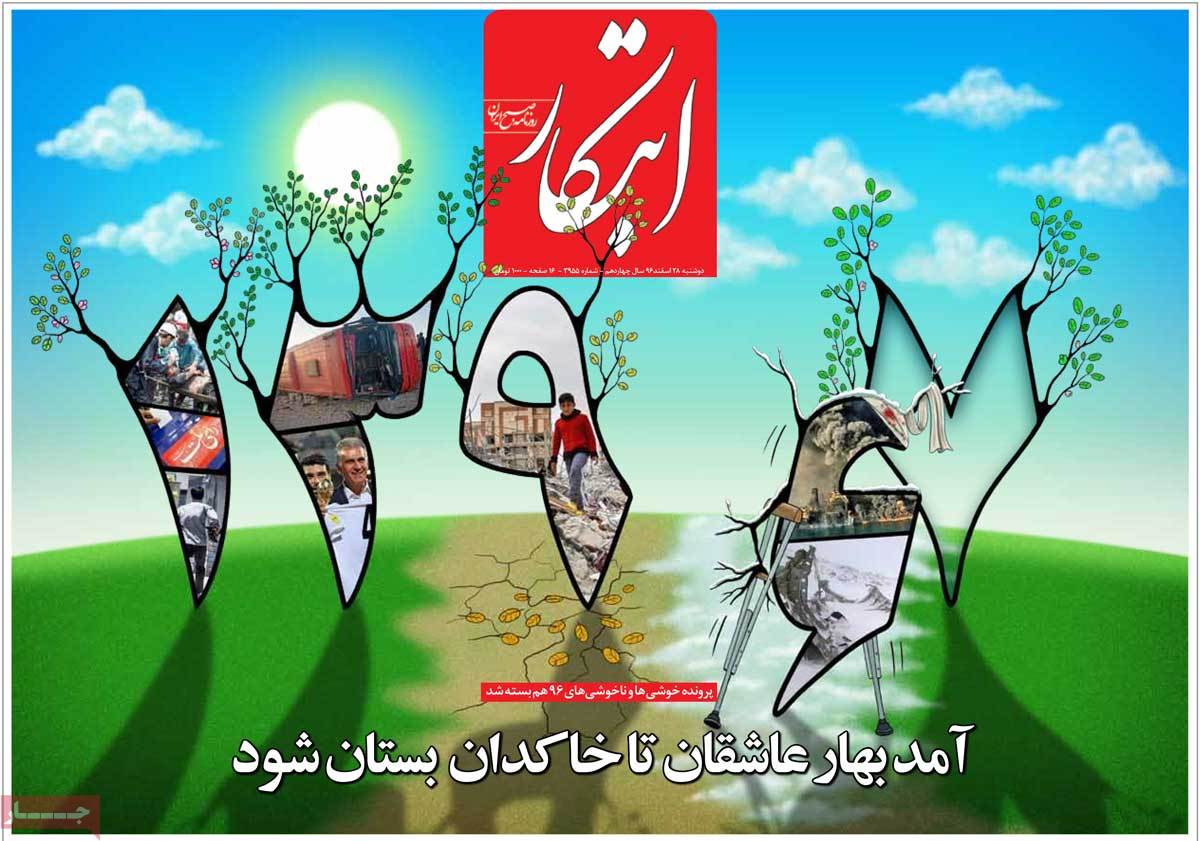
Ebtekar
Current Iranian Calendar Year Over with All Its Ups and Downs of
Etemad:
Now It’s Time for Spring: Fears and Hopes for New Year
Ettela’at:
Rouhani: Next Year to Be Year of Economic Development, Social Justice
Syria’s Afrin Taken by Turkish Army
Fareed Zakaria: Withdrawal from Iran Nuclear Deal to Cost US Dearly
Forsat-e Emrooz:
Persian Language’s Increased Role in Worldwide Web
ICT Minister Says Persian Language’s Share Has Risen to 1.8%
Ghanoon:
Waiting for End of a Tragedy (Year 1396)
Hamshahri:
Breaking Records on Railway
Unprecedented Railway Development in Iran’s History
Iran:
Rouhani: You Cannot Ignore People’s Voice by Jamming
Everyone Must Listen to People’s Demands, Criticisms
Javan:
Production Not Supported This Year
Rouhani Vows to Support It Next Year
US Betrays Kurds to Turkey
Google Earning over $200,000 per Day Thanks to Iranian Ads
Iranians Use Internet, Foreigners Earn Money
Jomhouri Eslami:
Iran VP: People’s Livelihood among Major Priorities of Gov’t in New Year
Kayhan:
People Expect Gov’t to Offer Real Report on Production, Employment
15 Saudi Shiites to Be Executed by Al Saud Regime
First VP: 1396 among Best Years in History in Terms of Creation of Job Opportunities!
Resalat:
Rouhani: Iran on Path of Growth, Development
West Concerned about Putin’s Re-Election
Setareh Sobh:
What Experts Say about Recent Year’s Political, Economic Events
Shakhe-ye Sabz:
Larijani: Iran’s Missile Program Not Negotiable
Shargh:
Russians Once Again Elect Putin
Sobh-e Now:
A Report on Parliament’s Closed Session on Cyberspace
Protecting National Interests in Cyber World
Putin, The Icy Man Who Never Melts
Ta’adol:
Year of Pains, Difficulties Over
5% Growth in Iran’s Non-Oil Exports in Past Few Months
Vatan-e Emrooz:
World in Previous Year: End of ISIS Rule
Did Government Hear Sound of People’s Economic Protests?
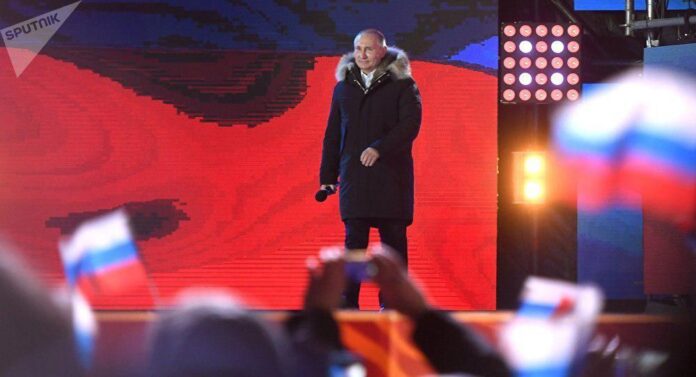
From the Arctic to the International Space Station, Russia rolled out an elaborate election-day display designed to show the breadth of Putin’s public support as he extended his tenure for a fourth term to 2024.
Putin’s opponents on Sunday’s ballot included a nationalist, a Communist and two liberals. But Putin barely campaigned, opposition activist Alexei Navalny was barred from the ballot, and reports of ballot-stuffing and people being ordered to vote by their employers rolled in throughout the day.
With about two-thirds of the ballots counted, more than 75 percent were for Putin, according to the Central Election Commission. The runner-up was Communist Party candidate Pavel Grudinin, with 12.7 percent.
“Success awaits us!” Putin told supporters in central Moscow. “Together, we will get to work on a great, massive scale, in the name of Russia.”
Although Putin’s victory is highly likely, the battle for second place remains a subject of speculation, with veteran politician Vladimir Zhirinovsky going neck and neck with Grudinin, a newcomer to the world of high Russian politics who was advanced by the Russian Communist Party (KPRF).
The biggest question as Russians went to the polls on Sunday was the level of turnout, and uncertainty on the final tally lingered into the night in Moscow. While independent surveys show that most Russians continue to approve of Putin as president, a lack of suspense or popular opposition candidates threatened to keep people home.
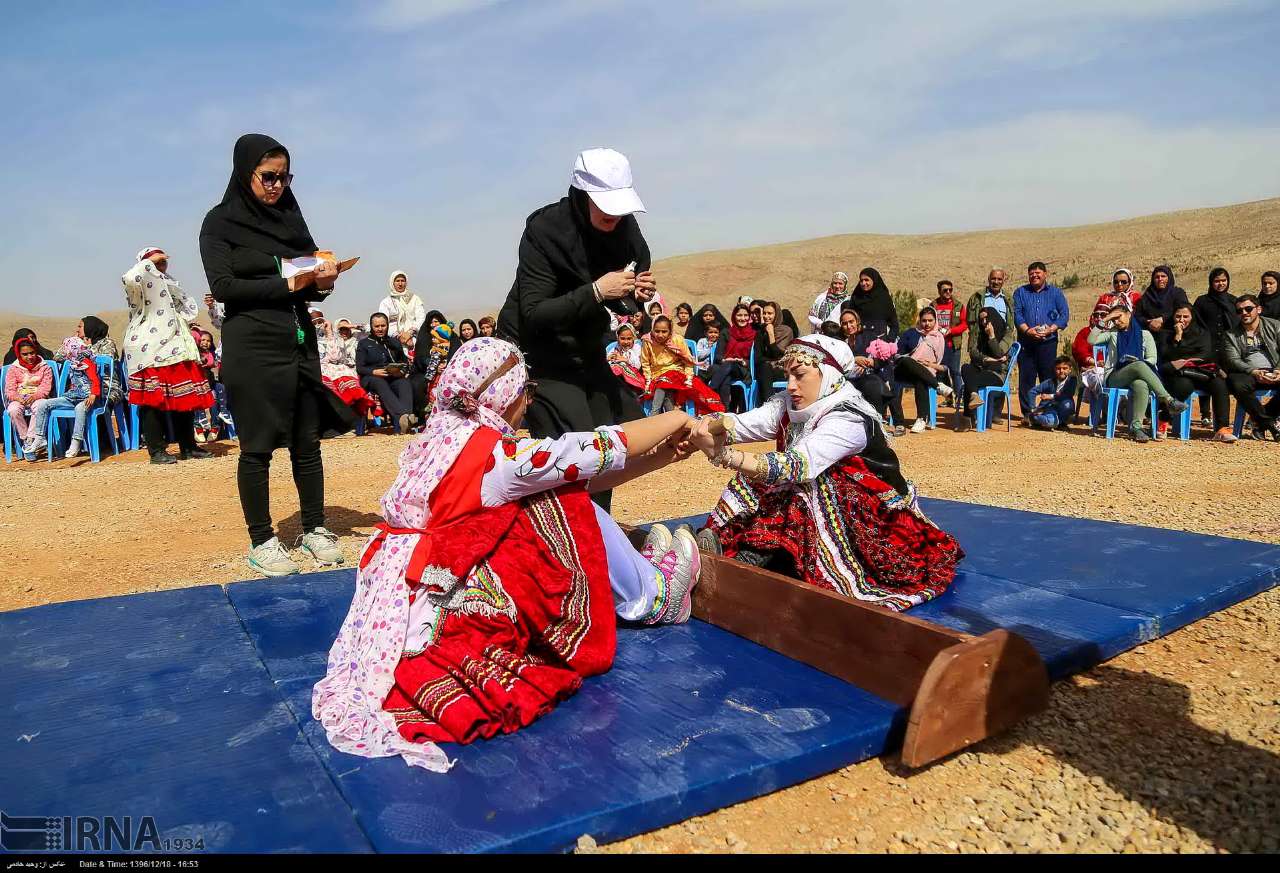
Nowruz, one of the world’s oldest festivals dating back to ancient Persia, features numerous celebrations and festivities some of which have taken on a more modern shape and some have slipped into oblivion.
A number of practices and traditions associated with Nowruz are observed before the festival actually begins, as reported by the Persian-language websitekarnaval.ir.
New Year Spring Cleaning
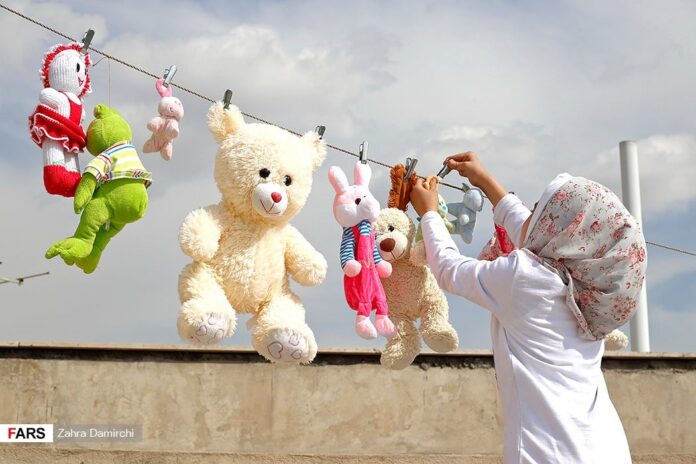
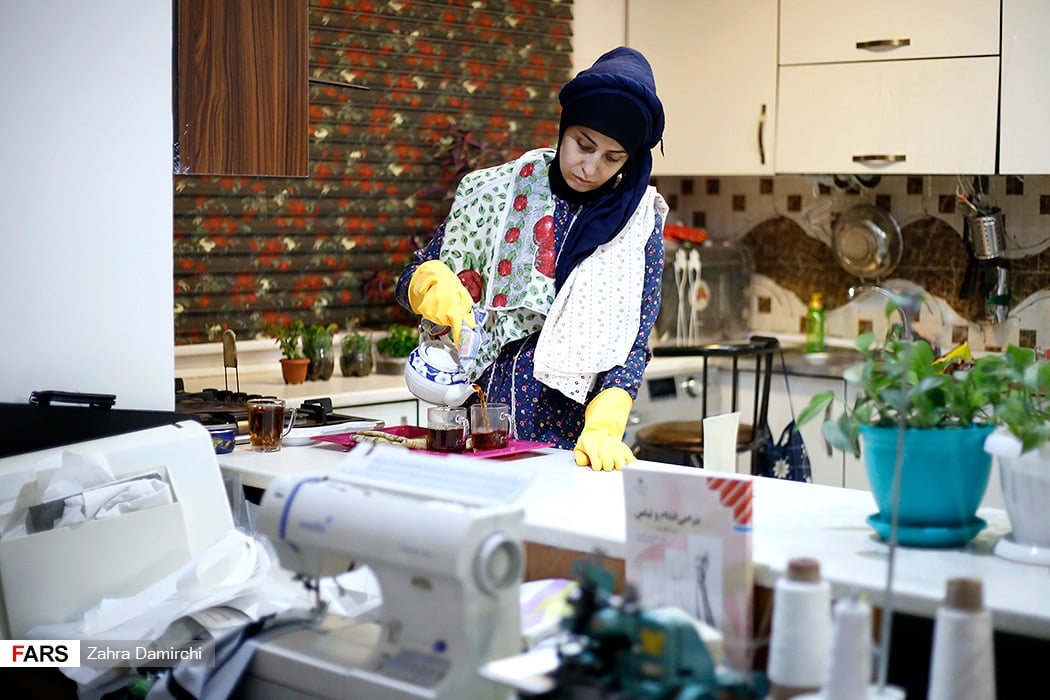
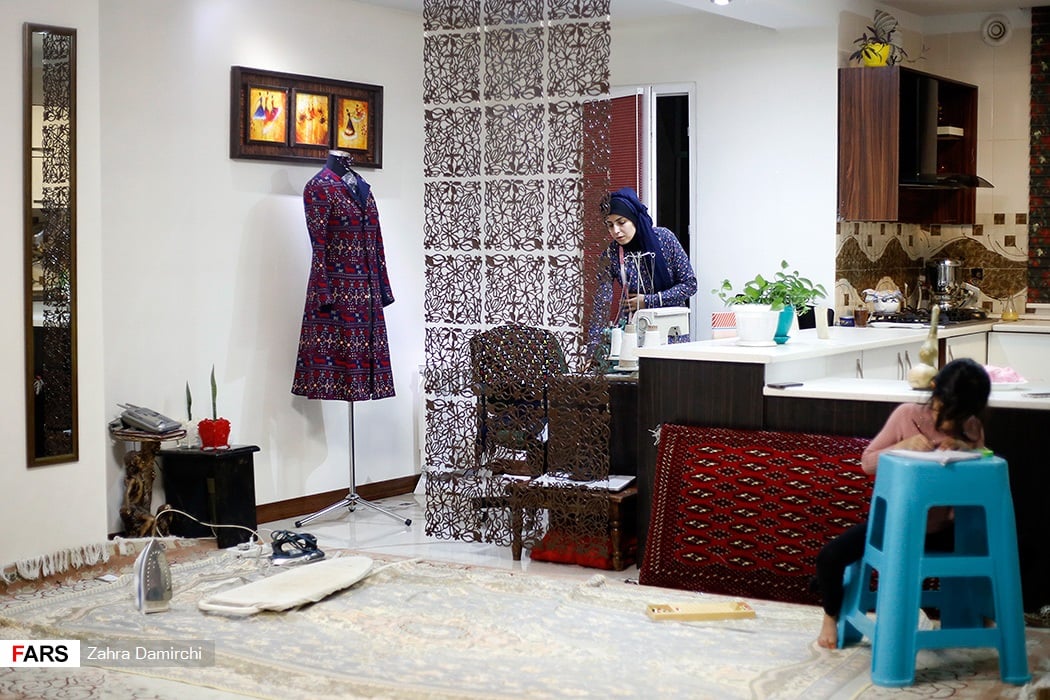
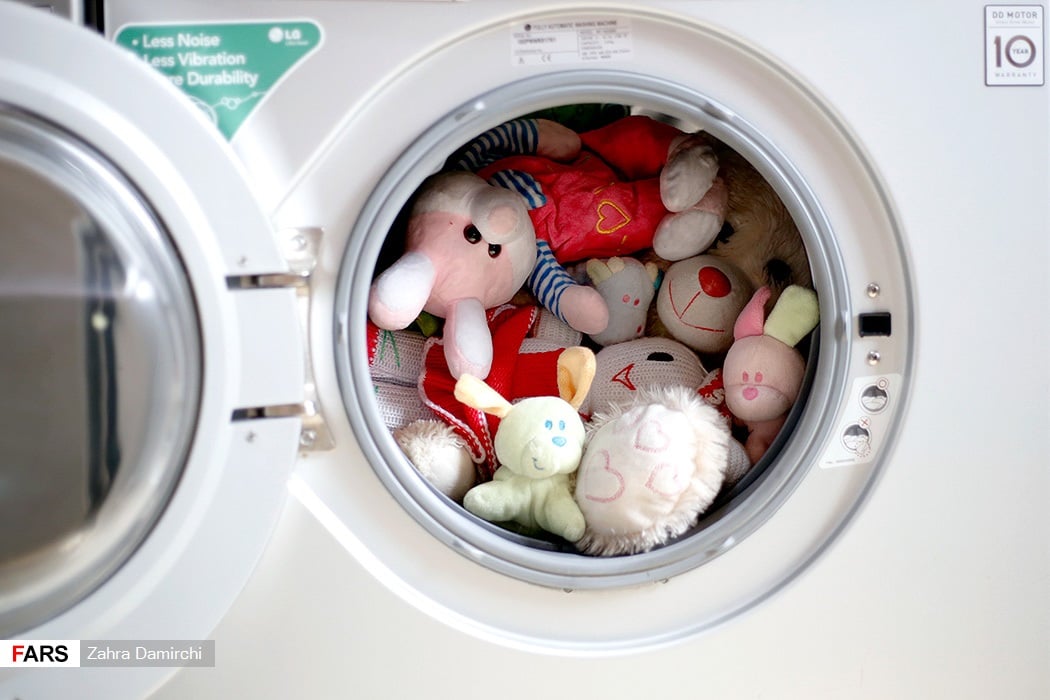
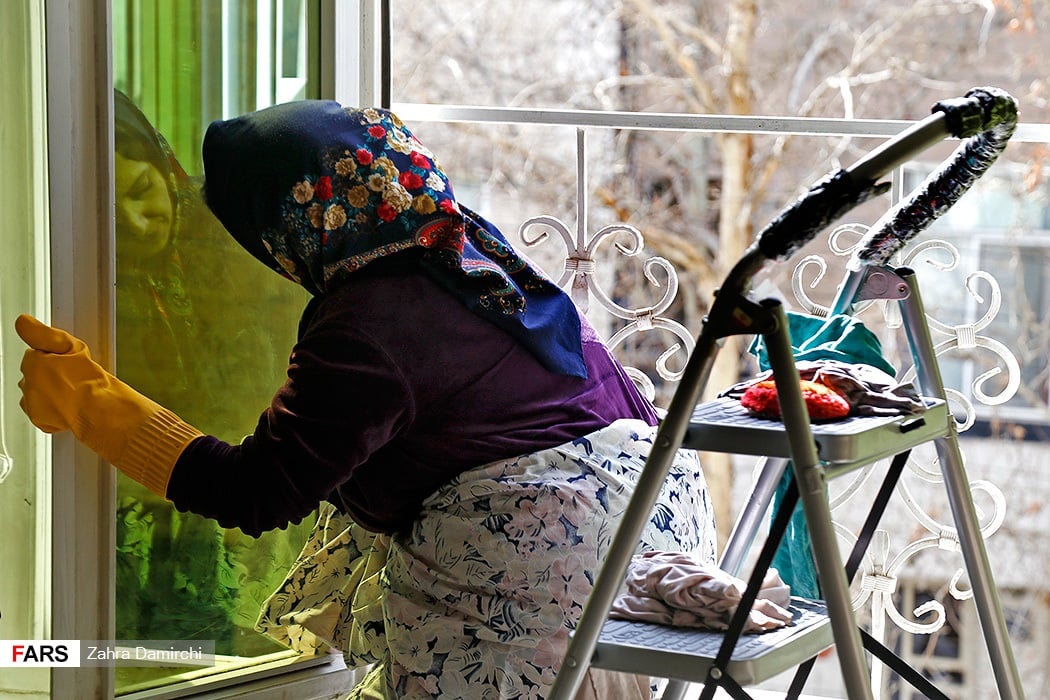
As March begins, Iranian ladies start to get obsessed with the thought of washing, cleaning, buying new furniture, having devices repaired, getting carpets washed, and washing clothes in order to cleanse dirty things. Traditionally, it is ladies that plan how spring cleaningshould be done, but no one can wriggle out of the cleaning work as all family members should help to get the job done. In Ancient Persia, people believed that no contamination should remain on the body and spirit of the house from the previous year, and that they should ring in the New Year in a clean atmosphere for family members.
1 of 5
Shopping Sprees Before Nowruz
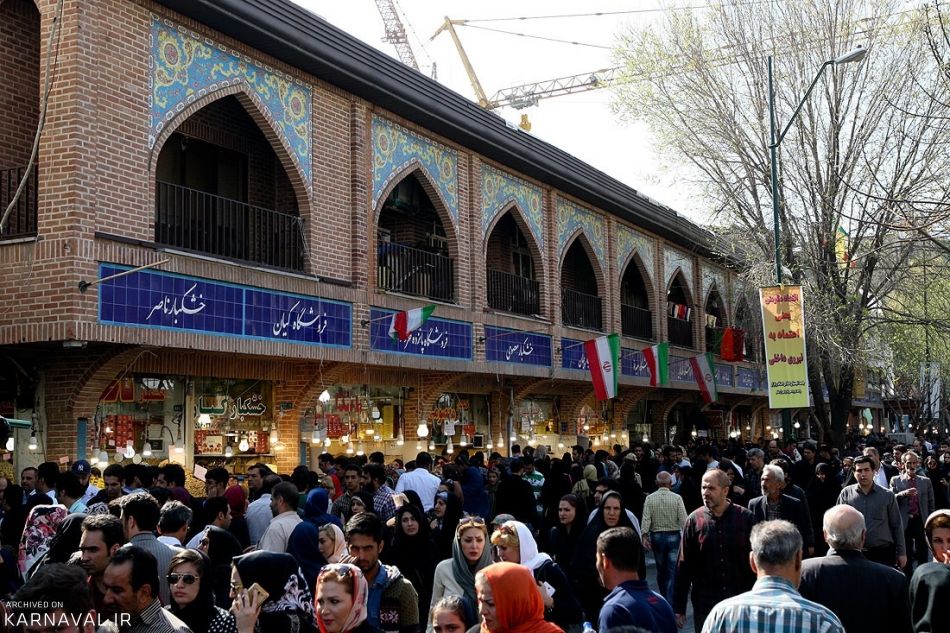
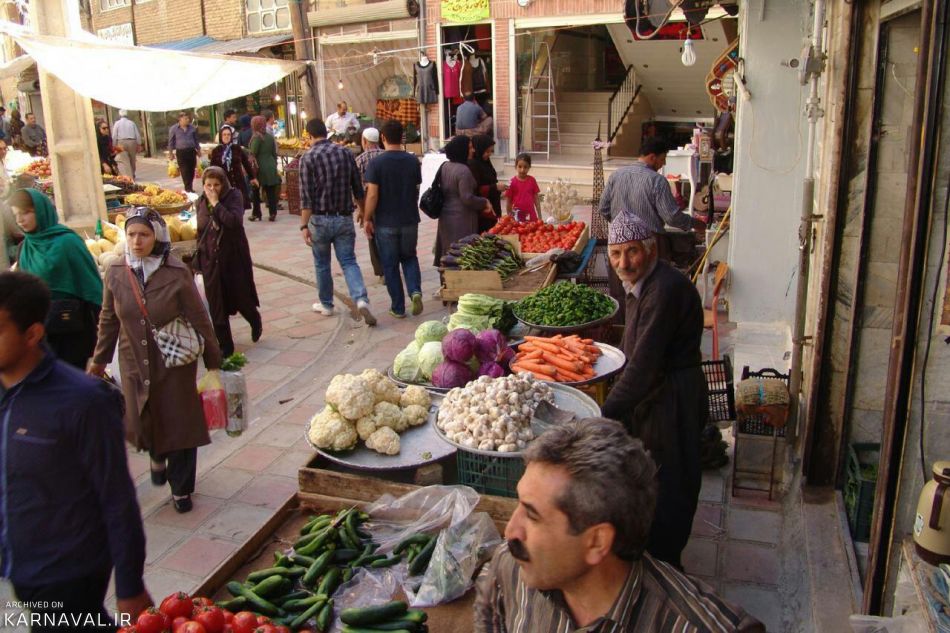
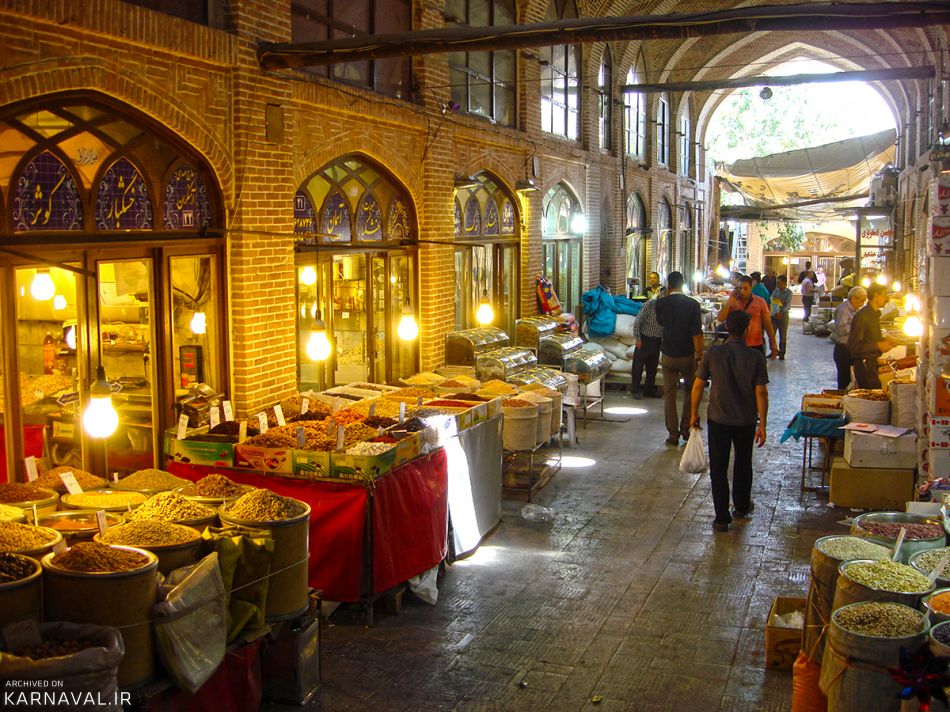
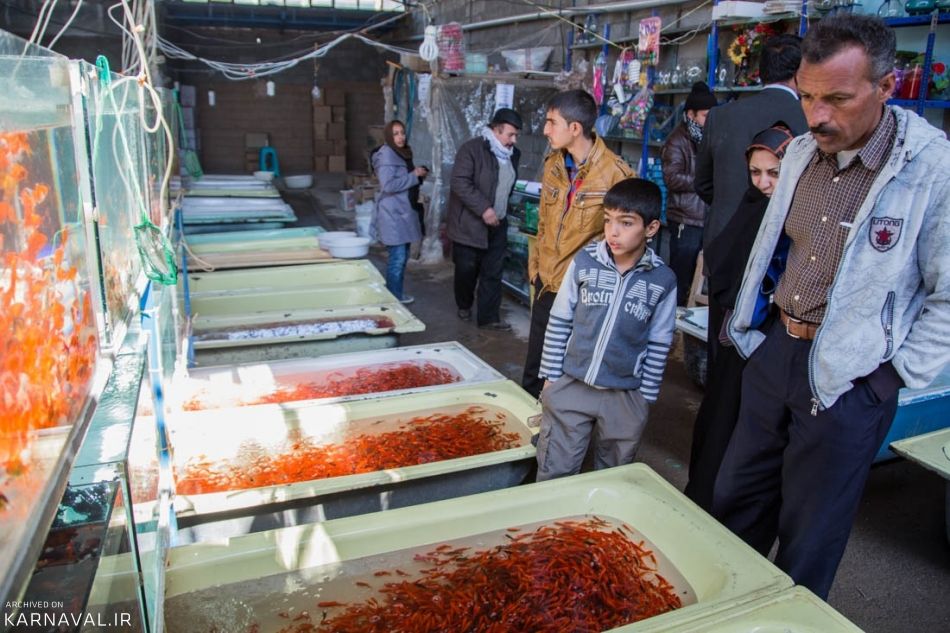
As of early or mid-March, the hubbub of busy streets filled with shoppers and street vendors becomes the order of the day. Based on their financial situation, everybody tries to buy a new piece of clothing as well as confectionary, nuts and fruit for visitors to their homes during Nowruz holidays.
1 of 4
Haji Firooz & Uncle Nowruz
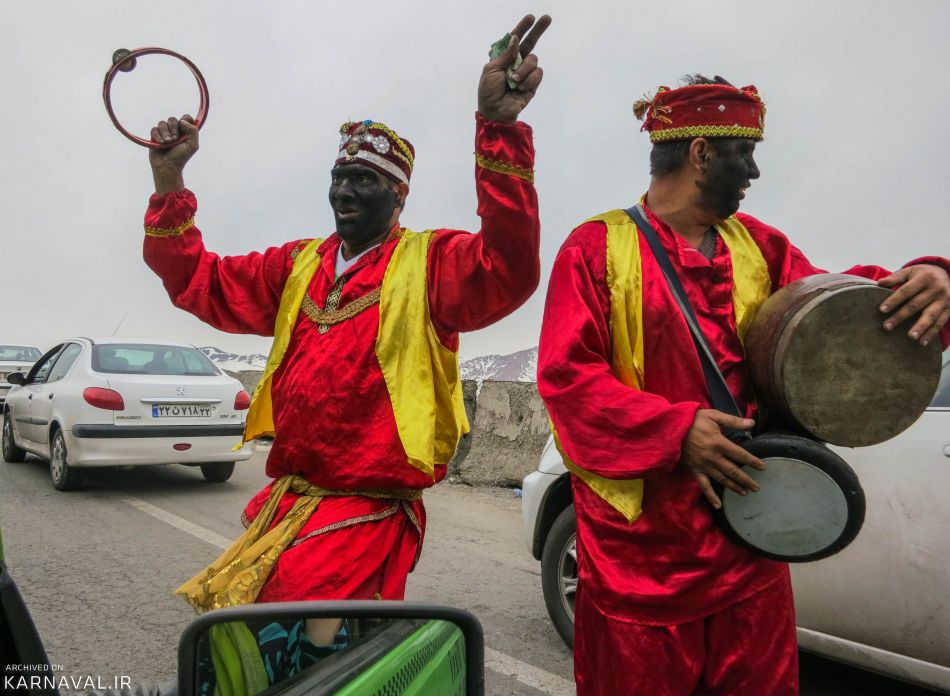
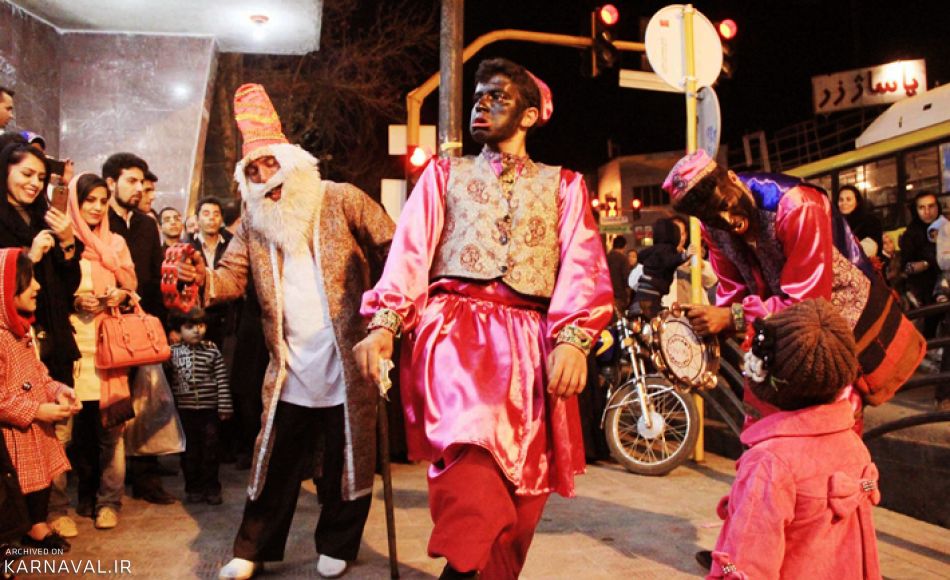
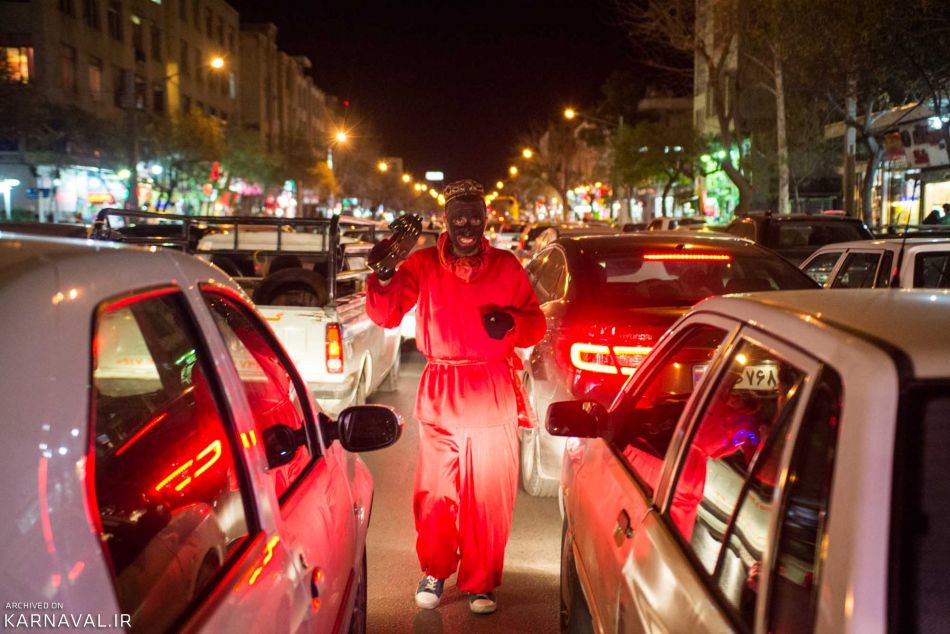
Haji Firooz is a well-known figure in the Iranian folklore culture who goes to towns and cities in the final days of the year and harbingers the arrival of Nowruz. Haji Firooz is a thin man wearing a cone-shaped hat, pointed espadrilles and a red garment. He holds a tambourine and begins dancing, singing and clowning around. Passers-by pay him as much tip as they can afford.
Apart from Haji Firooz, another folkloric figure hits the streets, heralding the arrival of the New Year. He is called Uncle Nowruz or Daddy Nowruz. The traditional figure has a white beard and hair, a felt hat, a blue-coloured silk belt, a white shawl, cotton trousers and flat-soled espadrilles.
1 of 4
Sprouts for Haft-Seen
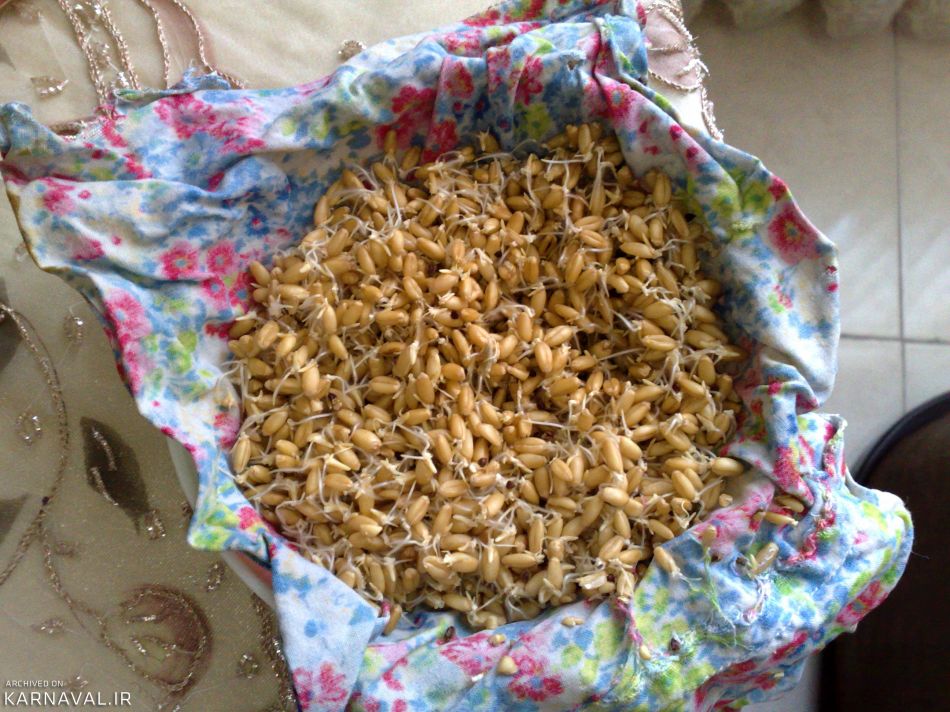
Sprouts are the oldest and most obvious item of the so-called Haft-Seen table that Iranians set for Nowruz. In Ancient Persia, when 25 five days were left before the turn of the year, they would build 12 mud-brick columns at the town’s square symbolising the 12 months of the year. They would grow the seeds of barely, wheat, broad beans, beans, peas, sesame seeds, lentils, mung beans, etc. on each one of the columns. Six days into the Persian New Year (late March), people would pick the sprouts and hold celebrations.
Today, gone are those columns; still, many are observing the tradition and grow sprouts of wheat, lentils, mung beans, etc. in big and small containers at home to put them on the Haft-Seen table.
1 of 3
Cooking Samanu for Haft-Seen
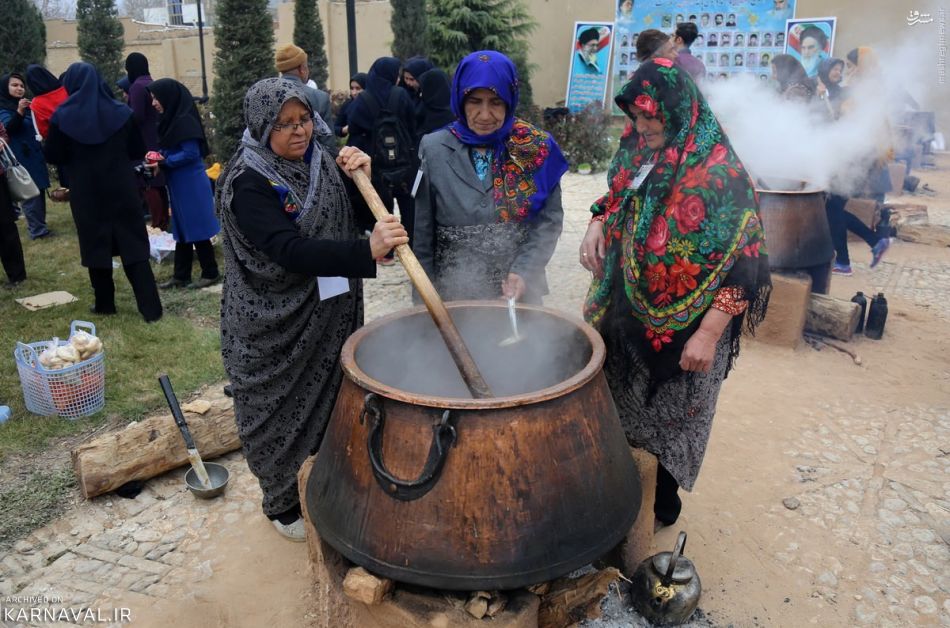
Samanuis one of the tasty items on the Haft-Seen table. The ritual of cooking samanu is observed in many parts of Iran. Family members and friends get together and cook samanu while singing special songs. The ceremony sometimes features local dance.
Wheat sprouts and flour are the main ingredients of samanu, which is not only a symbolic item on the Haft-Seen table, but is good for health as well.
Iranian Women Cooking Samanu for Haft-Seen
Preparing Items for Haft-Seen
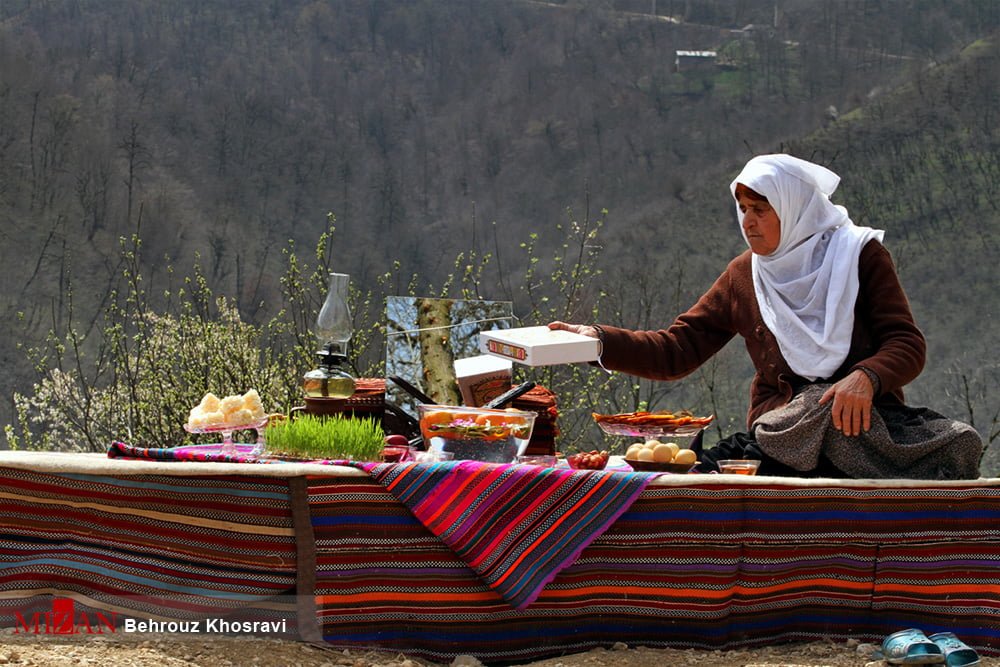
The Haft-Seen tableis the most important symbol of Nowruz. Families set the Haft-Seen table in their homes. The table contains seven items beginning with the Persian /s/ sound, including apples, sprouts, Russian olives, sumac, garlic, vinegar, and samanu.
In addition to these items, a volume of the holy Quran, a mirror, candles, coloured eggs, bread and vegetables, rosewater, flowers, coins, etc. are also put on the Haft-Seen table.
The Haft-Seen table is the most important symbol of Nowruz
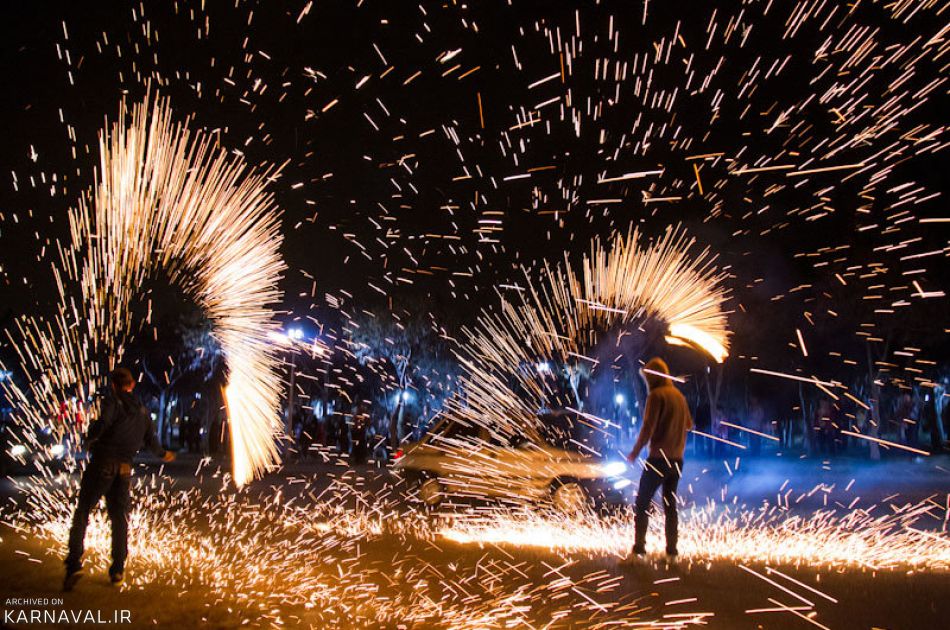
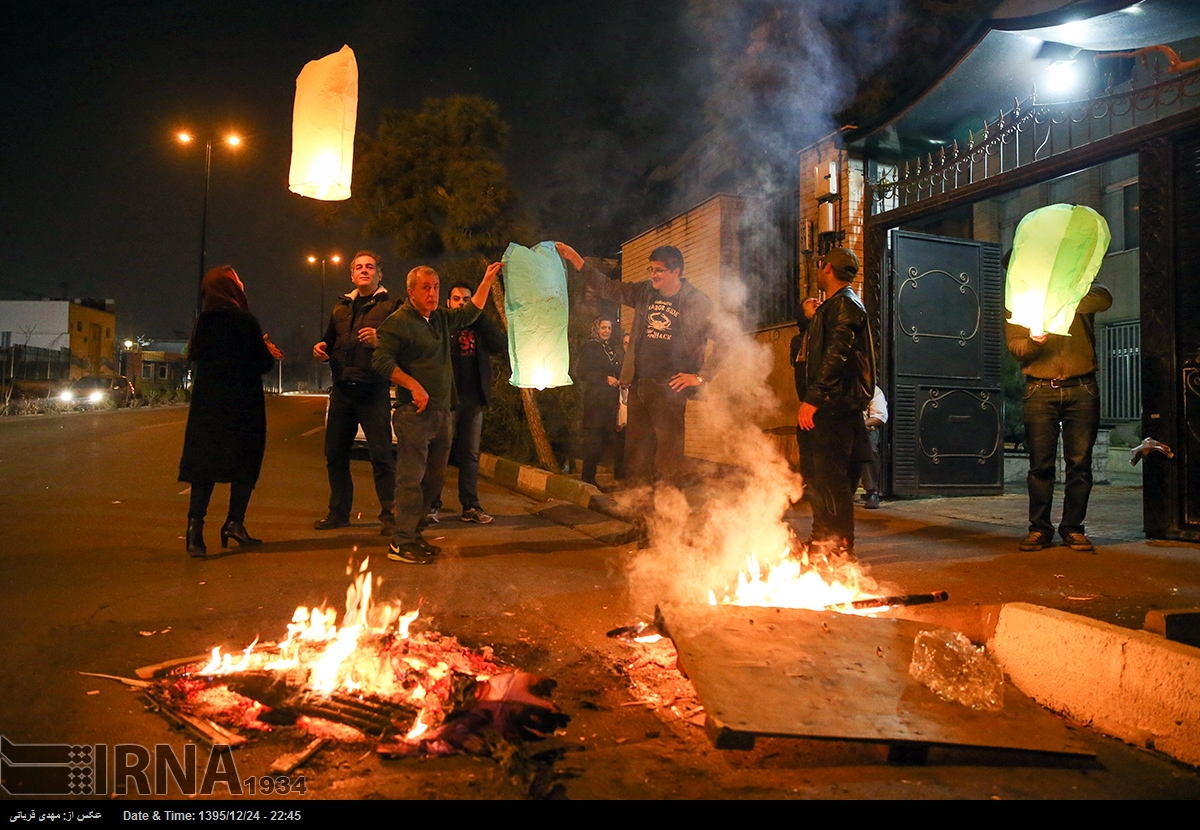
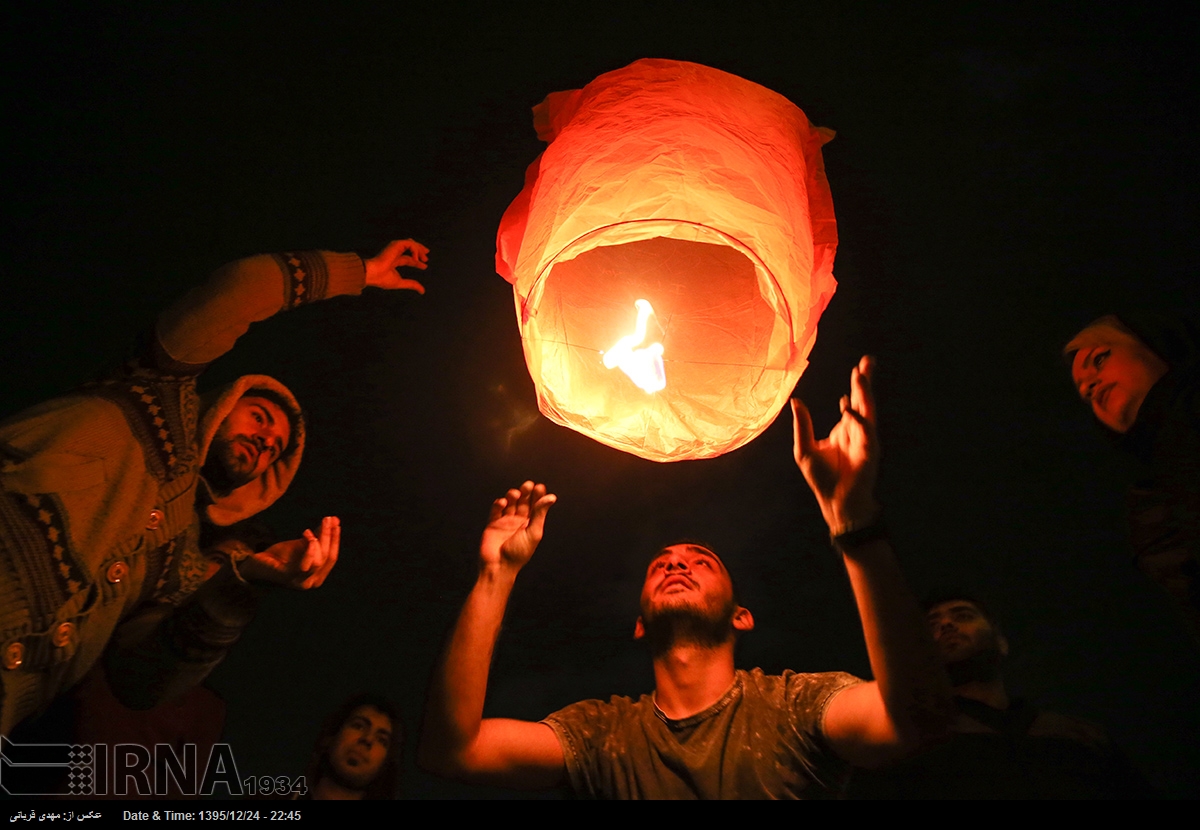
Chaharshanbe Suri (Fireworks Wednesday)
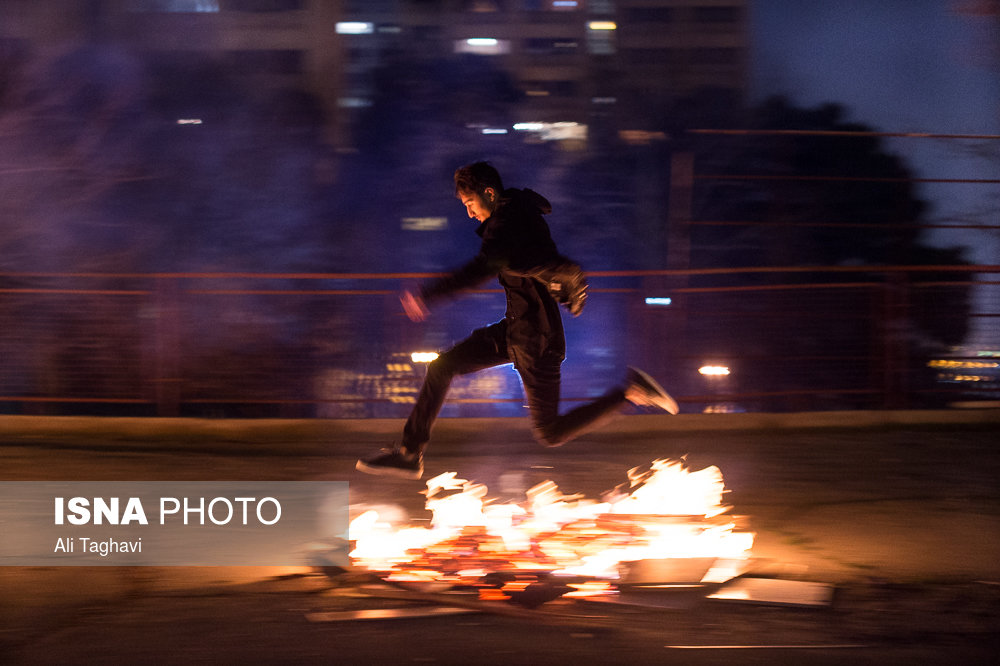
The last Tuesday night of the year is known as Chaharshanbe Suri which features different ceremonies. The main ritual is to set up bonfires and jump over them, which is held nationwide. Qashoq-Zani, an ancient predecessor of the trick-or-treating, is also among the main rituals of the day. People in towns and villages celebrate the event and there is joy and happiness everywhere.
1 of 4
Last Thursday of Year
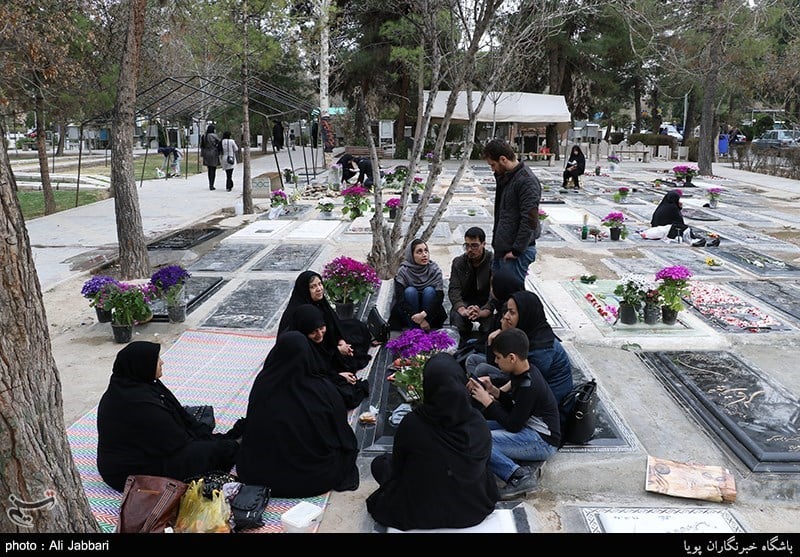
One of the traditions of Nowruz is to go to the tombs of loved ones and pay tribute to them. The ceremony is more significant for people who lost a family member or friend recently or during the past year. Even some people take Haft-Seen items, including the sprouts, to the final resting place of their loved one to share their happiness with those who have departed this life.
Iranians visit the tombs of loved-ones during the last Thursday of year
Eating Sabzi Polo on the Night of New Year
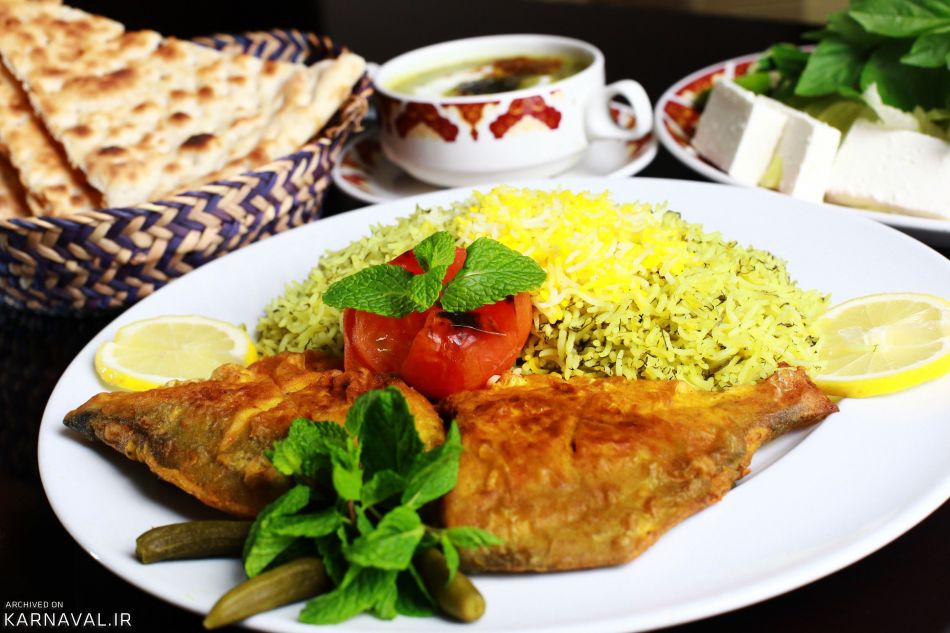
Iranians usually have Sabzi polo (pilaf mixed with chopped vegetables or herbs) with fish as the last meal before the turn of the year. Before the New Year begins, one can smell the aroma of Sabzi polo andKuku Sabzi (a cutlet-like food made with vegetables) along with fresh garlic and fish. In the past, well-off families would provide the needy with rice, oil, fish and eggs, so that they could make food and enjoy the occasion as well.
It is believed that eating sabzi polo on New Year’s Eve will make hearts lively and brings happiness and vivacity to people’s lives.
Sabzi Polo, the special Iranian dish for the night of Persian New Year
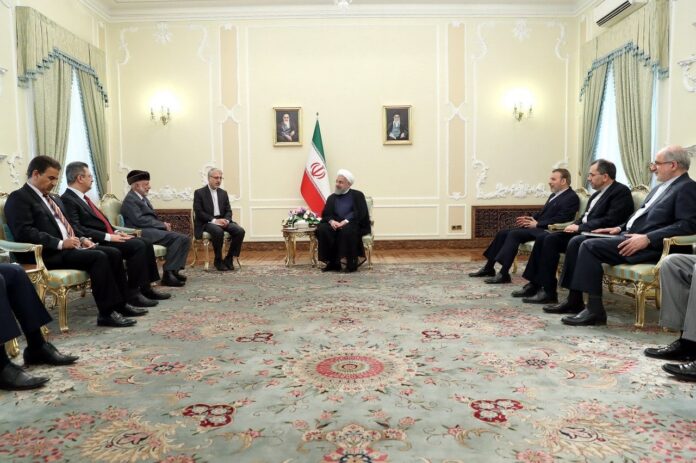
Speaking in a Sunday meeting with Omani Foreign Minister Yusuf bin Alawi in Tehran, President Rouhani said Iran and Oman shoulder a heavy responsibility towards the chaotic region.
Rouhani said the two governments must work towards promoting peace and stability in West Asia, as an unstable region harms its inhabitants the most.
The president expressed hope the two countries could help restore calm to Yemen and end bombardments and bloodshed in the poorest Arab country, as the humanitarian situation in the country is grave.
Bin Alawi, for his part, thanked the Islamic Republic for its efforts to strengthen peace and stability in the region, emphasizing the need for putting an end to various conflicts in West Asia.
“The clashes in Yemen have brought nothing but chaos and destruction for the region. We must try to end bloodshed there as soon as possible and provide humanitarian aid for the nation,” bin Alawi said.
Since 2015, Yemen has been the scene of a Saudi military campaign, which Riyadh says aims to push Houti fighters out of the Yemen capital Sana’a and restore to power the fugitive president Abd-Rabbu Mansour Hadi.
The Saudi campaign has left thousands dead and millions on the verge of starvation.
Tehran, Muscat Resolved to Enhance Bilateral Ties
During the talks, Rouhani and the Omani diplomat also discussed bilateral issues. The Iranian President said Tehran is bent on strengthening bonds of friendship with Oman, stressing the need for greater efforts to boost “brotherly” relations between Tehran and Muscat.
“The Islamic Republic of Iran is determined to develop all-out relations with Oman,” Rouhani said.
The president added Iran and Oman ought to encourage entrepreneurs and businessmen to form partnerships and implement joint projects, through removing obstacles to banking relations and facilitating trips between the two countries.
“There are great opportunities in Iran for investment in various sectors, particularly petrochemicals, energy, steel, aluminum, railroads and ports, that Omani investors can take advantage of,” Rouhani said.
In turn, Bin Alawi said Oman has always sought close relations with Tehran and is satisfied with the harmonious course of relations between the two countries in recent years.
The top Omani diplomat said his government agrees that there is need for encouraging Iranian and Omani businessmen to work together, and is considering measures to pave the way for broader economic and cultural relations.
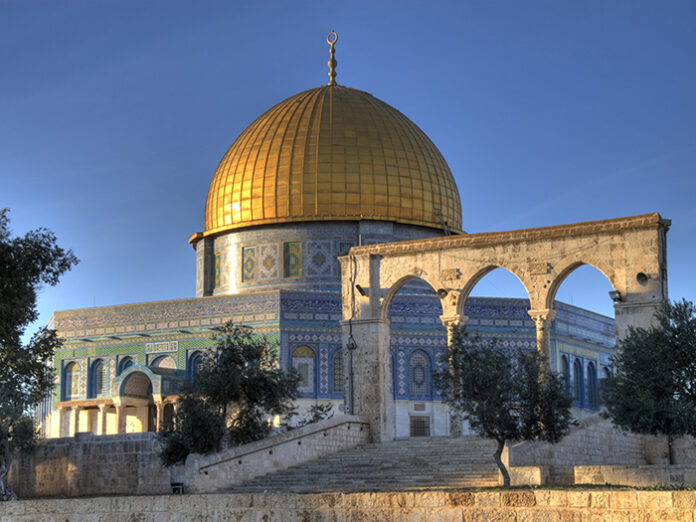
“Trump and his successors would fail to move their embassy to Jerusalem, just like their predecessors,” Salah Al-Zawawi said.
Trump recognised Jerusalem as the capital of Israel early December, saying the US embassy will soon be moved to the city after over 20 years of foot-dragging by previous US presidents.
Trump’s decision was met with widespread condemnation from the international community, with protests taking place across the Middle East, as well as in Malaysia, Indonesia, Afghanistan, Somalia, Pakistan, Bangladesh and South Africa.
Much of the Europe also saw large protests, including the UK, Germany, Macedonia, Austria and France, as well as demonstration in major US cities.
The embassy is due to be moved in May and will temporarily be hosted in the Jerusalem Al-Quds’ Arnona neighborhood, recognized as occupied territory under international law, until another building is constructed.
Speaking to the Persian-language ICANA, Zawawi referred to famous remarks by the late founder of Islamic Republic Ayatollah Ruhollah Khomeini that Israel is a “cancerous tumor” that must be wiped out, saying the “fake regime” will eventually collapse, despite strong backing for Israel by western states.
In August 1979, Ayatollah Khomeini declared the last Friday of Ramadan as the International Quds Day, calling on Muslims across the world to hold street rallies in protest to the long-standing occupation of the Palestine.
“The declaration shows this Muslim leader well understood the situation [of Palestine] about 4o years ago, when there were only 10 Zionist settlements [in the West Bank]”, he said.
From 1979 through 2016, the number of Israeli settlements established in the West Bank reached over 200.
The top story in almost all newspapers today was the European Union’s decision to join the US in imposing fresh sanctions on Iran in a bid to keep Trump in the nuclear deal known as JCPOA.
The Russian presidential elections and the expected victory of incumbent President Vladimir Putin also received great coverage today.
The possible blocking of Telegram messaging app and the calls by top clerics to control the cyberspace were among other stories on Sunday.
The above issues, as well as many more, are highlighted in the following headlines and top stories:
Abrar:
Bin Salman: Saudi Arabia Oldest Ally of US in Mideast
MP: There Are Reports Telegram Would Be Blocked Soon
Lavrov: Any Plan on Syria Disintegration Must Be Dropped
Abrar-e Eqtesadi:
Sustainability, Super Challenge of Iran’s Economy
Decreased Unemployment Not Tangible This Year
Iran, Iraq to Play Decisive Role in Setting Oil Price in Future
Aftab-e Yazd:
Tehran Prosecutor: Ahmadinejad’s Ally Rahim-Mashaei Arrested
Kermanshah Official: Unemployment More Serious Concern than Quake Ruins
We Wasted Iran Nuclear Deal
New Sanctions to Be Imposed by Europe against Iran
Why Is Existence of Iran Nuclear Deal Being Threatened after 2 Years?
Arman-e Emrooz:
Oman FM in Tehran: Bin Alawi Possibly Conveying US Message for Iran
Guardian Council Not Yet Reached Consensus on Women’s Candidacy for Presidency
Ebtekar
Science Minister: Women Account for 30% of Faculty Members in Iran