Friday, December 26, 2025
Home Blog Page 3651

“Resistance Front to Have Upper Hand in Possible War with Israel”

Hossein Sheikholeslam, a former Iranian diplomat and a senior political commentator, in an interview with the Persian-language Tasnim News Agency, has weighed in on the latest developments regarding Palestine over the past year.

In his comments, the analyst described the defeat of the ISIS terrorist group as the most important event during the past year which saw the Palestine issue turn into the top priority of the Middle East region and the Muslim world. He also reviews the situation of the resistance front and the Israeli regime, which has lost its social base both at home and in the court of public opinion around the world. With that in mind, he believes the odds of a war breaking out are slim, and that the resistance front will prevail should any war erupt. He also believes the best way to tackle Trump’s relocation of the US embassy from Tel Aviv to al-Quds would be for regional nations to remain on the scene and show reaction along with governments’ diplomatic measures. The highlights of his remarks follow.


Defeat of ISIS; Palestine Becoming Top-Priority Issue Again

Everyone believes that the most important event which occurred last year was the defeat of ISIS. Religious terrorism is gone, creating an opportunity to bring the issue of Palestine to the fore. It was a great achievement for the resistance front. The American created ISIS to wage an ideological war against us, but their plot failed.


Israeli Regime’s Support Bases in Europe Falling Apart

The second point to mention is the Zionist regime of Israel’s position in Europe. Settlement construction is the pillar of Tel Aviv’s development. The Israeli regime has eliminated trade tariffs between itself and Europe. The settlements built by Israel are different from those in other parts of the world. These settlements are supposed to create hope, bring prosperity upon the Israeli regime, absorb some Zionists or adventurous people from across the world and further consolidate support for the occupation of Palestine.

The settlements need security. Therefore, the settlers are armed, so that they can quench their thirst for savagery.

Now, European people regard the settlements constructed after the 1968 as illegal. Although the commodities of these settlements are cheaper that similar products elsewhere, European people insist that the goods should come with labels that show which settlement the commodities were produced in. So, they can refuse to buy the goods produced in settlements they consider illegal.


How Will Israeli Regime Be Destroyed?

The Zionist regime of Israel will be destroyed this way: The Zionists are propagating the idea that Iran seeks to develop state-of-the-art weapons and missiles, and produce bombs accordingly, to destroy the Israeli regime. But this is not the case at all. Neither can the Israeli regime be annihilated this way, nor do we have any intention of destroying the regime this way. We wouldn’t like the Israeli regime to exist because it is an oppressive regime. It is associated with aggression and occupation. However, the regime will be destroyed if it is ostracized by the world, and it WLL be ostracized by the world. We have produced missiles and we do have missile only to deter potential attacks on us by the Israeli regime. Our weapons are defensive and aimed at deterring enemies’ aggression.


Trump Going to Extremes

Trump’s illogical and irrational support for the Israeli regime, and the way he imposes his will on others, and his violation of UN Security Council resolutions, will scuttle all the negotiations in which the US was a guarantor. His moves such as the relocation of the US embassy from Tel Aviv to al-Quds is a good opportunity to provoke the Islamic world and Muslims, prompting them to stand up to such aggression and bullying.


Oppression by Monarchial Arab Regimes in Mideast & Getting Closer to Israel

Repressive acts by monarchial Arab regimes in the region and their getting closer to Tel Aviv are beginning to assume a special meaning for regional nations. The same thing happened with the former despotic Shah of Iran and the Israeli regime. The Zionists are trying to enter the Arab world. The Arab world tells them that they may be able to enter the monarchial palaces, but can’t enter people’s homes. People in the Muslim world do not accept the Israeli regime. The axis of oppression made up of the US, hegemonic powers, the Israeli regime and Arab monarchies has turned into a problem for Europeans as well.


Defeat of Zionists in Iraq’s Kurdistan

Another thing that the Zionists wanted to make happen but failed to do so was to get Iraq disintegrated through a referendum. The Zionists want the region to be partitioned based on racial differences and ethnicity. They have an old plan for this, too. It is Bernard Lewis’ famous plan which maintains when the region is partitioned along racial and ethnic lines – and do not forget that Israel’s definition of Judaism is a racist one – such a division will justify the establishment of a Jewish country based on ethnicity. People in the region are resisting this Israeli plan, which amounts to a major failure for Tel Aviv in achieving its objectives.


Seeking to Replace Fight against Israel with Iranophobia

By exerting pressure on Iran as the main brains, backup and frontline of the resistance against global hegemony, they wanted to make Islamic nations oppose Iran rather than the Israeli regime. However, the plan failed given Trump’s policies, the issue of relocating the US embassy to al-Quds and the pressure put on the Egyptian nation.


Looking Inside Palestine

There have been several Intifadas inside Palestine each of which had a different function. Now, a new approach is unfolding in Palestine. The demonstrations being held regularly on Fridays can continue. The weekly protests can exhaust the Israeli regime.


Settling the Syria Crisis, Reinforcing Resistance Front

Another issue is Syria. The Syria crisis is moving toward a political solution. Syria has, in essence, been against the Israeli regime and in favour of Palestinians. One of the reasons behind this support is the occupation of Syria’s Golan Heights by Israel. The settlement of the Syria crisis can have a positive impact on the issue of Palestine.


Crushing Response to Israeli Regime

One of the issues in the spotlight nowadays is the Israeli regime’s excessive demands on its joint natural gas field with Lebanon. Accordingly, Sayyid Hassan Nasrallah adopted an appropriate position in that regard, showing Hezbollah will use its military capabilities to safeguard the rights of Lebanon.


Popular Nature of Resistance amid Failed Western Democracies

The structure of the resistance front is more democratic than the structures of other sides such as the monarchical Saudi regime, the Israeli regime, the US and the like, or the Palestinian Self-Rule Authority, which has aligned itself with them. The Palestinian Self-Rule Authority led by Mahmoud Abbas is not a democratic one, unlike the Palestinian resistance movement Hamas, which has remained democratic in the most difficult times.


Bullying Ideology vs. Democratic Ideology

There are two types of ideology which are standing against each other. The bullying ideology says pressure, sanctions and bullying are effective ways in dealing with those opposing you. However, the democratic ideology believes it is possible to achieve one’s goals through resistance.


Resistance Front’s Upper Hand

We have the upper hand; it is unlikely that the Zionist regime of Israel would even dream of waging a war. It may chant the slogan of war or make threats, but will not launch a war anywhere.


Israeli Regime’s Internal Situation

I believe radicals in the Israeli regime need to step aside because they have chanted a lot of extremist slogans, but not achieved much. Moreover, Netanyahu’s days are numbered, and he must go.


Compromise Plan Fails

The compromise theory and all its supporters have failed, and the Self-Rule Authority has lost its credibility among Palestinians because of the measures adopted by the Zionists and Trump. As a case in point, security cooperation has resulted in the martyrdom of Palestinians. Netanyahu’s radicalism is not compatible with the Self-Rule Authority’s weakness and humiliation. Netanyahu should change.


Ways of Countering Relocation of US Embassy to al-Quds

The best way is popular presence in the face of the Americans. We should provoke people to show reaction outside US embassies and institutions in Muslim countries. We should even urge Saudi officials to take a stance against this US move.

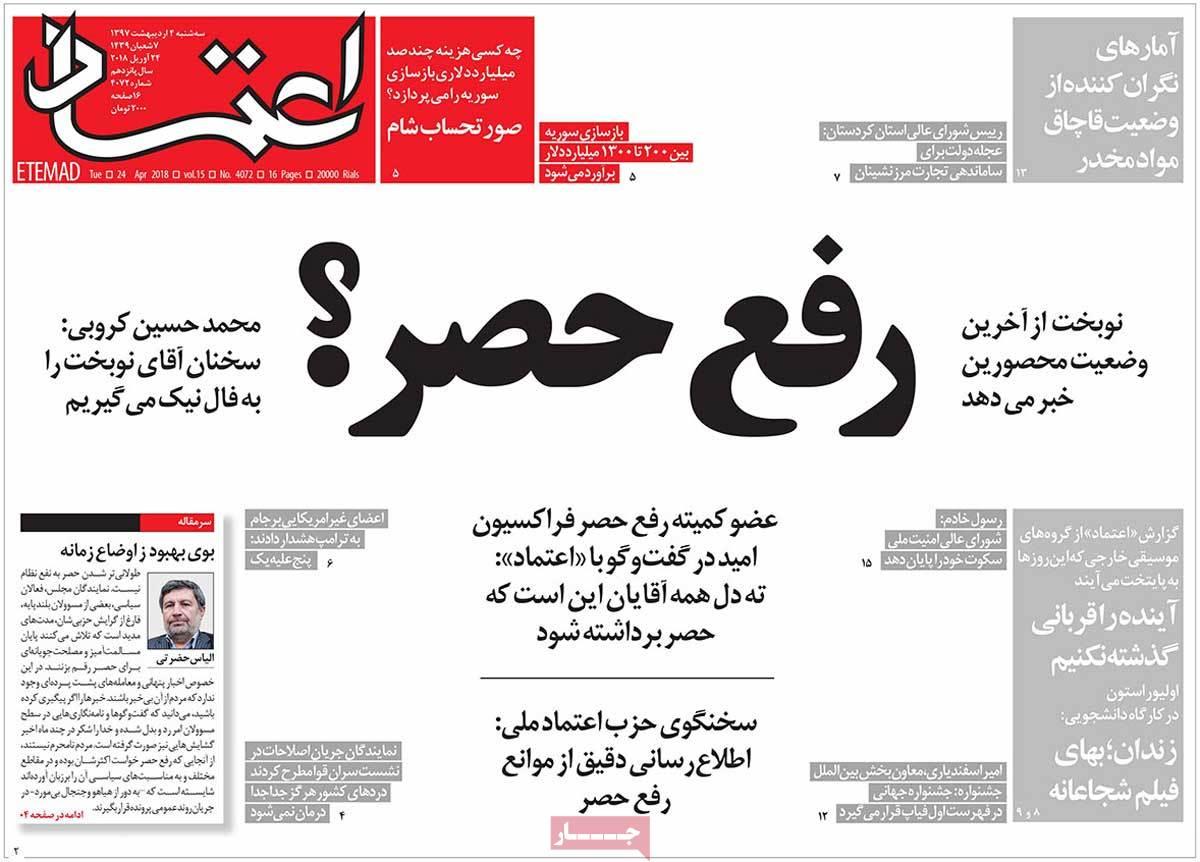
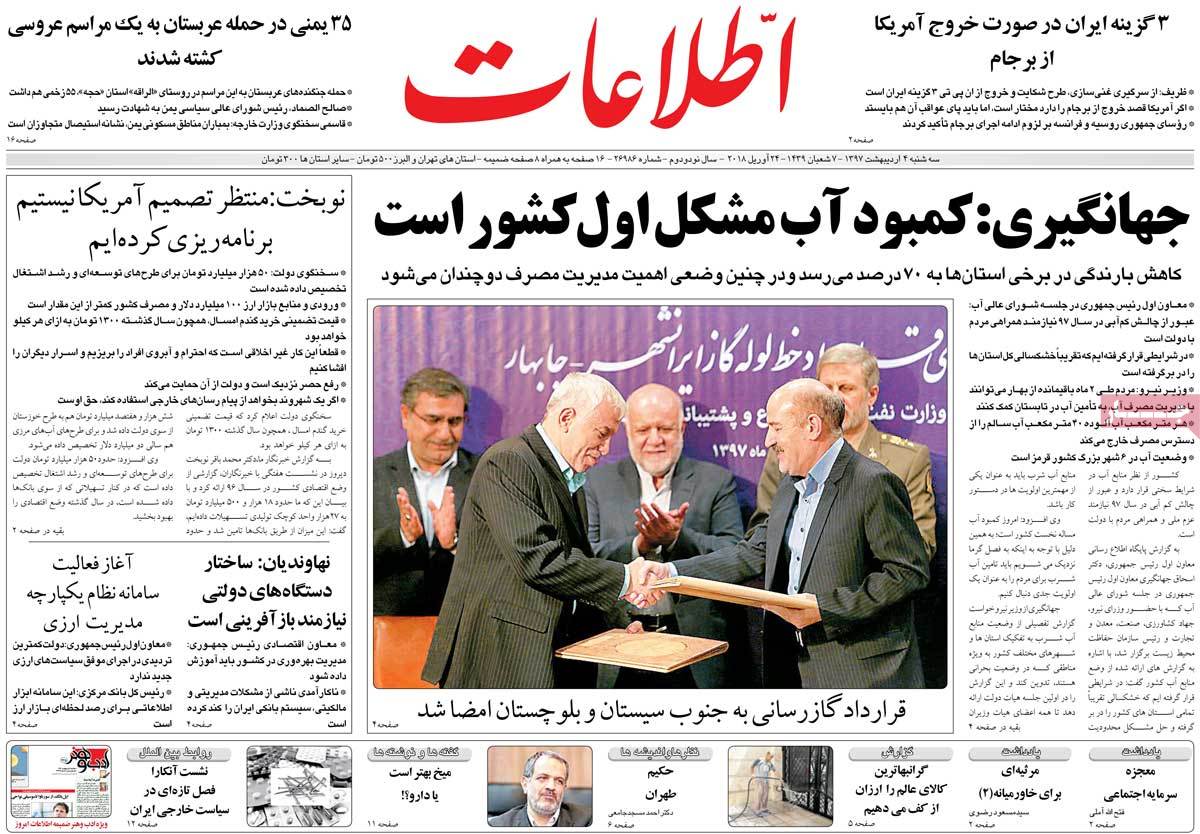
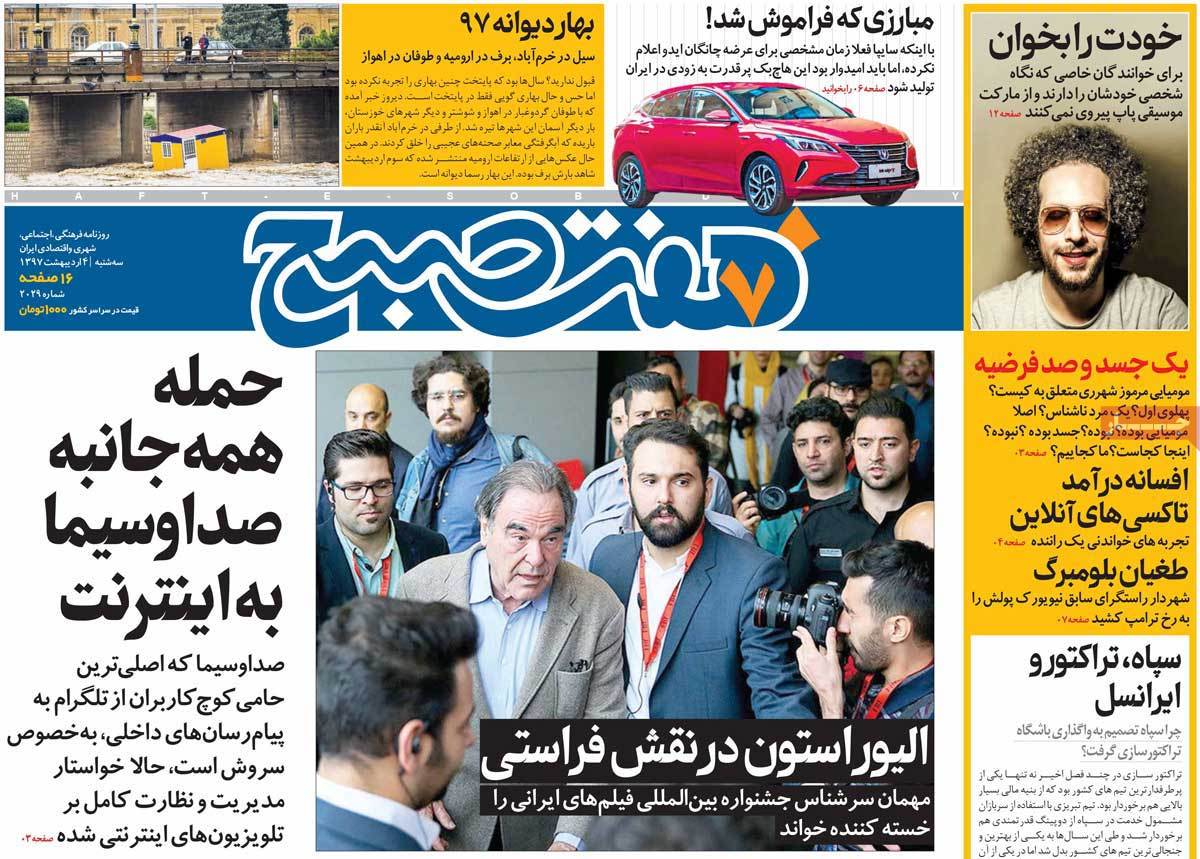
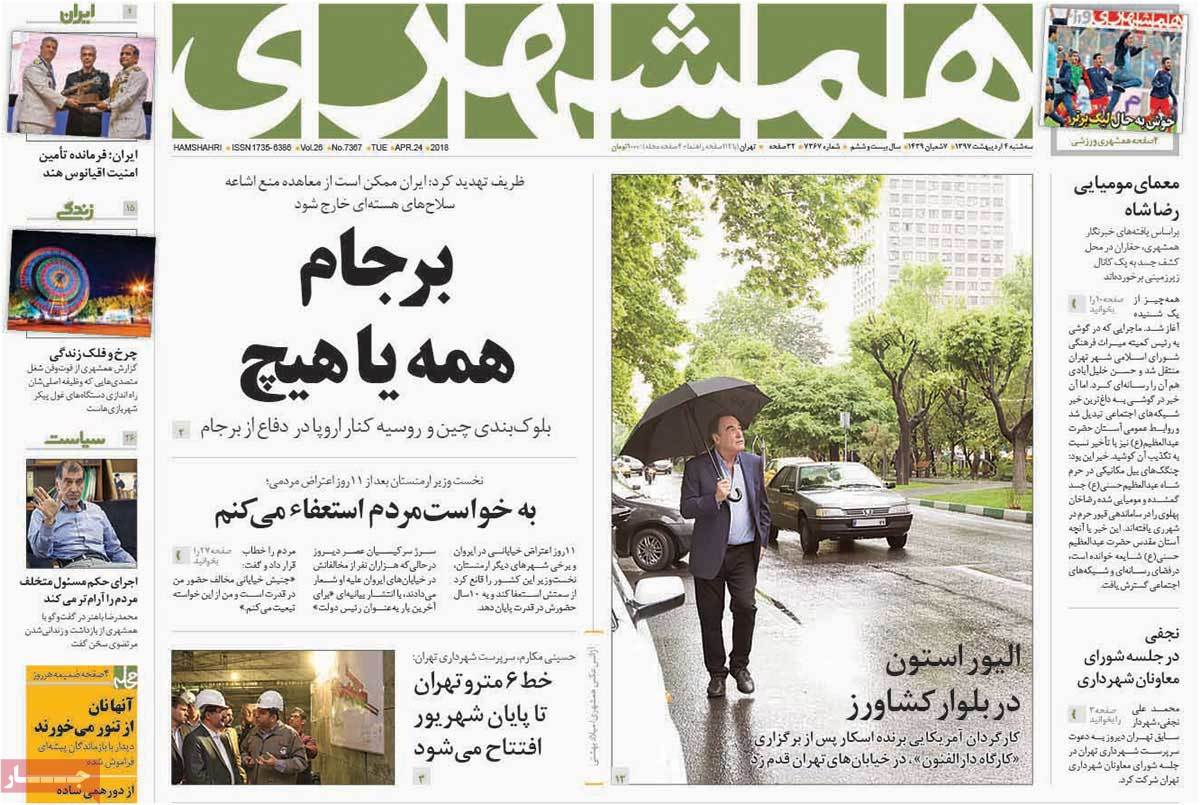
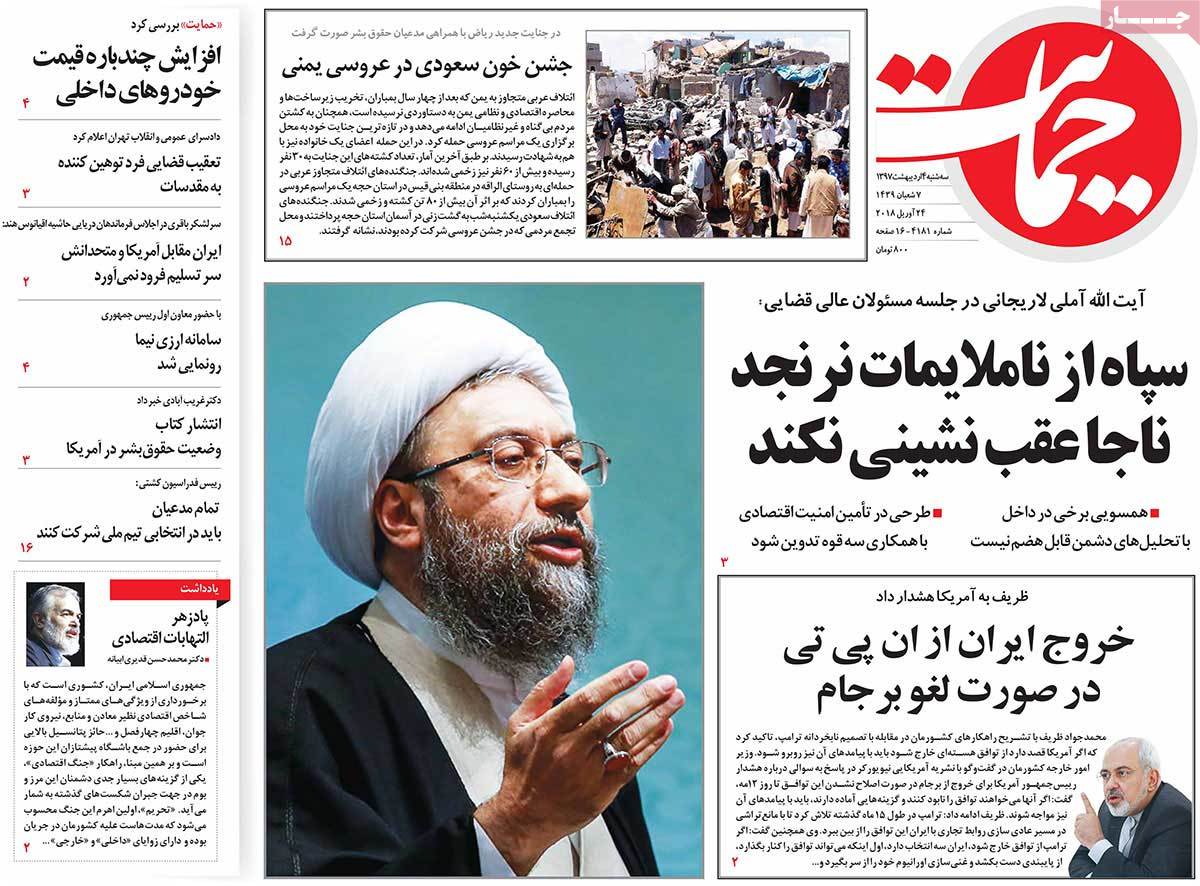
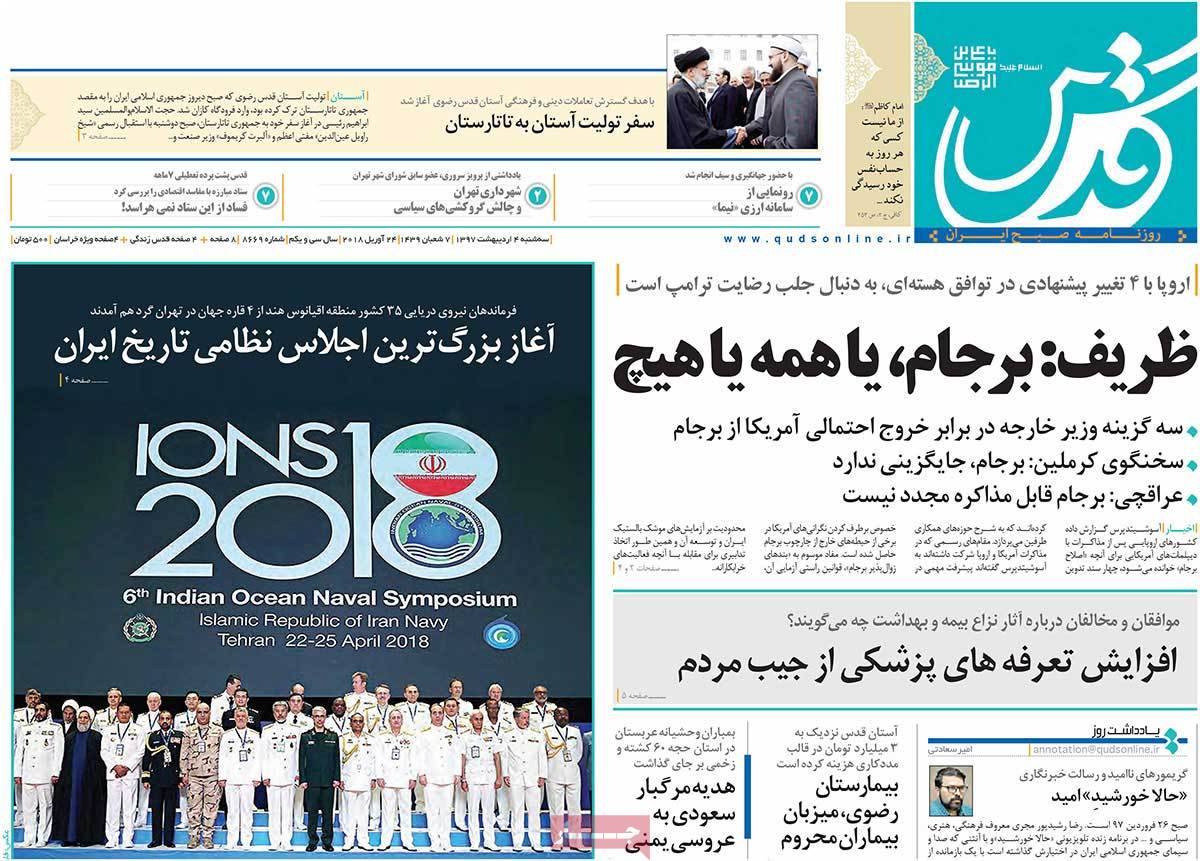
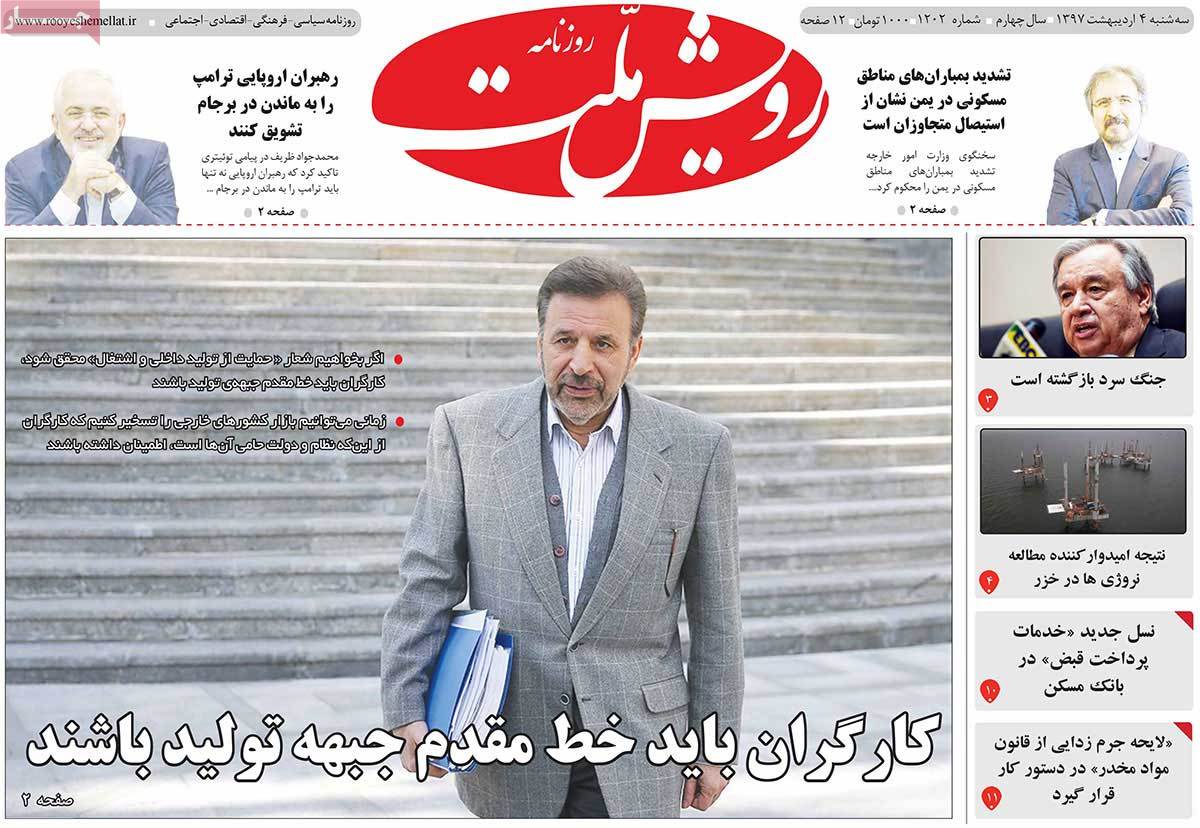
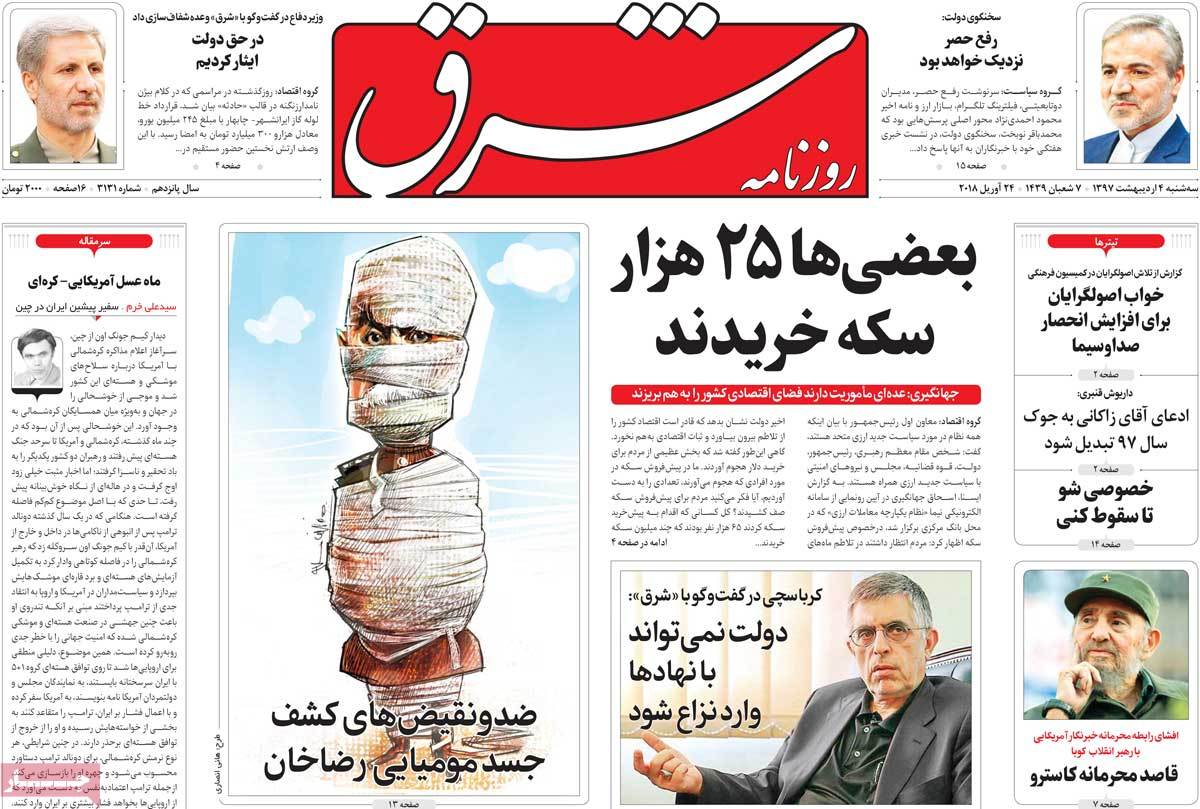
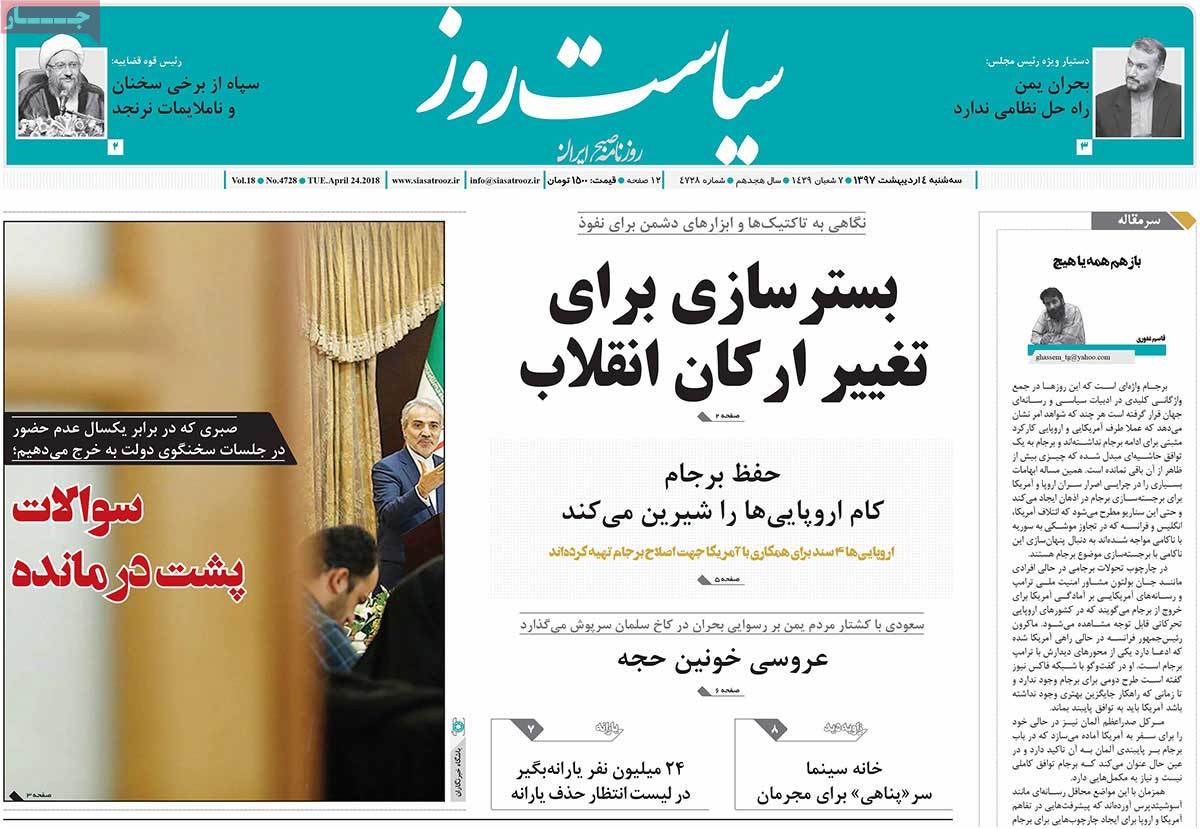
A Look at Iranian Newspaper Front Pages on April 8

A Look at Iranian Newspaper Front Pages on November 18

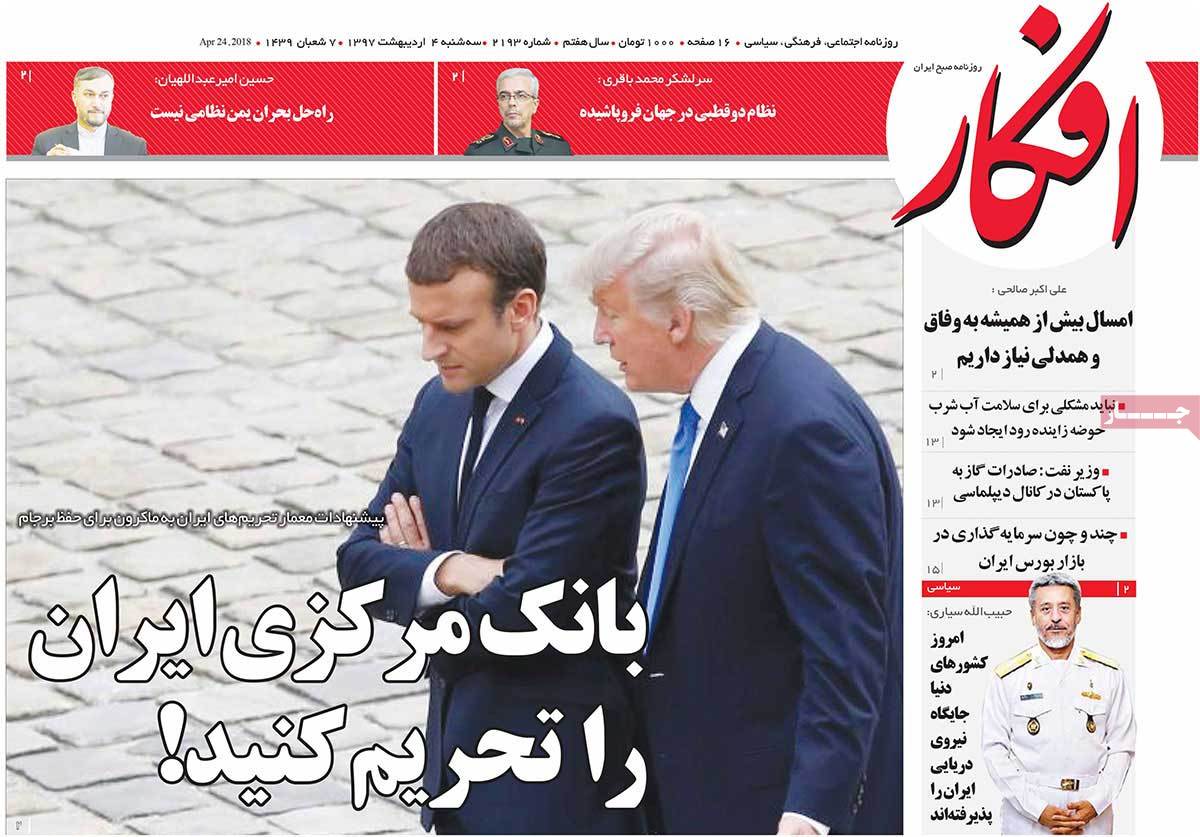
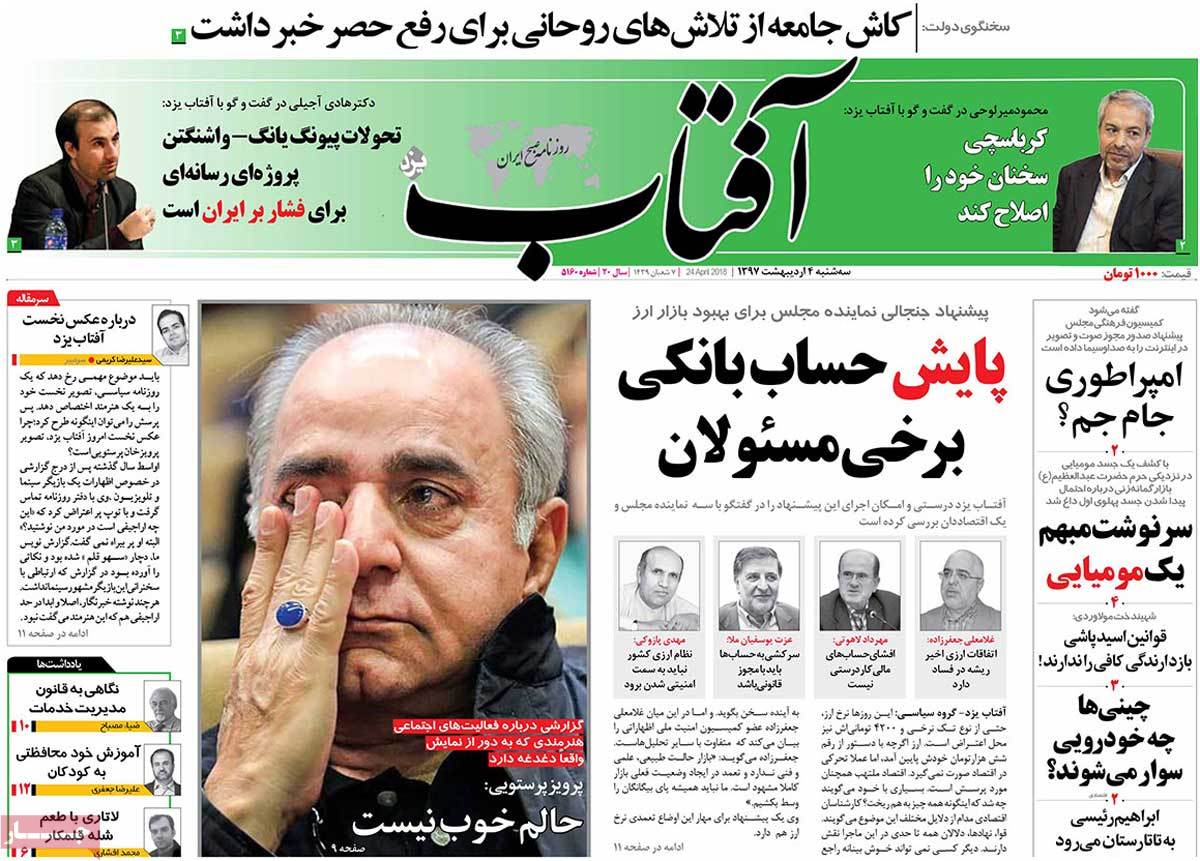
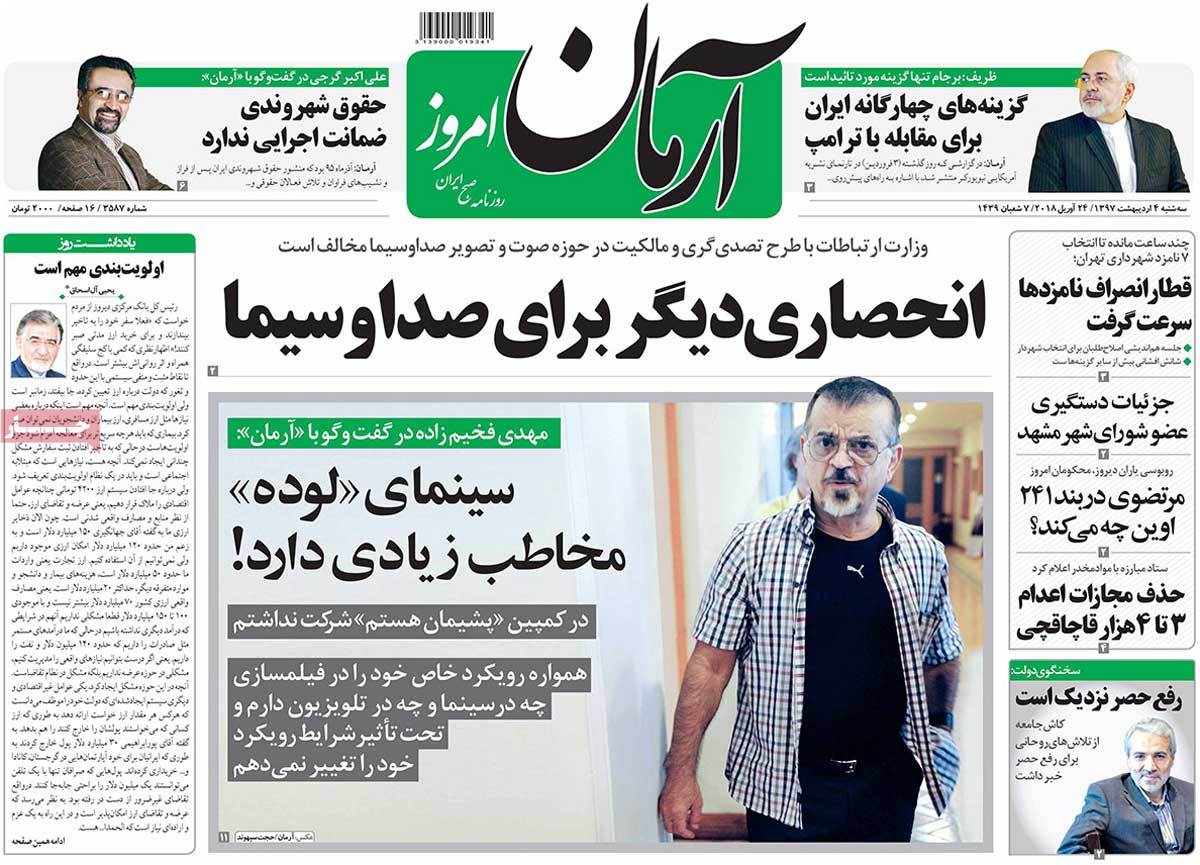
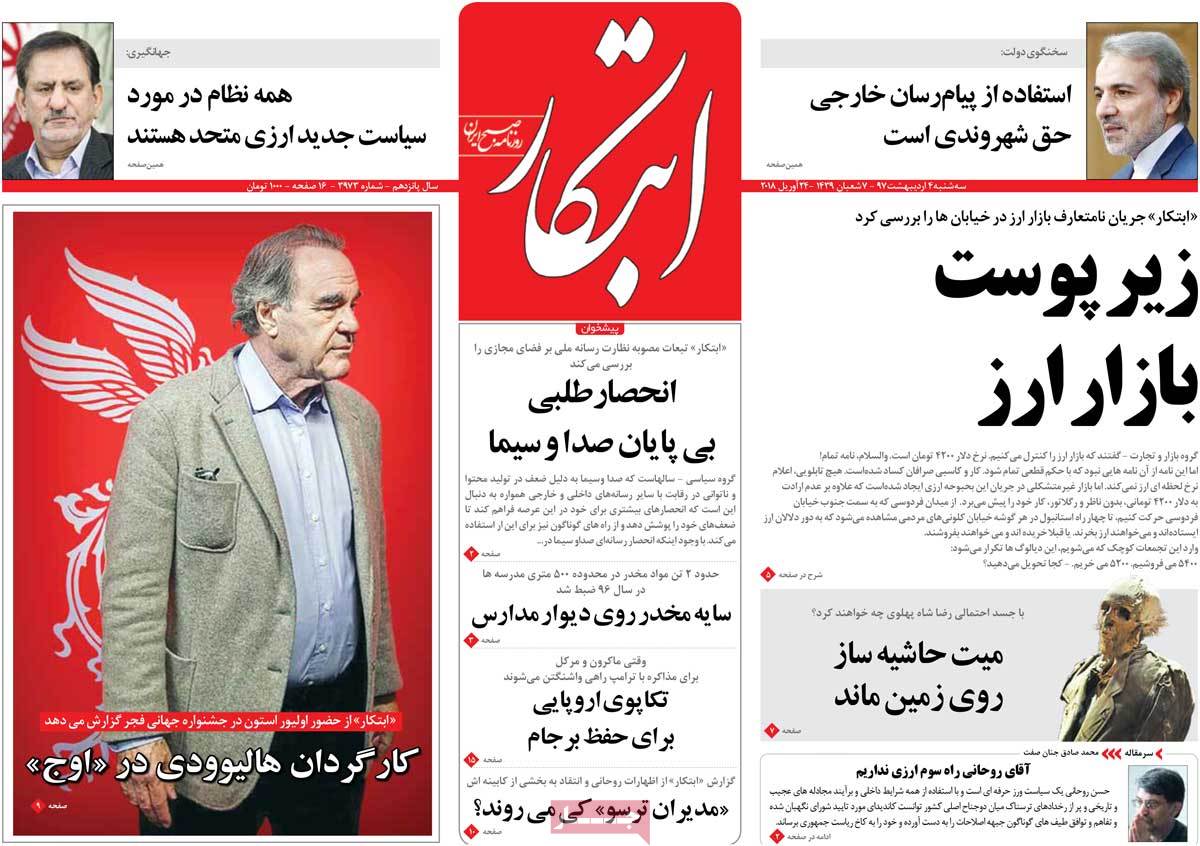
The top story in all papers today was the growing rate of US dollar and other foreign currencies in Iran, and the ongoing efforts to control it. The Parliament is going to give an ultimatum to the Central Bank while Economy Minister Massoud Karbasian has vowed to return the country’s economy to normal.

Several newspapers also highlighted the Friday night’s cyber-attacks on major Iranian databases, which were caused by a flaw in the Cisco switch.

The Israeli troops’ ongoing violence against Palestinian protesters, which has so far killed dozens of people and wounded hundreds of others, also received great coverage today.

Also a top story was Persepolis FC’s second consecutive championship three weeks before the end of the Iran Pro League.

The above issues, as well as many more, are highlighted in the following headlines and top stories:


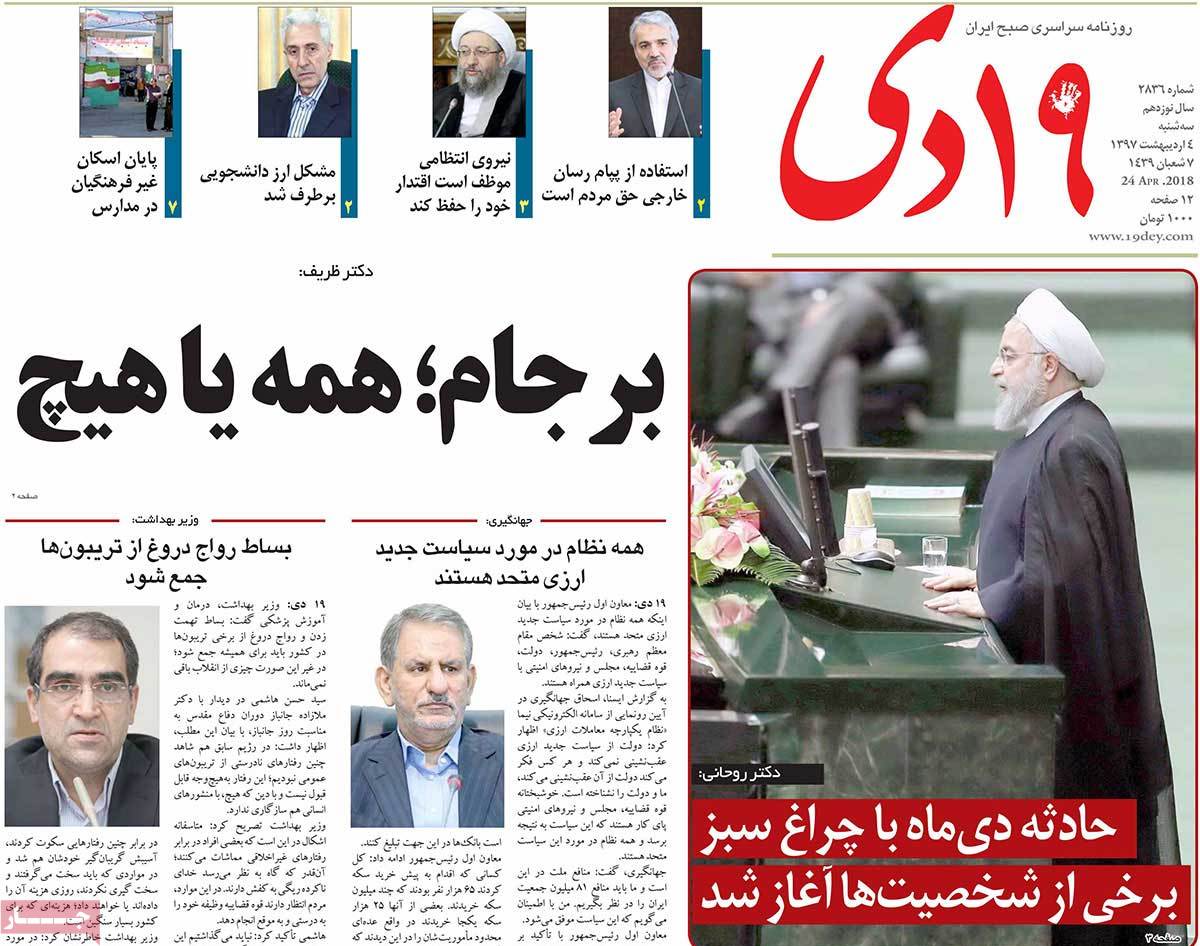
19 Dey:

  • Minister: Stability to Return to Iran’s Economy Soon

A Look at Iranian Newspaper Front Pages on April 8


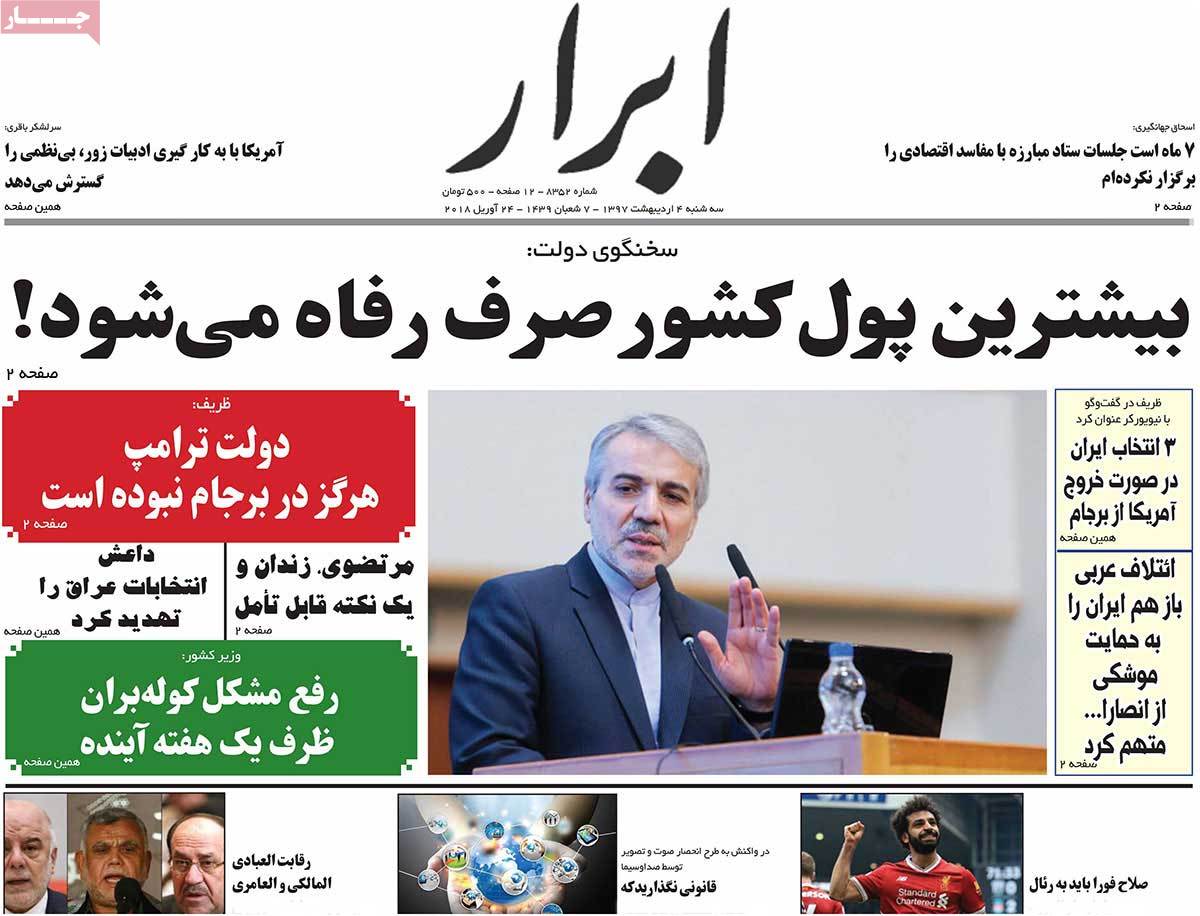
Abrar:

  • Russian Parliamentary Delegation to Visit Iran
  • IRGC General: No Country Should Test Iran’s Strategic Might, Patience

A Look at Iranian Newspaper Front Pages on April 8


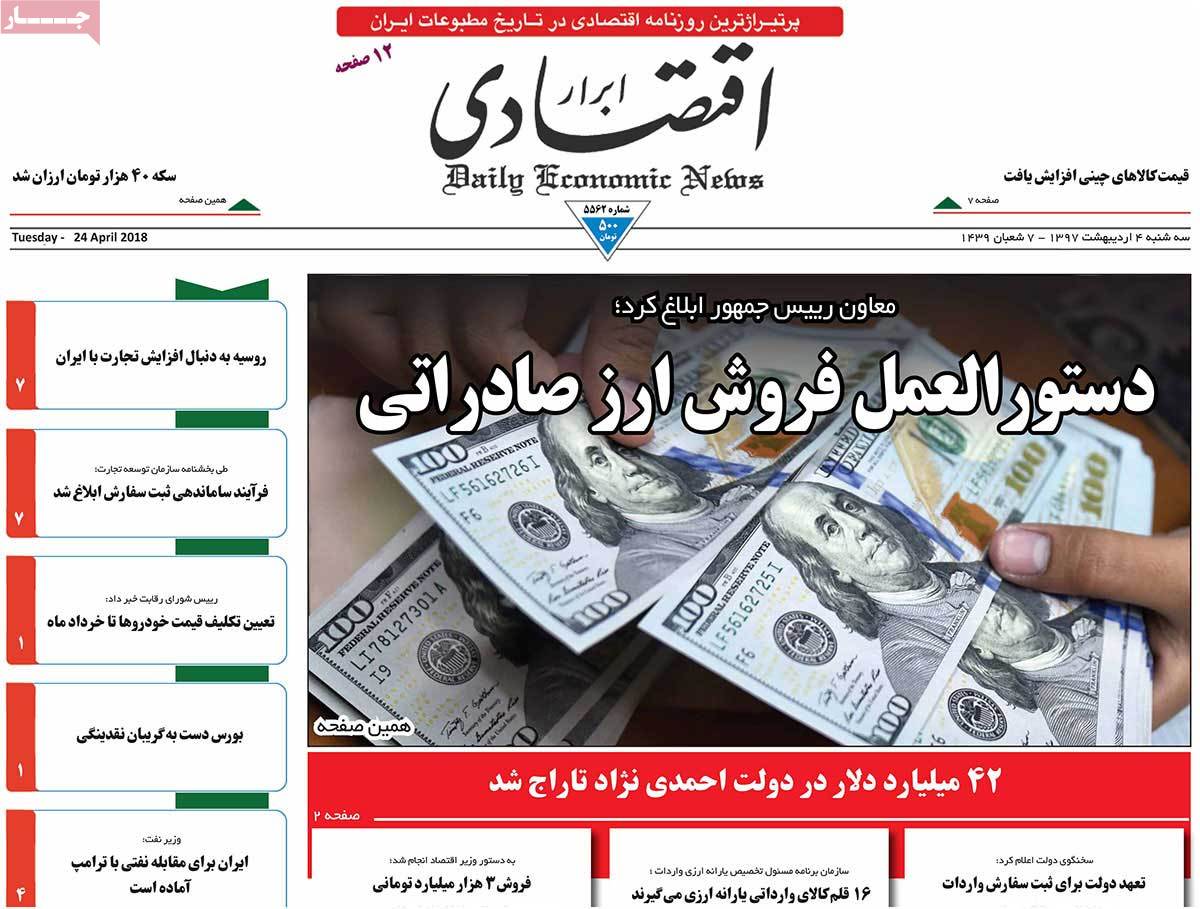
Abrar-e Eqtesadi:

  • US Dollar’s Storm in Iran’s Economy
  • Parliament to Give Ultimatum to Central Bank

A Look at Iranian Newspaper Front Pages on April 8


Afkar:

  • IRGC General: Iran’s Policy Based on All-Out, Active Presence in Southern Waters
  • Senior MP: Iran Will Definitely Pull Out of JCPOA If Sanctions Re-Imposed

A Look at Iranian Newspaper Front Pages on April 8


Aftab-e Yazd:

  • Wild Diplomacy: Hawkish National Security Advisor Bolton Starts Work
  • Disappointment with Rouhani to Damage Reputation of Reformism: Karbaschi
  • Persepolis FC Claims Iran Pro League Title

A Look at Iranian Newspaper Front Pages on April 8


Asrar:

  • Oil Minister: Trump Has Caused Americans Firms to Lose Their Chance in Iran

A Look at Iranian Newspaper Front Pages on April 8


Ebtekar

  • Economy Used as Weapon in New Cold War
  • US Blacklists 24 Russian Citizens, 14 Firms for Moscow’s Sabotage

A Look at Iranian Newspaper Front Pages on April 8


Etemad:

  • People in Underdeveloped Sistan and Baluchestan Province Are Crying
  • MP Talks about Consequences of Water Crisis in Province
  • Impact of Increased Dollar Rate on People’s Livelihood

A Look at Iranian Newspaper Front Pages on April 8


Ettela’at:

  • Economy Minister: Gov’t Will Strongly Reconstruct Economy, Fight Corruption
  • US Blocks UN Security Council Statement against Zionists’ Crimes
  • MP: Mousavi, Karroubi Not after Overthrowing Establishment
  • Lifting Their House Arrest to Reinforce National Solidarity

A Look at Iranian Newspaper Front Pages on April 8


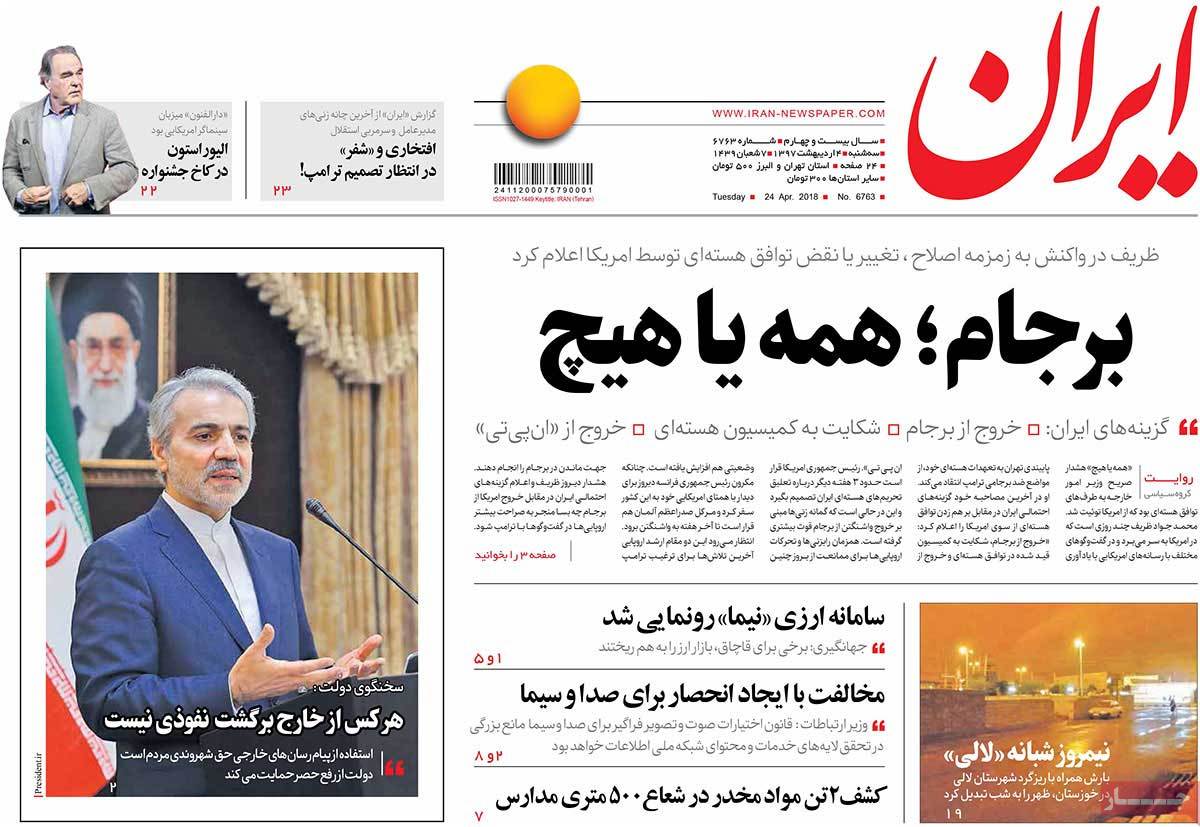
Iran:

  • Spring Rainfall across Iran
  • Zoroastrian Councillor of Yazd: My Membership Doesn’t Matter Anymore
  • I’ll Pursue Rights of Minorities
  • Two-Fold Increase in Oil Exports to India

A Look at Iranian Newspaper Front Pages on April 8


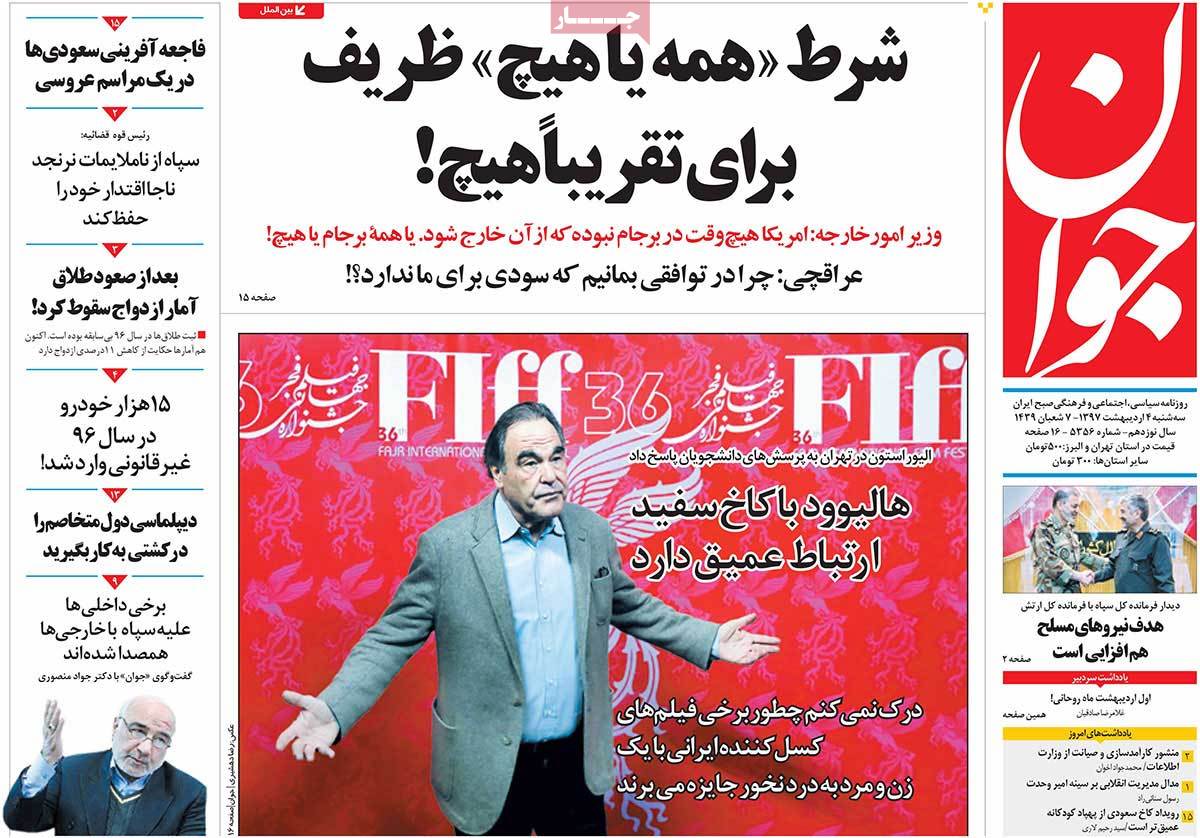
Javan:

  • Iran’s Vulnerable Cyberspace
  • Massive Cyber-Attacks on Friday Night Highlights Need for National Network
  • Tel Aviv Worried about Spread of Gaza Protests to West Bank

A Look at Iranian Newspaper Front Pages on April 8


Jomhouri Eslami:

  • Palestinians Urge Int’l Bodies to Prevent Zionists’ Brutality
  • Russia: US Sanctions Not to Remain Unanswered
  • Saudi Crown Prince: We Have Many Common Interests with Israel

A Look at Iranian Newspaper Front Pages on April 8


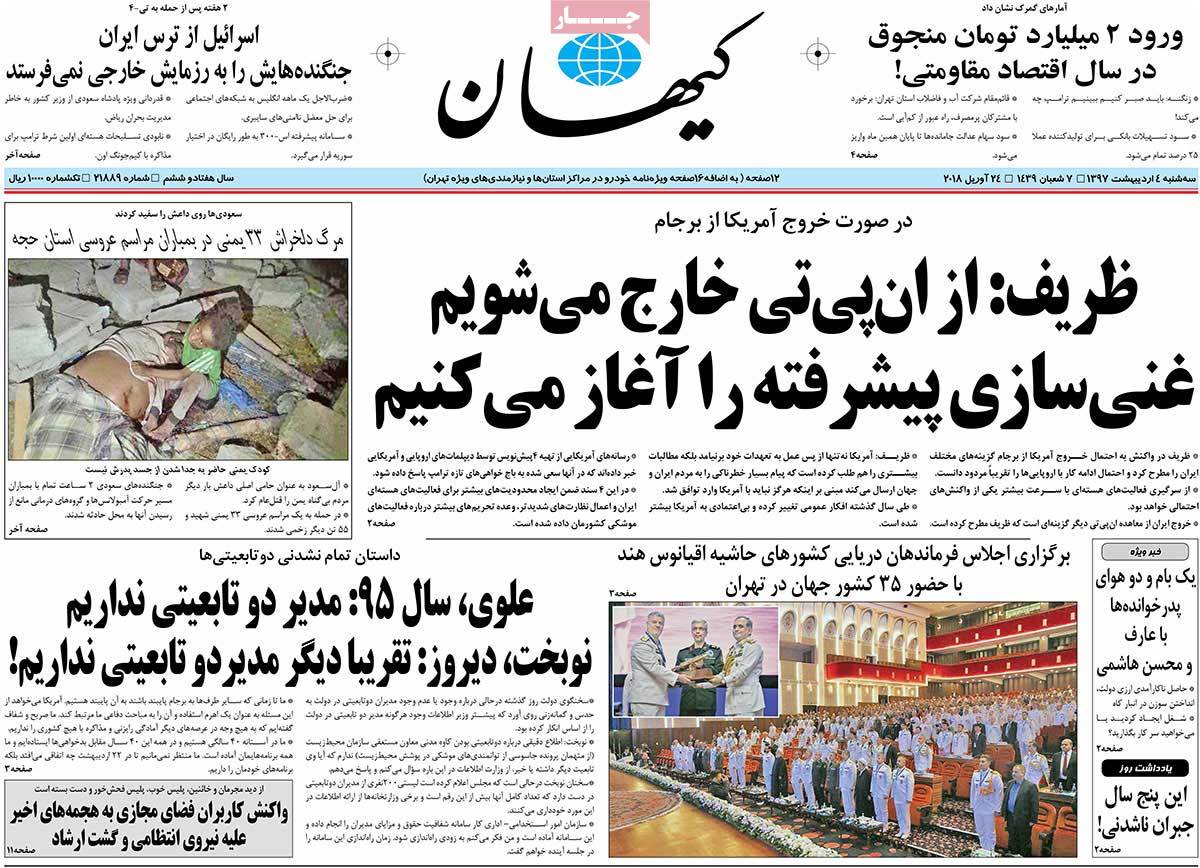
Kayhan:

  • Government’s Reactions to Dollar Rate Hike
  • Yesterday Described as Rivals’ Plot, Today as Economic Necessity!

A Look at Iranian Newspaper Front Pages on April 8


Khorasan:

  • Parliament’s Double-Urgency Motion to Control Forex Rate

A Look at Iranian Newspaper Front Pages on April 8


Payam-e Zaman:

  • 33% of Iranian People in Absolute Poverty
  • IRR 40m [around $760] Is Poverty Like for People in Cities
  • Macron, Merkel to Visit US for Talks on JCPOA

A Look at Iranian Newspaper Front Pages on April 8


Resalat:

  • IRGC General: We’re Ready for Any Reaction by Constantly Observing Enemies

A Look at Iranian Newspaper Front Pages on April 8


Rooyesh-e Mellat:

  • Interior Minister: Iran Most Powerful State Fighting Terror in Mideast

A Look at Iranian Newspaper Front Pages on April 8


Sazandegi:

  • Turkey’s Hands in Iran’s Pockets
  • Iranian Tourists Spend $400 More than Other Tourists in Turkey

A Look at Iranian Newspaper Front Pages on April 8


Shargh:

  • Billions of Dollars of Dirty Money Taken Out of Iran in Ahmadinejad’s Era

A Look at Iranian Newspaper Front Pages on April 8


Tejarat:

  • Iran DM: Saudi Crown Prince Has Illusion of Power

A Look at Iranian Newspaper Front Pages on April 8


Vatan-e Emrooz:

  • Cyber Stroke: ICT Minister Says Attacks on Iranian Databases Had Global Scope

A Look at Iranian Newspaper Front Pages on April 8

“Iran Will Definitely Pull Out of JCPOA If Sanctions Re-Imposed”

“The most important objective of the JCPOA (the nuclear deal, officially known as the Joint Comprehensive Plan of Action), was the lifting of sanctions,” Chairman of the Iranian Parliament’s Committee on National Security and Foreign Policy Alaeddin Boroujerdi said on Saturday.

“If … sanctions are re-imposed on Iran, we definitely will not remain in the JCPOA,” he added.

The US ambassador to the United Nations, Nikki Haley, said on Thursday that Washington would probably get out of the Iran nuclear deal and re-impose sanctions on the Islamic Republic.

She accused Iran of supporting terrorism and violating the terms of the JCPOA and said Europeans were closing their eyes on this, but added that the US would not do so.

The Iranian lawmaker rejected Haley’s comments that Tehran would not pull out of the JCPOA because it intended to continue trade ties with European countries and said the US envoy should not make decisions for Iran.

In her Thursday lecture at Duke University, in Durham, North Carolina, Haley said, “The Europeans stay in the deal. Fine. They can have it. We can put our sanctions back on. Iran is not going to get out of that deal. They want the trade with the Europeans. They want to keep the $100 billion that they have. They are not going to leave, but we don’t have to be a part of it.”

Boroujerdi further emphasized that Iran made decisions based on its own national interests.

He said if sanctions were set to be re-imposed on Tehran after a possible US withdrawal from the nuclear deal, Iran’s remaining in the JCPOA would not secure the country’s objectives.

The senior legislator emphasized that Iran would maintain its ties with European countries as long as mutual interests existed.

US President Donald Trump on January 12 reluctantly agreed to waive sanctions against Iran that were lifted as part of the landmark deal, but said it would be the last time he issued such a waiver unless conditions were met.

The US president once again threatened to withdraw from the nuclear deal if some “disastrous flaws” were not fixed.

Trump said he wanted America’s European allies to use the 120-day period before sanctions relief again came up for renewal to agree to tougher measures and new conditions, otherwise Washington would pull out of the deal.

German Chancellor Angela Merkel in March warned Israeli Prime Minister Benjamin Netanyahu, a staunch opponent of the Iran deal, against serious repercussions of a US decision to pull out of the multilateral agreement, saying such a move would plunge the Middle East into war.

Merkel said the US and Israel would clash with their Western allies should Trump withdraw his country from the nuclear agreement.

Earlier in March, Iranian Foreign Minister Mohammad Javad Zarif also warned the US against the “painful mistake” of pulling out of the 2015 Iran nuclear agreement.

“Considering what has been envisaged in the JCPOA in the field of research and development and the Islamic Republic of Iran’s continued measures to develop its peaceful nuclear capability, if the US makes the mistake of exiting the JCPOA, it will definitely be a painful mistake for the Americans,” Zarif said.

Two-Fifth of Drying Lake Urmia Filled with Water

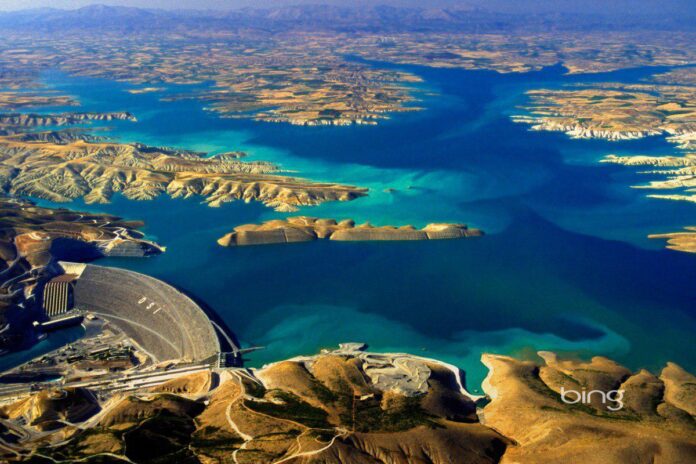
Baqerzadeh Karimi says currently two-fifth of Lake Urmia’s surface area is covered with water, adding, however, the water level of the lake is still low.

“Fortunately, the lake is now in a relatively good condition due to the last season’s rainfall. We expect further increase of the lake’s water level following the spring’s precipitation, melting of the winter’s snow and opening of dams’ floodgates,” he was quoted as saying in a Farsi report by ISNA.

He said at present the water level of the lake stands at 1270,67 centimetres which has increased by 60 centimetres compared with its lowest level.

“Meanwhile, the water level of the lake has increased by 4 centimetres compared with the last year,” he said.

As the Head of Wetland Affairs at the Department of Environment, Baqerzadeh Karimi said with the increase of the lake’s water level, its surface area covered with water reaches 212,000 hectares which shows a relative growth compared with the last year.

“At present, over two-fifth of the lake’s surface area is covered with water but unfortunately, the water volume of the lake is only 1.84bn cubic meters. This means that the lake’s water level is still too low and this puts it in a dangerous situation ahead of the hot season of summer,” he added.

Touching on the plans to restore Lake Urmia, Baqerzadeh Karimi said “we have made good progress in a number of fields like establishing channels and tunnels for transferring water, sealing illegal wells, making reforms to irrigation systems and creating plant cover around the lake.”

He added last year, only 30 percent of the financial credit to restore the lake was provided and naturally only 30 percent of the target goals were fulfilled.

“To provide the financial credit, we need to seek resources other than the government like private sector as well as foreign investments,” he said.

He underlined that the plans to restore Lake Urmia will remain intact but the methods to implement them will undergo changes to speed up the restoration process.

Lake Urmia has been depleted drastically due to a variety of factors, including the construction of a causeway as well as several dams that have choked off water from the mountains on either side of the lake.

A report compiled by the UN Development Plan (UNDP) says human factors, particularly building numerous dams over the rivers flowing into the lake, have further complicated the fate of the largest inland body of water in Iran. However many others maintain that that illegal water wells have played a pivotal role in shrinking Lake Urmia.

Five years ago, Iranian President Hassan Rouhani and his first cabinet launched a “task force” for the revival of Lake Urmia.

Persepolis Wins Iran Pro League Title for Second Consecutive Year

The reds on Saturday defeated Padideh FC in the north-eastern city of Mashhad 0-1 to gain enough edge over Zobahan of Isfahan and claim the title for the second consecutive year.

The match against Padideh was the third one in a row where Persepolis had the chance to win the title by securing minimum points, but the reds had lost their two previous matches to Saipa and their arch-rival Esteghlal.

Persepolis Wins Iran Pro League Title for Second Consecutive YearManager Branko Ivankovich and his men had last year ended a 9-year wait for the title, again with 3 matches to spare.

Persepolis FC was founded in 1963 and has been in the first division of Iranian football since 1968.

The Tehran giants have won a record eleven Iranian league titles, as well as five Hazfi Cups, one Super Cup and the 1990–91 Asian Cup Winners’ Cup.

Many notable players have played for the club, including former Bayern Munich players Ali Karimi, Ali Daei, Vahid Hashemian and former Hamburger SV player Mehdi Mahdavikia.

“EU’s Talks with US over Iran Deal Strategic Mistake”

US President Donald Trump, German Chancellor Angela Merkel and French President Emmanuel Macron at the G-20 Summit in Hamburg, Germany, 2017 / Photo by DPA

The US is seemingly intent on terminating the landmark 2015 nuclear agreement between Iran and major powers, which removed international sanctions on Iran in exchange for confidence-building curbs on its nuclear program.

In recent months, Britain, Germany and France have been holding talks with the US on the nuclear deal in a bid to convince the US not to kill the accord.

However, the evidence suggests the efforts have led to nowhere so far.

An article published by the Persian-language Basirat website says the EU has made a big mistake by entering into talks with the US, instead of holding its ground and announcing it will never accept US calls for renegotiation of the pact. The following is a translation of the article:

The European Union and particularly top European powers have failed a test to contain America. This was evident during the presidency of Barack Obama, when the US Treasury Department was unfaithful to the deal, and during the presidency of Donald Trump. The evidence suggests the Trump administration is preparing to walk out of the Iran deal. The nomination of Mike Pompeo as the US secretary of state and appointment of John Bolton as national security advisor sent meaningful messages from Washington to Europe: the US is willing to walk out of the Iran deal as soon as possible.

Trump has set four ridiculous conditions for staying in the deal: Carrying out inspections of Iran’s military sites, removing the so-called “sunset clauses” of the deal, adding articles to the deal restricting Iran’s missile program, and limiting Iran’s regional activities. Without a doubt, the Islamic Republic will accept none of these conditions and efforts by the European Union will do the West no good in this regard.

In recent days, the Europe has been a scene to many developments related to the pact. France, the UK and Germany are trying to persuade their EU partners into supporting new sanctions against Iran aimed at saving the nuclear deal. But Italy has doubts these sanctions will prevent the US from exiting the pact.

According to a Reuters report, Paris, London and Berlin have held a meeting with ambassadors of other EU member states to win their support for approving new sanctions in April. The meeting was held behind closed doors in Brussels. A while ago, western media reported joint efforts by the three European powers to impose sanctions on Iran over its missile and regional activities. The three countries claim the move will help convince the US to keep the deal in place. However, such an argument is unacceptable even within the EU.

Italy, supported by Spain and Austria, has opposed imposing travel ban and asset freeze on 15 firms and persons connected to Iran’s missile program and presence in Syria. Some European countries believe these measures won’t be enough to convince Trump to stay in the deal and will endanger growing trade relations with Iran. According to the EU rules, the imposing of economic sanctions requires the approval of all EU members.

The fact is that since early August, the Trump administration has held lengthy talks with Europeans on altering the JCPOA to the US benefit. The Europeans made their first mistake in August. French President Emmanuel Macron announced in August that he favoured talks with Iran on the country’s missile program and the fate of Iran’s nuclear program after the end of temporary restrictions set by the pact. The annual meeting of the United Nations General Assembly in New York in September was the scene of close consultations between US and European powers. Seemingly, one of the top goals of Washington in the talks is to the share the cost of the termination of the deal among the US and its European partners. The behaviour of European powers in the face of US insistence on altering the deal and their inactivity has enabled the White House to leave the EU with two options, whether to help change the deal or see the pact cancelled. This is while the three countries, who played a big role during the nuclear talks between Iran and P5+1, should have avoided entering into talks with the US on the deal.

Trump has asked Europeans to fix the so-called flaws of the deal by May 12, when he should decide whether to extend waivers of Iran sanctions. As it was pointed out, many international analysts believe the appointment of John Bolton, the neoconservative politician who is antagonistic towards the deal, and the nomination of Mike Pompeo are signals that the US will pull out of the deal. In other words, the talks between the US and Europe in the past eight months have borne no fruit. Washington is preparing to walk out of the pact and Europeans seems to be disappointed with Trump.

The recent report by Guardian testifies to this fact. Kelsey Davenport, director of non-proliferation policy at the Arms Control Association, has pointed to the replacement of National Security Advisor Herbert McMaster and said, “I think the Bolton appointment is another nail in the coffin of the Iran deal.”

Davenport stressed the need for the other sides of the JCPOA to stay united in the face of the US bullying.

“I think it’s critical that the EU, Russia and China, and other states too, try to hold the deal together. Failure to support the JCPOA would be a capitulation to the US position, but would also send a dangerous message that risks non-proliferation norms more broadly,” she said.

A senior European diplomat who didn’t want his name disclosed told the Guardian, “We have given up hoping. He wants to tick the JCPOA off, another thing he said he would do in the campaign, that he did.”

The biggest mistake of the EU was engaging in talks with the US on changing the deal, with Macron and UK Foreign Secretary Boris Johnson on the one side and Trump on the other. The European Union and European powers have not only failed to keep the deal in place, but they have thrown into question their prestige and credibility in the international scene.

Standing up to the US bullying was a test in which the EU has so far failed. Undoubtedly, continued inactivity of the EU in case the US pulls out of the JCPOA will further damage the credibility of Europe in the international scene and in the eyes of world public opinion.

Iran Sympathizes with Canada over Deadly Bus Crash

In a Saturday night statement, Qassemi offered sympathy to the Canadian nation and the families of the 15 victims of the incident.

The Humboldt Broncos team, which has members aged between 16 and 21, were en route to a play-off game when their bus collided with a lorry on a rural road. As a result, 15 people were killed and several others injured.

The tragedy sent shock waves throughout Canada, where hockey is the dominant sport and making long bus rides to tournaments is a rite of passage for young players.

“Riyadh’s Recognition of Israel to Unite Muslim World against Tel Aviv”

The Persian-language website of IRGC-affiliated Basirat think-tank has, in a recent report, weighed on the possible consequences of Bin Salman’s recent recognition of the Israeli regime. What follows is the full text of the article:

Since King Salman rose to power in Saudi Arabia, a new chapter was opened in the relations between Riyadh and the Zionist regime. Over the past three years, bilateral relations between the two sides have gained momentum step by step reaching a climax at which the Saudi Crown Prince announced, in a recent interview, that Riyadh recognizes the entity of the Zionist regime.

In the interview with The Atlantic, the Saudi crown prince said “there are a lot of interests we share with Israel and if there is peace, there would be a lot of interest between Israel and the [Persian] Gulf Cooperation Council countries and countries like Egypt and Jordan.”

In reply to a question whether or not the Palestinian nation is entitled to have control over parts of the occupied lands, he said “I believe that each people, anywhere, has a right to live in their peaceful nation.”

The crown prince claimed that he has religious concerns about the holy mosque in Jerusalem al-Quds and the rights of the Palestinians, adding “Saudi Arabia has no objection against any other people.”

He noted “I believe the Palestinians and the Israelis have the right to have their own lands. But we have to have a peace agreement to assure the stability for everyone and to have normal relations.”

The remarks by Bin Salman should be taken as the final act of the three-year efforts by the Zionist regime to pressurize Saudi Arabia into recognizing the regime. The recognition comes as US President Donald Trump is seeking to implement the “Deal of Century” and relocate the US embassy from Tel Aviv to Jerusalem al-Quds. So, recognition of Israel by Saudi Arabia will have clear messages and ramifications.


Ramifications of Bin Salman’s Move for Israel

The new stance of Bin Salman towards Israel means the recognition of the Zionist regime by Saudi Arabia. This, in turn, can pave the way for the implementation of the US’ Deal of Century to relocate its embassy from Tel Aviv to Jerusalem al-Quds. Trump’s move to recognize Jerusalem al-Quds as the capital of Israel sparked harsh reactions from all over the world, except for a number of states; no major international player backed the move.

So, due to the global objections, the US decision to relocate its embassy in the occupied territories is facing a large number of challenges. Amid this situation, Saudi Arabia’s support for Israel and its recognition of the Zionist regime can partly decrease the pressure on Trump because Riyadh has a special position in the Islamic world due to its custodianship of the two Holy Mosques in Medina and Mecca. The Saudi regime has had the custodianship of the mosques over the past eight decades. This, in turn, has created a capacity which Riyadh takes advantage of to fulfill its goals.

Today the triangle of Bin Salman, Netanyahu and Trump has focused on coping with Iran’s regional influence. Therefore, targeting Palestine as one of the soft power capacities of Iran in the Islamic world has been carried out by the three-member group not only to deal with Iran’s influence but also to prepare the grounds for recognition of Israel.

On the other hand, one of the main dangerous consequences of Bin Salman’s move is that some tiny Arab countries like Bahrain may follow the footsteps of Saudi Arabia. By offering financial support to some weak Arab and Islamic states, Saudi Arabia has managed to take control of their foreign policies. Now, there are deep concerns that these countries might recognize Israel as a state like Saudi Arabia did.

While Saudi Arabia’s move will increase pressure on the Palestinians and funnel more Saudi money to Israel, it can also have dire consequences for both Riyadh and Tel Aviv. Over the past eight decades, Saudi Arabia has managed to whitewash its anti-Islamic measures by underlining its custodianship of the Holy Mosques in Mecca and Medina but recognition of Israel will destroy the low credibility of Saudi Arabia in the Islamic world. Meanwhile, through this move, Saudi Arabia has allied itself with Israel and the US. This in turn can lead to the creation of an anti-Israel coalition by the Islamic states. Today, any country’s recognizing of Israel can inflict a heavy blow on the Palestinian cause and such moves can reunite the Islamic states against Tel Aviv.

Finally, Bin Salman’s recognition of Israel has put an end to the three-year covert and secret relations between Riyadh and Tel Aviv. From now on, Saudi Arabia should be viewed as the close friend of Israel and a protector of its interest.

Therefore, it is upon all Islamic states to revise the structures of their leagues and unions and rearrange them without Saudi Arabia and with a focus on the Palestinian cause and support for Jerusalem al-Quds as the Palestinian capital.

Iran FM to Start Tour of Africa, Latin America Sunday

According to Foreign Ministry Spokesman Bahram Qassemi, Zarif will travel to Senegal, Namibia, Brazil, and Uruguay to meet with political, economic and parliamentary officials of these countries.

“Zarif will also attend bilateral economic and trade conferences in each country and deliver speeches at some research institutes of these countries,” Qassemi said.

The spokesman said tens of businesspeople and entrepreneurs from the governmental and private companies active in various sectors will accompany Zarif in these trips.

“Iranian Theatre Deserves to Be Known Globally”

Theatre

Saberi is a renowned Iranian drama and theatre director. She studied at Vaugirard Cinematography College which is one of the most prestigious higher education institutes of France in cinematography. She has so far received numerous awards and medals including the French order of Chevalier des Arts et Lettres and the UNESCO’s Avicenna Prize.

Over the past decades she has staged a number of leading plays including Antigone, The Flying Shams, and Rostam’s Seven Labours, among others.

In a recent Farsi interview with the Iran newspaper, Saberi said Iran is home to a large number of traditional arts which have remained neglected throughout history while they can be used as a basis for the contemporary arts.

Saberi referred to the passion play or Ta’zieh in the Iranian history and said the play is the main basis of Iranian tragic play.

“I’ve received some leading medals for my theatrical works and only because of my focus on ancient Iranian arts in my plays,” she said.

Saberi went on to say the new Iranian generations are interested in theatre and expressed her readiness to teach the young people who are going to play a key role in making the future of Iran’s theatre.

“The young people I’m working with are very talented. I hope they can continue to make progress without facing any serious obstacles,” she said.

Saberi said theatre does not spark a revolution, adding theatre is a culture which should be taught and learned.

Saberi is now working on her new theatre on the life of the Cyrus the Great, the founder of the Achaemenid Empire, the first Persian Empire.

“You can’t think about Iran’s history without coming across to Cyrus. The play is still at its rehearsal stage. I chose Cyrus because Iran’s history and Cyrus’ role is among the main concerns of the Iranian people,” she noted.