Thursday, December 25, 2025
Home Blog Page 3644

Iranian Researchers Develop Language-Teaching Robot

Mina Raeisi, one of the researchers involved in the project says the plan is aimed at teaching the English language using robots.
“In this plan, the robot functions as an assistant teacher, and, accordingly, we have executed all interactive programs on it.”

The robot is an interactive one, she told the Persian-language Iranian Students’ News Agency (ISNA).

“The robot is programmed to be able to take questions and give answers. Language learners are to give answers based on the questions that the robot asks them. When the answer is given, the learner’s name will be stored in the robot and he/she will score points,” said the researcher.
She said the robots only save the positive points that learners score based on which they will be evaluated.

“Based on the scores received, the learner is allowed to play computer games. The game includes information about the learner’s language learning. The information is taught to learners through games,” the researchers said.

For a brief review of Iran’s achievements in various fields of science and technology, check the book “Science and Technology in Iran: A Brief Review

She said the results of the tests conducted showed that learners were under less stress when speaking English. Moreover, said Raeisi, learners were more active in class.

“Since the robots make traditional methods redundant, the class is livelier, and we predict that each individual should have a robot of his/her own to be able to learn the language,” said the researcher.

One of the capabilities of the robot is that it can be connected to the Internet, she said.

“In some cases, this robot does not know the answers to the questions asked; so, it can get connected to the web to search for the information it needs on Google, and finally give the information to language learners,” she noted.

She then touched upon the way that the robots interact with humans.

“The robot is programmmed in English and will not answer the questions asked in Persian. Moreover, it corrects learners. If they make an error in their speech, the robots will correct it,” she said.

The researcher said the most difficult stage in teaching a language is the “speaking” skill, and added, “This robot gives learners the courage to speak.”

Among other features of the robot is that it is capable of offering information in areas other than language teaching.

“This robot, for instance, can announce to users the weather forecast and temperatures through the Google app,” she said.

The project has been completed by Mina Raeisi, Maryam Raeisi and Hadi Salehi at Isfahan University.

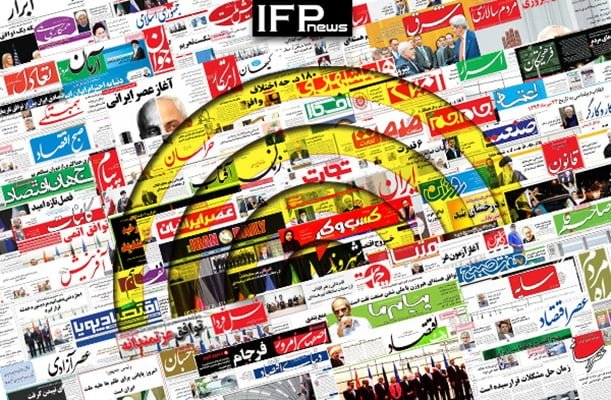
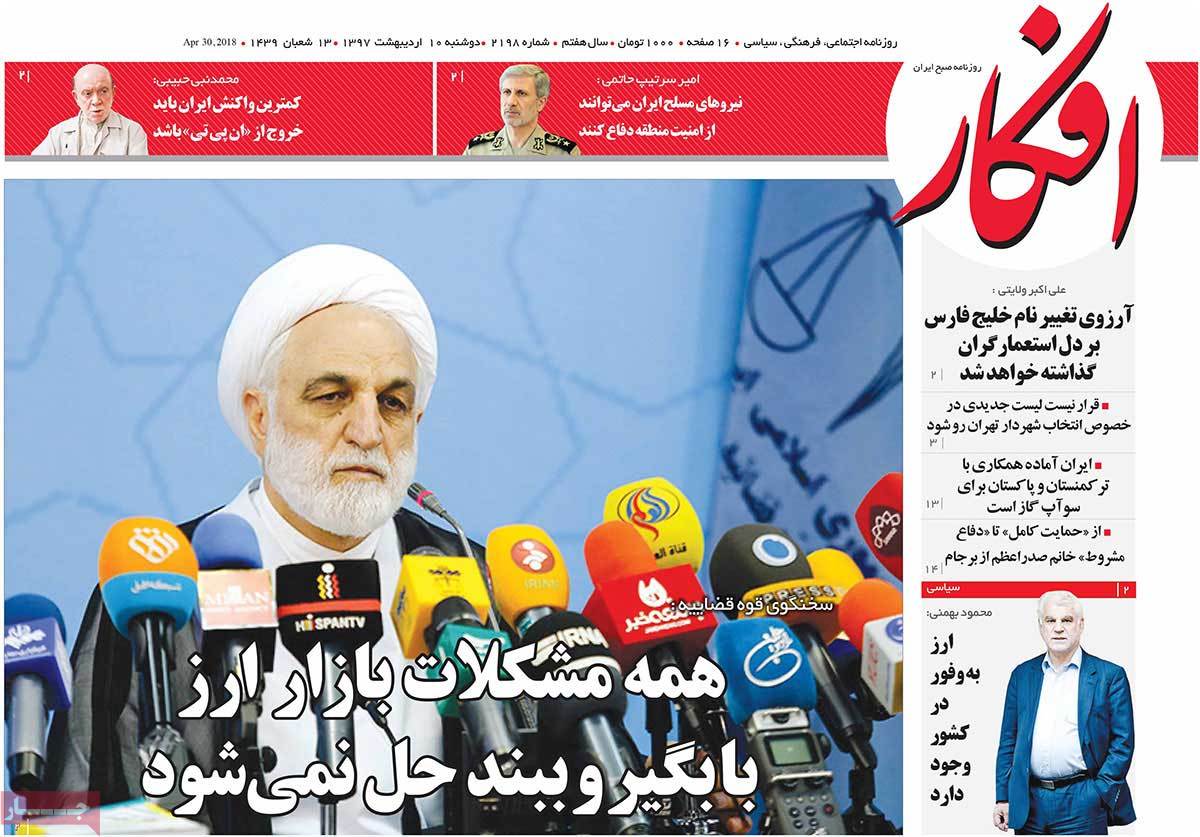
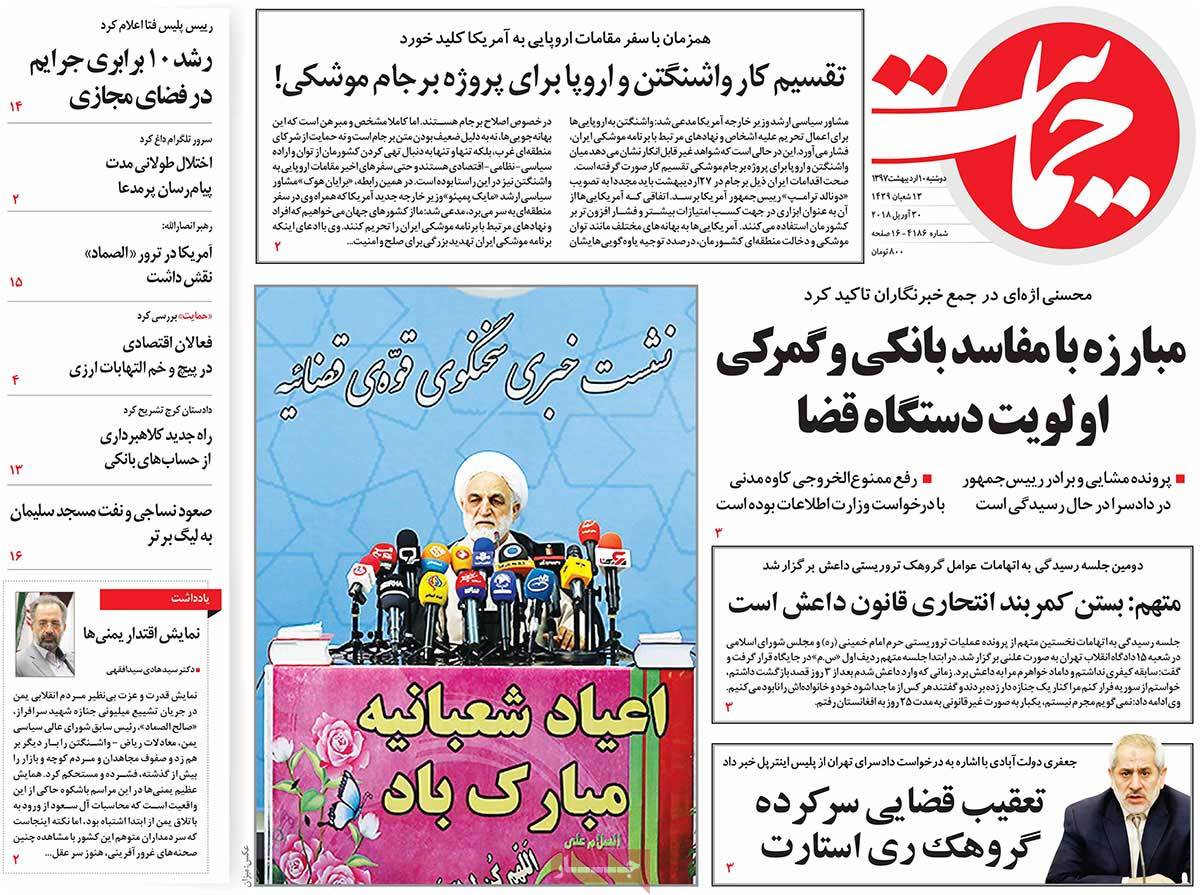
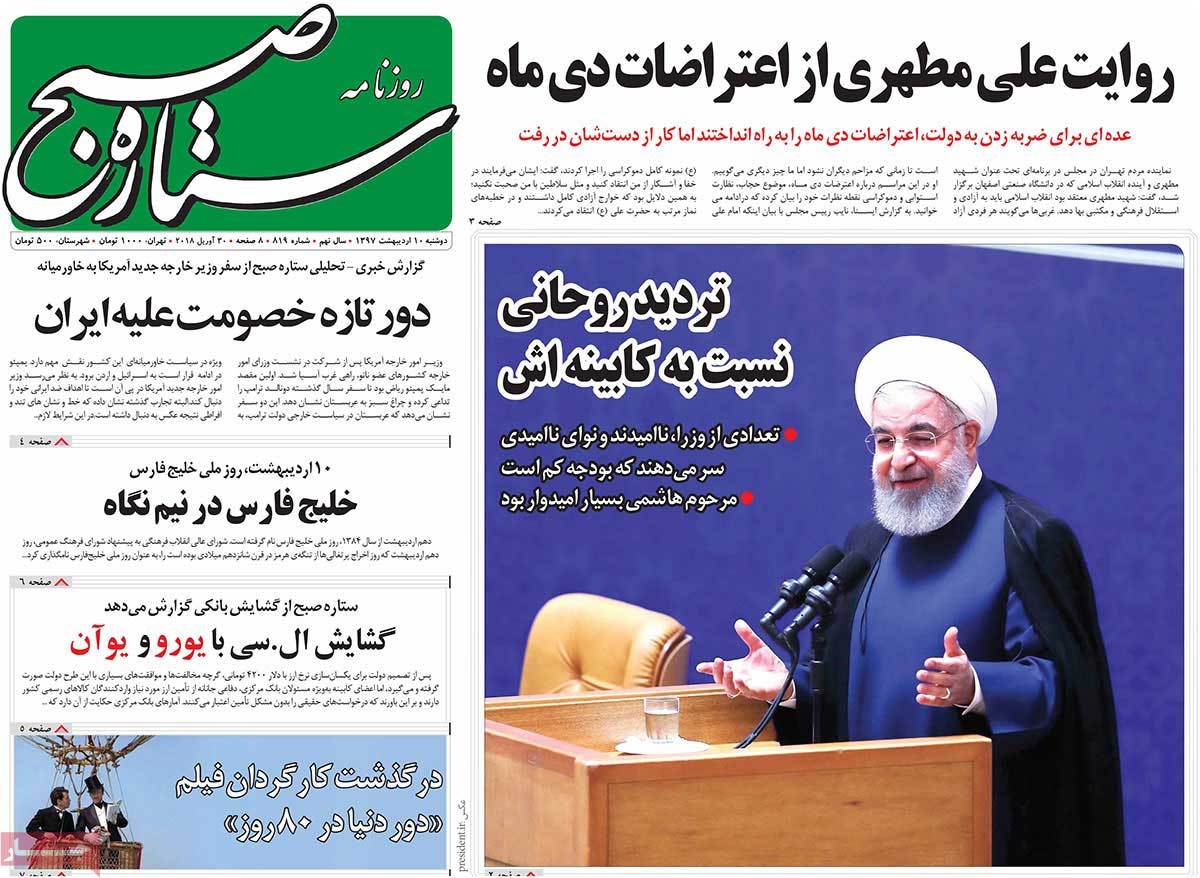
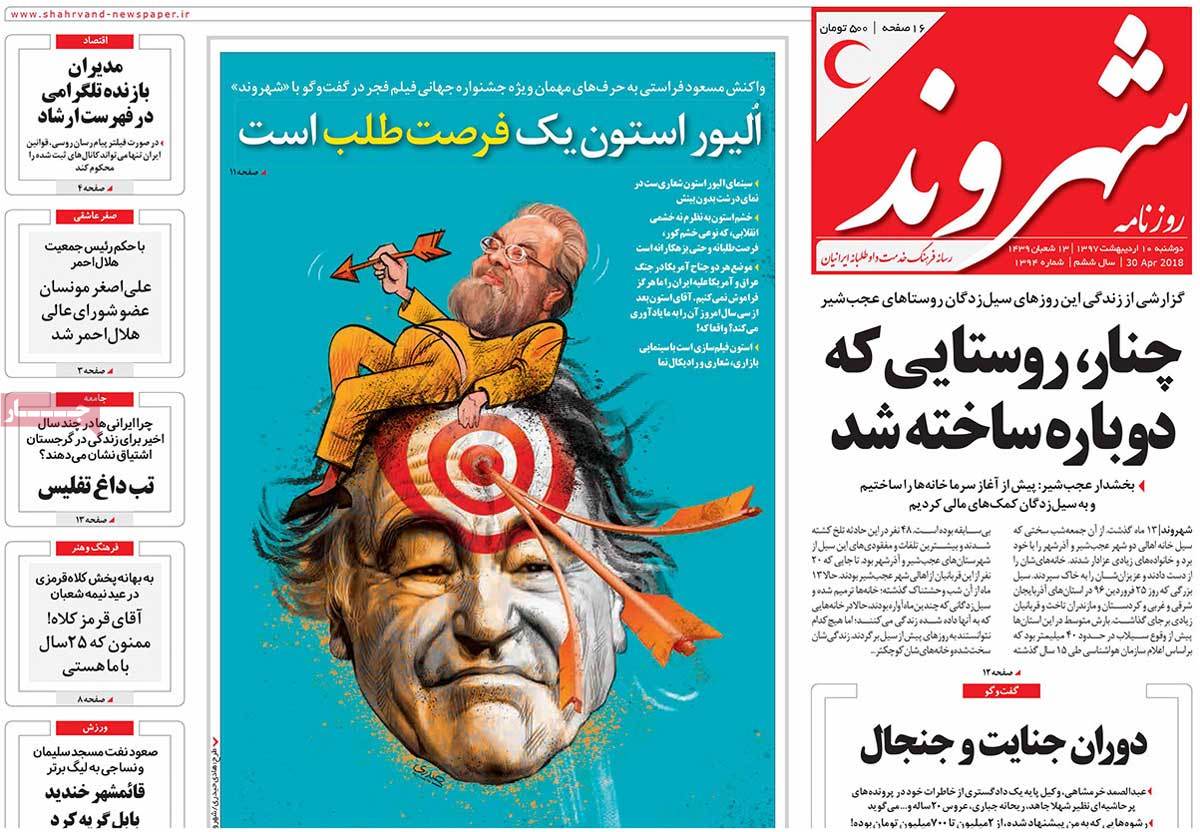
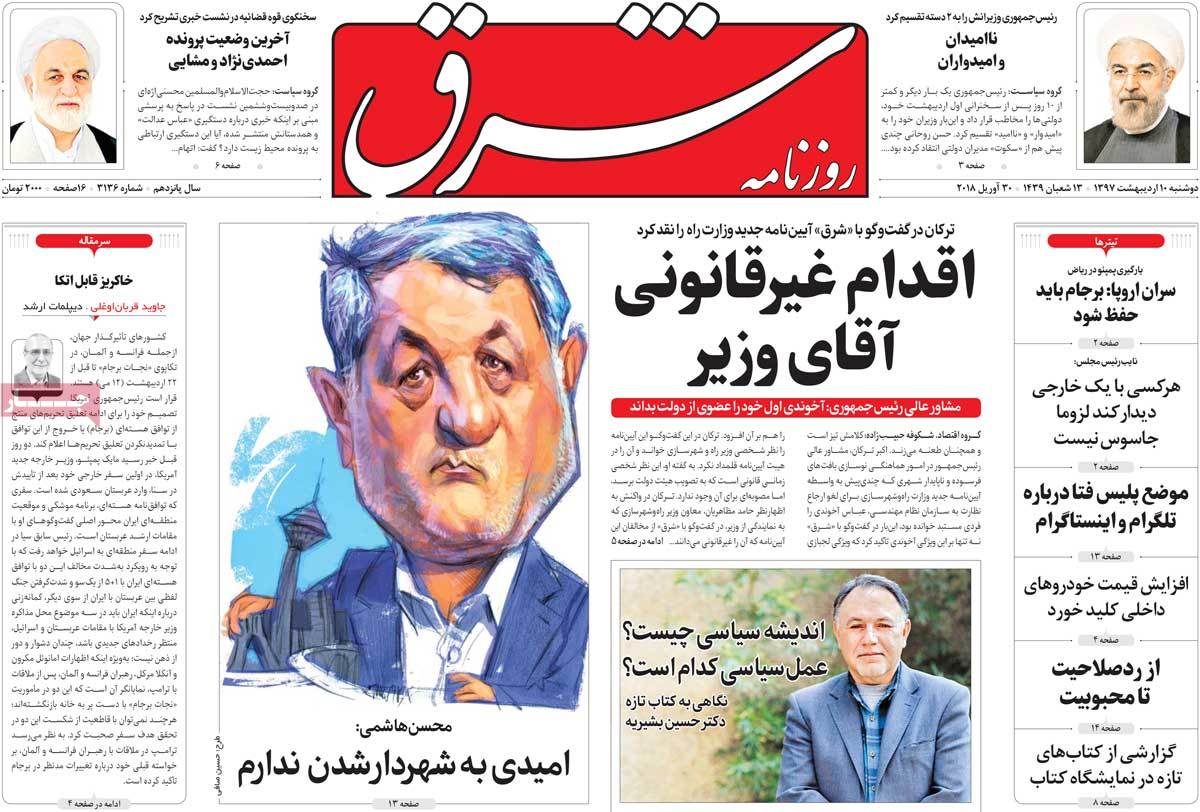
A Look at Iranian Newspaper Front Pages on April 12

A Look at Iranian Newspaper Front Pages on November 18

The top story in almost all newspapers today was the ongoing debates over the possibility of a war by the US and its allies on Syria.

Several papers also covered the latest developments regarding the country’s forex market, and the recent decision by the Iranian government to control the market.

The above issues, as well as many more, are highlighted in the following headlines and top stories:


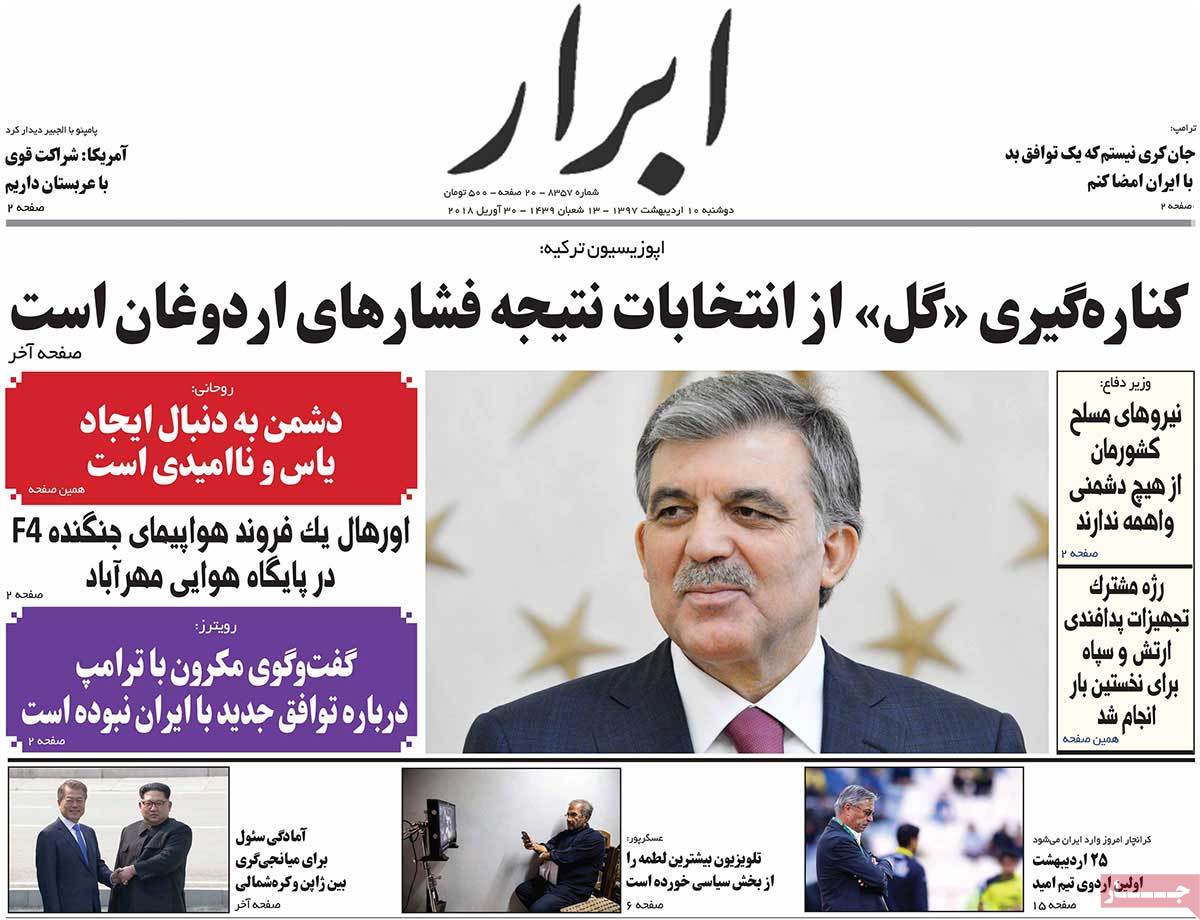
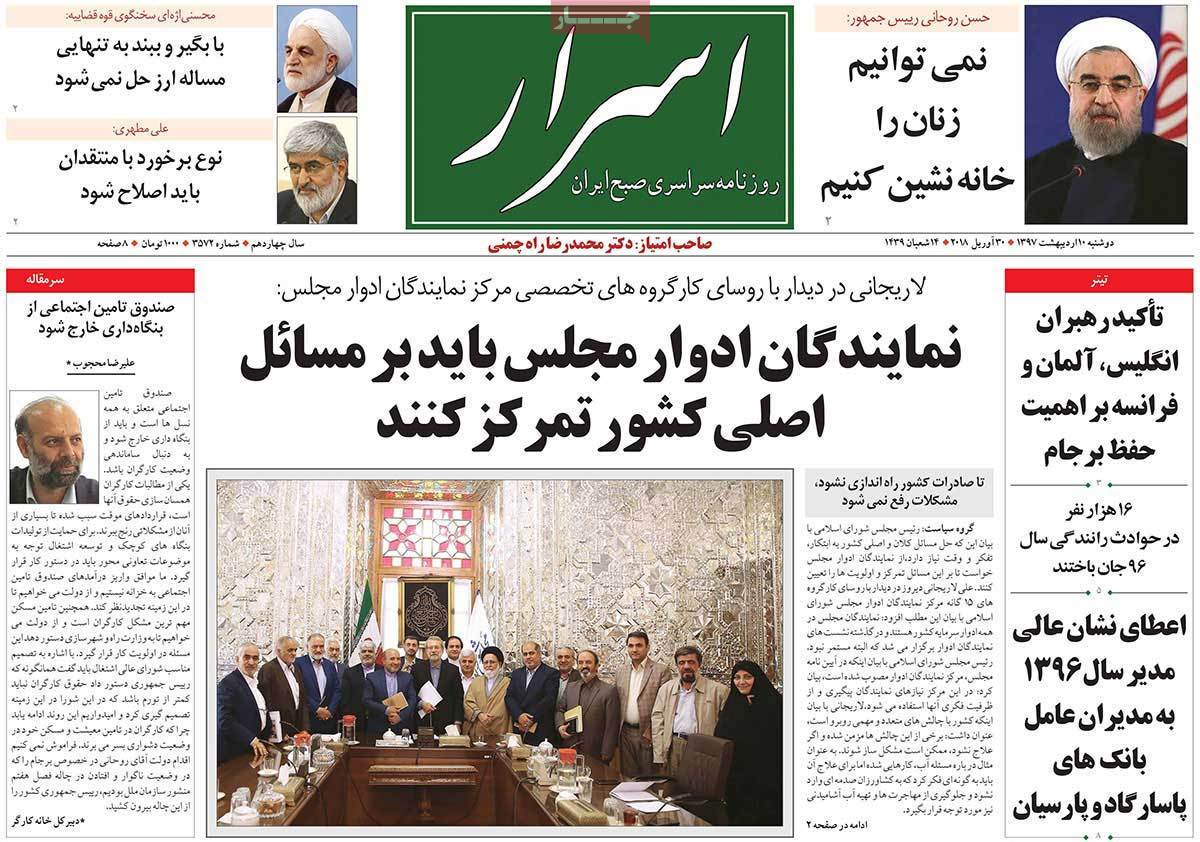
Abrar:

  • European Parliament to Discuss Ways to Implement JCPOA without US
  • Sadr Movement Spokesman: Muqtada Sadr Has Good Ties with Both Iran, Saudi Arabia
  • Rumours that Assad, His Family Have Escaped to Tehran Dismissed

A Look at Iranian Newspaper Front Pages on April 12


Afkar:

  • Ayatollah Jannati Calls for Strong Support of Iranian Products
  • Certain Executives Don’t Feel Responsible for Domestic Production

A Look at Iranian Newspaper Front Pages on April 12


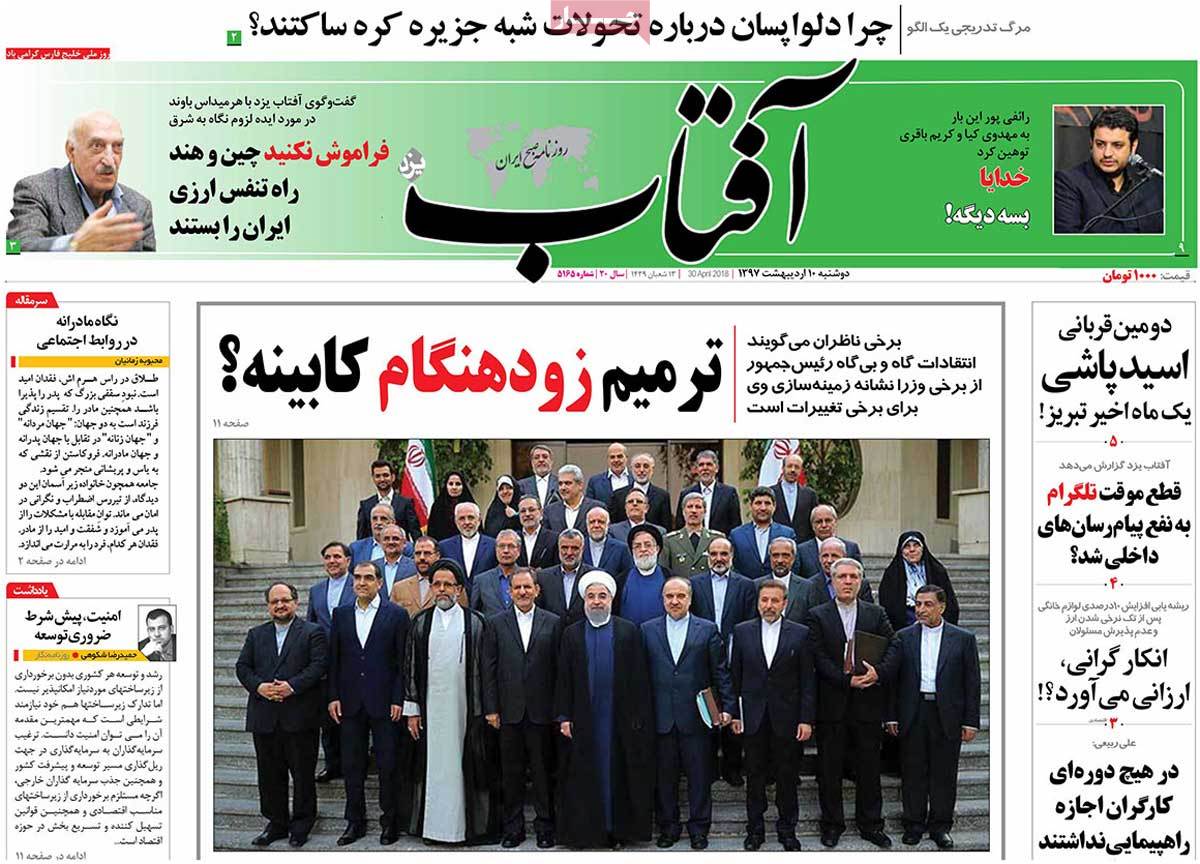
Aftab-e Yazd:

  • Saudi FM: Europe Has Opposed Washington’s Idea about Iran Missile
  • Former IRGC Official: Ahmadinejad Will Soon Be Prosecuted

A Look at Iranian Newspaper Front Pages on April 12


Afarinesh:

  • Political Inflammation, Economic Distrust in Society Main Cause of Forex Rate Crisis

A Look at Iranian Newspaper Front Pages on April 12


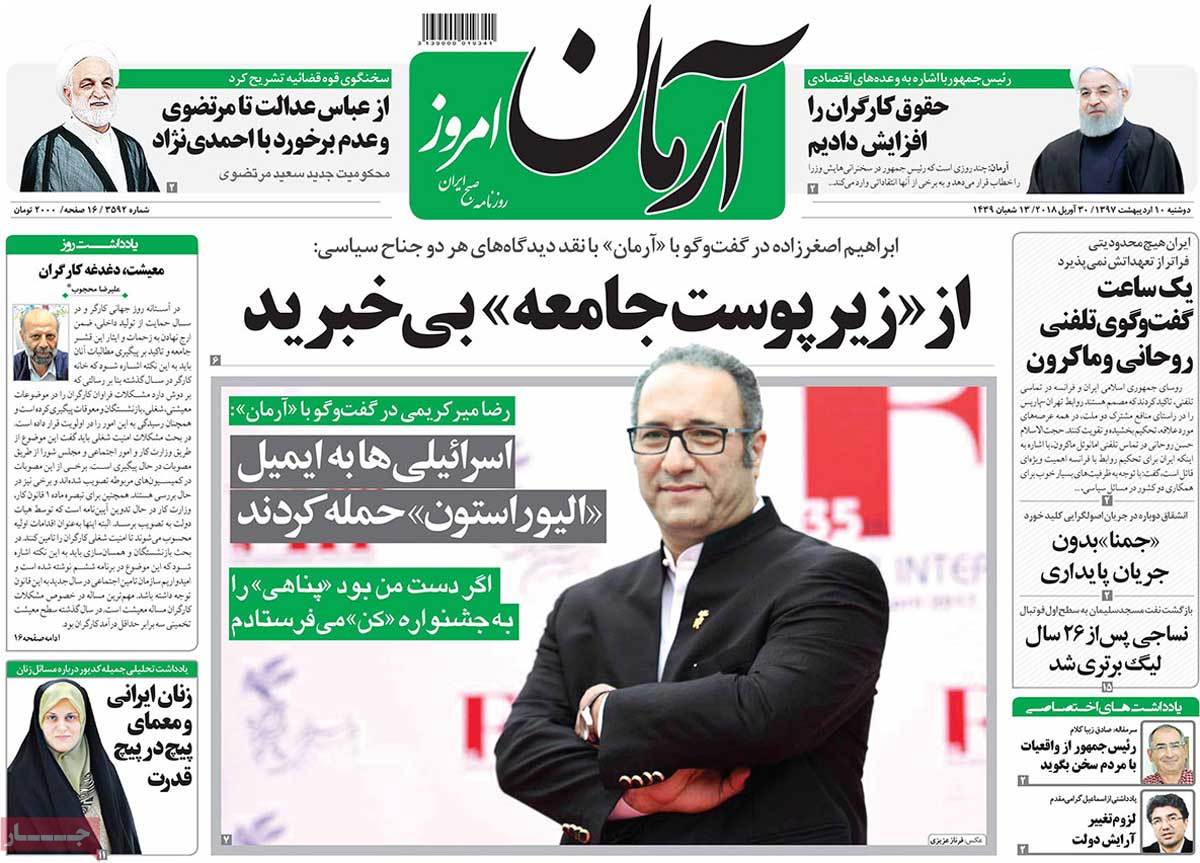
Arman-e Emrooz:

  • Trump Intends to Wage Psychological War against Russia: Analyst

A Look at Iranian Newspaper Front Pages on April 12


Arman-e Melli:

  • Culture Minister: No Decision Made for Blocking Telegram Yet

A Look at Iranian Newspaper Front Pages on April 12


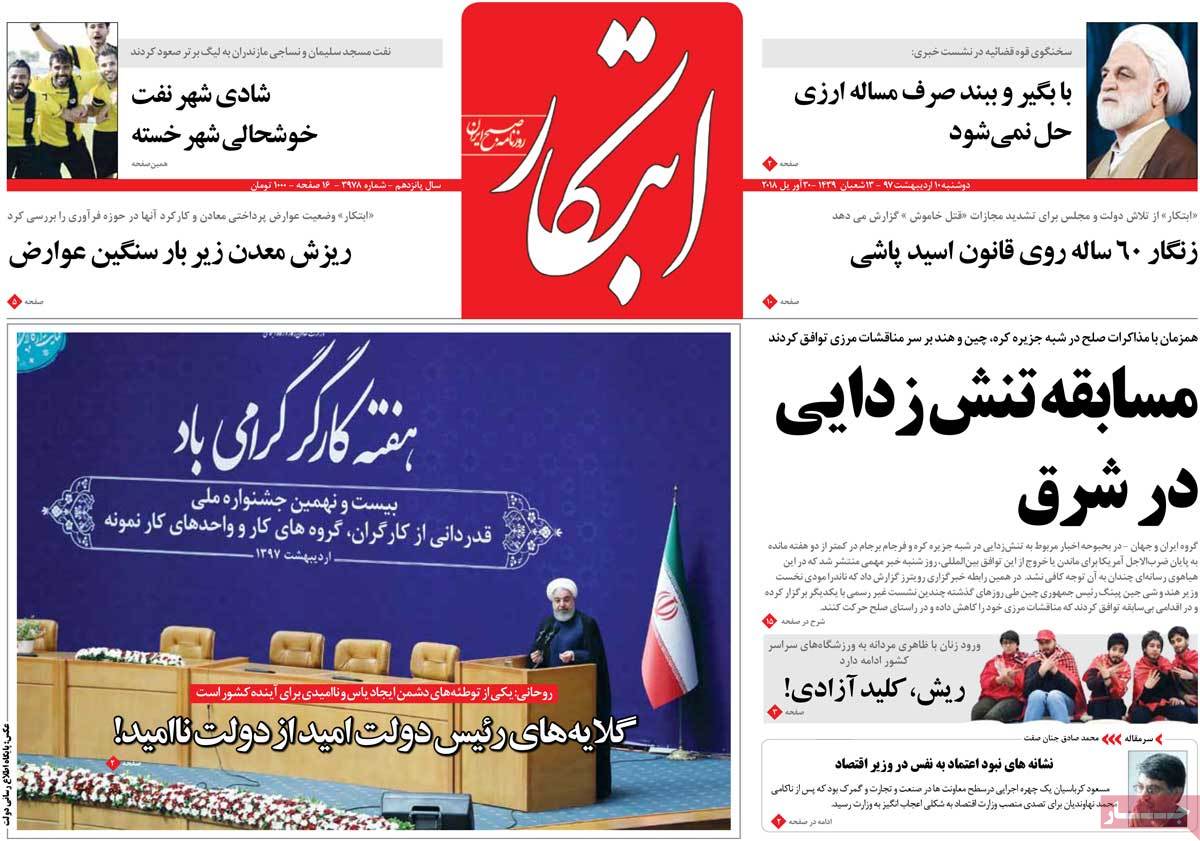
Ebtekar

  • Iranian Diplomacy in Latin America
  • Zarif Arrives in Uruguay after Meeting Brazilian Officials

A Look at Iranian Newspaper Front Pages on April 12


Emtiaz:

  • Economy Minister: Iran in Good Conditions in Terms of Forex Resources, Prospect

A Look at Iranian Newspaper Front Pages on April 12


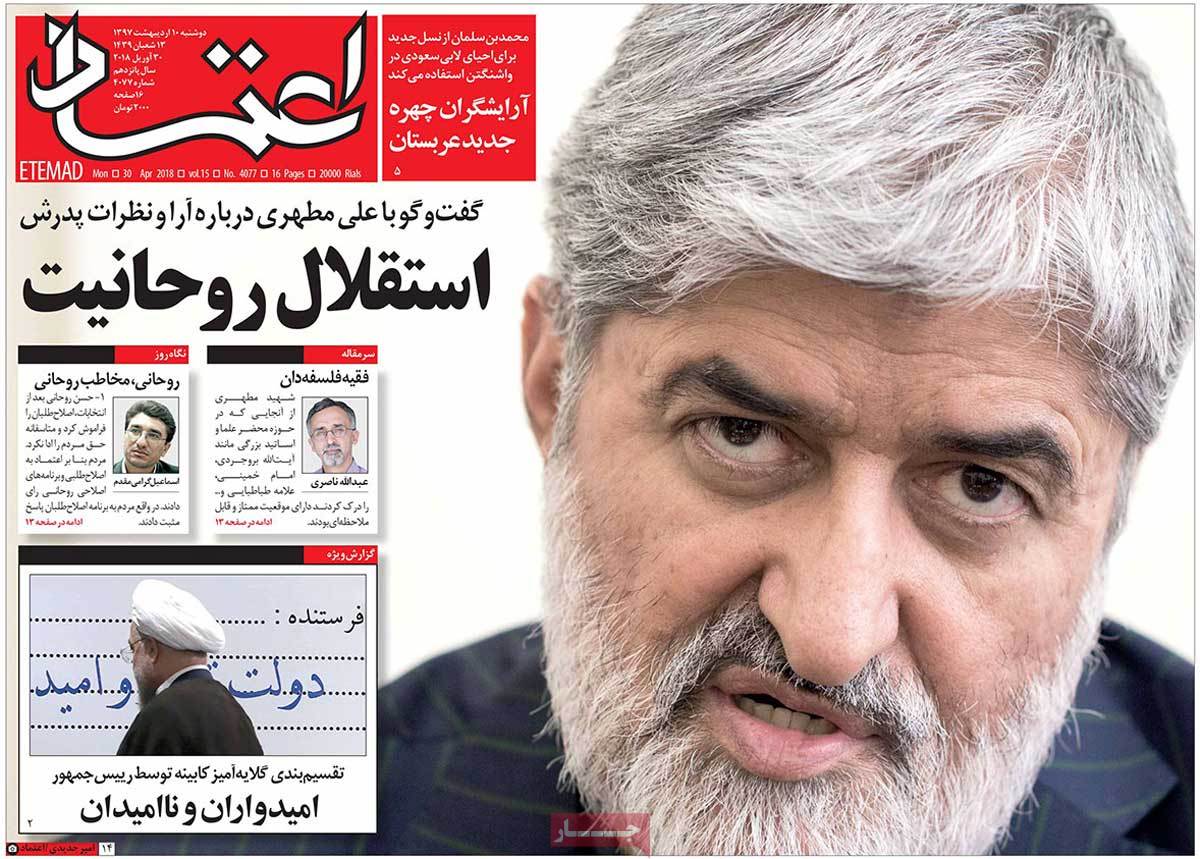
Etemad:

  • Waiting for Another Bitter Incident: Trump Playing with Mideast in Twitter
  • Three Explosions Heard in Saudi Sky

A Look at Iranian Newspaper Front Pages on April 12


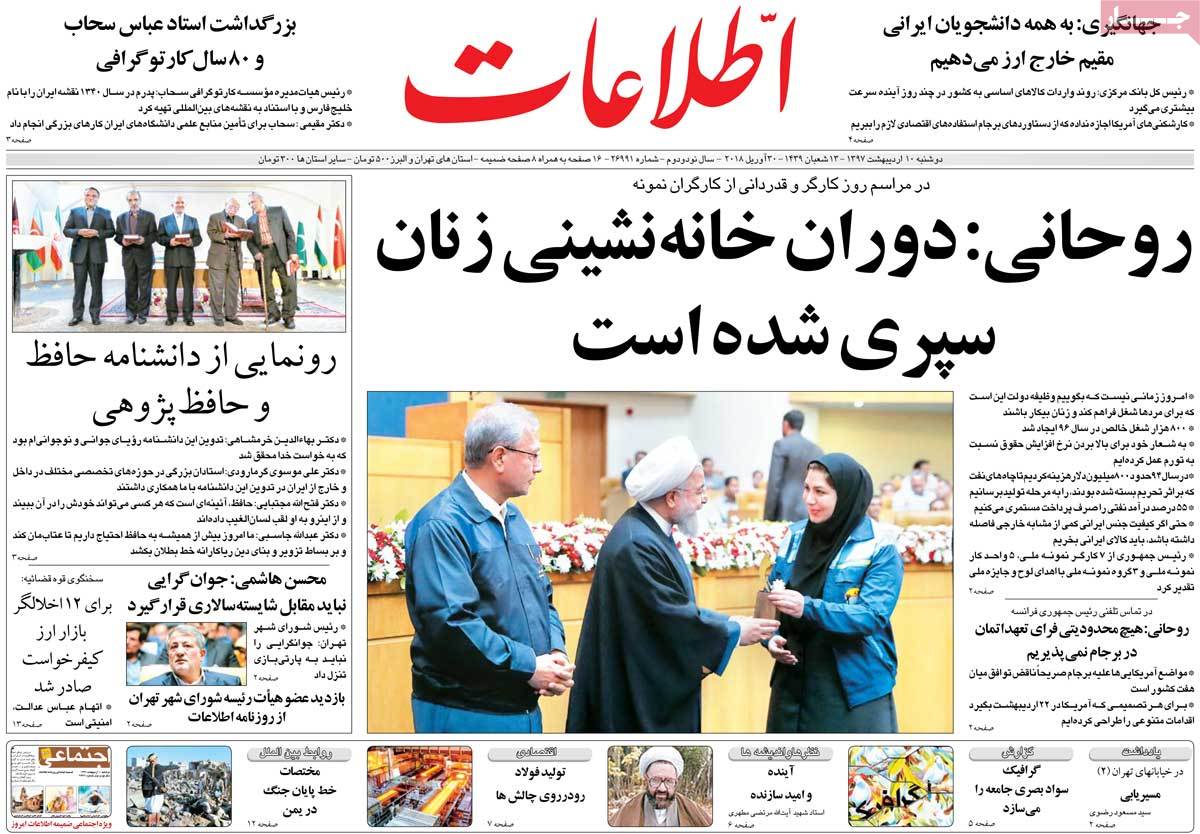
Ettela’at:

  • US Planning Attack on Syria
  • Russia: Our Reaction Rapid, Any Missile to Be Shot Down

A Look at Iranian Newspaper Front Pages on April 12


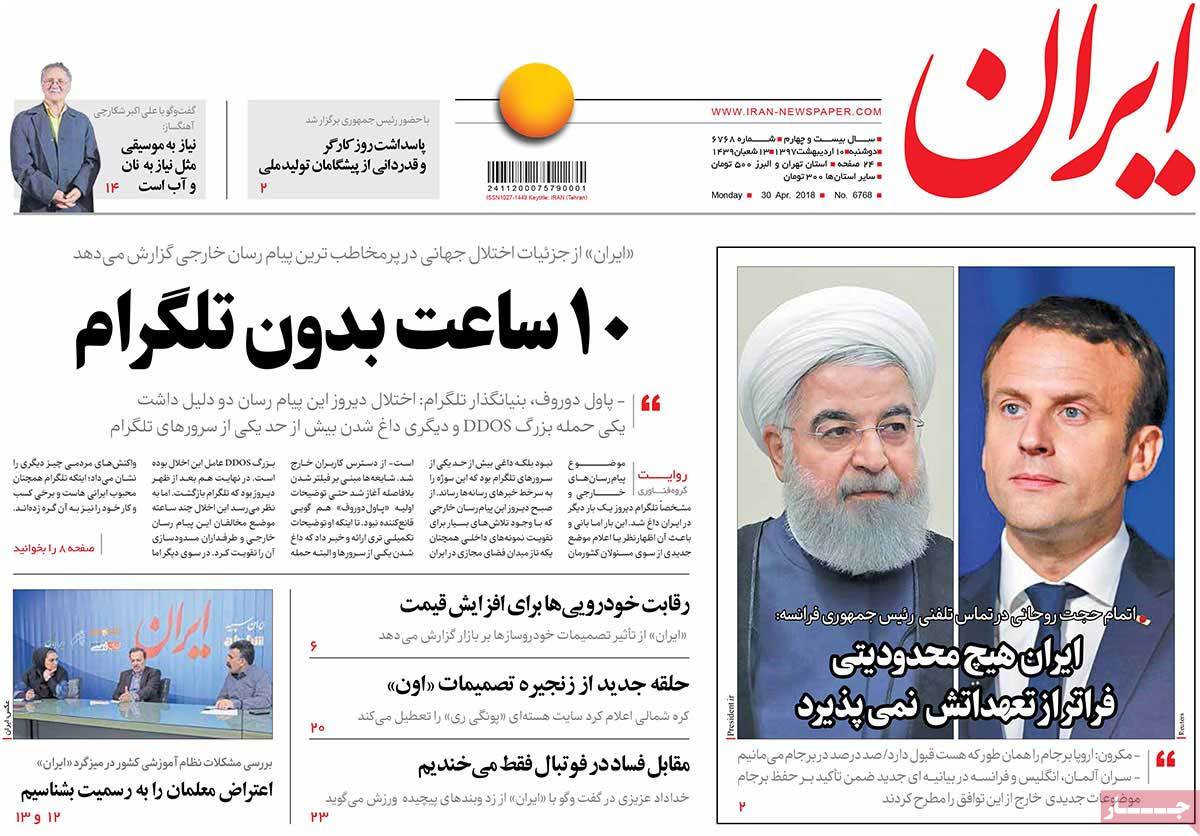
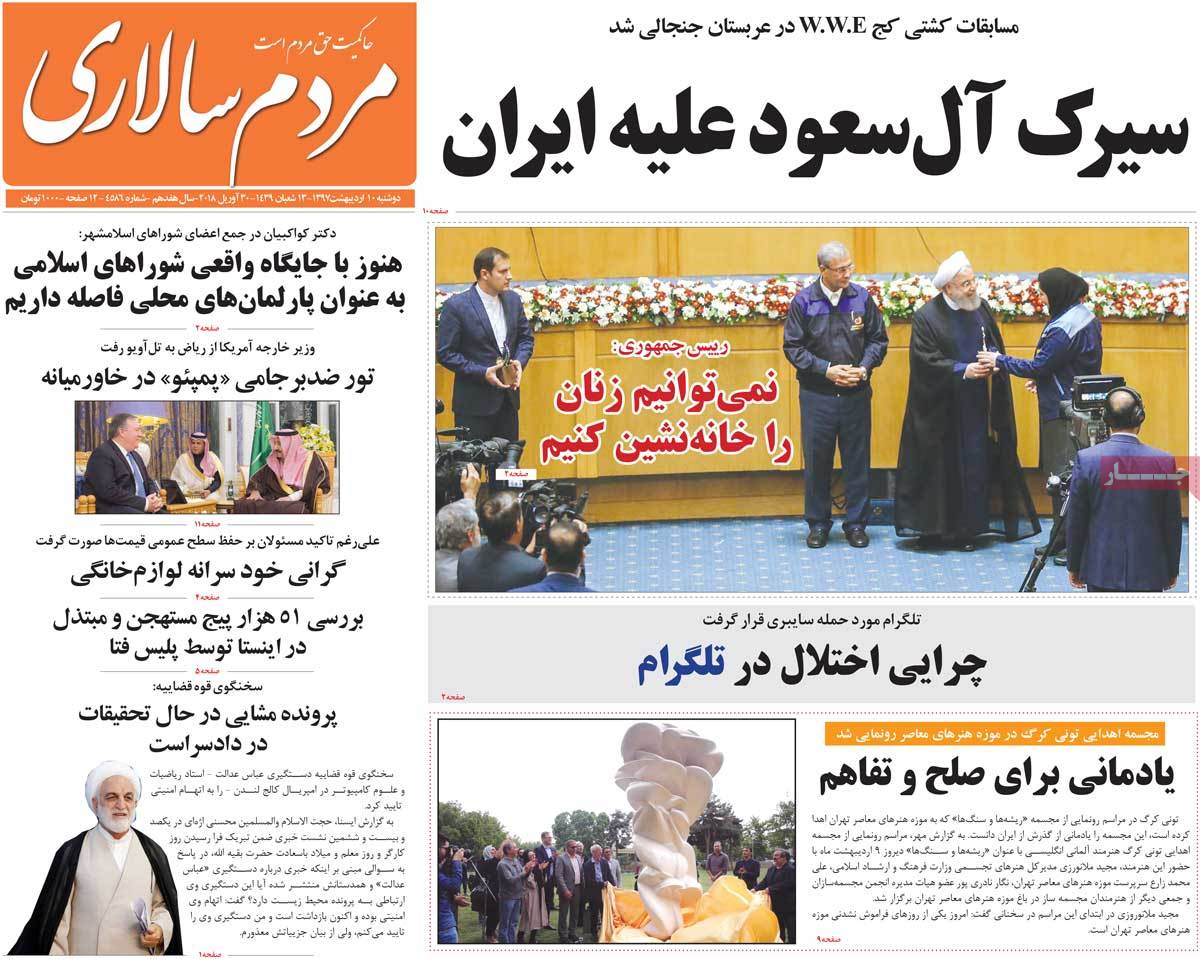
Iran:

  • 5% Increase in Workers’ Salaries Next Year

A Look at Iranian Newspaper Front Pages on April 12


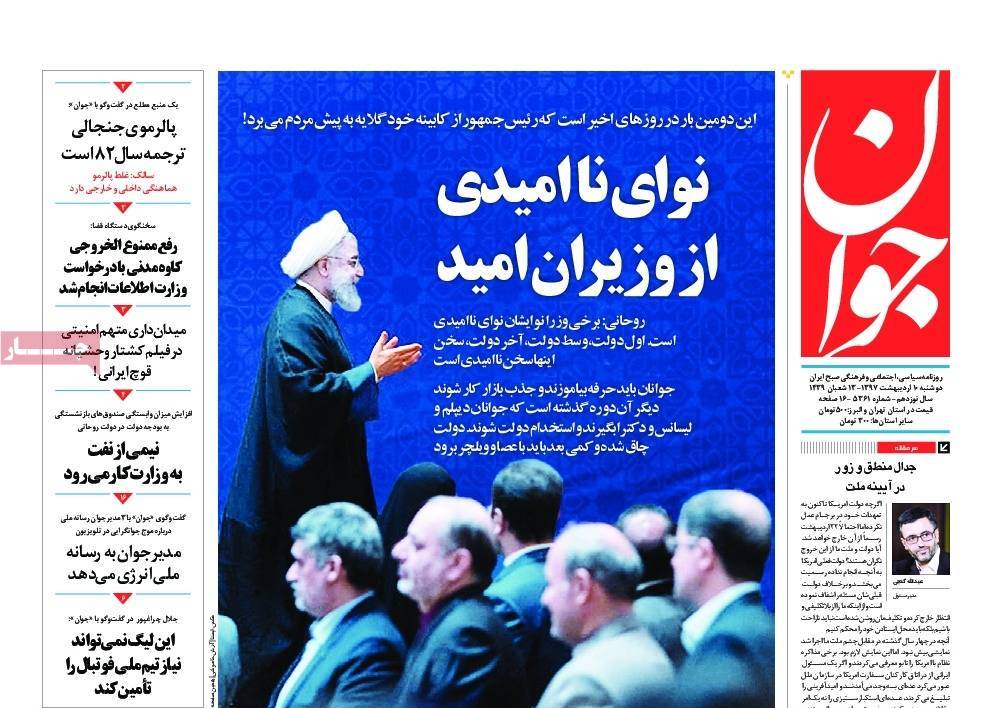
Javan:

  • World Threatened with Insanity of Hawkish US President
  • Trump: Russia Be Prepared for Our Missiles Because They’re Coming!
  • 257 Dead in Crash of Algerian Military Plane

A Look at Iranian Newspaper Front Pages on April 12


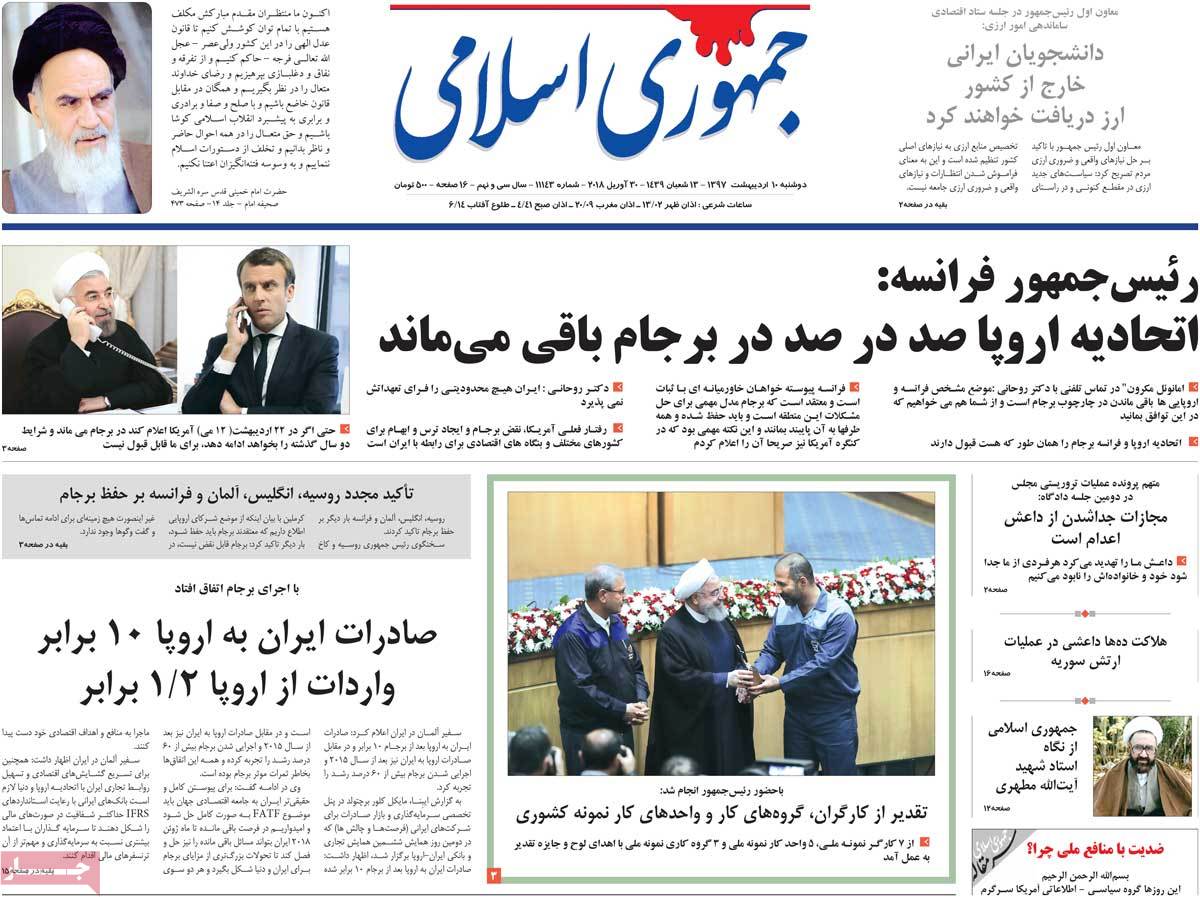
Jomhouri Eslami:

  • Rouhani: Gov’t Trying to Allay Concerns of People, Producers
  • Differences with India on Farzad B Gas Field Resolved: Iran

A Look at Iranian Newspaper Front Pages on April 12


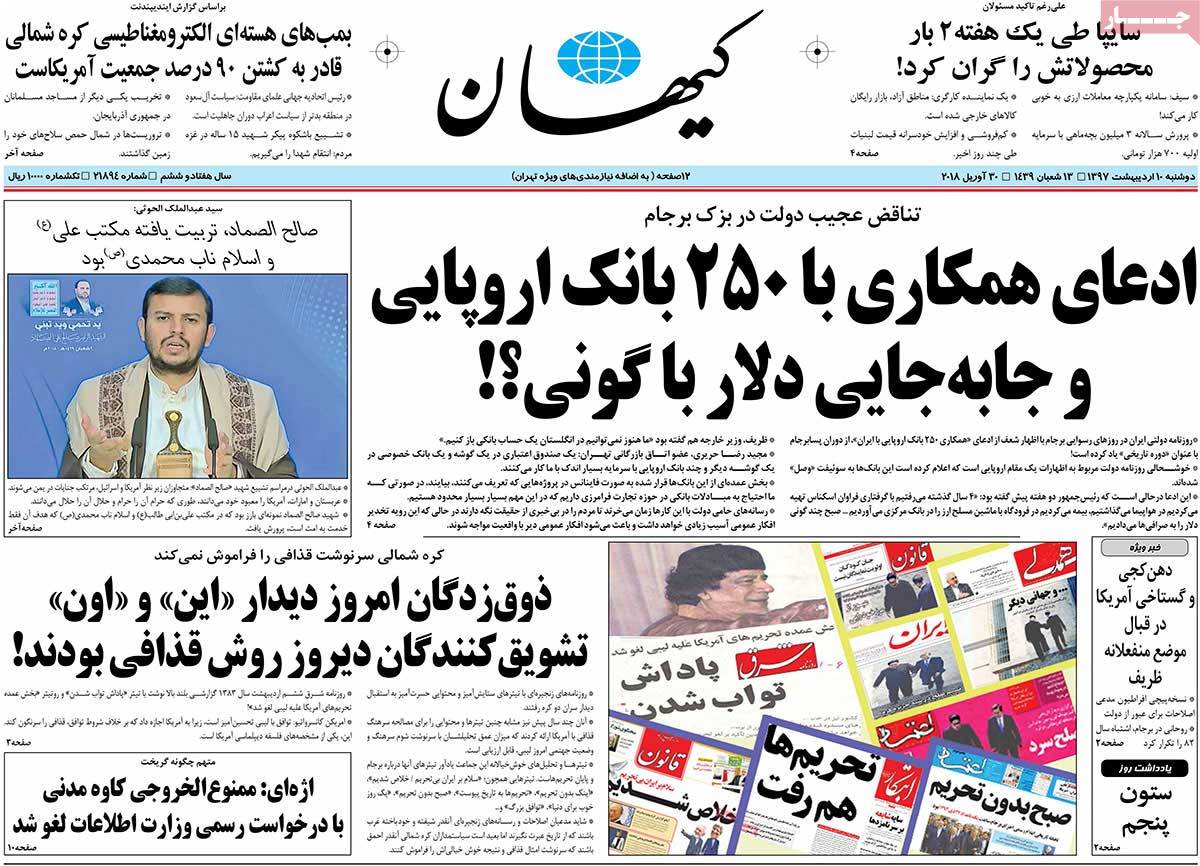
Kayhan:

  • Ansarullah Shows Off Its Power to Al Saud
  • Ansarullah’s Pinpoint-Accuracy Missile Hits Saudi Defence Ministry in Riyadh
  • Takfiri Mercenaries in Syria Defeated, Trump Starts Talking Nonsense
  • Facebook Founder Confesses to Violating Privacy of 87 Million Americans

A Look at Iranian Newspaper Front Pages on April 12


Khorasan:

  • Cold War Turning Hot
  • Escalation of War of Words between US, Russia; Deployment of Forces in Syria Coasts

A Look at Iranian Newspaper Front Pages on April 12


Resalat:

  • Ayatollah Nouri Hamadani: We Must Give Good Response to Zionist Regime
  • Silence to Embolden Zionists

A Look at Iranian Newspaper Front Pages on April 12


Rooyesh-e Mellat:

  • Qassemi: Saudi Rulers Turned to Symbols of Aggression, Crime in Mideast

A Look at Iranian Newspaper Front Pages on April 12


Sayeh:

  • Number of Cars in Tehran Five Times More than Its Capacity

A Look at Iranian Newspaper Front Pages on April 12


Shargh:

  • Central Bank Chief: US Dollars Kept in People’s Houses Might Be Declared Null and Void

A Look at Iranian Newspaper Front Pages on April 12


Vatan-e Emrooz:

  • Macron: Iran Nuclear Deal Not Enough!
  • French President Seeks to Milk King Salman’s Rich Son

A Look at Iranian Newspaper Front Pages on April 12

Iran Leader’s Aide Visits Eastern Ghouta near Syrian Capital

Ali Akbar Velayati on Wednesday visited Eastern Ghouta and secret underground tunnels used by Takfiri terrorists in the almost fully liberated region near Damascus.

He also met with military commanders there.

Velayati reaffirmed Iran’s support for Syria and the nation’s resistance against terrorists and underlined the necessity of further expansion of bilateral ties to counter the threats of the US, Israel and their regional stooges.

He also congratulated the victories of the Syrian army in Eastern Ghouta, and described as pivotal the strategic ties between Tehran and Damascus.

Earlier in the day, the adviser to Ayatollah Khamenei also met with Syria’s Foreign Minister Walid al-Muallem, during which the two sides emphasized further coordination between the two brotherly countries in order to contribute to further victories of the Syrian army in combating terrorism and confronting its provocative acts and threats by the United States and its allies in the region against Syria.

Velayati, who is in Damascus to attend a conference on Palestine, also stressed that the Islamic Republic would stand by the Syrian government and people and reaffirmed Tehran’s support for resistance against terrorism that has targeted the territorial integrity of Syria and the stability of the region. He also underlined the need for the strengthening of relations with Syria.

Muallem, for his part, briefed the Iranian official on the latest developments in Syria and praised Iran’s full support for his country.

Eastern Ghouta, which is home to nearly 400,000 people, fell to multiple militant groups in 2012, months after Syria plunged into crisis. Militants had been using the area to launch incessant rocket attacks on the capital.

Syria has been gripped by foreign-backed militancy since March 2011. The Syrian government says the Israeli regime and its Western and regional allies are aiding Takfiri terrorist groups that are wreaking havoc in the country.

Iran President Congratulates Azeri Counterpart on Re-Election

Officials Say Iran-Azerbaijan Border Should Remain Open amid Coronavirus Fight

In his congratulatory message on Thursday, Rouhani referred to the result of the presidential election in Azerbaijan as a sign of the Azeri nation’s support for the Aliyev administration’s programs and their interest in the continuation of their country’s development and progress.

The Iranian president also expressed the hope that the developing trend of friendly and brotherly relations between the Tehran and Baku, which is rooted in the historical, religious and cultural commonalities of the two nations, will vigorously continue through the efforts of the two sides’ officials.

He finally prayed to the Almighty God for health and success for his Azeri counterpart and happiness and prosperity for the neighbouring country’s people.

Aliyev secured his fourth consecutive term in a snap election on Wednesday, according to partial results.

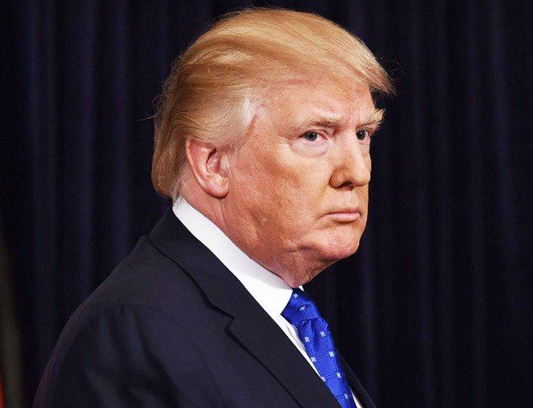
Trump Flip-Flops on Attacking Syria in Five Years

US President Donald Trump has threatened to strike Syria with missiles while he, back in 2013, had asked “foolish” Barack Obama (then US president) not to attack the Arab country!

The following is Trump’s tweet about Obama dated September 5, 2013:

“Again, to our very foolish leader, do not attack Syria – If you do many very bad things will happen & from that fight the US gets nothing!”

However, Trump threatened in a recent tweet on April 11, 2018 to fire missiles at Syria:

“Russia vows to shoot down any and all missile fired at Syria. Get ready Russia, because they will be coming, nice and new and ‘smart!’ You shouldn’t be partners with a Gas Killing Animal who kills his people and enjoys it!”

The two abovementioned tweets written in two different periods of time indicate the contradiction in the words and behaviour of US authorities, particularly the country’s president.

This comes as Trump has also said that, “Our relationship with Russia is worse now than it has ever been, and that includes the Cold War.”

He also said, “There is no reason for this. Russia needs us to help with their economy, something that would be very easy to do, and we need all nations to work together. Stop the arms race?”

“No One Can Claim Syria Used Chemical Weapons against Opposition”

Levan Dzhagaryan, in a Farsi interview with ISNA, agreed with the idea that Donald Trump’s claim about the Syrian President Bashar al-Assad’s use of chemical weapons is aimed at military intervening in Syria.

Regarding US claims on Russia and Iran’s support for Syria in this case he said “we have already warned that the United States intends to make such allegations, exactly like what happened in eastern Ghouta.”

“This is another show. We already knew it. No one can prove that the Syrian government has done this,” added Dzhagaryan.

The Russian ambassador to Tehran also noted that “I have no doubt this has been carried out by the supporters of the terrorists, and we condemn all these acts.”

“We have offered for several times that an investigation is conducted to see who used these chemical weapons, but they keep making baseless allegations which is not acceptable at all,” concluded the Russian official.

Iran, Brazil to Enhance Science, Technology Relations

The working group was established three years ago, but had not met until now. Zarif’s trip created an opportunity for the working group to meet.

In the meeting, the two sides stressed the importance of working together closely in the domains of science, technology and innovation.

During the 4-hour program, opportunities for mutual cooperation on science, technology and innovation in various areas, particularly nanotechnology, were discussed under an action plan.

In the domain of university affairs, B2B programs were envisaged for sci-tech parks. Plans to give fresh impetus to research at universities were also introduced.

The Iranian delegation at the meeting was led by Mr Birang, the director of the Centre for International Sci-Tech Transactions of the Iranian Vice-Presidency for Science and Technology. The Brazilian team was led by a top Brazilian official in charge of technological development and innovations.

The Iranian side touched upon Tehran’s good cooperation with Russia, China and Austria on science and technology, and said Iran has set up a special center for international cooperation in the fields of science and technology.

For a brief review of Iran’s achievements in various fields of science and technology, check the book “Science and Technology in Iran: A Brief Review

Accordingly, Iran has introduced diverse models of cooperation with different countries, including joint committees or joint funds, and similar models can be used for cooperation with Brazil.

Birang also referred to the efforts made in recent years to develop knowledge-based companies in Iran and to use them to create a knowledge-driven economy and create jobs for university graduates. He said the two countries can share one another’s experience in those areas.

The Brazilian side, in turn, described the meeting as fruitful and said nanotechnology can be a starting point for both sides to expand their cooperation in different areas.

He also proposed a team from his country take part at an international exhibit due to be held in Tehran in 2018.

At the beginning of the meeting, the Brazilian side said Brasilia knows Iran has conducted good activities in the fields of modern technologies and knowledge-based economy. It was also stressed that the two sides can work together closely in pertinent fields.

Also addressing the gathering was Reza Asadifard, the deputy head of the Iranian Technology Development Committee for the industry and market, who presented a report on Iran’s recent accomplishments in the field of nanotechnology.

He says Iran’s current status in nanotechnology is the result of an intensive ten-year plan running from 2006 to 2016. Among the achievements mentioned in his report were Iran’s securing the fourth place in the world in terms of producing science in nanotechnology with a 6.5-percent share of the world’s whole scientific productions in the domain of nanotechnology, training more than 35,000 nanotechnology experts, having over 210 international nanotechnology patents registered, establishing some 170 nanotechnology production companies and commercializing over 400 products which are based on nanotechnology.

He concluded by putting forward proposals on Iran-Brazil cooperation in the field of nanotechnology.

The Tuesday meeting was attended by deputy head of Iran’s Nanotechnology Development Commission for the market industry as well as representatives of eight knowledge-based companies.

The Brazilian team also comprised representatives from most Brazilian organizations operating in the fields of science, technology and innovation.

Iran, Brazil to Enhance Science, Technology Relations

Iran has in recent years made great progress in various scientific fields, particularly nanotechnology, in which the country ranks seventh globally.

The incumbent administration has adopted plans to commercialize knowledge-based firm, as knowledge-based activities can make a significant contribution to Iran’s economic development by increasing added value among other things.

The main priorities are to promote the establishment of more knowledge-based firms and to encourage universities to focus largely on knowledge-based economy.

There are over 3,000 such companies in the country, which can benefit from governmental loans to finance their projects

Experts believe nanotechnology could worth a lot to the Iranian economy, as Iran currently ranks seventh globally in this field, according to the data released by Iran’s Vice-Presidency for Science and Technology.

The government plans to boost export of nanotechnology-related products and equipment to $1 billion by 2019.

Promoting knowledge-based companies is a main principle of Resistance Economy, a concept aimed at weaning the Iranian government from heavy dependence on oil revenues and boosting productivity and export

It was first proposed by the Leader of Islamic Revolution in 2011, amid the tightening of international sanctions on Iran, which were imposed over unproven allegations that its nuclear program has military purposes.

The sanctions were lifted under the 2015 nuclear deal, which removed international sanctions in return for confidence-building curbs on Iran’s nuclear work.

Iran, Uruguay Discuss Expansion of Banking, Agricultural Ties

In the Wednesday meeting in Montevideo, Zarif hailed the traditional and continuous relations between Iran and Uruguay, and said the ties have always been based on mutual respect.

Given the good grounds for cooperation between the two countries, especially in the economic sector, bilateral cooperation and its diversification must be put on the agenda, he noted.

Zarif also called for the use of great cooperation capacities in the two countries that have not been used so far.

Moreover, due to the Uruguayan presidency over Mercosur, Iran’s greater link with the trade bloc through cooperation with Montevideo and Brasilia was discussed in this meeting.

Cooperation in the fields of banking, agriculture, construction of dams and knowledge-based companies were the other issues that the two sides talked about.

For his part, Vázquez welcomed the expansion of bilateral ties emphasizing that the economic cooperation between Uruguay and the Islamic Republic of Iran must be promoted in all areas.

Uruguay is the third destination of FM Zarif’s four-nation tour of Africa and South America. Accompanied by a high-ranking politico-economic delegation, the Iranian minister earlier visited Senegal and Brazil where he signed a number of MoUs in different fields. The tour will later take him to Namibia.

Iran Leader Hails Idea of Replacing Dollar with Euro in Int’l Transactions

“Changing [the main foreign] currency from dollar to euro is seriously [pursued] and its bill will soon be approved at the Cabinet,” Seif said on the sidelines of a cabinet meeting on Wednesday.

The plan is apparently in response to what Iranian officials describe as an economic plot hatched by the US and its allies to decrease the value of the Iranian currency rial.

Speaking in a parliamentary session on Tuesday, Seif had noted that the idea has been shared with the Leader of Islamic Revolution in a recent meeting, and Ayatollah Seyyed Ali Khamenei has embraced the plan, a Farsi report by ISNA said.

The bill must be approved by the Iranian parliament and the Guardian Council before going into effect.

The plan comes amid a record decline in the rial’s value on the free market this week.

The currency has lost close to half of its value since September.

Some analysts blame threats by US President Donald Trump that he will return US sanctions on Iran unless the so-called flaws of the 2015 nuclear deal are fixed.

The deadline for the Trump administration to extend Iran sanctions waivers is May 12. The US refusal to keep sanctions frozen will mean the US is longer bound by the pact.

However, Iranian officials blame plots of foreign adversaries for the problem.

Late on Monday, authorities announced a plan to unify official and free-market exchange rates for the rial in favour of a single rate set at 42,000 against the US dollar.

The government said official rates would be in force from Tuesday and that police would arrest those trading dollars at other rates.

Moreover, the Central Bank of Iran clamped a 10,000-euro ($12,400) ceiling on the amount of foreign currency that citizens can hold outside banks.

Asked to comment on the outcome of the government’s plan to support the plunging rial, Seif said it has positively affected the country’s economy in recent days, and the benefits will be even greater in the long-term.

The governor said the plan will allow the government to better protect the Iranian economy from “hostile plots” hatched by Iran’s foreign adversaries.

“The recent exchange rate fluctuations have no economic reason and have mostly originated from non-economic issues. This governmental plan has brought under control the currency rate and non-economic factors can no longer heavily affect the economy,” he said.

Beijing Hosts Conference on Iran-China Civil Nuclear Cooperation

The day-long event is a sequel to international gatherings on cooperation in the field of peaceful nuclear technology held in Brussels, Moscow and Isfahan.

The Beijing seminar aims to boost peaceful nuclear cooperation with China in accordance with the JCPOA and its third addendum concerning international cooperation, a Farsi report by IRIB News Agency said.

The conference hosted by the Chinese government brings together delegates from the P5+1 Group of nations who will exchange views on a host of different issues, namely the prospects for international nuclear cooperation within the framework of the JCPOA and its third addendum.

As scheduled, Behrouz Kamalvandi, the deputy head of the Atomic Energy Organization of Iran for international, legal and parliamentary affairs, Mojtaba Zonoori, an MP and head of the Parliament’s Nuclear Commission, and some other Chinese and Iranian officials delivered speeches at the event. Iran’s ambassador to Beijing also addressed the inaugural ceremony.

Issues of mutual interest were discussed at the conference. Iranian scientists and engineers also visited China’s nuclear facilities on the sidelines of the event.