Thursday, December 25, 2025
Home Blog Page 3630

“Merkel, Macron’s Efforts to Keep US in Iran Nuclear Deal Misguided”

Speaking in a recent interview with Al Monitor in New York, efforts by German Chancellor Angela Merkel and French President Emmanuel Macron to ramp up pressure on Tehran over its regional policies and missile program in exchange for Washington staying in the deal were “misguided.”

Merkel and Macron are meeting with Trump at the White House this week, following rounds of US-EU negotiations aimed at preserving the accord.

Zarif also noted that if Trump withholds the next round of Iran sanctions waivers due May 12, effectively exiting the nuclear deal, Tehran could resume its nuclear program “in a much more advanced way.”

While he did not confirm whether Iran would leave the deal in response, he stressed that an exit by Washington wouldn’t represent a major break from the past. Zarif said the policies Trump has pursued over the past 15 months have stunted the Joint Comprehensive Plan of Action’s (JCPOA) economic impact on Iran, and thus any decision Tehran makes would be “fully justified by the JCPOA.”

“The mere presence of the United States in the deal is not sufficient. The United States must be an active participant in the deal in good faith,” he said.

As Trump prepares to meet North Korean leader Kim Jong Un, Zarif said that any similar high-level meeting between Tehran and Washington would “require respect, and once President Trump is prepared to exhibit some of that” such a meeting could occur.

The full text of the interview, conducted by Al-Monitor’s executive editor, is below:

Al-Monitor:  We are less than three weeks away from May 12, when the Trump administration may walk away from the JCPOA and re-impose certain sanctions on Iran. If the US steps back from the JCPOA, will Iran do the same?

Zarif:  The Trump administration was never in the JCPOA. They made sure over the last 15 months that Iran would not benefit from the economic dividends of the JCPOA, and so whatever they do in three weeks would not be a major break from the past. And the economic impact on Iran has been eased, basically, by the policies that they have pursued over the past 15 months. So that would give us the necessary justification to make a decision based on our own national interest whether to stay or not. If we decide to leave, it would be fully justified by the JCPOA itself in the view of the international community. It will further isolate the United States as a party that is not reliable — not just not predictable, but not reliable — the international community would recognize that Iran could not unilaterally and without the other side implement the deal. So I believe that would even reduce the negative economic implications for Iran.

At the same time, because of what we have been able to do within the JCPOA on research and development, we can resume the nuclear program in a much more advanced way, still for peaceful purposes, but in a much more advanced way. So that’s one of the options that is open to Iran and probably the most serious one.

Al-Monitor:  Chancellor Merkel and President Macron will be in Washington this coming week to meet with President Trump to discuss ramping up pressure on Iran over its regional policies and missile program in exchange for staying in the nuclear deal. How do you view this effort?

Zarif:  I think that’s a misguided policy. They should use the opportunity of meeting with President Trump to encourage him to live up to the United States’ commitments under the JCPOA rather than trying to appease him because by trying to appease him, he will take further steps in the wrong direction. I think if they have their own interests in mind and the European interest in mind, they should use the possibility to encourage him, not just to stay in the deal, but to implement his part of the bargain in good faith.

Al-Monitor:  And how will Iran respond if this does proceed, if their efforts to persuade Trump on this are successful?

Zarif:  We will decide based on our interests whether Iran can receive the economic benefits and whether the United States is prepared to stop what it’s been doing for the past 15 [months] to perpetuate the atmosphere of uncertainty and to prevent economic partners from engaging in Iran. That’s a policy that needs to stop, and we believe that President Macron and Chancellor Merkel need to convince President Trump that that is a policy that has made the deal not sustainable, and it has to stop.

The mere presence of the United States in the deal is not sufficient. The US must be an active participant in the deal in good faith, and it has not been, at least since President Trump entered the Oval Office.

Al-Monitor:  There have been more protests in Iran. Many demonstrators have complained about economic hardship and unmet expectations from the nuclear deal. The Rouhani administration has also argued that a desire for more political freedom was also a factor. Is your government taking these demonstrations seriously? Do you consider the demands of these demonstrators as legitimate?

Zarif:  Certainly people have legitimate concerns, and they have legitimate demands. And they have the right to air those demands without violence and without breaking the law, and that has been the persistent policy of the government to insist on the rights of people to make their views known. And that’s what differentiates Iran from the rest of the region. We have an active polity. We have an active public opinion and an active public, which expresses their views through the ballot box mostly, but when they feel necessary through public expression such as demonstrations, as long as they’re peaceful.

On the other hand, economic indicators in Iran have been very good — 8% growth from something in the neighbourhood of minus 7%, 7 or 8% inflation from 45%. So, these are important achievements.

Job creation has been rather significant. I mean, the government has been able to produce in the last three or four years between 700 [thousand] to a million jobs a year. However, as you correctly pointed out, expectations of the people were different. People expected the international community to live up to its commitments under the JCPOA, and that would have meant more foreign investment, which would have meant even more jobs.

We’re doing a good job creating a lot of new job opportunities, but people expected more, and it is important for us to have a more predictable future for the population. And a predictable future does not necessarily involve greater international investment. Iran has a lot of domestic capital. It is important to make sure that the capital that we have is invested inside the country, and that can only be achieved by removing the elements of uncertainty in a positive or a negative.

Al-Monitor:  There’s been discussion of creating an Arab military force in Syria that could replace US troops, and the Saudis have signalled that they are open to joining. What are your thoughts on this?

Zarif:  I think what is necessary in Syria is we get out of these military strategies and military thinkingz and get into the need for a political solution. I think people have never abandoned the illusion that they could replace the current government in Syria through military means, and I think this is the continuation of that illusion. The more they persist on this line of thinking, the more they achieve defeats and losses in Syria.

They could have accepted our offer five years ago when the Syrian government only controlled 35% of the territory and could have accepted to stop the illusion of a military victory and come to the negotiating table and seek a political solution based on the four-point plan that we offered almost five years ago this September. But they decided to wish for a military victory, and now the government controls 70% of the territory.

We still believe that the same political outcome is the most desired outcome. So people have to stop thinking about military strategy and to start thinking what is the political strategy to end this bloodshed and to end this nightmare in Syria, and to accept the realities and to work for a national unity government.

Al-Monitor:  How long will Iranian forces stay in Syria? Under what conditions will they leave?

Zarif:  We sent our advisers to Syria in order to be able to prevent the fall of Damascus into the hands of terrorists. We did exactly the same in Baghdad, and we did exactly the same in Erbil, where the similarities that they’re making about the illusions of a Shiite whatever wouldn’t apply in Erbil. But since Erbil is inconvenient for them, they just tend to neglect that reality and they cite alternative realities, alternative facts that support their mentality and analysis.

So we’re there in order to do something that is important for the international community, and that is to prevent extremists from winning, and whenever that’s not necessary, we don’t have any territorial ambitions on any country. The fact that Iran has not raised its flag in any place where we have our military advisers indicates to you that we don’t have any territorial ambitions.

Al-Monitor:  Would Iran support Hezbollah forces leaving Syria if other foreign fighters were also required to leave?

Zarif:  We don’t need to do that. If Hezbollah is not needed in Syria, they don’t have any reason to stay. They have their own home to defend, and they have their own home to be at, and they have their own home to build. As they have said very publicly, they are — they have been forced to because of the national security, the security of Lebanon. Lebanon has been threatened by these extremists more than any other country, and they have been able to defeat those extremists, both in their border area as well as inside Lebanon. And I think anybody in their right mind, if they don’t need to do that, they’ll be at home.

Al-Monitor:  There have been reports that Israel has targeted Iranian forces on the ground in Syria on multiple occasions. How would you characterize the potential for Iranian confrontation with Israel in Syria?

Zarif:  I believe Israelis have been routinely violating Syrian territory, violating Syrian airspace, and they suffered losses recently because of that, because the Syrians resisted. And we believe the policy that’s pursued by Israel will continue to attract resistance from Syria.

Al-Monitor:  But regarding the Israeli attacks on Iranian forces, does Iran see a potential for a confrontation with Israel over this?

Zarif:  I believe Israeli aggression has been resisted and will be resisted, and I think it will be best for everybody to advise for them to stop aggression against others.

Al-Monitor:  How does Iran see the future of the Astana trio in light of Turkey’s support for the US-led strikes on Syria and Turkish President Recep Tayyip Erdogan’s refusal to hand over Afrin to the Syrian government?

Zarif:  The Astana process did not start with the illusion that we agreed on everything and will not end with the reality that we don’t. So we have differences, but we have a shared objective, and that is we are concerned about the situation in Syria. We believe that we should de-escalate the conflict in Syria. That’s why we continue to work, and we will be meeting again at different levels in order to make sure that this process would continue to bring greater — I mean less bloodshed and greater calm to the situation in Syria.

But we will have — we will maintain our differences. Some, you just mentioned, but there are other differences, obviously. If we did not have differences, we would not meet, to meet so many times in order to work out mechanisms that we could all agree upon.

Al-Monitor:  Even before Friday’s announcement that North Korea would cease all nuclear tests and launches of intercontinental ballistic missiles, President Trump had announced his plans to meet with North Korean leader Kim Jong Un. Under what conditions, if any, would Iran consider a meeting with President Trump?

Zarif:  I think any interaction, certainly with Iran, would require respect, and once President Trump is prepared to exhibit some of that.

Al-Monitor:  Regarding Yemen, you have recently held a series of meetings with the Europeans regarding the conflict there. What can you tell us about these talks and any progress you’ve made?

Zarif:  A few days after the beginning of the hostilities, I mean, the aerial campaign against the Yemeni people, we made a proposal publicly to have an immediate cease-fire, urgent humanitarian assistance, intra-Yemeni dialogue and an inclusive government in Yemen. That line of thinking is still what we’re following with the Europeans, with the Russians, with anybody who is interested — with the special representative of the [UN] secretary-general. We will continue to call for all sides to stop fighting and to have an immediate cease-fire and to move to a dialogue. So that’s the gist of our discussion with the Europeans.

Al-Monitor:  Are the Saudis involved in the talks, directly or indirectly?

Zarif:  Unfortunately, it seems to me that the Saudis — the same illusion that they had in Syria, that they could achieve a military victory — they have been entertaining the same illusion in Yemen, and that is why the conflict in Yemen has been prolonged. We were prepared to — I mean, we’re not bombing anybody in Yemen. We’re not engaged in Yemen, but we have some very limited influence that we can use in order to bring about a political dialogue in Yemen, and we have been always ready from day one, even before the hostilities erupted. Even from September 2013, we offered to Saudi Arabia our readiness to engage with them in order to help facilitate a dialogue between the Yemenis to avoid the type of disaster that we’ve been seeing in Yemen. Unfortunately, the Saudis at that time decided to decline our offer, and since then on every occasion that we have made this offer, they have opted for military confrontation. And unfortunately they haven’t been successful in ending the war.

And all they have been able to do, in spite of the very serious imbalance in military capability — with all the beautiful military equipment that they buy from the United States — they haven’t been able to bring the people of Yemen to their knees. And I don’t think they will ever be able to do that. That’s why the sooner they realize that there needs to be a political solution in Yemen, the sooner we will get out of this nightmare in Yemen with a million people dying from cholera and a lot of people dying from malnutrition — almost 20 million people [suffering] from malnutrition.

Al-Monitor:  Has there been any progress on your four-point plan for Yemen?

Zarif:  Again, if Saudi Arabia believes that they can … achieve military victory, we go to the famous Iranian saying that if you are asleep, somebody can wake you up, but if you pretend to be asleep, nobody can wake you up. If they’re hoping that they can achieve military victory [they can’t be woken up].

Al-Monitor:  Certainly, Iran’s relationship with Saudi Arabia is quite strained. In your view, what would it take to repair this relationship?

Zarif:  Dialogue. But more importantly, abandoning the illusion that Saudi Arabia needs a conflict with Iran in order to be able to push its agenda forward. I don’t think they need a conflict with Iran nor that they can afford one.

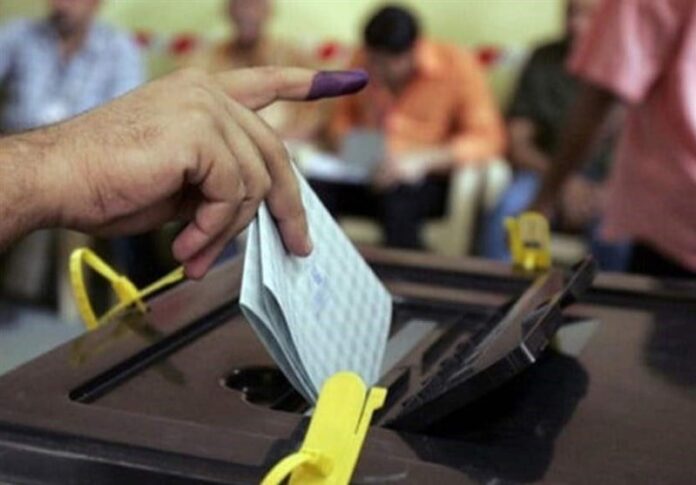
Al-Monitor:  Iraq is about to hold elections. What does Iran want and expect to come out of these elections?

Zarif:  We want a free and fair, serious election, and we believe it’s going to be a serious election. And we want the will of the Iraqi people to emerge and whoever is chosen by the Iraqi people to emerge. We believe that, like the previous elections, it will be a complicated process — hopefully not too lengthy process of political bargaining and negotiations, but we wish the Iraqi people the best. We wish the Iraqi government a successful holding and organizing of the elections.

Al-Monitor:  Is Iran willing to support the integration of the Popular Mobilization Units into the Iraqi military?

Zarif:  That’s a decision that the Iraqi people and the Iraqi government can make. The Popular Mobilization Units in Iraq have been able to provide the necessary resistance to [the Islamic State] and have been able to defeat them. So that’s a valuable asset for the Iraqi people, but it’s up to the Iraqis to decide.
Al-Monitor:  What about Iran’s relations with Erbil? Following last year’s referendum and Baghdad’s swift response, the Kurdistan Regional Government [KRG] — especially under the leadership of Prime Minister [Nechirvan] Barzani — appears to want better relations with Tehran. What are the prospects of a reconciliation?

Zarif:  We have very good relations with the KRG, and we encourage both sides — both Baghdad and Erbil — to engage more closely. We have offered our good offices for them to engage more closely, and we are happy to see some progress there. I don’t think we can see any tangible results of these negotiations before the elections. So we hope that after the elections, they will resume those discussions and will resolve the differences, and wherever we can be of any assistance, we will be at their disposal.

Downtown Tehran, Second Home of Bibliophiles

Enqelab Avenue in downtown Tehran stretches 5 kilometres from the Enqelab Square all the way to the east, leading to the landmark Imam Hussein Square.

Enqelab Avenue is one of the main thoroughfares of Tehran not only because it is one of the major venues for rallies and demonstrations, but because it is a place where the University of Tehran and large bookstores are located.

The western stretch of the avenue from the Enqelab Square to the Vali-e-Asr Junction is one of the busiest and most popular places in the capital.

That stretch of the avenue is the hub of bookshops some of which belong to major publishers. In addition, shops selling stationery, engineering equipment as well as medical equipment and uniforms are located on Enqelab Avenue. The avenue is also home to large numbers of newsstands, cafes and cinemas.

The Enqelab Square is the “book quarter” of Tehran. Most publishers and wholesalers of books have a sales outlet at or near the Enqelab Square.

In fact, this span of Enqelab Avenue is known for its publishers and bookshops. Some publishers have shops on the main avenue, and some are located on nearby streets. Street vendors selling books are also part of the show.

What follows are IBNA’s photos of these vendors who offer a wide range of books, from vintage books to even illegal ones:

Iran Not to Bow to US, Allies: Top General

Geral Baqeri says the traditional bipolar system in the world has collapsed and new powers have emerged in the East and the West.

“Of course, certain powers and regional players have closed their eyes to the realities in the modern world, and unfortunately no region in the world is safe from blows,” said the top general in an address to the Indian Ocean Naval Symposium, commonly known as IONS, which opened in Tehran on Monday, April 23.

He also lashed out at the White House for contributing to disorder in the world, a Farsi report by Fars News Agency said.

“The US and certain other powers send military units to different locations and promote chaos in the world by using the language of force,” said the senior commander.

“By supporting the ISIS terror group, the US has plunged a large part of West Asia into crisis, setting the scene for [the] displacement [of people] and killing,” he said.

General Baqeri also described the recent air attack on Syria by the United States and its allies as a clear example of “illegal behaviour.”

“They export weapons to different countries, including Saudi Arabia, preparing the ground for war,” he said.


Foreign Powers’ Presence in Indian Ocean Triggers Insecurity

Elsewhere in his remarks, the top commander said the special features of the Indian Ocean has made it an influential region whose sphere of influence goes beyond the region.

“Any changes to the Indian Ocean’s security situation has a direct link to security in other parts of the world,” the top commander underlined.

He also underscored that the Armed Forces of the Islamic Republic of Iran, as a leading country in the war on terror, are prepared to share their experience with other countries.

He said the Iranian Navy has dispatched 51 flotillas of warships to the Indian Ocean to deal with pirates and marine insecurity.

“This comes as the massive presence of military units of some major powers and their interference in the Indian Ocean region triggers insecurity, a clear example of which is the large-scale bombardment of Yemeni people,” he said.

Iran’s Beauties in Photos: Scenic Village of Filband

This village is located at an altitude of about 2,300 metres above sea level. Filband on the eastern side of Mazandaran is known as the roof of the province.

In this village, winter begins very soon and ends late.

The combination of high mountains and dense forests which pass through a large amount of white clouds has turned the village into a beautiful tourist destination.

The skies of Filband open up hidden and new aspects of nature to the tourists in the tranquillity of the clouds and the silence of nature.

Here are Mizan News Agency’s photos of the village:

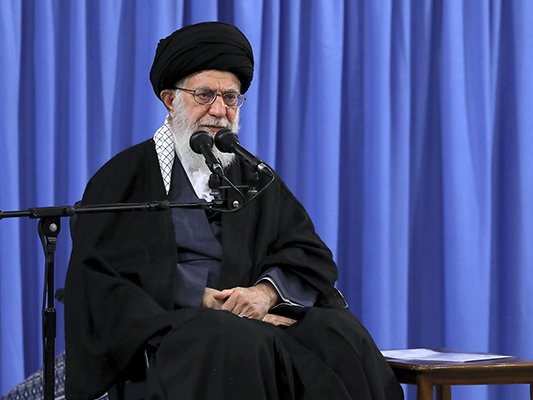
Iran Leader Calls for Further Unity between Army, IRGC

In a Sunday meeting with the top commander of Iranian Army as well as a group of commanders of the Iranian Army Ground Forces on National Army Day, the Leader praised the remarkable skills and valuable experiences of the senior personnel of the Iranian Army.

Ayatollah Khamenei also expressed hope for a bright future for the young generation of the army staff and underlined the urgency of continuous boosting of Iranian Army’s progress and might.

“The progress should keep going on so that tomorrow’s army becomes better, stronger and more efficient and revolutionary compared with today’s army,” he was quoted as saying.

He also directly addressed the young generations of the army’s staff and urged them to undertake new initiatives, make serious attempts and expand their capacities to further develop the army’s capabilities.

The Leader also hailed the Commander of Iran’s Army Major General Abdolrahim Mousavi for his recent revolutionary and unifying remarks in which he had said all Iranian armed forces will stand united in the face of enemies.

“Despite his emotional commitment to the Iranian Army which is critical for the survival of the military bloc, Major General Mousavi made wise remarks about the urgency of promoting unity between the armed forces which reveal his honesty and management wisdom,” he concluded.

Iraq Major Customer of Iran’s Medicinal Herbs

Medicinal Plant

The western Iranian province of Kermanshah is among the areas home to a large variety of medicinal herbs and one of the provinces exporting the products.

“Only yesterday (April 21, 2018) some 20 tonnes of spear thistles produced just from the farms created by people were exported to Iraq, and this can be a good source of income for the country,” said Morad Sheikh Veisi, the director general of the Watershed and Natural Resources Management Department of Kermanshah Province.

Mehr News Agency quoted him as saying that a whole variety of other types of herbs are also produced and exported.

“Out of around 2,000 species of flora which grow in Zagros region, 800 species grow in Kermanshah province, of which 200 are regarded as medicinal and edible herbs,” he said.

The official noted that people are interested in using medicinal and edible herbs, especially in spring. However, he underlined that some people have put different species of medicinal herbs on the verge of extinction through the excessive and unrestrained picking of the plants.

He said some species of the medicinal herbs are on the brink of extinction and can only be found in hardly negotiable passageways. He called on people to avoid the excessive exploitation of areas where medicinal herbs grow.

Given the growing interest in the use of natural products of medicinal and food industries in the global healthcare debates, Iranian people, officials, and industries have increasingly considered the benefits of medicinal herbs and significance of integrating traditional medicine into modern healthcare system and supporting it.

According to the data released by the Iranian Vice-Presidency for Science and Technology, Iran is home to 8,000 herb species, and 2,500 species with medicinal properties and applications such as spice, fragrance, and cosmetics. It also has a rich heritage of traditional medicine with over 14,000 reference books and elegant works such as Avicenna’s Canon of Medicine and Book of Healing, Al-Razi’s Al-Havi, and Zakhireh-i Kharazmshahi.

Given its great potential in the field of medicinal herbs, the country plans to increase the export of medicinal herbs, herbal-based products and herbal products to join the top 10 countries in the world.

Iran Designs System to Inspect Airbus A320’s Landing Gear

Iran Designs System to Inspect Airbus A320’s Landing Gear

CEO of Iran Air Farzaneh Sharafbafi says “it is an honour we now have the technical know-how of producing the system required for checking the landing gear in the country.”

“This technical knowledge is much more valuable than the production itself,” she added, according to a Farsi report by Young Journalists’ Club (YJC).

The landing gear is the sole direct link between the airframe and tarmac and is vital to the safe conclusion of the flight. Like all other components which make up an aircraft the landing gear – often simply known as the “legs” by aircrew and ground crew – the landing gear is also checked and maintained on a daily basis, repaired as required and fully overhauled at regular intervals.

A full landing gear overhaul is a task for specialists that requires the use of special tools, equipment and technology. For this reason, for some long time many airlines have sub-contracted this work to organizations with commensurate equipment and know-how, but according to Sharafbafi Iran Air is now able to do the job itself.

Under the cruel sanctions, Iran could not import aviation products to the country. The sanctions also preclude non-American manufacturers from exporting plane parts to Iran if the US-made parts exceed 10 percent.

The Islamic Republic’s aviation industry is a sector rapidly drawing increasing attention. As evidenced by the inaugural flight of Iran’s indigenously designed and manufactured Azarakhsh fighter jet to the mass production of small turboprops and passenger planes, this sector was seen to be making rapid strides.

Part of the impetus for the development of this industry lay within domestic demand factors. It was for a time estimated that over 10% of total demand for passenger planes in the Asian-Pacific market was in Iran, as domestic passenger traffic was expected to top eleven million passengers by the year 2000. This massive demand also spurred private sector investment in this sector as evidenced by the establishment of 17 private airlines.

Iran’s aviation industry infrastructure was by and large established in the 1970s. The Iran Helicopter Support and Renewal Company (IHSRC), or Panha Company, was formed in 1969, the Iranian Aircraft Industries (IACI) in 1970, and Iran Aircraft Manufacturing Industries Corporation (IAMI), also known under its Farsi acronym (HESA), in 1974.

Two other important companies, Iran Aviation Industries Organization of the Armed Forces (IAIO), also known as the Iranian Armed Forces Aviation Industries Organization (IAFAIO), and Quds Research Centre were formed in the early 1980s. These companies progressed from repair and maintenance facilities to larger defence enterprises with several thousand employees.

Joint aircraft technology projects with Russia were supplemented by such projects as the indigenously designed and manufactured Shabaviz helicopter manufactured by the IHSRC and the S-68 turboprop trainer manufactured by Iran Aircraft Industries.

The IHSRC in Tehran is a producer of the helicopter’s body and maintenance of helicopters according to American standards. However, the achievements of Iran’s aviation industry has not only been limited to the manufacture of planes. Iran Air had successfully and completely overhauled a number of planes in its fleet, without any foreign assistance as have other local companies such as Aseman.

According to the data released by the Iranian Vice-Presidency for Science and Technology, Iran plans to design and manufacture 100-150-seat regional aircrafts and general aviation airplanes in accordance with national and global market demands. It also aims to design and manufacture medium and semi-heavy helicopters, and design and manufacture mini turbojet engines, light and heavy turbofan engines and gas turbine engine compressors with a capacity of 1-10 MW.

Iran Strongly Denounces Kabul Terrorist Blast

Bahram Qassemi

In a Sunday statement, Qassemi extended Iran’s condolences to the Afghan nation, government as well as the families of the victims of the deadly attack.

He also expressed hope that terrorism in all its aspects and forms would be eradicated soon in the region and the whole world through joint resolve and attempts by all states at bilateral, regional and international levels.

At least 45 people were killed and over 60 others injured earlier Sunday in a blast targeting a voter registration centre in Kabul.

Police say the explosion occurred when a bomber detonated explosives in Dasht-e Barchi area. The ISIS terror group has claimed responsibility for the attack.

Voter registration centres have been set up across Afghanistan in preparation for long-delayed parliamentary elections due to be held in October. The bombing is the fourth attack against the election process in less than a week.

Dasht-e Barchi is largely inhabited by members of the Shiite Hazara minority, which has been repeatedly targeted by ISIS terrorists.

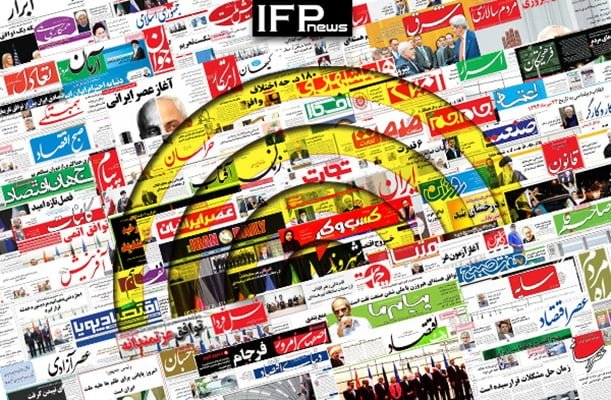
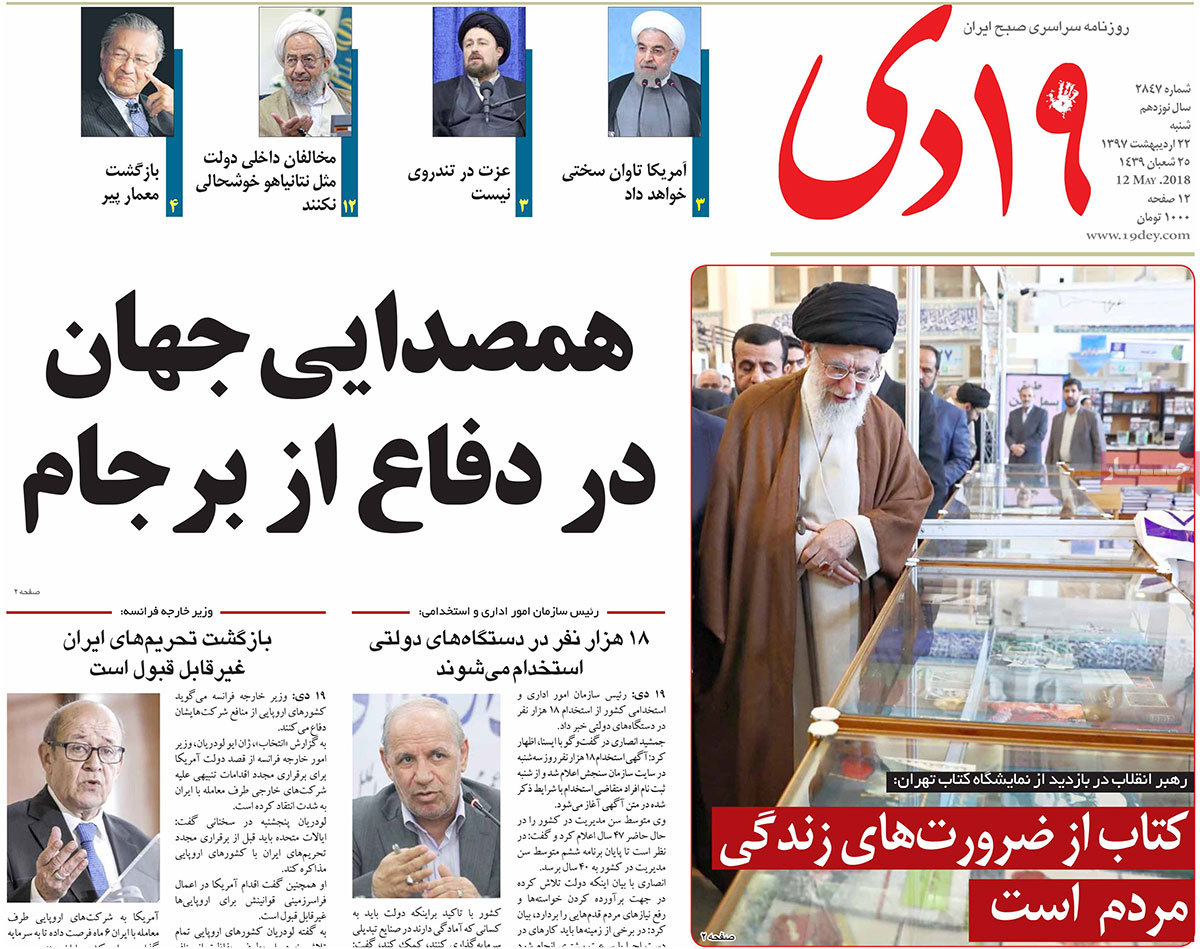
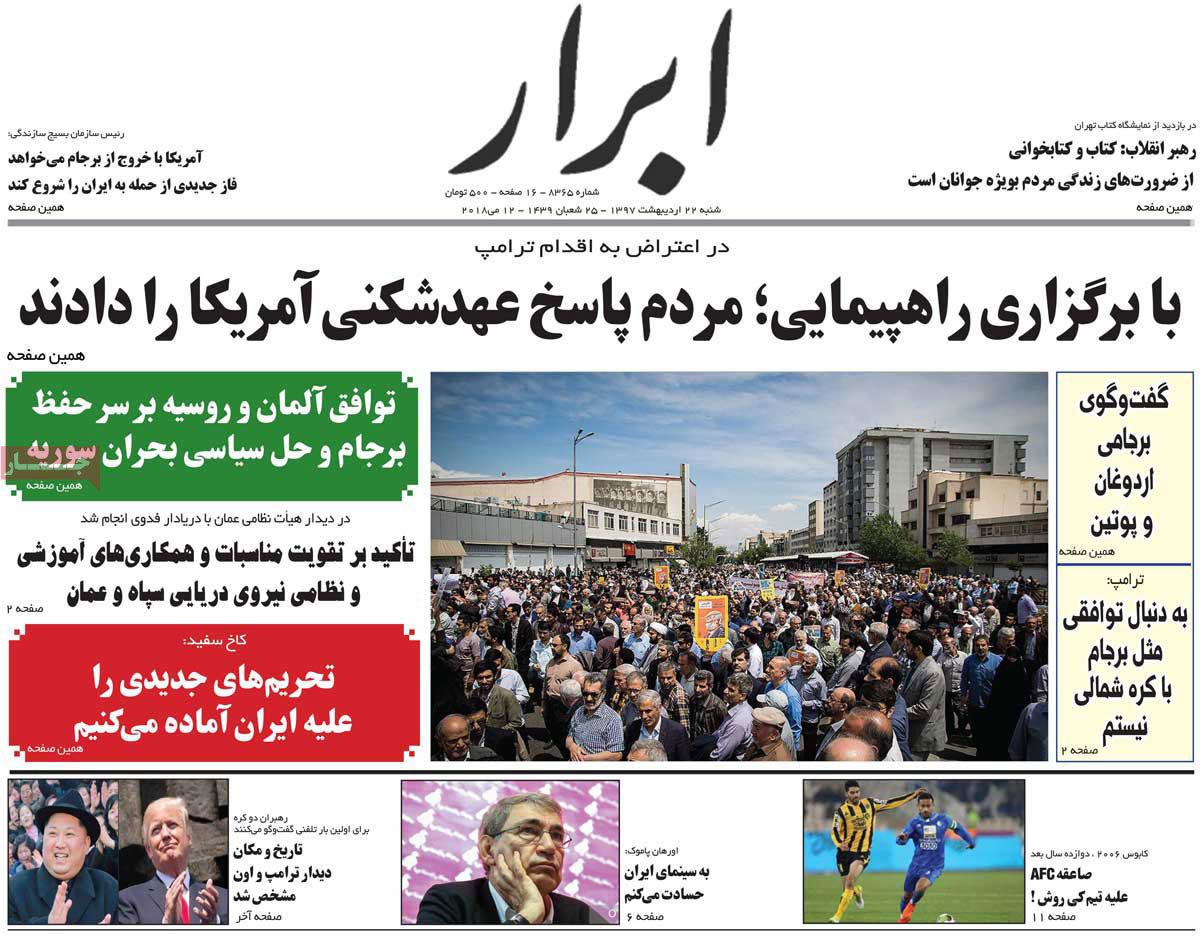
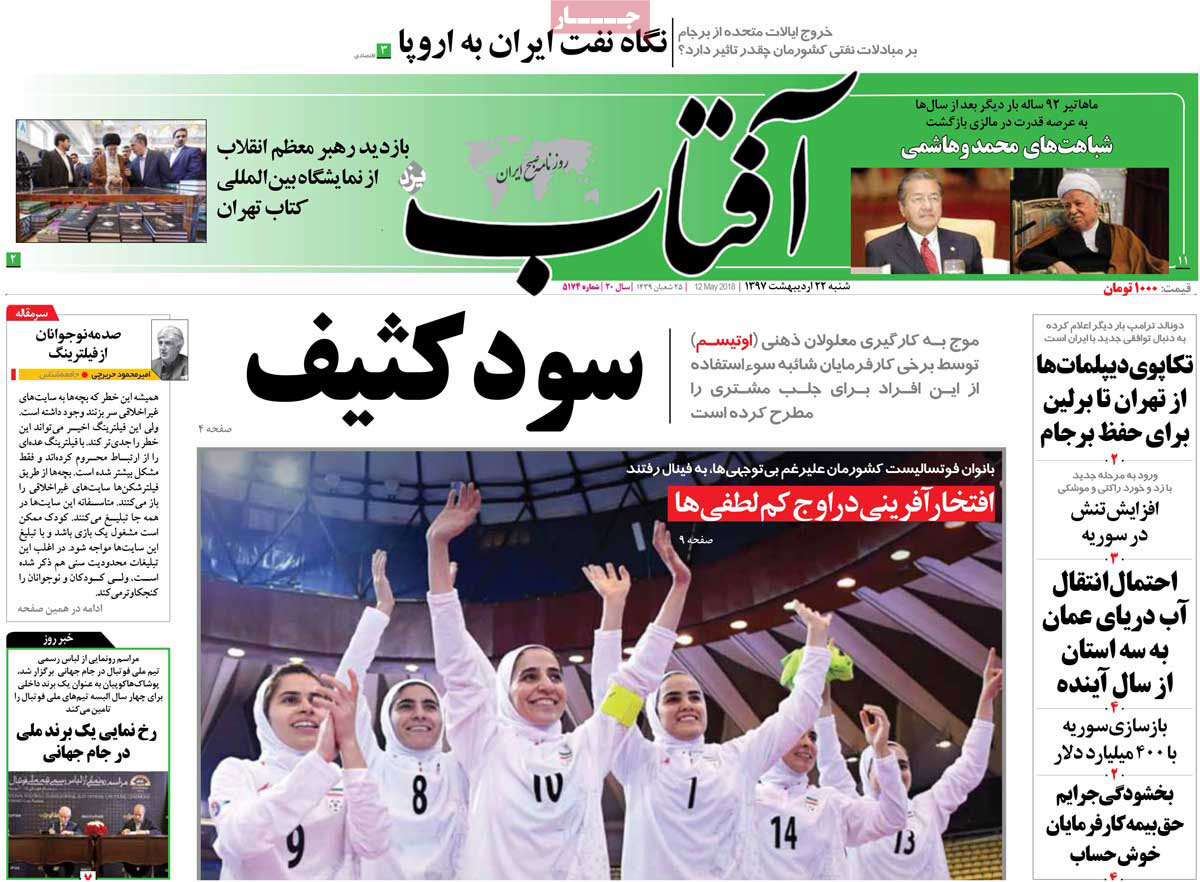
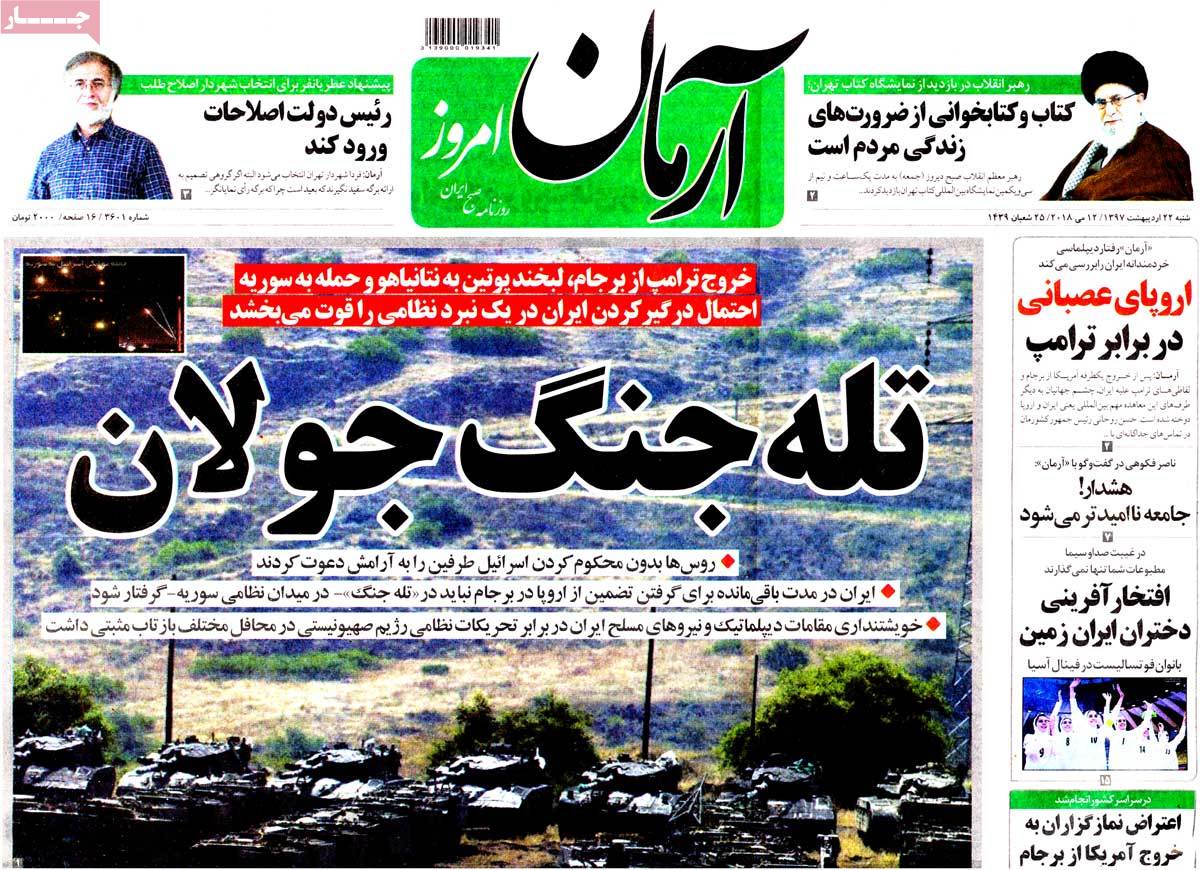
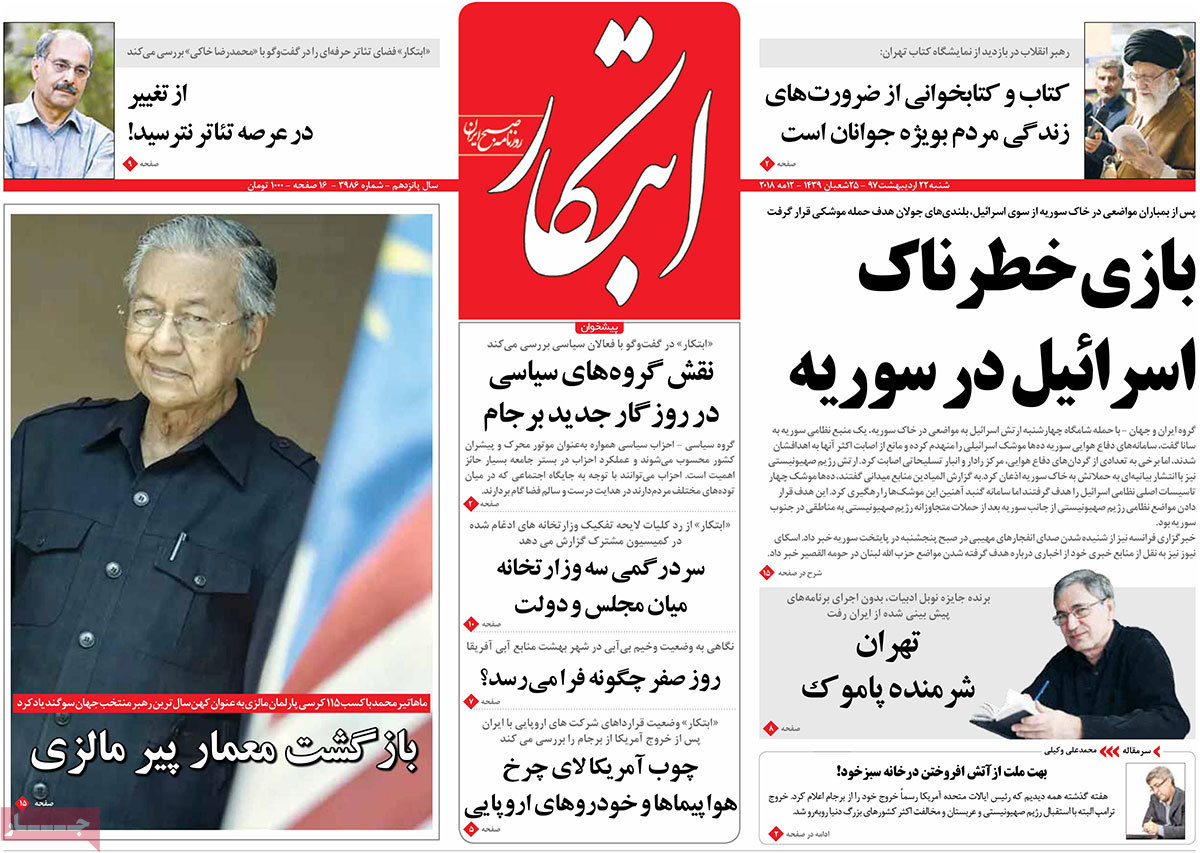
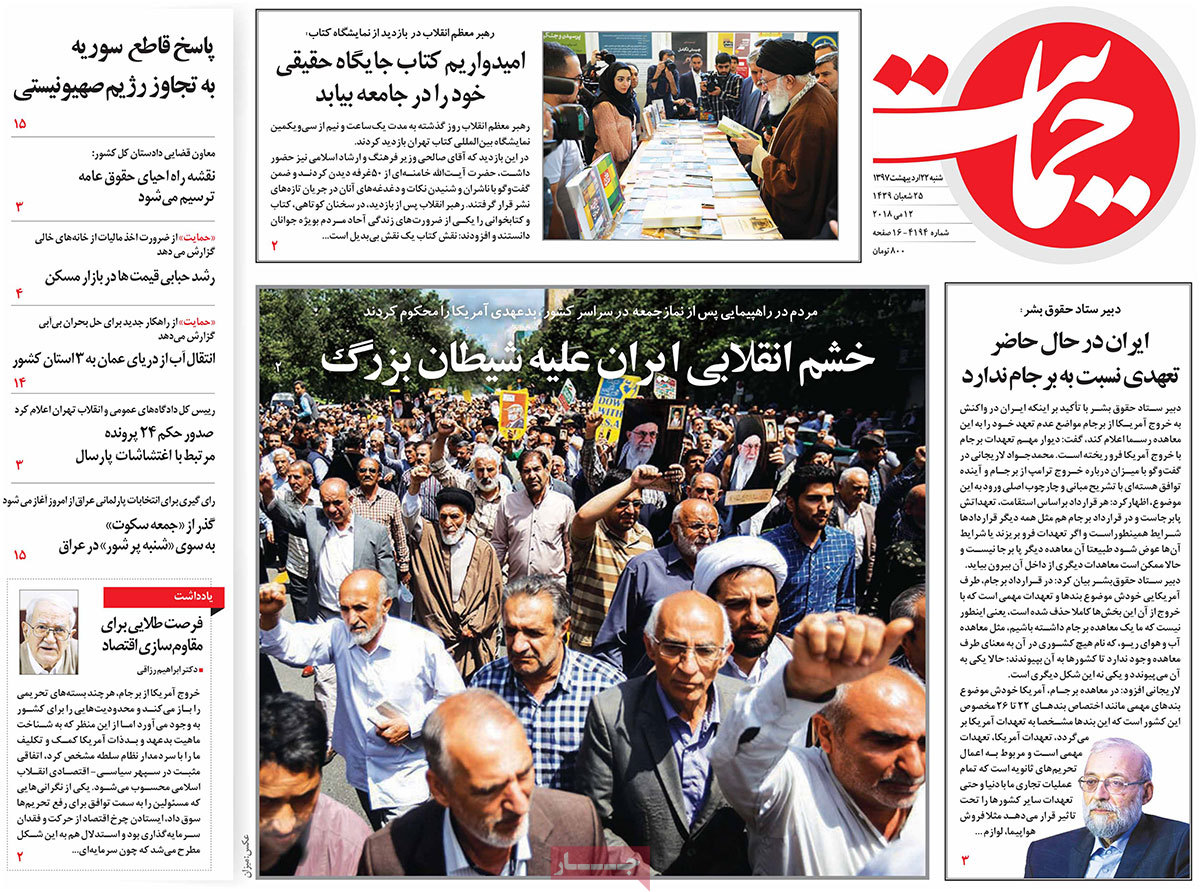
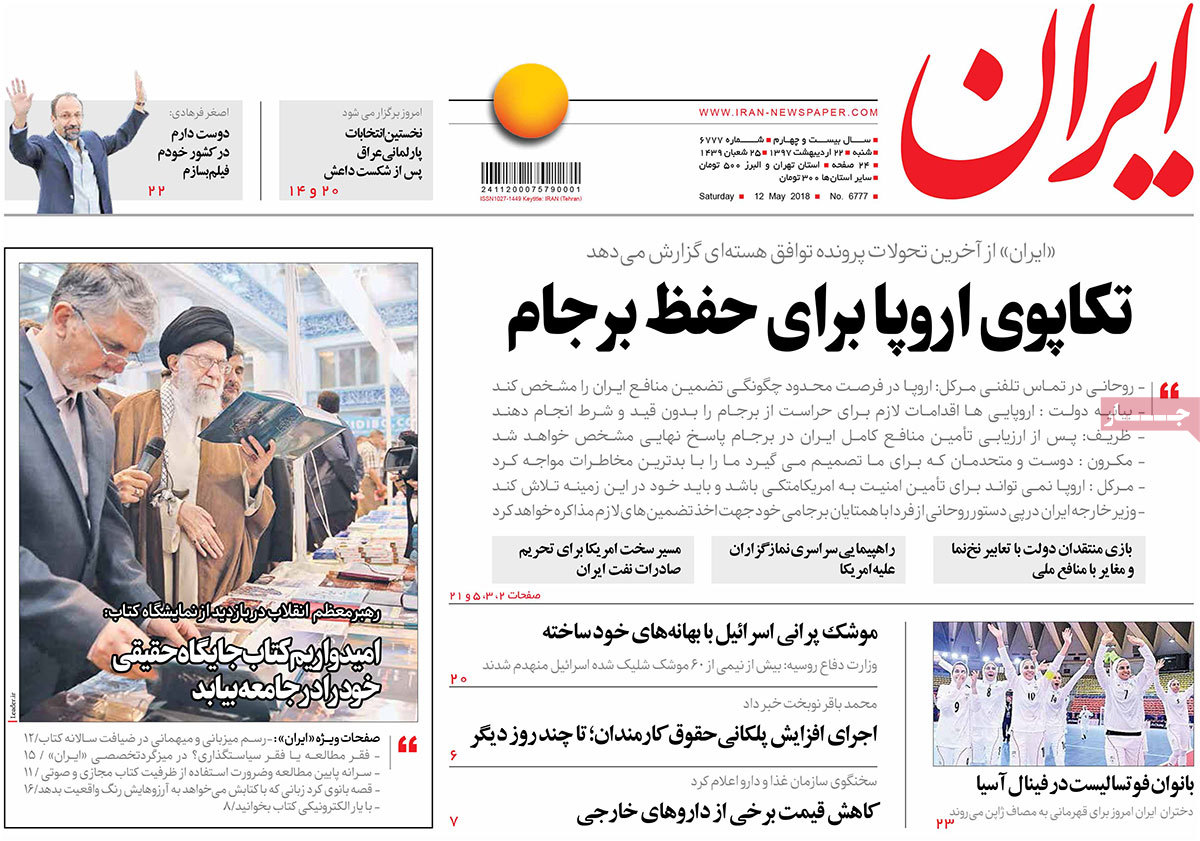
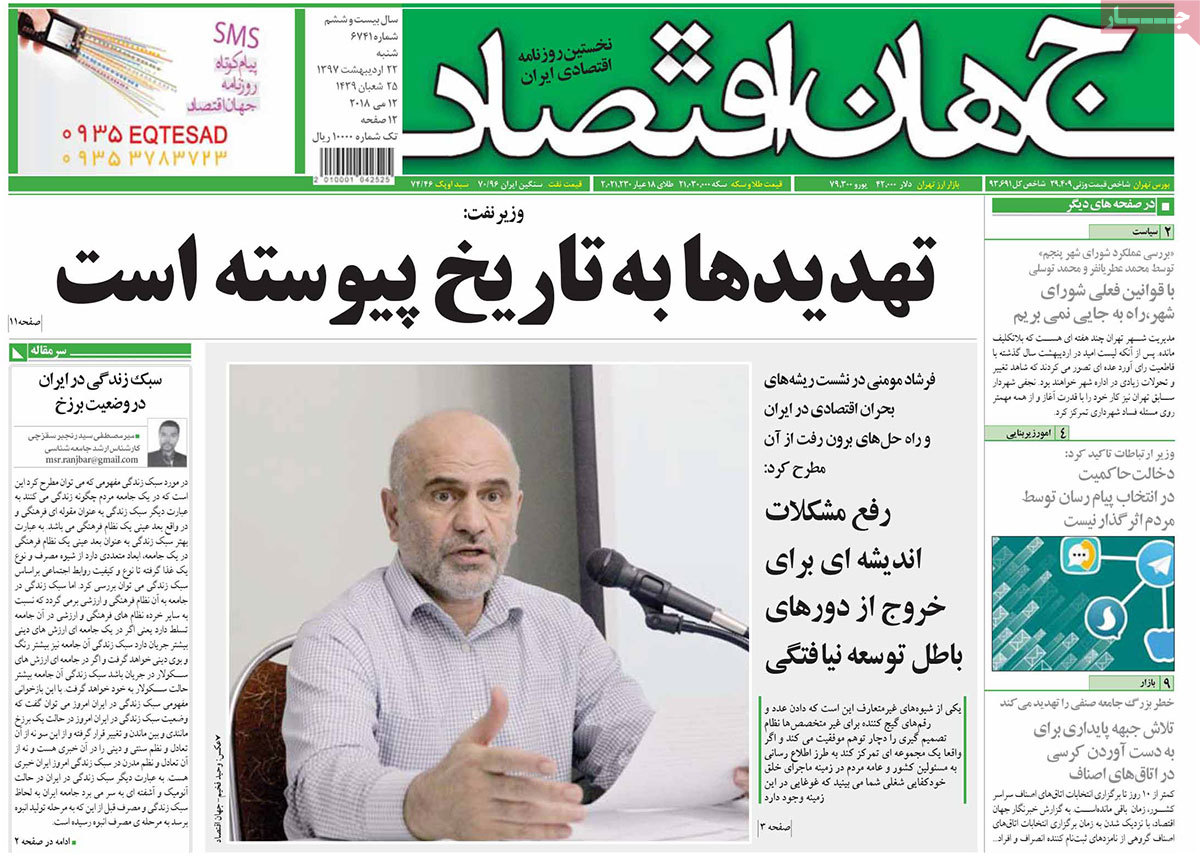
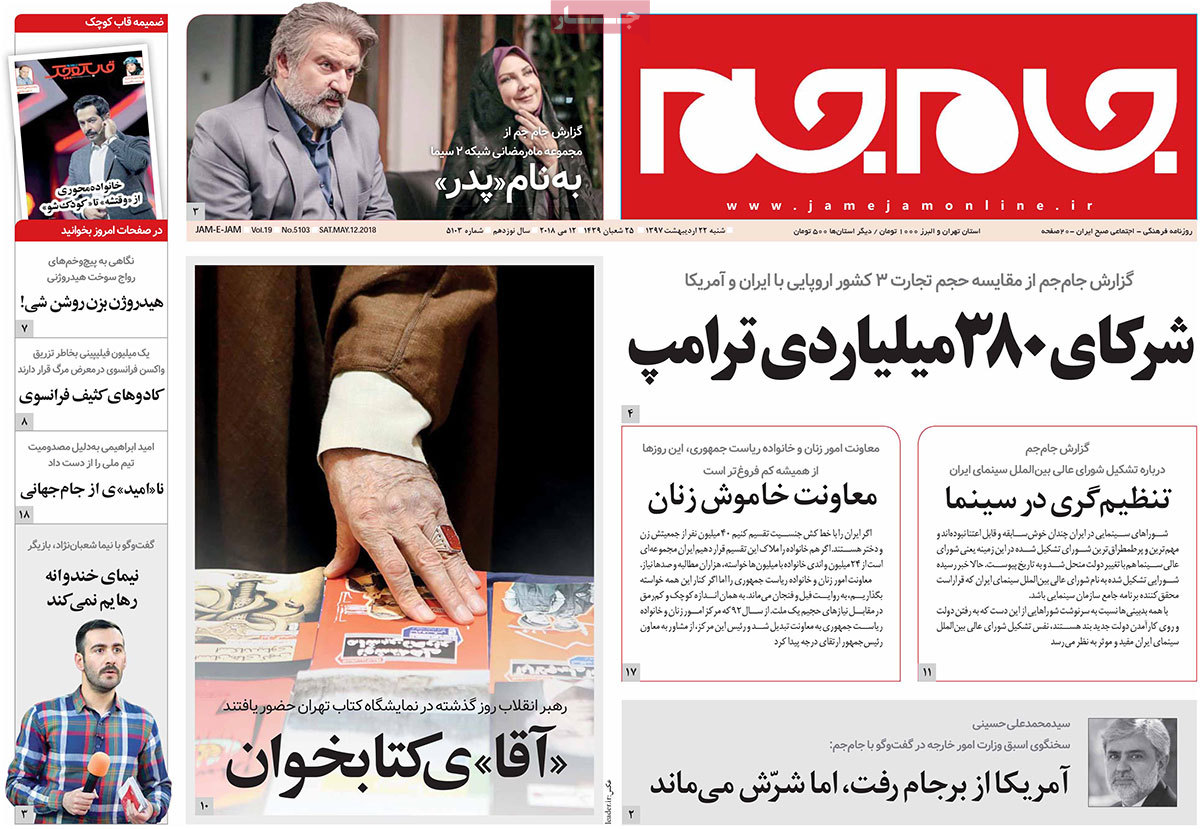
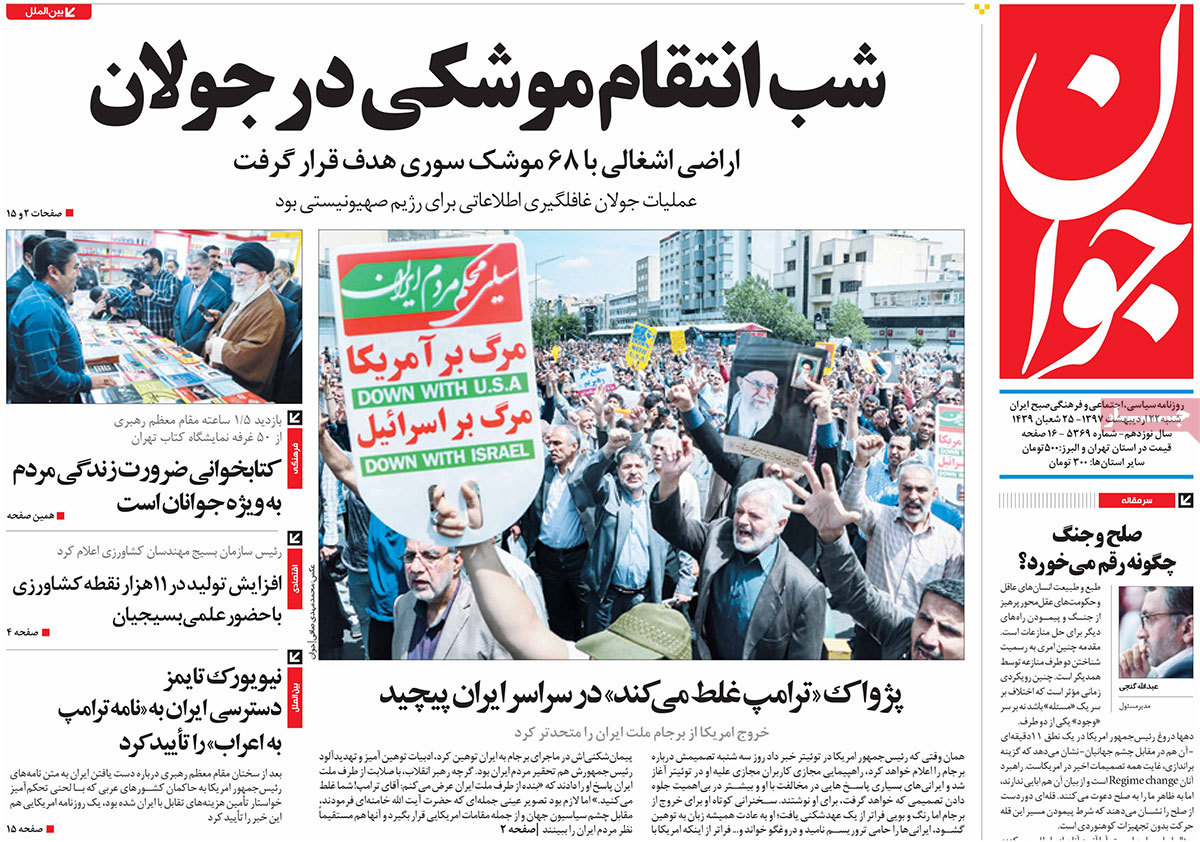
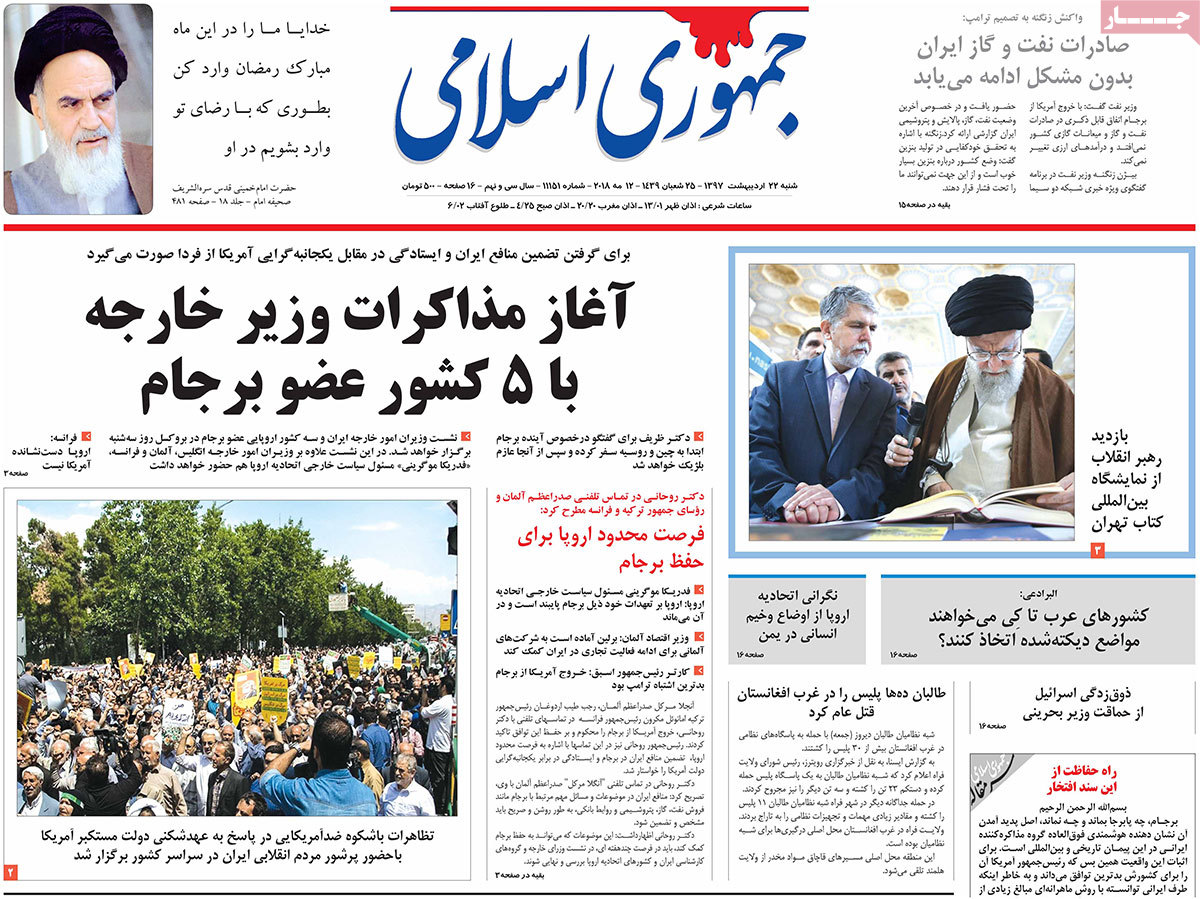
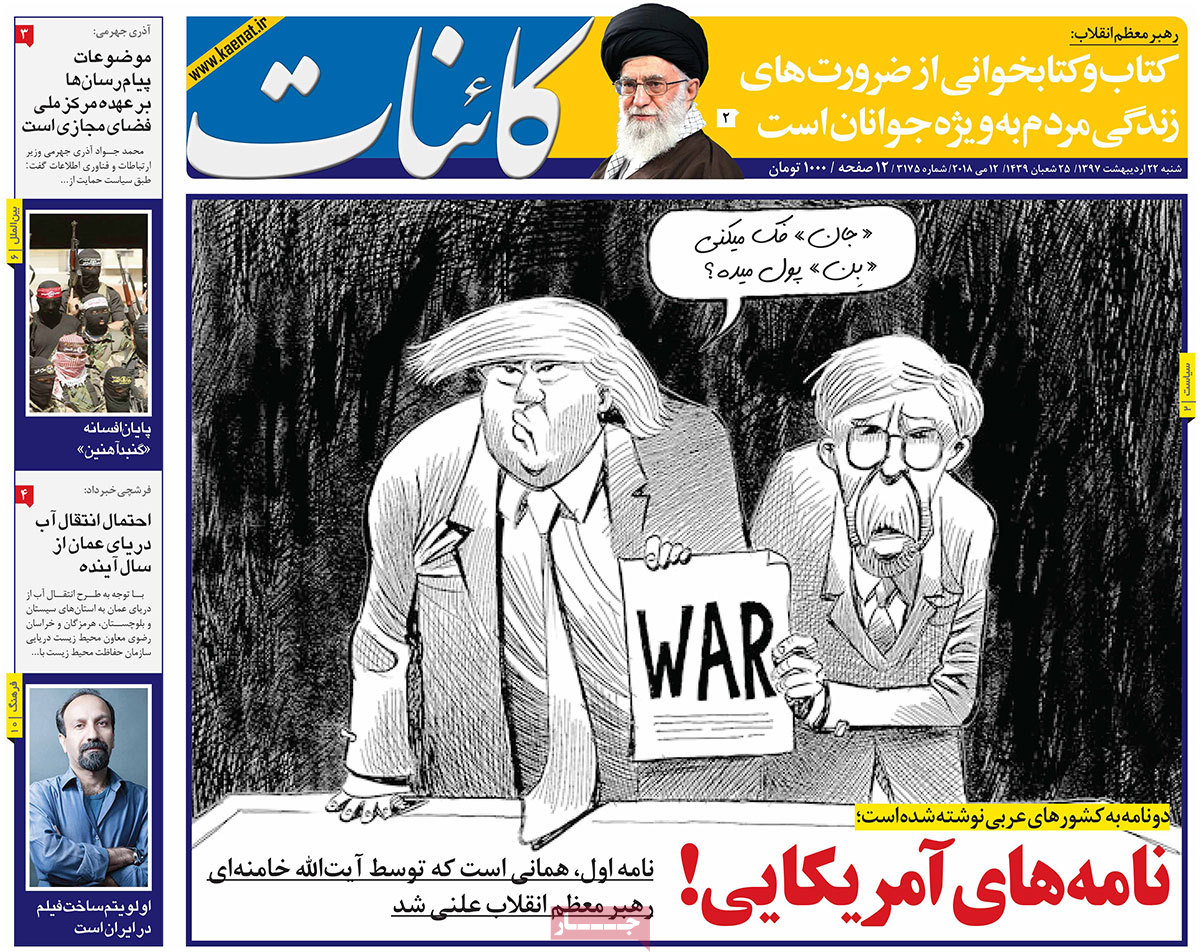
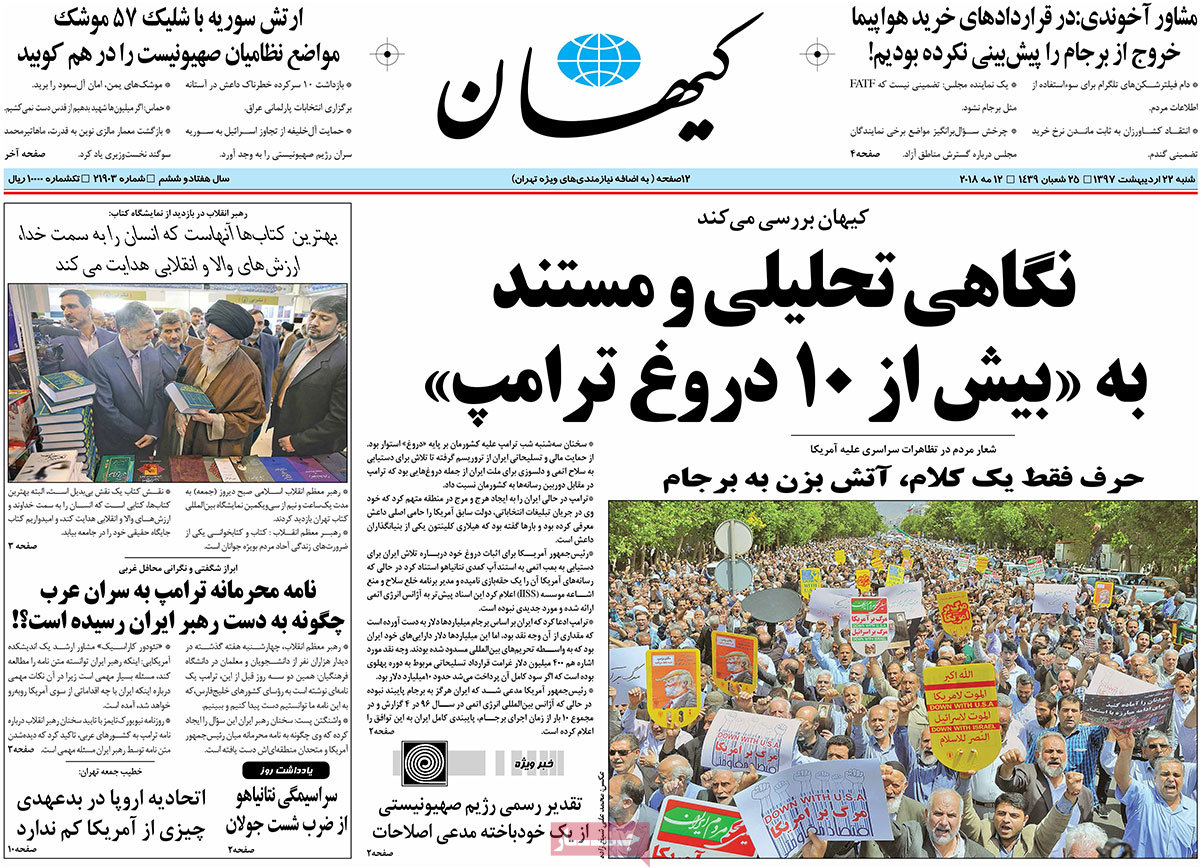
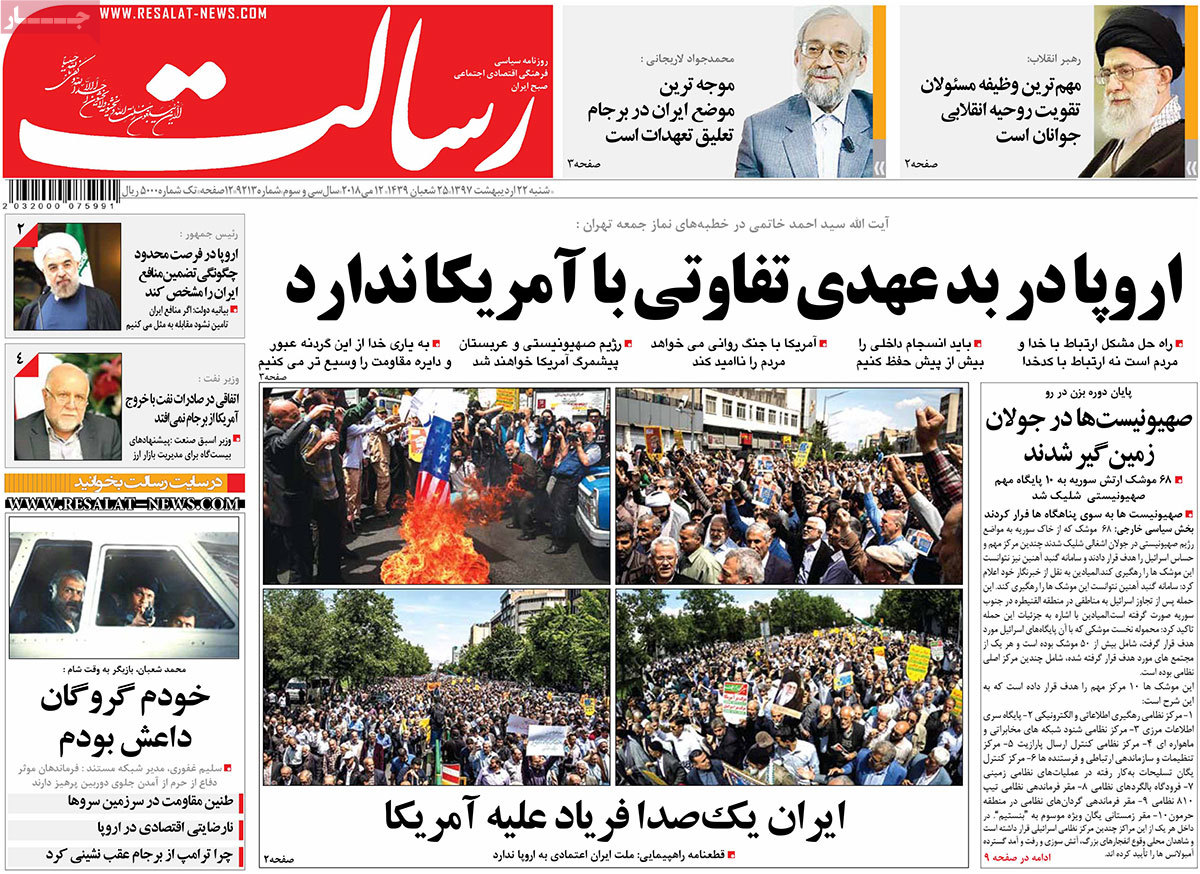
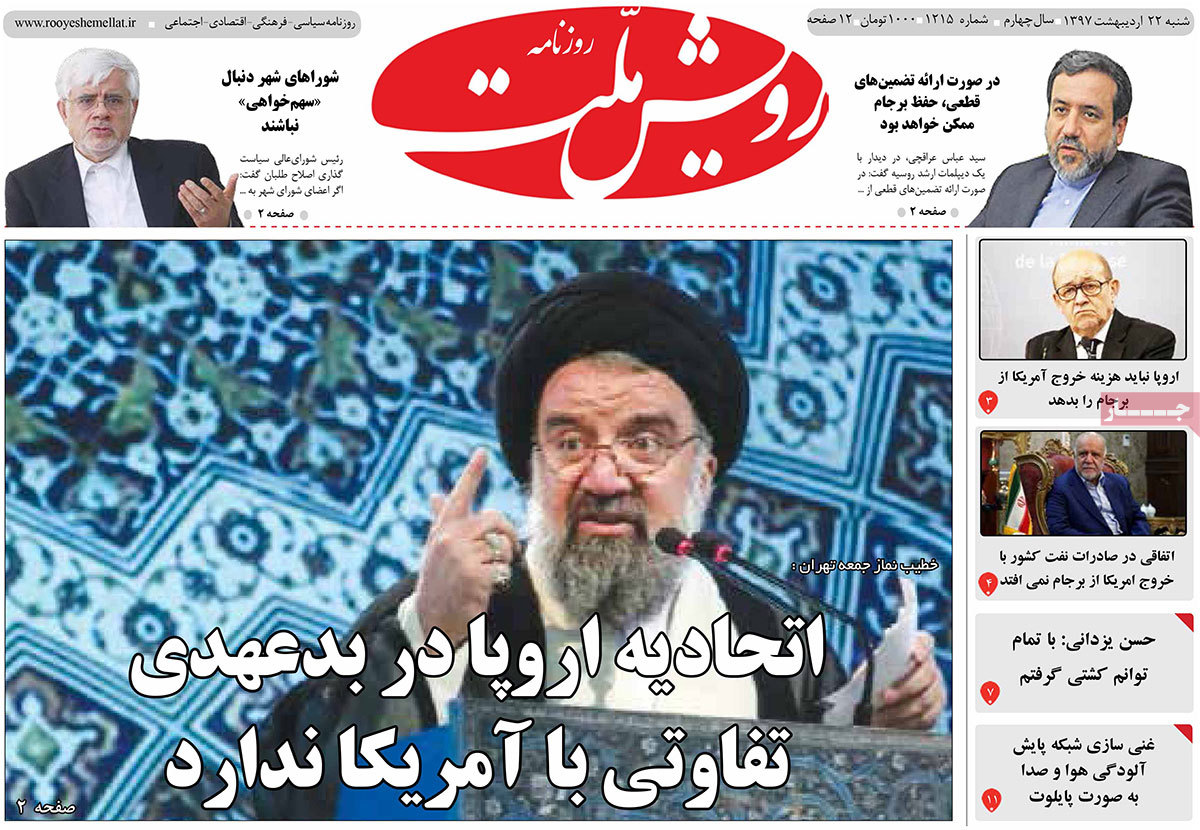
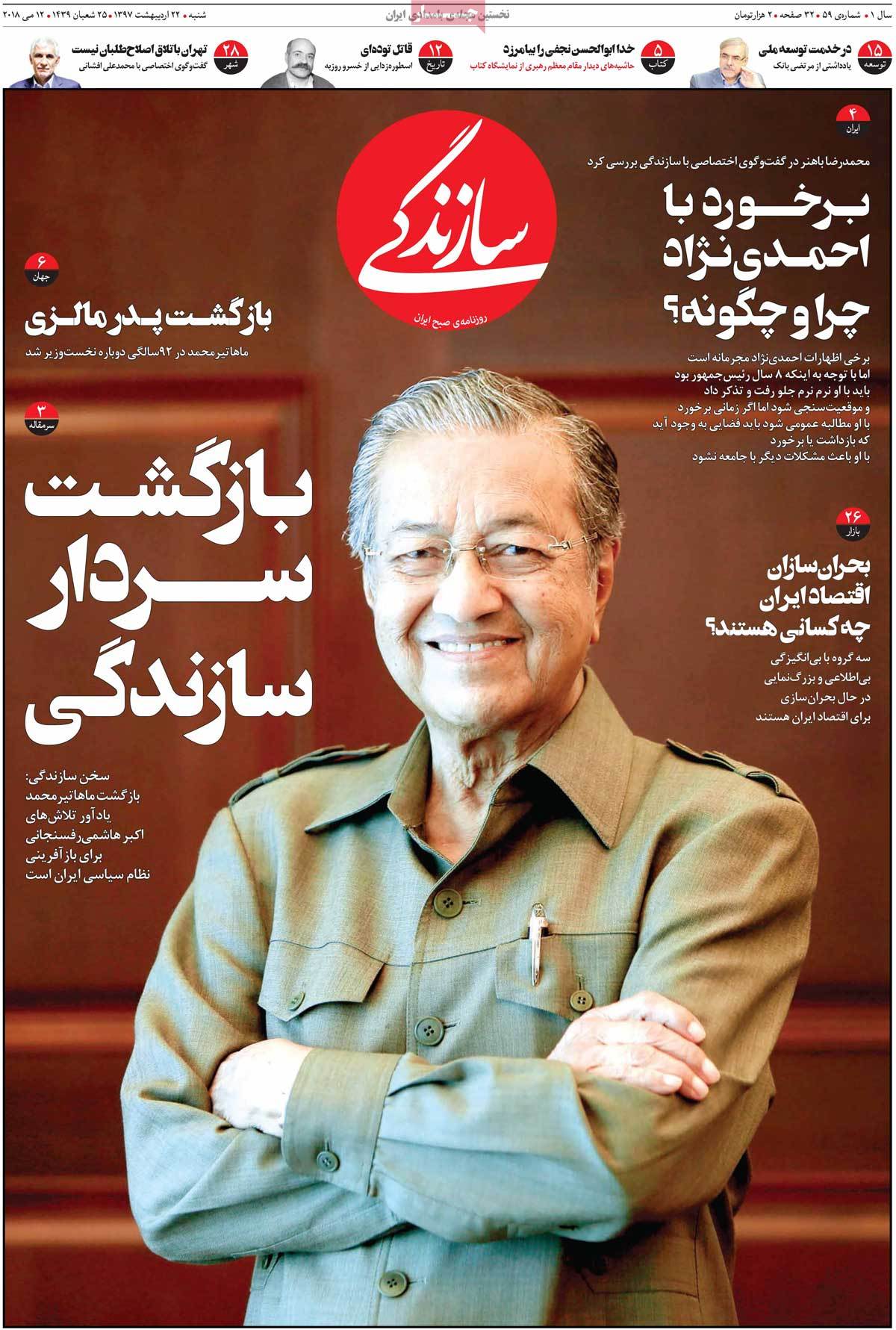
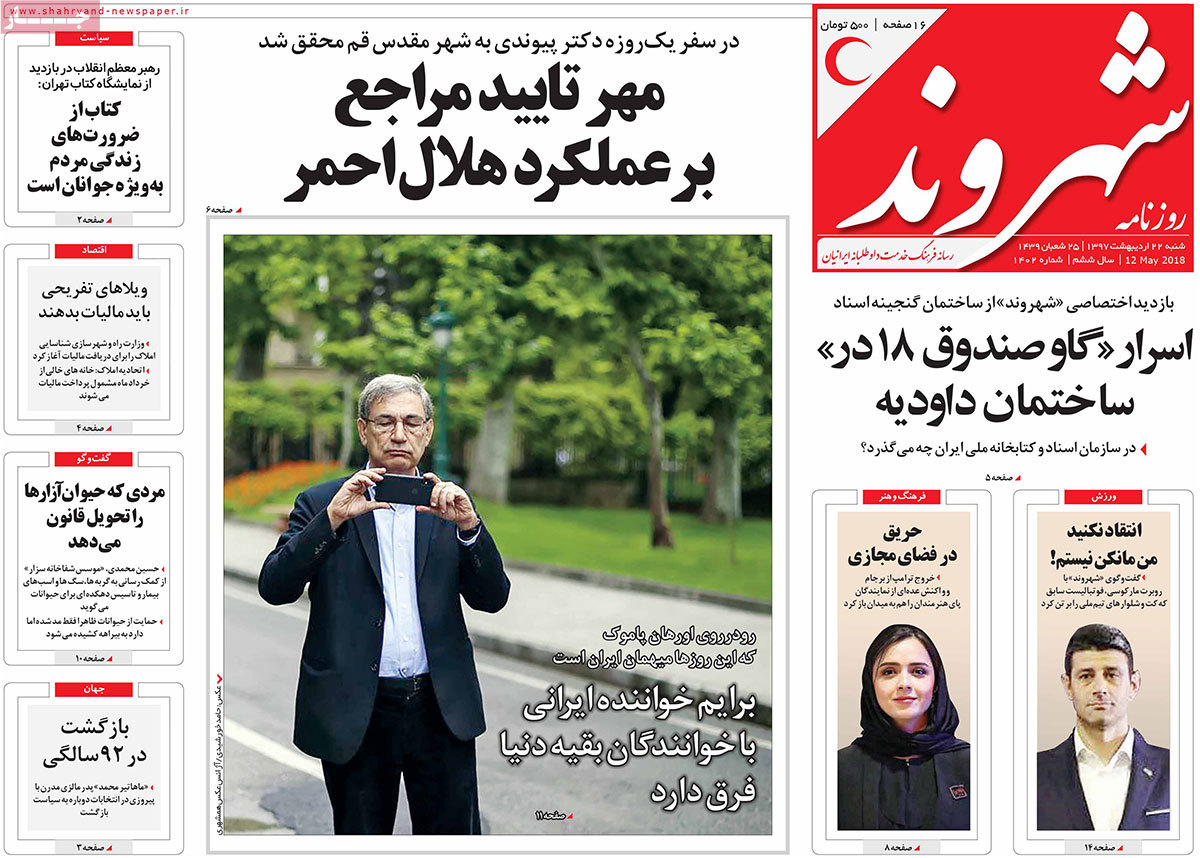
A Look at Iranian Newspaper Front Pages on April 22

A Look at Iranian Newspaper Front Pages on November 19

Almost all papers today covered the remarks made by Iranian President Hassan Rouhani in an address to a group of top executives and cabinet members.

Also a top story was the comments made by Army Chief-Commander Major General Abdolrahim Mousavi in support of the Islamic Revolution Guards Corps (IRGC).

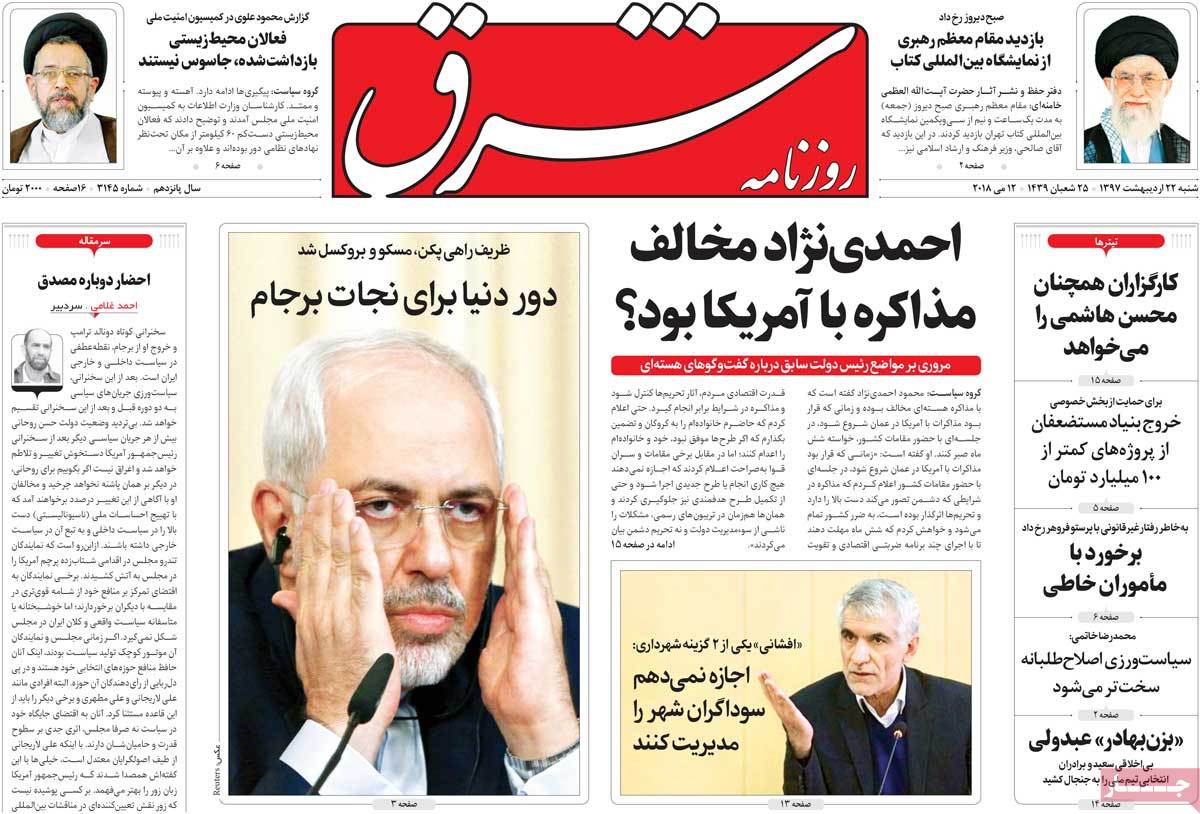
Several papers also highlighted the remarks made by Iranian Foreign Minister Mohammad Javad Zarif in an interview with the CBS News about Tehran’s reaction to Washington’s possible withdrawal from the Iran nuclear deal. Zarif stressed that the Islamic Republic will immediately resume its nuclear program in a faster pace than before if Trump decides to pull out of the JCPOA.

The above issues, as well as many more, are highlighted in the following headlines and top stories:


19 Dey:

  • Cowards Must Leave Their Government Positions: Rouhani
  • I Can’t Tell Everything
  • Nuclear Chief: Those Violating Nuclear Deal to Be Surprised by Iran’s Reaction

A Look at Iranian Newspaper Front Pages on April 22


Abrar:

  • Rouhani: Recent Forex Decision Heavy Blow to US
  • Zarif: We’re Ready to Resume Our Nuclear Program at Faster Pace

A Look at Iranian Newspaper Front Pages on April 22


Afkar:

  • Iran Nuclear Chief: I Hope Other Side Would Come to Its Senses

A Look at Iranian Newspaper Front Pages on April 22


Aftab-e Yazd:

  • North Korea Looking for Peace? Pyongyang Stops Missile Test Centre

A Look at Iranian Newspaper Front Pages on April 22


Arman-e Emrooz:

  • Rouhani, from Lip Service to Action
  • President: Bodies Supervising Gov’t Not Allowed to Interfere in Executive Affairs
  • We’ll Make US Regret Violating Iran Nuclear Deal: Zarif

A Look at Iranian Newspaper Front Pages on April 22


Asrar:

  • Iran First VP: Solidarity to Solve All Problems in the Country

A Look at Iranian Newspaper Front Pages on April 22


Ebtekar:

  • North Korean Leader: I Don’t Want to Turn into Another Saddam, Gaddafi

A Look at Iranian Newspaper Front Pages on April 22


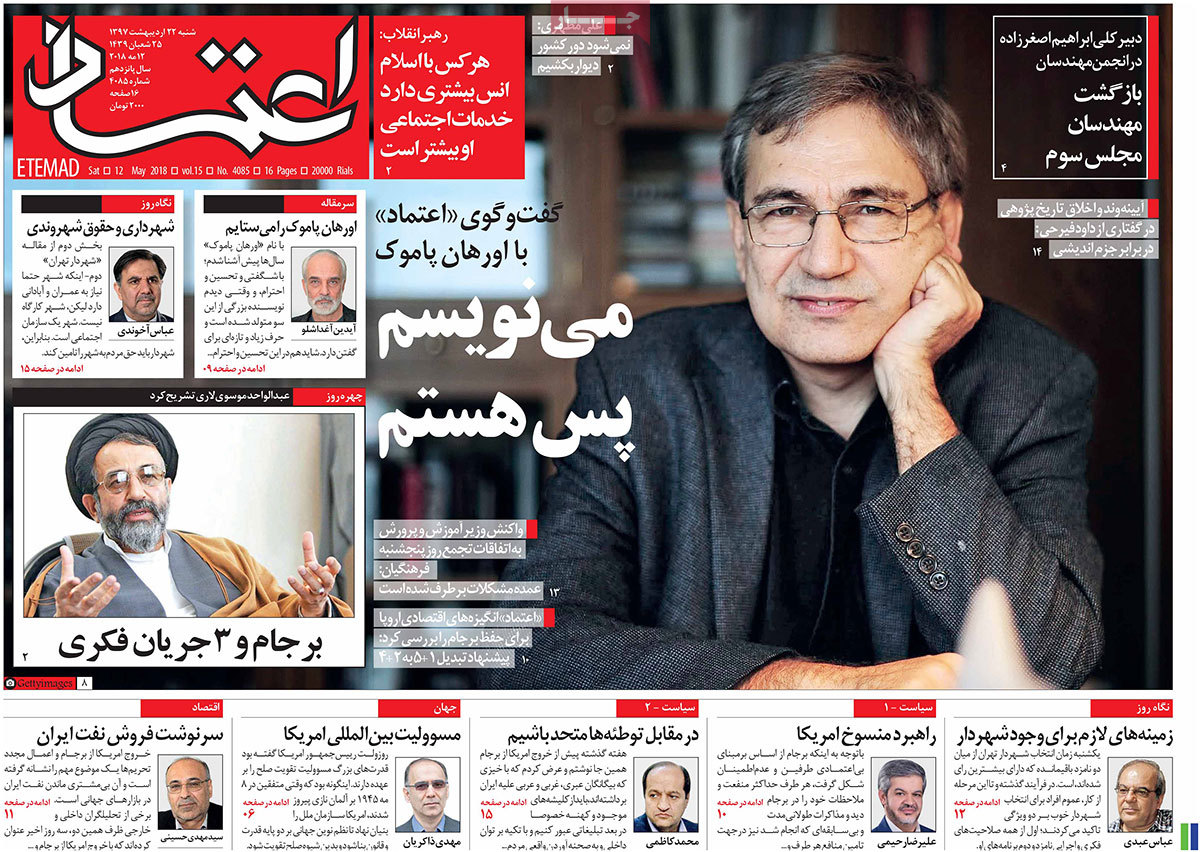
Etemad:

  • Rouhani’s First VP to Ahmadinejad: Don’t Threaten Establishment, Know Your Limits

A Look at Iranian Newspaper Front Pages on April 22


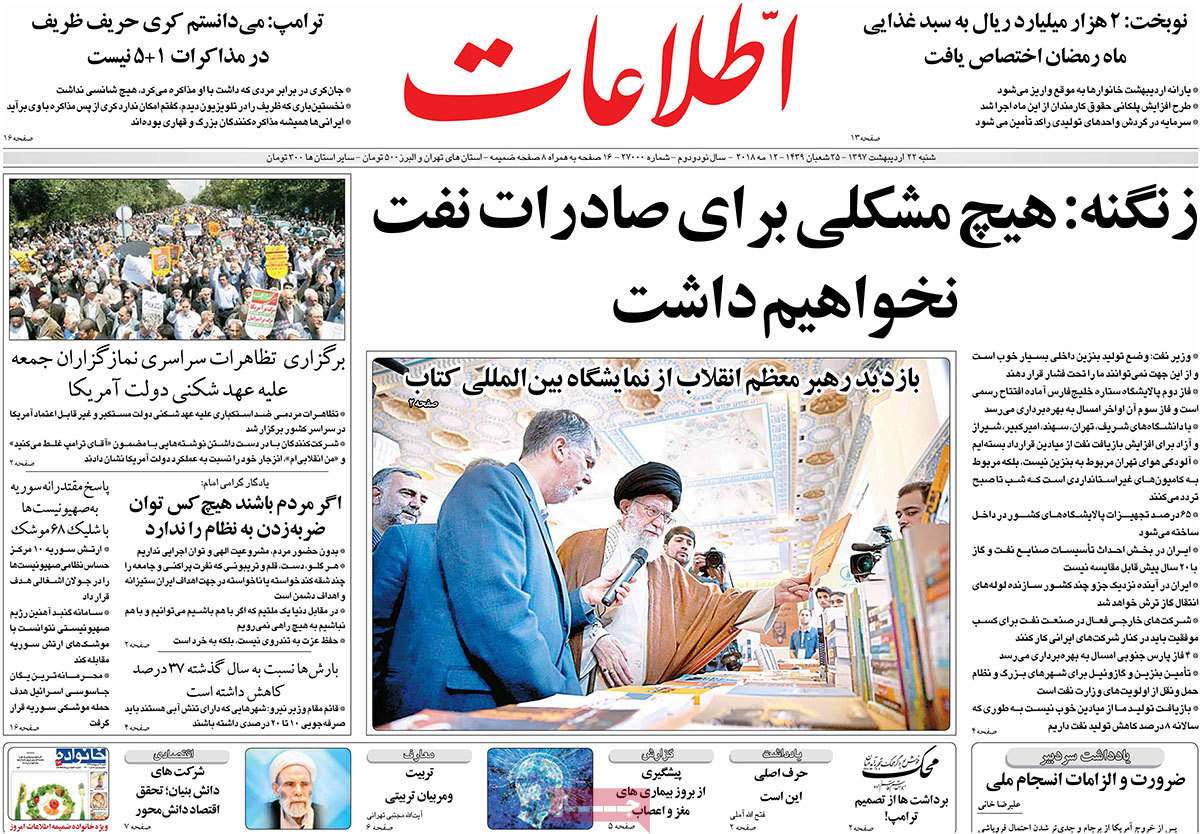
Ettela’at:

  • Rouhani: We’ll Overcome Problems If We Manage to Convince People
  • North Korea’s Missile, Nuclear Activities Stopped on Leader’s Order

A Look at Iranian Newspaper Front Pages on April 22


Iran:

  • Zarif in US: We’re Ready to Resume Nuclear Activities
  • Rouhani: Executives Who Are Afraid Must Leave Their Positions

A Look at Iranian Newspaper Front Pages on April 22


Javan:

  • Army Chief: We Won’t Let Anyone Disrupt IRGC’s Progress
  • Incorrect Judgements about IRGC Nothing New

A Look at Iranian Newspaper Front Pages on April 22


Jomhouri Eslami:

  • Jahangiri Warns Ahmadinejad: You’ll Face People’s Outrage If You Threaten Establishment
  • Palestinian Researcher Assassinated in Malaysia by Mossad Agents

A Look at Iranian Newspaper Front Pages on April 22


Kayhan:

  • Late Admission of JCPOA’s Failure
  • Rouhani: It’s Been Four Years We’re Transferring US Dollars in Sacks!
  • Army Chief: I Attended IRGC Day Ceremony to Deal Heavy Blow to Enemies
  • Muslim Woman Denied French Citizenship over Refusing to Shake Hands with a Man!

A Look at Iranian Newspaper Front Pages on April 22


Khorasan:

  • People Now Have Access to Treasury’s Payments to All State Bodies

A Look at Iranian Newspaper Front Pages on April 22


Rah-e Mardom:

  • Rouhani: Fight against Corruption Needs Planning

A Look at Iranian Newspaper Front Pages on April 22


Resalat:

  • Ayatollah Nouri Hamadani: Those Undermining IRGC Echoing Enemies’ Words

A Look at Iranian Newspaper Front Pages on April 22


Rooyesh-e Mellat:

  • Army Chief: We Produce All Equipment We Need Inside Iran

A Look at Iranian Newspaper Front Pages on April 22


Sayeh:

  • Interior Minister: Morality Police Force’s Illegal Move to Be Dealt with Immediately

A Look at Iranian Newspaper Front Pages on April 22


Shahrvand:

  • Rouhani to Top Executives: Resolve People’s Problems

A Look at Iranian Newspaper Front Pages on April 22


Shargh:

  • Mohsen Hashemi Rafsanjani: First VP Jahangiri among Supporters of My Mayoralty

A Look at Iranian Newspaper Front Pages on April 22


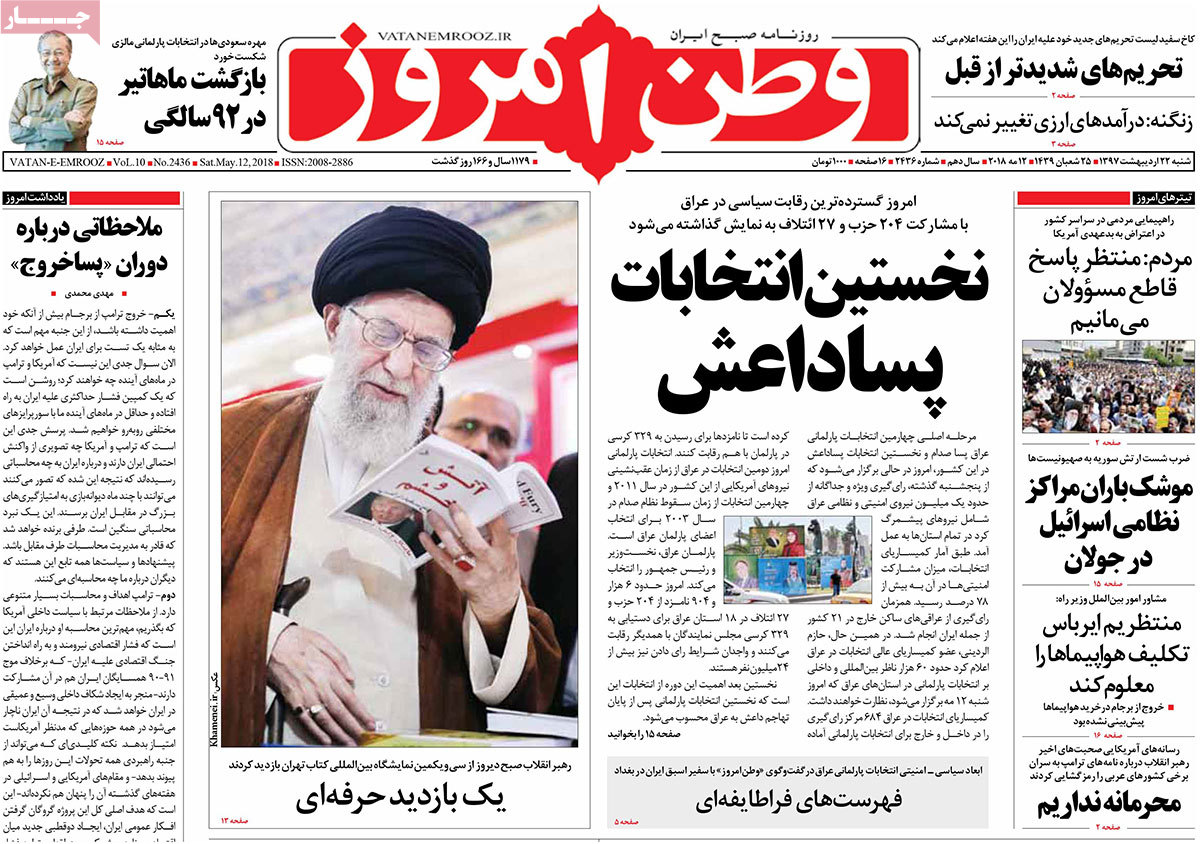
Vatan-e Emrooz:

  • A Woman Plans to Replace Erdogan
  • Will Turkey’s Early Elections Be Winning Card for Ruling Party?

A Look at Iranian Newspaper Front Pages on April 22


Iran President Vows Not to Restrict Social Media

Apparently referring to the controversial issue of blocking people’s access to the popular messenger Telegram, Rouhani stressed that people have the right to choose between the social networks they want to use.

In a Farsi post on his Instagram account on Sunday, the Iranian president also added that his government will protect the cyberspace and people’s access to communications.

This comes as within the past few weeks there were contradictory reports saying the popular messaging app Telegram is seemingly drawing its last breaths in Iran.

Telegram has more than 40 million users in Iran and is widely believed to have played a significant role in the victory of Rouhani in the 2017 presidential elections.

On April 18, the Telegram channel of Leader of Iran’s Islamic Revolution Ayatollah Khamenei announced it would have no further activity in the app. It said “in order to protect the national interests and to break the monopoly of the Telegram messenger,” the website Khamanei.ir has stopped its activity on this messaging application.

For a brief review of Iran’s achievements in various fields of science and technology, check the book “Science and Technology in Iran: A Brief Review

Following that, a number of other Telegram channels attributed to top Iranian officials stopped their activities in a move that seemed to signal the imminent blocking of the messenger.

The fate of Telegram in Iran became a hot subject in political circles late last month, when the chairman of the Parliament’s National Security Commission Alaeddin Boroujerdi said a decision has been made “at the highest levels” to permanently ban Telegram by April 20.

However, shortly afterwards, President Rouhani said he opposes the filtering of Telegram.