Saturday, December 27, 2025
Home Blog Page 3573

Terrorist Cell Smashed by IRGC in Northwestern Iran

The public relations office of the IRGC Hamzeh Seyed al-Shohada Base said in a statement on Saturday that the forces killed all members of the terrorist team “tied to global Arrogance” in the Oshnavieh border region in Kurdistan Province on Friday evening.

The statement said that the terrorist group had planned an attack in northern Iraq before crossing the border into Iran.

“Elements of the terrorist team received orders from the heads of terrorist groups in northern Iraq and had precise plans to carry out terrorist and anti-security actions after infiltrating the country,” the statement read.

Iran’s northwest has repeatedly witnessed attacks by terrorist and anti-Islamic Republic elements.

In June 2017, 40 members of the Daesh Takfiri terrorist group who intended to carry out acts of terror inside Iran in the holy month of Ramadan were identified and arrested in the cities of Piranshahr, Sardasht, Mahabad, Bukan and Takab in West Azarbaijan Province.

Iranian Netizens Shocked, Saddened by Death of Anthony Bourdain

Anthony Bourdain enjoying a cup of tea in a traditional tea-house in Iran's Isfahan

The famed cook, writer and host of the CNN’s award-winning series “Parts Unknown” killed himself Friday in a luxury hotel in France.

Bourdain visited Iran in 2014, as part of his tour around the Middle East for his TV show.

Iranians took to Twitter and Instagram on Saturday to praise Bourdain for offering a different picture of their country to the usual Western media reports and government rhetoric.

Commentators praise him for his ability to tell stories that went beyond the superficial picture painted by the daily news cycle over the course of his TV career.

After visiting Iran, he came back with a confusing picture of the country, as what he experienced was so at odds with what he understood of the country from the vision portrayed by the US government, CNN reported.

“Because the Iran you see from the inside, once you walk the streets of Tehran, once you meet Iranians, is a very different place than the Iran you know from the news”, Bourdain wrote on his trip.

“Nowhere else I’ve been has been so extreme between what one sees and feels from the people and what one sees and hears from the government,” he wrote.

In the episode CNN aired on his visit to Iran, Bourdain says, “Forget about the politics if you can for a moment. How about the food? The food here is amazing.”

“Iranians are the descendants of Ancient Persia, an empire of poetry, flowers, the highly influential culture that goes back thousands of years.”

“The road back to Tehran. Along the way, reminders of just how far back this culture goes. The ruins of ancient caravansaries, highway rest stops from when armies, merchants, traders traveling by camel, by foot all passed along these same routes. This right here a stop on what was once the Silk Road extending all the way to China.”

“In this part of the world, whatever your background, bread is a vital, essential, fundamental, and deeply respected staple.”

“It is worth mentioning, whatever you think, wherever we are now, that Saddam—supported by the US government and with our full knowledge — used sarin and mustard gas on hundreds of thousands of Iranians. Less known in America, known and felt by everyone in Iran.”

“Iran does not look and does not feel the way I had expected. Neither East nor West, but always somewhere in the middle.”

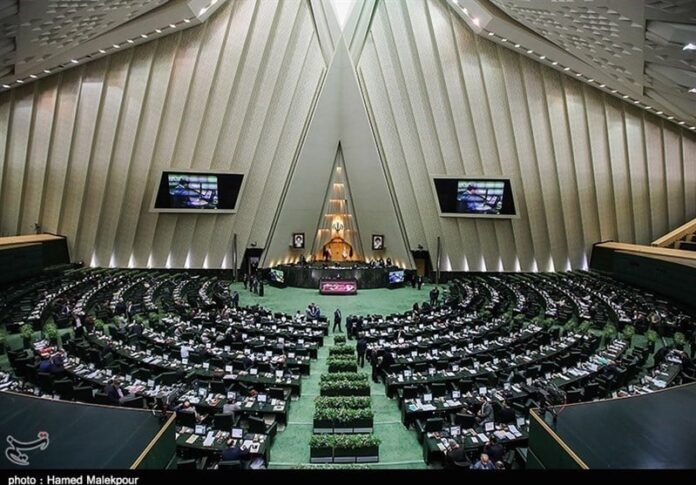
Lawmakers Ratify Iran’s Accession to Palermo Convention

136 MPs voted for the bill, 89 voted against it, and 11 abstained.

The previous version of the bill was amended after the Guardian Council announced there are some mistakes in the document. The newly passed bill, which was approved amid harsh protests by certain conservative lawmakers, still needs to be approved by the Guardian Council to be signed into law.

According to a report by Jam-e-Jam Online, the final approval of the Palermo Convention bill will allow Iran to join the United Nations Convention against Transnational Organized Crime (UNTOC).

The UNTOC, adopted by General Assembly resolution 55/25 of 15 November 2000, along with its protocols, is the main international instrument in the fight against transnational organized crime. It opened for signature by Member States at a High-level Political Conference convened for that purpose in Palermo, Italy, on 12-15 December 2000 and entered into force on 29 September 2003.

The Convention represents a major step forward in the fight against transnational organized crime and signifies the recognition by Member States of the seriousness of the problems posed by it, as well as the need to foster and enhance close international cooperation in order to tackle those problems.

States that ratify this instrument commit themselves to taking a series of measures against transnational organized crime, including the creation of domestic criminal offences (participation in an organized criminal group, money laundering, corruption and obstruction of justice); the adoption of new and sweeping frameworks for extradition, mutual legal assistance and law enforcement cooperation; and the promotion of training and technical assistance for building or upgrading the necessary capacity of national authorities.

Iran Says Time Running Out for Europe to Preserve JCPOA

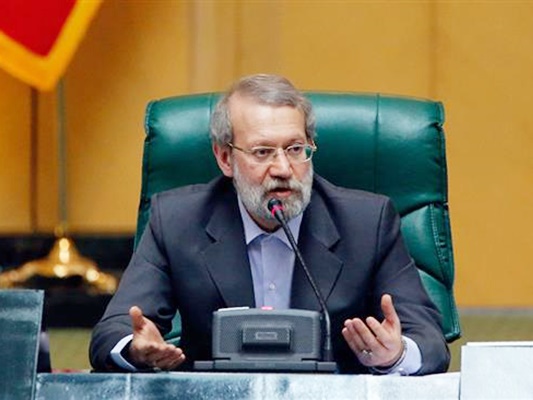
larijani

Addressing lawmakers in the Parliament on Sunday, Larijani said, “If Europe believes it has what it takes to preserve the nuclear agreement, it should announce its decision more explicitly and more quickly.”

According to Fars News Agency, he also referred to comments made by Leader of the Islamic Revolution Ayatollah Seyyed Ali Khamenei regarding the JCPOA, and said, “His warnings about the nuclear issue was not only significant for talks with Europe, but laid the groundwork for parts of the nuclear industry to become active.”

“The Leader’s orders were very timely and appropriate at this sensitive juncture. Mr [Ali-Akbar] Salehi, the head of the Atomic Energy Organization [of Iran], should act on those orders decisively, and [Parliament’s] National Security Commission should constantly follow up the issue to make sure the orders are carried out,” said Larijani.

He further touched upon Israel’s efforts to rally support for the US, saying Tel Aviv seeks to get Europe on board with pulling out from the JCPOA.

“With the terrorists having suffered a blow in Iraq and Syria, this adventurous regime seems to be going to create another crisis in the region to cover up some of the domestic and foreign problems Israel is facing,” he noted.

Elsewhere in his remarks, Larijani lashed out at recent comments by US President Donald Trump.

“The point is that they speak of imposing tough sanctions against Iran, and at the same time claim there is a need for a kind of new dialogue to settle issues,” said Larijani, dismissing the remarks as amateurish.

Iran Keen to Promote Sci-Tech Relations with Belarus

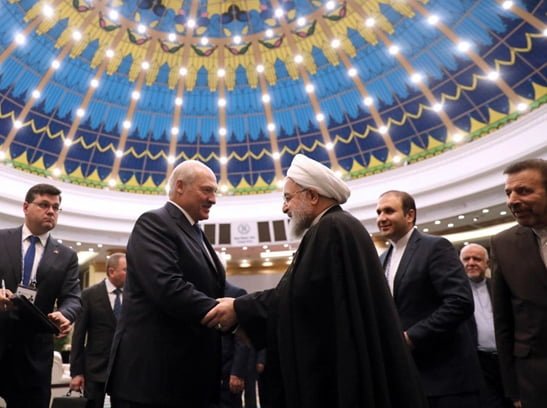
President Rouhani on Saturday described Tehran-Minsk relations as developing and stressed that all potentialities and opportunities must be tapped for deepening bilateral ties in all fields.

He made the remarks in a meeting with his Belarusian counterpart Alexander Lukashenko on the sidelines of the Shanghai Cooperation Organisation (SCO) summit in China.

“Belarus has always been a friend of Iran and Tehran is ready to deepen economic and business relations, especially in scientific and modern technology fields,” he added.

“Cooperation between Iran and Eurasia further boosts relations between the two countries,” he went on to say.

Touching upon the importance of transit routes in the region, he said, “In North-South transit, Iran is the best route for Central Asia and Caucasus and South-eastern Europe to Persian Gulf and southern waters.”

He also referred to the new US government’s withdrawal from the Joint Comprehensive Plan of Action (JCPOA) and said, “The global community’s standing up to the unilateral actions of Washington means supporting international rules and regulations.”

The President of Belarus, for his part, said that his country was determined to develop relations with Tehran, adding, “Iran is a key partner for us in the region and we are determined to further promote our relations with Iran in all political and economic fields.”

Lukashenko described Iran’s stance towards the US’ unilateral withdrawal from the JCPOA as a wise move, and said, “The US’ unilateral actions and violating international obligations is a threat to international laws and the international community must help create a new balance in the world.”

Iran Blasts US’ Efforts to Impose Its Policies on Others

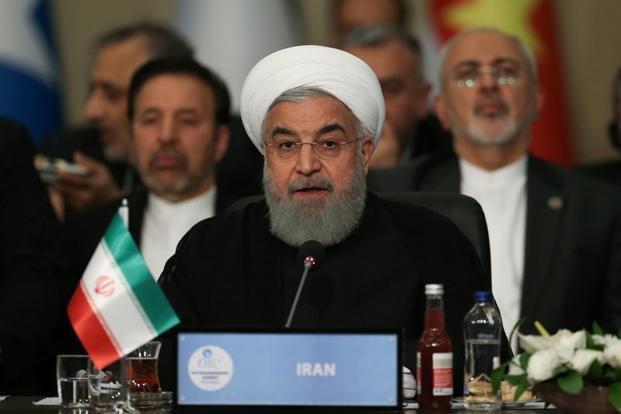
“Without a doubt, economic, political and legal unilateralism undermines regional convergence. In this regard, the United States’ attempts to impose its own policies on others are a growing danger,” President Rouhani said on Sunday.

“A recent example of the United States’ unilateralism and indifference towards the opinions of the international community is its decisions to withdraw from the JCPOA,” he added in an address to a summit of the Shanghai Cooperation Organisation (SCO) in the Chinese port city of Qingdao.

What follows is the full text of his speech:

In the Name of Allah, the Most Beneficent, the Most Merciful

Your Excellency Mr Xi Jinping, honourable President of the People’s Republic of China;

Distinguished Presidents;

Honourable Prime Ministers;

Ladies and gentlemen;

At the outset, I would like to express my gratitude to Mr Xi Jinping, President of the friendly country of the People’s Republic of China, for his warm hospitality and proper planning for holding this summit.

The 18th Shanghai Cooperation Organisation Summit is held at a time when the international community faces many unprecedented challenges: at the international level, the challenge of unilateralism, terrorism, extremism, the reduction of the role of international organisations and treaties; at the regional level, the challenge of transnational actors’ interference and the weakening of interaction and interconnectedness mechanisms based on common interests, and finally, at the national level, the challenge of interference and internal threats, which, from time to time, attack the security, political, economic and cultural infrastructures of the countries.

To counter these challenges at the regional level, we require closes regional cooperation in different fields. The ample commonalities, and not racial, religious, cultural and historical points of divergence; and long-term common interests, not attempt to secure short-term interests at the expense of others, especially neighbours, must be the base for interaction and cooperation at the regional level so that we can have more secure, instable and developed region.

Poverty and underdevelopment are among the causes that lead to insecurity, instability and spread of terrorism and extremism in the region. At the same time, all-out development and cooperation and preventing damage to international trade and having legitimate economic relations based on irrelevant political considerations are definitely necessary to achieve this common goal and lead to balanced and sustainable development.

Here, I see it necessary to stress that unilateral sanctions are not only against international rules and regulations, but also damage legitimate international trade. In this regard, energy security and non-political approach to it is a must for regional and global development and it is essential that the international community stand up to abuse of energy.

Without a doubt, economic, political and legal unilateralism undermines regional convergence. In this regard, the United States’ attempts to impose its own policies on others are a growing danger. A recent example of the United States’ unilateralism and indifference towards the opinions of the international community is its decisions to withdraw from the JCPOA. The Islamic Republic of Iran has so far lived up to all his commitments under the JCPOA and the International Atomic Energy Agency (IAEA) has so far confirmed my country’s commitment to its obligations for 11 times.

All signatories to the JCPOA have a responsibility regarding the commitments of removing sanctions under the JCPOA, and also based on Resolution 2231 of the UN Security Council and Article 25 of the Charter of the United Nations are responsible to help full implementation of the JCOPA and prevent any move that poses an obstacle on implementation of the JCPOA.

The Islamic Republic of Iran has given a limited opportunity to remaining signatories to the JCPOA so that they can give the necessary guarantee in action to help implement all the agreed conditions in the JCPOA and continue being a party to this agreement. Definitely, the US has monitored the reactions to its withdrawal from the JCPOA and considers the lack of response to its unilateral withdrawal as not being costly, which will have very bad consequences for the international community.

Here, I would like to welcome efforts by Russia and China in maintaining the JCPOA.

Ladies and Gentlemen;

Over the past few years, terrorism, separatism and extremism have struck different regions of the world, especially our surroundings including Central Asia and Western Asia. By taking advantage of the intelligence gap which exists among regional countries, terrorist groups they have created networks and recruited new troops. Therefore, an increase in intelligence exchange between the countries of the region can play a role in weakening terrorist groups and their efforts to create regional networks. Hence, we need to draw up new mechanisms and offer new legal methods in order to counter these groups.

Over the past decades, the Islamic Republic of Iran has faced with the scourge of terrorism both in the country and its surrounding regions and has invaluable experience in curtailing and weakening of extremist and terrorist currents, an example of which is cooperating with the government of Iraq and Syria in fighting ISIS terrorist. On the other hand, by relying on its valuable experiences over the past years, the Shanghai Cooperation Organisation has offered good solutions to multifaceted challenges facing the region. The Islamic Republic of Iran is ready to cooperate with SCO in the fight against terrorism, extremism, separatism and drugs.

Excellencies;

Iran’s strategic situation connecting North in the east umbrella stand it has created opportunities and strategic position Iran can be seen as an independent and reliable partner for promotion original international economic cooperation thank you

Iran’s strategic position in linking the East to the West from one side, and the North to the South on the other side, is a very good opportunity to take advantage of port facilities in the Persian Gulf and the Sea of Oman, as well as the transportation rail network in the country to link East Asia to Central Asia and Europe through the North-South and South-West corridor. Iran is aware of its role in establishing peace and security and development in the region and, regarding its considerable potentials such as its young and educated population, rich energy sources, countless mines, and its strategic location, is ready to develop   regional and International economic cooperation as an independent and reliable partner.

Thank you

Iran Blasts US’ Efforts to Impose Its Policies on Others

The 18th Summit of Shanghai Cooperation Organisation began on Sunday, June 10, in China’s Qingdao.

SCO’s member states are China, Kazakhstan, Kyrgyzstan, Russia, Tajikistan, Uzbekistan, India and Pakistan, observer states are Afghanistan, Belarus, Iran and Mongolia, and dialogue partners are Azerbaijan, Armenia, Cambodia, Nepal, Turkey and Sri Lanka.

Afghanistan’s Stability Vital for Regional Development: Iran

In a meeting with his Afghan counterpart Ashraf Ghani on the sidelines of a summit of the Shanghai Cooperation Organization (SCO) in the Chinese port city of Qingdao on Saturday, Rouhani underlined that Iran will not withhold any effort to contribute to restoring permanent peace to and fighting terrorism in Afghanistan.

“Iran has always stood by the nation of Afghanistan over the past four decades and as two neighbouring and brotherly states, the two sides have significant cultural, security and trade commonalities,” he was quoted as saying in a report by the President’s Website.

He then expressed hope for signing a comprehensive agreement for cooperation between Iran and Afghanistan in the near future and said Iran is interested in expanding its ties with neighbouring states particularly Afghanistan and making joint investments in various development projects like transit infrastructures.

“The big project of Chabahar port in Iran which is underway with the participation of Iran, India and Afghanistan is a long stride in rebuilding transit roads of the region,” he said.

The Iranian president then described the two governments’ support for continuous economic development and the private sector as highly necessary and said Khaf-Heart Railway and other similar development projects in the region should be pressed ahead with political and economic coordination.

He then referred to the global outrage over the US withdrawal from the Iran nuclear deal and said the illegitimate move by the US was not a mere pullout of a multi-national agreement but a stark violation of the UN Security Council’s resolution.

Rouhani finally called for further efforts to fight against drug trafficking and said Iran and Afghanistan as well as other regional states should fight hand in hand against the problem which is a serious threat to the whole region.

Iran Welcomes Ceasefire between Taliban, Afghan Government

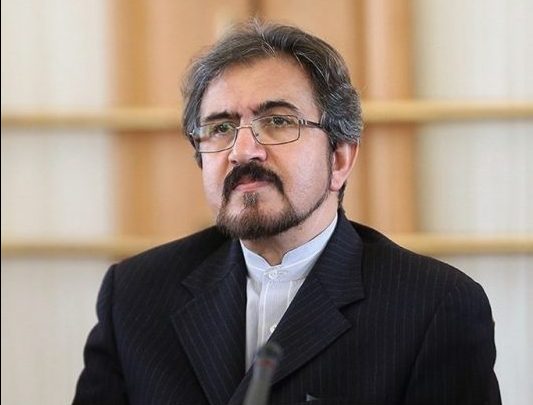
In a Saturday statement, Qassemi said the Islamic Republic of Iran welcomes the Afghan government’s decision to accept a ceasefire with the Taliban militants and views it as a positive step to achieve bigger agreements and restore permanent stability and security to Afghanistan.

The spokesman also expressed Iran’s preparedness to offer all types of contributions to promote peace in the neighbouring Afghanistan under the guidance and leadership of the country’s government.

The Afghan government and the militant group agreed to the truce two days after it was announced by Afghan President Ashraf Ghani.

The ceasefire will begin either next Friday or Saturday, as Eid al-Fitr falls on one of these days. The government had said the ceasefire would last for a week, and would exclude ISIS and other terror outfits.

But the Taliban say they will stop fighting for three days adding that they will defend themselves, if attacked. They’ve also pledged to continue their operations against foreign forces.

The Taliban have been fighting the Afghan government, since their regime was ousted 17 years ago.

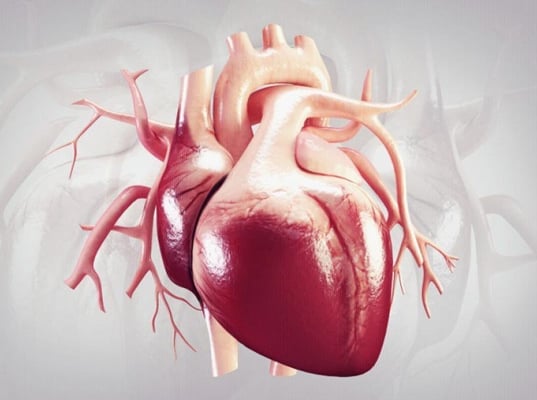
Iranian Experts Make Heart Valves for Treatment of Acute Defects

Dr Bayanolhaq, the initiator of the project, says the heart valves and cardiovascular products have been manufactured by the company inside Iran.

According to a report by ISNA, the heart valves made in this company, such as bone tissue, are made using the donated body organs which undergo special processes.

“The final product should be kept at a low temperature to be transplanted according to the specific size of the target valve,” noted the Iranian scientist.

Stressing that heart valves must be transferred at a temperature of minus 40 degrees, he said the transportation of this product should be carried out using special boxes containing dry ice or liquid nitrogen, which keep the temperature so low that the tissues of the heart valves are not damaged.

For a brief review of Iran’s achievements in various fields of science and technology, check the book “Science and Technology in Iran: A Brief Review

According to him, these types of valves can be used to treat Aortic Stenosis or Atresia”, Hypoplastic Left Heart, and Pulmonary Atresia.

Bayanolhaq also noted that production of skin is another research achievement of the company.

That was also produced from the donated skins, he said, pointing out that the antigens of the donated skins are removed, but the intercellular matrix and the framework are maintained.

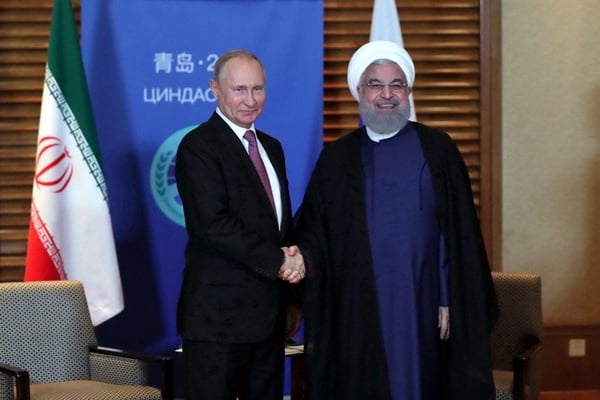
Putin Says Russia Supports Iran’s Full SCO Membership

“Through the years, Iran has strongly contributed to the SCO’s efforts as an observer member and Russia’s position is to support Tehran’s full membership in the organization,” Putin said on a Saturday.

He made the remarks in a meeting with his Iranian counterpart Hassan Rouhani on the eve of the 18th meeting of the heads of state and government of Shanghai Cooperation Organisation scheduled to be held in China’s coastal city of Qingdao on Saturday and Sunday.

Iran has held observer status in the security bloc since 2005, along with Afghanistan, Belarus and Mongolia, and has been declaring its willingness to become a full-fledged member for years.

The security bloc granted membership status to India and Pakistan last year, in its first expansion in sixteen years after its 2001 creation by China, Russia and four ex-Soviet Central Asian republics of Kazakhstan, Uzbekistan, Tajikistan and Kyrgyzstan.

Bright Prospects for Economic Cooperation
Putin said Moscow will keep up deepening cooperation with Tehran in various fields, including energy and defence.

“There are good prospects for mutual cooperation in all sectors, including economic ones,” he said.

On JCPOA, the Russian president censured the US withdrawal from the 2015 nuclear accord as “illegal”, stressing Russia will continue to work with other parties to the multi-party accord to support JCPOA.

Putin also hailed Tehran-Moscow cooperation to promote stability in the region, saying the two countries will continue to work towards settlement of the Syria conflict.

Fruitful Anti-Terror Collaboration
Rouhani, for his part, said Tehran attaches great importance to its cooperation with Russia to improve security in the region.

“Iran-Russia cooperation against ISIS and other terrorist groups has proven effective and fruitful and will bee maintained,” he said.

The Iranian president said there are vast capacities for cooperation between Tehran and Moscow, adding Iran welcomes Russian firms and investors willing to enter its markets.

On JCPOA, Rouhani hailed Russia’s great role in keeping the deal in place, expressing hope its efforts to push other sides of the nuclear deal to fulfill their commitments will bear fruits.